

The DOI matches its Crossref record; 233 of the 233 references it cites were found in a registry or an index.
Role of advanced glycation end products in cellular signaling
Open accessAbstract
Improvements in health care and lifestyle have led to an elevated lifespan and increased focus on age-associated diseases, such as neurodegeneration, cardiovascular disease, frailty and arteriosclerosis. In all these chronic diseases protein, lipid or nucleic acid modifications are involved, including cross-linked and non-degradable aggregates, such as advanced glycation end products (AGEs). Formation of endogenous or uptake of dietary AGEs can lead to further protein modifications and activation of several inflammatory signaling pathways. This review will give an overview of the most prominent AGE-mediated signaling cascades, AGE receptor interactions, prevention of AGE formation and the impact of AGEs during pathophysiological processes.
Overview
The claims and statistics of this paper haven’t been checked yet.
Run the check — free, no account needed. It reads the open-access text and checks the sources it cites.
Integrity signals
Registry
Cites
Statistics
Figures
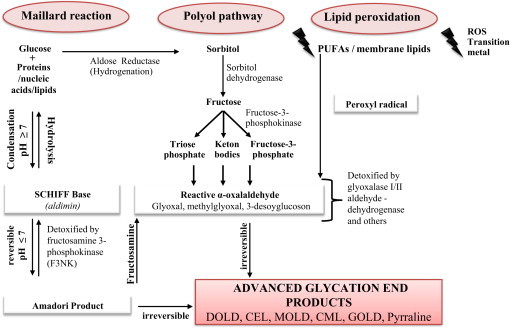
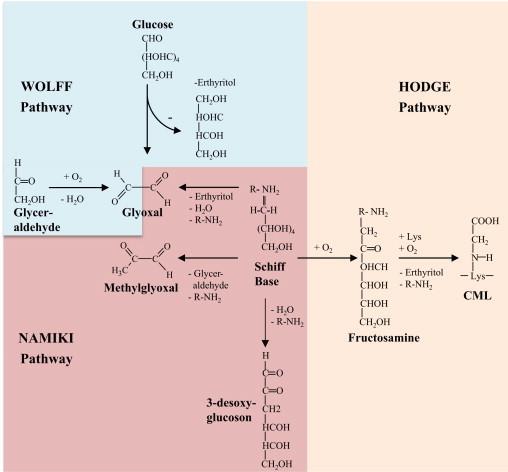
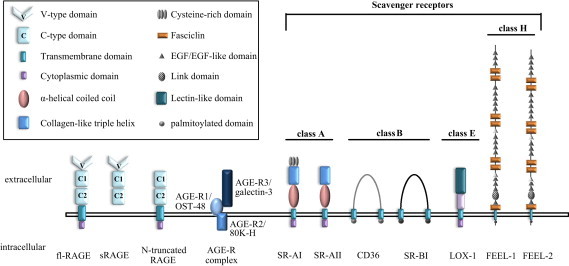
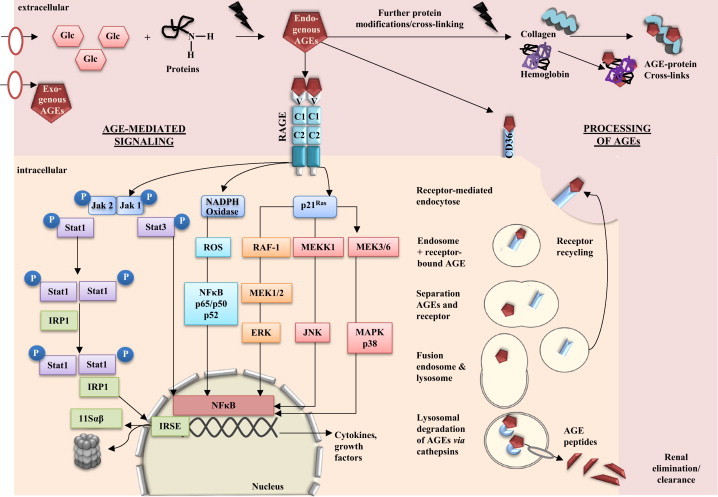
Verification
Claims the paper makes
The claims and statistics of this paper haven’t been checked yet.
Run the check — free, no account needed. It reads the open-access text and checks the sources it cites.
Claims other papers make about this one
Each is checked against this paper’s own text: does it say what the citing paper says it does?
In the citing paper
“These AGE cell surface receptors include AGE-R1, AGE-R2, AGE-R3, and scavenger receptors such as macrophage scavenger receptors, scavenger receptor class B type I and II (SR-BI, SR-BII), and cluster of differentiation 36 (CD36).”
From Advanced glycation end products (AGEs) and other adducts in aging-related diseases and alcohol-mediated tissue injury (2021) · cites this paper as [46]
In the citing paper
“The interaction of AGEs with these receptors can enhance their catabolism and clearance by modulating endocytosis and degradation45,46, suggesting a potentially adaptive defensive mechanism in the body to reduce the detrimental effects of increased glycation products.”
From Advanced glycation end products (AGEs) and other adducts in aging-related diseases and alcohol-mediated tissue injury (2021) · cites this paper as [46]
In the citing paper
“Notably, several conditions, including aging, diabetes, renal failure, tobacco smoking, and excessive alcohol consumption that induce AGE accumulation and AGE-RAGE interaction, are risk factors for increased bone fracture and osteoporosis46,85.”
From Advanced glycation end products (AGEs) and other adducts in aging-related diseases and alcohol-mediated tissue injury (2021) · cites this paper as [46]
In the citing paper
“In addition to lipid peroxide-related protein adducts, recent data suggest that sugar moiety-related protein adduct such as advanced glycation end products (AGEs) can be produced by high fat or excessive alcohol exposure or under pathological states such as diabetes, cardiovascular diseases and Alzheimer's disease, as recently reviewed [190], [191], [192], [193].”
Self-check
Percentages, sums and reported differences re-computed from the paper’s own numbers.
The self-check needs the paper’s full text.
Citations
Cites
Bundesgesundheitsblatt - Gesundheitsforschung - Gesundheitsschutz
(2013) · Bundesgesundheitsblatt - Gesundheitsforschung - Gesundheitsschutz · doi:10.1007/103.1437-1588 · Cited by 11,769
Pathways towards and Away from Alzheimer’s Disease
Mattson, M. P. (2004) · Nature · doi:10.1038/nature02621 · Cited by 3,052
Broken Limits to Life Expectancy
Oeppen, J., & Vaupel, J. W. (2002) · Science · doi:10.1126/science.1069675 · Cited by 2,819
Advanced glycation end-products: A review
Singh, R., Barden, A., Mori, T., & Beilin, L. (2001) · Diabetologia · doi:10.1007/s001250051591 · Cited by 2,597
Goldstein, J. L., Ho, Y. K., Basu, S. K., & Brown, M. S. (1979) · Proceedings of the National Academy of Sciences · doi:10.1073/pnas.76.1.333 · Cited by 2,447
Advanced Glycation End Products: Sparking the Development of Diabetic Vascular Injury
Goldin, A., Beckman, J. A., Schmidt, A. M., & Creager, M. A. (2006) · Circulation · doi:10.1161/circulationaha.106.621854 · Cited by 2,261
Identification of Scavenger Receptor SR-BI as a High Density Lipoprotein Receptor
Acton, S., Rigotti, A., Landschulz, K. T., Xu, S., Hobbs, H. H., & Krieger, M. (1996) · Science · doi:10.1126/science.271.5248.518 · Cited by 2,026
Understanding the odd science of aging
Kirkwood, T. B. L. (2005) · Cell · doi:10.1016/j.cell.2005.01.027 · Cited by 1,984
RAGE Mediates a Novel Proinflammatory Axis
Hofmann, M. A., Drury, S., Fu, C., Qu, W., Taguchi, A., Lu, Y., Avila, C., Kambham, N., Bierhaus, A., Nawroth, P., et al. (1999) · Cell · doi:10.1016/s0092-8674(00)80801-6 · Cited by 1,864
Steinbrecher, U. P., Parthasarathy, S., Leake, D. S., Witztum, J. L., & Steinberg, D. I. (1984) · Proceedings of the National Academy of Sciences · doi:10.1073/pnas.81.12.3883 · Cited by 1,626
Cited by
Sorted by citations
Advanced Glycation End Products and Oxidative Stress in Type 2 Diabetes Mellitus
Nowotny, K., Jung, T., Höhn, A., Weber, D., & Grune, T. (2015) · Biomolecules · doi:10.3390/biom5010194 · Cited by 1,095
Self-citationKang, Q., & Yang, C. (2020) · Redox Biology · doi:10.1016/j.redox.2020.101799 · Cited by 1,134
Advanced Glycation End Products and Diabetes Mellitus: Mechanisms and Perspectives
Khalid, M., Petroianu, G. A., & Adem, A. (2022) · Biomolecules · doi:10.3390/biom12040542 · Cited by 972
Redox regulation of FoxO transcription factors
Klotz, L.-O., Sánchez-Ramos, C., Prieto-Arroyo, I., Urbánek, P., Steinbrenner, H., & Monsalve, M. (2015) · Redox Biology · doi:10.1016/j.redox.2015.06.019 · Cited by 747
Twarda‐Clapa, A., Olczak, A., Białkowska, A. M., & Koziołkiewicz, M. (2022) · Cells · doi:10.3390/cells11081312 · Cited by 829
Metadata
- Authors
- Ott, C., Jacobs, K., Haucke, E., Navarrete Santos, A., Grune, T., & Simm, A.
- Affiliations
- Friedrich Schiller University Jena (DE)
- University Hospital in Halle (DE)
- Martin Luther University Halle-Wittenberg (DE)
- Corresponding author
- Simm, Andreas
- Venue
- Redox Biology
- Publisher
- Elsevier BV
- Published
- 2014
- Volume
- 2
- Pages
- 411-429
- ISSN
- 2213-2317 (ISSN-L)
- PMC
- PMC3949097
- OpenAlex
- W2086327676
- Cited by
- 1,150
- References
- 233
- Citations by year
- 2026: 62 · 2025: 82 · 2024: 105 · 2023: 121 · 2022: 108 · 2021: 131 · 2020: 107 · 2019: 106 · 2018: 86 · 2017: 94 · 2016: 70 · 2015: 52 · 2014: 21
- FWCI
- 10.15
- Type
- journal article
- Language
- en
- Open access
- gold
- doi.org
- Licence
- Locations
- Redox Biology (publishedVersion, cc-by-nc-sa)
- Europe PMC (PubMed Central) (publishedVersion)
- PubMed Central (publishedVersion, cc-by-nc-sa)
- PubMed (publishedVersion)
- DOAJ (DOAJ: Directory of Open Access Journals) (submittedVersion)
- Topics
- Life Sciences › Biochemistry, Genetics and Molecular Biology › Clinical Biochemistry › Advanced Glycation End Products research
- Life Sciences › Agricultural and Biological Sciences › Food Science › Potato Plant Research
- Life Sciences › Biochemistry, Genetics and Molecular Biology › Aging › Genetics, Aging, and Longevity in Model Organisms
- Keywords
- advanced glycation end products, AGE receptor, signal transduction, protein modification, inflammatory signaling, age-related diseases, neurodegeneration, cardiovascular disease, arteriosclerosis, frailty, dietary AGEs
- MeSH terms
- Receptor for Advanced Glycation End Products, Aging, Animals, Bone and Bones, Dietary Proteins, Humans, Hyperglycemia, Immune System, Inflammation, Lung, Models, Biological, Neurons, Polymers, Receptors, Immunologic, Lipid Peroxidation, Signal Transduction, Maillard Reaction, NF-kappa B, Glycation End Products, Advanced, Reactive Oxygen Species, Oxidative Stress, Protein Transport, Reactive Nitrogen Species, Receptors, Scavenger, Protein Aggregates
About these checks
Registry, retraction, Cites and statistics results are computed, not judged, with one exception: a printed reference that no index lists is read once by a model before it counts as a citation error. Claims are extracted by a model and kept only when their quote appears verbatim in the text; each cited source is then checked, with a model’s help, for whether it says what the claim relies on. Those verdicts can be wrong — read the claim’s quote and the cited source before relying on one.
Statistics and arithmetic are recomputed, not judged.
Confidence bands are shown only for fields calibrated on our annotated test set. None is calibrated yet, so no band is shown.
What counts as a claim ›How we measure confidence ›How we check this ›
Are you an author, or do you see a problem with this page? Request a review
