

The DOI matches its Crossref record; 90 of the 91 references it cites were found in a registry or an index; 20 of the 41 sources its claims cite were checked for support.
Global, regional, and national burden of diabetes from 1990 to 2021, with projections of prevalence to 2050: a systematic analysis for the Global Burden of Disease Study 2021
Open accessAbstract
BACKGROUND: Diabetes is one of the leading causes of death and disability worldwide, and affects people regardless of country, age group, or sex. Using the most recent evidentiary and analytical framework from the Global Burden of Diseases, Injuries, and Risk Factors Study (GBD), we produced location-specific, age-specific, and sex-specific estimates of diabetes prevalence and burden from 1990 to 2021, the proportion of type 1 and type 2 diabetes in 2021, the proportion of the type 2 diabetes burden attributable to selected risk factors, and projections of diabetes prevalence through 2050. METHODS: Estimates of diabetes prevalence and burden were computed in 204 countries and territories, across 25 age groups, for males and females separately and combined; these estimates comprised lost years of healthy life, measured in disability-adjusted life-years (DALYs; defined as the sum of years of life lost [YLLs] and years lived with disability [YLDs]). We used the Cause of Death Ensemble model (CODEm) approach to estimate deaths due to diabetes, incorporating 25 666 location-years of data from vital registration and verbal autopsy reports in separate total (including both type 1 and type 2 diabetes) and type-specific models. Other forms of diabetes, including gestational and monogenic diabetes, were not explicitly modelled. Total and type 1 diabetes prevalence was estimated by use of a Bayesian meta-regression modelling tool, DisMod-MR 2.1, to analyse 1527 location-years of data from the scientific literature, survey microdata, and insurance claims; type 2 diabetes estimates were computed by subtracting type 1 diabetes from total estimates. Mortality and prevalence estimates, along with standard life expectancy and disability weights, were used to calculate YLLs, YLDs, and DALYs. When appropriate, we extrapolated estimates to a hypothetical population with a standardised age structure to allow comparison in populations with different age structures. We used the comparative risk assessment framework to estimate the risk-attributable type 2 diabetes burden for 16 risk factors falling under risk categories including environmental and occupational factors, tobacco use, high alcohol use, high body-mass index (BMI), dietary factors, and low physical activity. Using a regression framework, we forecast type 1 and type 2 diabetes prevalence through 2050 with Socio-demographic Index (SDI) and high BMI as predictors, respectively. FINDINGS: In 2021, there were 529 million (95% uncertainty interval [UI] 500-564) people living with diabetes worldwide, and the global age-standardised total diabetes prevalence was 6·1% (5·8-6·5). At the super-region level, the highest age-standardised rates were observed in north Africa and the Middle East (9·3% [8·7-9·9]) and, at the regional level, in Oceania (12·3% [11·5-13·0]). Nationally, Qatar had the world's highest age-specific prevalence of diabetes, at 76·1% (73·1-79·5) in individuals aged 75-79 years. Total diabetes prevalence-especially among older adults-primarily reflects type 2 diabetes, which in 2021 accounted for 96·0% (95·1-96·8) of diabetes cases and 95·4% (94·9-95·9) of diabetes DALYs worldwide. In 2021, 52·2% (25·5-71·8) of global type 2 diabetes DALYs were attributable to high BMI. The contribution of high BMI to type 2 diabetes DALYs rose by 24·3% (18·5-30·4) worldwide between 1990 and 2021. By 2050, more than 1·31 billion (1·22-1·39) people are projected to have diabetes, with expected age-standardised total diabetes prevalence rates greater than 10% in two super-regions: 16·8% (16·1-17·6) in north Africa and the Middle East and 11·3% (10·8-11·9) in Latin America and Caribbean. By 2050, 89 (43·6%) of 204 countries and territories will have an age-standardised rate greater than 10%. INTERPRETATION: Diabetes remains a substantial public health issue. Type 2 diabetes, which makes up the bulk of diabetes cases, is largely preventable and, in some cases, potentially reversible if identified and managed early in the disease course. However, all evidence indicates that diabetes prevalence is increasing worldwide, primarily due to a rise in obesity caused by multiple factors. Preventing and controlling type 2 diabetes remains an ongoing challenge. It is essential to better understand disparities in risk factor profiles and diabetes burden across populations, to inform strategies to successfully control diabetes risk factors within the context of multiple and complex drivers. FUNDING: Bill & Melinda Gates Foundation.
Overview
AI snapshot
Written from the paper’s full text.
TL;DR
In 2021, an estimated 529 million people worldwide were living with diabetes, with a global age-standardised prevalence of 6·1%, and type 2 diabetes accounted for 96·0% of cases and 95·4% of diabetes DALYs. Projections indicate more than 1·31 billion people will have diabetes by 2050, with no countries or territories expected to see prevalence decrease.
Key findings
In 2021, there were 529 million (95% UI 500–564) people with diabetes globally, and the global age-standardised total diabetes prevalence was 6·1% (5·8–6·5); type 2 diabetes made up 96·0% (95·1–96·8) of cases and 95·4% (94·9–95·9) of DALYs.
- The highest age-standardised rates were in north Africa and the Middle East (9·3% [8·7–9·9]) and, regionally, Oceania (12·3% [11·5–13·0]); Qatar had the highest age-specific prevalence at 76·1% (73·1–79·5) in people aged 75–79 years.
- High BMI was the leading risk factor, accounting for 52·2% (25·5–71·8) of global type 2 diabetes DALYs in 2021, and its contribution rose by 24·3% (18·5–30·4) between 1990 and 2021.
- By 2050, more than 1·31 billion (1·22–1·39) people are projected to have diabetes, with global age-standardised total prevalence expected to reach 9·8% (9·4–10·2); 89 (43·6%) of 204 countries and territories are projected to exceed 10%, and no countries are expected to see a decrease.
Methods
The study produced estimates for 204 countries and territories across 25 age groups for males and females separately and combined, covering prevalence, mortality, YLLs, YLDs, and DALYs from 1990 to 2021, plus type-specific proportions, risk-attributable burden, and forecasts to 2050.
- Mortality was modelled with CODEm using 25 666 location-years of vital registration and verbal autopsy data; non-fatal estimates used DisMod-MR 2.1 with 1527 location-years from 172 countries, and type 2 diabetes was computed by subtracting type 1 diabetes from total diabetes.
- Risk-attributable type 2 diabetes burden was estimated for 16 risk factors using comparative risk assessment; forecasting used regression models with Socio-demographic Index for type 1 diabetes and high BMI for type 2 diabetes.
Limitations
Stated by the paper: self-reported diabetes not validated by blood glucose tests was excluded; estimates and forecasts do not reflect COVID-19 impacts in 2020–2021; ICD coding variation and reallocation of unspecified diabetes deaths relied on data from high-income and high-middle-income locations; single glucose tests may overestimate prevalence; blood collection method was missing for about half of data sources; gestational and monogenic diabetes were not modelled; all individuals younger than 15 years were assumed to have type 1 diabetes; and risk factor analyses were limited to modifiable risk–outcome pairs, with no cohort effects except tobacco.
- Evident from the text: type 2 diabetes estimates were derived by subtracting type 1 diabetes from total diabetes because available data labelled as type 2 were not considered accurate, so type 2 estimates depend on the type 1 model; forecasts use only SDI for type 1 and high BMI for type 2 as predictors, not all known risk factors.
Model-written summary. Check it against the paper before relying on it.
Integrity signals
Registry
Cites
Statistics
Figures
Verification
Claims the paper makes
97 Own result · 15 Own method · 10 Partly supported · 8 Own interpretation · 4 Sources not found · 3 Supported so far · 2 Supported · 2 Couldn’t confirm · 2 No full text of the sources · 2 No basis given · 1 Not checked yet · accuracy not yet measured
The sources with a verdict support this claim; the rest weren’t checked yet, have no full text we could read, or their verdicts aren’t rated yet.
In the paper
“Other limitations of our study include, first, that ICD coding practices documenting the underlying cause of death can vary.”
§ Global, regional, and national burden of diabetes from 1990 to 2021, with projections of prevalence to 2050: a systematic analysis for the Global Burden of Disease Study 2021 > Discussion
What the sources say
- Not checked — no full text of the sourcecites [84] Jougla, 1992, Death certificate coding practices related to diabetes in European countries—the ‘EURODIAB Subarea C’ Study, Int J Epidemiol source
- Supportedcites [85] McEwen, 2006, Diabetes reporting as a cause of death: results from the Translating Research Into Action for Diabetes (TRIAD) study, Diabetes Care source
The discussion section (labeled D; page not provided) explicitly identifies “variations in nosological coding” and differences in interpreting causal sequences as problems with cause-of-death information on death certificates. This supports the claim that coding practices for documenting the underlying cause of death can vary. (LLM, conf=0.91)
- Supportedcites [86] Rampatige, 2014, Systematic review of statistics on causes of deaths in hospitals: strengthening the evidence for policy-makers, Bull World Health Organ source
The Introduction says that countries differ in their adoption of the standard death certificate and that physicians often lack training in ICD death-certification practices. The Results also report that reviewed studies used different classification lists. Together, these passages support the general point that practices for documenting and coding the underlying cause of death can vary. (LLM, conf=0.89)
plain- Asserted: passes — The authors put it forward as true.
- Checkable: passes — It can be checked against evidence.
- Load-bearing: unclear — It is unclear whether the paper’s conclusions depend on it.
- Based: passes — The paper gives a reason why it holds.
The cited sources support only part of this claim — read each source’s verdict below.
In the paper
“Differences between estimates produced by GBD and IDF or NCD-RisC are likely to be due to differences in methods, case inclusion criteria, and data sources used.”
§ Global, regional, and national burden of diabetes from 1990 to 2021, with projections of prevalence to 2050: a systematic analysis for the Global Burden of Disease Study 2021 > Discussion
What the sources say
- Not matchedcites [4] 2021
Couldn’t be matched to a paper in Crossref, so it can’t be checked.
- Partly supportedcites [11] Zhou, 2016, Worldwide trends in diabetes since 1980: a pooled analysis of 751 population-based studies with 4·4 million participants, Lancet sourceExperimental — accuracy not yet measured
The Discussion (page not provided) reports that this paper’s diabetes estimates differed from IDF estimates in some countries and regions. The Methods describe its data sources and diabetes definitions, but our copy does not say that differences between GBD and IDF or NCD-RisC estimates are likely caused by differences in methods, case inclusion criteria, and data sources. (LLM, conf=0.78)
hedgedconditional- Asserted: passes — The authors put it forward as true.
- Checkable: passes — It can be checked against evidence.
- Load-bearing: unclear — It is unclear whether the paper’s conclusions depend on it.
- Based: passes — The paper gives a reason why it holds.
- Not matched
The sources with a verdict support this claim; the rest weren’t checked yet, have no full text we could read, or their verdicts aren’t rated yet.
In the paper
“Under the GBD's comparative risk assessment framework, we do not currently capture risk factors that have been reported in the literature for type 1 diabetes.93, 94”
§ Global, regional, and national burden of diabetes from 1990 to 2021, with projections of prevalence to 2050: a systematic analysis for the Global Burden of Disease Study 2021 > Discussion
What the sources say
- Not checked — no full text of the sourcecites [93] Pociot, 2016, Genetic risk factors for type 1 diabetes, Lancet source
- Supportedcites [94] Rewers, 2016, Environmental risk factors for type 1 diabetes, Lancet source
The Introduction (page not provided) says the paper discusses candidate triggers of islet autoimmunity and factors thought to promote progression to type 1 diabetes. That supports the cited point that risk factors have been reported in the literature. The statement about what the GBD framework currently captures is the citing authors’ own assessment, not a finding attributed to this source. (LLM, conf=0.88)
plain- Asserted: passes — The authors put it forward as true.
- Checkable: passes — It can be checked against evidence.
- Load-bearing: unclear — It is unclear whether the paper’s conclusions depend on it.
- Based: passes — The paper gives a reason why it holds.
A result the paper reports from its own data — it cites no other source for it, so there is none to check. The quote shows it is in the paper.
In the paper
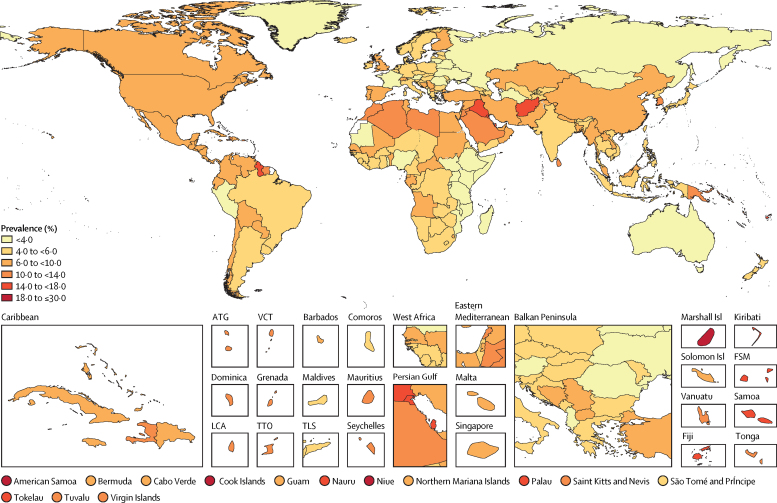
“At the super-region level, the highest age-standardised rates were observed in north Africa and the Middle East (9·3% [8·7–9·9])”
- Also stated in: § Total diabetes prevalence · plain
“north Africa and the Middle East had an age-standardised total diabetes prevalence rate of 9·3% (8·7–9·9)”
§ Global, regional, and national burden of diabetes from 1990 to 2021, with projections of prevalence to 2050: a systematic analysis for the Global Burden of Disease Study 2021 > Abstract > Findings
plain- Asserted: passes — The authors put it forward as true.
- Checkable: passes — It can be checked against evidence.
- Load-bearing: unclear — It is unclear whether the paper’s conclusions depend on it.
- Based: passes — The paper gives a reason why it holds.
- Also stated in: § Total diabetes prevalence · plain
A result the paper reports from its own data — it cites no other source for it, so there is none to check. The quote shows it is in the paper.
In the paper
“type 2 diabetes, which in 2021 accounted for 96·0% (95·1–96·8) of diabetes cases”
§ Global, regional, and national burden of diabetes from 1990 to 2021, with projections of prevalence to 2050: a systematic analysis for the Global Burden of Disease Study 2021 > Abstract > Findings
plain- Asserted: passes — The authors put it forward as true.
- Checkable: passes — It can be checked against evidence.
- Load-bearing: unclear — It is unclear whether the paper’s conclusions depend on it.
- Based: passes — The paper gives a reason why it holds.
- The authors state this as an assumption: All deaths due to diabetes in people younger than 15 years were from type 1 diabetes.
- The authors state this as an assumption: There was no remission (no cure) in the type 1 diabetes model.
- The authors state this as an assumption: All diabetes cases in people aged younger than 15 years were type 1 diabetes.
- The authors state this as an assumption: All patients aged younger than 15 years with diabetes had sought hospital care due to their insulin dependence.
A result the paper reports from its own data — it cites no other source for it, so there is none to check. The quote shows it is in the paper.
In the paper
“Nationally, Qatar had the world's highest age-specific prevalence of diabetes, at 76·1% (73·1–79·5) in individuals aged 75–79 years.”
§ Global, regional, and national burden of diabetes from 1990 to 2021, with projections of prevalence to 2050: a systematic analysis for the Global Burden of Disease Study 2021 > Abstract > Findings
plain- Asserted: passes — The authors put it forward as true.
- Checkable: passes — It can be checked against evidence.
- Load-bearing: unclear — It is unclear whether the paper’s conclusions depend on it.
- Based: passes — The paper gives a reason why it holds.
A result the paper reports from its own data — it cites no other source for it, so there is none to check. The quote shows it is in the paper.
In the paper
“In 2021, there were 529 million (95% uncertainty interval [UI] 500–564) people living with diabetes worldwide”
- Also stated in: § Total diabetes prevalence · plain
“In 2021, there were 529 million (95% UI 500–564) people of all ages, worldwide, living with diabetes”
§ Global, regional, and national burden of diabetes from 1990 to 2021, with projections of prevalence to 2050: a systematic analysis for the Global Burden of Disease Study 2021 > Abstract > Findings
plain- Asserted: passes — The authors put it forward as true.
- Checkable: passes — It can be checked against evidence.
- Load-bearing: passes — The paper’s conclusions depend on it.
- Based: passes — The paper gives a reason why it holds.
- Also stated in: § Total diabetes prevalence · plain
A result the paper reports from its own data — it cites no other source for it, so there is none to check. The quote shows it is in the paper.
In the paper
“and 95·4% (94·9–95·9) of diabetes DALYs worldwide.”
§ Global, regional, and national burden of diabetes from 1990 to 2021, with projections of prevalence to 2050: a systematic analysis for the Global Burden of Disease Study 2021 > Abstract > Findings
plain- Asserted: passes — The authors put it forward as true.
- Checkable: passes — It can be checked against evidence.
- Load-bearing: unclear — It is unclear whether the paper’s conclusions depend on it.
- Based: passes — The paper gives a reason why it holds.
- The authors state this as an assumption: All deaths due to diabetes in people younger than 15 years were from type 1 diabetes.
- The authors state this as an assumption: There was no remission (no cure) in the type 1 diabetes model.
- The authors state this as an assumption: All diabetes cases in people aged younger than 15 years were type 1 diabetes.
- The authors state this as an assumption: All patients aged younger than 15 years with diabetes had sought hospital care due to their insulin dependence.
A result the paper reports from its own data — it cites no other source for it, so there is none to check. The quote shows it is in the paper.
In the paper
“the global age-standardised total diabetes prevalence was 6·1% (5·8–6·5)”
- Also stated in: § Total diabetes prevalence · plain
“yielding a global age-standardised prevalence of 6·1% (5·8–6·5; figure 1)”
§ Global, regional, and national burden of diabetes from 1990 to 2021, with projections of prevalence to 2050: a systematic analysis for the Global Burden of Disease Study 2021 > Abstract > Findings
plain- Asserted: passes — The authors put it forward as true.
- Checkable: passes — It can be checked against evidence.
- Load-bearing: unclear — It is unclear whether the paper’s conclusions depend on it.
- Based: passes — The paper gives a reason why it holds.
- Also stated in: § Total diabetes prevalence · plain
A result the paper reports from its own data — it cites no other source for it, so there is none to check. The quote shows it is in the paper.
In the paper
“The contribution of high BMI to type 2 diabetes DALYs rose by 24·3% (18·5–30·4) worldwide between 1990 and 2021.”
§ Global, regional, and national burden of diabetes from 1990 to 2021, with projections of prevalence to 2050: a systematic analysis for the Global Burden of Disease Study 2021 > Abstract > Findings
plaindirect- Asserted: passes — The authors put it forward as true.
- Checkable: passes — It can be checked against evidence.
- Load-bearing: unclear — It is unclear whether the paper’s conclusions depend on it.
- Based: passes — The paper gives a reason why it holds.
- It may state two separate claims as one. 31
- Probably not a substantial claim. 44
- The quote only partly states this claim. 1
The cited sources that could be checked couldn’t confirm or dispute this claim.
In the paper
“All risk factors have been shown to be associated with type 2 diabetes, but high air temperature and low air temperature are the only risk factors associated with type 1 diabetes.28”
§ Global, regional, and national burden of diabetes from 1990 to 2021, with projections of prevalence to 2050: a systematic analysis for the Global Burden of Disease Study 2021 > Methods > Risk-attributable burden
What the sources say
- Could not verifycites [28] 2020, Global burden of 87 risk factors in 204 countries and territories, 1990–2019: a systematic analysis for the Global Burden of Disease Study 2019, Lancet sourceExperimental — accuracy not yet measured
The Methods section (‘Determining the inclusion of risk–outcome pairs in GBD’; page unavailable) says high and low temperatures were evaluated against disease outcomes, but does not identify type 1 diabetes among them. Searches for type 1 diabetes, type 2 diabetes, and diabetes–temperature risk–outcome pairs found no passage establishing the claimed distinction or that all the relevant risk factors are associated with type 2 diabetes. (LLM, conf=0.72)
plaincorrelational- Asserted: passes — The authors put it forward as true.
- Checkable: passes — It can be checked against evidence.
- Load-bearing: unclear — It is unclear whether the paper’s conclusions depend on it.
- Based: passes — The paper gives a reason why it holds.
It may state two separate claims as one.
- Could not verify
The cited sources support only part of this claim — read each source’s verdict below.
In the paper
“estimates by the International Diabetes Federation (IDF) indicating that 537 million people worldwide had diabetes in 2021”
§ Global, regional, and national burden of diabetes from 1990 to 2021, with projections of prevalence to 2050: a systematic analysis for the Global Burden of Disease Study 2021 > Introduction
What the sources say
- Not matchedcites [4] 2021
Couldn’t be matched to a paper in Crossref, so it can’t be checked.
- Supportedcites [10] Sun, 2022, IDF Diabetes Atlas: Global, regional and country-level diabetes prevalence estimates for 2021 and projections for 2045, Diabetes Res Clin Pract source
The Discussion states that the 10th edition IDF Diabetes Atlas estimates 537 million people living with diabetes worldwide in 2021. The Results specify that this estimate covers adults aged 20–79. (LLM, conf=0.95)
hedgedn = 537- Asserted: passes — The authors put it forward as true.
- Checkable: passes — It can be checked against evidence.
- Load-bearing: fails — The paper’s conclusions may not depend on it.
- Based: passes — The paper gives a reason why it holds.
Probably not a substantial claim. The paper’s conclusions may not depend on it.
- Not matched
The cited sources support only part of this claim — read each source’s verdict below.
In the paper
“resulting in health expenditures of US$966 billion globally, forecast to reach more than $1054 billion by 2045.4, 10”
§ Global, regional, and national burden of diabetes from 1990 to 2021, with projections of prevalence to 2050: a systematic analysis for the Global Burden of Disease Study 2021 > Introduction
What the sources say
- Not matchedcites [4] 2021
Couldn’t be matched to a paper in Crossref, so it can’t be checked.
- Partly supportedcites [10] Sun, 2022, IDF Diabetes Atlas: Global, regional and country-level diabetes prevalence estimates for 2021 and projections for 2045, Diabetes Res Clin Pract sourceExperimental — accuracy not yet measured
The Results (Health expenditure) report global diabetes-related healthcare expenditure of USD 966 billion in 2021 and predict USD 1,054 billion for 2045. The source does not say the 2045 figure will be more than USD 1,054 billion; it gives that figure as the estimate. (LLM, conf=0.87)
plaindirectn = 537- Asserted: passes — The authors put it forward as true.
- Checkable: passes — It can be checked against evidence.
- Load-bearing: fails — The paper’s conclusions may not depend on it.
- Based: passes — The paper gives a reason why it holds.
Probably not a substantial claim. The paper’s conclusions may not depend on it. It may state two separate claims as one.
- Not matched
The cited sources support only part of this claim — read each source’s verdict below.
In the paper
“According to estimates from the Global Burden of Diseases, Injuries, and Risk Factors Study (GBD) 2019, diabetes was the eighth leading cause of death and disability combined in the world”
§ Global, regional, and national burden of diabetes from 1990 to 2021, with projections of prevalence to 2050: a systematic analysis for the Global Burden of Disease Study 2021 > Introduction
What the sources say
- Partly supportedcites [6] 2020, Global burden of 369 diseases and injuries in 204 countries and territories, 1990–2019: a systematic analysis for the Global Burden of Disease Study 2019, Lancet sourceExperimental — accuracy not yet measured
The Results (Global trends; page unavailable) place diabetes among the ten leading causes of disability-adjusted life-years (DALYs) in both older age groups in 2019, and the Discussion describes it as a major contributor to disease burden. The passages in our copy do not establish that diabetes ranked eighth worldwide across all ages; searches for “eighth” and the global diabetes ranking did not find that rank. (LLM, conf=0.79)
hedged- Asserted: passes — The authors put it forward as true.
- Checkable: passes — It can be checked against evidence.
- Load-bearing: fails — The paper’s conclusions may not depend on it.
- Based: passes — The paper gives a reason why it holds.
Probably not a substantial claim. The paper’s conclusions may not depend on it.
- Partly supported
The cited sources support only part of this claim — read each source’s verdict below.
In the paper
“the comparative risk assessment approach, a framework used by GBD since 2002 that is predicated on a causal web of hierarchically organised, potentially overlapping health risks.29, 37”
§ Global, regional, and national burden of diabetes from 1990 to 2021, with projections of prevalence to 2050: a systematic analysis for the Global Burden of Disease Study 2021 > Methods > Risk-attributable burden
What the sources say
- Not checked — no full text of the sourcecites [29] Murray, 1997, Global mortality, disability, and the contribution of risk factors: Global Burden of Disease Study, Lancet source
- Partly supportedcites [37] Murray, 2003, Comparative quantification of health risks conceptual framework and methodological issues, Popul Health Metr sourceExperimental — accuracy not yet measured
The Introduction (page unavailable) identifies comparative risk assessment as a GBD framework and says it considers multiple stages in a causal network, including interactions and joint effects of risk factors. The Risk Quantification Models section (page unavailable) describes layers of a causal web, supporting the claim about hierarchically organised, potentially overlapping risks. The paper identifies the framework with the GBD 2000 study but does not establish that GBD has used it since 2002. (LLM, conf=0.85)
plaindirect- Asserted: passes — The authors put it forward as true.
- Checkable: passes — It can be checked against evidence.
- Load-bearing: fails — The paper’s conclusions may not depend on it.
- Based: passes — The paper gives a reason why it holds.
Probably not a substantial claim. The paper’s conclusions may not depend on it.
The cited sources support only part of this claim — read each source’s verdict below.
In the paper
“with nearly 460 million people across every country and age group living with the disease in 2019.6”
§ Global, regional, and national burden of diabetes from 1990 to 2021, with projections of prevalence to 2050: a systematic analysis for the Global Burden of Disease Study 2021 > Introduction
What the sources say
- Partly supportedcites [6] 2020, Global burden of 369 diseases and injuries in 204 countries and territories, 1990–2019: a systematic analysis for the Global Burden of Disease Study 2019, Lancet sourceExperimental — accuracy not yet measured
The Discussion (Main findings; page unavailable) describes rising diabetes prevalence globally, and the Results (Global trends; page unavailable) identify diabetes as a major contributor to disease burden in 2019. Neither passage gives a count of nearly 460 million people living with diabetes or establishes the claim for every country and age group. (LLM, conf=0.78)
hedgedn = 460- Asserted: passes — The authors put it forward as true.
- Checkable: passes — It can be checked against evidence.
- Load-bearing: fails — The paper’s conclusions may not depend on it.
- Based: passes — The paper gives a reason why it holds.
Probably not a substantial claim. The paper’s conclusions may not depend on it.
- Partly supported
The cited sources support only part of this claim — read each source’s verdict below.
In the paper
“The 2016 NCD Risk Factor Collaboration (NCD-RisC) Study projected that the probability of meeting global targets to halt the rising diabetes prevalence by 2025 was lower than 1% for women and even lower for men.11”
§ Global, regional, and national burden of diabetes from 1990 to 2021, with projections of prevalence to 2050: a systematic analysis for the Global Burden of Disease Study 2021 > Introduction
What the sources say
- Partly supportedcites [11] Zhou, 2016, Worldwide trends in diabetes since 1980: a pooled analysis of 751 population-based studies with 4·4 million participants, Lancet sourceExperimental — accuracy not yet measured
The Results state that, if post-2000 trends continue, the worldwide probability of meeting the 2025 diabetes target is lower than 1% for men but is 1% for women. The claim gets the ordering right, but incorrectly says the probability for women is lower than 1%. (LLM, conf=0.94)
plain- Asserted: passes — The authors put it forward as true.
- Checkable: passes — It can be checked against evidence.
- Load-bearing: fails — The paper’s conclusions may not depend on it.
- Based: passes — The paper gives a reason why it holds.
Probably not a substantial claim. The paper’s conclusions may not depend on it.
- Partly supported
The cited sources support only part of this claim — read each source’s verdict below.
In the paper
“Type 1 diabetes often develops during childhood, while type 2 diabetes has a strong genetic component and a robust association with obesity and a sedentary lifestyle.10, 13”
§ Global, regional, and national burden of diabetes from 1990 to 2021, with projections of prevalence to 2050: a systematic analysis for the Global Burden of Disease Study 2021 > Introduction
What the sources say
- Partly supportedcites [10] Sun, 2022, IDF Diabetes Atlas: Global, regional and country-level diabetes prevalence estimates for 2021 and projections for 2045, Diabetes Res Clin Pract sourceExperimental — accuracy not yet measured
The Discussion > Limitations passage says type 1 diabetes incidence peaks in childhood and links type 2 diabetes to excess body weight and sedentary behaviour. It does not describe a strong genetic component of type 2 diabetes; its discussion of genetic factors concerns type 1 diabetes. (LLM, conf=0.88)
- Not checked — no full text of the sourcecites [13] Ahmad, 2022, Type 2 diabetes, Lancet source
boostedcorrelational- Asserted: passes — The authors put it forward as true.
- Checkable: passes — It can be checked against evidence.
- Load-bearing: fails — The paper’s conclusions may not depend on it.
- Based: passes — The paper gives a reason why it holds.
Probably not a substantial claim. The paper’s conclusions may not depend on it. It may state two separate claims as one.
- Partly supported
Every source the paper cites for this claim was checked and supports it.
In the paper
“Diabetes is also a major risk factor for ischaemic heart disease and stroke,12”
§ Global, regional, and national burden of diabetes from 1990 to 2021, with projections of prevalence to 2050: a systematic analysis for the Global Burden of Disease Study 2021 > Introduction
What the sources say
- Supportedcites [12] 2010, Diabetes mellitus, fasting blood glucose concentration, and risk of vascular disease: a collaborative meta-analysis of 102 prospective studies, Lancet source
The Results report that people with diabetes had about twice the risk of coronary heart disease and ischaemic stroke as people without diabetes. The Discussion likewise describes a roughly two-fold excess risk for coronary heart disease and major stroke subtypes, supporting the claim that diabetes is a major risk factor for ischaemic heart disease and stroke. (LLM, conf=0.94)
plaindirect- Asserted: passes — The authors put it forward as true.
- Checkable: passes — It can be checked against evidence.
- Load-bearing: fails — The paper’s conclusions may not depend on it.
- Based: passes — The paper gives a reason why it holds.
Probably not a substantial claim. The paper’s conclusions may not depend on it.
- Supported
The cited sources that could be checked couldn’t confirm or dispute this claim.
In the paper
“Furthermore, efforts that succeed in halting the rise in diabetes could mitigate or delay associated health complications if implemented early.76, 77, 78, 79, 80”
§ Global, regional, and national burden of diabetes from 1990 to 2021, with projections of prevalence to 2050: a systematic analysis for the Global Burden of Disease Study 2021 > Discussion
What the sources say
- Not checked — no full text of the sourcecites [76] Aggarwal, 2020, Diabetes mellitus association with coronavirus disease 2019 (COVID-19) severity and mortality: a pooled analysis, J Diabetes source
- Could not verifycites [77] Feldman, 2020, COVID-19 and diabetes: a collision and collusion of two diseases, Diabetes sourceExperimental — accuracy not yet measured
The Glycemic Control section reports better COVID-19 outcomes among people with diabetes whose blood glucose was well controlled. The Conclusions discuss improving care, but neither section addresses whether early efforts to halt the rise in diabetes could mitigate or delay its associated health complications; searches for diabetes prevention and early intervention found no such passage. (LLM, conf=0.75)
- Not checked — no full text of the sourcecites [78] Kissela, 2005, Epidemiology of ischemic stroke in patients with diabetes: the greater Cincinnati/Northern Kentucky Stroke Study, Diabetes Care source
hedgedconditional- Asserted: passes — The authors put it forward as true.
- Checkable: fails — It may be too vague to check against evidence.
- Load-bearing: fails — The paper’s conclusions may not depend on it.
- Based: passes — The paper gives a reason why it holds.
Probably not a substantial claim. It may be too vague to check against evidence. The paper’s conclusions may not depend on it.
Every source the paper cites for this claim was checked and supports it.
In the paper
“The regional variation in sex differences in age-standardised diabetes prevalence rates revealed by our estimates is probably also related to variation in patterns in and the impact of obesity on type 2 diabetes, socioeconomic factors, and biological and hormonal differences.48”
§ Global, regional, and national burden of diabetes from 1990 to 2021, with projections of prevalence to 2050: a systematic analysis for the Global Burden of Disease Study 2021 > Discussion
What the sources say
- Supportedcites [48] Kautzky-Willer, 2016, Sex and gender differences in risk, pathophysiology and complications of type 2 diabetes mellitus, Endocr Rev source
The Introduction links regional sex differences in type 2 diabetes prevalence to obesity patterns, socioeconomic conditions, and biological and psychosocial factors. The Abstract also identifies sex hormones as affecting diabetes-related metabolism and risk. The citing authors’ own estimates are not attributed to this source. (LLM, conf=0.91)
hedgedconditional- Asserted: passes — The authors put it forward as true.
- Checkable: passes — It can be checked against evidence.
- Load-bearing: fails — The paper’s conclusions may not depend on it.
- Based: passes — The paper gives a reason why it holds.
Probably not a substantial claim. The paper’s conclusions may not depend on it.
- Supported
The cited sources support only part of this claim — read each source’s verdict below.
In the paper
“Various interventions and policies to address obesity have been developed and studied,53, 54, 55, 56 but no programme to date has shown long-term, sustained, population-level reductions in obesity.57”
§ Global, regional, and national burden of diabetes from 1990 to 2021, with projections of prevalence to 2050: a systematic analysis for the Global Burden of Disease Study 2021 > Discussion
What the sources say
- Partly supportedcites [53] Maniadakis, 2013, A systematic review of the effectiveness of taxes on nonalcoholic beverages and high-in-fat foods as a means to prevent obesity trends, Clinicoecon Outcomes Res sourceExperimental — accuracy not yet measured
The Discussion (page unavailable) says the evidence for pricing and tax policies reducing obesity rates is inconsistent. That supports a narrower concern about those policies, but the review does not establish that no obesity programme of any kind has achieved long-term, sustained, population-level reductions. (LLM, conf=0.84)
- Could not verifycites [54] Puzziferri, 2014, Long-term follow-up after bariatric surgery: a systematic review, JAMA sourceExperimental — accuracy not yet measured
Citation 57 is attached to the claim that no programme has achieved sustained, population-level reductions in obesity. The Discussion and Abstract Conclusions address long-term follow-up and possible overestimation of outcomes after bariatric surgery, not population-level obesity trends or the effectiveness of programmes generally. Searches for sustained population-level reductions and obesity programmes found no passage addressing that claim; page numbers were unavailable in our copy. (LLM, conf=0.77)
- Not checked — no full text of the sourcecites [55] Sun, 2017, The effectiveness and cost of lifestyle interventions including nutrition education for diabetes prevention: a systematic review and meta-analysis, J Acad Nutr Diet source
plain- Asserted: passes — The authors put it forward as true.
- Checkable: passes — It can be checked against evidence.
- Load-bearing: unclear — It is unclear whether the paper’s conclusions depend on it.
- Based: passes — The paper gives a reason why it holds.
It may state two separate claims as one.
- Partly supported
The sources with a verdict support this claim; the rest weren’t checked yet, have no full text we could read, or their verdicts aren’t rated yet.
In the paper
“Although obesity is theoretically reversible28, 51, 52 and addressing it could provide the biggest opportunity to limit the advance of diabetes, current trends suggest that obesity rates are likely to continue to climb.45”
§ Global, regional, and national burden of diabetes from 1990 to 2021, with projections of prevalence to 2050: a systematic analysis for the Global Burden of Disease Study 2021 > Discussion
What the sources say
- Supportedcites [28] 2020, Global burden of 87 risk factors in 204 countries and territories, 1990–2019: a systematic analysis for the Global Burden of Disease Study 2019, Lancet source
Citation 45 is attached to the final clause about future obesity trends, not the preceding claims about reversibility or diabetes. The Discussion (Important risk factor trends; page not provided) reports that high BMI has risen and that no country or territory had a significant decline in the proportion of people with high BMI from 1990 to 2019 or in the past decade. Those trends support the citing sentence’s hedged prediction. (LLM, conf=0.89)
- Not checked — no full text of the sourcecites [51] Afshin, 2017, Health effects of overweight and obesity in 195 countries, N Engl J Med source
- Supportedcites [52] Teufel, 2021, Body-mass index and diabetes risk in 57 low-income and middle-income countries: a cross-sectional study of nationally representative, individual-level data in 685 616 adults, Lancet source
Citation 45 is attached to the claim that obesity rates are likely to keep climbing, not to the preceding claims about reversibility or prevention. The Introduction reports rising global prevalence and accelerating obesity in low- and middle-income countries; the Discussion refers to reversing “current and projected trends.” (LLM, conf=0.87)
hedgedconditional- Asserted: passes — The authors put it forward as true.
- Checkable: passes — It can be checked against evidence.
- Load-bearing: unclear — It is unclear whether the paper’s conclusions depend on it.
- Based: passes — The paper gives a reason why it holds.
It may state two separate claims as one.
- Supported
The cited sources support only part of this claim — read each source’s verdict below.
In the paper
“Although there is growing evidence of type 2 diabetes occurring in younger individuals in many parts of the world,91, 92 we do not have population-based studies that distinguish type 1 diabetes from type 2 diabetes among people younger than 15 years across time, age, and location.”
§ Global, regional, and national burden of diabetes from 1990 to 2021, with projections of prevalence to 2050: a systematic analysis for the Global Burden of Disease Study 2021 > Discussion
What the sources say
- Not matchedcites [91] Kao, 2016, Type 2 diabetes mellitus in children and adolescents, Aust Fam Physician
Couldn’t be matched to a paper in Crossref, so it can’t be checked.
- Supportedcites [92] Nadeau, 2016, Youth-onset type 2 diabetes consensus report: current status, challenges, and priorities, Diabetes Care source
Split into 2 atoms — 2 confirmed, 0 partially supported, 0 disputed, 0 misattributed, 0 unverifiable. Expand the claim to see per-atom verdicts.
plain- Asserted: passes — The authors put it forward as true.
- Checkable: passes — It can be checked against evidence.
- Load-bearing: passes — The paper’s conclusions depend on it.
- Based: passes — The paper gives a reason why it holds.
It may state two separate claims as one.
- Not matched
A result the paper reports from its own data — it cites no other source for it, so there is none to check. The quote shows it is in the paper.
In the paper
“and 321 million (304–341) people aged 18 years and older with diabetes in 2010”
§ Global, regional, and national burden of diabetes from 1990 to 2021, with projections of prevalence to 2050: a systematic analysis for the Global Burden of Disease Study 2021 > Results > Total diabetes prevalence
plain- Asserted: passes — The authors put it forward as true.
- Checkable: passes — It can be checked against evidence.
- Load-bearing: fails — The paper’s conclusions may not depend on it.
- Based: passes — The paper gives a reason why it holds.
Probably not a substantial claim. The paper’s conclusions may not depend on it.
A result the paper reports from its own data — it cites no other source for it, so there is none to check. The quote shows it is in the paper.
In the paper
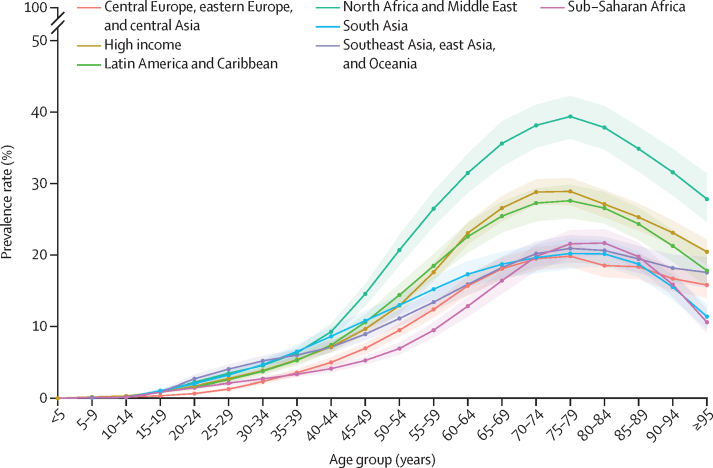
“and lowest in central Europe, eastern Europe, and central Asia, at 19·8% (18·3–21·6; figure 2).”
§ Global, regional, and national burden of diabetes from 1990 to 2021, with projections of prevalence to 2050: a systematic analysis for the Global Burden of Disease Study 2021 > Results > Age-specific total diabetes prevalence
plain- Asserted: passes — The authors put it forward as true.
- Checkable: passes — It can be checked against evidence.
- Load-bearing: fails — The paper’s conclusions may not depend on it.
- Based: passes — The paper gives a reason why it holds.
Probably not a substantial claim. The paper’s conclusions may not depend on it.
A result the paper reports from its own data — it cites no other source for it, so there is none to check. The quote shows it is in the paper.
In the paper
“The global age-standardised total diabetes prevalence was higher in males than in females (6·5% [95% UI 6·2–7·0] vs 5·8% [5·4–6·1])”
§ Global, regional, and national burden of diabetes from 1990 to 2021, with projections of prevalence to 2050: a systematic analysis for the Global Burden of Disease Study 2021 > Results > Sex-specific total diabetes prevalence
plain- Asserted: passes — The authors put it forward as true.
- Checkable: passes — It can be checked against evidence.
- Load-bearing: unclear — It is unclear whether the paper’s conclusions depend on it.
- Based: passes — The paper gives a reason why it holds.
It may state two separate claims as one.
The paper states this without a source or data behind it here, so there is nothing to check it against. The quote shows it is in the paper.
In the paper
“There was no difference in type-specific breakdown by sex.”
§ Global, regional, and national burden of diabetes from 1990 to 2021, with projections of prevalence to 2050: a systematic analysis for the Global Burden of Disease Study 2021 > Results > Type-specific diabetes prevalence
plain- Asserted: passes — The authors put it forward as true.
- Checkable: passes — It can be checked against evidence.
- Load-bearing: fails — The paper’s conclusions may not depend on it.
- Based: passes — The paper gives a reason why it holds.
Probably not a substantial claim. The paper’s conclusions may not depend on it.
A result the paper reports from its own data — it cites no other source for it, so there is none to check. The quote shows it is in the paper.
In the paper
“with expected age-standardised total diabetes prevalence rates greater than 10% in two super-regions: 16·8% (16·1–17·6) in north Africa and the Middle East and 11·3% (10·8–11·9) in Latin America and Caribbean.”
§ Global, regional, and national burden of diabetes from 1990 to 2021, with projections of prevalence to 2050: a systematic analysis for the Global Burden of Disease Study 2021 > Abstract > Findings
plain- Asserted: passes — The authors put it forward as true.
- Checkable: passes — It can be checked against evidence.
- Load-bearing: passes — The paper’s conclusions depend on it.
- Based: passes — The paper gives a reason why it holds.
It may state two separate claims as one.
- The authors state this as an assumption: Annual remission in the total diabetes model could be no more than 1%.
A result the paper reports from its own data — it cites no other source for it, so there is none to check. The quote shows it is in the paper.
In the paper
“In this age group, prevalence was highest in the north Africa and Middle East super-region, at 39·4% (36·3–42·3)”
§ Global, regional, and national burden of diabetes from 1990 to 2021, with projections of prevalence to 2050: a systematic analysis for the Global Burden of Disease Study 2021 > Results > Age-specific total diabetes prevalence
plain- Asserted: passes — The authors put it forward as true.
- Checkable: passes — It can be checked against evidence.
- Load-bearing: fails — The paper’s conclusions may not depend on it.
- Based: passes — The paper gives a reason why it holds.
Probably not a substantial claim. The paper’s conclusions may not depend on it.
A result the paper reports from its own data — it cites no other source for it, so there is none to check. The quote shows it is in the paper.
In the paper
“age-standardised prevalence rates were greater than 20% in the Marshall Islands, at 22·2% (20·7–23·9), and American Samoa, at 21·4% (19·9–22·7).”
§ Global, regional, and national burden of diabetes from 1990 to 2021, with projections of prevalence to 2050: a systematic analysis for the Global Burden of Disease Study 2021 > Results > Total diabetes prevalence
plain- Asserted: passes — The authors put it forward as true.
- Checkable: passes — It can be checked against evidence.
- Load-bearing: unclear — It is unclear whether the paper’s conclusions depend on it.
- Based: passes — The paper gives a reason why it holds.
It may state two separate claims as one.
A result the paper reports from its own data — it cites no other source for it, so there is none to check. The quote shows it is in the paper.
In the paper
“Because diabetes prevalence rates are driven almost entirely by type 2 diabetes, which accounted for more than 96% of diabetes cases worldwide in 2021, much of the following discussion will focus on type 2 diabetes.”
§ Global, regional, and national burden of diabetes from 1990 to 2021, with projections of prevalence to 2050: a systematic analysis for the Global Burden of Disease Study 2021 > Discussion
plaindirectn = 529- Asserted: passes — The authors put it forward as true.
- Checkable: passes — It can be checked against evidence.
- Load-bearing: passes — The paper’s conclusions depend on it.
- Based: passes — The paper gives a reason why it holds.
It may state two separate claims as one.
A result the paper reports from its own data — it cites no other source for it, so there is none to check. The quote shows it is in the paper.
In the paper
“The age-standardised diabetes prevalence increased by more than 100% in 97 (47·5%) of 204 countries and territories and by more than 200% in three countries and one territory: Egypt (284·3%; 262·7–305·9), Greenland (263·6%; 236·8–296·3), Timor-Leste (225·3%; 206·7–243·7), and Seychelles (211·5%; 193·5–230·7).”
§ Global, regional, and national burden of diabetes from 1990 to 2021, with projections of prevalence to 2050: a systematic analysis for the Global Burden of Disease Study 2021 > Results > Diabetes prevalence over time: 1990 to 2021, and forecasts to 2050
plaindirect- Asserted: passes — The authors put it forward as true.
- Checkable: passes — It can be checked against evidence.
- Load-bearing: unclear — It is unclear whether the paper’s conclusions depend on it.
- Based: passes — The paper gives a reason why it holds.
It may state two separate claims as one.
A result the paper reports from its own data — it cites no other source for it, so there is none to check. The quote shows it is in the paper.
In the paper
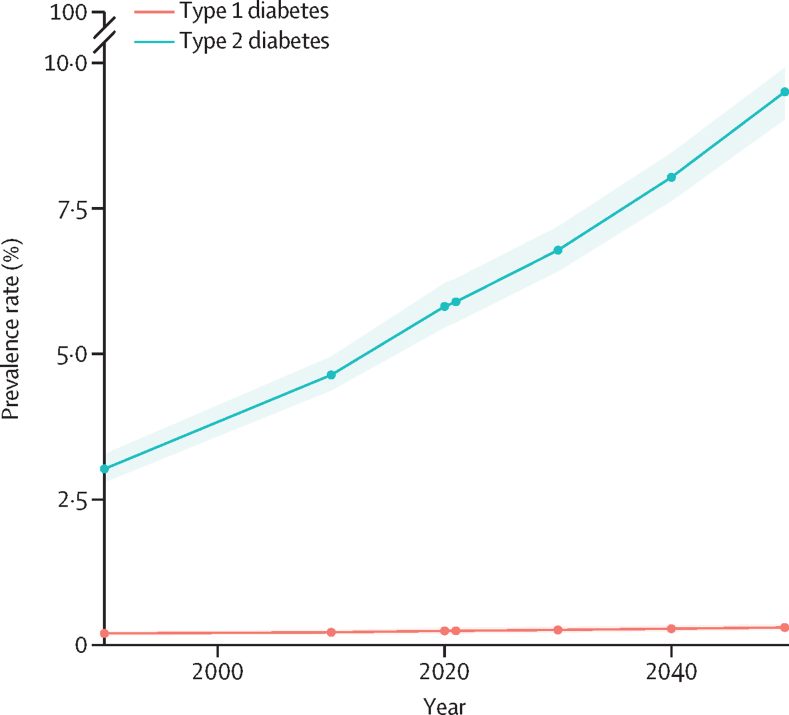
“The age-standardised global prevalence of type 2 diabetes is projected to rise by 61·2% (95% UI 56·2–68·1), from 5·9% (5·5–6·3) in 2021 to 9·5% (9·0–9·9) in 2050, affecting more than 1·27 billion (1·19–1·35) people.”
- Also stated in: § Discussion · plain
“By 2050, we project a global increase in age-standardised type 2 diabetes prevalence of more than 60%, with increases of more than 70% in six regions: north Africa and the Middle East, east Asia, central sub-Saharan Africa, southern sub-Saharan Africa, central Latin America, and Australasia.”
§ Global, regional, and national burden of diabetes from 1990 to 2021, with projections of prevalence to 2050: a systematic analysis for the Global Burden of Disease Study 2021 > Results > Diabetes prevalence over time: 1990 to 2021, and forecasts to 2050
plaindirect- Asserted: passes — The authors put it forward as true.
- Checkable: passes — It can be checked against evidence.
- Load-bearing: passes — The paper’s conclusions depend on it.
- Based: passes — The paper gives a reason why it holds.
It may state two separate claims as one.
- Also stated in: § Discussion · plain
A result the paper reports from its own data — it cites no other source for it, so there is none to check. The quote shows it is in the paper.
In the paper
“The global age-standardised diabetes DALY rate was 915·0 (782·6–1067·5) per 100 000”
§ Global, regional, and national burden of diabetes from 1990 to 2021, with projections of prevalence to 2050: a systematic analysis for the Global Burden of Disease Study 2021 > Results > Total diabetes burden: YLLs, YLDs, and DALYs
plain- Asserted: passes — The authors put it forward as true.
- Checkable: passes — It can be checked against evidence.
- Load-bearing: fails — The paper’s conclusions may not depend on it.
- Based: passes — The paper gives a reason why it holds.
Probably not a substantial claim. The paper’s conclusions may not depend on it.
A result the paper reports from its own data — it cites no other source for it, so there is none to check. The quote shows it is in the paper.
In the paper
“In 47 (23·0%) countries and territories, age-standardised DALY rates were greater than 2000 per 100 000 (table).”
§ Global, regional, and national burden of diabetes from 1990 to 2021, with projections of prevalence to 2050: a systematic analysis for the Global Burden of Disease Study 2021 > Results > Total diabetes burden: YLLs, YLDs, and DALYs
plain- Asserted: passes — The authors put it forward as true.
- Checkable: passes — It can be checked against evidence.
- Load-bearing: fails — The paper’s conclusions may not depend on it.
- Based: passes — The paper gives a reason why it holds.
Probably not a substantial claim. The paper’s conclusions may not depend on it.
A result the paper reports from its own data — it cites no other source for it, so there is none to check. The quote shows it is in the paper.
In the paper
“Globally, there were 37·8 million (95% UI 35·4–40·2) total diabetes-related YLLs”
§ Global, regional, and national burden of diabetes from 1990 to 2021, with projections of prevalence to 2050: a systematic analysis for the Global Burden of Disease Study 2021 > Results > Total diabetes burden: YLLs, YLDs, and DALYs
plain- Asserted: passes — The authors put it forward as true.
- Checkable: passes — It can be checked against evidence.
- Load-bearing: fails — The paper’s conclusions may not depend on it.
- Based: passes — The paper gives a reason why it holds.
Probably not a substantial claim. The paper’s conclusions may not depend on it.
A result the paper reports from its own data — it cites no other source for it, so there is none to check. The quote shows it is in the paper.
In the paper
“Between 2021 and 2050, the global age-standardised total diabetes prevalence is expected to increase by 59·7% (95% UI 54·7–66·0), from 6·1% (5·8–6·5) to 9·8% (9·4–10·2), resulting in 1·31 billion (1·22–1·39) people living with diabetes in 2050, or an annualised rate of change of 3·31%.”
§ Global, regional, and national burden of diabetes from 1990 to 2021, with projections of prevalence to 2050: a systematic analysis for the Global Burden of Disease Study 2021 > Results > Diabetes prevalence over time: 1990 to 2021, and forecasts to 2050
hedgeddirect- Asserted: passes — The authors put it forward as true.
- Checkable: passes — It can be checked against evidence.
- Load-bearing: passes — The paper’s conclusions depend on it.
- Based: passes — The paper gives a reason why it holds.
It may state two separate claims as one.
A result the paper reports from its own data — it cites no other source for it, so there is none to check. The quote shows it is in the paper.
In the paper
“96·6% (96·0–97·3) of YLDs”
§ Global, regional, and national burden of diabetes from 1990 to 2021, with projections of prevalence to 2050: a systematic analysis for the Global Burden of Disease Study 2021 > Results > Total diabetes burden: YLLs, YLDs, and DALYs
plain- Asserted: passes — The authors put it forward as true.
- Checkable: passes — It can be checked against evidence.
- Load-bearing: fails — The paper’s conclusions may not depend on it.
- Based: passes — The paper gives a reason why it holds.
Probably not a substantial claim. The paper’s conclusions may not depend on it.
A result the paper reports from its own data — it cites no other source for it, so there is none to check. The quote shows it is in the paper.
In the paper
“The age-standardised DALY rate was more than 1000 per 100 000 in four GBD super-regions: Latin America and Caribbean, sub-Saharan Africa, north Africa and the Middle East, and south Asia.”
§ Global, regional, and national burden of diabetes from 1990 to 2021, with projections of prevalence to 2050: a systematic analysis for the Global Burden of Disease Study 2021 > Results > Total diabetes burden: YLLs, YLDs, and DALYs
plain- Asserted: passes — The authors put it forward as true.
- Checkable: passes — It can be checked against evidence.
- Load-bearing: fails — The paper’s conclusions may not depend on it.
- Based: passes — The paper gives a reason why it holds.
Probably not a substantial claim. The paper’s conclusions may not depend on it.
A result the paper reports from its own data — it cites no other source for it, so there is none to check. The quote shows it is in the paper.
In the paper
“and the YLD rate was 477·6 (340·7–637·4) per 100 000.”
§ Global, regional, and national burden of diabetes from 1990 to 2021, with projections of prevalence to 2050: a systematic analysis for the Global Burden of Disease Study 2021 > Results > Total diabetes burden: YLLs, YLDs, and DALYs
plain- Asserted: passes — The authors put it forward as true.
- Checkable: passes — It can be checked against evidence.
- Load-bearing: fails — The paper’s conclusions may not depend on it.
- Based: passes — The paper gives a reason why it holds.
Probably not a substantial claim. The paper’s conclusions may not depend on it.
A result the paper reports from its own data — it cites no other source for it, so there is none to check. The quote shows it is in the paper.
In the paper
“At the regional level, the increase in type 2 diabetes DALYs attributable to high BMI between 1990 and 2021 was greater than 45% in south Asia (58·0%; 44·0 to 75·4), central sub-Saharan Africa (48·8%; 35·8 to 61·2), and east Asia (45·7%; 33·5 to 57·3).”
§ Global, regional, and national burden of diabetes from 1990 to 2021, with projections of prevalence to 2050: a systematic analysis for the Global Burden of Disease Study 2021 > Results > Type 2 diabetes risk factors
plaindirect- Asserted: passes — The authors put it forward as true.
- Checkable: passes — It can be checked against evidence.
- Load-bearing: unclear — It is unclear whether the paper’s conclusions depend on it.
- Based: passes — The paper gives a reason why it holds.
It may state two separate claims as one.
A result the paper reports from its own data — it cites no other source for it, so there is none to check. The quote shows it is in the paper.
In the paper
“Type 2 diabetes made up 94·0% (93·6–94·6) of diabetes YLLs”
§ Global, regional, and national burden of diabetes from 1990 to 2021, with projections of prevalence to 2050: a systematic analysis for the Global Burden of Disease Study 2021 > Results > Total diabetes burden: YLLs, YLDs, and DALYs
plain- Asserted: passes — The authors put it forward as true.
- Checkable: passes — It can be checked against evidence.
- Load-bearing: fails — The paper’s conclusions may not depend on it.
- Based: passes — The paper gives a reason why it holds.
Probably not a substantial claim. The paper’s conclusions may not depend on it.
A result the paper reports from its own data — it cites no other source for it, so there is none to check. The quote shows it is in the paper.
In the paper
“and 41·4 million (29·5–55·4) YLDs”
§ Global, regional, and national burden of diabetes from 1990 to 2021, with projections of prevalence to 2050: a systematic analysis for the Global Burden of Disease Study 2021 > Results > Total diabetes burden: YLLs, YLDs, and DALYs
plain- Asserted: passes — The authors put it forward as true.
- Checkable: passes — It can be checked against evidence.
- Load-bearing: fails — The paper’s conclusions may not depend on it.
- Based: passes — The paper gives a reason why it holds.
Probably not a substantial claim. The paper’s conclusions may not depend on it.
A result the paper reports from its own data — it cites no other source for it, so there is none to check. The quote shows it is in the paper.
In the paper
“the YLL rate was 437·4 (409·2–464·1) per 100 000”
§ Global, regional, and national burden of diabetes from 1990 to 2021, with projections of prevalence to 2050: a systematic analysis for the Global Burden of Disease Study 2021 > Results > Total diabetes burden: YLLs, YLDs, and DALYs
plain- Asserted: passes — The authors put it forward as true.
- Checkable: passes — It can be checked against evidence.
- Load-bearing: fails — The paper’s conclusions may not depend on it.
- Based: passes — The paper gives a reason why it holds.
Probably not a substantial claim. The paper’s conclusions may not depend on it.
A result the paper reports from its own data — it cites no other source for it, so there is none to check. The quote shows it is in the paper.
In the paper
“Of this increase, 49·6% is driven by trends in obesity, and the remaining 50·4% is driven by demographic shifts.”
§ Global, regional, and national burden of diabetes from 1990 to 2021, with projections of prevalence to 2050: a systematic analysis for the Global Burden of Disease Study 2021 > Results > Diabetes prevalence over time: 1990 to 2021, and forecasts to 2050
plaindirect- Asserted: passes — The authors put it forward as true.
- Checkable: passes — It can be checked against evidence.
- Load-bearing: unclear — It is unclear whether the paper’s conclusions depend on it.
- Based: passes — The paper gives a reason why it holds.
It may state two separate claims as one.
A result the paper reports from its own data — it cites no other source for it, so there is none to check. The quote shows it is in the paper.
In the paper
“Diabetes was especially prevalent in people aged 65 years and older in every location, but in some locations the prevalence rates were high even in younger adults, exceeding 10% among those aged 30–34 years in ten countries, all in Oceania.”
§ Global, regional, and national burden of diabetes from 1990 to 2021, with projections of prevalence to 2050: a systematic analysis for the Global Burden of Disease Study 2021 > Discussion
plain- Asserted: passes — The authors put it forward as true.
- Checkable: passes — It can be checked against evidence.
- Load-bearing: unclear — It is unclear whether the paper’s conclusions depend on it.
- Based: passes — The paper gives a reason why it holds.
It may state two separate claims as one.
A result the paper reports from its own data — it cites no other source for it, so there is none to check. The quote shows it is in the paper.
In the paper
“Global | Global | 79 200 (67 800 to 92 500) | 189·8% (171·1 to 203·4) | 915·0 (782·6 to 1067·4) | 38·6% (29·7 to 45·3)”
§ Global, regional, and national burden of diabetes from 1990 to 2021, with projections of prevalence to 2050: a systematic analysis for the Global Burden of Disease Study 2021 > Results > Total diabetes burden: YLLs, YLDs, and DALYs
plaindirect- Asserted: passes — The authors put it forward as true.
- Checkable: passes — It can be checked against evidence.
- Load-bearing: fails — The paper’s conclusions may not depend on it.
- Based: passes — The paper gives a reason why it holds.
Probably not a substantial claim. The paper’s conclusions may not depend on it.
A result the paper reports from its own data — it cites no other source for it, so there is none to check. The quote shows it is in the paper.
In the paper
“There were an estimated 529 million people living with diabetes in 2021, a number we project will more than double to about 1·31 billion by 2050.”
§ Global, regional, and national burden of diabetes from 1990 to 2021, with projections of prevalence to 2050: a systematic analysis for the Global Burden of Disease Study 2021 > Discussion
hedgedn = 529- Asserted: passes — The authors put it forward as true.
- Checkable: passes — It can be checked against evidence.
- Load-bearing: passes — The paper’s conclusions depend on it.
- Based: passes — The paper gives a reason why it holds.
It may state two separate claims as one.
A result the paper reports from its own data — it cites no other source for it, so there is none to check. The quote shows it is in the paper.
In the paper
“yielding 79·2 million (67·8–92·5) DALYs due to diabetes in 2021”
§ Global, regional, and national burden of diabetes from 1990 to 2021, with projections of prevalence to 2050: a systematic analysis for the Global Burden of Disease Study 2021 > Results > Total diabetes burden: YLLs, YLDs, and DALYs
plain- Asserted: passes — The authors put it forward as true.
- Checkable: passes — It can be checked against evidence.
- Load-bearing: fails — The paper’s conclusions may not depend on it.
- Based: passes — The paper gives a reason why it holds.
Probably not a substantial claim. The paper’s conclusions may not depend on it.
A result the paper reports from its own data — it cites no other source for it, so there is none to check. The quote shows it is in the paper.
In the paper
“Although there were increases in every super-region, the largest change occurred in south Asia, with an increase of 58·0% (44·0 to 75·4).”
§ Global, regional, and national burden of diabetes from 1990 to 2021, with projections of prevalence to 2050: a systematic analysis for the Global Burden of Disease Study 2021 > Results > Type 2 diabetes risk factors
plaindirect- Asserted: passes — The authors put it forward as true.
- Checkable: passes — It can be checked against evidence.
- Load-bearing: unclear — It is unclear whether the paper’s conclusions depend on it.
- Based: passes — The paper gives a reason why it holds.
It may state two separate claims as one.
A result the paper reports from its own data — it cites no other source for it, so there is none to check. The quote shows it is in the paper.
In the paper
“In 13 of 18 countries and territories in Oceania, ten of 21 countries in north Africa and the Middle East, and one country in the Caribbean, the diabetes prevalence will be greater than 20% by 2050.”
§ Global, regional, and national burden of diabetes from 1990 to 2021, with projections of prevalence to 2050: a systematic analysis for the Global Burden of Disease Study 2021 > Results > Diabetes prevalence over time: 1990 to 2021, and forecasts to 2050
plain- Asserted: passes — The authors put it forward as true.
- Checkable: passes — It can be checked against evidence.
- Load-bearing: unclear — It is unclear whether the paper’s conclusions depend on it.
- Based: passes — The paper gives a reason why it holds.
It may state two separate claims as one.
A result the paper reports from its own data — it cites no other source for it, so there is none to check. The quote shows it is in the paper.
In the paper
“Regionally, the age-standardised DALY rate varied from a high of 3577·0 (95% UI 3157·0–4120·5) per 100 000 in Oceania to a low of 511·8 (402·0–648·3) per 100 000 in western Europe.”
§ Global, regional, and national burden of diabetes from 1990 to 2021, with projections of prevalence to 2050: a systematic analysis for the Global Burden of Disease Study 2021 > Results > Total diabetes burden: YLLs, YLDs, and DALYs
plain- Asserted: passes — The authors put it forward as true.
- Checkable: passes — It can be checked against evidence.
- Load-bearing: fails — The paper’s conclusions may not depend on it.
- Based: passes — The paper gives a reason why it holds.
Probably not a substantial claim. The paper’s conclusions may not depend on it.
A result the paper reports from its own data — it cites no other source for it, so there is none to check. The quote shows it is in the paper.
In the paper
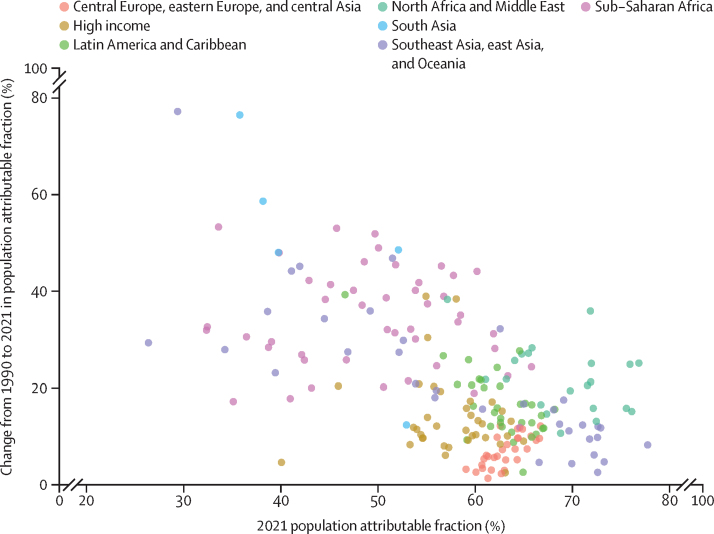
“Over this period, the proportion of DALYS due to high BMI increased in every country and territory, ranging from an increase of 77·2% (52·2 to 107·9) in Viet Nam to 1·3% (–1·5 to 4·1) in Czechia (figure 3).”
§ Global, regional, and national burden of diabetes from 1990 to 2021, with projections of prevalence to 2050: a systematic analysis for the Global Burden of Disease Study 2021 > Results > Type 2 diabetes risk factors
plaindirect- Asserted: passes — The authors put it forward as true.
- Checkable: passes — It can be checked against evidence.
- Load-bearing: unclear — It is unclear whether the paper’s conclusions depend on it.
- Based: passes — The paper gives a reason why it holds.
It may state two separate claims as one. The quote only partly states this claim.
A result the paper reports from its own data — it cites no other source for it, so there is none to check. The quote shows it is in the paper.
In the paper
“The age-standardised diabetes prevalence rate is projected to exceed 10% in 89 (43·6%) countries and territories and to surpass 20% in 24 (11·8%) countries and territories.”
§ Global, regional, and national burden of diabetes from 1990 to 2021, with projections of prevalence to 2050: a systematic analysis for the Global Burden of Disease Study 2021 > Results > Diabetes prevalence over time: 1990 to 2021, and forecasts to 2050
plain- Asserted: passes — The authors put it forward as true.
- Checkable: passes — It can be checked against evidence.
- Load-bearing: unclear — It is unclear whether the paper’s conclusions depend on it.
- Based: passes — The paper gives a reason why it holds.
It may state two separate claims as one.
A result the paper reports from its own data — it cites no other source for it, so there is none to check. The quote shows it is in the paper.
In the paper
“At the country level, Fiji had the highest age-standardised DALY rate, at 7333·9 (6066·7–8776·7) per 100 000.”
§ Global, regional, and national burden of diabetes from 1990 to 2021, with projections of prevalence to 2050: a systematic analysis for the Global Burden of Disease Study 2021 > Results > Total diabetes burden: YLLs, YLDs, and DALYs
plain- Asserted: passes — The authors put it forward as true.
- Checkable: passes — It can be checked against evidence.
- Load-bearing: fails — The paper’s conclusions may not depend on it.
- Based: passes — The paper gives a reason why it holds.
Probably not a substantial claim. The paper’s conclusions may not depend on it.
A result the paper reports from its own data — it cites no other source for it, so there is none to check. The quote shows it is in the paper.
In the paper
“and 95·4% (94·9–95·9) of DALYs.”
§ Global, regional, and national burden of diabetes from 1990 to 2021, with projections of prevalence to 2050: a systematic analysis for the Global Burden of Disease Study 2021 > Results > Total diabetes burden: YLLs, YLDs, and DALYs
plain- Asserted: passes — The authors put it forward as true.
- Checkable: passes — It can be checked against evidence.
- Load-bearing: fails — The paper’s conclusions may not depend on it.
- Based: passes — The paper gives a reason why it holds.
Probably not a substantial claim. The paper’s conclusions may not depend on it.
A result the paper reports from its own data — it cites no other source for it, so there is none to check. The quote shows it is in the paper.
In the paper
“The global age-standardised diabetes prevalence rate in 2021 was 6·1%, with highs of 9·3% in the north Africa and Middle East super-region and 12·3% in the Oceania region.”
§ Global, regional, and national burden of diabetes from 1990 to 2021, with projections of prevalence to 2050: a systematic analysis for the Global Burden of Disease Study 2021 > Discussion
plain- Asserted: passes — The authors put it forward as true.
- Checkable: passes — It can be checked against evidence.
- Load-bearing: unclear — It is unclear whether the paper’s conclusions depend on it.
- Based: passes — The paper gives a reason why it holds.
It may state two separate claims as one.
The paper states this without a source or data behind it here, so there is nothing to check it against. The quote shows it is in the paper.
In the paper
“diabetes prevalence continues to increase in every country and territory, age group, and in both males and females.”
§ Global, regional, and national burden of diabetes from 1990 to 2021, with projections of prevalence to 2050: a systematic analysis for the Global Burden of Disease Study 2021 > Discussion
plaindirect- Asserted: passes — The authors put it forward as true.
- Checkable: passes — It can be checked against evidence.
- Load-bearing: passes — The paper’s conclusions depend on it.
- Based: passes — The paper gives a reason why it holds.
It may state two separate claims as one.
In the paper
“The Lancet Commission on diabetes published in 2020 highlights the unequal burden of the disease on people in low-income and middle-income countries (LMICs), reporting that 80% of diabetes cases occur in LMICs.2”
§ Global, regional, and national burden of diabetes from 1990 to 2021, with projections of prevalence to 2050: a systematic analysis for the Global Burden of Disease Study 2021 > Introduction
What the sources say
- Not checked — no full text of the sourcecites [2] Chan, 2021, The Lancet Commission on diabetes: using data to transform diabetes care and patient lives, Lancet source
plain- Asserted: passes — The authors put it forward as true.
- Checkable: passes — It can be checked against evidence.
- Load-bearing: fails — The paper’s conclusions may not depend on it.
- Based: passes — The paper gives a reason why it holds.
Probably not a substantial claim. The paper’s conclusions may not depend on it.
A conclusion the paper draws from its own results — it cites no other source for it, so there is none to check. The quote shows it is in the paper.
In the paper
“Type 2 diabetes, which makes up the bulk of diabetes cases, is largely preventable and, in some cases, potentially reversible if identified and managed early in the disease course.”
§ Global, regional, and national burden of diabetes from 1990 to 2021, with projections of prevalence to 2050: a systematic analysis for the Global Burden of Disease Study 2021 > Abstract > Interpretation
hedgedconditional- Asserted: passes — The authors put it forward as true.
- Checkable: passes — It can be checked against evidence.
- Load-bearing: fails — The paper’s conclusions may not depend on it.
- Based: fails — The paper may give no reason why it holds.
Probably not a substantial claim. The paper’s conclusions may not depend on it. The paper may give no reason why it holds. It may state two separate claims as one.
What the paper did — it cites no source for this, so there is none to check. The quote shows it is in the paper.
In the paper
“There were 1527 location-years of data from 172 countries (84·3% of the 204 countries and territories included in GBD) used in the diabetes modelling process (appendix section 4.1.1).”
§ Global, regional, and national burden of diabetes from 1990 to 2021, with projections of prevalence to 2050: a systematic analysis for the Global Burden of Disease Study 2021 > Methods > Non-fatal outcomes
plain- Asserted: passes — The authors put it forward as true.
- Checkable: passes — It can be checked against evidence.
- Load-bearing: fails — The paper’s conclusions may not depend on it.
- Based: passes — The paper gives a reason why it holds.
Probably not a substantial claim. The paper’s conclusions may not depend on it.
A conclusion the paper draws from its own results — it cites no other source for it, so there is none to check. The quote shows it is in the paper.
In the paper
“However, all evidence indicates that diabetes prevalence is increasing worldwide, primarily due to a rise in obesity caused by multiple factors.”
§ Global, regional, and national burden of diabetes from 1990 to 2021, with projections of prevalence to 2050: a systematic analysis for the Global Burden of Disease Study 2021 > Abstract > Interpretation
hedgeddirect- Asserted: passes — The authors put it forward as true.
- Checkable: passes — It can be checked against evidence.
- Load-bearing: passes — The paper’s conclusions depend on it.
- Based: passes — The paper gives a reason why it holds.
It may state two separate claims as one.
None of the sources cited for this claim have been checked yet.
In the paper
“Type 1 and type 2 diabetes are the most common forms of the disease and are diagnosed through well established criteria.1, 2, 4”
§ Global, regional, and national burden of diabetes from 1990 to 2021, with projections of prevalence to 2050: a systematic analysis for the Global Burden of Disease Study 2021 > Introduction
What the sources say
- Not matchedcites [1]
Couldn’t be matched to a paper in Crossref, so it can’t be checked.
- Not checked — no full text of the sourcecites [2] Chan, 2021, The Lancet Commission on diabetes: using data to transform diabetes care and patient lives, Lancet source
- Not matchedcites [4] 2021
Couldn’t be matched to a paper in Crossref, so it can’t be checked.
boosted- Asserted: passes — The authors put it forward as true.
- Checkable: passes — It can be checked against evidence.
- Load-bearing: fails — The paper’s conclusions may not depend on it.
- Based: passes — The paper gives a reason why it holds.
Probably not a substantial claim. The paper’s conclusions may not depend on it. It may state two separate claims as one.
- Not matched
What the paper did — it cites no source for this, so there is none to check. The quote shows it is in the paper.
In the paper
“The funder of the study had no role in study design, data collection, data analysis, data interpretation, or the writing of the report.”
§ Global, regional, and national burden of diabetes from 1990 to 2021, with projections of prevalence to 2050: a systematic analysis for the Global Burden of Disease Study 2021 > Methods > Role of the funding source
plain- Asserted: passes — The authors put it forward as true.
- Checkable: passes — It can be checked against evidence.
- Load-bearing: fails — The paper’s conclusions may not depend on it.
- Based: passes — The paper gives a reason why it holds.
Probably not a substantial claim. The paper’s conclusions may not depend on it.
What the paper did — it cites no source for this, so there is none to check. The quote shows it is in the paper.
In the paper
“There were 25 666 location-years of death data included in the fatal model (appendix section 3.1).”
§ Global, regional, and national burden of diabetes from 1990 to 2021, with projections of prevalence to 2050: a systematic analysis for the Global Burden of Disease Study 2021 > Methods > Mortality
plain- Asserted: passes — The authors put it forward as true.
- Checkable: passes — It can be checked against evidence.
- Load-bearing: fails — The paper’s conclusions may not depend on it.
- Based: passes — The paper gives a reason why it holds.
Probably not a substantial claim. The paper’s conclusions may not depend on it.
What the paper did — it cites no source for this, so there is none to check. The quote shows it is in the paper.
In the paper
“All codes used for these analyses are publicly available online.”
§ Global, regional, and national burden of diabetes from 1990 to 2021, with projections of prevalence to 2050: a systematic analysis for the Global Burden of Disease Study 2021 > Methods > Code availability
plain- Asserted: passes — The authors put it forward as true.
- Checkable: passes — It can be checked against evidence.
- Load-bearing: fails — The paper’s conclusions may not depend on it.
- Based: passes — The paper gives a reason why it holds.
Probably not a substantial claim. The paper’s conclusions may not depend on it.
What the paper did — it cites no source for this, so there is none to check. The quote shows it is in the paper.
In the paper
“For this study, we identified 27 193 data sources to which we applied the methodological and evidentiary framework provided by GBD.”
§ Global, regional, and national burden of diabetes from 1990 to 2021, with projections of prevalence to 2050: a systematic analysis for the Global Burden of Disease Study 2021 > Methods > Overview
plain- Asserted: passes — The authors put it forward as true.
- Checkable: passes — It can be checked against evidence.
- Load-bearing: fails — The paper’s conclusions may not depend on it.
- Based: passes — The paper gives a reason why it holds.
Probably not a substantial claim. The paper’s conclusions may not depend on it.
In the paper
“This study complies with the Guidelines for Accurate and Transparent Health Estimates Reporting (GATHER) statement (appendix table S1).30”
§ Global, regional, and national burden of diabetes from 1990 to 2021, with projections of prevalence to 2050: a systematic analysis for the Global Burden of Disease Study 2021 > Methods > Overview
What the sources say
- Not matchedcites [30] Stevens, 2016, Guidelines for accurate and transparent health estimates reporting: the GATHER statement, PLoS Med
Couldn’t be matched to a paper in Crossref, so it can’t be checked.
plain- Asserted: passes — The authors put it forward as true.
- Checkable: passes — It can be checked against evidence.
- Load-bearing: fails — The paper’s conclusions may not depend on it.
- Based: passes — The paper gives a reason why it holds.
Probably not a substantial claim. The paper’s conclusions may not depend on it.
- Not matched
A conclusion the paper draws from its own results — it cites no other source for it, so there is none to check. The quote shows it is in the paper.
In the paper
“This is probably because no strategy has attempted to deal with the multiple factors that potentially contribute to obesity.”
§ Global, regional, and national burden of diabetes from 1990 to 2021, with projections of prevalence to 2050: a systematic analysis for the Global Burden of Disease Study 2021 > Discussion
hedgedconditional- Asserted: passes — The authors put it forward as true.
- Checkable: fails — It may be too vague to check against evidence.
- Load-bearing: fails — The paper’s conclusions may not depend on it.
- Based: passes — The paper gives a reason why it holds.
Probably not a substantial claim. It may be too vague to check against evidence. The paper’s conclusions may not depend on it.
What the paper did — it cites no source for this, so there is none to check. The quote shows it is in the paper.
In the paper
“The robust location-specific, age-specific, and sex-specific diabetes estimates produced by our analysis are largely due to our ability to leverage the rigorous evidentiary and methodological framework provided by the larger GBD enterprise.”
§ Global, regional, and national burden of diabetes from 1990 to 2021, with projections of prevalence to 2050: a systematic analysis for the Global Burden of Disease Study 2021 > Discussion
plaindirect- Asserted: passes — The authors put it forward as true.
- Checkable: fails — It may be too vague to check against evidence.
- Load-bearing: passes — The paper’s conclusions depend on it.
- Based: passes — The paper gives a reason why it holds.
Probably not a substantial claim. It may be too vague to check against evidence.
A conclusion the paper draws from its own results — it cites no other source for it, so there is none to check. The quote shows it is in the paper.
In the paper
“Few countries have health-care systems, however, that are positioned to take a proactive approach or possess the infrastructure to prioritise early interventions.”
§ Global, regional, and national burden of diabetes from 1990 to 2021, with projections of prevalence to 2050: a systematic analysis for the Global Burden of Disease Study 2021 > Discussion
plain- Asserted: passes — The authors put it forward as true.
- Checkable: fails — It may be too vague to check against evidence.
- Load-bearing: fails — The paper’s conclusions may not depend on it.
- Based: fails — The paper may give no reason why it holds.
Probably not a substantial claim. It may be too vague to check against evidence. The paper’s conclusions may not depend on it. The paper may give no reason why it holds.
In the paper
“Despite methodological and reporting differences, our estimates of particularly high total diabetes prevalence rates in the north Africa and the Middle East super-region are supported by similar estimates reported in the 2021 IDF Atlas.4”
§ Global, regional, and national burden of diabetes from 1990 to 2021, with projections of prevalence to 2050: a systematic analysis for the Global Burden of Disease Study 2021 > Discussion
What the sources say
- Not matchedcites [4] 2021
Couldn’t be matched to a paper in Crossref, so it can’t be checked.
plaincorrelational- Asserted: passes — The authors put it forward as true.
- Checkable: passes — It can be checked against evidence.
- Load-bearing: fails — The paper’s conclusions may not depend on it.
- Based: passes — The paper gives a reason why it holds.
Probably not a substantial claim. The paper’s conclusions may not depend on it.
- Not matched
In the paper
“Relying on a single glucose test could overestimate diabetes prevalence; however, the magnitude of error depends on the distribution of blood sugar concentrations as the reliability of a single glucose test increases with higher blood sugar values.87”
§ Global, regional, and national burden of diabetes from 1990 to 2021, with projections of prevalence to 2050: a systematic analysis for the Global Burden of Disease Study 2021 > Discussion
What the sources say
- Not checked — no full text of the sourcecites [87] Selvin, 2007, Short-term variability in measures of glycemia and implications for the classification of diabetes, Arch Intern Med source
hedgeddirect- Asserted: passes — The authors put it forward as true.
- Checkable: passes — It can be checked against evidence.
- Load-bearing: unclear — It is unclear whether the paper’s conclusions depend on it.
- Based: passes — The paper gives a reason why it holds.
It may state two separate claims as one.
What the paper did — it cites no source for this, so there is none to check. The quote shows it is in the paper.
In the paper
“Finally, due to limitations inherent in the available literature and the comparative risk factor framework, we were unable to account for cohort effects apart from those pertaining to tobacco exposure.”
§ Global, regional, and national burden of diabetes from 1990 to 2021, with projections of prevalence to 2050: a systematic analysis for the Global Burden of Disease Study 2021 > Discussion
plain- Asserted: passes — The authors put it forward as true.
- Checkable: passes — It can be checked against evidence.
- Load-bearing: fails — The paper’s conclusions may not depend on it.
- Based: passes — The paper gives a reason why it holds.
Probably not a substantial claim. The paper’s conclusions may not depend on it.
In the paper
“Fifth, our analysis did not estimate gestational diabetes explicitly since this diagnosis is captured in another GBD disease category, “Other maternal disorders”, nor did our study include rarer forms of diabetes such as monogenic diabetes,1 due to the paucity of relevant data.”
§ Global, regional, and national burden of diabetes from 1990 to 2021, with projections of prevalence to 2050: a systematic analysis for the Global Burden of Disease Study 2021 > Discussion
What the sources say
- Not matchedcites [1]
Couldn’t be matched to a paper in Crossref, so it can’t be checked.
plain- Asserted: passes — The authors put it forward as true.
- Checkable: passes — It can be checked against evidence.
- Load-bearing: unclear — It is unclear whether the paper’s conclusions depend on it.
- Based: passes — The paper gives a reason why it holds.
It may state two separate claims as one.
- Not matched
What the paper did — it cites no source for this, so there is none to check. The quote shows it is in the paper.
In the paper
“Although our forecasts do not incorporate all known risk factors, here we capture the principal driver of type 2 diabetes, high BMI.”
§ Global, regional, and national burden of diabetes from 1990 to 2021, with projections of prevalence to 2050: a systematic analysis for the Global Burden of Disease Study 2021 > Discussion
plaindirect- Asserted: passes — The authors put it forward as true.
- Checkable: passes — It can be checked against evidence.
- Load-bearing: unclear — It is unclear whether the paper’s conclusions depend on it.
- Based: passes — The paper gives a reason why it holds.
It may state two separate claims as one.
What the paper did — it cites no source for this, so there is none to check. The quote shows it is in the paper.
In the paper
“Seventh, GBD generates risk factor analyses for modifiable risk–outcome pairs. Each risk factor is identified by a review of the literature, and we regularly revisit the possibility of adding additional risk factors. The risk–outcome association is quantified through a rules-based assessment of existing evidence.”
§ Global, regional, and national burden of diabetes from 1990 to 2021, with projections of prevalence to 2050: a systematic analysis for the Global Burden of Disease Study 2021 > Discussion
plain- Asserted: passes — The authors put it forward as true.
- Checkable: passes — It can be checked against evidence.
- Load-bearing: fails — The paper’s conclusions may not depend on it.
- Based: passes — The paper gives a reason why it holds.
Probably not a substantial claim. The paper’s conclusions may not depend on it. It may state two separate claims as one.
A conclusion the paper draws from its own results — it cites no other source for it, so there is none to check. The quote shows it is in the paper.
In the paper
“with no effective mitigation strategy currently in place”
§ Global, regional, and national burden of diabetes from 1990 to 2021, with projections of prevalence to 2050: a systematic analysis for the Global Burden of Disease Study 2021 > Discussion
plain- Asserted: passes — The authors put it forward as true.
- Checkable: passes — It can be checked against evidence.
- Load-bearing: passes — The paper’s conclusions depend on it.
- Based: passes — The paper gives a reason why it holds.
Probably not a substantial claim.
In the paper
“Third, although clinical diagnostic criteria for diabetes require more than one abnormal glucose concentration in the absence of symptoms,1 very few population-based epidemiological studies require these diagnostic criteria.”
§ Global, regional, and national burden of diabetes from 1990 to 2021, with projections of prevalence to 2050: a systematic analysis for the Global Burden of Disease Study 2021 > Discussion
What the sources say
- Not matchedcites [1]
Couldn’t be matched to a paper in Crossref, so it can’t be checked.
plain- Asserted: passes — The authors put it forward as true.
- Checkable: passes — It can be checked against evidence.
- Load-bearing: unclear — It is unclear whether the paper’s conclusions depend on it.
- Based: passes — The paper gives a reason why it holds.
It may state two separate claims as one.
- Not matched
The authors state this as an assumption.
All deaths due to diabetes in people younger than 15 years were from type 1 diabetes.
“We assumed that all deaths due to diabetes in people younger than 15 years were from type 1 diabetes.”
The authors state this as an assumption.
There was no remission (no cure) in the type 1 diabetes model.
“We assumed there was no remission (ie, no cure).”
The authors state this as an assumption.
Annual remission in the total diabetes model could be no more than 1%.
“and assumed that annual remission could be no more than 1% (appendix sections 4.3.1 and 4.3.2).”
The authors state this as an assumption.
All diabetes cases in people aged younger than 15 years were type 1 diabetes.
“For data from people aged younger than 15 years, we assumed that all diabetes cases were type 1 diabetes”
The authors state this as an assumption.
All patients aged younger than 15 years with diabetes had sought hospital care due to their insulin dependence.
“and that all patients had sought hospital care due to their insulin dependence.”
The authors state this as an assumption.
Reporting bias in self-reported diabetes data changes over time and across location.
“we assumed that reporting bias would change over time and across location (eg, due to variability in diagnostic and screening efficacy), thus making bias adjustment challenging.”
The authors state this as an assumption.
All individuals younger than 15 years have type 1 diabetes.
“GBD currently assumes that all individuals younger than 15 years have type 1 diabetes.”
The authors state this as an assumption.
SDI is a good proxy for better access to care leading to a lower case fatality rate, and to increases in type 1 diabetes prevalence.
“However, we believe that SDI is a good proxy for better access to care leading to a lower case fatality rate, and to increases in type 1 diabetes prevalence.”
The paper relies on this without support.
Type 1 and type 2 diabetes differ with respect to risk factor profiles and underlying pathophysiology.
“Differences between type 1 and type 2 diabetes with respect to risk factor profiles and underlying pathophysiology”
The paper relies on this without support.
Hyperglycaemia leads to similar complications for both type 1 and type 2 diabetes.
“given that hyperglycaemia leads to similar complications for both types”
The paper relies on this without support.
Type 2 diabetes can in some cases be prevented.
“Although type 2 diabetes can in some cases be prevented”
The paper relies on this without support.
Management of hyperglycaemia has the potential to improve outcomes.
“management of hyperglycaemia has the potential to improve outcomes”
The paper relies on this without support.
Type 2 diabetes continues to be a major public health problem due to high rates of obesity.
“the disease continues to be a major public health problem due to high rates of obesity that place an increasing burden on individuals and health-care systems alike”
Claims other papers make about this one
Each is checked against this paper’s own text: does it say what the citing paper says it does?
The source backs part of the claim, not all of it — or backs it for a different population, condition or comparison.
In the citing paper
“The non-communicable disease burden was distributed widely across the world's populations, irrespective of age, sex, or socioeconomic circumstance”
From Global incidence, prevalence, years lived with disability (YLDs), disability-adjusted life-years (DALYs), and healthy life expectancy (HALE) for 371 diseases and injuries in 204 countries and territories and 811 subnational locations, 1990–2021: a systematic analysis for the Global Burden of Disease Study 2021 (2024) · cites this paper as [33]
Experimental — accuracy not yet measuredThe source backs part of the claim, not all of it — or backs it for a different population, condition or comparison.
In the citing paper
“Type 2 diabetes is preventable and, in some instances, reversible with early detection and adequate care.33, 45, 46”
From Global incidence, prevalence, years lived with disability (YLDs), disability-adjusted life-years (DALYs), and healthy life expectancy (HALE) for 371 diseases and injuries in 204 countries and territories and 811 subnational locations, 1990–2021: a systematic analysis for the Global Burden of Disease Study 2021 (2024) · cites this paper as [33]
Experimental — accuracy not yet measuredThe cited source says what the claim attributes to it.
In the citing paper
“however, without global intervention, a separate GBD 2021 analysis has forecast that more than 1·31 billion people worldwide will have diabetes by 2050.33”
From Global incidence, prevalence, years lived with disability (YLDs), disability-adjusted life-years (DALYs), and healthy life expectancy (HALE) for 371 diseases and injuries in 204 countries and territories and 811 subnational locations, 1990–2021: a systematic analysis for the Global Burden of Disease Study 2021 (2024) · cites this paper as [33]
Self-check
Percentages, sums and reported differences re-computed from the paper’s own numbers.
Each contradiction between two passages listed here was confirmed by an independent check.
Rated minor: it would not touch a result — a value no result rests on, a p-value that stays on the same side of the significance level, or a conflict that is clerical, resolved elsewhere in the paper, or outside its own findings.
In the paper
§ Global, regional, and national burden of diabetes from 1990 to 2021, with projections of prevalence to 2050: a systematic analysis for the Global Burden of Disease Study 2021 > Results > Total diabetes burden: YLLs, YLDs, and DALYs
“Regionally, the age-standardised DALY rate varied from a high of 3577·0 (95% UI 3157·0–4120·5) per 100 000 in Oceania to a low of 511·8 (402·0–648·3) per 100 000 in western Europe.”
§ Global, regional, and national burden of diabetes from 1990 to 2021, with projections of prevalence to 2050: a systematic analysis for the Global Burden of Disease Study 2021 > Results > Total diabetes burden: YLLs, YLDs, and DALYs
“| Australasia | Australasia | 226 (183 to 288) | 140·8% (122·2 to 164·8) | 469·2 (378·1 to 602·4) | 15·3% (5·5 to 27·1) |”
Rated minor: it would not touch a result — a value no result rests on, a p-value that stays on the same side of the significance level, or a conflict that is clerical, resolved elsewhere in the paper, or outside its own findings.
In the paper
§ Global, regional, and national burden of diabetes from 1990 to 2021, with projections of prevalence to 2050: a systematic analysis for the Global Burden of Disease Study 2021 > Results > Total diabetes burden: YLLs, YLDs, and DALYs
“The global age-standardised diabetes DALY rate was 915·0 (782·6–1067·5) per 100 000”
§ Global, regional, and national burden of diabetes from 1990 to 2021, with projections of prevalence to 2050: a systematic analysis for the Global Burden of Disease Study 2021 > Results > Total diabetes burden: YLLs, YLDs, and DALYs
“| Global | Global | 79 200 (67 800 to 92 500) | 189·8% (171·1 to 203·4) | 915·0 (782·6 to 1067·4) | 38·6% (29·7 to 45·3) |”
Citations
Cites
Vos, T., Lim, S. S., Abbafati, C., Abbas, K. M., Abbasi, M., Abbasifard, M., Abbasi-Kangevari, M., Abbastabar, H., Abd-Allah, F., Abdelalim, A., et al. (2020) · The Lancet · doi:10.1016/s0140-6736(20)30925-9 · Cited by 19,358
Self-citationReduction in the incidence of type 2 diabetes with lifestyle intervention or metformin
(2002) · New England Journal of Medicine · doi:10.1056/nejmoa012512 · Cited by 19,011 · cited 1×
“71,72 75 Few countries have health-care systems, however, that are positioned to take a proactive approach or possess the infrastructure to prioritise early interventions.”
Sun, H., Saeedi, P., Karuranga, S., Pinkepank, M., Ogurtsova, K., Duncan, B. B., Stein, C., Basit, A., Chan, J. C. N., Mbanya, J. C., et al. (2022) · Diabetes Research and Clinical Practice · doi:10.1016/j.diabres.2021.109119 · Cited by 10,123 · cited 2×
“47 A high diabetes burden in LMICs is also related to economic and sociopolitical challenges, including limited health spending on diabetes 10 and inadequate or incomplete coverage for pharmacological treatment.”
Self-citationMurray, C. J. L., Aravkin, A. Y., Zheng, P., Abbafati, C., Abbas, K. M., Abbasi-Kangevari, M., Abd-Allah, F., Abdelalim, A., Abdollahi, M., Abdollahpour, I., et al. (2020) · The Lancet · doi:10.1016/s0140-6736(20)30752-2 · Cited by 9,854
Self-citationHealth effects of overweight and obesity in 195 countries over 25 years
Collaborators, T. G. 2. O. (2017) · New England Journal of Medicine · doi:10.1056/nejmoa1614362 · Cited by 7,918
Obesity: global epidemiology and pathogenesis
Blüher, M. (2019) · Nature Reviews Endocrinology · doi:10.1038/s41574-019-0176-8 · Cited by 5,126 · cited 1×
“57 This is probably because no strategy has attempted to deal with the multiple factors that potentially contribute to obesity.”
The Emerging Risk Factors Collaboration (2010) · The Lancet · doi:10.1016/s0140-6736(10)60484-9 · Cited by 5,125
Global mortality, disability, and the contribution of risk factors: Global Burden of Disease Study
Murray, C. J., & Lopez, A. D. (1997) · The Lancet · doi:10.1016/s0140-6736(96)07495-8 · Cited by 4,492 · cited 3×
“29,37 For each risk factor analysed here, we estimated the relative risk of diabetes as a function of risk exposure, using the following methods, which have been extensively detailed elsewhere.”
InfluentialGlobal nutrition transition and the pandemic of obesity in developing countries
Popkin, B. M., Adair, L. S., & Ng, S. W. (2012) · Nutrition Reviews · doi:10.1111/j.1753-4887.2011.00456.x · Cited by 4,313 · cited 2×
“45 Various interventions and policies to address obesity have been developed and studied, 53–56 but no programme to date has shown long-term, sustained, population-level reductions in obesity.”
Zhou, B., Lu, Y., Hajifathalian, K., Bentham, J., Di Cesare, M., Danaei, G., Bixby, H., Cowan, M., Ali, M., Taddei, C., et al. (2016) · The Lancet · doi:10.1016/s0140-6736(16)00618-8 · Cited by 4,311
Self-citation
Cited by
Sorted by citations
Items 2,601–2,700 of 4,684
Mei, S.-T., & Li, J. (2025) · World Journal of Clinical Cases · doi:10.12998/wjcc.v13.i28.109358 · Cited by 1
Beena, B., Devasia, S., Stephena, P. S., Sriraam, V. T., Madhavan, S., & Kailas, A. P. (2025) · Next research. · doi:10.1016/j.nexres.2025.100700 · Cited by 1
Camacho, P. A., Latorre-Arevalo, M. G., Camacho-Naranjo, P., & Flórez, S. J. V. (2025) · Cureus · doi:10.7759/cureus.88114 · Cited by 2
Xi, M., Hou, Y., Jiang, Z., Li, D., He, P., Yan, J., Wei, D., Wang, K., & Gu, X. (2026) · International Journal of Biological Macromolecules · doi:10.1016/j.ijbiomac.2026.152020 · Cited by 1
Salsabila, T., Fa’rifah, R. Y., & Pramesti, D. (2025) · International Conference on Electronics Representation and Algorithm (ICERA) · doi:10.1109/icera66156.2025.11087261 · Cited by 1
Fakih, T. M., Sodik, J. J., Khaerulihsan, R. R., et al. (2025) · Intelligent Pharmacy · doi:10.1016/j.ipha.2025.07.002 · Cited by 1
Total and excess bed‐days in people with diabetes in Australia
Feleke, B. E., Salim, A., Magliano, D. J., et al. (2025) · Diabetic Medicine · doi:10.1111/dme.70118 · Cited by 1
Self-citationTakase, M., Nakaya, N., Kogure, M., Hatanaka, R., Nakaya, K., Chiba, I., Tokioka, S., Nochioka, K., Nakamura, T., Tsuchiya, N., et al. (2025) · Cardiovascular Diabetology · doi:10.1186/s12933-025-02849-8 · Cited by 1
Hosoe, S., Katakami, N., Taya, N., Omori, K., Takahara, M., Konya, Y., Obara, S., Hidaka, A., Nakao, M., Takahashi, M., et al. (2025) · Diabetes · doi:10.2337/db25-0099 · Cited by 1
Izewski, J. M., Peña, A., Tang, R., Crites, K., Campbell, M., Pelton, S., Saiko-Blair, M., & Scifres, C. (2025) · American Journal of Perinatology · doi:10.1055/a-2682-6382 · Cited by 1
Duan, T., Qin, M., Du, Y., et al. (2025) · Frontiers in Public Health · doi:10.3389/fpubh.2025.1624622 · Cited by 1
Wang, M., Zhang, W., Li, J., Luan, Y., Ding, X., & Hu, Y. (2025) · BMC Cardiovascular Disorders · doi:10.1186/s12872-025-04972-6 · Cited by 1
Haruyama, R., Rahman, M. S., Rahman, M. M., Khim, S. A., Moadsiri, A., Chham, S., Chhim, S., Kol, H., & Phy, M. (2025) · Journal of Global Health · doi:10.7189/jogh.15.04251 · Cited by 1
Self-citationAn Update on GLP ‐1 Receptor Agonists
Bloomgarden, Z. T. (2025) · Journal of Diabetes · doi:10.1111/1753-0407.70147 · Cited by 2
Corneal Epithelial Wound Healing: Cellular Mechanisms and Therapeutic Approaches
Ong, J., Thanitcul, C., Fotovat-Ahmadi, N., et al. (2025) · Springer eBooks · doi:10.1007/978-3-031-93677-7_9 · Cited by 1
Rahman, M., Khatri, R. B., Gomersall, S. R., Hossian, M., & Khan, A. (2025) · International Journal of Environmental Research and Public Health · doi:10.3390/ijerph22081279 · Cited by 1
Self-citationEffects of Genistein on Inflammasome Induced Pancreatic β‐Cell Apoptosis by Dexamethasone
Jitprawet, N., Sujjitjoon, J., Maneethorn, P., et al. (2025) · Molecular Nutrition & Food Research · doi:10.1002/mnfr.70218 · Cited by 1
Jiang, C., Qi, J., Zou, H., López, O. L., Xie, X., & Xue, Y. (2025) · Journal of Alzheimer s Disease · doi:10.1177/13872877251365662 · Cited by 1
Huang, Q., Xie, H. W., Wang, Z., et al. (2025) · Frontiers in Medicine · doi:10.3389/fmed.2025.1599857 · Cited by 1
Self-citationZhang, Y., Deng, H., Zu, J., Deng, Y., Tan, J., Yang, Z., Jiao, Y., Cui, X., Zhang, L., Ji, F., et al. (2025) · Frontiers in Endocrinology · doi:10.3389/fendo.2025.1601089 · Cited by 1
Self-citationNoronha, J. C., Mechanick, J. I., Barazzoni, R., Tarazona‐Santabalbina, F. J., Dimosthenopoulos, C., Raben, A., Kendall, C. W. C., Chiavaroli, L., & Sievenpiper, J. L. (2025) · Clinical Nutrition ESPEN · doi:10.1016/j.clnesp.2025.08.027 · Cited by 2
Biomaterials-Based Additive Manufactured Products for Diabetic Wound Healing
Puri, A. V., Mohite, P. B., Singh, S. K., Chaudhari, Y. S., Chaudhari, M. Y., Ansari, Y., & Gholap, A. (2025) · Springer eBooks · doi:10.1007/978-3-031-96070-3_10 · Cited by 2
Self-citationWong, C. K., Shimoda, C., Steel, E., et al. (2025) · Physical Therapy · doi:10.1093/ptj/pzaf105 · Cited by 1
Lei, K., Zhao, Z., Chen, A., An, X., Li, Y., & Su, B. (2025) · Renal Failure · doi:10.1080/0886022x.2025.2551731 · Cited by 1
Self-citationSelf-care practices in diabetes among populations in India: a systematic review and meta-analysis
Chaudhuri, S., Agiwal, V., Chandrasekhar, C., et al. (2025) · Discover Public Health · doi:10.1186/s12982-025-00915-w · Cited by 1
Functions and Mechanisms of Diabetes-Linked Transcription Factors
Parthiban, N. K., Nassif, N. T., & Simpson, A. M. (2025) · Frontiers in Bioscience-Landmark · doi:10.31083/fbl36544 · Cited by 1
Desalegn, G. K., Birhan, G. S., Bogale, Z. M., & Assefa, A. L. (2025) · BMJ Open · doi:10.1136/bmjopen-2024-097380 · Cited by 1
Wang, L., Zou, X., Zi, X., She, M., & Duan, C. (2025) · Medicine · doi:10.1097/md.0000000000044006 · Cited by 3
Epidemiology of ischemic heart disease
Vujcic, I. S., Maksimovic, J. M., & Grujičić, S. Š. (2025) · Medicinska istrazivanja · doi:10.5937/medi0-58650 · Cited by 1
Tibballs, K. L. B., Kirkebøen, L. J., Jenum, A. K., Straand, J., Berg, T. J., & Buhl, E. S. (2025) · BMJ Open · doi:10.1136/bmjopen-2024-096521 · Cited by 1
Su, I.-M., Teng, Y.-Y., Li, J.-C., Liu, C., Wu, D.-A., & Hsu, B. (2025) · Medicina · doi:10.3390/medicina61091607 · Cited by 1
Self-citationChen, J., Fu, G., Lei, X., Bai, C., Wen, L., & Zhang, Y. (2025) · Frontiers in Endocrinology · doi:10.3389/fendo.2025.1605008 · Cited by 1
Yi, S., & Marques-Vidal, P. M. (2025) · Preventive Medicine · doi:10.1016/j.ypmed.2025.108407 · Cited by 1
Self-citationAnju, V. V., & Elyas, K. K. (2025) · International Journal of Peptide Research and Therapeutics · doi:10.1007/s10989-025-10757-4 · Cited by 1
Malik, Z. I., Khan, S. E., & Ahmad, A. M. R. (2025) · Frontiers in Public Health · doi:10.3389/fpubh.2025.1641499 · Cited by 1
Self-citationJin, Y., Zhang, W., Ling, J., Huang, J., Tian, T., Liu, T., Ma, L., Zhang, L., Dong, J., & Ruan, Y. (2025) · International Journal of Biometeorology · doi:10.1007/s00484-025-03040-0 · Cited by 1
Self-citationCao, K., Feng, Q., Tian, W., Liu, M., Tang, D., Feng, T., Sun, X., Zeng, Y., & Wang, Z. (2025) · American Journal of Public Health · doi:10.2105/ajph.2025.308245 · Cited by 1
Self-citationTarchi, L., Bonacchi, L., Santo, A. D., Rovero, P., Sassoli, C., Garella, R., Squecco, R., Villa, G., Nassini, R., Logu, F. D., et al. (2025) · Endocrinology Diabetes & Metabolism · doi:10.1002/edm2.70109 · Cited by 1
High prevalence of overweight and obesity among young adults, Cameroon
Soubgui, A. F. M., Mboussi, W. S. N., Foko, L. P. K., et al. (2025) · Medicine · doi:10.1097/md.0000000000044583 · Cited by 1
Lutambi, A. M., Mwing’a, G. P., & Emidi, B. (2025) · PLoS ONE · doi:10.1371/journal.pone.0332275 · Cited by 1
Süsstrunk, J., Erne, S., Wilhelm, A., Köstler, T., Mattiello, D., & Zingg, U. (2025) · Obesity Surgery · doi:10.1007/s11695-025-08263-z · Cited by 2
Debbarma, S., Yadav, A., Naik, B. N., Pandey, S., Bhardwaj, M., Kumari, S., Singh, R., & Biswas, R. (2025) · Journal of Family Medicine and Primary Care · doi:10.4103/jfmpc.jfmpc_222_25 · Cited by 1
Chen, X., Zhou, T., & Huang, W. (2025) · Annals of Medicine · doi:10.1080/07853890.2025.2564294 · Cited by 1
Okawa, S., Iso, H., Yokobori, Y., Hachiya, M., Nguyen, C. Q., Pham, T. T. P., Phan, D. C., Do, T. H., Mizoue, T., & Inoue, Y. (2025) · Journal of Diabetes Research · doi:10.1155/jdr/1068375 · Cited by 1
Self-citationFadini, G. P., Longato, E., Poletto, S., Giaccari, A., Ghiani, M., Strazzabosco, M., Trombetta, M., Penno, G., Avogaro, A., Solini, A., et al. (2025) · Diabetes Obesity and Metabolism · doi:10.1111/dom.70151 · Cited by 2
Zhang, X., Liu, M., Xuan, H., Fang, H., Yang, X., & Fan, J. (2025) · Frontiers in Medicine · doi:10.3389/fmed.2025.1640888 · Cited by 1
Li, N., Yan, X., Lin, J., Wu, M. Y., He, X., Yang, J., Li, H., Wei, W., Zhang, Y., Zhong, Y., et al. (2025) · BMC Endocrine Disorders · doi:10.1186/s12902-025-02016-w · Cited by 1
Self-citationAagaard, A., Röttger, R., Johnson, E. K., & Olsen, K. R. (2025) · Scientific Reports · doi:10.1038/s41598-025-18079-7 · Cited by 1
Pham, T. D. (2025) · Health Science Reports · doi:10.1002/hsr2.71280 · Cited by 1
Xu, W., Tse, E. T. Y., Tanuseputro, P., et al. (2025) · Canadian Medical Association Journal · doi:10.1503/cmaj.241703 · Cited by 1
Glycaemic Control and Erectile Function: Unravelling the Links to Type 2 Diabetes Mellitus
Corona, G., & Reisman, Y. (2025) · Trends in andrology and sexual medicine · doi:10.1007/978-3-031-98580-5_3 · Cited by 1
Sex-Specific Dietary Predictors of Blood Glucose Identified Through Decision Tree Modeling in Adults
Gautney, J., Aguilar, C., Chan, J., & Aguilar, D. (2025) · Nutrients · doi:10.3390/nu17193119 · Cited by 1
The Timeline of the Association Between Diabetes and Cardiovascular Diseases: A Narrative Review
Luca, S. A., Bungau, R. M., Lazăr, S., Herascu, A., Gaiţă, L., Avram, V. F., & Timar, B. (2025) · Journal of Clinical Medicine · doi:10.3390/jcm14196877 · Cited by 1
Mishra, R. C., Khaddaj‐Mallat, R., John, C. M., Belke, D. D., Hamm, L., Singh, L., Kim, T., George, G., Chen, Y.-X., Wulff, H., et al. (2025) · Metabolism · doi:10.1016/j.metabol.2025.156410 · Cited by 2
Chowdhury, M. H., Khan, N. M., & Rahman, M. M. (2025) · BMC Public Health · doi:10.1186/s12889-025-23762-5 · Cited by 1
Self-citationAkinbule, O. O., Tor-Anyiin, F. N., & Adenusi, S. A. (2025) · Scientific Reports · doi:10.1038/s41598-025-15889-7 · Cited by 1
Factors influencing type 2 diabetes in adults: a cross-sectional study
Zou, Y., Huang, L.-C., He, M., Han, D., Su, D., Xu, P., & Zhang, R. (2025) · Frontiers in Public Health · doi:10.3389/fpubh.2025.1662519 · Cited by 1
Tang, X., Pan, J., Fang, F., et al. (2025) · BMJ Health & Care Informatics · doi:10.1136/bmjhci-2024-101323 · Cited by 1
Self-citationLi, H., Wang, Y., Zheng, W., Lü, J., Tang, C., Long, M., Liu, B., Chen, B., Li, W., & Xu, Z. (2025) · Lipids in Health and Disease · doi:10.1186/s12944-025-02721-4 · Cited by 1
Self-citationGeng, H., Zhang, Y., Li, F., et al. (2025) · Phytomedicine · doi:10.1016/j.phymed.2025.157337 · Cited by 1
Self-citationTai, J.-H., Lyu, Y.-Y., Zhang, Y., Chu, W.-W., Yang, M. C., Zhou, Q., & Wu, Y. (2025) · International Journal of Antimicrobial Agents · doi:10.1016/j.ijantimicag.2025.107636 · Cited by 1
Self-citationYang, K., Liu, X., He, M., et al. (2025) · Neuroepidemiology · doi:10.1159/000548480 · Cited by 1
Self-citationRen, Y., He, Y., Hao, Y., Yue, Z., Zhu, Z., & Li, X. (2025) · BMC Cardiovascular Disorders · doi:10.1186/s12872-025-05209-2 · Cited by 1
Song, H.-E., Feng, P., Lin, K., Han, X., Wang, X., & Yao, M. (2025) · BMC Family Practice · doi:10.1186/s12875-025-02995-8 · Cited by 2
Diabetes, anxiety, and mortality risk among middle and older-aged Americans
Banerjee, S. K., Khubchandani, J., & Gonzales-Lagos, R. (2025) · Journal of Diabetes and its Complications · doi:10.1016/j.jdiacomp.2025.109194 · Cited by 1
Self-citationTian, X., Chen, S., Xia, X., Xu, Q., Wu, S., & Wang, A. (2025) · Annals of Epidemiology · doi:10.1016/j.annepidem.2025.10.007 · Cited by 1
Self-citationLiu, J., Liu, Y., Liu, T., Zhang, L., Xiong, A., Ran, Q., Qing, B., Li, J., Li, J., He, X., et al. (2025) · International Journal of Cardiology Cardiovascular Risk and Prevention · doi:10.1016/j.ijcrp.2025.200528 · Cited by 1
Choi, Y., Na, J., Park, S. Y., Cho, J. M., Jeong, Y., & Hwang, J. G. (2025) · Clinical and Translational Science · doi:10.1111/cts.70376 · Cited by 1
Low circulating miR-190a-5p predicts progression of chronic kidney disease
Baird, D., Zang, J., Connor, K. L., Teenan, O., Reck, M., Cairns, C., Sutherland, C., Bell, R. M. B., Traynor, J. P., Wong, R., et al. (2025) · Nature Communications · doi:10.1038/s41467-025-64168-6 · Cited by 2
Ali, S., Fazid, S., Hussain, B. M., Haq, I. U., Aldekhail, N. M., & Haq, Z. U. (2025) · Psychiatry International · doi:10.3390/psychiatryint6040125 · Cited by 3
He, Y., Zeng, C., Zhang, Y., Wu, Q., Xiao-yu, Z., Yan, P., Xu, Y., Guo, M., & Teng, F. (2025) · Diabetes/Metabolism Research and Reviews · doi:10.1002/dmrr.70097 · Cited by 3
Pursuing remission in type 2 diabetes: Competing strategies or complementary paths?
Koufakis, T., Sarafidis, P. A., Τσάπας, Α., & Doumas, M. N. (2025) · Diabetes Obesity and Metabolism · doi:10.1111/dom.70212 · Cited by 2
Zhou, H., Wang, Y., Song, X., Xu, T., Xia, C., Guo, Y., Weng, S., Gong, J., & Wang, F. (2025) · Diabetes Obesity and Metabolism · doi:10.1111/dom.70217 · Cited by 3
Self-citationChadwick, J., Ganeshkumar, P., Jeyashree, K., Shewade, H. D., Kalyanasundaram, M., Shanmugasundaram, D., & Lokesh, S. (2025) · BMJ Open · doi:10.1136/bmjopen-2025-100310 · Cited by 1
Self-citationRising burden of steatotic liver disease in women of childbearing age and projections to 2035
Wang, Y., Chen, R., Lee, S. Y., Tan, E. X. X., Muthiah, M. D., Zhou, Y., Teng, M. L. P., Leo, J., Ng, C. H., Choudhury, A., et al. (2025) · JHEP Reports · doi:10.1016/j.jhepr.2025.101646 · Cited by 1
Self-citationLi, Z., Liu, L., Wang, C., Peng, W., Wu, Q., Peng, P., & Zhang, J. (2025) · Frontiers in Psychiatry · doi:10.3389/fpsyt.2025.1563265 · Cited by 1
Self-citationMa, Q., Li, X., Liu, L., Liu, F., Lv, Y., Wang, J., & Wang, T. (2025) · European journal of medical research · doi:10.1186/s40001-025-03277-w · Cited by 1
Effect of Copper-Catalyzed Oxidation on the Aggregation of the Islet Amyloid Polypeptide
Amilca, O., Nguyen, P. T., Perquis, L., Collin, F., & Bourgault, S. (2025) · Antioxidants · doi:10.3390/antiox14111269 · Cited by 1
Self-citationLipid Nanoparticles: A New Frontier in Diabetes Treatment
Sharma, B., Ahuja, A., Singh, A. P., & Sharma, A. (2025) · Drug Metabolism and Bioanalysis · doi:10.2174/0118723128404825250930064303 · Cited by 1
Han, W. R., Zhang, M., & Zhang, Y. F. (2025) · International Journal of Nursing Practice · doi:10.1111/ijn.70070 · Cited by 2
Hor, M. S., Rahgozar, S., Souri, Z., & Malekahmadi, M. (2025) · International Ophthalmology · doi:10.1007/s10792-025-03807-9 · Cited by 1
Parveen, A., Parveen, S., Vats, N., Shafeeque, M., Choudhary, A., Zaidi, S. A. H., & Yar, M. S. (2025) · Archiv der Pharmazie · doi:10.1002/ardp.70127 · Cited by 4
Khatoon, S., Miraj, M. A., Mansoor, V. B., Alam, Q. U. A., Kazmi, S. K. S., Rasheed, F., Mannan, A., & Aqeel, M. (2025) · Cureus · doi:10.7759/cureus.95477 · Cited by 1
Yue, F., Liu, J., Guo, L., et al. (2025) · BMC Nephrology · doi:10.1186/s12882-025-04525-1 · Cited by 1
Self-citationWang, R., Zhang, C., Zhao, A., Gerstein, H. C., Thabane, L., Liu, Y., Chen, B., Lip, G. Y. H., Li, G., & Spall, H. G. C. V. (2025) · Nutrition Journal · doi:10.1186/s12937-025-01228-z · Cited by 1
Wang, Z., Fan, J., Fan, J.-N., & Jing, M. (2025) · BMC Public Health · doi:10.1186/s12889-025-24777-8 · Cited by 1
Self-citationGlobal burden of cancer in adolescents and young adults aged 10–24 years: a trend analysis
Yang, J., Luo, G., Xiang, Q., et al. (2025) · Frontiers in Oncology · doi:10.3389/fonc.2025.1663523 · Cited by 1
Tian, L., Wang, L., Wang, Y., Liu, W., Zhao, W., & Wang, Y. (2025) · Annals of Medicine · doi:10.1080/07853890.2025.2581157 · Cited by 1
Self-citationAssociations between perceived stress and glycemic measures: gender and age as moderators
Tsai, M., Goh, C. E., Lee, M. H., Seah, F., Lim, M., Febriana, E., Fu, J., Yip, J. K., Preshaw, P. M., & Toh, S.-A. E. S. (2025) · BMJ Open Diabetes Research & Care · doi:10.1136/bmjdrc-2025-005368 · Cited by 1
Self-citationQi, B., Chen, Y., Lan, Y., Lou, Y., Cui, P., Yuan, R., Zhao, J., Chai, S., Kang, L., Zhou, G., et al. (2025) · Journal of Biological Chemistry · doi:10.1016/j.jbc.2025.110909 · Cited by 2
Huang, S., Chen, X., Yuan, Y., Yuan, Y., Shen, L., Wang, H., Tang, W., Bi, Y., & Wu, T. (2025) · Genomics · doi:10.1016/j.ygeno.2025.111152 · Cited by 1
Kikula, A. I., Beňová, L., Molenaar, J., Birabwa, C., Ramaiya, K. L., Peñalvo, J. L., Pembe, A. B., & Sirili, N. S. (2025) · PLOS Global Public Health · doi:10.1371/journal.pgph.0005373 · Cited by 1
Cui, H., Wang, P., & Liu, Y. (2025) · Medicine · doi:10.1097/md.0000000000045976 · Cited by 1
Zheng, Y., Zhang, F., Li, X., Zhang, X., & Zhong, Y. (2025) · Frontiers in Pharmacology · doi:10.3389/fphar.2025.1691597 · Cited by 1
Caturano, A., Simeon, V., Galiero, R., Russo, V., Nicola, L. D., Chiodini, P., Rinaldi, L., Vetrano, E., Salvatore, T., Conte, C., et al. (2025) · World Journal of Diabetes · doi:10.4239/wjd.v16.i11.111698 · Cited by 1
Postema, A., Gaspersz, J., Baak, B. N., Huisman, E. L., Hoogstraten, C., Hagelund, L. M., Beest, F. J. A. P., & Overbeek, J. A. (2025) · Diabetes Obesity and Metabolism · doi:10.1111/dom.70251 · Cited by 2
Global burden and forecast of malignant neoplasms of bone and articular cartilage from 1990 to 2030
Wu, S., Wu, Y., Huang, J., et al. (2025) · Frontiers in Medicine · doi:10.3389/fmed.2025.1697423 · Cited by 1
Self-citationaf Geijerstam, P., Johansson, E., Fägerstam, S., Wu, J. H. Y., Ghafouri, B., Karlsson, K., Hebib, L., Kastbom, L., Wennberg, P., Hedov, E. G., et al. (2025) · BMJ Open · doi:10.1136/bmjopen-2025-110141 · Cited by 1
Self-citationChen, J., Wu, S., Zhai, P., Ou, X., Zhou, L., & Pan, X. (2025) · Frontiers in Public Health · doi:10.3389/fpubh.2025.1685807 · Cited by 2
Tang, X., Chen, H., Zhang, G., Li, H., Zhao, D., Bi, Z., Wang, P., Zhou, J., Chen, S., Cong, Z., et al. (2025) · Chinese Journal of Natural Medicines · doi:10.1016/s1875-5364(25)60969-1 · Cited by 1
Self-citation
Metadata
- Authors
- Ong, K. L., Stafford, L. K., McLaughlin, S. A., Boyko, E. J., Vollset, S. E., Smith, A. E., Dalton, B. E., Duprey, J., Cruz, J. A., Hagins, H., Lindstedt, P. A., Aali, A., Abate, Y. H., Abate, M. D., Abbasian, M., Abbasi-Kangevari, Z., Abbasi-Kangevari, M., Abd ElHafeez, S., Abd-Rabu, R., Abdulah, D. M., Abdullah, A. Y. M., Abedi, V., Abidi, H., Aboagye, R. G., Abolhassani, H., Abu-Gharbieh, E., Abu-Zaid, A., Adane, T. D., Adane, D. E., Addo, I. Y., Adegboye, O. A., Adekanmbi, V., Adepoju, A. V., Adnani, Q. E. S., Afolabi, R. F., Agarwal, G., Aghdam, Z. B., Agudelo-Botero, M., Aguilera Arriagada, C. E., Agyemang-Duah, W., Ahinkorah, B. O., Ahmad, D., Ahmad, R., Ahmad, S., Ahmad, A., Ahmadi, A., Ahmadi, K., Ahmed, A., Ahmed, A., Ahmed, L. A., Ahmed, S. A., Ajami, M., Akinyemi, R. O., Al Hamad, H., Al Hasan, S. M., AL-Ahdal, T. M. A., Alalwan, T. A., Al-Aly, Z., AlBataineh, M. T., Alcalde-Rabanal, J. E., Alemi, S., Ali, H., Alinia, T., Aljunid, S. M., Almustanyir, S., Al-Raddadi, R. M., Alvis-Guzman, N., Amare, F., Ameyaw, E. K., Amiri, S., Amusa, G. A., Andrei, C. L., Anjana, R. M., Ansar, A., Ansari, G., Ansari-Moghaddam, A., Anyasodor, A. E., Arabloo, J., Aravkin, A. Y., Areda, D., Arifin, H., Arkew, M., Armocida, B., Ärnlöv, J., Artamonov, A. A., Arulappan, J., Aruleba, R. T., Arumugam, A., Aryan, Z., Asemu, M. T., Asghari-Jafarabadi, M., Askari, E., Asmelash, D., Astell-Burt, T., Athar, M., Athari, S. S., Atout, M. M. W., Avila-Burgos, L., Awaisu, A., Azadnajafabad, S., B, D. B., Babamohamadi, H., Badar, M., Badawi, A., Badiye, A. D., Baghcheghi, N., Bagheri, N., Bagherieh, S., Bah, S., Bahadory, S., Bai, R., Baig, A. A., Baltatu, O. C., Baradaran, H. R., Barchitta, M., Bardhan, M., Barengo, N. C., Bärnighausen, T. W., Barone, M. T. U., Barone-Adesi, F., Barrow, A., Bashiri, H., Basiru, A., Basu, S., Basu, S., Batiha, A.-M. M., Batra, K., Bayih, M. T., Bayileyegn, N. S., Behnoush, A. H., Bekele, A. B., Belete, M. A., Belgaumi, U. I., Belo, L., Bennett, D. A., Bensenor, I. M., Berhe, K., Berhie, A. Y., Bhaskar, S., Bhat, A. N., Bhatti, J. S., Bikbov, B., Bilal, F., Bintoro, B. S., Bitaraf, S., Bitra, V. R., Bjegovic-Mikanovic, V., Bodolica, V., Boloor, A., Brauer, M., Brazo-Sayavera, J., Brenner, H., Butt, Z. A., Calina, D., Campos, L. A., Campos-Nonato, I. R., Cao, Y., Cao, C., Car, J., Carvalho, M., Castañeda-Orjuela, C. A., Catalá-López, F., Cerin, E., Chadwick, J., Chandrasekar, E. K., Chanie, G. S., Charan, J., Chattu, V. K., Chauhan, K., Cheema, H. A., Chekol Abebe, E., Chen, S., Cherbuin, N., Chichagi, F., Chidambaram, S. B., Cho, W. C. S., Choudhari, S. G., Chowdhury, R., Chowdhury, E. K., Chu, D.-T., Chukwu, I. S., Chung, S.-C., Coberly, K., Columbus, A., Contreras, D., Cousin, E., Criqui, M. H., Cruz-Martins, N., Cuschieri, S., Dabo, B., Dadras, O., Dai, X., Damasceno, A. A. M., Dandona, R., Dandona, L., Das, S., Dascalu, A. M., Dash, N. R., Dashti, M., Dávila-Cervantes, C. A., De la Cruz-Góngora, V., Debele, G. R., Delpasand, K., Demisse, F. W., Demissie, G. D., Deng, X., Denova-Gutiérrez, E., Deo, S. V., Dervišević, E., Desai, H. D., Desale, A. T., Dessie, A. M., Desta, F., Dewan, S. M. R., Dey, S., Dhama, K., Dhimal, M., Diao, N., Diaz, D., Dinu, M., Diress, M., Djalalinia, S., Doan, L. P., Dongarwar, D., dos Santos Figueiredo, F. W., Duncan, B. B., Dutta, S., Dziedzic, A. M., Edinur, H. A., Ekholuenetale, M., Ekundayo, T. C., Elgendy, I. Y., Elhadi, M., El-Huneidi, W., Elmeligy, O. A. A., Elmonem, M. A., Endeshaw, D., Esayas, H. L., Eshetu, H. B., Etaee, F., Fadhil, I., Fagbamigbe, A. F., Fahim, A., Falahi, S., Faris, M. E. M., Farrokhpour, H., Farzadfar, F., Fatehizadeh, A., Fazli, G., Feng, X., Ferede, T. Y., Fischer, F., Flood, D., Forouhari, A., Foroumadi, R., Foroutan Koudehi, M., Gaidhane, A. M., Gaihre, S., Gaipov, A., Galali, Y., Ganesan, B., Garcia-Gordillo, M., Gautam, R. K., Gebrehiwot, M., Gebrekidan, K. G., Gebremeskel, T. G., Getacher, L., Ghadirian, F., Ghamari, S.-H., Ghasemi Nour, M., Ghassemi, F., Golechha, M., Goleij, P., Golinelli, D., Gopalani, S. V., Guadie, H. A., Guan, S.-Y., Gudayu, T. W., Guimarães, R. A., Guled, R. A., Gupta, R., Gupta, K., Gupta, V. B., Gupta, V. K., Gyawali, B., Haddadi, R., Hadi, N. R., Haile, T. G., Hajibeygi, R., Haj-Mirzaian, A., Halwani, R., Hamidi, S., Hankey, G. J., Hannan, M. A., Haque, S., Harandi, H., Harlianto, N. I., Hasan, S. M. M., Hasan, S. S., Hasani, H., Hassanipour, S., Hassen, M. B., Haubold, J., Hayat, K., Heidari, G., Heidari, M., Hessami, K., Hiraike, Y., Holla, R., Hossain, S., Hossain, M. S., Hosseini, M.-S., Hosseinzadeh, M., Hosseinzadeh, H., Huang, J., Huda, M. N., Hussain, S., Huynh, H.-H., Hwang, B.-F., Ibitoye, S. E., Ikeda, N., Ilic, I. M., Ilic, M. D., Inbaraj, L. R., Iqbal, A., Islam, S. M. S., Islam, R. M., Ismail, N. E., Iso, H., Isola, G., Itumalla, R., Iwagami, M., Iwu, C. C. D., Iyamu, I. O., Iyasu, A. N., Jacob, L., Jafarzadeh, A., Jahrami, H., Jain, R., Jaja, C., Jamalpoor, Z., Jamshidi, E., Janakiraman, B., Jayanna, K., Jayapal, S. K., Jayaram, S., Jayawardena, R., Jebai, R., Jeong, W., Jin, Y., Jokar, M., Jonas, J. B., Joseph, N., Joseph, A., Joshua, C. E., Joukar, F., Jozwiak, J. J., Kaambwa, B., Kabir, A., Kabthymer, R. H., Kadashetti, V., Kahe, F., Kalhor, R., Kandel, H., Karanth, S. D., Karaye, I. M., Karkhah, S., Katoto, P. D., Kaur, N., Kazemian, S., Kebede, S. A., Khader, Y. S., Khajuria, H., Khalaji, A., Khan, M. A., Khan, M., Khan, A., Khanal, S., Khatatbeh, M. M., Khater, A. M., Khateri, S., khorashadizadeh, F., Khubchandani, J., Kibret, B. G., Kim, M. S., Kimokoti, R. W., Kisa, A., Kivimäki, M., Kolahi, A.-A., Komaki, S., Kompani, F., Koohestani, H. R., Korzh, O., Kostev, K., Kothari, N., Koyanagi, A., Krishan, K., Krishnamoorthy, Y., Kuate Defo, B., Kuddus, M., Kuddus, M. A., Kumar, R., Kumar, H., Kundu, S., Kurniasari, M. D., Kuttikkattu, A., La Vecchia, C., Lallukka, T., Larijani, B., Larsson, A. O., Latief, K., Lawal, B. K., Le, T. T. T., Le, T. T. B., Lee, S. W. H., Lee, M., Lee, W.-C., Lee, P. H., Lee, S.-W., Lee, S. W., Legesse, S. M., Lenzi, J., Li, Y., Li, M.-C., Lim, S. S., Lim, L.-L., Liu, X., Liu, C., Lo, C.-H., Lopes, G., Lorkowski, S., Lozano, R., Lucchetti, G., Maghazachi, A. A., Mahasha, P. W., Mahjoub, S., Mahmoud, M. A., Mahmoudi, R., Mahmoudimanesh, M., Mai, A. T., Majeed, A., Majma Sanaye, P., Makris, K. C., Malhotra, K., Malik, A. A., Malik, I., Mallhi, T. H., Malta, D. C., Mamun, A. A., Mansouri, B., Marateb, H. R., Mardi, P., Martini, S., Martorell, M., Marzo, R. R., Masoudi, R., Masoudi, S., Mathews, E., Maugeri, A., Mazzaglia, G., Mekonnen, T., Meshkat, M., Mestrovic, T., Miao Jonasson, J., Miazgowski, T., Michalek, I. M., Minh, L. H. N., Mini, G., Miranda, J. J., Mirfakhraie, R., Mirrakhimov, E. M., Mirza-Aghazadeh-Attari, M., Misganaw, A., Misgina, K. H., Mishra, M., Moazen, B., Mohamed, N. S., Mohammadi, E., Mohammadi, M., Mohammadian-Hafshejani, A., Mohammadshahi, M., Mohseni, A., Mojiri-forushani, H., Mokdad, A. H., Momtazmanesh, S., Monasta, L., Moniruzzaman, M., Mons, U., Montazeri, F., Moodi Ghalibaf, A., Moradi, Y., Moradi, M., Moradi Sarabi, M., Morovatdar, N., Morrison, S. D., Morze, J., Mossialos, E., Mostafavi, E., Mueller, U. O., Mulita, F., Mulita, A., Murillo-Zamora, E., Musa, K. I., Mwita, J. C., Nagaraju, S. P., Naghavi, M., Nainu, F., Nair, T. S., Najmuldeen, H. H. R., Nangia, V., Nargus, S., Naser, A. Y., Nassereldine, H., Natto, Z. S., Nauman, J., Nayak, B. P., Ndejjo, R., Negash, H., Negoi, R. I., Nguyen, H. T. H., Nguyen, D. H., Nguyen, P. T., Nguyen, V. T., Nguyen, H. Q., Niazi, R. K., Nigatu, Y. T., Ningrum, D. N. A., Nizam, M. A., Nnyanzi, L. A., Noreen, M., Noubiap, J. J., Nzoputam, O. J., Nzoputam, C. I., Oancea, B., Odogwu, N. M., Odukoya, O. O., Ojha, V. A., Okati-Aliabad, H., Okekunle, A. P., Okonji, O. C., Okwute, P. G., Olufadewa, I. I., Onwujekwe, O. E., Ordak, M., Ortiz, A., Osuagwu, U. L., Oulhaj, A., Owolabi, M. O., Padron-Monedero, A., Padubidri, J. R., Palladino, R., Panagiotakos, D., Panda-Jonas, S., Pandey, A., Pandey, A., Pandi-Perumal, S. R., Pantea Stoian, A. M., Pardhan, S., Parekh, T., Parekh, U., Pasovic, M., Patel, J., Patel, J. R., Paudel, U., Pepito, V. C. F., Pereira, M., Perico, N., Perna, S., Petcu, I.-R., Petermann-Rocha, F. E., Podder, V., Postma, M. J., Pourali, G., Pourtaheri, N., Prates, E. J. S., Qadir, M. M. F., Qattea, I., Raee, P., Rafique, I., Rahimi, M., Rahimifard, M., Rahimi-Movaghar, V., Rahman, M. O., Rahman, M. A., Rahman, M. H. U., Rahman, M., Rahman, M. M., Rahmani, M., Rahmani, S., Rahmanian, V., Rahmawaty, S., Rahnavard, N., Rajbhandari, B., Ram, P., Ramazanu, S., Rana, J., Rancic, N., Ranjha, M. M. A. N., Rao, C. R., Rapaka, D., Rasali, D. P., Rashedi, S., Rashedi, V., Rashid, A. M., Rashidi, M.-M., Ratan, Z. A., Rawaf, S., Rawal, L., Redwan, E. M. M., Remuzzi, G., Rengasamy, K. R., Renzaho, A. M. N., Reyes, L. F., Rezaei, N., Rezaei, N., Rezaeian, M., Rezazadeh, H., Riahi, S. M., Rias, Y. A., Riaz, M., Ribeiro, D., Rodrigues, M., Rodriguez, J. A. B., Roever, L., Rohloff, P., Roshandel, G., Roustazadeh, A., Rwegerera, G. M., Saad, A. M. A., Saber-Ayad, M. M., Sabour, S., Sabzmakan, L., Saddik, B., Sadeghi, E., Saeed, U., Saeedi Moghaddam, S., Safi, S., Safi, S. Z., Saghazadeh, A., Saheb Sharif-Askari, N., Saheb Sharif-Askari, F., Sahebkar, A., Sahoo, S. S., Sahoo, H., Saif-Ur-Rahman, K., Sajid, M. R., Salahi, S., Salahi, S., Saleh, M. A., Salehi, M. A., Salomon, J. A., Sanabria, J., Sanjeev, R. K., Sanmarchi, F., Santric-Milicevic, M. M., Sarasmita, M. A., Sargazi, S., Sathian, B., Sathish, T., Sawhney, M., Schlaich, M. P., Schmidt, M. I., Schuermans, A., Seidu, A.-A., Senthil Kumar, N., Sepanlou, S. G., Sethi, Y., Seylani, A., Shabany, M., Shafaghat, T., Shafeghat, M., Shafie, M., Shah, N. S., Shahid, S., Shaikh, M. A., Shanawaz, M., Shannawaz, M., Sharfaei, S., Shashamo, B. B., Shiri, R., Shittu, A., Shivakumar, K. M., Shivalli, S., Shobeiri, P., Shokri, F., Shuval, K., Sibhat, M. M., Silva, L. M. L. R., Simpson, C. R., Singh, J. A., Singh, P., Singh, S., Siraj, M. S., Skryabina, A. A., Sohag, A. A. M., Soleimani, H., Solikhah, S., Soltani-Zangbar, M. S., Somayaji, R., Sorensen, R. J. D., Starodubova, A. V., Sujata, S., Suleman, M., Sun, J., Sundström, J., Tabarés-Seisdedos, R., Tabatabaei, S. M., Tabatabaeizadeh, S.-A., Tabish, M., Taheri, M., Taheri, E., Taki, E., Tamuzi, J. J. L., Tan, K.-K., Tat, N. Y., Taye, B. T., Temesgen, W. A., Temsah, M.-H., Tesler, R., Thangaraju, P., Thankappan, K. R., Thapa, R., Tharwat, S., Thomas, N., Ticoalu, J. H. V., Tiyuri, A., Tonelli, M., Tovani-Palone, M. R., Trico, D., Trihandini, I., Tripathy, J. P., Tromans, S. J., Tsegay, G. M., Tualeka, A. R., Tufa, D. G., Tyrovolas, S., Ullah, S., Upadhyay, E., Vahabi, S. M., Vaithinathan, A. G., Valizadeh, R., van Daalen, K. R., Vart, P., Varthya, S. B., Vasankari, T. J., Vaziri, S., Verma, M. V., Verras, G.-I., Vo, D. C., Wagaye, B., Waheed, Y., Wang, Z., Wang, Y., Wang, C., Wang, F., Wassie, G. T., Wei, M. Y. W., Weldemariam, A. H., Westerman, R., Wickramasinghe, N. D., Wu, Y., Wulandari, R. D., Xia, J., Xiao, H., Xu, S., Xu, X., Yada, D. Y., Yang, L., Yatsuya, H., Yesiltepe, M., Yi, S., Yohannis, H. K., Yonemoto, N., You, Y., Zaman, S. B., Zamora, N., Zare, I., Zarea, K., Zarrintan, A., Zastrozhin, M. S., Zeru, N. G., Zhang, Z.-J., Zhong, C., Zhou, J., Zielińska, M., Zikarg, Y. T., Zodpey, S., Zoladl, M., Zou, Z., Zumla, A., Zuniga, Y. M. H., Magliano, D. J., Murray, C. J. L., Hay, S. I., & Vos, T.
- Affiliations
- University of Washington (US)
- ORCID
- Ong, Kanyin Liane
- Stafford, Lauryn K
- Boyko, Edward J
- Smith, Amanda E
- Lindstedt, Paulina A
- Aali, Amirali
- Abate, Melsew Dagne
- Abbasian, Mohammadreza
- Abbasi-Kangevari, Zeinab
- Abdulah, Deldar Morad
- Abdullah, Abu Yousuf Md
- Abedi, Vida
- Abidi, Hassan
- Aboagye, Richard Gyan
- Abolhassani, Hassan
- Adane, Tigist Demssew
- Addo, Isaac Yeboah
- Adegboye, Oyelola A
- Adekanmbi, Victor
- Adnani, Qorinah Estiningtyas Sakilah
- Afolabi, Rotimi Felix
- Agarwal, Gina
- Aghdam, Zahra Babaei
- Ahinkorah, Bright Opoku
- Ahmad, Danish
- Ahmad, Rizwan
- Ahmad, Aqeel
- Ahmadi, Ali
- Ahmadi, Keivan
- Ahmed, Ayman
- Ahmed, Ali
- Ahmed, Luai A
- Ahmed, Syed Anees
- Ajami, Marjan
- Akinyemi, Rufus Olusola
- AL-Ahdal, Tareq Mohammed Ali
- Alalwan, Tariq A
- Alemi, Sharifullah
- Ali, Hassam
- Alinia, Tahereh
- Aljunid, Syed Mohamed
- Almustanyir, Sami
- Al-Raddadi, Rajaa M
- Amare, Firehiwot
- Ameyaw, Edward Kwabena
- Amiri, Sohrab
- Anjana, Ranjit Mohan
- Ansar, Adnan
- Anyasodor, Anayochukwu Edward
- Arabloo, Jalal
- Aravkin, Aleksandr Y
- Arifin, Hidayat
- Arkew, Mesay
- Armocida, Benedetta
- Ärnlöv, Johan
- Artamonov, Anton A
- Arulappan, Judie
- Aruleba, Raphael Taiwo
- Arumugam, Ashokan
- Aryan, Zahra
- Asmelash, Daniel
- Athar, Mohammad
- Athari, Seyyed Shamsadin
- Atout, Maha Moh'd Wahbi
- Awaisu, Ahmed
- Azadnajafabad, Sina
- Babamohamadi, Hassan
- Badar, Muhammad
- Badawi, Alaa
- Badiye, Ashish D
- Baghcheghi, Nayereh
- Bagheri, Nasser
- Bagherieh, Sara
- Bah, Sulaiman
- Bahadory, Saeed
- Bai, Ruhai
- Baig, Atif Amin
- Baltatu, Ovidiu Constantin
- Baradaran, Hamid Reza
- Barchitta, Martina
- Bardhan, Mainak
- Bärnighausen, Till Winfried
- Barone, Mark Thomaz Ugliara
- Barrow, Amadou
- Basiru, Afisu
- Basu, Sanjay
- Basu, Saurav
- Batiha, Abdul-Monim Mohammad
- Batra, Kavita
- Bayih, Mulat Tirfie
- Bayileyegn, Nebiyou Simegnew
- Behnoush, Amir Hossein
- Bekele, Alehegn Bekele
- Belete, Melaku Ashagrie
- Belgaumi, Uzma Iqbal
- Bennett, Derrick A
- Berhe, Kidanemaryam
- Berhie, Alemshet Yirga
- Bhaskar, Sonu
- Bhatti, Jasvinder Singh
- Bikbov, Boris
- Bintoro, Bagas Suryo
- Bitaraf, Saeid
- Bitra, Veera R
- Bjegovic-Mikanovic, Vesna
- Boloor, Archith
- Brauer, Michael
- Brenner, Hermann
- Butt, Zahid A
- Campos, Luciana Aparecida
- Cao, Yin
- Cao, Chao
- Car, Josip
- Carvalho, Márcia
- Castañeda-Orjuela, Carlos A
- Catalá-López, Ferrán
- Cerin, Ester
- Chadwick, Joshua
- Chandrasekar, Eeshwar K
- Chanie, Gashaw Sisay
- Charan, Jaykaran
- Chattu, Vijay Kumar
- Chauhan, Kirti
- Cheema, Huzaifa Ahmad
- Chen, Simiao
- Cherbuin, Nicolas
- Chichagi, Fatemeh
- Chidambaram, Saravana Babu
- Cho, William C S
- Choudhari, Sonali Gajanan
- Chowdhury, Rajiv
- Chowdhury, Enayet Karim
- Chu, Dinh-Toi
- Chukwu, Isaac Sunday
- Chung, Sheng-Chia
- Columbus, Alyssa
- Contreras, Daniela
- Cousin, Ewerton
- Criqui, Michael H
- Cuschieri, Sarah
- Dadras, Omid
- Dai, Xiaochen
- Damasceno, Albertino Antonio Moura
- Dandona, Rakhi
- Dandona, Lalit
- Dash, Nihar Ranjan
- Dashti, Mohsen
- Dávila-Cervantes, Claudio Alberto
- Debele, Gebiso Roba
- Delpasand, Kourosh
- Demissie, Getu Debalkie
- Deo, Salil V
- Dervišević, Emina
- Desai, Hardik Dineshbhai
- Dessie, Anteneh Mengist
- Desta, Fikreab
- Dewan, Syed Masudur Rahman
- Dhama, Kuldeep
- Dhimal, Meghnath
- Dinu, Monica
- Diress, Mengistie
- Djalalinia, Shirin
- Doan, Linh Phuong
- Dongarwar, Deepa
- Duncan, Bruce B
- Dutta, Siddhartha
- Dziedzic, Arkadiusz Marian
- Edinur, Hisham Atan
- Ekholuenetale, Michael
- Ekundayo, Temitope Cyrus
- Elgendy, Islam Y
- Elhadi, Muhammed
- Elmonem, Mohamed A
- Endeshaw, Destaw
- Eshetu, Habitu Birhan
- Fadhil, Ibtihal
- Fagbamigbe, Adeniyi Francis
- Fahim, Ayesha
- Falahi, Shahab
- Faris, MoezAlIslam Ezzat Mahmoud
- Farrokhpour, Hossein
- Farzadfar, Farshad
- Fatehizadeh, Ali
- Fazli, Ghazal
- Feng, Xiaoqi
- Fischer, Florian
- Flood, David
- Forouhari, Ali
- Foroumadi, Roham
- Gaidhane, Abhay Motiramji
- Gaihre, Santosh
- Gaipov, Abduzhappar
- Galali, Yaseen
- Ganesan, Balasankar
- Gautam, Rupesh K
- Gebrehiwot, Mesfin
- Gebrekidan, Kahsu Gebrekirstos
- Gebremeskel, Teferi Gebru
- Getacher, Lemma
- Ghamari, Seyyed-Hadi
- Ghassemi, Fariba
- Golechha, Mahaveer
- Goleij, Pouya
- Golinelli, Davide
- Gopalani, Sameer Vali
- Guadie, Habtamu Alganeh
- Guan, Shi-Yang
- Gudayu, Temesgen Worku
- Guimarães, Rafael Alves
- Guled, Rashid Abdi
- Gupta, Kartik
- Gupta, Veer Bala
- Gupta, Vivek Kumar
- Gyawali, Bishal
- Haddadi, Rasool
- Haile, Teklehaimanot Gereziher
- Hajibeygi, Ramtin
- Halwani, Rabih
- Hamidi, Samer
- Hankey, Graeme J
- Hannan, Md Abdul
- Haque, Shafiul
- Harandi, Hamid
- Harlianto, Netanja I
- Hasan, S M Mahmudul
- Hasan, Syed Shahzad
- Hassanipour, Soheil
- Haubold, Johannes
- Hayat, Khezar
- Heidari, Golnaz
- Heidari, Mohammad
- Hessami, Kamran
- Holla, Ramesh
- Hossain, Sahadat
- Hossain, Md Shakhaoat
- Hosseini, Mohammad-Salar
- Hosseinzadeh, Mehdi
- Hosseinzadeh, Hassan
- Huang, Junjie
- Huda, Md Nazmul
- Hussain, Salman
- Huynh, Hong-Han
- Hwang, Bing-Fang
- Ibitoye, Segun Emmanuel
- Ikeda, Nayu
- Inbaraj, Leeberk Raja
- Iqbal, Afrin
- Islam, Sheikh Mohammed Shariful
- Islam, Rakibul M
- Ismail, Nahlah Elkudssiah
- Iso, Hiroyasu
- Isola, Gaetano
- Itumalla, Ramaiah
- Iwagami, Masao
- Iyamu, Ihoghosa Osamuyi
- Iyasu, Assefa N
- Jacob, Louis
- Jafarzadeh, Abdollah
- Jahrami, Haitham
- Jain, Rajesh
- Jamshidi, Elham
- Janakiraman, Balamurugan
- Jayanna, Krishnamurthy
- Jayapal, Sathish Kumar
- Jayawardena, Ranil
- Jebai, Rime
- Jeong, Wonjeong
- Jin, Yinzi
- Jokar, Mohammad
- Jonas, Jost B
- Joseph, Nitin
- Joseph, Abel
- Jozwiak, Jacek Jerzy
- Kaambwa, Billingsley
- Kabir, Ali
- Kabthymer, Robel Hussen
- Kalhor, Rohollah
- Kandel, Himal
- Karanth, Shama D
- Karaye, Ibraheem M
- Karkhah, Samad
- Katoto, Patrick DMC
- Kaur, Navjot
- Kazemian, Sina
- Kebede, Sewnet Adem
- Khader, Yousef Saleh
- Khajuria, Himanshu
- Khalaji, Amirmohammad
- Khan, Moien AB
- Khan, Maseer
- Khan, Ajmal
- Khanal, Saval
- Khatatbeh, Moawiah Mohammad
- Khateri, Sorour
- khorashadizadeh, Fatemeh
- Khubchandani, Jagdish
- Kim, Min Seo
- Kimokoti, Ruth W
- Kolahi, Ali-Asghar
- Kompani, Farzad
- Koohestani, Hamid Reza
- Korzh, Oleksii
- Kostev, Karel
- Kothari, Nikhil
- Koyanagi, Ai
- Krishan, Kewal
- Krishnamoorthy, Yuvaraj
- Kuddus, Mohammed
- Kuddus, Md Abdul
- Kundu, Satyajit
- Kurniasari, Maria Dyah
- Lallukka, Tea
- Larijani, Bagher
- Larsson, Anders O
- Latief, Kamaluddin
- Lawal, Basira Kankia
- Le, Trang Thi Bich
- Lee, Shaun Wen Huey
- Lee, Munjae
- Lee, Wei-Chen
- Lee, Paul H
- Lee, Seung Won
- Legesse, Samson Mideksa
- Lenzi, Jacopo
- Li, Yongze
- Li, Ming-Chieh
- Lim, Stephen S
- Lim, Lee-Ling
- Liu, Xuefeng
- Liu, Chaojie
- Lo, Chun-Han
- Lopes, Graciliana
- Lozano, Rafael
- Lucchetti, Giancarlo
- Maghazachi, Azzam A
- Mahasha, Phetole Walter
- Majeed, Azeem
- Makris, Konstantinos Christos
- Malhotra, Kashish
- Malik, Ahmad Azam
- Malik, Iram
- Mallhi, Tauqeer Hussain
- Mamun, Abdullah A
- Mansouri, Borhan
- Marateb, Hamid Reza
- Mardi, Parham
- Martini, Santi
- Martorell, Miquel
- Marzo, Roy Rillera
- Masoudi, Sahar
- Mathews, Elezebeth
- Maugeri, Andrea
- Mazzaglia, Giampiero
- Mekonnen, Teferi
- Miazgowski, Tomasz
- Minh, Le Huu Nhat
- Mini, GK
- Miranda, J Jaime
- Mirfakhraie, Reza
- Mirrakhimov, Erkin M
- Misgina, Kebede Haile
- Mishra, Manish
- Moazen, Babak
- Mohamed, Nouh Saad
- Mohammadi, Esmaeil
- Mohammadian-Hafshejani, Abdollah
- Mohammadshahi, Marita
- Mojiri-forushani, Hoda
- Mokdad, Ali H
- Momtazmanesh, Sara
- Monasta, Lorenzo
- Mons, Ute
- Moradi, Yousef
- Moradi, Maryam
- Morovatdar, Negar
- Morrison, Shane Douglas
- Morze, Jakub
- Mossialos, Elias
- Mostafavi, Ebrahim
- Mueller, Ulrich Otto
- Mulita, Francesk
- Mulita, Admir
- Musa, Kamarul Imran
- Mwita, Julius C
- Nagaraju, Shankar Prasad
- Naghavi, Mohsen
- Nainu, Firzan
- Nair, Tapas Sadasivan
- Najmuldeen, Hastyar Hama Rashid
- Nargus, Shumaila
- Naser, Abdallah Y
- Nassereldine, Hasan
- Natto, Zuhair S
- Nauman, Javaid
- Nayak, Biswa Prakash
- Ndejjo, Rawlance
- Negoi, Ruxandra Irina
- Nguyen, Dang H
- Nguyen, Phat Tuan
- Nguyen, Hien Quang
- Nigatu, Yeshambel T
- Ningrum, Dina Nur Anggraini
- Nnyanzi, Lawrence Achilles
- Noreen, Mamoona
- Noubiap, Jean Jacques
- Nzoputam, Ogochukwu Janet
- Nzoputam, Chimezie Igwegbe
- Oancea, Bogdan
- Odogwu, Nkechi Martina
- Odukoya, Oluwakemi Ololade
- Okekunle, Akinkunmi Paul
- Okonji, Osaretin Christabel
- Olufadewa, Isaac Iyinoluwa
- Onwujekwe, Obinna E
- Osuagwu, Uchechukwu Levi
- Owolabi, Mayowa O
- Padubidri, Jagadish Rao
- Palladino, Raffaele
- Panagiotakos, Demosthenes
- Pandey, Ashok
- Pandey, Anamika
- Pandi-Perumal, Seithikurippu R
- Pardhan, Shahina
- Parekh, Tarang
- Parekh, Utsav
- Pasovic, Maja
- Patel, Jay
- Patel, Jenil R
- Paudel, Uttam
- Pepito, Veincent Christian Filipino
- Pereira, Marcos
- Perico, Norberto
- Perna, Simone
- Petcu, Ionela-Roxana
- Petermann-Rocha, Fanny Emily
- Podder, Vivek
- Postma, Maarten J
- Pourali, Ghazaleh
- Prates, Elton Junio Sady
- Qadir, Mirza Muhammad Fahd
- Qattea, Ibrahim
- Raee, Pourya
- Rahimi, Mehran
- Rahimifard, Mahban
- Rahman, Muhammad Aziz
- Rahman, Mohammad Hifz Ur
- Rahman, Mosiur
- Rahman, Md Mosfequr
- Rahmanian, Vahid
- Rahmawaty, Setyaningrum
- Rajbhandari, Bibek
- Ram, Pradhum
- Ramazanu, Sheena
- Rana, Juwel
- Ranjha, Muhammad Modassar Ali Nawaz
- Rao, Chythra R
- Rapaka, Deepthi
- Rasali, Drona Prakash
- Rashedi, Sina
- Rashedi, Vahid
- Rashid, Ahmed Mustafa
- Rashidi, Mohammad-Mahdi
- Ratan, Zubair Ahmed
- Rawaf, Salman
- Rawal, Lal
- Remuzzi, Giuseppe
- Rengasamy, Kannan RR
- Reyes, Luis Felipe
- Rezaei, Nima
- Rezaei, Nazila
- Rezaeian, Mohsen
- Rezazadeh, Hossein
- Riahi, Seyed Mohammad
- Rias, Yohanes Andy
- Riaz, Muhammad
- Rodrigues, Mónica
- Roever, Leonardo
- Rohloff, Peter
- Roshandel, Gholamreza
- Roustazadeh, Abazar
- Rwegerera, Godfrey M
- Saad, Aly M A
- Saber-Ayad, Maha Mohamed
- Sabour, Siamak
- Sabzmakan, Leila
- Saddik, Basema
- Sadeghi, Erfan
- Saeed, Umar
- Safi, Sare
- Safi, Sher Zaman
- Saghazadeh, Amene
- Sahebkar, Amirhossein
- Sahoo, Soumya Swaroop
- Sahoo, Harihar
- Sajid, Mirza Rizwan
- Saleh, Mohamed A
- Salehi, Mohammad Amin
- Salomon, Joshua A
- Sanabria, Juan
- Sanjeev, Rama Krishna
- Sanmarchi, Francesco
- Santric-Milicevic, Milena M
- Sarasmita, Made Ary
- Sargazi, Saman
- Sathian, Brijesh
- Schlaich, Markus P
- Schuermans, Art
- Sepanlou, Sadaf G
- Sethi, Yashendra
- Shafaghat, Tahereh
- Shafeghat, Melika
- Shafie, Mahan
- Shah, Nilay S
- Shahid, Samiah
- Shaikh, Masood Ali
- Shanawaz, Mohd
- Shannawaz, Mohammed
- Sharfaei, Sadaf
- Shashamo, Bereket Beyene
- Shiri, Rahman
- Shittu, Aminu
- Shivakumar, K M
- Shivalli, Siddharudha
- Shobeiri, Parnian
- Shokri, Fereshteh
- Shuval, Kerem
- Sibhat, Migbar Mekonnen
- Simpson, Colin R
- Singh, Paramdeep
- Singh, Surjit
- Siraj, Md Shahjahan
- Skryabina, Anna Aleksandrovna
- Sohag, Abdullah Al Mamun
- Soleimani, Hamidreza
- Solikhah, Solikhah
- Somayaji, Ranjani
- Sorensen, Reed J D
- Starodubova, Antonina V
- Sujata, Sujata
- Suleman, Muhammad
- Sun, Jing
- Sundström, Johan
- Tabatabaei, Seyyed Mohammad
- Tabatabaeizadeh, Seyed-Amir
- Tabish, Mohammad
- Taheri, Majid
- Taki, Elahe
- Tan, Ker-Kan
- Tat, Nathan Y
- Taye, Birhan Tsegaw
- Temesgen, Worku Animaw
- Temsah, Mohamad-Hani
- Tesler, Riki
- Thangaraju, Pugazhenthan
- Thapa, Rajshree
- Tharwat, Samar
- Thomas, Nihal
- Tiyuri, Amir
- Tonelli, Marcello
- Trihandini, Indang
- Tripathy, Jaya Prasad
- Tromans, Samuel Joseph
- Tualeka, Abdul Rohim
- Tyrovolas, Stefanos
- Ullah, Sana
- Upadhyay, Era
- Vahabi, Seyed Mohammad
- Vaithinathan, Asokan Govindaraj
- Vart, Priya
- Varthya, Shoban Babu
- Vasankari, Tommi Juhani
- Verma, Madhur verma
- Verras, Georgios-Ioannis
- Wagaye, Birhanu
- Waheed, Yasir
- Wang, Ziyue
- Wang, Yanqing
- Wang, Cong
- Wang, Fang
- Wassie, Gizachew Tadesse
- Wei, Melissa Y Wei
- Westerman, Ronny
- Wickramasinghe, Nuwan Darshana
- Wu, YiFan
- Wulandari, Ratna DWI
- Xiao, Hong
- Xu, Suowen
- Xu, Xiaoyue
- Yada, Dereje Y
- Yang, Lin
- Yatsuya, Hiroshi
- Yi, Siyan
- Yohannis, Hunachew Kibret
- Yonemoto, Naohiro
- You, Yuyi
- Zaman, Sojib Bin
- Zarea, Kourosh
- Zarrintan, Armin
- Zhang, Zhi-Jiang
- Zielińska, Magdalena
- Zikarg, Yossef Teshome
- Zodpey, Sanjay
- Zoladl, Mohammad
- Zumla, Alimuddin
- Magliano, Dianna J
- Murray, Christopher J L
- Hay, Simon I
- Vos, Theo
- Venue
- The Lancet
- Publisher
- Elsevier BV
- Published
- 2023-07
- Volume
- 402
- Issue
- 10397
- Pages
- 203-234
- ISSN
- 0099-5355 (ISSN-L)
- 0140-6736
- PMC
- PMC10364581
- OpenAlex
- W4381799391
- Cited by
- 4,681
- References
- 91
- Citations by year
- 2026: 1296 · 2025: 1970 · 2024: 1249 · 2023: 162
- FWCI
- 773.24
- Type
- journal article
- Language
- en
- Update notices
- Open access
- hybrid
- doi.org
- Licence
- Locations
- The Lancet (publishedVersion, cc-by)
- UWA Profiles and Research Repository (UWA) (publishedVersion, cc-by)
- PubMed (publishedVersion)
- Institutional Repository University of Antioquia (University of Antioquia) (publishedVersion, cc-by-nc-nd)
- Research at the University of Copenhagen (University of Copenhagen) (publishedVersion, cc-by)
- University of Groningen research database (University of Groningen / Centre for Information Technology) (publishedVersion, cc-by)
- Monash University Research Portal (Monash University) (acceptedVersion, cc-by)
- London School of Economics and Political Science Research Online (London School of Economics and Political Science) (acceptedVersion)
- ePrints Soton (University of Southampton) (acceptedVersion)
- LSHTM Research Online (London School of Hygiene and Tropical Medicine) (acceptedVersion)
- UEA Digital Repository (University of East Anglia) (acceptedVersion)
- DSPACE System - Metalibrary (University of the Coast) (submittedVersion, cc-by)
- ResearchOnline at James Cook University (James Cook University) (submittedVersion)
- UNSWorks (University of New South Wales, Sydney, Australia) (submittedVersion, cc-by-nc-nd)
- UPCommons institutional repository (Universitat Politècnica de Catalunya) (submittedVersion, cc-by-nc-nd)
- OAR@UM (University of Malta) (submittedVersion, other-oa)
- Diva portal (Dalarna University Library) (submittedVersion, other-oa)
- Archivio Istituzionale della Ricerca (Universita Degli Studi Di Milano) (submittedVersion, other-oa)
- CINECA IRIS Institutial research information system (University of Pisa) (submittedVersion, cc-by)
- BOA (University of Milano-Bicocca) (submittedVersion, cc-by)
- Archivio istituzionale della ricerca (Alma Mater Studiorum Università di Bologna) (submittedVersion, cc-by)
- Econstor (Econstor) (submittedVersion, cc-by)
- UCL Discovery (University College London) (submittedVersion, cc-by)
- eScholarship (California Digital Library) (submittedVersion, cc-by)
- Florence Research (University of Florence) (submittedVersion, cc-by-nc-nd)
- Lirias (KU Leuven) (submittedVersion, cc-by)
- PubMed Central (submittedVersion, cc-by)
- UpSpace Institutional Repository (University of Pretoria) (submittedVersion, cc-by)
- LA Referencia (Red Federada de Repositorios Institucionales de Publicaciones Científicas) (submittedVersion, cc-by-nc-sa)
- AJOU Open Repository (Ajou University) (submittedVersion)
- Digital Scholarship - UNLV (University of Nevada Reno) (submittedVersion, cc-by)
- Charles Sturt University Research Output (CRO) (submittedVersion, cc-by)
- Kharkiv National Medical University Repository (Kharkiv National Medical University) (submittedVersion)
- Research Online (University of Wollongong) (submittedVersion)
- National University of Singapore (submittedVersion)
- FedUni ResearchOnline (Federation University Australia) (submittedVersion, cc-by)
- KTH Publication Database DiVA (KTH Royal Institute of Technology) (submittedVersion, other-oa)
- Aberdeen University Research Archive (Aberdeen University) (submittedVersion, cc-by)
- Adelaide Research & Scholarship (AR&S) (University of Adelaide) (submittedVersion, cc-by)
- DR-NTU (Nanyang Technological University) (submittedVersion)
- Utrecht University Repository (Utrecht University) (submittedVersion, cc-by)
- Estudo Geral (Universidad de Coimbra) (submittedVersion, cc-by)
- Figshare (submittedVersion, cc-by)
- Figshare (submittedVersion)
- Työväentutkimus Vuosikirja (submittedVersion)
- TeesRep (Teesside University) (submittedVersion, cc-by)
- Intellectum (Universidad de La Sabana) (submittedVersion, cc-by-nc-nd)
- NORA - Norwegian Open Research Archives (submittedVersion, other-oa)
- Huddersfield Research Portal (University of Huddersfield) (submittedVersion, cc-by)
- Qatar University QSpace (Qatar University) (submittedVersion, cc-by-nc-nd)
- Griffith Research Online (submittedVersion, cc-by)
- Spiral (Imperial College London) (submittedVersion, other-oa)
- Tampere University Institutional Repository (Tampere University) (submittedVersion, cc-by)
- Funders
- Heart Foundation
- European Commission
- Fundação de Amparo à Pesquisa do Estado de Minas Gerais
- National Health and Medical Research Council
- Taibah University
- International Medical University
- Ministry of Education
- McGill University
- Universitätsklinikum Essen
- National Institute of Biomedical Innovation
- King Abdulaziz City for Science and Technology
- Universidad de La Sabana
- University of Aberdeen
- Manipal Academy of Higher Education
- Public Health Agency of Canada
- Ministero della Salute (34/2017)
- Academy of Scientific Research and Technology
- University of Sydney
- Medical Research Council
- Ateneo de Manila University
- Deutsche Forschungsgemeinschaft (FU 356/12-2)
- Wellcome Trust (221854/Z/20/Z, R024227)
- Ministarstvo Prosvete, Nauke i Tehnološkog Razvoja (2011-2023)
- Office of the Secretary of Transportation
- China Medical University, Taiwan (CMU111-MF-55)
- National Heart, Lung, and Blood Institute (CENTRO-04-3559-FSE-000162, K23HL157766)
- Horizon 2020 Framework Programme (EDCTP-RIA2016E-1609)
- Central University of Kerala
- European and Developing Countries Clinical Trials Partnership
- Belgian American Educational Foundation
- JSS Academy of Higher Education and Research
- Universiti Kebangsaan Malaysia
- Chandigarh University
- Korea Institute for Advancement of Technology
- University Grants Commission
- Marga und Walter Boll-Stiftung
- Ministry of Higher Education, Malaysia (FRGS/1/2020/STG03/USM/03/5)
- National Research Foundation of Korea (NRF-2021R1I1A4A01057428)
- Ministry of Trade, Industry and Energy (P0017805)
- National Natural Science Foundation of China (72204112)
- National Institute on Aging (R01AG062553)
- Conselho Nacional de Desenvolvimento Científico e Tecnológico (304224/2022-7)
- Instituto de Salud Carlos III (RD21/0005/0001)
- National Science and Technology Council (NSTC 111-2410-H-003-100-SSS)
- Bundesministerium für Bildung und Forschung (01EA1808A)
- Research Council of Finland (350426)
- Wellcome Trust DBT India Alliance (IA/CPHE/17/1/503345)
- Applied Molecular Biosciences Unit (LA/P/0140/2020)
- National Heart Foundation of Australia (102597)
- Bill and Melinda Gates Foundation
- Department of Biotechnology, Ministry of Science and Technology, India
- King Abdulaziz University
- Jazan University
- Social Science Foundation of Jiangsu Province (21GLD008)
- Fundação para a Ciência e a Tecnologia (UIDB/04084/2020, UIDP/04378/2020, UIDB/04378/2020)
- Science and Technology Development Fund
- Università ta' Malta
- Australian Research Council (FT220100857)
- Topics
- Health Sciences › Medicine › Endocrinology, Diabetes and Metabolism › Diabetes, Cardiovascular Risks, and Lipoproteins
- Health Sciences › Medicine › Endocrinology, Diabetes and Metabolism › Diabetes Management and Research
- Health Sciences › Medicine › Public Health, Environmental and Occupational Health › Global Health and Epidemiology
- Keywords
- diabetes mellitus, type 1 diabetes, type 2 diabetes, diabetes prevalence, diabetes mortality, disability-adjusted life years, years of life lost, years lived with disability, risk factors, body mass index, physical activity, tobacco use, alcohol consumption, dietary factors, sex differences, age differences, global burden of disease
- MeSH terms
- Global Burden of Disease, Aged, Bayes Theorem, Diabetes Mellitus, Type 1, Diabetes Mellitus, Type 2, Female, Humans, Life Expectancy, Male, Risk Factors, Global Health, Prevalence, Quality-Adjusted Life Years
About these checks
Registry, retraction, Cites and statistics results are computed, not judged, with one exception: a printed reference that no index lists is read once by a model before it counts as a citation error. Claims are extracted by a model and kept only when their quote appears verbatim in the text; each cited source is then checked, with a model’s help, for whether it says what the claim relies on. Those verdicts can be wrong — read the claim’s quote and the cited source before relying on one.
A language model drew the claims from the paper on 2026-10-16, under version 3 of the claim definition (model deepseek-v4.1-flash, prompt extract-v3).
A second model labelled each claim on 2026-10-16 (model jev-1.13-20260917, definition revision gold-guideline-v0.2).
Cited sources are checked with a language model’s help (gpt-6-sol).
Statistics and arithmetic are recomputed, not judged.
Confidence bands are shown only for fields calibrated on our annotated test set. None is calibrated yet, so no band is shown.
What counts as a claim ›How we measure confidence ›How we check this ›
Are you an author, or do you see a problem with this page? Request a review
