

Managing early-onset type 2 diabetes in the individual and at the population level
Open accessThe DOI matches its Crossref record; 164 of the 169 references it cites were found in a registry or an index; 3 of the 151 sources its claims cite were checked for support.
Abstract
Early-onset type 2 diabetes (defined as type 2 diabetes diagnosed in people aged <40 years) is an increasingly prevalent condition with a more aggressive disease trajectory than late-onset type 2 diabetes. It is associated with accelerated microvascular and macrovascular complications, reduced life expectancy, and adverse pregnancy outcomes. Despite its rising incidence, global management strategies have mostly been extrapolated from studies in older adults with limited evidence specific to younger populations. In this Series paper, we aim to highlight the unique challenges in the management of early-onset type 2 diabetes and why current models of care are inadequate. We emphasise that early-onset type 2 diabetes necessitates proactive and combination treatment strategies to address weight, faster β-cell decline, worse insulin resistance, and rapidly progressing hyperglycaemia compared with late-onset type 2 diabetes. However, there is minimal evidence on how best to address these factors and clinical inertia risks contributing to glycaemic burden. Cardiovascular risk assessment tools underestimate long-term risk, contributing to low use of statin and antihypertensive therapy. Reproductive health remains a key concern, yet preconception and pregnancy care are inadequate, with low adherence to recommended interventions. Health-care systems are not optimised to address the distinct needs of young adults, and gaps in transitional care (from paediatric to adult services) contribute to disengagement and adverse outcomes. Addressing these challenges requires tailored management strategies that consider the unique metabolic and psychosocial factors in this population. In this Series paper, we summarise the evidence base for the management of early-onset type 2 diabetes, key evidence gaps, and discuss the multisectoral and transdisciplinary elements needed to achieve population-level prevention to reverse these concerning trends.
Overview
CoChat Summary
TL;DR
Early-onset type 2 diabetes (diagnosed <40 years) is rising globally and has a more aggressive course than late-onset disease, yet management and prevention strategies are largely extrapolated from older adults. This Lancet Series paper reviews the evidence and argues for proactive weight-focused, cardiovascular, reproductive, psychosocial, and multisectoral population-level approaches while highlighting major evidence gaps.
Key findings
- Early-onset type 2 diabetes is associated with accelerated microvascular and macrovascular complications, reduced life expectancy (~15 years of life lost when diagnosed <30 years), and adverse pregnancy outcomes. Global prevalence in people aged 20–39 years rose from 2.9% (63 million) in 2013 to 3.8% (260 million) in 2021, and obesity is predicted to affect more than 206 million people aged 5–19 years by 2030.
- Management should be weight-focused and proactive: early combination therapy reduced time-to-treatment failure by 48% in the VERIFY trial; metformin monotherapy is unlikely to achieve durable glycaemic control. Meta-analyses in children/adolescents showed SGLT-2 inhibitors reduced HbA1c (mean difference −0.93%; 95% CI −1.36 to −0.49) and GLP-1 receptor agonists reduced HbA1c (−1.01%; −1.26 to −0.76) and bodyweight (−1.6 kg; −2.83 to −0.36).
- Bariatric surgery can induce remission in adolescents with severe obesity and type 2 diabetes: in TEEN-LABS (242 adolescents), remission was 95% at 3 years and 57% at 10 years; a systematic review of 29 studies (4970 adolescents) found 90% remission at 5 years and pooled BMI reduction of 13.1 kg/m² (95% CI 11.6–14.4).
- Cardiovascular risk is underestimated, with a 3% increase in cardiovascular disease risk for every year earlier that type 2 diabetes is diagnosed under age 40 years; reproductive care is inadequate, and women with prior gestational diabetes have a 10-fold higher risk of progression to early-onset type 2 diabetes (HR 9.51; 95% CI 7.14–12.67). In LMICs, fewer than one in ten individuals receive guideline-based diabetes treatment.
Methods
- This is a Lancet Series paper (narrative review/synthesis), not an original primary study. The authors conducted a literature search on PubMed from database inception to Jan 11, 2025, restricted to English-language articles.
- Search terms included “type 2 diabetes”, “early-onset”, “youth-onset”, “management”, “prevention”, and “treatment”; the authors prioritised randomised controlled trials testing interventions, observational studies with glycaemic outcomes, and studies on prevention of obesity and type 2 diabetes in young people.
- The paper summarises the evidence base, key evidence gaps, and multisectoral/transdisciplinary elements needed for population-level prevention and management.
Limitations
- Stated in the text: young adults are substantially under-represented in diabetes research and clinical trials; evidence specific to early-onset type 2 diabetes is minimal; many recommendations have low GRADE certainty; there are no RCTs of statins specifically in early-onset type 2 diabetes; and long-term outcomes of bariatric surgery, GLP-1 receptor agonists on growth, and early cardiovascular/renal effects remain unclear.
- Evident from the text: the literature search was restricted to PubMed and English-language articles, and the paper is a narrative Series review rather than a systematic review with formal risk-of-bias assessment or meta-analytic methods.
- Evident from the text: the authors prioritised certain study designs and outcomes, which may introduce selection bias into the evidence summarised.
Model-written summary. Check it against the paper before relying on it.
Integrity signals
Registry
Cites
Statistics
Figures
Verification
Claims the paper makes
3 Valid · 7 Not valid · 87 Not checked · 33 Own results and interpretations
Every source the paper cites for this claim was checked and supports it.
In the paper
“The SEARCH study 46 found that young adults with type 2 diabetes were often lost to follow-up and effective approaches to tackle this attrition are required.”
§ Managing early-onset type 2 diabetes in the individual and at the population level > Why early-onset type 2 diabetes needs a different approach
What the sources say
- Supportedcites [46] Agarwal S, Raymond JK, Isom S, et al. Transfer from paediatric to adult care for young adults with type 2 diabetes: the SEARCH for Diabetes in Youth Study. Diabet Med 2018; 35: 504-12. source
The Abstract Conclusions (p. 1) state plainly that 'Young adults with Type 2 diabetes exhibit worsening glycaemic control and loss to follow-up during the transfer from paediatric to adult care', and immediately call for 'development of tailored clinical programmes and healthcare system policies' — covering both halves of the citing sentence. The Results back the magnitude: 15% (n = 28) reported no care at follow-up (Results, Characteristics by care at follow-up), and 212 of 532 initially diagnosed participants had no SEARCH visit after age 18 (Patients and methods, Study population and eligibility). The second clause about needing effective approaches is the paper's own stated conclusion, so the paraphrase holds. (LLM, conf=0.88)
plain- Asserted: passes — The authors put it forward as true.
- Checkable: passes — It can be checked against evidence.
- Load-bearing: passes — The paper’s conclusions depend on it.
- Based: passes — The paper gives a reason why it holds.
- Supported
Every source the paper cites for this claim was checked and supports it.
In the paper
“health-care systems are not structured to manage early-onset type 2 diabetes.”
§ Managing early-onset type 2 diabetes in the individual and at the population level > Key messages
What the sources say
- Supportedcites [16] Misra S, Gable D, Khunti K, et al. Developing services to support the delivery of care to people with early-onset type 2 diabetes. Diabet Med 2022; 39: e14927. source
The INTRODUCTION states that 'Current models of diabetes care were developed when early‐onset type 2 diabetes in adolescents and young adults was sporadic' and that there is 'a pressing need to consider how services are organised to support these individuals'. The section 'IS THE CURRENT MODEL OF CARE WORKING?' asserts as fact that 'the current models of care do not address the expanding caseload, the role of remission programmes, accessibility/appropriateness of bariatric surgery or the need for expertise in medical management', and the INTRODUCTION notes clinical guidelines with 'no distinct targets or recommendations for younger adults living with type 2 diabetes'; 'VARIABILITY IN TRANSITION SERVICES' adds that the experience of care differs substantially between services and localities. Together these support the paraphrase that health care is not organised/structured for early‑onset type 2 diabetes; the only softer element is the paper's hedged opening line that current models 'may work less well' than for later‑onset cases, and its focus is on diabetes care models/services (largely UK‑framed) rather than health systems as a whole. (LLM, conf=0.82)
plain- Asserted: passes — The authors put it forward as true.
- Checkable: passes — It can be checked against evidence.
- Load-bearing: passes — The paper’s conclusions depend on it.
- Based: passes — The paper gives a reason why it holds.
- Supported
The cited sources support only part of this claim — read each source’s verdict below.
In the paper
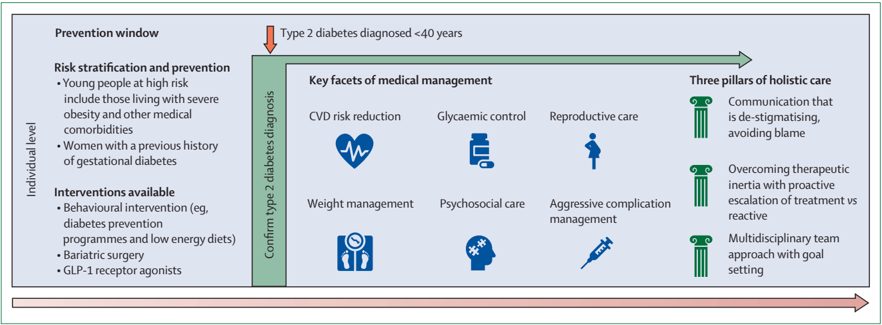
“treatment guidelines are not dissimilar for adults diagnosed at age 22 years or 62 years, 31,32”
§ Managing early-onset type 2 diabetes in the individual and at the population level > Why early-onset type 2 diabetes needs a different approach
What the sources say
- Not checked yetcites [31] Wong J, Ross GP, Zoungas S, et al. Management of type 2 diabetes in young adults aged 18-30 years: ADS/ADEA/APEG consensus statement. Med J Aust 2022; 216: 422-29. source
Checked before — its earlier verdict is held back until a new check runs.
- Partly supportedcites [32] Davies MJ, Aroda VR, Collins BS, et al. Management of hyperglycemia in type 2 diabetes, 2022. A consensus report by the American Diabetes Association (ADA) and the European Association for the Study of Diabetes (EASD). Diabetes Care 2022; 45: 2753-86. sourceExperimental — accuracy not yet measured
The ADA/EASD 2022 consensus report does support the general thrust: in 'Additional Clinical Considerations Age: Older People With Diabetes' it concludes that 'recommendations for the selection of medications to improve cardiovascular and kidney outcomes do not differ for older people' (echoed in the Consensus Recommendations bullet 'In general, selection of medications to improve cardiovascular and kidney outcomes should not differ for older people'), and in 'Age: Younger People With Diabetes' it says younger people 'should be considered at very high risk for complications and treated correspondingly.' However, the same sections make age-dependent distinctions the claim glosses over — a recommendation to 'consider early combination therapy' specifically in people <40 years, tailored glycemic targets factoring in 'younger age (i.e., age < 40 years)' (THE RATIONALE... section), and modification/deprescribing for frail older adults — and its 'older' category is defined as >65 years, so a diagnosis at 62 is not the population that passage addresses. The claim of broadly similar guidance for a 22- versus 62-year-old is therefore only partly attributable to this source. (LLM, conf=0.75)
plain- Asserted: passes — The authors put it forward as true.
- Checkable: passes — It can be checked against evidence.
- Load-bearing: unclear — It is unclear whether the paper’s conclusions depend on it.
- Based: passes — The paper gives a reason why it holds.
- Not checked yet
A statement the paper makes itself — it cites no source for it, so there is none to check. The quote shows it is in the paper.
In the paper
“As outlined in this Series, most early-onset diabetes cases are accompanied by excess adiposity.”
§ Managing early-onset type 2 diabetes in the individual and at the population level > Pharmacotherapy
plainstates an association- Asserted: passes — The authors put it forward as true.
- Checkable: passes — It can be checked against evidence.
- Load-bearing: passes — The paper’s conclusions depend on it.
- Based: passes — The paper gives a reason why it holds.
A statement the paper makes itself — it cites no source for it, so there is none to check. The quote shows it is in the paper.
In the paper
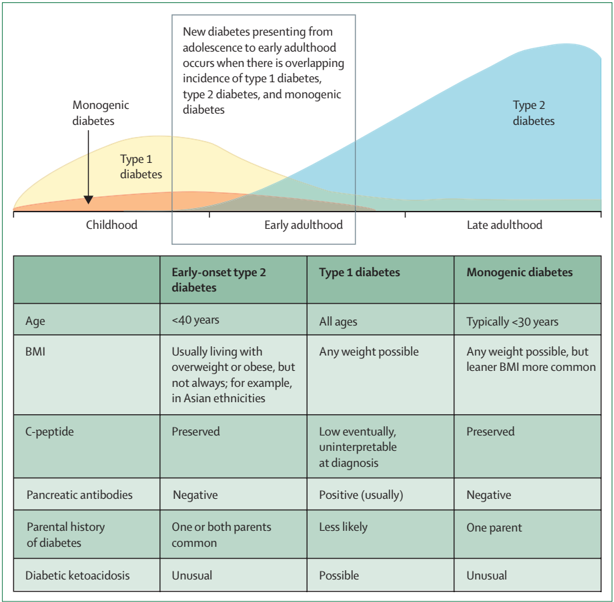
“the probability of alternative diabetes subtypes in those diagnosed before age 40 years is higher, including type 1 and monogenic diabetes.”
§ Managing early-onset type 2 diabetes in the individual and at the population level > Why early-onset type 2 diabetes needs a different approach
plainstates an association- Asserted: passes — The authors put it forward as true.
- Checkable: passes — It can be checked against evidence.
- Load-bearing: passes — The paper’s conclusions depend on it.
- Based: passes — The paper gives a reason why it holds.
54 more claims
Create a free account to see all 130 claims and to verify the 136 references still open.
- It may state two separate claims as one. 56
- Probably not a substantial claim. 21
Claims other papers make about this one
Each is checked against this paper’s own text: does it say what the citing paper says it does?
In the citing paper
“In addition to physical complications, existing evidence suggests that EOT2D is associated with unique psychosocial challenges and an increased risk of mental health comorbidities (the presence of two or more conditions), such as anxiety, depression and diabetes‐related distress.”
From Psychosocial care and experiences in young adults living with early‐onset type 2 diabetes: A narrative review (2026) · cites this paper as [7]
In the citing paper
“Recent recommendations for the management of EOT2D have highlighted the importance of mental well‐being, identifying it as an essential component of care and a key treatment target.”
From Psychosocial care and experiences in young adults living with early‐onset type 2 diabetes: A narrative review (2026) · cites this paper as [7]
In the citing paper
“Although unsurprising, these findings are of concern as rates of EOT2D are especially higher in these underserved groups, which are already typically more affected by social and health inequalities.”
From Psychosocial care and experiences in young adults living with early‐onset type 2 diabetes: A narrative review (2026) · cites this paper as [7]
In the citing paper
“Longitudinal studies show that youth diagnosed with T2DM face disproportionately early microvascular and macrovascular complications, along with increased mortality [[4], [5]].”
From Transition to adult diabetes care for young adults with type 2 diabetes: Challenge and opportunity (2026) · cites this paper as [5]
In the citing paper
“The fundamental gap in the current management of EOT2D is the failure of traditional, episodic care models to mitigate the uniquely aggressive trajectory of EOT2D [28, 60].”
From Digital Management of Early-Onset Type 2 Diabetes: Empowerment, Challenges, and Future Outlook (2026) · cites this paper as [60]
Self-check
Percentages, sums and reported differences re-computed from the paper’s own numbers.
Each contradiction between two passages listed here was confirmed by an independent check.
Rated minor: it would not touch a result — a value no result rests on, a p-value that stays on the same side of the significance level, or a conflict that is clerical, resolved elsewhere in the paper, or outside its own findings.
In the paper
§ Managing early-onset type 2 diabetes in the individual and at the population level > Pharmacotherapy
“metformin did not lead to significantly better outcomes than glimepiride, placebo, or rosiglitazone for glycaemic control”
§ Managing early-onset type 2 diabetes in the individual and at the population level > Pharmacotherapy
“(mean difference [MD] in glycated haemoglobin [HbA 1c ] -0•67%; 95% CI -1•65 to -0•31) or BMI (-0•64 kg/m²; -1•84 to -0•56)”
Citations
Cites
GRADE: an emerging consensus on rating quality of evidence and strength of recommendations
Guyatt, G. H., Oxman, A. D., Vist, G. E., Kunz, R., Falck-Ytter, Y., Alonso-Coello, P., & Schünemann, H. J. (2008) · BMJ · doi:10.1136/bmj.39489.470347.ad · Cited by 23,305
Abarca-Gómez, L., Abdeen, Z. A., Hamid, Z. A., Abu-Rmeileh, N. M., Acosta-Cazares, B., Acuin, C., Adams, R. J., Aekplakorn, W., Afsana, K., Aguilar-Salinas, C. A., et al. (2017) · The Lancet · doi:10.1016/s0140-6736(17)32129-3 · Cited by 7,482
Ong, K. L., Stafford, L. K., McLaughlin, S. A., Boyko, E. J., Vollset, S. E., Smith, A. E., Dalton, B. E., Duprey, J., Cruz, J. A., Hagins, H., et al. (2023) · The Lancet · doi:10.1016/s0140-6736(23)01301-6 · Cited by 6,146
Self-citationInterventions for preventing obesity in children
Brown, T., Moore, T. H., Hooper, L., Gao, Y., Zayegh, A., Ijaz, S., Elwenspoek, M., Foxen, S. C., Magee, L., O'Malley, C., et al. (2019) · Cochrane Database of Systematic Reviews · doi:10.1002/14651858.cd001871.pub4 · Cited by 2,982
Davies, M. J., Aroda, V. R., Collins, B. S., Gabbay, R. A., Green, J., Maruthur, N. M., Rosas, S. E., Del Prato, S., Mathieu, C., Mingrone, G., et al. (2022) · Diabetes Care · doi:10.2337/dci22-0034 · Cited by 2,104
Lean, M. E., Leslie, W. S., Barnes, A. C., Brosnahan, N., Thom, G., McCombie, L., Peters, C., Zhyzhneuskaya, S., Al-Mrabeh, A., Hollingsworth, K. G., et al. (2018) · The Lancet · doi:10.1016/s0140-6736(17)33102-1 · Cited by 2,095
Social determinants of health and diabetes: A scientific review
Hill-Briggs, F., Adler, N. E., Berkowitz, S. A., Chin, M. H., Gary-Webb, T. L., Navas-Acien, A., Thornton, P. L., & Haire-Joshu, D. (2021) · Diabetes Care · doi:10.2337/dci20-0053 · Cited by 1,732
Hampl, S. E., Hassink, S. G., Skinner, A. C., Armstrong, S. C., Barlow, S. E., Bolling, C. F., Avila Edwards, K. C., Eneli, I., Hamre, R., Joseph, M. M., et al. (2023) · Pediatrics · doi:10.1542/peds.2022-060640 · Cited by 1,389
Vounzoulaki, E., Khunti, K., Abner, S. C., Tan, B. K., Davies, M. J., & Gillies, C. L. (2020) · BMJ · doi:10.1136/bmj.m1361 · Cited by 1,150
Self-citationZhou, B., Rayner, A. W., Gregg, E. W., Sheffer, K. E., Carrillo-Larco, R. M., Bennett, J. E., Shaw, J. E., Paciorek, C. J., Singleton, R. K., Barradas Pires, A., et al. (2024) · The Lancet · doi:10.1016/s0140-6736(24)02317-1 · Cited by 1,013
The double burden of malnutrition: aetiological pathways and consequences for health
Wells, J. C., Sawaya, A. L., Wibaek, R., Mwangome, M., Poullas, M. S., Yajnik, C. S., & Demaio, A. (2020) · The Lancet · doi:10.1016/s0140-6736(19)32472-9 · Cited by 993
A Clinical Trial to Maintain Glycemic Control in Youth with Type 2 Diabetes
TODAY Study Group (2012) · New England Journal of Medicine · doi:10.1056/nejmoa1109333 · Cited by 971
Tuberculosis and diabetes mellitus: convergence of two epidemics
Dooley, K. E., & Chaisson, R. E. (2009) · The Lancet Infectious Diseases · doi:10.1016/s1473-3099(09)70282-8 · Cited by 932
Adair, L. S., Fall, C. H., Osmond, C., Stein, A. D., Martorell, R., Ramirez-Zea, M., Sachdev, H. S., Dahly, D. L., Bas, I., Norris, S. A., et al. (2013) · The Lancet · doi:10.1016/s0140-6736(13)60103-8 · Cited by 895
Weight loss and health status 3 years after bariatric surgery in adolescents
Inge, T. H., Courcoulas, A. P., Jenkins, T. M., Michalsky, M. P., Helmrath, M. A., Brandt, M. L., Harmon, C. M., Zeller, M. H., Chen, M. K., Xanthakos, S. A., et al. (2016) · New England Journal of Medicine · doi:10.1056/nejmoa1506699 · Cited by 750
Once-weekly semaglutide in adolescents with obesity
Weghuber, D., Barrett, T., Barrientos-Pérez, M., Gies, I., Hesse, D., Jeppesen, O. K., Kelly, A. S., Mastrandrea, L. D., Sørrig, R., & Arslanian, S. (2022) · New England Journal of Medicine · doi:10.1056/nejmoa2208601 · Cited by 730
A Randomized, Controlled Trial of Liraglutide for Adolescents with Obesity
Kelly, A. S., Auerbach, P., Barrientos-Perez, M., Gies, I., Hale, P. M., Marcus, C., Mastrandrea, L. D., Prabhu, N., & Arslanian, S. (2020) · New England Journal of Medicine · doi:10.1056/nejmoa1916038 · Cited by 723
20-Year Follow-up of Statins in Children with Familial Hypercholesterolemia
Luirink, I. K., Wiegman, A., Kusters, D. M., Hof, M. H., Groothoff, J. W., de Groot, E., Kastelein, J. J. P., & Hutten, B. A. (2019) · New England Journal of Medicine · doi:10.1056/nejmoa1816454 · Cited by 654
Clinical Inertia in People With Type 2 Diabetes
Khunti, K., Wolden, M. L., Thorsted, B. L., Andersen, M., & Davies, M. J. (2013) · Diabetes Care · doi:10.2337/dc13-0331 · Cited by 613
Self-citationSattar, N., Rawshani, A., Franzén, S., Rawshani, A., Svensson, A.-M., Rosengren, A., McGuire, D. K., Eliasson, B., & Gudbjörnsdottir, S. (2019) · Circulation · doi:10.1161/circulationaha.118.037885 · Cited by 555
ASMBS pediatric metabolic and bariatric surgery guidelines, 2018
Pratt, J. S. A., Browne, A., Browne, N. T., Bruzoni, M., Cohen, M., Desai, A., Inge, T., Linden, B. C., Mattar, S. G., Michalsky, M., et al. (2018) · Surgery for Obesity and Related Diseases · doi:10.1016/j.soard.2018.03.019 · Cited by 555
Long-term complications in youth-onset type 2 diabetes
TODAY Study Group (2021) · New England Journal of Medicine · doi:10.1056/nejmoa2100165 · Cited by 546
Preventing childhood obesity: what works?
Birch, L. L., & Ventura, A. K. (2009) · International Journal of Obesity · doi:10.1038/ijo.2009.22 · Cited by 519
Young-onset type 2 diabetes mellitus — implications for morbidity and mortality
Magliano, D. J., Sacre, J. W., Harding, J. L., Gregg, E. W., Zimmet, P. Z., & Shaw, J. E. (2020) · Nature Reviews Endocrinology · doi:10.1038/s41574-020-0334-z · Cited by 483
Obesity prevention: the case for action
Kumanyika, S., Jeffery, R., Morabia, A., Ritenbaugh, C., & Antipatis, V. (2002) · International Journal of Obesity · doi:10.1038/sj.ijo.0801938 · Cited by 483
Copeland, K. C., Zeitler, P., Geffner, M., Guandalini, C., Higgins, J., Hirst, K., Kaufman, F. R., Linder, B., Marcovina, S., McGuigan, P., et al. (2011) · The Journal of Clinical Endocrinology & Metabolism · doi:10.1210/jc.2010-1642 · Cited by 464
Tirzepatide for Obesity Treatment and Diabetes Prevention
Jastreboff, A. M., le Roux, C. W., Stefanski, A., Aronne, L. J., Halpern, B., Wharton, S., Wilding, J. P. H., Perreault, L., Zhang, S., Battula, R., et al. (2025) · New England Journal of Medicine · doi:10.1056/nejmoa2410819 · Cited by 462
Heslehurst, N., Vieira, R., Akhter, Z., Bailey, H., Slack, E., Ngongalah, L., Pemu, A., & Rankin, J. (2019) · PLOS Medicine · doi:10.1371/journal.pmed.1002817 · Cited by 435
Caleyachetty, R., Barber, T. M., Mohammed, N. I., Cappuccio, F. P., Hardy, R., Mathur, R., Banerjee, A., & Gill, P. (2021) · The Lancet Diabetes & Endocrinology · doi:10.1016/s2213-8587(21)00088-7 · Cited by 429
The Burden of Treatment Failure in Type 2 Diabetes
Brown, J. B., Nichols, G. A., & Perry, A. (2004) · Diabetes Care · doi:10.2337/diacare.27.7.1535 · Cited by 424
Nanayakkara, N., Curtis, A. J., Heritier, S., Gadowski, A. M., Pavkov, M. E., Kenealy, T., Owens, D. R., Thomas, R. L., Song, S., Wong, J., et al. (2021) · Diabetologia · doi:10.1007/s00125-020-05319-w · Cited by 393
Interventions for Childhood Obesity in the First 1,000 Days A Systematic Review
Blake-Lamb, T. L., Locks, L. M., Perkins, M. E., Woo Baidal, J. A., Cheng, E. R., & Taveras, E. M. (2016) · American Journal of Preventive Medicine · doi:10.1016/j.amepre.2015.11.010 · Cited by 373
Matthews, D. R., Paldánius, P. M., Proot, P., Chiang, Y., Stumvoll, M., & Del Prato, S. (2019) · The Lancet · doi:10.1016/s0140-6736(19)32131-2 · Cited by 364
Liraglutide in Children and Adolescents with Type 2 Diabetes
Tamborlane, W. V., Barrientos-Pérez, M., Fainberg, U., Frimer-Larsen, H., Hafez, M., Hale, P. M., Jalaludin, M. Y., Kovarenko, M., Libman, I., Lynch, J. L., et al. (2019) · New England Journal of Medicine · doi:10.1056/nejmoa1903822 · Cited by 357
Murphy, H. R., Howgate, C., O'Keefe, J., Myers, J., Morgan, M., Coleman, M. A., Jolly, M., Valabhji, J., Scott, E. M., Knighton, P., et al. (2021) · The Lancet Diabetes & Endocrinology · doi:10.1016/s2213-8587(20)30406-x · Cited by 346
Trends in incidence of total or type 2 diabetes: systematic review
Magliano, D. J., Islam, R. M., Barr, E. L. M., Gregg, E. W., Pavkov, M. E., Harding, J. L., Tabesh, M., Koye, D. N., & Shaw, J. E. (2019) · BMJ · doi:10.1136/bmj.l5003 · Cited by 346
Rito, A. I., Buoncristiano, M., Spinelli, A., Salanave, B., Kunešová, M., Hejgaard, T., García Solano, M., Fijałkowska, A., Sturua, L., Hyska, J., et al. (2019) · Obesity Facts · doi:10.1159/000500425 · Cited by 316
Xie, J., Wang, M., Long, Z., Ning, H., Li, J., Cao, Y., Liao, Y., Liu, G., Wang, F., & Pan, A. (2022) · BMJ · doi:10.1136/bmj-2022-072385 · Cited by 300
TODAY Study Group (2013) · Diabetes Care · doi:10.2337/dc12-2393 · Cited by 288
Flood, D., Seiglie, J. A., Dunn, M., Tschida, S., Theilmann, M., Marcus, M. E., Brian, G., Norov, B., Mayige, M. T., Gurung, M. S., et al. (2021) · The Lancet Healthy Longevity · doi:10.1016/s2666-7568(21)00089-1 · Cited by 277
Wagenknecht, L. E., Lawrence, J. M., Isom, S., Jensen, E. T., Dabelea, D., Liese, A. D., Dolan, L. M., Shah, A. S., Bellatorre, A., Sauder, K., et al. (2023) · The Lancet Diabetes & Endocrinology · doi:10.1016/s2213-8587(23)00025-6 · Cited by 264
15. Management of Diabetes in Pregnancy: Standards of Care in Diabetes—2025
American Diabetes Association Professional Practice Committee, ElSayed, N. A., McCoy, R. G., Aleppo, G., Balapattabi, K., Beverly, E. A., Briggs Early, K., Bruemmer, D., Echouffo-Tcheugui, J. B., Ekhlaspour, L., et al. (2025) · Diabetes Care · doi:10.2337/dc25-s015 · Cited by 252
Self-citationFeig, D. S., Donovan, L. E., Zinman, B., Sanchez, J. J., Asztalos, E., Ryan, E. A., Fantus, I. G., Hutton, E., Armson, A. B., Lipscombe, L. L., et al. (2020) · The Lancet Diabetes & Endocrinology · doi:10.1016/s2213-8587(20)30310-7 · Cited by 234
15. Management of Diabetes in Pregnancy: Standards of Care in Diabetes—2024
American Diabetes Association Professional Practice Committee, ElSayed, N. A., Aleppo, G., Bannuru, R. R., Bruemmer, D., Collins, B. S., Ekhlaspour, L., Hilliard, M. E., Johnson, E. L., Khunti, K., et al. (2024) · Diabetes Care · doi:10.2337/dc24-s015 · Cited by 232
Self-citationKaptoge, S., Seshasai, S., Sun, L., Walker, M., Bolton, T., Spackman, S., Ataklte, F., Willeit, P., Bell, S., Burgess, S., et al. (2023) · The Lancet Diabetes & Endocrinology · doi:10.1016/s2213-8587(23)00223-1 · Cited by 231
Current insights and emerging trends in early-onset type 2 diabetes
Misra, S., Ke, C., Srinivasan, S., Goyal, A., Nyriyenda, M. J., Florez, J. C., Khunti, K., Magliano, D. J., & Luk, A. (2023) · The Lancet Diabetes & Endocrinology · doi:10.1016/s2213-8587(23)00225-5 · Cited by 222
Self-citationMohan, V, Deepa, M., Bhansali, A., Anjana, R., Pradeepa, R., Joshi, Sr., Joshi, P., Dhandhania, V., Rao, P., Subashini, R., et al. (2014) · Indian Journal of Endocrinology and Metabolism · doi:10.4103/2230-8210.131191 · Cited by 213
Cardiovascular Risk and Statin Eligibility of Young Adults After an MI
Singh, A., Collins, B. L., Gupta, A., Fatima, A., Qamar, A., Biery, D., Baez, J., Cawley, M., Klein, J., Hainer, J., et al. (2018) · Journal of the American College of Cardiology · doi:10.1016/j.jacc.2017.11.007 · Cited by 212
Early Outcomes From the English National Health Service Diabetes Prevention Programme
Valabhji, J., Barron, E., Bradley, D., Bakhai, C., Fagg, J., O’Neill, S., Young, B., Wareham, N., Khunti, K., Jebb, S., et al. (2020) · Diabetes Care · doi:10.2337/dc19-1425 · Cited by 211
Self-citationChow, C. K., Ramasundarahettige, C., Hu, W., AlHabib, K. F., Avezum, A., Cheng, X., Chifamba, J., Dagenais, G., Dans, A., Egbujie, B. A., et al. (2018) · The Lancet Diabetes & Endocrinology · doi:10.1016/s2213-8587(18)30233-x · Cited by 203
Safety of GLP-1 Receptor Agonists and Other Second-Line Antidiabetics in Early Pregnancy
Cesta, C. E., Rotem, R., Bateman, B. T., Chodick, G., Cohen, J. M., Furu, K., Gissler, M., Huybrechts, K. F., Kjerpeseth, L. J., Leinonen, M. K., et al. (2024) · JAMA Internal Medicine · doi:10.1001/jamainternmed.2023.6663 · Cited by 200
Famine Exposure in the Young and the Risk of Type 2 Diabetes in Adulthood
van Abeelen, A. F. M., Elias, S. G., Bossuyt, P. M. M., Grobbee, D. E., van der Schouw, Y. T., Roseboom, T. J., & Uiterwaal, C. S. P. M. (2012) · Diabetes · doi:10.2337/db11-1559 · Cited by 196
Gooding, H. C., Gidding, S. S., Moran, A. E., Redmond, N., Allen, N. B., Bacha, F., Burns, T. L., Catov, J. M., Grandner, M. A., Harris, K. M., et al. (2020) · Journal of the American Heart Association · doi:10.1161/jaha.120.016115 · Cited by 189
Lean, M. E., Leslie, W. S., Barnes, A. C., Brosnahan, N., Thom, G., McCombie, L., Kelly, T., Irvine, K., Peters, C., Zhyzhneuskaya, S., et al. (2024) · The Lancet Diabetes & Endocrinology · doi:10.1016/s2213-8587(23)00385-6 · Cited by 186
Constraints and challenges in access to insulin: a global perspective
Beran, D., Ewen, M., & Laing, R. (2016) · The Lancet Diabetes & Endocrinology · doi:10.1016/s2213-8587(15)00521-5 · Cited by 186
Self-citationIssues of Unequal Access to Public Health in India
Barik, D., & Thorat, A. (2015) · Frontiers in Public Health · doi:10.3389/fpubh.2015.00245 · Cited by 178
Lean diabetes mellitus: An emerging entity in the era of obesity
George, A. M., Jacob, A. G., & Fogelfeld, L. (2015) · World Journal of Diabetes · doi:10.4239/wjd.v6.i4.613 · Cited by 177
The RISE Consortium, Nadeau, K. J., Hannon, T. S., Edelstein, S. L., Arslanian, S. A., Caprio, S., Leschek, E. W., Zeitler, P. S., Buchanan, T. A., Ehrmann, D. A., et al. (2018) · Diabetes Care · doi:10.2337/dc18-0787 · Cited by 176
14. Children and Adolescents: Standards of Care in Diabetes—2025
American Diabetes Association Professional Practice Committee, ElSayed, N. A., McCoy, R. G., Aleppo, G., Balapattabi, K., Beverly, E. A., Briggs Early, K., Bruemmer, D., Echouffo-Tcheugui, J. B., Ekhlaspour, L., et al. (2025) · Diabetes Care · doi:10.2337/dc25-s014 · Cited by 173
Self-citationReducing Obesity: Motivating Action While Not Blaming the Victim
ADLER, N. E., & STEWART, J. (2009) · The Milbank Quarterly · doi:10.1111/j.1468-0009.2009.00547.x · Cited by 171
ISPAD Clinical Practice Consensus Guidelines 2022: Type 2 diabetes in children and adolescents
Shah, A. S., Zeitler, P. S., Wong, J., Pena, A. S., Wicklow, B., Arslanian, S., Chang, N., Fu, J., Dabadghao, P., Pinhas‐Hamiel, O., et al. (2022) · Pediatric Diabetes · doi:10.1111/pedi.13409 · Cited by 170
Diabetes in South Asians: Is the Phenotype Different?
Unnikrishnan, R., Anjana, R. M., & Mohan, V. (2014) · Diabetes · doi:10.2337/db13-1592 · Cited by 165
Adolescent Obesity and Early-Onset Type 2 Diabetes
Twig, G., Zucker, I., Afek, A., Cukierman-Yaffe, T., Bendor, C. D., Derazne, E., Lutski, M., Shohat, T., Mosenzon, O., Tzur, D., et al. (2020) · Diabetes Care · doi:10.2337/dc19-1988 · Cited by 161
Salam, R. A., Padhani, Z. A., Das, J. K., Shaikh, A. Y., Hoodbhoy, Z., Jeelani, S. M., Lassi, Z. S., & Bhutta, Z. A. (2020) · Nutrients · doi:10.3390/nu12082208 · Cited by 161
Pekka, P., Pirjo, P., & Ulla, U. (2002) · Public Health Nutrition · doi:10.1079/phn2001300 · Cited by 151
Once-Weekly Dulaglutide for the Treatment of Youths with Type 2 Diabetes
Arslanian, S. A., Hannon, T., Zeitler, P., Chao, L. C., Boucher-Berry, C., Barrientos-Pérez, M., Bismuth, E., Dib, S., Cho, J. I., & Cox, D. (2022) · New England Journal of Medicine · doi:10.1056/nejmoa2204601 · Cited by 150
Models of transitional care for young people with complex health needs: a scoping review
Watson, R., Parr, J. R., Joyce, C., May, C., & Le Couteur, A. S. (2011) · Child: Care, Health and Development · doi:10.1111/j.1365-2214.2011.01293.x · Cited by 143
Glimepiride Versus Metformin as Monotherapy in Pediatric Patients With Type 2 Diabetes
Gottschalk, M., Danne, T., Vlajnic, A., & Cara, J. F. (2007) · Diabetes Care · doi:10.2337/dc06-1554 · Cited by 143
Liraglutide for Children 6 to <12 Years of Age with Obesity — A Randomized Trial
Fox, C. K., Barrientos-Pérez, M., Bomberg, E. M., Dcruz, J., Gies, I., Harder-Lauridsen, N. M., Jalaludin, M. Y., Sahu, K., Weimers, P., Zueger, T., et al. (2025) · New England Journal of Medicine · doi:10.1056/nejmoa2407379 · Cited by 142
Interventions to prevent obesity in children aged 5 to 11 years old
Spiga, F., Davies, A. L., Tomlinson, E., Moore, T. H., Dawson, S., Breheny, K., Savović, J., Gao, Y., Phillips, S. M., Hillier-Brown, F. C., et al. (2024) · Cochrane Database of Systematic Reviews · doi:10.1002/14651858.cd015328.pub2 · Cited by 130
Shields, B. M., Peters, J. L., Cooper, C., Lowe, J., Knight, B. A., Powell, R. J., Jones, A., Hyde, C. J., & Hattersley, A. T. (2015) · BMJ Open · doi:10.1136/bmjopen-2015-009088 · Cited by 126
Hampl, S. E., Hassink, S. G., Skinner, A. C., Armstrong, S. C., Barlow, S. E., Bolling, C. F., Avila Edwards, K. C., Eneli, I., Hamre, R., Joseph, M. M., et al. (2023) · Pediatric Collections: Adolescent Health Part 1: Promoting Wellness · doi:10.1542/9781610027052-part01-clinical · Cited by 126
Grijalva-Eternod, C. S., Wells, J. C. K., Cortina‐Borja, M., Salse-Ubach, N., Tondeur, M. C., Dolan, C., Meziani, C., Wilkinson, C., Spiegel, P. B., & Seal, A. (2012) · PLoS Medicine · doi:10.1371/journal.pmed.1001320 · Cited by 125
Ryan, P. M., Seltzer, S., Hayward, N. E., Rodriguez, D. A., Sless, R. T., & Hawkes, C. P. (2021) · The Journal of Pediatrics · doi:10.1016/j.jpeds.2021.05.009 · Cited by 111
Dispelling myths and removing barriers about insulin in type 2 diabetes
Meece, J. (2006) · The Diabetes Educator · doi:10.1177/0145721705285638 · Cited by 111
Dao, K., Shechtman, S., Weber-Schoendorfer, C., Diav-Citrin, O., Murad, R. H., Berlin, M., Hazan, A., Richardson, J. L., Eleftheriou, G., Rousson, V., et al. (2024) · BMJ Open · doi:10.1136/bmjopen-2023-083550 · Cited by 110
Laffel, L. M., Danne, T., Klingensmith, G. J., Tamborlane, W. V., Willi, S., Zeitler, P., Neubacher, D., Marquard, J., Bardymova, T., Barrientos Perez, M., et al. (2023) · The Lancet Diabetes & Endocrinology · doi:10.1016/s2213-8587(22)00387-4 · Cited by 106
Klein, D. J., Battelino, T., Chatterjee, D. J., Jacobsen, L. V., Hale, P. M., Arslanian, S., & on behalf of the NN2211-1800 Study Group (2014) · Diabetes Technology & Therapeutics · doi:10.1089/dia.2013.0366 · Cited by 101
Tamborlane, W. V., Laffel, L. M., Shehadeh, N., ISGANAITIS, E. M., Name, M. A. V., Ratnayake, J., Karlsson, C., & Norjavaara, E. (2022) · The Lancet Diabetes & Endocrinology · doi:10.1016/s2213-8587(22)00052-3 · Cited by 100
Early life factors and type 2 diabetes mellitus
Jiang, X., Ma, H., Wang, Y., & Liu, Y. (2013) · Journal of Diabetes Research · doi:10.1155/2013/485082 · Cited by 92
Interventions to prevent obesity in children aged 12 to 18 years old
Spiga, F., Tomlinson, E., Davies, A. L., Moore, T. H., Dawson, S., Breheny, K., Savović, J., Hodder, R. K., Wolfenden, L., Higgins, J. P. T., et al. (2024) · Cochrane Database of Systematic Reviews · doi:10.1002/14651858.cd015330.pub2 · Cited by 91
Kral, T. V. E., Chittams, J., & Moore, R. H. (2017) · Journal for Specialists in Pediatric Nursing · doi:10.1111/jspn.12177 · Cited by 91
Once-Weekly Exenatide in Youth With Type 2 Diabetes
Tamborlane, W. V., Bishai, R., Geller, D., Shehadeh, N., Al-Abdulrazzaq, D., Vazquez, E. M., Karoly, E., Troja, T., Doehring, O., Carter, D., et al. (2022) · Diabetes Care · doi:10.2337/dc21-2275 · Cited by 91
Siddiqui, M. K., Anjana, R. M., Dawed, A. Y., Martoeau, C., Srinivasan, S., Saravanan, J., Madanagopal, S. K., Taylor, A., Bell, S., Veluchamy, A., et al. (2022) · Diabetologia · doi:10.1007/s00125-022-05671-z · Cited by 88
Kahn, S. E., Deanfield, J. E., Jeppesen, O. K., Emerson, S. S., Boesgaard, T. W., Colhoun, H. M., Kushner, R. F., Lingvay, I., Burguera, B., Gajos, G., et al. (2024) · Diabetes Care · doi:10.2337/dc24-0491 · Cited by 86
Ke, C., Lau, E., Shah, B. R., Stukel, T. A., Ma, R. C., So, W.-Y., Kong, A. P., Chow, E., Clarke, P., Goggins, W., et al. (2019) · Annals of Internal Medicine · doi:10.7326/m18-1900 · Cited by 85
Ten-year outcomes after bariatric surgery in adolescents
Ryder, J. R., Jenkins, T. M., Xie, C., Courcoulas, A. P., Harmon, C. M., Helmrath, M. A., Sisley, S., Michalsky, M. P., Brandt, M., & Inge, T. H. (2024) · New England Journal of Medicine · doi:10.1056/nejmc2404054 · Cited by 83
Early-onset type 2 diabetes: the next major diabetes transition
Luk, A., Wild, S. H., Jones, S., Anjana, R. M., Hivert, M.-F., McCaffrey, J., Gregg, E. W., & Misra, S. (2025) · The Lancet · doi:10.1016/s0140-6736(25)00830-x · Cited by 81
Self-citationTreatment of Type 2 Diabetes in Childhood Using a Very-Low-Calorie Diet
Willi, S. M., Martin, K., Datko, F. M., & Brant, B. P. (2004) · Diabetes Care · doi:10.2337/diacare.27.2.348 · Cited by 81
Clinical management of type 2 diabetes in south Asia
Misra, A., Sattar, N., Tandon, N., Shrivastava, U., Vikram, N. K., Khunti, K., & Hills, A. P. (2018) · The Lancet Diabetes & Endocrinology · doi:10.1016/s2213-8587(18)30199-2 · Cited by 78
Self-citationPsychosocial aspects of diabetes management: dilemma of diabetes distress
Tareen, R. S., & Tareen, K. (2017) · Translational Pediatrics · doi:10.21037/tp.2017.10.04 · Cited by 78
Valabhji, J., Gorton, T., Barron, E., Safazadeh, S., Earnshaw, F., Helm, C., Virr, M., Kernan, J., Crowe, S., Aveyard, P., et al. (2024) · The Lancet Diabetes & Endocrinology · doi:10.1016/s2213-8587(24)00194-3 · Cited by 72
Taylor, R., Barnes, A. C., Hollingsworth, K. G., Irvine, K. M., Solovyova, A. S., Clark, L., Kelly, T., Martin-Ruiz, C., Romeres, D., Koulman, A., et al. (2023) · Clinical Science · doi:10.1042/cs20230586 · Cited by 71
Barriers and solutions to diabetes management: an Indian perspective
Wangnoo, S., Maji, D., Das, A., Rao, P., Moses, A., Sethi, B., Unnikrishnan, A., Kalra, S., Balaji, V, Bantwal, G., et al. (2013) · Indian Journal of Endocrinology and Metabolism · doi:10.4103/2230-8210.113749 · Cited by 66
Developmental undernutrition, offspring obesity and type 2 diabetes
Stein, A. D., Obrutu, O. E., Behere, R. V., & Yajnik, C. S. (2019) · Diabetologia · doi:10.1007/s00125-019-4930-1 · Cited by 62
Ford, N. D., Behrman, J. R., Hoddinott, J. F., Maluccio, J. A., Martorell, R., Ramirez-Zea, M., & Stein, A. D. (2018) · The Lancet Global Health · doi:10.1016/s2214-109x(18)30231-6 · Cited by 61
Xie, J., Wang, M., Long, Z., Ning, H., Li, J., Cao, Y., Liao, Y., Liu, G., Wang, F., & Pan, A. (2023) · Yearbook of pediatric endocrinology · doi:10.1530/ey.20.11.9 · Cited by 60
Understanding the drivers and consequences of early-onset type 2 diabetes
Lim, L.-L., Jones, S., Cikomola, J. C., Hivert, M.-F., & Misra, S. (2025) · The Lancet · doi:10.1016/s0140-6736(25)01012-8 · Cited by 59
Self-citationUS Preventive Services Task Force, Mangione, C. M., Barry, M. J., Nicholson, W. K., Cabana, M., Chelmow, D., Coker, T. R., Davidson, K. W., Davis, E. M., Donahue, K. E., et al. (2022) · JAMA · doi:10.1001/jama.2022.14543 · Cited by 57
Pathophysiology and treatment of prediabetes and type 2 diabetes in youth
Bacha, F., Hannon, T. S., Tosur, M., Pike, J. M., Butler, A., Tommerdahl, K. L., & Zeitler, P. S. (2024) · Diabetes Care · doi:10.2337/dci24-0029 · Cited by 57
Agarwal, S., Raymond, J. K., Isom, S., Lawrence, J. M., Klingensmith, G., Pihoker, C., Corathers, S., Saydah, S., D'Agostino, R. B., & Dabelea, D. (2018) · Diabetic Medicine · doi:10.1111/dme.13589 · Cited by 54
Shivashankar, R., Kirk, K., Kim, W. C., Rouse, C., Tandon, N., Venkat Narayan, K. M., & Ali, M. K. (2015) · Diabetes Research and Clinical Practice · doi:10.1016/j.diabres.2014.11.004 · Cited by 52
Self-citationManagement of diabetes in resource-poor settings
Grant, P. (2013) · Clinical Medicine · doi:10.7861/clinmedicine.13-1-27 · Cited by 50
Galderisi, A., Giannini, C., Weiss, R., Kim, G., Shabanova, V., Santoro, N., Pierpont, B., Savoye, M., & Caprio, S. (2018) · The Lancet Child & Adolescent Health · doi:10.1016/s2352-4642(18)30235-9 · Cited by 49
Humphries, S. E., Cooper, J., Dale, P., & Ramaswami, U. (2018) · Journal of Clinical Lipidology · doi:10.1016/j.jacl.2017.11.005 · Cited by 48
Sargeant, J. A., Brady, E. M., Zaccardi, F., Tippins, F., Webb, D. R., Aroda, V. R., Gregg, E. W., Khunti, K., & Davies, M. J. (2020) · Diabetologia · doi:10.1007/s00125-020-05174-9 · Cited by 46
Self-citationMisra, S., Holman, N., Barron, E., Knighton, P., Warner, J., Kar, P., Young, B., & Valabhji, J. (2023) · Diabetic Medicine · doi:10.1111/dme.14940 · Cited by 46
Self-citationArslanian, S. A., El ghormli, L., Kim, J. Y., Tjaden, A. H., Barengolts, E., Caprio, S., Hannon, T. S., Mather, K. J., Nadeau, K. J., Utzschneider, K. M., et al. (2021) · Diabetes Care · doi:10.2337/dc20-2134 · Cited by 45
Dapagliflozin or Saxagliptin in Pediatric Type 2 Diabetes
Shehadeh, N., Barrett, T. G., Galassetti, P. R., Karlsson, C., Monyak, J. T., Iqbal, N., & Tamborlane, W. V. (2023) · NEJM Evidence · doi:10.1056/evidoa2300210 · Cited by 45
Heerman, W. J., Rothman, R. L., Sanders, L. M., Schildcrout, J. S., Flower, K. B., Delamater, A. M., Kay, M. C., Wood, C. T., Gross, R. S., Bian, A., et al. (2024) · JAMA · doi:10.1001/jama.2024.22362 · Cited by 45
Current knowledge on the pathophysiology of lean/normal-weight type 2 diabetes
Salvatore, T., Galiero, R., Caturano, A., Rinaldi, L., Criscuolo, L., Di Martino, A., Albanese, G., Vetrano, E., Catalini, C., Sardu, C., et al. (2022) · International Journal of Molecular Sciences · doi:10.3390/ijms24010658 · Cited by 45
Khadilkar, V. V., Shah, N. B., Harish, R., Ayyavoo, A., Bang, A., Basu, S., Chatterjee, S., Chhatwal, J., Elizabeth, K. E., Ghate, S., et al. (2023) · Indian Pediatrics · doi:10.1007/s13312-023-3066-z · Cited by 43
Update on statin use in pregnancy
Poornima, I. G., Pulipati, V. P., Brinton, E. A., & Wild, R. A. (2023) · The American Journal of Medicine · doi:10.1016/j.amjmed.2022.08.029 · Cited by 43
Liu, L., Shi, H., Shi, Y., Wang, A., Guo, N., Tao, H., & Nahata, M. C. (2024) · Pharmaceuticals · doi:10.3390/ph17070828 · Cited by 40
Bonvicini, L., Pingani, I., Venturelli, F., Patrignani, N., Bassi, M. C., Broccoli, S., Ferrari, F., Gallelli, T., Panza, C., Vicentini, M., et al. (2022) · Preventive Medicine Reports · doi:10.1016/j.pmedr.2022.101940 · Cited by 40
Wu, Z., Gao, Z., Qiao, Y., Chen, F., Guan, B., Wu, L., Cheng, L., Huang, S., & Yang, J. (2023) · Obesity Surgery · doi:10.1007/s11695-023-06593-4 · Cited by 40
Breast-feeding and diabetes: long-term impact on mothers and their infants
Gunderson, E. P. (2008) · Current Diabetes Reports · doi:10.1007/s11892-008-0050-x · Cited by 38
Earle, S., Tariq, A., Komaromy, C., Lloyd, C. E., Karamat, M. A., Webb, J., & Gill, P. S. (2017) · Health Technology Assessment · doi:10.3310/hta21140 · Cited by 37
Pregnancy outcomes in young women with youth‐onset type 2 diabetes followed in the TODAY study
TODAY Study Group, Marcus, M. D., Gandica, R., El ghormli, L., Higgins, J., Tesfaldet, B., Koren, D., Macleish, S., Escaname, E. N., & Weinstock, R. S. (2022) · Diabetes Care · doi:10.2337/dc21-1071 · Cited by 37
Magliano, D. J., Chen, L., Morton, J. I., Salim, A., Carstensen, B., Gregg, E. W., Pavkov, M. E., Arffman, M., Colhoun, H. M., Ha, K. H., et al. (2024) · The Lancet Diabetes & Endocrinology · doi:10.1016/s2213-8587(24)00243-2 · Cited by 36
Self-citationPUSKA, P. (2000) · Acta Cardiologica · doi:10.2143/ac.55.4.2005743 · Cited by 34
Identifying barriers and facilitators to self care in young adults with type 2 diabetes
Wong, S. K. W., Soon, W., Griva, K., & Smith, H. E. (2024) · Diabetic Medicine · doi:10.1111/dme.15229 · Cited by 33
Cultural differences and considerations when initiating insulin
Rebolledo, J. A., & Arellano, R. (2016) · Diabetes Spectrum · doi:10.2337/diaspect.29.3.185 · Cited by 33
Psychosocial Factors and Glycemic Control in Young Adults With Youth-Onset Type 2 Diabetes
Trief, P. M., Wen, H., Burke, B., Uschner, D., Anderson, B. J., Liu, X., Bulger, J., & Weinstock, R. S. (2024) · JAMA Network Open · doi:10.1001/jamanetworkopen.2024.5620 · Cited by 32
Jalaludin, M. Y., Deeb, A., Zeitler, P., Garcia, R., Newfield, R. S., Samoilova, Y., Rosario, C. A., Shehadeh, N., Saha, C. K., Zhang, Y., et al. (2022) · Pediatric Diabetes · doi:10.1111/pedi.13282 · Cited by 31
Shankar, R. R., Zeitler, P., Deeb, A., Jalaludin, M. Y., Garcia, R., Newfield, R. S., Samoilova, Y., Rosario, C. A., Shehadeh, N., Saha, C. K., et al. (2022) · Pediatric Diabetes · doi:10.1111/pedi.13279 · Cited by 31
Cardiovascular outcomes trials in type 2 diabetes: Time to include young adults
Ke, C., Shah, B. R., Luk, A. O., Di Ruggiero, E., & Chan, J. C. N. (2020) · Diabetes, Obesity and Metabolism · doi:10.1111/dom.13874 · Cited by 30
Hanssen, H., Moholdt, T., Bahls, M., Biffi, A., Siegrist, M., Lewandowski, A. J., Biondi-Zoccai, G., Cavarretta, E., Kokkvoll, A., Løchen, M.-L., et al. (2023) · European Journal of Preventive Cardiology · doi:10.1093/eurjpc/zwad152 · Cited by 29
Exergames in childhood obesity treatment: a systematic review
Valeriani, F., Protano, C., Marotta, D., Liguori, G., Romano Spica, V., Valerio, G., Vitali, M., & Gallè, F. (2021) · International Journal of Environmental Research and Public Health · doi:10.3390/ijerph18094938 · Cited by 29
Echouffo-Tcheugui, J. B., Niiranen, T. J., McCabe, E. L., Henglin, M., Jain, M., Vasan, R. S., Larson, M. G., & Cheng, S. (2020) · Diabetes Care · doi:10.2337/dc19-1758 · Cited by 28
Su, X., Hassan, M. A., Kim, H., & Gao, Z. (2025) · Journal of Sport and Health Science · doi:10.1016/j.jshs.2024.101008 · Cited by 28
Alarming rise in young-onset type 2 diabetes
Endocrinology, T. L. D. &. (2024) · The Lancet Diabetes & Endocrinology · doi:10.1016/s2213-8587(24)00161-x · Cited by 28
Vaishya, R., Misra, A., Vaish, A., & Singh, S. K. (2023) · Journal of Diabetes · doi:10.1111/1753-0407.13427 · Cited by 27
Management of type 2 diabetes in young adults aged 18–30 years: ADS/ADEA/APEG consensus statement
Wong, J., Ross, G. P., Zoungas, S., Craig, M. E., Davis, E. A., Donaghue, K. C., Maple‐Brown, L. J., McGill, M. J., Shaw, J. E., Speight, J., et al. (2022) · Medical Journal of Australia · doi:10.5694/mja2.51482 · Cited by 26
Prepregnancy Counseling Among U.S. Women With Diabetes and Hypertension, 2016–2018
Marshall, C. J., Huma, Z., Deardorff, J., & Britton, L. E. (2021) · American Journal of Preventive Medicine · doi:10.1016/j.amepre.2021.03.021 · Cited by 26
Interventions to prevent obesity in children aged 2 to 4 years old
Phillips, S. M., Spiga, F., Moore, T. H., Dawson, S., Stockton, H., Rizk, R., Cheng, H., Hodder, R. K., Gao, Y., Hillier-Brown, F. C., et al. (2025) · Cochrane Database of Systematic Reviews · doi:10.1002/14651858.cd015326.pub2 · Cited by 25
The efficacy and safety of GLP-1 receptor agonists in youth with type 2 diabetes: a meta-analysis
Yugar, L. B. T., Sedenho-Prado, L. G., da Silva Ferreira, I. M. C., Silva, C. A. M., Sposito, A. C., & Cercato, C. (2024) · Diabetology & Metabolic Syndrome · doi:10.1186/s13098-024-01337-5 · Cited by 23
Developing services to support the delivery of care to people with early‐onset type 2 diabetes
Misra, S., Gable, D., Khunti, K., Barron, E., Young, B., Kar, P., & Valabhji, J. (2022) · Diabetic Medicine · doi:10.1111/dme.14927 · Cited by 23
Self-citationBorges, R. D. S., Conegundes, A. F., de Paula, L. H., dos Santos, R. L. C., Alves, S. N., Machado, R. A., Viana, I. B., & Silva, A. C. S. E. (2024) · Pediatric Diabetes · doi:10.1155/2024/6295345 · Cited by 23
Weinstock, R. S., Trief, P. M., Burke, B. K., Wen, H., Liu, X., Kalichman, S., Anderson, B. J., & Bulger, J. D. (2023) · JAMA Network Open · doi:10.1001/jamanetworkopen.2023.36964 · Cited by 23
McGough, B., Murray, E., Brownlee, L., Barron, E., Smith, J., & Valabhji, J. (2019) · Diabetic Medicine · doi:10.1111/dme.14083 · Cited by 19
Time to act on childhood obesity: the use of technology
Porri, D., Morabito, L. A., Cavallaro, P., La Rosa, E., Li Pomi, A., Pepe, G., & Wasniewska, M. (2024) · Frontiers in Pediatrics · doi:10.3389/fped.2024.1359484 · Cited by 18
Behavioral Economic Factors Related to Pediatric Obesity
Jacques‐Tiura, A. J., & Greenwald, M. K. (2016) · Pediatric Clinics of North America · doi:10.1016/j.pcl.2016.02.001 · Cited by 15
Pérez, M. B., Hsia, D. S., Sloan, L. A., Nell, H., Mungur, O., Hovsepian, L., Schmider, W., Spranger, R., Yang, N., & Niemoeller, E. (2022) · Pediatric Diabetes · doi:10.1111/pedi.13343 · Cited by 15
Eradicating atherosclerosis: should we start statins at younger ages and at lower LDL-Cs
O’Toole, T., Kelsey, M. D., Shah, N. P., McGarrah, R. W., & Pagidipati, N. J. (2022) · Current Cardiology Reports · doi:10.1007/s11886-022-01760-y · Cited by 14
Jullien, S., Carai, S., & Weber, M. W. (2024) · Global Pediatrics · doi:10.1016/j.gpeds.2024.100186 · Cited by 12
Yen, F.-S., Cheng-Chung Wei, J., Hung, Y.-T., Hsu, C.-C., & Hwu, C.-M. (2022) · Diabetes Research and Clinical Practice · doi:10.1016/j.diabres.2022.110136 · Cited by 11
Women & diabetes: Our right to a healthy future
Kapur, A., & Seshiah, V. (2017) · Indian Journal of Medical Research · doi:10.4103/ijmr.ijmr_1695_17 · Cited by 11
Increased prevalence of younger onset type 2 diabetes: why and what could be done?
Sattar, N. A., Kennon, B., & White, A. D. (2024) · The Lancet Diabetes & Endocrinology · doi:10.1016/s2213-8587(24)00231-6 · Cited by 10
Use of contraception before and after a diabetes diagnosis: An observational matched cohort study
Horwitz, M. E. M., Pace, L. E., Schwarz, E. B., & Ross‐Degnan, D. (2021) · Primary care diabetes · doi:10.1016/j.pcd.2021.02.012 · Cited by 10
Gow, M. L., Jebeile, H., House, E. T., Alexander, S., Baur, L. A., Brown, J., Collins, C. E., Cowell, C. T., Day, K., Garnett, S. P., et al. (2024) · Nutrients · doi:10.3390/nu16183125 · Cited by 10
Trief, P. M., Uschner, D., Kalichman, S., Anderson, B. J., Fette, L. M., Wen, H., Bulger, J. D., & Weinstock, R. S. (2023) · Diabetic Medicine · doi:10.1111/dme.15062 · Cited by 10
Childhood Obesity: An Economic PerspectivePreprint
Crowle, J., & Turner, E. (2010) · RePEc: Research Papers in Economics · Cited by 10
Nagendra, L., Dutta, D., Girijashankar, H. B., Khandelwal, D., Lathia, T., & Sharma, M. (2024) · Annals of Pediatric Endocrinology & Metabolism · doi:10.6065/apem.2346162.081 · Cited by 8
Designing a regional clinical service for people with early‐onset type 2 diabetes in England
Goldney, J., Alabraba, V., Sarkar, P., Morgan, H., Hamza, M., Skarlatos, M., Slater, T., Sargeant, J. A., O'Callaghan, R., Hadjiconstantinou, M., et al. (2025) · Diabetic Medicine · doi:10.1111/dme.15479 · Cited by 7
Bransteter, I., McVoy, M., Miller, D. W., Gubitosi-Klug, R. A., Segall, T. L., Divan, M. K., Surdam, J., Sajatovic, M., & Dusek, J. A. (2024) · JAACAP Open · doi:10.1016/j.jaacop.2024.01.005 · Cited by 6
Carydias, E., Tasho, A., Kani, C., Bacopoulou, F., Stefanaki, C., & Markantonis, S. L. (2022) · Children · doi:10.3390/children9101572 · Cited by 5
Early-onset type 2 diabetes and frailty
Maltese, G., Karalliedde, J. J., Misra, S., & Hanlon, P. (2025) · The Lancet Diabetes & Endocrinology · doi:10.1016/s2213-8587(25)00086-5 · Cited by 4
Self-citationDeciphering the Effects of Semaglutide Across the Glycemic Spectrum
Misra, S. (2024) · Diabetes Care · doi:10.2337/dci24-0057 · Cited by 3
Self-citationContraception for Adolescents and Young Women with Type 2 Diabetes–Specific Considerations
Merino, P. M., & Ethel Codner, D. (2022) · Current Diabetes Reports · doi:10.1007/s11892-022-01448-1 · Cited by 3
Insulin, the patient, and the health professional
Heller, S. R., Durrant, A., & Tandon, N. (2021) · The Lancet · doi:10.1016/s0140-6736(21)02450-8 · Cited by 2
Self-citation(1998) · Europe PMC (PubMed Central)
(2008) · PubMed
(1995)
Research works printed but not linked: 1
- TODAY Study Group. Pregnancy outcomes in young women with youth-onset type 2 diabetes followed in the TODAY study. Diabetes Care 2021; 45: 1038-45.
Cited by
Early-onset type 2 diabetes: the next major diabetes transition
Luk, A., Wild, S. H., Jones, S., Anjana, R. M., Hivert, M.-F., McCaffrey, J., Gregg, E. W., & Misra, S. (2025) · The Lancet · doi:10.1016/s0140-6736(25)00830-x · Cited by 81
Self-citationUnderstanding the drivers and consequences of early-onset type 2 diabetes
Lim, L.-L., Jones, S., Cikomola, J. C., Hivert, M.-F., & Misra, S. (2025) · The Lancet · doi:10.1016/s0140-6736(25)01012-8 · Cited by 59
Self-citationDavies, M. J., Lim, S. K., Slater, T., Goldney, J., Philis‐Tsimikas, A., Franco, D. R., Lamptey, R., Yates, T. E., Tankova, T. I., & Lingvay, I. (2026) · Nature Reviews Disease Primers · doi:10.1038/s41572-026-00687-w · Cited by 64
Hay, S. I., Nam, P., Saqib, H., McLaughlin, S. A., Bisignano, C., Ostroff, S. M., Ng, M., Nomura, S., Schumacher, A. E., & Murray, C. J. L. (2026) · The Lancet Public Health · doi:10.1016/s2468-2667(26)00098-8 · Cited by 16
Santulli, G. (2025) · Cardiovascular Diabetology – Endocrinology Reports · doi:10.1186/s40842-025-00239-3 · Cited by 10
Metadata
- Authors
- Misra, S., Khunti, K., Goyal, A., Gable, D., Armocida, B., Tandon, N., Sachdev, P., Wild, S. H., Hivert, M.-F., & Beran, D.
- Affiliations
- Imperial College Healthcare NHS Trust (GB)
- University of Leicester (GB)
- All India Institute of Medical Sciences Bhopal (IN)
- Istituto Superiore di Sanità (IT)
- All India Institute of Medical Sciences (IN)
- University of Nottingham (GB)
- University of Edinburgh (GB)
- Harvard University (US)
- University of Geneva (CH)
- Corresponding author
- Misra, Shivani
- ORCID
- Venue
- The Lancet
- Publisher
- Elsevier BV
- Published
- 2025-06
- Volume
- 405
- Issue
- 10497
- Pages
- 2341-2354
- ISSN
- 0099-5355 (ISSN-L)
- 0140-6736
- OpenAlex
- W4411538221
- Cited by
- 47
- References
- 169
- Citations by year
- 2026: 40 · 2025: 7
- FWCI
- 4.03
- Type
- journal article
- Language
- en
- Open access
- Licence
- cc-by
- www.elsevier.com/tdm/userlicense/1.0/ (tdm)
- www.elsevier.com/legal/tdmrep-license (tdm)
- doi.org/10.15223/policy-017 (stm-asf)
- doi.org/10.15223/policy-037 (stm-asf)
- doi.org/10.15223/policy-012 (stm-asf)
- doi.org/10.15223/policy-029 (stm-asf)
- doi.org/10.15223/policy-004 (stm-asf)
- Locations
- The Lancet (publishedVersion)
- Edinburgh Research Explorer (University of Edinburgh) (publishedVersion, cc-by)
- PubMed (publishedVersion)
- Archive ouverte UNIGE (University of Geneva) (publishedVersion)
- Figshare (submittedVersion, cc-by)
- Funders
- Wellcome Trust
- National Institute for Health Research Imperial Biomedical Research Centre
- Topics
- Health Sciences › Medicine › Endocrinology, Diabetes and Metabolism › Diabetes Treatment and Management
- Health Sciences › Medicine › Endocrinology, Diabetes and Metabolism › Diabetes Management and Research
- Health Sciences › Medicine › Endocrinology, Diabetes and Metabolism › Diabetes, Cardiovascular Risks, and Lipoproteins
- Keywords
- early-onset type 2 diabetes, young adults, diabetes management, combination therapy, insulin resistance, hyperglycemia, cardiovascular risk assessment, statin therapy, antihypertensive therapy, preconception care, pregnancy outcomes, reproductive health, transition to adult care, care transitions, population-level prevention, models of care
- MeSH terms
- Adult, Diabetes Mellitus, Type 2, Female, Humans, Hypoglycemic Agents, Pregnancy, Age of Onset
About these checks
Registry, retraction, Cites and statistics results are computed, not judged, with one exception: a printed reference that no index lists is read once by a model before it counts as a citation error. Claims are extracted by a model and kept only when their quote appears verbatim in the text; each cited source is then checked, with a model’s help, for whether it says what the claim relies on. Those verdicts can be wrong — read the claim’s quote and the cited source before relying on one.
The claim verdicts this report counts are experimental: their accuracy is not yet measured.
A language model drew the claims from the paper on 2026-11-20, under version 3 of the claim definition (model deepseek-v4.1-flash, prompt extract-v3).
A second model labelled each claim on 2026-11-20 (model jev-1.13-20260917, definition revision gold-guideline-v0.2).
Cited sources are checked with a language model’s help (qwen3.8-omni-flash).
Statistics and arithmetic are recomputed, not judged.
Confidence bands are shown only for fields calibrated on our annotated test set. None is calibrated yet, so no band is shown.
What counts as a claim ›How we measure confidence ›How we check this ›
Are you an author, or do you see a problem with this page? Request a review
Data sources
Bibliographic data: Semantic Scholar, OpenAlex, Crossref.
Contains information from the Semantic Scholar Academic Graph Datasets, made available under the ODC Attribution License (ODC-BY 1.0).
Semantic Scholar’s data is described in: Kinney, R., et al. (2023). The Semantic Scholar Open Data Platform. arXiv:2301.10140.
