

The economics of small business finance: The roles of private equity and debt markets in the financial growth cycle
Open accessThe DOI matches its Crossref record; 217 of the 230 references it cites were found in a registry or an index, and 1 are not checked yet; 24 of the 170 sources its claims cite were checked for support.
Abstract
This article examines the economics of financing small business in private equity and debt markets. Firms are viewed through a financial growth cycle paradigm in which different capital structures are optimal at different points in the cycle. We show the sources of small business finance, and how capital structure varies with firm size and age. The interconnectedness of small firm finance is discussed along with the impact of the macroeconomic environment. We also analyze a number of research and policy issues, review the literature, and suggest topics for future research.
Verified 2026-11-25 · 1 reference not checked yet
Overview
CoChat Summary
TL;DR
This article reviews the economics of small business finance through a financial growth cycle paradigm, emphasizing informational opacity and the roles of private equity and debt markets. It documents US small business funding sources and contracts, and analyzes vulnerability to macroeconomic shocks, credit crunches, and bank consolidation.
Key findings
- US small business finance is split roughly evenly between equity (49.63%) and debt (50.37%); the largest sources are the principal owner, commercial banks, and trade creditors, together accounting for 70.10% of total funding. Commercial banks provide 18.75%, trade credit 15.78%, principal owner equity 31.33%, angel finance 3.59%, venture capital 1.85%, and credit card debt 0.14%.
- Financial institution debt is used by 54.23% of small businesses; 86.95% name a commercial bank as their primary financial institution. Average relationship length is 6.64 years overall and 9.01 years with the primary institution; 52.03% of financial institution debt is under lines of credit, 91.94% is secured, and 51.63% is guaranteed.
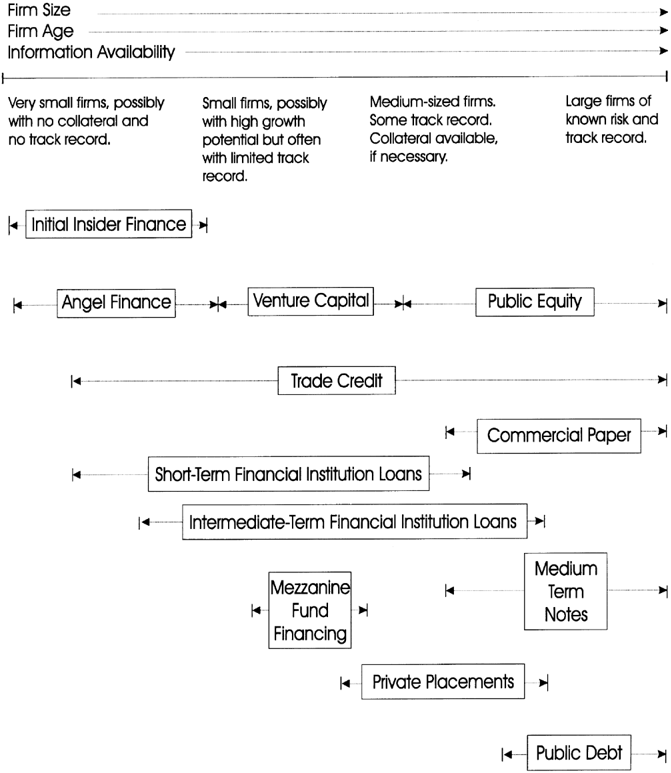
- The growth cycle paradigm predicts younger/more opaque firms rely on insider finance, trade credit, and angel finance, then venture capital and banks, and eventually public markets. However, 1993 NSSBF data show insider finance does not dominate external finance even for adolescents (upper bound 56.8% insider, roughly equal to external), and financial institution debt is important to very young firms, often based on personal guarantees or collateral.
- Macro vulnerability: the early-1990s credit crunch saw real C&I loans fall 23.2% ($596.7 billion to $458.2 billion) and estimated small business lending fall 38.5% ($143.7 billion to $88.4 billion). Banks with less than $100 million in assets held about 9% of portfolios in small business loans versus about 2% for banks over $10 billion; large banks charged about 100 basis points less and required collateral about 25% less often than small banks, other things equal.
Methods
- Design: review and synthesis organized around the financial growth cycle paradigm, covering theoretical and empirical literature on private equity and debt markets, contracts, and macroeconomic vulnerability.
- Data: primarily the 1993 National Survey of Small Business Finances (NSSBF) for US small business finance tables, plus other sources including NFIB, SCF, STBL, CALL, CRA, Venture Economics/VentureOne, and international data.
- Analysis: descriptive tabulations (Tables 1 and 2) and literature synthesis; the paper is a review rather than a new primary empirical study.
Limitations
- Paper-stated: Table 1 data are not completely accurate or consistent and should be considered rough estimates; angel finance estimates are imprecise (range $15 billion to $120 billion); 1993 data may not reflect current conditions; weighted averages mask considerable heterogeneity.
- Paper-stated: the growth cycle paradigm is not intended to fit all small businesses; firm size, age, and information availability are far from perfectly correlated, and the points at which different funding sources begin and end are not definitive.
- Evident from the text: informational opacity and the intertwining of personal and business finances make small business finance difficult to research, and data on owners’ finances are often unavailable; the paper relies heavily on existing literature and available data rather than new primary data collection.
Model-written summary. Check it against the paper before relying on it.
Integrity signals
Registry
Cites
Statistics
Figures
Verification
Claims the paper makes
22 Valid · 27 Not valid · 107 Not checked · 201 Own results and interpretations
Every source the paper cites for this claim was checked and supports it.
In the paper
“This use of personal assets to help with external ®nance also highlights another important aspect of small business ®nance ± the ®nancial intertwining of owners and their businesses (Ang, 1992).”
§ The economics of small business ®nance: The roles of private equity and debt markets in the ®nancial growth cycle > 2.3. The ®nancial growth cycle of small business
What the sources say
- Supportedcites Ang, 1992 matched to “On the Theory of Finance for Privately Held Firms” (1992) source
In “Integrating Personal and Business Accounts,” Ang says that personal guarantees or collateral make business risk inseparable from owners’ personal risk. “The Financing Decision” also identifies owners’ assets used for loan guarantees as contributions to the business. Together, these passages support the cited point that using personal assets to obtain external finance intertwines owners’ and businesses’ finances. (LLM, conf=0.94)
plainstates an association- Asserted: passes — The authors put it forward as true.
- Checkable: passes — It can be checked against evidence.
- Load-bearing: unclear — It is unclear whether the paper’s conclusions depend on it.
- Based: passes — The paper gives a reason why it holds.
- Supported
The cited sources support only part of this claim — read each source’s verdict below.
In the paper
“Costly state veri®cation (Townsend, 1979;Diamond, 1984) and adverse selection (Myers, 1984;Myers and Majluf, 1984;Nachman and Noe, 1994) arguments suggest the optimality of debt contracts after insider ®nance has been exhausted.”
§ The economics of small business ®nance: The roles of private equity and debt markets in the ®nancial growth cycle > 2.3. The ®nancial growth cycle of small business
What the sources say
- Partly supportedcites Townsend, 1979 matched to “Optimal contracts and competitive markets with costly state verification” (1979) sourceExperimental — accuracy not yet measured
Section 3 characterizes an optimal contract for a firm financing an investment project as a bond that defaults when returns fall below a threshold, supporting the costly-state-verification rationale for debt. The paper does not establish that debt becomes optimal only after insider finance has been exhausted. The adverse-selection citations in the sentence refer to other sources, not Townsend. (LLM, conf=0.85)
- Not checked — no full text of the sourcecites Diamond, 1984 matched to “Financial intermediation and delegated monitoring” (1984) source
- Not matchedcites Myers, 1984
More than one paper fits this citation.
hedgedstates a cause- Asserted: passes — The authors put it forward as true.
- Checkable: passes — It can be checked against evidence.
- Load-bearing: passes — The paper’s conclusions depend on it.
- Based: passes — The paper gives a reason why it holds.
- Partly supported
The cited sources support only part of this claim — read each source’s verdict below.
In the paper
“An agency problem arises in the relationship between the entrepreneur and the venture capitalist in which the entrepreneur may expend insucient eort, exhibit expense preference behavior, or lack sucient information or skill to make optimal production decisions.”
§ The economics of small business ®nance: The roles of private equity and debt markets in the ®nancial growth cycle > 3.2. The venture capital market
What the sources say
- Not checked — no full text of the sourcecites Cooper and Carleton, 1979 matched to “Dynamics of Borrower‐Lender Interaction: Partitioning Final Payoff in Venture Capital Finance” (1979) source
- Partly supportedcites Bergemann and Hege, 1998 matched to “Venture capital financing, moral hazard, and learning” (1998) sourceExperimental — accuracy not yet measured
Section 2.3, “Moral hazard and financing,” describes an entrepreneur who may reduce costly effort or divert investment funds to private ends, supporting the insufficient-effort and expense-preference parts of the claim. It does not identify a lack of the entrepreneur’s information or skill as a cause of poor production decisions; it instead says the entrepreneur and venture capitalists initially have the same assessment of the project. (LLM, conf=0.88)
hedgedstates a possible cause- Asserted: passes — The authors put it forward as true.
- Checkable: passes — It can be checked against evidence.
- Load-bearing: passes — The paper’s conclusions depend on it.
- Based: passes — The paper gives a reason why it holds.
Every source the paper cites for this claim was checked and supports it.
In the paper
“Since 1990, this share has about doubled to 30% (Fenn et al., 1997).”
§ The economics of small business ®nance: The roles of private equity and debt markets in the ®nancial growth cycle > 3. The role of private equity markets in small business ®nance
What the sources say
- Supportedcites Fenn et al., 1997 matched to “The Private Equity Market: An Overveiw” (1997) source
In “IPO Firms that Received Private Equity Backing,” the paper states that the share of IPOs with venture backing averaged 15% during the 1980s and doubled to 30% since 1990. This directly supports the cited claim. (LLM, conf=0.95)
plainstates an association- Asserted: passes — The authors put it forward as true.
- Checkable: passes — It can be checked against evidence.
- Load-bearing: unclear — It is unclear whether the paper’s conclusions depend on it.
- Based: passes — The paper gives a reason why it holds.
- Supported
The cited sources support only part of this claim — read each source’s verdict below.
In the paper
“During the 1980s, approximately 15% of all IPOs were backed by venture capital, well out of proportion to the fraction of all ®rms that received venture capital.”
§ The economics of small business ®nance: The roles of private equity and debt markets in the ®nancial growth cycle > 3. The role of private equity markets in small business ®nance
What the sources say
- Partly supportedcites Fenn et al., 1997 matched to “The Private Equity Market: An Overveiw” (1997) sourceExperimental — accuracy not yet measured
The section “IPO Firms that Received Private Equity Backing” states that venture-backed IPOs averaged 15% of IPOs during the 1980s. It does not give the fraction of all firms that received venture capital or make the claimed comparison with that fraction. (LLM, conf=0.84)
plainstates an association- Asserted: passes — The authors put it forward as true.
- Checkable: passes — It can be checked against evidence.
- Load-bearing: unclear — It is unclear whether the paper’s conclusions depend on it.
- Based: passes — The paper gives a reason why it holds.
- Partly supported
184 more claims · 6 with their cited sources checked
Create a free account to see all 357 claims and to verify the 12 references still open.
- Probably not a substantial claim. 94
- It may state two separate claims as one. 87
- Borderline: one of the tests for a substantial claim is unclear. 2
Claims other papers make about this one
Each is checked against this paper’s own text: does it say what the citing paper says it does?
The cited source says what the claim attributes to it.
In the citing paper
“SMEs are more dependent on external financing supplied by commercial banks (Berger and Udell 1998) because most of them are not qualified to raise money from the stock market.”
From Local Bank, Digital Financial Inclusion and SME Financing Constraints: Empirical Evidence from China (2022) · cites this paper as Berger and Udell 1998
Self-check
Percentages, sums and reported differences re-computed from the paper’s own numbers.
Rated minor: it would not touch a result — a value no result rests on, a p-value that stays on the same side of the significance level, or a conflict that is clerical, resolved elsewhere in the paper, or outside its own findings.
In the paper
“Non®nancial business/government debt provides 19.26% of small business funding (mostly trade credit)”
§ The economics of small business ®nance: The roles of private equity and debt markets in the ®nancial growth cycle > 4. The role of private debt markets in small business ®nance
Reported 19.26 · recomputed 18.01
Citations
Cites
Corporate financing and investment decisions when firms have information that investors do not have
Myers, S. C., & Majluf, N. S. (1984) · Journal of Financial Economics · doi:10.1016/0304-405x(84)90023-0 · Cited by 18,957
The Cost of Capital, Corporation Finance and the Theory of Investment
Miller, M. H. (1958) · American Economic Review · Cited by 14,574
Determinants of corporate borrowing
Myers, S. C. (1977) · Journal of Financial Economics · doi:10.1016/0304-405x(77)90015-0 · Cited by 13,169
Credit Rationing in Markets with Imperfect Information
Stiglitz, J. E., & Weiss, A. (1981) · Columbia University · doi:10.7916/d8v12ft1 · Cited by 12,769 · cited 1×
“…pledging outside collateral may help resolve adverse selection problems when the borrower has more information about the quality of the investment than the lender, and may help prevent credit rationing (Stiglitz and Weiss 1981, 1986, Bester 1985, Chan and Kanatas 1985, Besanko and Thakor 1987a,b).”
The cost of capital, corporation finance and the theory of investment
Terra, P. R. (2008) · Revista de Administração e Contabilidade da Unisinos · doi:10.4013/base.20082.07 · Cited by 8,615
Financial intermediation and delegated monitoring
Diamond, D. W. (1984) · The Review of Economic Studies · doi:10.2307/2297430 · Cited by 8,476 · cited 2×
“Costly state verification (Townsend 1979, Diamond 1984) and adverse selection (Myers 1984, Myers and Majluf 1984, Nachman and Noe 1994) arguments suggest the optimality of debt contracts after insider cFor example, there are generally accepted definitions of the stages of finance for the kind of…”
Corporate Financing and Investment Decisions When Firms Have InformationThat Investors Do Not Have
Myers, S., & Majluf, N. (1984) · doi:10.3386/w1396 · Cited by 6,745
The Benefits of Lending Relationships: Evidence from Small Business Data
PETERSEN, M. A., & RAJAN, R. G. (1994) · The Journal of Finance · doi:10.1111/j.1540-6261.1994.tb04418.x · Cited by 5,440 · cited 4×
“…whereas mortgages, equipment loans, motor vehicle loans, and other loans may more often be transactionsdriven .zs It was also found that dependence on trade credit decreased with the length of the banking relationship, supporting the value of relationship lending (Petersen and Rajan 1994, 1995).”
InfluentialInside the black box: the credit channel of monetary policy transmission
Bernanke, B. S., & Gertler, M. (1995) · Journal of Economic Perspectives · doi:10.1257/jep.9.4.27 · Cited by 4,211
Insiders and Outsiders: The Choice between Informed and Arm's‐Length Debt
RAJAN, R. G. (1992) · The Journal of Finance · doi:10.1111/j.1540-6261.1992.tb04662.x · Cited by 3,902 · cited 1×
“Some research suggests that these firms may try to reduce the control of their banks by issuing public debt, even though public debt may entail higher costs (Diamond 1991, 1993, Rajan 1992, Houston and James 1996).”
Research works printed but not linked: 11
- 66. Cook, L., 1997. Trade ®nance, bank ®nance, and capital market imperfections. Working paper. Harvard University, Cambridge, MA.
- 89. Freear, J., Sohl, J.E., Wetzel, W.E., Jr., 1994. The private investor market for venture capital. The Financier 1, 7±19.
- 112. Hancock, D., Wilcox, J.A., 1997. Bank capital, nonbank ®nance, and real estate activity. Journal of Housing Research 8, 75±105.
- 117. Hempel, G., Coleman, A., Simonson, D., 1986. Bank Management, Wiley, New York.
- 119. Ho, R., 1997. Credit-card use to ®nance small business is soaring, says survey of small ®rms. Wall Street Journal B2, Sept. 25.
- 153. Megginson, W.L., Weiss, K.A., 1991. Venture capitalist certi®cation in initial public oerings. Journal of Finance 46, 903±979.
- 162. Morsman Jr., E., 1986. Commercial loan structuring. Journal of Commercial Bank Lending 68, 2± 20.
- 187. Ravid, S.A., 1996. Debt maturity ± A survey. Financial Markets, Institutions and Instruments 5 (3), 1±68.
- 217. Wetzel Jr. W.E., 1994. Venture capital. In: Bygrave, W.D. (Ed.), Portable MBA in Entrepreneur- ship. Wiley, New York, pp. 172±194.
- 219. White, L.J., 1995. An analytical framework. In: Zahid, S.N. (Ed.), Financial Sector Development in Asia. Oxford University Press, New York, pp. 3±35.
- 222. McKean, R. (Ed.), Issues in Defense Economics. Columbia University Press, New York.
Cited by
Items 1,701–1,800 of 3,739
The Corporate Life Cycle and the Cost of Equity
Orellana, S. B. (2019) · Journal of Business Valuation and Economic Loss Analysis · doi:10.1515/jbvela-2018-0009 · Cited by 8
Managing uncertainty in the start-up environment. Is a business plan an incentive or a limitation?
Mariani, G., Morelli, D., & Bartoloni, L. (2019) · MANAGEMENT CONTROL · doi:10.3280/maco2019-001004 · Cited by 10
The survival of the German FinTech market: An accounting-based valuation
Stuckenborg, L., & Leker, J. (2019) · The journal of entrepreneurial finance · doi:10.57229/2373-1761.1334 · Cited by 8
“Thus, start-ups are usually obliged to fall back on venture capitalists, own capital, or short-term debt (Berger & Udell, 1998; Gregory et al., 2005).”
BackgroundEffects of Corporate Governance on the Performance of Nepalese Firms
Silwal, P. P. (2016) · International Research Journal of Management Science · doi:10.3126/irjms.v1i0.28140 · Cited by 8
The value of in-person banking: evidence from U.S. small businesses
Zhang, S., Han, L., Kallias, K., & Kallias, A. (2021) · Review of Quantitative Finance and Accounting · doi:10.1007/s11156-021-00982-5 · Cited by 10
İbicioğlu, H., Kocabıyık, T., & Dalğar, H. (2010) · Marmara Üniversitesi İktisadi ve İdari Bilimler Dergisi · doi:10.14780/iibd.34135 · Cited by 25
Institutional Support in Managerial Capacity Building and SMEs Growth
Forkuoh, S. K., Li, Y., Ampadu, M. B., & Osei, M. A. (2016) · Open Journal of Business and Management · doi:10.4236/ojbm.2016.42021 · Cited by 9
“Introduction Several challenges including inadequate access to finance, skilled labor and limited market size faced by SME restrict their growth and development in both developed and developing nations [1]-[4].”
BackgroundRetos de la educación superior en América Latina: el caso de la República Dominicana
Costa, E. S. (2017) · Ciencia y Sociedad · doi:10.22206/cys.2017.v42i1.pp9-23 · Cited by 29
Executive compensation in less regulated markets: the impact of debt monitoring
Marshall, A. P., Pinto, H., & Tang, L. (2019) · European Journal of Finance · doi:10.1080/1351847x.2019.1668448 · Cited by 9
“Smaller, younger firms have less public debt and rely more on private equity, bank loans, and personal commitments (Berger and Udell, 1998).”
BackgroundLucanera, J. P., Fabregat‐Aibar, L., Scherger, V., & Vigier, H. P. (2020) · Axioms · doi:10.3390/axioms9020046 · Cited by 10
“Moreover, the business cycle theory of [27] explained the firms’ capital structure.”
BackgroundSasson, A., & Fjeldstad, Ø. D. (2009) · Strategic Organization · doi:10.1177/1476127009346243 · Cited by 8
“Small and medium-sized firms do not have access to public debt and are therefore heavily dependent on banks to provide them with liquid assets (Berger and Udell, 1998; Petersen and Rajan, 1994).”
BackgroundHourd, P. C., & Williams, D. J. (2006) · Innovation · doi:10.5172/impp.2006.8.3.229 · Cited by 8
“Hence, the sources of finance that small healthcare businesses need to access change according to the growth stage of the company and the level of funding required (Berger & Udell 1998).”
BackgroundIndustry Effects and Banking Relationship as Determinants of Small Firm Capital Structure Decisions
Korkeamäki, T., & Rutherford, M. W. (2006) · The journal of entrepreneurial finance · doi:10.57229/2373-1761.1231 · Cited by 8
Investigating the Transmission Mechanism of Monetary Policy in Egypt
Ahmed, H. E. M. A. (2012) · UPT. Syiah Kuala University Library (Syiah Kuala University) · Cited by 8
On Government Intervention in the Small-Firm Credit Market and its Effect on Economic PerformancePreprint
Craig, B. R., Jackson, W. E., & Thomson, J. B. (2007) · SSRN Electronic Journal · doi:10.2139/ssrn.1003304 · Cited by 9
Deposits and Relationship Lending Review of Financial StudiesPreprint
Berlin, M., & Mester, L. J. (1998) · RePEc: Research Papers in Economics · Cited by 8
Financing High-Tech Growth: The Role of Debt or EquityPreprint
Audretsch, D. B., & Lehmann, E. E. (2004) · RePEc: Research Papers in Economics · Cited by 16
Determinants of loan defaults by small and medium enterprises among commercial banks in Kenya
Kibosia, N. C. (2012) · Cited by 10
Asset Restructuring Strategies in Bank Acquisitions: Evidence from the Italian Banking IndustryPreprint
Zazzaro, A., Alessandrini, P., & Calcagnini, G. (2006) · SSRN Electronic Journal · doi:10.2139/ssrn.907300 · Cited by 9
“6 be positively affected by the efficiency gains of M&As (Berger, Demsetz and Strahan 1999), by a higher risk diversification of the consolidated bank (Strahan and Weston 1998) and by the establishment of an internal capital market (Houston and James, 1998). Moreover, the reaction of other banks serving (or entering)…”
InfluentialSmall-Firm Credit Markets, SBA-Guaranteed Lending, and Economic Performance in Low-Income Areas
Craig, B. R., Jackson, W. E., & Thomson, J. B. (2006) · Working paper · doi:10.26509/frbc-wp-200601 · Cited by 8
Small Business Borrowing and the Owner-Manager Agency Costs: Evidence on Finnish DataPreprint
Niskanen, M., & Niskanen, J. (2006) · SSRN Electronic Journal · doi:10.2139/ssrn.874924 · Cited by 8
Banking Deregulation, Bargaining Power and InnovationPreprint
Chava, S., Oettl, A., Subramanian, A., & Subramanian, K. V. (2012) · SSRN Electronic Journal · doi:10.2139/ssrn.2110455 · Cited by 8
The Financial Growth Life Cycle: An Empirical Examination of Irish SMEsPreprint
Bhaird, C. M. A., & Lucey, B. M. (2007) · SSRN Electronic Journal · doi:10.2139/ssrn.991296 · Cited by 10
Ratinho, T. (2011) · doi:10.3990/1.9789036532631 · Cited by 9
New Pecking Order Financing for Innovative Firms: an OverviewPreprint
Sau, L. (2007) · RePEc: Research Papers in Economics · Cited by 15
The Impact of Government Financial Assistance on SMEs in Australia During the GFCPreprint
Dong, X. L., & Worthington, A. C. (2013) · RePEc: Research Papers in Economics · Cited by 8
Determinants of the Capital Structure of SMEs: A Seemingly Unrelated Regression ApproachPreprint
Bhaird, C. M. A., & Lucey, B. M. (2007) · SSRN Electronic Journal · doi:10.2139/ssrn.1018383 · Cited by 11
Small-Business Financing after the Financial Crisis: Lessons from the LiteraturePreprint
Miller, S. M. (2016) · SSRN Electronic Journal · doi:10.2139/ssrn.2828279 · Cited by 9
“Berger et al. (1998) write that, whereas mergers and acquisitions led to decreased lending at specific firms, significant offsetting effects occurred because of changes in the local markets as other lenders stepped up to extend small-business loans.”
BackgroundAn Empirical Analysis of SME and Large Business Linkages: Evidence from the PhilippinesPreprint
Canare, T. A., Francisco, J. P., & Price, N. A. (2017) · SSRN Electronic Journal · doi:10.2139/ssrn.3079455 · Cited by 11
The determinants of SME capital structure across the lifecyclePreprint
Martinez‐Cillero, M., Lawless, M., & O’Toole, C. M. (2019) · RePEc: Research Papers in Economics · Cited by 8
Private Company Finance and Financial ReportingPreprint
Hope, O., & Vyas, D. (2016) · SSRN Electronic Journal · doi:10.2139/ssrn.2871542 · Cited by 8
Craig, B. R., Jackson, W. E., & Thomson, J. B. (2007) · SSRN Electronic Journal · doi:10.2139/ssrn.1022187 · Cited by 7
Financial reporting by small and medium enterprises in Thailand
Ploybut, S. (2012) · OpenGrey (Institut de l'Information Scientifique et Technique) · Cited by 15
Accounting for intangible assets, firm life cycle and the value relevance of intangible assets
Jaafar, H. B. (2011) · UTAS Research Repository · doi:10.25959/23208785 · Cited by 9
Foreign banks and foreign currency lending in emerging Europe
Brown, M., & Haas, R. D. (2012) · Economic Policy · doi:10.1111/j.1468-0327.2011.00277.x · Cited by 115
“3 Banks may not be able to verify the income sources of small firms which do not keep detailed and audited financial records (Berger and Udell, 1998).”
BackgroundThe Modigliani–Miller proposition after fifty years and its relation to entrepreneurial finance
Bhaird, C. M. A. (2010) · Strategic Change · doi:10.1002/jsc.855 · Cited by 31
Weniger, S., Jarchow, S., & Nenadić, O. (2023) · Journal of Small Business and Enterprise Development · doi:10.1108/jsbed-05-2022-0238 · Cited by 11
Singh, S., & Hillemane, B. S. M. (2023) · Small Enterprise Research · doi:10.1080/13215906.2023.2270447 · Cited by 8
“…in a startup post an investment round from a BA that results in a pre-screening opportunity for VCs regarding information asymmetry and growth potential of a startup (Berger & Udell, 1998; Bertoni et al., 2011; Davila et al., 2003; De Bettignies & Brander, 2007; Kanniainen & Keuschnigg, 2003).”
BackgroundFinancing small and innovative firms during COVID-19
Cowling, M., Liu, W., Chen, Y., Calabrese, R., & Vorley, T. (2023) · Economics of Innovation and New Technology · doi:10.1080/10438599.2023.2297255 · Cited by 11
“…innovation is more likely to happen in smaller fi rms (Acs and Audretsch 1987), there are fewer scale economies to investment compared to larger fi rms (Berger and Udell 1998; Cassar 2004, Freel 2007), which makes the investment returns to innovation signi fi cantly and negatively skewed (Coad and…”
InfluentialA novel framework for analyzing the impact of COVID-19 on entrepreneurial financial firms in Jordan
Abaddi, S. (2024) · Journal of Entrepreneurship and Public Policy · doi:10.1108/jepp-01-2024-0009 · Cited by 8
Crowdlending, Self-Employment, and Entrepreneurial Performance
Cumming, D. J., & Sewaid, A. (2024) · Entrepreneurship Theory and Practice · doi:10.1177/10422587241270596 · Cited by 9
“Access to external financial resources enables entrepreneurs to scale their operations by investing in assets (Berger & Udell, 1998) and technology (Hall & Lerner, 2010), hiring skilled labor (Parker, 2009), and expanding their market reach (Robb & Robinson, 2014).”
SME lending relationships: A learning perspective
Haag, A., & Henschel, T. (2016) · The International Journal of Entrepreneurship and Innovation · doi:10.1177/1465750316655905 · Cited by 10
“Furthermore, start-ups or young SMEs have no or only little credit history (Armstrong et al., 2014; Berger and Udell, 1998; Columba et al., 2010; Craig et al., 2008).”
BackgroundInfluentialHavlik, A., & Heinemann, F. (2021) · Credit and Capital Markets – Kredit und Kapital · doi:10.3790/ccm.54.2.173 · Cited by 7
Creative industries project financing through crowdfunding: the roles of fund target & backers
Rijanto, A. (2021) · Creative Industries Journal · doi:10.1080/17510694.2021.1899489 · Cited by 16
Private family firms, generations and bank debt
Díaz, N. L. D., García‐Teruel, P. J., & Solano, P. M. (2022) · Accounting and Finance · doi:10.1111/acfi.13013 · Cited by 7
Okazaki, T., Okubo, T., & Strobl, E. (2023) · Journal of money credit and banking · doi:10.1111/jmcb.13018 · Cited by 8
Capital Structure with Information about the Upside and the Downside
Chaigneau, P. (2023) · Journal of Financial and Quantitative Analysis · doi:10.1017/s0022109023001278 · Cited by 7
“Berger and Udell (1998) find that “ debt held by the principal owner through loans and credit debt as well as debt held by other individuals (mostly family and friends) decline as the firm matures and retires these insider loans that were needed in the early stages.”
Azimli, A. (2023) · Financial Innovation · doi:10.1186/s40854-023-00528-9 · Cited by 13
“According to Berger and Udell (1998), the debt-to-equity ratio provides important inferences regarding firms’ financing choices.”
BackgroundMaus, C., Greven, A., Kurth, N., & Brettel, M. (2023) · Journal of Business Economics · doi:10.1007/s11573-023-01185-1 · Cited by 13
“The primary investment motivation of VCs is usually financial returns with timely exits, by taking strategic roles in venture management, such as positions on the board (Berger and Udell 1998).”
Factors affecting small and medium enterprises access to capital: Evidence from Vietnam
Nguyen, H. T., Nguyen, T., Dao, Q. T., et al. (2024) · NURTURE · doi:10.55951/nurture.v18i2.641 · Cited by 7
Supply chain finance and firm strategic change: A firm life cycle perspective
Ma, C., Liu, Q., Cao, R., Dai, Z., & Guo, F. (2024) · Economics and Politics · doi:10.1111/ecpo.12302 · Cited by 9
Khan, S. N., Khan, T., & Jilhajj, K. (2024) · Business Strategy & Development · doi:10.1002/bsd2.418 · Cited by 11
Does digital finance development affect corporate cash holdings? Evidence from China
Fan, J., Wang, K., & Xu, M. (2024) · Technology Analysis and Strategic Management · doi:10.1080/09537325.2024.2389137 · Cited by 9
“However, enterprises in the early stage are often faced with financing difficulties due to the lack of collateral and the problem of information asymmetry with banks (Berger and Udell 1998).”
Agency costs theory and the financing life cycle empirical evidence from Swedish firm-level data
Yazdanfar, D. (2012) · International Journal of Business and Globalisation · doi:10.1504/ijbg.2012.045397 · Cited by 7
“consistent with the findings reported by Berger and Udell (1998), Michaelas et al.”
BackgroundResultExploring the Determinants of Technology Innovation in MSMEs
Singh, D., Khamba, J. S., & Nanda, T. (2014) · International journal of engineering research in Africa · doi:10.4028/www.scientific.net/jera.13.103 · Cited by 9
“[58], in their study on small business finance in the US, concluded that smaller and younger MSMEs relied on internal source of financing (personal or family savings), trade credit and angel finance for initial capital.”
BackgroundCan credit unions bridge the gap in lending to SMEs?
Talbot, S., Bhaird, C. M. A., & Whittam, G. (2015) · Venture Capital · doi:10.1080/13691066.2015.1021027 · Cited by 15
“Asymmetric information arises from the differing views of the lender and borrower regarding the nature of risk involved in advancing finance, which in turn leads to adverse selection and moral hazard (Berger and Udell 1998; Nofsinger and Wang 2011; Denis 2004).”
BackgroundCrowdfunding in social finance
Lehner, O. M. (2015) · Oxford University Press eBooks · doi:10.1093/acprof:oso/9780198703761.003.0017 · Cited by 8
Government Sponsored Venture Capital: Blessing Or Curse?
Jáki, E., Molnár, E. M., & Walter, G. (2017) · Management · doi:10.26493/1854-4231.12.317-331 · Cited by 7
Bala, A. J., Raja, A. S., & Dandago, K. I. (2019) · SEISENSE Journal of Management · doi:10.33215/sjom.v2i3.109 · Cited by 7
“Debt is an integral part of the financial leverage and this is acquired not only for the needs of the capital but also enlarge the profits accruing to the shareholders (Berger & Udell, 1998; Chang, 2010).”
BackgroundWhat were they thinking? Firms' expectations since the financial crisis
Ferrando, A., Ganoulis, I., & Preuss, C. (2020) · Review of Behavioral Finance · doi:10.1108/rbf-07-2019-0084 · Cited by 7
Factors of Export Promotion of MSME in India with Special Reference to Raw Material Availability
Bandopadhyay, K., & Khan, T. L. (2020) · SEDME (Small Enterprises Development Management & Extension Journal) A worldwide window on MSME Studies · doi:10.1177/0970846420930446 · Cited by 7
Corporate Bond Issuance Behaviour in African Emerging Markets
Ahwireng-Obeng, A. S., & Ahwireng‐Obeng, F. (2020) · Journal of African Business · doi:10.1080/15228916.2020.1826853 · Cited by 7
“Profits are the ratio of earnings before interest, tax, and depreciation to book value of total assets and are measured as the average ratio of earnings before interest and taxes (EBIT) to total assets (Booth et al., 2001). Two other indicators commonly used are Return on Assets (ROA) and Return on Equity (ROE) (Booth…”
BackgroundSMEs with legally restricted banking access: evidence from the US marijuana industry
Merz, M., & Riepe, J. (2021) · Journal of Business Economics · doi:10.1007/s11573-020-01017-6 · Cited by 8
Bank switching of US small businesses: new methods and evidence
Zhang, S., Han, L., Kallias, K., & Kallias, A. (2022) · Review of Quantitative Finance and Accounting · doi:10.1007/s11156-021-01030-y · Cited by 8
“The relationship with the primary financial institution features extensively as a reference point in much empirical work in relationship banking (e.g., Berger and Udell 1998; Berger et al.”
BackgroundResultThe role of private equity investments on exports: Evidence from OECD countries
Herrera-Echeverri, H., Nandy, D. K., & Fragua, D. (2022) · Journal of Multinational Financial Management · doi:10.1016/j.mulfin.2022.100739 · Cited by 8
The effect of life cycle stages on capital expenditures: evidence from an emerging market
Can, G., Demiraj, R., & Mersni, H. (2023) · EuroMed Journal of Business · doi:10.1108/emjb-06-2022-0115 · Cited by 14
Trade credit, payment duration, and SMEs’ growth in the European Union
Lefebvre, V. (2023) · International Entrepreneurship and Management Journal · doi:10.1007/s11365-023-00871-4 · Cited by 20
“Indeed, the high degree of information asymmetry that characterizes SMEs constrains their ability to borrow money externally (Stiglitz & Weiss, 1981; Berger & Udell, 1998; Cassar, 2004).”
BackgroundDeloof, M., & Paeleman, I. (2023) · The Economic History Review · doi:10.1111/ehr.13278 · Cited by 4
Micro and small enterprises default risk portrait: evidence from explainable machine learning method
Zheng, C., Weng, F., Luo, Y., & Yang, C. (2023) · Journal of Ambient Intelligence and Humanized Computing · doi:10.1007/s12652-023-04722-6 · Cited by 9
“On the one hand, these enterprises rely heavily on credit from financial institutions as external financing options are limited (Berger and Udell 1998; Beck et al. 2008).”
Growth in established SMEs : Exploring the innovative and ambitious firm
Uddenberg, A. (2015) · Linköping University Electronic Press eBooks · doi:10.3384/lic.diva-114396 · Cited by 11
“Birch et al. (1995) or OECD (2006) is that the sample size is not large enough to comply with these more strict definitions.”
InfluentialNaranjo, G. F., Bulla, F. J. M., Hernández, G., et al. (2011) · Revista Escuela de Administración de Negocios · doi:10.21158/01208160.n71.2011.555 · Cited by 7
Zuluaga, B. B., Mejía, A. G., & Salazar, J. (2006) · Cuadernos de Administración · Cited by 7
The effect of life cycles on diversification of financing sources for SMEs: Evidence from Argentina
Briozzo, A. (2012) · AFRICAN JOURNAL OF BUSINESS MANAGEMENT · doi:10.5897/ajbm11.830 · Cited by 13
“We present the different stages of the financial growth cycle (Berger and Udell, 1998) using three groups and propose two explanations complementary to the information asymmetries argument: the models for the life cycle of the owner- manager and the life-cycle of the family firm.”
BackgroundMethodInfluentialThe Impact of Venture Capital Finance on Performance of Small and Medium Enterprises in Kenya
Memba, F. (2013) · Abstracts of postgraduate thesis · Cited by 7
Optimal Financing Decisions of Two Cash-Constrained Supply Chains with Complementary Products
Li, Y., Chen, T., & Xin, B. (2016) · Sustainability · doi:10.3390/su8050429 · Cited by 7
“Cressy and Olofsson [16], Berger and Udell [17], Meyer [18] and Bernanke and Blinder [19] showed that the main method to solve the cash constraint problem is still firms to ask for a loan from banks.”
MethodFelipe, I. J. D. S., Mendes‐Da‐Silva, W., & Gattaz, C. C. (2017) · IEEE International Conference on Semantic Computing (ICSC) · doi:10.1109/icsc.2017.32 · Cited by 9
“Such financing alternatives do not usually require the formalization of complex contracts, but require some type of guarantee, which in most cases involves the personal patrimony of the entrepreneur [7].”
BackgroundBusiness Cycle and Financial Cycle Interdependence and the Rising Role of China in SAARC
Ahmad, W., & Sehgal, S. (2017) · Journal of Quantitative Economics · doi:10.1007/s40953-017-0086-3 · Cited by 7
Martínez‐Victoria, M., Maté‐Sánchez‐Val, M., & Lario, N. A. (2017) · Spanish Journal of Agricultural Research · doi:10.5424/sjar/2017151-10270 · Cited by 7
“Large 13 9 4 1 Groups for age were established following Berger & Udell (1998).”
BackgroundDISINCENTIVES TO BUSINESS DEVELOPMENT ON THE NAVAJO NATION
Yonk, R. M., Hoffer, S., & Stein, D. (2017) · Journal of Developmental Entrepreneurship · doi:10.1142/s1084946717500121 · Cited by 8
Micro determinants of the extent of credit rationing amongst SMEs in Ghana
Domeher, D., Musah, G., & Poku, K. (2017) · International Journal of Social Economics · doi:10.1108/ijse-03-2016-0089 · Cited by 15
Wu, J. (2018) · Chinese Economy · doi:10.1080/10971475.2017.1368897 · Cited by 7
“The state responded rapidly with a significant fiscal expansion and a loosening of monetary policy (Hou & Wang, 2013; for context regarding back activity, see Berger & Udell, 1998, 2006; Bernanke & Gertler, 1995; Kakes, 2000; Önder & Özyıldırım, 2013).”
BackgroundRelationship between the pecking order theory and firm's age: Empirical evidences from India
Bhama, V., Jain, P. K., & Yadav, S. S. (2018) · IIMB Management Review · doi:10.1016/j.iimb.2018.01.003 · Cited by 20
Yao, Y.-J., & Liu, H. (2018) · International Conference on Robots & Intelligent System · doi:10.1109/icris.2018.00147 · Cited by 7
Effects of main bank switching on new business bankruptcy
Ogane, Y. (2019) · Applied Economics · doi:10.1080/00036846.2019.1616067 · Cited by 7
“However, Bharath et al. (2011) imply that loan terms from prior lenders are better; they suggest that long-lasting relationships with financial institutions benefit financially opaque firms.”
BackgroundOn the optimal investment finance of small businesses
Tirelli, M. (2019) · Small Business Economics · doi:10.1007/s11187-019-00283-1 · Cited by 8
Determinants of Cash Holdings in Private Firms: The Case of the Slovenian SMEs
Angelovska, M., & Valentinčič, A. (2020) · Economic and business review · doi:10.15458/ebr95 · Cited by 8
Optimistic disclosure tone in corporate annual reporting and financial performance
AlAlwani, Z. A., & Mousa, G. A. (2020) · International Conference on Decision Aid Sciences and Application (DASA) · doi:10.1109/dasa51403.2020.9317105 · Cited by 7
“Reference [42] have shown that mature firms’ reports are more reliable since they have already been covered by the analysts.”
BackgroundDifferences in Capital Structure of Publicly Traded Companies in Europe and USA
Krištofík, P., & Šlampiaková, L. (2021) · Politická ekonomie · doi:10.18267/j.polek.1320 · Cited by 7
A New Measure of Managers' Intentional Income Smoothing
Black, D. E., Pierce, S. R., & Thomas, W. B. (2017) · Management Science · doi:10.1287/mnsc.2021.4158 · Cited by 9
“Private debt providers often share close relationships with management, have access to inside information, and may rely less on formal published financial statements (Berger and Udell 1998).”
Achleitner, A., & Braun, R. (2015) · Springer eBooks · doi:10.1007/978-3-658-05263-8_8-1 · Cited by 7
Government responses to the impact of the global crisis on finance for young and small enterprises
Potter, J., & Thompson, J. L. (2011) · Strategic Change · doi:10.1002/jsc.892 · Cited by 7
Effect of micro finance on performance of women owned enterprises, in Kisumu City, kenya
Ocholah, R. M. A., Ojwang, C., Aila, F., et al. (2013) · Greener Journal of Business and Management Studies · doi:10.15580/gjbms.2013.4.022613501 · Cited by 7
“A thorough understanding of how SMEs grow is an important issue because, according to Berger and Udell (1998), and Radovic (2007), small and medium-sized enterprises provide the engine for economic growth for many countries.”
BackgroundThe Principal, the Agent, and the Culture: Potential Impacts of Culture on Financing Contracts
Asare, E. K., Beldona, S., & Nketia, J. (2019) · The International Trade Journal · doi:10.1080/08853908.2019.1693450 · Cited by 8
“It is well documented that lenders, to minimize lending risks, rely on a myriad of programs owing to SME information opacity (Berger and Udell 1988, 2006).”
InfluentialWhat does it take to Borrow? A framework for analysis
Glackin, C. (2002) · Journal of Microfinance / ESR Review · Cited by 11
Accessing bank credit in Eritrea: bottlenecks for small firms and for the Commercial Bank of Eritrea
von Eije, H., Fishazion, M., & Lutz, C. H. M. (2002) · Cited by 8
The determinants of equity needs: size, youth or innovation?
Venturelli, V., & Gualandri, E. (2009) · Journal of Small Business and Enterprise Development · doi:10.1108/14626000911000947 · Cited by 10
Implication of inside-debt: signalling for bankruptcy probabilities within small firms
Seppa, R. (2014) · Baltic Journal of Management · doi:10.1108/bjm-03-2013-0043 · Cited by 8
Análisis de la producción científica en Economía Financiera: 1995-2006
Domènech, M. C. I., García-Blandón, J., & Sales, R. Ú. (2009) · Revista española de Documentación Científica · doi:10.3989/redc.2009.2.671 · Cited by 13
The creative economy: Challenges and opportunities for the DC regions
Voldere, I. D., Janssens, E., Onkelinx, J., et al. (2006) · Cited by 7
Manigart, S., Baeyens, K., & Manigart, S. (2002) · Ghent University Academic Bibliography (Ghent University) · Cited by 10
Metadata
- Authors
- N. Berger, A., & F. Udell, G.
- Venue
- Journal of Banking & Finance
- Publisher
- Elsevier BV
- Published
- 1998-08
- Volume
- 22
- Issue
- 6-8
- Pages
- 613-673
- ISSN
- 0378-4266 (ISSN-L)
- OpenAlex
- W2119780569
- Semantic Scholar
- dfc06f7f7eb83d2c0e2a1d67ecb95b520a406843
- Cited by
- 3,690
- References
- 230
- Citations by year
- 2026: 136 · 2025: 148 · 2024: 144 · 2023: 193 · 2022: 155 · 2021: 211 · 2020: 200 · 2019: 156 · 2018: 208 · 2017: 174 · 2016: 186 · 2015: 187 · 2014: 168 · 2013: 177 · 2012: 171
- FWCI
- 169.26
- Type
- journal article
- Language
- en
- Open access
- hybrid
- doi.org
- Licence
- cc-by-nc-nd
- www.elsevier.com/tdm/userlicense/1.0/ (tdm)
- www.elsevier.com/legal/tdmrep-license (tdm)
- creativecommons.org/licenses/by-nc-nd/4.0/ (vor, 125 d)
- Locations
- Journal of Banking & Finance (publishedVersion, cc-by-nc-nd)
- RePEc: Research Papers in Economics (submittedVersion)
- Funders
- York University
- Topics
- Social Sciences › Economics, Econometrics and Finance › Finance › Private Equity and Venture Capital
- Social Sciences › Economics, Econometrics and Finance › Finance › Corporate Finance and Governance
- Social Sciences › Economics, Econometrics and Finance › Finance › Banking stability, regulation, efficiency
- Keywords
- small business financing, private equity, debt markets, capital structure, firm size, firm age, macroeconomic conditions
About these checks
Registry, retraction, Cites and statistics results are computed, not judged, with one exception: a printed reference that no index lists is read once by a model before it counts as a citation error. Claims are extracted by a model and kept only when their quote appears verbatim in the text; each cited source is then checked, with a model’s help, for whether it says what the claim relies on. Those verdicts can be wrong — read the claim’s quote and the cited source before relying on one.
The claim verdicts this report counts are experimental: their accuracy is not yet measured.
A language model drew the claims from the paper on 2026-10-10, under version 3 of the claim definition (model deepseek-v4.1-flash, prompt extract-v3).
A second model labelled each claim on 2026-10-10 (model jev-1.13-20260917, definition revision gold-guideline-v0.2).
Cited sources are checked with a language model’s help (gpt-6-sol).
Statistics and arithmetic are recomputed, not judged.
Confidence bands are shown only for fields calibrated on our annotated test set. None is calibrated yet, so no band is shown.
What counts as a claim ›How we measure confidence ›How we check this ›
Are you an author, or do you see a problem with this page? Request a review
Data sources
Bibliographic data: Semantic Scholar, OpenAlex, Crossref.
Contains information from the Semantic Scholar Academic Graph Datasets, made available under the ODC Attribution License (ODC-BY 1.0).
Semantic Scholar’s data is described in: Kinney, R., et al. (2023). The Semantic Scholar Open Data Platform. arXiv:2301.10140.
