

The economics of small business finance: The roles of private equity and debt markets in the financial growth cycle
Open accessThe DOI matches its Crossref record; 217 of the 230 references it cites were found in a registry or an index, and 1 are not checked yet; 24 of the 170 sources its claims cite were checked for support.
Abstract
This article examines the economics of financing small business in private equity and debt markets. Firms are viewed through a financial growth cycle paradigm in which different capital structures are optimal at different points in the cycle. We show the sources of small business finance, and how capital structure varies with firm size and age. The interconnectedness of small firm finance is discussed along with the impact of the macroeconomic environment. We also analyze a number of research and policy issues, review the literature, and suggest topics for future research.
Verified 2026-11-25 · 1 reference not checked yet
Overview
CoChat Summary
TL;DR
This article reviews the economics of small business finance through a financial growth cycle paradigm, emphasizing informational opacity and the roles of private equity and debt markets. It documents US small business funding sources and contracts, and analyzes vulnerability to macroeconomic shocks, credit crunches, and bank consolidation.
Key findings
- US small business finance is split roughly evenly between equity (49.63%) and debt (50.37%); the largest sources are the principal owner, commercial banks, and trade creditors, together accounting for 70.10% of total funding. Commercial banks provide 18.75%, trade credit 15.78%, principal owner equity 31.33%, angel finance 3.59%, venture capital 1.85%, and credit card debt 0.14%.
- Financial institution debt is used by 54.23% of small businesses; 86.95% name a commercial bank as their primary financial institution. Average relationship length is 6.64 years overall and 9.01 years with the primary institution; 52.03% of financial institution debt is under lines of credit, 91.94% is secured, and 51.63% is guaranteed.
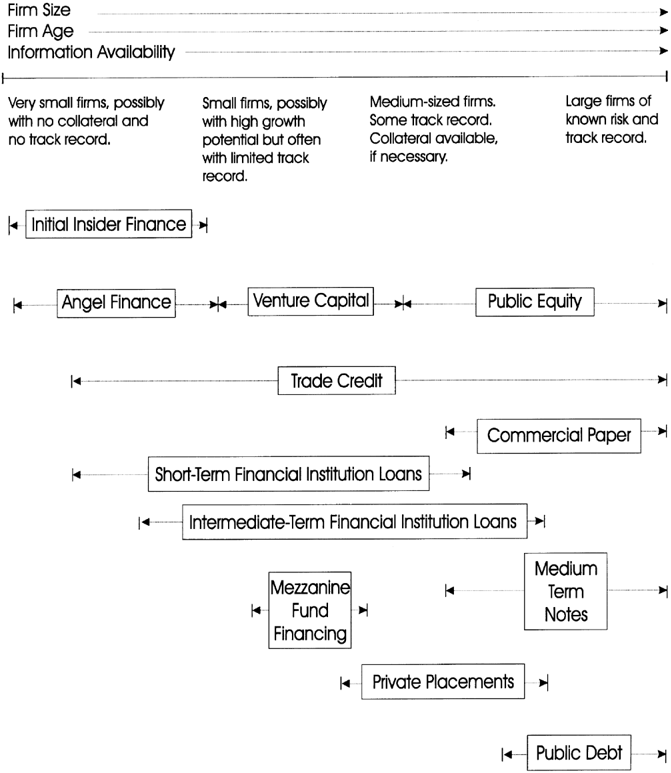
- The growth cycle paradigm predicts younger/more opaque firms rely on insider finance, trade credit, and angel finance, then venture capital and banks, and eventually public markets. However, 1993 NSSBF data show insider finance does not dominate external finance even for adolescents (upper bound 56.8% insider, roughly equal to external), and financial institution debt is important to very young firms, often based on personal guarantees or collateral.
- Macro vulnerability: the early-1990s credit crunch saw real C&I loans fall 23.2% ($596.7 billion to $458.2 billion) and estimated small business lending fall 38.5% ($143.7 billion to $88.4 billion). Banks with less than $100 million in assets held about 9% of portfolios in small business loans versus about 2% for banks over $10 billion; large banks charged about 100 basis points less and required collateral about 25% less often than small banks, other things equal.
Methods
- Design: review and synthesis organized around the financial growth cycle paradigm, covering theoretical and empirical literature on private equity and debt markets, contracts, and macroeconomic vulnerability.
- Data: primarily the 1993 National Survey of Small Business Finances (NSSBF) for US small business finance tables, plus other sources including NFIB, SCF, STBL, CALL, CRA, Venture Economics/VentureOne, and international data.
- Analysis: descriptive tabulations (Tables 1 and 2) and literature synthesis; the paper is a review rather than a new primary empirical study.
Limitations
- Paper-stated: Table 1 data are not completely accurate or consistent and should be considered rough estimates; angel finance estimates are imprecise (range $15 billion to $120 billion); 1993 data may not reflect current conditions; weighted averages mask considerable heterogeneity.
- Paper-stated: the growth cycle paradigm is not intended to fit all small businesses; firm size, age, and information availability are far from perfectly correlated, and the points at which different funding sources begin and end are not definitive.
- Evident from the text: informational opacity and the intertwining of personal and business finances make small business finance difficult to research, and data on owners’ finances are often unavailable; the paper relies heavily on existing literature and available data rather than new primary data collection.
Model-written summary. Check it against the paper before relying on it.
Integrity signals
Registry
Cites
Statistics
Figures
Verification
Claims the paper makes
22 Valid · 27 Not valid · 107 Not checked · 201 Own results and interpretations
Every source the paper cites for this claim was checked and supports it.
In the paper
“This use of personal assets to help with external ®nance also highlights another important aspect of small business ®nance ± the ®nancial intertwining of owners and their businesses (Ang, 1992).”
§ The economics of small business ®nance: The roles of private equity and debt markets in the ®nancial growth cycle > 2.3. The ®nancial growth cycle of small business
What the sources say
- Supportedcites Ang, 1992 matched to “On the Theory of Finance for Privately Held Firms” (1992) source
In “Integrating Personal and Business Accounts,” Ang says that personal guarantees or collateral make business risk inseparable from owners’ personal risk. “The Financing Decision” also identifies owners’ assets used for loan guarantees as contributions to the business. Together, these passages support the cited point that using personal assets to obtain external finance intertwines owners’ and businesses’ finances. (LLM, conf=0.94)
plainstates an association- Asserted: passes — The authors put it forward as true.
- Checkable: passes — It can be checked against evidence.
- Load-bearing: unclear — It is unclear whether the paper’s conclusions depend on it.
- Based: passes — The paper gives a reason why it holds.
- Supported
The cited sources support only part of this claim — read each source’s verdict below.
In the paper
“Costly state veri®cation (Townsend, 1979;Diamond, 1984) and adverse selection (Myers, 1984;Myers and Majluf, 1984;Nachman and Noe, 1994) arguments suggest the optimality of debt contracts after insider ®nance has been exhausted.”
§ The economics of small business ®nance: The roles of private equity and debt markets in the ®nancial growth cycle > 2.3. The ®nancial growth cycle of small business
What the sources say
- Partly supportedcites Townsend, 1979 matched to “Optimal contracts and competitive markets with costly state verification” (1979) sourceExperimental — accuracy not yet measured
Section 3 characterizes an optimal contract for a firm financing an investment project as a bond that defaults when returns fall below a threshold, supporting the costly-state-verification rationale for debt. The paper does not establish that debt becomes optimal only after insider finance has been exhausted. The adverse-selection citations in the sentence refer to other sources, not Townsend. (LLM, conf=0.85)
- Not checked — no full text of the sourcecites Diamond, 1984 matched to “Financial intermediation and delegated monitoring” (1984) source
- Not matchedcites Myers, 1984
More than one paper fits this citation.
hedgedstates a cause- Asserted: passes — The authors put it forward as true.
- Checkable: passes — It can be checked against evidence.
- Load-bearing: passes — The paper’s conclusions depend on it.
- Based: passes — The paper gives a reason why it holds.
- Partly supported
The cited sources support only part of this claim — read each source’s verdict below.
In the paper
“An agency problem arises in the relationship between the entrepreneur and the venture capitalist in which the entrepreneur may expend insucient eort, exhibit expense preference behavior, or lack sucient information or skill to make optimal production decisions.”
§ The economics of small business ®nance: The roles of private equity and debt markets in the ®nancial growth cycle > 3.2. The venture capital market
What the sources say
- Not checked — no full text of the sourcecites Cooper and Carleton, 1979 matched to “Dynamics of Borrower‐Lender Interaction: Partitioning Final Payoff in Venture Capital Finance” (1979) source
- Partly supportedcites Bergemann and Hege, 1998 matched to “Venture capital financing, moral hazard, and learning” (1998) sourceExperimental — accuracy not yet measured
Section 2.3, “Moral hazard and financing,” describes an entrepreneur who may reduce costly effort or divert investment funds to private ends, supporting the insufficient-effort and expense-preference parts of the claim. It does not identify a lack of the entrepreneur’s information or skill as a cause of poor production decisions; it instead says the entrepreneur and venture capitalists initially have the same assessment of the project. (LLM, conf=0.88)
hedgedstates a possible cause- Asserted: passes — The authors put it forward as true.
- Checkable: passes — It can be checked against evidence.
- Load-bearing: passes — The paper’s conclusions depend on it.
- Based: passes — The paper gives a reason why it holds.
Every source the paper cites for this claim was checked and supports it.
In the paper
“Since 1990, this share has about doubled to 30% (Fenn et al., 1997).”
§ The economics of small business ®nance: The roles of private equity and debt markets in the ®nancial growth cycle > 3. The role of private equity markets in small business ®nance
What the sources say
- Supportedcites Fenn et al., 1997 matched to “The Private Equity Market: An Overveiw” (1997) source
In “IPO Firms that Received Private Equity Backing,” the paper states that the share of IPOs with venture backing averaged 15% during the 1980s and doubled to 30% since 1990. This directly supports the cited claim. (LLM, conf=0.95)
plainstates an association- Asserted: passes — The authors put it forward as true.
- Checkable: passes — It can be checked against evidence.
- Load-bearing: unclear — It is unclear whether the paper’s conclusions depend on it.
- Based: passes — The paper gives a reason why it holds.
- Supported
The cited sources support only part of this claim — read each source’s verdict below.
In the paper
“During the 1980s, approximately 15% of all IPOs were backed by venture capital, well out of proportion to the fraction of all ®rms that received venture capital.”
§ The economics of small business ®nance: The roles of private equity and debt markets in the ®nancial growth cycle > 3. The role of private equity markets in small business ®nance
What the sources say
- Partly supportedcites Fenn et al., 1997 matched to “The Private Equity Market: An Overveiw” (1997) sourceExperimental — accuracy not yet measured
The section “IPO Firms that Received Private Equity Backing” states that venture-backed IPOs averaged 15% of IPOs during the 1980s. It does not give the fraction of all firms that received venture capital or make the claimed comparison with that fraction. (LLM, conf=0.84)
plainstates an association- Asserted: passes — The authors put it forward as true.
- Checkable: passes — It can be checked against evidence.
- Load-bearing: unclear — It is unclear whether the paper’s conclusions depend on it.
- Based: passes — The paper gives a reason why it holds.
- Partly supported
184 more claims · 6 with their cited sources checked
Create a free account to see all 357 claims and to verify the 12 references still open.
- Probably not a substantial claim. 94
- It may state two separate claims as one. 87
- Borderline: one of the tests for a substantial claim is unclear. 2
Claims other papers make about this one
Each is checked against this paper’s own text: does it say what the citing paper says it does?
The cited source says what the claim attributes to it.
In the citing paper
“SMEs are more dependent on external financing supplied by commercial banks (Berger and Udell 1998) because most of them are not qualified to raise money from the stock market.”
From Local Bank, Digital Financial Inclusion and SME Financing Constraints: Empirical Evidence from China (2022) · cites this paper as Berger and Udell 1998
Self-check
Percentages, sums and reported differences re-computed from the paper’s own numbers.
Rated minor: it would not touch a result — a value no result rests on, a p-value that stays on the same side of the significance level, or a conflict that is clerical, resolved elsewhere in the paper, or outside its own findings.
In the paper
“Non®nancial business/government debt provides 19.26% of small business funding (mostly trade credit)”
§ The economics of small business ®nance: The roles of private equity and debt markets in the ®nancial growth cycle > 4. The role of private debt markets in small business ®nance
Reported 19.26 · recomputed 18.01
Citations
Cites
Corporate financing and investment decisions when firms have information that investors do not have
Myers, S. C., & Majluf, N. S. (1984) · Journal of Financial Economics · doi:10.1016/0304-405x(84)90023-0 · Cited by 18,957
The Cost of Capital, Corporation Finance and the Theory of Investment
Miller, M. H. (1958) · American Economic Review · Cited by 14,574
Determinants of corporate borrowing
Myers, S. C. (1977) · Journal of Financial Economics · doi:10.1016/0304-405x(77)90015-0 · Cited by 13,169
Credit Rationing in Markets with Imperfect Information
Stiglitz, J. E., & Weiss, A. (1981) · Columbia University · doi:10.7916/d8v12ft1 · Cited by 12,769 · cited 1×
“…pledging outside collateral may help resolve adverse selection problems when the borrower has more information about the quality of the investment than the lender, and may help prevent credit rationing (Stiglitz and Weiss 1981, 1986, Bester 1985, Chan and Kanatas 1985, Besanko and Thakor 1987a,b).”
The cost of capital, corporation finance and the theory of investment
Terra, P. R. (2008) · Revista de Administração e Contabilidade da Unisinos · doi:10.4013/base.20082.07 · Cited by 8,615
Financial intermediation and delegated monitoring
Diamond, D. W. (1984) · The Review of Economic Studies · doi:10.2307/2297430 · Cited by 8,476 · cited 2×
“Costly state verification (Townsend 1979, Diamond 1984) and adverse selection (Myers 1984, Myers and Majluf 1984, Nachman and Noe 1994) arguments suggest the optimality of debt contracts after insider cFor example, there are generally accepted definitions of the stages of finance for the kind of…”
Corporate Financing and Investment Decisions When Firms Have InformationThat Investors Do Not Have
Myers, S., & Majluf, N. (1984) · doi:10.3386/w1396 · Cited by 6,745
The Benefits of Lending Relationships: Evidence from Small Business Data
PETERSEN, M. A., & RAJAN, R. G. (1994) · The Journal of Finance · doi:10.1111/j.1540-6261.1994.tb04418.x · Cited by 5,440 · cited 4×
“…whereas mortgages, equipment loans, motor vehicle loans, and other loans may more often be transactionsdriven .zs It was also found that dependence on trade credit decreased with the length of the banking relationship, supporting the value of relationship lending (Petersen and Rajan 1994, 1995).”
InfluentialInside the black box: the credit channel of monetary policy transmission
Bernanke, B. S., & Gertler, M. (1995) · Journal of Economic Perspectives · doi:10.1257/jep.9.4.27 · Cited by 4,211
Insiders and Outsiders: The Choice between Informed and Arm's‐Length Debt
RAJAN, R. G. (1992) · The Journal of Finance · doi:10.1111/j.1540-6261.1992.tb04662.x · Cited by 3,902 · cited 1×
“Some research suggests that these firms may try to reduce the control of their banks by issuing public debt, even though public debt may entail higher costs (Diamond 1991, 1993, Rajan 1992, Houston and James 1996).”
Research works printed but not linked: 11
- 66. Cook, L., 1997. Trade ®nance, bank ®nance, and capital market imperfections. Working paper. Harvard University, Cambridge, MA.
- 89. Freear, J., Sohl, J.E., Wetzel, W.E., Jr., 1994. The private investor market for venture capital. The Financier 1, 7±19.
- 112. Hancock, D., Wilcox, J.A., 1997. Bank capital, nonbank ®nance, and real estate activity. Journal of Housing Research 8, 75±105.
- 117. Hempel, G., Coleman, A., Simonson, D., 1986. Bank Management, Wiley, New York.
- 119. Ho, R., 1997. Credit-card use to ®nance small business is soaring, says survey of small ®rms. Wall Street Journal B2, Sept. 25.
- 153. Megginson, W.L., Weiss, K.A., 1991. Venture capitalist certi®cation in initial public oerings. Journal of Finance 46, 903±979.
- 162. Morsman Jr., E., 1986. Commercial loan structuring. Journal of Commercial Bank Lending 68, 2± 20.
- 187. Ravid, S.A., 1996. Debt maturity ± A survey. Financial Markets, Institutions and Instruments 5 (3), 1±68.
- 217. Wetzel Jr. W.E., 1994. Venture capital. In: Bygrave, W.D. (Ed.), Portable MBA in Entrepreneur- ship. Wiley, New York, pp. 172±194.
- 219. White, L.J., 1995. An analytical framework. In: Zahid, S.N. (Ed.), Financial Sector Development in Asia. Oxford University Press, New York, pp. 3±35.
- 222. McKean, R. (Ed.), Issues in Defense Economics. Columbia University Press, New York.
Cited by
Items 1,501–1,600 of 3,739
ESG performance and corporate labor investment efficiency: Evidence from China
Yang, X., Wang, C., & Liu, B. (2025) · International Review of Economics & Finance · doi:10.1016/j.iref.2025.103909 · Cited by 15
Bo, L., Li, H., Zhang, S., & Tang, R. (2025) · Digital Economy and Sustainable Development · doi:10.1007/s44265-025-00054-9 · Cited by 18
“External factors, such as regulatory requirements (Porter and Heppelmann 2014), stringent lending criteria (Berger and Udell 1998), market condition (Miozzo and Soete 2001), the openness of the stock market (Wang et al. 2021), China’s interest rate liberalization reform (Zhao and Yao 2022), local…”
Li, J., Colombo, M. G., Rossi‐Lamastra, C., & Brush, C. G. (2025) · The Journal of Technology Transfer · doi:10.1007/s10961-025-10214-w · Cited by 18
“3 Bank loan is the most traditional and vital financing source for businesses worldwide (Berger & Udell, 1998; Robb & Robinson, 2014 ).”
Couppey-Soubeyran, J., & Héricourt, J. (2013) · Review of Middle East Economics and Finance · doi:10.1515/rmeef-2012-0048 · Cited by 10
“…Financial Development 11 reputation and offer better guarantees, and so have an easier access to external financing and less need for trade credit (Berger and Udell 1998, 2002; Delannay and Weill 2004; Ge and Qiu 2007); but for the very same reasons (reputation, better guarantees), suppliers may…”
BackgroundCapital structure of small companies in the Spanish footwear sector: relevant factors
Ramírez, M. Á. A., Calvo, J. C. A., & Rodríguez-Osés, J. E. (2012) · SERIEs · doi:10.1007/s13209-012-0085-8 · Cited by 17
“Moreover, these transaction costs are higher in small firms because they cannot benefit from economies of scale (Wijst and Thurik 1993; Berger and Udell 1998).”
BackgroundPaul, S., Prystav, F., & Stein, S. (2011) · Schmalenbach Journal of Business Research · doi:10.1007/bf03372859 · Cited by 13
Trade Credit and Product Pricing: The Role of Implicit Interest Rates
Amberg, N., Jacobson, T., & von Schedvin, E. L. (2020) · Journal of the European Economic Association · doi:10.1093/jeea/jvaa007 · Cited by 15
Unemployment insurance and cash holdings of privately held firms around the world
Deloof, M., Du, Y., & Vanacker, T. R. (2020) · Corporate Governance An International Review · doi:10.1111/corg.12318 · Cited by 12
DOES INITIAL ACCESS TO BANK LOANS PREDICT START‐UPS' FUTURE DEFAULT PROBABILITY? EVIDENCE FROM ITALY
Castaldo, A., Luca, G. D., & Barile, B. (2020) · Contemporary Economic Policy · doi:10.1111/coep.12480 · Cited by 15
Financing Decision of High-tech SMEs in Korea: A Revisitation to Pecking Order Theory
Kwak, G. (2020) · Applied Economics Letters · doi:10.1080/13504851.2020.1820437 · Cited by 10
“…fund is insufficient (Audretsch and CONTACT Gihyun Kwak mr.cloudying@gmail.com Research and Analysis Team, Investment Management Division, Korea Venture Investment Corporation, Seoul, South Korea © 2020 Informa UK Limited, trading as Taylor & Francis Group Lehmann 2004; Berger & Udell, 1998).”
BackgroundMethodInfluentialInvestment and the WACC: New Micro Evidence for France
Carluccio, J., Mazet-Sonilhac, C., & Mésonnier, J. (2018) · European Journal of Finance · doi:10.1080/1351847x.2021.1955463 · Cited by 25
“As pointed out in the influential survey by Berger and Udell (1998): ‘The pricing of angel finance and venture capital at the origination stage are based in great part on forecasts of valuation at the time of exit. One of the principal valuation techniques involves taking current publicmarket price/earningsmultiples a…”
BackgroundInfluentialCapital Structure and Debt Maturity in Nonprofit Organizations
García-Rodriguez, Í., Romero‐Merino, M. E., & Mariscal, M. S. (2021) · Nonprofit and Voluntary Sector Quarterly · doi:10.1177/08997640211065500 · Cited by 16
“Tangible assets can be seen as a determinant of solvency (Khodjamirian, 2008) or as a level of collateral for creditors and lenders (Frydenberg, 2011) that reduces problems of information asymmetry between managers/owners and creditors (Berger & Udell, 1998).”
BackgroundCrowdfunding investors, intermediaries and risky entrepreneurs
Tassel, E. V. (2022) · Small Business Economics · doi:10.1007/s11187-022-00622-9 · Cited by 10
“For entrepreneurs seeking to start new business projects, gaining access to external funding is often one of the most critical steps to success (Berger & Udell, 1998; Gompers & Lerner, 2004).”
BackgroundInvestment and financing behaviours in the financial crisis: The sustainable implications for SMEs
Nguyen, H. H., Nguyen, T. P., & Tram, T. X. H. (2022) · Cogent Business & Management · doi:10.1080/23311975.2022.2087462 · Cited by 10
“SMEs are particularly dependent on bank loans, which are the main external funding source for their business operations (Berger & Udell, 1998; Petersen & Rajan, 1994).”
BackgroundBEHAVIORAL FINANCE: FACTORS INFLUENCING ANGEL INVESTOR DECISIONS
Forrester, R. (2014) · DigitalCommons - Kennesaw State University (Kennesaw State University) · Cited by 12
Le financement des PME en Tunisie: Dépendance à l’égard des banques et rationnement du crédit
Adair, P., & Fhima, F. (2014) · Revue internationale P M E Économie et gestion de la petite et moyenne entreprise · doi:10.7202/1024521ar · Cited by 19
“et Wu G. (2006), Financial constraints risk, Review of Financial Studies, 19, 2, 531-559.”
BackgroundMethodInfluentialJohan, S., & Wu, Z.-Y. (2014) · International Review of Financial Analysis · doi:10.1016/j.irfa.2014.01.006 · Cited by 7
Bridging the Equity Gap: il caso delle PMI innovative
Gualandri, E., & Schwizer, P. (2008) · IRIS UNIMORE (University of Modena and Reggio Emilia) · Cited by 21
Manyani, O., Onias, Z., Hove, N., et al. (2014) · Cited by 10
Efecto de las relaciones bancarias sobre la deuda de las pymes
Hernández‐Cánovas, G., & Solano, P. M. (2006) · Revista Europea de Dirección y Economía de la Empresa · Cited by 17
Owner-Managers' Preferences for Financing: A Study of Singaporean SME
Low, C. K., & Mazzarol, T. W. (2006) · UWA Profiles and Research Repository (University of Western Australia) · Cited by 14
Dynamic analysis of the forecasting bankruptcy under presence of unobserved heterogeneity
Abid, I., Mkaouar, F., & Kaabia, O. (2016) · Annals of Operations Research · doi:10.1007/s10479-016-2143-2 · Cited by 10
Cojoianu, T., & Ascui, F. (2017) · Journal of Sustainable Finance & Investment · doi:10.1080/20430795.2017.1375776 · Cited by 12
Financial innovation in microcap public offerings
Knyazeva, A. (2018) · Journal of Banking & Finance · doi:10.1016/j.jbankfin.2018.06.012 · Cited by 10
Trade Credit Policy Between Supplier–Manufacturer–Retailer for Ameliorating/Deteriorating Items
Rai, V. (2018) · Journal of the Operations Research Society of China · doi:10.1007/s40305-018-0203-9 · Cited by 10
Pindado, J., Requejo, I., & Rivera, J. C. (2019) · European Journal of Finance · doi:10.1080/1351847x.2019.1695645 · Cited by 11
Boulanouar, Z., Locke, S. M., & Holmes, M. J. (2020) · Qualitative Research in Financial Markets · doi:10.1108/qrfm-12-2018-0139 · Cited by 15
Impacts of Earnings Quality and Debt Maturity on Investment Efficiency: Study Case in Vietnam
Hung, D. N., Van, V. T. T., & Phương, N. T. T. (2020) · International Journal of Financial Research · doi:10.5430/ijfr.v11n4p421 · Cited by 14
“When considering small businesses, the study (Berger & Udell, 1998) suggested that small businesses often had unaudited financial statements with not many assets that could be easily assessed for pledge or mortgage; there were few credit or income records for external providers to review.”
BackgroundDeterminants of Liquidity in Manufacturing Firms
Thu Minh Thi, V. U., Truong, T. V., & Dinh, D. T. (2020) · Journal of Asian Finance Economics and Business · doi:10.13106/jafeb.2020.vol7.no12.011 · Cited by 19
“BañosCaballero, García-Teruel, and Martínez-Solano (2010), Berger and Udell (1998) demonstrated that older firms have greater investment in working capital and maintain a longer cash conversion cycle because they are easily able to gain access to external financing resouces with lower costs. AlHomaidi, Tabash, Al-Ahda…”
BackgroundResultInfluentialFinancing Resources of SMEs and Firm Performance: Evidence from Korea
Kim, H. S., & Cho, K.-S. (2020) · Asian Journal of Business and Accounting · doi:10.22452/ajba.vol13no2.1 · Cited by 10
“Another approach used by others (Kimhi, 1997; La Rocca, La Rocca, & Cariola, 2011) to examine SME’s financing is the financial growth cycle paradigm (Berger & Udell, 1998).”
BackgroundMethodTahir, M. (2021) · Jinnah Business Review · doi:10.53369/qddd5317 · Cited by 14
Do cooperative banks matter for new business creation? Evidence on Italian manufacturing industry
Agostino, M., Errico, L., Rondinella, S., & Trivieri, F. (2021) · Annals of Public and Cooperative Economics · doi:10.1111/apce.12342 · Cited by 12
Funding and Performance Pattern Matrix in the Startup Phase: A Study of Startup MSMEs in Indonesia
Rita, M. R., Kristanto, A. B., Nugrahanti, Y. W., et al. (2022) · Emerald Group Publishing Limited eBooks · doi:10.1108/978-1-80262-077-120221012 · Cited by 10
The fundamentals of private equity and venture capital
Caselli, S., & Negri, G. (2021) · Elsevier eBooks · doi:10.1016/b978-0-323-85401-6.00010-2 · Cited by 10
Stochastic frontier modelling of working capital efficiency across Europe
Afrifa, G. A., Tingbani, I., & Adesina, O. O. (2022) · Technological Forecasting and Social Change · doi:10.1016/j.techfore.2022.122012 · Cited by 21
Financial Models of Small Innovative Firms: An Empirical Investigation
Calcagnini, G., Favaretto, I., & Giombini, G. (2010) · Contributions to economics · doi:10.1007/978-3-7908-2623-4_9 · Cited by 10
“As already pointed out, size plays an important role in firms’ financial structure ( Berger and Udell, 1998 ).”
BackgroundInfluentialRestricciones a la financiación de la PYME en México: una aproximación empírica
Martínez, A. G., de Lema, D. G. P., & Hernández, S. M. (2009) · Análisis Económico · Cited by 10
Capital Structure Determinants In Growth Firms Accessing Venture Funding
Balboa, M., Martí, J., & Tanaka, Á. T. (2012) · Oxford University Press eBooks · doi:10.1093/oxfordhb/9780195391596.013.0011 · Cited by 10
Equity-worthiness and equity-willingness: Key factors in private equity deals
Capasso, A., Faraci, R., & Picone, P. M. (2014) · Business Horizons · doi:10.1016/j.bushor.2014.05.006 · Cited by 15
The Response of Small Business Owners to Changes in Monetary Policy
Dunkelberg, W. C., & Scott, J. A. (2009) · Business Economics · doi:10.1057/be.2008.6 · Cited by 10
Is the Italian Government effective in relaxing the financial constraints of high technology firms?
Colombo, M. G., Croce, A., & Guerini, M. (2012) · Prometheus · doi:10.1080/08109028.2012.673757 · Cited by 12
“collateral) are weakened by the intangibility of their assets (Berger and Udell, 1998).”
BackgroundMonitoring and market power in credit markets
Hyytinen, A., & Toivanen, O. (2003) · International Journal of Industrial Organization · doi:10.1016/j.ijindorg.2003.06.001 · Cited by 9
“In Section 2, we outline (as mentioned above) the predictions that the two theoretical strands of the banking literature yield for the correlation between banks’ fixed investments and selected measures of bank 1 See the excellent survey of Berger and Udell (1998) and the references therein.”
BackgroundNaidu, S., & Chand, A. (2012) · International Journal of Business Excellence · doi:10.1504/ijbex.2013.050573 · Cited by 14
Optimal financing for growth firms
Langberg, N. (2008) · Journal of Financial Intermediation · doi:10.1016/j.jfi.2008.02.001 · Cited by 6
“The fact that high-growth, high-risk new ventures often obtain angel finance and/or venture capital before they obtain amounts of external debt finance suggests that the moral hazard problem may be particularly acute for these firms. Berger and Udell (1998, p. 624)”
BackgroundNuwagaba, A., & Nzewi, H. N. (2013) · American Journal of Business and Management · doi:10.11634/216826311706298 · Cited by 11
Trade Credit, Bank Credit and Crisis: Some Empirical Evidence for India?
Ghosh, S. (2015) · Margin The Journal of Applied Economic Research · doi:10.1177/0973801015596854 · Cited by 21
“Yet, according to Berger and Udell (1998), in 1993, roughly 16 per cent of the total assets of small US businesses were funded by trade credit. Similarly, Rajan and Zingales (1995) document that in 1991, funds loaned to customers represented 17.8 per cent of total assets for US firms, 22 per cent for UK firms and more…”
BackgroundInfluentialThe corporate governance and financing of small-cap firms in Canada
Atanasova, C., Gatev, E., & Shapiro, D. (2016) · Managerial Finance · doi:10.1108/mf-01-2015-0003 · Cited by 13
Trade credit, SMEs and short-run survivorship: what we know and what we would like to know
Gaudio, B. L. D., Porzio, C., & Verdoliva, V. (2018) · Qualitative Research in Financial Markets · doi:10.1108/qrfm-02-2018-0014 · Cited by 17
Homeownership and entrepreneurship: A regional and industrial analysis of house prices and startups
Berggren, B., Fili, A., & Wilhelmsson, M. H. (2018) · International Journal of Housing Markets and Analysis · doi:10.1108/ijhma-01-2018-0007 · Cited by 12
Of substitutes and complements: trade credit versus bank loans in Japan, 1980–2012
Lau, C. M., & Schaede, U. (2019) · Review of Quantitative Finance and Accounting · doi:10.1007/s11156-019-00844-1 · Cited by 11
Franck, T., & Huyghebaert, N. (2010) · The Journal of Financial Research · doi:10.1111/j.1475-6803.2010.01280.x · Cited by 10
“For newly established ventures in traditional industries, the external financing sources typically consist of bank loans and trade credit (e.g., Berger and Udell 1998; Huyghebaert and Van de Gucht 2007).”
BackgroundResultInfluentialTrade credit in SMEs: a quantile regression approach
Canto-Cuevas, F.-J., Palacín-Sánchez, M.-J., & di Pietro, F. (2015) · Applied Economics Letters · doi:10.1080/13504851.2015.1122727 · Cited by 10
“According to the financial growth cycle paradigm (Berger and Udell, 1998), the level of trade credit can be taken as a proxy for the age and size of the firm.”
BackgroundIncidencia del Número de Relaciones Bancarias en el Endeudamiento de la PYME y sus Determinantes
Hernández‐Cánovas, G., & Solano, P. M. (2005) · Spanish Journal of Finance and Accounting / Revista Española de Financiación y Contabilidad · doi:10.1080/02102412.2005.10779541 · Cited by 20
Financial Performance of SMEs - Evidence on the Impact of Ownership Structure and Board CompositionPreprint
Lappalainen, J., & Niskanen, M. (2009) · SSRN Electronic Journal · doi:10.2139/ssrn.1500853 · Cited by 10
“According to Berger and Udell (1998), business angels and venture”
Hyytinen, A., & Väänänen, L. (2004) · RePEc: Research Papers in Economics · Cited by 10
Couppey-Soubeyran, J., & Héricourt, J. (2011) · RePEc: Research Papers in Economics · Cited by 17
Bank Relationships and Firm ProfitabilityPreprint
Degryse, H., & Ongena, S. R. G. (1999) · SSRN Electronic Journal · doi:10.2139/ssrn.157133 · Cited by 20
Do R&D Subsidies Affect SMEs' Access to External Financing?Preprint
Meuleman, M. L. C. J., & Maeseneire, W. D. (2008) · SSRN Electronic Journal · doi:10.2139/ssrn.1099346 · Cited by 10
Innovation and transformation in the Swedish manufacturing sector, 1970-2007
Sjöö, K. (2014) · Lund University Publications (Lund University) · Cited by 19
Capital structure and debt maturity choices of firms in developing countries
Baş, T. (2012) · City Research Online (City University London) · Cited by 12
On the Usefulness of Tax Incentives for Business Angels and SME Owners: An empirical AnalysisPreprint
Carpentier, C., & Suret, J. (2005) · RePEc: Research Papers in Economics · Cited by 10
Staging of Venture Financing, Investor Opportunism, and Patent LawPreprint
Bigus, J. (2004) · SSRN Electronic Journal · doi:10.2139/ssrn.493342 · Cited by 10
Direct Lenders in the U.S. Middle MarketPreprint
Davydiuk, T., Marchuk, T., & Rosen, S. (2020) · SSRN Electronic Journal · doi:10.2139/ssrn.3568718 · Cited by 10
“In general, our findings support the argument that small lenders are more efficient in generating local economic growth (Hakenes, Hasan, Molyneux, and Xie, 1See Berger and Udell (1998) for an extensive review of small business financing.”
ResultKennickell, A. B., Kwast, M. L., & Pogach, J. (2015) · SSRN Electronic Journal · doi:10.2139/ssrn.2694751 · Cited by 11
Luo, S. (2019) · SSRN Electronic Journal · doi:10.2139/ssrn.3355017 · Cited by 10
The number of bank relationships and bank lending to informationally opaque SMEs
Ogane, Y. (2023) · Pacific-Basin Finance Journal · doi:10.1016/j.pacfin.2023.102082 · Cited by 12
Financial Analysis and Survival Research of the Visegrad Countries’ Health Industries
Vitéz-Durgula, J., Dunay, A., Thalmeiner, G., Vajai, B., & Pataki, L. (2023) · Sustainability · doi:10.3390/su151612360 · Cited by 15
Can the tone of central bankers’ speeches discourage potential bank borrowers in the Eurozone?
Anastasiou, D., Krokida, S.-I. A., Tsouknidis, D. A., & Δράκος, Κ. (2023) · Journal of International Money and Finance · doi:10.1016/j.jimonfin.2023.102950 · Cited by 10
Access to finance for UK social enterprises
Liñares-Zegarra, J. M., & Wilson, J. O. S. (2024) · European Journal of Finance · doi:10.1080/1351847x.2024.2332712 · Cited by 12
“Previous research also suggests there are significant impediments in the form of informational asymmetries, limited collateral and unstable cash flows to SMEs seeking bank funding (Berger and Black 2019; Berger and Udell 1998; Cowling, Liu, and Ledger2012 ; Norden and Wang 2024).”
Baalbaki, C., & Khoury, A. (2024) · Journal of Entrepreneurship in Emerging Economies · doi:10.1108/jeee-11-2023-0489 · Cited by 18
Idris, M. M. (2024) · ATESTASI Jurnal Ilmiah Akuntansi · doi:10.57178/atestasi.v7i2.878 · Cited by 29
“According to Berger and Udell (1998), investors view a well-managed capital structure as a signal of a startup’s maturity and understanding of financial health, which can enhance the firm’s credibility and attractiveness as an investment.”
BackgroundReputational Costs as a Tax Avoidance Deterrent in Small to Medium Enterprises
Compagnie, V., & Torsin, W. (2024) · Abacus · doi:10.1111/abac.12347 · Cited by 10
Financing of Firms in Developing Countries
Ayyagari, M., Demirgüç‐Kunt, A., & Maksimovic, V. (2012) · World Bank, Washington, DC eBooks · Cited by 11
Bhukuth, A., Terrany, B., & Wulandari, A. (2019) · Studies in Business and Economics · doi:10.2478/sbe-2019-0040 · Cited by 14
“Berger and Udell (1998) show that the size, age, ownership, and availability of information explain financing barrier fronted by enterprises.”
BackgroundInfluentialBhattacharyya, S. S. (2020) · Journal of Operations and Strategic Planning · doi:10.1177/2516600x20968973 · Cited by 9
“Public equity (PE) could be another mode of financing (Bascha & Walz, 2001; Berger & Udell, 1998).”
BackgroundA magyar mikro-, kis- és középvállalatok versenyképessége és pénzügyi teljesítménye
Márkus, G., & Rideg, A. (2021) · Közgazdasági Szemle · doi:10.18414/ksz.2021.6.617 · Cited by 9
Entrepreneurship and source of finance: The case of Indian women microentrepreneurs
Kumari, P., & Mor, S. (2021) · Strategic Change · doi:10.1002/jsc.2427 · Cited by 12
Performance shortfalls and financialization of non-financial enterprises in China
Wang, S. (2022) · Chinese Management Studies · doi:10.1108/cms-11-2021-0472 · Cited by 13
Khan, S. N. (2023) · International Journal of Finance & Economics · doi:10.1002/ijfe.2771 · Cited by 15
Housing investment and family entrepreneurship: Evidence from China
Huang, X., Min, L., Meng, X., Liu, X., Khan, Y. A., & Abbas, S. Z. (2023) · PLoS ONE · doi:10.1371/journal.pone.0285699 · Cited by 10
“Debt financing is the main form of external finance for new business establishers [33, 34], but the amount a small business can borrow PLOS ONE Housing investment and family entrepreneurship: Evidence from China”
BackgroundImplications of Sharia-compliant financing trade-offs on unemployment and growth
Yuli, S. B. C., & Rofik, M. (2023) · Public and Municipal Finance · doi:10.21511/pmf.12(1).2023.09 · Cited by 24
“Berger and Udell (1998) emphasized the significance of external financing in promoting investment and business growth.”
Tsuruta, D. (2023) · International Review of Financial Analysis · doi:10.1016/j.irfa.2023.102905 · Cited by 13
Choi, J., & Kessler, D. (2023) · Sustainability · doi:10.3390/su151813944 · Cited by 11
THE CONTINUUM OF CAPITAL FOR SMALL AND MICRO ENTERPRISES
Servon, L. J., Visser, M. A., & Fairlie, R. W. (2010) · Journal of Developmental Entrepreneurship · doi:10.1142/s1084946710001579 · Cited by 9
The effect of recessions on firms’ boundaries
Knudsen, E. S., & Foss, K. (2014) · Industrial and Corporate Change · doi:10.1093/icc/dtu021 · Cited by 15
INFLUENCE OF CASH MANAGEMENT PRACTICES ON FINANCIAL PERFORMANCE OF AGRIBUSINESS ENTERPRISES IN KENYA
Njeri, G. B., Gaster, N., Mwencha, N., et al. (2014) · Cited by 9
Independent accountant’s reports: signaling and early-stage venture funding
Foster, B. P., Garrett, R. P., & Shastri, T. (2016) · Managerial Auditing Journal · doi:10.1108/maj-04-2015-1184 · Cited by 17
Impact of Venture Capital on the Growth of University Spin-Offs
Rodríguez‐Gulías, M. J., Pazos, D. R., & López, S. F. (2016) · Innovation, technology and knowledge management · doi:10.1007/978-3-319-29677-7_11 · Cited by 9
Whaite, I., Allen, R., & Jones, D. (1999) · doi:10.1007/978-1-349-14724-3_6 · Cited by 9
Towards the Factors affecting Small Firm Growth: Review of Previous Studies
Hossain, M. M., Ibrahim, Y., & Uddin, M. M. (2016) · International Journal of Academic Research in Business and Social Sciences · doi:10.6007/ijarbss/v6-i5/2127 · Cited by 15
Slimane, F. B., & Rousselet, E. (2018) · Innovations · doi:10.3917/inno.pr1.0043 · Cited by 14
Private equity investment in family firms: the role of stake size and deal syndication
Dawson, A., & Barrédy, C. (2018) · Venture Capital · doi:10.1080/13691066.2018.1516358 · Cited by 15
“…deal with adverse selection (Brander, Antweiler, and Amit 2002; Bruining et al. 2005; Lerner 1994), which is associated with providing external finance to firms that are informationally opaque, as family firms often are, and require a lot of time in order to be evaluated (Berger and Udell 1998).”
BackgroundRiskiness of lending to small businesses: a dynamic panel data analysis
Moyi, E. D. (2019) · The Journal of Risk Finance · doi:10.1108/jrf-09-2017-0140 · Cited by 9
Family involvement, external auditing, and the cost of debt: Evidence from U.S. small firms
Li, J., Wu, Z., & Zhang, L. (2019) · Journal of Small Business Management · doi:10.1111/jsbm.12519 · Cited by 9
“However, it is also difficult for SMEs to access debt financing, partly because they lack collateral and credit records CONTACT Zhenyu Wu zhenyu_wu@umanitoba.ca I.H. Asper School of Business, University of Manitoba, 181 Freedman Crescent, Winnipeg, MB R3T 5V4, Canada © 2019 International Council for Small Business (Be…”
BackgroundInfluentialDinterman, R., & Katchova, A. L. (2020) · Agribusiness · doi:10.1002/agr.21662 · Cited by 9
New Sources of Entrepreneurial Finance
Lynn, T., & Rosati, P. (2020) · Future of business and finance · doi:10.1007/978-3-030-53914-6_11 · Cited by 10
“Entrepreneurs have traditionally leveraged their personal network to raise capital (Berger and Udell 1998; Kotha and George 2012; Robb and Robinson 2014; Cummins et al. 2019).”
BackgroundMichiels, A., Schepers, J., Vandekerkhof, P., & Cirillo, A. (2021) · Sustainability · doi:10.3390/su13126978 · Cited by 12
Martínez‐Victoria, M., & Maté‐Sánchez‐Val, M. (2021) · Agricultural Finance Review · doi:10.1108/afr-09-2021-0126 · Cited by 18
How Does Organization Capital Alleviate SMEs’ Financial Constraints? Evidence from China
Cheng, M., Ji, L., & Xu, Z. (2022) · Emerging Markets Finance and Trade · doi:10.1080/1540496x.2022.2057846 · Cited by 11
İNCEKARA, M. (2021) · Ege Akademik Bakis (Ege Academic Review) · doi:10.21121/eab.992423 · Cited by 17
Metadata
- Authors
- N. Berger, A., & F. Udell, G.
- Venue
- Journal of Banking & Finance
- Publisher
- Elsevier BV
- Published
- 1998-08
- Volume
- 22
- Issue
- 6-8
- Pages
- 613-673
- ISSN
- 0378-4266 (ISSN-L)
- OpenAlex
- W2119780569
- Semantic Scholar
- dfc06f7f7eb83d2c0e2a1d67ecb95b520a406843
- Cited by
- 3,690
- References
- 230
- Citations by year
- 2026: 136 · 2025: 148 · 2024: 144 · 2023: 193 · 2022: 155 · 2021: 211 · 2020: 200 · 2019: 156 · 2018: 208 · 2017: 174 · 2016: 186 · 2015: 187 · 2014: 168 · 2013: 177 · 2012: 171
- FWCI
- 169.26
- Type
- journal article
- Language
- en
- Open access
- hybrid
- doi.org
- Licence
- cc-by-nc-nd
- www.elsevier.com/tdm/userlicense/1.0/ (tdm)
- www.elsevier.com/legal/tdmrep-license (tdm)
- creativecommons.org/licenses/by-nc-nd/4.0/ (vor, 125 d)
- Locations
- Journal of Banking & Finance (publishedVersion, cc-by-nc-nd)
- RePEc: Research Papers in Economics (submittedVersion)
- Funders
- York University
- Topics
- Social Sciences › Economics, Econometrics and Finance › Finance › Private Equity and Venture Capital
- Social Sciences › Economics, Econometrics and Finance › Finance › Corporate Finance and Governance
- Social Sciences › Economics, Econometrics and Finance › Finance › Banking stability, regulation, efficiency
- Keywords
- small business financing, private equity, debt markets, capital structure, firm size, firm age, macroeconomic conditions
About these checks
Registry, retraction, Cites and statistics results are computed, not judged, with one exception: a printed reference that no index lists is read once by a model before it counts as a citation error. Claims are extracted by a model and kept only when their quote appears verbatim in the text; each cited source is then checked, with a model’s help, for whether it says what the claim relies on. Those verdicts can be wrong — read the claim’s quote and the cited source before relying on one.
The claim verdicts this report counts are experimental: their accuracy is not yet measured.
A language model drew the claims from the paper on 2026-10-10, under version 3 of the claim definition (model deepseek-v4.1-flash, prompt extract-v3).
A second model labelled each claim on 2026-10-10 (model jev-1.13-20260917, definition revision gold-guideline-v0.2).
Cited sources are checked with a language model’s help (gpt-6-sol).
Statistics and arithmetic are recomputed, not judged.
Confidence bands are shown only for fields calibrated on our annotated test set. None is calibrated yet, so no band is shown.
What counts as a claim ›How we measure confidence ›How we check this ›
Are you an author, or do you see a problem with this page? Request a review
Data sources
Bibliographic data: Semantic Scholar, OpenAlex, Crossref.
Contains information from the Semantic Scholar Academic Graph Datasets, made available under the ODC Attribution License (ODC-BY 1.0).
Semantic Scholar’s data is described in: Kinney, R., et al. (2023). The Semantic Scholar Open Data Platform. arXiv:2301.10140.
