

How conscious experience and working memory interact
The DOI matches its Crossref record; 40 of the 41 references it cites were found in a registry or an index.
Abstract
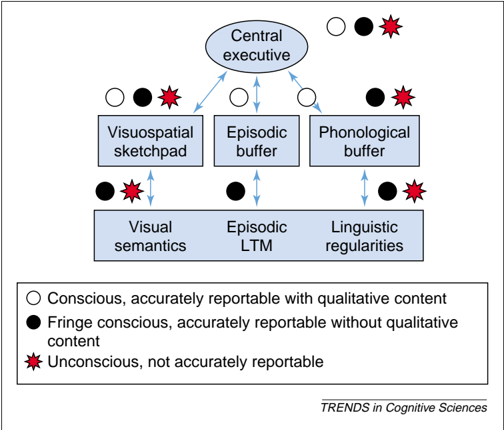
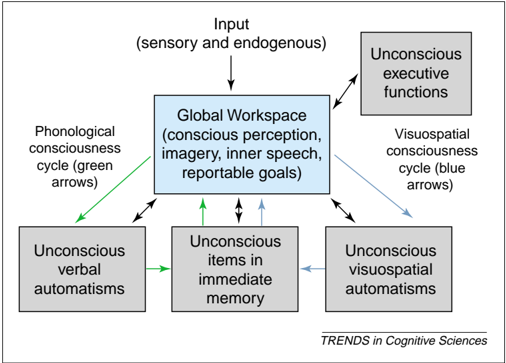
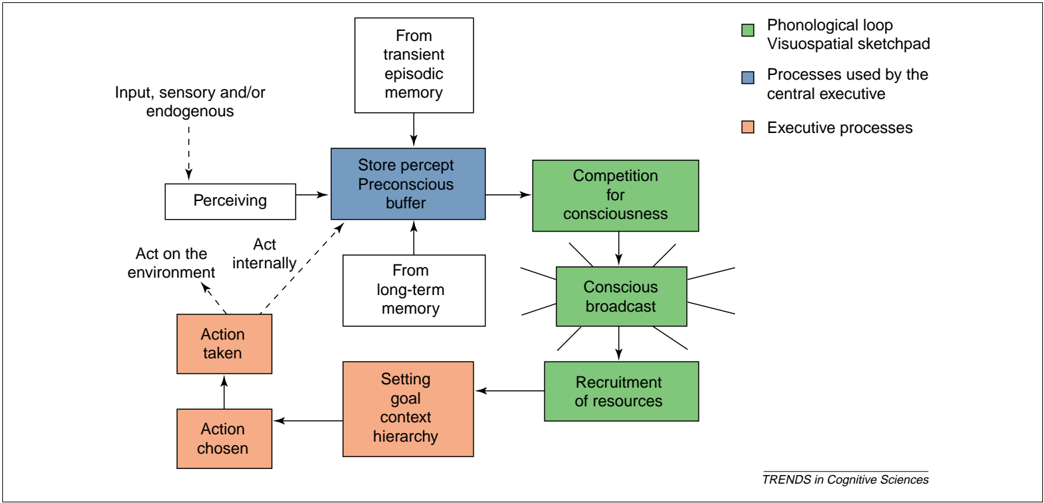
Active components of classical working memory are conscious, but traditional theory does not account for this fact. Global Workspace theory suggests that consciousness is needed to recruit unconscious specialized networks that carry out detailed working memory functions. The IDA model provides a fine-grained analysis of this process, specifically of two classical working-memory tasks, verbal rehearsal and the utilization of a visual image. In the process, new light is shed on the interactions between conscious and unconscious aspects of working memory.
Overview
The claims and statistics of this paper haven’t been checked yet.
Free: it reads the open-access text and checks the first 5 claims that cite a source we can check. Create a free account to check every claim.
Integrity signals
Registry
Cites
Statistics
Figures
Verification
Claims the paper makes
The claims and statistics of this paper haven’t been checked yet.
Free: it reads the open-access text and checks the first 5 claims that cite a source we can check. Create a free account to check every claim.
Claims other papers make about this one
Each is checked against this paper’s own text: does it say what the citing paper says it does?
The source backs part of the claim, not all of it — or backs it for a different population, condition or comparison.
In the citing paper
“Baars and Franklin (2003) suggest that all working memory tasks are consciously mediated – inner rehearsal, executive control, and other WM elements are all claimed to require a conscious cue to execute.”
From Global Workspace Dynamics: Cortical “Binding and Propagation” Enables Conscious Contents (2013) · cites this paper as Baars and Franklin (2003)
Experimental — accuracy not yet measuredThe cited source says what the claim attributes to it.
In the citing paper
“Baars and Franklin (2003) used GW theory to propose that consciousness enables access between otherwise separate knowledge sources.”
From Global Workspace Dynamics: Cortical “Binding and Propagation” Enables Conscious Contents (2013) · cites this paper as Baars and Franklin (2003)
The cited source says what the claim attributes to it.
In the citing paper
“when automatic capabilities fail, there follows a call recruiting additional collaborative conscious support ~Baars & Franklin, 2003!”
From AT THE INTERFACE: DYNAMIC INTERACTIONS OF EXPLICIT AND IMPLICIT LANGUAGE KNOWLEDGE (2005) · cites this paper as Baars & Franklin, 2003!
In the citing paper
“Working memory lies at the interface of perception and action (7) and requires the integration of large-scale neural circuits (8–11).”
From Dynamic reconfiguration of frontal brain networks during executive cognition in humans (2015) · cites this paper as [11]
Self-check
Percentages, sums and reported differences re-computed from the paper’s own numbers.
The self-check needs the paper’s full text.
Citations
Cites
James, W. (1913) · Henry Holt and Company eBooks · doi:10.1037/11059-000 · Cited by 25,226
Baddeley, A. D., & Hitch, G. (1974) · Psychology of Learning and Motivation · doi:10.1016/s0079-7421(08)60452-1 · Cited by 15,284
Barsalou, L. W. (1999) · Behavioral and Brain Sciences · doi:10.1017/s0140525x99002149 · Cited by 6,887
(1988) · Cited by 3,656
Self-citationEricsson, K. A., & Kintsch, W. (1995) · Psychological Review · doi:10.1037/0033-295x.102.2.211 · Cited by 3,498 · cited 1×
“Working memory Working memory [16] Long-term working memory [ 28 ] Emotions Neural networks [29] [30,31]”
Background(2012) · Encyclopedia of the Sciences of Learning · doi:10.1007/978-1-4419-1428-6_5794 · Cited by 2,562
Common regions of the human frontal lobe recruited by diverse cognitive demands
Duncan, J., & Owen, A. M. (2000) · Trends in Neurosciences · doi:10.1016/s0166-2236(00)01633-7 · Cited by 2,498
Towards a cognitive neuroscience of consciousness: basic evidence and a workspace framework
Dehaene, S. (2001) · Cognition · doi:10.1016/s0010-0277(00)00123-2 · Cited by 2,498
Is It an agent, or just a program?: A taxonomy for autonomous agents
Franklin, S., & Graesser, A. (1997) · Lecture Notes in Computer Science · doi:10.1007/bfb0013570 · Cited by 2,286 · cited 1×
“The IDA implementation of GW theory IDA (Intelligent Distribution Agent) is an autonomous software agent [ 18 ] that automates the entire set of tasks of a human personnel agent who assigns sailors to new tours of duty [19].”
MethodSelf-citationRolls, E. T. (1998) · doi:10.1093/oso/9780198524649.001.0001 · Cited by 1,257
Research works printed but not linked: 1
- 7 Baars, B.J. (1993) How does a serial, integrated and very limited stream of consciousness emerge from a nervous system that is mostly unconscious, distributed, and of enormous capacity? In CIBA SymposiumonExperimental and Theoretical Studies of Consciousness (Bock, G.R. and Marsh, J., eds) pp. 282-290, John Wiley & Sons
Cited by
Items 201–300 of 542
Consciousness, (meta)cognition, and culture
Frith, C. (2023) · Quarterly Journal of Experimental Psychology · doi:10.1177/17470218231164502 · Cited by 26
“However, working memory also involves many unconscious processes, leading Baars and Franklin (2003) to equate the contents of consciousness with a global workspace, a key sub-component of working memory.”
Background’I, Max’ - Communicating with an Artificial Agent
Wachsmuth, I. (2008) · Springer eBooks · doi:10.1007/978-3-540-79037-2_15 · Cited by 17
“Roughly in the middle between both extremes, there is the Global Workspace theory of Baars [3], [4] positing that consciousness emerges if multiple sensory inputs trigger neural mechanisms, which compete to ascertain the most logical response to the inputs.”
Backgroundvan der Velde, F. (2010) · Advances in Artificial Intelligence · doi:10.1155/2010/918062 · Cited by 30
“Ambiguities are common in language and cognition in general, but humans often do not notice them [30, 31].”
BackgroundToward formal models of biologically inspired, highly parallel machine cognition
Wallace, R. (2008) · International Journal of Parallel Emergent and Distributed Systems · doi:10.1080/17445760801932357 · Cited by 22
“The central ideas of Baars’ GWT of individual consciousness are as follows [9]: (1) The brain can be viewed as a collection of distributed specialised networks (processors).”
BackgroundHow Deliberate, Spontaneous, and Unwanted Memories Emerge in a Computational Model of Consciousness
Baars, B. J., Ramamurthy, U., & Franklin, S. (2007) · Wiley eBooks · doi:10.1002/9780470774069.ch9 · Cited by 17
“Though often assumed (e.g., Panksepp 1998, p.129 assumes a " transient memory store " ), the existence of such a memory has rarely been explicitly asserted (Donald 2001; Conway 2002; Baars and Franklin 2003; Franklin, et al, 2003).”
BackgroundInfluentialSelf-citationNeural Mechanisms of Human Decision-Making
Herd, S. A., Krueger, K. A., Nair, A., Mollick, J., & O’Reilly, R. C. (2021) · Cognitive Affective & Behavioral Neuroscience · doi:10.3758/s13415-020-00842-0 · Cited by 32
Matias, J., Belletier, C., Izaute, M., Lutz, M., & Silvert, L. (2021) · Quarterly Journal of Experimental Psychology · doi:10.1177/17470218211064903 · Cited by 22
Hsieh, P., & Colas, J. T. (2012) · Journal of Experimental Psychology Human Perception & Performance · doi:10.1037/a0028345 · Cited by 17
“…and maintained in visual WM. Keywords: awareness, attention, visual working memory, consciousness Cognitive processes that underlie working memory (WM), attention, and awareness are closely intertwined (Baars & Franklin, 2003; Dudai, 2004; Kintsch, Healy, Hegarety, Pennington, & Salthouse, 1999).”
BackgroundBeing Open Minded Without Knowing Why: Evidence from Nonconscious Goal Pursuit
Hassin, R. R. (2008) · Social Cognition · doi:10.1521/soco.2008.26.5.578 · Cited by 21
“…WM (whether as a mode of operation, or as a separate mechanism) is undoubtedly foreign to the current zeitgeist in the cognitive sciences (e.g., Baars & Franklin, 2003; Baddeley, 1993; Cowan, 1999; Dudai, 2004; Gathercole, 2007; Kintsch, Healy, Hegarety, Pennington, & Salthouse, 1999;…”
BackgroundMental saccades in control of cognitive process
Starzyk, J. A. (2011) · International Joint Conference on Neural Networks (IJCNN) · doi:10.1109/ijcnn.2011.6033262 · Cited by 19
“Mental saccades constitute an alternative solution to the idea of attention codelets competing for consciousness as presented in the LIDA model [23].”
BackgroundDoes Temporal Integration Occur for Unrecognizable Words in Visual Crowding?
Zhou, J., Lee, C., Li, K.-A., Tien, Y.-H., & Yeh, S. (2016) · PLoS ONE · doi:10.1371/journal.pone.0149355 · Cited by 18
“Working memory is widely thought to be closely related to consciousness ([37,38,39], but see [40] for exceptions).”
BackgroundConsciousness can overflow report: Novel evidence from attribute amnesia of a single stimulus
Wang, R., Fu, Y., Chen, L., Chen, Y., Zhou, J., & Chen, H. (2020) · Consciousness and Cognition · doi:10.1016/j.concog.2020.103052 · Cited by 18
Evolutionary origin and the development of consciousness
Kanaev, I. A. (2021) · Neuroscience & Biobehavioral Reviews · doi:10.1016/j.neubiorev.2021.12.034 · Cited by 17
“One of the most influential explanations of the subjective experience suggests that consciousness originates when many non-conscious domain computations are combined in a global neuronal workspace, thus making regional information available globally (Baars and Franklin, 2003; Changeux et al., 2021; Dehaene et al., 201…”
BackgroundCognitive robots: perceptual associative memory and learning
Franklin, S. (2006) · IEEE RO-MAN · doi:10.1109/roman.2005.1513816 · Cited by 16
“Preconscious perception is the first step in a continually cascading series of cognitive cycles by means of which every animal samples its environment and acts on it (Baars & Franklin 2003, Franklin et al. in review).”
BackgroundSelf-citationArtificial consciousness: A discipline between technological and theoretical obstacles
Manzotti, R., & Tagliasco, V. (2008) · Artificial Intelligence in Medicine · doi:10.1016/j.artmed.2008.07.002 · Cited by 22
“The quest for Neural Correlates of Consciousness (NCC) is currently based on this undemonstrated framework [14] as well as most consciousness inspired models in AI [57—63].”
BackgroundGarforth, J., McHale, S., & Meehan, A. S. (2006) · Neurocomputing · doi:10.1016/j.neucom.2005.11.018 · Cited by 14
“In the most recent elaboration of the IDA model, which extends the working implementation described above to include some features which are not yet implemented, Franklin, Baars, Ramamuthy and Ventura [22] present a nine-step cycle of computation that makes concrete the cycle of computation implicit in GWT. Sensory st…”
BackgroundMethodInfluentialAxioms, properties and criteria: Roles for synthesis in the science of consciousness
Clowes, R. W., & Seth, A. K. (2008) · Artificial Intelligence in Medicine · doi:10.1016/j.artmed.2008.07.009 · Cited by 22
“Most fully developed among GW models is Franklin’s IDA [26], which implements a version of the GW model at the computational level as a nine-step processing cycle (see [27]).”
MethodFields, C., & Glazebrook, J. F. (2018) · Journal of Experimental & Theoretical Artificial Intelligence · doi:10.1080/0952813x.2018.1544285 · Cited by 17
“For specific GNW-based models of event awareness, see Baars and Franklin (2003), Dehaene and Changeux (2004), Baars, Franklin, and Ramsoy (2013), Dehaene, Charles, King, and Marti (2014); see also Franklin and Patterson (2006) and Franklin et al. (2014) for discussions on GNW design principles as…”
BackgroundThe perceived present: What is it, and what is it there for?
White, P. A. (2020) · Psychonomic Bulletin & Review · doi:10.3758/s13423-020-01726-7 · Cited by 18
Evolutionary radiation and the spectrum of consciousness
Wallace, R. G., & Wallace, R. (2009) · Consciousness and Cognition · doi:10.1016/j.concog.2008.12.002 · Cited by 19
“Its central ideas are as follows (Baars & Franklin, 2003): (1) The brain can be viewed as a collection of distributed specialized networks (processors).”
BackgroundA Cognitive Science Based Machine Learning Architecture
D’Mello, S. K., Franklin, S., Ramamurthy, U., & Baars, B. J. (2006) · CogPrints (University of Southampton) · Cited by 16
Self-citationThe Design of Procedural, Semantic, and Episodic Memory Systems for a Cognitive Robot
Dodd, W. (2005) · Cited by 16
Duplex Vision: Separate Cortical Pathways for Conscious Perception and the Control of Action
Goodale, M. A. (2007) · Blackwell Publishing Ltd eBooks · doi:10.1002/9780470751466.ch49 · Cited by 21
Serafini, E. J. (2013) · DigitalGeorgetown (Georgetown University Library) · Cited by 36
What do estimates of working memory capacity tell us?
Cowan, N., Morey, C. C., Chen, Z., & Bunting, M. F. (2007) · Oxford University Press eBooks · doi:10.1093/acprof:oso/9780198570394.003.0003 · Cited by 24
“Philosophically, the portion of working memory that is based on the focus of attention is closely related to the conscious mind (Baars & Franklin 2003; James 1890).”
BackgroundAn Introduction to the Philosophy of Psychology
Weiskopf, D. A., & Adams, F. (2015) · Cambridge University Press eBooks · doi:10.1017/cbo9781139019040 · Cited by 24
Glazebrook, J. F., & Wallace, R. (2014) · Cognitive Processing · doi:10.1007/s10339-014-0636-y · Cited by 15
Tools for thinking applied to nature: an inclusive pedagogical framework for environmental education
Root‐Bernstein, M., Root-Bernstein, M., & Root-Bernstein, R. S. (2014) · Oryx · doi:10.1017/s0030605313000100 · Cited by 15
“By contrast, introspection can provide accurate reports of cognitive working memory (Baars & Franklin, 2003) and, as such, is interpreted as indicating the development of conscious knowledge (Baars & Franklin, 2003).”
BackgroundSpatial Working Memory in the LIDA Cognitive Architecture
Madl, T., Franklin, S., Chen, K., & Trappl, R. (2013) · Research Explorer (The University of Manchester) · Cited by 17
Self-citationGrounded Event-Based and Modal Representations for Objects, Relations, Beliefs, Etc.
McCall, R. J., Franklin, S., & Friedlander, D. S. (2010) · The Florida AI Research Society · Cited by 15
Self-citationRETRACTED ARTICLE: Chatbot design issues: building intelligence with the Cartesian paradigm
Shestak, V. A., Gura, D. A., Khudyakova, N., Shaikh, Z. A., & Bokov, Y. (2020) · Evolutionary Intelligence · doi:10.1007/s12065-020-00358-z · Cited by 20
RetractedDo Process-1 simulations generate the epistemic feelings that drive Process-2 decision making?
Fields, C., & Glazebrook, J. F. (2020) · Cognitive Processing · doi:10.1007/s10339-020-00981-9 · Cited by 14
“We formulate in “Epistemic feelings as synthetic interoceptions” Section the question of how highly distributed sets of implicitly represented probabilities could be repackaged into and summarized by feelings of confidence in a Process-1 solution, using a generalized global neuronal workspace (GNW) model (Baars and Fr…”
BackgroundMethodInfluentialSnaider, J., & Franklin, S. (2014) · Procedia Computer Science · doi:10.1016/j.procs.2014.11.103 · Cited by 19
Self-citationOpen and closed loops: A computational approach to attention and consciousness
Trapp, S., Schroll, H., & Hamker, F. H. (2012) · Advances in Cognitive Psychology · doi:10.5709/acp-0096-y · Cited by 16
The subjective experience of committed errors and the Discrepancy-Attribution hypothesis
Wilbert, J., & Haider, H. (2011) · Acta Psychologica · doi:10.1016/j.actpsy.2011.11.010 · Cited by 14
The Memory Labyrinth: Systems, Processes, and Boundaries
Veselis, R. A. (2017) · Springer eBooks · doi:10.1007/978-3-319-47609-4_3 · Cited by 14
Heterogeneous artificial agents for triage nurse assistance
Wilkes, D. M., Franklin, S., Erdemir, E., Gordon, S. M., Strain, S., Miller, K. F., & Kawamura, K. (2010) · IEEE-RAS International Conference on Humanoid Robots (Humanoids) · doi:10.1109/ichr.2010.5686839 · Cited by 13
“Humans process sensory data, and select and begin executing a response five to ten times a second [18].”
BackgroundSelf-citationThe effects of working memory load on visual awareness and its electrophysiological correlates
Koivisto, M., Ruohola, M., Vahtera, A., Lehmusvuo, T., & Intaitė, M. (2018) · Neuropsychologia · doi:10.1016/j.neuropsychologia.2018.10.011 · Cited by 14
Ghosh, L., Konar, A., Rakshit, P., & Nagar, A. K. (2019) · IEEE Transactions on Emerging Topics in Computational Intelligence · doi:10.1109/tetci.2019.2937566 · Cited by 14
Toth, P. D. (2022) · Language Learning · doi:10.1111/lang.12490 · Cited by 19
Autobiographical Memory and Mindfulness: a Critical Review with a Systematic Search
Dominguez, E., Casagrande, M., & Raffone, A. (2022) · Mindfulness · doi:10.1007/s12671-022-01902-x · Cited by 16
“The notion of global workspace has also been considered in interplay with the self, meant both as a “narrative interpreter” of conscious experience and as an implicit “contextual system” (with activated goals) supporting conscious processing in the brain (Baars, 1998; Baars and Franklin, 2003) .”
BackgroundCan Conscious Agency Be Saved?
Pacherie, É. (2013) · Topoi · doi:10.1007/s11245-013-9187-6 · Cited by 13
“…as the hallmark of consciously controlled processes as opposed to automatic processes, that are independent of working memory (e.g., Evans 2008; Baars and Franklin 2003), this strongly suggests that MTT planning is a form of conscious thought, involving the cooperation of the autobiographical…”
BackgroundImpromptu Decisions to Deceive
Walczyk, J. J., Tcholakian, T., Newman, D. N., & Duck, T. K. (2016) · Applied Cognitive Psychology · doi:10.1002/acp.3282 · Cited by 16
Working Memory: The Information You Are Now Thinking of
Cowan, N. (2017) · Elsevier eBooks · doi:10.1016/b978-0-12-809324-5.21040-7 · Cited by 16
An attentional blink in the absence of spatial attention: a cost of awareness?
Ophir, E. A., Sherman, E., & Lamy, D. (2018) · Psychological Research · doi:10.1007/s00426-018-1100-x · Cited by 17
“…conscious perception and consolidation in working memory are tightly related constructs and the mechanisms underlying the processes that support them are likely to overlap (Baars, 1997, Baars & Franklin, 2003; Koch & Tsuchiya, 2007; Lamme, 2006; Soto & Silvanto, 2014; Velichkovsky, 2017).”
BackgroundEEG analysis for working memory modeling in face recognition task
Ghosh, L., Parui, S., Rakshit, P., & Konar, A. (2017) · International Conference on Research in Computational Intelligence and Communication Networks (ICRCICN) · doi:10.1109/icrcicn.2017.8234477 · Cited by 12
Dissecting Social Engineering Attacks Through the Lenses of Cognition
Burda, P., Allodi, L., & Zannone, N. (2021) · IEEE European Symposium on Security and Privacy Workshops (EuroS&PW) · doi:10.1109/eurospw54576.2021.00024 · Cited by 18
Building the Blocks of Being: The Attributes and Qualities Required for Consciousness
Tait, I., Bensemann, J., & Nguyen, T. (2023) · Philosophies · doi:10.3390/philosophies8040052 · Cited by 20
“This idea was demonstrated in the embeddedprocess WM model [54], activation-based models of WM [55,56] and the opinions of having a distinction between conscious WM content and unconscious WM content (which may become conscious) [57].”
MethodGlobal workspace model of consciousness and its electromagnetic correlates
Prakash, R., Prakash, O., Prakash, S., Abhishek, P., & Gandotra, S. (2008) · Annals of Indian Academy of Neurology · doi:10.4103/0972-2327.42933 · Cited by 15
Consciousness and information integration
Brogaard, B. “., Chomanski, B., & Gatzia, D. E. (2020) · Synthese · doi:10.1007/s11229-020-02613-3 · Cited by 14
Wallace, R., Fullilove, M. T., Fullilove, R. E., & Wallace, D. (2007) · Theoretical Biology and Medical Modelling · doi:10.1186/1742-4682-4-10 · Cited by 13
Extending the global workspace theory to emotion: Phenomenality without access
Schutter, D. J. L. G., & van Honk, J. (2004) · Consciousness and Cognition · doi:10.1016/j.concog.2004.05.002 · Cited by 15
“Some of these unconscious networks, designated as contexts, are suggested to be capable of shaping conscious contents (Baars & Franklin, 2003).”
SELF-SYSTEM IN A MODEL OF COGNITION
Ramamurthy, U., Franklin, S., & Agrawal, P. (2012) · International Journal of Machine Consciousness · doi:10.1142/s1793843012400185 · Cited by 13
Self-citationWallace, R. (2023) · Journal of Artificial Intelligence and Consciousness · doi:10.1142/s2705078522500187 · Cited by 16
Rohlfshagen, P., & Bryson, J. (2010) · Cognitive Computation · doi:10.1007/s12559-010-9057-0 · Cited by 16
“implement a theory of consciousness [3].”
Computational modeling/cognitive robotics complements functional modeling/experimental psychology
D’Mello, S. K., & Franklin, S. (2009) · New Ideas in Psychology · doi:10.1016/j.newideapsych.2009.07.003 · Cited by 13
“…cognition (Clark, 1997; Glenberg, 1997; Varela et al., 1991), Barsalou’s theory of perceptual symbol systems (1999, Harnad, 1990), working memory (Baars & Franklin, 2003; Baddeley, 1992, 2000; Baddeley & Hitch, 1974), Glenberg’s theory (1997) of the importance of affordances (Gibson, 1979) to…”
BackgroundMethodInfluentialSelf-citationUsing Broad Cognitive Models to Apply Computational Intelligence to Animal Cognition
Franklin, S., & Ferkin, M. H. (2008) · Studies in computational intelligence · doi:10.1007/978-3-540-78534-7_15 · Cited by 11
“These lower-level processes include perception [53], various forms of memory [55], attention [ 6 ], learning [23], and action selection [82].”
BackgroundSelf-citationThe unconscious nature of insight: A dual-task paradigm investigation
Lebed, A., & Коровкин, С. (2017) · Psychology in Russia State of Art · doi:10.11621/pir.2017.0307 · Cited by 10
Free Will, Causality, and Neuroscience
Feltz, B., Missal, M., & Sims, A. C. (2019) · BRILL eBooks · doi:10.1163/9789004409965 · Cited by 14
Programming coevolutionary machines: the emerging conundrum
Wallace, R. (2009) · International Journal of Parallel Emergent and Distributed Systems · doi:10.1080/17445760902761945 · Cited by 16
“Wallace [25] introduced a class of biologically inspired models of highly parallel machine cognition based on a spectrum of multiple global broadcast versions of the Baars model of biological consciousness [4–6,21–25,27,28].”
BackgroundHirschhorn, R., Biderman, D., Biderman, N., Yaron, I., Bennet, R., Plotnik, M., & Mudrik, L. (2024) · Behavior Research Methods · doi:10.3758/s13428-024-02401-8 · Cited by 14
“Different answers have been suggested to this question, from assigning different high-level functions to consciousness (e.g., working memory: Baars & Franklin, 2003; Baddeley, 2003; integration of information: Hirschhorn et al., 2021; Mudrik et al., 2014; chaining mental operations: Sackur &…”
BackgroundThe relationship between consciousness, understanding, and rationality
Smith, R. S. (2016) · Philosophical Psychology · doi:10.1080/09515089.2016.1172700 · Cited by 13
“This proposal is also related to an influential line of empirical work in cognitive neuroscience on the “global neuronal workspace” theory of consciousness (Baars, 2005; Baars & Franklin, 2003; Dehaene, 2014; Dehaene & Naccache, 2001; Dehaene, Sergent, & Changeux, 2003).”
BackgroundSimione, L., Akyürek, E. G., Vastola, V., Raffone, A., & Bowman, H. (2017) · Consciousness and Cognition · doi:10.1016/j.concog.2017.03.004 · Cited by 13
“They also support the views that the consolidation of a representation means that it has been consciously perceived and that conscious access is based upon the material consolidated into working memory (Baars & Franklin, 2003; Block, 2007; Lamme, 2006).”
Tu, S., Wan, S., Jou, J., Ma, Y., Zhao, G. W., & Pan, W. (2019) · Attention Perception & Psychophysics · doi:10.3758/s13414-019-01816-2 · Cited by 12
Dynamics of working memory process revealed by independent component analysis in an fMRI study
Fąfrowicz, M., Ceglarek, A., Olszewska, J. M., Sobczak, A. M., Bohaterewicz, B., Ostrogórska, M., Reuter‐Lorenz, P. A., Lewandowska, K., Sikora-Wachowicz, B., Ogińska, H., et al. (2023) · Scientific Reports · doi:10.1038/s41598-023-29869-2 · Cited by 13
The benefit of surface uniformity for encoding boundary features in visual working memory.
Kim, S.-H., & Kim, J.-O. (2011) · Journal of Experimental Psychology Human Perception & Performance · doi:10.1037/a0025639 · Cited by 10
Neurocognitive spotlights: Configuring domains for ideation
Iyer, L., Venkatesan, V., & Minai, A. A. (2010) · International Joint Conference on Neural Networks (IJCNN) · doi:10.1109/ijcnn.2010.5596800 · Cited by 17
“However, as the neural mechanisms underlying the more response-oriented functions have become better understood, it has become possible to infer similar mechanisms for internal processes such as ideation, and a number of computational models have been proposed [9], [10], [11], [12], including one…”
BackgroundEncoding and Retrieval Efficiency of Episodic Data in a Modified Sparse Distributed Memory System
D’Mello, S. K., Franklin, S., & Ramamurthy, U. (2005) · eScholarship (California Digital Library) · Cited by 10
Self-citationImpact of Alcohol-Related Video Sequences on Functional MRI in Abstinent Alcoholics
Krienke, U. J., Nikesch, F., Spiegelhalder, K., Hennig, J., Olbrich, H. M., & Langosch, J. M. (2013) · European Addiction Research · doi:10.1159/000349909 · Cited by 14
Natural constraints explain working memory capacity limitations in sensory-cognitive modelsPreprint
Xie, Y., Duan, Y., Cheng, A., Jiang, P., Cueva, C. J., & Yang, G. R. (2023) · bioRxiv (Cold Spring Harbor Laboratory) · doi:10.1101/2023.03.30.534982 · Cited by 14
Sustained conscious access to incidental memories in RSVP
Matthews, J., Wu, J., Corneille, V., Hohwy, J., van Boxtel, J., & Tsuchiya, N. (2019) · Attention, Perception, & Psychophysics · doi:10.3758/s13414-018-1600-1 · Cited by 9
A Perspective on Machine Consciousness
Prasad, D. K., & Starzyk, J. A. (2010) · Cited by 10
Executive Functions and Theory of Mind in Teachers and Non-Teachers
Barraza, P., & Rodríguez, E. (2023) · Heliyon · doi:10.1016/j.heliyon.2023.e19915 · Cited by 16
Weitz, D., O’Shea, G., Zook, N., & Needham, W. P. (2011) · The American Journal of Psychology · doi:10.5406/amerjpsyc.124.1.0049 · Cited by 11
Conscious and Unconscious Awareness in Learning and Performance
Masters, R. S. W. (2012) · Oxford University Press eBooks · doi:10.1093/oxfordhb/9780199731763.013.0007 · Cited by 11
A Scene-Based Episodic Memory System for a Simulated Autonomous Creature
Castro, E., & Gudwin, R. (2013) · International Journal of Synthetic Emotions · doi:10.4018/jse.2013010102 · Cited by 9
Semantic learning in autonomously active recurrent neural networks
Gros, C., & Kaczor, G. (2009) · Logic Journal of IGPL · doi:10.1093/jigpal/jzp045 · Cited by 10
“The global workspace serves, in the view of Baars and Franklin [12], as an exchange platform for conscious experience and working memory.”
BackgroundA working memory bias for alcohol-related stimuli depends on drinking score.
Kessler, K., Pajak, K. M., Harkin, B., & Jones, B. T. (2012) · Psychology of Addictive Behaviors · doi:10.1037/a0028664 · Cited by 9
A cognitive model’s view of animal cognition
D’Mello, S. K., & Franklin, S. (2011) · Current Zoology · doi:10.1093/czoolo/57.4.499 · Cited by 11
“It has been suggested that conscious input, rehearsal, and retrieval are necessary for the normal functions of working memory in humans (Baars and Franklin, 2003); we make no such claim for the present analysis of animal cognition.”
BackgroundSelf-citationAttention, Consciousness and Mindfulness in Meditation
Raffone, A., Srinivasan, N., & Barendregt, H. P. (2014) · IRIS Research product catalog (Sapienza University of Rome) · Cited by 12
Working memory can compare two visual items without accessing visual consciousness
Nakano, S., & Ishihara, M. (2019) · Consciousness and Cognition · doi:10.1016/j.concog.2019.102859 · Cited by 9
Modularity and Self-Organized Functional Architectures in the Brain
Iyer, L., Minai, A. A., Doboli, S., & Brown, V. R. (2012) · Springer eBooks · doi:10.1007/978-3-642-18003-3_16 · Cited by 9
“It has been proposed that effortful responses require the involvement of working memory [2] or global workspace [1], which functions essentially as a temporary “hidden layer” facilitating direct linkage between stimulus and response.”
BackgroundMemory-Augmented Graph Neural Networks: A Brain-Inspired Review
Ma, G., Vo, V. A., Willke, T. L., & Ahmed, N. K. (2023) · IEEE Transactions on Artificial Intelligence · doi:10.1109/tai.2023.3329454 · Cited by 14
“Working memory plays a central role in global workspace theory [34], [35], which posits the existence of a globally accessible, limited capacity workspace where information can be coordinated and communicated.”
BackgroundModeling Medical Diagnosis Using a Comprehensive Cognitive Architecture
Strain, S., & Franklin, S. (2011) · Journal of Healthcare Engineering · doi:10.1260/2040-2295.2.2.241 · Cited by 9
“The cognitive cycle [17,18] can be conceptualized as occurring in three phases: 1) Understanding; 2) Attention; and 3) Action.”
BackgroundSelf-citationCastagna, P. J. (2019) · Brain Structure and Function · doi:10.1007/s00429-019-01974-x · Cited by 10
An externalist approach to creativity: discovery versus recombination
Lavazza, A., & Manzotti, R. (2013) · Mind & Society · doi:10.1007/s11299-013-0124-6 · Cited by 8
“This will be consistent with two further approaches—namely the global workspace theory (Baars 1997; Baars and Franklin 2003) and the idea that consciousness may corresponds to an intermediate cognitive level (Haugeland 1998).”
ResultIn Situ Representations and Access Consciousness in Neural Blackboard or Workspace Architectures
van der Velde, F. (2018) · Frontiers in Robotics and AI · doi:10.3389/frobt.2018.00032 · Cited by 8
“cONsciOUsNess BAseD ON QUeries AND ANsWers WitH IN SITU rePreseNtAtiONs In the Global Workspace theory of consciousness, representations compete to get access to the workspace and to (temporarily) dominate it (e.g., Baars, 2002; Baars and Franklin, 2003; Wiggins, 2012).”
BackgroundTowards A Novel Integrated Neuro-Cognitive Architecture (INCA)
Oentaryo, R. J., & Pasquier, M. (2008) · International Joint Conference on Neural Networks (IJCNN) · doi:10.1109/ijcnn.2008.4634058 · Cited by 8
Reinforcement learning at the interface of artificial intelligence and cognitive science
Alkam, T., Tarshizi, E., & Benschoten, A. H. V. (2025) · Neuroscience · doi:10.1016/j.neuroscience.2025.09.004 · Cited by 9
Awareness as the heart of working memory
Allen, R. J., Baddeley, A., & Hitch, G. J. (2026) · Trends in Cognitive Sciences · doi:10.1016/j.tics.2026.04.001 · Cited by 15
Integer sparse distributed memory and modular composite representation
Franklin, S., & Snaider, J. (2012) · Cited by 8
Self-citationLow working memory reduces the use of mental contrasting
Sevincer, A. T., Schröder, A., Plakides, A., Edler, N., & Oettingen, G. (2024) · Consciousness and Cognition · doi:10.1016/j.concog.2024.103644 · Cited by 8
“Thus, recent conceptualizations of working memory acknowledge that working memory involves the interplay between conscious and nonconscious processes (Baars & Franklin, 2003).”
BackgroundThe neural basis of temporal individuation and its capacity limits in the human brain
Naughtin, C. K., Tamber-Rosenau, B. J., & Dux, P. E. (2017) · Journal of Neurophysiology · doi:10.1152/jn.00839.2016 · Cited by 7
“The widespread patterns of activity that emerged for temporal individuation are instead in line with existing accounts of consciousness, such as the “global neuronal workspace” model (Dehaene et al. 2003; Sergent and Dehaene 2004; see also Baars and Franklin 2003).”
BackgroundMethodResultInfluentialExploring the Computational Explanatory Gap
Reggia, J. A., Huang, D.-W., & Katz, G. E. (2017) · Philosophies · doi:10.3390/philosophies2010005 · Cited by 9
Realizing Forgetting in a Modified Sparse Distributed Memory System
D’Mello, S. K., Franklin, S., & Ramamurthy, U. (2006) · eScholarship (California Digital Library) · Cited by 7
Self-citationWorking memory modeling using inverse fuzzy relational approach
Ghosh, L., Rakshit, P., & Konar, A. (2019) · Applied Soft Computing · doi:10.1016/j.asoc.2019.105591 · Cited by 7
Canonical failure modes of real-time control systems: insights from cognitive theory
Wallace, R. (2014) · International Journal of Systems Science · doi:10.1080/00207721.2014.923951 · Cited by 6
“…evidence from brain imaging experiments to show that individual animal consciousness involves a single large-scale global broadcast that en-trains ‘low level’ cognitive modules into working coalitions (Baars, 1988, 2005; Baars & Franklin, 2003; Baars, Franklin, & Ramsoy, 2013; Wallace, 2005).”
BackgroundHabitually breaking habits: Agency, awareness, and decision-making in musical improvisation
Bergamin, J. A. (2024) · Phenomenology and the Cognitive Sciences · doi:10.1007/s11097-024-09974-x · Cited by 8
Physical integration: A causal account for consciousness
Manzotti, R., & Chella, A. (2014) · Journal of Integrative Neuroscience · doi:10.1142/s0219635214400044 · Cited by 7
The Role of Working Memory in Implicit Memory: A Developmental Perspective
Yang, Y., Chen, M., He, W. Y., & Merrill, E. C. (2020) · Cognitive Development · doi:10.1016/j.cogdev.2020.100929 · Cited by 11
Metadata
- Authors
- Baars, B. J., & Franklin, S.
- Affiliations
- Neurosciences Institute (US)
- University of Memphis (US)
- Corresponding author
- Baars, Bernard J.
- Venue
- Trends in Cognitive Sciences
- Publisher
- Elsevier BV
- Published
- 2003-04
- Volume
- 7
- Issue
- 4
- Pages
- 166-172
- ISSN
- 1364-6613 (ISSN-L)
- OpenAlex
- W2170468585
- Semantic Scholar
- 59210192d31d570d83532e24b6908f57fae8747a
- Cited by
- 541
- References
- 41
- Citations by year
- 2026: 36 · 2025: 36 · 2024: 18 · 2023: 28 · 2022: 16 · 2021: 17 · 2020: 19 · 2019: 21 · 2018: 24 · 2017: 25 · 2016: 18 · 2015: 22 · 2014: 30 · 2013: 38 · 2012: 30
- FWCI
- 2.61
- Type
- journal article
- Language
- en
- Open access
- closed
- Licence
- www.elsevier.com/tdm/userlicense/1.0/ (tdm)
- www.elsevier.com/legal/tdmrep-license (tdm)
- Locations
- Trends in Cognitive Sciences (publishedVersion)
- PubMed (publishedVersion)
- CogPrints (University of Southampton) (submittedVersion)
- Funders
- Field Neurosciences Institute
- Neurosciences Research Foundation
- Topics
- Social Sciences › Arts and Humanities › Philosophy › Philosophy and Theoretical Science
- Social Sciences › Psychology › Experimental and Cognitive Psychology › Cognitive Abilities and Testing
- Life Sciences › Neuroscience › Cognitive Neuroscience › Neural dynamics and brain function
- Keywords
- subjective experience, working memory, global workspace theory, unconscious processes, verbal rehearsal, visual imagery
About these checks
Registry, retraction, Cites and statistics results are computed, not judged, with one exception: a printed reference that no index lists is read once by a model before it counts as a citation error. Claims are extracted by a model and kept only when their quote appears verbatim in the text; each cited source is then checked, with a model’s help, for whether it says what the claim relies on. Those verdicts can be wrong — read the claim’s quote and the cited source before relying on one.
Statistics and arithmetic are recomputed, not judged.
Confidence bands are shown only for fields calibrated on our annotated test set. None is calibrated yet, so no band is shown.
What counts as a claim ›How we measure confidence ›How we check this ›
Are you an author, or do you see a problem with this page? Request a review
Data sources
Bibliographic data: Semantic Scholar, OpenAlex, Crossref.
Contains information from the Semantic Scholar Academic Graph Datasets, made available under the ODC Attribution License (ODC-BY 1.0).
Semantic Scholar’s data is described in: Kinney, R., et al. (2023). The Semantic Scholar Open Data Platform. arXiv:2301.10140.
