

How conscious experience and working memory interact
The DOI matches its Crossref record; 40 of the 41 references it cites were found in a registry or an index.
Abstract
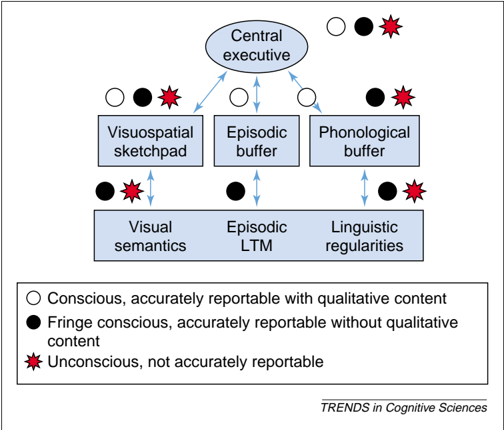
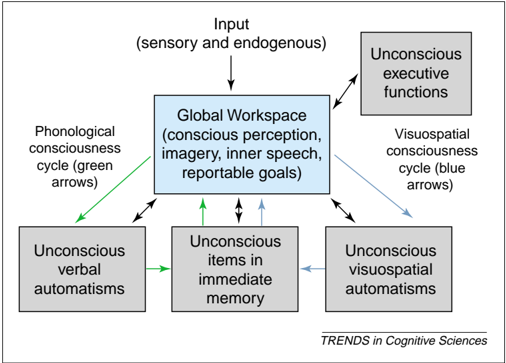
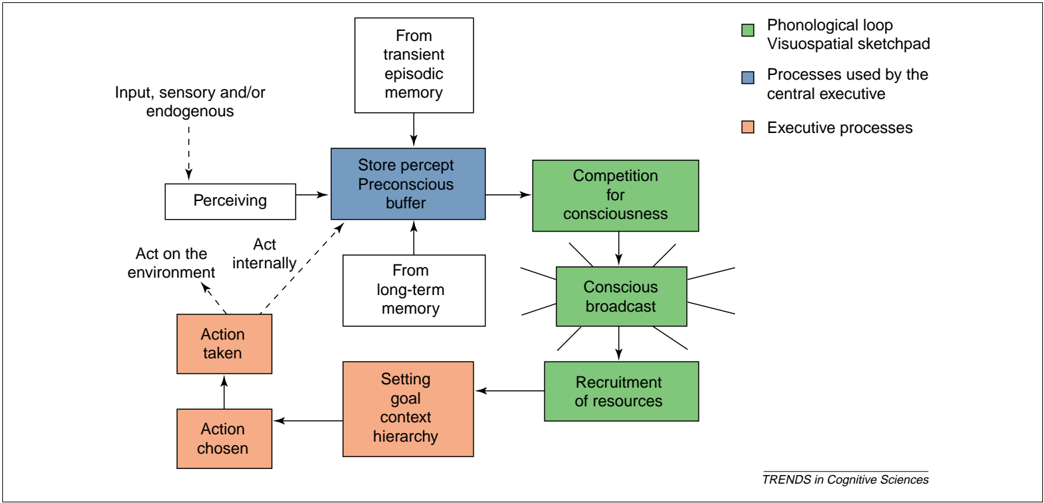
Active components of classical working memory are conscious, but traditional theory does not account for this fact. Global Workspace theory suggests that consciousness is needed to recruit unconscious specialized networks that carry out detailed working memory functions. The IDA model provides a fine-grained analysis of this process, specifically of two classical working-memory tasks, verbal rehearsal and the utilization of a visual image. In the process, new light is shed on the interactions between conscious and unconscious aspects of working memory.
Overview
The claims and statistics of this paper haven’t been checked yet.
Free: it reads the open-access text and checks the first 5 claims that cite a source we can check. Create a free account to check every claim.
Integrity signals
Registry
Cites
Statistics
Figures
Verification
Claims the paper makes
The claims and statistics of this paper haven’t been checked yet.
Free: it reads the open-access text and checks the first 5 claims that cite a source we can check. Create a free account to check every claim.
Claims other papers make about this one
Each is checked against this paper’s own text: does it say what the citing paper says it does?
The source backs part of the claim, not all of it — or backs it for a different population, condition or comparison.
In the citing paper
“Baars and Franklin (2003) suggest that all working memory tasks are consciously mediated – inner rehearsal, executive control, and other WM elements are all claimed to require a conscious cue to execute.”
From Global Workspace Dynamics: Cortical “Binding and Propagation” Enables Conscious Contents (2013) · cites this paper as Baars and Franklin (2003)
Experimental — accuracy not yet measuredThe cited source says what the claim attributes to it.
In the citing paper
“Baars and Franklin (2003) used GW theory to propose that consciousness enables access between otherwise separate knowledge sources.”
From Global Workspace Dynamics: Cortical “Binding and Propagation” Enables Conscious Contents (2013) · cites this paper as Baars and Franklin (2003)
The cited source says what the claim attributes to it.
In the citing paper
“when automatic capabilities fail, there follows a call recruiting additional collaborative conscious support ~Baars & Franklin, 2003!”
From AT THE INTERFACE: DYNAMIC INTERACTIONS OF EXPLICIT AND IMPLICIT LANGUAGE KNOWLEDGE (2005) · cites this paper as Baars & Franklin, 2003!
In the citing paper
“Working memory lies at the interface of perception and action (7) and requires the integration of large-scale neural circuits (8–11).”
From Dynamic reconfiguration of frontal brain networks during executive cognition in humans (2015) · cites this paper as [11]
Self-check
Percentages, sums and reported differences re-computed from the paper’s own numbers.
The self-check needs the paper’s full text.
Citations
Cites
James, W. (1913) · Henry Holt and Company eBooks · doi:10.1037/11059-000 · Cited by 25,226
Baddeley, A. D., & Hitch, G. (1974) · Psychology of Learning and Motivation · doi:10.1016/s0079-7421(08)60452-1 · Cited by 15,284
Barsalou, L. W. (1999) · Behavioral and Brain Sciences · doi:10.1017/s0140525x99002149 · Cited by 6,887
(1988) · Cited by 3,656
Self-citationEricsson, K. A., & Kintsch, W. (1995) · Psychological Review · doi:10.1037/0033-295x.102.2.211 · Cited by 3,498 · cited 1×
“Working memory Working memory [16] Long-term working memory [ 28 ] Emotions Neural networks [29] [30,31]”
Background(2012) · Encyclopedia of the Sciences of Learning · doi:10.1007/978-1-4419-1428-6_5794 · Cited by 2,562
Common regions of the human frontal lobe recruited by diverse cognitive demands
Duncan, J., & Owen, A. M. (2000) · Trends in Neurosciences · doi:10.1016/s0166-2236(00)01633-7 · Cited by 2,498
Towards a cognitive neuroscience of consciousness: basic evidence and a workspace framework
Dehaene, S. (2001) · Cognition · doi:10.1016/s0010-0277(00)00123-2 · Cited by 2,498
Is It an agent, or just a program?: A taxonomy for autonomous agents
Franklin, S., & Graesser, A. (1997) · Lecture Notes in Computer Science · doi:10.1007/bfb0013570 · Cited by 2,286 · cited 1×
“The IDA implementation of GW theory IDA (Intelligent Distribution Agent) is an autonomous software agent [ 18 ] that automates the entire set of tasks of a human personnel agent who assigns sailors to new tours of duty [19].”
MethodSelf-citationRolls, E. T. (1998) · doi:10.1093/oso/9780198524649.001.0001 · Cited by 1,257
Research works printed but not linked: 1
- 7 Baars, B.J. (1993) How does a serial, integrated and very limited stream of consciousness emerge from a nervous system that is mostly unconscious, distributed, and of enormous capacity? In CIBA SymposiumonExperimental and Theoretical Studies of Consciousness (Bock, G.R. and Marsh, J., eds) pp. 282-290, John Wiley & Sons
Cited by
Items 501–542 of 542
Knowledge-first mentalizing: concept-based or merely state-based?
Harder, R. (2025) · Synthese · doi:10.1007/s11229-025-05213-1
Implication of Sanskrit language in 21st Century: An Exploratory Study
Sarkar, S. (2025) · Journal of Global Economy · doi:10.1956/jge.v21i3.800 · Cited by 1
Hierarchical Bayesian Inference and the Classical FEP
Fields, C., & Glazebrook, J. F. (2025) · Synthesis lectures on engineering, science, and technology · doi:10.1007/978-3-031-97263-8_4
Exploring Metacognitive Experiences by Simulating Internal Decisions of Information Access
Ukov, T. G., & Tsochev, G. (2025) · Systems · doi:10.3390/systems13110982
“What is more, a TIC is recognized as a discrete event of consciousness [4,5] that interacts with working memory [21].”
Entering the blackboard jungle: canonical dysfunction in conscious machinesPreprint
Wallace, R. (2005) · CogPrints (University of Southampton)
Rahimi, R. (2012) · Diva portal (Dalarna University Library)
Wallace, R. (2007) · CogPrints (University of Southampton)
Gimenes, G. (2014) · theses.fr (ABES) · doi:10.70675/2be4e39bz39bcz4522z9968zfd6b59b33f4f
Behavioral and neural properties of conscious and unconscious expectancy effects
Rozier, C. (2018) · theses.fr (ABES) · doi:10.70675/995b04ecz26b6z43d0z8a32z6715548ab55d
“2.1.3.2 Unconscious working memory: a possible explanation of these long-lasting influences Most of the theories of working memory postulate that the information has to be conscious in order to be maintained (Baars and Franklin, 2003; Squire and Dede, 2015).”
BackgroundInfluentialTasserie, J. (2020) · theses.fr (ABES) · doi:10.70675/de1896a4z56b3z4f72z93dfz02c239bd29f1 · Cited by 3
Taylor, H. (2026) · Oxford University Press eBooks · doi:10.1093/9780198995043.002.0005
The Path to Eliminativism? Natural Kinds and Conceptual Reform in Psychology
Taylor, H. (2026) · Oxford University Press eBooks · doi:10.1093/9780198995043.003.0004
Infant Consciousness: When Does It Arise?
Taylor, H. (2026) · Oxford University Press eBooks · doi:10.1093/9780198995043.003.0010
The First Light: Natural Kinds and Baby Consciousness
Taylor, H. (2026) · Oxford University Press eBooks · doi:10.1093/9780198995043.003.0009
The Two Visual Streams Hypothesis: Two Natural Kinds?
Taylor, H. (2026) · Oxford University Press eBooks · doi:10.1093/9780198995043.003.0005
Working Memory, Vagueness, and Consciousness
Taylor, H. (2026) · Oxford University Press eBooks · doi:10.1093/9780198995043.003.0008
Property Clusters: In Defence of a Liberal Approach
Taylor, H. (2026) · Oxford University Press eBooks · doi:10.1093/9780198995043.003.0003
Taylor, H. (2026) · Oxford University Press eBooks · doi:10.1093/9780198995043.003.0001
Natural Kinds and Property Clusters: Why Long-Term Memory Is a Natural Kind
Taylor, H. (2026) · Oxford University Press eBooks · doi:10.1093/9780198995043.003.0002
Taylor, H. (2026) · Oxford University Press eBooks · doi:10.1093/9780198995043.003.0006
Taylor, H. (2026) · Oxford University Press eBooks · doi:10.1093/9780198995043.002.0006
The Mind’s Central Station: The Science of Working Memory
Taylor, H. (2026) · Oxford University Press eBooks · doi:10.1093/9780198995043.003.0007
Baars, B. J., & Geld, N. (2026) · Studies in systems, decision and control · doi:10.1007/978-3-032-00242-6_12
Self-citationTracing Subliminal Memory Traces
Bergström, F. (2011) · DiVA (Digitala Vetenskapliga Arkivet)
Litvin, D. V. (2026) · Applied psychology and pedagogy · doi:10.12737/2500-0543-2026-11-4-62-84
A Scientific Theory of Consciousness
Goldstein, S., & Kirk‐Giannini, C. D. (2026) · Oxford University Press eBooks · doi:10.1093/9780197840375.003.0009
Goldstein, S., & Kirk‐Giannini, C. D. (2026) · Oxford University Press eBooks · doi:10.1093/9780197840375.003.0002
Goldstein, S., & Kirk‐Giannini, C. D. (2026) · Oxford University Press eBooks · doi:10.1093/9780197840375.003.0008
Goldstein, S., & Kirk‐Giannini, C. D. (2026) · Oxford University Press eBooks · doi:10.1093/9780197840375.003.0001
Goldstein, S., & Kirk‐Giannini, C. D. (2026) · Oxford University Press eBooks · doi:10.1093/9780197840375.003.0010
Goldstein, S., & Kirk‐Giannini, C. D. (2026) · Oxford University Press eBooks · doi:10.1093/9780197840375.003.0011
Goldstein, S., & Kirk‐Giannini, C. D. (2026) · Oxford University Press eBooks · doi:10.1093/9780197840375.003.0004
Goldstein, S., & Kirk‐Giannini, C. D. (2026) · Oxford University Press eBooks · doi:10.1093/9780197840375.003.0013
Goldstein, S., & Kirk‐Giannini, C. D. (2026) · Oxford University Press eBooks · doi:10.1093/9780197840375.003.0006
Goldstein, S., & Kirk‐Giannini, C. D. (2026) · Oxford University Press eBooks · doi:10.1093/9780197840375.003.0017
Goldstein, S., & Kirk‐Giannini, C. D. (2026) · Oxford University Press eBooks · doi:10.1093/9780197840375.003.0015
Goldstein, S., & Kirk‐Giannini, C. D. (2026) · Oxford University Press eBooks · doi:10.1093/9780197840375.003.0014
Belief and Desire in AI Systems
Goldstein, S., & Kirk‐Giannini, C. D. (2026) · Oxford University Press eBooks · doi:10.1093/9780197840375.003.0005
Goldstein, S., & Kirk‐Giannini, C. D. (2026) · Oxford University Press eBooks · doi:10.1093/9780197840375.003.0016
AI Welfare: Agency, Consciousness, Sentience
Goldstein, S., & Kirk‐Giannini, C. D. (2026) · doi:10.1093/9780197840375.001.0001 · Cited by 5
Metadata
- Authors
- Baars, B. J., & Franklin, S.
- Affiliations
- Neurosciences Institute (US)
- University of Memphis (US)
- Corresponding author
- Baars, Bernard J.
- Venue
- Trends in Cognitive Sciences
- Publisher
- Elsevier BV
- Published
- 2003-04
- Volume
- 7
- Issue
- 4
- Pages
- 166-172
- ISSN
- 1364-6613 (ISSN-L)
- OpenAlex
- W2170468585
- Semantic Scholar
- 59210192d31d570d83532e24b6908f57fae8747a
- Cited by
- 541
- References
- 41
- Citations by year
- 2026: 36 · 2025: 36 · 2024: 18 · 2023: 28 · 2022: 16 · 2021: 17 · 2020: 19 · 2019: 21 · 2018: 24 · 2017: 25 · 2016: 18 · 2015: 22 · 2014: 30 · 2013: 38 · 2012: 30
- FWCI
- 2.61
- Type
- journal article
- Language
- en
- Open access
- closed
- Licence
- www.elsevier.com/tdm/userlicense/1.0/ (tdm)
- www.elsevier.com/legal/tdmrep-license (tdm)
- Locations
- Trends in Cognitive Sciences (publishedVersion)
- PubMed (publishedVersion)
- CogPrints (University of Southampton) (submittedVersion)
- Funders
- Field Neurosciences Institute
- Neurosciences Research Foundation
- Topics
- Social Sciences › Arts and Humanities › Philosophy › Philosophy and Theoretical Science
- Social Sciences › Psychology › Experimental and Cognitive Psychology › Cognitive Abilities and Testing
- Life Sciences › Neuroscience › Cognitive Neuroscience › Neural dynamics and brain function
- Keywords
- subjective experience, working memory, global workspace theory, unconscious processes, verbal rehearsal, visual imagery
About these checks
Registry, retraction, Cites and statistics results are computed, not judged, with one exception: a printed reference that no index lists is read once by a model before it counts as a citation error. Claims are extracted by a model and kept only when their quote appears verbatim in the text; each cited source is then checked, with a model’s help, for whether it says what the claim relies on. Those verdicts can be wrong — read the claim’s quote and the cited source before relying on one.
Statistics and arithmetic are recomputed, not judged.
Confidence bands are shown only for fields calibrated on our annotated test set. None is calibrated yet, so no band is shown.
What counts as a claim ›How we measure confidence ›How we check this ›
Are you an author, or do you see a problem with this page? Request a review
Data sources
Bibliographic data: Semantic Scholar, OpenAlex, Crossref.
Contains information from the Semantic Scholar Academic Graph Datasets, made available under the ODC Attribution License (ODC-BY 1.0).
Semantic Scholar’s data is described in: Kinney, R., et al. (2023). The Semantic Scholar Open Data Platform. arXiv:2301.10140.
