

How conscious experience and working memory interact
The DOI matches its Crossref record; 40 of the 41 references it cites were found in a registry or an index.
Abstract
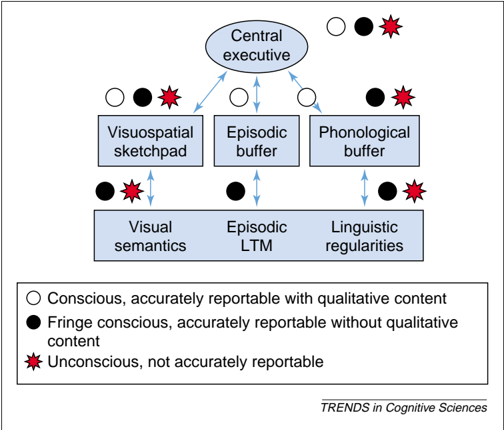
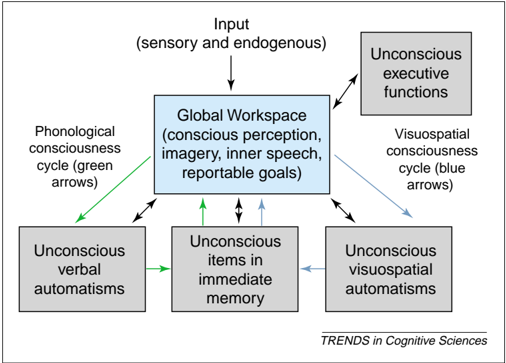
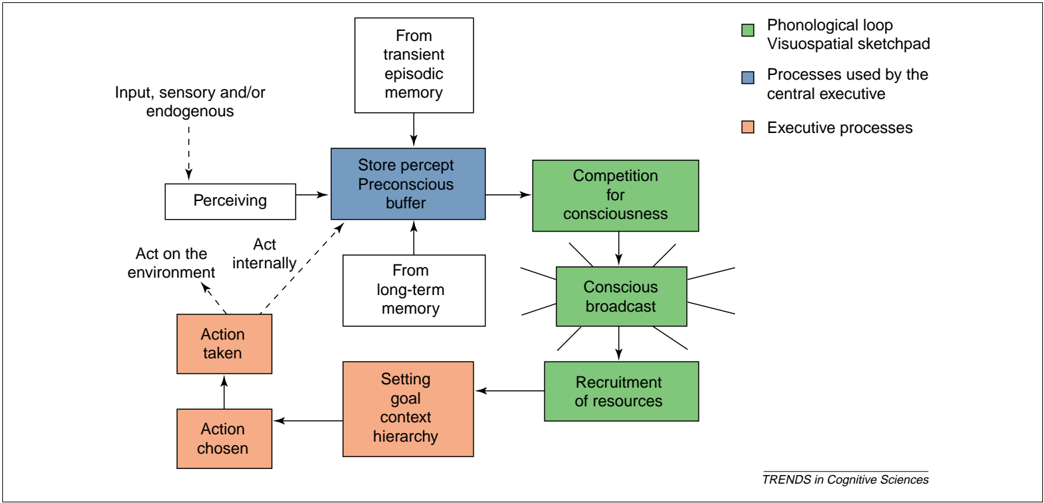
Active components of classical working memory are conscious, but traditional theory does not account for this fact. Global Workspace theory suggests that consciousness is needed to recruit unconscious specialized networks that carry out detailed working memory functions. The IDA model provides a fine-grained analysis of this process, specifically of two classical working-memory tasks, verbal rehearsal and the utilization of a visual image. In the process, new light is shed on the interactions between conscious and unconscious aspects of working memory.
Overview
The claims and statistics of this paper haven’t been checked yet.
Free: it reads the open-access text and checks the first 5 claims that cite a source we can check. Create a free account to check every claim.
Integrity signals
Registry
Cites
Statistics
Figures
Verification
Claims the paper makes
The claims and statistics of this paper haven’t been checked yet.
Free: it reads the open-access text and checks the first 5 claims that cite a source we can check. Create a free account to check every claim.
Claims other papers make about this one
Each is checked against this paper’s own text: does it say what the citing paper says it does?
The source backs part of the claim, not all of it — or backs it for a different population, condition or comparison.
In the citing paper
“Baars and Franklin (2003) suggest that all working memory tasks are consciously mediated – inner rehearsal, executive control, and other WM elements are all claimed to require a conscious cue to execute.”
From Global Workspace Dynamics: Cortical “Binding and Propagation” Enables Conscious Contents (2013) · cites this paper as Baars and Franklin (2003)
Experimental — accuracy not yet measuredThe cited source says what the claim attributes to it.
In the citing paper
“Baars and Franklin (2003) used GW theory to propose that consciousness enables access between otherwise separate knowledge sources.”
From Global Workspace Dynamics: Cortical “Binding and Propagation” Enables Conscious Contents (2013) · cites this paper as Baars and Franklin (2003)
The cited source says what the claim attributes to it.
In the citing paper
“when automatic capabilities fail, there follows a call recruiting additional collaborative conscious support ~Baars & Franklin, 2003!”
From AT THE INTERFACE: DYNAMIC INTERACTIONS OF EXPLICIT AND IMPLICIT LANGUAGE KNOWLEDGE (2005) · cites this paper as Baars & Franklin, 2003!
In the citing paper
“Working memory lies at the interface of perception and action (7) and requires the integration of large-scale neural circuits (8–11).”
From Dynamic reconfiguration of frontal brain networks during executive cognition in humans (2015) · cites this paper as [11]
Self-check
Percentages, sums and reported differences re-computed from the paper’s own numbers.
The self-check needs the paper’s full text.
Citations
Cites
James, W. (1913) · Henry Holt and Company eBooks · doi:10.1037/11059-000 · Cited by 25,226
Baddeley, A. D., & Hitch, G. (1974) · Psychology of Learning and Motivation · doi:10.1016/s0079-7421(08)60452-1 · Cited by 15,284
Barsalou, L. W. (1999) · Behavioral and Brain Sciences · doi:10.1017/s0140525x99002149 · Cited by 6,887
(1988) · Cited by 3,656
Self-citationEricsson, K. A., & Kintsch, W. (1995) · Psychological Review · doi:10.1037/0033-295x.102.2.211 · Cited by 3,498 · cited 1×
“Working memory Working memory [16] Long-term working memory [ 28 ] Emotions Neural networks [29] [30,31]”
Background(2012) · Encyclopedia of the Sciences of Learning · doi:10.1007/978-1-4419-1428-6_5794 · Cited by 2,562
Common regions of the human frontal lobe recruited by diverse cognitive demands
Duncan, J., & Owen, A. M. (2000) · Trends in Neurosciences · doi:10.1016/s0166-2236(00)01633-7 · Cited by 2,498
Towards a cognitive neuroscience of consciousness: basic evidence and a workspace framework
Dehaene, S. (2001) · Cognition · doi:10.1016/s0010-0277(00)00123-2 · Cited by 2,498
Is It an agent, or just a program?: A taxonomy for autonomous agents
Franklin, S., & Graesser, A. (1997) · Lecture Notes in Computer Science · doi:10.1007/bfb0013570 · Cited by 2,286 · cited 1×
“The IDA implementation of GW theory IDA (Intelligent Distribution Agent) is an autonomous software agent [ 18 ] that automates the entire set of tasks of a human personnel agent who assigns sailors to new tours of duty [19].”
MethodSelf-citationRolls, E. T. (1998) · doi:10.1093/oso/9780198524649.001.0001 · Cited by 1,257
Research works printed but not linked: 1
- 7 Baars, B.J. (1993) How does a serial, integrated and very limited stream of consciousness emerge from a nervous system that is mostly unconscious, distributed, and of enormous capacity? In CIBA SymposiumonExperimental and Theoretical Studies of Consciousness (Bock, G.R. and Marsh, J., eds) pp. 282-290, John Wiley & Sons
Cited by
Items 401–500 of 542
Consciousness, cognition, and the hierarchy of context: expanding the global neuronal workspacePreprint
Wallace, R. (2004) · CogPrints (University of Southampton) · Cited by 1
Consciousness: A Simple Information Theory Global Workspace ModelPreprint
Wallace, R. (2011) · CogPrints (University of Southampton) · Cited by 1
Magic Strategies: the basic biology of multilevel, multiscale, health promotionPreprint
Wallace, R., & Wallace, D. (2013) · doi:10.7287/peerj.preprints.8v2 · Cited by 1
Accessing the mind: relating metacognition to attention, memory, and cognitive function
Matthews, J. (2020) · Figshare · doi:10.26180/5c5a1486c5372 · Cited by 1
“For example, if one assumes a strong association between working memory and consciousness (Baars & Franklin, 2003; Baddeley, 2003), one might expect that Electronic supplementary material The online version of this article (https://doi.org/10.3758/s13414-018-1600-1) contains supplementary material,…”
BackgroundInfluentialShort‐Term Memory Modeling in Shape‐Recognition Task by Type‐2 Fuzzy Deep Brain Learning
Ghosh, L., Konar, A., & Rakshit, P. (2020) · Wiley eBooks · doi:10.1002/9781119705925.ch3 · Cited by 1
Shared and Independent Neural Representation Between Visual Perception and Mental ImageryPreprint
Huang, Y., Pollick, F. E., Liu, M., & Zhang, D. (2021) · Research Square · doi:10.21203/rs.3.rs-788978/v1 · Cited by 1
“In history, there has been a longstanding debate about whether the content of working memory can be regarded as its conscious experience (Atkinson & Shiffrin, 1968; Baars, 2002; Baars & Franklin, 2003; Cowan, 1988; Oberauer, 2002, 2009).”
Background(2010) · Elsevier eBooks · doi:10.1016/b978-0-12-375070-9.00021-8 · Cited by 1
Machine Consciousness and the Global Workspace TheoryPreprint
Haqiqatkhah, M. M. (2019) · Thesis Commons (OSF Preprints) · doi:10.31237/osf.io/vfy3e · Cited by 1
Knowledge consolidation and inference in an integrated neuro-cognitive architecture
Oentaryo, R. J. (2011) · DR-NTU (Nanyang Technological University) · doi:10.32657/10356/43793 · Cited by 1
The Self-Simulation Theory:A Computational Theory of ConsciousnessPreprint
Chakraborty, S., & Lahkar, R. (2022) · Preprints.org · doi:10.20944/preprints202211.0434.v1
Can working memory performance be disrupted by distractors under the threshold of consciousness?Preprint
Yáñez, A. D.-B., Malleret, G., Salin, P. A., Mazza, S., & Plancher, G. (2024) · PsyArXiv (OSF Preprints) · doi:10.31234/osf.io/psw35 · Cited by 1
Explaining Qualia: A Proposed Theoretical Framework for Addressing the Hard Problem of ConsciousnessPreprint
Castelluccio, L. (2024) · OSF Preprints (OSF Preprints) · doi:10.31219/osf.io/tc9s8 · Cited by 2
Brudermann, C. (2010) · theses.fr (ABES) · doi:10.70675/545fec1ez3d36z46fdz921dza37e0004302b · Cited by 18
Stimulus processing and unsupervised learning in autonomously active recurrent networks.
Gros, C., & Kaczor, G. (2009) · Cited by 1
Schweigen ist Silber, Reden ist Gold? Die Rolle von Sprache als Determinante expliziten Wissens
Eichler, A. (2011) · Kölner Universitäts PublikationsServer (Universität zu Köln)
Coping with Bargains in the Ultimatum Game: The Triple Circuit Hypothesis
Machado, Á. M., Britto, L. R., & Ferracioli-Oda, E. (2011) · Revista internacional de psicología y terapia psicológica/Revista internacional de psicología y terapia psicológica
Leyva, R. (2013) · Middlesex University Research Repository (Middlesex University Of London)
Sense of coherence as a mediator of stress among high school students in Tromsø, Norway.
Mellem, L. S. (2008) · NORA - Norwegian Open Research Archives
Elements of Cognitive Systems Theory
Gros, C. (2015) · Springer eBooks · doi:10.1007/978-3-319-16265-2_10
The quality of perception without attention
Vandenbroucke, A. R. E. (2013) · UvA-DARE (University of Amsterdam)
Distributed neural blackboards could be more attractive
Grüning, A., & Treves, A. (2006) · Behavioral and Brain Sciences · doi:10.1017/s0140525x06319024
Shylaja, K. R., Venkatamuni, V. M., Davis, D. N., & Prasad, E. V. (2012) · International Journal of Artificial Life Research · doi:10.4018/jalr.2012040103
Even “unconscious thought” is influenced by attentional mechanisms
Srinivasan, N., & Mukherjee, S. (2014) · Behavioral and Brain Sciences · doi:10.1017/s0140525x1300085x · Cited by 1
Cognitive memory systems in consciousness and memory model
Shi, Z., Wang, X., & Yang, X. (2014) · International Joint Conference on Neural Networks (IJCNN) · doi:10.1109/ijcnn.2014.6889966
“The IDA model implements and fleshes out Global Workspace theory [10,11], which suggests that conscious events involving widespread distribution of focal information need to recruit neuronal resources for problem solving.”
MethodVadakkan, K. I. (2014) · Advances in Artificial Neural Systems · doi:10.1155/2014/318390 · Cited by 1
“…neuronal activity at certain neuronal orders (e.g., the induction of sleep), the observed relationship between memory and consciousness [11–18], and the relationship between long-term potentiation (LTP) and behavioral motor activity that are currently used as surrogate markers for the…”
BackgroundNeuroimaging Consciousness: What happens in the brain when we become aware of what we percieve?
Eriksson, J. (2004) · DiVA at Umeå University (Umeå University)
Wallace, R. (2006) · CogPrints (University of Southampton)
A computer-based model of Crick and Koch's Framework for Consciousness
Franklin, S. (2003)
Self-citationTrambacz-Oleszak, S., Witkowska, D., & Ober, J. K. (2010)
Perceptual Representation Content, Constancies and Phenomenal Consciousness
Lains, C. P. (2013) · NVA (Nasjonalt vitenarkiv)
SOUS LE SCEAU DE L'UNIVERSITÉ EUROPÉENNE DE BRETAGNE
Cognitive, P. (2014)
Brain-Like Ro 57. Brain-Like Robotics
Duro, R. J., Bellas, F., & Becerra, J. A. (2014)
Glazebrook, J. F. (2013) · Cognitive Systems Research · doi:10.1016/j.cogsys.2013.01.003
Is Consciousness Computationally Functional
Baars, B. J. (2009) · Biologically Inspired Cognitive Architectures
Self-citationThe Country of Ownership Paradox
Varga, N., & Zhao, F. (2016) · Lund University Publications Student Papers (Lund University)
Representation of Neuro-Information and Knowledge
van der Velde, F. (2011) · IGI Global eBooks · doi:10.4018/978-1-60960-018-1.ch002
The neural substrates of non-conscious working memory
Bergström, F. (2016) · Portuguese National Funding Agency for Science, Research and Technology (RCAAP Project by FCT)
Unconscious Endogenous Attention
지은희, & Kim, M.-S. (2017) · 한국심리학회지: 인지 및 생물 · doi:10.22172/cogbio.2017.29.1.002
EEG analysis for short term memory modeling in visually explored shape recognition tasks
Ghosh, L., Konar, A., Rakshit, P., Ralescu, A., & Nagar, A. K. (2017) · IEEE Symposium Series on Computational Intelligence (SSCI) · doi:10.1109/ssci.2017.8285309
Fields, C., & Glazebrook, J. F. (2018) · arXiv (Cornell University) · doi:10.48550/arxiv.1803.08874
Isenman, L. D. (2018) · Elsevier eBooks · doi:10.1016/b978-0-12-814108-3.00008-7
"SIMPLE AS DO RE ME, ABC": LANGUAGE, MUSIC, AND WORKING MEMORY
Atherton, R. P. (2013) · Minds at UW (University of Wisconsin)
The consciousness science paradox
Balmer, A. L. (2019) · Keele Research Repository (Keele University)
An exploration of the experiences of dyslexic students in science
Maxwell, G. (2006)
Castagna, P. J. (2020) · Louisiana State University · doi:10.31390/gradschool_dissertations.5145
بحيرى, ص. م., & ندا, م. ا. أ. ا. (2018) · Mağallaẗ Kulliyyaẗ Al-Tarbiyyaẗ, Ǧāmiʿaẗ Al-Iskandariyyaẗ/Mağallaẗ Kulliyyaẗ Al-Tarbiyyaẗ, Ǧāmiʿaẗ Al-Iskandariyyaẗ · doi:10.21608/jealex.2018.156723
Les richesses de la pleine conscience
Teasdale, J., & Chaskalson, M. (2018) · De Boeck Supérieur eBooks · doi:10.3917/dbu.mark.2018.01.0149
Learning the Meaning of the Vervet Alarm Calls using a Cognitive and Computational Model
Khayi-Enyinda, N. A. (2013) · Cited by 1
Liu, B., Zheng, C., Wang, P., Yu, J., Li, R., Xiao, W., & Li, J. (2021) · Lecture notes in electrical engineering · doi:10.1007/978-981-16-6324-6_16
Temporal Structure of Now from a Close-Up View
Lubashevsky, I., & Plavinska, N. (2021) · Understanding complex systems · doi:10.1007/978-3-030-82612-3_2
Meningkatkan Aktivitas Memori Kerja Berbantuan Binaural Beats
Nurhadi, J., & Syihabuddin, S. (2021) · Pedagogi Jurnal Ilmu Pendidikan · doi:10.24036/pedagogi.v21i2.1086 · Cited by 4
Culture and generalized inattentional blindnessPreprint
Wallace, R. (2006) · CogPrints (University of Southampton)
Executive functions for Learning and decision-making in a bio-inspired cognitive architecture
Raizer, K. (2015) · doi:10.47749/t/unicamp.2015.946459 · Cited by 1
(2005) · Springer eBooks · doi:10.1007/0-387-25244-4_7
(2007) · Springer eBooks · doi:10.1007/978-0-387-76765-9_9
Hierarchical Emergent Ontology (HEO)
Havlík, V. (2022) · Springer eBooks · doi:10.1007/978-3-030-98148-8_4
Elements of Cognitive Systems Theory
Gros, C. (2013) · Springer eBooks · doi:10.1007/978-3-642-36586-7_8
Working Memory Modeling Using Inverse Fuzzy Relational Approach
Ghosh, L., Konar, A., & Rakshit, P. (2020) · doi:10.1002/9781119705925.ch2
(2013) · Elsevier eBooks · doi:10.1016/b978-0-12-415805-4.00020-5
Elements of Cognitive Systems Theory
Gros, C. (2010) · Springer eBooks · doi:10.1007/978-3-642-04706-0_8
Sustained conscious access to incidental memories in RSVPPreprint
Matthews, J., Wu, J., Corneille, V., Hohwy, J., van Boxtel, J. J. A., & Tsuchiya, N. (2018) · PsyArXiv (OSF Preprints) · doi:10.31234/osf.io/yscdu
Artificial Minds with Consciousness and Common sense Aspects
Shylaja, K. R., Vijayakumar, M. V., Prasad, E. V., & Davis, D. N. (2019) · IGI Global eBooks · doi:10.4018/978-1-7998-1754-3.ch069
The Facilitative and Inhibitive Effect of Semantic Priming in Pronunciation of Working Memory
Mansoor, B., Hashemi, T., & Atabati, M. (2018) · Journal of Research in Behavioural Sciences · doi:10.52547/rbs.16.4.476
فعالية برنامج تدريبى لتحسين الوظائف التنفيذية للأطفال ذوي اضطراب التوحد
عبدالله, ع., & الباز, ش. (2022) · مجلة التربية الخاصة · doi:10.21608/mtkh.2022.232031
Overflow of Working Memory from an Easily Accessible Active StatePreprint
Ideriha, T., & Ushiyama, J. (2022) · bioRxiv (Cold Spring Harbor Laboratory) · doi:10.1101/2022.11.02.514822
“Interestingly, the active memory capacity of two suggests that the active state of working memory is not equal to that of the conscious (Baars & Franklin, 2003; Trübutschek et al., 2019) or attended part of working memory (LaRocque et al., 2014; Olivers et al., 2011), whose capacity would be one at…”
Backgroundالمبادأة کأحد الوظائف التنفيذية وعلاقتها بمهارات التواصل اللغوي لدي الأطفال ذوي اضطراب طيف التوحد
أبوالحمد, أ., حسن, س., & شوقي, م. (2022) · مجلة کلیة علوم ذوی الاحتیاجات الخاصة · doi:10.21608/jshm.2022.138284.1195
Grammar: Documenting growth in L2 classrooms
Toth, P. D. (2022) · Research methods in applied linguistics · doi:10.1075/rmal.3.09tot · Cited by 1
The Self-Simulation Theory: A Computational Theory Of ConsciounessPreprint
Chakraborty, S., & Lahkar, R. (2022) · doi:10.14293/s2199-1006.1.sor-.ppz776i.v1
Cognitive WarfarePreprint
Pastor, A. (2022) · OSF Preprints (OSF Preprints) · doi:10.31219/osf.io/ynfzr
Further evidence and theoretical framework for a subliminal sensory buffer store (SSBS)
Pang, D. K. F., & Elntib, S. (2022) · Consciousness and Cognition · doi:10.1016/j.concog.2022.103452
Sun, R. (2023) · Cambridge University Press eBooks · doi:10.1017/9781108755610.041
Cognitive warfarePreprint
Pastor, A. (2023) · PsyArXiv (OSF Preprints) · doi:10.31234/osf.io/zgsej · Cited by 1
كامل, ض. ا. ا. (2023) · Mağallaẗ Al-Tarbiyyaẗ wa Ṯaqāfiẗ Al-Ṯifl · doi:10.21608/jkfb.2023.304359
Dehn, M. J. (2015) · Wiley eBooks · doi:10.1002/9781394259441.refs
Dehn, M. J. (2015) · Wiley eBooks · doi:10.1002/9781394259441.ch1 · Cited by 1
NATURAL INTELLIGENCE, CONSCIOUSNESS AND INFORMATION PROCESSING: TURNING THE BRAIN INTO LEARNING MODE
Verbitskaya, N. (2024) · Вестник Южно-Уральского государственного университета. Серия: Образование. Педагогические науки · doi:10.14529/ped240108
Mahmood, T., & Sherwani, R. A. K. (2024) · Research Square · doi:10.21203/rs.3.rs-4217084/v1
(2024) · Tourism social science series · doi:10.1108/s1571-504320240000027032
Aboitiz, F. (2024) · The Transmitter · doi:10.53053/jvbq9096
Making Up Our Minds: Imaginative Deconstruction in MathArt, 1920–Present
Dobson, S., & Fields, C. (2024) · Association for Women in Mathematics series · doi:10.1007/978-3-031-66402-1_1 · Cited by 1
On Embodied Machine Consciousness
Wallace, R. (2025) · Studies in applied philosophy, epistemology and rational ethics · doi:10.1007/978-3-031-83709-8_12
Kotseruba, I., & Tsotsos, J. K. (2025) · Oxford University Press eBooks · doi:10.1093/oso/9780192844835.002.0005
Kotseruba, I., & Tsotsos, J. K. (2025) · Oxford University Press eBooks · doi:10.1093/oso/9780192844835.002.0007
Kotseruba, I., & Tsotsos, J. K. (2025) · Oxford University Press eBooks · doi:10.1093/oso/9780192844835.003.0007
Kotseruba, I., & Tsotsos, J. K. (2025) · Oxford University Press eBooks · doi:10.1093/oso/9780192844835.003.0001
Taxonomies of Cognitive Architectures
Kotseruba, I., & Tsotsos, J. K. (2025) · Oxford University Press eBooks · doi:10.1093/oso/9780192844835.003.0004
Practical Applications of Cognitive Architectures
Kotseruba, I., & Tsotsos, J. K. (2025) · Oxford University Press eBooks · doi:10.1093/oso/9780192844835.003.0010
Cognitive Architectures, AI, and Cognitive Science
Kotseruba, I., & Tsotsos, J. K. (2025) · Oxford University Press eBooks · doi:10.1093/oso/9780192844835.003.0003
Kotseruba, I., & Tsotsos, J. K. (2025) · Oxford University Press eBooks · doi:10.1093/oso/9780192844835.002.0004
Kotseruba, I., & Tsotsos, J. K. (2025) · Oxford University Press eBooks · doi:10.1093/oso/9780192844835.003.0008
Challenges of the Past and Opportunities Ahead
Kotseruba, I., & Tsotsos, J. K. (2025) · Oxford University Press eBooks · doi:10.1093/oso/9780192844835.003.0013
Kotseruba, I., & Tsotsos, J. K. (2025) · Oxford University Press eBooks · doi:10.1093/oso/9780192844835.003.0006
Cognitive Architectures in the Deep Learning Era
Kotseruba, I., & Tsotsos, J. K. (2025) · Oxford University Press eBooks · doi:10.1093/oso/9780192844835.003.0012
Kotseruba, I., & Tsotsos, J. K. (2025) · Oxford University Press eBooks · doi:10.1093/oso/9780192844835.003.0009
What Are Cognitive Architectures?
Kotseruba, I., & Tsotsos, J. K. (2025) · Oxford University Press eBooks · doi:10.1093/oso/9780192844835.003.0002
Evaluating Cognitive Architectures
Kotseruba, I., & Tsotsos, J. K. (2025) · Oxford University Press eBooks · doi:10.1093/oso/9780192844835.003.0011
فعالية برنامج انتقائى تنموى في تحسين الوظائف التركيبية لدى عينه من التوحديين
محمد, م. م. ا. (2025) · مجلة المنهج العلمي والسلوک · doi:10.21608/psyb.2025.408495.1029
Singleton, R. L. (2025) · SSRN Electronic Journal · doi:10.2139/ssrn.5389116
Metadata
- Authors
- Baars, B. J., & Franklin, S.
- Affiliations
- Neurosciences Institute (US)
- University of Memphis (US)
- Corresponding author
- Baars, Bernard J.
- Venue
- Trends in Cognitive Sciences
- Publisher
- Elsevier BV
- Published
- 2003-04
- Volume
- 7
- Issue
- 4
- Pages
- 166-172
- ISSN
- 1364-6613 (ISSN-L)
- OpenAlex
- W2170468585
- Semantic Scholar
- 59210192d31d570d83532e24b6908f57fae8747a
- Cited by
- 541
- References
- 41
- Citations by year
- 2026: 36 · 2025: 36 · 2024: 18 · 2023: 28 · 2022: 16 · 2021: 17 · 2020: 19 · 2019: 21 · 2018: 24 · 2017: 25 · 2016: 18 · 2015: 22 · 2014: 30 · 2013: 38 · 2012: 30
- FWCI
- 2.61
- Type
- journal article
- Language
- en
- Open access
- closed
- Licence
- www.elsevier.com/tdm/userlicense/1.0/ (tdm)
- www.elsevier.com/legal/tdmrep-license (tdm)
- Locations
- Trends in Cognitive Sciences (publishedVersion)
- PubMed (publishedVersion)
- CogPrints (University of Southampton) (submittedVersion)
- Funders
- Field Neurosciences Institute
- Neurosciences Research Foundation
- Topics
- Social Sciences › Arts and Humanities › Philosophy › Philosophy and Theoretical Science
- Social Sciences › Psychology › Experimental and Cognitive Psychology › Cognitive Abilities and Testing
- Life Sciences › Neuroscience › Cognitive Neuroscience › Neural dynamics and brain function
- Keywords
- subjective experience, working memory, global workspace theory, unconscious processes, verbal rehearsal, visual imagery
About these checks
Registry, retraction, Cites and statistics results are computed, not judged, with one exception: a printed reference that no index lists is read once by a model before it counts as a citation error. Claims are extracted by a model and kept only when their quote appears verbatim in the text; each cited source is then checked, with a model’s help, for whether it says what the claim relies on. Those verdicts can be wrong — read the claim’s quote and the cited source before relying on one.
Statistics and arithmetic are recomputed, not judged.
Confidence bands are shown only for fields calibrated on our annotated test set. None is calibrated yet, so no band is shown.
What counts as a claim ›How we measure confidence ›How we check this ›
Are you an author, or do you see a problem with this page? Request a review
Data sources
Bibliographic data: Semantic Scholar, OpenAlex, Crossref.
Contains information from the Semantic Scholar Academic Graph Datasets, made available under the ODC Attribution License (ODC-BY 1.0).
Semantic Scholar’s data is described in: Kinney, R., et al. (2023). The Semantic Scholar Open Data Platform. arXiv:2301.10140.
