

How conscious experience and working memory interact
The DOI matches its Crossref record; 40 of the 41 references it cites were found in a registry or an index.
Abstract
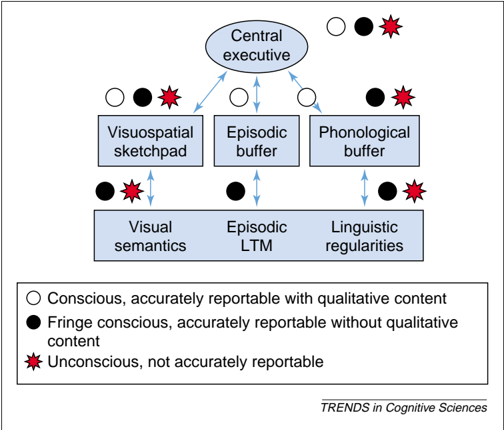
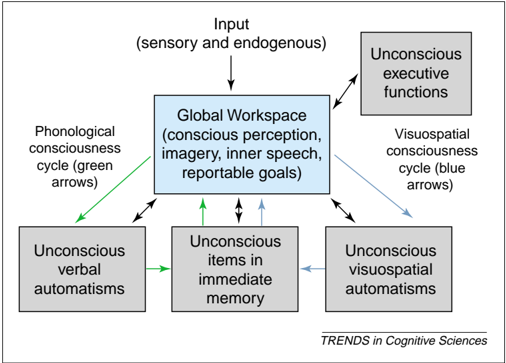
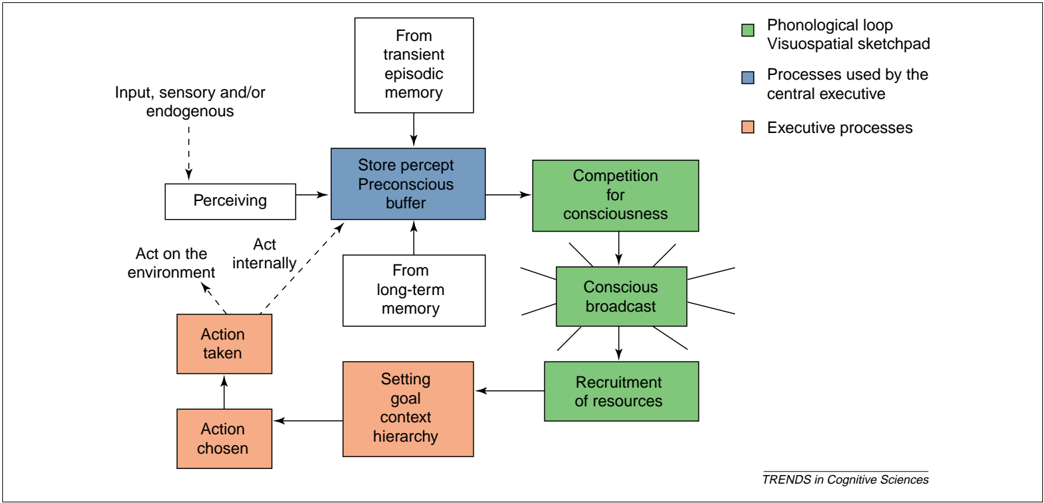
Active components of classical working memory are conscious, but traditional theory does not account for this fact. Global Workspace theory suggests that consciousness is needed to recruit unconscious specialized networks that carry out detailed working memory functions. The IDA model provides a fine-grained analysis of this process, specifically of two classical working-memory tasks, verbal rehearsal and the utilization of a visual image. In the process, new light is shed on the interactions between conscious and unconscious aspects of working memory.
Overview
The claims and statistics of this paper haven’t been checked yet.
Free: it reads the open-access text and checks the first 5 claims that cite a source we can check. Create a free account to check every claim.
Integrity signals
Registry
Cites
Statistics
Figures
Verification
Claims the paper makes
The claims and statistics of this paper haven’t been checked yet.
Free: it reads the open-access text and checks the first 5 claims that cite a source we can check. Create a free account to check every claim.
Claims other papers make about this one
Each is checked against this paper’s own text: does it say what the citing paper says it does?
The source backs part of the claim, not all of it — or backs it for a different population, condition or comparison.
In the citing paper
“Baars and Franklin (2003) suggest that all working memory tasks are consciously mediated – inner rehearsal, executive control, and other WM elements are all claimed to require a conscious cue to execute.”
From Global Workspace Dynamics: Cortical “Binding and Propagation” Enables Conscious Contents (2013) · cites this paper as Baars and Franklin (2003)
Experimental — accuracy not yet measuredThe cited source says what the claim attributes to it.
In the citing paper
“Baars and Franklin (2003) used GW theory to propose that consciousness enables access between otherwise separate knowledge sources.”
From Global Workspace Dynamics: Cortical “Binding and Propagation” Enables Conscious Contents (2013) · cites this paper as Baars and Franklin (2003)
The cited source says what the claim attributes to it.
In the citing paper
“when automatic capabilities fail, there follows a call recruiting additional collaborative conscious support ~Baars & Franklin, 2003!”
From AT THE INTERFACE: DYNAMIC INTERACTIONS OF EXPLICIT AND IMPLICIT LANGUAGE KNOWLEDGE (2005) · cites this paper as Baars & Franklin, 2003!
In the citing paper
“Working memory lies at the interface of perception and action (7) and requires the integration of large-scale neural circuits (8–11).”
From Dynamic reconfiguration of frontal brain networks during executive cognition in humans (2015) · cites this paper as [11]
Self-check
Percentages, sums and reported differences re-computed from the paper’s own numbers.
The self-check needs the paper’s full text.
Citations
Cites
James, W. (1913) · Henry Holt and Company eBooks · doi:10.1037/11059-000 · Cited by 25,226
Baddeley, A. D., & Hitch, G. (1974) · Psychology of Learning and Motivation · doi:10.1016/s0079-7421(08)60452-1 · Cited by 15,284
Barsalou, L. W. (1999) · Behavioral and Brain Sciences · doi:10.1017/s0140525x99002149 · Cited by 6,887
(1988) · Cited by 3,656
Self-citationEricsson, K. A., & Kintsch, W. (1995) · Psychological Review · doi:10.1037/0033-295x.102.2.211 · Cited by 3,498 · cited 1×
“Working memory Working memory [16] Long-term working memory [ 28 ] Emotions Neural networks [29] [30,31]”
Background(2012) · Encyclopedia of the Sciences of Learning · doi:10.1007/978-1-4419-1428-6_5794 · Cited by 2,562
Common regions of the human frontal lobe recruited by diverse cognitive demands
Duncan, J., & Owen, A. M. (2000) · Trends in Neurosciences · doi:10.1016/s0166-2236(00)01633-7 · Cited by 2,498
Towards a cognitive neuroscience of consciousness: basic evidence and a workspace framework
Dehaene, S. (2001) · Cognition · doi:10.1016/s0010-0277(00)00123-2 · Cited by 2,498
Is It an agent, or just a program?: A taxonomy for autonomous agents
Franklin, S., & Graesser, A. (1997) · Lecture Notes in Computer Science · doi:10.1007/bfb0013570 · Cited by 2,286 · cited 1×
“The IDA implementation of GW theory IDA (Intelligent Distribution Agent) is an autonomous software agent [ 18 ] that automates the entire set of tasks of a human personnel agent who assigns sailors to new tours of duty [19].”
MethodSelf-citationRolls, E. T. (1998) · doi:10.1093/oso/9780198524649.001.0001 · Cited by 1,257
Research works printed but not linked: 1
- 7 Baars, B.J. (1993) How does a serial, integrated and very limited stream of consciousness emerge from a nervous system that is mostly unconscious, distributed, and of enormous capacity? In CIBA SymposiumonExperimental and Theoretical Studies of Consciousness (Bock, G.R. and Marsh, J., eds) pp. 282-290, John Wiley & Sons
Cited by
Items 101–200 of 542
Global Workspace Theory, its LIDA model and the underlying neuroscience
Franklin, S., Strain, S., Snaider, J., McCall, R., & Faghihi, U. (2012) · Biologically Inspired Cognitive Architectures · doi:10.1016/j.bica.2012.04.001 · Cited by 47
“…inspired LIDA 2 cognitive architecture (Franklin, Baars, Ramamurthy, & Ventura, 2005; Franklin & Patterson, 2006) implements GWT conceptually (Baars & Franklin, 2003; Baars & Franklin, 2007) and computationally (Snaider, McCall, & Franklin, 2011), as well as other theories from cognitive…”
BackgroundSelf-citation(2003) · Cited by 47
Self-citationThe Relationship Between Consciousness and Top-Down Attention
Tsuchiya, N., & Koch, C. (2015) · Elsevier eBooks · doi:10.1016/b978-0-12-800948-2.00005-4 · Cited by 53
The Global Workspace Theory of Consciousness: Predictions and Results
Baars, B. J. (2017) · The Blackwell Companion to Consciousness · doi:10.1002/9781119132363.ch16 · Cited by 46
Self-citationInductive rule learning on the knowledge level
Schmid, U., & Kitzelmann, E. (2010) · Cognitive Systems Research · doi:10.1016/j.cogsys.2010.12.002 · Cited by 56
“The preference or search bias characterizes the mechanism for selecting hypothesis.”
BackgroundThe offline stream of conscious representations
Sergent, C. (2018) · Philosophical Transactions of the Royal Society B: Biological Sciences · doi:10.1098/rstb.2017.0349 · Cited by 44
Single-neuron theory of consciousness
Sevush, S. (2005) · Journal of Theoretical Biology · doi:10.1016/j.jtbi.2005.06.018 · Cited by 47
Brooks, S. J., O’Daly, O., Uher, R., Schiöth, H. B., Treasure, J. L., & Campbell, I. C. (2012) · Consciousness and Cognition · doi:10.1016/j.concog.2012.02.006 · Cited by 54
Wouters, H., van Gool, W. A., Schmand, B., Zwinderman, A. H., & Lindeboom, R. (2010) · International Journal of Geriatric Psychiatry · doi:10.1002/gps.2402 · Cited by 43
Neurons as hierarchies of quantum reference frames
Fields, C., Glazebrook, J. F., & Levin, M. (2022) · Biosystems · doi:10.1016/j.biosystems.2022.104714 · Cited by 48
“The Global Neuronal Workspace, as a massively parallel, distributed system, performs precisely this function for the mammalian central nervous system [84, 85, 86].”
BackgroundDoes the mismatch negativity operate on a consciously accessible memory trace?
Dykstra, A. R., & Gutschalk, A. (2015) · Science Advances · doi:10.1126/sciadv.1500677 · Cited by 42
Jacobs, C., & Silvanto, J. (2015) · Neuroscience & Biobehavioral Reviews · doi:10.1016/j.neubiorev.2015.06.003 · Cited by 42
Large Capacity of Conscious Access for Incidental Memories in Natural Scenes
Kaunitz, L. N., Rowe, E. G., & Tsuchiya, N. (2016) · Psychological Science · doi:10.1177/0956797616658869 · Cited by 42
“This would be expected from traditional working memory theories, which equate working memory with conscious memory (Baars & Franklin, 2003; Baddeley, 2003).”
BackgroundMethodMaintenance of non-consciously presented information engages the prefrontal cortex
Bergström, F., & Eriksson, J. (2014) · Frontiers in Human Neuroscience · doi:10.3389/fnhum.2014.00938 · Cited by 42
“Although working memory is commonly seen as intimately linked with conscious experience (Baars and Franklin, 2003; Dehaene and Changeux, 2011; Baddeley, 2012), it has been suggested on theoretical grounds that working memory indeed can operate non-consciously, as below-threshold activity (Fuster, 1995).”
BackgroundTheory and Measurement of Working Memory Capacity Limits
Cowan, N., Morey, C. C., Chen, Z., Gilchrist, A. L., & Saults, J. S. (2008) · The Psychology of learning and motivation/The psychology of learning and motivation · doi:10.1016/s0079-7421(08)00002-9 · Cited by 56
Multiple sources of conscious odor integration and propagation in olfactory cortex
Baars, B. J. (2013) · Frontiers in Psychology · doi:10.3389/fpsyg.2013.00930 · Cited by 45
Self-citationShulman, A., Goldstein, B., & STRASHUN, A. M. (2009) · PubMed · Cited by 49
Palmer, S. D., & Mattys, S. L. (2016) · Quarterly Journal of Experimental Psychology · doi:10.1080/17470218.2015.1112825 · Cited by 57
“Second, although some have argued that all working memory operations are conscious (e.g., Baars & Franklin, 2003), recent evidence suggests that some working memory processes (including the active maintenance of ordered information and context relevant updating) can be recruited without conscious…”
BackgroundPandit, J. J. (2014) · Consciousness and Cognition · doi:10.1016/j.concog.2014.05.007 · Cited by 43
“This approach has similarities with the Integrated Information Theory (Tononi, 2004) and the Global Workspace Theory (Baars & Franklin, 2003; Baars et al., 2003; Dehaene & Naccache, 2001), both of which seek to explain how consciousness appears to us as a unified whole.”
BackgroundOn the Emergence of Human Goal Pursuit: The Nonconscious Regulation and Motivation of Goals
Aarts, H. (2007) · Social and Personality Psychology Compass · doi:10.1111/j.1751-9004.2007.00014.x · Cited by 47
“Contrary to most current views (e.g. Baars & Franklin, 2003; Baddeley, 1993; Gazzaniga, Ivry, & Mangun, 1998), however, these processes (and the information on which they operate) seem to run below the threshold of consciousness.”
ResultNeural Evidence for Non-conscious Working Memory
Bergström, F., & Eriksson, J. (2017) · Cerebral Cortex · doi:10.1093/cercor/bhx193 · Cited by 44
“…involving the hippocampus, were strongly associated with conscious experience (Graf and Schacter 1985; Squire et al. 1992; Baddeley and Andrade 2000; Dehaene and Naccache 2001; Tulving 2002; Baars and Franklin 2003; Baddeley 2003; Baars 2005; Dehaene and Changeux 2011; Squire and Dede 2015).”
BackgroundInterpretations of responses using the isolated forearm technique in general anaesthesia: a debate
Pandit, J. J., Russell, I. F., & Wang, M. (2015) · British Journal of Anaesthesia · doi:10.1093/bja/aev106 · Cited by 42
Toppi, J., Astolfi, L., Risetti, M., Anzolin, A., Kober, S. E., Wood, G. M. D. O., & Mattia, D. (2018) · Frontiers in Human Neuroscience · doi:10.3389/fnhum.2017.00637 · Cited by 43
“Such dynamics in the topological rearrangement is consistent with the recently released global workspace theory (Baars and Franklin, 2003; Baars et al., 2013) postulating that the networks structure reorganizes across”
ResultSmall worlds and Red Queens in the Global Workspace: An information-theoretic approach
Glazebrook, J. F., & Wallace, R. (2009) · Cognitive Systems Research · doi:10.1016/j.cogsys.2009.01.002 · Cited by 47
Triple-aspect monism: A conceptual framework for the science of human consciousness
Pereira, A. (2013) · Cambridge University Press eBooks · doi:10.1017/cbo9781139207065.011 · Cited by 51
Takaura, K., Yoshida, M., & Isa, T. (2011) · Journal of Neuroscience · doi:10.1523/jneurosci.5143-10.2011 · Cited by 40
“…with visual awareness has been discussed on many occasions (Baars, 1988; Crick and Koch, 1995; Dehaene and Naccache, 2001; Engel and Singer, 2001; Baars and Franklin, 2003), some of which proposed that working memory and visual awareness would be tightly linked to each other (Baars, 2003;…”
BackgroundCognition in Social Engineering Empirical Research: A Systematic Literature Review
Burda, P., Allodi, L., & Zannone, N. (2024) · ACM Transactions on Computer-Human Interaction · doi:10.1145/3635149 · Cited by 57
Free Choice and the Human Brain
Passingham, R. E., & Lau, H. C. (2006) · The MIT Press eBooks · doi:10.7551/mitpress/2477.003.0006 · Cited by 36
Memory and executive functions correlates of self-awareness in traumatic brain injury
Zimmermann, N., Mograbi, D. C., Pereira, A. H., Fonseca, R. P., & Prigatano, G. P. (2017) · Cognitive Neuropsychiatry · doi:10.1080/13546805.2017.1330191 · Cited by 44
“For this reason, this memory system is thought to be linked to self-awareness, having a role in the emergence of consciousness (Baars & Franklin, 2003; Baddeley, 1992) and episodic future thought (Hill & Emery, 2013).”
BackgroundLeón-Domínguez, U., İzzetoğlu, M., León‐Carrión, J., Marcos, I. S., Garcia-Torrado, F. J., Forastero-Rodríguez, A., Miras, P. M., Villegas-Duque, D., Lopez-Romero, J. L., Onaral, B., et al. (2013) · NeuroImage · doi:10.1016/j.neuroimage.2013.07.023 · Cited by 40
“These cognitive processes automatically choose cortico-cortical networks which are necessary for conscious manipulation of information and generating an adequate response to a given context (Baars and Franklin, 2003; Lamme, 2003; Posner and Petersen, 1990).”
Consciousness, emotion, and imagination a brain-inspired architecture for cognitive robotics
Goldie, P., & Shanahan, M. (2005) · Research Explorer (The University of Manchester) · Cited by 42
Schubert, T., Rothlein, D., Brothers, T. A., Coderre, E. L., Ledoux, K., Gordon, B., & McCloskey, M. E. (2020) · Proceedings of the National Academy of Sciences · doi:10.1073/pnas.2000424117 · Cited by 36
“These theories espouse a strong parallel between consciousness and cognitive processing; the assumption of such a close relationship is not present in other theories of visual awareness (79, 83).”
BackgroundQasem, W. A., Abubaker, M., & Kvašňák, E. (2022) · Frontiers in Psychology · doi:10.3389/fpsyg.2022.822545 · Cited by 39
Brock, R., & Taber, K. S. (2016) · Studies in Science Education · doi:10.1080/03057267.2016.1262046 · Cited by 39
Conceptual Commitments of the LIDA Model of Cognition
Franklin, S., Strain, S., McCall, R. J., & Baars, B. J. (2013) · Journal of Artificial General Intelligence · doi:10.2478/jagi-2013-0002 · Cited by 36
Self-citationFields, C., & Glazebrook, J. F. (2016) · Cognitive Neurodynamics · doi:10.1007/s11571-016-9419-8 · Cited by 35
“The GNW concept was originally introduced to explain both the apparent unity of and the requirement for serial processing in ordinary, waking consciousness (Baars, 1998; Dehaene and Naccache, 2001; Baars and Franklin, 2003; Dehaene and Changeaux, 2004; Wallace, 2005).”
BackgroundInfluentialFriedlander, D. S., & Franklin, S. (2008) · Cited by 34
Self-citationThe role of consciousness in the phonological loop: hidden in plain sight
Buchsbaum, B. R. (2013) · Frontiers in Psychology · doi:10.3389/fpsyg.2013.00496 · Cited by 42
“Baars (Baars and Franklin, 2003) has argued that consciousness is associated with a limited capacity “global workspace,” akin to working memory, whose focal contents are broadcast to widely distributed specialized networks in the brain.”
BackgroundKorzyukov, O. A., Sattler, L., Behroozmand, R., & Larson, C. R. (2012) · PLoS ONE · doi:10.1371/journal.pone.0041216 · Cited by 35
“The interactions between auditory and motor components of the voice-control system fit nicely within the framework of a hierarchical model of frontal lobe organization and processing [28] and a large scale model of Global Workspace theory [29], suggesting that cognitive processes are built on multiple perception-actio…”
A Global Workspace perspective on mental disorders
Wallace, R. (2005) · Theoretical Biology and Medical Modelling · doi:10.1186/1742-4682-2-49 · Cited by 39
Concentrative Meditation Influences Visual Awareness: a Study with Color Afterimages
Srinivasan, N., & Singh, A. K. (2015) · Mindfulness · doi:10.1007/s12671-015-0428-1 · Cited by 35
Gayet, S., van Maanen, L., Heilbron, M., Paffen, C. L. E., & der Stigchel, S. V. (2016) · Journal of Vision · doi:10.1167/16.11.26 · Cited by 37
Biophysics Of Consciousness: A Foundational Approach
Poznański, R. R., Tuszyński, J. A., & Feinberg, T. E. (2016) · doi:10.1142/9444#t=toc · Cited by 32
The LIDA Model as a Foundational Architecture for AGI
Faghihi, U., & Franklin, S. (2012) · Atlantis thinking machines · doi:10.2991/978-94-91216-62-6_7 · Cited by 40
“LIDA’s science side fleshes out a number of psychological and neuropsychological theories of human cognition including GWT [2], situated cognition [10], perceptual sym- bol systems [11], working memory [12], memory by affordances [13], long-term working memory [14], and the H-CogAff architecture [15].”
BackgroundInfluentialSelf-citationMetacognition as a Consequence of Competing Evolutionary Time Scales
Kuchling, F., Fields, C., & Levin, M. G. (2022) · Entropy · doi:10.3390/e24050601 · Cited by 32
“Global workspace [36,37] and higher-order thought [38,39] approaches to consciousness naturally involve metacognition; others, for example Integrated Information Theory [40], do not.”
BackgroundFour-dimensional graded consciousness
Jonkisz, J., Wierzchoń, M., & Binder, M. (2017) · Frontiers in Psychology · doi:10.3389/fpsyg.2017.00420 · Cited by 30
“At the same time, it also appears closely related to various cognitive processes or functions, such as attention, language, and working memory (see Baars and Franklin, 2003; Lamme, 2006; Bor and Seth, 2012) .”
BackgroundTemporal-order information can be maintained in non-conscious working memory
Trübutschek, D., Marti, S., & Dehaene, S. (2019) · Scientific Reports · doi:10.1038/s41598-019-42942-z · Cited by 33
Computational models of consciousness: a taxonomy and some examples
Sun, R., & Franklin, S. (2007) · Cambridge University Press eBooks · doi:10.1017/cbo9780511816789.008 · Cited by 31
“IDA’s flexible cognitive cycle has also been used to analyze the relation of consciousness to working memory at a fine level of detail, offering explanations of such classical working memory tasks as visual imagery to gain information and the rehearsal of a telephone number ( Baars & Franklin, 2003: Franklin et al., 2…”
InfluentialSelf-citationCognition and biology: perspectives from information theory
Wallace, R. (2013) · Cognitive Processing · doi:10.1007/s10339-013-0573-1 · Cited by 32
Novelty, unexpectedness and surprise: a conceptual clarification
Skavronskaya, L., Moyle, B., Scott, N., & Schaffer, V. (2020) · Tourism Recreation Research · doi:10.1080/02508281.2020.1828556 · Cited by 31
“Cognitive psychologydifferentiates between a subjective current experience which is evoked in the brain through a process known as consciousness (Baars & Franklin, 2003).”
BackgroundOut of our skull, in our skin: the Microbiota-Gut-Brain axis and the Extended Cognition Thesis
Boem, F., Ferretti, G., & Caiani, S. Z. (2021) · Biology & Philosophy · doi:10.1007/s10539-021-09790-6 · Cited by 35
“…execution, stimulus perception, and working memory: here the execution of one action has the consequence of modifying the sensory input, which, in turn, gives rise to the working memory processing that contributes to generating a subsequent action as an output (Baars and Franklin 2003; Madl et al.”
BackgroundNonconscious Goal Pursuit and the Effortful Control of Behavior
Hassin, R. R., Aarts, H., Eitam, B., Custers, R., & Kleiman, T. (2008) · Oxford University Press eBooks · doi:10.1093/oso/9780195309980.003.0026 · Cited by 43
Dual-System Theory and the Role of Consciousness in Intentional Action
Schlosser, M. E. (2019) · BRILL eBooks · doi:10.1163/9789004409965_004 · Cited by 34
“There has been some debate about whether or not the workspace can simply be identified with the central working memory system, but it is agreed that working memory is a central component of the workspace (Baars & Franklin 2003, Levy 2014).”
BackgroundA Comparison Among Cognitive Architectures: A Theoretical Analysis
Lucentini, D. F., & Gudwin, R. (2015) · Procedia Computer Science · doi:10.1016/j.procs.2015.12.198 · Cited by 32
Mämmelä, A., Riekki, J. P., Kotelba, A., & Anttonen, A. (2018) · IEEE Access · doi:10.1109/access.2018.2816605 · Cited by 34
McFadden, J. (2023) · Frontiers in Human Neuroscience · doi:10.3389/fnhum.2022.1024934 · Cited by 27
“Global workspace theory (GWT) (Baars, 2005) and the related global neuronal workspace (GNWT) theories (Dehaene, 2014) avoid these pitfalls by not specifying the criteria by which neuronal activity gains access to the global workspace (Baars and Franklin, 2003) except, in GNWT, to claim that it is driven by non-linear…”
BackgroundAberrant EEG responses to gamma-frequency visual stimulation in schizophrenia
Riečanský, I., Kašpárek, T., Řehulová, J., Katina, S., & Přikryl, R. (2010) · Schizophrenia Research · doi:10.1016/j.schres.2010.06.022 · Cited by 27
“Palva and Palva (2007) recently suggested that alpha synchrony could be the major mechanism supporting the brain global workspace, which is proposed to integrate information by dynamic networking of locally distributed processing units (Baars and Franklin, 2003).”
BackgroundEfficiency of Conscious Access Improves with Coupling of Slow and Fast Neural Oscillations
Nakatani, C., Raffone, A., & van Leeuwen, C. (2014) · Journal of Cognitive Neuroscience · doi:10.1162/jocn_a_00540 · Cited by 28
“In EEG signals, slow activities such as delta (<4 Hz) and theta (4–8 Hz) ranges have been related to conscious access (Zylberberg, Dehaene, Roelfsema, & Sigman, 2011; Gaillard et al., 2009; Baars & Franklin, 2003).”
BackgroundVölter, C. J., Mundry, R., Call, J., & Seed, A. M. (2019) · Proceedings of the Royal Society B Biological Sciences · doi:10.1098/rspb.2019.0715 · Cited by 31
Parallel explicit and implicit control of reaching
Mazzoni, P., & Wexler, N. S. (2009) · PLoS ONE · doi:10.1371/journal.pone.0007557 · Cited by 24
“This type of working memory task is widely considered to be guided by conscious awareness [28,29] and thus is under explicit control.”
BackgroundA mosaic of Chu spaces and Channel Theory I: Category-theoretic concepts and tools
Fields, C., & Glazebrook, J. F. (2018) · Journal of Experimental & Theoretical Artificial Intelligence · doi:10.1080/0952813x.2018.1544282 · Cited by 24
“Such modelling can be implemented, for example, by the Learned Intelligent Distribution Agent (LIDA) architecture (Baars and Franklin, 2003; Franklin & Patterson, 2006; Friedlander & Franklin, 2008; Franklin, Madl, D ’ Mello and Snaider, 2014).”
MethodFellow travellers in cognitive evolution: Co-evolution of working memory and mental time travel?
Dere, D., Zlomuzica, A., & Dere, E. (2019) · Neuroscience & Biobehavioral Reviews · doi:10.1016/j.neubiorev.2019.07.016 · Cited by 28
A cognitive model fleshes out Kahneman’s fast and slow systems
Faghihi, U., Estey, C., McCall, R. J., & Franklin, S. (2014) · Biologically Inspired Cognitive Architectures · doi:10.1016/j.bica.2014.11.014 · Cited by 29
Self-citationGlobal workspace theory emerges unscathed
Shanahan, M., & Baars, B. J. (2007) · Behavioral and Brain Sciences · doi:10.1017/s0140525x07003056 · Cited by 27
Self-citationThe function(s) of consciousness: an evolutionary perspective
Lacalli, T. C. (2024) · Frontiers in Psychology · doi:10.3389/fpsyg.2024.1493423 · Cited by 27
Learning of control in a neural architecture of grounded language processing
van der Velde, F., & de Kamps, M. (2008) · Cognitive Systems Research · doi:10.1016/j.cogsys.2008.08.007 · Cited by 24
“Ambiguities of this kind are common in language and cog- nition in general, but humans often do not notice them (e.g., Baars, 2006; Baars & Franklin, 2003).”
BackgroundArtificial Motivation for Cognitive Software Agents
McCall, R. J., Franklin, S., Faghihi, U., Snaider, J., & Kugele, S. (2020) · Journal of Artificial General Intelligence · doi:10.2478/jagi-2020-0002 · Cited by 28
“Just as atoms have inner structure, the LIDA architecture includes a rich inner structure for its cognitive cycles (Baars & Franklin, 2003; Franklin, Baars, Ramamurthy, & Ventura, 2005; Franklin, et al., 2016).”
BackgroundSelf-citationTransient Perceptual Neglect: Visual Working Memory Load Affects Conscious Object Processing
Emrich, S. M., Burianová, H., & Ferber, S. (2011) · Journal of Cognitive Neuroscience · doi:10.1162/jocn_a_00028 · Cited by 24
“It has been argued that for an object percept to reach conscious awareness, it must be maintained in a capacity-limited global cognitive workspace as an episodic representation called an object file (Kahneman, Treisman, & Gibbs, 1992 ; Kahneman & Treisman, 1984 ; see also Baars & Franklin, 2003 ).”
BackgroundDetection of the number of changes in a display in working memory.
Cowan, N., Hardman, K. O., Saults, J. S., Blume, C. L., Clark, K. M., & Sunday, M. A. (2016) · Journal of Experimental Psychology Learning Memory and Cognition · doi:10.1037/xlm0000163 · Cited by 26
“…arrays are open to introspection, as one would expect if the attention system is used for retention of information in one way or another (e.g., Baars & Franklin, 2003) as a number of investigators have suggested (e.g., Cowan, 1995, 2001; Cowan, Saults, & Blume, 2014; Barrouillet et al., 2011;…”
EVOLUTIONARY PRESSURES FOR PERCEPTUAL STABILITY AND SELF AS GUIDES TO MACHINE CONSCIOUSNESS
Franklin, S., D’Mello, S. K., Baars, B. J., & Ramamurthy, U. (2009) · International Journal of Machine Consciousness · doi:10.1142/s1793843009000104 · Cited by 23
Self-citationKasai, H. (2023) · Proceedings of the Japan Academy Series B · doi:10.2183/pjab.99.018 · Cited by 26
Esser, S., Lustig, C., & Haider, H. (2021) · Psychological Research · doi:10.1007/s00426-021-01594-3 · Cited by 34
Fields, C., Fabrocini, F., Friston, K. J., Glazebrook, J. F., Hazan, H., Levin, M. G., & Marcianò, A. (2023) · IEEE Transactions on Molecular Biological and Multi-Scale Communications · doi:10.1109/tmbmc.2023.3272158 · Cited by 34
Quantum explanations of consciousness: A “Just So” story?
Baars, B. J. (2012) · Physics of Life Reviews · doi:10.1016/j.plrev.2012.09.001 · Cited by 21
Self-citationEmpirical investigations into intuitive interaction: a summary
Blackler, A. L., Popović, V., & Mahar, D. (2007) · QUT ePrints (Queensland University of Technology) · Cited by 29
How Working Memory Provides Representational Change During Insight Problem Solving
Коровкин, С., Vladimirov, I., Chistopolskaya, A. V., & Savinova, A. D. (2018) · Frontiers in Psychology · doi:10.3389/fpsyg.2018.01864 · Cited by 30
“While working memory is typically viewed as a system involved in explicit processing, the fact that working memory (especially the storage systems) plays a role in insight problem solving (that features rather limited conscious self-awareness), supports the idea that working memory is crucial for implicit processing a…”
BackgroundArtificial Conscious Intelligence
Reggia, J. A., Katz, G. E., & Davis, G. P. (2020) · Journal of Artificial Intelligence and Consciousness · doi:10.1142/s270507852050006x · Cited by 29
An Ontology for Comparative Cognition: A Functional Approach
Franklin, S., & Ferkin, M. H. (2006) · Comparative Cognition & Behavior Reviews · doi:10.3819/ccbr.2008.10003 · Cited by 21
“Cognitive processing in IDA consists of continually repeated traversals through the steps of a cognitive cycle (Baars & Franklin, 2003; Franklin et al., 2005), as justified above (see text surrounding Figure 1.) and described below.”
BackgroundMethodInfluentialSelf-citationSpontaneous Remembering is the Norm
Franklin, S., & Baars, B. J. (2010) · Wiley eBooks · doi:10.1002/9781444328202.ch6 · Cited by 22
Self-citationEinfühlung as the breath of art: six modes of embodiment
Esrock, E. J. (2017) · Cognitive Processing · doi:10.1007/s10339-017-0835-4 · Cited by 24
A construct-first approach to consciousness science
Fazekas, P., Cleeremans, A., & Overgaard, M. S. (2023) · Neuroscience & Biobehavioral Reviews · doi:10.1016/j.neubiorev.2023.105480 · Cited by 31
“References to working memory permeate consciousness science (Vandenbroucke et al., 2015; Baars and Franklin, 2003; Block, 2011; Cohen and Dennett, 2011; Bronfman et al., 2014; Phillips, 2018).”
BackgroundSatler, C. E., Belham, F. S., Garcia, A., Tomaz, C. A. B., & Tavares, M. C. H. (2015) · Frontiers in Aging Neuroscience · doi:10.3389/fnagi.2015.00053 · Cited by 21
“The conception of WM grew up of the literature on short-term memory (STM) in the mid 1970s (Baddeley and Hitch, 1974) and soon became the most influential empirical model of cognitive functions (Baars and Franklin, 2003).”
BackgroundBengson, J. J., & Mangun, G. R. (2010) · Attention Perception & Psychophysics · doi:10.3758/s13414-010-0020-7 · Cited by 22
“Working memory may serve as the workspace under which these systems are coordinated (Baars & Franklin, 2003).”
BackgroundMethodInfluentialRole of consciousness in temporal integration of semantic information
Yang, Y., Tien, Y.-H., Yang, P.-L., & Yeh, S. (2017) · Cognitive Affective & Behavioral Neuroscience · doi:10.3758/s13415-017-0525-9 · Cited by 28
“Such information chaining (Sackur & Dehaene, 2009) and the need for working memory support (Baars & Franklin, 2003; Baddeley, 2003; but see Soto,Mäntylä, & Silvanto, 2011, for an exception) are thought to be closely associated with consciousness.”
BackgroundCountry of ownership change in the premium segment: consequences for brand image
Johansson, U., Koch, C., Varga, N., & Zhao, F. (2018) · Journal of Product & Brand Management · doi:10.1108/jpbm-10-2017-1651 · Cited by 25
From non-conscious processing to conscious events: a minimalist approach
Sklar, A. Y., Kardosh, R., & Hassin, R. R. (2021) · Neuroscience of Consciousness · doi:10.1093/nc/niab026 · Cited by 28
“Yet, high-level, ‘central’, integrated cognition is often left to conscious processes (Ajzen 1991; Dehaene and Naccache 2001; Baars and Franklin 2003; Tononi and Koch 2003).”
Evolutionary pressures and a stable world for animals and robots: A commentary on Merker
Franklin, S. (2004) · Consciousness and Cognition · doi:10.1016/j.concog.2004.09.003 · Cited by 22
“We conjecture that we humans complete a cognitive cycle to select such an action five to ten times during every second (Baars & Franklin, 2003)!”
BackgroundSelf-citationNo language unification without neural feedback: How awareness affects sentence processing
Mongelli, V., Meijs, E. L., van Gaal, S., & Hagoort, P. (2019) · NeuroImage · doi:10.1016/j.neuroimage.2019.116063 · Cited by 23
“Within this theoretical framework, when information is consciously processed in a global, recurrent network, it can also be maintained ad libitum in working memory (Baars and Franklin, 2003; Dehaene et al., 2006).”
BackgroundWhy should working memory be related to incidentally learned sequence structures?
Martini, M., Sachse, P., Furtner, M. R., & Gaschler, R. (2014) · Cortex · doi:10.1016/j.cortex.2014.05.016 · Cited by 24
How best to study the function of consciousness?
Samaha, J. (2015) · Frontiers in Psychology · doi:10.3389/fpsyg.2015.00604 · Cited by 22
“Under some accounts, the temporary retention of information (short-term or working memory) is accomplished via the maintenance of a conscious representation of that information, and is a candidate function of consciousness (Atkinson and Shiffrin, 1968; Baars and Franklin, 2003).”
BackgroundThe neural basis of attaining conscious awareness of sad mood
Smith, R. S., Braden, B. B., Chen, K., Ponce, F. A., Lane, R. D., & Baxter, L. C. (2014) · Brain Imaging and Behavior · doi:10.1007/s11682-014-9318-8 · Cited by 21
“sults support the idea that consciousness is associated with the cognitive accessibility of perceptual information (Baars and Franklin 2003; Baars 2002; Prinz 2012) and may reflect a neural signature representing the accumulation of introspective evidence leading to the decision to change the verbal classification of…”
BackgroundMethodConsciousness, perception, and short-term memory
Shevlin, H. (2016) · CUNY Academic Works (City University of New York) · Cited by 20
Principled limitations on self-representation for generic physical systems
Fields, C., Glazebrook, J. F., & Levin, M. (2024) · Entropy · doi:10.3390/e26030194 · Cited by 16
“[39], or other implementations of the original GW concept of a system that provides access to consciousness [40,41]; see Ref.”
BackgroundCowan, N., & Rachev, N. R. (2018) · Consciousness and Cognition · doi:10.1016/j.concog.2018.06.001 · Cited by 23
Neurodynamics of consciousness
Cosmelli, D. J., Lachaux, J.-P., & Thompson, E. T. (2007) · Cited by 18
General and specific consciousness: a first-order representationalist approach
Mehta, N., & Mashour, G. A. (2013) · Frontiers in Psychology · doi:10.3389/fpsyg.2013.00407 · Cited by 21
Educational Neuroscience: Exploring Cognitive Processes that Underlie Learning
Antonenko, P. (2018) · Educational communications and technology: issues and innovations · doi:10.1007/978-3-030-02631-8_3 · Cited by 23
Time production and representation in a conceptual and computational cognitive model
Snaider, J., McCall, R. J., & Franklin, S. (2010) · Cognitive Systems Research · doi:10.1016/j.cogsys.2010.10.004 · Cited by 21
Self-citationA "Consciousness"-Based Architecture for a Functioning Mind
Franklin, S. (2011) · IGI Global eBooks · doi:10.4018/978-1-59140-482-8.ch008 · Cited by 17
Self-citationCategorical Ontology of Complex Spacetime Structures: The Emergence of Life and Human Consciousness
Băianu, I. C., Brown, R., & Glazebrook, J. F. (2007) · Axiomathes · doi:10.1007/s10516-007-9011-2 · Cited by 20
“Consciousness loops (Edelmann 1989, 1992) and the neuronal workspace of Baars (1988) (see also Baars and Franklin 2003) are among an assortment of models that have such a categorical representation.”
Background
Metadata
- Authors
- Baars, B. J., & Franklin, S.
- Affiliations
- Neurosciences Institute (US)
- University of Memphis (US)
- Corresponding author
- Baars, Bernard J.
- Venue
- Trends in Cognitive Sciences
- Publisher
- Elsevier BV
- Published
- 2003-04
- Volume
- 7
- Issue
- 4
- Pages
- 166-172
- ISSN
- 1364-6613 (ISSN-L)
- OpenAlex
- W2170468585
- Semantic Scholar
- 59210192d31d570d83532e24b6908f57fae8747a
- Cited by
- 541
- References
- 41
- Citations by year
- 2026: 36 · 2025: 36 · 2024: 18 · 2023: 28 · 2022: 16 · 2021: 17 · 2020: 19 · 2019: 21 · 2018: 24 · 2017: 25 · 2016: 18 · 2015: 22 · 2014: 30 · 2013: 38 · 2012: 30
- FWCI
- 2.61
- Type
- journal article
- Language
- en
- Open access
- closed
- Licence
- www.elsevier.com/tdm/userlicense/1.0/ (tdm)
- www.elsevier.com/legal/tdmrep-license (tdm)
- Locations
- Trends in Cognitive Sciences (publishedVersion)
- PubMed (publishedVersion)
- CogPrints (University of Southampton) (submittedVersion)
- Funders
- Field Neurosciences Institute
- Neurosciences Research Foundation
- Topics
- Social Sciences › Arts and Humanities › Philosophy › Philosophy and Theoretical Science
- Social Sciences › Psychology › Experimental and Cognitive Psychology › Cognitive Abilities and Testing
- Life Sciences › Neuroscience › Cognitive Neuroscience › Neural dynamics and brain function
- Keywords
- subjective experience, working memory, global workspace theory, unconscious processes, verbal rehearsal, visual imagery
About these checks
Registry, retraction, Cites and statistics results are computed, not judged, with one exception: a printed reference that no index lists is read once by a model before it counts as a citation error. Claims are extracted by a model and kept only when their quote appears verbatim in the text; each cited source is then checked, with a model’s help, for whether it says what the claim relies on. Those verdicts can be wrong — read the claim’s quote and the cited source before relying on one.
Statistics and arithmetic are recomputed, not judged.
Confidence bands are shown only for fields calibrated on our annotated test set. None is calibrated yet, so no band is shown.
What counts as a claim ›How we measure confidence ›How we check this ›
Are you an author, or do you see a problem with this page? Request a review
Data sources
Bibliographic data: Semantic Scholar, OpenAlex, Crossref.
Contains information from the Semantic Scholar Academic Graph Datasets, made available under the ODC Attribution License (ODC-BY 1.0).
Semantic Scholar’s data is described in: Kinney, R., et al. (2023). The Semantic Scholar Open Data Platform. arXiv:2301.10140.
