

How conscious experience and working memory interact
The DOI matches its Crossref record; 40 of the 41 references it cites were found in a registry or an index.
Abstract
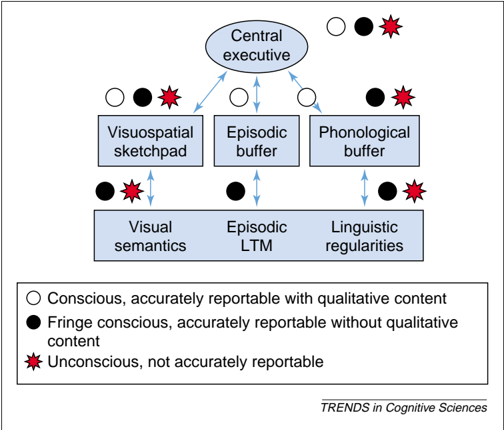
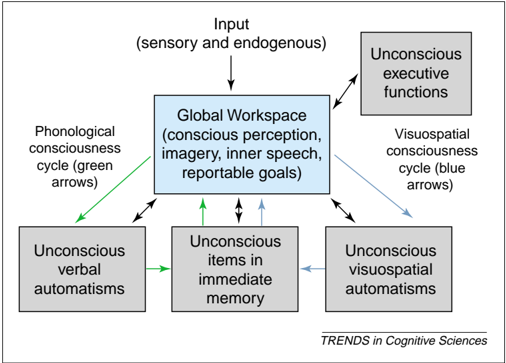
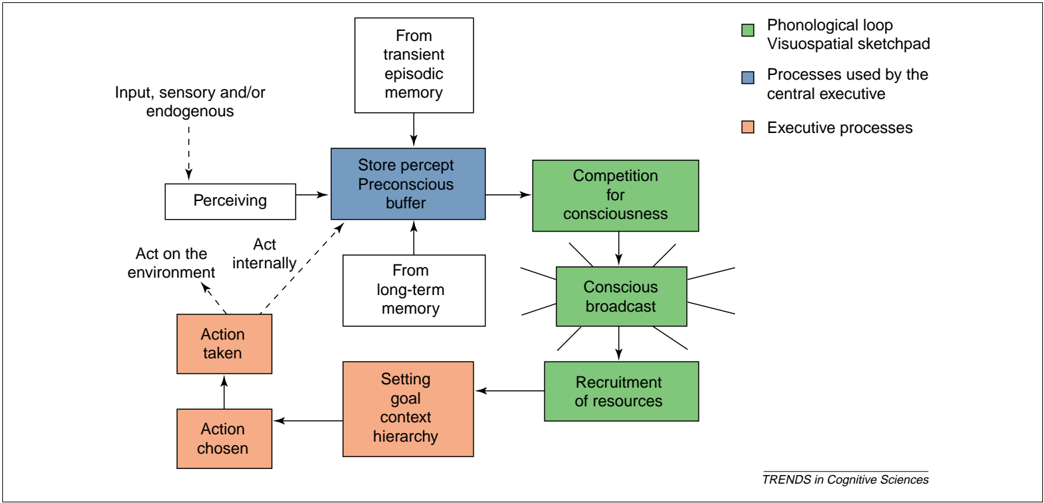
Active components of classical working memory are conscious, but traditional theory does not account for this fact. Global Workspace theory suggests that consciousness is needed to recruit unconscious specialized networks that carry out detailed working memory functions. The IDA model provides a fine-grained analysis of this process, specifically of two classical working-memory tasks, verbal rehearsal and the utilization of a visual image. In the process, new light is shed on the interactions between conscious and unconscious aspects of working memory.
Overview
The claims and statistics of this paper haven’t been checked yet.
Free: it reads the open-access text and checks the first 5 claims that cite a source we can check. Create a free account to check every claim.
Integrity signals
Registry
Cites
Statistics
Figures
Verification
Claims the paper makes
The claims and statistics of this paper haven’t been checked yet.
Free: it reads the open-access text and checks the first 5 claims that cite a source we can check. Create a free account to check every claim.
Claims other papers make about this one
Each is checked against this paper’s own text: does it say what the citing paper says it does?
The source backs part of the claim, not all of it — or backs it for a different population, condition or comparison.
In the citing paper
“Baars and Franklin (2003) suggest that all working memory tasks are consciously mediated – inner rehearsal, executive control, and other WM elements are all claimed to require a conscious cue to execute.”
From Global Workspace Dynamics: Cortical “Binding and Propagation” Enables Conscious Contents (2013) · cites this paper as Baars and Franklin (2003)
Experimental — accuracy not yet measuredThe cited source says what the claim attributes to it.
In the citing paper
“Baars and Franklin (2003) used GW theory to propose that consciousness enables access between otherwise separate knowledge sources.”
From Global Workspace Dynamics: Cortical “Binding and Propagation” Enables Conscious Contents (2013) · cites this paper as Baars and Franklin (2003)
The cited source says what the claim attributes to it.
In the citing paper
“when automatic capabilities fail, there follows a call recruiting additional collaborative conscious support ~Baars & Franklin, 2003!”
From AT THE INTERFACE: DYNAMIC INTERACTIONS OF EXPLICIT AND IMPLICIT LANGUAGE KNOWLEDGE (2005) · cites this paper as Baars & Franklin, 2003!
In the citing paper
“Working memory lies at the interface of perception and action (7) and requires the integration of large-scale neural circuits (8–11).”
From Dynamic reconfiguration of frontal brain networks during executive cognition in humans (2015) · cites this paper as [11]
Self-check
Percentages, sums and reported differences re-computed from the paper’s own numbers.
The self-check needs the paper’s full text.
Citations
Cites
James, W. (1913) · Henry Holt and Company eBooks · doi:10.1037/11059-000 · Cited by 25,226
Baddeley, A. D., & Hitch, G. (1974) · Psychology of Learning and Motivation · doi:10.1016/s0079-7421(08)60452-1 · Cited by 15,284
Barsalou, L. W. (1999) · Behavioral and Brain Sciences · doi:10.1017/s0140525x99002149 · Cited by 6,887
(1988) · Cited by 3,656
Self-citationEricsson, K. A., & Kintsch, W. (1995) · Psychological Review · doi:10.1037/0033-295x.102.2.211 · Cited by 3,498 · cited 1×
“Working memory Working memory [16] Long-term working memory [ 28 ] Emotions Neural networks [29] [30,31]”
Background(2012) · Encyclopedia of the Sciences of Learning · doi:10.1007/978-1-4419-1428-6_5794 · Cited by 2,562
Common regions of the human frontal lobe recruited by diverse cognitive demands
Duncan, J., & Owen, A. M. (2000) · Trends in Neurosciences · doi:10.1016/s0166-2236(00)01633-7 · Cited by 2,498
Towards a cognitive neuroscience of consciousness: basic evidence and a workspace framework
Dehaene, S. (2001) · Cognition · doi:10.1016/s0010-0277(00)00123-2 · Cited by 2,498
Is It an agent, or just a program?: A taxonomy for autonomous agents
Franklin, S., & Graesser, A. (1997) · Lecture Notes in Computer Science · doi:10.1007/bfb0013570 · Cited by 2,286 · cited 1×
“The IDA implementation of GW theory IDA (Intelligent Distribution Agent) is an autonomous software agent [ 18 ] that automates the entire set of tasks of a human personnel agent who assigns sailors to new tours of duty [19].”
MethodSelf-citationRolls, E. T. (1998) · doi:10.1093/oso/9780198524649.001.0001 · Cited by 1,257
Research works printed but not linked: 1
- 7 Baars, B.J. (1993) How does a serial, integrated and very limited stream of consciousness emerge from a nervous system that is mostly unconscious, distributed, and of enormous capacity? In CIBA SymposiumonExperimental and Theoretical Studies of Consciousness (Bock, G.R. and Marsh, J., eds) pp. 282-290, John Wiley & Sons
Cited by
Items 301–400 of 542
Toward the Aircraft of the Future: A Perspective from Consciousness
Ezhilarasu, C. M., Angus, J., & Jennions, I. K. (2023) · Journal of Artificial Intelligence and Consciousness · doi:10.1142/s2705078523300013 · Cited by 7
“Some of the unconscious modules like contexts (e.g., motives and emotions are goal contexts) could shape conscious contents and can work together to constrain conscious events [Baars and Franklin, 2003].”
BackgroundComplex Systems in Interdisciplinary Interaction
Njegovanović, A. (2024) · Financial Markets Institutions and Risks · doi:10.61093/fmir.8(1).94-107.2024 · Cited by 10
Kotseruba, I., & Tsotsos, J. K. (2025) · Oxford University Press eBooks · doi:10.1093/oso/9780192844835.003.0005 · Cited by 6
Foundations of Intelligence Science
Shi, Z. (2011) · International Journal of Intelligence Science · doi:10.4236/ijis.2011.11002 · Cited by 6
“Based on the LIDA cognitive architecture, Franklin et al. proposed an underlying computational software framework for Artificial General Intelligence [7].”
MethodInfluentialDeterminants of Association and Dissociation between Subjective and Objective Measures of Workload
Yakobi, O. (2018) · Proceedings of the Human Factors and Ergonomics Society Annual Meeting · doi:10.1177/1541931218621052 · Cited by 7
“As working-memory is closely related to consciousness (Baars & Franklin, 2003) and involved in central executive functions (Baddeley, 2003), the count-Oddball involve type 2 processing.”
Modeling Working Memory to Identify Computational Correlates of Consciousness
Reggia, J. A., Katz, G. E., & Davis, G. P. (2019) · Open Philosophy · doi:10.1515/opphil-2019-0022 · Cited by 9
Compositional memory in attractor neural networks with one-step learning
Davis, G. P., Katz, G. E., Gentili, R. J., & Reggia, J. A. (2021) · Neural Networks · doi:10.1016/j.neunet.2021.01.031 · Cited by 7
“Performance on working memory tasks is correlated with measures of general intelligence (Conway et al., 2003; Colom et al., 2004; Jaeggi et al., 2008), and working memory operations are considered to be consciously reportable (Baars and Franklin, 2003; Baddeley, 1993).”
Duro, R. J., Bellas, F., & Becerra, J. A. (2013) · Springer eBooks · doi:10.1007/978-3-642-30574-0_57 · Cited by 6
Ramamurthy, U., & Franklin, S. (2009) · International Journal of Machine Consciousness · doi:10.1142/s1793843009000220 · Cited by 6
Self-citationThe biological cost of consciousnessPreprint
Baars, B. J., & Baars, B. (2012) · Nature Precedings · doi:10.1038/npre.2012.6775.1 · Cited by 8
Self-citationA modular network treatment of Baars' Global Workspace consciousness modelPreprint
Wallace, R. (2005) · CogPrints (University of Southampton) · Cited by 6
Implementation of Emotional Learning for Cognitive Tutoring Agents
Faghihi, U., Poirier, P., Dubois, D., Gaha, M., & Nkambou, R. (2008) · Mexican International Conference on Artificial Intelligence · doi:10.1109/micai.2008.45 · Cited by 7
Kanaev, I. A. (2023) · Entropy · doi:10.3390/e25030418 · Cited by 7
GLOBAL WORKSPACE THEORY, SHANAHAN, AND LIDA
Franklin, S. (2011) · International Journal of Machine Consciousness · doi:10.1142/s1793843011000728 · Cited by 5
Self-citationComputational Models of Cognitive and Motor Control
Minai, A. A. (2015) · Springer eBooks · doi:10.1007/978-3-662-43505-2_35 · Cited by 6
“This model has been implemented computationally in the Intelligent Distribution Agent (IDA) model by Franklin (Baars and Franklin, 2003; Franklin and Patterson, 2006).”
MethodEEG induced working memory performance analysis using inverse fuzzy relational approach
Ghosh, L., Konar, A., Rakshit, P., Ralescu, A., & Nagar, A. K. (2017) · IEEE International Conference on Fuzzy Systems (FUZZ-IEEE) · doi:10.1109/fuzz-ieee.2017.8015653 · Cited by 5
“Psychologists have developed different models to explain the intelligent mechanisms involved in sensory perception [1-6], encoding of perceived information in memory [7] and recall of stored information [78] through a complex process of information processing, communication among different brain modules and their temp…”
BackgroundVolk, S., & Becker, W. J. (2014) · Schmalenbach Business Review · doi:10.1007/bf03396919 · Cited by 7
Kiat, J. E., Dodd, M. D., Belli, R. F., & Cheadle, J. E. (2018) · Journal of Neurophysiology · doi:10.1152/jn.00722.2017 · Cited by 5
“2015), it is also possible that the increase in theta activity may reflect the contextual updating of preconscious aspects of visual memory (Baars and Franklin 2003) to incorporate the presented changes into the post-change scene representation.”
BackgroundOphir, E. A., Hesselmann, G., & Lamy, D. (2020) · Consciousness and Cognition · doi:10.1016/j.concog.2020.103008 · Cited by 7
Does superior visual working memory capacity enable greater distractor suppression?
Hauck, C., Lien, M.-C., & Ruthruff, E. D. (2022) · Visual Cognition · doi:10.1080/13506285.2022.2145403 · Cited by 6
“…implicit and automatic, then it makes sense that it does not rely on visual working memory capacity, as working memory is usually considered to be an explicit system that operates on conscious representations (e.g., Baars & Franklin, 2003; Baddeley, 2010; for a review, see Persuh et al., 2018).”
BackgroundA MODEL OF PRIMITIVE CONSCIOUSNESS BASED ON SYSTEM-LEVEL LEARNING ACTIVITY IN AUTONOMOUS ADAPTATION
Kinouchi, Y., & Kato, Y. (2012) · International Journal of Machine Consciousness · doi:10.1007/978-3-642-34274-5_33 · Cited by 5
“The model not only explains the time delay in Libet's experiment [Libet, 2004], but is also positioned as an improved model of Global Workspace Theory (GWT) [Baars, 1988; Baars and Franklin, 2003].”
BackgroundMethodLevel of consciousness: Reframing our understanding of individual differences in learning
Troyer, J. A. (2011) · Procedia - Social and Behavioral Sciences · doi:10.1016/j.sbspro.2011.02.038 · Cited by 7
Categorical Ontology of Levels and Emergent Complexity: An Introduction
Băianu, I. C. (2007) · Axiomathes · doi:10.1007/s10516-007-9013-0 · Cited by 6
The level of subjective visibility at different stages of memory processing
Skóra, Z., & Wierzchoń, M. (2016) · Journal of Cognitive Psychology · doi:10.1080/20445911.2016.1225745 · Cited by 8
“One example is Baars’ Global Workspace theory (see e.g. Baars & Franklin, 2003), which assumes that consciousness is associated with global distribution of information in the brain and that all the components of WM that become activated are conscious (e.g. rehearsal or visuospatial operations).”
BackgroundLearning in cognitive systems with autonomous dynamicsPreprint
Gros, C., & Kaczor, G. (2008) · arXiv (Cornell University) · doi:10.48550/arxiv.0804.1306 · Cited by 5
Dack, H., Rogelberg, S. L., Cash, A. H., & Fitchett, P. G. (2025) · RMLE Online · doi:10.1080/19404476.2025.2484492 · Cited by 4
“To encode information about the meaning of content into long-term memory, learners must first think about that meaning, and to think about it, they must first pay attention to it (Baars & Franklin, 2003).”
Statistical Learning Facilitates Access to Awareness
Xu, L., Paffen, C. L. E., der Stigchel, S. V., & Gayet, S. (2024) · Psychological Science · doi:10.1177/09567976241263344 · Cited by 6
Reviewing a Model of Metacognition for Application in Cognitive Architecture Design
Ukov, T. G., & Tsochev, G. (2025) · Systems · doi:10.3390/systems13030177 · Cited by 7
The Computational Evolution of Cognitive Architectures
Kotseruba, I., & Tsotsos, J. K. (2025) · doi:10.1093/oso/9780192844835.001.0001 · Cited by 7
CONSCIOUSNESS AS A PROCESS OF QUERIES AND ANSWERS IN ARCHITECTURES BASED ON IN SITU REPRESENTATIONS
van der Velde, F. (2013) · International Journal of Machine Consciousness · doi:10.1142/s1793843013400039 · Cited by 4
Spontaneous Repetitive Thoughts Can Be Adaptive: Postscript on McKay and Vane (2010)
Baars, B. J. (2010) · Cited by 4
Self-citationChen, X. (2013) · ProQuest LLC eBooks · Cited by 4
The neural basis of temporal individuation and its capacity limits in the human brain
Naughtin, C. K., Tamber-Rosenau, B. J., & Dux, P. E. (2013) · Journal of Neurophysiology · doi:10.1152/jn.00534.2013 · Cited by 4
RetractedExploring the visual (un)conscious
Breitmeyer, B. G., Kiefer, M., & Niedeggen, M. (2015) · Consciousness and Cognition · doi:10.1016/j.concog.2015.04.021 · Cited by 6
Băianu, I. C., & Poli, R. (2010) · Cited by 4
Modeling the effect of hint timing on the idea generation process
Doboli, S., Jacques, M., Minai, A. A., Paulus, P., Korde, R. M., & Doboli, A. (2013) · International Joint Conference on Neural Networks (IJCNN) · doi:10.1109/ijcnn.2013.6706935 · Cited by 4
“Recently, our group has proposed a number of neural cognitive models [13], [14], [15] inspired by the neurobiology of semantic cognition [17], [18], [19], [20], [21], the connectivity of semantic memory [22], [23], [24], [25], working memory [26] and cognitive control [27], [28].”
BackgroundThe case for using brain-based devices to study consciousness
Fleischer, J., McKinstry, J. L., Edelman, D. B., & Edelman, G. M. (2011) · Cambridge University Press eBooks · doi:10.1017/cbo9780511994838.014 · Cited by 4
“Various memory systems, particularly working memory, may be fundamental to the induction of conscious states (Baars and Franklin, 2003).”
BackgroundOn 'Machine Consciousness'Preprint
Wallace, R. (2023) · doi:10.31234/osf.io/fmp93 · Cited by 4
Control flow in active inference systemsPreprint
Fields, C., Fabrocini, F., Friston, K. J., Glazebrook, J. F., Hazan, H., Levin, M. G., & Marcianò, A. (2023) · doi:10.31219/osf.io/8e4ra · Cited by 4
Anesthesia-Induced State Transitions in Neuronal Populations
SLEIGH, J. W., Steyn‐Ross, M. L., Steyn‐Ross, D. A., Voss, L. J., & Wilson, M. T. (2009) · Contemporary clinical neuroscience · doi:10.1007/978-1-60761-462-3_7 · Cited by 3
“Twenty years ago, Baars introduced the hypothesis that the neural basis of the phenomenon of consciousness could be explained in terms of a concept he called the “global workspace” ( Baars and Franklin 2003, 2007 ).”
BackgroundDecision-Making in Cognitive Tutoring Systems
Dubois, D., Nkambou, R., Quintal, J.-F., & Savard, F. (2010) · Studies in computational intelligence · doi:10.1007/978-3-642-14363-2_8 · Cited by 6
“In the GW theory, consciousness is associated with a global workspace in the brain – a fleeting memory capacity whose focal contents are widely distributed ("broadcast") to many unconscious specialized networks (Baars and Franklin 2003).”
BackgroundA Monitoring System for Measuring the Cognitive Cycle via a Continuous Reaction Time Task
Ukov, T. G., Tsochev, G., & Yoshinov, R. (2025) · Systems · doi:10.3390/systems13070597 · Cited by 3
A neural architecture for grounded cognition: Representation, structure, dynamics and learning
van der Velde, F., & de Kamps, M. (2008) · International Joint Conference on Neural Networks (IJCNN) · doi:10.1109/ijcnn.2008.4633915 · Cited by 3
Improved Animal-Like Maintenance of Homeostatic Goals via Flexible Latching ⁄
Rohlfshagen, P., & Bryson, J. J. (2008) · University of Birmingham Research Portal (University of Birmingham) · Cited by 4
Effect of verbal working memory load during the oculomotor activity in visual search
Velichkovsky, B. B., & Izmalkova, A. I. (2015) · Experimental Psychology (Russia) · doi:10.17759/exppsy.2015080203 · Cited by 5
A Conscious-based Mind for an Artificial Creature
da Silva, R. C. M., & Gudwin, R. (2010) · Cited by 3
Artificial Minds with Consciousness and Common sense Aspects
Shylaja, K. R., Vijayakumar, M. V., Prasad, E. V., & Davis, D. N. (2017) · International Journal of Agent Technologies and Systems · doi:10.4018/ijats.2017010102 · Cited by 3
A Motivational System for Mind Model CAM.
Shi, Z., Zhang, J., Yue, J., & Qi, B. (2013) · National Conference on Artificial Intelligence · Cited by 3
Working memory and consciousness: three theoretical perspectives
Landínez-Martínez, D., Arenas, D. A. M., & Pineda, D. A. (2022) · Ánfora · doi:10.30854/anf.v29.n53.2022.800 · Cited by 4
The centered mind: What the science of working memory shows us about the nature of human thought
Gomez‐Lavin, J. (2017) · Philosophical Psychology · doi:10.1080/09515089.2017.1299858 · Cited by 3
“…is dependent on the global broadcast account of consciousness.1 Global broadcast theories of consciousness hold that a mental state is conscious when it is made “globally” or broadly available to a wide set of brain systems for consumption and processing (p. 52; see also Baars & Franklin, 2003).”
BackgroundDecoding Working Memory Load from EEG with LSTM NetworksPreprint
Goldstein, S., Hu, Z., & Ding, M. (2019) · arXiv (Cornell University) · doi:10.48550/arxiv.1910.05621 · Cited by 3
Lian, R., & Goertzel, B. (2025) · Lecture notes in computer science · doi:10.1007/978-3-032-00686-8_35 · Cited by 2
Poststroke Attention Function: A Rasch Analysis of Neuropsychological Tests
Miyauchi, T., Sasaki, S., Nagao, T., & Tanemura, R. (2025) · Asian Journal of Occupational Therapy · doi:10.11596/asiajot.21.117 · Cited by 2
Consciousness, subjectivity, and aging in western thought
Alexopoulos, G. S. (2026) · Neuropsychopharmacology · doi:10.1038/s41386-026-02321-5 · Cited by 2
Relation between working memory and implicit learning in the contextual cueing paradigm
Wang, C., Venkateshan, S., Milliken, B., & Sun, H. (2020) · Visual Cognition · doi:10.1080/13506285.2020.1825140 · Cited by 3
Recollective and non-recollective processes in working memory retrieval
Rosselet-Jordan, F. L., Abadie, M., Elsig, S. M., Barrouillet, P., & Camos, V. (2024) · Cognition · doi:10.1016/j.cognition.2024.105978 · Cited by 2
“It could be surmised that the content of WM, as it has often been assimilated with conscious awareness, is necessarily directly accessible and accurately reportable (Baars & Franklin, 2003; see also Andrade, 2001; Baddeley, 1993, 2000; Barrouillet & Camos, 2015, 2021).”
BackgroundRetroactive Consciousness of Dreams: What Do We Remember When We Wake Up?
Rosen, M. G. (2024) · Synthese Library/Synthese library · doi:10.1007/978-3-031-68204-9_3 · Cited by 2
Time, Memory, and the Physical Basis of Consciousness
Reggia, J. A. (2025) · Journal of Consciousness Studies · doi:10.53765/20512201.32.3.034 · Cited by 2
Do Marked Topics Enhance Memory?
Netz, H., Eviatar, Z., & Kuzar, R. (2011) · Research in Language · doi:10.2478/v10015-011-0023-z · Cited by 2
A cognitive model of human thinking
Guangzuo, C., Wei, X., & Boling, L. W. (2011) · International Conference on Natural Computation (ICNC) · doi:10.1109/icnc.2011.6022208 · Cited by 4
“On the other hand, recent research has found that loops from effectors to sensors or from motor controller to perceptual cortex in fact exit [11, 20-23].”
A conscious model for autonomous robotics: statistical evaluation
Luise, D. L. D., Rancez, L., Biedma, N., & Elía, B. D. (2015) · International Journal of Advanced Intelligence Paradigms · doi:10.1504/ijaip.2015.070331 · Cited by 2
“It extends COFRAM, a framework that aims to be an implementation of a conscious model (Baars, 1998; Baars and Franklin, 2003; Baddeley and Hitch, 1974; Varela et al., 1991; Franklin et al., 2005; Sloman, 1999) inspired on Hofstadter theory (Hofstadter et al., 1994).”
MethodThe Evolutionary Pathway to Consciousness and Reason: the Cognitome from a Philosophical Perspective
Kanaev, I. A., & Dryaeva, E. D. (2023) · Neuroscience and Behavioral Physiology · doi:10.1007/s11055-023-01511-8 · Cited by 4
“Global workspace theory [Baars and Franklin, 2003; Dehaene and Changeux, 2011; Dehaene et al., 2017; Demertzi et al., 2019] offers one of the most consistent and experimentally supported descriptions of the emergence of a moment of consciousness.”
BackgroundProductivity and stress recollection inaccuracy: Anchoring effects in work-from-home evaluation
Stroom, M. (2025) · PLoS ONE · doi:10.1371/journal.pone.0320959 · Cited by 3
“These findings highlight the necessity of caution and critical review when utilizing self-reported studies, as the nature of human behavior has the potential to reflect a non-existing or opposite change even within the productivity domain [39,54].”
Graded Attractors: Configuring Context-Dependent Workspaces for Ideation.
Minai, A. A., Iyer, L., Padur, D., Doboli, S., & Brown, V. R. (2009) · Cited by 2
The Language of Thought: A New Philosophical Direction, by Susan Schneider
Sprevak, M. D. (2018) · Mind · doi:10.1093/mind/fzy031 · Cited by 2
The role of neural feedback in language unification: How awareness affects combinatorial processing
Mongelli, V. (2020) · MPG.PuRe (Max Planck Society) · Cited by 2
Human as machine: A discussion on the transformations and exhaustion of a metaphorPreprint
Pastor, A. (2021) · OSF Preprints (OSF Preprints) · doi:10.31219/osf.io/d9pr6 · Cited by 2
Tait, I., Bensemann, J., & Nguyen, T. (2023) · Preprints.org · doi:10.20944/preprints202303.0010.v1 · Cited by 1
Institutional paraconsciousness and its pathologiesPreprint
Wallace, R. (2006) · CogPrints (University of Southampton) · Cited by 1
Information-Processing Skills Related to Working Memory in Individuals With Asperger's Disorder
Musarra, N. L. (2007) · PsycEXTRA Dataset · doi:10.1037/e689312007-001 · Cited by 2
“Because the basic constructs of the working memory model are easily testable and the brain basis of these functions is understood (Baars & Franklin, 2003), specific IP deficiencies related to working memory capacity can be identified and assessed.”
BackgroundGeneralized inattentional blindness from a Global Workspace perspectivePreprint
Wallace, R. (2006) · CogPrints (University of Southampton) · Cited by 2
Reggia, J. A. (2025) · Symmetry · doi:10.3390/sym17070992 · Cited by 1
What is consciousness and what it is for. An introduction to extended information theory
Forti, B. (2025) · Frontiers in Psychology · doi:10.3389/fpsyg.2025.1627289 · Cited by 4
Leading from behind: How the symbolic self exerts its free will
Sheldon, K. M., & Sedikides, C. (2025) · European Review of Social Psychology · doi:10.1080/10463283.2025.2577073 · Cited by 1
A Systematic Review of the Need for Conceptual Models of Imagery Experiences
Ukov, T. G., Sharabov, M., & Tsochev, G. (2025) · Systems · doi:10.3390/systems13121051 · Cited by 1
Beyond mimicry: a framework for evaluating genuine intelligence in artificial systems
Niazi, S. K. (2026) · Frontiers in Artificial Intelligence · doi:10.3389/frai.2025.1686752 · Cited by 1
“This broadcasting enables flexible coordination between otherwise independent processing systems, supporting integrated cognition underlying human intelligence (Baars and Franklin, 2003; Franklin et al., 2005).”
Three propositions about conscious experience and their implications for theories of consciousness
White, P. A. (2026) · Consciousness and Cognition · doi:10.1016/j.concog.2026.103994 · Cited by 2
Ghosh, S., & Raj, R. (2026) · Advances in computational intelligence and robotics book series · doi:10.4018/979-8-3373-5530-6.ch005 · Cited by 1
Jorda, M. P. S. (2005) · Multilingual Matters eBooks · doi:10.21832/9781853598043-003 · Cited by 1
Concepts and functional characteristics of consciousness in comparison of memory and attention
김은숙, & Shin, H. (2010) · 인지과학 · doi:10.19066/cogsci.2010.21.4.006 · Cited by 2
Biased competition in the global workspace
Glazebrook, J. F. (2012) · Physics of Life Reviews · doi:10.1016/j.plrev.2012.10.002 · Cited by 1
김기남 (2012) · The Journal of The Korean Association of Geographic and Environmental Education · doi:10.17279/jkagee.2012.20.1.95 · Cited by 1
Odometer Errors for a Robot Controlled by Consciousness
de Luise, M. D. L., Rancez, L., Biedma, N., Elía, B. D., Colodrero, D. L., & Mendez, J. (2016) · IEEE Biennial Congress of Argentina (ARGENCON) · doi:10.1109/argencon.2016.7585237 · Cited by 1
“It is a derivative of COFRAM, the framework that intends to be an implementation of a Consciousness Model from Baars [1] [2] [3] [4] [5] [6].”
MethodConsciousness, Crosstalk, and the Mereological Fallacy
Wallace, R. (2017) · Springer eBooks · doi:10.1007/978-3-319-53910-2_1 · Cited by 1
Philosophical Issues in Computational Cognitive Sciences
Sprevak, M. D. (2023) · Cambridge University Press eBooks · doi:10.1017/9781108755610.043 · Cited by 2
Yu, J., Zhou, Y., Fu, Y., Wang, C., Zhou, J., Chen, H., & Chen, H. (2023) · Consciousness and Cognition · doi:10.1016/j.concog.2023.103520 · Cited by 1
Institutional Dynamics Under Selection Pressure and Uncertainty
Wallace, R. (2023) · SpringerBriefs in evolutionary biology · doi:10.1007/978-3-031-29879-0_5 · Cited by 1
"The Self-Simulation Theory: A Computational Theory of Consciousness"
Chakraborty, S. (2023) · Biomedical Journal of Scientific & Technical Research · doi:10.26717/bjstr.2023.48.007699 · Cited by 1
EVOLUTIONARY PATH OF CONSCIOUSNESS AND REASON: COGNITOME FROM A PHILOSOPHICAL PERSPECTIVE
Kanaev, I. A., & Dryaeva, E. D. (2023) · Журнал высшей нервной деятельности им И П Павлова · doi:10.31857/s0044467723010082 · Cited by 1
On the structural ambiguity in natural language that the neural architecture cannot deal with
Bod, R., Fitz, H., & Zuidema, W. H. (2006) · Behavioral and Brain Sciences · doi:10.1017/s0140525x06239025 · Cited by 1
Arguing for a conscious emergence of language
Cardini, F.-E. (2017) · Lingua · doi:10.1016/j.lingua.2017.04.009 · Cited by 1
Independent operation of implicit working memory under cognitive load
Ji, E., Lee, K. M., & Kim, M.-S. (2017) · Consciousness and Cognition · doi:10.1016/j.concog.2017.08.014 · Cited by 1
“Previous researchers have regarded consciousness as essential for WM operation (Baars & Franklin, 2003; Baddeley, 1992; Cohen, Cavanagh, Chun, & Nakayama, 2012), given that WM is involved in maintaining mental representations and operating executive functions such as cognitive control, inhibition,…”
BackgroundMboyo, J. P. E. (2021) · PRACTICE · doi:10.1080/25783858.2021.1968277 · Cited by 1
“Despite various advances in studies around enhancing human memory, much of the knowledge of our experiences is lost in human unconsciousness (Baars and Franklin 2003).”
BackgroundCANDID: A Neurodynamical Model for Adaptive Context-Dependent Idea Generation
Iyer, L., & Minai, A. A. (2012) · Understanding complex systems · doi:10.1007/978-3-030-77198-0_7 · Cited by 1
Working memory: The information you are now thinking of
Cowan, N. (2024) · Elsevier eBooks · doi:10.1016/b978-0-443-15754-7.00029-8 · Cited by 1
A Tripartite Framework for Working Memory Processes
Patsula, P. J. (2004) · Lecture notes in computer science · doi:10.1007/978-3-540-27795-8_34 · Cited by 1
“It has been conjectured that a full WM processing sequence from input to output, called a “cognitive cycle,” takes a minimum of 200 msec [ 1 ].”
BackgroundThe unconscious and conscious foundations of human reward pursuit
Bijleveld, E. (2007) · Utrecht University Repository (Utrecht University) · Cited by 1
Rate distortion coevolutionary dynamics and the flow nature of cognitive epigenetic systemsPreprint
Glazebrook, J. F., & Wallace, R. (2011) · arXiv (Cornell University) · doi:10.48550/arxiv.1101.4984 · Cited by 2
“in the framework of a kind of broadcasting system relaying within ‘a theater of consciousness’ – the basic operative hypothesis of the Global (Neuronal) Workspace theory as developed in (Baars, 1988; Baars and Franklin, 2003) that forms an integral part of the model in (Wallace, 2005; Wallace and Fullilove, 2008). Her…”
BackgroundMethodInfluentialDarwin's Rainbow: Evolutionary radiation and the spectrum of consciousnessPreprint
Wallace, R., & Wallace, R. G. (2006) · CogPrints (University of Southampton) · Cited by 1
Wallace, R. (2012) · Physics of Life Reviews · doi:10.1016/j.plrev.2012.11.002 · Cited by 1
Metadata
- Authors
- Baars, B. J., & Franklin, S.
- Affiliations
- Neurosciences Institute (US)
- University of Memphis (US)
- Corresponding author
- Baars, Bernard J.
- Venue
- Trends in Cognitive Sciences
- Publisher
- Elsevier BV
- Published
- 2003-04
- Volume
- 7
- Issue
- 4
- Pages
- 166-172
- ISSN
- 1364-6613 (ISSN-L)
- OpenAlex
- W2170468585
- Semantic Scholar
- 59210192d31d570d83532e24b6908f57fae8747a
- Cited by
- 541
- References
- 41
- Citations by year
- 2026: 36 · 2025: 36 · 2024: 18 · 2023: 28 · 2022: 16 · 2021: 17 · 2020: 19 · 2019: 21 · 2018: 24 · 2017: 25 · 2016: 18 · 2015: 22 · 2014: 30 · 2013: 38 · 2012: 30
- FWCI
- 2.61
- Type
- journal article
- Language
- en
- Open access
- closed
- Licence
- www.elsevier.com/tdm/userlicense/1.0/ (tdm)
- www.elsevier.com/legal/tdmrep-license (tdm)
- Locations
- Trends in Cognitive Sciences (publishedVersion)
- PubMed (publishedVersion)
- CogPrints (University of Southampton) (submittedVersion)
- Funders
- Field Neurosciences Institute
- Neurosciences Research Foundation
- Topics
- Social Sciences › Arts and Humanities › Philosophy › Philosophy and Theoretical Science
- Social Sciences › Psychology › Experimental and Cognitive Psychology › Cognitive Abilities and Testing
- Life Sciences › Neuroscience › Cognitive Neuroscience › Neural dynamics and brain function
- Keywords
- subjective experience, working memory, global workspace theory, unconscious processes, verbal rehearsal, visual imagery
About these checks
Registry, retraction, Cites and statistics results are computed, not judged, with one exception: a printed reference that no index lists is read once by a model before it counts as a citation error. Claims are extracted by a model and kept only when their quote appears verbatim in the text; each cited source is then checked, with a model’s help, for whether it says what the claim relies on. Those verdicts can be wrong — read the claim’s quote and the cited source before relying on one.
Statistics and arithmetic are recomputed, not judged.
Confidence bands are shown only for fields calibrated on our annotated test set. None is calibrated yet, so no band is shown.
What counts as a claim ›How we measure confidence ›How we check this ›
Are you an author, or do you see a problem with this page? Request a review
Data sources
Bibliographic data: Semantic Scholar, OpenAlex, Crossref.
Contains information from the Semantic Scholar Academic Graph Datasets, made available under the ODC Attribution License (ODC-BY 1.0).
Semantic Scholar’s data is described in: Kinney, R., et al. (2023). The Semantic Scholar Open Data Platform. arXiv:2301.10140.
