

Guided self-help to reduce psychological distress in South Sudanese female refugees in Uganda: a cluster randomised trial
Open accessThe DOI matches its Crossref record; 47 of the 47 references it cites were found in a registry or an index; 15 of the 28 sources its claims cite were checked for support.
Abstract
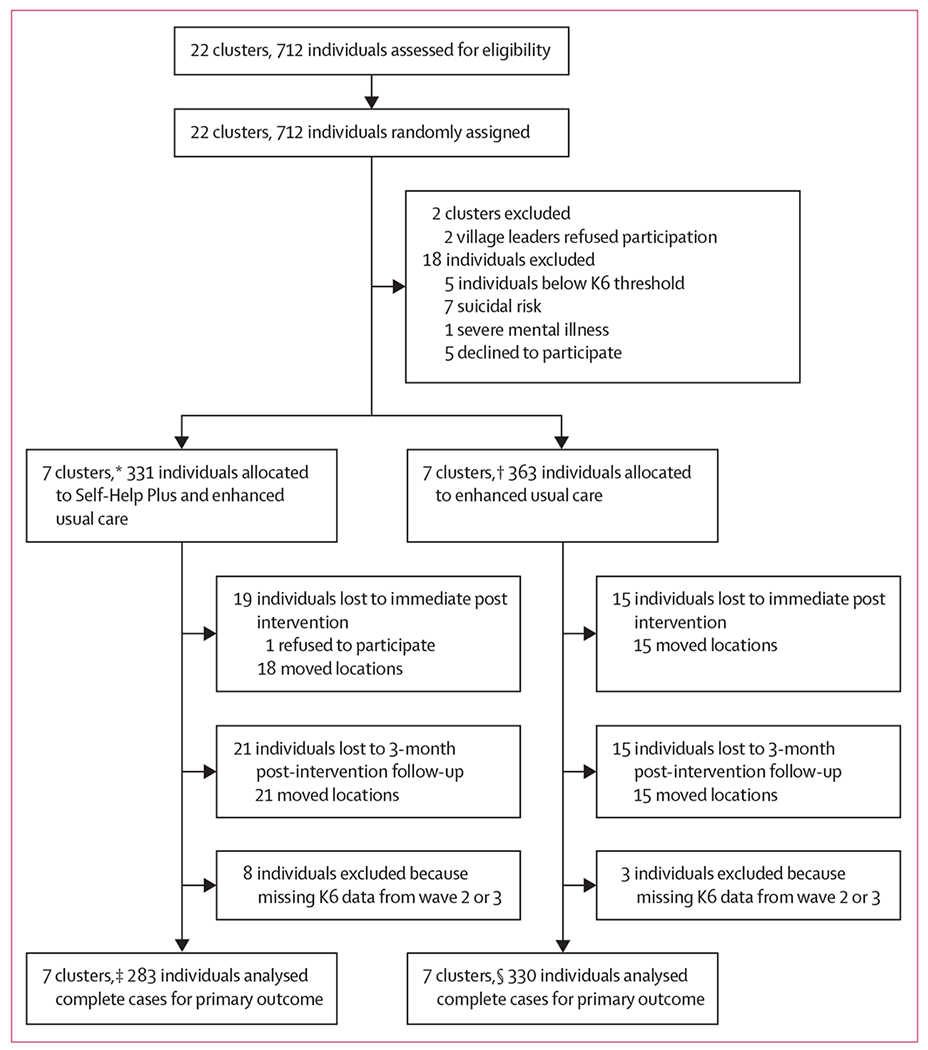
BACKGROUND: Innovative solutions are required to provide mental health support at scale in low-resource humanitarian contexts. We aimed to assess the effectiveness of a facilitator-guided, group-based, self-help intervention (Self-Help Plus) to reduce psychological distress in female refugees. METHODS: We did a cluster randomised trial in rural refugee settlements in northern Uganda. Participants were female South Sudanese refugees with at least moderate levels of psychological distress (cutoff ≥5 on the Kessler 6). The intervention comprised access to usual care and five 2-h audio-recorded stress-management workshops (20-30 refugees) led by briefly trained lay facilitators, accompanied by an illustrated self-help book. Villages were randomly assigned to either intervention (Self-Help Plus or enhanced usual care) on a 1:1 basis. Within 14 villages, randomly selected households were approached. Screening of women in households continued until 20-30 eligible participants were identified per site. The primary outcome was individual psychological distress, assessed using the Kessler 6 symptom checklist 1 week before, 1 week after, and 3 months after intervention, in the intention-to-treat population. All outcomes were measured at the individual (rather than cluster) level. Secondary outcomes included personally identified problems, post-traumatic stress, depression symptoms, feelings of anger, social interactions with other ethnic groups, functional impairment, and subjective wellbeing. Assessors were masked to allocation. This trial was prospectively registered at ISRCTN, number 50148022. FINDINGS: Of 694 eligible participants (331 Self-Help Plus, 363 enhanced usual care), 613 (88%) completed all assessments. Compared with controls, we found stronger improvements for Self-Help Plus on psychological distress 3 months post intervention (β -1·20, 95% CI -2·33 to -0·08; p=0·04; d -0·26). We also found larger improvements for Self-Help Plus 3 months post-intervention for five of eight secondary outcomes (effect size range -0·30 to -0·36). Refugees with different trauma exposure, length of time in settlements, and initial psychological distress benefited similarly. With regard to safety considerations, the independent data safety management board responded to six adverse events, and none were evaluated to be concerns in response to the intervention. INTERPRETATION: Self-Help Plus is an innovative, facilitator-guided, group-based self-help intervention that can be rapidly deployed to large numbers of participants, and resulted in meaningful reductions in psychological distress at 3 months among South Sudanese female refugees. FUNDING: Research for Health in Humanitarian Crises (R2HC) Programme.
Overview
CoChat Summary
TL;DR
In a cluster randomised trial among South Sudanese female refugees in Uganda, facilitator-guided group self-help (Self-Help Plus) plus enhanced usual care reduced psychological distress more than enhanced usual care alone at 3 months. The intervention also improved several secondary outcomes, with effects not moderated by trauma exposure, length of stay, or baseline distress.
Key findings
- Among 694 eligible participants (331 Self-Help Plus, 363 enhanced usual care), 613 (88%) completed all assessments; Self-Help Plus led to greater 3-month reductions in psychological distress on the Kessler 6 (β -1·20, 95% CI -2·33 to -0·08; p=0·04; d -0·26).
- Immediately after intervention, the psychological distress effect was larger (β -3·25, 95% CI -4·31 to -2·19; p<0·0001; d -0·72).
- At 3 months, Self-Help Plus showed larger improvements for five of eight secondary outcomes, with effect sizes ranging from -0·30 to -0·36, including post-traumatic stress, depression symptoms, explosive anger, functional impairment, and subjective wellbeing.
- The independent data safety management board responded to six adverse events, and none were evaluated to be concerns in response to the intervention.
Methods
- Single-blind, parallel-group cluster randomised trial in 14 villages in Rhino Camp settlement, northwestern Uganda; villages were allocated 1:1 to Self-Help Plus plus enhanced usual care or enhanced usual care alone.
- Participants were female South Sudanese refugees with at least moderate psychological distress (Kessler 6 cutoff ≥5); the intervention comprised five 2-h audio-recorded stress-management workshops (20–30 refugees) led by briefly trained lay facilitators, plus an illustrated self-help book.
- Outcomes were measured at the individual level; primary outcome was Kessler 6 psychological distress at 1 week before, 1 week after, and 3 months after intervention, analysed in the intention-to-treat population using linear mixed-effects models with village as a random effect.
Limitations
- The authors state follow-up was only 3 months, so long-term benefits are unknown; the psychological distress measure had lower-than-acceptable internal consistency (Cronbach α=0·65); frequency of contact with service providers was not controlled between study conditions; only a limited number of clusters were randomised, so unmeasured cluster differences are possible; and the study focused on female refugees, limiting generalisability.
- The authors also note that it remains unclear why effect sizes reduce over time and that mechanisms of change were not tested.
- Evident from the text: the 3-month effects were smaller than immediate post-treatment effects (e.g., K6 d -0·72 immediately vs -0·26 at 3 months), and the trial did not include male refugees, so male mental health needs are not addressed.
Model-written summary. Check it against the paper before relying on it.
Integrity signals
Registry
Cites
Statistics
Figures
Verification
Claims the paper makes
13 Valid · 1 Not valid · 7 Not checked · 54 Own results and interpretations
The cited sources support only part of this claim — read each source’s verdict below.
In the paper
“Current evidence-based treatments generally require a substantial clinical workforce not typically available in disrupted, under-resourced health systems. 4”
What the sources say
- Partly supportedcites [4] 4 Tol WA, Barbui C, Bisson J, et al. World Health Organization guidelines for management of acute stress, PTSD, and bereavement: key challenges on the road ahead. PLoS Med 2014; 11: e1001769. sourceExperimental — accuracy not yet measured
In “What Are the Key Obstacles on the Road Ahead?”, the paper identifies personnel shortages in low-resource and humanitarian settings, including too few specialists to train and supervise delivery of recommended psychotherapies. But it does not say evidence-based treatments generally require a substantial clinical workforce; it also reports that non-specialists can deliver psychotherapeutic interventions. (LLM, conf=0.82)
plain- Asserted: passes — The authors put it forward as true.
- Checkable: passes — It can be checked against evidence.
- Load-bearing: passes — The paper’s conclusions depend on it.
- Based: passes — The paper gives a reason why it holds.
- Partly supported
Every source the paper cites for this claim was checked and supports it.
In the paper
“Initial piloting with one group of male and female refugees each identified challenges with engagement and participation of male refugees. 22”
What the sources say
- Supportedcites [22] 22 Tol WA, Augustinavicius J, Carswell K, et al. Translation, adaptation, and pilot of a guided self-help intervention to reduce psychological distress in South Sudanese refugees in Uganda. Glob Ment Health 2018; 5: e25. source
The Methods (Phase 3: Pilot implementation) describe recruiting one female and one male refugee group. The Results (Phases 3 and 4) report lower attendance among men and describe male participants who did not engage with the program. (LLM, conf=0.94)
plain- Asserted: passes — The authors put it forward as true.
- Checkable: passes — It can be checked against evidence.
- Load-bearing: passes — The paper’s conclusions depend on it.
- Based: passes — The paper gives a reason why it holds.
- Supported
Every source the paper cites for this claim was checked and supports it.
In the paper
“Self-Help Plus was deemed a good fit for this setting after an initial needs assessment indicated the ubiquity of overthinking, 32 a local idiom of psychological distress and an explicit target of ACT.”
What the sources say
- Supportedcites [32] 32 Adaku A, Okello J, Lowry B, et al. Mental health and psychosocial support for South Sudanese refugees in northern Uganda: a needs and resource assessment. Confl Health 2016; 10: 18. source
The Results and discussion (Semi-structured interviews and focus group discussions; page unavailable) say overthinking was the second most common general concern raised by participants and one of their most important mental health and psychosocial concerns. The paper also describes it as an idiom of distress. The citation follows the assessment finding; the statement about Self-Help Plus and ACT is the citing authors’ framing, not a finding attributed to this source. (LLM, conf=0.87)
plain- Asserted: passes — The authors put it forward as true.
- Checkable: passes — It can be checked against evidence.
- Load-bearing: passes — The paper’s conclusions depend on it.
- Based: passes — The paper gives a reason why it holds.
- Supported
The cited sources support only part of this claim — read each source’s verdict below.
In the paper
“A Cochrane review of psychological treatments-mostly consisting of relatively higher resource-intensive interventions-in humanitarian settings in low-income and middle-income countries found a drop in effect size for post-traumatic stress disorder symptoms from -1·07 immediately after treat ment (16 studies), to -0·49 at 1-3 months after intervention (18 studies), and -0·37 at 6 months”
What the sources say
- Partly supportedcites [3] 3 Purgato M, Gastaldon C, Papola D, van Ommeren M, Barbui C, Tol WA. Psychological therapies for the treatment of mental disorders in low- and middle-income countries affected by humanitarian crises. Cochrane Database Syst Rev 2018; 7: CD011849. sourceExperimental — accuracy not yet measured
Section 1.1, “PTSD symptoms,” reports the stated effect sizes and study counts for adults and describes a declining effect over follow-up. Its follow-up windows are one to four months, not one to three months, and six months or later, not precisely six months. The passages do not establish the citing sentence’s description of the interventions as mostly relatively resource-intensive. (LLM, conf=0.88)
plainstates an association- Asserted: passes — The authors put it forward as true.
- Checkable: passes — It can be checked against evidence.
- Load-bearing: passes — The paper’s conclusions depend on it.
- Based: passes — The paper gives a reason why it holds.
- Partly supported
A result the paper reports from its own data — it cites no other source for it, so there is none to check. The quote shows it is in the paper.
In the paper
“Compared with controls, we found stronger improvements for Self-Help Plus on psychological distress 3 months post intervention (β -1·20, 95% CI -2·33 to -0·08; p=0·04; d -0·26).”
- Also stated in: § Added value of this study · p. 2 · plain
“Compared with controls, Self-Help Plus was associated with higher levels of improvements on psychological distress, functioning, and wellbeing outcomes 3 months after the intervention.”
plainstates a causen = 694 ·- Asserted: passes — The authors put it forward as true.
- Checkable: passes — It can be checked against evidence.
- Load-bearing: passes — The paper’s conclusions depend on it.
- Based: passes — The paper gives a reason why it holds.
- Also stated in: § Added value of this study · p. 2 · plain
20 more claims
Create a free account to see all 75 claims and to verify the 2 references still open.
- Probably not a substantial claim. 32
- It may state two separate claims as one. 31
Claims other papers make about this one
Each is checked against this paper’s own text: does it say what the citing paper says it does?
The source backs part of the claim, not all of it — or backs it for a different population, condition or comparison.
In the citing paper
“but with evidence also suggesting that a significant number (39%) do not respond to the intervention,12”
From Evaluating a stepped care model of psychological support for adults affected by adversity: study protocol for a randomised controlled trial in Jordan (2024) · cites this paper as [12]
Experimental — accuracy not yet measuredThe source backs part of the claim, not all of it — or backs it for a different population, condition or comparison.
In the citing paper
“Additionally, traditional psychotherapy interventions generally require a substantial clinical workforce, such as mental health specialists and specialist facilities, which are especially not available in developing countries (12).”
From Translation, adaptation, and initial evaluation of a guided self-help intervention to reduce psychological distress among nurses during COVID-19 in China (2023) · cites this paper as [12]
Experimental — accuracy not yet measuredThe source backs part of the claim, not all of it — or backs it for a different population, condition or comparison.
In the citing paper
“The SH+ app has been tested in a large randomized trial with almost 700 South Sudanese refugee women. After three months of the intervention, participants reported a significant reduction in psychological distress as well as improvements in functioning and wellbeing (Tol et al., 2020).”
From Identifying resilience-promoting factors for refugee survivors of torture (2022) · cites this paper as Tol et al., 2020
Experimental — accuracy not yet measuredThe source backs part of the claim, not all of it — or backs it for a different population, condition or comparison.
In the citing paper
“Recently, the World Health Organisation has developed an intervention app for refugee mental health named Self-Help Plus (SH+) which targets increasing psychological flexibility through mindfulness exercises (Tol et al., 2020).”
From Identifying resilience-promoting factors for refugee survivors of torture (2022) · cites this paper as Tol et al., 2020
Experimental — accuracy not yet measuredThe source backs part of the claim, not all of it — or backs it for a different population, condition or comparison.
In the citing paper
“Public health ACT-based interventions designed to strengthen psychological flexibility have been shown to promote mental health in a variety of populations using flexible modes of delivery in various contexts”
From Health Anxiety and Mental Health Outcome During COVID-19 Lockdown in Italy: The Mediating and Moderating Roles of Psychological Flexibility (2020) · cites this paper as Tol et al., 2020
Experimental — accuracy not yet measured
6 more claims about this paper
Create a free account to see every claim other papers make about this one.
Self-check
Percentages, sums and reported differences re-computed from the paper’s own numbers.
Each contradiction between two passages listed here was confirmed by an independent check.
Rated minor: it would not touch a result — a value no result rests on, a p-value that stays on the same side of the significance level, or a conflict that is clerical, resolved elsewhere in the paper, or outside its own findings.
In the paper
§ Outcomes · p. 5
“The 12-item version of the WHODAS, which uses a five-point scale (range 12-60; α=0·78).”
§ Results · p. 7
“WHODAS 2.0 (0-48)”
Rated minor: it would not touch a result — a value no result rests on, a p-value that stays on the same side of the significance level, or a conflict that is clerical, resolved elsewhere in the paper, or outside its own findings.
In the paper
§ Outcomes · p. 5
“scored on a four-point scale [range zero to 12]; α=0·74”
§ Results · p. 7
“Interethnic relationship score (3-12)”
Rated minor: it would not touch a result — a value no result rests on, a p-value that stays on the same side of the significance level, or a conflict that is clerical, resolved elsewhere in the paper, or outside its own findings.
In the paper
§ Results · p. 6
“Study conditions were largely similar with regard to sociodemographics and baseline scores on outcomes, with the exception of ethnicity and length of time in refugee settlement.”
§ Discussion · p. 8
“Although we did not identify differences between study conditions at baseline, it is possible that clusters differed on unmeasured variables.”
Rated minor: it would not touch a result — a value no result rests on, a p-value that stays on the same side of the significance level, or a conflict that is clerical, resolved elsewhere in the paper, or outside its own findings.
In the paper
§ Outcomes · p. 5
“rate problem severity on a six-point scale (range zero to 18; α=0·65).”
§ Results · p. 7
“PSYCHLOPS score (0-20)”
Citations
Cites
The WHO-5 well-being index: A systematic review of the literature
Topp, C. W., Østergaard, S. D., Søndergaard, S., & Bech, P. (2015) · Psychotherapy and Psychosomatics · doi:10.1159/000376585 · Cited by 4,708
Norman, G. R., Sloan, J. A., & Wyrwich, K. W. (2003) · Medical Care · doi:10.1097/01.mlr.0000062554.74615.4c · Cited by 4,700
Bond, F. W., Hayes, S. C., Baer, R. A., Carpenter, K. M., Guenole, N., Orcutt, H. K., Waltz, T., & Zettle, R. D. (2011) · Behavior Therapy · doi:10.1016/j.beth.2011.03.007 · Cited by 3,950
Garnefski, N., Kraaij, V., Schroevers, M. J., & Somsen, G. A. (2008) · Journal of Clinical Psychology in Medical Settings · doi:10.1007/s10880-008-9136-5 · Cited by 2,479
Charlson, F., van Ommeren, M., Flaxman, A., Cornett, J., Whiteford, H., & Saxena, S. (2019) · The Lancet · doi:10.1016/s0140-6736(19)30934-1 · Cited by 1,702
(2010) · Virtual Defense Library (Ministerio de Defensa) · Cited by 1,530
Kessler, R. C., Green, J. G., Gruber, M. J., Sampson, N. A., Bromet, E., Cuitan, M., Furukawa, T. A., Gureje, O., Hinkov, H., Hu, C., et al. (2010) · International Journal of Methods in Psychiatric Research · doi:10.1002/mpr.310 · Cited by 1,434
Prochaska, J. J., Sung, H., Max, W., Shi, Y., & Ong, M. (2012) · International Journal of Methods in Psychiatric Research · doi:10.1002/mpr.1349 · Cited by 942 · cited 2×
“34 We applied the standard cutoff for moderate levels of psychological distress (≥5) 14 with internal consistency (Cronbach α) of 0·65.”
BackgroundMethodCuijpers, P., Donker, T., van Straten, A., Li, J., & Andersson, G. (2010) · Psychological Medicine · doi:10.1017/s0033291710000772 · Cited by 832
Hayes, S. C., Villatte, M., Levin, M., & Hildebrandt, M. (2011) · Annual Review of Clinical Psychology · doi:10.1146/annurev-clinpsy-032210-104449 · Cited by 800 · cited 1×
“25 Self-Help Plus incorporates many of these factors, with a strong focus on mindful practices and grounding, values clarification, and compassion (being kind to self and others), with the latter also encouraging a social support element through the practice of acts of kindness towards others…”
BackgroundThe contemporary refugee crisis: an overview of mental health challenges
Silove, D., Ventevogel, P., & Rees, S. (2017) · World Psychiatry · doi:10.1002/wps.20438 · Cited by 775 · cited 1×
“8 Psychological distress poses risk for subsequent mental disorders and causes marked impairment.”
BackgroundSelf-citationMental health and psychosocial support in humanitarian settings: linking practice and research
Tol, W. A., Barbui, C., Galappatti, A., Silove, D., Betancourt, T. S., Souza, R., Golaz, A., & van Ommeren, M. (2011) · The Lancet · doi:10.1016/s0140-6736(11)61094-5 · Cited by 625
Self-citationBolton, P., Bass, J., Betancourt, T., Speelman, L., Onyango, G., Clougherty, K. F., Neugebauer, R., Murray, L., & Verdeli, H. (2007) · JAMA · doi:10.1001/jama.298.5.519 · Cited by 589 · cited 2×
“15 Although previous studies have evaluated effective treatment strategies with conflict-affected women and girls, 5,16 there remains a paucity of knowledge on how to bring mental health supports to the required scale.”
BackgroundDawson, K. S., Bryant, R. A., Harper, M., Kuowei Tay, A., Rahman, A., Schafer, A., & van Ommeren, M. (2015) · World Psychiatry · doi:10.1002/wps.20255 · Cited by 440 · cited 2×
“For example, interventions such as the Common Elements Treatment Approach, 10 Problem Management Plus, 11 and Youth Readiness Intervention 12 have combined elements from disorder-specific evidence-based treatments to target (signs and symptoms of) multiple mental disorders.”
BackgroundMethodSelf-citationControlled trial of psychotherapy for Congolese survivors of sexual violence
Bass, J. K., Annan, J., McIvor Murray, S., Kaysen, D., Griffiths, S., Cetinoglu, T., Wachter, K., Murray, L. K., & Bolton, P. A. (2013) · New England Journal of Medicine · doi:10.1056/nejmoa1211853 · Cited by 423 · cited 1×
“15 Although previous studies have evaluated effective treatment strategies with conflict-affected women and girls, 5,16 there remains a paucity of knowledge on how to bring mental health supports to the required scale.”
BackgroundCommon mental disorders in postconflict settings
de Jong, J. T., Komproe, I. H., & Van Ommeren, M. (2003) · The Lancet · doi:10.1016/s0140-6736(03)13692-6 · Cited by 421
Murray, L. K., Dorsey, S., Haroz, E., Lee, C., Alsiary, M. M., Haydary, A., Weiss, W. M., & Bolton, P. (2014) · Cognitive and Behavioral Practice · doi:10.1016/j.cbpra.2013.06.005 · Cited by 403
A Systematic Review of Prevalence Studies of Gender-Based Violence in Complex Emergencies
Stark, L., & Ager, A. (2011) · Trauma, Violence, & Abuse · doi:10.1177/1524838011404252 · Cited by 386
van Ommeren, M., Sharma, B., Thapa, S., Makaju, R., Prasain, D., Bhattarai, R., & de Jong, J. (1999) · Transcultural Psychiatry · doi:10.1177/136346159903600304 · Cited by 339
Self-citationCuijpers, P., Muñoz, R. F., Clarke, G. N., & Lewinsohn, P. M. (2009) · Clinical Psychology Review · doi:10.1016/j.cpr.2009.04.005 · Cited by 336
Rahman, A., Hamdani, S. U., Awan, N. R., Bryant, R. A., Dawson, K. S., Khan, M. F., Azeemi, M. M.-U.-H., Akhtar, P., Nazir, H., Chiumento, A., et al. (2016) · JAMA · doi:10.1001/jama.2016.17165 · Cited by 292
Self-citationAbbreviated PTSD Checklist (PCL) as a guide to clinical response
Lang, A. J., Wilkins, K., Roy-Byrne, P. P., Golinelli, D., Chavira, D., Sherbourne, C., Rose, R. D., Bystritsky, A., Sullivan, G., Craske, M. G., et al. (2012) · General Hospital Psychiatry · doi:10.1016/j.genhosppsych.2012.02.003 · Cited by 280 · cited 1×
“36 We measured depression symptoms with the Patient Health Questionnaire, nine-item version (PHQ-9), which has a four-point scale (range zero to 27; α=0·67).”
MethodPurgato, M., Gastaldon, C., Papola, D., van Ommeren, M., Barbui, C., & Tol, W. A. (2018) · Cochrane Database of Systematic Reviews · doi:10.1002/14651858.cd011849.pub2 · Cited by 215
Self-citationWeiss, W. M., Murray, L. K., Zangana, G. A. S., Mahmooth, Z., Kaysen, D., Dorsey, S., Lindgren, K., Gross, A., Murray, S. M., Bass, J. K., et al. (2015) · BMC Psychiatry · doi:10.1186/s12888-015-0622-7 · Cited by 206
Lee, Y. Y., Stockings, E. A., Harris, M. G., Doi, S. A. R., Page, I. S., Davidson, S. K., & Barendregt, J. J. (2019) · Psychological Medicine · doi:10.1017/s0033291718000557 · Cited by 201 · cited 1×
“13,14 Although non-specialist-delivered interventions reduce psychological symptoms with moderate to large effect sizes, they typically only reach individuals or small groups of people at a time.”
BackgroundStockton, D., Kellett, S., Berrios, R., Sirois, F., Wilkinson, N., & Miles, G. (2019) · Behavioural and Cognitive Psychotherapy · doi:10.1017/s1352465818000553 · Cited by 193
A behavioral intervention for war-affected youth in Sierra Leone: a randomized controlled trial
Betancourt, T. S., McBain, R., Newnham, E. A., Akinsulure-Smith, A. M., Brennan, R. T., Weisz, J. R., & Hansen, N. B. (2014) · Journal of the American Academy of Child & Adolescent Psychiatry · doi:10.1016/j.jaac.2014.09.011 · Cited by 165 · cited 2×
“For example, interventions such as the Common Elements Treatment Approach, 10 Problem Management Plus, 11 and Youth Readiness Intervention 12 have combined elements from disorder-specific evidence-based treatments to target (signs and symptoms of) multiple mental disorders.”
BackgroundMethodPrabhakaran, D., Anand, S., Watkins, D., Gaziano, T., Wu, Y., Mbanya, J. C., Nugent, R., Ajay, V. S., Afshin, A., Adler, A., et al. (2018) · The Lancet · doi:10.1016/s0140-6736(17)32471-6 · Cited by 162 · cited 1×
“18 WHO has been seeking to apply such a public health approach to address vast mental health needs and has developed a multimedia guided (ie, audio recordings and book) self-help intervention called Self-Help Plus.”
BackgroundSelf‐Help Plus ( SH +): a new WHO stress management package
Epping‐Jordan, J. E., Harris, R., Brown, F. L., Carswell, K., Foley, C., García‐Moreno, C., Kogan, C., & van Ommeren, M. (2016) · World Psychiatry · doi:10.1002/wps.20355 · Cited by 151 · cited 1×
“19 The intervention’s format was informed by meta-analyses showing promising results for bibliotherapy, group-based prerecorded psycho educational self-help inter ventions and guided self-help in general.”
BackgroundSelf-citationResearch priorities for mental health and psychosocial support in humanitarian settings
Tol, W. A., Patel, V., Tomlinson, M., Baingana, F., Galappatti, A., Panter-Brick, C., Silove, D., Sondorp, E., Wessells, M., & van Ommeren, M. (2011) · PLoS Medicine · doi:10.1371/journal.pmed.1001096 · Cited by 138
Self-citationTol, W. A., Stavrou, V., Greene, M. C., Mergenthaler, C., van Ommeren, M., & García Moreno, C. (2013) · Conflict and Health · doi:10.1186/1752-1505-7-16 · Cited by 137 · cited 1×
“17 Against these challenges, it is clear that addressing the substantive mental health needs in humanitarian settings will require further innovation.”
BackgroundHacker, T., Stone, P., & MacBeth, A. (2016) · Journal of Affective Disorders · doi:10.1016/j.jad.2015.10.053 · Cited by 130 · cited 1×
“…focuses on promoting values-based living, rather than attempting to directly control or reduce symptoms, a substantial evidence base exists linking ACT with reductions in anxiety, depression, and stress, 27 and evidence is emerging for mindfulness based-approaches and ACT 28 in self-help formats.”
BackgroundFrench, K., Golijani-Moghaddam, N., & Schröder, T. (2017) · Journal of Contextual Behavioral Science · doi:10.1016/j.jcbs.2017.08.002 · Cited by 100 · cited 8×
“Self-Help Plus is based on acceptance and commitment therapy (ACT), a modern variant of cognitive behavioural therapy.”
BackgroundInfluentialTol, W. A., Barbui, C., Bisson, J., Cohen, J., Hijazi, Z., Jones, L., de Jong, J. T. V. M., Magrini, N., Omigbodun, O., Seedat, S., et al. (2014) · PLoS Medicine · doi:10.1371/journal.pmed.1001769 · Cited by 83 · cited 1×
“4 The intervention attempted to meet these challenges by further innovation in the area of task sharing and intervention delivery (ie, decreasing requirements for training and supervision while delivering excellent intervention fidelity through use of audio recordings and a self-help book);…”
BackgroundSelf-citationAdaku, A., Okello, J., Lowry, B., Kane, J. C., Alderman, S., Musisi, S., & Tol, W. A. (2016) · Conflict and Health · doi:10.1186/s13031-016-0085-6 · Cited by 77 · cited 2×
“…than a symptom checklist associated with a particular disorder, because it matched well with the idiom of overthinking identified in previous qualitative research, 32 thus measuring a psychological construct of local salience; and assessing the broader stress-management aims of Self-Help Plus.”
BackgroundMethodSelf-citationAre family warmth and positive remarks related to outcomes in psychosis? A systematic review
Butler, R., Berry, K., Varese, F., & Bucci, S. (2019) · Psychological Medicine · doi:10.1017/s0033291718003768 · Cited by 75
Tol, W. A., Augustinavicius, J., Carswell, K., Brown, F. L., Adaku, A., Leku, M. R., García-Moreno, C., Ventevogel, P., White, R. G., & van Ommeren, M. (2018) · Global Mental Health · doi:10.1017/gmh.2018.14 · Cited by 69 · cited 3×
“22 We subsequently decided to focus further piloting and the current trial on female refugees, and engage in a separate trajectory to adapt and test the intervention with male refugees.”
BackgroundMethodSelf-citationKessler, R. C., Green, J. G., Gruber, M. J., Sampson, N. A., Bromet, E. J., Cuitan, M., Furukawa, T. A., Gureje, O., Hinkov, H. R., Hu, C., et al. (2011) · International Journal of Methods in Psychiatric Research · doi:10.1002/mpr.333 · Cited by 45
Tol, W. A., Augustinavicius, J., Carswell, K., Leku, M. R., Adaku, A., Brown, F. L., García‐Moreno, C., Ventevogel, P., White, R. G., Kogan, C. S., et al. (2018) · World Psychiatry · doi:10.1002/wps.20537 · Cited by 39 · cited 1×
“Following formative research, 22,23 this study aimed to evaluate the effectiveness of Self-Help Plus in a cluster randomised controlled trial (cRCT) with South Sudanese female refugees living in Uganda.”
MethodSelf-citationRees, B., Travis, F., Shapiro, D., & Chant, R. (2014) · Journal of Traumatic Stress · doi:10.1002/jts.21883 · Cited by 37 · cited 1×
“Third-wave approaches (such as ACT and mindfulness-based approaches) have been piloted previously in humanitarian settings, 29–31 but this is—to the best of our knowledge—the first randomised trial.”
MethodA preliminary evaluation of Acceptance and Commitment Therapy (ACT) training in Sierra Leone
Stewart, C., G. White, R., Ebert, B., Mays, I., Nardozzi, J., & Bockarie, H. (2016) · Journal of Contextual Behavioral Science · doi:10.1016/j.jcbs.2016.01.001 · Cited by 30 · cited 1×
“Third-wave approaches (such as ACT and mindfulness-based approaches) have been piloted previously in humanitarian settings, 29–31 but this is—to the best of our knowledge—the first randomised trial.”
MethodBrown, F. L., Carswell, K., Augustinavicius, J., Adaku, A., Leku, M. R., White, R. G., Ventevogel, P., Kogan, C. S., García-Moreno, C., Bryant, R. A., et al. (2018) · Global Mental Health · doi:10.1017/gmh.2018.17 · Cited by 24
Self-citationTol, W. A., Stavrou, V., Greene, M. C., Mergenthaler, C., Garcia‐Moreno, C., & van Ommeren, M. (2013) · World Psychiatry · doi:10.1002/wps.20054 · Cited by 24
Self-citationContextual behavioral science and global mental health: synergies and opportunities
White, R. G., Gregg, J., Batten, S., Hayes, L. L., & Kasujja, R. (2017) · Journal of Contextual Behavioral Science · doi:10.1016/j.jcbs.2017.07.001 · Cited by 22
Self-citationSilove, D. M., Mohsin, M., Tay, A. K., Steel, Z., Tam, N., Savio, E., Costa, Z. M. D., & Rees, S. J. (2017) · Social Psychiatry and Psychiatric Epidemiology · doi:10.1007/s00127-017-1428-3 · Cited by 15
Weiss, W. M., Murray, L. K., Zangana, G. A. S., et al. (2015) · Figshare · doi:10.6084/m9.figshare.c.3615254_d1
Cited by
Time for united action on depression: a Lancet–World Psychiatric Association Commission
Herrman, H., Patel, V., Kieling, C., Berk, M., Buchweitz, C., Cuijpers, P., Furukawa, T. A., Kessler, R. C., Kohrt, B. A., Maj, M., et al. (2022) · The Lancet · doi:10.1016/s0140-6736(21)02141-3 · Cited by 1,104
Søvold, L. E., Naslund, J. A., Kousoulis, A. A., Saxena, S., Qoronfleh, M. W., Grobler, C., & Münter, L. (2021) · Frontiers in Public Health · doi:10.3389/fpubh.2021.679397 · Cited by 973
A systematic review and meta-analysis of psychological interventions to improve mental wellbeing
van Agteren, J., Iasiello, M., Lo, L., Bartholomaeus, J., Kopsaftis, Z., Carey, M., & Kyrios, M. (2021) · Nature Human Behaviour · doi:10.1038/s41562-021-01093-w · Cited by 510
Oram, S., Fisher, H. L., Minnis, H., Seedat, S., Walby, S., Hegarty, K., Rouf, K., Angénieux, C., Callard, F., Chandra, P. S., et al. (2022) · The Lancet Psychiatry · doi:10.1016/s2215-0366(22)00008-6 · Cited by 331
Hayes, S. C., Ciarrochi, J., Hofmann, S. G., Chin, F., & Sahdra, B. (2022) · Behaviour Research and Therapy · doi:10.1016/j.brat.2022.104155 · Cited by 234
Metadata
- Authors
- Tol, W. A., Leku, M. R., Lakin, D. P., Carswell, K., Augustinavicius, J., Adaku, A., Au, T. M., Brown, F. L., Bryant, R. A., Garcia-Moreno, C., Musci, R. J., Ventevogel, P., White, R. G., & van Ommeren, M.
- Affiliations
- Johns Hopkins University (US)
- World Health Organization (CH)
- Arua Regional Referral Hospital (UG)
- War Child (NL)
- UNSW Sydney (AU)
- Office of the United Nations High Commissioner for Refugees (CH)
- University of Liverpool (GB)
- Corresponding author
- Tol, Wietse A
- ORCID
- Venue
- The Lancet Global Health
- Publisher
- Elsevier BV
- Published
- 2020-02
- Volume
- 8
- Issue
- 2
- Pages
- e254-e263
- ISSN
- 2214-109X (ISSN-L)
- PMC
- PMC9899129
- OpenAlex
- W3001930487
- Semantic Scholar
- d7341dfe6082fcaedb4f3a14c8f2648c31b27896
- Cited by
- 249
- References
- 46
- Citations by year
- 2026: 27 · 2025: 29 · 2024: 38 · 2023: 32 · 2022: 71 · 2021: 33 · 2020: 19
- FWCI
- 15.46
- Type
- journal article
- Language
- en
- Open access
- gold
- doi.org
- Licence
- cc-by-nc-nd
- www.elsevier.com/tdm/userlicense/1.0/ (tdm)
- www.elsevier.com/legal/tdmrep-license (tdm)
- creativecommons.org/licenses/by-nc-nd/3.0/igo/ (vor)
- Locations
- The Lancet Global Health (publishedVersion, cc-by-nc-nd)
- PubMed (publishedVersion)
- Research at the University of Copenhagen (University of Copenhagen) (publishedVersion, cc-by)
- PubMed Central (acceptedVersion, cc-by-nc-nd)
- DOAJ (DOAJ: Directory of Open Access Journals) (submittedVersion)
- Funders
- Enhancing Learning and Research for Humanitarian Assistance
- Topics
- Social Sciences › Psychology › Clinical Psychology › Migration, Health and Trauma
- Health Sciences › Medicine › Psychiatry and Mental health › Mental Health Treatment and Access
- Social Sciences › Psychology › Applied Psychology › Digital Mental Health Interventions
- Keywords
- guided self-help, psychological distress, refugee women, South Sudanese refugees, refugee mental health, humanitarian settings, group intervention, stress management workshops, self-help books, post-traumatic stress, depression, functional disability, subjective well-being, resource-limited settings, refugee settlement, Uganda, South Sudan, Kessler-6, trauma exposure, adverse events
- MeSH terms
- Adult, Depression, Female, Humans, Psychotherapy, Refugees, Self Care, Stress, Psychological, Uganda, Cluster Analysis, Young Adult
About these checks
Registry, retraction, Cites and statistics results are computed, not judged, with one exception: a printed reference that no index lists is read once by a model before it counts as a citation error. Claims are extracted by a model and kept only when their quote appears verbatim in the text; each cited source is then checked, with a model’s help, for whether it says what the claim relies on. Those verdicts can be wrong — read the claim’s quote and the cited source before relying on one.
The claim verdicts this report counts are experimental: their accuracy is not yet measured.
A language model drew the claims from the paper on 2026-10-07, under version 3 of the claim definition (model deepseek-v4.1-flash, prompt extract-v3).
A second model labelled each claim on 2026-10-07 (model jev-1.13-20260917, definition revision gold-guideline-v0.2).
Cited sources are checked with a language model’s help (gpt-6-sol).
Statistics and arithmetic are recomputed, not judged.
Confidence bands are shown only for fields calibrated on our annotated test set. None is calibrated yet, so no band is shown.
What counts as a claim ›How we measure confidence ›How we check this ›
Are you an author, or do you see a problem with this page? Request a review
Data sources
Bibliographic data: Semantic Scholar, OpenAlex, Crossref.
Contains information from the Semantic Scholar Academic Graph Datasets, made available under the ODC Attribution License (ODC-BY 1.0).
Semantic Scholar’s data is described in: Kinney, R., et al. (2023). The Semantic Scholar Open Data Platform. arXiv:2301.10140.
