

Guided self-help to reduce psychological distress in South Sudanese female refugees in Uganda: a cluster randomised trial
Open accessThe DOI matches its Crossref record; 47 of the 47 references it cites were found in a registry or an index; 15 of the 28 sources its claims cite were checked for support.
Abstract
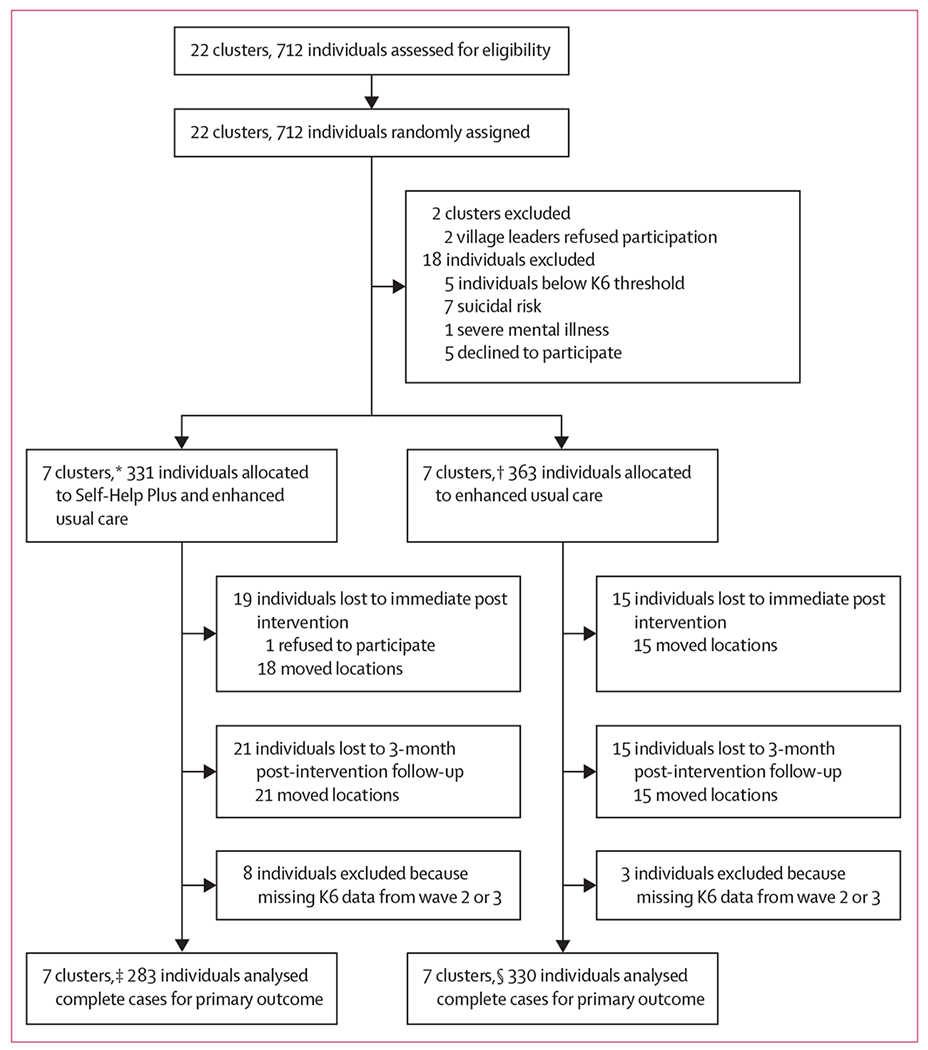
BACKGROUND: Innovative solutions are required to provide mental health support at scale in low-resource humanitarian contexts. We aimed to assess the effectiveness of a facilitator-guided, group-based, self-help intervention (Self-Help Plus) to reduce psychological distress in female refugees. METHODS: We did a cluster randomised trial in rural refugee settlements in northern Uganda. Participants were female South Sudanese refugees with at least moderate levels of psychological distress (cutoff ≥5 on the Kessler 6). The intervention comprised access to usual care and five 2-h audio-recorded stress-management workshops (20-30 refugees) led by briefly trained lay facilitators, accompanied by an illustrated self-help book. Villages were randomly assigned to either intervention (Self-Help Plus or enhanced usual care) on a 1:1 basis. Within 14 villages, randomly selected households were approached. Screening of women in households continued until 20-30 eligible participants were identified per site. The primary outcome was individual psychological distress, assessed using the Kessler 6 symptom checklist 1 week before, 1 week after, and 3 months after intervention, in the intention-to-treat population. All outcomes were measured at the individual (rather than cluster) level. Secondary outcomes included personally identified problems, post-traumatic stress, depression symptoms, feelings of anger, social interactions with other ethnic groups, functional impairment, and subjective wellbeing. Assessors were masked to allocation. This trial was prospectively registered at ISRCTN, number 50148022. FINDINGS: Of 694 eligible participants (331 Self-Help Plus, 363 enhanced usual care), 613 (88%) completed all assessments. Compared with controls, we found stronger improvements for Self-Help Plus on psychological distress 3 months post intervention (β -1·20, 95% CI -2·33 to -0·08; p=0·04; d -0·26). We also found larger improvements for Self-Help Plus 3 months post-intervention for five of eight secondary outcomes (effect size range -0·30 to -0·36). Refugees with different trauma exposure, length of time in settlements, and initial psychological distress benefited similarly. With regard to safety considerations, the independent data safety management board responded to six adverse events, and none were evaluated to be concerns in response to the intervention. INTERPRETATION: Self-Help Plus is an innovative, facilitator-guided, group-based self-help intervention that can be rapidly deployed to large numbers of participants, and resulted in meaningful reductions in psychological distress at 3 months among South Sudanese female refugees. FUNDING: Research for Health in Humanitarian Crises (R2HC) Programme.
Overview
CoChat Summary
TL;DR
In a cluster randomised trial among South Sudanese female refugees in Uganda, facilitator-guided group self-help (Self-Help Plus) plus enhanced usual care reduced psychological distress more than enhanced usual care alone at 3 months. The intervention also improved several secondary outcomes, with effects not moderated by trauma exposure, length of stay, or baseline distress.
Key findings
- Among 694 eligible participants (331 Self-Help Plus, 363 enhanced usual care), 613 (88%) completed all assessments; Self-Help Plus led to greater 3-month reductions in psychological distress on the Kessler 6 (β -1·20, 95% CI -2·33 to -0·08; p=0·04; d -0·26).
- Immediately after intervention, the psychological distress effect was larger (β -3·25, 95% CI -4·31 to -2·19; p<0·0001; d -0·72).
- At 3 months, Self-Help Plus showed larger improvements for five of eight secondary outcomes, with effect sizes ranging from -0·30 to -0·36, including post-traumatic stress, depression symptoms, explosive anger, functional impairment, and subjective wellbeing.
- The independent data safety management board responded to six adverse events, and none were evaluated to be concerns in response to the intervention.
Methods
- Single-blind, parallel-group cluster randomised trial in 14 villages in Rhino Camp settlement, northwestern Uganda; villages were allocated 1:1 to Self-Help Plus plus enhanced usual care or enhanced usual care alone.
- Participants were female South Sudanese refugees with at least moderate psychological distress (Kessler 6 cutoff ≥5); the intervention comprised five 2-h audio-recorded stress-management workshops (20–30 refugees) led by briefly trained lay facilitators, plus an illustrated self-help book.
- Outcomes were measured at the individual level; primary outcome was Kessler 6 psychological distress at 1 week before, 1 week after, and 3 months after intervention, analysed in the intention-to-treat population using linear mixed-effects models with village as a random effect.
Limitations
- The authors state follow-up was only 3 months, so long-term benefits are unknown; the psychological distress measure had lower-than-acceptable internal consistency (Cronbach α=0·65); frequency of contact with service providers was not controlled between study conditions; only a limited number of clusters were randomised, so unmeasured cluster differences are possible; and the study focused on female refugees, limiting generalisability.
- The authors also note that it remains unclear why effect sizes reduce over time and that mechanisms of change were not tested.
- Evident from the text: the 3-month effects were smaller than immediate post-treatment effects (e.g., K6 d -0·72 immediately vs -0·26 at 3 months), and the trial did not include male refugees, so male mental health needs are not addressed.
Model-written summary. Check it against the paper before relying on it.
Integrity signals
Registry
Cites
Statistics
Figures
Verification
Claims the paper makes
13 Valid · 1 Not valid · 7 Not checked · 54 Own results and interpretations
The cited sources support only part of this claim — read each source’s verdict below.
In the paper
“Current evidence-based treatments generally require a substantial clinical workforce not typically available in disrupted, under-resourced health systems. 4”
What the sources say
- Partly supportedcites [4] 4 Tol WA, Barbui C, Bisson J, et al. World Health Organization guidelines for management of acute stress, PTSD, and bereavement: key challenges on the road ahead. PLoS Med 2014; 11: e1001769. sourceExperimental — accuracy not yet measured
In “What Are the Key Obstacles on the Road Ahead?”, the paper identifies personnel shortages in low-resource and humanitarian settings, including too few specialists to train and supervise delivery of recommended psychotherapies. But it does not say evidence-based treatments generally require a substantial clinical workforce; it also reports that non-specialists can deliver psychotherapeutic interventions. (LLM, conf=0.82)
plain- Asserted: passes — The authors put it forward as true.
- Checkable: passes — It can be checked against evidence.
- Load-bearing: passes — The paper’s conclusions depend on it.
- Based: passes — The paper gives a reason why it holds.
- Partly supported
Every source the paper cites for this claim was checked and supports it.
In the paper
“Initial piloting with one group of male and female refugees each identified challenges with engagement and participation of male refugees. 22”
What the sources say
- Supportedcites [22] 22 Tol WA, Augustinavicius J, Carswell K, et al. Translation, adaptation, and pilot of a guided self-help intervention to reduce psychological distress in South Sudanese refugees in Uganda. Glob Ment Health 2018; 5: e25. source
The Methods (Phase 3: Pilot implementation) describe recruiting one female and one male refugee group. The Results (Phases 3 and 4) report lower attendance among men and describe male participants who did not engage with the program. (LLM, conf=0.94)
plain- Asserted: passes — The authors put it forward as true.
- Checkable: passes — It can be checked against evidence.
- Load-bearing: passes — The paper’s conclusions depend on it.
- Based: passes — The paper gives a reason why it holds.
- Supported
Every source the paper cites for this claim was checked and supports it.
In the paper
“Self-Help Plus was deemed a good fit for this setting after an initial needs assessment indicated the ubiquity of overthinking, 32 a local idiom of psychological distress and an explicit target of ACT.”
What the sources say
- Supportedcites [32] 32 Adaku A, Okello J, Lowry B, et al. Mental health and psychosocial support for South Sudanese refugees in northern Uganda: a needs and resource assessment. Confl Health 2016; 10: 18. source
The Results and discussion (Semi-structured interviews and focus group discussions; page unavailable) say overthinking was the second most common general concern raised by participants and one of their most important mental health and psychosocial concerns. The paper also describes it as an idiom of distress. The citation follows the assessment finding; the statement about Self-Help Plus and ACT is the citing authors’ framing, not a finding attributed to this source. (LLM, conf=0.87)
plain- Asserted: passes — The authors put it forward as true.
- Checkable: passes — It can be checked against evidence.
- Load-bearing: passes — The paper’s conclusions depend on it.
- Based: passes — The paper gives a reason why it holds.
- Supported
The cited sources support only part of this claim — read each source’s verdict below.
In the paper
“A Cochrane review of psychological treatments-mostly consisting of relatively higher resource-intensive interventions-in humanitarian settings in low-income and middle-income countries found a drop in effect size for post-traumatic stress disorder symptoms from -1·07 immediately after treat ment (16 studies), to -0·49 at 1-3 months after intervention (18 studies), and -0·37 at 6 months”
What the sources say
- Partly supportedcites [3] 3 Purgato M, Gastaldon C, Papola D, van Ommeren M, Barbui C, Tol WA. Psychological therapies for the treatment of mental disorders in low- and middle-income countries affected by humanitarian crises. Cochrane Database Syst Rev 2018; 7: CD011849. sourceExperimental — accuracy not yet measured
Section 1.1, “PTSD symptoms,” reports the stated effect sizes and study counts for adults and describes a declining effect over follow-up. Its follow-up windows are one to four months, not one to three months, and six months or later, not precisely six months. The passages do not establish the citing sentence’s description of the interventions as mostly relatively resource-intensive. (LLM, conf=0.88)
plainstates an association- Asserted: passes — The authors put it forward as true.
- Checkable: passes — It can be checked against evidence.
- Load-bearing: passes — The paper’s conclusions depend on it.
- Based: passes — The paper gives a reason why it holds.
- Partly supported
A result the paper reports from its own data — it cites no other source for it, so there is none to check. The quote shows it is in the paper.
In the paper
“Compared with controls, we found stronger improvements for Self-Help Plus on psychological distress 3 months post intervention (β -1·20, 95% CI -2·33 to -0·08; p=0·04; d -0·26).”
- Also stated in: § Added value of this study · p. 2 · plain
“Compared with controls, Self-Help Plus was associated with higher levels of improvements on psychological distress, functioning, and wellbeing outcomes 3 months after the intervention.”
plainstates a causen = 694 ·- Asserted: passes — The authors put it forward as true.
- Checkable: passes — It can be checked against evidence.
- Load-bearing: passes — The paper’s conclusions depend on it.
- Based: passes — The paper gives a reason why it holds.
- Also stated in: § Added value of this study · p. 2 · plain
20 more claims
Create a free account to see all 75 claims and to verify the 2 references still open.
- Probably not a substantial claim. 32
- It may state two separate claims as one. 31
Claims other papers make about this one
Each is checked against this paper’s own text: does it say what the citing paper says it does?
The source backs part of the claim, not all of it — or backs it for a different population, condition or comparison.
In the citing paper
“but with evidence also suggesting that a significant number (39%) do not respond to the intervention,12”
From Evaluating a stepped care model of psychological support for adults affected by adversity: study protocol for a randomised controlled trial in Jordan (2024) · cites this paper as [12]
Experimental — accuracy not yet measuredThe source backs part of the claim, not all of it — or backs it for a different population, condition or comparison.
In the citing paper
“Additionally, traditional psychotherapy interventions generally require a substantial clinical workforce, such as mental health specialists and specialist facilities, which are especially not available in developing countries (12).”
From Translation, adaptation, and initial evaluation of a guided self-help intervention to reduce psychological distress among nurses during COVID-19 in China (2023) · cites this paper as [12]
Experimental — accuracy not yet measuredThe source backs part of the claim, not all of it — or backs it for a different population, condition or comparison.
In the citing paper
“The SH+ app has been tested in a large randomized trial with almost 700 South Sudanese refugee women. After three months of the intervention, participants reported a significant reduction in psychological distress as well as improvements in functioning and wellbeing (Tol et al., 2020).”
From Identifying resilience-promoting factors for refugee survivors of torture (2022) · cites this paper as Tol et al., 2020
Experimental — accuracy not yet measuredThe source backs part of the claim, not all of it — or backs it for a different population, condition or comparison.
In the citing paper
“Recently, the World Health Organisation has developed an intervention app for refugee mental health named Self-Help Plus (SH+) which targets increasing psychological flexibility through mindfulness exercises (Tol et al., 2020).”
From Identifying resilience-promoting factors for refugee survivors of torture (2022) · cites this paper as Tol et al., 2020
Experimental — accuracy not yet measuredThe source backs part of the claim, not all of it — or backs it for a different population, condition or comparison.
In the citing paper
“Public health ACT-based interventions designed to strengthen psychological flexibility have been shown to promote mental health in a variety of populations using flexible modes of delivery in various contexts”
From Health Anxiety and Mental Health Outcome During COVID-19 Lockdown in Italy: The Mediating and Moderating Roles of Psychological Flexibility (2020) · cites this paper as Tol et al., 2020
Experimental — accuracy not yet measured
6 more claims about this paper
Create a free account to see every claim other papers make about this one.
Self-check
Percentages, sums and reported differences re-computed from the paper’s own numbers.
Each contradiction between two passages listed here was confirmed by an independent check.
Rated minor: it would not touch a result — a value no result rests on, a p-value that stays on the same side of the significance level, or a conflict that is clerical, resolved elsewhere in the paper, or outside its own findings.
In the paper
§ Outcomes · p. 5
“The 12-item version of the WHODAS, which uses a five-point scale (range 12-60; α=0·78).”
§ Results · p. 7
“WHODAS 2.0 (0-48)”
Rated minor: it would not touch a result — a value no result rests on, a p-value that stays on the same side of the significance level, or a conflict that is clerical, resolved elsewhere in the paper, or outside its own findings.
In the paper
§ Outcomes · p. 5
“scored on a four-point scale [range zero to 12]; α=0·74”
§ Results · p. 7
“Interethnic relationship score (3-12)”
Rated minor: it would not touch a result — a value no result rests on, a p-value that stays on the same side of the significance level, or a conflict that is clerical, resolved elsewhere in the paper, or outside its own findings.
In the paper
§ Results · p. 6
“Study conditions were largely similar with regard to sociodemographics and baseline scores on outcomes, with the exception of ethnicity and length of time in refugee settlement.”
§ Discussion · p. 8
“Although we did not identify differences between study conditions at baseline, it is possible that clusters differed on unmeasured variables.”
Rated minor: it would not touch a result — a value no result rests on, a p-value that stays on the same side of the significance level, or a conflict that is clerical, resolved elsewhere in the paper, or outside its own findings.
In the paper
§ Outcomes · p. 5
“rate problem severity on a six-point scale (range zero to 18; α=0·65).”
§ Results · p. 7
“PSYCHLOPS score (0-20)”
Citations
Cites
The WHO-5 well-being index: A systematic review of the literature
Topp, C. W., Østergaard, S. D., Søndergaard, S., & Bech, P. (2015) · Psychotherapy and Psychosomatics · doi:10.1159/000376585 · Cited by 4,708
Norman, G. R., Sloan, J. A., & Wyrwich, K. W. (2003) · Medical Care · doi:10.1097/01.mlr.0000062554.74615.4c · Cited by 4,700
Bond, F. W., Hayes, S. C., Baer, R. A., Carpenter, K. M., Guenole, N., Orcutt, H. K., Waltz, T., & Zettle, R. D. (2011) · Behavior Therapy · doi:10.1016/j.beth.2011.03.007 · Cited by 3,950
Garnefski, N., Kraaij, V., Schroevers, M. J., & Somsen, G. A. (2008) · Journal of Clinical Psychology in Medical Settings · doi:10.1007/s10880-008-9136-5 · Cited by 2,479
Charlson, F., van Ommeren, M., Flaxman, A., Cornett, J., Whiteford, H., & Saxena, S. (2019) · The Lancet · doi:10.1016/s0140-6736(19)30934-1 · Cited by 1,702
(2010) · Virtual Defense Library (Ministerio de Defensa) · Cited by 1,530
Kessler, R. C., Green, J. G., Gruber, M. J., Sampson, N. A., Bromet, E., Cuitan, M., Furukawa, T. A., Gureje, O., Hinkov, H., Hu, C., et al. (2010) · International Journal of Methods in Psychiatric Research · doi:10.1002/mpr.310 · Cited by 1,434
Prochaska, J. J., Sung, H., Max, W., Shi, Y., & Ong, M. (2012) · International Journal of Methods in Psychiatric Research · doi:10.1002/mpr.1349 · Cited by 942 · cited 2×
“34 We applied the standard cutoff for moderate levels of psychological distress (≥5) 14 with internal consistency (Cronbach α) of 0·65.”
BackgroundMethodCuijpers, P., Donker, T., van Straten, A., Li, J., & Andersson, G. (2010) · Psychological Medicine · doi:10.1017/s0033291710000772 · Cited by 832
Hayes, S. C., Villatte, M., Levin, M., & Hildebrandt, M. (2011) · Annual Review of Clinical Psychology · doi:10.1146/annurev-clinpsy-032210-104449 · Cited by 800 · cited 1×
“25 Self-Help Plus incorporates many of these factors, with a strong focus on mindful practices and grounding, values clarification, and compassion (being kind to self and others), with the latter also encouraging a social support element through the practice of acts of kindness towards others…”
Background
Cited by
Time for united action on depression: a Lancet–World Psychiatric Association Commission
Herrman, H., Patel, V., Kieling, C., Berk, M., Buchweitz, C., Cuijpers, P., Furukawa, T. A., Kessler, R. C., Kohrt, B. A., Maj, M., et al. (2022) · The Lancet · doi:10.1016/s0140-6736(21)02141-3 · Cited by 1,104
Søvold, L. E., Naslund, J. A., Kousoulis, A. A., Saxena, S., Qoronfleh, M. W., Grobler, C., & Münter, L. (2021) · Frontiers in Public Health · doi:10.3389/fpubh.2021.679397 · Cited by 973
A systematic review and meta-analysis of psychological interventions to improve mental wellbeing
van Agteren, J., Iasiello, M., Lo, L., Bartholomaeus, J., Kopsaftis, Z., Carey, M., & Kyrios, M. (2021) · Nature Human Behaviour · doi:10.1038/s41562-021-01093-w · Cited by 510
Oram, S., Fisher, H. L., Minnis, H., Seedat, S., Walby, S., Hegarty, K., Rouf, K., Angénieux, C., Callard, F., Chandra, P. S., et al. (2022) · The Lancet Psychiatry · doi:10.1016/s2215-0366(22)00008-6 · Cited by 331
Hayes, S. C., Ciarrochi, J., Hofmann, S. G., Chin, F., & Sahdra, B. (2022) · Behaviour Research and Therapy · doi:10.1016/j.brat.2022.104155 · Cited by 234
Pakenham, K. I., Landi, G., Boccolini, G., Furlani, A., Grandi, S., & Tossani, E. (2020) · Journal of Contextual Behavioral Science · doi:10.1016/j.jcbs.2020.07.003 · Cited by 210
“For example, an ACT-based self-help program effectively reduced psychological distress among war refugees (Tol et al., 2020).”
van Ginneken, N., Chin, W. Y., Lim, Y. C., Ussif, A., Singh, R., Shahmalak, U., Purgato, M., Rojas-García, A., Uphoff, E., McMullen, S., et al. (2021) · Cochrane Database of Systematic Reviews · doi:10.1002/14651858.cd009149.pub3 · Cited by 188
Landi, G., Pakenham, K. I., Boccolini, G., Grandi, S., & Tossani, E. (2020) · Frontiers in Psychology · doi:10.3389/fpsyg.2020.02195 · Cited by 146
Arundell, L.-L., Barnett, P., Buckman, J. E. J., Saunders, R., & Pilling, S. (2021) · Clinical Psychology Review · doi:10.1016/j.cpr.2021.102063 · Cited by 134
Purgato, M., Carswell, K., Tedeschi, F., Acarturk, C., Anttila, M., Au, T., Bajbouj, M., Baumgartner, J., Biondi, M., Churchill, R., et al. (2021) · Psychotherapy and Psychosomatics · doi:10.1159/000517504 · Cited by 132
Self-citationAcarturk, C., Uygun, E., Ilkkursun, Z., Carswell, K., Tedeschi, F., Batu, M., Eskici, S., Kurt, G., Anttila, M., Au, T., et al. (2022) · World Psychiatry · doi:10.1002/wps.20939 · Cited by 119
Self-citationThe Dynamics of Fear at the Time of Covid-19: A Contextual Behavioral Science Perspective.
(2020) · PubMed Central · doi:10.36131/cn20200206 · Cited by 115
“The World health organization has found that a self-help program based on acceptance and commitment Therapy (acT; hayes et al., 2012) that fostered psychological flexibility reduced psychological distress among displaced war refugees (Tol et al., 2020).”
BackgroundKeynejad, R. C., Hanlon, C., & Howard, L. M. (2020) · The Lancet Psychiatry · doi:10.1016/s2215-0366(19)30510-3 · Cited by 114
Purgato, M., Uphoff, E., Singh, R., Thapa Pachya, A., Abdulmalik, J., & van Ginneken, N. (2020) · Epidemiology and Psychiatric Sciences · doi:10.1017/s204579602000061x · Cited by 94
Global priorities for climate change and mental health research
Charlson, F., Ali, S., Augustinavicius, J., Benmarhnia, T., Birch, S., Clayton, S., Fielding, K., Jones, L., Juma, D., Snider, L., et al. (2022) · Environment International · doi:10.1016/j.envint.2021.106984 · Cited by 103
Self-citationYang, L., Yin, J., Wang, D., Rahman, A., & Li, X. (2021) · Psychological Medicine · doi:10.1017/s0033291720001385 · Cited by 85
“Evidence has shown that guided SH+ can be rapidly implemented and achieved meaningful improvement in psychological distress, posttraumatic stress disorders (PTSD) and depression symptoms among south Sudanese female refugees (Tol et al., 2020).”
BackgroundPapola, D., Purgato, M., Gastaldon, C., Bovo, C., van Ommeren, M., Barbui, C., & Tol, W. A. (2020) · Cochrane Database of Systematic Reviews · doi:10.1002/14651858.cd012417.pub2 · Cited by 85
“Tol 2020 {published data only} Tol WA, Leku MR, Lakin DP, Carswell K, Augustinavicius J, Adaku A, et al. Guided self-help to reduce psychological distress in South Sudanese female refugees in Uganda: a cluster randomised trial.”
BackgroundSelf-citationKim, J., Aryee, L. M. D., Bang, H., Prajogo, S., Choi, Y. K., Hoch, J. S., & Prado, E. L. (2023) · JMIR Mental Health · doi:10.2196/43066 · Cited by 106
“More information about the included studies is available in Multimedia Appendix 6 [26-121].”
BackgroundInfluentialPosttraumatic Stress Disorder in Refugees
Bryant, R. A., Nickerson, A., Morina, N., & Liddell, B. J. (2023) · Annual Review of Clinical Psychology · doi:10.1146/annurev-clinpsy-080921-080359 · Cited by 105
Self-citationTol, W. A., Ager, A., Bizouerne, C., Bryant, R. A., Chammay, R. E., Colebunders, R., Garcia‐Moreno, C., Hamdani, S. U., James, L. E., Jansen, S., et al. (2020) · Conflict and Health · doi:10.1186/s13031-020-00317-6 · Cited by 81
Self-citationMiller, K. E., Jordans, M. J. D., Tol, W. A., & Galappatti, A. (2021) · Epidemiology and Psychiatric Sciences · doi:10.1017/s2045796020001110 · Cited by 61
“, 2013), and ‘low-intensity psychological interventions’ are increasingly being developed for non-specialist delivery (de Graaf et al., 2020; Tol et al., 2020).”
Self-citationA network meta-analysis of psychosocial interventions for refugees and asylum seekers with PTSD
Turrini, G., Tedeschi, F., Cuijpers, P. J., Giovane, C. D., Kip, A., Morina, N., Nosè, M., Ostuzzi, G., Purgato, M., Ricciardi, C., et al. (2021) · BMJ Global Health · doi:10.1136/bmjgh-2021-005029 · Cited by 76
Self-citationAizik-Reebs, A., Yuval, K., Hadash, Y., Gebremariam, S. G., & Bernstein, A. (2021) · Clinical Psychological Science · doi:10.1177/2167702621998641 · Cited by 68
Riello, M., Purgato, M., Bove, C., Tedeschi, F., MacTaggart, D., Barbui, C., & Rusconi, E. (2021) · Royal Society Open Science · doi:10.1098/rsos.210219 · Cited by 42
“The present findings would suggest that the positive effects of the SH+ observed in previous trials [18,63,64], that did not employ a control condition with similar quality and quantity of interactions and stimulation given to participants, might be related to non-specific factors.”
InfluentialFine, S. L., Malik, A., Guimond, M.-F., Nemiro, A., Temu, G., Likindikoki, S. L., Annan, J. R., & Tol, W. A. (2021) · Behaviour Research and Therapy · doi:10.1016/j.brat.2021.103944 · Cited by 50
Self-citationBöge, K., Karnouk, C., Hoell, A., Tschorn, M., Kamp‐Becker, I., Padberg, F., Übleis, A., Hasan, A., Falkai, P., Salize, H. J., et al. (2022) · The Lancet Regional Health - Europe · doi:10.1016/j.lanepe.2022.100413 · Cited by 49
Dixon, M. R., Hayes, S. C., Stanley, C., Law, S., & al-Nasser, T. (2020) · The Psychological Record · doi:10.1007/s40732-020-00436-9 · Cited by 42
“A recent large trial done by the World Health Organization with South Sudanese refugees in Uganda successfully delivered ACT using a cartoon book and an audiotape (Tol et al., 2020).”
BackgroundHuang, L., Kern, M. L., & Oades, L. G. (2020) · International Journal of Environmental Research and Public Health · doi:10.3390/ijerph17155538 · Cited by 61
“Taking advantage of online technologies, a growing number of programs offer self-help interventions [29].”
BackgroundEl-Haj-Mohamad, R., Nohr, L., Niemeyer, H., Böttche, M., & Knaevelsrud, C. (2023) · Cambridge Prisms Global Mental Health · doi:10.1017/gmh.2022.61 · Cited by 40
“The above-mentioned scalable interventions of the WHO Step-by-Step and Problem Management Plus might offer further possibilities to combine smartphone-delivered interventions with already existing effective and scalable group interventions (e.g., Tol et al., 2020; Acarturk et al., 2022).”
Hayes, S. C., Hofmann, S. G., & Stanton, C. E. (2020) · Journal of Contextual Behavioral Science · doi:10.1016/j.jcbs.2020.08.009 · Cited by 39
Arnold, T., Haubrick, K. K., Klasko-Foster, L. B., Rogers, B. G., Barnett, A., Ramirez- Sanchez, N. A., Bertone, Z., & Gaudiano, B. A. (2022) · Journal of Contextual Behavioral Science · doi:10.1016/j.jcbs.2022.05.005 · Cited by 37
Hayes, S. C., Hofmann, S. G., & Ciarrochi, J. (2023) · Behavior Therapy · doi:10.1016/j.beth.2023.07.011 · Cited by 37
Scaling up and scaling out: Consilience and the evolution of more nurturing societies
Biglan, A., Johansson, M., Ryzin, M. J. V., & Embry, D. D. (2020) · Clinical Psychology Review · doi:10.1016/j.cpr.2020.101893 · Cited by 51
“Based on similar theoretical underpinnings, self-help has been used to reduce psychological distress in Uganda (Tol et al., 2020).”
Nickerson, A., Hoffman, J., Keegan, D., Kashyap, S., Argadianti, R., Tricesaria, D., Pestalozzi, Z., Nandyatama, R., Khakbaz, M., Nilasari, N., et al. (2023) · Journal of Anxiety Disorders · doi:10.1016/j.janxdis.2023.102672 · Cited by 33
Peng‐Keller, S., Winiger, F., & Rauch, R. (2022) · doi:10.1093/oso/9780192865502.001.0001 · Cited by 62
Mediavilla, R., Monistrol-Mula, A., McGreevy, K. R., Félez-Nóbrega, M., Delaire, A., Nicaise, P., Palomo-Conti, S., Bayón, C., Bravo‐Ortiz, M. F., Vega, B. R., et al. (2022) · Frontiers in Public Health · doi:10.3389/fpubh.2022.956403 · Cited by 30
Self-citationSelf-Help Plus for refugees and asylum seekers: an individual participant data meta-analysis
Karyotaki, E., Sijbrandij, M., Purgato, M., Acarturk, C., Lakin, D., Bailey, D., Peckham, E., Uygun, E., Tedeschi, F., Wancata, J., et al. (2023) · BMJ Mental Health · doi:10.1136/bmjment-2023-300672 · Cited by 30
Self-citationNöthling, J., Abrahams, N., Jewkes, R., Mhlongo, S., Lombard, C., Hemmings, S. M. J., & Seedat, S. (2022) · Journal of Affective Disorders · doi:10.1016/j.jad.2022.04.032 · Cited by 28
Mediavilla, R., McGreevy, K. R., Félez-Nóbrega, M., Monistrol-Mula, A., Bravo‐Ortiz, M. F., Bayón, C., Vega, B. R., Nicaise, P., Delaire, A., Sijbrandij, M., et al. (2022) · Digital Health · doi:10.1177/20552076221129084 · Cited by 31
“It has also been used to reduce psychological distress in South Sudanese female refugees in Uganda (28).”
MethodSelf-citationVertsberger, D., Naor, N., & Winsberg, M. E. (2022) · JMIR AI · doi:10.2196/38171 · Cited by 37
“For example, an intervention based on Acceptance and Commitment Therapy (ACT), which focuses on cognitive diffusion, psychological flexibility, mindfulness, and values clarification, was found to be associated with greater well-being posttreatment, as well as at the 3-month follow-up, compared to the control group who…”
MethodPurgato, M., Prina, E., Ceccarelli, C., Cadorin, C., Abdulmalik, J. O., Amaddeo, F., Arcari, L., Churchill, R., Jordans, M. J., Lund, C., et al. (2023) · Cochrane Database of Systematic Reviews · doi:10.1002/14651858.cd014722.pub2 · Cited by 27
Self-citationSim, A. L., Puffer, E. S., Ahmad, A., Hammad, L., & Georgiades, K. (2023) · BMC Public Health · doi:10.1186/s12889-023-15300-y · Cited by 41
“The Kessler Psychological Distress Scale (K-6) is a six-item measure of psychological distress widely used to screen for depression and anxiety [33], including among refugee populations [34].”
BackgroundPrudenzi, A., Graham, C. D., Rogerson, O., & O’Connor, D. B. (2023) · Psychology & Health · doi:10.1080/08870446.2021.2020272 · Cited by 27
“Recent studies have shown that at times of great difficulty, such as wars (Tol et al., 2020), school shootings, devastating storms, or violent crime (e.g. Brockman et al., 2016; Gold & Marx 2007; Kumpula et al., 2011), higher psychological flexibility can help people function effectively even when…”
BackgroundCost-effectiveness of the Self-Help Plus Intervention for Adult Syrian Refugees Hosted in Turkey
Park, A., Waldmann, T., Kösters, M., Tedeschi, F., Nosè, M., Ostuzzi, G., Purgato, M., Turrini, G., Valimaki, M. A., Lantta, T., et al. (2022) · JAMA Network Open · doi:10.1001/jamanetworkopen.2022.11489 · Cited by 32
Self-citationMahon, D. (2022) · Trauma Care · doi:10.3390/traumacare2010005 · Cited by 26
Acartürk, C., Kurt, G., İlkkurşun, Z., de Graaff, A. M., Bryant, R. A., Cuijpers, P. J., Fuhr, D. C., McDaid, D., Park, A. L., Sijbrandij, M., et al. (2024) · Epidemiology and Psychiatric Sciences · doi:10.1017/s2045796024000453 · Cited by 43
Self-citationTeshome, A. A., Abebe, E. C., Mengstie, M. A., Seid, M. A., Yitbarek, G. Y., Molla, Y. M., Baye, N. D., Yazie, T. S., Ayehu, G. W., & Taye, M. (2023) · Frontiers in Psychiatry · doi:10.3389/fpsyt.2023.1083138 · Cited by 34
Turrini, G., Purgato, M., Cadorin, C., Bartucz, M. B., Cristofalo, D., Gastaldon, C., Nosè, M., Ostuzzi, G., Papola, D., Prina, E., et al. (2024) · The Lancet Regional Health - Europe · doi:10.1016/j.lanepe.2024.101152 · Cited by 39
Challenges to mental health services for refugees: a global perspective
Silove, D. M. (2021) · World Psychiatry · doi:10.1002/wps.20818 · Cited by 27
Schäfer, S. K., Kunzler, A. M., Lindner, S., Broll, J., Stoll, M., Stoffers‐Winterling, J., & Lieb, K. (2023) · European Journal of Psychotraumatology · doi:10.1080/20008066.2023.2196762 · Cited by 24
Purgato, M., Tedeschi, F., Turrini, G., Cadorin, C., Compri, B., Muriago, G., Ostuzzi, G., Pinucci, I., Prina, E., Serra, R., et al. (2025) · World Psychiatry · doi:10.1002/wps.21281 · Cited by 30
Self-citationPurgato, M., Abdulmalik, J. O., Prina, E., Ceccarelli, C., Tol, W. A., van Ginneken, N., Uphoff, E., Papola, D., Amaddeo, F., Churchill, R. C., et al. (2021) · Cochrane Database of Systematic Reviews · doi:10.1002/14651858.cd014722 · Cited by 22
Self-citationPurgato, M., Turrini, G., Tedeschi, F., Serra, R., Tarsitani, L., Compri, B., Muriago, G., Cadorin, C., Ostuzzi, G., Nicaise, P., et al. (2023) · Frontiers in Public Health · doi:10.3389/fpubh.2023.1100546 · Cited by 20
Self-citationScalable interventions for refugees
Bryant, R. A. (2023) · Cambridge Prisms Global Mental Health · doi:10.1017/gmh.2022.59 · Cited by 30
Self-citationKasujja, R., Bangirana, P., Chiumento, A., Hasan, M. T., Jansen, S., Kagabo, D. M., Popa, M., Ventevogel, P., & White, R. G. (2022) · Conflict and Health · doi:10.1186/s13031-022-00447-z · Cited by 25
Self-citationFine, S. L., Kane, J. C., Spiegel, P. B., Tol, W. A., & Ventevogel, P. (2022) · BMC Medicine · doi:10.1186/s12916-022-02371-8 · Cited by 20
Self-citationSingh, A., Nemiro, A., Malik, A., Guimond, M.-F., Nduwimana, E., Likindikoki, S. L., Annan, J. R., & Tol, W. A. (2021) · Conflict and Health · doi:10.1186/s13031-021-00391-4 · Cited by 22
Self-citationContext, coping, and mental health in refugees living in protracted displacement
Nickerson, A., Hoffman, J., Keegan, D., Kashyap, S., Tricesaria, D., Pestalozzi, Z., Rachmah, R. A., Nandyatama, R. W., Khakbaz, M., Nilasari, N., et al. (2022) · Journal of Traumatic Stress · doi:10.1002/jts.22885 · Cited by 25
White, R. G., & van der Boor, C. (2021) · Epidemiology and Psychiatric Sciences · doi:10.1017/s2045796021000263 · Cited by 22
Self-citationMolendijk, M. L., Baart, C., Schaffeld, J., Akçakaya, Z., Rönnau, C., Kooistra, M. J., de Kleine, R. A., Strater, C., & Mooshammer, L. (2024) · Clinical Psychology & Psychotherapy · doi:10.1002/cpp.3042 · Cited by 28
Lorenzo‐Luaces, L., & Howard, J. (2023) · Journal of Medical Internet Research · doi:10.2196/45411 · Cited by 24
“Prior work supports the reliability and validity of the WHO-5 [39], and it has previously been studied XSL • FO RenderX as an outcome measure in CBT self-help studies [40].”
Lakin, D. P., García-Moreno, C., & Roesch, E. (2022) · International Journal of Environmental Research and Public Health · doi:10.3390/ijerph19052916 · Cited by 18
“An RCT of female former child soldiers in the DRC demonstrated the efficacy of a group version of NET in reducing PTS, depression symptoms, and aggressive behaviors in the midst of ongoing conflict [76].”
BackgroundInfluentialSelf-citationPsychological flexibility and fear of recurrence in prostate cancer
Sevier‐Guy, L., Ferreira, N. B., Somerville, C. L., & Gillanders, D. T. (2021) · European Journal of Cancer Care · doi:10.1111/ecc.13483 · Cited by 32
Giebel, C. M., Zuluaga, M. I., Ruíz, G. J. S., White, R. G., Reilly, S., Montoya, E., Allen, D., Liu, G., Castaño-Pineda, Y., & Gabbay, M. (2022) · BMC Health Services Research · doi:10.1186/s12913-022-07645-8 · Cited by 19
“The intervention will be based on existing guidelines for psychosocial interventions, such as Self-help Plus [20] or World Health Organisation’s Mental Health Gap Action programme (mhGAP) Intervention Guide [13].”
MethodSelf-citationTurrini, G., Purgato, M., Tedeschi, F., Acartürk, C., Anttila, M., Au, T. M., Carswell, K., Churchill, R. C., Cuijpers, P. J., Friedrich, F., et al. (2022) · Epidemiology and Psychiatric Sciences · doi:10.1017/s2045796022000269 · Cited by 20
“SH + has been shown to be feasible and acceptable with refugees in Uganda (Tol et al., 2020), with positive findings indicating short-term improvements in psychological distress.”
BackgroundSelf-citationBaluku, M. M., Nansubuga, F., Musanje, K., Nantamu, S., & Otto, K. (2023) · Current Research in Ecological and Social Psychology · doi:10.1016/j.cresp.2023.100148 · Cited by 20
Pedersen, G. A., Sangraula, M., Shrestha, P., Lakshmin, P., Schafer, A., Ghimire, R., Luitel, N. P., Jordans, M. J. D., & Kohrt, B. A. (2021) · Journal on Education in Emergencies · doi:10.33682/u4t0-acde · Cited by 25
“Self-Help Plus, designed based on acceptance and commitment therapy principles for people with high levels of stress and psychological distress, particularly those living in humanitarian settings (Brown et al. 2018; Epping-Jordan et al. 2016; Tol et al. 2018; Tol et al. 2020).”
BackgroundLorenzo‐Luaces, L., Howard, J., Jesús-Romero, R. D., Peipert, A., Buss, J., Lind, C. M., Botts, K., & Starvaggi, I. (2022) · Cognitive Therapy and Research · doi:10.1007/s10608-022-10338-5 · Cited by 17
“The formative work by the WHO regarding DWM also saw difficulty with recruiting men (Tol et al., 2020).”
BackgroundMethodInfluentialAugustinavicius, J., Purgato, M., Tedeschi, F., Musci, R. J., Leku, M. R., Carswell, K., Lakin, D. P., van Ommeren, M., Cuijpers, P. J., Sijbrandij, M., et al. (2023) · BMJ Open · doi:10.1136/bmjopen-2020-048043 · Cited by 18
Self-citationMewes, R., Giesebrecht, J., Weise, C., & Grupp, F. (2021) · Clinical Psychology in Europe · doi:10.32872/cpe.4577 · Cited by 18
Dawson, A. J., Tappis, H., & Tran, N. T. (2022) · BMC Health Services Research · doi:10.1186/s12913-022-07916-4 · Cited by 21
“Self‑care for gender‑based violence, contraception, and abortion We identified one study concerned with self-care in the context of GBV [43].”
BackgroundInfluentialHoehne, E., Böge, K., Karnouk, C., Tschorn, M., Banaschewski, T., Hoell, A., Sukale, T., Plener, P. L., Schneider, F. W., Padberg, F., et al. (2023) · European Child & Adolescent Psychiatry · doi:10.1007/s00787-023-02179-8 · Cited by 19
Mahon, D. (2022) · Mental Health and Social Inclusion · doi:10.1108/mhsi-12-2021-0085 · Cited by 16
Bernstein, A., Aizik-Reebs, A., Phung, Y., Yuval, K., Gebremariam, S. G., & Vujanovic, A. A. (2026) · Clinical Psychological Science · doi:10.1177/21677026251344148 · Cited by 14
“…utility of mindfulness-and compassion-based training among FDP (Aizik-Reebs et al., 2021; Blignault et al., 2023; Foka et al., 2021; Jeebodh-Desai, 2022; Özcan Neslihan, 2021; Pillay & Eagle, 2021; Shaw et al., 2019; Tol et al., 2020; Tubbs Dolan et al., 2022; Van der Gucht et al., 2019).”
Waterman, L. Z., & Cooper, M. (2020) · BJPsych Open · doi:10.1192/bjo.2020.92 · Cited by 15
“39 A meta-analysis of internet-based psychological therapies for PTSD (mostly using cognitive – behavioural models) demonstrated an emerging evidence base supporting e-Mental Health to treat symptoms of PTSD. 16 There have also been initially promising results of research into the quality and…”
Role of Chinese government and Public–Private Partnership in combating COVID-19 in China
Abbas, H. S. M., Xu, X., Sun, C., Gillani, S., & Raza, M. A. A. (2021) · Journal of Management & Governance · doi:10.1007/s10997-021-09593-7 · Cited by 18
Geda, Y. E., Krell-Roesch, J., Fisseha, Y., Tefera, A., Beyero, T., Rosenbaum, D., Szabo, T. G., Araya, M., & Hayes, S. C. (2021) · Frontiers in Public Health · doi:10.3389/fpubh.2021.732800 · Cited by 13
Mumin, F. I., Wesonga, F. D., Handuleh, J. I. M., White, R. G., & Mor, S. M. (2022) · BMC Public Health · doi:10.1186/s12889-022-14878-z · Cited by 16
Self-citationCohen, F., Hermosilla, S., Knox, J., Agaba, G. S., Obalim, G., Kajungu, R., Mangen, P. O., & Stark, L. (2021) · BMC Public Health · doi:10.1186/s12889-021-10921-7 · Cited by 13
“The scale shows consistency across multiple socio-demographic variables and has been previously documented among refugees in Uganda [45].”
BackgroundPurgato, M., Tedeschi, F., Turrini, G., Acartürk, C., Anttila, M., Augustinavicious, J., Baumgartner, J. S., Bryant, R. A., Churchill, R. C., İlkkurşun, Z., et al. (2022) · European Journal of Psychotraumatology · doi:10.1080/20008066.2022.2128270 · Cited by 13
Self-citationWalcott, R. L., Schmidt, C., Kaminsky, M., Singh, R. J., Anderson, L., Desai, S., & de Hoop, T. (2023) · Gates Open Research · doi:10.12688/gatesopenres.14771.1 · Cited by 14
“Women’s groups may form organically after a shock as a way for members to provide psychosocial support to one another (Berry, 2015; Huang & Wong, 2013; Sim et al., 2019; Tol et al., 2020), to pool resources for survival (Corbin & Hall, 2019; Falk, 2014; Porter, 2001; Tawodzera, 2012), and to advocate for inclusion in…”
BackgroundInfluentialA guide for self-help guides: best practice implementation
Shafran, R., Egan, S. J., de Valle, M. K., Davey, E., Carlbring, P., Creswell, C., & Wade, T. D. (2024) · Cognitive Behaviour Therapy · doi:10.1080/16506073.2024.2369637 · Cited by 17
“…of guidance being correlated with the benefits patients achieve (Johansson & Andersson, 2012) They are a central part of the delivery of mental health services across the globe that can be used in low and middle-income countries as well as their wealthier counter-parts (e.g. Tol et al., 2020).”
BackgroundPapola, D., Prina, E., Ceccarelli, C., Cadorin, C., Gastaldon, C., Ferreira, M. C., Tol, W. A., van Ommeren, M., Barbui, C., & Purgato, M. (2024) · Cochrane Database of Systematic Reviews · doi:10.1002/14651858.cd014300.pub2 · Cited by 23
Self-citationPreventing the mental health consequences of war in refugee populations
Barbui, C., Purgato, M., Acartürk, C., Churchill, R. C., Cuijpers, P. J., Koesters, M., Sijbrandij, M., Valimaki, M. A., Wancata, J., & White, R. G. (2022) · Epidemiology and Psychiatric Sciences · doi:10.1017/s2045796022000154 · Cited by 16
“, 2022), while a trial in Uganda showed its beneficial effects for reducing psychological distress (Tol et al., 2020).”
BackgroundSelf-citationBolpagni, M., Pardini, S., & Gabrielli, S. (2024) · Internet Interventions · doi:10.1016/j.invent.2024.100775 · Cited by 13
“SHIVA delivers a digital version of the SelfHelp + intervention (Doing What Matters in Times of Stress) (World Health Organization, 2020; Epping-Jordan et al., 2016; Tol et al., 2020) developed by WHO.”
MethodShrivastava, R., Singh, A., Khan, A., Choubey, S., Haney, J. R., Karyotaki, E., Tugnawat, D. K., Bhan, A., & Naslund, J. A. (2023) · SSM - Mental Health · doi:10.1016/j.ssmmh.2023.100230 · Cited by 17
Keyan, D., Habashneh, R., Akhtar, A., El-Dardery, H., Faroun, M., Abualhaija, A., Aqel, I. S., Dardas, L. A., & Bryant, R. (2024) · BMJ Open · doi:10.1136/bmjopen-2023-078091 · Cited by 10
“%) do not respond to the intervention, 12 and other studies evidencing an absence of meaningful change from SH+. 13 14 It is worth contextualising these findings within the context of its intended use as an initial early intervention rather than as standalone care.”
BackgroundSelf-citationMusanje, K., Kasujja, R., Camlin, C. S., Hooper, N., Hope-Bell, J., Sinclair, D. L., Kibanja, G. M., Mpirirwe, R., Kalyango, J. N., & Kamya, M. R. (2024) · PLoS ONE · doi:10.1371/journal.pone.0301988 · Cited by 10
“…standard of care, involving peer leaders to lessen the burden on providers, fitting sessions into pre-existing scheduled activities such as drama clubs and running DNA-V sessions on clinic days to reduce on the frequency of clinic visits as earlier identified in our previous studies [31,38].”
Noha, A.-M. A., Asanov, I., & Buenstorf, G. (2024) · Social Science & Medicine · doi:10.1016/j.socscimed.2024.117442 · Cited by 13
Kirabira, J., Forry, J. B., Ssebuufu, R., Akimana, B., Nakawuki, M., Anyayo, L. G., Mpamizo, E., Onen, B. C., Ingabire, J., Gumisiriza, N., et al. (2022) · Heliyon · doi:10.1016/j.heliyon.2022.e08807 · Cited by 11
Im, H., & Swan, L. E. T. (2021) · International Journal of Social Psychiatry · doi:10.1177/00207640211037726 · Cited by 11
3 years after the Myanmar military coup—the people are suffering
Htet, A. S., Soe, Z. W., Aye, W. T., Maung, C., Lien, L., Ottersen, O. P., & Bjertness, E. (2024) · The Lancet · doi:10.1016/s0140-6736(24)00584-1 · Cited by 9
hAnrachtaigh, É. Ó., Brown, G. P., Beck, A. F., Conway, R., Jones, H. G., & Angelakis, I. (2024) · Depression and Anxiety · doi:10.1155/2024/5037662 · Cited by 17
“Goloktionova and Mukerjee [84] reported that, despite a pilot demonstrating that PM + was successful in treating CMD within a con fl ict effected region of eastern Ukraine, there have been major dif fi culties in continuing in primary care health settings without the backing of government-level…”
Karyotaki, E., Sijbrandij, M., Purgato, M., Acarturk, C., Lakin, D., Bailey, D., Peckham, E., Uygun, E., Tedeschi, F., Wancata, J., et al. (2021) · European Journal of Psychotraumatology · doi:10.1080/20008198.2021.1930690 · Cited by 9
“In terms of study procedures, the RCTs in Western Europe and Turkey used individual randomization, whereas the study in Uganda used cluster randomization, in which 14 villages were randomized in either the intervention or the control groups to avoid contamination of the intervention materials within villages (Tol et a…”
BackgroundMethodResultInfluentialSelf-citationAizik-Reebs, A., Yuval, K., Kesete, Y. B., Lurie, I., & Bernstein, A. (2022) · Epidemiology and Psychiatric Sciences · doi:10.1017/s2045796022000579 · Cited by 11
“Furthermore, although there are a number of additional, stress- and trauma-related mental health interventions for refugees and asylum-seekers, their potential therapeutic efficacy for suicidality has yet to be tested (Barbui et al., 2020; Tol et al., 2020).”
BackgroundInfluentialTian, T., Sun, J., Jiang, Y., Guo, Q., Huang, Z., Wang, D., Rahman, A., Li, X., & Yang, L. (2023) · Frontiers in Psychiatry · doi:10.3389/fpsyt.2023.1168117 · Cited by 8
Reynolds, C. W., Rha, J. Y., Lenselink, A. M., Asokumar, D., Zebib, L., Rana, G., Giacona, F. L., Islam, N. N., Kannikeswaran, S., Manuel, K., et al. (2024) · PLOS Global Public Health · doi:10.1371/journal.pgph.0003514 · Cited by 9
Teixeira, R., de Freitas, C., Sanna, L., Prina, E., Turrini, G., Brizar, A. S., Gherdan, C., Kazlauskas, E., Dumarkaitė, A., Wasmus, H., et al. (2025) · Health Research Policy and Systems · doi:10.1186/s12961-025-01349-1 · Cited by 14
Self-citationOmoge, A. O., & Omoge, M. O. (2026) · Mental Wellness · doi:10.4081/mw.2026.50 · Cited by 8
Experience of the Sexually Abused Street Children. A Case of One of the Cities in Tanzania
Ally, S. N., & Paul, D. M. (2022) · Open Journal of Social Sciences · doi:10.4236/jss.2022.1010008 · Cited by 12
Metadata
- Authors
- Tol, W. A., Leku, M. R., Lakin, D. P., Carswell, K., Augustinavicius, J., Adaku, A., Au, T. M., Brown, F. L., Bryant, R. A., Garcia-Moreno, C., Musci, R. J., Ventevogel, P., White, R. G., & van Ommeren, M.
- Affiliations
- Johns Hopkins University (US)
- World Health Organization (CH)
- Arua Regional Referral Hospital (UG)
- War Child (NL)
- UNSW Sydney (AU)
- Office of the United Nations High Commissioner for Refugees (CH)
- University of Liverpool (GB)
- Corresponding author
- Tol, Wietse A
- ORCID
- Venue
- The Lancet Global Health
- Publisher
- Elsevier BV
- Published
- 2020-02
- Volume
- 8
- Issue
- 2
- Pages
- e254-e263
- ISSN
- 2214-109X (ISSN-L)
- PMC
- PMC9899129
- OpenAlex
- W3001930487
- Semantic Scholar
- d7341dfe6082fcaedb4f3a14c8f2648c31b27896
- Cited by
- 249
- References
- 46
- Citations by year
- 2026: 27 · 2025: 29 · 2024: 38 · 2023: 32 · 2022: 71 · 2021: 33 · 2020: 19
- FWCI
- 15.46
- Type
- journal article
- Language
- en
- Open access
- gold
- doi.org
- Licence
- cc-by-nc-nd
- www.elsevier.com/tdm/userlicense/1.0/ (tdm)
- www.elsevier.com/legal/tdmrep-license (tdm)
- creativecommons.org/licenses/by-nc-nd/3.0/igo/ (vor)
- Locations
- The Lancet Global Health (publishedVersion, cc-by-nc-nd)
- PubMed (publishedVersion)
- Research at the University of Copenhagen (University of Copenhagen) (publishedVersion, cc-by)
- PubMed Central (acceptedVersion, cc-by-nc-nd)
- DOAJ (DOAJ: Directory of Open Access Journals) (submittedVersion)
- Funders
- Enhancing Learning and Research for Humanitarian Assistance
- Topics
- Social Sciences › Psychology › Clinical Psychology › Migration, Health and Trauma
- Health Sciences › Medicine › Psychiatry and Mental health › Mental Health Treatment and Access
- Social Sciences › Psychology › Applied Psychology › Digital Mental Health Interventions
- Keywords
- guided self-help, psychological distress, refugee women, South Sudanese refugees, refugee mental health, humanitarian settings, group intervention, stress management workshops, self-help books, post-traumatic stress, depression, functional disability, subjective well-being, resource-limited settings, refugee settlement, Uganda, South Sudan, Kessler-6, trauma exposure, adverse events
- MeSH terms
- Adult, Depression, Female, Humans, Psychotherapy, Refugees, Self Care, Stress, Psychological, Uganda, Cluster Analysis, Young Adult
About these checks
Registry, retraction, Cites and statistics results are computed, not judged, with one exception: a printed reference that no index lists is read once by a model before it counts as a citation error. Claims are extracted by a model and kept only when their quote appears verbatim in the text; each cited source is then checked, with a model’s help, for whether it says what the claim relies on. Those verdicts can be wrong — read the claim’s quote and the cited source before relying on one.
The claim verdicts this report counts are experimental: their accuracy is not yet measured.
A language model drew the claims from the paper on 2026-10-07, under version 3 of the claim definition (model deepseek-v4.1-flash, prompt extract-v3).
A second model labelled each claim on 2026-10-07 (model jev-1.13-20260917, definition revision gold-guideline-v0.2).
Cited sources are checked with a language model’s help (gpt-6-sol).
Statistics and arithmetic are recomputed, not judged.
Confidence bands are shown only for fields calibrated on our annotated test set. None is calibrated yet, so no band is shown.
What counts as a claim ›How we measure confidence ›How we check this ›
Are you an author, or do you see a problem with this page? Request a review
Data sources
Bibliographic data: Semantic Scholar, OpenAlex, Crossref.
Contains information from the Semantic Scholar Academic Graph Datasets, made available under the ODC Attribution License (ODC-BY 1.0).
Semantic Scholar’s data is described in: Kinney, R., et al. (2023). The Semantic Scholar Open Data Platform. arXiv:2301.10140.
