

Predictors of future suicide attempt among adolescents with suicidal thoughts or non-suicidal self-harm: a population-based birth cohort study
Open accessThe DOI matches its Crossref record; 45 of the 48 references it cites were found in a registry or an index; 13 of the 29 sources its claims cite were checked for support.
Abstract
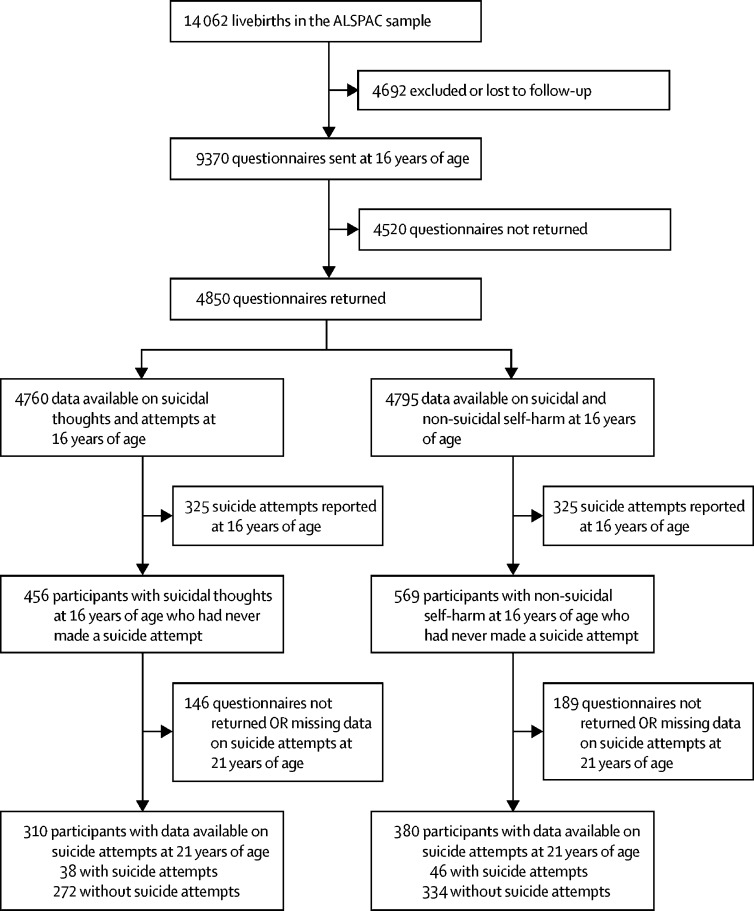
BACKGROUND: Suicidal thoughts and non-suicidal self-harm are common in adolescents and are strongly associated with suicide attempts. We aimed to identify predictors of future suicide attempts in these high-risk groups. METHODS: Participants were from the Avon Longitudinal Study of Parents and Children, a population-based birth cohort study in the UK. The sample included 456 adolescents who reported suicidal thoughts and 569 who reported non-suicidal self-harm at 16 years of age. Logistic regression analyses were used to explore associations between a wide range of prospectively recorded risk factors and future suicide attempts, assessed at the age of 21 years. FINDINGS: 38 (12%) of 310 participants with suicidal thoughts and 46 (12%) of 380 participants who had engaged in non-suicidal self-harm reported having attempted suicide for the first time by the follow-up at 21 years of age. Among participants with suicidal thoughts, the strongest predictors of transition to attempts were non-suicidal self-harm (odds ratio [OR] 2·78, 95% CI 1·35-5·74; p=0·0059), cannabis use (2·61, 1·11-6·14; p=0·029), other illicit drug use (2·47, 1·02-5·96; p=0·045), exposure to self-harm (family 2·03, 0·93-4·44, p=0·076; friend 1·85, 0·93-3·69, p=0·081), and higher levels of the personality type intellect/openness (1·62, 1·06-2·46; p=0·025). Among participants with non-suicidal self-harm at baseline, the strongest predictors were cannabis use (OR 2·14, 95% CI 1·04-4·41; p=0·038), other illicit drug use (2·17, 1·10-4·27; p=0·025), sleep problems (waking in the night 1·91, 0·95-3·84, p=0·069; insufficient sleep 1·97, 1·02-3·81, p=0·043), and lower levels of the personality type extraversion (0·71, 0·49-1·03; p=0·068). INTERPRETATION: Most adolescents who think about suicide or engage in non-suicidal self-harm will not make an attempt on their life. Many commonly cited risk factors were not associated with transition to suicide attempt among these high-risk groups. Our findings suggest that asking about substance use, non-suicidal self-harm, sleep, personality traits, and exposure to self-harm could inform risk assessments, and might help clinicians to identify which adolescents are at greatest risk of attempting suicide in the future. FUNDING: American Foundation for Suicide Prevention, National Institute for Health Research Biomedical Research Centre at the University Hospitals Bristol National Health Service Foundation Trust, and the University of Bristol.
Overview
CoChat Summary
TL;DR
In a UK population-based birth cohort, most adolescents with suicidal thoughts or non-suicidal self-harm at age 16 did not attempt suicide by age 21, but substance use, non-suicidal self-harm, sleep problems, and some personality/exposure factors predicted transition. The authors conclude that asking about these factors could help identify which high-risk adolescents are most likely to attempt suicide.
Key findings
- By age 21, 38 (12%) of 310 participants with suicidal thoughts and 46 (12%) of 380 participants with non-suicidal self-harm at baseline reported a first suicide attempt.
- Among adolescents with suicidal thoughts, the strongest predictors were non-suicidal self-harm (adjusted OR 2·78, 95% CI 1·35–5·74), cannabis use (2·61, 1·11–6·14), other illicit drug use (2·47, 1·02–5·96), and higher intellect/openness (1·62, 1·06–2·46); family and friend self-harm showed weaker evidence.
- Among adolescents with non-suicidal self-harm, the strongest predictors were cannabis use (adjusted OR 2·14, 95% CI 1·04–4·41), other illicit drug use (2·17, 1·10–4·27), and insufficient sleep (1·97, 1·02–3·81); waking in the night and lower extraversion showed weaker evidence.
- Of 107 participants reporting both suicidal thoughts and non-suicidal self-harm, 22 (21%) attempted suicide by follow-up, compared with 32 (1%) of 2283 participants reporting neither.
Methods
- Participants were from the Avon Longitudinal Study of Parents and Children (ALSPAC), a UK population-based birth cohort; analysis samples included 456 adolescents reporting suicidal thoughts and 569 reporting non-suicidal self-harm at age 16, after excluding 325 who had already attempted suicide by age 16.
- Logistic regression examined associations between prospectively recorded risk factors assessed at or before age 16 and first suicide attempt reported at age 21, adjusting for sex and socioeconomic position.
- Analyses used multiple imputation by chained equations with 50 imputed datasets; complete-case and imputed findings were broadly consistent.
Limitations
- Stated: associations cannot be assumed causal; only sex and socioeconomic position were adjusted for, and the authors did not aim to identify independent predictors.
- Stated: no date of first suicide attempt was available, so risk factors were restricted to those at or before age 16; the 5-year follow-up may miss shorter-term predictors, and excluding adolescents who had already attempted suicide may have weakened associations and limits applicability to those with prior attempts.
- Stated: analyses were exploratory without correction for multiple testing and need replication; attrition and non-random response to the age-16 self-harm questionnaire may limit generalisability, although imputed analyses were similar.
Model-written summary. Check it against the paper before relying on it.
Integrity signals
Registry
Cites
Statistics
Figures
Verification
Claims the paper makes
7 Valid · 0 Not valid · 4 Not checked · 58 Own results and interpretations
Every source the paper cites for this claim was checked and supports it.
In the paper
“In a previous study of more than 4500 adolescents,9 we explored a wide range of risk factors and found that exposure to self-harm in others, psychiatric disorders, and substance use most strongly distinguished between adolescents with suicidal thoughts and those who acted on those thoughts.”
§ Predictors of future suicide attempt among adolescents with suicidal thoughts or non-suicidal self-harm: a population-based birth cohort study > Introduction
What the sources say
- Supportedcites [9] Mars B Heron J Klonsky ED What distinguishes adolescents with suicidal thoughts from those who have attempted suicide? A population-based birth cohort study J Child Psychol Psychiatry 60 2019 91 99 29492978 PMC6334515 source
The Abstract reports 4,772 adolescents, and the Introduction says the study compared a wide range of risk factors. The Discussion identifies notably larger effects for exposure to self-harm in family or friends, mental health disorders, smoking, and illicit drug use excluding cannabis—the factors summarized in the claim. (LLM, conf=0.91)
boostedstates an association- Asserted: passes — The authors put it forward as true.
- Checkable: passes — It can be checked against evidence.
- Load-bearing: passes — The paper’s conclusions depend on it.
- Based: passes — The paper gives a reason why it holds.
- Supported
The cited sources support only part of this claim — read each source’s verdict below.
In the paper
“Several large epidemiological and meta-analytical studies provide empirical support for this framework and have found that many well established risk factors for suicide (such as depression, impulsivity, and hopelessness) do not meaningfully differentiate individuals with suicidal thoughts from those who have made an attempt.1, 5, 6, 7”
§ Predictors of future suicide attempt among adolescents with suicidal thoughts or non-suicidal self-harm: a population-based birth cohort study > Introduction
What the sources say
- Partly supportedcites [1] Nock MK Green JG Hwang I Prevalence, correlates, and treatment of lifetime suicidal behavior among adolescents: results from the National Comorbidity Survey Replication Adolescent Supplement JAMA Psychiatry 70 2013 300 310 23303463 PMC3886236 sourceExperimental — accuracy not yet measured
In Results (page unavailable), prior mental disorders are more strongly associated with ideation than with attempts among ideators, supporting the general point. But the Comment (page unavailable) says MDD/dysthymia predicts the transition from ideation to an attempt, and intermittent explosive disorder predicts planned attempts. The paper does not establish the claim about hopelessness, and its findings concern adolescents. (LLM, conf=0.87)
- Not checked — no full text of the sourcecites [5] May AM Klonsky ED What distinguishes suicide attempters from suicide ideators? A meta–analysis of potential factors Clin Psychol 23 2016 5 20 source
- Not checked — no full text of the sourcecites [6] Kessler RC Borges G Walters EE Prevalence of and risk factors for lifetime suicide attempts in the National Comorbidity Survey Arch Gen Psychiatry 56 1999 617 626 10401507 source
- Partly supportedcites [7] Nock MK Hwang I Sampson N Cross-national analysis of the associations among mental disorders and suicidal behavior: findings from the WHO World Mental Health Surveys PLoS Med 6 2009 e1000123 19668361 PMC2717212 sourceExperimental — accuracy not yet measured
The Discussion says major depression is much less useful for predicting which people with suicidal thoughts go on to make plans or attempts. But it identifies disorders characterized by poor impulse-control as among the strongest predictors of that progression, rather than showing that impulsivity fails to differentiate the groups. The provided passages do not assess hopelessness. (LLM, conf=0.88)
boosted- Asserted: passes — The authors put it forward as true.
- Checkable: passes — It can be checked against evidence.
- Load-bearing: passes — The paper’s conclusions depend on it.
- Based: passes — The paper gives a reason why it holds.
- Partly supported
The cited sources support only part of this claim — read each source’s verdict below.
In the paper
“Suicidal thoughts and non-suicidal self-harm are strongly associated with suicide attempts.”
§ Predictors of future suicide attempt among adolescents with suicidal thoughts or non-suicidal self-harm: a population-based birth cohort study > Introduction
What the sources say
- Partly supportedcites [1] Nock MK Green JG Hwang I Prevalence, correlates, and treatment of lifetime suicidal behavior among adolescents: results from the National Comorbidity Survey Replication Adolescent Supplement JAMA Psychiatry 70 2013 300 310 23303463 PMC3886236 sourceExperimental — accuracy not yet measured
The Results section (Prevalence and age-of-onset of suicidal behaviors; page unavailable) reports that 33.9% of adolescents with suicidal ideation made an attempt, supporting the link between suicidal thoughts and attempts. The Methods section (Measures; page unavailable) assesses ideation, plans, and attempts, but not non-suicidal self-harm; searches for that term and related terms found no evidence for the self-harm part of the claim. (LLM, conf=0.88)
- Not checked — no full text of the sourcecites [15] Hamza CA Stewart SL Willoughby T Examining the link between nonsuicidal self-injury and suicidal behavior: a review of the literature and an integrated model Clin Psychol Rev 32 2012 482 495 22717336 source
- Not checked — no full text of the sourcecites [16] Wilkinson P Kelvin R Roberts C Dubicka B Goodyer I Clinical and psychosocial predictors of suicide attempts and nonsuicidal self-injury in the Adolescent Depression Antidepressants and Psychotherapy Trial (ADAPT) Am J Psychiatry 168 2011 495 501 21285141 source
- Partly supportedcites [17] Guan K Fox KR Prinstein MJ Nonsuicidal self-injury as a time-invariant predictor of adolescent suicide ideation and attempts in a diverse community sample J Consult Clin Psychol 80 2012 842 849 22845782 PMC3458144 sourceExperimental — accuracy not yet measured
The Results section, “Longitudinal Prediction of Suicide Attempts” (page unavailable), reports that greater nonsuicidal self-injury was associated with a seven-fold increase in the likelihood of later attempts. It does not report a corresponding association between suicidal thoughts and attempts; the paper instead reports that self-injury predicted both later ideation and attempts. (LLM, conf=0.84)
- Supportedcites [18] Asarnow JR Porta G Spirito A Suicide attempts and nonsuicidal self-injury in the treatment of resistant depression in adolescents: findings from the TORDIA study J Am Acad Child Adolesc Psychiatry 50 2011 772 781 21784297 PMC3143365 source
In Results > Baseline Presentation (page unavailable), adolescents with histories of both nonsuicidal self-injury (NSSI) and suicide attempts had significantly higher suicidal-ideation scores than those with neither history. The same section reports a significant association between NSSI and suicide attempts; Results > Prediction of Time to SAs through Week 24 also identifies baseline NSSI as a significant predictor of later attempts. These findings are from adolescents with treatment-resistant depression. (LLM, conf=0.88)
- Not checked — no full text of the sourcecites [19] Klonsky ED May AM Glenn CR The relationship between nonsuicidal self-injury and attempted suicide: converging evidence from four samples J Abnorm Psychol 122 2013 231 237 23067259 source
boostedstates an association- Asserted: passes — The authors put it forward as true.
- Checkable: passes — It can be checked against evidence.
- Load-bearing: passes — The paper’s conclusions depend on it.
- Based: passes — The paper gives a reason why it holds.
- Partly supported
Every source the paper cites for this claim was checked and supports it.
In the paper
“Only a third of adolescents who have suicidal thoughts are estimated to go on to make a suicide attempt.1”
§ Predictors of future suicide attempt among adolescents with suicidal thoughts or non-suicidal self-harm: a population-based birth cohort study > Introduction
What the sources say
- Supportedcites [1] Nock MK Green JG Hwang I Prevalence, correlates, and treatment of lifetime suicidal behavior among adolescents: results from the National Comorbidity Survey Replication Adolescent Supplement JAMA Psychiatry 70 2013 300 310 23303463 PMC3886236 source
The Results section, under “Prevalence and age-of-onset of suicidal behaviors,” states that 33.9% of adolescents with suicidal ideation go on to make an attempt. That supports the citing sentence’s estimate of about one-third. (LLM, conf=0.94)
hedgedstates an association- Asserted: passes — The authors put it forward as true.
- Checkable: passes — It can be checked against evidence.
- Load-bearing: unclear — It is unclear whether the paper’s conclusions depend on it.
- Based: passes — The paper gives a reason why it holds.
- Supported
The cited sources support only part of this claim — read each source’s verdict below.
In the paper
“Both of these factors have been associated with suicidal behaviour in previous research;36, 37, 38, 39 however, our study is the first to explore prospectively the role of sleep difficulties and personality traits in the transition to suicide attempts over time.”
§ Predictors of future suicide attempt among adolescents with suicidal thoughts or non-suicidal self-harm: a population-based birth cohort study > Discussion
What the sources say
- Not checked — no full text of the sourcecites [36] O'Connor RC Nock MK The psychology of suicidal behaviour Lancet Psychiatry 1 2014 73 85 26360404 source
- Supportedcites [37] Hysing M Stormark KM O'Connor RC Sleep problems and self-harm in adolescence Br J Psychiatry 207 2015 306 312 26206862 source
The citation supports the sentence’s first clause, not the citing authors’ claim about their own prospective study. The Abstract describes prior evidence linking sleep problems to suicidal behaviour and identifies an established relationship between perfectionism and self-harm; the References also list a review of perfectionism and suicidality. The source is not being cited as the prospective study. (LLM, conf=0.87)
- Partly supportedcites [38] Wong MM Brower KJ Craun EA Insomnia symptoms and suicidality in the national comorbidity survey–adolescent supplement J Psychiatr Res 81 2016 1 8 27355426 PMC5021568 sourceExperimental — accuracy not yet measured
The citation attaches to the statement that sleep difficulties and personality traits have been associated with suicidal behaviour in previous research, not to the citing authors’ claim about their own prospective study. The source’s Results (section 3.2; page unavailable) associate sleep problems with suicidal thoughts, plans and attempts, but the passages do not establish an association for personality traits. (LLM, conf=0.86)
- Not checked — no full text of the sourcecites [39] Pigeon WR Pinquart M Conner K Meta-analysis of sleep disturbance and suicidal thoughts and behaviors J Clin Psychiatry 73 2012 e1160 e1167 23059158 source
plainstates an association- Asserted: passes — The authors put it forward as true.
- Checkable: passes — It can be checked against evidence.
- Load-bearing: passes — The paper’s conclusions depend on it.
- Based: passes — The paper gives a reason why it holds.
44 more claims
Create a free account to see all 69 claims and every source verdict.
- Probably not a substantial claim. 11
- It may state two separate claims as one. 11
Claims other papers make about this one
Each is checked against this paper’s own text: does it say what the citing paper says it does?
The source backs part of the claim, not all of it — or backs it for a different population, condition or comparison.
In the citing paper
“Although most adolescents that have suicidal thoughts and behaviors do not progress to suicide attempts, they account for 26% of future suicide attempts by the age of 26 and they are strongly associated with suicide death [11].”
From Adolescent Suicide—Understanding Unique Risks and Opportunities for Trauma Centers to Recognize, Intervene, and Prevent a Leading Cause of Death (2022) · cites this paper as [11]
Experimental — accuracy not yet measuredThe source backs part of the claim, not all of it — or backs it for a different population, condition or comparison.
In the citing paper
“Certain mental health disorders and a history of suicide behaviors (ideation, attempts) and non-suicidal self-injury (NSSI) significantly increase risk [7••, 11].”
From Adolescent Suicide—Understanding Unique Risks and Opportunities for Trauma Centers to Recognize, Intervene, and Prevent a Leading Cause of Death (2022) · cites this paper as [11]
Experimental — accuracy not yet measuredThe source backs part of the claim, not all of it — or backs it for a different population, condition or comparison.
In the citing paper
“alcohol and illicit substance use further potentiates the risk of suicide among youth with depression [11, 71].”
From Adolescent Suicide—Understanding Unique Risks and Opportunities for Trauma Centers to Recognize, Intervene, and Prevent a Leading Cause of Death (2022) · cites this paper as [11]
Experimental — accuracy not yet measuredThe source backs part of the claim, not all of it — or backs it for a different population, condition or comparison.
In the citing paper
“substance abuse is not only an independent risk factor for suicide”
From Adolescent Suicide—Understanding Unique Risks and Opportunities for Trauma Centers to Recognize, Intervene, and Prevent a Leading Cause of Death (2022) · cites this paper as [11]
Experimental — accuracy not yet measuredThe source backs part of the claim, not all of it — or backs it for a different population, condition or comparison.
In the citing paper
“some clinical factors that may influence the transition from suicidal ideation to suicide attempt include anxiety disorders, impulse-control disorders, post-traumatic stress disorder, eating disorders, previous self-harm, exposure to suicidal behaviour in others, and alcohol and drug abuse or dependence 6,7,88 .”
From Suicide and suicide risk (2019) · cites this paper as [7]
Experimental — accuracy not yet measured
7 more claims about this paper
Create a free account to see every claim other papers make about this one.
Self-check
Percentages, sums and reported differences re-computed from the paper’s own numbers.
Each contradiction between two passages listed here was confirmed by an independent check.
Rated minor: it would not touch a result — a value no result rests on, a p-value that stays on the same side of the significance level, or a conflict that is clerical, resolved elsewhere in the paper, or outside its own findings.
In the paper
§ Predictors of future suicide attempt among adolescents with suicidal thoughts or non-suicidal self-harm: a population-based birth cohort study > Results
“17·9 (15·61)”
§ Predictors of future suicide attempt among adolescents with suicidal thoughts or non-suicidal self-harm: a population-based birth cohort study > Results
“17·1 (4·33) | 17·7 (3·78)”
Rated minor: it would not touch a result — a value no result rests on, a p-value that stays on the same side of the significance level, or a conflict that is clerical, resolved elsewhere in the paper, or outside its own findings.
In the paper
“| Female | 202 (74%) | 28 (74%) | 275 (82%) | 36 (70%) |”
§ Predictors of future suicide attempt among adolescents with suicidal thoughts or non-suicidal self-harm: a population-based birth cohort study > Results
Reported 70 · recomputed 78.26087
Rated minor: it would not touch a result — a value no result rests on, a p-value that stays on the same side of the significance level, or a conflict that is clerical, resolved elsewhere in the paper, or outside its own findings.
In the paper
§ Predictors of future suicide attempt among adolescents with suicidal thoughts or non-suicidal self-harm: a population-based birth cohort study > Results
“| | Attentional control | 17·9 (15·61) | 17·1 (4·33) | 17·7 (3·78) |”
§ Predictors of future suicide attempt among adolescents with suicidal thoughts or non-suicidal self-harm: a population-based birth cohort study > Results
“| | Total sample | No transition to attempts | Transition to attempts | Unadjusted odds ratio (95% CI) | p value | Adjusted odds ratio*(95% CI) | p value |”
Rated minor: it would not touch a result — a value no result rests on, a p-value that stays on the same side of the significance level, or a conflict that is clerical, resolved elsewhere in the paper, or outside its own findings.
In the paper
§ Predictors of future suicide attempt among adolescents with suicidal thoughts or non-suicidal self-harm: a population-based birth cohort study > Results
“waking in the night (adjusted OR 1·91, 95% CI 0·93–4·44; p=0·069)”
§ Predictors of future suicide attempt among adolescents with suicidal thoughts or non-suicidal self-harm: a population-based birth cohort study > Results
“| | Waking in the night | 55% | 52% | 67% | 1·94 (1·01–3·73) | 0·047 | 1·91 (0·95–3·84) | 0·069 |”
Rated minor: it would not touch a result — a value no result rests on, a p-value that stays on the same side of the significance level, or a conflict that is clerical, resolved elsewhere in the paper, or outside its own findings.
In the paper
§ Predictors of future suicide attempt among adolescents with suicidal thoughts or non-suicidal self-harm: a population-based birth cohort study > Results
“| | Attentional switching | 11·3 (14·48) | 11·5 (15·19) | 12·2 (15·7) |”
§ Predictors of future suicide attempt among adolescents with suicidal thoughts or non-suicidal self-harm: a population-based birth cohort study > Results
“| | Total sample | No transition to attempts | Transition to attempts | Unadjusted odds ratio (95% CI) | p value | Adjusted odds ratio*(95% CI) | p value |”
Citations
Cites
The interpersonal theory of suicide.
Van Orden, K. A., Witte, T. K., Cukrowicz, K. C., Braithwaite, S. R., Selby, E. A., & Joiner, T. E. (2010) · Psychological Review · doi:10.1037/a0018697 · Cited by 5,292
Multiple imputation by chained equations: what is it and how does it work?
Azur, M. J., Stuart, E. A., Frangakis, C., & Leaf, P. J. (2011) · International Journal of Methods in Psychiatric Research · doi:10.1002/mpr.329 · Cited by 3,542
Boyd, A., Golding, J., Macleod, J., Lawlor, D. A., Fraser, A., Henderson, J., Molloy, L., Ness, A., Ring, S., & Davey Smith, G. (2013) · International Journal of Epidemiology · doi:10.1093/ije/dys064 · Cited by 2,996
Prevalence of and Risk Factors for Lifetime Suicide Attempts in the National Comorbidity Survey
Kessler, R. C., Borges, G., & Walters, E. E. (1999) · Archives of General Psychiatry · doi:10.1001/archpsyc.56.7.617 · Cited by 2,514
Cohort Profile: The Avon Longitudinal Study of Parents and Children: ALSPAC mothers cohort
Fraser, A., Macdonald-Wallis, C., Tilling, K., Boyd, A., Golding, J., Davey Smith, G., Henderson, J., Macleod, J., Molloy, L., Ness, A., et al. (2013) · International Journal of Epidemiology · doi:10.1093/ije/dys066 · Cited by 2,494
Self-citationThe Three-Step Theory (3ST): A New Theory of Suicide Rooted in the “Ideation-to-Action” Framework
Klonsky, E. D., & May, A. M. (2015) · International Journal of Cognitive Therapy · doi:10.1521/ijct.2015.8.2.114 · Cited by 1,799
Self-citationThe integrated motivational–volitional model of suicidal behaviour
O'Connor, R. C., & Kirtley, O. J. (2018) · Philosophical Transactions of the Royal Society B: Biological Sciences · doi:10.1098/rstb.2017.0268 · Cited by 1,781
Self-citationNock, M. K., Green, J. G., Hwang, I., McLaughlin, K. A., Sampson, N. A., Zaslavsky, A. M., & Kessler, R. C. (2013) · JAMA Psychiatry · doi:10.1001/2013.jamapsychiatry.55 · Cited by 1,666
Multiple Imputation by Chained Equations (MICE): Implementation in Stata
Royston, P., & White, I. (2011) · Journal of Statistical Software · doi:10.18637/jss.v045.i04 · Cited by 1,248
The psychology of suicidal behaviour
O'Connor, R. C., & Nock, M. K. (2014) · The Lancet Psychiatry · doi:10.1016/s2215-0366(14)70222-6 · Cited by 1,193
Self-citation
Cited by
Items 101–200 of 528
Cadorna, G., Juan, N. V. S., Staples, H., Johnson, S., & Appleton, R. (2023) · Child and Adolescent Mental Health · doi:10.1111/camh.12683 · Cited by 27
Zheng, Q., Liu, J., Ji, Y., Zhang, Y., Chen, X., & Liu, B. (2022) · BMC Psychiatry · doi:10.1186/s12888-022-04260-z · Cited by 26
“attempts (SA) [6, 7] and that NSSI is the strongest predictor of future suicidal behavior [8].”
BackgroundBulat, L. R., Sušac, N., & Ajduković, M. (2023) · Current Psychology · doi:10.1007/s12144-023-04404-8 · Cited by 43
“Mars et al. (2019) explored the nature of the transition from SI or NSSI to suicide attempts (SAs) 1 3 among adolescents and found that, among youth with SI at the age of 16, the future risk of SAs was associated with higher openness, while for those with NSSI, SAs were predicted with lower levels…”
BackgroundMethodInfluentialVieira, A. I., Moreira, C. S., Rodrigues, T. F., Brandão, I., Timóteo, S., Nunes, P., & Gonçalves, S. F. (2020) · Journal of Clinical Psychology · doi:10.1002/jclp.23038 · Cited by 25
Seong, E., Noh, G., Lee, K. H., Lee, J.-S., Kim, S., Seo, D. G., Yoo, J. H., Hwang, H., Choi, C.-H., Han, D. H., et al. (2021) · Frontiers in Psychology · doi:10.3389/fpsyg.2021.691438 · Cited by 35
Zhu, S., Li, X., & Wong, P. W. C. (2023) · Psychiatry Research · doi:10.1016/j.psychres.2023.115059 · Cited by 32
Tintori, A., Pompili, M., Ciancimino, G., Corsetti, G., & Cerbara, L. (2023) · Scientific Reports · doi:10.1038/s41598-023-48201-6 · Cited by 39
“In contrast to the results of prior studies 17 , tolerance towards alcohol and other substance use did not emerge as a significant factor in relation to the well-being of adolescents and the epistemological approach adopted in this study could account for this result.”
Non-suicidal self-injury and co-occurring suicide attempt in male prisoners
Favril, L. (2019) · Psychiatry Research · doi:10.1016/j.psychres.2019.05.017 · Cited by 31
Russell, K., Rasmussen, S. A., & Hunter, S. C. (2020) · International Journal of Environmental Research and Public Health · doi:10.3390/ijerph17186771 · Cited by 37
“Self-harm, defined as “self-injury or self-poisoning irrespective of the apparent purpose of the act” [1,2], first emerges as a significant public health problem during adolescence [3,4].”
BackgroundTetteh, J., Ekem‐Ferguson, G., Quarshie, E. N., Swaray, S. M., Ayanore, M. A., Seneadza, N. A. H., Asante, K. O., & Yawson, A. E. (2021) · General Psychiatry · doi:10.1136/gpsych-2021-100558 · Cited by 26
“15 21 22 Whereas there is emerging significant evidence on suicidal ideation, planning and attempts, and associated risks and protective factors among adolescents in Africa, 13 we are aware of only one recently published study that has reported the association between marijuana use and repeated…”
Marqués-Feixa, L., Moya-Higueras, J., Romero, S., Santamarina-Pérez, P., Rapado‐Castro, M., Zorrilla, E. P., Martín, M., Anglada, E., Lobato, M. J., Ramírez, M., et al. (2021) · Journal of Clinical Medicine · doi:10.3390/jcm10225293 · Cited by 38
“In fact, the transition to suicide attempts among adolescents with suicide ideation or NSSI may also be predicted by other variables such as cannabis and other illicit drug abuse, sleep problems and a lower extraversion score [23].”
BackgroundLengvenytė, A., Belzeaux-R, R., Olié, É., Hamzeh‐Cognasse, H., Sénèque, M., Strumila, R., Cognasse, F., & Courtet, P. (2023) · Brain Behavior and Immunity · doi:10.1016/j.bbi.2023.08.025 · Cited by 26
Adolescent self-harm in Ghana: a qualitative interview-based study of first-hand accounts
Quarshie, E. N., Waterman, M. G., & House, A. O. (2020) · BMC Psychiatry · doi:10.1186/s12888-020-02599-9 · Cited by 27
Multimodal assessment of sustained threat in adolescents with nonsuicidal self-injury
Başgöze, Z., Mirza, S. A., Silamongkol, T., Hill, D. C., Falke, C. A., Thai, M., Schreiner, M. W., Parenteau, A. M., Roediger, D. J., Hendrickson, T. J., et al. (2021) · Development and Psychopathology · doi:10.1017/s0954579421000754 · Cited by 28
“With a prevalence in adolescents of approximately 17% (Mars et al., 2019; Swannell, Martin, Page, Hasking, & St John, 2014), NSSI is associated with risk for negative outcomes including suicide attempts (Mars et al., 2019; Swannell et al., 2014).”
BackgroundBaer, M. M., Tull, M. T., & Gratz, K. L. (2021) · Archives of Suicide Research · doi:10.1080/13811118.2021.1931595 · Cited by 24
“In a recent population-based young adult study in the United Kingdom, illicit drug use (excluding cannabis) distinguished between those with suicidal ideation but no attempts and those with both suicidal ideation and attempts (Mars et al., 2019).”
BackgroundWang, Y., Zhou, X., Cao, B., Chen, L., Wang, R., Qi, L., Meng, L., Zeng, L., Liu, X., Wang, W., et al. (2021) · Journal of Affective Disorders · doi:10.1016/j.jad.2021.10.130 · Cited by 26
Geoffroy, M., Arseneault, L., Girard, A., Ouellet‐Morin, I., & Power, C. (2022) · Psychological Medicine · doi:10.1017/s0033291722000836 · Cited by 35
“Although suicide ideation, suicide attempts and suicide mortality share a range of common risk factors, specific risk factors have also been identified (Klonsky, Saffer, & Bryan, 2018; Mars et al., 2019).”
BackgroundDuprey, E. B., Handley, E. D., Wyman, P. A., Ross, A. J., Cerulli, C., & Oshri, A. (2022) · Development and Psychopathology · doi:10.1017/s0954579422000414 · Cited by 26
Establishment and validation of a nomogram for suicidality in Chinese secondary school students
Yan, J., Liu, Y., Yu, J., Liao, L., & Wang, H. (2023) · Journal of Affective Disorders · doi:10.1016/j.jad.2023.02.062 · Cited by 23
Quarshie, E. N., Shuweihdi, F., Waterman, M. G., & House, A. O. (2021) · BMJ Open · doi:10.1136/bmjopen-2020-041609 · Cited by 26
Lannoy, S., Mars, B., Heron, J. E., & Edwards, A. C. (2022) · Journal of Child Psychology and Psychiatry · doi:10.1111/jcpp.13653 · Cited by 24
“…and nonsuicidal selfharm are predominant at this time (Gillies et al., 2018; Lawrence et al., 2021) and may lead to suicide attempt (Gillies et al., 2018; Mars et al., 2019a; Nock et al., 2009), whereas suicide is identified as a leading cause of death among adolescents (Shain, 2016; WHO, 2021).”
BackgroundMethodInfluentialSelf-citationMitchell, R. H. B., Toulany, A., Chung, H., Cohen, E., Fu, L., Strauss, R., Vigod, S. N., Stukel, T. A., Moran, K. A., Guttmann, A., et al. (2023) · Canadian Medical Association Journal · doi:10.1503/cmaj.230127 · Cited by 29
Bilello, D., Townsend, E., Broome, M. R., Armstrong, G., & Heyes, S. B. (2024) · The Lancet Psychiatry · doi:10.1016/s2215-0366(24)00170-6 · Cited by 32
Lin, K., Ramos, S. B., & Sun, J. (2024) · Current Opinion in Psychiatry · doi:10.1097/yco.0000000000000927 · Cited by 26
Bakken, V., Lydersen, S., Skokauskas, N., Sund, A. M., & Kaasbøll, J. (2025) · BMC Psychiatry · doi:10.1186/s12888-025-06552-6 · Cited by 33
“Most adolescents do not act on SI [7], yet SI is a robust precursor for SA [8] and history of SA is a prominent risk factor for future attempts or completed suicide [9, 10].”
Hammond, N. G., Semchishen, S. N., Geoffroy, M., Sikora, L., Wafy, G., Hsueh, L., Khan, H., Edwards, J., Gravel, C. A., Ferro, M. A., et al. (2025) · The Lancet Psychiatry · doi:10.1016/s2215-0366(25)00217-2 · Cited by 34
Risk factors for suicide: Systematic review
Conceicao, A., Fletes, Lemos, T., Teixeira, E. P., & de Souza, M. D. (2020) · Saudi Journal for Health Sciences · doi:10.4103/sjhs.sjhs_83_20 · Cited by 24
van der Venne, P., Mürner-Lavanchy, I. M., Höper, S., Koenig, J., & Kaess, M. (2023) · Journal of Affective Disorders · doi:10.1016/j.jad.2023.06.041 · Cited by 24
Time to take self-harm in young people seriously
Townsend, E. (2019) · The Lancet Psychiatry · doi:10.1016/s2215-0366(19)30101-4 · Cited by 26
Fındık, O. T. P., Yıldırım, A. B. E., Fadıloğlu, E., & Arman, A. R. (2021) · Child Psychiatry & Human Development · doi:10.1007/s10578-021-01125-6 · Cited by 26
Patterns of psychological pain and self‐harm behaviors in adolescents
Sun, F., Li, H., Song, W., Bao, J., & Zhen, Z. (2022) · Suicide and Life-Threatening Behavior · doi:10.1111/sltb.12898 · Cited by 24
Geda, N. R., Feng, C. X., & Peters, B. (2022) · BMC Psychiatry · doi:10.1186/s12888-022-04353-9 · Cited by 22
“Research has shown cannabis users can be common among persons prone to be impulsive, and among persons who engage in many types of high-risk behaviors that result in suicidal ideation [16, 28].”
BackgroundGaynor, K., Dwan-O'Reilly, M., Redmond, D., Nealon, C., Twomey, C. D., & Hennessy, E. (2023) · Comprehensive Psychiatry · doi:10.1016/j.comppsych.2023.152374 · Cited by 23
The Association Between Atypical Speech Development and Adolescent Self-Harm
McAllister, J., Skinner, J. S., Hayhow, R., Heron, J. E., & Wren, Y. E. (2023) · Journal of Speech Language and Hearing Research · doi:10.1044/2023_jslhr-21-00652 · Cited by 28
Self-citationSeong, E., Lee, K. H., Lee, J.-S., Kim, S., Seo, D. G., Yoo, J. H., Han, D. H., Hwang, H., Choi, C.-H., & Kim, J.-W. (2024) · BMC Psychiatry · doi:10.1186/s12888-024-05533-5 · Cited by 23
Moloney, F., Amini, J., Sinyor, M., Schaffer, A., Lanctôt, K. L., & Mitchell, R. H. B. (2025) · Journal of Child Psychology and Psychiatry · doi:10.1111/jcpp.14114 · Cited by 27
Culbreth, R. E., Swahn, M. H., Osborne, M. C., Brandenberger, K. J., & Kota, K. K. (2021) · Preventive Medicine · doi:10.1016/j.ypmed.2021.106682 · Cited by 17
Macalli, M., Castel, L., Jacqmin‐Gadda, H., Galesne, C., Tournier, M., Galéra, C., Pereira, E., & Tzourio, C. (2024) · Journal of Affective Disorders · doi:10.1016/j.jad.2024.09.093 · Cited by 22
May, A. M., Czyz, E. K., & West, B. T. (2020) · Journal of Adolescent Health · doi:10.1016/j.jadohealth.2020.04.018 · Cited by 22
“There is, however, more uniform evidence pointing to behavioral disorders (oppositional defiant disorder, conduct disorders) [3,15] as well as substance use disorders [3,16,17] accounting for some of these group differences.”
BackgroundAmadori, A., & Brighi, A. (2025) · Computers in Human Behavior · doi:10.1016/j.chb.2025.108576 · Cited by 23
Rees, S., Watkins, A., Keauffling, J., & John, A. (2022) · Clinical Epidemiology · doi:10.2147/clep.s325235 · Cited by 21
“People aged 10–19 years old in England between 1997 and 2012 were at significantly increased risk of death or further emergency admission in the 10 year period following a drug or alcohol-related hospital admission(20) and SUD was a significant risk factor for progression to suicidal behaviour in young people under 22…”
BackgroundAn Intersectional Modeling of Risk for Nonsuicidal Self-Injury among LGBTQ Adolescents
Speer, S. R., Ash, B. A., Kattari, S. K., Kattari, L., Gupta, R., & Walls, N. E. (2022) · Journal of Child and Family Studies · doi:10.1007/s10826-022-02250-z · Cited by 19
“Among youths, engaging in NSSI has been shown to predict the transition from suicidal ideation to suicide attempts (Mars et al., 2019).”
BackgroundDimick, M. K., Hird, M. A., Sultan, A. A., Mitchell, R. H. B., Sinyor, M., MacIntosh, B. J., & Goldstein, B. I. (2022) · Psychological Medicine · doi:10.1017/s0033291721005419 · Cited by 19
Testing the interpersonal theory of suicide in adolescents: A multi‐wave longitudinal study
Pagliaccio, D., Bitran, A., Kirshenbaum, J. S., Alqueza, K. L., Durham, K., Chernick, L. S., Joyce, K. J., Lan, R., Porta, G., Brent, D. A., et al. (2023) · Journal of Child Psychology and Psychiatry · doi:10.1111/jcpp.13868 · Cited by 25
Emotional dysregulation and its pathways to suicidality in a community-based sample of adolescents
Mittermeier, S., Seidel, A., Scheiner, C., Kleindienst, N., Romanos, M., & Buerger, A. (2024) · Child and Adolescent Psychiatry and Mental Health · doi:10.1186/s13034-023-00699-4 · Cited by 22
“…[13] but also appears to contribute to the SS: In a longitudinal study of 1025 adolescents, Mars and colleagues demonstrated that NSSI significantly increased the risk of transition from SI to SA (odds ratio (OR) 2.79) [14], rendering NSSI an extremely important risk factor for suicidality.”
BackgroundInfluentialWang, Z., Li, D., Chen, Y., Tao, Z., Jiang, L., He, X., & Zhang, W. (2024) · Psychiatry Research · doi:10.1016/j.psychres.2024.115816 · Cited by 24
Kirtley, O. J., Hussey, I., & Marzano, L. (2020) · Psychiatry Research · doi:10.1016/j.psychres.2020.113572 · Cited by 21
Suicidal behaviours and moderator support in online health communities: a scoping review
Perry, A. N., Pyle, D., Lamont‐Mills, A., du Plessis, C., & du Preez, J. (2021) · BMJ Open · doi:10.1136/bmjopen-2020-047905 · Cited by 21
Sinyor, M., Mallia, E., de Oliveira, C., Schaffer, A., Niederkrotenthaler, T., Zaheer, J., Mitchell, R. H. B., Rudoler, D., & Kurdyak, P. A. (2021) · Australian & New Zealand Journal of Psychiatry · doi:10.1177/00048674211065999 · Cited by 17
“…suggestive of harm to adolescents resulting from the release of 13RW. Self-harm (self-injurious behavior with or without suicidal intent) that does not result in death is, in itself, an important negative health outcome and is a key predictor of future suicide attempt and death (Mars et al., 2019).”
BackgroundThe forever decision: a qualitative study among survivors of a suicide attempt
de Jonge-Heesen, K. W. J., Mérelle, S. Y. M., van den Brand, I., van Bergen, D. D., Baden, D., Slotema, K., Gilissen, R., & van Veen, S. M. P. (2024) · EClinicalMedicine · doi:10.1016/j.eclinm.2024.102449 · Cited by 20
Suicide Risk and Living Alone With Depression or Anxiety
Moon, D. U., Kim, H., Jung, J., Han, K., & Jeon, H. J. (2025) · JAMA Network Open · doi:10.1001/jamanetworkopen.2025.1227 · Cited by 24
Prediction of suicide among 372,813 individuals under medical check-up
Cho, S., Geem, Z. W., & Na, K. (2020) · Journal of Psychiatric Research · doi:10.1016/j.jpsychires.2020.08.035 · Cited by 20
Trends in Adolescent Online and Offline Victimization and Suicide Risk Factors
Kreski, N. T., Chen, Q., Olfson, M., Cerdá, M., Hasin, D. S., Martins, S. S., Mauro, P. M., & Keyes, K. M. (2021) · PEDIATRICS · doi:10.1542/peds.2020-049585 · Cited by 19
Zegarra-López, A., Santisteban, B. F., Romero, J. F., Tenorio, A. L. D., & Ames, A. P. C. (2022) · International Journal of Environmental Research and Public Health · doi:10.3390/ijerph192114240 · Cited by 19
“95% suicide rate on 2019 [45] and suicidal behavior is one of the main predictors of suicide [46].”
BackgroundCepuch, G., Kruszecka-Krówka, A., Liber, P., & Micek, A. (2023) · Healthcare · doi:10.3390/healthcare11030306 · Cited by 25
“[86], a high level of stress and sleep disorders [85,86], as well as a high level of negative emotions [55] were significantly associated with the incidence of suicidal thoughts.”
BackgroundA Bayesian network analysis of psychosocial risk and protective factors for suicidal ideation
Delgadillo, J., Budimir, S., Barkham, M., Humer, E. C., Pieh, C., & Probst, T. (2023) · Frontiers in Public Health · doi:10.3389/fpubh.2023.1010264 · Cited by 24
Rong, F., Wang, M., Peng, C., Cheng, J., Wang, Y., & Yu, Y. (2024) · Child Abuse & Neglect · doi:10.1016/j.chiabu.2023.106627 · Cited by 18
Yue, L., Zhao, R., Yu, Z., Kou, X., & Yu, J. (2024) · BMC Psychiatry · doi:10.1186/s12888-024-06064-9 · Cited by 17
“Additionally, the suicide risk of patients who engage in NSSI is hundreds of times higher than that of the general population [8].”
BackgroundAslan, E. A., Batmaz, S., Yıldız, M., & Songur, E. (2020) · Journal of Rational-Emotive & Cognitive-Behavior Therapy · doi:10.1007/s10942-020-00354-3 · Cited by 26
“Among participants with non-suicidal self-harm at baseline, the strongest predictors were cannabis use, other illicit drug use, sleep problems, and lower levels of the personality type extraversion (Mars et al. 2019).”
BackgroundNILSSON, M. H. L., Lundh, L., & Westling, S. (2022) · Clinical Psychology & Psychotherapy · doi:10.1002/cpp.2744 · Cited by 27
“Arguably, one of the more important findings is that NSSI seems to be a significant predictor for later suicide attempts (Mars et al., 2019).”
BackgroundWinstone, L., Jamal, S., & Mars, B. (2024) · Journal of Adolescent Health · doi:10.1016/j.jadohealth.2024.04.004 · Cited by 29
Self-citationdel Carpio, L., Rasmussen, S. A., & Paul, S. (2020) · Frontiers in Psychology · doi:10.3389/fpsyg.2020.01153 · Cited by 22
“In a UK population-based cohort study, Mars et al. (2019a) showed that exposure to family self-harm was a predictor of future suicide attempts among adolescents who reported suicidal thoughts (but not those who engaged in NSSI).”
BackgroundDiurnal variation of cardiac autonomic activity in adolescent non-suicidal self-injury
Sigrist, C., Jakob, H., Beeretz, C. J., Schmidt, S. J., Kaess, M., & Koenig, J. (2023) · European Archives of Psychiatry and Clinical Neuroscience · doi:10.1007/s00406-023-01574-1 · Cited by 20
“NSSI is linked with other health-risk behaviors, and critically, presents one of the strongest transitional predictors of suicide attempts among adolescents [5, 81, 125].”
BackgroundWho are we missing? Self‐selection bias in nonsuicidal self‐injury research
Robinson, K., Dayer, K., Mirichlis, S., Hasking, P. A., & Wilson, M. (2023) · Suicide and Life-Threatening Behavior · doi:10.1111/sltb.12987 · Cited by 23
Langjord, T., Pedersen, G., Bovim, T., Christensen, T. B., Eikenæs, I. U.-M., Hove, O., Kildahl, A. N., Mork, E., Norheim, A. B., Ramleth, R., et al. (2023) · Frontiers in Psychiatry · doi:10.3389/fpsyt.2023.1258025 · Cited by 21
Guo, X., Wang, L., Li, Z., Feng, Z., Li, L., Jiang, L., & Zhao, L. (2024) · Frontiers in Public Health · doi:10.3389/fpubh.2024.1305746 · Cited by 24
A qualitative study of how self-harm starts and continues among Chinese adolescents
Chen, R., Wang, Y. Y., Liu, L., Lu, L., Wilson, A. D., Gong, S., Zhu, Y., Sheng, C., Zeng, Y., Li, Y., et al. (2020) · BJPsych Open · doi:10.1192/bjo.2020.144 · Cited by 27
Lannoy, S., Ohlsson, H., Kendler, K. S., Sundquist, J., Sundquist, K., & Edwards, A. C. (2022) · Journal of Affective Disorders · doi:10.1016/j.jad.2022.03.004 · Cited by 27
Risk factors for suicidality among college students: A systematic review and meta-analysis
Zhao, M., Xin, Y., Bai, X., Zhang, S., Liu, H., Xu, W., Duan, W., Jin, Q., Chen, Y., Luo, Y., et al. (2025) · Journal of Affective Disorders · doi:10.1016/j.jad.2025.04.137 · Cited by 23
Lewis, C. P., Klimes‐Dougan, B., Croarkin, P. E., & Cullen, K. R. (2025) · Neuropsychopharmacology · doi:10.1038/s41386-025-02168-2 · Cited by 34
Fitzpatrick, S., Varma, S., & Ip, J. (2021) · Archives of Suicide Research · doi:10.1080/13811118.2021.1932647 · Cited by 16
“Although the relationship between TIB and urges is unclear, shorter TST is associated with greater suicidal thoughts and behavior (e.g., Ferentinos et al., 2016; Goodwin & Marusic, 2008; Littlewood et al., 2019; Mars et al., 2019; Mirsu-Paun et al., 2017; Walker et al., 2019).”
BackgroundPorras‐Segovia, A., Nobile, B., Olié, É., Gourguechon-Buot, E., Baca‐García, E., Gorwood, P. A. P. M., Abascal‐Peiró, S., & Courtet, P. (2023) · Journal of Affective Disorders · doi:10.1016/j.jad.2023.05.018 · Cited by 18
Bauducco, S., Tilton‐Weaver, L. C., Gradisar, M., Hysing, M., & Latina, D. (2025) · Scientific Reports · doi:10.1038/s41598-025-85779-5 · Cited by 20
Predictive Model of Suicide Risk in Young People: The Mediating Role of Alcohol Consumption
Núñez, C., Tabares, Á. S. G., Méndez, J. H. M., Osorio, M., & Caballo, V. E. (2022) · Archives of Suicide Research · doi:10.1080/13811118.2022.2029783 · Cited by 22
“…explanation and occurrence of suicidal behavior because when associated with other relational phenomena such as family dysfunction, stress, and low academic performance, act as possible predictors of suicide (Hern andez-Cervantes & AlejandreGarc ıa, 2015; Mars et al., 2019; Perales et al., 2019).”
BackgroundTakahashi, M., Yamaki, M., Kondo, A., Hattori, M., Kobayashi, M., & Shimane, T. (2022) · Child Abuse & Neglect · doi:10.1016/j.chiabu.2022.105763 · Cited by 18
Gregersen, M., Jepsen, J. R. M., Brandt, J. M., Søndergaard, A., Rohd, S. B., Veddum, L., Knudsen, C. B., Andreassen, A. K., Burton, B. K., Hjorthøj, C. R., et al. (2023) · Schizophrenia Bulletin · doi:10.1093/schbul/sbad052 · Cited by 14
Chen, Y. R., Xie, R., Tan, D., Wang, X., Fan, R., Li, W., & Ding, W. (2023) · Children and Youth Services Review · doi:10.1016/j.childyouth.2023.107130 · Cited by 19
Martínez-Líbano, J., & Yeomans‐Cabrera, M. (2023) · Frontiers in Education · doi:10.3389/feduc.2023.1293259 · Cited by 25
Li, Y., Wan, Z., Gong, X., Li, W., Sun, T., Liu, J., Xie, X., Zhang, C., & Cai, Z. (2024) · BMC Psychiatry · doi:10.1186/s12888-024-06041-2 · Cited by 18
“In recent times, Non-Suicidal Self-Injury (NSSI) has emerged as a significant global public health concern [1].”
Kim, J., & Ko, Y. (2021) · International Journal of Environmental Research and Public Health · doi:10.3390/ijerph182010853 · Cited by 19
“Previous studies examining the relationship between bullying and suicide-related behavior have several limitations, in that they do not research national in scope or do not consider various factors related to the experience of bullying and suicidality [14,15,17,22,23,25].”
BackgroundResultCheng, F., Hu, C., Zhang, W., Xie, H., Shen, L., Wang, B., Hu, Z., Wang, Y., & Yu, H. (2022) · PeerJ · doi:10.7717/peerj.14507 · Cited by 24
“Furthermore, extensive evidence has shown that NSSI in adolescence is strongly associated with concurrent and subsequent suicidal ideation or attempts (Plener et al., 2015; Koenig et al., 2017; Mars et al., 2019), psychological symptoms (e.”
BackgroundRusli, N., Nordin, N. Z., Matusin, A. M. R. A., Yusof, J. N., Rosley, M. S. F., Ling, G. H. T., Hussain, M. H. M., & Bakar, S. Z. A. (2023) · Big Data and Cognitive Computing · doi:10.3390/bdcc7020063 · Cited by 18
Daneshmend, A., Stewart, J., Jarkas, D., Franklyn, S. I., Gabrys, R. L., Patterson, Z. R., Abizaid, A. B., Hellemans, K. G. C., & McQuaid, R. J. (2022) · International Journal of Environmental Research and Public Health · doi:10.3390/ijerph19159307 · Cited by 18
“Impulsiveness is widely considered a predictor of suicidal thoughts and behaviors and is strongly tied with perceived suicide capability [7].”
BackgroundInfluentialEtherson, M. E., Lee, S., Loney, K. J., Steward, I. P., Ward, J., McClelland, H., Kandola, A. A., Mendes, J. A. D. A., Hollis, C. P., Townsend, E., et al. (2025) · PLoS ONE · doi:10.1371/journal.pone.0326381 · Cited by 17
Self-citationNear-Fatal Self-Harm Among Canadian Adolescents
Mitchell, R. H., Ani, C., Cyr, C., Irvine, J., Joffe, A. R., Skinner, R., Wong, S., Stang, A. S., Laffin, M., & Korczak, D. J. (2022) · The Canadian Journal of Psychiatry · doi:10.1177/07067437211058602 · Cited by 12
Chartrand, H., Tefft, B. M., Sareen, J., Hiebert‐Murphy, D., Katz, L. Y., Klonsky, E. D., Wang, Y., Kim, H., & Bolton, J. M. (2020) · Archives of Suicide Research · doi:10.1080/13811118.2020.1856259 · Cited by 13
“…different types of samples (e.g., university students, adolescent community, population-based, treatment seeking) is that NSSI is associated with future SA (Cox et al., 2012b; Guan, Fox, & Prinstein, 2012; Hamza & Willoughby, 2016; Mars et al., 2019; Tuisku et al., 2014; Whitlock et al., 2013).”
BackgroundSelf-citationGårdvik, K. S., Torgersen, T., Rygg, M., Lydersen, S., & Indredavik, M. S. (2021) · BMC Psychiatry · doi:10.1186/s12888-021-03100-w · Cited by 15
“Suicidal symptoms increase during this developmental period [4–6], with a rapid shift from suicidal ideation to suicidal behavior [5, 7, 8], and an estimated lifetime prevalence of suicidal ideation and suicide attempts of 12.”
BackgroundBerona, J., Whitton, S. W., Newcomb, M. E., Mustanski, B. S., & Gibbons, R. D. (2021) · Psychiatric Services · doi:10.1176/appi.ps.202000497 · Cited by 14
Schreiner, M. W., Roberts, H., Dillahunt, A. K., Farstead, B. W., Feldman, D. A., Thomas, L. R., Jacobs, R. H., Bessette, K. L., Welsh, R. C., Watkins, E. R., et al. (2023) · Suicide and Life-Threatening Behavior · doi:10.1111/sltb.12960 · Cited by 13
Cannabis and tobacco use among adolescents aged 12-17 years from 16 low- and middle-income countries
Wang, Q., & Wang, H. (2023) · Journal of Global Health · doi:10.7189/jogh.13.04066 · Cited by 17
“Nonethe-less, given possible self-harm associated with cannabis use, especially among high-risk groups (i.e. adolescents with suicidal thoughts) [30] and young people residing in regions where cannabis has been legalised for general adult use [31], it should the central focus of drug…”
BackgroundWen, X., Qu, D., Liu, D., Shu, Y., Zhao, S., Wu, G., Wang, Y. Y., Cui, Z., Zhang, X., & Chen, R. (2023) · Molecular Psychiatry · doi:10.1038/s41380-023-02342-2 · Cited by 11
Risk factors and their association network for young adults’ suicidality: a cross-sectional study
Lu, J., Jin, Y., Liang, S., Wang, Q., Li, X., & Li, T. (2024) · BMC Public Health · doi:10.1186/s12889-024-18860-9 · Cited by 13
“Suicidality, encompassing suicidal ideation (SI), suicide plan (SP), and suicide attempt (SA), is one of the strongest predictors of future psychiatric morbidity and mortality [8, 9], leading to enduring vulnerability to physical and mental health issues [10].”
BackgroundResultChoosing Death Over Survival: A Need to Identify Evolutionary Mechanisms Underlying Human Suicide
Chatterjee, D., & Rai, R. (2021) · Frontiers in Psychology · doi:10.3389/fpsyg.2021.689022 · Cited by 10
Adolescents With Non-Suicidal Self-Harm—Who Among Them Has Attempted Suicide?
Neupane, S. P., & Mehlum, L. I. (2022) · Archives of Suicide Research · doi:10.1080/13811118.2022.2072254 · Cited by 14
“Most community-dwelling adolescents who engage in NSSH will never make a suicide attempt (SA) (Mars et al., 2019; Robinson, Garisch, & Wilson, 2021); however, these adolescents are nine times more likely to report attempted suicide than their non–self-harming counterparts (Gillies et al., 2018).”
BackgroundInfluentialFarah, N., Obeïd, S., Malaeb, D. N., Haddad, C., Fekih‐Romdhane, F., & Hallit, S. R. (2023) · BMC Psychiatry · doi:10.1186/s12888-023-04778-w · Cited by 11
“Finally, although SI is a strong predictor of subsequent suicide behaviors [92, 93], future studies are needed to investigate the interplay between PLEs, insomnia and suicidal behaviors (e.”
BackgroundLange, S., Bagge, C. L., Probst, C., & Rehm, J. T. (2020) · Crisis · doi:10.1027/0227-5910/a000690 · Cited by 13
Villarreal‐Otálora, T., Boyas, J. F., Alvarez-Hernandez, L. R., & Fatehi, M. (2020) · Children and Youth Services Review · doi:10.1016/j.childyouth.2020.105444 · Cited by 12
Hill, R. M., Gushanas, K. L., Alvis, L. M., Dodd, C. G., Kurian, S. R., Saxena, J. E., Saxena, K., Kaplow, J. B., Rufino, K. A., & Williams, L. L. (2021) · Suicide and Life-Threatening Behavior · doi:10.1111/sltb.12701 · Cited by 14
Ma, J., Ding, J., Hu, J., Wang, K., Xiao, S., Luo, T., Yu, S., Liu, C., Xu, Y., Liu, Y., et al. (2021) · Journal of Psychiatry and Brain Science · doi:10.20900/jpbs.20210020 · Cited by 14
Denissoff, A., Mustonen, A., Miettunen, J., Alakokkare, A., Veijola, J. M., Scott, J. G., Sami, M. B., & Niemelä, S. (2022) · Schizophrenia Research · doi:10.1016/j.schres.2022.06.014 · Cited by 15
Metadata
- Authors
- Mars, B., Heron, J., Klonsky, E. D., Moran, P., O'Connor, R. C., Tilling, K., Wilkinson, P., & Gunnell, D.
- Affiliations
- University Hospitals Bristol NHS Foundation Trust (GB)
- University of Bristol (GB)
- University of British Columbia (CA)
- University of Cambridge (GB)
- Corresponding author
- Mars, Becky
- Venue
- The Lancet Psychiatry
- Publisher
- Elsevier BV
- Published
- 2019-04
- Volume
- 6
- Issue
- 4
- Pages
- 327-337
- ISSN
- 2215-0366 (ISSN-L)
- PMC
- PMC6494973
- OpenAlex
- W2921579356
- Cited by
- 546
- References
- 48
- Citations by year
- 2026: 63 · 2025: 107 · 2024: 82 · 2023: 84 · 2022: 69 · 2021: 70 · 2020: 56 · 2019: 15
- FWCI
- 61.27
- Type
- journal article
- Language
- en
- Open access
- hybrid
- doi.org
- Licence
- cc-by
- www.elsevier.com/tdm/userlicense/1.0/ (tdm)
- www.elsevier.com/legal/tdmrep-license (tdm)
- creativecommons.org/licenses/by/4.0/ (vor)
- Locations
- The Lancet Psychiatry (publishedVersion, cc-by)
- Europe PMC (PubMed Central) (publishedVersion, cc-by)
- PubMed Central (publishedVersion, cc-by)
- PubMed (publishedVersion)
- ENLIGHTEN (Jurnal Bimbingan dan Konseling Islam) (acceptedVersion, cc-by-sa)
- Bristol Research (University of Bristol) (submittedVersion, cc-by)
- Explore Bristol Research (submittedVersion, cc-by)
- Apollo (University of Cambridge) (submittedVersion, cc-by)
- Apollo (cc-by)
- Funders
- National Institute for Health Research
- Wellcome Trust (102215/2/13 /2, GR067797MA)
- University of Bristol
- Medical Research Council
- Norges Teknisk-Naturvitenskapelige Universitet (PR-RS-0912-11023)
- American Foundation for Suicide Prevention
- Topics
- Social Sciences › Psychology › Clinical Psychology › Suicide and Self-Harm Studies
- Social Sciences › Sociology and Political Science › Homicide, Infanticide, and Child Abuse
- Health Sciences › Medicine › Public Health, Environmental and Occupational Health › Injury Epidemiology and Prevention
- Keywords
- suicide attempts, suicidal ideation, non-suicidal self-injury, adolescents, cannabis use, illicit drug use, sleep disorders, personality traits, openness to experience, risk factors, Avon Longitudinal Study of Parents and Children, birth cohort, mental health service utilization, suicide prevention, hopelessness
- MeSH terms
- Adolescent, Female, Follow-Up Studies, United Kingdom, Humans, Longitudinal Studies, Male, Personality, Prognosis, Risk Factors, Sleep Wake Disorders, Suicide, Attempted, Self-Injurious Behavior, Substance-Related Disorders, Young Adult, Suicidal Ideation
About these checks
Registry, retraction, Cites and statistics results are computed, not judged, with one exception: a printed reference that no index lists is read once by a model before it counts as a citation error. Claims are extracted by a model and kept only when their quote appears verbatim in the text; each cited source is then checked, with a model’s help, for whether it says what the claim relies on. Those verdicts can be wrong — read the claim’s quote and the cited source before relying on one.
The claim verdicts this report counts are experimental: their accuracy is not yet measured.
A language model drew the claims from the paper on 2026-10-10, under version 3 of the claim definition (model deepseek-v4.1-flash, prompt extract-v3).
A second model labelled each claim on 2026-10-10 (model jev-1.13-20260917, definition revision gold-guideline-v0.2).
Cited sources are checked with a language model’s help (gpt-6-sol).
Statistics and arithmetic are recomputed, not judged.
Confidence bands are shown only for fields calibrated on our annotated test set. None is calibrated yet, so no band is shown.
What counts as a claim ›How we measure confidence ›How we check this ›
Are you an author, or do you see a problem with this page? Request a review
Data sources
Bibliographic data: Semantic Scholar, OpenAlex, Crossref.
Contains information from the Semantic Scholar Academic Graph Datasets, made available under the ODC Attribution License (ODC-BY 1.0).
Semantic Scholar’s data is described in: Kinney, R., et al. (2023). The Semantic Scholar Open Data Platform. arXiv:2301.10140.
