

Predictors of future suicide attempt among adolescents with suicidal thoughts or non-suicidal self-harm: a population-based birth cohort study
Open accessThe DOI matches its Crossref record; 45 of the 48 references it cites were found in a registry or an index; 13 of the 29 sources its claims cite were checked for support.
Abstract
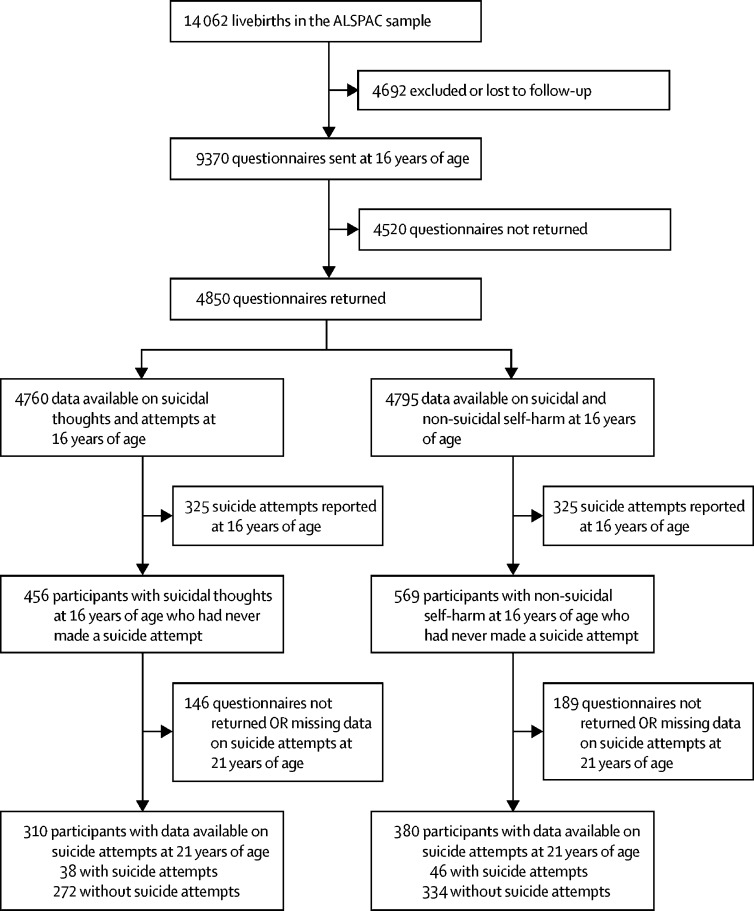
BACKGROUND: Suicidal thoughts and non-suicidal self-harm are common in adolescents and are strongly associated with suicide attempts. We aimed to identify predictors of future suicide attempts in these high-risk groups. METHODS: Participants were from the Avon Longitudinal Study of Parents and Children, a population-based birth cohort study in the UK. The sample included 456 adolescents who reported suicidal thoughts and 569 who reported non-suicidal self-harm at 16 years of age. Logistic regression analyses were used to explore associations between a wide range of prospectively recorded risk factors and future suicide attempts, assessed at the age of 21 years. FINDINGS: 38 (12%) of 310 participants with suicidal thoughts and 46 (12%) of 380 participants who had engaged in non-suicidal self-harm reported having attempted suicide for the first time by the follow-up at 21 years of age. Among participants with suicidal thoughts, the strongest predictors of transition to attempts were non-suicidal self-harm (odds ratio [OR] 2·78, 95% CI 1·35-5·74; p=0·0059), cannabis use (2·61, 1·11-6·14; p=0·029), other illicit drug use (2·47, 1·02-5·96; p=0·045), exposure to self-harm (family 2·03, 0·93-4·44, p=0·076; friend 1·85, 0·93-3·69, p=0·081), and higher levels of the personality type intellect/openness (1·62, 1·06-2·46; p=0·025). Among participants with non-suicidal self-harm at baseline, the strongest predictors were cannabis use (OR 2·14, 95% CI 1·04-4·41; p=0·038), other illicit drug use (2·17, 1·10-4·27; p=0·025), sleep problems (waking in the night 1·91, 0·95-3·84, p=0·069; insufficient sleep 1·97, 1·02-3·81, p=0·043), and lower levels of the personality type extraversion (0·71, 0·49-1·03; p=0·068). INTERPRETATION: Most adolescents who think about suicide or engage in non-suicidal self-harm will not make an attempt on their life. Many commonly cited risk factors were not associated with transition to suicide attempt among these high-risk groups. Our findings suggest that asking about substance use, non-suicidal self-harm, sleep, personality traits, and exposure to self-harm could inform risk assessments, and might help clinicians to identify which adolescents are at greatest risk of attempting suicide in the future. FUNDING: American Foundation for Suicide Prevention, National Institute for Health Research Biomedical Research Centre at the University Hospitals Bristol National Health Service Foundation Trust, and the University of Bristol.
Overview
CoChat Summary
TL;DR
In a UK population-based birth cohort, most adolescents with suicidal thoughts or non-suicidal self-harm at age 16 did not attempt suicide by age 21, but substance use, non-suicidal self-harm, sleep problems, and some personality/exposure factors predicted transition. The authors conclude that asking about these factors could help identify which high-risk adolescents are most likely to attempt suicide.
Key findings
- By age 21, 38 (12%) of 310 participants with suicidal thoughts and 46 (12%) of 380 participants with non-suicidal self-harm at baseline reported a first suicide attempt.
- Among adolescents with suicidal thoughts, the strongest predictors were non-suicidal self-harm (adjusted OR 2·78, 95% CI 1·35–5·74), cannabis use (2·61, 1·11–6·14), other illicit drug use (2·47, 1·02–5·96), and higher intellect/openness (1·62, 1·06–2·46); family and friend self-harm showed weaker evidence.
- Among adolescents with non-suicidal self-harm, the strongest predictors were cannabis use (adjusted OR 2·14, 95% CI 1·04–4·41), other illicit drug use (2·17, 1·10–4·27), and insufficient sleep (1·97, 1·02–3·81); waking in the night and lower extraversion showed weaker evidence.
- Of 107 participants reporting both suicidal thoughts and non-suicidal self-harm, 22 (21%) attempted suicide by follow-up, compared with 32 (1%) of 2283 participants reporting neither.
Methods
- Participants were from the Avon Longitudinal Study of Parents and Children (ALSPAC), a UK population-based birth cohort; analysis samples included 456 adolescents reporting suicidal thoughts and 569 reporting non-suicidal self-harm at age 16, after excluding 325 who had already attempted suicide by age 16.
- Logistic regression examined associations between prospectively recorded risk factors assessed at or before age 16 and first suicide attempt reported at age 21, adjusting for sex and socioeconomic position.
- Analyses used multiple imputation by chained equations with 50 imputed datasets; complete-case and imputed findings were broadly consistent.
Limitations
- Stated: associations cannot be assumed causal; only sex and socioeconomic position were adjusted for, and the authors did not aim to identify independent predictors.
- Stated: no date of first suicide attempt was available, so risk factors were restricted to those at or before age 16; the 5-year follow-up may miss shorter-term predictors, and excluding adolescents who had already attempted suicide may have weakened associations and limits applicability to those with prior attempts.
- Stated: analyses were exploratory without correction for multiple testing and need replication; attrition and non-random response to the age-16 self-harm questionnaire may limit generalisability, although imputed analyses were similar.
Model-written summary. Check it against the paper before relying on it.
Integrity signals
Registry
Cites
Statistics
Figures
Verification
Claims the paper makes
7 Valid · 0 Not valid · 4 Not checked · 58 Own results and interpretations
Every source the paper cites for this claim was checked and supports it.
In the paper
“In a previous study of more than 4500 adolescents,9 we explored a wide range of risk factors and found that exposure to self-harm in others, psychiatric disorders, and substance use most strongly distinguished between adolescents with suicidal thoughts and those who acted on those thoughts.”
§ Predictors of future suicide attempt among adolescents with suicidal thoughts or non-suicidal self-harm: a population-based birth cohort study > Introduction
What the sources say
- Supportedcites [9] Mars B Heron J Klonsky ED What distinguishes adolescents with suicidal thoughts from those who have attempted suicide? A population-based birth cohort study J Child Psychol Psychiatry 60 2019 91 99 29492978 PMC6334515 source
The Abstract reports 4,772 adolescents, and the Introduction says the study compared a wide range of risk factors. The Discussion identifies notably larger effects for exposure to self-harm in family or friends, mental health disorders, smoking, and illicit drug use excluding cannabis—the factors summarized in the claim. (LLM, conf=0.91)
boostedstates an association- Asserted: passes — The authors put it forward as true.
- Checkable: passes — It can be checked against evidence.
- Load-bearing: passes — The paper’s conclusions depend on it.
- Based: passes — The paper gives a reason why it holds.
- Supported
The cited sources support only part of this claim — read each source’s verdict below.
In the paper
“Several large epidemiological and meta-analytical studies provide empirical support for this framework and have found that many well established risk factors for suicide (such as depression, impulsivity, and hopelessness) do not meaningfully differentiate individuals with suicidal thoughts from those who have made an attempt.1, 5, 6, 7”
§ Predictors of future suicide attempt among adolescents with suicidal thoughts or non-suicidal self-harm: a population-based birth cohort study > Introduction
What the sources say
- Partly supportedcites [1] Nock MK Green JG Hwang I Prevalence, correlates, and treatment of lifetime suicidal behavior among adolescents: results from the National Comorbidity Survey Replication Adolescent Supplement JAMA Psychiatry 70 2013 300 310 23303463 PMC3886236 sourceExperimental — accuracy not yet measured
In Results (page unavailable), prior mental disorders are more strongly associated with ideation than with attempts among ideators, supporting the general point. But the Comment (page unavailable) says MDD/dysthymia predicts the transition from ideation to an attempt, and intermittent explosive disorder predicts planned attempts. The paper does not establish the claim about hopelessness, and its findings concern adolescents. (LLM, conf=0.87)
- Not checked — no full text of the sourcecites [5] May AM Klonsky ED What distinguishes suicide attempters from suicide ideators? A meta–analysis of potential factors Clin Psychol 23 2016 5 20 source
- Not checked — no full text of the sourcecites [6] Kessler RC Borges G Walters EE Prevalence of and risk factors for lifetime suicide attempts in the National Comorbidity Survey Arch Gen Psychiatry 56 1999 617 626 10401507 source
- Partly supportedcites [7] Nock MK Hwang I Sampson N Cross-national analysis of the associations among mental disorders and suicidal behavior: findings from the WHO World Mental Health Surveys PLoS Med 6 2009 e1000123 19668361 PMC2717212 sourceExperimental — accuracy not yet measured
The Discussion says major depression is much less useful for predicting which people with suicidal thoughts go on to make plans or attempts. But it identifies disorders characterized by poor impulse-control as among the strongest predictors of that progression, rather than showing that impulsivity fails to differentiate the groups. The provided passages do not assess hopelessness. (LLM, conf=0.88)
boosted- Asserted: passes — The authors put it forward as true.
- Checkable: passes — It can be checked against evidence.
- Load-bearing: passes — The paper’s conclusions depend on it.
- Based: passes — The paper gives a reason why it holds.
- Partly supported
The cited sources support only part of this claim — read each source’s verdict below.
In the paper
“Suicidal thoughts and non-suicidal self-harm are strongly associated with suicide attempts.”
§ Predictors of future suicide attempt among adolescents with suicidal thoughts or non-suicidal self-harm: a population-based birth cohort study > Introduction
What the sources say
- Partly supportedcites [1] Nock MK Green JG Hwang I Prevalence, correlates, and treatment of lifetime suicidal behavior among adolescents: results from the National Comorbidity Survey Replication Adolescent Supplement JAMA Psychiatry 70 2013 300 310 23303463 PMC3886236 sourceExperimental — accuracy not yet measured
The Results section (Prevalence and age-of-onset of suicidal behaviors; page unavailable) reports that 33.9% of adolescents with suicidal ideation made an attempt, supporting the link between suicidal thoughts and attempts. The Methods section (Measures; page unavailable) assesses ideation, plans, and attempts, but not non-suicidal self-harm; searches for that term and related terms found no evidence for the self-harm part of the claim. (LLM, conf=0.88)
- Not checked — no full text of the sourcecites [15] Hamza CA Stewart SL Willoughby T Examining the link between nonsuicidal self-injury and suicidal behavior: a review of the literature and an integrated model Clin Psychol Rev 32 2012 482 495 22717336 source
- Not checked — no full text of the sourcecites [16] Wilkinson P Kelvin R Roberts C Dubicka B Goodyer I Clinical and psychosocial predictors of suicide attempts and nonsuicidal self-injury in the Adolescent Depression Antidepressants and Psychotherapy Trial (ADAPT) Am J Psychiatry 168 2011 495 501 21285141 source
- Partly supportedcites [17] Guan K Fox KR Prinstein MJ Nonsuicidal self-injury as a time-invariant predictor of adolescent suicide ideation and attempts in a diverse community sample J Consult Clin Psychol 80 2012 842 849 22845782 PMC3458144 sourceExperimental — accuracy not yet measured
The Results section, “Longitudinal Prediction of Suicide Attempts” (page unavailable), reports that greater nonsuicidal self-injury was associated with a seven-fold increase in the likelihood of later attempts. It does not report a corresponding association between suicidal thoughts and attempts; the paper instead reports that self-injury predicted both later ideation and attempts. (LLM, conf=0.84)
- Supportedcites [18] Asarnow JR Porta G Spirito A Suicide attempts and nonsuicidal self-injury in the treatment of resistant depression in adolescents: findings from the TORDIA study J Am Acad Child Adolesc Psychiatry 50 2011 772 781 21784297 PMC3143365 source
In Results > Baseline Presentation (page unavailable), adolescents with histories of both nonsuicidal self-injury (NSSI) and suicide attempts had significantly higher suicidal-ideation scores than those with neither history. The same section reports a significant association between NSSI and suicide attempts; Results > Prediction of Time to SAs through Week 24 also identifies baseline NSSI as a significant predictor of later attempts. These findings are from adolescents with treatment-resistant depression. (LLM, conf=0.88)
- Not checked — no full text of the sourcecites [19] Klonsky ED May AM Glenn CR The relationship between nonsuicidal self-injury and attempted suicide: converging evidence from four samples J Abnorm Psychol 122 2013 231 237 23067259 source
boostedstates an association- Asserted: passes — The authors put it forward as true.
- Checkable: passes — It can be checked against evidence.
- Load-bearing: passes — The paper’s conclusions depend on it.
- Based: passes — The paper gives a reason why it holds.
- Partly supported
Every source the paper cites for this claim was checked and supports it.
In the paper
“Only a third of adolescents who have suicidal thoughts are estimated to go on to make a suicide attempt.1”
§ Predictors of future suicide attempt among adolescents with suicidal thoughts or non-suicidal self-harm: a population-based birth cohort study > Introduction
What the sources say
- Supportedcites [1] Nock MK Green JG Hwang I Prevalence, correlates, and treatment of lifetime suicidal behavior among adolescents: results from the National Comorbidity Survey Replication Adolescent Supplement JAMA Psychiatry 70 2013 300 310 23303463 PMC3886236 source
The Results section, under “Prevalence and age-of-onset of suicidal behaviors,” states that 33.9% of adolescents with suicidal ideation go on to make an attempt. That supports the citing sentence’s estimate of about one-third. (LLM, conf=0.94)
hedgedstates an association- Asserted: passes — The authors put it forward as true.
- Checkable: passes — It can be checked against evidence.
- Load-bearing: unclear — It is unclear whether the paper’s conclusions depend on it.
- Based: passes — The paper gives a reason why it holds.
- Supported
The cited sources support only part of this claim — read each source’s verdict below.
In the paper
“Both of these factors have been associated with suicidal behaviour in previous research;36, 37, 38, 39 however, our study is the first to explore prospectively the role of sleep difficulties and personality traits in the transition to suicide attempts over time.”
§ Predictors of future suicide attempt among adolescents with suicidal thoughts or non-suicidal self-harm: a population-based birth cohort study > Discussion
What the sources say
- Not checked — no full text of the sourcecites [36] O'Connor RC Nock MK The psychology of suicidal behaviour Lancet Psychiatry 1 2014 73 85 26360404 source
- Supportedcites [37] Hysing M Stormark KM O'Connor RC Sleep problems and self-harm in adolescence Br J Psychiatry 207 2015 306 312 26206862 source
The citation supports the sentence’s first clause, not the citing authors’ claim about their own prospective study. The Abstract describes prior evidence linking sleep problems to suicidal behaviour and identifies an established relationship between perfectionism and self-harm; the References also list a review of perfectionism and suicidality. The source is not being cited as the prospective study. (LLM, conf=0.87)
- Partly supportedcites [38] Wong MM Brower KJ Craun EA Insomnia symptoms and suicidality in the national comorbidity survey–adolescent supplement J Psychiatr Res 81 2016 1 8 27355426 PMC5021568 sourceExperimental — accuracy not yet measured
The citation attaches to the statement that sleep difficulties and personality traits have been associated with suicidal behaviour in previous research, not to the citing authors’ claim about their own prospective study. The source’s Results (section 3.2; page unavailable) associate sleep problems with suicidal thoughts, plans and attempts, but the passages do not establish an association for personality traits. (LLM, conf=0.86)
- Not checked — no full text of the sourcecites [39] Pigeon WR Pinquart M Conner K Meta-analysis of sleep disturbance and suicidal thoughts and behaviors J Clin Psychiatry 73 2012 e1160 e1167 23059158 source
plainstates an association- Asserted: passes — The authors put it forward as true.
- Checkable: passes — It can be checked against evidence.
- Load-bearing: passes — The paper’s conclusions depend on it.
- Based: passes — The paper gives a reason why it holds.
44 more claims
Create a free account to see all 69 claims and every source verdict.
- Probably not a substantial claim. 11
- It may state two separate claims as one. 11
Claims other papers make about this one
Each is checked against this paper’s own text: does it say what the citing paper says it does?
The source backs part of the claim, not all of it — or backs it for a different population, condition or comparison.
In the citing paper
“Although most adolescents that have suicidal thoughts and behaviors do not progress to suicide attempts, they account for 26% of future suicide attempts by the age of 26 and they are strongly associated with suicide death [11].”
From Adolescent Suicide—Understanding Unique Risks and Opportunities for Trauma Centers to Recognize, Intervene, and Prevent a Leading Cause of Death (2022) · cites this paper as [11]
Experimental — accuracy not yet measuredThe source backs part of the claim, not all of it — or backs it for a different population, condition or comparison.
In the citing paper
“Certain mental health disorders and a history of suicide behaviors (ideation, attempts) and non-suicidal self-injury (NSSI) significantly increase risk [7••, 11].”
From Adolescent Suicide—Understanding Unique Risks and Opportunities for Trauma Centers to Recognize, Intervene, and Prevent a Leading Cause of Death (2022) · cites this paper as [11]
Experimental — accuracy not yet measuredThe source backs part of the claim, not all of it — or backs it for a different population, condition or comparison.
In the citing paper
“alcohol and illicit substance use further potentiates the risk of suicide among youth with depression [11, 71].”
From Adolescent Suicide—Understanding Unique Risks and Opportunities for Trauma Centers to Recognize, Intervene, and Prevent a Leading Cause of Death (2022) · cites this paper as [11]
Experimental — accuracy not yet measuredThe source backs part of the claim, not all of it — or backs it for a different population, condition or comparison.
In the citing paper
“substance abuse is not only an independent risk factor for suicide”
From Adolescent Suicide—Understanding Unique Risks and Opportunities for Trauma Centers to Recognize, Intervene, and Prevent a Leading Cause of Death (2022) · cites this paper as [11]
Experimental — accuracy not yet measuredThe source backs part of the claim, not all of it — or backs it for a different population, condition or comparison.
In the citing paper
“some clinical factors that may influence the transition from suicidal ideation to suicide attempt include anxiety disorders, impulse-control disorders, post-traumatic stress disorder, eating disorders, previous self-harm, exposure to suicidal behaviour in others, and alcohol and drug abuse or dependence 6,7,88 .”
From Suicide and suicide risk (2019) · cites this paper as [7]
Experimental — accuracy not yet measured
7 more claims about this paper
Create a free account to see every claim other papers make about this one.
Self-check
Percentages, sums and reported differences re-computed from the paper’s own numbers.
Each contradiction between two passages listed here was confirmed by an independent check.
Rated minor: it would not touch a result — a value no result rests on, a p-value that stays on the same side of the significance level, or a conflict that is clerical, resolved elsewhere in the paper, or outside its own findings.
In the paper
§ Predictors of future suicide attempt among adolescents with suicidal thoughts or non-suicidal self-harm: a population-based birth cohort study > Results
“17·9 (15·61)”
§ Predictors of future suicide attempt among adolescents with suicidal thoughts or non-suicidal self-harm: a population-based birth cohort study > Results
“17·1 (4·33) | 17·7 (3·78)”
Rated minor: it would not touch a result — a value no result rests on, a p-value that stays on the same side of the significance level, or a conflict that is clerical, resolved elsewhere in the paper, or outside its own findings.
In the paper
“| Female | 202 (74%) | 28 (74%) | 275 (82%) | 36 (70%) |”
§ Predictors of future suicide attempt among adolescents with suicidal thoughts or non-suicidal self-harm: a population-based birth cohort study > Results
Reported 70 · recomputed 78.26087
Rated minor: it would not touch a result — a value no result rests on, a p-value that stays on the same side of the significance level, or a conflict that is clerical, resolved elsewhere in the paper, or outside its own findings.
In the paper
§ Predictors of future suicide attempt among adolescents with suicidal thoughts or non-suicidal self-harm: a population-based birth cohort study > Results
“| | Attentional control | 17·9 (15·61) | 17·1 (4·33) | 17·7 (3·78) |”
§ Predictors of future suicide attempt among adolescents with suicidal thoughts or non-suicidal self-harm: a population-based birth cohort study > Results
“| | Total sample | No transition to attempts | Transition to attempts | Unadjusted odds ratio (95% CI) | p value | Adjusted odds ratio*(95% CI) | p value |”
Rated minor: it would not touch a result — a value no result rests on, a p-value that stays on the same side of the significance level, or a conflict that is clerical, resolved elsewhere in the paper, or outside its own findings.
In the paper
§ Predictors of future suicide attempt among adolescents with suicidal thoughts or non-suicidal self-harm: a population-based birth cohort study > Results
“waking in the night (adjusted OR 1·91, 95% CI 0·93–4·44; p=0·069)”
§ Predictors of future suicide attempt among adolescents with suicidal thoughts or non-suicidal self-harm: a population-based birth cohort study > Results
“| | Waking in the night | 55% | 52% | 67% | 1·94 (1·01–3·73) | 0·047 | 1·91 (0·95–3·84) | 0·069 |”
Rated minor: it would not touch a result — a value no result rests on, a p-value that stays on the same side of the significance level, or a conflict that is clerical, resolved elsewhere in the paper, or outside its own findings.
In the paper
§ Predictors of future suicide attempt among adolescents with suicidal thoughts or non-suicidal self-harm: a population-based birth cohort study > Results
“| | Attentional switching | 11·3 (14·48) | 11·5 (15·19) | 12·2 (15·7) |”
§ Predictors of future suicide attempt among adolescents with suicidal thoughts or non-suicidal self-harm: a population-based birth cohort study > Results
“| | Total sample | No transition to attempts | Transition to attempts | Unadjusted odds ratio (95% CI) | p value | Adjusted odds ratio*(95% CI) | p value |”
Citations
Cites
The interpersonal theory of suicide.
Van Orden, K. A., Witte, T. K., Cukrowicz, K. C., Braithwaite, S. R., Selby, E. A., & Joiner, T. E. (2010) · Psychological Review · doi:10.1037/a0018697 · Cited by 5,292
Multiple imputation by chained equations: what is it and how does it work?
Azur, M. J., Stuart, E. A., Frangakis, C., & Leaf, P. J. (2011) · International Journal of Methods in Psychiatric Research · doi:10.1002/mpr.329 · Cited by 3,542
Boyd, A., Golding, J., Macleod, J., Lawlor, D. A., Fraser, A., Henderson, J., Molloy, L., Ness, A., Ring, S., & Davey Smith, G. (2013) · International Journal of Epidemiology · doi:10.1093/ije/dys064 · Cited by 2,996
Prevalence of and Risk Factors for Lifetime Suicide Attempts in the National Comorbidity Survey
Kessler, R. C., Borges, G., & Walters, E. E. (1999) · Archives of General Psychiatry · doi:10.1001/archpsyc.56.7.617 · Cited by 2,514
Cohort Profile: The Avon Longitudinal Study of Parents and Children: ALSPAC mothers cohort
Fraser, A., Macdonald-Wallis, C., Tilling, K., Boyd, A., Golding, J., Davey Smith, G., Henderson, J., Macleod, J., Molloy, L., Ness, A., et al. (2013) · International Journal of Epidemiology · doi:10.1093/ije/dys066 · Cited by 2,494
Self-citationThe Three-Step Theory (3ST): A New Theory of Suicide Rooted in the “Ideation-to-Action” Framework
Klonsky, E. D., & May, A. M. (2015) · International Journal of Cognitive Therapy · doi:10.1521/ijct.2015.8.2.114 · Cited by 1,799
Self-citationThe integrated motivational–volitional model of suicidal behaviour
O'Connor, R. C., & Kirtley, O. J. (2018) · Philosophical Transactions of the Royal Society B: Biological Sciences · doi:10.1098/rstb.2017.0268 · Cited by 1,781
Self-citationNock, M. K., Green, J. G., Hwang, I., McLaughlin, K. A., Sampson, N. A., Zaslavsky, A. M., & Kessler, R. C. (2013) · JAMA Psychiatry · doi:10.1001/2013.jamapsychiatry.55 · Cited by 1,666
Multiple Imputation by Chained Equations (MICE): Implementation in Stata
Royston, P., & White, I. (2011) · Journal of Statistical Software · doi:10.18637/jss.v045.i04 · Cited by 1,248
The psychology of suicidal behaviour
O'Connor, R. C., & Nock, M. K. (2014) · The Lancet Psychiatry · doi:10.1016/s2215-0366(14)70222-6 · Cited by 1,193
Self-citation
Cited by
Turecki, G., Brent, D. A., Gunnell, D., O’Connor, R. C., Oquendo, M. A., Pirkis, J., & Stanley, B. H. (2019) · Nature Reviews Disease Primers · doi:10.1038/s41572-019-0121-0 · Cited by 1,074
Self-citationMcClelland, H., Evans, J. J., Nowland, R., Ferguson, E., & O'Connor, R. C. (2020) · Journal of Affective Disorders · doi:10.1016/j.jad.2020.05.004 · Cited by 466
“In addition to acts of suicidal behaviour, given that approximately 12% of individuals who experience suicidal ideation or NSSI will attempt suicide within 5 years (Mars et al., 2019), we also investigated the relationship between loneliness and suicidal ideation or thoughts of self-harm.”
BackgroundSelf-citationMcManus, S., Gunnell, D., Cooper, C., Bebbington, P. E., Howard, L. M., Brugha, T., Jenkins, R., Hassiotis, A., Weich, S., & Appleby, L. (2019) · The Lancet Psychiatry · doi:10.1016/s2215-0366(19)30188-9 · Cited by 415
Self-citationKnipe, D., Padmanathan, P., Newton-Howes, G., Chan, L. F., & Kapur, N. (2022) · The Lancet · doi:10.1016/s0140-6736(22)00173-8 · Cited by 331
Social media, internet use and suicide attempts in adolescents
Sedgwick, R., Epstein, S., Dutta, R., & Ougrin, D. (2019) · Current Opinion in Psychiatry · doi:10.1097/yco.0000000000000547 · Cited by 260
Sleep and suicide: A systematic review and meta-analysis of longitudinal studies
Liu, R. T., Steele, S. J., Hamilton, J. L., Do, Q. B. P., Furbish, K., Burke, T. A., Martinez, A. P., & Gerlus, N. (2020) · Clinical Psychology Review · doi:10.1016/j.cpr.2020.101895 · Cited by 239
Risk and protective factors for childhood suicidality: a US population-based study
Janiri, D., Doucet, G. E., Pompili, M., Sani, G., Luna, B., Brent, D. A., & Frangou, S. (2020) · The Lancet Psychiatry · doi:10.1016/s2215-0366(20)30049-3 · Cited by 204
Harris, L. M., Huang, X., Linthicum, K. P., Bryen, C. P., & Ribeiro, J. D. (2020) · Scientific Reports · doi:10.1038/s41598-020-70866-6 · Cited by 201
Williams, A. J., Jones, C., Arcelus, J., Townsend, E., Lazaridou, A., & Michail, M. (2021) · PLOS ONE · doi:10.1371/journal.pone.0245268 · Cited by 187
“Given the large number of individual risk factors, similar variables were categorised resembling the format used by previous literature [40]; demographic, psychosocial, mental health difficulties.”
MethodQu, D., Wen, X., Liu, B., Zhang, X., He, Y., Chen, D., Duan, X., Yu, J., Liu, D., Zhang, X., et al. (2023) · The Lancet Regional Health - Western Pacific · doi:10.1016/j.lanwpc.2023.100794 · Cited by 183
Kothgassner, O. D., Robinson, K., Goreis, A., Ougrin, D., & Plener, P. L. (2020) · Borderline Personality Disorder and Emotion Dysregulation · doi:10.1186/s40479-020-00123-9 · Cited by 163
“In particular, the interpersonal–psychological theory of suicidal behaviour argues that engaging in NSSI increases a person’s capability for suicide by creating habituation to the psychophysiological aversiveness of self-injury [35], with recent evidence that engaging in NSSI is one of the strongest predictors of tran…”
BackgroundKaess, M., Hooley, J. M., Klimes‐Dougan, B., Koenig, J., Plener, P. L., Reichl, C., Robinson, K., Schmahl, C. G., Sicorello, M., Schreiner, M. W., et al. (2021) · Neuroscience & Biobehavioral Reviews · doi:10.1016/j.neubiorev.2021.08.022 · Cited by 163
“Critically, NSSI is a significant predictor of subsequent suicide (Mars et al., 2019).”
BackgroundPoudel, A., Lamichhane, A., Magar, K. R., & Khanal, G. P. (2022) · BMC Psychiatry · doi:10.1186/s12888-022-03763-z · Cited by 199
“Most of the previous studies suggest that NSSI is a strong risk factor for future SA [10, 11, 27, 30].”
BackgroundDepression and Suicidal Behavior in Adolescents
Grossberg, A., & Rice, T. (2022) · Medical Clinics of North America · doi:10.1016/j.mcna.2022.04.005 · Cited by 199
Sleep Deprivation and Insomnia in Adolescence: Implications for Mental Health
Uccella, S., Cordani, R., Salfi, F., Gorgoni, M., Scarpelli, S., Gemignani, A., Geoffroy, P. A., De Gennaro, L., Palagini, L., Ferrara, M., et al. (2023) · Brain Sciences · doi:10.3390/brainsci13040569 · Cited by 131
“from NSSIs to SA in a 16-years old sample [75].”
BackgroundThe prevalence of self-injury in adolescence: a systematic review and meta-analysis
Farkas, B. F., Takács, Z. K., Kollárovics, N., & Balázs, J. (2023) · European Child & Adolescent Psychiatry · doi:10.1007/s00787-023-02264-y · Cited by 196
McManus, S., Walby, S., Barbosa, E. C., Appleby, L., Brugha, T. S., Bebbington, P., Cook, E. A., & Knipe, D. W. (2022) · The Lancet Psychiatry · doi:10.1016/s2215-0366(22)00151-1 · Cited by 171
“30 Suicide is rarely the consequence of a single risk factor or event, but could result from a cumulation and interaction of multiple factors.”
Nordin, N., Zainol, Z. B., Noor, M. H. M., & Chan, L. F. (2022) · Asian Journal of Psychiatry · doi:10.1016/j.ajp.2022.103316 · Cited by 141
Niederkrotenthaler, T., Gunnell, D., Arensman, E., Pirkis, J., Appleby, L., Hawton, K., John, A., Kapur, N., Khan, M., O'Connor, R. C., et al. (2020) · Crisis · doi:10.1027/0227-5910/a000731 · Cited by 115
“What is the impact of COVID-19 on suicide and suicidal behavior in different occupational groups, e.g., health-care staff, those working in the retail sector, artists, and groups in precarious working conditions? iors (Mars et al., 2019; May & Klonsky, 2016).”
BackgroundSelf-citationQuarshie, E. N.-B., Waterman, M. G., & House, A. O. (2020) · BMC Psychiatry · doi:10.1186/s12888-020-02587-z · Cited by 100
Dantchev, S., Hickman, M., Heron, J. E., Zammit, S., & Wolke, D. (2019) · Frontiers in Psychiatry · doi:10.3389/fpsyt.2019.00651 · Cited by 113
“Suicidal ideation was assessed at 24 years only via 1 item asking participants whether they had ever had thoughts about killing themselves at some point during their lifetime (Mars et al., 2019).”
Self-citationReconsidering Informed Consent for Trans-Identified Children, Adolescents, and Young Adults
Levine, S. B., Abbruzzese, E., & Mason, J. W. (2022) · Journal of Sex & Marital Therapy · doi:10.1080/0092623x.2022.2046221 · Cited by 110
“Clinicians caring for trans-identified youth should be reminded that suicide risk in all patients is a multi-factorial phenomenon (Mars et al., 2019).”
BackgroundRisk and Protective Factors in Adolescent Suicidal Behaviour: A Network Analysis
Fonseca‐Pedrero, E., Al‐Halabí, S., Pérez‐Albéniz, A., & Debbané, M. (2022) · International Journal of Environmental Research and Public Health · doi:10.3390/ijerph19031784 · Cited by 131
Autistic traits in adults who have attempted suicide
Richards, G., Kenny, R., Griffiths, S., Allison, C., Mosse, D., Holt, R., O’Connor, R. C., Cassidy, S., & Baron-Cohen, S. (2019) · Molecular Autism · doi:10.1186/s13229-019-0274-4 · Cited by 85
Self-citationGeoffroy, P. A., Tebeka, S., Blanco, C., Dubertret, C., & Strat, Y. L. (2020) · Journal of Psychiatric Research · doi:10.1016/j.jpsychires.2020.02.018 · Cited by 95
Robinson, K., Garisch, J. A., & Wilson, M. (2021) · Journal of Affective Disorders · doi:10.1016/j.jad.2020.12.201 · Cited by 91
Kuhns, L., Kroon, E., Colyer‐Patel, K., & Cousijn, J. (2021) · Psychopharmacology · doi:10.1007/s00213-021-06001-8 · Cited by 85
Adolescent mental health in China requires more attention
Wang, C., Zhang, P., & Zhang, N. (2020) · The Lancet Public Health · doi:10.1016/s2468-2667(20)30094-3 · Cited by 75
Hink, A. B., Killings, X., Bhatt, A., Ridings, L. E., & Andrews, A. L. (2022) · Current Trauma Reports · doi:10.1007/s40719-022-00223-7 · Cited by 67
Depression and suicidal thoughts in untreated and treated narcolepsy: Systematic analysis
Barateau, L., Lopez, R., Chenini, S., Pesenti, C., Rassu, A. L., Jaussent, I., & Dauvilliers, Y. A. (2020) · Neurology · doi:10.1212/wnl.0000000000010737 · Cited by 66
“In addition, the presence of clinically definedmajor depressive episode, suicidal thoughts, and suicide risks have been seldom investigated in NT1, although sleep disturbances are often associated with suicidality.(19,20) Moreover, depressed patients with suicidal behavior seem to have lower CSF ORX levels than other…”
BackgroundRomanelli, M., Sheftall, A. H., Irsheid, S. B., Lindsey, M. A., & Grogan, T. M. (2022) · Prevention Science · doi:10.1007/s11121-021-01295-8 · Cited by 65
Xie, X., Li, Y., Liu, J., Zhang, L., Sun, T., Zhang, C., Liu, Z., Liu, J., Li, W., Gong, X., et al. (2023) · Psychiatry Research · doi:10.1016/j.psychres.2023.115638 · Cited by 73
“The Diagnostic and Statistical Manual of Mental Disorders, Fifth Edition (DSM-5) now acknowledges NSSI as a distinct mental health concern (Mars et al., 2019).”
BackgroundHu, Z., Yu, H., Zou, J., Zhang, Y., Lu, Z., & Hu, M. (2021) · Brain and Behavior · doi:10.1002/brb3.2419 · Cited by 63
Byrne, S. J., Bellairs-Walsh, I., Rice, S. M., Bendall, S., Lamblin, M., Boubis, E., McGregor, B., O’Keefe, M., & Robinson, J. (2021) · International Journal of Environmental Research and Public Health · doi:10.3390/ijerph18062892 · Cited by 61
“EDs need to be able to respond compassionately and effectively to self-harm, regardless of intent, remaining cognizant that self-harm is one of the most consistent known risk factors for suicide [90].”
BackgroundAdolescent suicide: what can pediatricians do?
Breslin, K., Balaban, J., & Shubkin, C. D. (2020) · Current Opinion in Pediatrics · doi:10.1097/mop.0000000000000916 · Cited by 66
Horváth, L. O., Győri, D., Komáromy, D., Mészáros, G., Szentiványi, D., & Balázs, J. (2020) · Frontiers in Psychiatry · doi:10.3389/fpsyt.2020.00370 · Cited by 71
Classification and Epidemiology of Sleep Disorders in Children and Adolescents
Trosman, I., & Ivanenko, A. (2020) · Child and Adolescent Psychiatric Clinics of North America · doi:10.1016/j.chc.2020.08.002 · Cited by 83
Cannabinoid use and self-injurious behaviours: A systematic review and meta-analysis
Escelsior, A., Murri, M. B., Corsini, G. P., Serafini, G., Aguglia, A., Zampogna, D., Cattedra, S., Nebbia, J., Trabucco, A., Prestía, D., et al. (2020) · Journal of Affective Disorders · doi:10.1016/j.jad.2020.09.020 · Cited by 71
Machine learning-based prediction for self-harm and suicide attempts in adolescents
Su, R., John, J. R., & Lin, P. (2023) · Psychiatry Research · doi:10.1016/j.psychres.2023.115446 · Cited by 88
“These results lend some support for the need of utilising ML techniques to process vast amount of information simultaneously, which outperform the prediction dependent solely on history of self-harm or suicide attempt (Mars et al., 2019; Ribeiro et al., 2016).”
Two Pathways to Self-Harm in Adolescence
Uh, S., Dalmaijer, E. S., Siugzdaite, R., Ford, T. J., & Astle, D. E. (2021) · Journal of the American Academy of Child & Adolescent Psychiatry · doi:10.1016/j.jaac.2021.03.010 · Cited by 54
Sinyor, M., Williams, M., Mitchell, R., Zaheer, R., Bryan, C. J., Schaffer, A., Westreich, N., Ellis, J., Goldstein, B. I., Cheung, A. H., et al. (2020) · Journal of Affective Disorders · doi:10.1016/j.jad.2020.01.178 · Cited by 53
Kirshenbaum, J. S., Pagliaccio, D., Bitran, A., Xu, E., & Auerbach, R. P. (2024) · Translational Psychiatry · doi:10.1038/s41398-024-02914-y · Cited by 81
“Consistent with these fi ndings, transgender adolescents endorse greater perceived burdensome-ness compared to thwarted belongingness [125, 126]; however in those who attempted suicide, most patients endorsed a combination of these IPTS factors [126].”
BackgroundGeoffroy, M., Orri, M., Girard, A., Perret, L. C., & Turecki, G. (2020) · Psychological Medicine · doi:10.1017/s0033291720000732 · Cited by 69
Commisso, M., Temcheff, C. E., Orri, M., Poirier, M., Lau, M., Côté, S. M., Vitaro, F., Turecki, G., Tremblay, R. E., & Geoffroy, M. (2021) · Psychological Medicine · doi:10.1017/s0033291721002464 · Cited by 59
“In line with our findings, prior studies found that impulsivity, a feature of externalizing problems, is a key contributing factor to the progression from suicidal ideation to suicide attempt (Mars et al., 2019a).”
Bjureberg, J., Kuja‐Halkola, R., Ohlis, A., Lichtenstein, P., D'Onofrio, B. M., Hellner, C., & Cederlöf, M. (2021) · Journal of Child Psychology and Psychiatry · doi:10.1111/jcpp.13544 · Cited by 58
Fresán, A., Dionisio-García, D. M., González‐Castro, T. B., Ramos-Méndez, M. Á., Castillo-Ávila, R. G., Tovilla‐Zárate, C. A., Juárez‐Rojop, I. E., López‐Narváez, M. L., Mendoza, A. D. G., & Nicolini, H. (2022) · Journal of Psychiatric Research · doi:10.1016/j.jpsychires.2022.06.053 · Cited by 66
Hasking, P. A., Lewis, S. P., Bloom, E. L., Brausch, A. M., Kaess, M., & Robinson, K. (2020) · School Psychology International · doi:10.1177/0143034320974414 · Cited by 65
“People who engage in NSSI are over four times more likely to subsequently make a suicide attempt (Ribeiro et al., 2016), and engaging in NSSI predicts the transition from suicidal ideation to suicidal attempts among adolescents (Mars et al., 2019).”
BackgroundZhu, S., Lee, P. H., & Wong, P. W. C. (2021) · BJPsych Open · doi:10.1192/bjo.2021.47 · Cited by 51
Islam, M. I., Yunus, F. M., Kabir, E., & Khanam, R. (2022) · American Journal of Health Promotion · doi:10.1177/08901171211034105 · Cited by 48
“One possible explanation is that insufficient sleep may play a role in impairing social connectedness and may subsequently increase depression in an individual and may lead to suicidality and self-harm.(22) Further, high level of self-esteem was found to be significantly associated with self-harm only in traditional b…”
BackgroundGlenn, C. R., Kleiman, E. M., Kearns, J. C., Boatman, A. E., Conwell, Y., Alpert‐Gillis, L. J., & Pigeon, W. R. (2021) · Development and Psychopathology · doi:10.1017/s0954579421000699 · Cited by 51
“Shorter sleep duration has been related to greater risk for STBs in youth (Chiu et al., 2018; Mars et al., 2019), and a real-time monitoring study with adults found associations between less TST and suicide ideation at the daily level (Littlewood et al.”
BackgroundInfluentialYe, Z., Xiong, F., & Li, W. (2022) · Frontiers in Psychiatry · doi:10.3389/fpsyt.2022.976217 · Cited by 63
Protective factors for suicidal ideation: a prospective study from adolescence to adulthood
Bakken, V., Lydersen, S., Skokauskas, N., Sund, A. M., & Kaasbøll, J. (2024) · European Child & Adolescent Psychiatry · doi:10.1007/s00787-024-02379-w · Cited by 86
“Although most adolescents experiencing SI will not act upon their thoughts [11], SI is a robust predictor of suicide attempts and deaths at all ages [12].”
BackgroundVidal-Ribas, P., Janiri, D., Doucet, G. E., Pornpattananangkul, N., Nielson, D. M., Frangou, S., & Stringaris, A. (2021) · American Journal of Psychiatry · doi:10.1176/appi.ajp.2020.20020120 · Cited by 45
Kim, S. Y., Kim, H., Park, B., & Choi, H. G. (2021) · JAMA Network Open · doi:10.1001/jamanetworkopen.2021.36137 · Cited by 49
Jiao, T., Guo, S., Zhang, Y., Li, Y., Xie, X., Ma, Y., Chen, R., Yu, Y., & Tang, J. (2022) · Frontiers in Psychiatry · doi:10.3389/fpsyt.2022.1018525 · Cited by 54
Hielscher, E., DeVylder, J., Hasking, P. A., Connell, M., Martin, G., & Scott, J. G. (2020) · European Child & Adolescent Psychiatry · doi:10.1007/s00787-020-01593-6 · Cited by 47
Zhang, Y., Lai, S., Wu, W., Wang, Y., Zhao, H., He, J., Zhu, Y., Chen, G., Qi, Z., Chen, P., et al. (2021) · Journal of Affective Disorders · doi:10.1016/j.jad.2021.10.132 · Cited by 49
Hu, C., Huang, J., Shang, Y., Huang, T., Jiang, W., & Yuan, Y. (2023) · Child and Adolescent Psychiatry and Mental Health · doi:10.1186/s13034-023-00557-3 · Cited by 54
“NSSI is increasingly recognized as a significant public health concern because of its high prevalence and its association with several internalizing and externalizing disorders [5] and NSSI is considered to be a strong predictor of suicidal behaviour [6].”
BackgroundPadmanathan, P., Hall, K., Moran, P., Jones, H. E., Gunnell, D., Carlisle, V., Lingford-Hughes, A., & Hickman, M. (2020) · Comprehensive Psychiatry · doi:10.1016/j.comppsych.2019.152135 · Cited by 41
Self-citationKlim-Conforti, P., Zaheer, R., Levitt, A. J., Cheung, A. H., Schachar, R., Schaffer, A., Goldstein, B. I., Fefergrad, M., Niederkrotenthaler, T., & Sinyor, M. (2021) · Journal of Affective Disorders · doi:10.1016/j.jad.2021.02.028 · Cited by 41
Wei, C., Li, Z., Ma, T., Jiang, X., Yu, C., & Xu, Q. (2022) · Frontiers in Public Health · doi:10.3389/fpubh.2022.944726 · Cited by 48
“Longitudinal results have shown that NSSI is a predictor of adolescents’ suicidal behavior, not only a simple correlate (10).”
BackgroundHaregu, T., Cho, E., Spittal, M. J., & Armstrong, G. (2023) · Journal of Affective Disorders · doi:10.1016/j.jad.2023.03.063 · Cited by 49
Using machine learning to classify suicide attempt history among youth in medical care settings
Burke, T. A., Jacobucci, R., Ammerman, B. A., Alloy, L. B., & Diamond, G. S. (2020) · Journal of Affective Disorders · doi:10.1016/j.jad.2020.02.048 · Cited by 45
Oliphant, R. Y. K., Smith, E. M., & Grahame, V. (2020) · Journal of Autism and Developmental Disorders · doi:10.1007/s10803-020-04422-6 · Cited by 49
A comparative study of machine learning techniques for suicide attempts predictive model
Nordin, N., Zainol, Z. B., Noor, M. H. M., & Fong, C. L. (2021) · Health Informatics Journal · doi:10.1177/1460458221989395 · Cited by 42
mHealth Interventions for Self-Harm: Scoping Review
Cliffe, B., Tingley, J., Greenhalgh, I., & Stallard, P. (2021) · Journal of Medical Internet Research · doi:10.2196/25140 · Cited by 29
“Notably, self-harm has been identified as a significant and persistent predictor of suicide [4].”
BackgroundXu, H., Song, X., Wang, S., Zhang, S., Xu, S., & Wan, Y. (2019) · International Journal of Environmental Research and Public Health · doi:10.3390/ijerph16204023 · Cited by 42
Kushal, S. A., Amin, Y. M., Reza, S., & Shawon, M. S. R. (2020) · EClinicalMedicine · doi:10.1016/j.eclinm.2020.100691 · Cited by 42
“Despite the potential benefits of parents-adolescent relationships on suicidal behaviours among adolescents, the current evidence base is importantly limited by one or more of the following: i) lack of comprehensive assessment of various aspects of parents-adolescent relationships; ii) it is unclear whether different…”
BackgroundGardner, K. J., Paul, E., Selby, E. A., Klonsky, E. D., & Mars, B. (2021) · Frontiers in Psychology · doi:10.3389/fpsyg.2021.688472 · Cited by 50
Self-citationDistinguishing prisoners who think about suicide from those who attempt suicide
Favril, L., & O’Connor, R. C. (2019) · Psychological Medicine · doi:10.1017/s0033291719003118 · Cited by 47
Self-citationFavril, L. (2021) · Psychologica Belgica · doi:10.5334/pb.1072 · Cited by 60
Hedley, D., Hayward, S. M., Denney, K., Uljarević, M., Bury, S., Sahin, E., Brown, C. M., Clapperton, A., Dissanayake, C., Robinson, J., et al. (2021) · Autism Research · doi:10.1002/aur.2614 · Cited by 38
“, 2021), which are strong predictors of suicide attempt (Klonsky et al., 2017; Mars et al., 2019; Nock et al., 2009; Nock et al., 2013).”
BackgroundPredictors of chronic loneliness during adolescence: a population-based cohort study
Hosozawa, M., Cable, N., Yamasaki, S., Ando, S., Endo, K., Usami, S., Nakanishi, M., Niimura, J., Nakajima, N., Baba, K., et al. (2022) · Child and Adolescent Psychiatry and Mental Health · doi:10.1186/s13034-022-00545-z · Cited by 38
Zou, H., Huang, J., Zhang, W., Wu, J., Wu, W., & Huo, L. (2023) · Journal of Affective Disorders · doi:10.1016/j.jad.2023.08.099 · Cited by 43
Hyland, P., Rochford, S., Munnelly, A., Dodd, P. C., Fox, R. J., Vallières, F., McBride, O., Shevlin, M. E., Bentall, R. P., Butter, S., et al. (2021) · Suicide and Life-Threatening Behavior · doi:10.1111/sltb.12783 · Cited by 45
“Our findings, therefore, are consistent with and complement those from studies that have investigated the association between these phenomena over time (Mars et al., 2019; Neeleman et al., 2004; Ribeiro et al., 2016).”
ResultIslam, M. I., Khanam, R., & Kabir, E. (2021) · Journal of Affective Disorders · doi:10.1016/j.jad.2021.10.061 · Cited by 41
Ma, Y., Guo, H., Guo, S., Jiao, T., Zhao, C., Ammerman, B. A., Gazimbi, M. M., Yu, Y., Chen, R., Wang, H., et al. (2021) · JAMA Network Open · doi:10.1001/jamanetworkopen.2021.33596 · Cited by 39
Young Adult Outcomes Associated With Adolescent Suicidality: A Meta-analysis
Cantor, N., Kingsbury, M. K., Warner, E. A., Landry, H., Clayborne, Z. M., Islam, R., & Colman, I. (2023) · PEDIATRICS · doi:10.1542/peds.2022-058113 · Cited by 40
Liang, K., Zhao, L., Lei, Y., Zou, K., Ji, S., Wang, R., & Huang, X. (2022) · Comprehensive Psychiatry · doi:10.1016/j.comppsych.2022.152311 · Cited by 47
Farooq, B., Clements, C., Hawton, K. E., Geulayov, G., Casey, D., Waters, K., Ness, J., Patel, A., Kelly, S., Townsend, E., et al. (2021) · The Lancet Child & Adolescent Health · doi:10.1016/s2352-4642(21)00239-x · Cited by 43
Adverse Childhood Experiences and Nonsuicidal Self-Injury and Suicidality in Chinese Adolescents
He, Y., Jiang, W., Wang, W., Liu, Q., Peng, S., & Guo, L. (2024) · JAMA Network Open · doi:10.1001/jamanetworkopen.2024.52816 · Cited by 43
Factors associated with the transition from suicidal ideation to suicide attempt in prison
Favril, L., O’Connor, R. C., Hawton, K. E., & Laenen, F. V. (2020) · European Psychiatry · doi:10.1192/j.eurpsy.2020.101 · Cited by 44
“Consistent with studies highlighting that exposure to suicidal behavior of others is associated with the transition from ideation to attempt in youth [11,35], we found that prisoners exposed to suicidal behavior of incarcerated peers were twice as likely to act on their suicidal thoughts relative to those with no such…”
Self-citationKim, H., Son, Y., Lee, H., Kang, J., Hammoodi, A., Choi, Y., Kim, H. J., Lee, H., Fond, G. B., Boyer, L., et al. (2024) · Journal of Medical Internet Research · doi:10.2196/55913 · Cited by 64
“While various methodologies have been proposed to prevent suicidal thinking in adolescents, many lack empirical outcomes and often fail to identify key determinants [7-9].”
BackgroundIdentifying behaviour-related and physiological risk factors for suicide attempts in the UK Biobank
Zhang, B., You, J., Rolls, E. T., Wang, X., Kang, J., Li, Y., Zhang, R., Zhang, W., Wang, H.-F., Xiang, S., et al. (2024) · Nature Human Behaviour · doi:10.1038/s41562-024-01903-x · Cited by 36
“1 for an overview of the study).”
BackgroundInfluentialDenissoff, A., Niemelä, S., Scott, J. G., Salom, C., Hielscher, E., Miettunen, J., Alakokkare, A., & Mustonen, A. (2021) · Acta Psychiatrica Scandinavica · doi:10.1111/acps.13384 · Cited by 34
Wong, S. M. Y., Ip, C. H., Hui, C. L. M., Suen, Y. N., Wong, C. S. M., Chang, W. C., Chan, S. K. W., Lee, E. H. M., Lui, S. S. Y., Chan, K. T., et al. (2022) · Psychological Medicine · doi:10.1017/s0033291722001519 · Cited by 41
“Various individual-level risk factors for suicidal behaviours have been discussed, including younger age, higher levels of hopelessness and neuroticism, self-harm, as well as pre-existing psychiatric conditions, particularly depressive disorder and excessive substance use (Cha et al., 2018; Mars et al., 2019).”
Diep, C., Bhat, V., Wijeysundera, D. N., Clarke, H. A., & Ladha, K. S. (2021) · The Canadian Journal of Psychiatry · doi:10.1177/0706743721996112 · Cited by 35
African American adolescent suicidal ideation and behavior: The role of racism and prevention
Robinson, W. L., Whipple, C. R., Jason, L. A., & Flack, C. E. (2021) · Journal of Community Psychology · doi:10.1002/jcop.22543 · Cited by 36
Tang, Y. C., Wan, Y., Xu, S., Zhang, S., Hao, J., & Tao, F. (2021) · BMC Psychiatry · doi:10.1186/s12888-021-03539-x · Cited by 35
Başgöze, Z., Wiglesworth, A., Carosella, K. A., Klimes‐Dougan, B., & Cullen, K. R. (2021) · Journal of Psychiatry and Brain Science · doi:10.20900/jpbs.20210018 · Cited by 38
“Given that each of these clinical problems can independently and conjointly predict future self-harm and death by suicide [1-5], there is an urgent need to better understand and appropriately address each one.”
BackgroundFan, Q., Li, Y., Gao, Y., Nazari, N., & Griffiths, M. D. (2022) · International Journal of Mental Health and Addiction · doi:10.1007/s11469-021-00727-4 · Cited by 42
“Suicide is a major and complex public health issue, the risk of which increases throughout adolescence (aged 15–19 years) and is consistently ranked among the leading causes of death worldwide (Mars et al., 2019).”
BackgroundResilience to suicidal behavior in young adults: a cross-sectional study
Han, J., Wong, I., Christensen, H. M., & Batterham, P. J. (2022) · Scientific Reports · doi:10.1038/s41598-022-15468-0 · Cited by 39
Stewart, G. R., Corbett, A., Ballard, C. G., Creese, B., Aarsland, D., Hampshire, A., Charlton, R. A., & Happe, F. G. E. (2022) · Journal of Autism and Developmental Disorders · doi:10.1007/s10803-022-05595-y · Cited by 42
“While the majority of people who engage in non-suicidal self-harm do not go on to experience suicidal self-harm, theories of suicide place non-suicidal self-harm as a key precursor to the future development of suicidal behaviours (Cassidy et al., 2018a, 2018b; Mars et al., 2019; Pelton et al., 2020).”
BackgroundSuicidal Behaviour, including Ideation and Self-Harm, in Young Migrants: A Systematic Review
Basu, A., Boland, A. K., Witt, K., & Robinson, J. (2022) · International Journal of Environmental Research and Public Health · doi:10.3390/ijerph19148329 · Cited by 39
Zhang, Y., Wang, D., Ma, Z., Liu, W., Su, Y., Wang, W. J., You, Z., & Fan, F. (2023) · Journal of Affective Disorders · doi:10.1016/j.jad.2023.10.081 · Cited by 33
Alsoubai, A., Razi, A., Agha, Z., Ali, S., Stringhini, G., Choudhury, M. D., & Wiśniewski, P. (2024) · Proceedings of the ACM on Human-Computer Interaction · doi:10.1145/3637391 · Cited by 40
“Overall, this body of literature has emphasized concerns related to youth use of social media, mainly related to normalizing their perception of risks or reinforcing such behaviors in their offline environment.”
BackgroundSelf-harm in primary school-aged children: Prospective cohort study
Borschmann, R., Mundy, L. K., Canterford, L. D., Moreno‐Betancur, M., Moran, P., Allen, N. B., Viner, R., Degenhardt, L. J., Kosola, S. K., Fedyszyn, I. E., et al. (2020) · PLoS ONE · doi:10.1371/journal.pone.0242802 · Cited by 30
Self-citationObesity and COVID-19 in Adult Patients With Diabetes
Cao, P., Song, Y., Zhuang, Z., Ran, J., Xu, L., Geng, Y., Han, L., Zhao, S., Qin, J., He, D., et al. (2021) · Diabetes · doi:10.2337/db20-0671 · Cited by 32
Fernandes, S. N., Zuckerman, E., Miranda, R., & Baroni, A. (2020) · Child and Adolescent Psychiatric Clinics of North America · doi:10.1016/j.chc.2020.08.009 · Cited by 34
Macalli, M., Kinouani, S., Texier, N., Schück, S., & Tzourio, C. (2022) · Scientific Reports · doi:10.1038/s41598-022-21288-z · Cited by 29
Metadata
- Authors
- Mars, B., Heron, J., Klonsky, E. D., Moran, P., O'Connor, R. C., Tilling, K., Wilkinson, P., & Gunnell, D.
- Affiliations
- University Hospitals Bristol NHS Foundation Trust (GB)
- University of Bristol (GB)
- University of British Columbia (CA)
- University of Cambridge (GB)
- Corresponding author
- Mars, Becky
- Venue
- The Lancet Psychiatry
- Publisher
- Elsevier BV
- Published
- 2019-04
- Volume
- 6
- Issue
- 4
- Pages
- 327-337
- ISSN
- 2215-0366 (ISSN-L)
- PMC
- PMC6494973
- OpenAlex
- W2921579356
- Semantic Scholar
- 46a256ed87ae675baf851eeb31546bf3ea3767f7
- Cited by
- 546
- References
- 48
- Citations by year
- 2026: 63 · 2025: 107 · 2024: 82 · 2023: 84 · 2022: 69 · 2021: 70 · 2020: 56 · 2019: 15
- FWCI
- 61.27
- Type
- journal article
- Language
- en
- Open access
- hybrid
- doi.org
- Licence
- cc-by
- www.elsevier.com/tdm/userlicense/1.0/ (tdm)
- www.elsevier.com/legal/tdmrep-license (tdm)
- creativecommons.org/licenses/by/4.0/ (vor)
- Locations
- The Lancet Psychiatry (publishedVersion, cc-by)
- Europe PMC (PubMed Central) (publishedVersion, cc-by)
- PubMed Central (publishedVersion, cc-by)
- PubMed (publishedVersion)
- ENLIGHTEN (Jurnal Bimbingan dan Konseling Islam) (acceptedVersion, cc-by-sa)
- Bristol Research (University of Bristol) (submittedVersion, cc-by)
- Explore Bristol Research (submittedVersion, cc-by)
- Apollo (University of Cambridge) (submittedVersion, cc-by)
- Apollo (cc-by)
- Funders
- National Institute for Health Research
- Wellcome Trust (102215/2/13 /2, GR067797MA)
- University of Bristol
- Medical Research Council
- Norges Teknisk-Naturvitenskapelige Universitet (PR-RS-0912-11023)
- American Foundation for Suicide Prevention
- Topics
- Social Sciences › Psychology › Clinical Psychology › Suicide and Self-Harm Studies
- Social Sciences › Sociology and Political Science › Homicide, Infanticide, and Child Abuse
- Health Sciences › Medicine › Public Health, Environmental and Occupational Health › Injury Epidemiology and Prevention
- Keywords
- suicide attempts, suicidal ideation, non-suicidal self-injury, adolescents, cannabis use, illicit drug use, sleep disorders, personality traits, openness to experience, risk factors, Avon Longitudinal Study of Parents and Children, birth cohort, mental health service utilization, suicide prevention, hopelessness
- MeSH terms
- Adolescent, Female, Follow-Up Studies, United Kingdom, Humans, Longitudinal Studies, Male, Personality, Prognosis, Risk Factors, Sleep Wake Disorders, Suicide, Attempted, Self-Injurious Behavior, Substance-Related Disorders, Young Adult, Suicidal Ideation
About these checks
Registry, retraction, Cites and statistics results are computed, not judged, with one exception: a printed reference that no index lists is read once by a model before it counts as a citation error. Claims are extracted by a model and kept only when their quote appears verbatim in the text; each cited source is then checked, with a model’s help, for whether it says what the claim relies on. Those verdicts can be wrong — read the claim’s quote and the cited source before relying on one.
The claim verdicts this report counts are experimental: their accuracy is not yet measured.
A language model drew the claims from the paper on 2026-10-10, under version 3 of the claim definition (model deepseek-v4.1-flash, prompt extract-v3).
A second model labelled each claim on 2026-10-10 (model jev-1.13-20260917, definition revision gold-guideline-v0.2).
Cited sources are checked with a language model’s help (gpt-6-sol).
Statistics and arithmetic are recomputed, not judged.
Confidence bands are shown only for fields calibrated on our annotated test set. None is calibrated yet, so no band is shown.
What counts as a claim ›How we measure confidence ›How we check this ›
Are you an author, or do you see a problem with this page? Request a review
Data sources
Bibliographic data: Semantic Scholar, OpenAlex, Crossref.
Contains information from the Semantic Scholar Academic Graph Datasets, made available under the ODC Attribution License (ODC-BY 1.0).
Semantic Scholar’s data is described in: Kinney, R., et al. (2023). The Semantic Scholar Open Data Platform. arXiv:2301.10140.
