

Predictors of future suicide attempt among adolescents with suicidal thoughts or non-suicidal self-harm: a population-based birth cohort study
Open accessThe DOI matches its Crossref record; 45 of the 48 references it cites were found in a registry or an index; 13 of the 29 sources its claims cite were checked for support.
Abstract
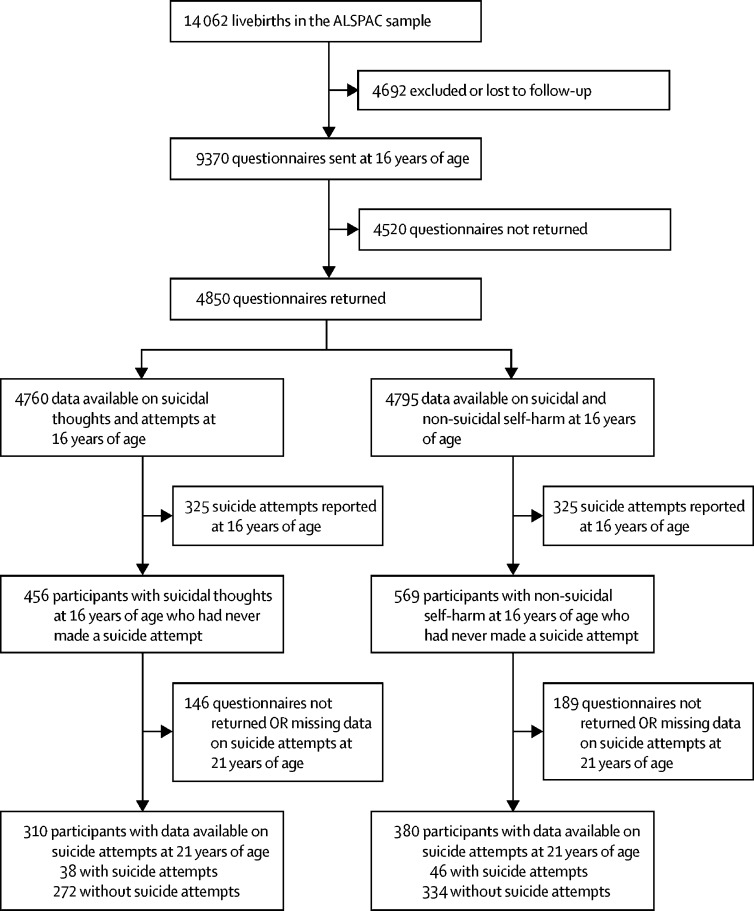
BACKGROUND: Suicidal thoughts and non-suicidal self-harm are common in adolescents and are strongly associated with suicide attempts. We aimed to identify predictors of future suicide attempts in these high-risk groups. METHODS: Participants were from the Avon Longitudinal Study of Parents and Children, a population-based birth cohort study in the UK. The sample included 456 adolescents who reported suicidal thoughts and 569 who reported non-suicidal self-harm at 16 years of age. Logistic regression analyses were used to explore associations between a wide range of prospectively recorded risk factors and future suicide attempts, assessed at the age of 21 years. FINDINGS: 38 (12%) of 310 participants with suicidal thoughts and 46 (12%) of 380 participants who had engaged in non-suicidal self-harm reported having attempted suicide for the first time by the follow-up at 21 years of age. Among participants with suicidal thoughts, the strongest predictors of transition to attempts were non-suicidal self-harm (odds ratio [OR] 2·78, 95% CI 1·35-5·74; p=0·0059), cannabis use (2·61, 1·11-6·14; p=0·029), other illicit drug use (2·47, 1·02-5·96; p=0·045), exposure to self-harm (family 2·03, 0·93-4·44, p=0·076; friend 1·85, 0·93-3·69, p=0·081), and higher levels of the personality type intellect/openness (1·62, 1·06-2·46; p=0·025). Among participants with non-suicidal self-harm at baseline, the strongest predictors were cannabis use (OR 2·14, 95% CI 1·04-4·41; p=0·038), other illicit drug use (2·17, 1·10-4·27; p=0·025), sleep problems (waking in the night 1·91, 0·95-3·84, p=0·069; insufficient sleep 1·97, 1·02-3·81, p=0·043), and lower levels of the personality type extraversion (0·71, 0·49-1·03; p=0·068). INTERPRETATION: Most adolescents who think about suicide or engage in non-suicidal self-harm will not make an attempt on their life. Many commonly cited risk factors were not associated with transition to suicide attempt among these high-risk groups. Our findings suggest that asking about substance use, non-suicidal self-harm, sleep, personality traits, and exposure to self-harm could inform risk assessments, and might help clinicians to identify which adolescents are at greatest risk of attempting suicide in the future. FUNDING: American Foundation for Suicide Prevention, National Institute for Health Research Biomedical Research Centre at the University Hospitals Bristol National Health Service Foundation Trust, and the University of Bristol.
Overview
CoChat Summary
TL;DR
In a UK population-based birth cohort, most adolescents with suicidal thoughts or non-suicidal self-harm at age 16 did not attempt suicide by age 21, but substance use, non-suicidal self-harm, sleep problems, and some personality/exposure factors predicted transition. The authors conclude that asking about these factors could help identify which high-risk adolescents are most likely to attempt suicide.
Key findings
- By age 21, 38 (12%) of 310 participants with suicidal thoughts and 46 (12%) of 380 participants with non-suicidal self-harm at baseline reported a first suicide attempt.
- Among adolescents with suicidal thoughts, the strongest predictors were non-suicidal self-harm (adjusted OR 2·78, 95% CI 1·35–5·74), cannabis use (2·61, 1·11–6·14), other illicit drug use (2·47, 1·02–5·96), and higher intellect/openness (1·62, 1·06–2·46); family and friend self-harm showed weaker evidence.
- Among adolescents with non-suicidal self-harm, the strongest predictors were cannabis use (adjusted OR 2·14, 95% CI 1·04–4·41), other illicit drug use (2·17, 1·10–4·27), and insufficient sleep (1·97, 1·02–3·81); waking in the night and lower extraversion showed weaker evidence.
- Of 107 participants reporting both suicidal thoughts and non-suicidal self-harm, 22 (21%) attempted suicide by follow-up, compared with 32 (1%) of 2283 participants reporting neither.
Methods
- Participants were from the Avon Longitudinal Study of Parents and Children (ALSPAC), a UK population-based birth cohort; analysis samples included 456 adolescents reporting suicidal thoughts and 569 reporting non-suicidal self-harm at age 16, after excluding 325 who had already attempted suicide by age 16.
- Logistic regression examined associations between prospectively recorded risk factors assessed at or before age 16 and first suicide attempt reported at age 21, adjusting for sex and socioeconomic position.
- Analyses used multiple imputation by chained equations with 50 imputed datasets; complete-case and imputed findings were broadly consistent.
Limitations
- Stated: associations cannot be assumed causal; only sex and socioeconomic position were adjusted for, and the authors did not aim to identify independent predictors.
- Stated: no date of first suicide attempt was available, so risk factors were restricted to those at or before age 16; the 5-year follow-up may miss shorter-term predictors, and excluding adolescents who had already attempted suicide may have weakened associations and limits applicability to those with prior attempts.
- Stated: analyses were exploratory without correction for multiple testing and need replication; attrition and non-random response to the age-16 self-harm questionnaire may limit generalisability, although imputed analyses were similar.
Model-written summary. Check it against the paper before relying on it.
Integrity signals
Registry
Cites
Statistics
Figures
Verification
Claims the paper makes
7 Valid · 0 Not valid · 4 Not checked · 58 Own results and interpretations
Every source the paper cites for this claim was checked and supports it.
In the paper
“In a previous study of more than 4500 adolescents,9 we explored a wide range of risk factors and found that exposure to self-harm in others, psychiatric disorders, and substance use most strongly distinguished between adolescents with suicidal thoughts and those who acted on those thoughts.”
§ Predictors of future suicide attempt among adolescents with suicidal thoughts or non-suicidal self-harm: a population-based birth cohort study > Introduction
What the sources say
- Supportedcites [9] Mars B Heron J Klonsky ED What distinguishes adolescents with suicidal thoughts from those who have attempted suicide? A population-based birth cohort study J Child Psychol Psychiatry 60 2019 91 99 29492978 PMC6334515 source
The Abstract reports 4,772 adolescents, and the Introduction says the study compared a wide range of risk factors. The Discussion identifies notably larger effects for exposure to self-harm in family or friends, mental health disorders, smoking, and illicit drug use excluding cannabis—the factors summarized in the claim. (LLM, conf=0.91)
boostedstates an association- Asserted: passes — The authors put it forward as true.
- Checkable: passes — It can be checked against evidence.
- Load-bearing: passes — The paper’s conclusions depend on it.
- Based: passes — The paper gives a reason why it holds.
- Supported
The cited sources support only part of this claim — read each source’s verdict below.
In the paper
“Several large epidemiological and meta-analytical studies provide empirical support for this framework and have found that many well established risk factors for suicide (such as depression, impulsivity, and hopelessness) do not meaningfully differentiate individuals with suicidal thoughts from those who have made an attempt.1, 5, 6, 7”
§ Predictors of future suicide attempt among adolescents with suicidal thoughts or non-suicidal self-harm: a population-based birth cohort study > Introduction
What the sources say
- Partly supportedcites [1] Nock MK Green JG Hwang I Prevalence, correlates, and treatment of lifetime suicidal behavior among adolescents: results from the National Comorbidity Survey Replication Adolescent Supplement JAMA Psychiatry 70 2013 300 310 23303463 PMC3886236 sourceExperimental — accuracy not yet measured
In Results (page unavailable), prior mental disorders are more strongly associated with ideation than with attempts among ideators, supporting the general point. But the Comment (page unavailable) says MDD/dysthymia predicts the transition from ideation to an attempt, and intermittent explosive disorder predicts planned attempts. The paper does not establish the claim about hopelessness, and its findings concern adolescents. (LLM, conf=0.87)
- Not checked — no full text of the sourcecites [5] May AM Klonsky ED What distinguishes suicide attempters from suicide ideators? A meta–analysis of potential factors Clin Psychol 23 2016 5 20 source
- Not checked — no full text of the sourcecites [6] Kessler RC Borges G Walters EE Prevalence of and risk factors for lifetime suicide attempts in the National Comorbidity Survey Arch Gen Psychiatry 56 1999 617 626 10401507 source
- Partly supportedcites [7] Nock MK Hwang I Sampson N Cross-national analysis of the associations among mental disorders and suicidal behavior: findings from the WHO World Mental Health Surveys PLoS Med 6 2009 e1000123 19668361 PMC2717212 sourceExperimental — accuracy not yet measured
The Discussion says major depression is much less useful for predicting which people with suicidal thoughts go on to make plans or attempts. But it identifies disorders characterized by poor impulse-control as among the strongest predictors of that progression, rather than showing that impulsivity fails to differentiate the groups. The provided passages do not assess hopelessness. (LLM, conf=0.88)
boosted- Asserted: passes — The authors put it forward as true.
- Checkable: passes — It can be checked against evidence.
- Load-bearing: passes — The paper’s conclusions depend on it.
- Based: passes — The paper gives a reason why it holds.
- Partly supported
The cited sources support only part of this claim — read each source’s verdict below.
In the paper
“Suicidal thoughts and non-suicidal self-harm are strongly associated with suicide attempts.”
§ Predictors of future suicide attempt among adolescents with suicidal thoughts or non-suicidal self-harm: a population-based birth cohort study > Introduction
What the sources say
- Partly supportedcites [1] Nock MK Green JG Hwang I Prevalence, correlates, and treatment of lifetime suicidal behavior among adolescents: results from the National Comorbidity Survey Replication Adolescent Supplement JAMA Psychiatry 70 2013 300 310 23303463 PMC3886236 sourceExperimental — accuracy not yet measured
The Results section (Prevalence and age-of-onset of suicidal behaviors; page unavailable) reports that 33.9% of adolescents with suicidal ideation made an attempt, supporting the link between suicidal thoughts and attempts. The Methods section (Measures; page unavailable) assesses ideation, plans, and attempts, but not non-suicidal self-harm; searches for that term and related terms found no evidence for the self-harm part of the claim. (LLM, conf=0.88)
- Not checked — no full text of the sourcecites [15] Hamza CA Stewart SL Willoughby T Examining the link between nonsuicidal self-injury and suicidal behavior: a review of the literature and an integrated model Clin Psychol Rev 32 2012 482 495 22717336 source
- Not checked — no full text of the sourcecites [16] Wilkinson P Kelvin R Roberts C Dubicka B Goodyer I Clinical and psychosocial predictors of suicide attempts and nonsuicidal self-injury in the Adolescent Depression Antidepressants and Psychotherapy Trial (ADAPT) Am J Psychiatry 168 2011 495 501 21285141 source
- Partly supportedcites [17] Guan K Fox KR Prinstein MJ Nonsuicidal self-injury as a time-invariant predictor of adolescent suicide ideation and attempts in a diverse community sample J Consult Clin Psychol 80 2012 842 849 22845782 PMC3458144 sourceExperimental — accuracy not yet measured
The Results section, “Longitudinal Prediction of Suicide Attempts” (page unavailable), reports that greater nonsuicidal self-injury was associated with a seven-fold increase in the likelihood of later attempts. It does not report a corresponding association between suicidal thoughts and attempts; the paper instead reports that self-injury predicted both later ideation and attempts. (LLM, conf=0.84)
- Supportedcites [18] Asarnow JR Porta G Spirito A Suicide attempts and nonsuicidal self-injury in the treatment of resistant depression in adolescents: findings from the TORDIA study J Am Acad Child Adolesc Psychiatry 50 2011 772 781 21784297 PMC3143365 source
In Results > Baseline Presentation (page unavailable), adolescents with histories of both nonsuicidal self-injury (NSSI) and suicide attempts had significantly higher suicidal-ideation scores than those with neither history. The same section reports a significant association between NSSI and suicide attempts; Results > Prediction of Time to SAs through Week 24 also identifies baseline NSSI as a significant predictor of later attempts. These findings are from adolescents with treatment-resistant depression. (LLM, conf=0.88)
- Not checked — no full text of the sourcecites [19] Klonsky ED May AM Glenn CR The relationship between nonsuicidal self-injury and attempted suicide: converging evidence from four samples J Abnorm Psychol 122 2013 231 237 23067259 source
boostedstates an association- Asserted: passes — The authors put it forward as true.
- Checkable: passes — It can be checked against evidence.
- Load-bearing: passes — The paper’s conclusions depend on it.
- Based: passes — The paper gives a reason why it holds.
- Partly supported
Every source the paper cites for this claim was checked and supports it.
In the paper
“Only a third of adolescents who have suicidal thoughts are estimated to go on to make a suicide attempt.1”
§ Predictors of future suicide attempt among adolescents with suicidal thoughts or non-suicidal self-harm: a population-based birth cohort study > Introduction
What the sources say
- Supportedcites [1] Nock MK Green JG Hwang I Prevalence, correlates, and treatment of lifetime suicidal behavior among adolescents: results from the National Comorbidity Survey Replication Adolescent Supplement JAMA Psychiatry 70 2013 300 310 23303463 PMC3886236 source
The Results section, under “Prevalence and age-of-onset of suicidal behaviors,” states that 33.9% of adolescents with suicidal ideation go on to make an attempt. That supports the citing sentence’s estimate of about one-third. (LLM, conf=0.94)
hedgedstates an association- Asserted: passes — The authors put it forward as true.
- Checkable: passes — It can be checked against evidence.
- Load-bearing: unclear — It is unclear whether the paper’s conclusions depend on it.
- Based: passes — The paper gives a reason why it holds.
- Supported
The cited sources support only part of this claim — read each source’s verdict below.
In the paper
“Both of these factors have been associated with suicidal behaviour in previous research;36, 37, 38, 39 however, our study is the first to explore prospectively the role of sleep difficulties and personality traits in the transition to suicide attempts over time.”
§ Predictors of future suicide attempt among adolescents with suicidal thoughts or non-suicidal self-harm: a population-based birth cohort study > Discussion
What the sources say
- Not checked — no full text of the sourcecites [36] O'Connor RC Nock MK The psychology of suicidal behaviour Lancet Psychiatry 1 2014 73 85 26360404 source
- Supportedcites [37] Hysing M Stormark KM O'Connor RC Sleep problems and self-harm in adolescence Br J Psychiatry 207 2015 306 312 26206862 source
The citation supports the sentence’s first clause, not the citing authors’ claim about their own prospective study. The Abstract describes prior evidence linking sleep problems to suicidal behaviour and identifies an established relationship between perfectionism and self-harm; the References also list a review of perfectionism and suicidality. The source is not being cited as the prospective study. (LLM, conf=0.87)
- Partly supportedcites [38] Wong MM Brower KJ Craun EA Insomnia symptoms and suicidality in the national comorbidity survey–adolescent supplement J Psychiatr Res 81 2016 1 8 27355426 PMC5021568 sourceExperimental — accuracy not yet measured
The citation attaches to the statement that sleep difficulties and personality traits have been associated with suicidal behaviour in previous research, not to the citing authors’ claim about their own prospective study. The source’s Results (section 3.2; page unavailable) associate sleep problems with suicidal thoughts, plans and attempts, but the passages do not establish an association for personality traits. (LLM, conf=0.86)
- Not checked — no full text of the sourcecites [39] Pigeon WR Pinquart M Conner K Meta-analysis of sleep disturbance and suicidal thoughts and behaviors J Clin Psychiatry 73 2012 e1160 e1167 23059158 source
plainstates an association- Asserted: passes — The authors put it forward as true.
- Checkable: passes — It can be checked against evidence.
- Load-bearing: passes — The paper’s conclusions depend on it.
- Based: passes — The paper gives a reason why it holds.
44 more claims
Create a free account to see all 69 claims and every source verdict.
- Probably not a substantial claim. 11
- It may state two separate claims as one. 11
Claims other papers make about this one
Each is checked against this paper’s own text: does it say what the citing paper says it does?
The source backs part of the claim, not all of it — or backs it for a different population, condition or comparison.
In the citing paper
“Although most adolescents that have suicidal thoughts and behaviors do not progress to suicide attempts, they account for 26% of future suicide attempts by the age of 26 and they are strongly associated with suicide death [11].”
From Adolescent Suicide—Understanding Unique Risks and Opportunities for Trauma Centers to Recognize, Intervene, and Prevent a Leading Cause of Death (2022) · cites this paper as [11]
Experimental — accuracy not yet measuredThe source backs part of the claim, not all of it — or backs it for a different population, condition or comparison.
In the citing paper
“Certain mental health disorders and a history of suicide behaviors (ideation, attempts) and non-suicidal self-injury (NSSI) significantly increase risk [7••, 11].”
From Adolescent Suicide—Understanding Unique Risks and Opportunities for Trauma Centers to Recognize, Intervene, and Prevent a Leading Cause of Death (2022) · cites this paper as [11]
Experimental — accuracy not yet measuredThe source backs part of the claim, not all of it — or backs it for a different population, condition or comparison.
In the citing paper
“alcohol and illicit substance use further potentiates the risk of suicide among youth with depression [11, 71].”
From Adolescent Suicide—Understanding Unique Risks and Opportunities for Trauma Centers to Recognize, Intervene, and Prevent a Leading Cause of Death (2022) · cites this paper as [11]
Experimental — accuracy not yet measuredThe source backs part of the claim, not all of it — or backs it for a different population, condition or comparison.
In the citing paper
“substance abuse is not only an independent risk factor for suicide”
From Adolescent Suicide—Understanding Unique Risks and Opportunities for Trauma Centers to Recognize, Intervene, and Prevent a Leading Cause of Death (2022) · cites this paper as [11]
Experimental — accuracy not yet measuredThe source backs part of the claim, not all of it — or backs it for a different population, condition or comparison.
In the citing paper
“some clinical factors that may influence the transition from suicidal ideation to suicide attempt include anxiety disorders, impulse-control disorders, post-traumatic stress disorder, eating disorders, previous self-harm, exposure to suicidal behaviour in others, and alcohol and drug abuse or dependence 6,7,88 .”
From Suicide and suicide risk (2019) · cites this paper as [7]
Experimental — accuracy not yet measured
7 more claims about this paper
Create a free account to see every claim other papers make about this one.
Self-check
Percentages, sums and reported differences re-computed from the paper’s own numbers.
Each contradiction between two passages listed here was confirmed by an independent check.
Rated minor: it would not touch a result — a value no result rests on, a p-value that stays on the same side of the significance level, or a conflict that is clerical, resolved elsewhere in the paper, or outside its own findings.
In the paper
§ Predictors of future suicide attempt among adolescents with suicidal thoughts or non-suicidal self-harm: a population-based birth cohort study > Results
“17·9 (15·61)”
§ Predictors of future suicide attempt among adolescents with suicidal thoughts or non-suicidal self-harm: a population-based birth cohort study > Results
“17·1 (4·33) | 17·7 (3·78)”
Rated minor: it would not touch a result — a value no result rests on, a p-value that stays on the same side of the significance level, or a conflict that is clerical, resolved elsewhere in the paper, or outside its own findings.
In the paper
“| Female | 202 (74%) | 28 (74%) | 275 (82%) | 36 (70%) |”
§ Predictors of future suicide attempt among adolescents with suicidal thoughts or non-suicidal self-harm: a population-based birth cohort study > Results
Reported 70 · recomputed 78.26087
Rated minor: it would not touch a result — a value no result rests on, a p-value that stays on the same side of the significance level, or a conflict that is clerical, resolved elsewhere in the paper, or outside its own findings.
In the paper
§ Predictors of future suicide attempt among adolescents with suicidal thoughts or non-suicidal self-harm: a population-based birth cohort study > Results
“| | Attentional control | 17·9 (15·61) | 17·1 (4·33) | 17·7 (3·78) |”
§ Predictors of future suicide attempt among adolescents with suicidal thoughts or non-suicidal self-harm: a population-based birth cohort study > Results
“| | Total sample | No transition to attempts | Transition to attempts | Unadjusted odds ratio (95% CI) | p value | Adjusted odds ratio*(95% CI) | p value |”
Rated minor: it would not touch a result — a value no result rests on, a p-value that stays on the same side of the significance level, or a conflict that is clerical, resolved elsewhere in the paper, or outside its own findings.
In the paper
§ Predictors of future suicide attempt among adolescents with suicidal thoughts or non-suicidal self-harm: a population-based birth cohort study > Results
“waking in the night (adjusted OR 1·91, 95% CI 0·93–4·44; p=0·069)”
§ Predictors of future suicide attempt among adolescents with suicidal thoughts or non-suicidal self-harm: a population-based birth cohort study > Results
“| | Waking in the night | 55% | 52% | 67% | 1·94 (1·01–3·73) | 0·047 | 1·91 (0·95–3·84) | 0·069 |”
Rated minor: it would not touch a result — a value no result rests on, a p-value that stays on the same side of the significance level, or a conflict that is clerical, resolved elsewhere in the paper, or outside its own findings.
In the paper
§ Predictors of future suicide attempt among adolescents with suicidal thoughts or non-suicidal self-harm: a population-based birth cohort study > Results
“| | Attentional switching | 11·3 (14·48) | 11·5 (15·19) | 12·2 (15·7) |”
§ Predictors of future suicide attempt among adolescents with suicidal thoughts or non-suicidal self-harm: a population-based birth cohort study > Results
“| | Total sample | No transition to attempts | Transition to attempts | Unadjusted odds ratio (95% CI) | p value | Adjusted odds ratio*(95% CI) | p value |”
Citations
Cites
The interpersonal theory of suicide.
Van Orden, K. A., Witte, T. K., Cukrowicz, K. C., Braithwaite, S. R., Selby, E. A., & Joiner, T. E. (2010) · Psychological Review · doi:10.1037/a0018697 · Cited by 5,292
Multiple imputation by chained equations: what is it and how does it work?
Azur, M. J., Stuart, E. A., Frangakis, C., & Leaf, P. J. (2011) · International Journal of Methods in Psychiatric Research · doi:10.1002/mpr.329 · Cited by 3,542
Boyd, A., Golding, J., Macleod, J., Lawlor, D. A., Fraser, A., Henderson, J., Molloy, L., Ness, A., Ring, S., & Davey Smith, G. (2013) · International Journal of Epidemiology · doi:10.1093/ije/dys064 · Cited by 2,996
Prevalence of and Risk Factors for Lifetime Suicide Attempts in the National Comorbidity Survey
Kessler, R. C., Borges, G., & Walters, E. E. (1999) · Archives of General Psychiatry · doi:10.1001/archpsyc.56.7.617 · Cited by 2,514
Cohort Profile: The Avon Longitudinal Study of Parents and Children: ALSPAC mothers cohort
Fraser, A., Macdonald-Wallis, C., Tilling, K., Boyd, A., Golding, J., Davey Smith, G., Henderson, J., Macleod, J., Molloy, L., Ness, A., et al. (2013) · International Journal of Epidemiology · doi:10.1093/ije/dys066 · Cited by 2,494
Self-citationThe Three-Step Theory (3ST): A New Theory of Suicide Rooted in the “Ideation-to-Action” Framework
Klonsky, E. D., & May, A. M. (2015) · International Journal of Cognitive Therapy · doi:10.1521/ijct.2015.8.2.114 · Cited by 1,799
Self-citationThe integrated motivational–volitional model of suicidal behaviour
O'Connor, R. C., & Kirtley, O. J. (2018) · Philosophical Transactions of the Royal Society B: Biological Sciences · doi:10.1098/rstb.2017.0268 · Cited by 1,781
Self-citationNock, M. K., Green, J. G., Hwang, I., McLaughlin, K. A., Sampson, N. A., Zaslavsky, A. M., & Kessler, R. C. (2013) · JAMA Psychiatry · doi:10.1001/2013.jamapsychiatry.55 · Cited by 1,666
Multiple Imputation by Chained Equations (MICE): Implementation in Stata
Royston, P., & White, I. (2011) · Journal of Statistical Software · doi:10.18637/jss.v045.i04 · Cited by 1,248
The psychology of suicidal behaviour
O'Connor, R. C., & Nock, M. K. (2014) · The Lancet Psychiatry · doi:10.1016/s2215-0366(14)70222-6 · Cited by 1,193
Self-citation
Cited by
Items 301–400 of 528
Wong, S. M. Y., Suen, Y. N., Hui, C. L. M., Lee, E. H. M., Chan, S. K. W., & Chen, E. Y. H. (2025) · Journal of Affective Disorders · doi:10.1016/j.jad.2025.120909 · Cited by 4
Praharaj, S. K., Zhang, X., Jain, P., Kamath, A., Vishwanath, R., Abio, A., Soans, S., Sesha, S., Lahiri, V., Buskutty, A., et al. (2026) · Child and Adolescent Psychiatry and Mental Health · doi:10.1186/s13034-026-01041-4 · Cited by 6
“This co-occurrence is concerning, as self-harm significantly raises the risk of suicide attempts in adolescents with suicidal ideation [33].”
Tiwari, K., Walia, A., & Kamboj, M. (2025) · Gender & Development · doi:10.1080/13552074.2025.2580700 · Cited by 3
“Studies indicate increased risks of mental health issues, sleep disturbances, extreme guilt, and suicidal ideation (Mars et al. 2019; Pashang, Khanlou, and Clarke 2019; Snaychuk and O’Neill 2020).”
Gavan, L., van der Spek, N., Bergers, N., Breedvelt, J., Hellegers, F., Bosmans, G., & Bockting, C. (2026) · Comprehensive Psychiatry · doi:10.1016/j.comppsych.2026.152691 · Cited by 5
NILSSON, M. H. L., Lundh, L., Westrin, Å., & Westling, S. (2021) · Frontiers in Psychiatry · doi:10.3389/fpsyt.2021.579987 · Cited by 8
Muslić, L., Rukavina, T., Markelić, M., & Milanović, S. M. (2023) · Child Psychiatry & Human Development · doi:10.1007/s10578-023-01574-1 · Cited by 6
“Cannabis and other illicit drug use have also been identified as strong predictors of transition from suicidal thoughts to suicidal attempts [50], possibly due to lowering inhibitions and impairing decision making.”
Liu, S., Qi, Q., Zeng, Z., & Hu, Y. (2024) · Child & Youth Care Forum · doi:10.1007/s10566-024-09817-5 · Cited by 4
“Research indicates that a small proportion of adolescents who experience suicidal ideation eventually act on these thoughts(Mars et al., 2019 ; Nock et al., 2008).”
Immunological correlates of suicidality among adolescents with internalizing symptoms
Roske, C., Nguyen, T. N. B., Schwartz, J. J., Erulker, A., Nie, K., Xie, H., Kim‐Schulze, S., Ely, B. A., Tobe, R. H., Mowrey, W. B., et al. (2024) · Brain Behavior & Immunity - Health · doi:10.1016/j.bbih.2024.100866 · Cited by 5
“…of a future suicide attempt among depressed individuals are a past attempt, suicidal ideation, and non-suicidal self-injury (Lewinsohn et al., 1994; Mars et al., 2019; May and Klonsky, 2016; Ribeiro et al., 2016; Shaffer et al., 1996; Wong et al., 2008), suggesting that those at risk for suicide…”
BackgroundGeng, S., Zhang, W., Gao, X., Qu, L., Zheng, X., Sun, J., Mingdong, X., Lin, H., Jia, X., & Zhang, X. (2025) · Frontiers in Psychiatry · doi:10.3389/fpsyt.2025.1546039 · Cited by 3
Chong, D. K. S., Marimuttu, V. J., Hoe, P. S., Chew, C. S. E., & Ang, A. S. Y. (2025) · Annals of the Academy of Medicine Singapore · doi:10.47102/annals-acadmedsg.2024334 · Cited by 7
Dayasiri, K. C., Nuskiya, F., Ranasinghe, A., et al. (2025) · BMC Research Notes · doi:10.1186/s13104-025-07350-9 · Cited by 3
“Additionally, self-poisoning behaviours have long-term consequences, including impaired social relationships, academic disruption, increased healthcare burden, increased risk of completed suicide, and persistent psychological distress [11].”
Суицидальные попытки: клинические характеристики с позиций суицидального процесса
Zotov, P. B., Любов, Е. Б., Rozanov, V. A., & Станиславовна, Р. А. (2020) · Суицидология · doi:10.32878/suiciderus.20-11-03(40)-101-119 · Cited by 5
Cannabis and Intentional Self-injury: a Narrative Review
Denissoff, A., Levola, J. M., Niemelä, S., & Mustonen, A. (2022) · Current Addiction Reports · doi:10.1007/s40429-022-00453-4 · Cited by 7
Exploring self-harm risk vulnerabilities in autism using the ‘thinking patterns profiling model’
Tollerfield, I., Wilkinson, E., Stewart, A. G., Nall‐Evans, S., Michelet, F., Elliott, P., & Jaydeokar, S. (2023) · Discover Psychology · doi:10.1007/s44202-023-00069-3 · Cited by 7
“With this in mind, all forms of self-harm have the potential for tragic consequences [8].”
BackgroundLimsuwan, N., Lantomrattana, A., Prachason, T., Tantrarungroj, T., Lorterapong, P., Thongpan, M., & Waleeprakhon, P. (2023) · Frontiers in Psychology · doi:10.3389/fpsyg.2023.957477 · Cited by 8
“In addition, some studies showed a complex relationship between these two conditions; for example, NSSI can predict subsequent suicidal behaviors (Castellvi et al., 2017; Knorr et al., 2019; Mars et al., 2019).”
BackgroundSocial Contagion of Nonsuicidal Self-Injury
Steele, S. J., Jaffe, N., & Murray, G. E. (2023) · Oxford University Press eBooks · doi:10.1093/oxfordhb/9780197611272.013.42 · Cited by 3
Armstrong, G., Haregu, T., Cho, E., Jorm, A. F., Batterham, P. J., & Spittal, M. J. (2023) · Psychiatry Research · doi:10.1016/j.psychres.2023.115445 · Cited by 4
“…strongly favoured investigating clinical measures, such as psychiatric disorders, executive function and personality characteristics, as risk factors for suicide attempts among people with suicidal ideation (Haregu et al., review; Haregu et al., 2023; Hielscher et al., 2020; Mars et al., 2019).”
InfluentialSocial zeitgeber and sleep loss as risk factors for suicide in American Indian adolescents
Ehlers, C. L., Gilder, D. A., Benedict, J., Wills, D. N., Phillips, E., Gonzales, C., Karriker‐Jaffe, K. J., & Bernert, R. A. (2024) · Transcultural Psychiatry · doi:10.1177/13634615241227679 · Cited by 4
“Adolescents may be particularly vulnerable to the effects of insuf fi cient sleep on suicidal ideation, as demonstrated in several studies in the United States, Asia, and the United Kingdom (Baiden et al., 2020; Kearns et al., 2022; Mars et al., 2019; Park et al., 2019).”
BackgroundDadras, O. (2024) · School Mental Health · doi:10.1007/s12310-024-09696-0 · Cited by 6
“This approach enabled the estimation of the independent effects of the study variables on suicide attempts, regardless of potential confounding by age and sex (Mars, Heron et al. 2019, Dadras & Wang 2023).”
Wei, C., Liu, B., An, X., & Wang, Y. (2025) · Frontiers in Psychiatry · doi:10.3389/fpsyt.2025.1553740 · Cited by 3
Ju, Y., Liu, Y., Tan, L., & Su, L. (2025) · Journal of Psychiatric Research · doi:10.1016/j.jpsychires.2025.05.029 · Cited by 3
The Prevalence and Correlates of Suicidal Ideation among University Students: A Survey
Mazelan, M. A. F. B., & Choi, L. J. (2022) · Journal of Cognitive Sciences and Human Development · doi:10.33736/jcshd.4374.2022 · Cited by 34
“Based on the three-step theory of Suicide by Mars et al. (2019), ideation and attempts of Suicide are caused by the combination of both pain and hopelessness.”
MethodПсихологические особенности женщин с депрессией и самоповреждающим поведением
Medvedeva, T. I., Ениколопов, С. Н., Vorontsova, O. Y., & Kazmina, O. (2020) · Психологические исследования · doi:10.54359/ps.v13i69.206 · Cited by 5
Dai, H., Pei, X., Chen, J., Li, X., Zhang, Q., & Martin, P. (2023) · Geriatric Nursing · doi:10.1016/j.gerinurse.2023.03.023 · Cited by 4
Nonsuicidal Self-Injury in Adolescents: Research and Clinical Practice
Balázs, J., & Brunner, R. M. (2024) · Cambridge University Press eBooks · doi:10.1017/9781009067287.003 · Cited by 3
The meanings of self-harm behavior: internet study results
Medvedeva, T. I., Boyko, O. M., Vorontsova, O. Y., et al. (2020) · Neurology Bulletin · doi:10.17816/nb16521 · Cited by 3
Suizidalität im Kindes- und Jugendalter
Plener, P. L., & Kaess, M. (2023) · Springer Reference Medizin · doi:10.1007/978-3-662-49289-5_128-1 · Cited by 2
Leece, S., Wilson, H., & Andriopoulou, P. (2023) · Counselling Psychology Quarterly · doi:10.1080/09515070.2023.2252770 · Cited by 3
Armstrong, G., Cherian, A. V., Haregu, T., Bilello, D., Sobhana, H., Deuri, S. P., Bhat, S. U., Aiman, A., John, S., Kannappan, Y., et al. (2025) · Journal of Affective Disorders Reports · doi:10.1016/j.jadr.2025.100898 · Cited by 6
Strengthening Mental Health Services for Children and Youth in Canada
Mitchell, R. H. B., & Ameis, S. H. (2025) · The Canadian Journal of Psychiatry · doi:10.1177/07067437251346090 · Cited by 4
“Regardless of intent, any self-harm behaviour in youth is a strong predictor of suicide attempts, 35 as is suicidal ideation 36,37 ; and both are markers of distress that warrant intervention.”
Harries, M. D., Ballard, R., Burnside, A. N., Ros, A., & Janssen, A. C. (2025) · Journal of Adolescent Health · doi:10.1016/j.jadohealth.2025.02.013 · Cited by 3
Gómez-Tabares, A. S., & Restrepo, J. E. (2025) · Research in Psychotherapy Psychopathology Process and Outcome · doi:10.4081/ripppo.2025.843 · Cited by 4
Wong, O. L., Fang, H., Zhong, J., Wang, Q. J., & Zhang, X. (2025) · Archives of Suicide Research · doi:10.1080/13811118.2025.2552455 · Cited by 2
“Persistent engagement in NSSI can severely impact adolescents’ mental health, and studies have demonstrated a strong correlation between NSSI (Klonsky et al., 2013; Mars et al., 2019; Whitlock et al., 2013).”
Atypical intra- and inter-regional coupling patterns involved in repetitive non-suicidal self-injury
Xia, Y., Bao, C., Liu, J., Huang, Y., Wang, X., Hua, L., Yan, R., Shi, J., Yao, Z., & Lü, Q. (2025) · Journal of Psychiatric Research · doi:10.1016/j.jpsychires.2025.10.041 · Cited by 2
Huang, C., Zhou, Y., Yue, Y., Yu, Y., Wang, Z., Huang, C., Zhu, Y., Bredemeier, K., Edenbaum, E. R., Joiner, T. E., et al. (2025) · American Journal of Epidemiology · doi:10.1093/aje/kwaf242 · Cited by 6
Shu, Y., Zhang, Q., Zheng, Z.-L., & Hou, Y.-Z. (2025) · Neural Plasticity · doi:10.1155/np/7885279 · Cited by 3
“It is frequently comorbid with a range of psychiatric conditions, particularly in adolescents, and has been classi fi ed by the Diagnostic and Statistical Manual of Mental Disorders, Fifth Edition as a condition warranting further clinical research [6, 7].”
Radünz, M., Quinney, B. A., Galanis, C. R., King, D. L., & Wade, T. D. (2025) · International Journal of Mental Health and Addiction · doi:10.1007/s11469-025-01597-w · Cited by 5
“Among the critical risk factors for suicide are self-injurious behaviours (SIBs), which include intentional self-harm without suicidal intent (Mars et al., 2019).”
Julià, A., Jaén, I., Giménez, M. C., García‐Palacios, A., Pascual, J. C., Estévez, A. S., Lara, A., Méndez, I., Romero, S., Puntí, J., et al. (2026) · JMIR Research Protocols · doi:10.2196/86413 · Cited by 6
“NSSI is a significant public health concern that typically emerges during adolescence and young adulthood and is associated with a range of negative mental health outcomes [5].”
Yi, X., Yi, D., Zhang, X., Qi, W., Zhao, M., Li, M., Grecucci, A., Yuan, K., Dong, H., & Chen, B. T. (2026) · Journal of Affective Disorders · doi:10.1016/j.jad.2026.121525 · Cited by 4
Schreiner, M. W., Dillahunt, A. K., Frandsen, S. B., DelDonno, S. R., Schubert, B. L., Pocius, S. L., Jenkins, L. M., Kassel, M. T., Bessette, K. L., Thomas, L. R., et al. (2022) · Journal of Psychiatric Research · doi:10.1016/j.jpsychires.2022.06.025 · Cited by 4
Childhood Trauma and Self-harm in Adults with Clinical Depression and Non-Clinical Controls
Younas, F., Rubab, A., & Noor, K. (2023) · Journal of Professional & Applied Psychology · doi:10.52053/jpap.v4i1.149 · Cited by 3
Mirza, S. A., Docherty, A. R., Monson, E. T., Coon, H. H., Keeshin, B. R., & Fries, G. R. (2023) · Journal of Child Psychology and Psychiatry · doi:10.1111/jcpp.13778 · Cited by 3
Javdan, M., AhmadiTeifakani, B., & Samavi, S. A. (2024) · Journal of Research and Health · doi:10.32598/jrh.14.3.2313.1 · Cited by 3
Transitions in Suicide Risk from Early Adolescence to Early Adulthood
Adrian, M. C., James, K. M., Gallop, R., Chu, P. V., Stoep, A. V., & McCauley, E. (2024) · Archives of Suicide Research · doi:10.1080/13811118.2024.2403491 · Cited by 3
“Using this cross-sectional approach, researchers suggest that the factors that differentiate those with SI from SA are non-suicidal self-injury, cannabis use, other illicit drug use, exposure to self-harm, and higher levels of the personality type intellect/openness (Mars et al., 2019).”
Epidemiology of suicidal behavior in children and adolescents worldwide
Basova, A. Y., & Bezmenov, P. V. (2024) · S S Korsakov Journal of Neurology and Psychiatry · doi:10.17116/jnevro202412411216 · Cited by 3
Baiden, P., Vélez‐Grau, C., Romanelli, M., Sellers, C. M., & LaBrenz, C. A. (2025) · Child Abuse & Neglect · doi:10.1016/j.chiabu.2025.107449 · Cited by 5
Zhu, Y., Ren, W., Yang, L., Yue, Y., Lu, X., Zhu, F., Liu, Y., Zhou, Y., Li, C., & Du, X. (2025) · Journal of Affective Disorders · doi:10.1016/j.jad.2025.05.017 · Cited by 2
Tang, S., Batterham, P. J., Slade, A., Werner‐Seidler, A., Maston, K., Corkish, B., Christensen, H. M., & Calear, A. L. (2025) · Psychiatry Research · doi:10.1016/j.psychres.2025.116683 · Cited by 3
Potential predictors of future suicide attempts in adolescents assigned female at birth
Başgöze, Z., Mueller, B. A., Fiecas, M. J. A., Klimes‐Dougan, B., & Cullen, K. R. (2025) · Journal of Affective Disorders · doi:10.1016/j.jad.2025.120363 · Cited by 4
Drubina, B., Kökönyei, G., & Reinhardt, M. (2022) · Magyar Pszichológiai Szemle · doi:10.1556/0016.2022.00005 · Cited by 3
Wang, T., Gong, J., Wang, Y., Pang, K.-L., Pang, K.-L., Wang, J.-S., Zhang, Z., Zhang, C.-Y., Zhou, Y., Li, J., et al. (2023) · Current Medical Science · doi:10.1007/s11596-023-2772-z · Cited by 3
“Those traits were also associated with NSSI and suicide behaviors [23, 24] .”
BackgroundAn observational study on deliberate self-harm in individuals with alcohol dependence syndrome
Sutradhar, B., Mukherjee, D., & Pathak, K. (2023) · Industrial Psychiatry Journal · doi:10.4103/ipj.ipj_50_23 · Cited by 3
Konno, Y. T., Araujo-Filho, G., Almeida, J. R. S., Santos, N. B. L., Filho, A. B. M., Damiano, B. B. F., Parreira, G. S., Carvalho, P. H. F., & Cenedesi, L. M. T. (2023) · Clinical Child Psychology and Psychiatry · doi:10.1177/13591045231213029 · Cited by 4
“Prior episodes and psychiatric diagnoses are believed to increase the risk of recurrence (Mars et al., 2019).”
Estresse precoce, impulsividade e comportamento suicida em usuários de substâncias psicoativas
Júnior, E. B. C. (2020) · Digital Library of Theses and Dissertations (Universidade de São Paulo) · doi:10.11606/t.22.2020.tde-17032021-102918 · Cited by 2
Robinson, K. (2021) · Open Access Victoria University of Wellington | Te Herenga Waka (Figshare) · doi:10.26686/wgtn.16960195.v1 · Cited by 2
Zheng, Q., Liu, J., Ji, Y., et al. (2022) · Research Square · doi:10.21203/rs.3.rs-1679507/v1 · Cited by 2
Prevalence and Help Seeking Behavior for Non-Suicidal Self-Injury on College Students
Hidayati, F., Fanani, M., & Mulyani, S. (2023) · Journal of Public Health and Development · doi:10.55131/jphd/2023/210219 · Cited by 13
Способы и средства медикаментозной профилактики суицидов
Kozlov, V. A., Голенков, А. В., & Евгеньевна, Б. И. (2023) · Суицидология · doi:10.32878/suiciderus.23-14-02(51)-36-58 · Cited by 2
Guidelines, Policies, and Recommendations for Responding to NSSI in Schools and Universities
Baetens, I., Lloyd‐Richardson, E. E., Bloom, E. L., Hamza, C. A., Hasking, P. A., Lewis, S. P., Bezugla, D., Meers, E., & Hove, L. V. (2023) · Oxford University Press eBooks · doi:10.1093/oxfordhb/9780197611272.013.47 · Cited by 2
Self-harming behavior in adolescents: Current diagnostic and therapeutic approaches
Yazıcı, M., & Hocaoğlu, Ç. (2023) · IntechOpen eBooks · doi:10.5772/intechopen.1002918 · Cited by 3
A narrative review on psychosocial factors associated with suicide amongst youth
Shophi, T. (2024) · EUREKA Social and Humanities · doi:10.21303/2504-5571.2024.003352 · Cited by 2
Petti, T. A., & Chen, A. (2024) · Psychology & Psychological Research International Journal · doi:10.23880/pprij-16000409 · Cited by 2
Rabasco, A., DeSon, J. J., & Andover, M. S. (2024) · Transgender Health · doi:10.1089/trgh.2023.0150 · Cited by 2
“12,14,20 In addition, our fi ndings that NSSI versatility predicted suicidal ideation severity, while NSSI frequency did not, are consistent with research conducted with cisgender individuals.”
Greiner, C., Chen, C., Sabé, M., & Prada, P. (2024) · Cogent Psychology · doi:10.1080/23311908.2024.2411868 · Cited by 2
“…et al., 2023). in recent years, a substantial body of research on suicide and Nssi in adolescents has been conducted in developed countries (Mars et al., 2019), which is not the case in low-and middle-income countries (Poudel et al., 2022). this highlights a gap that is prevalent…”
Giang, T.-V., Nguyen-Ngoc, P.-B., Sam, V.-L., & Huynh, V.-S. (2025) · Frontiers in Psychology · doi:10.3389/fpsyg.2024.1449688 · Cited by 2
The Etiopathogenic Mosaic of Suicidal Behaviour
Temelie-Olinici, D., Knieling, A., Vâță, D., Solovăstru, L. G., Neamţu, M., Mocanu, M., Pătrașcu, A.-I., Grecu, V.-B., & Leca, D. A. (2025) · Behavioral Sciences · doi:10.3390/bs15010087 · Cited by 1
“Some observational studies also draw attention to the interdependence of violence/aggression– suicide (Mars et al., 2019).”
InfluentialJiang, H., Qu, F., Long, Q., Chong, S. T., & Nan, J. (2025) · Child Abuse & Neglect · doi:10.1016/j.chiabu.2025.107429 · Cited by 3
Çalışkan, Y., Caliskan, M., Meral, Y., Haşimoğlu, A., Sandıkçı, T., Doğangün, B., & Kadak, M. T. (2025) · Clinical and Experimental Obstetrics & Gynecology · doi:10.31083/ceog27160 · Cited by 1
Varo, C., Barrigón, M. L., Rider, J., Reguera, P., Mayo-Jaraquemada, A., Canal‐Rivero, M., Torres, N. G., Baca‐García, E., Ruíz-Veguilla, M., & Crespo‐Facorro, B. (2025) · Research on Child and Adolescent Psychopathology · doi:10.1007/s10802-025-01309-x · Cited by 4
“Many youths who have difficulties coping with their problems seek relief from drugs and alcohol (Mars et al., 2019).”
Difronzo, M. J., Thackeray, L. A., O’Keeffe, S., Calderón, A., & Midgley, N. (2025) · Research in Psychotherapy Psychopathology Process and Outcome · doi:10.4081/ripppo.2025.841 · Cited by 1
“Adolescent research has been looking at how to enhance treatment engagement to reduce adolescent mental health risks and relapses (Costantino et al. , 2010; Mars et al. , 2019).”
Hussey, L. J., Kontopantelis, E., Kapur, N., Williams, R., Mok, P. L. H., Ashcroft, D. M., Garg, S., Chew-Graham, C. A., Lovell, K., & Webb, R. T. (2025) · BMJ Mental Health · doi:10.1136/bmjment-2025-301615 · Cited by 1
Gardner, K. J., Smith, R. E., Rayner, G., Lamph, G., Moores, L., Crossan, R., Bisland, L., Danino, N., & Taylor, P. J. (2025) · International Journal of Environmental Research and Public Health · doi:10.3390/ijerph22070979 · Cited by 1
The Lived Experiences of Malaysian Young Adults Engaging in Nonsuicidal Self-Injury
Fernandez, J. A., Jaladin, R. A. M., & Lau, P. L. (2025) · Journal of Loss and Trauma · doi:10.1080/15325024.2025.2522693 · Cited by 1
“Apart from that, a myriad of studies have reported that NSSI is a strong predictor of future suicide attempts, especially among adolescents (Klonsky et al., 2013; Mars et al., 2019).”
Gao, J., Pan, L., Wang, X., Xu, J., Xu, W., Zhang, Y., & Pan, Z. (2025) · American Journal of Medical Genetics Part B Neuropsychiatric Genetics · doi:10.1002/ajmg.b.33050 · Cited by 1
“Recognized as a distinct diagnostic category by the DSM-5 (Zetterqvist 2015), the disorder's prevalence ranges from 0.3% to 5% in non-clinical populations, while inpatient rates are alarmingly higher at 50%–80% (Mars et al. 2019).”
InfluentialGao, Y., Ge, Y., Chen, Y., Huang, H., & Ge, Z. (2025) · BMC Psychology · doi:10.1186/s40359-025-03053-9 · Cited by 1
“In light of rising suicide rates, NSSI is considered a critical risk factor for future suicide, and its potential threat cannot be over-looked [8].”
Imm, P., & Wright, D. A. (2025) · Injury Prevention · doi:10.1136/ip-2025-045800 · Cited by 1
Understanding Latine disparities in nocturnal wakefulness as a suicide risk factor
Fernandez, F., Tubbs, A. S., Perlis, M. L., & Grandner, M. A. (2025) · Sleep Epidemiology · doi:10.1016/j.sleepe.2025.100117 · Cited by 1
Hypnotics and Suicide: A Tangled Web
Tubbs, A. S., Grandner, M. A., & Fernandez, F. (2025) · Journal of Psychopharmacology · doi:10.1177/02698811251378129 · Cited by 1
“Longitudinal studies and meta-analyses consistently show that insomnia symptoms confer elevated suicide risk even after controlling for depressive symptoms (Bernert et al., 2014; Liu et al., 2020; Mars et al., 2019; Wong and Brower, 2012).”
Ren, X., Pan, L., Song, Y., He, P., Wu, D., & Luo, J. (2025) · Frontiers in Psychiatry · doi:10.3389/fpsyt.2025.1644937 · Cited by 1
Hammond, C. J., Hyer, M., Boustead, A. E., Platt, R. E., Young, A. S., Fristad, M. A., Steelesmith, D. L., Brock, G. N., Hasin, D. S., & Fontanella, C. A. (2025) · American Journal of Preventive Medicine · doi:10.1016/j.amepre.2025.108141 · Cited by 1
Gao, Y., Wang, Y., Chen, Y., Shi, J., Mao, X., Wang, J., He, J., Huang, H., & Xu, X. (2025) · BMC Psychology · doi:10.1186/s40359-025-02789-8 · Cited by 2
“Given the ongoing rise in suicide rates, NSSI is increasingly recognized as a critical predictor of future suicide risk, and its potential threat must not be overlooked [9].”
Lundwall, R. A., Cutrer‐Párraga, E. A., Lundwall, R., Squires, M. E., Beck, J. S., & Gabrielsen, T. P. (2025) · Research in Autism · doi:10.1016/j.reia.2025.202725 · Cited by 1
ALHO, J. S., Webb, R. T., Gutvilig, M., Niemi, R., Komulainen, K., Suokas, K., Böckerman, P., Elovainio, M. J., Kapur, N., & Hakulinen, C. A. (2025) · The Lancet Regional Health - Europe · doi:10.1016/j.lanepe.2025.101517 · Cited by 5
Non-Suicidal Self-Injury in Adolescence and Youth
Петрова, Н. Н. (2025) · Psikhiatriya · doi:10.30629/2618-6667-2025-23-4-103-116 · Cited by 1
Jin, Y., Xu, S.-C., Liu, F., Li, J., Du, J., Zheng, Q., Bu, Y., & Wang, Y.-Y. (2025) · International Journal of Child Abuse & Neglect · doi:10.1016/j.chiabu.2025.107790 · Cited by 1
Zhang, F.-F., Guo, R., Chen, S.-L., Yang, W., Liang, X.-L., & Ma, M.-F. (2025) · World Journal of Psychiatry · doi:10.5498/wjp.v16.i1.113130 · Cited by 1
Wei, C., Wang, L., Lu, H. K., & Li, J. (2026) · Frontiers in Psychiatry · doi:10.3389/fpsyt.2025.1695119 · Cited by 1
Lo, H. K. Y., Chu, I. W. L., Chan, J. K. N., Wong, C. S. M., & Chang, W. C. (2026) · Molecular Psychiatry · doi:10.1038/s41380-026-03555-x · Cited by 1
Wen, W., Guan, Y., Zhong, L., Li, Z., Ma, R., Lin, X., & Yang, C. (2026) · BMC Psychology · doi:10.1186/s40359-026-04476-8 · Cited by 1
“Among the 23 studies, 17 were from China [14, 33, 44, 46, 48–51, 53–56, 59–63], 2 from Norway [52, 57], 1 from the United States [64], 1 from the United Kingdom [47], 1 from Turkey [45] and 1 from Sweden [58].”
Wang, J., Liao, X., Kuang, Y., Gu, Y., Zhu, T., Hu, Y. G., Li, C., Zeng, X., Xuan, C., Zhu, T., et al. (2026) · Journal of Affective Disorders · doi:10.1016/j.jad.2026.121757 · Cited by 2
Solidum, E., Harris, A., Emery, K. J., & Sheftall, A. H. (2026) · Journal of the American Academy of Child & Adolescent Psychiatry · doi:10.1016/j.jaac.2026.05.003 · Cited by 1
An International Collection of Multidisciplinary Approaches to Violence and Aggression
Lewis, C. (2022) · IntechOpen eBooks · doi:10.5772/intechopen.100654 · Cited by 3
Toraman, M. Ç., Sarıgedik, E., & Özçetin, A. (2022) · OMEGA - Journal of Death and Dying · doi:10.1177/00302228221142092 · Cited by 1
“Suicidal behavior is associated with a broad pattern of risk and protective factors (Fonseca-Pedrero et al., 2022; Glenn et al., 2020; Mars et al., 2019), including the presence of a mental disorder, previous suicide attempts, family history of suicide, bullying, and alexithymia, etc.…”
Suicide Attempts in an Italian Population with Cannabis Use Disorders: Results of a Follow-Up Study
Pavarin, R. M., Lia, L., Tugnoli, S., & Caracciolo, S. (2023) · Journal of Psychoactive Drugs · doi:10.1080/02791072.2023.2287674 · Cited by 1
“…use (odds ratio (OR) 2.1 to 3.5) (Borges, Bagge, and Orozco 2016; Carvalho, Souza, and Moreira 2022; Gobbi et al. 2019; Gukasyan and Strain 2020; Mars et al. 2019), higher for heavy cannabis users (OR 4.6) (Borges, Bagge, and Orozco 2016), and early cannabis users (OR 4.4 to 5.2) (Ahuja et al.…”
InfluentialCase Report: A Teenager Girl with an Accentuated Personality and Self-Injurious Behavior
Darin, E. V., Олеговна, Б. Е., Зайцева, О. Г., Гафурова, А. Н., & Шинкаренко, Л. Н. (2023) · Психиатрия психотерапия и клиническая психология · doi:10.34883/pi.2023.14.3.007 · Cited by 1
Permana, M. Z. (2024) · Afkar Journal. · doi:10.53893/qjwt5a97 · Cited by 6
“This means that the predictive power of NSSI often exceeds that of previous suicide attempts (Asarnow et al., 2011; Mars et al., 2019; Ribeiro et al., 2016; Victor and Klonsky, 2014).”
Perfil epidemiológico das lesões autoprovocadas por adolescentes no estado do Paraná
Michalczyszyn, K. C., Nahm, C. L., Takemoto, A. Y., dos Santos, C. E., dos Santos, T. M., Bischof, T., da Maia, M. R., & Pereira, M. E. P. (2024) · Brazilian Journal of Health Review · doi:10.34119/bjhrv7n3-410 · Cited by 3
Beyond Barriers: Illuminating Pathways to Effective Self‐Harm Treatment for Diverse Young People
Lindquist, E. G., Woodward, D. W., Oh, L., & West, A. E. (2025) · Journal of Psychiatric and Mental Health Nursing · doi:10.1111/jpm.13178 · Cited by 2
Oktary, D., Pohan, R. A., Astuti, R. D., & Pohan, P. B. A. (2025) · Journal of Affective Disorders · doi:10.1016/j.jad.2025.120125 · Cited by 1
Asl, Z. N., Ghorbali, A., & Farahani, H. (2025) · Iranian Journal of Psychiatry and Behavioral Sciences · doi:10.5812/ijpbs-158485 · Cited by 1
Metadata
- Authors
- Mars, B., Heron, J., Klonsky, E. D., Moran, P., O'Connor, R. C., Tilling, K., Wilkinson, P., & Gunnell, D.
- Affiliations
- University Hospitals Bristol NHS Foundation Trust (GB)
- University of Bristol (GB)
- University of British Columbia (CA)
- University of Cambridge (GB)
- Corresponding author
- Mars, Becky
- Venue
- The Lancet Psychiatry
- Publisher
- Elsevier BV
- Published
- 2019-04
- Volume
- 6
- Issue
- 4
- Pages
- 327-337
- ISSN
- 2215-0366 (ISSN-L)
- PMC
- PMC6494973
- OpenAlex
- W2921579356
- Semantic Scholar
- 46a256ed87ae675baf851eeb31546bf3ea3767f7
- Cited by
- 546
- References
- 48
- Citations by year
- 2026: 63 · 2025: 107 · 2024: 82 · 2023: 84 · 2022: 69 · 2021: 70 · 2020: 56 · 2019: 15
- FWCI
- 61.27
- Type
- journal article
- Language
- en
- Open access
- hybrid
- doi.org
- Licence
- cc-by
- www.elsevier.com/tdm/userlicense/1.0/ (tdm)
- www.elsevier.com/legal/tdmrep-license (tdm)
- creativecommons.org/licenses/by/4.0/ (vor)
- Locations
- The Lancet Psychiatry (publishedVersion, cc-by)
- Europe PMC (PubMed Central) (publishedVersion, cc-by)
- PubMed Central (publishedVersion, cc-by)
- PubMed (publishedVersion)
- ENLIGHTEN (Jurnal Bimbingan dan Konseling Islam) (acceptedVersion, cc-by-sa)
- Bristol Research (University of Bristol) (submittedVersion, cc-by)
- Explore Bristol Research (submittedVersion, cc-by)
- Apollo (University of Cambridge) (submittedVersion, cc-by)
- Apollo (cc-by)
- Funders
- National Institute for Health Research
- Wellcome Trust (102215/2/13 /2, GR067797MA)
- University of Bristol
- Medical Research Council
- Norges Teknisk-Naturvitenskapelige Universitet (PR-RS-0912-11023)
- American Foundation for Suicide Prevention
- Topics
- Social Sciences › Psychology › Clinical Psychology › Suicide and Self-Harm Studies
- Social Sciences › Sociology and Political Science › Homicide, Infanticide, and Child Abuse
- Health Sciences › Medicine › Public Health, Environmental and Occupational Health › Injury Epidemiology and Prevention
- Keywords
- suicide attempts, suicidal ideation, non-suicidal self-injury, adolescents, cannabis use, illicit drug use, sleep disorders, personality traits, openness to experience, risk factors, Avon Longitudinal Study of Parents and Children, birth cohort, mental health service utilization, suicide prevention, hopelessness
- MeSH terms
- Adolescent, Female, Follow-Up Studies, United Kingdom, Humans, Longitudinal Studies, Male, Personality, Prognosis, Risk Factors, Sleep Wake Disorders, Suicide, Attempted, Self-Injurious Behavior, Substance-Related Disorders, Young Adult, Suicidal Ideation
About these checks
Registry, retraction, Cites and statistics results are computed, not judged, with one exception: a printed reference that no index lists is read once by a model before it counts as a citation error. Claims are extracted by a model and kept only when their quote appears verbatim in the text; each cited source is then checked, with a model’s help, for whether it says what the claim relies on. Those verdicts can be wrong — read the claim’s quote and the cited source before relying on one.
The claim verdicts this report counts are experimental: their accuracy is not yet measured.
A language model drew the claims from the paper on 2026-10-10, under version 3 of the claim definition (model deepseek-v4.1-flash, prompt extract-v3).
A second model labelled each claim on 2026-10-10 (model jev-1.13-20260917, definition revision gold-guideline-v0.2).
Cited sources are checked with a language model’s help (gpt-6-sol).
Statistics and arithmetic are recomputed, not judged.
Confidence bands are shown only for fields calibrated on our annotated test set. None is calibrated yet, so no band is shown.
What counts as a claim ›How we measure confidence ›How we check this ›
Are you an author, or do you see a problem with this page? Request a review
Data sources
Bibliographic data: Semantic Scholar, OpenAlex, Crossref.
Contains information from the Semantic Scholar Academic Graph Datasets, made available under the ODC Attribution License (ODC-BY 1.0).
Semantic Scholar’s data is described in: Kinney, R., et al. (2023). The Semantic Scholar Open Data Platform. arXiv:2301.10140.
