

How Censorship in China Allows Government Criticism but Silences Collective Expression
Open accessThe DOI matches its Crossref record; 53 of the 54 references it cites were found in a registry or an index, and 1 are not checked yet; none of the 12 sources its claims cite is checked for support yet.
Abstract
We offer the first large scale, multiple source analysis of the outcome of what may be the most extensive effort to selectively censor human expression ever implemented. To do this, we have devised a system to locate, download, and analyze the content of millions of social media posts originating from nearly 1,400 different social media services all over China before the Chinese government is able to find, evaluate, and censor (i.e., remove from the Internet) the subset they deem objectionable. Using modern computer-assisted text analytic methods that we adapt to and validate in the Chinese language, we compare the substantive content of posts censored to those not censored over time in each of 85 topic areas. Contrary to previous understandings, posts with negative, even vitriolic, criticism of the state, its leaders, and its policies are not more likely to be censored. Instead, we show that the censorship program is aimed at curtailing collective action by silencing comments that represent, reinforce, or spur social mobilization, regardless of content. Censorship is oriented toward attempting to forestall collective activities that are occurring now or may occur in the future—and, as such, seem to clearly expose government intent.
Checked 2026-11-22 · 1 reference not checked yet
Overview
CoChat Summary
TL;DR
The paper uses large-scale, real-time collection of Chinese social media posts to test why China censors online expression. It finds that censorship does not target criticism of the state or leaders; instead, it targets posts with collective action potential, regardless of whether they support or criticize the government.
Key findings
- Across the data, an average of approximately 13% of all social media posts were censored. Ex ante political sensitivity had only a weak relationship with censorship: Low and Medium categories were censored at 16% and 17%, respectively, versus 24% for High.
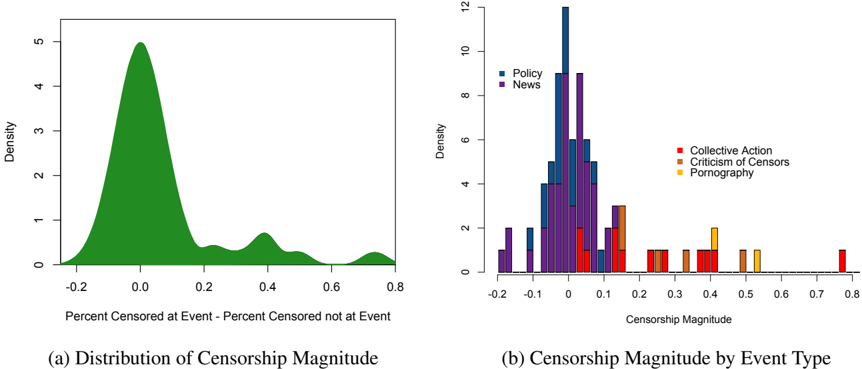
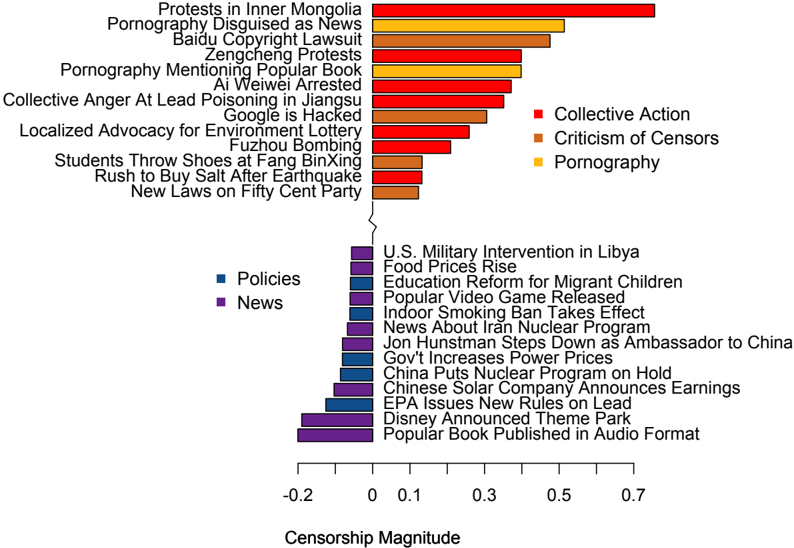
- Censorship was much higher during volume bursts tied to collective action: average censorship magnitude was 27% for collective action, compared with -1% for policy and -4% for news.
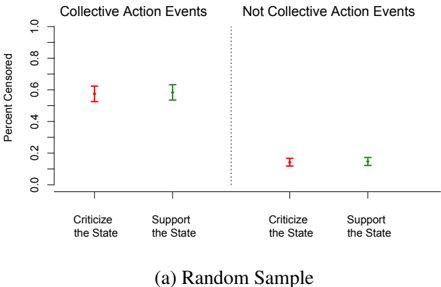
- For collective action events such as Ai Weiwei’s arrest, Inner Mongolia protests, and Fuzhou bombings, posts were censored at about 80% on average whether they criticized or supported the state. For non-collective-action events such as the one child policy, corruption policy, and food prices, censorship was about 10% on average for both critical and supportive posts.
- Censorship also targeted pornography and criticism of the censors, but not government policy or other news. The authors argue censorship is aimed at curtailing collective action by silencing comments that represent, reinforce, or spur social mobilization.
Methods
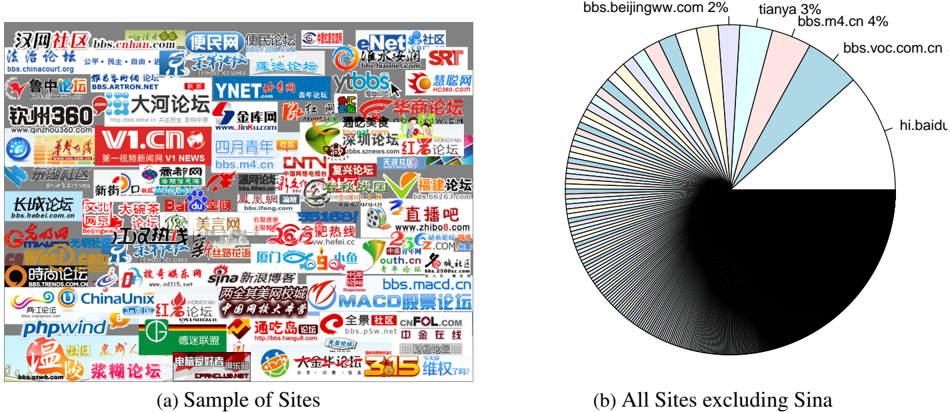
- The authors built a system to locate, download, and analyze posts from 1,382 Chinese websites during the first half of 2011, before government censors could remove them. They collected 3,674,698 posts, randomly selected 127,283 for further analysis, and overall collected and analyzed 11,382,221 posts.
- They used a stratified random sampling design covering 85 topic areas across three hypothesized political sensitivity levels, detected 87 volume bursts in 67 of the 85 topic areas using robust regression-based burst detection, and classified events into collective action potential, criticism of censors, pornography, government policies, and other news.
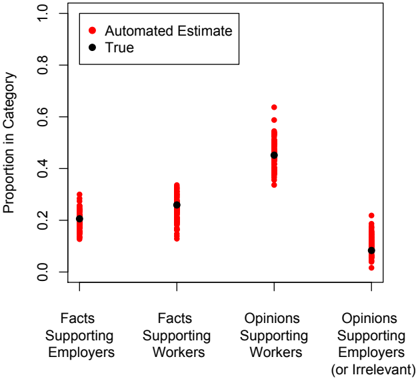
- To analyze content, they adapted the Hopkins and King “ReadMe” automated text analysis method to Chinese and extended it with a Bayesian procedure to estimate the percent censored within categories. Validation used native Chinese speakers coding 1,000 posts about 2010 labor strikes, with 100 as training and 900 as test; event coding reliability was 98.9% (86 of 87 events).
Limitations
- The paper states that its methodology misses self-censorship and censorship that may occur before the post is obtained; it also does not quantify the direct effects of the Great Firewall, keyword blocking, or search filtering.
- The authors state they have not studied physical violence, such as arrest of bloggers, or threats of the same; although many officials and levels of government influence censorship decisions, their data only sometimes distinguish among these sources, and they cannot determine the consequences of these limitations.
- The authors note that the presumably smaller number of discussions they cannot observe are likely to be those of most interest to the Chinese government, and they offer little evidence connecting social media findings to press freedom or other types of human expression in China. They also state that the predictive analysis was conducted retrospectively and with only three events, so further prospective validation would be valuable.
Model-written summary. Check it against the paper before relying on it.
Integrity signals
Registry
Cites
Statistics
Figures
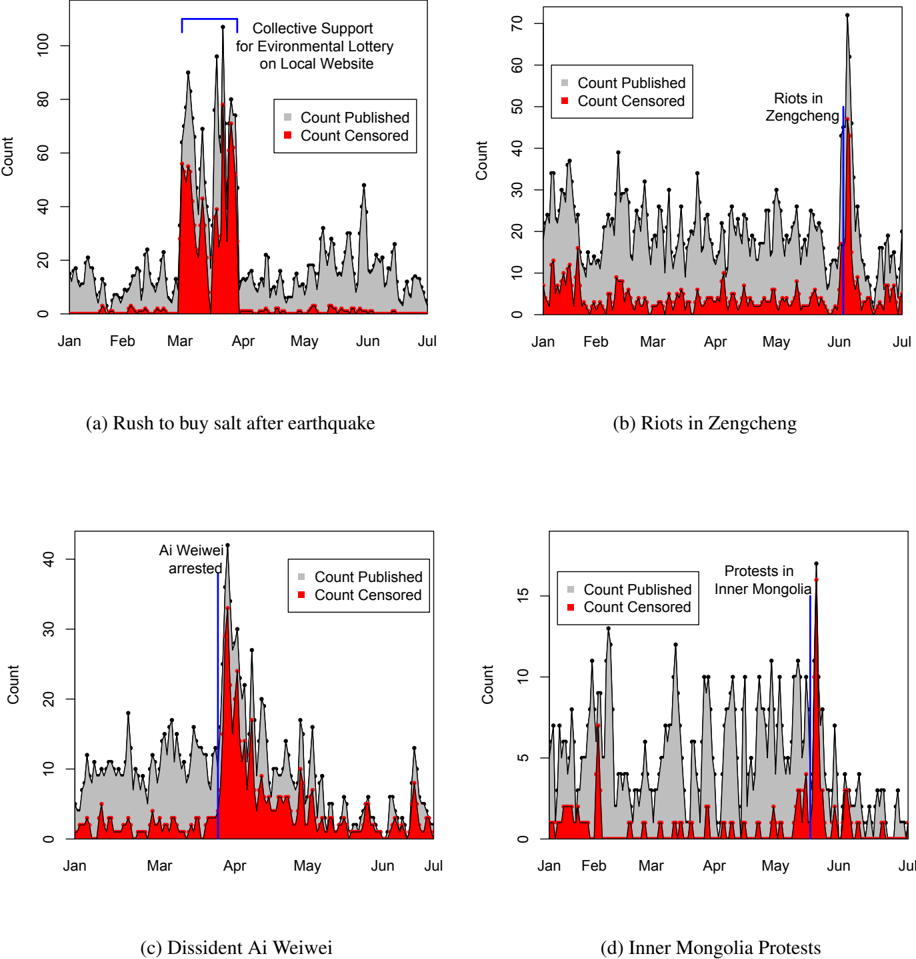
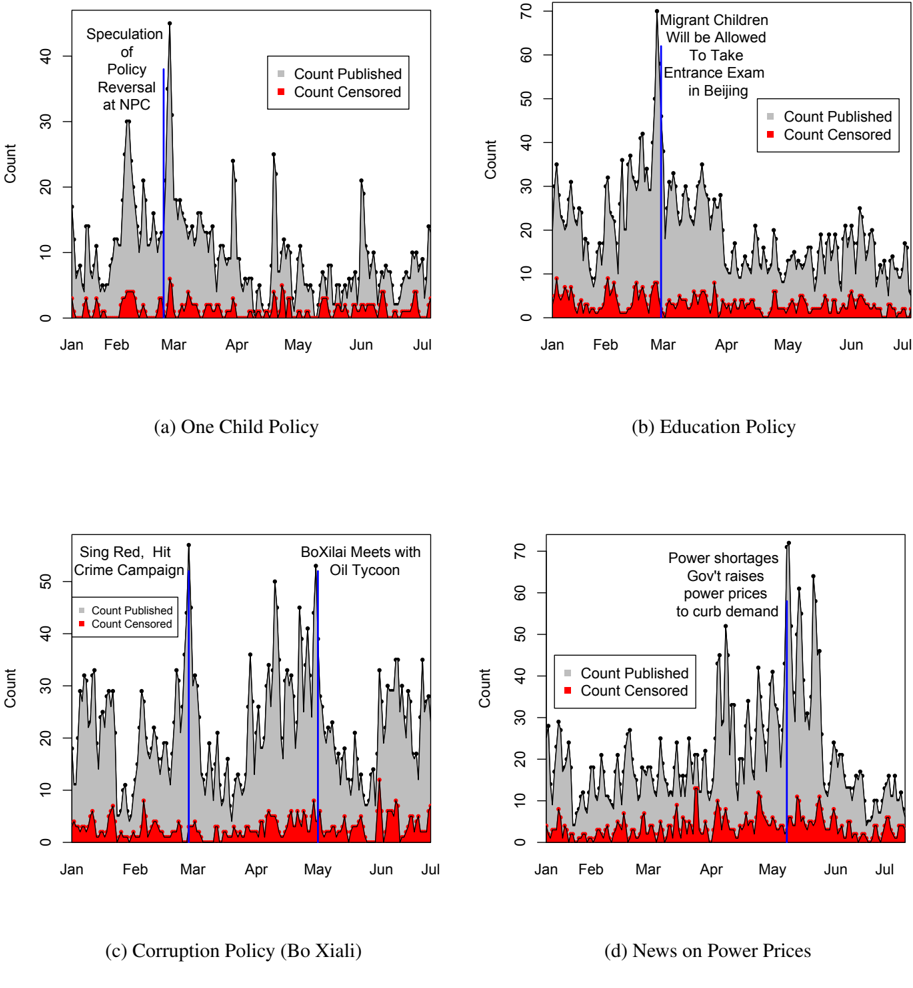
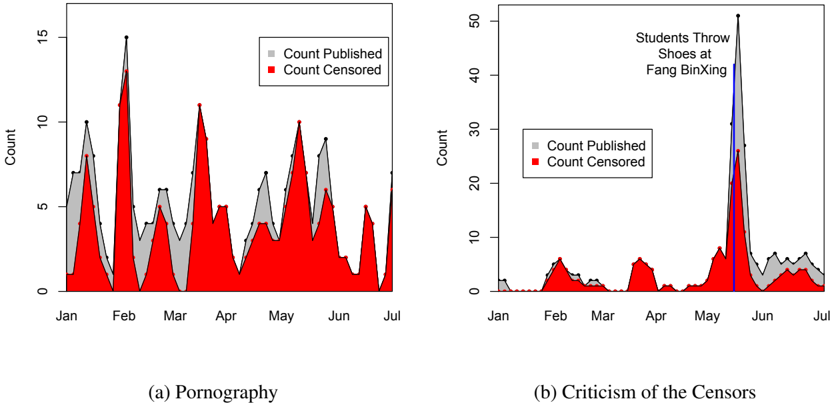
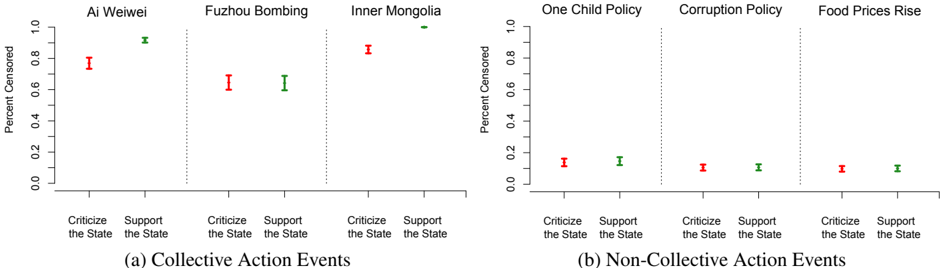
Verification
Claims the paper makes
0 Valid · 7 Not valid · 7 Not checked · 88 Own results and interpretations
A result the paper reports from its own data — it cites no other source for it, so there is none to check. The quote shows it is in the paper.
In the paper
“Our data show that the Chinese censorship program allows for a wide variety of criticisms of the Chinese government, its officials, and its policies.”
§ How Censorship in China Allows Government Criticism but Silences Collective Expression * > Outline of Results
plain- Asserted: passes — The authors put it forward as true.
- Checkable: passes — It can be checked against evidence.
- Load-bearing: passes — The paper’s conclusions depend on it.
- Based: passes — The paper gives a reason why it holds.
A result the paper reports from its own data — it cites no other source for it, so there is none to check. The quote shows it is in the paper.
In the paper
“Contrary to previous understandings, posts with negative, even vitriolic, criticism of the state, its leaders, and its policies are not more likely to be censored.”
- Also stated in: § 1 Introduction · plain
“we find that when the Chinese people write scathing criticisms of their government and its leaders, the probability that their post will be censored does not increase.”
§ How Censorship in China Allows Government Criticism but Silences Collective Expression * > Abstract
plain- Asserted: passes — The authors put it forward as true.
- Checkable: passes — It can be checked against evidence.
- Load-bearing: passes — The paper’s conclusions depend on it.
- Based: passes — The paper gives a reason why it holds.
- Also stated in: § 1 Introduction · plain
A result the paper reports from its own data — it cites no other source for it, so there is none to check. The quote shows it is in the paper.
In the paper
“Large increases in online volume are good predictors of censorship when these increases are associated with events related to collective action, e.g., protest on the ground.”
§ How Censorship in China Allows Government Criticism but Silences Collective Expression * > Outline of Results
plainstates an association- Asserted: passes — The authors put it forward as true.
- Checkable: passes — It can be checked against evidence.
- Load-bearing: passes — The paper’s conclusions depend on it.
- Based: passes — The paper gives a reason why it holds.
A result the paper reports from its own data — it cites no other source for it, so there is none to check. The quote shows it is in the paper.
In the paper
“In addition, we measure sentiment within each of these events and show that during these events, the government censors views that are both supportive and critical of the state.”
§ How Censorship in China Allows Government Criticism but Silences Collective Expression * > Outline of Results
plainstates a cause- Asserted: passes — The authors put it forward as true.
- Checkable: passes — It can be checked against evidence.
- Load-bearing: passes — The paper’s conclusions depend on it.
- Based: passes — The paper gives a reason why it holds.
A result the paper reports from its own data — it cites no other source for it, so there is none to check. The quote shows it is in the paper.
In the paper
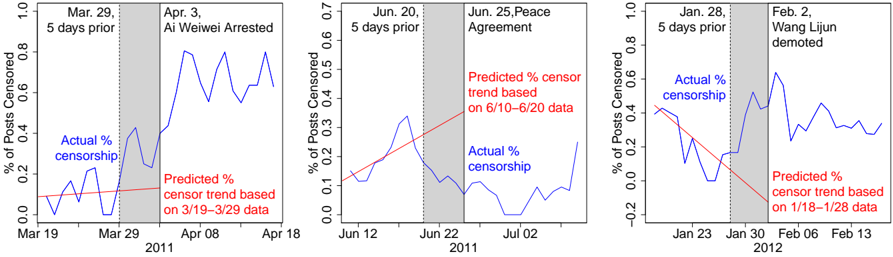
“We thus conduct the same analysis for the demotion of Wang Lijun in Panel (c) of Figure 11, and again see a large difference in actual and predicted percent censorship before Wang's demotion.”
§ How Censorship in China Allows Government Criticism but Silences Collective Expression * > Additional information
plainSingle case- Asserted: passes — The authors put it forward as true.
- Checkable: passes — It can be checked against evidence.
- Load-bearing: unclear — It is unclear whether the paper’s conclusions depend on it.
- Based: passes — The paper gives a reason why it holds.
46 more claims
Create a free account to see all 102 claims and every source verdict.
- Probably not a substantial claim. 26
- It may state two separate claims as one. 33
Claims other papers make about this one
Each is checked against this paper’s own text: does it say what the citing paper says it does?
The source backs part of the claim, not all of it — or backs it for a different population, condition or comparison.
In the citing paper
“Authorities are keen to review social media posts and have contentious messages removed (King etal., 2013) to ensure that potential threats remain invisible.”
From How Dictators Control the Internet: A Review Essay (2020) · cites this paper as King et al., 2013
Experimental — accuracy not yet measuredThe source backs part of the claim, not all of it — or backs it for a different population, condition or comparison.
In the citing paper
“In most autocratic regimes, governmental interference in digital infrastructure and communication is commonplace.”
From How Dictators Control the Internet: A Review Essay (2020) · cites this paper as King et al., 2013
Experimental — accuracy not yet measuredThe source backs part of the claim, not all of it — or backs it for a different population, condition or comparison.
In the citing paper
“First, the timing of censorship during a coup is consistent with many studies that have shown that Internet censorship is targeted during sensitive political time periods and periods of potential power transitions, such as elections and large-scale protests [23,25,44,47,73].”
From A multi-perspective view of Internet censorship in Myanmar (2021) · cites this paper as [44]
Experimental — accuracy not yet measuredThe cited source says what the claim attributes to it.
In the citing paper
“research has shown how mobilization organized through public coordination is repressed using that very same public information-for instance, repression is preemptively increased before focal days (Truex 2019); and autocracies censor online calls for collective action (King, Pan, and Roberts 2013), coerce online opinion leaders (Pan and Siegel 2020), and at times, turn off the internet entirely.”
From Coordinated Dis-Coordination (2024) · cites this paper as King, Pan, and Roberts 2013
The check wasn’t confident either way, so it gives no verdict — never disputed.
In the citing paper
“In China, for instance, two virtual police officers remind citizens that their browsing behavior is monitored (King etal., 2013).”
From How Dictators Control the Internet: A Review Essay (2020) · cites this paper as King et al., 2013
Experimental — accuracy not yet measured
1 more claim about this paper
Create a free account to see every claim other papers make about this one.
Citations
Cites
Robust estimation of a location parameter
Huber, P. J. (1964) · The Annals of Mathematical Statistics · doi:10.1214/aoms/1177703732 · Cited by 7,228
Robust Regression and Outlier Detection
Piepel, G. F. (1989) · Technometrics · doi:10.1080/00401706.1989.10488524 · Cited by 6,144
Robust Regression and Outlier Detection
Rousseeuw, P. J., & Leroy, A. M. (1987) · Wiley Series in Probability and Statistics · doi:10.1002/0471725382 · Cited by 5,609
Logistic Regression in Rare Events Data
King, G., & Zeng, L. (2001) · Political Analysis · doi:10.1093/oxfordjournals.pan.a004868 · Cited by 4,316 · cited 1×
“We do this via well-known and widely used case-control methodology (King and Zeng 2001).”
MethodSelf-citationDemocracy and Development: Political Institutions and Well-Being in the World, 1950–1990
Przeworski, A., Alvarez, M. E., Cheibub, J. A., & Limongi, F. (2000) · doi:10.1017/cbo9780511804946 · Cited by 2,845
Rightful Resistance in Rural China
O'Brien, K. J., & Li, L. (2006) · Cambridge University Press eBooks · doi:10.1017/cbo9780511791086 · Cited by 1,104
The Dynamics of Informational Cascades: The Monday Demonstrations in Leipzig, East Germany, 1989–91
Lohmann, S. (1994) · World Politics · doi:10.2307/2950679 · Cited by 1,035 · cited 1×
“Protests in East Germany, Eastern Europe, and most recently the Middle East have all preceded regime change (Ash 2002; Lohmann 1994; Przeworski et al. 2000).”
BackgroundRightful Resistance in Rural China
O'Brien, K., & Li, L.-J. (2006) · doi:10.1017/cbo9780511791086.003 · Cited by 987
China's Changing of the Guard: Authoritarian Resilience
Nathan, A. J. (2003) · Journal of Democracy · doi:10.1353/jod.2003.0019 · Cited by 927
Sparks and prairie fires: A theory of unanticipated political revolution
Kuran, T. (1989) · Public Choice · doi:10.1007/bf00116762 · Cited by 905 · cited 1×
“In fact, Kuran (1989) and Lohmann (2002) show that it is information about a collective action event that propels collective action and so distinguishing this from explicit calls for collective action would be difficult if not impossible.”
Background
Research works printed but not linked: 13
- 22. Freedom House. 2012. "Freedom of the Press, 2012." www.freedomhouse.org.
- 8. Chang, Parris. 1983. Elite Conflict in the Post-Mao China. New York: Occasional Papers Reprints.
- 26. Hinton, Harold. 1955. The "Unprincipled Dispute" Within Chinese Communist Top Lead- ership. Washington, DC: U.S. Information Agency.
- 44. Perry, Elizabeth. 2002. Challenging the Mandate of Heaven: Social Protest and State Power in China. Armork, NY: M. E. Sharpe.
- 52. Schurmann, Franz. 1966. Ideology and Organization in Communist China. Berkeley, CA: University of California Press.
- Tsai, 2007, Capitalism without Democracy: The Private Sector in Contemporary China
- 48. Qiang, Xiao. 2011. The Rise of Online Public Opinion and Its Political Impact. In Chang- ing Media, Changing China, ed. Susan Shirk. New York: Oxford University Press pp. 202-224.
- 9. Charles, David. 1966. The Dismissal of Marshal P'eng Teh-huai. In China Under Mao: Politics Takes Command, ed. Roderick MacFarquhar. Cambridge: MIT University Press pp. 20-33.
- 54. Shirk, Susan. 2007. China: Fragile Superpower: How China's Internal Politics Could Derail Its Peaceful Rise. New York: Oxford University Press.
- 56. Teiwes, Frederick. 1979. Politics and Purges in China: Retification and the Decline of Party Norms. Armork, NY: M. E. Sharpe. Tsai, Kellee. 2007a. Capitalism without Democracy: The Private Sector in Contemporary China. Ithaca, NY: Cornell University Press.
- 15. Duan, Qing. 2007. China's IT Leadership. Vdm Verlag.
- 38. MacFarquhar, Roderick. 1974. The Origins of the Cultural Revolution Volume 1: Contra- dictions Among the People 1956-1957. New York: Columbia University Press.
- 12. Chen, Xiaoyan and Peng Hwa Ang. 2011. Internet Police in China: Regulation, Scope and Myths. In Online Society in China: Creating, Celebrating, and Instrumentalising the Online Carnival, ed. David Herold and Peter Marolt. New York: Routledge pp. 40-52.
Cited by
Items 1,401–1,500 of 2,443
No Encore for Encore? Ethical Questions for Web-Based Censorship MeasurementPreprint
Zevenbergen, A. N. A. B., & Zevenbergen, B. (2015) · SSRN Electronic Journal · doi:10.2139/ssrn.2665148 · Cited by 27
Fu, J. (2021) · Perspectives on children and young people · doi:10.1007/978-981-16-5532-6_2 · Cited by 2
Big Data und Governance im digitalen Zeitalter
Ulbricht, L. (2019) · transcript Verlag eBooks · doi:10.1515/9783839448649-015 · Cited by 5
Is TikTok a public sphere for democracy in China? A Political Economy Approach
Lin, H. (2022) · European Conference on Social Media · doi:10.34190/ecsm.9.1.139 · Cited by 9
Ghazi-Tehrani, A. K., & Pontell, H. N. (2022) · Springer series on Asian criminology and criminal justice research · doi:10.1007/978-3-030-90704-4_4 · Cited by 2
Bank, W. (2016) · World Bank, Washington, DC eBooks · doi:10.1596/978-1-4648-0671-1_ch3 · Cited by 2
THE IMPACT OF CHINESE E-GOVERNMENT-TO-CITIZENS ON GOVERNMENT TRANSPARENCY AND PUBLIC PARTICIPATION
(2015) · Issues in Information Systems · doi:10.48009/1_iis_2015_51-59 · Cited by 2
Does the crying baby always get the milk? An analysis of government responses for online requests
Cai, T., Li, F., Jian, Z., & Wang, Z. (2022) · Chinese Sociological Review · doi:10.1080/21620555.2022.2103667 · Cited by 4
Carter, B. L. (2022) · Journal of Conflict Resolution · doi:10.1177/00220027221126156 · Cited by 5
Pan, Y., & Shu, Z. (2022) · International Journal of Public Opinion Research · doi:10.1093/ijpor/edac036 · Cited by 3
Limitations of Chinese Social Media Censorship and Their Relationships with Government Policies
Chen, Z. (2023) · Journal of Education Humanities and Social Sciences · doi:10.54097/ehss.v8i.4250 · Cited by 3
Cai, Y. (2023) · Asian Survey · doi:10.1525/as.2023.1814629 · Cited by 3
The Social Credit System in China
Woesler, M. (2023) · Advances in public policy and administration (APPA) book series · doi:10.4018/978-1-6684-6429-8.ch014 · Cited by 3
The Public Sphere and Weibo Microblogging Social Media Platforms in China
Han, B., & Bowen, J. P. (2023) · Electronic workshops in computing · doi:10.14236/ewic/eva2023.23 · Cited by 3
“…persistent as possible, so that its commercial interests somewhat mitigate the strictness demonstrate its practical utility as a catalyst social and political change in the public sphere (King et al. 2013); instead, the platform features monetisation and entertainment, and rumours and algorithm.”
Instant Archives: Social Media and Social Movement Research
Rochford, E., Hudgens, B., & Einwohner, R. L. (2023) · Research in social movements, conflicts and change · doi:10.1108/s0163-786x20230000047005 · Cited by 4
Despicable ‘other’ and innocent ‘us’: emotion politics in the time of the pandemic
Zhang, C., & Wang, Z. (2023) · Humanities and Social Sciences Communications · doi:10.1057/s41599-023-01925-2 · Cited by 6
“This revelation discloses yet another mechanism for Chinese government to adapt internet censorship to reinforce authoritarian resilience (Han, 2023; King et al., 2013).”
Taboo and Collaborative Knowledge Production: Evidence from Wikipedia
Champion, K., & Hill, B. M. (2023) · Proceedings of the ACM on Human-Computer Interaction · doi:10.1145/3610090 · Cited by 4
“At the state level, for example, China suppresses information on human rights abuses and collective action, and Norway blocks many pornography and gambling websites [47, 75, 90].”
Marie, A., & Petersen, M. B. (2023) · Psychological Inquiry · doi:10.1080/1047840x.2023.2274401 · Cited by 2
“And authoritarian countries apply strict censorship on their populations, kill and imprison political dissidents, etc. (Amnesty International, 2021; King et al., 2013; Sherstoboeva, 2020).”
BackgroundTHE CHALLENGES OF WEIBO FOR DATA-DRIVEN DIGITAL MEDIA RESEARCH
Zeng, J., Burgess, J., & Bruns, A. (2015) · QUT ePrints (Queensland University of Technology) · Cited by 2
How “Power–Interest Networks” Have Shaped Anti-Demolition Protests in Grassroots China
Gui, X. (2017) · China An International Journal · doi:10.1353/chn.2017.0040 · Cited by 2
Policing Expression: A Survey Experiment on the Efficacy of Repression in Saudi Arabia
Kurd, D. E. (2017) · Journal of Arabian Studies · doi:10.1080/21534764.2017.1455391 · Cited by 3
Types of Big Data and designs of evaluation research
Aragona, B. (2018) · RIV Rassegna Italiana di Valutazione · doi:10.3280/riv2017-068004 · Cited by 3
Xu, Q., & Billings, A. C. (2018) · International Journal of Sport Communication · doi:10.1123/ijsc.2018-0093 · Cited by 4
Como o Mundo Mudou as Mídias Sociais
Miller, D., Costa, E., Haynes, N., McDonald, T., Nicolescu, R., Sinanan, J., Spyer, J., Venkatraman, S., & Wang, X. (2019) · UCL Press eBooks · doi:10.14324/111.9781787356542 · Cited by 38
Conclusion: China, Russia, and the Authoritarian Embrace of Globalization
Beissinger, M. R. (2020) · Oxford University Press eBooks · doi:10.1093/oso/9780190093488.003.0012 · Cited by 2
Attitudes and Beliefs about Distributive Justice in China
Im, D. K. (2014) · Digital Access to Scholarship at Harvard (DASH) (Harvard University) · Cited by 6
Censorship in the Wild: Analyzing Web Filtering in Syria.Preprint
Chaabane, A., Cunche, M., Chen, T., et al. (2014) · arXiv (Cornell University) · Cited by 2
Thomson, H. (2015) · SSRN Electronic Journal · doi:10.2139/ssrn.2597070 · Cited by 2
The effects of the Internet on collective democratic action in China
Chen, X. (2016) · Research Portal (King's College London) · Cited by 3
In Public or in Private: Repressing Dissidents in ChinaPreprint
Gueorguiev, D. D. (2017) · SSRN Electronic Journal · doi:10.2139/ssrn.3038812 · Cited by 2
Schuler, P. (2014) · eScholarship (California Digital Library) · Cited by 2
Linguistic Characteristics of Censorable Language on SinaWeiboPreprint
Ng, K. Y., Feldman, A., Peng, J., et al. (2018) · arXiv (Cornell University) · doi:10.48550/arxiv.1807.03654 · Cited by 2
Political Violence in China: Terrorism, Official Media, and Political PrioritiesPreprint
Potter, P., & Wang, C. (2018) · SSRN Electronic Journal · doi:10.2139/ssrn.3271903 · Cited by 2
Deciphering Chinese Censorship: Introducing CensorScout and the Weibo Censorship DashboardPreprint
Shen, J. Z., & McCain, R. M. (2018) · SSRN Electronic Journal · doi:10.2139/ssrn.3266193 · Cited by 2
Hughes, G. F. (2019) · SSRN Electronic Journal · doi:10.2139/ssrn.3810578 · Cited by 2
The Art of “iWar”: Disinformation Campaign as a Strategy of Informational Autocracy PromotionPreprint
Chang, M.-C., Chang, C.-C., & Lin, T.-H. (2020) · doi:10.33774/apsa-2020-wkkll · Cited by 3
Liu, Z. J. (2020) · SSRN Electronic Journal · doi:10.2139/ssrn.3723674 · Cited by 2
Can You Hear Me Now?: How Communication Technology Affects Protest and RepressionPreprint
Christensen, D., & Garfias, F. (2014) · SSRN Electronic Journal · doi:10.2139/ssrn.2529769 · Cited by 2
The Reach of the StatePreprint
Chang, C., & Wang, Y. (2021) · SSRN Electronic Journal · doi:10.2139/ssrn.3736763 · Cited by 2
Crises, Catharses, and Boiling Frogs: Path Dependence in Collective ActionPreprint
Correa, S., Nandong, G., & Shadmehr, M. (2021) · SSRN Electronic Journal · doi:10.2139/ssrn.3906282 · Cited by 2
Attention Online, Abatement Offline a Natural Experiment on Social Media in ChinaPreprint
Liang, P., Zou, W., & Qi, X. (2021) · SSRN Electronic Journal · doi:10.2139/ssrn.3978777 · Cited by 2
Subjective Freedom of Speech: Why Do Citizens Think They Cannot Speak Freely?Preprint
Menzner, J., & Traunmüller, R. (2022) · SSRN Electronic Journal · doi:10.2139/ssrn.4052854 · Cited by 2
Can Alcohol Facilitate Information Manipulation in China? A Social Norm PerspectivePreprint
Li, Z., Massa, M., Xu, N., & Zhang, H. (2022) · SSRN Electronic Journal · doi:10.2139/ssrn.4143966 · Cited by 2
Information Control on YouTube During Russia’s Invasion of UkrainePreprint
Golovchenko, Y., Pedersen, K. A., Raaschou-Pederse, J. S., et al. (2022) · doi:10.31235/osf.io/uw79m · Cited by 2
Shen, S. V., Wang, Q., & Zhang, B. (2023) · SSRN Electronic Journal · doi:10.2139/ssrn.4371501 · Cited by 2
Rochlitz, M., Schoors, K. J. L., & Zakharov, N. (2023) · SSRN Electronic Journal · doi:10.2139/ssrn.4433145 · Cited by 2
Authoritarian Surveillance, Innovation and GrowthPreprint
Klarl, T., Karpa, D. F., Leusin, M. E., & Rochlitz, M. (2023) · SSRN Electronic Journal · doi:10.2139/ssrn.4594849 · Cited by 3
Authoritarian Legal (Ir)rationality:The Saga of 'Picking Quarrels' in ChinaPreprint
Luo, J. (2024) · SSRN Electronic Journal · doi:10.2139/ssrn.4647656 · Cited by 2
Anti-Corruption and Political Trust: Evidence from ChinaPreprint
Fang, M., Lai, W., & Xia, C. (2024) · SSRN Electronic Journal · doi:10.2139/ssrn.4792700 · Cited by 2
Lu, Y., Pan, J., Xu, X., et al. (2025) · SSRN Electronic Journal · doi:10.2139/ssrn.5145803 · Cited by 2
Self-citationPolitical Cycles of Media RepressionPreprint
Schulze, G. G., & Zakharov, N. (2025) · SSRN Electronic Journal · doi:10.2139/ssrn.5166523 · Cited by 3
Ji, Q. (2016) · Advances in public policy and administration (APPA) book series · doi:10.4018/978-1-5225-1081-9.ch015 · Cited by 2
Cruelty and Brutality in How Journalists Die in Mexico. A Micro-sociological Approach
Guerra, E., & Programa de Política de Drogas, C. D. I. Y. D. E. (. (2019) · Sociológica (México) · doi:10.24275/uam/azc/dcsh/sm/2019v34n97/guerra · Cited by 4
Audience Costs and China’s South China Sea Policy
Moore, G. J., & Primiano, C. B. (2020) · Journal of Asian Security and International Affairs · doi:10.1177/2347797020962635 · Cited by 1
Is it a win-win strategy? Examining the media discourse on toponymic commodification in China
Xu, W., & Ji, F. (2022) · Urban Geography · doi:10.1080/02723638.2022.2072076 · Cited by 1
“In China, both central and local governments have long exercised tight control over the media to avoid covering politically incorrect reports and to maintain a favorable image of the governments (King et al., 2013).”
BackgroundImplications for China and Beyond
Gruffydd-Jones, J. J. (2022) · Oxford University Press eBooks · doi:10.1093/oso/9780197643198.003.0009 · Cited by 1
Studying Global Online Discussions: A Grounded Theory Approach
Slavtcheva‐Petkova, V. (2023) · Springer eBooks · doi:10.1007/978-3-031-18980-7_3 · Cited by 1
Ahmed, S. (2023) · Asian Journal of Communication · doi:10.1080/01292986.2023.2233976 · Cited by 1
“Citizen communication is under continuous surveillance in authoritarian states, and any expressions of protest or mobilization are censored by the government (King et al., 2013).”
BackgroundWang-Kaeding, H. N. K. (2023) · East Asian Journal of Popular Culture · doi:10.1386/eapc_00101_1 · Cited by 3
Shmanatov, M. (2023) · Strategic Panorama · doi:10.53679/2616-9460.2.2022.03 · Cited by 1
Ko, J. (2023) · Oxford University Press eBooks · doi:10.1093/oso/9780197684566.003.0004 · Cited by 1
Flonk, D., & McNeil‐Willson, R. (2023) · Policy & Internet · doi:10.1002/poi3.377 · Cited by 1
What are online controls, and how do they work?
Gohdes, A. (2023) · Oxford University Press eBooks · doi:10.1093/oso/9780197743577.003.0002 · Cited by 1
Gohdes, A. (2023) · Oxford University Press eBooks · doi:10.1093/oso/9780197743577.003.0009 · Cited by 1
Chang, C.-C., Zeng, Y., & Guo, X. (2024) · Political Studies Review · doi:10.1177/14789299241229404 · Cited by 1
“However, King et al. (2013, 2014, 2017; Roberts, 2018) contend that the Chinese government has deployed propaganda and censorship tools to manipulate public perception through the media.”
Content Modeling in Multi-Platform Multilingual Social Media Data
Setser, A., Lange, L., Weiss, K., & Barash, V. (2024) · Journal of Online Trust and Safety · doi:10.54501/jots.v2i2.136 · Cited by 2
“As mentioned in the introduction, this is a particularly insightful use case, as internal Chinese social media data is well known to be biased toward China-positive content (King, Pan, and Roberts 2013).”
BackgroundGray Zone: Ambiguity and Escalation
Gannon, J. A., & Schram, P. (2024) · Oxford University Press eBooks · doi:10.1093/oso/9780197754443.003.0014 · Cited by 3
Gartzke, E. A., & Lindsay, J. R. (2024) · Oxford University Press eBooks · doi:10.1093/oso/9780197754443.003.0002 · Cited by 2
Space: Intelligence and Stability
Gartzke, E. A., Lindsay, J. R., & Bryan, E. (2024) · Oxford University Press eBooks · doi:10.1093/oso/9780197754443.003.0011 · Cited by 1
Masterson, M. (2024) · International Studies Quarterly · doi:10.1093/isq/sqae033 · Cited by 2
Grmuša, A., & Hong, J. S. (2024) · Advances in educational marketing, administration, and leadership book series · doi:10.4018/979-8-3693-1706-8.ch002 · Cited by 1
The Effect of Spotlight on the Allocation of Voter Attention: Evidence From Block-Voting Ballots
Li, Y., & Li, T. (2024) · Political Studies · doi:10.1177/00323217241254335 · Cited by 1
“Compared with traditional media, social media is under less state control and allows more criticism of officials (Chen and Li, 2024; King et al., 2013, 2014).”
Using social networks to study the political culture of modern China
Bocharova, A., Lukin, A. V., Perminova, A. A., & Olga, P. (2024) · Полис Политические исследования · doi:10.17976/jpps/2024.03.07 · Cited by 2
Social media, youth and civil unrest in India: A new rebel's dilemma
Roy, S. G. (2024) · Asian Journal of Comparative Politics · doi:10.1177/20578911241254165 · Cited by 2
“For example, Chinese censors allow expression of grievance on microblogging sites but restrict any talk about collective action (King et al., 2013).”
Remembering the counterrevolution: disappointment, denial, and demobilization
Nugent, E. R., & Hoffman, M. (2024) · Democratization · doi:10.1080/13510347.2024.2362256 · Cited by 3
Ciberdefesa e software power: uma análise exploratória da China
Nunes, B. M., de Oliveira, T. F. D., & Brito, R. V. L. (2024) · Revista Brasileira de Estudos de Defesa · doi:10.26792/rbed.v11i1.75323 · Cited by 1
Dreier, S. K., Serrano, S., Gade, E. K., et al. (2024) · The Journal of Politics · doi:10.1086/733001 · Cited by 1
Browsing and believing: divergent effects of internet use on government trust in Central Asia
Dzutsati, V., & Rakhmatullayeva, D. Z. (2024) · Central Asian Survey · doi:10.1080/02634937.2024.2393790 · Cited by 3
“While the Internet has the potential to increase transparency and accountability, it can also create new challenges for governments seeking to maintain control over information and shape public opinion (Han and Jia 2018; King, Pan, and Roberts 2013; Parent, Vandebeek, and Gemino 2005).”
Unpacking drivers of online censorship endorsement: Psychological and demographic factors
Jafari, H., Keshavarz, H., Khosrowjerdi, M., Rak, D., & Noruzi, A. (2025) · Computers in Human Behavior Reports · doi:10.1016/j.chbr.2025.100639 · Cited by 2
Zhu, H., Manion, M., & Rothschild, V. (2025) · Political Behavior · doi:10.1007/s11109-025-10005-x · Cited by 6
“…impressive range of sophisticated tools to monitor, control, censor, spin, and rebut negative information (Gallagher & Miller, 2021 ; Huang, 2017 ; King et al., 2013 ; Roberts, 2018 ; Stockmann & Gallagher, 2011 ; Wang & Huang, 2021 )— to manage the message about its performance, especially at…”
Gripped by Fear: China's Digital “Stability Maintenance” and Revanchist Emotional Nationalism
Stevens, F. M. S. (2025) · Journal of Current Chinese Affairs · doi:10.1177/18681026251326100 · Cited by 3
Landa, D., & Pevnick, R. (2025) · Oxford University Press eBooks · doi:10.1093/oso/9780198897538.003.0001 · Cited by 1
Bailo, F. (2025) · Journal of Information Technology & Politics · doi:10.1080/19331681.2025.2494116 · Cited by 2
Targeting the Weak: Exploring Transnational Digital Repression
Brantly, A. F. (2025) · Applied Cybersecurity & Internet Governance · doi:10.60097/acig/203788 · Cited by 1
Сергеевич, Т. М., Zavadskaya, M., & Golosov, G. V. (2025) · Democratization · doi:10.1080/13510347.2025.2507360 · Cited by 2
The political legacy of disease control: Evidence from a polio vaccination campaign in China
Shen, X., Sun, Y., & Zhou, X. (2025) · China Economic Review · doi:10.1016/j.chieco.2025.102447 · Cited by 1
Huang, H. V. (2025) · Social Media + Society · doi:10.1177/20563051251339487 · Cited by 10
Cheng, X., & Jin, J. (2025) · Entropy · doi:10.3390/e27070699 · Cited by 2
How Big Five personality relates to political attitudes in Chinese samples
Zhang, Z., & Xu, X. (2025) · Current Psychology · doi:10.1007/s12144-025-08055-9 · Cited by 1
“Protection of civil liberties in China is currently weaker, with the Chinese political system taking measures to cur-tail basic civil liberties, i.e., freedoms of speech and media (Hung & Dingle, 2014; King et al., 2013).”
Information foundations of state capacity: evidence from the imperial bureaucracy of China
Zhang, X. (2025) · Social Forces · doi:10.1093/sf/soaf106 · Cited by 1
Kuznetsova, D. (2025) · Journal of Information Technology & Politics · doi:10.1080/19331681.2025.2540822 · Cited by 3
Plague, Food, and Freedom: Bounded Resistance in the Shanghai COVID-19 Lockdown
Wang, J., & Xiang, Y. (2025) · Sociological Focus · doi:10.1080/00380237.2025.2533824 · Cited by 3
“…created a “gilded cage” for Chinese society, allowing authorities to remove protest content at will and use astroturfing tactics to spread state-favorable propaganda (Huang 2015, 2018; King, Pan, and Roberts 2013, 2014, 2017; Lei 2023; Pan 2010:197; Qiaoan and Teets 2020; Repnikova and Fang 2018).”
Women engaging with huangwen: Women-oriented huangwen as an intimate counterpublic sphere
Du, Y. (2025) · Sexualities · doi:10.1177/13634607251365712 · Cited by 1
“Many authors employ strategic workarounds: publishing on offshore platforms such as Haitang (Liu, 2009); converting text into images or altering character shapes to evade optical character recognition (King and Roberts, 2013).”
Yoo, I. T., & Moon, C. (2025) · Journal of Information Technology & Politics · doi:10.1080/19331681.2025.2541279 · Cited by 2
The Effects of Forced Versus Selective Exposure to Propaganda in China
Shen, X. (2022) · Political Science Research and Methods · doi:10.1017/psrm.2025.10040 · Cited by 2
Measuring Media Criticism with ALC Word Embeddings
Barrie, C., Ketchley, N., Siegel, A. A., & Bagdouri, M. (2025) · Political Analysis · doi:10.1017/pan.2025.10012 · Cited by 5
On the political consequences of local deliberative governance in China
Chen, J., Wang, Y., Zhang, M., & Zhou, X. (2025) · Political Science Research and Methods · doi:10.1017/psrm.2025.10037 · Cited by 4
“Widespread information manipulation and censorship can severely restrict the spaces for public deliberation and legitimate bargaining (King et al., 2013; Chen and Xu, 2017a).”
Pillay, D. P. K., & Slaria, S. (2025) · Strategic Analysis · doi:10.1080/09700161.2025.2545153 · Cited by 1
“Third, even today, China continues to curb freedoms by selective censorship to prevent and suppress social mobilization that could spur collective action (King, Pan, and Roberts 2013; Yan and Li 2024).”
Lee, T. (2025) · China Information · doi:10.1177/0920203x251373018 · Cited by 1
“52 On the contrary, they may even hold a positive value for the PRC government, because their grievances can serve as a release valve for internal pressure caused by public dissatisfaction with the government ’ s performance.”
Who Uses Douyin (or TikTok) in Taiwan? Evidence from a 2025 Online Survey
Li, S. Y. J. (2025) · Taiwan politics. · doi:10.58570/001c.144409 · Cited by 1
Metadata
- Authors
- KING, G., PAN, J., & ROBERTS, M. E.
- Affiliations
- Harvard University (US)
- Corresponding author
- KING, GARY
- PAN, JENNIFER
- Venue
- American Political Science Review
- Publisher
- Cambridge University Press (CUP)
- Published
- 2013-05
- Volume
- 107
- Issue
- 2
- Pages
- 326-343
- ISSN
- 0003-0554 (ISSN-L)
- 1537-5943
- OpenAlex
- W2144188763
- Cited by
- 2,415
- References
- 48
- Citations by year
- 2026: 161 · 2025: 206 · 2024: 249 · 2023: 272 · 2022: 230 · 2021: 193 · 2020: 206 · 2019: 157 · 2018: 178 · 2017: 153 · 2016: 137 · 2015: 120 · 2014: 91 · 2013: 54
- FWCI
- 395.09
- Type
- journal article
- Language
- en
- Open access
- green
- nrs.harvard.edu
- Licence
- Locations
- American Political Science Review (publishedVersion)
- Digital Access to Scholarship at Harvard (DASH) (Harvard University) (submittedVersion, cc-by)
- RePEc: Research Papers in Economics (submittedVersion)
- Topics
- Social Sciences › Communication › Social Media and Politics
- Social Sciences › Law › Freedom of Expression and Defamation
- Social Sciences › Sociology and Political Science › Media Influence and Politics
- Keywords
- internet censorship, Chinese government, social media, collective action, social mobilization, political criticism, online speech
About these checks
Registry, retraction, Cites and statistics results are computed, not judged, with one exception: a printed reference that no index lists is read once by a model before it counts as a citation error. Claims are extracted by a model and kept only when their quote appears verbatim in the text; each cited source is then checked, with a model’s help, for whether it says what the claim relies on. Those verdicts can be wrong — read the claim’s quote and the cited source before relying on one.
A language model drew the claims from the paper on 2026-10-11, under version 3 of the claim definition (model deepseek-v4.1-flash, prompt extract-v3).
A second model labelled each claim on 2026-10-11 (model jev-1.13-20260917, definition revision gold-guideline-v0.2).
Statistics and arithmetic are recomputed, not judged.
Confidence bands are shown only for fields calibrated on our annotated test set. None is calibrated yet, so no band is shown.
What counts as a claim ›How we measure confidence ›How we check this ›
Are you an author, or do you see a problem with this page? Request a review
Data sources
Bibliographic data: Semantic Scholar, OpenAlex, Crossref.
Contains information from the Semantic Scholar Academic Graph Datasets, made available under the ODC Attribution License (ODC-BY 1.0).
Semantic Scholar’s data is described in: Kinney, R., et al. (2023). The Semantic Scholar Open Data Platform. arXiv:2301.10140.
