

How Censorship in China Allows Government Criticism but Silences Collective Expression
Open accessThe DOI matches its Crossref record; 53 of the 54 references it cites were found in a registry or an index, and 1 are not checked yet; none of the 12 sources its claims cite is checked for support yet.
Abstract
We offer the first large scale, multiple source analysis of the outcome of what may be the most extensive effort to selectively censor human expression ever implemented. To do this, we have devised a system to locate, download, and analyze the content of millions of social media posts originating from nearly 1,400 different social media services all over China before the Chinese government is able to find, evaluate, and censor (i.e., remove from the Internet) the subset they deem objectionable. Using modern computer-assisted text analytic methods that we adapt to and validate in the Chinese language, we compare the substantive content of posts censored to those not censored over time in each of 85 topic areas. Contrary to previous understandings, posts with negative, even vitriolic, criticism of the state, its leaders, and its policies are not more likely to be censored. Instead, we show that the censorship program is aimed at curtailing collective action by silencing comments that represent, reinforce, or spur social mobilization, regardless of content. Censorship is oriented toward attempting to forestall collective activities that are occurring now or may occur in the future—and, as such, seem to clearly expose government intent.
Checked 2026-11-22 · 1 reference not checked yet
Overview
CoChat Summary
TL;DR
The paper uses large-scale, real-time collection of Chinese social media posts to test why China censors online expression. It finds that censorship does not target criticism of the state or leaders; instead, it targets posts with collective action potential, regardless of whether they support or criticize the government.
Key findings
- Across the data, an average of approximately 13% of all social media posts were censored. Ex ante political sensitivity had only a weak relationship with censorship: Low and Medium categories were censored at 16% and 17%, respectively, versus 24% for High.
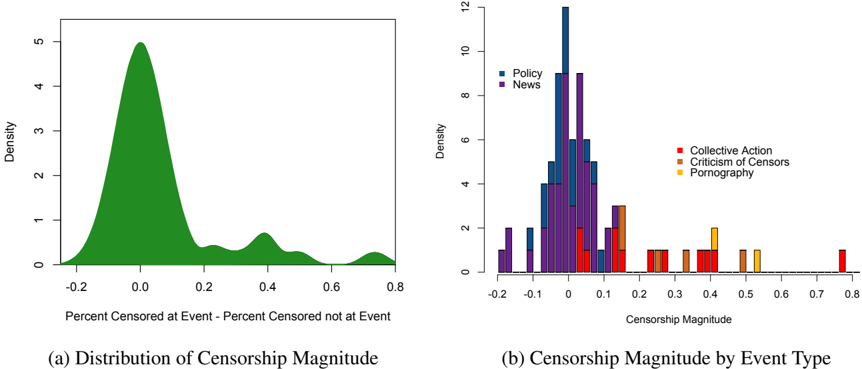
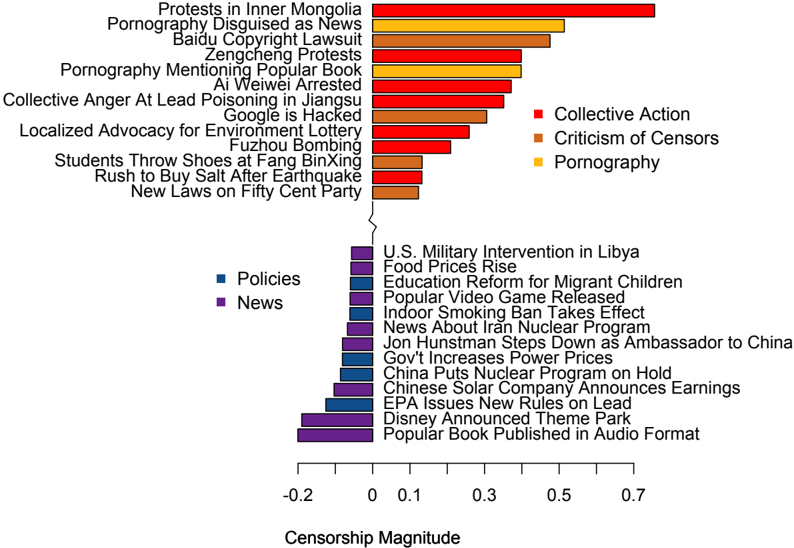
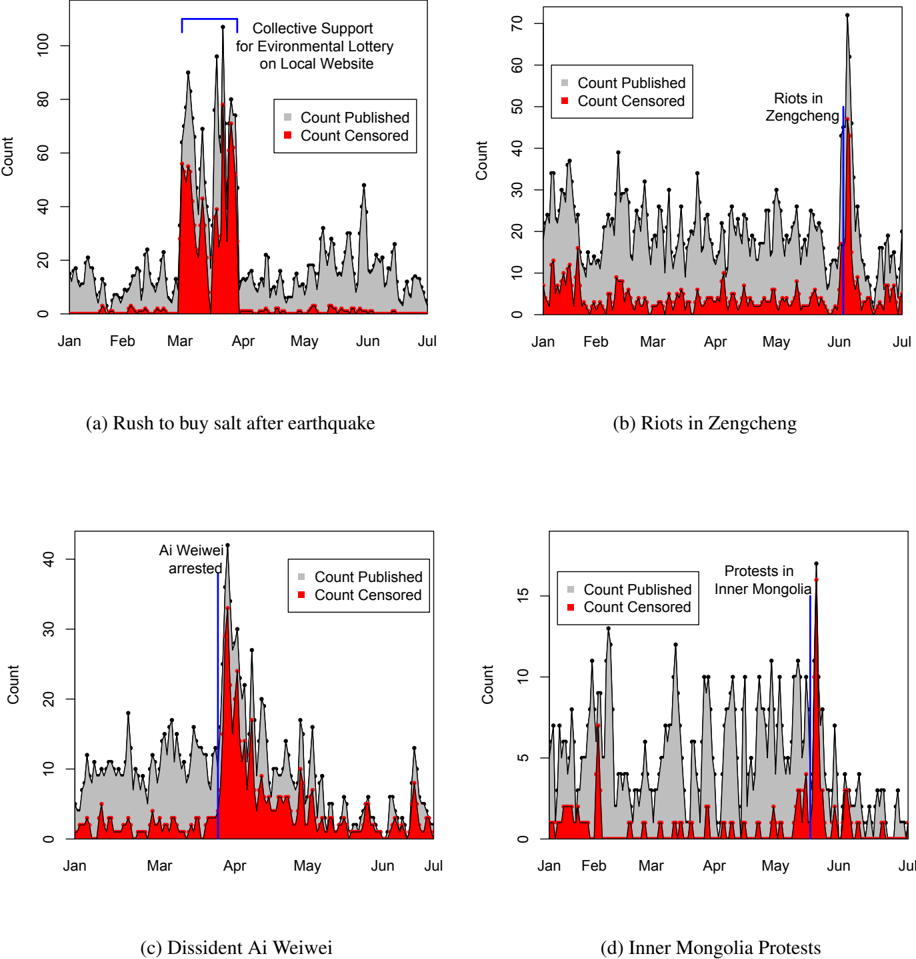
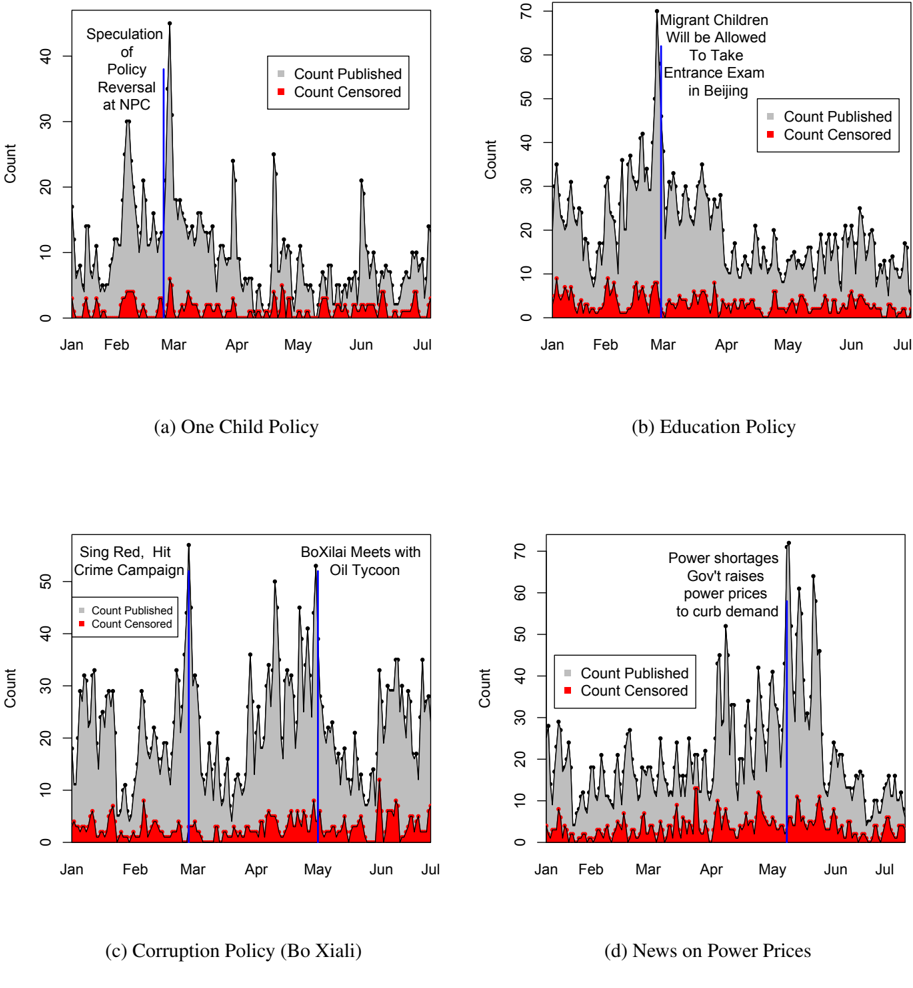
- Censorship was much higher during volume bursts tied to collective action: average censorship magnitude was 27% for collective action, compared with -1% for policy and -4% for news.
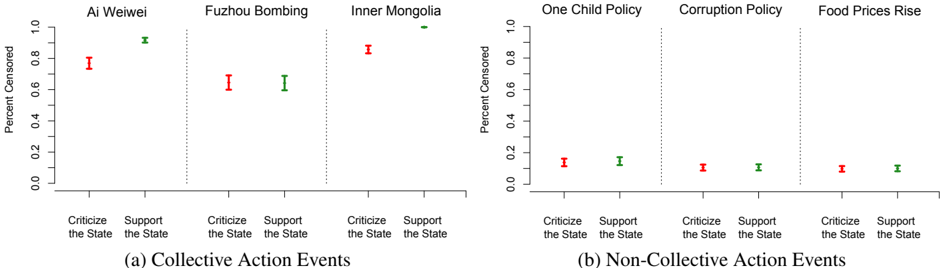
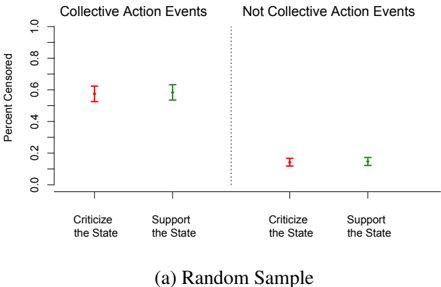
- For collective action events such as Ai Weiwei’s arrest, Inner Mongolia protests, and Fuzhou bombings, posts were censored at about 80% on average whether they criticized or supported the state. For non-collective-action events such as the one child policy, corruption policy, and food prices, censorship was about 10% on average for both critical and supportive posts.
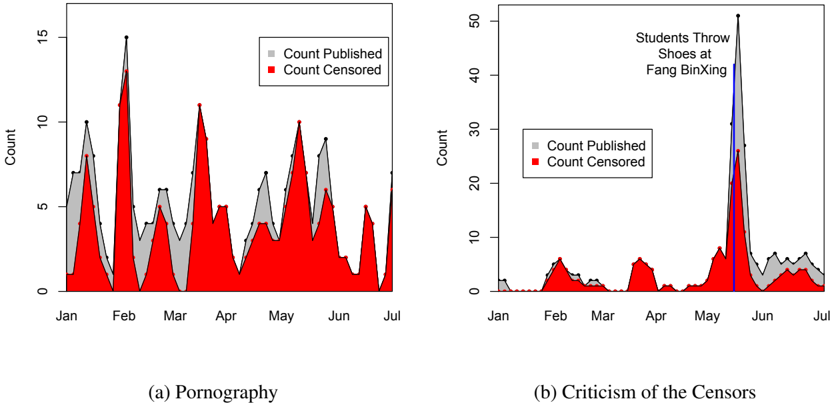
- Censorship also targeted pornography and criticism of the censors, but not government policy or other news. The authors argue censorship is aimed at curtailing collective action by silencing comments that represent, reinforce, or spur social mobilization.
Methods
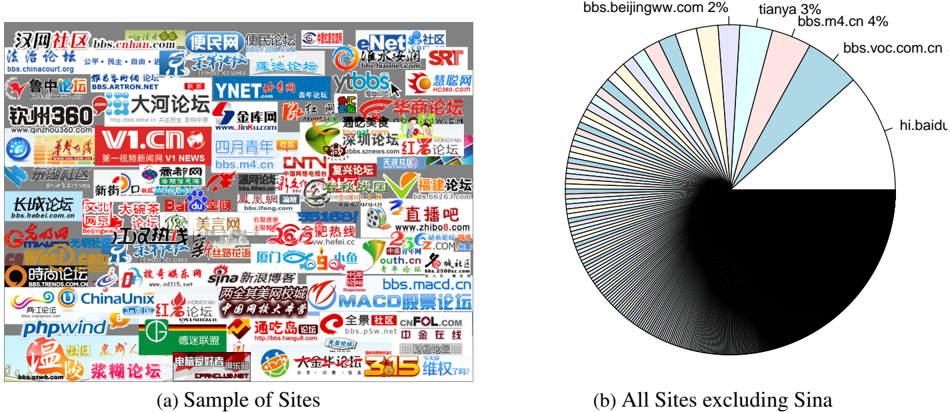
- The authors built a system to locate, download, and analyze posts from 1,382 Chinese websites during the first half of 2011, before government censors could remove them. They collected 3,674,698 posts, randomly selected 127,283 for further analysis, and overall collected and analyzed 11,382,221 posts.
- They used a stratified random sampling design covering 85 topic areas across three hypothesized political sensitivity levels, detected 87 volume bursts in 67 of the 85 topic areas using robust regression-based burst detection, and classified events into collective action potential, criticism of censors, pornography, government policies, and other news.
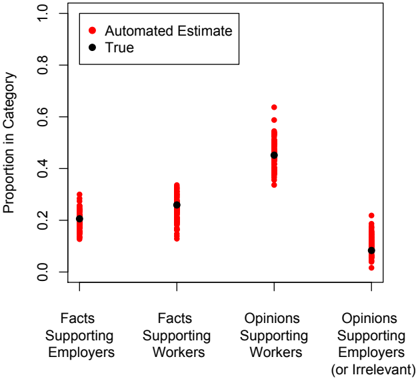
- To analyze content, they adapted the Hopkins and King “ReadMe” automated text analysis method to Chinese and extended it with a Bayesian procedure to estimate the percent censored within categories. Validation used native Chinese speakers coding 1,000 posts about 2010 labor strikes, with 100 as training and 900 as test; event coding reliability was 98.9% (86 of 87 events).
Limitations
- The paper states that its methodology misses self-censorship and censorship that may occur before the post is obtained; it also does not quantify the direct effects of the Great Firewall, keyword blocking, or search filtering.
- The authors state they have not studied physical violence, such as arrest of bloggers, or threats of the same; although many officials and levels of government influence censorship decisions, their data only sometimes distinguish among these sources, and they cannot determine the consequences of these limitations.
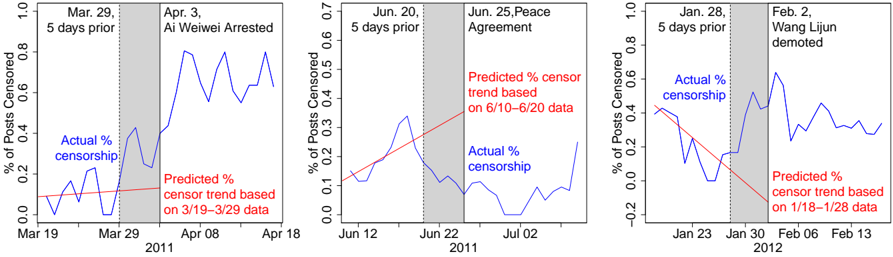
- The authors note that the presumably smaller number of discussions they cannot observe are likely to be those of most interest to the Chinese government, and they offer little evidence connecting social media findings to press freedom or other types of human expression in China. They also state that the predictive analysis was conducted retrospectively and with only three events, so further prospective validation would be valuable.
Model-written summary. Check it against the paper before relying on it.
Integrity signals
Registry
Cites
Statistics
Figures
Verification
Claims the paper makes
0 Valid · 7 Not valid · 7 Not checked · 88 Own results and interpretations
A result the paper reports from its own data — it cites no other source for it, so there is none to check. The quote shows it is in the paper.
In the paper
“Our data show that the Chinese censorship program allows for a wide variety of criticisms of the Chinese government, its officials, and its policies.”
§ How Censorship in China Allows Government Criticism but Silences Collective Expression * > Outline of Results
plain- Asserted: passes — The authors put it forward as true.
- Checkable: passes — It can be checked against evidence.
- Load-bearing: passes — The paper’s conclusions depend on it.
- Based: passes — The paper gives a reason why it holds.
A result the paper reports from its own data — it cites no other source for it, so there is none to check. The quote shows it is in the paper.
In the paper
“Contrary to previous understandings, posts with negative, even vitriolic, criticism of the state, its leaders, and its policies are not more likely to be censored.”
- Also stated in: § 1 Introduction · plain
“we find that when the Chinese people write scathing criticisms of their government and its leaders, the probability that their post will be censored does not increase.”
§ How Censorship in China Allows Government Criticism but Silences Collective Expression * > Abstract
plain- Asserted: passes — The authors put it forward as true.
- Checkable: passes — It can be checked against evidence.
- Load-bearing: passes — The paper’s conclusions depend on it.
- Based: passes — The paper gives a reason why it holds.
- Also stated in: § 1 Introduction · plain
A result the paper reports from its own data — it cites no other source for it, so there is none to check. The quote shows it is in the paper.
In the paper
“Large increases in online volume are good predictors of censorship when these increases are associated with events related to collective action, e.g., protest on the ground.”
§ How Censorship in China Allows Government Criticism but Silences Collective Expression * > Outline of Results
plainstates an association- Asserted: passes — The authors put it forward as true.
- Checkable: passes — It can be checked against evidence.
- Load-bearing: passes — The paper’s conclusions depend on it.
- Based: passes — The paper gives a reason why it holds.
A result the paper reports from its own data — it cites no other source for it, so there is none to check. The quote shows it is in the paper.
In the paper
“In addition, we measure sentiment within each of these events and show that during these events, the government censors views that are both supportive and critical of the state.”
§ How Censorship in China Allows Government Criticism but Silences Collective Expression * > Outline of Results
plainstates a cause- Asserted: passes — The authors put it forward as true.
- Checkable: passes — It can be checked against evidence.
- Load-bearing: passes — The paper’s conclusions depend on it.
- Based: passes — The paper gives a reason why it holds.
A result the paper reports from its own data — it cites no other source for it, so there is none to check. The quote shows it is in the paper.
In the paper
“We thus conduct the same analysis for the demotion of Wang Lijun in Panel (c) of Figure 11, and again see a large difference in actual and predicted percent censorship before Wang's demotion.”
§ How Censorship in China Allows Government Criticism but Silences Collective Expression * > Additional information
plainSingle case- Asserted: passes — The authors put it forward as true.
- Checkable: passes — It can be checked against evidence.
- Load-bearing: unclear — It is unclear whether the paper’s conclusions depend on it.
- Based: passes — The paper gives a reason why it holds.
46 more claims
Create a free account to see all 102 claims and every source verdict.
- Probably not a substantial claim. 26
- It may state two separate claims as one. 33
Claims other papers make about this one
Each is checked against this paper’s own text: does it say what the citing paper says it does?
The source backs part of the claim, not all of it — or backs it for a different population, condition or comparison.
In the citing paper
“Authorities are keen to review social media posts and have contentious messages removed (King etal., 2013) to ensure that potential threats remain invisible.”
From How Dictators Control the Internet: A Review Essay (2020) · cites this paper as King et al., 2013
Experimental — accuracy not yet measuredThe source backs part of the claim, not all of it — or backs it for a different population, condition or comparison.
In the citing paper
“In most autocratic regimes, governmental interference in digital infrastructure and communication is commonplace.”
From How Dictators Control the Internet: A Review Essay (2020) · cites this paper as King et al., 2013
Experimental — accuracy not yet measuredThe source backs part of the claim, not all of it — or backs it for a different population, condition or comparison.
In the citing paper
“First, the timing of censorship during a coup is consistent with many studies that have shown that Internet censorship is targeted during sensitive political time periods and periods of potential power transitions, such as elections and large-scale protests [23,25,44,47,73].”
From A multi-perspective view of Internet censorship in Myanmar (2021) · cites this paper as [44]
Experimental — accuracy not yet measuredThe cited source says what the claim attributes to it.
In the citing paper
“research has shown how mobilization organized through public coordination is repressed using that very same public information-for instance, repression is preemptively increased before focal days (Truex 2019); and autocracies censor online calls for collective action (King, Pan, and Roberts 2013), coerce online opinion leaders (Pan and Siegel 2020), and at times, turn off the internet entirely.”
From Coordinated Dis-Coordination (2024) · cites this paper as King, Pan, and Roberts 2013
The check wasn’t confident either way, so it gives no verdict — never disputed.
In the citing paper
“In China, for instance, two virtual police officers remind citizens that their browsing behavior is monitored (King etal., 2013).”
From How Dictators Control the Internet: A Review Essay (2020) · cites this paper as King et al., 2013
Experimental — accuracy not yet measured
1 more claim about this paper
Create a free account to see every claim other papers make about this one.
Citations
Cites
Robust estimation of a location parameter
Huber, P. J. (1964) · The Annals of Mathematical Statistics · doi:10.1214/aoms/1177703732 · Cited by 7,228
Robust Regression and Outlier Detection
Piepel, G. F. (1989) · Technometrics · doi:10.1080/00401706.1989.10488524 · Cited by 6,144
Robust Regression and Outlier Detection
Rousseeuw, P. J., & Leroy, A. M. (1987) · Wiley Series in Probability and Statistics · doi:10.1002/0471725382 · Cited by 5,609
Logistic Regression in Rare Events Data
King, G., & Zeng, L. (2001) · Political Analysis · doi:10.1093/oxfordjournals.pan.a004868 · Cited by 4,316 · cited 1×
“We do this via well-known and widely used case-control methodology (King and Zeng 2001).”
MethodSelf-citationDemocracy and Development: Political Institutions and Well-Being in the World, 1950–1990
Przeworski, A., Alvarez, M. E., Cheibub, J. A., & Limongi, F. (2000) · doi:10.1017/cbo9780511804946 · Cited by 2,845
Rightful Resistance in Rural China
O'Brien, K. J., & Li, L. (2006) · Cambridge University Press eBooks · doi:10.1017/cbo9780511791086 · Cited by 1,104
The Dynamics of Informational Cascades: The Monday Demonstrations in Leipzig, East Germany, 1989–91
Lohmann, S. (1994) · World Politics · doi:10.2307/2950679 · Cited by 1,035 · cited 1×
“Protests in East Germany, Eastern Europe, and most recently the Middle East have all preceded regime change (Ash 2002; Lohmann 1994; Przeworski et al. 2000).”
BackgroundRightful Resistance in Rural China
O'Brien, K., & Li, L.-J. (2006) · doi:10.1017/cbo9780511791086.003 · Cited by 987
China's Changing of the Guard: Authoritarian Resilience
Nathan, A. J. (2003) · Journal of Democracy · doi:10.1353/jod.2003.0019 · Cited by 927
Sparks and prairie fires: A theory of unanticipated political revolution
Kuran, T. (1989) · Public Choice · doi:10.1007/bf00116762 · Cited by 905 · cited 1×
“In fact, Kuran (1989) and Lohmann (2002) show that it is information about a collective action event that propels collective action and so distinguishing this from explicit calls for collective action would be difficult if not impossible.”
Background
Research works printed but not linked: 13
- 22. Freedom House. 2012. "Freedom of the Press, 2012." www.freedomhouse.org.
- 8. Chang, Parris. 1983. Elite Conflict in the Post-Mao China. New York: Occasional Papers Reprints.
- 26. Hinton, Harold. 1955. The "Unprincipled Dispute" Within Chinese Communist Top Lead- ership. Washington, DC: U.S. Information Agency.
- 44. Perry, Elizabeth. 2002. Challenging the Mandate of Heaven: Social Protest and State Power in China. Armork, NY: M. E. Sharpe.
- 52. Schurmann, Franz. 1966. Ideology and Organization in Communist China. Berkeley, CA: University of California Press.
- Tsai, 2007, Capitalism without Democracy: The Private Sector in Contemporary China
- 48. Qiang, Xiao. 2011. The Rise of Online Public Opinion and Its Political Impact. In Chang- ing Media, Changing China, ed. Susan Shirk. New York: Oxford University Press pp. 202-224.
- 9. Charles, David. 1966. The Dismissal of Marshal P'eng Teh-huai. In China Under Mao: Politics Takes Command, ed. Roderick MacFarquhar. Cambridge: MIT University Press pp. 20-33.
- 54. Shirk, Susan. 2007. China: Fragile Superpower: How China's Internal Politics Could Derail Its Peaceful Rise. New York: Oxford University Press.
- 56. Teiwes, Frederick. 1979. Politics and Purges in China: Retification and the Decline of Party Norms. Armork, NY: M. E. Sharpe. Tsai, Kellee. 2007a. Capitalism without Democracy: The Private Sector in Contemporary China. Ithaca, NY: Cornell University Press.
- 15. Duan, Qing. 2007. China's IT Leadership. Vdm Verlag.
- 38. MacFarquhar, Roderick. 1974. The Origins of the Cultural Revolution Volume 1: Contra- dictions Among the People 1956-1957. New York: Columbia University Press.
- 12. Chen, Xiaoyan and Peng Hwa Ang. 2011. Internet Police in China: Regulation, Scope and Myths. In Online Society in China: Creating, Celebrating, and Instrumentalising the Online Carnival, ed. David Herold and Peter Marolt. New York: Routledge pp. 40-52.
Cited by
Items 1,301–1,400 of 2,443
Jungherr, A. M., & Posegga, O. (2023) · Springer eBooks · doi:10.1007/978-3-658-31480-4_54-1 · Cited by 4
Olczak, N. (2023) · Journal of Chinese Political Science · doi:10.1007/s11366-023-09847-1 · Cited by 3
“…North Korea are likely to be removed, but research has shown that censorship is primarily of posts which threaten to lead to offline collective action or are directly critical of the government [51] and that there remains space for relatively open discussion of topics such as North Korea [49].”
BackgroundTapia, M., Elfström, M., & Roca‐Servat, D. (2018) · Emerald Group Publishing Limited eBooks · doi:10.1108/s0733-558x20180000056008 · Cited by 14
Martin, F. R. (2019) · Springer eBooks · doi:10.1007/978-3-030-17906-9_4 · Cited by 4
Stockmann, D. (2015) · SSRN Electronic Journal · doi:10.2139/ssrn.2607998 · Cited by 3
Lei, X., & Lü, J. (2014) · SSRN Electronic Journal · doi:10.2139/ssrn.2454133 · Cited by 3
Corruption, Censorship, the Media, and the Market in ChinaPreprint
Hassid, J. (2017) · SSRN Electronic Journal · doi:10.2139/ssrn.3041421 · Cited by 3
A study of online citizenship practices of Chinese young people
Fu, J. (2017) · Minerva Access (University of Melbourne) · Cited by 6
Automatically Generating a Large, Culture-Specific Blocklist for ChinaPreprint
Hounsel, A., Mittal, P., & Feamster, N. (2018) · arXiv (Cornell University) · doi:10.48550/arxiv.1806.03255 · Cited by 10
Ünver, H. A. (2019) · SocArXiv (OSF Preprints) · doi:10.31235/osf.io/nj8gx · Cited by 5
Li, X., Shi, W., & Zhu, B. (2017) · SSRN Electronic Journal · doi:10.2139/ssrn.3002066 · Cited by 5
Stokes, E. C. (2017) · Cited by 5
What Drives Demand for Government-Controlled News in Russia?Preprint
Simonov, A., & Rao, J. M. (2018) · SSRN Electronic Journal · doi:10.2139/ssrn.3051165 · Cited by 7
Public Sentiment on Chinese Social Media during the Emergence of COVID-19Preprint
Lu, Y., Pan, J., & Xu, Y. (2020) · SSRN Electronic Journal · doi:10.2139/ssrn.3757135 · Cited by 3
Self-citationLi, H. (2022) · SSRN Electronic Journal · doi:10.2139/ssrn.4069885 · Cited by 3
Han, R. (2021) · SSRN Electronic Journal · doi:10.2139/ssrn.3783338 · Cited by 3
The Social Costs of Digital vs. In-Person SurveillancePreprint
Xu, X. (2020) · SSRN Electronic Journal · doi:10.2139/ssrn.3572138 · Cited by 6
Crisis Communication in Authoritarian Systems and Digital Innovation
Asmolov, G. (2022) · Wiley eBooks · doi:10.1002/9781119678953.ch15 · Cited by 4
Measuring Media Criticism with ALC Word EmbeddingsPreprint
Barrie, C., Ketchley, N., Siegel, A. A., et al. (2023) · doi:10.31219/osf.io/68zn4 · Cited by 3
Williams, N. W., Casas, A., Aslett, K., & Wilkerson, J. (2023) · SSRN Electronic Journal · doi:10.2139/ssrn.4540742 · Cited by 3
Violence Against Journalists and Freedom of the Press: Evidence from MexicoPreprint
Jurado, J. A., & Morales, J. S. (2024) · SSRN Electronic Journal · doi:10.2139/ssrn.4843961 · Cited by 2
Colglazier, C., TeBlunthuis, N., & Shaw, A. (2024) · arXiv · doi:10.48550/arxiv.2404.02109 · Cited by 3
Media Freedom in the Shadow of a Coup
Boleslavsky, R., Shadmehr, M., & Sonin, K. (2018) · doi:10.2139/ssrn.3251019 · Cited by 2
The parable of copycat headlines under Erdogan regime in Turkey
Akkus, A. (2023) · Cogent Social Sciences · doi:10.1080/23311886.2023.2243723 · Cited by 4
“Likewise, the intertwined relationships between media organisations and political actors as well as bias in coverage of politics (Haselmayer et al., 2017; King et al., 2013; van der Pas et al., 2017; Voltmer, 2008) can also be regarded as an indirect form of state intervention.”
BackgroundKoo, J. N. L., & Quek, K. (2024) · International Studies Quarterly · doi:10.1093/isq/sqae148 · Cited by 3
Zhang, Y. (2024) · Society · doi:10.1007/s12115-024-01040-1 · Cited by 3
“By attributing domestic issues and challenges to the machinations of a few conspiratorial groups, governments not only divert public attention but also reinforce their political stance, serving to maintain the political order (King et al., 2013).”
Popa, M. (2025) · Journal of Computational Social Science · doi:10.1007/s42001-024-00353-9 · Cited by 3
How authoritarianism and extraversion relate to censorship
Wentzel, K., & Lambe, J. (2025) · Communication and Democracy · doi:10.1080/27671127.2025.2472640 · Cited by 2
Contagious media mobilization: The dynamics of anti-harassment activism on campus
Chen, W., & Wang, Y. (2025) · Women s Studies International Forum · doi:10.1016/j.wsif.2025.103118 · Cited by 3
Zheng, R., & Liu, N. (2025) · Journal of Chinese Governance · doi:10.1080/23812346.2025.2520111 · Cited by 2
Who gets what and why? A configurational analysis of China’s environmental regulatory enforcement
Zhang, W. (2025) · Journal of Chinese Governance · doi:10.1080/23812346.2025.2523176 · Cited by 4
“126 Moreover, this research advances academic discourse on environmental governance in transitional contexts by providing deeper insights into China’s evolving institutional landscape and regulatory reforms.”
Li, H., Liu, Z., Zhang, Z., Ping, L., Gu, W., & Yao, Y. (2025) · Journal of Medical Internet Research · doi:10.2196/70087 · Cited by 3
Xia, N. (2025) · Continuum · doi:10.1080/10304312.2025.2544779 · Cited by 4
“In the digital space, this is achieved through ‘strategic censorship’ and ‘organized spontaneity,’ where state-aligned actors orchestrate apparently organic, grassroots support to create the impression of consensus (King, Pan, and Roberts 2013; Repnikova and Fang 2018).”
Li, G. M., & Ma, Z. (2025) · Frontiers in Political Science · doi:10.3389/fpos.2025.1599347 · Cited by 3
Pandemic, paternalism, and the (im)possibilities of citizenship in China: A netnography
Ma, Z., Bi, Y., & Jiang, N. (2025) · American Ethnologist · doi:10.1111/amet.70017 · Cited by 14
Tell China’s conspiracy well: Networks and narratives of anti-CCP YouTube conspiracy theorists
Qin, A. Y., Xiao, F., & Dai, L. (2025) · Convergence The International Journal of Research into New Media Technologies · doi:10.1177/13548565251392612 · Cited by 4
“Domes-tically, they censor contents on news and social media (Xu, 2014), especially those with potential to incite collective actions (King et al., 2013).”
Knowing Is Disturbing: Emotions and Public Attitudes toward Digital Control under Autocracy
Guo, D., & Kostka, G. (2025) · Perspectives on Politics · doi:10.1017/s1537592725103551 · Cited by 3
“Especially during crises, state-initiated censorship campaigns can a ff ect a broad range of individual social media users through various techniques (King, Pan, and Roberts 2013), suggesting that many people may have personally experienced digital censorship (Hobbs and Roberts 2018; Jansen and…”
Platform policy reinvention: evidence from China’s ride-hailing policy
Jiang, G., & Yang, W. (2025) · Journal of Chinese Governance · doi:10.1080/23812346.2025.2591536 · Cited by 3
Understanding resilience and resistance against sexual harassment in a patri-authoritarian context
Li, Y. V., & Eklund, L. (2025) · Women s Studies International Forum · doi:10.1016/j.wsif.2025.103253 · Cited by 5
Chinese foreign aid and the erosion of media freedom
Lin, W., Lai, D.-Y., & Wu, W. (2025) · International Relations of the Asia-Pacific · doi:10.1093/irap/lcaf011 · Cited by 3
Gauging preference stability under authoritarianism
Pan, J., & Xu, Y. (2025) · Research & Politics · doi:10.1177/20531680251400418 · Cited by 11
“Second, China has one of the most expansive and sophisticated systems of information control (Brady, 2009; King et al., 2013).”
Self-citationJustice for @birdy: Queer counterpublics on Chinese TikTok (Douyin)
Wang, Z., Zhu, J., Kim, D.-G., Zuo, W., Yao, Z., Chen, Y., & Wang, Z. (2026) · New Media & Society · doi:10.1177/14614448251413683 · Cited by 6
Corporate sociopolitical activism as a Signal: A Meta-Analysis and research agenda
Braga, L. D., Tardin, M., Grinstein, A., & Perin, M. G. (2026) · Journal of Business Research · doi:10.1016/j.jbusres.2026.116147 · Cited by 4
Trust in the Central Chinese Government and Village Leader Relations During the COVID-19 Pandemic
Xi, J. (2026) · Journal of Chinese Political Science · doi:10.1007/s11366-026-09936-x · Cited by 2
Xu, Q., & Qi, L. (2014) · International Journal of Interactive Communication Systems and Technologies · doi:10.4018/ijicst.2014010102 · Cited by 2
L'art de la guerre revisité. Cyberstratégie et cybermenace chinoises
Douzet, F. (2014) · Hérodote · doi:10.3917/her.152.0161 · Cited by 2
Durdağ, B. (2017) · Gaziantep University Journal of Social Sciences · doi:10.21547/jss.272243 · Cited by 3
Zhao, J. (2017) · MedieKultur Journal of media and communication research · doi:10.7146/mediekultur.v33i62.24325 · Cited by 3
Contentious Politics in China: Causes, Dynamics, and Consequences
Elfström, M., & Li, Y. (2019) · Brill Research Perspectives in Governance and Public Policy in China · doi:10.1163/24519227-12340005 · Cited by 3
Staging environmental risk: a methodological cosmopolitanism approach to Chinese media events
Mao, Z., & Qiu, J. L. (2019) · Global Networks · doi:10.1111/glob.12274 · Cited by 2
Social Scientists as the Architects of Their Own Defeat in the Study of Video Games
Hart, M. (2020) · Emerald Group Publishing Limited eBooks · doi:10.1108/978-1-83867-447-220201003 · Cited by 17
A King Stifling Voices of Dissent? Popular Protests and State Responses in Xi's China
Wang, H., Tzeng, W., Wang, S., & Chiu, W. (2021) · Pacific Focus · doi:10.1111/pafo.12177 · Cited by 3
Measuring QQMail's automated email censorship in China
Knockel, J., & Ruan, L. (2021) · doi:10.1145/3473604.3474560 · Cited by 2
“Some research has focused on how blog [12, 16] or micro-blog [17, 26] posts are chosen to be deleted by moderation teams on domestic Chinese platforms.”
BackgroundChina’s Authoritarian Governance and AI
Zeng, J. (2022) · Springer eBooks · doi:10.1007/978-981-19-0722-7_4 · Cited by 4
The Politics of Naming: The Online Carnival in China
Lin, Z., & Zhao, Y. (2022) · China Perspectives · doi:10.4000/chinaperspectives.13820 · Cited by 2
Legitimizing Postcrisis Policy Change: Crisis-Framing Strategies by Public Leaders in China
Liu, Y., & van den Dool, A. (2022) · Natural Hazards Review · doi:10.1061/(asce)nh.1527-6996.0000570 · Cited by 2
The Art of Plucking the Goose: Chinese Urban Residents’ Tax Consciousness
Zhang, C., & Dickson, B. J. (2022) · Governance · doi:10.1111/gove.12769 · Cited by 6
Sun, Z., & Zhu, D. (2023) · Journal of Environmental Planning and Management · doi:10.1080/09640568.2023.2183822 · Cited by 2
“Additionally, unlike social media posts from platforms such as Sina Weibo, which are strictly censored by the Chinese government, analyses of non-sensitive terms collected from the BSI website are rarely affected by internet censorship (King, Pan, and Roberts 2013; Wang 2008).”
BackgroundLi, Z., Wu, W., & Meng, Q. (2023) · Systems · doi:10.3390/systems11030158 · Cited by 2
Liu, Y. V., & Nalla, M. K. (2023) · Asian Journal of Criminology · doi:10.1007/s11417-023-09399-6 · Cited by 3
Wang, M. D. (2023) · Artificial intelligence · doi:10.5772/intechopen.110794 · Cited by 3
How Media’s factor and governmental factor affected individual’s opinion on haze in China
Liu, H. (2023) · Environmental Research Communications · doi:10.1088/2515-7620/accdb8 · Cited by 4
Artists’ Narratives Across Culture: Globally Mapping Violence Against Women
Stetz, L. (2023) · Journal of Radiology Nursing · doi:10.1016/j.jradnu.2023.02.011 · Cited by 4
Cao, L., & Qiaoan, R. (2023) · The Communication Review · doi:10.1080/10714421.2023.2214056 · Cited by 6
“Additionally, King, Pan, and Roberts (2013) observe that censorship targets posts spurring social mobilization rather than ones criticizing the state.”
BackgroundSelecting More Informative Training Sets with Fewer Observations
Kaufman, A. R. (2023) · Political Analysis · doi:10.1017/pan.2023.19 · Cited by 4
Uneven Coverage and Blank Spaces: Bringing the State Back In
Creemers, R. J. E. H. (2023) · Asiascape Digital Asia · doi:10.1163/22142312-bja10044 · Cited by 4
CH-Wang, S., Saakyan, A., Li, O., Zhou, Y., & Muresan, S. (2023) · Conference on Empirical Methods in Natural Language Processing (EMNLP) · doi:10.18653/v1/2023.emnlp-main.215 · Cited by 33
Small apps for digital futures: Podcasting ecology in contemporary China
Wang, J. (2023) · Radio Journal International Studies in Broadcast & Audio Media · doi:10.1386/rjao_00082_1 · Cited by 5
Learn to Abstain: How Education Can Lower Voter Turnout in China's Grassroots Elections
Lai, W. (2021) · Journal of Economic Behavior & Organization · doi:10.1016/j.jebo.2024.03.021 · Cited by 4
The Role of Issue Characteristics in Shaping E-Participation: A Survey Experiment Approach
Wang, R., Wu, J., Yang, J. X., & Xu, C. K. (2024) · Annual International Conference on Digital Government Research · doi:10.1145/3657054.3657132 · Cited by 2
“[21, 29] time-critical nature of certain issues, urging swift and appropriate responses to mitigate harm.”
BackgroundChina’s Policy Response to Nancy Pelosi’s Visit to Taiwan: The Influence of Nationalism Revisited
Xu, W. (2024) · Pacific Affairs · doi:10.5509/2024973-art7 · Cited by 2
China’s internet controls: What if citizens disengage?
DeButts, M., & Pan, J. (2024) · Communication and the Public · doi:10.1177/20570473241267966 · Cited by 4
Self-citationCEO Cross-Sector Work Experience and Public–Private Partnership Formation of Private Firms in China
Chen, A., Wang, Y., & Zhang, J. (2024) · Management and Organization Review · doi:10.1017/mor.2024.10 · Cited by 2
“This is an important area on which to focus given that the information available to private actors is not homogeneous, but varies in its sources, coverage focuses, biases, and audience access (Enikolopov & Petrova, 2015; King, Pan, & Roberts, 2013).”
Murtazashvili, I., & Zhou, Y. (2024) · Constitutional Political Economy · doi:10.1007/s10602-024-09450-3 · Cited by 3
“Previous research and a good deal of news reporting in the West has argued that the Chinese government has used its extensive control of information to promote its political goals (King et al., 2013 , 2014, 2017; Zhou, 2018 ).”
Zhao, X., & Cheng, Z. (2024) · Public Administration and Policy · doi:10.1108/pap-11-2023-0157 · Cited by 3
Gao, X., Shen, X., & Wang, Q. (2024) · International Journal of Public Sector Management · doi:10.1108/ijpsm-11-2023-0322 · Cited by 2
Ong, L. H., & Luo, K. W. (2024) · Issues & Studies · doi:10.1142/s1013251124500152 · Cited by 2
Learning From the Enemies of Freedom: Freedom of Expression and Collective Power
Kurtulmuş, F. (2025) · British Journal of Political Science · doi:10.1017/s000712342400067x · Cited by 15
“The subsequent sections are devoted to the context of justification, where these insights are expanded to construct an account of freedom of expression for democratic societies.”
Xu, S., & Ding, Y. (2025) · Journal of Asian Public Policy · doi:10.1080/17516234.2025.2470498 · Cited by 2
“Despite tight online monitoring and regulation, the Chinese public could strategically use tightly regulated social media to express dissatisfaction with a policy (King et al., 2013) and set an outside-initiative agenda (Duckett & Wang, 2013; Su & Xiao, 2021).”
The Influence of Social Media on Environmental News Reporting and Public Discourse in China
Nguyen, J., Abdullah, A., & Park, J. (2024) · Khulna University Studies · doi:10.53808/kus.2024.21.02.1212-ss · Cited by 2
“Additionally, the Chinese government's stringent internet regulations and censorship policies pose significant constraints on the free flow of information, affecting the scope and accuracy of environmental reporting on social media (King, Pan, & Roberts, 2013).”
InfluentialYang, Y., Lu, L., Williams, M. D., & Jia, X. (2025) · Studies in Comparative International Development · doi:10.1007/s12116-025-09471-5 · Cited by 3
Text-as-Data Methods to Study Mass-Media Manipulations in Autocracies
Lova, L. L. (2025) · Communist and Post-Communist Studies · doi:10.1525/cpcs.2025.2638313 · Cited by 4
Foreign Correspondence in China: Authoritarian Media Control and Journalistic Responses
Lim, L. (2025) · The International Journal of Press/Politics · doi:10.1177/19401612251379585 · Cited by 5
Digital geospatial construction on Chinese social media based on IP geolocation
Zhao, G. (2025) · Mobile Media & Communication · doi:10.1177/20501579251356215 · Cited by 6
“…many studies have raised concerns about internet censorship in China (Schneider, 2018; Stockmann & Luo, 2015), the internet allows for diverse voices to exist as long as they do not involve collective opposition to the state (King et al., 2013), and there is limited interference (Peng, 2021).”
The Internet in China: New Methods and Opportunities
Zhang, Y. (2017) · Journal of Chinese Political Science · doi:10.1007/s11366-017-9526-3 · Cited by 2
The Post-Adoption Behaviors of Government Social Media in China
Ma, L. (2018) · Public administration and information technology · doi:10.1007/978-3-319-73386-9_2 · Cited by 2
Graphic Activism on WeChat: The Aesthetics of Dissent in the Age of COVID-19
Ma, R. (2021) · Design and Culture · doi:10.1080/17547075.2021.1875543 · Cited by 2
“These online activities create bottom-up pressure for the government to respond to public demands (Li, Liu, and Meng 2019).”
BackgroundSun, Z. (2022) · Visual Studies · doi:10.1080/1472586x.2022.2070535 · Cited by 2
The sin of words: Censorship and self‐censorship in China during the Qing dynasty (1644–1911)
Li, P. (2023) · Asia‐Pacific Economic History Review · doi:10.1111/aehr.12268 · Cited by 4
Zhu, Q., & Škorić, M. M. (2014) · Hawaii International Conference on System Sciences (HICSS) · doi:10.1109/hicss.2014.273 · Cited by 4
“Research suggests that online mobilization efforts are the primary targets of Chinese Internet censorship program [13], indicating the extent or potential of the Internet to promote engagement among citizens.”
BackgroundCyber-nationalism in China: challenging western media portrayals of censorship in China
Hassid, J. (2013) · Continuum · doi:10.1080/10304312.2013.843640 · Cited by 2
“Other scholars, however, have found the opposite – that national media have more leeway for sensitive stories than the local press (see for example King, Pan, and Roberts 2013).”
BackgroundDo ordinary bloggers really differ from blog celebrities?
Koltsova, O. Y., Koltcov, S., & Alexeeva, S. (2014) · ACM Conference on Web Science (WebSci) · doi:10.1145/2615569.2615675 · Cited by 2
“The lion share of the works have been devoted to English-language blogs, with only some attention to other languages, Chinese above all [2; 5; 6; 12].”
BackgroundMedia Bias in Autocracies: Evidence from China
Strömberg, B. Q., & Wu, Y. (2014) · Cited by 2
Anti-system Contentions and Authoritarian Response in China: Evolution and Mechanisms
He, J., & Su, Z. (2017) · Journal of Asian and African Studies · doi:10.1177/0021909616687598 · Cited by 3
“Research has pointed out that the Chinese censorship machine is far more interested in censoring speeches that have immediate potential in inciting collective actions than they are in paying attention to speeches that are only critical of the regime (King et al., 2013).”
BackgroundAn opinion leader and the making of a city on China's Sina Weibo
Wang, W. Y. (2016) · University of Adelaide Press eBooks · doi:10.20851/publics-10 · Cited by 2
Broniecki, P., & Hanchar, A. (2017) · International Conference on the Frontiers and Advances in Data Science (FADS) · doi:10.1109/fads.2017.8253201 · Cited by 6
“[33] automatically downloaded Chinese blogposts as they appeared online.”
BackgroundThe contention of nail residents
Gui, X. (2017) · Chinese Sociological Dialogue · doi:10.1177/2397200917728382 · Cited by 2
Küresel Bir Modele Doğru Çin Medyası
KETEN, E. T. (2015) · İnsan ve İnsan Dergisi · doi:10.29224/insanveinsan.279988 · Cited by 4
Media Coverage of Educational Testing: Understanding Issue Dimensions Using Topic Modeling
Wachen, J. (2018) · Carolina Digital Repository (University of North Carolina at Chapel Hill) · doi:10.17615/v2e2-dy94 · Cited by 3
The Nature of Popular Protest and the Employment of Repressive State Capacity in China
Wang, S., Wang, H., & Tzeng, W. (2019) · Issues & Studies · doi:10.1142/s1013251119500048 · Cited by 2
Metadata
- Authors
- KING, G., PAN, J., & ROBERTS, M. E.
- Affiliations
- Harvard University (US)
- Corresponding author
- KING, GARY
- PAN, JENNIFER
- Venue
- American Political Science Review
- Publisher
- Cambridge University Press (CUP)
- Published
- 2013-05
- Volume
- 107
- Issue
- 2
- Pages
- 326-343
- ISSN
- 0003-0554 (ISSN-L)
- 1537-5943
- OpenAlex
- W2144188763
- Cited by
- 2,415
- References
- 48
- Citations by year
- 2026: 161 · 2025: 206 · 2024: 249 · 2023: 272 · 2022: 230 · 2021: 193 · 2020: 206 · 2019: 157 · 2018: 178 · 2017: 153 · 2016: 137 · 2015: 120 · 2014: 91 · 2013: 54
- FWCI
- 395.09
- Type
- journal article
- Language
- en
- Open access
- green
- nrs.harvard.edu
- Licence
- Locations
- American Political Science Review (publishedVersion)
- Digital Access to Scholarship at Harvard (DASH) (Harvard University) (submittedVersion, cc-by)
- RePEc: Research Papers in Economics (submittedVersion)
- Topics
- Social Sciences › Communication › Social Media and Politics
- Social Sciences › Law › Freedom of Expression and Defamation
- Social Sciences › Sociology and Political Science › Media Influence and Politics
- Keywords
- internet censorship, Chinese government, social media, collective action, social mobilization, political criticism, online speech
About these checks
Registry, retraction, Cites and statistics results are computed, not judged, with one exception: a printed reference that no index lists is read once by a model before it counts as a citation error. Claims are extracted by a model and kept only when their quote appears verbatim in the text; each cited source is then checked, with a model’s help, for whether it says what the claim relies on. Those verdicts can be wrong — read the claim’s quote and the cited source before relying on one.
A language model drew the claims from the paper on 2026-10-11, under version 3 of the claim definition (model deepseek-v4.1-flash, prompt extract-v3).
A second model labelled each claim on 2026-10-11 (model jev-1.13-20260917, definition revision gold-guideline-v0.2).
Statistics and arithmetic are recomputed, not judged.
Confidence bands are shown only for fields calibrated on our annotated test set. None is calibrated yet, so no band is shown.
What counts as a claim ›How we measure confidence ›How we check this ›
Are you an author, or do you see a problem with this page? Request a review
Data sources
Bibliographic data: Semantic Scholar, OpenAlex, Crossref.
Contains information from the Semantic Scholar Academic Graph Datasets, made available under the ODC Attribution License (ODC-BY 1.0).
Semantic Scholar’s data is described in: Kinney, R., et al. (2023). The Semantic Scholar Open Data Platform. arXiv:2301.10140.
