

Administrative Records Mask Racially Biased Policing
Open accessThe DOI matches its Crossref record; 114 of the 116 references it cites were found in a registry or an index, and 1 are not checked yet; 13 of the 33 sources its claims cite were checked for support.
Abstract
Researchers often lack the necessary data to credibly estimate racial discrimination in policing. In particular, police administrative records lack information on civilians police observe but do not investigate. In this article, we show that if police racially discriminate when choosing whom to investigate, analyses using administrative records to estimate racial discrimination in police behavior are statistically biased, and many quantities of interest are unidentified—even among investigated individuals—absent strong and untestable assumptions. Using principal stratification in a causal mediation framework, we derive the exact form of the statistical bias that results from traditional estimation. We develop a bias-correction procedure and nonparametric sharp bounds for race effects, replicate published findings, and show the traditional estimator can severely underestimate levels of racially biased policing or mask discrimination entirely. We conclude by outlining a general and feasible design for future studies that is robust to this inferential snare.
Verified 2026-11-22 · 1 reference not checked yet
Overview
CoChat Summary
## TL;DR
The paper argues that analyses using police administrative records can systematically misstate racial bias because the data only include people police chose to stop, making the observed sample itself a product of potentially discriminatory selection. Using principal stratification and a causal mediation framework, the authors derive the bias, propose bounds and a bias-correction strategy, and show in a reanalysis of NYPD data that conventional estimates can dramatically understate racially discriminatory use of force.
## Key findings
- If police discriminate when deciding whom to stop, then estimates based only on stopped individuals are statistically biased; the paper says the bias is always negative, so naïve estimates understate racially discriminatory police violence.
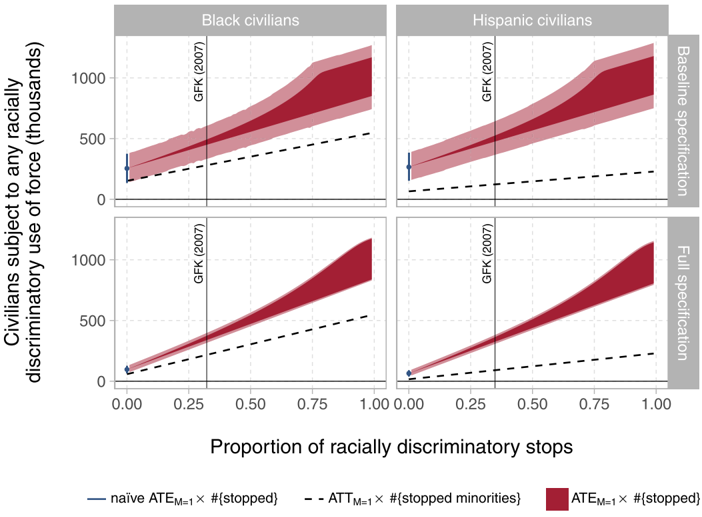
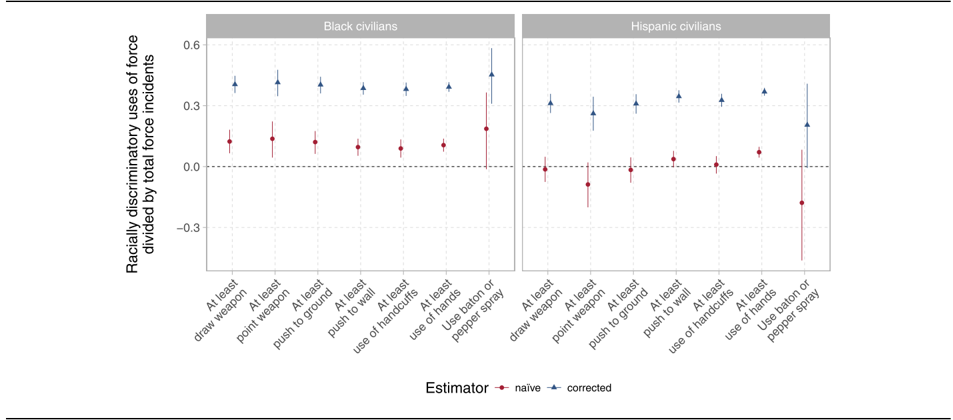
- In their reanalysis of Fryer (2019) using NYPD Stop, Question and Frisk data from 2003–13, the paper says the naïve approach suggested only about 10,000 black and Hispanic civilians were handcuffed because of racial bias, while the bias-corrected estimate is approximately 56,000.
- For uses of force against black and Hispanic civilians in those data, the paper says the naïve estimate implied 10% were discriminatory, while the bias-corrected estimate is 39%.
- In one example, the naïve approach implied 2.4 instances per 1,000 encounters of pushing Hispanic suspects to a wall due to suspect race, while the revised estimate was at least 26 per 1,000 encounters.
## Methods
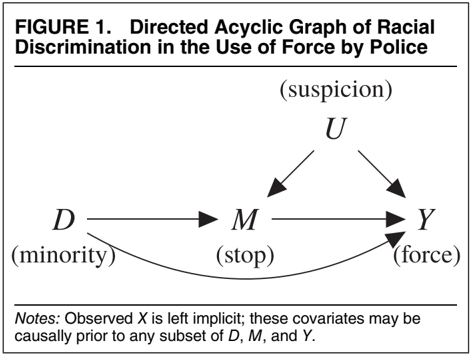
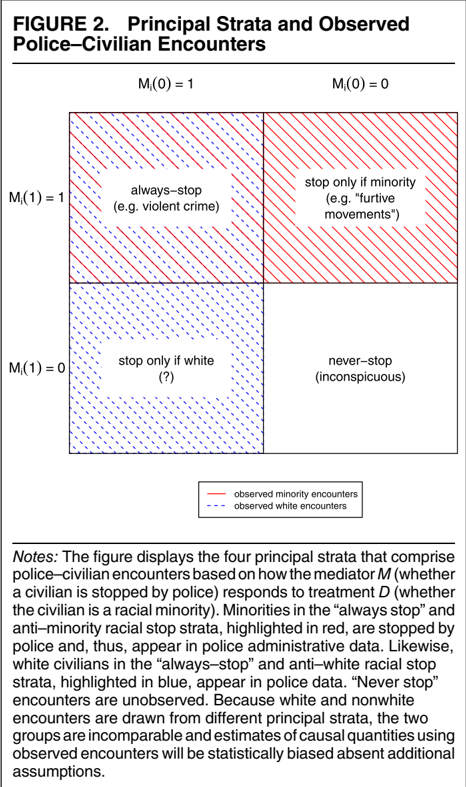
- The paper uses a principal stratification / causal mediation framework to define quantities of interest, derive the exact form of bias from conventional estimation, and distinguish estimates among stopped encounters from the overall causal effect of race.
- It proposes nonparametric sharp bounds for the average treatment effect among stops and the average treatment effect on the treated, and a bias-correction procedure based on an estimated share of racially discriminatory stops.
- It reanalyzes and extends Fryer (2019) using the NYPD Stop, Question and Frisk database (2003–13), which the paper says contains roughly 5 million pedestrian stop records, and compares naïve versus bias-corrected estimates across force thresholds.
## Limitations
- The paper explicitly says its bias-correction and bounding methods still rely on weaker assumptions that can be difficult to verify, and that some key quantities remain only partially identified without additional data.
- It states that point identification of the ATE requires additional data on unreported encounters; police administrative records alone are “virtually uninformative” about the unobserved proportion of discriminatory stops.
- Evident from the text: the reanalysis depends on assumptions about the proportion of discriminatory stops, including a conservative estimate from prior work, so corrected estimates still depend on an externally supplied sensitivity parameter.
Model-written summary. Check it against the paper before relying on it.
Integrity signals
Registry
Cites
Statistics
Figures
Verification
Claims the paper makes
11 Valid · 5 Not valid · 15 Not checked · 114 Own results and interpretations
The cited sources that could be checked couldn’t confirm or dispute this claim.
In the paper
“Replicating and extending the study of police behavior in New York in Fryer (2019), we show that the consequences of ignoring the selective process that generates police data are severe, leading analysts to dramatically underestimate or conceal entirely the differential police violence faced by civilians of color.”
What the sources say
- Could not verifycites Fryer 2019 matched to “Viktor Simov: Stanislavsky’s Designer” (2019) sourceExperimental — accuracy not yet measured
The cited work is Fryer and Toros’s *Viktor Simov*, not Roland Fryer’s 2019 study of police behavior. Two paper-scoped searches returned no snippets, and we do not hold its full text. Semantic Scholar snippets from other policing papers discuss selection bias and identify Knox, Lowe, and Mummolo’s work as relevant, but none provides the high-confidence matching text required to establish a specific misattribution under this rubric. (LLM, conf=0.72)
boostedstates a cause- Asserted: passes — The authors put it forward as true.
- Checkable: passes — It can be checked against evidence.
- Load-bearing: passes — The paper’s conclusions depend on it.
- Based: passes — The paper gives a reason why it holds.
- Rests on 2 assumptions not shown here.
- Could not verify
The cited sources support only part of this claim — read each source’s verdict below.
In the paper
“Knox and Mummolo(2020)showthat this conclusion rests on the erroneous assumption that police encounter minority and white civilians in equal number.”
What the sources say
- Partly supportedcites Knox and Mummolo 2020 matched to “Making inferences about racial disparities in police violence” (2020) sourceExperimental — accuracy not yet measured
In “Making inferences about racial disparities in police violence” (page unavailable), the authors say Johnson et al. did not account for how many minority or White civilians police encounter, so its data cannot support the claimed comparison of shooting rates. The paper does not say Johnson et al. assumed equal numbers of encounters or establish that such an assumption is false. (LLM, conf=0.86)
plainstates a cause- Asserted: passes — The authors put it forward as true.
- Checkable: passes — It can be checked against evidence.
- Load-bearing: passes — The paper’s conclusions depend on it.
- Based: passes — The paper gives a reason why it holds.
- Partly supported
The cited sources support only part of this claim — read each source’s verdict below.
In the paper
“Using the SQF data and controlling for precinct, suspected crime, and prior local arrest rates by race, Gelman, Fagan, and Kiss (2007) produce estimates that -by our calculations -imply 32% of black-civilian stops made by the NYPD could not be explained even by differential criminality between racial groups of suspects, as proxied by prior arrest rates.”
What the sources say
- Partly supportedcites Gelman, Fagan, and Kiss (2007) matched to “An Analysis of the New York City Police Department's “Stop-and-Frisk” Policy in the Context of Claims of Racial Bias” (2007) sourceExperimental — accuracy not yet measured
Section 5.1 reports estimates by suspected crime and precinct showing that, relative to prior arrests, Black civilians were stopped more often than white civilians for the most common stop categories. Section 6 concludes that prior arrest rates and precinct do not explain the disparities. The cited paper does not give or verify the citing authors’ calculation that 32% of all Black-civilian stops were unexplained. (LLM, conf=0.81)
hedgedstates a cause- Asserted: passes — The authors put it forward as true.
- Checkable: passes — It can be checked against evidence.
- Load-bearing: passes — The paper’s conclusions depend on it.
- Based: passes — The paper gives a reason why it holds.
- Partly supported
Every source the paper cites for this claim was checked and supports it.
In the paper
“Using a fl exible logistic regression to adjust for a vast array of indicators visible to of fi cers prestop, the study shows that white hit rates exceeded those of ' similarly situated ' black civilians.”
What the sources say
- Supportedcites Goel, Rao, and Shroff (2016) matched to “Precinct or prejudice? Understanding racial disparities in New York City’s stop-and-frisk policy” (2016) source
The Results (p. 15) describe using logistic regression to estimate hit rates for hypothetical similarly situated whites while preserving other aspects of stops of black civilians. They report a 3.8% hit rate for similarly situated whites versus 2.5% for black civilians. (LLM, conf=0.95)
boostedstates an association- Asserted: passes — The authors put it forward as true.
- Checkable: passes — It can be checked against evidence.
- Load-bearing: passes — The paper’s conclusions depend on it.
- Based: passes — The paper gives a reason why it holds.
- Supported
A result the paper states — it cites no source for it, so there is none to check. The quote shows it is in the paper.
In the paper
“To state this more formally, note that the na¨ ı ve estimator recovers the weighted combination of violence rates in observed principal strata:”
plainstates a cause- Asserted: passes — The authors put it forward as true.
- Checkable: passes — It can be checked against evidence.
- Load-bearing: passes — The paper’s conclusions depend on it.
- Based: passes — The paper gives a reason why it holds.
60 more claims
Create a free account to see all 145 claims and to verify the 9 references still open.
- It may state two separate claims as one. 33
- Probably not a substantial claim. 54
- The quote only partly states this claim. 2
Self-check
Percentages, sums and reported differences re-computed from the paper’s own numbers.
Self-check results appear here once an independent check has confirmed them.
Cited works that were retracted
Works this paper cites that were later retracted, from the retraction notices publishers deposit. Major when the notice came out before this paper was published.
A note, not an issue: for example, a cited work that was retracted only after this paper was published, which its authors could not have known.
In the paper
“10.1073/pnas.1903856116”
Cited work 10.1073/pnas.1903856116 · retracted 2020-07-10 · notice 10.1073/pnas.2014148117 · this paper published 2020-05-21
Citations
Cites
1 retracted
RETRACTED: Officer characteristics and racial disparities in fatal officer-involved shootings
Johnson, D. J., Tress, T., Burkel, N., Taylor, C., & Cesario, J. (2019) · Proceedings of the National Academy of Sciences · doi:10.1073/pnas.1903856116 · Cited by 83
RetractedSample Selection Bias as a Specification Error
Heckman, J. J. (1979) · Econometrica · doi:10.2307/1912352 · Cited by 28,779
Estimating causal effects of treatments in randomized and nonrandomized studies
Rubin, D. B. (1974) · Journal of Educational Psychology · doi:10.1037/h0037350 · Cited by 9,436 · cited 1×
“We ground our analysis in the potential outcomes framework (Rubin 1974) often used in the study of causal mediation (Imai et al. 2011; Pearl 2001).”
Street-Level Bureaucracy: Dilemmas of the Individual in Public Services
Lipsky, M. (1981) · Michigan Law Review · doi:10.2307/1288305 · Cited by 8,981
Marginal Structural Models and Causal Inference in Epidemiology
Robins, J. M., Hernán, M. Á., & Brumback, B. (2000) · Epidemiology · doi:10.1097/00001648-200009000-00011 · Cited by 5,581
Statistics and Causal Inference
Holland, P. W. (1986) · Journal of the American Statistical Association · doi:10.1080/01621459.1986.10478354 · Cited by 5,293
Mostly Harmless Econometrics: An Empiricist's Companion
Angrist, J. D., & Pischke, J.-S. (2008) · doi:10.2307/j.ctvcm4j72 · Cited by 5,051
The new Jim Crow: mass incarceration in the age of colorblindness
(2010) · Choice Reviews Online · doi:10.5860/choice.48-1766 · Cited by 4,407
Identification of Causal Effects Using Instrumental Variables
Angrist, J. D., Imbens, G. W., & Rubin, D. B. (1996) · Journal of the American Statistical Association · doi:10.1080/01621459.1996.10476902 · Cited by 4,230
Orne, M. T. (1962) · American Psychologist · doi:10.1037/h0043424 · Cited by 4,041
Research works printed but not linked: 1
- Acharya, Avidit, Matthew Blackwell, and Maya Sen. 2016. ' Explaining CausalFindingswithoutBias:DetectingandAssessing Direct Effects. ' Biometrics 110 (3): 512 -29.
Cited by
How Structural Racism Works — Racist Policies as a Root Cause of U.S. Racial Health Inequities
Bailey, Z. D., Feldman, J. M., & Bassett, M. T. (2021) · New England Journal of Medicine · doi:10.1056/nejmms2025396 · Cited by 1,598
Risk of being killed by police use of force in the United States by age, race–ethnicity, and sex
Edwards, F., Lee, H., & Esposito, M. (2019) · Proceedings of the National Academy of Sciences · doi:10.1073/pnas.1821204116 · Cited by 916
What Has Economics to Say About Racial Discrimination?
Arrow, K. J. (1998) · Journal of Economic Perspectives · doi:10.1257/jep.12.2.91 · Cited by 679
What Is Your Estimand? Defining the Target Quantity Connects Statistical Evidence to Theory
Lundberg, I., Johnson, R., & Stewart, B. M. (2021) · American Sociological Review · doi:10.1177/00031224211004187 · Cited by 364
The Effects of Police Violence on Inner-City Students*
Ang, D. (2020) · The Quarterly Journal of Economics · doi:10.1093/qje/qjaa027 · Cited by 226
Changing the narrative: structural barriers and racial and ethnic inequities in COVID-19 vaccination
Njoku, A., Joseph, M., & Felix, R. (2021) · International Journal of Environmental Research and Public Health · doi:10.3390/ijerph18189904 · Cited by 164
Inaccurate Statistical Discrimination: An Identification Problem
Bohren, J. A., Haggag, K., Imas, A., & Pope, D. G. (2019) · National Bureau of Economic Research · doi:10.3386/w25935 · Cited by 178
Schwartz, G. L., & Jahn, J. L. (2020) · PLOS ONE · doi:10.1371/journal.pone.0229686 · Cited by 149
The American racial divide in fear of the police
Pickett, J. T., Graham, A., & Cullen, F. T. (2022) · Criminology · doi:10.1111/1745-9125.12298 · Cited by 178
Effective for Whom? Ethnic Identity and Nonviolent Resistance
Manekin, D. S., & Mitts, T. (2021) · American Political Science Review · doi:10.1017/s0003055421000940 · Cited by 135
What the data say about police brutality and racial bias — and which reforms might work
Peeples, L. (2020) · Nature · doi:10.1038/d41586-020-01846-z · Cited by 120
Inaccurate Statistical Discrimination
Bohren, J. A., Haggag, K., Imas, A., & Pope, D. G. (2019) · The Review of Economics and Statistics · doi:10.1162/rest_a_01367 · Cited by 195
Officer bias, over-patrolling and ethnic disparities in stop and search
Vomfell, L., & Stewart, N. (2021) · Nature Human Behaviour · doi:10.1038/s41562-020-01029-w · Cited by 89
The Slow Violence of Contemporary Policing
Kramer, R. A., & Remster, B. (2021) · Annual Review of Criminology · doi:10.1146/annurev-criminol-030321-041307 · Cited by 104
Causal Inference and Data Fusion in Econometrics
Hünermund, P., & Bareinboim, E. (2019) · Econometrics Journal · doi:10.1093/ectj/utad008 · Cited by 117
Ross, C. T., Winterhalder, B., & McElreath, R. (2021) · Social Psychological and Personality Science · doi:10.1177/1948550620916071 · Cited by 61
Wang, A., Kapoor, S., Barocas, S., & Narayanan, A. (2024) · ACM Journal on Responsible Computing · doi:10.1145/3636509 · Cited by 57
Nix, J., & Shjarback, J. A. (2021) · PLoS ONE · doi:10.1371/journal.pone.0259024 · Cited by 57
Police Violence Reduces Civilian Cooperation and Engagement with Law EnforcementPreprint
Ang, D., Bencsik, P., Bruhn, J., & Derenoncourt, E. (2021) · SSRN Electronic Journal · doi:10.2139/ssrn.3920493 · Cited by 70
Causal inference on human behaviour
Bailey, D. H., Jung, A. J., Beltz, A. M., Eronen, M. I., Gische, C., Hamaker, E. L., Kording, K. P., Lebel, C., Lindquist, M. A., Moeller, J., et al. (2024) · Nature Human Behaviour · doi:10.1038/s41562-024-01939-z · Cited by 56
Would Eliminating Racial Disparities in Motor Vehicle Searches have Efficiency Costs?
Feigenberg, B., & Miller, C. (2021) · The Quarterly Journal of Economics · doi:10.1093/qje/qjab018 · Cited by 60
What is Your Estimand? Defining the Target Quantity Connects Statistical Evidence to TheoryPreprint
Lundberg, I., Johnson, R., & Stewart, B. (2020) · SocArXiv (OSF Preprints) · doi:10.31235/osf.io/ba67n · Cited by 61
Cook, S. J., & Fortunato, D. (2022) · American Political Science Review · doi:10.1017/s0003055422000624 · Cited by 58
An Empirical Analysis of Racial Differences in Police Use of Force: A Comment
Durlauf, S. N., & Heckman, J. J. (2020) · Journal of Political Economy · doi:10.1086/710976 · Cited by 47
Do Female Officers Police Differently? Evidence from Traffic Stops
Shoub, K., Stauffer, K. E., & Song, M. (2021) · American Journal of Political Science · doi:10.1111/ajps.12618 · Cited by 51
Ekstrom, P. D., Forestier, J. M. L., & Lai, C. K. (2022) · Psychological Science · doi:10.1177/09567976211053573 · Cited by 53
Civic Responses to Police Violence
Ang, D., & Tebes, J. (2023) · American Political Science Review · doi:10.1017/s0003055423000515 · Cited by 58
Riley, T., Schleimer, J. P., & Jahn, J. L. (2024) · Social Science & Medicine · doi:10.1016/j.socscimed.2024.116576 · Cited by 44
Toward a General Causal Framework for the Study of Racial Bias in Policing
Knox, D., & Mummolo, J. (2020) · Journal of Political Institutions and Political Economy · doi:10.1561/113.00000018 · Cited by 45
Self-citationHow Many Complaints Against Police Officers Can Be Abated by Incapacitating A Few 'Bad Apples?'
Chalfin, A. J., & Kaplan, J. (2020) · Criminology & Public Policy · doi:10.1111/1745-9133.12542 · Cited by 51
Political Participation Amid Mass Incarceration
White, A. R. (2021) · Annual Review of Political Science · doi:10.1146/annurev-polisci-051120-014809 · Cited by 53
Grade, A. M., Chan, N. W., Gajbhiye, P., Perkins, D. J., & Warren, P. S. (2022) · PLoS ONE · doi:10.1371/journal.pone.0277223 · Cited by 55
The effect of suspect race on police officers’ decisions to draw their weapons
WORRALL, J. L., Bishopp, S. A., & Terrill, W. (2020) · Justice Quarterly · doi:10.1080/07418825.2020.1760331 · Cited by 45
Slough, T. L. (2022) · American Journal of Political Science · doi:10.1111/ajps.12715 · Cited by 47
Thomas, M. D., Jewell, N. P., & Allen, A. M. (2021) · Annals of Epidemiology · doi:10.1016/j.annepidem.2020.08.014 · Cited by 33
Police Force Size and Civilian Race
Chalfin, A. J., Hansen, B., Weisburst, E., & Williams, M. C. (2020) · National Bureau of Economic Research · doi:10.3386/w28202 · Cited by 53
We can’t just shut up and play: How the NBA and WNBA are helping dismantle systemic racism
Thomas, M. B., & Wright, J. E. (2021) · Administrative Theory & Praxis · doi:10.1080/10841806.2021.1918988 · Cited by 32
Are Americans less likely to reply to emails from Black people relative to White people?
Block, R., Crabtree, C. D., Holbein, J. B., & Monson, J. Q. (2021) · Proceedings of the National Academy of Sciences · doi:10.1073/pnas.2110347118 · Cited by 38
A Causal Framework for Observational Studies of Discrimination
Gaebler, J., Cai, W., Basse, G., Shroff, R., Goel, S., & Hill, J. (2022) · Statistics and Public Policy · doi:10.1080/2330443x.2021.2024778 · Cited by 42
Explainable machine learning for predicting homicide clearance in the United States
Campedelli, G. M. (2022) · Journal of Criminal Justice · doi:10.1016/j.jcrimjus.2022.101898 · Cited by 32
Peer Effects in Police Use of Force
Holz, J. E., Rivera, R. G., & Ba, B. (2019) · American Economic Journal Economic Policy · doi:10.1257/pol.20200227 · Cited by 37
Beliefs about minority representation in policing and support for diversification
Peyton, K., WEISS, C. M., & Vaughn, P. E. (2022) · Proceedings of the National Academy of Sciences · doi:10.1073/pnas.2213986119 · Cited by 38
Clarifying the causes of consistent and inconsistent findings in genetics
Dattani, S., Howard, D. M., Lewis, C. M., & Sham, P. C. (2022) · Genetic Epidemiology · doi:10.1002/gepi.22459 · Cited by 29
Challenges in creating humane and equitable policing: A focus on the Global South
Magaloni, B. (2024) · Criminology & Public Policy · doi:10.1111/1745-9133.12661 · Cited by 32
Nix, J. (2020) · PLoS ONE · doi:10.1371/journal.pone.0236158 · Cited by 33
Bazzi, S., Ferrara, A., Fiszbein, M., Pearson, T., & Testa, P. (2023) · National Bureau of Economic Research · doi:10.3386/w31331 · Cited by 41
Perpetuating Advantage: Mechanisms of Structural Injustice
Goodin, R. E. (2023) · doi:10.1093/oso/9780192888204.001.0001 · Cited by 32
Is Police Misconduct Contagious? Non-trivial Null Findings from Dallas, Texas
Simpson, C. R., & Kirk, D. S. (2022) · Journal of Quantitative Criminology · doi:10.1007/s10940-021-09532-7 · Cited by 26
Drakulich, K., Robles, J., Rodriguez‐Whitney, E., & Pereira, C. (2022) · Journal of Research in Crime and Delinquency · doi:10.1177/00224278221120781 · Cited by 25
The politics of allyship: Multiethnic coalitions and mass attitudes toward protest
Manekin, D. S., Mitts, T., & Zeira, Y. (2024) · Proceedings of the National Academy of Sciences · doi:10.1073/pnas.2314653121 · Cited by 25
Sadler, R. C., Melde, C., Zeoli, A. M., Wolfe, S. E., & O’Brien, M. (2021) · Applied Spatial Analysis and Policy · doi:10.1007/s12061-021-09391-6 · Cited by 22
The Cumulative Discretion of Police over Community Complaints
Cheng, T. (2022) · American Journal of Sociology · doi:10.1086/719682 · Cited by 26
Officer Diversity Reduces Black Americans’ Fear of the Police
Pickett, J. T., Graham, A., Nix, J., & Cullen, F. T. (2022) · Criminology · doi:10.1111/1745-9125.12360 · Cited by 29
The social foundations of racial inequalities in arrest over the life course and in changing times
Sampson, R. J., & Neil, R. (2024) · Criminology · doi:10.1111/1745-9125.12374 · Cited by 25
Political Appointments and Outcomes in Federal District Courts
Hübert, R., & Copus, R. W. (2021) · The Journal of Politics · doi:10.1086/716947 · Cited by 19
Misinformation and Support for Vigilantism: An Experiment in India and Pakistan
Badrinathan, S., Chauchard, S., & Siddiqui, N. A. (2024) · American Political Science Review · doi:10.1017/s0003055424000790 · Cited by 35
Conceptualizing Belonging for Democratic Theory
de la Garza, Y. B. (2023) · The Journal of Politics · doi:10.1086/723980 · Cited by 22
Limantė, A. (2023) · Nordic Journal of Human Rights · doi:10.1080/18918131.2023.2277581 · Cited by 35
Survivorship Bias in Comparative Politics: Endogenous Sovereignty and the Resource Curse
Waldner, D., & Smith, B. B. (2020) · Perspectives on Politics · doi:10.1017/s1537592720003497 · Cited by 22
Whose Help Is on the Way? The Importance of Individual Police Officers in Law Enforcement Outcomes
Weisburst, E. (2022) · The Journal of Human Resources · doi:10.3368/jhr.0720-11019r2 · Cited by 34
Donahue, S. T. (2023) · American Sociological Review · doi:10.1177/00031224231173070 · Cited by 27
Environmental change and migration aspirations: Evidence from Bangladesh
Rudolph, L., Koubi, V., & Freihardt, J. (2025) · Global Environmental Change · doi:10.1016/j.gloenvcha.2025.102966 · Cited by 18
Zilka, M., Fogliato, R., Hron, J., Butcher, B., Ashurst, C., & Weller, A. (2023) · ACM Conference on Fairness, Accountability, and Transparency (FAccT) · doi:10.1145/3593013.3594099 · Cited by 33
Algorithmic bias and racial inequality: a critical review
Kasy, M. (2024) · Oxford Review of Economic Policy · doi:10.1093/oxrep/grae031 · Cited by 31
Neil, R., & Zanger-Tishler, M. (2024) · Annual Review of Criminology · doi:10.1146/annurev-criminol-022422-125019 · Cited by 32
Community representation and policing: Effects on Black civilians
Risi, J., & Graif, C. (2024) · Criminology · doi:10.1111/1745-9125.12376 · Cited by 17
Political diversity in U.S. police agencies
Ba, B., Ge, H., Kaplan, J., Knox, D., Komisarchik, M., Lanzalotto, G., Mariman, R., Mummolo, J., Rivera, R. G., & Torres, M. (2025) · American Journal of Political Science · doi:10.1111/ajps.12945 · Cited by 30
Self-citationTregle, B., Nix, J., & Pickett, J. T. (2020) · Justice Quarterly · doi:10.1080/07418825.2020.1821086 · Cited by 21
An Automated Approach to Causal Inference in Discrete Settings
Duarte, G., Finkelstein, N., Knox, D., Mummolo, J., & Shpitser, I. (2023) · Journal of the American Statistical Association · doi:10.1080/01621459.2023.2216909 · Cited by 80
Self-citationHaner, M., Sloan, M. M., Pickett, J. T., & Cullen, F. T. (2021) · Justice Quarterly · doi:10.1080/07418825.2021.1942162 · Cited by 16
The American Racial Divide in Fear of the PolicePreprint
Pickett, J. T., Graham, A., & Cullen, F. T. (2021) · doi:10.31235/osf.io/9hwv7 · Cited by 15
No Justice, No Peace: Political Science Perspectives on the American Carceral State
Harris, A. P., Walker, H. L., & Eckhouse, L. (2020) · The Journal of Race, Ethnicity, and Politics · doi:10.1017/rep.2020.21 · Cited by 15
Principal Fairness for Human and Algorithmic Decision-Making
Imai, K., & Jiang, Z. (2023) · Statistical Science · doi:10.1214/22-sts872 · Cited by 50
Jassal, N. (2023) · American Political Science Review · doi:10.1017/s0003055423000916 · Cited by 23
Race, Gender, and Police Violence in the Shadow of Controlling Images
Remster, B., Smith, C. M. M., & Kramer, R. A. (2022) · Social Problems · doi:10.1093/socpro/spac018 · Cited by 18
Organizational Practice and Neighborhood Context of Racial Inequality in Police Use-of-Force
Omori, M. K., Lautenschlager, R., & Stoler, J. B. (2022) · Social Problems · doi:10.1093/socpro/spac031 · Cited by 14
Adams, I. T., McCrain, J., Schiff, D. S., Schiff, K. J., & Mourtgos, S. M. (2025) · Journal of Policy Analysis and Management · doi:10.1002/pam.22620 · Cited by 13
Bayesian Kernel Machine Regression for Social Epidemiologic Research
Bather, J. R., Robinson, T. J., & Goodman, M. S. (2024) · Epidemiology · doi:10.1097/ede.0000000000001777 · Cited by 15
Racial Isolation and Marginalization of Economic Research on Race and Crime
Mason, P. L., Myers, S. L., & Simms, M. C. (2022) · Journal of Economic Literature · doi:10.1257/jel.20211688 · Cited by 18
Better for everyone: Black descriptive representation and police traffic stops
Christiani, L., Shoub, K., Baumgartner, F. R., Epp, D. A., & Roach, K. (2021) · Politics Groups and Identities · doi:10.1080/21565503.2021.1892782 · Cited by 17
A Note on Posttreatment Selection in Studying Racial Discrimination in Policing
Zhao, Q., Keele, L. J., Small, D. S., & Joffe, M. M. (2021) · American Political Science Review · doi:10.1017/s0003055421000654 · Cited by 14
Comparing Systemic and Individual Sources of Racially Disparate Traffic Stop Outcomes
Shoub, K. (2021) · Journal of Public Administration Research and Theory · doi:10.1093/jopart/muab029 · Cited by 14
Are Police Racially Biased in the Decision to Shoot?
Clark, T. S., Cohen, E., Glynn, A., Owens, M. L., Gunderson, A., & Schiff, K. J. (2023) · The Journal of Politics · doi:10.1086/723973 · Cited by 13
Handle with Care: A Sociologist's Guide to Causal Inference with Instrumental VariablesPreprint
Felton, C., & Stewart, B. (2022) · doi:10.31235/osf.io/3ua7q · Cited by 12
Do Police Maximize Arrests or Minimize Crime? Evidence from Racial Profiling in U.S. Cities
Stashko, A. (2018) · Journal of the European Economic Association · doi:10.1093/jeea/jvac039 · Cited by 13
Dammann, P., Šaffa, G., & Šumbera, R. (2022) · Biology Letters · doi:10.1098/rsbl.2022.0243 · Cited by 13
Dang, T. P., Mattan, B. D., Barth, D. M., Handley, G., Cloutier, J., & Kubota, J. T. (2022) · NeuroImage · doi:10.1016/j.neuroimage.2022.119153 · Cited by 18
A Behavioural Theory of Discrimination in Policing
Hübert, R., & Little, A. T. (2023) · The Economic Journal · doi:10.1093/ej/uead043 · Cited by 17
Playing Offense: How Athletes are Impacting a Changing Administrative State
Thomas, M. B., & Daniel, J. L. (2022) · Administration & Society · doi:10.1177/00953997221102612 · Cited by 10
Santaularia, N. J., Larson, R., Robertson, C. E., & Uggen, C. (2024) · American Journal of Epidemiology · doi:10.1093/aje/kwae359 · Cited by 9
Don't Call It a Comeback: The Criminological and Sociological Study of Subfelonies
Kohler‐Hausmann, I. (2022) · Annual Review of Criminology · doi:10.1146/annurev-criminol-070221-024802 · Cited by 11
Goals and outcomes of police officer communication: Evidence from in-depth interviews
Oxholm, P. D., & Glaser, J. (2023) · Group Processes & Intergroup Relations · doi:10.1177/13684302221121585 · Cited by 19
DICKSON, Z. P., & HOBOLT, S. B. (2024) · American Political Science Review · doi:10.1017/s0003055424000741 · Cited by 18
Null Effects of a Progressive Prosecution Policy on Marijuana Enforcement
Goldrosen, N. (2022) · Criminology Criminal Justice Law & Society · doi:10.54555/ccjls.4234.34103 · Cited by 12
On the Uncanny Similarities Between Police Brutality and Client Mistreatment
Morris, C., & Hollins, N. A. (2021) · Behavior Analysis in Practice · doi:10.1007/s40617-021-00576-6 · Cited by 8
Vredenburgh, K. (2022) · Oxford University Press eBooks · doi:10.1093/oxfordhb/9780197579329.013.8 · Cited by 9
Harawa, N. T., Schrode, K. M., Daniels, J., Javanbakht, M., Hotton, A., Makgoeng, S. B., Ragsdale, A. M., Schneider, J. A., Fujimoto, K., Bolan, R., et al. (2022) · PLoS ONE · doi:10.1371/journal.pone.0265034 · Cited by 7
Which Police Departments Want Reform? Barriers to Evidence-Based Policymaking
Goerger, S., Mummolo, J., & Westwood, S. J. (2022) · Journal of Experimental Political Science · doi:10.1017/xps.2022.21 · Cited by 12
Self-citationPrincipal Fairness for Human and Algorithmic Decision-MakingPreprint
Imai, K., & Jiang, Z. (2020) · arXiv (Cornell University) · doi:10.48550/arxiv.2005.10400 · Cited by 8
Not So Black and White: Uncovering Racial Bias from Systematically Misreported Trooper ReportsPreprint
Luh, E. (2019) · SSRN Electronic Journal · doi:10.2139/ssrn.3357063 · Cited by 23
Metadata
- Authors
- KNOX, D., LOWE, W., & MUMMOLO, J.
- Affiliations
- Princeton University (US)
- Hertie School (DE)
- Corresponding author
- KNOX, DEAN
- LOWE, WILL
- MUMMOLO, JONATHAN
- Venue
- American Political Science Review
- Publisher
- Cambridge University Press (CUP)
- Published
- 2020-05-21
- Volume
- 114
- Issue
- 3
- Pages
- 619-637
- ISSN
- 0003-0554 (ISSN-L)
- 1537-5943
- OpenAlex
- W3122864926
- Cited by
- 314
- References
- 115
- Citations by year
- 2026: 39 · 2025: 39 · 2024: 47 · 2023: 68 · 2022: 48 · 2021: 34 · 2020: 33
- FWCI
- 161.39
- Type
- journal article
- Language
- en
- Open access
- bronze
- doi.org
- Locations
- American Political Science Review (publishedVersion)
- SSRN Electronic Journal (acceptedVersion)
- PhilPapers (PhilPapers Foundation) (submittedVersion)
- RePEc: Research Papers in Economics (submittedVersion)
- OPUS 4 (Zuse Institute Berlin) (submittedVersion)
- Topics
- Social Sciences › Political Science and International Relations › Policing Practices and Perceptions
- Physical Sciences › Mathematics › Statistics and Probability › Advanced Causal Inference Techniques
- Social Sciences › Sociology and Political Science › Criminal Justice and Corrections Analysis
- Keywords
- racial discrimination in policing, administrative records, statistical bias, principal stratification, causal mediation analysis, bias correction, sharp bounds, unobserved heterogeneity
About these checks
Registry, retraction, Cites and statistics results are computed, not judged, with one exception: a printed reference that no index lists is read once by a model before it counts as a citation error. Claims are extracted by a model and kept only when their quote appears verbatim in the text; each cited source is then checked, with a model’s help, for whether it says what the claim relies on. Those verdicts can be wrong — read the claim’s quote and the cited source before relying on one.
The claim verdicts this report counts are experimental: their accuracy is not yet measured.
A language model drew the claims from the paper on 2026-09-29, under version 3 of the claim definition (model deepseek-v4.1-flash, prompt extract-v3).
A second model labelled each claim on 2026-09-29 (model jev-1.13-20260917, definition revision gold-guideline-v0.2).
Cited sources are checked with a language model’s help (gpt-6-sol).
Statistics and arithmetic are recomputed, not judged.
Confidence bands are shown only for fields calibrated on our annotated test set. None is calibrated yet, so no band is shown.
What counts as a claim ›How we measure confidence ›How we check this ›
Are you an author, or do you see a problem with this page? Request a review
Data sources
Bibliographic data: Semantic Scholar, OpenAlex, Crossref.
Contains information from the Semantic Scholar Academic Graph Datasets, made available under the ODC Attribution License (ODC-BY 1.0).
Semantic Scholar’s data is described in: Kinney, R., et al. (2023). The Semantic Scholar Open Data Platform. arXiv:2301.10140.
