

World Trade Center responders in their own words: predicting PTSD symptom trajectories with AI-based language analyses of interviews
Open accessThe DOI matches its Crossref record, with a small difference in title or year; 60 of the 63 references it cites were found in a registry or an index; 8 of the 30 sources its claims cite were checked for support.
Abstract
Abstract Background Oral histories from 9/11 responders to the World Trade Center (WTC) attacks provide rich narratives about distress and resilience. Artificial Intelligence (AI) models promise to detect psychopathology in natural language, but they have been evaluated primarily in non-clinical settings using social media. This study sought to test the ability of AI-based language assessments to predict PTSD symptom trajectories among responders. Methods Participants were 124 responders whose health was monitored at the Stony Brook WTC Health and Wellness Program who completed oral history interviews about their initial WTC experiences. PTSD symptom severity was measured longitudinally using the PTSD Checklist (PCL) for up to 7 years post-interview. AI-based indicators were computed for depression, anxiety, neuroticism, and extraversion along with dictionary-based measures of linguistic and interpersonal style. Linear regression and multilevel models estimated associations of AI indicators with concurrent and subsequent PTSD symptom severity (significance adjusted by false discovery rate). Results Cross-sectionally, greater depressive language ( β = 0.32; p = 0.049) and first-person singular usage ( β = 0.31; p = 0.049) were associated with increased symptom severity. Longitudinally, anxious language predicted future worsening in PCL scores ( β = 0.30; p = 0.049), whereas first-person plural usage ( β = −0.36; p = 0.014) and longer words usage ( β = −0.35; p = 0.014) predicted improvement. Conclusions This is the first study to demonstrate the value of AI in understanding PTSD in a vulnerable population. Future studies should extend this application to other trauma exposures and to other demographic groups, especially under-represented minorities.
Overview
CoChat Summary
TL;DR
In 124 World Trade Center responders’ oral history interviews, AI-based language features were associated with concurrent PTSD severity and, in a subset, predicted future PTSD symptom trajectories. Depressive/self-focused language tracked higher symptoms, while more anxious language predicted worsening and more plural pronouns/longer words predicted improvement.
Key findings
- In cross-sectional analyses, greater depressive language and first-person singular use were each associated with higher PTSD symptom severity: β = 0.32 and β = 0.31, both p = 0.049.
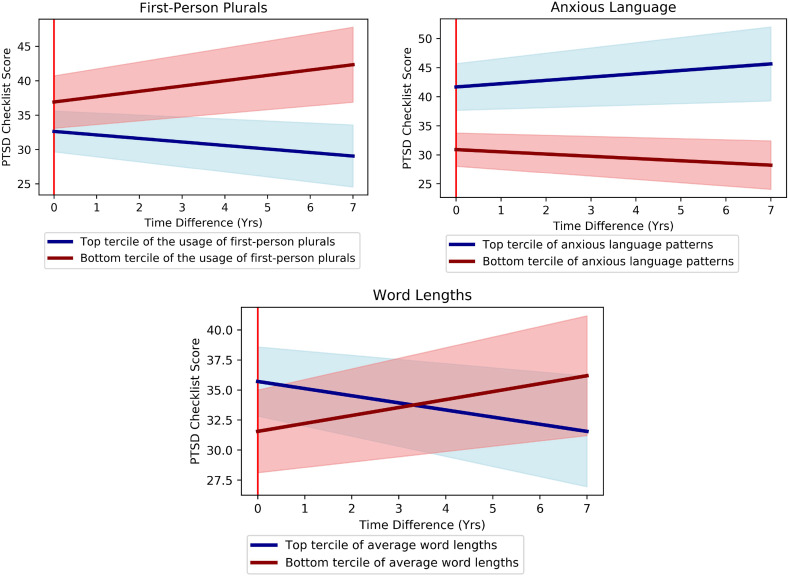
- Longitudinally, anxious language predicted future worsening in PTSD symptoms: β = 0.30, p = 0.049.
- First-person plural pronoun use and longer word usage predicted improvement in PTSD symptoms: β = −0.36 and β = −0.35, both p = 0.014.
- The paper reports that higher PCL scores were also associated with anxious, neurotic, and less extraverted language patterns, and with greater word count; results remained after adjustment for age, gender, occupation, and years after 9/11.
Methods
- Observational study of 124 WTC responders from the Stony Brook WTC Health & Wellness Program who completed ~1-hour oral history interviews; analysis sample was restricted to 113 responders with at least one valid PTSD Checklist (PCL) score within 2 years of interview and at least one pre-interview PCL, and a longitudinal subset of 75 had at least three post-interview assessments at least 2 years later.
- Audio interviews were transcribed and converted into language features; nine predictors were derived: AI-based depression, anxiety, neuroticism, extraversion; LIWC-style first-person singular, first-person plural, and article use; plus word count and average word length.
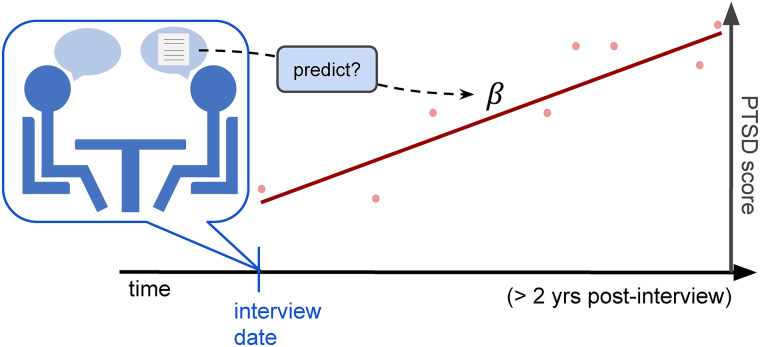
- Associations with concurrent PTSD severity and future symptom trajectories were estimated using linear regression and multilevel/trajectory models, adjusting for age, gender, occupation, and years since 9/11; significance used false discovery rate adjustment.
Limitations
- The authors state the sample was a specific WTC responder cohort that was predominantly male and largely police, which may limit generalizability to other occupations and demographic groups.
- They state the mechanisms behind the predictive effects were not tested directly.
- They state the sample was relatively small and the pre-trained AI models could not be retrained for this population; this likely limits model tailoring and predictive power.
Model-written summary. Check it against the paper before relying on it.
Integrity signals
Registry
Cites
Statistics
Figures
Verification
Claims the paper makes
7 Valid · 1 Not valid · 8 Not checked · 36 Own results and interpretations
The cited sources that could be checked couldn’t confirm or dispute this claim.
In the paper
“As compared to traditional questionnaire-based assessments, such approaches seem to suffer from fewer self-report biases (Youyou, Kosinski, & Stillwell, 2015) and generally leverage a larger amount of information per person (Kern et al., 2016).”
§ World Trade Center responders in their own words: predicting PTSD symptom trajectories with AI-based language analyses of interviews > Introduction
What the sources say
- Could not verifycites Youyou, Kosinski, & Stillwell, 2015 matched to “Computer-based personality judgments are more accurate than those made by humans” (2015) sourceExperimental — accuracy not yet measured
The Results (page not specified) describe personality predictions based on Facebook Likes and comparisons with questionnaire self-ratings, not language-based assessments. The External Validity section (page not specified) discusses shared method variance, but does not say that language-based approaches have fewer self-report biases; searches for language-based assessment and self-report bias found no such comparison. (LLM, conf=0.73)
hedgedstates an association- Asserted: passes — The authors put it forward as true.
- Checkable: passes — It can be checked against evidence.
- Load-bearing: unclear — It is unclear whether the paper’s conclusions depend on it.
- Based: passes — The paper gives a reason why it holds.
- Could not verify
The cited sources support only part of this claim — read each source’s verdict below.
In the paper
“As such, this study relied on a sample that is similar to the rest of the WTC responder population (Bromet et al., 2016).”
§ World Trade Center responders in their own words: predicting PTSD symptom trajectories with AI-based language analyses of interviews > Discussion > Limitations
What the sources say
- Partly supportedcites Bromet et al., 2016 matched to “DSM-IV post-traumatic stress disorder among World Trade Center responders 11–13 years after the disaster of 11 September 2001 (9/11)” (2016) sourceExperimental — accuracy not yet measured
The Results report similar PTSD rates for the Stony Brook sample (17.7%) and the weighted WTCHP general responder cohort (18.2%). But the Results and Method > Statistical analysis show substantial differences in racial and occupational composition, which the authors addressed by weighting; the paper does not establish that the sample is broadly similar to the rest of the WTC responder population. Page numbers are unavailable in our copy. (LLM, conf=0.86)
plain- Asserted: passes — The authors put it forward as true.
- Checkable: passes — It can be checked against evidence.
- Load-bearing: unclear — It is unclear whether the paper’s conclusions depend on it.
- Based: passes — The paper gives a reason why it holds.
- Partly supported
A result the paper reports from its own data — it cites no other source for it, so there is none to check. The quote shows it is in the paper.
In the paper
“Third, the use of more first-person plural pronouns (‘we’, ‘us’, ‘our’) predicted decreased PTSD symptoms in the future when adjusting for the confound variables.”
§ World Trade Center responders in their own words: predicting PTSD symptom trajectories with AI-based language analyses of interviews > Discussion > Implications
plainstates a cause- Asserted: passes — The authors put it forward as true.
- Checkable: passes — It can be checked against evidence.
- Load-bearing: passes — The paper’s conclusions depend on it.
- Based: passes — The paper gives a reason why it holds.
A result the paper reports from its own data — it cites no other source for it, so there is none to check. The quote shows it is in the paper.
In the paper
“Cross-sectionally, greater depressive language (β = 0.32; p = 0.049) and first-person singular usage (β = 0.31; p = 0.049) were associated with increased symptom severity.”
- Also stated in: § Depressive language and current PTSD severity · plain
“Depressive language (β = 0.32; p = 0.049) and high usage of first-person singulars (β = 0.31; p = 0.049) were most highly correlated with high PCL scores even after accounting for age, gender, days since 9/11, and responder occupation.”
§ World Trade Center responders in their own words: predicting PTSD symptom trajectories with AI-based language analyses of interviews > Abstract > Results
plainstates an association- Asserted: passes — The authors put it forward as true.
- Checkable: passes — It can be checked against evidence.
- Load-bearing: passes — The paper’s conclusions depend on it.
- Based: passes — The paper gives a reason why it holds.
- Also stated in: § Depressive language and current PTSD severity · plain
A result the paper reports from its own data — it cites no other source for it, so there is none to check. The quote shows it is in the paper.
In the paper
“Conversely, higher scores were also associated with less extraversion language patterns, first-person plurals, and articles.”
§ World Trade Center responders in their own words: predicting PTSD symptom trajectories with AI-based language analyses of interviews > Results > Associations between language-based assessments and PTSD severity
plainstates an association- Asserted: passes — The authors put it forward as true.
- Checkable: passes — It can be checked against evidence.
- Load-bearing: unclear — It is unclear whether the paper’s conclusions depend on it.
- Based: passes — The paper gives a reason why it holds.
27 more claims
Create a free account to see all 52 claims and to verify the 3 references still open.
- Probably not a substantial claim. 15
- It may state two separate claims as one. 9
Claims other papers make about this one
Each is checked against this paper’s own text: does it say what the citing paper says it does?
The cited source says what the claim attributes to it.
In the citing paper
“Words indicating depressive and anxious language patterns (related to the DLATK 35 models or LIWC categories) were also identified as language markers of PTSD symptoms and severity.44,60,61”
From Linguistic markers for identifying post-traumatic stress disorder and associated symptoms: a systematic literature review (2025) · cites this paper as [44]
The cited source says what the claim attributes to it.
In the citing paper
“Some studies 40,44,62,64 suggested that longer narratives are associated with more severe PTSD symptoms”
From Linguistic markers for identifying post-traumatic stress disorder and associated symptoms: a systematic literature review (2025) · cites this paper as [44]
The cited source says what the claim attributes to it.
In the citing paper
“Increased use of first-person singular pronouns (eg, “I”) was a common marker associated with PTSD, suggesting heightened self-focus and immersion in traumatic experiences.”
From Linguistic markers for identifying post-traumatic stress disorder and associated symptoms: a systematic literature review (2025) · cites this paper as [44]
Citations
Cites
(2003) · Journal of Machine Learning Research · doi:10.5555/944919.944937 · Cited by 32,337
Blei, D. M., Ng, A. Y., & Jordan, M. I. (2002) · Advances in Neural Information Processing Systems 14 · doi:10.7551/mitpress/1120.003.0082 · Cited by 12,223
The Psychological Meaning of Words: LIWC and Computerized Text Analysis Methods
Tausczik, Y. R., & Pennebaker, J. W. (2010) · Journal of Language and Social Psychology · doi:10.1177/0261927x09351676 · Cited by 5,774 · cited 3×
“• Articles: use of concrete nouns, interest in objects and things (Tausczik & Pennebaker, 2010).”
Multiple comparisons among means
Dunn, O. J. (1961) · Journal of the American Statistical Association · doi:10.1080/01621459.1961.10482090 · Cited by 5,006
Psychometric properties of the PTSD checklist (PCL)
Blanchard, E. B., Jones-Alexander, J., Buckley, T. C., & Forneris, C. A. (1996) · Behaviour Research and Therapy · doi:10.1016/0005-7967(96)00033-2 · Cited by 3,997
Bovin, M. J., Marx, B. P., Weathers, F. W., Gallagher, M. W., Rodriguez, P., Schnurr, P. P., & Keane, T. M. (2016) · Psychological Assessment · doi:10.1037/pas0000254 · Cited by 2,532 · cited 1×
“Following previous work which suggests that a fixed cutoff might not be optimally established for all cases (Andrykowski, Cordova, Studts, & Miller, 1998; Bovin et al., 2016), we focused on continuous values.”
The Path to Personalized Medicine
Hamburg, M. A., & Collins, F. S. (2010) · New England Journal of Medicine · doi:10.1056/nejmp1006304 · Cited by 1,970
Personality, Gender, and Age in the Language of Social Media: The Open-Vocabulary Approach
Schwartz, H. A., Eichstaedt, J. C., Kern, M. L., Dziurzynski, L., Ramones, S. M., Agrawal, M., Shah, A., Kosinski, M., Stillwell, D., Seligman, M. E. P., et al. (2013) · PLoS ONE · doi:10.1371/journal.pone.0073791 · Cited by 1,700 · cited 5×
“…pre-trained models for constructs known to be related to our mental health outcomes: (1) neuroticism and (2) extraversion (Park et al., 2015; Schwartz et al., 2013b) – the two factors of the five-factor model known to relate negatively to depression and anxiety-related mental health…”
InfluentialSelf-citationThe Development and Psychometric Properties of LIWC2015
Pennebaker, J. W., Boyd, R. L., Jordan, K., & Blackburn, K. (2015) · University of Texas at Austin · doi:10.15781/t25p41 · Cited by 1,674
Predicting Depression via Social Media
De Choudhury, M., Gamon, M., Counts, S., & Horvitz, E. (2021) · Proceedings of the International AAAI Conference on Web and Social Media · doi:10.1609/icwsm.v7i1.14432 · Cited by 1,579
Computer-based personality judgments are more accurate than those made by humans
Youyou, W., Kosinski, M., & Stillwell, D. (2015) · Proceedings of the National Academy of Sciences · doi:10.1073/pnas.1418680112 · Cited by 1,086
Self-focused attention in clinical disorders: Review and a conceptual model
Ingram, R. E. (1990) · Psychological Bulletin · doi:10.1037/0033-2909.107.2.156 · Cited by 1,056 · cited 1×
“…– the two factors of the five-factor model known to relate negatively to depression and anxiety-related mental health conditions (Farmer et al., 2002; Jorm et al., 2000; Jylhä & Isometsä, 2006), as well as (3) degree of depression and (4) anxiousness (Schwartz et al., 2014) – subfacets of…”
Language use of depressed and depression-vulnerable college students
Rude, S., Gortner, E.-M., & Pennebaker, J. (2004) · Cognition & Emotion · doi:10.1080/02699930441000030 · Cited by 1,018
Automatic personality assessment through social media language.
Park, G., Schwartz, H. A., Eichstaedt, J. C., Kern, M. L., Kosinski, M., Stillwell, D. J., Ungar, L. H., & Seligman, M. E. P. (2015) · Journal of Personality and Social Psychology · doi:10.1037/pspp0000020 · Cited by 802 · cited 5×
“They have been validated against standard questionnaire-based measures as well as convergent factors and external criteria under a range of situations (Schwartz et al., 2014; Park et al., 2015; Kern et al., 2016; Matero et al., 2019).”
InfluentialSelf-citationQuantifying Mental Health Signals in Twitter
Coppersmith, G., Dredze, M., & Harman, C. (2014) · Proceedings of the Workshop on Computational Linguistics and Clinical Psychology: From Linguistic Signal to Clinical Reality · doi:10.3115/v1/w14-3207 · Cited by 722 · cited 2×
“…setting, past work has shown that AI-based language techniques can distinguish Twitter users that have publicly disclosed a diagnosis of the condition from random selections of users (e.g. Coppersmith, Dredze, & Harman, 2014; Preotiuc-Pietro, Sap, Schwartz, & Ungar, 2015; Reece et al. 2017).”
Discovering Shifts to Suicidal Ideation from Mental Health Content in Social Media
De Choudhury, M., Kiciman, E., Dredze, M., Coppersmith, G., & Kumar, M. (2016) · Proceedings of the 2016 CHI Conference on Human Factors in Computing Systems · doi:10.1145/2858036.2858207 · Cited by 683
Facebook language predicts depression in medical records
Eichstaedt, J. C., Smith, R. J., Merchant, R. M., Ungar, L. H., Crutchley, P., Preoţiuc-Pietro, D., Asch, D. A., & Schwartz, H. A. (2018) · Proceedings of the National Academy of Sciences · doi:10.1073/pnas.1802331115 · Cited by 643
Self-citationBreslau, N., Davis, G. C., Peterson, E. L., & Schultz, L. R. (2000) · Biological Psychiatry · doi:10.1016/s0006-3223(00)00933-1 · Cited by 582
Rumination and overgeneral memory in depression: Effects of self-focus and analytic thinking.
Watkins, E., & Teasdale, J. D. (2001) · Journal of Abnormal Psychology · doi:10.1037/0021-843x.110.2.333 · Cited by 536 · cited 1×
“The use of ‘ I ’ pronouns, in turn, has previously been found to be a dependable marker of self-focus in natural language (Carey et al., 2015; Watkins & Teasdale, 2001; Wegner & Giuliano, 1980).”
Andrykowski, M. A., Cordova, M. J., Studts, J. L., & Miller, T. W. (1998) · Journal of Consulting and Clinical Psychology · doi:10.1037/0022-006x.66.3.586 · Cited by 454 · cited 1×
“Following previous work which suggests that a fixed cutoff might not be optimally established for all cases (Andrykowski, Cordova, Studts, & Miller, 1998; Bovin et al., 2016), we focused on continuous values.”
Rumination in posttraumatic stress disorder
Michael, T., Halligan, S. L., Clark, D. M., & Ehlers, A. (2007) · Depression and Anxiety · doi:10.1002/da.20228 · Cited by 434
Forecasting the onset and course of mental illness with Twitter data
Reece, A. G., Reagan, A. J., Lix, K. L. M., Dodds, P. S., Danforth, C. M., & Langer, E. J. (2017) · Scientific Reports · doi:10.1038/s41598-017-12961-9 · Cited by 401 · cited 1×
“…setting, past work has shown that AI-based language techniques can distinguish Twitter users that have publicly disclosed a diagnosis of the condition from random selections of users (e.g. Coppersmith, Dredze, & Harman, 2014; Preotiuc-Pietro, Sap, Schwartz, & Ungar, 2015; Reece et al. 2017).”
Risk factors for PTSD-related traumatic events: a prospective analysis
(1995) · American Journal of Psychiatry · doi:10.1176/ajp.152.4.529 · Cited by 364
Jylhä, P., & Isometsä, E. (2006) · Depression and Anxiety · doi:10.1002/da.20167 · Cited by 355
Pietrzak, R. H., Feder, A., Singh, R., Schechter, C. B., Bromet, E. J., Katz, C. L., Reissman, D. B., Ozbay, F., Sharma, V., Crane, M., et al. (2014) · Psychological Medicine · doi:10.1017/s0033291713000597 · Cited by 306
Self-citationEtiology of depression comorbidity in combat-related PTSD: a review of the literature
Stander, V. A., Thomsen, C. J., & Highfill-McRoy, R. M. (2014) · Clinical Psychology Review · doi:10.1016/j.cpr.2013.12.002 · Cited by 271
Towards Assessing Changes in Degree of Depression through Facebook
Schwartz, H. A., Eichstaedt, J., Kern, M. L., Park, G., Sap, M., Stillwell, D., Kosinski, M., & Ungar, L. (2014) · Proceedings of the Workshop on Computational Linguistics and Clinical Psychology: From Linguistic Signal to Clinical Reality · doi:10.3115/v1/w14-3214 · Cited by 256 · cited 3×
“They have been validated against standard questionnaire-based measures as well as convergent factors and external criteria under a range of situations (Kern et al., 2016; Matero et al., 2019; Park et al., 2015; Schwartz et al., 2014).”
Self-citationArousal-induced attention to self.
Wegner, D. M., & Giuliano, T. (1980) · Journal of Personality and Social Psychology · doi:10.1037//0022-3514.38.5.719 · Cited by 235
Pronouns in Marital Interaction: What Do “You” and “I” Say About Marital Health?
Simmons, R. A., Gordon, P. C., & Chambless, D. L. (2005) · Psychological Science · doi:10.1111/j.1467-9280.2005.01639.x · Cited by 235
A meta-analysis of correlations between depression and first person singular pronoun use
Edwards, T., & Holtzman, N. S. (2017) · Journal of Research in Personality · doi:10.1016/j.jrp.2017.02.005 · Cited by 224 · cited 1×
“Self-focused thinking has been identified as a trans-diagnostic factor of PTSD and depressive symptoms marking an often maladaptive preoccupation with the self and negative experience (Birrer & Michael, 2011; Ingram, 1990; Martin, 1985).”
Gaining insights from social media language: Methodologies and challenges.
Kern, M. L., Park, G., Eichstaedt, J. C., Schwartz, H. A., Sap, M., Smith, L. K., & Ungar, L. H. (2016) · Psychological Methods · doi:10.1037/met0000091 · Cited by 221 · cited 5×
“As compared to traditional questionnaire-based assessments, such approaches seem to suffer from fewer self-report biases (Youyou, Kosinski, & Stillwell, 2015) and generally leverage a larger amount of information per person (Kern et al., 2016).”
InfluentialSelf-citationCharacterizing Geographic Variation in Well-Being Using Tweets
Schwartz, H., Eichstaedt, J., Kern, M., Dziurzynski, L., Lucas, R., Agrawal, M., Park, G., Lakshmikanth, S., Jha, S., Seligman, M., et al. (2021) · Proceedings of the International AAAI Conference on Web and Social Media · doi:10.1609/icwsm.v7i1.14442 · Cited by 218
Self-citationPersonality Predictors of Injury-Related Posttraumatic Stress Disorder
FAUERBACH, J. A., LAWRENCE, J. W., SCHMIDT, C. W., MUNSTER, A. M., & COSTA, P. T. (2000) · The Journal of Nervous and Mental Disease · doi:10.1097/00005053-200008000-00006 · Cited by 197
Eichstaedt, J. C., Kern, M. L., Yaden, D. B., Schwartz, H. A., Giorgi, S., Park, G., Hagan, C. A., Tobolsky, V. A., Smith, L. K., Buffone, A., et al. (2021) · Psychological Methods · doi:10.1037/met0000349 · Cited by 187
Self-citationNeuroticism, extraversion, life events and depression
Farmer, A., Redman, K., Harris, T., Mahmood, A., Sadler, S., Pickering, A., & McGuffin, P. (2002) · British Journal of Psychiatry · doi:10.1017/s0007125000161823 · Cited by 170
Bromet, E. J., Hobbs, M. J., Clouston, S. A. P., Gonzalez, A., Kotov, R., & Luft, B. J. (2016) · Psychological Medicine · doi:10.1017/s0033291715002184 · Cited by 165 · cited 4×
“Previous work has made major headway in establishing longitudinal associations of exposure severity, demographic characteristics, and job duties with health trajectories of WTC responders (Bromet et al., 2016; Cone et al., 2015; Pietrzak et al., 2014).”
InfluentialSelf-citationData-Driven Content Analysis of Social Media: A Systematic Overview of Automated Methods
Schwartz, H. A., & Ungar, L. H. (2015) · The ANNALS of the American Academy of Political and Social Science · doi:10.1177/0002716215569197 · Cited by 164
Self-citationThe length of words reflects their conceptual complexity
Lewis, M. L., & Frank, M. C. (2016) · Cognition · doi:10.1016/j.cognition.2016.04.003 · Cited by 153
Jorm, A. F., Christensen, H., Henderson, A. S., Jacomb, P. A., Korten, A. E., & Rodgers, B. (2000) · Journal of Abnormal Psychology · doi:10.1037//0021-843x.109.1.145 · Cited by 150
Ramirez-Esparza, N., Chung, C., Kacewic, E., & Pennebaker, J. (2021) · Proceedings of the International AAAI Conference on Web and Social Media · doi:10.1609/icwsm.v2i1.18623 · Cited by 132
Neuroticism as predisposition toward depression: A cognitive mechanism
Martin, M. (1985) · Personality and Individual Differences · doi:10.1016/0191-8869(85)90060-1 · Cited by 131
DLATK: Differential Language Analysis ToolKit
Schwartz, H. A., Giorgi, S., Sap, M., Crutchley, P., Ungar, L., & Eichstaedt, J. (2017) · Proceedings of the 2017 Conference on Empirical Methods in Natural Language Processing: System Demonstrations · doi:10.18653/v1/d17-2010 · Cited by 130
Self-citationNarcissism and the use of personal pronouns revisited.
Carey, A. L., Brucks, M. S., Küfner, A. C. P., Holtzman, N. S., große Deters, F., Back, M. D., Donnellan, M. B., Pennebaker, J. W., & Mehl, M. R. (2015) · Journal of Personality and Social Psychology · doi:10.1037/pspp0000029 · Cited by 117
Luft, B. J., Schechter, C., Kotov, R., Broihier, J., Reissman, D., Guerrera, K., Udasin, I., Moline, J., Harrison, D., Friedman-Jimenez, G., et al. (2012) · Psychological Medicine · doi:10.1017/s003329171100256x · Cited by 109
Self-citationSuicide Risk Assessment with Multi-level Dual-Context Language and
Matero, M., Idnani, A., Son, Y., Giorgi, S., Vu, H., Zamani, M., Limbachiya, P., Guntuku, S. C., & Schwartz, H. A. (2019) · Proceedings of the Sixth Workshop on Computational Linguistics and Clinical Psychology · doi:10.18653/v1/w19-3005 · Cited by 102 · cited 2×
“They have been validated against standard questionnaire-based measures as well as convergent factors and external criteria under a range of situations (Kern et al., 2016; Matero et al., 2019; Park et al., 2015; Schwartz et al., 2014).”
Self-citationBirrer, E., & Michael, T. (2011) · Behavioural and Cognitive Psychotherapy · doi:10.1017/s1352465811000087 · Cited by 94
Lewis, C. E., Farewell, D., Groves, V., Kitchiner, N. J., Roberts, N. P., Vick, T., & Bisson, J. I. (2017) · Depression and Anxiety · doi:10.1002/da.22645 · Cited by 84 · cited 2×
“, natural disasters, WTC PTSD) similar to a previous online PTSD treatment (Lewis et al., 2017).”
Long‐term course of probable PTSD after the 9/11 attacks: A study in urban primary care
Neria, Y., Olfson, M., Gameroff, M. J., DiGrande, L., Wickramaratne, P., Gross, R., Pilowsky, D. J., Neugebaur, R., Manetti‐Cusa, J., Lewis‐Fernandez, R., et al. (2010) · Journal of Traumatic Stress · doi:10.1002/jts.20544 · Cited by 71 · cited 1×
“Many responders suffer from PTSD which has been either worsening, staying the same, or gradually improving over time (Cukor et al., 2011; Neria et al., 2010).”
Cukor, J., Wyka, K., Mello, B., Olden, M., Jayasinghe, N., Roberts, J., Giosan, C., Crane, M., & Difede, J. (2011) · Journal of Traumatic Stress · doi:10.1002/jts.20672 · Cited by 67 · cited 1×
“Many responders suffer from PTSD which has been either worsening, staying the same, or gradually improving over time (Cukor et al., 2011; Neria et al., 2010).”
Abstracts, introductions and discussions: How far do they differ in style?
Hartley, J., Pennebaker, J. W., & Fox, C. (2003) · Scientometrics · doi:10.1023/a:1025008802657 · Cited by 63 · cited 2×
“Previously correlated positively with neuroticism, depression, and anxiety (Baddeley & Singer, 2008; Holtzman, 2017; Rude, Gortner, & Pennebaker, 2004) and negatively with life satisfaction (Schwartz et al., 2013a).”
Cone, J. E., Li, J., Kornblith, E., Gocheva, V., Stellman, S. D., Shaikh, A., Schwarzer, R., & Bowler, R. M. (2015) · American Journal of Industrial Medicine · doi:10.1002/ajim.22446 · Cited by 62
Telling losses: Personality correlates and functions of bereavement narratives
Baddeley, J. L., & Singer, J. A. (2008) · Journal of Research in Personality · doi:10.1016/j.jrp.2007.07.006 · Cited by 56 · cited 1×
“Previously correlated positively with neuroticism, depression, and anxiety (Baddeley & Singer, 2008; Holtzman, 2017; Rude, Gortner, & Pennebaker, 2004) and negatively with life satisfaction (Schwartz et al., 2013a).”
Mental Illness Detection at the World Well-Being Project for the CLPsych 2015 Shared Task
Preoţiuc-Pietro, D., Sap, M., Schwartz, H. A., & Ungar, L. (2015) · Proceedings of the 2nd Workshop on Computational Linguistics and Clinical Psychology: From Linguistic Signal to Clinical Reality · doi:10.3115/v1/w15-1205 · Cited by 54
Self-citationThe effect of cognitive load and hyperarousal on negative intrusive memories
Nixon, R. D. V., Nehmy, T., & Seymour, M. (2007) · Behaviour Research and Therapy · doi:10.1016/j.brat.2007.06.010 · Cited by 53 · cited 1×
“PTSD is known to impair cognitive processing and impose a cognitive burden (e.g. through intrusive memories and thought suppression) (Nixon, Nehmy, & Seymour, 2007).”
McGowan, S. (2002) · Journal of Experimental Social Psychology · doi:10.1006/jesp.2001.1493 · Cited by 47
Papini, S., Yoon, P., Rubin, M., Lopez-Castro, T., & Hien, D. A. (2015) · Psychological Trauma: Theory, Research, Practice, and Policy · doi:10.1037/tra0000019 · Cited by 37 · cited 2×
“, 2004) and PTSD (Miragoli, Camisasca, & Di Blasio, 2019); PTSD also with few ‘we’ pronouns (Papini et al., 2015).”
Using language complexity to measure cognitive load for adaptive interaction design
Khawaja, M. A., Chen, F., & Marcus, N. (2010) · Proceedings of the 15th international conference on Intelligent user interfaces · doi:10.1145/1719970.1720024 · Cited by 32
Miragoli, S., Camisasca, E., & Blasio, P. D. (2019) · Heliyon · doi:10.1016/j.heliyon.2019.e01163 · Cited by 31
Eichstaedt, J. C., Kern, M. L., Yaden, D. B., et al. (2020) · doi:10.31234/osf.io/t52c6 · Cited by 30
Self-citationTrauma and Relationship Strain: Oral Histories With World Trade Center Disaster Responders
Hammock, A. C., Dreyer, R. E., Riaz, M., Clouston, S., McGlone, A., & Luft, B. J. (2019) · Qualitative Health Research · doi:10.1177/1049732319837534 · Cited by 22
Self-citation
Research works printed but not linked: 2
- 10.18653/v1/W19-3003 · doi:10.18653/v1/w19-3003
- Zirikly, A., Resnik, P., Uzuner, O., & Hollingshead, K. (2019). CLPsych 2019 shared task: Predicting the degree of suicide risk in Reddit posts. In Proceedings of the Sixth Workshop on Computational Linguistics and Clinical Psychology, pp. 24– 33.
Cited by
Malgaroli, M., Hull, T. D., Zech, J. M., & Althoff, T. (2023) · Translational Psychiatry · doi:10.1038/s41398-023-02592-2 · Cited by 201
Kjell, O., Kjell, K., & Schwartz, H. A. (2023) · Psychiatry Research · doi:10.1016/j.psychres.2023.115667 · Cited by 156
Self-citationDetecting presence of PTSD using sentiment analysis from text data
Sawalha, J., Yousefnezhad, M., Shah, Z., Brown, M. R. G., Greenshaw, A. J., & Greiner, R. (2022) · Frontiers in Psychiatry · doi:10.3389/fpsyt.2021.811392 · Cited by 58
Weisenburger, R. L., Mullarkey, M. C., Labrada, J., Labrousse, D., Yang, M. Y., Huff, A. J., Hsu, K. J., Ugail, H., Shumake, J., & Beevers, C. G. (2024) · Journal of Affective Disorders · doi:10.1016/j.jad.2024.01.212 · Cited by 41
Quillivic, R., Gayraud, F., Auxéméry, Y., Vanni, L., Peschanski, D., Eustache, F., Dayan, J., & Mesmoudi, S. (2024) · Scientific Reports · doi:10.1038/s41598-024-61557-7 · Cited by 24
Metadata
- Authors
- Son, Y., Clouston, S. A. P., Kotov, R., Eichstaedt, J. C., Bromet, E. J., Luft, B. J., & Schwartz, H. A.
- Affiliations
- Stony Brook University (US)
- Stanford University (US)
- Corresponding author
- Son, Youngseo
- ORCID
- Venue
- Psychological Medicine
- Publisher
- Cambridge University Press (CUP)
- Published
- 2021-06-22
- Volume
- 53
- Issue
- 3
- Pages
- 918-926
- ISSN
- 0033-2917 (ISSN-L)
- 1469-8978
- PMC
- PMC8692489
- OpenAlex
- W3174101453
- Semantic Scholar
- 52c5e2485a1f780a60126dd97a4c83a346c5d290
- Cited by
- 42
- References
- 63
- Citations by year
- 2026: 9 · 2025: 10 · 2024: 8 · 2023: 9 · 2022: 4 · 2021: 2
- FWCI
- 5.63
- Type
- journal article
- Language
- en
- Open access
- hybrid
- doi.org
- Locations
- Psychological Medicine (publishedVersion, cc-by)
- PubMed Central (publishedVersion, cc-by)
- PubMed (publishedVersion)
- arXiv (Cornell University) (submittedVersion)
- arXiv (Cornell University)
- Funders
- U.S. Department of Defense
- Stony Brook University
- National Institutes of Health (NIH-R01)
- Defense Advanced Research Projects Agency (W911NF-20-1-0306)
- National Institute on Alcohol Abuse and Alcoholism (R01AA028032)
- National Institute on Aging (R01AG049953)
- National Institute for Occupational Safety and Health (U01OH012476)
- Topics
- Social Sciences › Psychology › Social Psychology › Mental Health via Writing
- Social Sciences › Psychology › Clinical Psychology › Posttraumatic Stress Disorder Research
- Social Sciences › Psychology › Clinical Psychology › COVID-19 and Mental Health
- Keywords
- World Trade Center responders, September 11 attacks, post-traumatic stress disorder, PTSD symptom trajectories, natural language processing, depression, anxiety, language style, interpersonal style, resilience
- MeSH terms
- Artificial Intelligence, Humans, Linguistics, Stress Disorders, Post-Traumatic, September 11 Terrorist Attacks, Emergency Responders
About these checks
Registry, retraction, Cites and statistics results are computed, not judged, with one exception: a printed reference that no index lists is read once by a model before it counts as a citation error. Claims are extracted by a model and kept only when their quote appears verbatim in the text; each cited source is then checked, with a model’s help, for whether it says what the claim relies on. Those verdicts can be wrong — read the claim’s quote and the cited source before relying on one.
The claim verdicts this report counts are experimental: their accuracy is not yet measured.
A language model drew the claims from the paper on 2026-10-11, under version 3 of the claim definition (model deepseek-v4.1-flash, prompt extract-v3).
A second model labelled each claim on 2026-10-11 (model jev-1.13-20260917, definition revision gold-guideline-v0.2).
Cited sources are checked with a language model’s help (gpt-6-sol).
Statistics and arithmetic are recomputed, not judged.
Confidence bands are shown only for fields calibrated on our annotated test set. None is calibrated yet, so no band is shown.
What counts as a claim ›How we measure confidence ›How we check this ›
Are you an author, or do you see a problem with this page? Request a review
Data sources
Bibliographic data: Semantic Scholar, OpenAlex, Crossref.
Contains information from the Semantic Scholar Academic Graph Datasets, made available under the ODC Attribution License (ODC-BY 1.0).
Semantic Scholar’s data is described in: Kinney, R., et al. (2023). The Semantic Scholar Open Data Platform. arXiv:2301.10140.
