

Obsessive–compulsive disorder (OCD) is associated with increased engagement of frontal brain regions across multiple event-related potentials
Open accessPublished version of a preprint
The DOI matches its Crossref record; 96 of the 99 references it cites were found in a registry or an index; 13 of the 76 sources its claims cite were checked for support.
Abstract
Background: Obsessive–compulsive disorder (OCD) is a psychiatric condition leading to significant distress and poor quality of life. Successful treatment of OCD is restricted by the limited knowledge about its pathophysiology. This study aimed to investigate the pathophysiology of OCD using electroencephalographic (EEG) event-related potentials (ERPs), elicited from multiple tasks to characterise disorder-related differences in underlying brain activity across multiple neural processes. Methods: ERP data were obtained from 25 OCD patients and 27 age- and sex-matched healthy controls (HCs) by recording EEG during flanker and go/nogo tasks. Error-related negativity (ERN) was elicited by the flanker task, while N200 and P300 were generated using the go/nogo task. Primary comparisons of the neural response amplitudes and the topographical distribution of neural activity were conducted using scalp field differences across all time points and electrodes. Results: Compared to HCs, the OCD group showed altered ERP distributions. Contrasting with the previous literature on ERN and N200 topographies in OCD where fronto-central negative voltages were reported, we detected positive voltages. Additionally, the P300 was found to be less negative in the frontal regions. None of these ERP findings were associated with OCD symptom severity. Conclusions: These results indicate that individuals with OCD show altered frontal neural activity across multiple executive function-related processes, supporting the frontal dysfunction theory of OCD. Furthermore, due to the lack of association between altered ERPs and OCD symptom severity, they may be considered potential candidate endophenotypes for OCD.
Overview
CoChat Summary
TL;DR
In 25 OCD patients and 27 healthy controls, EEG event-related potentials showed altered topographical distributions—not overall amplitude—during ERN, N200, and P300 windows, with greater frontal positivity and posterior/centroparietal negativity in OCD. These ERP alterations were not associated with OCD symptom severity, supporting them as potential candidate endophenotypes.
Key findings
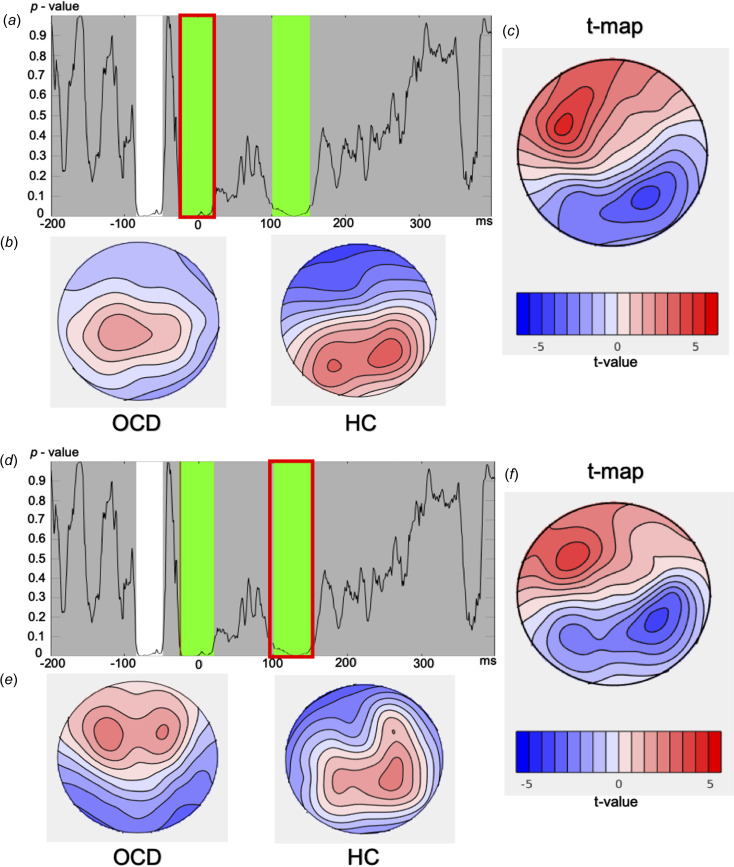
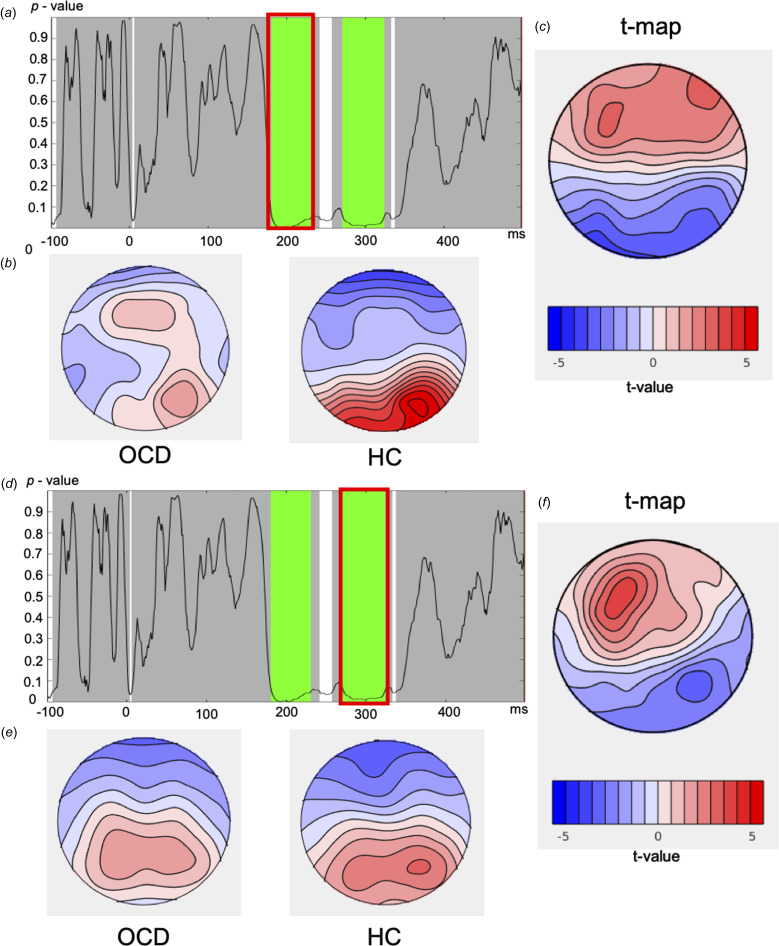
- TANOVA found significant group differences in ERP distribution for the ERN window (102–151 ms; averaged p = 0.0178, partial η² = 0.07), N200 window (182–230 ms; averaged p = 0.0184, partial η² = 0.08), and P300 window (272–323 ms; averaged p = 0.0206, partial η² = 0.06).
- The OCD group showed greater frontal positivity (ERN maximal at F3; N200 at AF8; P300 at F3) and greater negativity centroparietally/posteriorly (ERN at CP4; N200 at PO7; P300 at P6), contrasting with prior fronto-central negative-voltage reports.
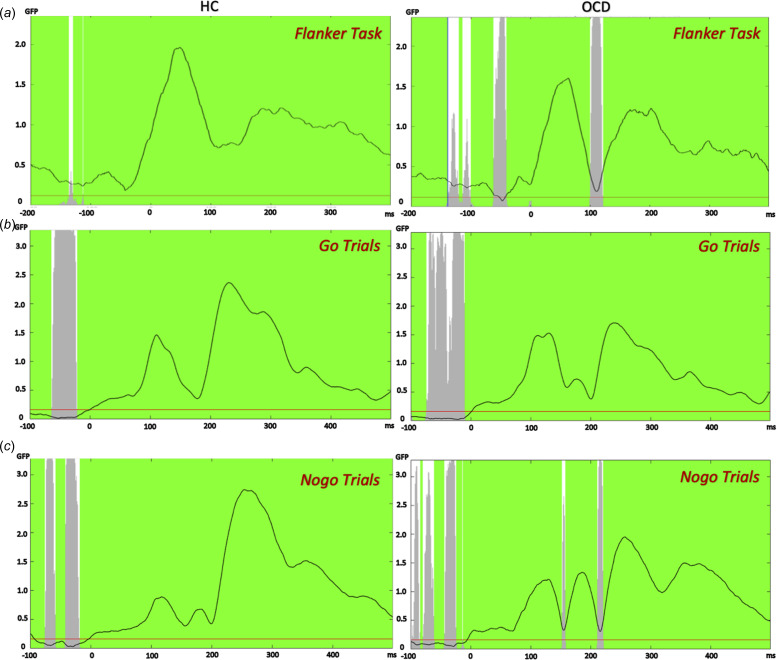
- GFP tests found no significant differences in overall neural response amplitude for either task (all p > 0.05), indicating altered distribution rather than increased overall response strength.
- TANCOVA showed no significant relationship between total YBOCS and ERN (p = 0.716), N200 (p = 0.597), or P300 (p = 0.281) topographies. Behaviourally, OCD had slower total flanker reaction time (379.38 vs 338.74 ms, p = 0.045), with no other significant behavioural differences.
Methods
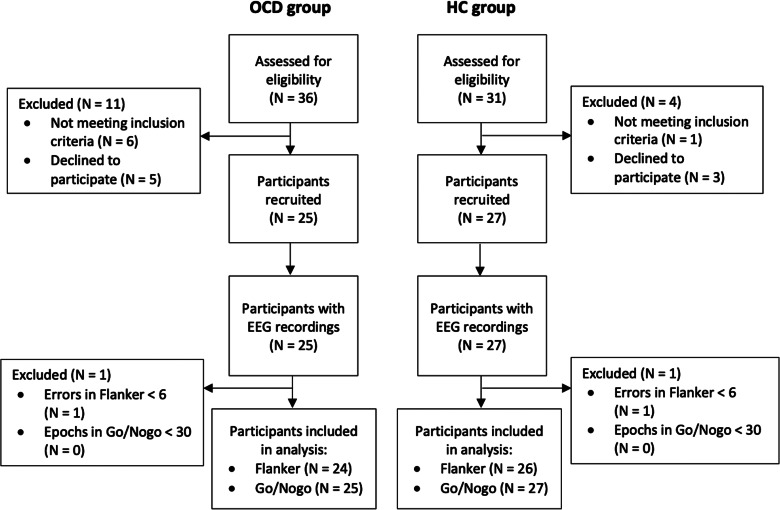
- Cross-sectional EEG/ERP study: 25 OCD patients and 27 age- and sex-matched healthy controls; final flanker analysis included 24 OCD and 26 HCs because one participant per group had fewer than six artefact-free error epochs, while all 25 OCD and 27 HCs were included in the go/nogo analysis.
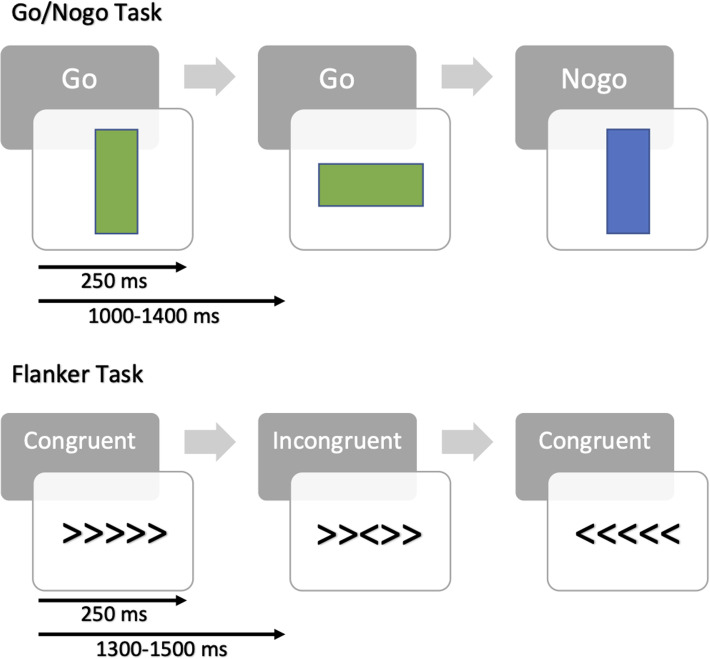
- Participants completed a flanker task (ERN) and a go/nogo task (N200, P300); EEG was recorded with 64 Ag/AgCl electrodes (63 analysed), 1000 Hz sampling, and pre-processed with the automated RELAX pipeline.
- Primary comparisons used RAGU randomisation statistics across all time points and electrodes: global field power (GFP) for overall strength and topographical analysis of variance (TANOVA) for distribution, with 5000 iterations, p = 0.05, FDR correction, and topographical consistency tests; exploratory TANCOVA assessed symptom-severity relationships.
Limitations
- The paper states that the sample size, while sufficient for group-level differences, would likely increase power with more participants and may reveal additional time-window findings.
- The paper states that participants were on different medication classes, increasing heterogeneity; medications may alter ERPs, so future studies should include drug-naïve participants.
- The paper states that behavioural tasks may not have been sensitive enough or the sample too small to detect behavioural differences, and that other endophenotype criteria—treatment effects, first-degree relatives, and specificity to OCD—were not tested. The text also makes evident that the TCT showed brief inconsistency in the OCD group overlapping the ERN/N200 windows, so those effects may partly reflect inconsistent neural activation rather than a consistent group difference.
Model-written summary. Check it against the paper before relying on it.
Integrity signals
Registry
Cites
Statistics
Figures
Verification
Claims the paper makes
13 Valid · 1 Not valid · 34 Not checked · 70 Own results and interpretations
The sources with a verdict support this claim; the rest weren’t checked yet, have no full text we could read, or their verdicts aren’t rated yet.
In the paper
“Significantly enhanced N200 amplitudes have been reported in OCD (Miyata et al., 1998; Riesel, Klawohn, Kathmann, & Endrass, 2017).”
§ Obsessive–compulsive disorder (OCD) is associated with increased engagement of frontal brain regions across multiple event-related potentials > Introduction
What the sources say
- Not checked — no full text of the sourcecites Miyata et al., 1998 matched to “Event‐related potentials in patients with obsessive–compulsive disorder” (1998) source
- Supportedcites Riesel, Klawohn, Kathmann, & Endrass, 2017 matched to “Conflict monitoring and adaptation as reflected by N2 amplitude in obsessive–compulsive disorder” (2017) source
The Electrophysiological data section reports significantly higher (more negative) N2 amplitudes in patients with OCD than in healthy controls (p < 0.01). This supports the claim that enhanced N200 amplitudes have been reported in OCD. (LLM, conf=0.93)
plainstates an association- Asserted: passes — The authors put it forward as true.
- Checkable: passes — It can be checked against evidence.
- Load-bearing: passes — The paper’s conclusions depend on it.
- Based: passes — The paper gives a reason why it holds.
The cited sources support only part of this claim — read each source’s verdict below.
In the paper
“Furthermore, several studies (Endrass, Riesel, Kathmann, & Buhlmann, 2014; Hanna et al., 2012; Nawani et al., 2017; Riesel, Kathmann, & Endrass, 2014; Ruchsow et al., 2005), including the present study reported no association between an altered ERN and OCD symptom severity.”
§ Obsessive–compulsive disorder (OCD) is associated with increased engagement of frontal brain regions across multiple event-related potentials > Discussion > Error-related negativity
What the sources say
- Not matchedcites Endrass, Riesel, Kathmann, & Buhlmann, 2014
An author–year citation the paper’s reference list doesn’t settle. We don’t search these by name.
- Supportedcites Hanna et al., 2012 matched to “Error-related negativity and tic history in pediatric obsessive-compulsive disorder” (2012) source
The Results section, under “Clinical Correlations and Comparisons in Obsessive-Compulsive Disorder Patients,” reports no significant correlation between event-related brain potentials and current or lifetime OCD symptom severity, both across all patients and within the tic-related and non-tic-related groups. The Discussion likewise describes the ERN as appearing independent of symptom severity. (LLM, conf=0.95)
- Not matchedcites Nawani et al., 2017
An author–year citation the paper’s reference list doesn’t settle. We don’t search these by name.
plain- Asserted: passes — The authors put it forward as true.
- Checkable: passes — It can be checked against evidence.
- Load-bearing: passes — The paper’s conclusions depend on it.
- Based: passes — The paper gives a reason why it holds.
- Not matched
Every source the paper cites for this claim was checked and supports it.
In the paper
“Moreover, our previous study of spectral power analysis in OCD using the same sample, reported significantly elevated delta and theta power in the same centroparietal electrodes showing higher negativity in the current study (Perera, Mallawaarachchi, Bailey, Murphy, & Fitzgerald, 2022).”
§ Obsessive–compulsive disorder (OCD) is associated with increased engagement of frontal brain regions across multiple event-related potentials > Discussion > Error-related negativity
What the sources say
- Supportedcites Perera, Mallawaarachchi, Bailey, Murphy, & Fitzgerald, 2022 matched to “Obsessive-Compulsive Disorder (OCD) is Associated with Increased Electroencephalographic (EEG) Delta and Theta Oscillatory Power but Reduced Delta Connectivity” (2022) source
The Power Spectral Analysis (pp. 10–11) reports significantly higher delta and theta power in the OCD group and lists central and parietal electrodes in both significant clusters, including C3, CP3, CP5, P3, and P5. The comparison to the current study’s negativity finding is the citing authors’ own observation, not a finding attributed to this source. (LLM, conf=0.90)
plainstates an association- Asserted: passes — The authors put it forward as true.
- Checkable: passes — It can be checked against evidence.
- Load-bearing: passes — The paper’s conclusions depend on it.
- Based: passes — The paper gives a reason why it holds.
- Supported
The sources with a verdict support this claim; the rest weren’t checked yet, have no full text we could read, or their verdicts aren’t rated yet.
In the paper
“Consequently, asymptomatic siblings (Carrasco et al., 2013) and first-degree relatives (Riesel et al., 2011) of OCD patients were also noted to have significantly enhanced ERN.”
§ Obsessive–compulsive disorder (OCD) is associated with increased engagement of frontal brain regions across multiple event-related potentials > Discussion > Error-related negativity
What the sources say
- Supportedcites Carrasco et al., 2013 matched to “INCREASED ERROR-RELATED BRAIN ACTIVITY IN YOUTH WITH OBSESSIVE-COMPULSIVE DISORDER AND UNAFFECTED SIBLINGS: Research Article: Error-Related Negativity in OCD” (2013) source
Carrasco et al. support the part of the sentence citing them: the Results section reports significantly increased ERN amplitude in unaffected siblings of pediatric OCD patients compared with healthy controls (P = .037). The sentence attributes the finding about first-degree relatives to Riesel et al., not Carrasco et al. (LLM, conf=0.94)
- Not checked — no full text of the sourcecites Riesel et al., 2011 matched to “Overactive error-related brain activity as a candidate endophenotype for obsessive-compulsive disorder: Evidence from unaffected first-degree relatives” (2011) source
plainstates an association- Asserted: passes — The authors put it forward as true.
- Checkable: passes — It can be checked against evidence.
- Load-bearing: passes — The paper’s conclusions depend on it.
- Based: passes — The paper gives a reason why it holds.
- Supported
The sources with a verdict support this claim; the rest weren’t checked yet, have no full text we could read, or their verdicts aren’t rated yet.
In the paper
“These results conflict with reports of several studies that found significantly larger N200 amplitudes in OCD groups when compared to HCs (Miyata et al., 1998; Riesel et al., 2017; Towey et al., 1990, 1993, 1994).”
§ Obsessive–compulsive disorder (OCD) is associated with increased engagement of frontal brain regions across multiple event-related potentials > Discussion > N200 and P300
What the sources say
- Not checked — no full text of the sourcecites Miyata et al., 1998 matched to “Event‐related potentials in patients with obsessive–compulsive disorder” (1998) source
- Supportedcites Riesel et al., 2017 matched to “Conflict monitoring and adaptation as reflected by N2 amplitude in obsessive–compulsive disorder” (2017) source
The Electrophysiological data section reports significantly higher (more negative) N2 amplitudes in patients with OCD than in healthy controls (p < 0.01). This supports citing Riesel et al. as one of the studies finding larger N200/N2 amplitudes in OCD, although the paper also notes that the groups did not differ in one trial condition. Page numbers were not supplied. (LLM, conf=0.94)
- Not matchedcites Towey et al., 1990, 1993, 1994
A range of references, not one source.
plain- Asserted: passes — The authors put it forward as true.
- Checkable: passes — It can be checked against evidence.
- Load-bearing: passes — The paper’s conclusions depend on it.
- Based: passes — The paper gives a reason why it holds.
49 more claims · 1 with their cited sources checked
Create a free account to see all 118 claims and every source verdict.
- Probably not a substantial claim. 43
- It may state two separate claims as one. 32
- The quote only partly states this claim. 1
Self-check
Percentages, sums and reported differences re-computed from the paper’s own numbers.
Each contradiction between two passages listed here was confirmed by an independent check.
Rated minor: it would not touch a result — a value no result rests on, a p-value that stays on the same side of the significance level, or a conflict that is clerical, resolved elsewhere in the paper, or outside its own findings.
In the paper
§ Obsessive–compulsive disorder (OCD) is associated with increased engagement of frontal brain regions across multiple event-related potentials > Results > Demographic and behavioural data
“The OCD group had a significantly slower reaction time in the flanker task (p = 0.024)”
§ Obsessive–compulsive disorder (OCD) is associated with increased engagement of frontal brain regions across multiple event-related potentials > Results > Demographic and behavioural data
“| Total RT (ms) | 379.38 | 71.12 | 25 | 338.74 | 53.98 | 27 | t = −2.00, p = 0.045* |”
Rated minor: it would not touch a result — a value no result rests on, a p-value that stays on the same side of the significance level, or a conflict that is clerical, resolved elsewhere in the paper, or outside its own findings.
In the paper
§ Obsessive–compulsive disorder (OCD) is associated with increased engagement of frontal brain regions across multiple event-related potentials > Discussion > N200 and P300
“Therefore, our finding of reduced N200 in OCD may indicate effects of treatment rather than a true OCD characteristic.”
§ Obsessive–compulsive disorder (OCD) is associated with increased engagement of frontal brain regions across multiple event-related potentials > Discussion > Limitations and future directions
“Our findings indicated that the N200 enhancement was not associated with OCD symptom severity, which is characteristic of an endophenotype.”
Citations
Cites
Controlling the False Discovery Rate: A Practical and Powerful Approach to Multiple Testing
Benjamini, Y., & Hochberg, Y. (1995) · Journal of the Royal Statistical Society Series B: Statistical Methodology · doi:10.1111/j.2517-6161.1995.tb02031.x · Cited by 109,482 · cited 1×
“The global count p -values of all primary and exploratory tests were corrected for experiment-wise multiple comparisons using the Benjamini and Hochberg false-discovery rate (FDR) method (Benjamini & Hochberg, 1995).”
MethodDelorme, A., & Makeig, S. (2004) · Journal of Neuroscience Methods · doi:10.1016/j.jneumeth.2003.10.009 · Cited by 24,371 · cited 2×
“The recorded, continuous EEG data were pre-processed using the automated RELAX pipeline (Bailey et al., 2023 b ), which was implemented on MATLAB (MATLAB, 2022) and utilised functions from EEGLAB (Delorme & Makeig, 2004) and fieldtrip (Oostenveld, Fries, Maris, & Schoffelen, 2011).”
Method(1998) · The Journal of Clinical Psychiatry · Cited by 19,139
An inventory for measuring clinical anxiety: Psychometric properties.
Beck, A. T., Epstein, N., Brown, G., & Steer, R. A. (1988) · Journal of Consulting and Clinical Psychology · doi:10.1037/0022-006x.56.6.893 · Cited by 14,407 · cited 2×
“The Yale – Brown Obsessive Compulsive Scale (YBOCS) (Goodman et al., 1989) was used to assess symptom severity, while the Beck Anxiety Inventory (BAI) (Beck, Epstein, Brown, & Steer, 1988) and the Quick Inventory for Depressive Symptoms –”
MethodOostenveld, R., Fries, P., Maris, E., & Schoffelen, J.-M. (2011) · Computational Intelligence and Neuroscience · doi:10.1155/2011/156869 · Cited by 10,323 · cited 1×
“The recorded, continuous EEG data were pre-processed using the automated RELAX pipeline [36], which was implemented on MATLAB [37] and utilised functions from EEGLAB [38] and fieldtrip [39].”
(1998) · PubMed · Cited by 10,216
Conflict monitoring and cognitive control
Botvinick, M. M., Braver, T. S., Barch, D. M., Carter, C. S., & Cohen, J. D. (2001) · Psychological Review · doi:10.1037/0033-295x.108.3.624 · Cited by 7,351 · cited 5×
“anterior cingulate cortex, response competition processing and greater top-down control processes are recruited from the DLPFC to improve task performance [15, 64].”
BackgroundMethodInfluentialEffects of noise letters upon the identification of a target letter in a nonsearch task
Eriksen, B. A., & Eriksen, C. W. (1974) · Perception & Psychophysics · doi:10.3758/bf03203267 · Cited by 7,230 · cited 1×
“The error related negativity (ERN) is conventionally defined as a negative deflection of the EEG that occurs approximately 100-150 ms following an erroneous response [7] and is most commonly measured with executive function and inhibition tasks such as the Eriksen Flanker task [8].”
MethodInfluentialThe Endophenotype Concept in Psychiatry: Etymology and Strategic Intentions
Gottesman, I. I., & Gould, T. D. (2003) · American Journal of Psychiatry · doi:10.1176/appi.ajp.160.4.636 · Cited by 5,615 · cited 1×
“…by several factors: endophenotypes (1) are related to the illness in the population, (2) manifest independent of the presence of symptoms, (3) are heritable, (4) may be present in unaffected relatives and (5) are co-segregated with the illness within families (Gottesman & Gould, 2003).”
BackgroundRush, A. J., Trivedi, M. H., Ibrahim, H. M., Carmody, T. J., Arnow, B., Klein, D. N., Markowitz, J. C., Ninan, P. T., Kornstein, S., Manber, R., et al. (2003) · Biological Psychiatry · doi:10.1016/s0006-3223(02)01866-8 · Cited by 3,829 · cited 2×
“while the Beck Anxiety Inventory (BAI) [33] and the Quick Inventory for Depressive Symptoms – Self Report (QIDS-SR) [34] were used to assess the level of anxiety and concurrent depression, respectively.”
MethodAnterior Cingulate Cortex, Error Detection, and the Online Monitoring of Performance
Carter, C. S., Braver, T. S., Barch, D. M., Botvinick, M. M., Noll, D., & Cohen, J. D. (1998) · Science · doi:10.1126/science.280.5364.747 · Cited by 3,273 · cited 5×
“Therefore, the altered ERN pattern seen in the current study, with an altered centropar-ietal and frontotemporal ERN distribution might signify an increased role of the DLPFC in performance monitoring in individuals with OCD.”
BackgroundInfluentialA neural system for error detection and compensation
Gehring, W. J., Goss, B., Coles, M. G. H., Meyer, D. E., & Donchin, E. (1993) · Psychological Science · doi:10.1111/j.1467-9280.1993.tb00586.x · Cited by 2,862 · cited 1×
“Moreover, the ERN has been suggested to reflect an error detection and conflict monitoring process, providing an evaluation of the consequence of error, which contributes to the adjustment of cognition that serves to prevent future errors (Gehring, Goss, Coles, Meyer, & Donchin, 1993).”
BackgroundThe Yale-Brown Obsessive Compulsive Scale: II. Validity
Goodman, W. K. (1989) · Archives of General Psychiatry · doi:10.1001/archpsyc.1989.01810110054008 · Cited by 2,799 · cited 6×
“The TANCOVA between the total YBOCS score and topographical findings across the ERN window showed no significant relationship ( p = 0.716), indicating that there was no significant association between the ERN and OCD symptom severity.”
MethodInfluentialThe epidemiology of obsessive-compulsive disorder in the National Comorbidity Survey Replication
Ruscio, A. M., Stein, D. J., Chiu, W. T., & Kessler, R. C. (2010) · Molecular Psychiatry · doi:10.1038/mp.2008.94 · Cited by 2,771 · cited 1×
“Obsessive-compulsive disorder (OCD) is a mental health condition with a lifetime prevalence of 2-3% that causes significant impact on the quality of life of sufferers [1, 2].”
BackgroundICLabel: An automated electroencephalographic independent component classifier, dataset, and website
Pion-Tonachini, L., Kreutz-Delgado, K., & Makeig, S. (2019) · NeuroImage · doi:10.1016/j.neuroimage.2019.05.026 · Cited by 2,267 · cited 2×
“Artifactual ICA components were detected using ICLabel [47] and these were cleaned with wavelet enhanced ICA (wICA) [48].”
MethodThe neural basis of error detection: Conflict monitoring and the error-related negativity
Yeung, N., Botvinick, M. M., & Cohen, J. D. (2004) · Psychological Review · doi:10.1037/0033-295x.111.4.931 · Cited by 1,924 · cited 1×
“In fact, previous research has found that the ERN activity starts slightly before the response [16].”
BackgroundThe PREP pipeline: standardized preprocessing for large-scale EEG analysis
Bigdely-Shamlo, N., Mullen, T., Kothe, C., Su, K.-M., & Robbins, K. A. (2015) · Frontiers in Neuroinformatics · doi:10.3389/fninf.2015.00016 · Cited by 1,351 · cited 3×
“After the MWF cleaning, data were average re-referenced using the PREP method (Bigdely-Shamlo et al., 2015), and then subjected to independent component analysis (ICA) using fastICA (Hyvarinen, 1999).”
MethodOrganization, W. H. (2025) · TIB Data Manager · doi:10.57702/o4rdcuwn · Cited by 1,158
Robust statistical methods in R using the WRS2 package
Mair, P., & Wilcox, R. (2020) · Behavior Research Methods · doi:10.3758/s13428-019-01246-w · Cited by 1,082 · cited 1×
“Behavioural and self-report data were compared using robust tests (Mair & Wilcox, 2019; Yuen, 1974).”
MethodFASTER: Fully Automated Statistical Thresholding for EEG artifact Rejection
Nolan, H., Whelan, R., & Reilly, R. B. (2010) · Journal of Neuroscience Methods · doi:10.1016/j.jneumeth.2010.07.015 · Cited by 1,077 · cited 1×
“EEG data were considered to be affected by drift if the amplitude was >10 times MAD from the median of all electrodes (Nolan, Whelan, & Reilly, 2010).”
MethodThe P300: Where in the Brain Is It Produced and What Does It Tell Us?
Linden, D. E. J. (2005) · The Neuroscientist · doi:10.1177/1073858405280524 · Cited by 833 · cited 2×
“…functionality of the brain systems that are required to provide sustained attention (Behzadnia, Ghassemi, Chermahini, Tabanfar, & Taymourtash, 2018; Linden, 2005), and has been found to under-pin clinical symptoms of waning attention in mental health conditions such as schizophrenia (Ford, 1999).”
BackgroundChamberlain, S. R., Blackwell, A. D., Fineberg, N. A., Robbins, T. W., & Sahakian, B. J. (2005) · Neuroscience & Biobehavioral Reviews · doi:10.1016/j.neubiorev.2004.11.006 · Cited by 830 · cited 1×
“monitoring, both of which are known to be dysfunctional in OCD groups [73-75].”
BackgroundTheta lingua franca: A common mid‐frontal substrate for action monitoring processes
Cavanagh, J. F., Zambrano‐Vazquez, L., & Allen, J. J. B. (2012) · Psychophysiology · doi:10.1111/j.1469-8986.2011.01293.x · Cited by 651 · cited 1×
“the notion that the ERN emerges, at least in part, from ongoing theta band activity [62, 63], as both seem to be enhanced in OCD when compared to HC.”
ResultThe Neural Basis of Error Detection: Conflict Monitoring and the Error-Related Negativity.
Yeung, N., Botvinick, M., & Cohen, J. D. (2004) · Psychological Review · doi:10.1037/0033-295x.111.4.939 · Cited by 616
Castellanos, N. P., & Makarov, V. A. (2006) · Journal of Neuroscience Methods · doi:10.1016/j.jneumeth.2006.05.033 · Cited by 569 · cited 1×
“Artefactual ICA components were detected using ICLabel (Pion-Tonachini, Kreutz-Delgado, & Makeig, 2019) and these were cleaned with wavelet enhanced ICA (wICA) (Castellanos & Makarov, 2006).”
MethodTHE INTERNATIONAL CONFERENCE ON HARMONIZATION GOOD CLINICAL PRACTICE GUIDELINE
Dixon, J. R. (1999) · Quality Assurance · doi:10.1080/105294199277860 · Cited by 504 · cited 1×
“The trial received ethics approval from the Monash Health Human Research Ethics Committee and was conducted under the Good Clinical Practice guidelines (Dixon, 1999).”
MethodThe two-sample trimmed t for unequal population variances
YUEN, K. K. (1974) · Biometrika · doi:10.1093/biomet/61.1.165 · Cited by 486 · cited 1×
“Behavioural and self-report data were compared using robust tests (Mair & Wilcox, 2019; Yuen, 1974).”
MethodSchizophrenia: The broken P300 and beyond
Ford, J. M. (1999) · Psychophysiology · doi:10.1111/1469-8986.3660667 · Cited by 437 · cited 1×
“…functionality of the brain systems that are required to provide sustained attention (Behzadnia, Ghassemi, Chermahini, Tabanfar, & Taymourtash, 2018; Linden, 2005), and has been found to under-pin clinical symptoms of waning attention in mental health conditions such as schizophrenia (Ford, 1999).”
BackgroundRogasch, N. C., Sullivan, C., Thomson, R. H., Rose, N. S., Bailey, N. W., Fitzgerald, P. B., Farzan, F., & Hernandez-Pavon, J. C. (2017) · NeuroImage · doi:10.1016/j.neuroimage.2016.10.031 · Cited by 411
Self-citationEvent-related brain potentials: an introduction
Coles, M. G. H., & Rugg, M. D. (1996) · Electrophysiology of Mind · doi:10.1093/acprof:oso/9780198524168.003.0001 · Cited by 396 · cited 1×
“Event related potentials (ERP) are voltage changes detected in the EEG that occur as a result of the brain’s time-locked response to a stimulus [6].”
BackgroundThut, G., & Pascual-Leone, A. (2010) · Brain Topography · doi:10.1007/s10548-009-0115-4 · Cited by 388 · cited 1×
“It has been reported that administering TMS may alter the electrophysiology of the brain leading to various EEG changes [90].”
BackgroundQuality of life for patients with obsessive-compulsive disorder
(1996) · American Journal of Psychiatry · doi:10.1176/ajp.153.6.783 · Cited by 367 · cited 1×
“Obsessive – compulsive disorder (OCD) is a mental health condition with a lifetime prevalence of 2 – 3% that causes significant impact on the quality of life of sufferers (Koran, Thienemann, & Davenport, 1996; Ruscio, Stein, Chiu, & Kessler, 2010).”
BackgroundKoenig, T., Kottlow, M., Stein, M., & Melie-García, L. (2011) · Computational Intelligence and Neuroscience · doi:10.1155/2011/938925 · Cited by 356 · cited 2×
“The TCT checks for patterns of consistency in the active sources between the subjects of each tested group and condition (Koenig et al., 2011).”
BackgroundMethodAnatomy of an error: ERP and fMRI
Mathalon, D. H., Whitfield, S. L., & Ford, J. M. (2003) · Biological Psychology · doi:10.1016/s0301-0511(03)00105-4 · Cited by 328 · cited 1×
“anterior cingulate cortex, response competition processing and greater top-down control processes are recruited from the DLPFC to improve task performance [15, 64].”
MethodNon-adherence and non-response in the treatment of anxiety disorders
Taylor, S., Abramowitz, J. S., & McKay, D. (2012) · Journal of Anxiety Disorders · doi:10.1016/j.janxdis.2012.02.010 · Cited by 317 · cited 1×
“The pathophysiology of OCD is poorly understood to date, which has led to poor response to many of the first-line treatments (Taylor, Abramowitz, & McKay, 2012), and significantly limits the development of more effective novel treatments.”
BackgroundTheta EEG dynamics of the error-related negativity
Trujillo, L. T., & Allen, J. J. B. (2007) · Clinical Neurophysiology · doi:10.1016/j.clinph.2006.11.009 · Cited by 314 · cited 1×
“This finding is in agreement with the notion that the ERN emerges, at least in part, from ongoing theta band activity (Cavanagh, Zambrano-Vazquez, & Allen, 2012; Trujillo & Allen, 2007), as both seem to be enhanced in OCD when compared to HCs.”
ResultImpaired response inhibition in obsessive compulsive disorder
Penadés, R., Catalán, R., Rubia, K., Andrés, S., Salamero, M., & Gastó, C. (2007) · European Psychiatry · doi:10.1016/j.eurpsy.2006.05.001 · Cited by 308 · cited 1×
“The N200 is reported to reflect processes underlying response inhibition and conflict monitoring, both of which are known to be dysfunctional in OCD groups (Chamberlain, Blackwell, Fineberg, Robbins, & Sahakian, 2005; Penades et al., 2007; Woolley et al., 2008).”
Backgroundde Wit, S. J., Alonso, P., Schweren, L., Mataix-Cols, D., Lochner, C., Menchón, J. M., Stein, D. J., Fouche, J.-P., Soriano-Mas, C., Sato, J. R., et al. (2014) · American Journal of Psychiatry · doi:10.1176/appi.ajp.2013.13040574 · Cited by 278 · cited 1×
“several studies have reported neuroimaging evidence of anomalies in the DLPFC in OCD [19, 65].”
BackgroundA generic EEG artifact removal algorithm based on the multi-channel Wiener filter
Somers, B., Francart, T., & Bertrand, A. (2018) · Journal of Neural Engineering · doi:10.1088/1741-2552/aaac92 · Cited by 255
Hajcak, G., Franklin, M. E., Foa, E. B., & Simons, R. F. (2008) · American Journal of Psychiatry · doi:10.1176/appi.ajp.2007.07010143 · Cited by 253 · cited 3×
“In fact, several studies have proposed ERN as a potential candidate endophenotype for OCD as the ERN enhancement was uncorrelated to symptom severity, and no changes were noted with successful treatment (Hajcak, Franklin, Foa, & Simons, 2008; Riesel, Endrass, Kaufmann, & Kathmann, 2011).”
BackgroundA cybernetic model of obsessive-compulsive psychopathology
Pitman, R. K. (1987) · Comprehensive Psychiatry · doi:10.1016/0010-440x(87)90070-8 · Cited by 229 · cited 2×
“including the feeling of incompleteness, doubt and repetitive behaviours may reflect overactive performance monitoring [17].”
BackgroundRiesel, A., Endrass, T., Kaufmann, C., & Kathmann, N. (2011) · American Journal of Psychiatry · doi:10.1176/appi.ajp.2010.10030416 · Cited by 228 · cited 2×
“In fact, several studies have proposed ERN as a potential candidate endophenotype for OCD as the ERN enhancement was uncorrelated to symptom severity, and no changes were noted with successful treatment (Hajcak, Franklin, Foa, & Simons, 2008; Riesel, Endrass, Kaufmann, & Kathmann, 2011).”
BackgroundERPs in schizophrenia: Effects of antipsychotic medication
Ford, J. M., White, P. M., Csernansky, J. G., Faustman, W. O., Roth, W. T., & Pfefferbaum, A. (1994) · Biological Psychiatry · doi:10.1016/0006-3223(94)91221-1 · Cited by 227 · cited 9×
“Two other ERPs that are commonly associated with OCD are the N200 and P300, which are both elicited using response inhibition tasks, such as the go/nogo task.”
BackgroundInfluentialPerformance monitoring and error significance in patients with obsessive-compulsive disorder
Endrass, T., Schuermann, B., Kaufmann, C., Spielberg, R., Kniesche, R., & Kathmann, N. (2010) · Biological Psychology · doi:10.1016/j.biopsycho.2010.02.002 · Cited by 206 · cited 2×
“Studies have reported that the ERN amplitude is significantly greater in OCD groups when compared to HCs (Endrass et al., 2010; Johannes et al., 2001; Xiao et al., 2011).”
ResultAlday, P. M. (2019) · Psychophysiology · doi:10.1111/psyp.13451 · Cited by 197 · cited 1×
“The data were baseline corrected to the − 400 to − 100 ms period for the flanker task and from − 100 to 0 ms for the go/nogo task using the regression baseline correction method (Alday, 2019), applied using an algorithm within the RELAX pipeline (Bailey et al., 2023 b ).”
MethodOn the relationship between EEG and P300: individual differences, aging, and ultradian rhythms
Polich, J. (1997) · International Journal of Psychophysiology · doi:10.1016/s0167-8760(97)00772-1 · Cited by 186 · cited 3×
“…averaged across the typical ERN (100 – 150 ms following an erroneous response), N200 (180 – 230 ms post-stimulus) and P300 (250 – 400 ms post-stimulus) windows as defined in the previous literature (Brunellière, Sánchez-García, Ikumi, & Soto-Faraco, 2013; Polich, 1997; Stemmer et al., 2004).”
MethodResultDiscrepant target detection and action monitoring in obsessive–compulsive disorder
Johannes, S., Wieringa, B. M., Nager, W., Rada, D., Dengler, R., Emrich, H. M., Münte, T. F., & Dietrich, D. E. (2001) · Psychiatry Research: Neuroimaging · doi:10.1016/s0925-4927(01)00117-2 · Cited by 179 · cited 2×
“Several previous ERP studies have addressed the question of whether conflict monitoring is enhanced in OCD with reports of significantly elevated ERN [9-11, 58, 59], mostly noted in midline fronto-central electrodes .”
BackgroundResultCognitive Frontal Lobe Dysfunction in Obsessive-Compulsive Disorder
Schmidtke, K., Schorb, A., Winkelmann, G., & Hohagen, F. (1998) · Biological Psychiatry · doi:10.1016/s0006-3223(97)00355-7 · Cited by 172 · cited 1×
“These findings suggest an array of neural differences between OCD and HC groups, which are likely to reflect alterations in executive functions such as attentional processes, conflict monitoring and response inhibition, perhaps produced by frontal dysfunction, which is a known finding in OCD [55, 56].”
BackgroundFast ICA for noisy data using Gaussian moments
Hyvarinen, A. (2003) · ISCAS'99. Proceedings of the 1999 IEEE International Symposium on Circuits and Systems VLSI (Cat. No.99CH36349) · doi:10.1109/iscas.1999.777510 · Cited by 170 · cited 2×
“After the MWF cleaning, data were average re-referenced using the PREP method (Bigdely-Shamlo et al., 2015), and then subjected to independent component analysis (ICA) using fastICA (Hyvarinen, 1999).”
MethodError detection in patients with lesions to the medial prefrontal cortex: an ERP study
Stemmer, B., Segalowitz, S. J., Witzke, W., & Schönle, P. W. (2004) · Neuropsychologia · doi:10.1016/s0028-3932(03)00121-0 · Cited by 166 · cited 4×
“…averaged across the typical ERN (100 – 150 ms following an erroneous response), N200 (180 – 230 ms post-stimulus) and P300 (250 – 400 ms post-stimulus) windows as defined in the previous literature (Brunellière, Sánchez-García, Ikumi, & Soto-Faraco, 2013; Polich, 1997; Stemmer et al., 2004).”
MethodResultInfluentialBrain activation in paediatric obsessive-compulsive disorder during tasks of inhibitory control
Woolley, J., Heyman, I., Brammer, M., Frampton, I., McGuire, P. K., & Rubia, K. (2008) · British Journal of Psychiatry · doi:10.1192/bjp.bp.107.036558 · Cited by 162 · cited 2×
“monitoring, both of which are known to be dysfunctional in OCD groups [73-75].”
BackgroundCarrasco, M., Harbin, S. M., Nienhuis, J. K., Fitzgerald, K. D., Gehring, W. J., & Hanna, G. L. (2013) · Depression and Anxiety · doi:10.1002/da.22035 · Cited by 149 · cited 4×
“Consequently, asymptomatic siblings [67] and first-degree relatives [13] of OCD patients were also noted to have significantly enhanced ERN.”
BackgroundInfluentialSpecificity of performance monitoring changes in obsessive-compulsive disorder
Endrass, T., & Ullsperger, M. (2014) · Neuroscience & Biobehavioral Reviews · doi:10.1016/j.neubiorev.2014.03.024 · Cited by 141 · cited 1×
“Increased ERN amplitude centroparietally and the potential involvement of the DLPFC reflect dysfunctional performance monitoring, which is known to be linked to checking symptoms of OCD (Endrass & Ullsperger, 2014), commonly reported by the OCD participants of our study.”
BackgroundAlday, P. (2019) · MPG.PuRe (Max Planck Society) · Cited by 135
Xiao, Z., Wang, J., Zhang, M., Li, H., Tang, Y., Wang, Y., Fan, Q., & Fromson, J. A. (2011) · Progress in Neuro-Psychopharmacology and Biological Psychiatry · doi:10.1016/j.pnpbp.2010.11.022 · Cited by 127 · cited 2×
“Studies have reported that the ERN amplitude is significantly greater in OCD groups when compared to HCs (Endrass et al., 2010; Johannes et al., 2001; Xiao et al., 2011).”
BackgroundResultPerformance monitoring in obsessive-compulsive disorder
Nieuwenhuis, S., Nielen, M. M., Mol, N., Hajcak, G., & Veltman, D. J. (2005) · Psychiatry Research · doi:10.1016/j.psychres.2005.02.005 · Cited by 119 · cited 2×
“However, at least one study has reported no significant difference in the ERN amplitude between OCD and HC groups (Nieuwenhuis, Nielen, Mol, Hajcak, & Veltman, 2005).”
BackgroundBailey, N. W., Biabani, M., Hill, A. T., Miljevic, A., Rogasch, N. C., McQueen, B., Murphy, O. W., & Fitzgerald, P. B. (2023) · Clinical Neurophysiology · doi:10.1016/j.clinph.2023.01.017 · Cited by 119 · cited 3×
“The recorded, continuous EEG data were pre-processed using the automated RELAX pipeline (Bailey et al., 2023 b ), which was implemented on MATLAB (MATLAB, 2022) and utilised functions from EEGLAB (Delorme & Makeig, 2004) and fieldtrip (Oostenveld, Fries, Maris, & Schoffelen, 2011).”
BackgroundMethodSelf-citationError-Related Brain Activity in Patients with Obsessive- Compulsive Disorder and in Healthy Controls
Ruchsow, M., Grön, G., Reuter, K., Spitzer, M., Hermle, L., & Kiefer, M. (2005) · Journal of Psychophysiology · doi:10.1027/0269-8803.19.4.298 · Cited by 116
Performance monitoring in obsessive–compulsive disorder and social anxiety disorder.
Endrass, T., Riesel, A., Kathmann, N., & Buhlmann, U. (2014) · Journal of Abnormal Psychology · doi:10.1037/abn0000012 · Cited by 113 · cited 1×
“Furthermore, several studies (Endrass, Riesel, Kathmann, & Buhlmann, 2014; Hanna et al., 2012; Nawani et al., 2017; Riesel, Kathmann, & Endrass, 2014; Ruchsow et al., 2005), including the present study reported no association between an altered ERN and OCD symptom severity.”
BackgroundBias in a common EEG and MEG statistical analysis and how to avoid it
Kilner, J. M. (2013) · Clinical Neurophysiology · doi:10.1016/j.clinph.2013.03.024 · Cited by 96 · cited 1×
“This may have resulted in both inflated false positives and in an inability to detect significant results in alternative time windows (Kilner, 2013).”
ResultPresupplementary Motor Area Contributes to Altered Error Monitoring in Obsessive-Compulsive Disorder
Grützmann, R., Endraß, T., Kaufmann, C., Allen, E. A., Eichele, T., & Kathmann, N. (2014) · Biological Psychiatry · doi:10.1016/j.biopsych.2014.12.010 · Cited by 96 · cited 1×
“…have addressed the question of whether conflict monitoring is enhanced in OCD with reports of significantly elevated ERN (Endrass et al., 2010; Grützmann et al., 2016; Johannes et al., 2001; Roh, Chang, Yoo, Shin, & Kim, 2017; Xiao et al., 2011), mostly noted in midline fronto-central…”
BackgroundMalloy, P., Rasmussen, S., Braden, W., & Haier, R. J. (1989) · Psychiatry Research · doi:10.1016/0165-1781(89)90198-4 · Cited by 92
Kim, M.-S., Kim, Y. Y., Yoo, S. Y., & Kwon, J. S. (2007) · Depression and Anxiety · doi:10.1002/da.20195 · Cited by 90 · cited 1×
“Instead, our results are consistent with two studies that reported opposing results with significantly smaller N200 amplitudes (Kim, Kim, Yoo, & Kwon, 2007; Morault, Guillem, Bourgeois, & Paty, 1998).”
ResultEndogenous event-related potentials in obsessive-compulsive disorder
Towey, J., Bruder, G., Hollander, E., Friedman, D., Erhan, H., Liebowitz, M., & Sutton, S. (1990) · Biological Psychiatry · doi:10.1016/0006-3223(90)90626-d · Cited by 87 · cited 1×
“These results conflict with reports of several studies that found significantly larger N200 amplitudes in OCD groups when compared to HC [21, 22, 76-78].”
ResultBrain event‐related potential correlates of overfocused attention in obsessive‐compulsive disorder
TOWEY, J. P., TENKE, C. E., BRUDER, G. E., LEITE, P., FRIEDMAN, D., LIEBOWITZ, M., & HOLLANDER, E. (1994) · Psychophysiology · doi:10.1111/j.1469-8986.1994.tb02346.x · Cited by 84 · cited 3×
“However, a few studies reported contradicting results of lower P300 amplitudes in OCD [25, 26, 78, 87].”
Attention and cognition in patients with obsessive–compulsive disorder
DE GEUS, F., DENYS, D. A. J. P., SITSKOORN, M. M., & WESTENBERG, H. G. M. (2007) · Psychiatry and Clinical Neurosciences · doi:10.1111/j.1440-1819.2007.01609.x · Cited by 83 · cited 1×
“Individuals with OCD are also known to have deficits in cognitive processes of attention and selective attention [85, 86].”
BackgroundRiesel, A., Kathmann, N., & Endrass, T. (2014) · European Archives of Psychiatry and Clinical Neuroscience · doi:10.1007/s00406-014-0499-3 · Cited by 83
Selective attention in obsessive-compulsive disorder.
Clayton, I. C., Richards, J. C., & Edwards, C. J. (1999) · Journal of Abnormal Psychology · doi:10.1037//0021-843x.108.1.171 · Cited by 82 · cited 1×
“Individuals with OCD are also known to have deficits in cognitive processes of attention and selective attention [85, 86].”
BackgroundError-related negativity and tic history in pediatric obsessive-compulsive disorder
Hanna, G. L., Carrasco, M., Harbin, S. M., Nienhuis, J. K., LaRosa, C. E., Chen, P., Fitzgerald, K. D., & Gehring, W. J. (2012) · Journal of the American Academy of Child & Adolescent Psychiatry · doi:10.1016/j.jaac.2012.06.019 · Cited by 80 · cited 1×
“Furthermore, several studies (Endrass, Riesel, Kathmann, & Buhlmann, 2014; Hanna et al., 2012; Nawani et al., 2017; Riesel, Kathmann, & Endrass, 2014; Ruchsow et al., 2005), including the present study reported no association between an altered ERN and OCD symptom severity.”
BackgroundBailey, N. W., Hill, A. T., Biabani, M., Murphy, O. W., Rogasch, N. C., McQueen, B., Miljevic, A., & Fitzgerald, P. B. (2023) · Clinical Neurophysiology · doi:10.1016/j.clinph.2023.01.018 · Cited by 79 · cited 3×
“The recorded, continuous EEG data were pre-processed using the automated RELAX pipeline (Bailey et al., 2023 b ), which was implemented on MATLAB (MATLAB, 2022) and utilised functions from EEGLAB (Delorme & Makeig, 2004) and fieldtrip (Oostenveld, Fries, Maris, & Schoffelen, 2011).”
BackgroundMethodSelf-citationThe Two-Sample Trimmed t for Unequal Population Variances
Yuen, K. K. (1974) · Biometrika · doi:10.2307/2334299 · Cited by 77
Fitzgibbon, S. P., DeLosAngeles, D., Lewis, T. W., Powers, D. M. W., Grummett, T. S., Whitham, E. M., Ward, L. M., Willoughby, J. O., & Pope, K. J. (2015) · Clinical Neurophysiology · doi:10.1016/j.clinph.2015.12.009 · Cited by 70 · cited 1×
“Thereafter, marking of electrodes for rejection occurred based on (1) excessive muscle activity (Fitzgibbon et al., 2016); (2) extreme kurtosis; (3) extreme drift; (4) extremely improbable voltage distributions and (5) extreme outlying amplitudes (Bailey et al., 2023 a ).”
BackgroundEvent-related potential and clinical correlates of neurodysfunction in obsessive-compulsive disorder
Towey, J., Bruder, G., Tenke, C., Leite, P., DeCaria, C., Friedman, D., & Hollander, E. (1993) · Psychiatry Research · doi:10.1016/0165-1781(93)90103-n · Cited by 67
Perera, M. P. N., Bailey, N. W., Herring, S. E., & Fitzgerald, P. B. (2019) · Journal of Anxiety Disorders · doi:10.1016/j.janxdis.2018.11.001 · Cited by 67 · cited 2×
“Electroencephalography (EEG) is an affordable and effective tool to explore the electro-physiology of the brain, and many studies have discovered differences in EEG measures in OCD groups when compared to healthy controls (HCs) (Perera, Bailey, Herring, & Fitzgerald, 2019).”
BackgroundResultSelf-citationSanz, M., Molina, V., Martin-Loeches, M., Calcedo, A., & Rubia, F. J. (2001) · Psychiatry Research · doi:10.1016/s0165-1781(00)00250-x · Cited by 66 · cited 3×
“However, a few studies reported contradicting results of lower P300 amplitudes in OCD [25, 26, 78, 87].”
ResultObsessive-compulsive disorder: Is there a frontal lobe dysfunction?
Khanna, S. (1988) · Biological Psychiatry · doi:10.1016/0006-3223(88)90171-0 · Cited by 64 · cited 1×
“…OCD and HC groups, which are likely to reflect alterations in executive functions such as attentional processes, conflict monitoring and response inhibition, perhaps produced by frontal dysfunction, which is a known finding in OCD (Khanna, 1988; Schmidtke, Schorb, Winkelmann, & Hohagen, 1998).”
BackgroundRussell, A., Cortese, B., Lorch, E., Ivey, J., Banerjee, S. P., Moore, G. J., & Rosenberg, D. R. (2003) · Journal of Child and Adolescent Psychopharmacology · doi:10.1089/104454603322126322 · Cited by 63 · cited 2×
“N -acetyl-aspartate) activity compared to HCs in brain regions that are thought to be associated with performance monitoring, such as the anterior cingulate cortex, orbitofrontal cortex and the dorsolateral prefrontal cortex (DLPFC) (Carter et al., 1998; Russell et al., 2003).”
BackgroundP300 subcomponents in obsessive-compulsive disorder
Mavrogiorgou, P., Juckel, G., Frodl, T., Gallinat, J., Hauke, W., Zaudig, M., Dammann, G., Möller, H.-J., & Hegerl, U. (2002) · Journal of Psychiatric Research · doi:10.1016/s0022-3956(02)00055-9 · Cited by 52 · cited 1×
“The OCD group was found to show less negative frontal voltages in the P300 compared to HC, which is consistent with findings of several previous studies [23, 24, 81, 82].”
ResultPerera, M. P. N., Mallawaarachchi, S., Miljevic, A., Bailey, N. W., Herring, S. E., & Fitzgerald, P. B. (2021) · Biological Psychiatry: Cognitive Neuroscience and Neuroimaging · doi:10.1016/j.bpsc.2021.03.010 · Cited by 51 · cited 1×
“Furthermore, treatment of OCD with non-invasive brain stimulation methods such as repetitive transcranial magnetic stimulation (rTMS) has shown to be efficacious (Perera et al., 2021).”
MethodSelf-citationPerera, M. P. N., Mallawaarachchi, S., Bailey, N. W., Murphy, O. W., & Fitzgerald, P. B. (2022) · doi:10.1101/2022.10.03.510571 · Cited by 51 · cited 1×
“Moreover, our previous study of spectral power analysis in OCD using the same sample, reported significantly elevated delta and theta power in the same centroparietal electrodes showing higher negativity in the current study [61].”
ResultSelf-citationPerera, M. P. N., Mallawaarachchi, S., Bailey, N. W., Murphy, O. W., & Fitzgerald, P. B. (2023) · Journal of Psychiatric Research · doi:10.1016/j.jpsychires.2023.05.026 · Cited by 50
Self-citationEvent‐related potentials in patients with obsessive–compulsive disorder
MIYATA, MATSUNAGA, KIRIIKE, IWASAKI, TAKEI, & YAMAGAMI (1998) · Psychiatry and Clinical Neurosciences · doi:10.1046/j.1440-1819.1998.00427.x · Cited by 49 · cited 2×
“Significantly enhanced N200 amplitudes have been reported in OCD (Miyata et al., 1998; Riesel, Klawohn, Kathmann, & Endrass, 2017).”
BackgroundResultGohle, D., Juckel, G., Mavrogiorgou, P., Pogarell, O., Mulert, C., Rujescu, D., Giegling, I., Zaudig, M., & Hegerl, U. (2008) · Journal of Psychiatric Research · doi:10.1016/j.jpsychires.2007.01.003 · Cited by 40 · cited 1×
“The OCD group was found to show less negative frontal voltages in the P300 compared to HC, which is consistent with findings of several previous studies [23, 24, 81, 82].”
ResultConflict monitoring and adaptation as reflected by N2 amplitude in obsessive–compulsive disorder
Riesel, A., Klawohn, J., Kathmann, N., & Endrass, T. (2017) · Psychological Medicine · doi:10.1017/s0033291716003597 · Cited by 36 · cited 2×
“Significantly enhanced N200 amplitudes have been reported in OCD [21, 22].”
BackgroundResultVisual information constrains early and late stages of spoken-word recognition in sentence context
Brunellière, A., Sánchez-García, C., Ikumi, N., & Soto‐Faraco, S. (2013) · International Journal of Psychophysiology · doi:10.1016/j.ijpsycho.2013.06.016 · Cited by 30 · cited 1×
“The identified significant periods from the TANOVA analysis were averaged and compared using topographical analysis of covariance (TANCOVA).”
MethodP300 in obsessive–compulsive disorder: Source localization and the effects of treatment
Andreou, C., Leicht, G., Popescu, V., Pogarell, O., Mavrogiorgou, P., Rujescu, D., Giegling, I., Zaudig, M., Juckel, G., Hegerl, U., et al. (2013) · Journal of Psychiatric Research · doi:10.1016/j.jpsychires.2013.09.003 · Cited by 29 · cited 2×
“The OCD group was found to show less negative frontal voltages in the P300 compared to HCs, which is consistent with findings of several previous studies (Andreou et al., 2013; Gohle et al., 2008; Ischebeck et al., 2011; Mavrogiorgou et al., 2002).”
ResultAttentional avoidance of threats in obsessive compulsive disorder: An event related potential study
Zhang, Z., Wang, M., Guo, X., Miao, X., Zhang, T., Gao, D., & Yuan, Z. (2017) · Behaviour Research and Therapy · doi:10.1016/j.brat.2017.07.011 · Cited by 28 · cited 1×
“…in OCD with reports of significantly elevated ERN (Endrass et al., 2010; Grützmann et al., 2016; Johannes et al., 2001; Roh, Chang, Yoo, Shin, & Kim, 2017; Xiao et al., 2011), mostly noted in midline fronto-central electrodes such as FCz, Fz and Cz (Nieuwenhuis et al., 2005; Zhang et al., 2017).”
BackgroundAuditory novelty processing is enhanced in obsessive–compulsive disorder
Ischebeck, M., Endrass, T., Simon, D., & Kathmann, N. (2011) · Depression and Anxiety · doi:10.1002/da.20886 · Cited by 27 · cited 3×
“The OCD group was found to show less negative frontal voltages in the P300 compared to HC, which is consistent with findings of several previous studies [23, 24, 81, 82].”
ResultImprovement predictors in obsessive-compulsive disorder. An event-related potential study
Morault, P., Guillem, F., Bourgeois, M., & Paty, J. (1998) · Psychiatry Research · doi:10.1016/s0165-1781(98)00091-2 · Cited by 26
Degeneracy in the nervous system: From neuronal excitability to neural coding
Kamaleddin, M. A. (2022) · BioEssays · doi:10.1002/bies.202100148 · Cited by 24 · cited 1×
“…with OCD, and instead suggests the potential involvement of multiple sources or degeneracy (defined as the potential for a disorder to be explained by the presence of multiple different elements all of which contribute to the same pathological behaviour of the system) (Kamaleddin, 2022).”
BackgroundStein, D. J., & Fineberg, N. A. (2007) · doi:10.1093/med/9780199204601.001.0001 · Cited by 22
Event-related potentials in drug-naïve pediatric patients with obsessive-compulsive disorder
Yamamuro, K., Ota, T., Nakanishi, Y., Matsuura, H., Okazaki, K., Kishimoto, N., Takahashi, H. R., Iwasaka, H., Iida, J., & Kishimoto, T. (2015) · Psychiatry Research · doi:10.1016/j.psychres.2015.09.026 · Cited by 19 · cited 2×
“…been inconsistent with reports of both higher (Andreou et al., 2013; Ischebeck, Endrass, Simon, & Kathmann, 2011) and lower (Sanz, Molina, Martin-Loeches, Calcedo, & Rubia, 2001; Yamamuro et al., 2015) amplitudes in OCD, although overfocused attention has been reported (Stein & Fineberg, 2007).”
ResultRoh, D., Chang, J.-G., Yoo, S. W., Shin, J., & Kim, C.-H. (2017) · Psychological Medicine · doi:10.1017/s0033291717000514 · Cited by 14 · cited 1×
“Several previous ERP studies have addressed the question of whether conflict monitoring is enhanced in OCD with reports of significantly elevated ERN [9-11, 58, 59], mostly noted in midline fronto-central electrodes .”
BackgroundNawani, H., Narayanaswamy, J. C., Basavaraju, S., Bose, A., Mahavir Agarwal, S., Venkatasubramanian, G., & Janardhan Reddy, Y. C. (2018) · Psychiatry Research · doi:10.1016/j.psychres.2017.09.010 · Cited by 14 · cited 1×
“Furthermore, several studies [68-72], including the present study reported no association between an altered ERN and OCD symptom severity.”
Behzadnia, A., Ghassemi, F., Chermahini, S. A., Tabanfar, Z., & Taymourtash, A. (2018) · NeuroReport · doi:10.1097/wnr.0000000000001062 · Cited by 6 · cited 1×
“An altered P300 has been suggested to point to disruptions in the functionality of the brain systems that are required to provide sustained attention [20, 83], and has been found to underpin clinical .”
BackgroundMWF toolbox for EEG artifact removal
Somers, B., Francart, T., & Bertrand, A. (2019) · Lirias (KU Leuven) · Cited by 5
Research works printed but not linked: 1
- American Psychiatric Association (2013). Diagnostic and statistical manual of mental disorders (DSM-5®). Washington, DC: American Psychiatric Publishing.
Cited by
Perera, M. P. N., Mallawaarachchi, S., Bailey, N. W., Murphy, O. W., & Fitzgerald, P. B. (2022) · doi:10.1101/2022.10.03.510571 · Cited by 51
Self-citationPerera, M. P. N., Mallawaarachchi, S., Bailey, N. W., Murphy, O. W., & Fitzgerald, P. B. (2023) · Journal of Psychiatric Research · doi:10.1016/j.jpsychires.2023.05.026 · Cited by 50
Self-citationPerera, M. P. N., Gotsis, E. S., Bailey, N. W., Fitzgibbon, B. M., & Fitzgerald, P. B. (2024) · Cerebral Cortex · doi:10.1093/cercor/bhae327 · Cited by 34
Self-citationPerera, M. P. N., Bailey, N. W., Murphy, O. W., Mallawaarachchi, S., Sullivan, C. M., Hill, A. T., & Fitzgerald, P. B. (2023) · Depression and Anxiety · doi:10.1155/2023/9958884 · Cited by 23
“Furthermore, it is known that several event-related potentials (ERP), such as the error-related negativity and N200, are altered in OCD when compared to HC [18, 53].”
Self-citationMechanisms of DBS: from informational lesions to circuit modulation and implications in OCD
Shea, J. M., Feigen, C. M., Eskandar, E. N., & Killian, N. J. (2025) · Frontiers in Human Neuroscience · doi:10.3389/fnhum.2025.1492744 · Cited by 10
Metadata
- Authors
- Perera, M. P. N., Mallawaarachchi, S., Bailey, N. W., Murphy, O. W., & Fitzgerald, P. B.
- Affiliations
- Monash University (AU)
- University of Oslo (NO)
- Australian National University (AU)
- Bionics Institute (AU)
- Corresponding author
- Perera, M. Prabhavi N.
- ORCID
- Venue
- Psychological Medicine
- Publisher
- Cambridge University Press (CUP)
- Published
- 2023-04-24
- Volume
- 53
- Issue
- 15
- Pages
- 7287-7299
- ISSN
- 0033-2917 (ISSN-L)
- 1469-8978
- PMC
- PMC10719690
- OpenAlex
- W4366822412
- Semantic Scholar
- 1f7892759af477b8447301b308a1aa2bef55ca86
- Cited by
- 18
- References
- 99
- Citations by year
- 2026: 3 · 2025: 9 · 2024: 2 · 2023: 4
- FWCI
- 4.10
- Type
- journal article
- Language
- en
- Open access
- hybrid
- doi.org
- Locations
- Psychological Medicine (publishedVersion, cc-by)
- bioRxiv (Cold Spring Harbor Laboratory) (submittedVersion, cc-by-nc-nd)
- PubMed Central (publishedVersion, cc-by)
- PubMed (publishedVersion)
- NORA - Norwegian Open Research Archives (submittedVersion, cc-by)
- Funders
- LivaNova
- BrainsWay
- Monash University
- Medical Research Council
- National Health and Medical Research Council (1193596, RES-20-0000-265A)
- Topics
- Social Sciences › Psychology › Clinical Psychology › Obsessive-Compulsive Spectrum Disorders
- Life Sciences › Neuroscience › Cognitive Neuroscience › Neural and Behavioral Psychology Studies
- Social Sciences › Psychology › Experimental and Cognitive Psychology › Anxiety, Depression, Psychometrics, Treatment, Cognitive Processes
- Keywords
- obsessive-compulsive disorder, event-related potentials, frontal brain activity, error-related negativity, N2 component, P300, flanker task, go/no-go task, executive function, endophenotypes, symptom severity
- MeSH terms
- Brain, Electroencephalography, Evoked Potentials, Humans, Obsessive-Compulsive Disorder, Quality of Life
About these checks
Registry, retraction, Cites and statistics results are computed, not judged, with one exception: a printed reference that no index lists is read once by a model before it counts as a citation error. Claims are extracted by a model and kept only when their quote appears verbatim in the text; each cited source is then checked, with a model’s help, for whether it says what the claim relies on. Those verdicts can be wrong — read the claim’s quote and the cited source before relying on one.
The claim verdicts this report counts are experimental: their accuracy is not yet measured.
A language model drew the claims from the paper on 2026-10-04, under version 3 of the claim definition (model deepseek-v4.1-flash, prompt extract-v3).
A second model labelled each claim on 2026-10-04 (model jev-1.13-20260917, definition revision gold-guideline-v0.2).
Cited sources are checked with a language model’s help (gpt-6-sol).
Statistics and arithmetic are recomputed, not judged.
Confidence bands are shown only for fields calibrated on our annotated test set. None is calibrated yet, so no band is shown.
What counts as a claim ›How we measure confidence ›How we check this ›
Are you an author, or do you see a problem with this page? Request a review
Data sources
Bibliographic data: Semantic Scholar, OpenAlex, Crossref.
Contains information from the Semantic Scholar Academic Graph Datasets, made available under the ODC Attribution License (ODC-BY 1.0).
Semantic Scholar’s data is described in: Kinney, R., et al. (2023). The Semantic Scholar Open Data Platform. arXiv:2301.10140.
