

A structured literature review on the role of mindfulness, mindful eating and intuitive eating in changing eating behaviours: effectiveness and associated potential mechanisms
Open accessThe DOI matches its Crossref record; 96 of the 97 references it cites were found in a registry or an index.
Abstract
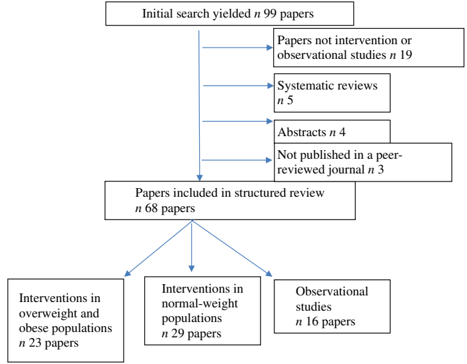
The role of mindfulness, mindful eating and a newer concept of intuitive eating in modulating eating habits is an area of increasing interest. In this structured literature review, a summary of the current evidence is presented, together with details of interventions undertaken and the tools to measure outcomes. It is broad in scope given the emerging evidence base in this area. The review yielded sixty-eight publications: twenty-three interventions in obese/overweight populations; twenty-nine interventions in normal-weight populations; sixteen observational studies, three of which were carried out in overweight/obese populations. Mindfulness-based approaches appear most effective in addressing binge eating, emotional eating and eating in response to external cues. There is a lack of compelling evidence for the effectiveness of mindfulness and mindful eating in weight management. Mindfulness-based approaches may prevent weight gain. Reduced food intake was seen in some of the studies in overweight and obese populations, but this was less apparent in the studies in normal-weight populations. The evidence base for intuitive eating is limited to date and further research is needed to examine its potential in altering eating behaviours. Mindfulness appears to work by an increased awareness of internal, rather than external, cues to eat. Mindfulness and mindful eating have the potential to address problematic eating behaviours and the challenges many face with controlling their food intake. Encouraging a mindful eating approach would seem to be a positive message to be included in general weight management advice to the public.
Overview
The claims and statistics of this paper haven’t been checked yet.
Free: it reads the open-access text and checks the first 5 claims that cite a source we can check. Create a free account to check every claim.
Integrity signals
Registry
Cites
Statistics
Figures
Verification
Claims the paper makes
The claims and statistics of this paper haven’t been checked yet.
Free: it reads the open-access text and checks the first 5 claims that cite a source we can check. Create a free account to check every claim.
Claims other papers make about this one
Each is checked against this paper’s own text: does it say what the citing paper says it does?
The cited source says what the claim attributes to it.
In the citing paper
“Therefore, mindful eating promotes healthier eating behaviors by enhancing individuals' awareness of hunger and satiety cues, fostering conscious food choices, and improving understanding of how internal states and external factors influence eating [3, 5].”
From Four Facet Mindful Eating and Eating Disorder Risk: Mediation By Depression and Body Mass Index. (2026) · cites this paper as [5]
Self-check
Percentages, sums and reported differences re-computed from the paper’s own numbers.
The self-check needs the paper’s full text.
Citations
Cites
The benefits of being present: Mindfulness and its role in psychological well-being
Brown, K. W., & Ryan, R. M. (2003) · Journal of Personality and Social Psychology · doi:10.1037/0022-3514.84.4.822 · Cited by 13,448 · cited 1×
“(2) The Mindfulness Awareness Attention Scale contained fifteen items((62)).”
Background(2008) · Medical Entomology and Zoology · Cited by 7,477
Mindfulness: A proposed operational definition.
Bishop, S. R., Lau, M., Shapiro, S., Carlson, L., Anderson, N. D., Carmody, J., Segal, Z. V., Abbey, S., Speca, M., Velting, D., et al. (2004) · Clinical Psychology: Science and Practice · doi:10.1093/clipsy.bph077 · Cited by 7,234 · cited 3×
“In mindfulness, an individual observes their immediate experience using an open and non-judgemental stance((3)).”
BackgroundThe Eating Attitudes Test: psychometric features and clinical correlates
Garner, D. M., Olmsted, M. P., Bohr, Y., & Garfinkel, P. E. (1982) · Psychological Medicine · doi:10.1017/s0033291700049163 · Cited by 4,962 · cited 2×
“Tools used to measure eating-related behaviours Eating behaviours were most frequently assessed using the Dutch Eating Behaviour Questionnaire(65), the Eating Attitudes Test(66) and the Eating Disorders Examination Questionnaire(67).”
MethodMindfulness practice leads to increases in regional brain gray matter density
Hölzel, B. K., Carmody, J., Vangel, M., Congleton, C., Yerramsetti, S. M., Gard, T., & Lazar, S. W. (2011) · Psychiatry Research: Neuroimaging · doi:10.1016/j.pscychresns.2010.08.006 · Cited by 1,914 · cited 1×
“emotional regulation and self-referential processing((92)).”
Chiesa, A., & Serretti, A. (2009) · The Journal of Alternative and Complementary Medicine · doi:10.1089/acm.2008.0495 · Cited by 1,681 · cited 1×
“Recent reviews have examined the evidence for mindfulness in the management of pain((5,6)), depression((7,8)) and psychological well-being((9,10)).”
BackgroundLoving-Kindness and Compassion Meditation: Potential for Psychological Interventions
Hofmann, S. G., Grossman, P., & Hinton, D. E. (2011) · Clinical Psychology Review · doi:10.1016/j.cpr.2011.07.003 · Cited by 960 · cited 1×
“Recent reviews have examined the evidence for mindfulness in the management of pain((5,6)), depression((7,8)) and psychological well-being((9,10)).”
BackgroundPiet, J., & Hougaard, E. (2011) · Clinical Psychology Review · doi:10.1016/j.cpr.2011.05.002 · Cited by 807 · cited 1×
“Recent reviews have examined the evidence for mindfulness in the management of pain((5,6)), depression((7,8)) and psychological well-being((9,10)).”
BackgroundTylka, T. L., & Kroon Van Diest, A. M. (2013) · Journal of Counseling Psychology · doi:10.1037/a0030893 · Cited by 763 · cited 2×
“Intuitive eating, when measured, was evaluated using the Intuitive Eating Scale(64) which contains twenty-one items.”
MethodAn Exploratory Study of a Meditation-based Intervention for Binge Eating Disorder
Kristeller, J. L., & Hallett, C. B. (1999) · Journal of Health Psychology · doi:10.1177/135910539900400305 · Cited by 681 · cited 9×
“Hunger awareness was measured in two overweight/obese populations and positive results were reported in both studies((11,28)).”
BackgroundInfluential
Cited by
Items 201–300 of 432
Mindful Eating and Perceived Stress in College Students
Garrett, E., Licata, A. L., & Hoffman, J. B. (2021) · Journal of the Academy of Nutrition and Dietetics · doi:10.1016/j.jand.2021.06.258 · Cited by 4
Kılıç, G., SAMAR, B. Ş., Akkuş, K., & Sütcü, S. T. (2022) · Psikoloji Çalışmaları / Studies in Psychology · doi:10.26650/sp2022-912407 · Cited by 6
Talib, N. Z., Ang, S. Q., Shamsudin, J., & Nor, Z. M. (2023) · Malaysian Journal of Nutrition · doi:10.31246/mjn-2022-0040 · Cited by 4
Beslenmede Güncel Bir Yaklaşım: Yeme Farkındalığı
ÖNEY, B., & ŞİŞMAN, Z. (2023) · Adnan Menderes Üniversitesi Sağlık Bilimleri Fakültesi Dergisi · doi:10.46237/amusbfd.1087583 · Cited by 6
İNÖZÜ, İ., & Köse, G. (2023) · Acibadem Universitesi Saglik Bilimleri Dergisi · doi:10.31067/acusaglik.1340369 · Cited by 5
“Encouraging the adoption of a mindful eating approach could be a positive inclusion in general weight management guidance for the public interventions (1,4).”
Wong, M. Y. C. (2023) · Youth · doi:10.3390/youth3040083 · Cited by 6
“Sufficient research has indicated the effect of mindful eating on reducing binge eating and emotional eating, better weight management, and enhancement in both trait and state mindfulness [23–26].”
BackgroundCool or hot: How dietary restraint produces both positive and negative eating behaviors
Moore, K., Walker, D., & Laczniak, R. N. (2024) · Food Quality and Preference · doi:10.1016/j.foodqual.2024.105147 · Cited by 8
Priol, M. D. L., & Schmitt, J. (2024) · Recherche et Applications en Marketing (French Edition) · doi:10.1177/07673701241231231 · Cited by 4
“Pour étudier cette question, nous prenons comme terrain empirique la pratique de l’alimentation en pleine conscience (Warren et al., 2017).”
Karaağaç, Y., Ceylan, C., & Koyu, E. B. (2025) · Eating Behaviors · doi:10.1016/j.eatbeh.2025.101989 · Cited by 5
Preissner, C. E., Vilier, L., Bertelsmann, N. C., Beckers, K., de Ruijter, D., de Vries, H., & Oenema, A. (2025) · BMC Public Health · doi:10.1186/s12889-025-22850-w · Cited by 4
“Manual searches were conducted on the reference lists of relevant systematic reviews [9, 10, 30, 31] for additional records.”
Sheng, R., Wen, X., & Xu, W. (2021) · Current Psychology · doi:10.1007/s12144-021-01668-w · Cited by 4
Giannakou, K., Kyprianidou, M., Basdani, E., Hadjimbei, E., & Chrysostomou, S. (2022) · Mediterranean Journal of Nutrition and Metabolism · doi:10.3233/mnm-220037 · Cited by 5
“Moreover, intuitive eating could be a useful strategy for reducing disordered eating behaviours, particularly binge eating [24, 25].”
Food-Related Impulsivity in the Triangle of Obesity, Eating Behaviors and Diet
EMİROĞLU, E., & Aktaç, Ş. (2023) · Black Sea Journal of Health Science · doi:10.19127/bshealthscience.1098930 · Cited by 6
A Digital Sommelier to Enhance Multisensory Wine Tasting
Parra, M. O., Favela, J., & Castro, L. A. (2024) · ACM International Conference on Interactive Media Experiences · doi:10.1145/3672406.3672408 · Cited by 4
“Mindful eating has been associated with healthier eating behaviors [15] and a pleasurable sensory experience [2].”
The Pediatric Obesity Encounter: Literature and Resources to Help with 4 Common Issues
Zachary, M., & Sisley, S. R. (2020) · Current Nutrition Reports · doi:10.1007/s13668-020-00308-2 · Cited by 4
Laguna‐Camacho, A., & Booth, D. (2021) · PsyArXiv (OSF Preprints) · doi:10.31234/osf.io/kcetd · Cited by 4
Vaccaro, S., Crescitelli, M. E. D., Mastrangelo, S., Fornaciari, N., Reverberi, E., Leo, S. D., & Ghirotto, L. (2025) · Frontiers in Nutrition · doi:10.3389/fnut.2024.1511113 · Cited by 4
Shabahang, R., Reyes, M. E. S., Huynh, H. P., Pacquing, M. C. T., Demetrovics, Z., & Zsila, Á. (2026) · Current Psychology · doi:10.1007/s12144-026-09213-3 · Cited by 3
“Empirical studies have documented the benefits of mindful awareness across a range of activities, including reading, learning, eating, exercising, and working (e.g., see Warren et al., 2017).”
From Restriction to Intuition: Evaluating Intuitive Eating in a Sample of the General Population
Angeletti, L. L., Spinelli, M. C., Cassioli, E., Rossi, E., Castellini, G., Brogioni, G., Ricca, V., & Rotella, F. (2024) · Nutrients · doi:10.3390/nu16081240 · Cited by 3
“Subjects who had never followed a diet showed higher levels of IE compared to those who had previously followed a”
ResultMyndFood: a conversational agent for enhancing the cooking and eating experience
Parra, M. O., Favela, J., & Castro, L. A. (2025) · Frontiers in Computer Science · doi:10.3389/fcomp.2025.1566940 · Cited by 3
Mindful Eating for Weight Loss: Try Before You Buy
Black, M. (2018) · The Journal of Clinical Endocrinology & Metabolism · doi:10.1210/jc.2018-02551 · Cited by 5
Examining stress and coping: Program improvements of pre-licensure nursing students
Hudson, K. W., Kim, G. R., Osipowicz, G. T., Mollenkopf, N. L., Akparewa, N. E., & Ball, M. J. (2019) · Journal of Nursing Education and Practice · doi:10.5430/jnep.v9n9p131 · Cited by 3
Roesler, A., & Nishi, N. (2020) · Nutrition and Health · doi:10.1177/0260106020917290 · Cited by 4
“Mindful eating to date has mainly been studied in shortterm singular causal pathway experiments (Kabat-Zinn 2003 and Warren et al., 2017).”
BackgroundSilva, A. F. D. S., Japúr, C. C., Silva, T. A., Motarelli, J. H. F., Buttros, T. S., & Penaforte, F. R. D. O. (2021) · Revista Família Ciclos de Vida e Saúde no Contexto Social · doi:10.18554/refacs.v9i4.5006 · Cited by 7
“Estudos excluídos por título e resumos (n=628) Estudos excluídos por serem duplicados e não empíricos (n= 129) a) Duplicados (n= 79) b) Revisões (n= 50) Estudos selecionados para leitura integral (n= 93) Ano de publicação 2020: 4 Não abordou saúde: 18 Utilizou somente mindfulness: 4 Relato de experiência: 1 Protótipo…”
BackgroundInfluentialFlores-Quijano, M. E., Mota-González, C., Rozada, G., León-Rico, J. C., López, M. E. G., & Vega‐Sánchez, R. (2023) · Nutrients · doi:10.3390/nu15224837 · Cited by 3
Is there any Difference between Males and Females in Mindful Eating?
Putri, W. A., Widodo, A., & Solihat, R. (2024) · Prisma Sains Jurnal Pengkajian Ilmu dan Pembelajaran Matematika dan IPA IKIP Mataram · doi:10.33394/j-ps.v12i1.8617 · Cited by 6
“Thus, male students are aware of the moment when one is eating, paying attention to the effects of food on the senses and detecting physical and emotional sensations in response to eating (Warren et al., 2017).”
BackgroundRohmawati, R., Wijayanti, L., Sari, R. Y., Faizah, I., & Anggraini, R. (2023) · Bali Medical Journal · doi:10.15562/bmj.v12i2.4317 · Cited by 4
Mindfulness training decreases the habituation response to persistent food stimulation
Torske, A., Schicker, D., Freiherr, J., & Koch, K. (2025) · Scientific Reports · doi:10.1038/s41598-025-90172-3 · Cited by 3
“20 , though also here further research is needed 21 .”
Kim, R., Olpin, E., Novilla, L. K. B., & Crandall, A. (2022) · International Journal of Environmental Research and Public Health · doi:10.3390/ijerph19106174 · Cited by 4
Childhood obesity and mindfulness
Marks, R. (2022) · Advances in Obesity Weight Management & Control · doi:10.15406/aowmc.2022.12.00365 · Cited by 2
Janssen, L. K., Duif, I., Speckens, A. E. M., van Loon, I., Wegman, J., de Vries, J. H., Cools, R., & Aarts, E. (2017) · bioRxiv (Cold Spring Harbor Laboratory) · doi:10.1101/165845 · Cited by 3
Nakamura, T., & Yoshiike, N. (2021) · Research Square · doi:10.21203/rs.3.rs-513005/v1 · Cited by 3
Mindfulness as a mediating mechanism between health importance and positive mental well-being
Borges, A. P., Rodrigues, P. C. L., Brochado, A. M., & Sousa, A. (2025) · International Journal of Pharmaceutical and Healthcare Marketing · doi:10.1108/ijphm-07-2024-0069 · Cited by 4
Preissner, C. E., de Ruijter, D., Oenema, A., & de Vries, H. (2025) · Health Psychology and Behavioral Medicine · doi:10.1080/21642850.2025.2519587 · Cited by 2
“Despite its suggested promise (e.g. Jordan et al., 2014; Warren et al., 2017), it remains unclear for whom and why mindful eating interventions may be effective.”
Beverages intake among women of childbearing age from 1990 to 2018: Global Dietary Database findings
Liu, Q., Li, Z., Huang, X., Song, Y., Lin, X., Yu, J., Si, J., Yang, Y., Zhai, S., Ji, Z., et al. (2025) · Nutrition · doi:10.1016/j.nut.2025.112923 · Cited by 2
Mindful Eating: Self-Regulation Strategies for Dysregulated Eating
Siemers, N., Frayn, M., Preissner, C. E., Carrière, K., Sante, J. D., Beebe, A., Juneau, C., & Knaüper, B. (2025) · Springer eBooks · doi:10.1007/978-3-031-91451-5_18 · Cited by 3
Time-restricted eating and circadian rhythms: A new frontier in diabetes and obesity management
Maqsood, S., Amjad, S., Ahmed, F., & Ahmad, M. F. (2025) · Primary care diabetes · doi:10.1016/j.pcd.2025.11.004 · Cited by 6
Cáceres, N. A., Steger, F. L., Salvy, S., Jamshed, H., Warriner, A. H., Martin, C. K., & Peterson, C. M. (2025) · Journal of Human Nutrition and Dietetics · doi:10.1111/jhn.70180 · Cited by 2
Uyar, G. Ö., Aslan, S., Arslan, M., Çamli, A., Bozkurt, O., & Bozkurt, B. K. (2025) · Nutrition · doi:10.1016/j.nut.2025.113078 · Cited by 2
The impact of intuitive eating v. pinned eating on behavioural markers: a preliminary investigation
Ogden, J., Pavlova, E., Fouracre, H., & Lammyman, F. (2020) · Journal of Nutritional Science · doi:10.1017/jns.2020.25 · Cited by 4
Joye, Y., Bruyneel, S. D., & Fennis, B. M. (2021) · Frontiers in Psychology · doi:10.3389/fpsyg.2021.671299 · Cited by 2
A nutrição comportamental e a relação com os aspectos sociais, fisiológicos e emocionais
da Cunha, P. P., Ferreira, J. C. D. S., & Freitas, F. M. N. D. O. (2022) · Research Society and Development · doi:10.33448/rsd-v11i15.37123 · Cited by 8
The Effect of Physical Activity Level on Intuitive Eating and Mindful Eating
DİNÇER, M. G., Toktaş, N., BAYHAN, B., & Balcı, C. (2023) · Spor Bilimleri Araştırmaları Dergisi · doi:10.25307/jssr.1267065 · Cited by 3
Sleep Patterns of Premedical Undergraduate Students: Pilot Study and Protocol Evaluation
Rajput, G., Gao, A., Wu, T.-C., Tsai, C.-T., Molano, J. R. V., & Wu, D. T. Y. (2023) · JMIR Formative Research · doi:10.2196/45910 · Cited by 3
Kreis, A., Gomes, A., Tsiouris, A., Beutel, M. E., Ruckes, C., Dahn, I., Schiller, A., Loy, G., Zajac, H., Kosmuetzky, G., et al. (2024) · Internet Interventions · doi:10.1016/j.invent.2024.100721 · Cited by 2
Boulanger, B., Bégin, C., Bédard, A., Lévy-Ndejuru, J., Carbonneau, É., & Lemieux, S. (2024) · Applied Physiology, Nutrition, and Metabolism · doi:10.1139/apnm-2023-0443 · Cited by 3
Conceptos básicos de la obesidad y el sobrepeso
Campos, F. J. C., & Jacobo, D. P. D. (2024) · Psic-Obesidad · doi:10.22201/fesz.20075502e.2023.13.50.88412 · Cited by 2
Akıl, M. (2024) · Research in Dance Education · doi:10.1080/14647893.2024.2346483 · Cited by 4
Mert-Biberoğlu, F., Güven, S., & Yenipınar, Z. G. (2024) · International Journal of Agriculture Environment and Food Sciences · doi:10.31015/jaefs.2024.2.7 · Cited by 2
Kendirkıran, G., & Bilgin, H. (2024) · Current Psychology · doi:10.1007/s12144-024-06482-8 · Cited by 2
“Mind - fulness can provide relief when faced with negative events and emotions and thus be effective in reducing impulsiv - ity associated with unconscious overeating (Warren et al., 2017 ).”
InfluentialConsumer reconnection through the practice of mindful eating
Priol, M. D. L., & Schmitt, J. (2024) · Recherche et Applications en Marketing (English Edition) · doi:10.1177/20515707241270102 · Cited by 4
“Mindfulness, specifically in the context of food consumption, is exemplified by the practice of mindful eating (Warren et al., 2017).”
Mindfulness Techniques Taught Through Game Mechanics
Hwang, D., & Melcer, E. F. (2024) · Annual Symposium on Computer-Human Interaction in Play · doi:10.1145/3665463.3678839 · Cited by 3
“These mini-games consist of a breathing exercise [26-28], an exercise to ground the player in the present moment [29-31], and a mindful eating exercise [32-34].”
Yetişkinlerde Yeme Farkındalığı, Beslenme Bilgi Düzeyi ve Antropometrik Ölçümlerin Değerlendirilmesi
Karaca, V., & Rakıcıoğlu, N. (2024) · Hacettepe Üniversitesi Sağlık Bilimleri Fakültesi Dergisi · doi:10.21020/husbfd.1443850 · Cited by 6
Glocker, C., Simon, M. S., Adler, N., Eder, J., Barton, B. B., Musil, R., & Oberberg Fachklinik Bad Tölz, B. T. (2024) · ALPHA PSYCHIATRY · doi:10.5152/alphapsychiatry.2024.241718 · Cited by 2
Mindful eating intervention for preventing obesity in youth: A narrative review of literature
Gutiérrez‐Domingo, T., & Vivas, S. (2025) · Nutrition Research · doi:10.1016/j.nutres.2025.07.001 · Cited by 6
Lim, E. C. N., Yu, X. F., & Lim, C. E. D. (2025) · Journal of Traditional Chinese Medical Sciences · doi:10.1016/j.jtcms.2025.08.003 · Cited by 5
King, K. M., Gonzalez, G. B., & Mitchell, A. M. (2021) · ACSMʼs Health & Fitness Journal · doi:10.1249/fit.0000000000000649 · Cited by 2
““Mindful eating is simply using mindfulness techniques during the act of eating and refers to developing an awareness of physical versus psychological hunger and satiety cues, focusing on how food affects all of the senses, and awareness of the physical and emotional sensations in response to eating (25,26).”
BackgroundInfluentialOlvera-Ruvalcaba, A. J., & Gómez‐Peresmitré, G. (2021) · Cuadernos Hispanoamericanos de Psicología · doi:10.18270/chps..v21i1.3711 · Cited by 5
Ideal de cuerpo femenino y cultura de la dieta: retos y recomendaciones para la mujer de hoy
Barrera, Y. (2021) · Apuntes de bioética · doi:10.35383/apuntes.v4i2.682 · Cited by 9
appropriation of mindfulness in the Evangelical Lutheran Church of Finland
Moberg, M., & Ramstedt, T. (2023) · Approaching Religion · doi:10.30664/ar.131078 · Cited by 6
Macht, M. L. (2022) · Research Square · doi:10.21203/rs.3.rs-1834873/v1 · Cited by 3
Influence Mechanism of Mindfulness-Based Eating Training on Unhealthy Eating Behavior
林, 浩. (2021) · Advances in Psychology · doi:10.12677/ap.2021.111022 · Cited by 1
O mindful eating modifica o comportamento alimentar em indivíduos com excesso de peso?
Bezerra, M. B. G. D. S., de Orange, L. G., Calaça, P. R. D. A., de Menezes, G. M. M., & de Lima, C. R. (2021) · Research Society and Development · doi:10.33448/rsd-v10i3.13465 · Cited by 4
Yemekte Küçük Bir Gurme Olun: Çocuklarda ve Adölesanlarda Yeme Farkındalığı
Özyalçın, B., & Yılmaz, S. (2022) · Gümüşhane Üniversitesi Sağlık Bilimleri Dergisi · doi:10.37989/gumussagbil.1001138 · Cited by 1
Erdoğan, P., & Ünüsan, N. (2023) · Journal of Nutrition and Dietetics · doi:10.33076/2022.bdd.1556 · Cited by 1
“Bu sonuçlar, aşırı yeme semptomlarının sıklığını ve yoğunluğunu azaltmada farkındalığın etkinliğine dair güçlü kanıtlar sunmaktadır (40).”
At the Same Table: A Delphi Consensus-Based Model of Health-Promoting Eating Behaviors
Rodgers, R. F., Goutama, V., & Sonneville, K. R. (2023) · Nutrients · doi:10.3390/nu15163601 · Cited by 4
“Importantly, they have also been shown to be associated with psychological health benefits including improved psychosocial functioning and lower levels of disordered eating [12,14,18].”
BackgroundThe Relationship Between BMI of Adolescents and Their Parents' Mindful Eating
Metin, Z. E., & Taş, D. (2023) · Hacettepe Üniversitesi Sağlık Bilimleri Fakültesi Dergisi · doi:10.21020/husbfd.1249408 · Cited by 1
Palazzo, C. C., Leghi, B. E., & Garcia, R. W. D. (2024) · Frontiers in Psychology · doi:10.3389/fpsyg.2023.1229105 · Cited by 1
Andriani, R., Kamila, A., Putri, R. A., Fadhillah, A., Helmi, S., & Septiani, D. (2024) · Healthcare in Low-resource Settings · doi:10.4081/hls.2024.11896 · Cited by 8
Can mindful eating be a psycho-marker of obesity in bipolar disorder?
Urhan, M., Cengisiz, C., Türk, M., & Akanalçı, C. (2024) · Nutrición Hospitalaria · doi:10.20960/nh.05084 · Cited by 4
Mindful Eating in Healthcare: A Concept Analysis
Han, K. S., Jung, M. R., & Hwang, D. W. (2024) · Journal of Korean Academy of Psychiatric and Mental Health Nursing · doi:10.12934/jkpmhn.2024.33.3.284 · Cited by 2
“Given the longstanding ambiguity surrounding the definition of mindful eating, these two concepts have been applied interchangeably in various studies and assessment tools, causing much confusion [8,24].”
BackgroundInfluentialNegi, J., & Bhardwaj, A. K. (2024) · Yoga Mimamsa · doi:10.4103/ym.ym_37_24 · Cited by 1
Chen, Y., Tan, F. F.-Y., Wang, Z., Liu, X., Zhang, J., Huang, Y., Zhao, S., & Yen, C. C. (2025) · CHI Conference on Human Factors in Computing Systems · doi:10.1145/3706598.3713793 · Cited by 7
“…mindful eating’s benefits extend to promoting healthy eating behaviors in the general population, including facilitating slower meal consumption [160], enhancing awareness of and responsiveness to satiety cues [99], improving eating control [7, 123], increasing food enjoyment [11], and…”
InfluentialMindful and Intuitive Eating: A Bibliometric Analysis of Research Trends From 2004 to 2024
Zhang, M., Bogosian, A., Stanmore, E., Edginton, T. L., & O’Connor, S. (2026) · Obesity Reviews · doi:10.1111/obr.70165 · Cited by 1
Ahuja, S. S., & Rai, K. (2025) · Journal of Consumer Behaviour · doi:10.1002/cb.2507 · Cited by 4
Prats, N., & López-Ramón, M. F. (2025) · Current Psychology · doi:10.1007/s12144-025-07901-0 · Cited by 1
“The two practices detailed in the previous two para-graphs (i.e. Warren et al., 2017 ; C.-H. Yang et al., 2021 ) are only a small example of the multitude that exists, and they are adaptable to be used in a MIFU intervention to treat the symptomatology of a population with ataxia.”
Gawron, L., Rodríguez-Clifford, K., Guillén, A. R., Carceller‐Sindreu, M., Carmona, C., Bonnín, C. D. M., & Portella, M. J. (2025) · International Journal of Eating Disorders · doi:10.1002/eat.24474 · Cited by 1
Jin, X., Zhu, J., Pan, D., Sun, L., Wang, R., Wang, N., Wang, J. P., Yuan, C., Wang, S., & Sun, G. (2025) · Brain and Behavior · doi:10.1002/brb3.70568 · Cited by 1
“Additionally, the scale entries have also been deleted to varying degrees (Carbonneau et al. 2016; Dockendorff et al. 2012; Khalsa et al. 2019; Warren et al. 2017; van Dyck et al. 2016).”
Four Facet Mindful Eating Scale (FFaMES)
Carrière, K., & Knaüper, B. (2025) · Springer eBooks · doi:10.1007/978-3-031-47219-0_95 · Cited by 1
MindEat!: Navigating Screen-Centric Dining through Mindful Technology Design
Khot, R. A., & Yi, J.-Y. (2025) · Designing Interactive Systems Conference · doi:10.1145/3715336.3735422 · Cited by 3
“Although mindful eating is not directly concerned with restricting calorie intake, numerous studies do indicate its benefit towards regulating calories intake and nurturing healthy eating behaviors [26,50,51,55].”
Piloting a Virtual Mindful Eating Program to Improve Eating Behaviors and Reduce Food Waste
Royer, M. F., Kechter, A., James, D. L., Moeller, M., Vizcaíno, M., & Wharton, C. M. (2025) · Challenges · doi:10.3390/challe16030038 · Cited by 3
“The mindful eating intervention that was piloted in this study shares similarities with past mindful eating interventions in measuring a range of eating-and food-related attitudes and behaviors [30].”
Çetiner, M. K., Aksu, H., Sevinçok, D., Özgür, B. G., & Ünüvar, T. (2025) · Childhood Obesity · doi:10.1177/21532176251370448 · Cited by 4
“28 While studies examining the relationship between mindfulness and obesity were mostly those investigating the effectiveness of mindfulness-based practices in obese adults, 29,30 studies on children and adolescents are limited.”
Rodrigues, D. A. C., Marcadenti, A., Bersch-Ferreira, Â. C., Gherardi‐Donato, E. C. D. S., Quinhoneiro, D. C. G., de Souza, S. R., Busnello, F. M., Bressan, J., Reis, I. A., Consoli, M. L. D., et al. (2025) · Endocrine · doi:10.1007/s12020-025-04425-2 · Cited by 1
“…turn, is associated with decreased emo - tional eating and external cues to eat and increased aware - ness of internal physical cues of hunger and satiety [ 34 ], Previous studies have demonstrated the effect of mindful eating on portion size and, consequently, on reduced energy intake [ 13, 14 ].”
Modern approaches to obesity management: Is dietary intervention sufficient?
Gligorijević, J., Stevanović, S., Stanković, V. V., Zuber, A., & Avramović, D. (2025) · PONS - medicinski casopis · doi:10.5937/pomc22-53816 · Cited by 1
Eating styles and psychological well-being: A latent profile analysis of college women
VanderJagt, H., Serier, K. N., Witkiewitz, K. A., Pacheco, C. R., & Smith, J. E. (2026) · Journal of Health Psychology · doi:10.1177/13591053251394348 · Cited by 1
“In turn, mindful eating is practiced by noticing the differences between physical versus psychological hunger, attending to the effect food has on one’s senses, and making intentional decisions about what to eat at any given time (Warren et al., 2017).”
de Souza, C. B., Mangia, M. S. P., Almeida, C. C. B., Pereira, R. C., Silva, D. F. A., & Teixeira, L. G. (2026) · Nutrition Reviews · doi:10.1093/nutrit/nuaf302 · Cited by 1
Gökcen, B. B., Kurtuluş, İ., Kabak, N., Budán, F., Ağagündüz, D., & Szép, D. (2026) · Frontiers in Nutrition · doi:10.3389/fnut.2026.1740363 · Cited by 1
Resistant and Refractory Obesity: The Complexity of Anti-Obesity Therapy Failure
Nicze, M., Borówka, M., Dec, A., Bułdak, Ł., Bołdys, A., & Okopień, B. (2026) · International Journal of Molecular Sciences · doi:10.3390/ijms27062539 · Cited by 7
Lalonde, H., Sawalmeh, E., Buhlman, R., Tadavich, S., Xie, Y., & Ling, J. (2026) · Nutrients · doi:10.3390/nu18071103 · Cited by 1
Chen, H., Hu, P., Yang, X., & Li, Y. (2026) · Nutrients · doi:10.3390/nu18091460 · Cited by 1
“Similarly, mindful eating, a practice that focuses on recognizing hunger and satiety cues, helps prevent unconscious overeating, particularly in overweight populations [15,16].”
Uğur, C. A. B. A., Çakir, A. S., Turan, M. B., Pepe, O., Pekel, A., Bahçe, A., Bayıroğlu, G. B., & Dalbudak, İ. (2026) · Frontiers in Nutrition · doi:10.3389/fnut.2026.1812781 · Cited by 2
“Mindful eating has also been conceptualized as being present while eating, paying attention to the sensory aspects of food, and distinguishing between physical and emotional sensations that trigger eating (37).”
Sánchez-Vidaña, D. I., Ahorsu, D. K., McCormack, L., Zeng, R. R., Miller, T., Viñas‐Guasch, N., Chan, N.-M. J., Lo, K. K.-H., González, P. C., Lau, B. W.-M., et al. (2026) · Journal of Behavioral Medicine · doi:10.1007/s10865-026-00673-3 · Cited by 2
“However, it is possible that an intervention of longer duration would lead to significantly reduced levels of emotional eating over time (Daniela Mercado et al., 2021 ; Warren et al., 2017).”
Bilinçli Yeme Ölçeğinin Türkçeye Uyarlanması: Geçerlik ve Güvenirlik Çalışması
Şentürk, K., & Onbaşı, Ö. (2026) · İzmir Katip Çelebi Üniversitesi Sağlık Bilimleri Fakültesi Dergisi · doi:10.61399/ikcusbfd.1754574 · Cited by 1
Wang, D., Huang, K., Zhou, X., Ye, X., Chen, J., Xu, H., Dong, G. P., Yuan, T. M., Chen, X., Zhou, H. J., et al. (2026) · Obesity · doi:10.1002/oby.70225 · Cited by 1
“…is consistent with evidence that mindfulness-based and mindful eating interventions reduce maladaptive eating behaviors, including reward-driven, emotional, and binge eating, by increasing awareness of hunger and satiety cues and disrupting automatic responses to food stimuli [36, 37].”
Ahmadyar, K., Zhang, Q., Ferriday, D., Hinton, E. C., Robinson, E., Jones, A., Bogosian, A., Chen, G., & Tapper, K. (2026) · Clinical Psychology Review · doi:10.1016/j.cpr.2026.102780 · Cited by 3
Gratitude for food as a driver of improved dietary behaviors: A scoping review
Kawasaki, Y., Nagao-Sato, S., Yoshii, E., & Akamatsu, R. (2026) · Appetite · doi:10.1016/j.appet.2026.108703 · Cited by 1
Mindful Eating, Disordered Eating, and Exercise Addiction: A Bayesian Gaussian Network Analysis
Alpay, M., Alpay, C. B., & Szabó, A. (2026) · Nutrients · doi:10.3390/nu18152524 · Cited by 2
Mindfulness y compasión en el Sistema Nacional de Salud
Muñoz‐Sanjosé, A., Liria, A. F., Vega, B. R., Palao, Á., Bayón, C., Amador, B., & Pérez, A. (2019) · Revista de Investigación y Educación en Ciencias de la Salud (RIECS) · doi:10.37536/riecs.2019.4.s1.128 · Cited by 5
Dantas, A. E. C., Silva, A. D. M. D., Lins, J. A., Filho, G. H. C. N., Nunes, G. R. B., & Bezerra, K. F. D. O. (2021) · Brazilian Journal of Health Review · doi:10.34119/bjhrv4n2-413 · Cited by 2
Wilcox, C. E. (2021) · Springer eBooks · doi:10.1007/978-3-030-83078-6_2 · Cited by 1
Metadata
- Authors
- Warren, J. M., Smith, N., & Ashwell, M.
- Affiliations
- University of Oxford (GB)
- Corresponding author
- Warren, Janet M.
- Venue
- Nutrition Research Reviews
- Publisher
- Cambridge University Press (CUP)
- Published
- 2017-07-18
- Volume
- 30
- Issue
- 2
- Pages
- 272-283
- ISSN
- 0954-4224 (ISSN-L)
- 1475-2700
- OpenAlex
- W2739082572
- Semantic Scholar
- 084ccf96fb5a49401eb8d985c7702fea5427696b
- Cited by
- 435
- References
- 97
- Citations by year
- 2026: 70 · 2025: 60 · 2024: 68 · 2023: 55 · 2022: 60 · 2021: 63 · 2020: 32 · 2019: 17 · 2018: 9 · 2017: 1
- FWCI
- 2.48
- Type
- journal article
- Language
- en
- Open access
- hybrid
- doi.org
- Locations
- Nutrition Research Reviews (publishedVersion, cc-by)
- PubMed (publishedVersion)
- Topics
- Social Sciences › Psychology › Clinical Psychology › Eating Disorders and Behaviors
- Health Sciences › Nursing › Nutrition and Dietetics › Nutrition, Health and Food Behavior
- Social Sciences › Psychology › Clinical Psychology › Mindfulness and Compassion Interventions
- Keywords
- mindfulness, mindful eating, intuitive eating, eating behaviour, weight management, obesity, binge eating, emotional eating, dietary intake, weight gain prevention, mindfulness-based interventions, mechanisms of change
- MeSH terms
- Awareness, Behavior Therapy, Cues, Eating, Emotions, Feeding Behavior, Food Preferences, Humans, Hunger, Obesity, Treatment Outcome, Overweight, Binge-Eating Disorder, Mindfulness
About these checks
Registry, retraction, Cites and statistics results are computed, not judged, with one exception: a printed reference that no index lists is read once by a model before it counts as a citation error. Claims are extracted by a model and kept only when their quote appears verbatim in the text; each cited source is then checked, with a model’s help, for whether it says what the claim relies on. Those verdicts can be wrong — read the claim’s quote and the cited source before relying on one.
Statistics and arithmetic are recomputed, not judged.
Confidence bands are shown only for fields calibrated on our annotated test set. None is calibrated yet, so no band is shown.
What counts as a claim ›How we measure confidence ›How we check this ›
Are you an author, or do you see a problem with this page? Request a review
Data sources
Bibliographic data: Semantic Scholar, OpenAlex, Crossref.
Contains information from the Semantic Scholar Academic Graph Datasets, made available under the ODC Attribution License (ODC-BY 1.0).
Semantic Scholar’s data is described in: Kinney, R., et al. (2023). The Semantic Scholar Open Data Platform. arXiv:2301.10140.
