

A structured literature review on the role of mindfulness, mindful eating and intuitive eating in changing eating behaviours: effectiveness and associated potential mechanisms
Open accessThe DOI matches its Crossref record; 96 of the 97 references it cites were found in a registry or an index.
Abstract
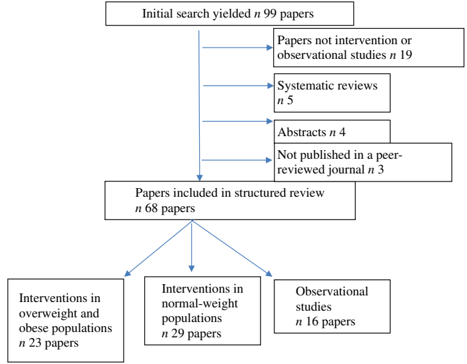
The role of mindfulness, mindful eating and a newer concept of intuitive eating in modulating eating habits is an area of increasing interest. In this structured literature review, a summary of the current evidence is presented, together with details of interventions undertaken and the tools to measure outcomes. It is broad in scope given the emerging evidence base in this area. The review yielded sixty-eight publications: twenty-three interventions in obese/overweight populations; twenty-nine interventions in normal-weight populations; sixteen observational studies, three of which were carried out in overweight/obese populations. Mindfulness-based approaches appear most effective in addressing binge eating, emotional eating and eating in response to external cues. There is a lack of compelling evidence for the effectiveness of mindfulness and mindful eating in weight management. Mindfulness-based approaches may prevent weight gain. Reduced food intake was seen in some of the studies in overweight and obese populations, but this was less apparent in the studies in normal-weight populations. The evidence base for intuitive eating is limited to date and further research is needed to examine its potential in altering eating behaviours. Mindfulness appears to work by an increased awareness of internal, rather than external, cues to eat. Mindfulness and mindful eating have the potential to address problematic eating behaviours and the challenges many face with controlling their food intake. Encouraging a mindful eating approach would seem to be a positive message to be included in general weight management advice to the public.
Overview
The claims and statistics of this paper haven’t been checked yet.
Free: it reads the open-access text and checks the first 5 claims that cite a source we can check. Create a free account to check every claim.
Integrity signals
Registry
Cites
Statistics
Figures
Verification
Claims the paper makes
The claims and statistics of this paper haven’t been checked yet.
Free: it reads the open-access text and checks the first 5 claims that cite a source we can check. Create a free account to check every claim.
Claims other papers make about this one
Each is checked against this paper’s own text: does it say what the citing paper says it does?
The cited source says what the claim attributes to it.
In the citing paper
“Therefore, mindful eating promotes healthier eating behaviors by enhancing individuals' awareness of hunger and satiety cues, fostering conscious food choices, and improving understanding of how internal states and external factors influence eating [3, 5].”
From Four Facet Mindful Eating and Eating Disorder Risk: Mediation By Depression and Body Mass Index. (2026) · cites this paper as [5]
Self-check
Percentages, sums and reported differences re-computed from the paper’s own numbers.
The self-check needs the paper’s full text.
Citations
Cites
The benefits of being present: Mindfulness and its role in psychological well-being
Brown, K. W., & Ryan, R. M. (2003) · Journal of Personality and Social Psychology · doi:10.1037/0022-3514.84.4.822 · Cited by 13,448 · cited 1×
“(2) The Mindfulness Awareness Attention Scale contained fifteen items((62)).”
Background(2008) · Medical Entomology and Zoology · Cited by 7,477
Mindfulness: A proposed operational definition.
Bishop, S. R., Lau, M., Shapiro, S., Carlson, L., Anderson, N. D., Carmody, J., Segal, Z. V., Abbey, S., Speca, M., Velting, D., et al. (2004) · Clinical Psychology: Science and Practice · doi:10.1093/clipsy.bph077 · Cited by 7,234 · cited 3×
“In mindfulness, an individual observes their immediate experience using an open and non-judgemental stance((3)).”
BackgroundThe Eating Attitudes Test: psychometric features and clinical correlates
Garner, D. M., Olmsted, M. P., Bohr, Y., & Garfinkel, P. E. (1982) · Psychological Medicine · doi:10.1017/s0033291700049163 · Cited by 4,962 · cited 2×
“Tools used to measure eating-related behaviours Eating behaviours were most frequently assessed using the Dutch Eating Behaviour Questionnaire(65), the Eating Attitudes Test(66) and the Eating Disorders Examination Questionnaire(67).”
MethodMindfulness practice leads to increases in regional brain gray matter density
Hölzel, B. K., Carmody, J., Vangel, M., Congleton, C., Yerramsetti, S. M., Gard, T., & Lazar, S. W. (2011) · Psychiatry Research: Neuroimaging · doi:10.1016/j.pscychresns.2010.08.006 · Cited by 1,914 · cited 1×
“emotional regulation and self-referential processing((92)).”
Chiesa, A., & Serretti, A. (2009) · The Journal of Alternative and Complementary Medicine · doi:10.1089/acm.2008.0495 · Cited by 1,681 · cited 1×
“Recent reviews have examined the evidence for mindfulness in the management of pain((5,6)), depression((7,8)) and psychological well-being((9,10)).”
BackgroundLoving-Kindness and Compassion Meditation: Potential for Psychological Interventions
Hofmann, S. G., Grossman, P., & Hinton, D. E. (2011) · Clinical Psychology Review · doi:10.1016/j.cpr.2011.07.003 · Cited by 960 · cited 1×
“Recent reviews have examined the evidence for mindfulness in the management of pain((5,6)), depression((7,8)) and psychological well-being((9,10)).”
BackgroundPiet, J., & Hougaard, E. (2011) · Clinical Psychology Review · doi:10.1016/j.cpr.2011.05.002 · Cited by 807 · cited 1×
“Recent reviews have examined the evidence for mindfulness in the management of pain((5,6)), depression((7,8)) and psychological well-being((9,10)).”
BackgroundTylka, T. L., & Kroon Van Diest, A. M. (2013) · Journal of Counseling Psychology · doi:10.1037/a0030893 · Cited by 763 · cited 2×
“Intuitive eating, when measured, was evaluated using the Intuitive Eating Scale(64) which contains twenty-one items.”
MethodAn Exploratory Study of a Meditation-based Intervention for Binge Eating Disorder
Kristeller, J. L., & Hallett, C. B. (1999) · Journal of Health Psychology · doi:10.1177/135910539900400305 · Cited by 681 · cited 9×
“Hunger awareness was measured in two overweight/obese populations and positive results were reported in both studies((11,28)).”
BackgroundInfluential
Cited by
Items 301–400 of 432
Nutritional Wellness for the Busy Health Care Provider
Bielsky, A. R., & Foley, C. B. (2022) · Anesthesiology Clinics · doi:10.1016/j.anclin.2022.01.008 · Cited by 1
Métodos de tratamento de transtornos alimentares segundo a nutrição comportamental
Silva, R. I., Guedes, K. D. L., & Freire, L. G. (2023) · Research Society and Development · doi:10.33448/rsd-v12i11.43553 · Cited by 1
An exploratory study on emotional consequents of visceral food pleasure
Donato, C., & Monsurrò, L. (2023) · Qualitative Market Research An International Journal · doi:10.1108/qmr-11-2022-0160 · Cited by 1
Carandang, R. R., Epel, E. S., Radin, R. M., Lewis, J. B., Ickovics, J. R., & Cunningham, S. D. (2024) · Nutrition and Health · doi:10.1177/02601060241246353 · Cited by 1
“Emerging evidence suggests that mindful eating may in fl uence metabolic health in non-pregnant individuals (Daubenmier et al., 2016; Warren et al., 2017), but its effects in the context of pregnancy are less well understood.”
Comer con el corazón: los lazos entre emociones y alimentación
Vizmanos-Lamotte, B., & Betancourt‐Núñez, A. (2024) · Revista Digital Universitaria · doi:10.22201/ceide.16076079e.2024.25.4.4 · Cited by 4
Chiba, A., & Yoshiike, N. (2024) · Eating Behaviors · doi:10.1016/j.eatbeh.2024.101923 · Cited by 1
Reflecting on Solo Dining Behavior with Annotated Data Physicalization
Wang, X., van Iterson, H. C., Bae, S. S., & Liang, R.-H. (2025) · International Conference on Tangible, Embedded, and Embodied Interaction (TEI) · doi:10.1145/3689050.3705985 · Cited by 5
“” Extensive research has consistently shown that practicing mindfulness of physiological signals related to hunger and satiety, eating slowly, minimizing distractions during meals, and focusing attention on the food are effective strategies to develop healthy eating behaviors [18, 44, 48].”
Liénard, Y. (2018) · Cahiers de Nutrition et de Diététique · doi:10.1016/j.cnd.2018.04.002 · Cited by 5
SAYGI, Y. B., & Saygi, I. (2021) · GIDA / THE JOURNAL OF FOOD · doi:10.15237/gida.gd21109 · Cited by 2
Veterans’ experiences with mindfulness-based eating: A mixed methods study on MB-SAVOR
Herrmann, T. S., Preib, E., French, M., Beckstrom, J. L., Nazarenko, E., Lackner, R. J., Marchand, W. R., & Yabko, B. A. (2022) · Complementary Therapies in Clinical Practice · doi:10.1016/j.ctcp.2022.101548 · Cited by 2
Effects of Mindful Eating on the Mental Health of Students at State Universities in Malang
Hilmia, M., Firdausiyah, U. W., & Wafi, H. A. (2022) · Jurnal Educative Journal of Educational Studies · doi:10.30983/educative.v7i1.5485 · Cited by 1
INNOVACIÓN Y EMPRENDIMIENTO EN PRODUCTOS, TÉCNICAS Y SEGURIDAD EN EL SECTOR AGROALIMENTARIO
García, C. J. (2023) · Universitat de València eBooks · doi:10.7203/puv-oa-602-0
Mindful eating mobile application to reduce binge eating in emergency department staff
Jensen, E. J. (2021) · UA Campus Repository (The University of Arizona) · Cited by 1
Turkish Adaptation of the Mind-Eat Scale in Adults: A Validity and Reliability StudyPreprint
ALTUN, H. K., Akkoyun, E., Bostancıoğlu, Z. S., Çancı, E., Doğru, H. B., Güngör, B., & Pay, B. (2026) · Research Square · doi:10.21203/rs.3.rs-9835806/v1 · Cited by 1
Four Facet Mindful Eating and Eating Disorder Risk: Mediation By Depression and Body Mass Index.
Aydin, O., & Cetin, A. K. (2026) · Journal of Human Nutrition and Dietetics · doi:10.1111/jhn.70199
Mindful eating: awareness-based choices for better health
Chauhan, A., & Goyal, M. R. (2026) · Dietary, Sensory and Gastronomic Applications · doi:10.1016/b978-0-443-33345-3.00007-9
Narrativas, Mindfulness y diálogo colaborativo
Muñoz‐Sanjosé, A., Vega, B. R., Liria, A. F., Bayón, C., & Palao, Á. (2019) · Revista de Investigación y Educación en Ciencias de la Salud (RIECS) · doi:10.37536/riecs.2019.4.s1.129 · Cited by 4
Koidis, F. (2020) · University of Surrey Open Research repository · doi:10.15126/thesis.00852053
Binge Eating Disorder in Adolescents and Emerging Adults
Nesbitt, J. B., & Wassenaar, E. (2020) · Springer eBooks · doi:10.1007/978-3-030-45103-5_17 · Cited by 2
RELATIONSHIP BETWEEN MINDFULNESS, INTUITIVE AND EMOTIONAL EATING IN ADULTS
Brisotto, M., & Andretta, I. (2021) · Psicologia Saúde & Doenças · doi:10.15309/21psd220125 · Cited by 2
Place de la pleine conscience dans la prise en charge
Liénard, Y. (2021) · Les Obésités · doi:10.1016/b978-2-294-76753-1.00079-5
Eltan, S., Merdan-Yıldız, E. D., Kumpasoğlu, G. B., & Erden, G. (2021) · Nesne Psikoloji Dergisi · doi:10.7816/nesne-09-20-13 · Cited by 3
Binge-Related Eating Disorders (Binge Eating Disorder and Bulimia Nervosa)
Wilcox, C. E., & Bedford, S. (2021) · Springer eBooks · doi:10.1007/978-3-030-83078-6_3 · Cited by 1
Araújo, M. P. D., Costa, R. A. F., & de Melo, L. G. N. S. (2021) · Research Society and Development · doi:10.33448/rsd-v10i16.23003 · Cited by 6
Valiquette, M.-J., & Cournoyer, M.-J. (2021) · Nutrition, science en évolution · doi:10.7202/1084273ar · Cited by 1
GENDER BAISED ASSOCIATION OF MINDFULNESS AMONG UNIVERSITY STUDENTS OF LAHORE, CITY: Mindful Eating
Aslam, M., Iftikhar, A., Shoaib, F., Shafaqat, N., Zahid, I., Shabir, H., & Ain, N. U. (2022) · Pakistan BioMedical Journal · doi:10.54393/pbmj.v5i2.140 · Cited by 3
Eda, M., Kawasaki, Y., Akamatsu, R., & Fujiwara, Y. (2021) · The Japanese Journal of Nutrition and Dietetics · doi:10.5264/eiyogakuzashi.79.331
Demir, H., & Bozyel, E. (2022) · Research Review · doi:10.52845/jmrhs/2022-5-1-1 · Cited by 4
Overlooked: The Relationship Between Disordered Eating Behaviors and Metabolic Disorders in Adults
Heydel, Z., & Phimphasone‐Brady, P. (2021) · doi:10.25261/rowdyscholar_sum_2021_zh
Mindful eating: A values-based approach in eating behavior
Zervos, K. (2022) · Public Health Toxicology · doi:10.18332/pht/149667
Rech, F. R. D. F., Lydiane, & Poínhos, R. (2022) · Acta Portuguesa de Nutrição · doi:10.21011/apn.2022.2806 · Cited by 1
DISPOSITIONAL MINDFULNESS AND FOOD CRAVINGS AMONG EXERCISERS AND NON-EXERCISERS: A COMPARATIVE STUDY
(2021) · INTERNATIONAL JOURNAL OF PSYCHOLOGICAL AND BEHAVIOURAL RESEARCH (IJPBR) · doi:10.37605/ijpbr.v1i1.1
“Warren et al. (2017) also proposed that mindfulness appears to be effective in addressing problematic eating behavior and helps in managing weight.”
BackgroundDetermination of Food Addiction and Mindful Eating in Overweight and Obese Adults
DÖLEK, C., & CEBİRBAY, M. A. (2022) · Acta Scientifci Nutritional Health · doi:10.31080/asnh.2022.06.1103
Haar, M., & Hercman, R. (2022) · Physician Assistant Clinics · doi:10.1016/j.cpha.2022.06.001 · Cited by 1
Sanzone, K., Short, D., Gaughan, J., & Feldman-Winter, L. (2022) · Women's Health Reports · doi:10.1089/whr.2022.0044
“The current literature, including systematic reviews and meta-analyses, supports these findings in other medical settings.(11) For example, one study suggests that body dissatisfaction, binge eating, and emotional/ exertional eating specifically had the strongest relationship between mindfulness and ED psychopathology.”
ResultHayek, S. E., Padilla, V. L., Eid, M., & Jovel, A. (2022) · Nutritional neurosciences · doi:10.1007/978-981-19-5021-6_12
Binge Eating: The Role of Bariatric Surgery
Fangueiro, F. S., & Colombo‐Souza, P. (2022) · Springer eBooks · doi:10.1007/978-3-030-67929-3_63-1 · Cited by 1
Evidence-Based Disordered Eating Prevention Programs for Active Females Including Mindfulness
Robert-McComb, J. J., Tacón, A. M., & Tang, Y. (2023) · Springer eBooks · doi:10.1007/978-3-031-15485-0_10
Binge Eating: The Role of Bariatric Surgery
Fangueiro, F. S., & Colombo‐Souza, P. (2023) · Springer eBooks · doi:10.1007/978-3-031-16691-4_63
Desinde, I. R., Silva, B. R., & Barbosa, M. R. (2023) · Instituto Scientia eBooks · doi:10.55232/1087001.59
Silva, T. A. (2022) · Digital Library of Theses and Dissertations (Universidade de São Paulo) · doi:10.11606/d.17.2022.tde-24032023-153745 · Cited by 1
Design of a worksite intervention to lower cardiometabollc risk In South Africa
Singh, S. (2023) · DUT Open Scholar (Durban University of Technology) · doi:10.51415/10321/4822
Evaluation of Mindful Eating Levels among Adolescents of Different BMI Category
Vijayakumar, P., & Nazeer, S. A. H. (2023) · The Indian Journal of Nutrition and Dietetics · doi:10.21048/ijnd.2023.60.2.30341
E-Reminder: A Mindfulness-Based Interactive Eating Reminder Device to Improve Emotional Eating
Xie, X., Zhang, L., Cao, Y., Xue, S., Xue, M., Hu, Y., & Yao, C. (2023) · Lecture notes in computer science · doi:10.1007/978-3-031-34609-5_33 · Cited by 1
Intuitive Eating and Eating Disorders Among Adults: A Relationship Analysis
Çiftçi, S., Demir, H., & ÇALIM, T. (2023) · Bandırma Onyedi Eylül Üniversitesi Sağlık Bilimleri ve Araştırmaları Dergisi · doi:10.46413/boneyusbad.1280046
The Four Facet Mindful Eating Scale (FFaMES)
Carrière, K., & Knaüper, B. (2023) · Springer eBooks · doi:10.1007/978-3-030-77644-2_95-1 · Cited by 2
Scoping Study: Changes in Dietary Behavior During the COVID-19 Pandemic
Tsoukalis-Chaikalis, N., Chaniotis, D. I., & Carayanni, V. (2023) · Review of Clinical Pharmacology and Pharmacokinetics - International Edition · doi:10.61873/ecgf6113
Psychology, Meditation, and the Brain Across Contemplative Traditions
Kelly, B. D. (2024) · Oxford University Press eBooks · doi:10.1093/oxfordhb/9780190905538.013.19 · Cited by 1
Translation of Eastern Meditative Disciplines into Western Psychotherapy
Semple, R. J., & Hatt, S. P. (2024) · Oxford University Press eBooks · doi:10.1093/oxfordhb/9780190905538.013.20
Filion, M., Soucy, C., Aquino-Russell, C. E., Busolo, D. S., Courneya, K. S., & B̀ouchard, D. R. (2024) · Integrative and Complementary Therapies · doi:10.1089/ict.2024.29120.mfi
Palupi, K. C., Sari, R. P., Gifari, N., & Sitoayu, L. (2023) · Jurnal Gizi Klinik Indonesia · doi:10.22146/ijcn.69116 · Cited by 2
“Pemberian edukasi menyeluruh mengenai rekomendasi diet dan juga pendekatan psikologis mindfulness dalam penerapannya maka diharapkan responden bisa mengalami perubahan perilaku dengan lebih mudah dan berkelanjutan [12].”
BackgroundBaer, N., Grissmer, N. V., Schenk, L., Wortmann, H. R., Warschburger, P., & Gisch, U. A. (2024) · Nutrients · doi:10.3390/nu16121949 · Cited by 1
“Until now, investigating IE in general populations and, more specifically, in middle-aged and older adults and those without diet-related disorders [27,34,35] has been neglected.”
BackgroundYufiarti, Y., Firdani, L., Defri, G., Rosalinda, I., & Lestari, D. P. (2024) · I-Com Indonesian Community Journal · doi:10.33379/icom.v4i2.4762
Tuncer, G. Z. (2024) · Journal of Psychiatric Nursing · doi:10.14744/phd.2023.54926 · Cited by 2
Carregosa, E. S., Medreiros, L. S., Lima, K. D. A., do Nascimento, M. V. S., Rodrigues, M. A. S., dos Santos, B. L. A., Franco, F. S., Souza, K. D. B. S., Vieira, J. D. F., Barreto, V. L. F., et al. (2024) · Revista Sociedade Científica · doi:10.61411/rsc202450717 · Cited by 1
The Association Between Mindful Eating, Eating Disorder and Body Satisfaction in Turkish AdultsPreprint
İŞERİ, C., Kaya, Y., Öztürk, E. E., Şahin, S. M., KIZIL, M., Çamlıbel, B., & Akbulut, G. (2024) · Research Square · doi:10.21203/rs.3.rs-5114976/v1
The Importance of Dietary Intervention in Obesity Management
Seo, Y. B. (2024) · Korean Journal of Family Practice · doi:10.21215/kjfp.2024.14.4.193
Intermittent fasting alters tumor burden, autophagy, and metabolites in chronic lymphocytic leukemiaPreprint
Stringer, E., Wei, Z., Punch, S., Costie, N., Han, J., Goodlett, D. R., Nathoo, F. S., Lum, J. J., & Macpherson, N. A. (2024) · medRxiv · doi:10.1101/2024.12.16.24319108
Lecerf, J., Apfeldorfer, G., Hincker, P., Sweerts, S. J., Bonte, A.-D., Deplanque, D., & Bertin, É. (2025) · Cahiers de Nutrition et de Diététique · doi:10.1016/j.cnd.2024.12.002 · Cited by 3
Practical Awareness‐Based Strategies for Eating (PASE): A Pilot and Feasibility Randomized Trial
Arterburn, D. E., Garcia, R., Rosenberg, D. E., Johnson, E., Mettert, K. D., Ng, J., & Brewer, J. A. (2025) · Obesity Science & Practice · doi:10.1002/osp4.70052
Four Facet Mindful Eating Scale (FFaMES)
Carrière, K., & Knaüper, B. (2025) · Springer eBooks · doi:10.1007/978-3-030-77644-2_95-2
AYDOĞDU, B. E. (2026) · Journal of Health Psychology · doi:10.1177/13591053261450177
GÜZEL, R., Çetin, N., & Avuk, H. S. (2025) · Gazzetta Medica Italiana Archivio per le Scienze Mediche · doi:10.23736/s0393-3660.24.05536-0
The science behind the lifesum app: an intervention design analysis
Svanfeldt, S., Seth, C., Gners, M., & Blomqvist, A. (2025) · Scientific Reports · doi:10.1038/s41598-025-97852-0
Saptır, A. B., & Çolak, T. S. (2025) · Balıkesir Medical Journal · doi:10.33716/bmedj.1633691
Mindfulness, mindful eating, and sustainable diets
Pompili, S., & Carfora, V. (2025) · Elsevier eBooks · doi:10.1016/b978-0-443-33140-4.00015-4
Evaluating Personalised Beneficial Interventions in the Daily Lives of Older Adults Using a Camera
Chen, L., Lochhead, C., Fisher, R., Farič, N., Fleuriot, J., & Ramamoorthy, S. (2025) · Lecture notes in computer science · doi:10.1007/978-3-032-00656-1_10
Kavla, B., Kavla, Y., & Karatepe, H. (2025) · Journal of Contextual Behavioral Science · doi:10.1016/j.jcbs.2025.100943
Doumani, N., Al-Dmoor, H. M., Helou, C., Novotni, D., Παπαγεωργίου, Μ., Pasqualone, A., Rosell, C. M., Valdramidis, V., Vurro, F., Le‐Bail, A., et al. (2025) · LWT · doi:10.1016/j.lwt.2025.118586 · Cited by 2
Gonzalez, M. S., Triedman, M., Mandapati, A., Tanzer, J. R., Rosen, R. K., Jelalian, E., & Jandasek, B. N. (2025) · Frontiers in Adolescent Medicine · doi:10.3389/fradm.2025.1667649
Duffy, R. G., & Attuquayefio, T. (2025) · Nutrients · doi:10.3390/nu17243885 · Cited by 1
“%) featured both sexes [38,41,42].”
An in-Situ Smartwatch-Assisted Approach to Emotional Eating and Dietary Self-Regulation
Huang, T., & Wu, K.-C. (2025) · IEEE Global Conference on Consumer Electronics (GCCE) · doi:10.1109/gcce65946.2025.11275602
“Research has demonstrated its effectiveness in reducing misinterpretations of hunger and mitigating emotional eating behavior [6].”
Moosburner, A., Bîlc, M. I., Anheyer, D., Schleinzer, A., Rahmdel, S., Vitinius, F., & Cramer, H. (2025) · British Journal Of Nutrition · doi:10.1017/s0007114525105849 · Cited by 1
“In a systematic review, positive effects on binge eating, emotional eating and eating in response to external stimuli through increased mindfulness are described (29) .”
Chen, J., Xu, W., Liu, Y., Liu, W., Ou, J. Y., Han, Y., Wang, C., Zhu, D., & Lin, Q. (2025) · Youth · doi:10.3390/youth5040135
“In contrast, cultivating a positive relationship with food could be associated with reducing emotional eating and improved long-term dietary adherence (Warren et al., 2017).”
Mercado, D., Werthmann, J., Duarte, T. A., Campbell, I. C., & Schmidt, U. (2024) · Figshare · doi:10.6084/m9.figshare.26581886
Shan, D., Wang, Y., Tousey-Pfarrer, M., Guo, C., Wan, M., Wang, P., Dai, Z., Ge, F., & Zhang, J. (2024) · Figshare · doi:10.6084/m9.figshare.26660302
Mercado, D., Werthmann, J., Duarte, T. A., Campbell, I. C., & Schmidt, U. (2024) · Figshare · doi:10.6084/m9.figshare.26581889
Ageeli, M., Flynn, M., Lopes, M., Ince, B., Alves, D., Westwood, S., Campbell, I., & Schmidt, U. (2026) · Pilot and Feasibility Studies · doi:10.1186/s40814-025-01748-9 · Cited by 1
“While certain studies reported significant weight loss [52], there remains insufficient compelling evidence to support the idea that mindfulness and mindful eating interventions consistently result in weight reduction [53].”
InfluentialDevelopment and validation of a shortened mindful eating inventory in U.S. Adults
Galloto, J., Thomas, C. J., Coakley, E., & Fung, T. T. (2026) · Nutrition and Health · doi:10.1177/02601060251413113
Eroğlu, F. E., Açıkalın, B., Arslan, N., & Kılıç, F. (2026) · BMC Women s Health · doi:10.1186/s12905-026-04267-8 · Cited by 2
Iglesias-Cans, M., Shahid, M., Alhusseini, L., Walsh, K. R., & Keaver, L. (2026) · Current Oncology · doi:10.3390/curroncol33020076 · Cited by 1
Mutai, E., Bauman, M. J., & Durocher, J. J. (2026) · Appetite · doi:10.1016/j.appet.2026.108483
“Mindful eating: a comparative study between medical and non-medical students of Tanta University”
Mohammad, A. M. A., Kassim, E., El-Sharawy, M., Elsherbini, A. A., & Eldeeb, A. F. (2026) · Journal of Health Population and Nutrition · doi:10.1186/s41043-025-01232-3 · Cited by 1
“MFE is also tied to food sustainability, with increasing awareness about reducing food waste, choosing local and seasonal foods, and supporting ethical food sourcing [4, 5].”
SAYGI, Y. B., & Saygi, I. (2021) · DergiPark (Istanbul University)
Priester, A. R., Valdameri, I. A., Lucas, M., Suzaki, P. A. R., & Mazur, C. E. (2026) · Psicologia e Saúde em Debate · doi:10.22289/2446-922x.v12a1a15
Profiles of Transdiagnostic Risk and Resilience Factors in Eating Behaviors
Jo, D., Redmond, B. Y., Duran, A., & Zvolensky, M. J. (2026) · Cognitive Therapy and Research · doi:10.1007/s10608-026-10724-3
Rajyasree, A., Mufina Begam, J., Mohan, S., & Anandhi, E. D. (2026) · Global Journal of Guntur Medical College · doi:10.25259/gjgmc_8_2026
Behavioral Interventions for Health Behaviors in Primary Care
Jackson, K., Montgomery, M., Daniel, R. M., Botello, R., Mixco, G., Mosley, T., Porter, D., Sekula, M. K. K., Swanson, J., Roberman, S., et al. (2026) · Springer eBooks · doi:10.1007/978-3-032-09558-9_9 · Cited by 1
Exploring differences in mindfulness and mindful eating between adults with varying weight status
Preissner, C. E., de Ruijter, D., de Vries, H., & Oenema, A. (2026) · Eating and Weight Disorders - Studies on Anorexia Bulimia and Obesity · doi:10.1007/s40519-026-01848-2
“Deriving from the potential benefits of mindfulness on dysregulated eating behaviors (e.g., binge eating, emotional eating, external eating) [5], several studies have investigated the effects of mindfulness-based interventions on eating behaviors and weight status [7, 18, 19].”
Guluzade, L., & Sas, C. (2026) · ACM Transactions on Computer-Human Interaction · doi:10.1145/3803855 · Cited by 1
Cognitive Factors in Sensory Perception and Preference
Cameron, E. L., & Møller, P. (2026) · Elsevier eBooks · doi:10.1016/b978-0-443-29139-5.00080-x
Kahve, A. N., & Bayrak, E. (2026) · Journal of Public Health · doi:10.1007/s10389-026-02762-8
High tech and low tech looking glasses : impact of empowerment on well-being
Faure, M. (2024) · theses.fr (ABES) · doi:10.70675/31dc1deaz839fz4472zb155z6a0b5cfbe6b2
Mindful eating and its implications for healthy nutrition and dietary behaviors
Çekal, N., & DOĞAN, E. (2026) · Journal of Human Sciences · doi:10.14687/jhs.v23i1.6550
Cozma, P. S., Dénes, L., & Simon-Szabó, Z. (2026) · Nutrients · doi:10.3390/nu18091405
“Increasing evidence suggests that mindful eating may be an effective method for reducing unhealthy eating habits, as it emphasizes the internal, psychological aspects of eating [19].”
Developing a Mindfulness Program for Families in a Pediatric Weight Management Clinic
Lane, M., Verdugo, B., Emerson, N. D., Kim, M., Zhang, Q., Thang, C. K., Garell, C. L., Depas, A. G., Slusser, W. M., Boyce, S., et al. (2026) · Children · doi:10.3390/children13050601
“In recent years, MBIs have attracted attention in modulating eating behaviors in adults and children, as they can help individuals become more aware of their thoughts and emotions around food, and of their eating and behavioral patterns [30,31].”
Yılmaz, S., Göbel, P., Ejder, Z. B., Kocabaş, Ş., Açıkalın, B., Başak, C. A. N., Müftüoğlu, S., & Şanlıer, N. (2026) · Journal of Eating Disorders · doi:10.1186/s40337-026-01624-8
“Similarly, Warren et al. [43] [emphasized that mindful eating training is effective in reducing external eating behaviors.”
Mindful Eating in a Globalized World: The Psychology Behind Emerging Food Trends
Suhag, N., & Kumar, S. (2026) · IGI Global eBooks · doi:10.4018/979-8-3373-4047-0.ch001
Metadata
- Authors
- Warren, J. M., Smith, N., & Ashwell, M.
- Affiliations
- University of Oxford (GB)
- Corresponding author
- Warren, Janet M.
- Venue
- Nutrition Research Reviews
- Publisher
- Cambridge University Press (CUP)
- Published
- 2017-07-18
- Volume
- 30
- Issue
- 2
- Pages
- 272-283
- ISSN
- 0954-4224 (ISSN-L)
- 1475-2700
- OpenAlex
- W2739082572
- Semantic Scholar
- 084ccf96fb5a49401eb8d985c7702fea5427696b
- Cited by
- 435
- References
- 97
- Citations by year
- 2026: 70 · 2025: 60 · 2024: 68 · 2023: 55 · 2022: 60 · 2021: 63 · 2020: 32 · 2019: 17 · 2018: 9 · 2017: 1
- FWCI
- 2.48
- Type
- journal article
- Language
- en
- Open access
- hybrid
- doi.org
- Locations
- Nutrition Research Reviews (publishedVersion, cc-by)
- PubMed (publishedVersion)
- Topics
- Social Sciences › Psychology › Clinical Psychology › Eating Disorders and Behaviors
- Health Sciences › Nursing › Nutrition and Dietetics › Nutrition, Health and Food Behavior
- Social Sciences › Psychology › Clinical Psychology › Mindfulness and Compassion Interventions
- Keywords
- mindfulness, mindful eating, intuitive eating, eating behaviour, weight management, obesity, binge eating, emotional eating, dietary intake, weight gain prevention, mindfulness-based interventions, mechanisms of change
- MeSH terms
- Awareness, Behavior Therapy, Cues, Eating, Emotions, Feeding Behavior, Food Preferences, Humans, Hunger, Obesity, Treatment Outcome, Overweight, Binge-Eating Disorder, Mindfulness
About these checks
Registry, retraction, Cites and statistics results are computed, not judged, with one exception: a printed reference that no index lists is read once by a model before it counts as a citation error. Claims are extracted by a model and kept only when their quote appears verbatim in the text; each cited source is then checked, with a model’s help, for whether it says what the claim relies on. Those verdicts can be wrong — read the claim’s quote and the cited source before relying on one.
Statistics and arithmetic are recomputed, not judged.
Confidence bands are shown only for fields calibrated on our annotated test set. None is calibrated yet, so no band is shown.
What counts as a claim ›How we measure confidence ›How we check this ›
Are you an author, or do you see a problem with this page? Request a review
Data sources
Bibliographic data: Semantic Scholar, OpenAlex, Crossref.
Contains information from the Semantic Scholar Academic Graph Datasets, made available under the ODC Attribution License (ODC-BY 1.0).
Semantic Scholar’s data is described in: Kinney, R., et al. (2023). The Semantic Scholar Open Data Platform. arXiv:2301.10140.
