

A structured literature review on the role of mindfulness, mindful eating and intuitive eating in changing eating behaviours: effectiveness and associated potential mechanisms
Open accessThe DOI matches its Crossref record; 96 of the 97 references it cites were found in a registry or an index.
Abstract
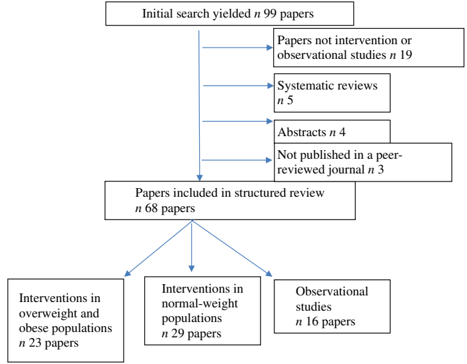
The role of mindfulness, mindful eating and a newer concept of intuitive eating in modulating eating habits is an area of increasing interest. In this structured literature review, a summary of the current evidence is presented, together with details of interventions undertaken and the tools to measure outcomes. It is broad in scope given the emerging evidence base in this area. The review yielded sixty-eight publications: twenty-three interventions in obese/overweight populations; twenty-nine interventions in normal-weight populations; sixteen observational studies, three of which were carried out in overweight/obese populations. Mindfulness-based approaches appear most effective in addressing binge eating, emotional eating and eating in response to external cues. There is a lack of compelling evidence for the effectiveness of mindfulness and mindful eating in weight management. Mindfulness-based approaches may prevent weight gain. Reduced food intake was seen in some of the studies in overweight and obese populations, but this was less apparent in the studies in normal-weight populations. The evidence base for intuitive eating is limited to date and further research is needed to examine its potential in altering eating behaviours. Mindfulness appears to work by an increased awareness of internal, rather than external, cues to eat. Mindfulness and mindful eating have the potential to address problematic eating behaviours and the challenges many face with controlling their food intake. Encouraging a mindful eating approach would seem to be a positive message to be included in general weight management advice to the public.
Overview
The claims and statistics of this paper haven’t been checked yet.
Free: it reads the open-access text and checks the first 5 claims that cite a source we can check. Create a free account to check every claim.
Integrity signals
Registry
Cites
Statistics
Figures
Verification
Claims the paper makes
The claims and statistics of this paper haven’t been checked yet.
Free: it reads the open-access text and checks the first 5 claims that cite a source we can check. Create a free account to check every claim.
Claims other papers make about this one
Each is checked against this paper’s own text: does it say what the citing paper says it does?
The cited source says what the claim attributes to it.
In the citing paper
“Therefore, mindful eating promotes healthier eating behaviors by enhancing individuals' awareness of hunger and satiety cues, fostering conscious food choices, and improving understanding of how internal states and external factors influence eating [3, 5].”
From Four Facet Mindful Eating and Eating Disorder Risk: Mediation By Depression and Body Mass Index. (2026) · cites this paper as [5]
Self-check
Percentages, sums and reported differences re-computed from the paper’s own numbers.
The self-check needs the paper’s full text.
Citations
Cites
The benefits of being present: Mindfulness and its role in psychological well-being
Brown, K. W., & Ryan, R. M. (2003) · Journal of Personality and Social Psychology · doi:10.1037/0022-3514.84.4.822 · Cited by 13,448 · cited 1×
“(2) The Mindfulness Awareness Attention Scale contained fifteen items((62)).”
Background(2008) · Medical Entomology and Zoology · Cited by 7,477
Mindfulness: A proposed operational definition.
Bishop, S. R., Lau, M., Shapiro, S., Carlson, L., Anderson, N. D., Carmody, J., Segal, Z. V., Abbey, S., Speca, M., Velting, D., et al. (2004) · Clinical Psychology: Science and Practice · doi:10.1093/clipsy.bph077 · Cited by 7,234 · cited 3×
“In mindfulness, an individual observes their immediate experience using an open and non-judgemental stance((3)).”
BackgroundThe Eating Attitudes Test: psychometric features and clinical correlates
Garner, D. M., Olmsted, M. P., Bohr, Y., & Garfinkel, P. E. (1982) · Psychological Medicine · doi:10.1017/s0033291700049163 · Cited by 4,962 · cited 2×
“Tools used to measure eating-related behaviours Eating behaviours were most frequently assessed using the Dutch Eating Behaviour Questionnaire(65), the Eating Attitudes Test(66) and the Eating Disorders Examination Questionnaire(67).”
MethodMindfulness practice leads to increases in regional brain gray matter density
Hölzel, B. K., Carmody, J., Vangel, M., Congleton, C., Yerramsetti, S. M., Gard, T., & Lazar, S. W. (2011) · Psychiatry Research: Neuroimaging · doi:10.1016/j.pscychresns.2010.08.006 · Cited by 1,914 · cited 1×
“emotional regulation and self-referential processing((92)).”
Chiesa, A., & Serretti, A. (2009) · The Journal of Alternative and Complementary Medicine · doi:10.1089/acm.2008.0495 · Cited by 1,681 · cited 1×
“Recent reviews have examined the evidence for mindfulness in the management of pain((5,6)), depression((7,8)) and psychological well-being((9,10)).”
BackgroundLoving-Kindness and Compassion Meditation: Potential for Psychological Interventions
Hofmann, S. G., Grossman, P., & Hinton, D. E. (2011) · Clinical Psychology Review · doi:10.1016/j.cpr.2011.07.003 · Cited by 960 · cited 1×
“Recent reviews have examined the evidence for mindfulness in the management of pain((5,6)), depression((7,8)) and psychological well-being((9,10)).”
BackgroundPiet, J., & Hougaard, E. (2011) · Clinical Psychology Review · doi:10.1016/j.cpr.2011.05.002 · Cited by 807 · cited 1×
“Recent reviews have examined the evidence for mindfulness in the management of pain((5,6)), depression((7,8)) and psychological well-being((9,10)).”
BackgroundTylka, T. L., & Kroon Van Diest, A. M. (2013) · Journal of Counseling Psychology · doi:10.1037/a0030893 · Cited by 763 · cited 2×
“Intuitive eating, when measured, was evaluated using the Intuitive Eating Scale(64) which contains twenty-one items.”
MethodAn Exploratory Study of a Meditation-based Intervention for Binge Eating Disorder
Kristeller, J. L., & Hallett, C. B. (1999) · Journal of Health Psychology · doi:10.1177/135910539900400305 · Cited by 681 · cited 9×
“Hunger awareness was measured in two overweight/obese populations and positive results were reported in both studies((11,28)).”
BackgroundInfluentialDevelopment and Validation of the Mindful Eating Questionnaire
Framson, C., Kristal, A. R., Schenk, J. M., Littman, A. J., Zeliadt, S., & Benitez, D. (2009) · Journal of the American Dietetic Association · doi:10.1016/j.jada.2009.05.006 · Cited by 574 · cited 1×
“The Mindful Eating Questionnaire contained twenty-eight items((63)) and was the only tool used to measure mindful eating.”
MethodMindfulness‐based interventions for obesity‐related eating behaviours: a literature review
O'Reilly, G. A., Cook, L., Spruijt‐Metz, D., & Black, D. S. (2014) · Obesity Reviews · doi:10.1111/obr.12156 · Cited by 547 · cited 2×
“Furthermore, there was evidence of its efficacy in emotional((20,23)) and external((23)) eating.”
BackgroundKatterman, S. N., Kleinman, B. M., Hood, M. M., Nackers, L. M., & Corsica, J. A. (2014) · Eating Behaviors · doi:10.1016/j.eatbeh.2014.01.005 · Cited by 533 · cited 5×
“Furthermore, there was evidence of its efficacy in emotional((20,23)) and external((23)) eating.”
BackgroundInfluentialMinding one’s emotions: Mindfulness training alters the neural expression of sadness.
Farb, N. A. S., Anderson, A. K., Mayberg, H., Bean, J., McKeon, D., & Segal, Z. V. (2010) · Emotion · doi:10.1037/a0017151 · Cited by 521 · cited 2×
“Significant selfreported differences in awareness of emotion are unlikely to be simply due to a blunting of the emotional experience but ‘represent more fundamental change in regulatory response’((88)).”
BackgroundSize Acceptance and Intuitive Eating Improve Health for Obese, Female Chronic Dieters
Bacon, L., Stern, J. S., Van Loan, M. D., & Keim, N. L. (2005) · Journal of the American Dietetic Association · doi:10.1016/j.jada.2005.03.011 · Cited by 483 · cited 5×
“MBCT or mindfulness action-based therapy Four studies((25,27,33,40)) Mindful eating Four studies((28,29,36,43)) MBSR Three studies((13,30,54)) Mindfulness Three studies((11,32,35,44)) Mindful eating and MB-EAT Three studies((14,16,38,41)) Mindfulness-based action committed therapy Two studies((38,42)) Combination of M…”
BackgroundResultInfluentialMindfulness-Based Eating Awareness Training (MB-EAT) for Binge Eating: A Randomized Clinical Trial
Kristeller, J., Wolever, R. Q., & Sheets, V. (2014) · Mindfulness · doi:10.1007/s12671-012-0179-1 · Cited by 469 · cited 9×
“MBCT or mindfulness action-based therapy Four studies((25,27,33,40)) Mindful eating Four studies((28,29,36,43)) MBSR Three studies((13,30,54)) Mindfulness Three studies((11,32,35,44)) Mindful eating and MB-EAT Three studies((14,16,38,41)) Mindfulness-based action committed therapy Two studies((38,42)) Combination of M…”
BackgroundMethodInfluentialAlberts, H. J. E. M., Thewissen, R., & Raes, L. (2012) · Appetite · doi:10.1016/j.appet.2012.01.009 · Cited by 395 · cited 6×
“MBCT or mindfulness action-based therapy Four studies((25,27,33,40)) Mindful eating Four studies((28,29,36,43)) MBSR Three studies((13,30,54)) Mindfulness Three studies((11,32,35,44)) Mindful eating and MB-EAT Three studies((14,16,38,41)) Mindfulness-based action committed therapy Two studies((38,42)) Combination of M…”
BackgroundInfluentialMindfulness-based interventions for chronic pain: a systematic review of the evidence
Chiesa, A., & Serretti, A. (2011) · The Journal of Alternative and Complementary Medicine · doi:10.1089/acm.2009.0546 · Cited by 374 · cited 3×
“(3) Reducing the speed of eating; (4) Guided meditations that focused on awareness of hunger and satiety; (5) Mediations to identify eating triggers including emotional triggers; (6) Mediations to manage cravings.”
BackgroundExploratory randomised controlled trial of a mindfulness-based weight loss intervention for women
Tapper, K., Shaw, C., Ilsley, J., Hill, A. J., Bond, F. W., & Moore, L. (2009) · Appetite · doi:10.1016/j.appet.2008.11.012 · Cited by 366 · cited 7×
“MBCT or mindfulness action-based therapy Four studies((25,27,33,40)) Mindful eating Four studies((28,29,36,43)) MBSR Three studies((13,30,54)) Mindfulness Three studies((11,32,35,44)) Mindful eating and MB-EAT Three studies((14,16,38,41)) Mindfulness-based action committed therapy Two studies((38,42)) Combination of M…”
BackgroundResultInfluentialImpact of mindfulness-based stress reduction training on intrinsic brain connectivity
Kilpatrick, L. A., Suyenobu, B. Y., Smith, S. R., Bueller, J. A., Goodman, T., Creswell, J. D., Tillisch, K., Mayer, E. A., & Naliboff, B. D. (2011) · NeuroImage · doi:10.1016/j.neuroimage.2011.02.034 · Cited by 355
Mindfulness and emotion regulation—an fMRI study
Lutz, J., Herwig, U., Opialla, S., Hittmeyer, A., Jäncke, L., Rufer, M., Grosse Holtforth, M., & Brühl, A. B. (2014) · Social Cognitive and Affective Neuroscience · doi:10.1093/scan/nst043 · Cited by 342 · cited 1×
“found in the amygdala, the parahippocampal area and the insula during perception of negative stimuli in subjects but these activity levels have been regulated following mindfulness training((90)).”
BackgroundDalen, J., Smith, B. W., Shelley, B. M., Sloan, A. L., Leahigh, L., & Begay, D. (2010) · Complementary Therapies in Medicine · doi:10.1016/j.ctim.2010.09.008 · Cited by 337 · cited 8×
“MBCT or mindfulness action-based therapy Four studies((25,27,33,40)) Mindful eating Four studies((28,29,36,43)) MBSR Three studies((13,30,54)) Mindfulness Three studies((11,32,35,44)) Mindful eating and MB-EAT Three studies((14,16,38,41)) Mindfulness-based action committed therapy Two studies((38,42)) Combination of M…”
BackgroundResultInfluentialDaubenmier, J., Kristeller, J., Hecht, F. M., Maninger, N., Kuwata, M., Jhaveri, K., Lustig, R. H., Kemeny, M., Karan, L., & Epel, E. (2011) · Journal of Obesity · doi:10.1155/2011/651936 · Cited by 322 · cited 8×
“MBCT or mindfulness action-based therapy Four studies((25,27,33,40)) Mindful eating Four studies((28,29,36,43)) MBSR Three studies((13,30,54)) Mindfulness Three studies((11,32,35,44)) Mindful eating and MB-EAT Three studies((14,16,38,41)) Mindfulness-based action committed therapy Two studies((38,42)) Combination of M…”
BackgroundResultInfluentialMindfulness-based interventions for binge eating: A systematic review and meta-analysis
Godfrey, K. M., Gallo, L. C., & Afari, N. (2015) · Journal of Behavioral Medicine · doi:10.1007/s10865-014-9610-5 · Cited by 284
Zeidan, F., Grant, J. A., Brown, C. A., McHaffie, J. G., & Coghill, R. C. (2012) · Neuroscience Letters · doi:10.1016/j.neulet.2012.03.082 · Cited by 284 · cited 2×
“(3) Reducing the speed of eating; (4) Guided meditations that focused on awareness of hunger and satiety; (5) Mediations to identify eating triggers including emotional triggers; (6) Mediations to manage cravings.”
BackgroundMindfulness and acceptance in the treatment of disordered eating
Baer, R. A., Fischer, S., & Huss, D. B. (2005) · Journal of Rational-Emotive & Cognitive-Behavior Therapy · doi:10.1007/s10942-005-0015-9 · Cited by 283 · cited 4×
“MBCT or mindfulness action-based therapy Four studies((25,27,33,40)) Mindful eating Four studies((28,29,36,43)) MBSR Three studies((13,30,54)) Mindfulness Three studies((11,32,35,44)) Mindful eating and MB-EAT Three studies((14,16,38,41)) Mindfulness-based action committed therapy Two studies((38,42)) Combination of M…”
BackgroundMethodInfluentialCoping with food cravings. Investigating the potential of a mindfulness-based intervention
Alberts, H. J. E. M., Mulkens, S., Smeets, M., & Thewissen, R. (2010) · Appetite · doi:10.1016/j.appet.2010.05.044 · Cited by 270 · cited 3×
“MBCT or mindfulness action-based therapy Four studies((25,27,33,40)) Mindful eating Four studies((28,29,36,43)) MBSR Three studies((13,30,54)) Mindfulness Three studies((11,32,35,44)) Mindful eating and MB-EAT Three studies((14,16,38,41)) Mindfulness-based action committed therapy Two studies((38,42)) Combination of M…”
BackgroundMindful Attention Prevents Mindless Impulses
Papies, E. K., Barsalou, L. W., & Custers, R. (2012) · Social Psychological and Personality Science · doi:10.1177/1948550611419031 · Cited by 246 · cited 4×
“Physiological Weight 16 (overweight/obese) 8 positive((13,16,28,30,31,37,40,43)) 50 8 neutral/mixed((14,24,26,29,34,35,41,42)) 3 (normal weight) 2 positive((34,55)) 33 1 negative((54)) Physiological risk factors‡ 2 (overweight/obese) 2 positive((13,26)) Glycaemic control 1 (overweight/obese diabetics) 1 neutral/mixed(…”
ResultInfluentialMindful eating: Trait and state mindfulness predict healthier eating behavior
Jordan, C. H., Wang, W., Donatoni, L., & Meier, B. P. (2014) · Personality and Individual Differences · doi:10.1016/j.paid.2014.04.013 · Cited by 236 · cited 4×
“Physiological Weight 16 (overweight/obese) 8 positive((13,16,28,30,31,37,40,43)) 50 8 neutral/mixed((14,24,26,29,34,35,41,42)) 3 (normal weight) 2 positive((34,55)) 33 1 negative((54)) Physiological risk factors‡ 2 (overweight/obese) 2 positive((13,26)) Glycaemic control 1 (overweight/obese diabetics) 1 neutral/mixed(…”
BackgroundResultInfluentialMINDFULNESS-BASED APPROACHES TO EATING DISORDERS
Kristeller, J. L., Baer, R. A., & Wolever, R. Q. (2006) · Elsevier eBooks · doi:10.1016/b978-012088519-0/50005-8 · Cited by 235
From mindless eating to mindlessly eating better
Wansink, B. (2010) · Physiology & Behavior · doi:10.1016/j.physbeh.2010.05.003 · Cited by 230 · cited 1×
“external norms around consumption and enabled individuals to reduce their food intake((34,94)).”
BackgroundIntuitive eating is associated with interoceptive sensitivity. Effects on body mass index
Herbert, B. M., Blechert, J., Hautzinger, M., Matthias, E., & Herbert, C. (2013) · Appetite · doi:10.1016/j.appet.2013.06.082 · Cited by 220
Denny, K. N., Loth, K., Eisenberg, M. E., & Neumark-Sztainer, D. (2013) · Appetite · doi:10.1016/j.appet.2012.09.029 · Cited by 216
Forman, E. M., & Butryn, M. L. (2015) · Appetite · doi:10.1016/j.appet.2014.10.004 · Cited by 208 · cited 1×
“The use of mindfulness is designed to interrupt these automatic, non-conscious external influences((93)).”
BackgroundMindfulness and health behaviors: Is paying attention good for you?
Roberts, K. C., & Danoff-Burg, S. (2010) · Journal of American College Health · doi:10.1080/07448481.2010.484452 · Cited by 189 · cited 3×
“Positive results were seen in all studies.”
BackgroundBeshara, M., Hutchinson, A. D., & Wilson, C. J. (2013) · Appetite · doi:10.1016/j.appet.2013.03.012 · Cited by 188 · cited 6×
“Mindfulness and decreased portion size 1 Positive((83)) Intuitive eating and observing hunger cues 1 Positive((72)) Mindfulness and decreased binge eating 2 Positive((76,80)) Mindfulness and decreased emotional eating 3 Positive((76,77,79)) Mindfulness and external eating 1 Positive((77)) Mindfulness and reduced cravi…”
BackgroundInfluentialThe neural substrates of mindfulness: An fMRI investigation
Ives-Deliperi, V. L., Solms, M., & Meintjes, E. M. (2011) · Social Neuroscience · doi:10.1080/17470919.2010.513495 · Cited by 183 · cited 2×
“has an overall “quietening” effect on brain regions associated with subjective and cognitive appraisal of emotions’((87)).”
BackgroundMiller, C. K., Kristeller, J. L., Headings, A., Nagaraja, H., & Miser, W. F. (2012) · Journal of the Academy of Nutrition and Dietetics · doi:10.1016/j.jand.2012.07.036 · Cited by 179 · cited 11×
“In many cases, this was complemented with generic mindfulness meditations such as breathing techniques and body scans often as part of a mindfulness-based curriculum, for example, MB-EAT(16), MBSR(39,60) or mindfulness-based cognitive therapy(27,33).”
BackgroundResultInfluentialKlainin-Yobas, P., Cho, M. A. A., & Creedy, D. (2012) · International Journal of Nursing Studies · doi:10.1016/j.ijnurstu.2011.08.014 · Cited by 173 · cited 1×
“Recent reviews have examined the evidence for mindfulness in the management of pain((5,6)), depression((7,8)) and psychological well-being((9,10)).”
BackgroundMindfulness and Weight Loss: A Systematic Review
Olson, K. L., & Emery, C. F. (2015) · Psychosomatic Medicine · doi:10.1097/psy.0000000000000127 · Cited by 170 · cited 2×
“The high level of heterogeneity between studies((20)) and methodological weakness of many studies((22)) were highlighted.”
BackgroundA Pilot Study Comparing the Effects of Mindfulness-Based and Cognitive-Behavioral Stress Reduction
Smith, B. W., Shelley, B. M., Dalen, J., Wiggins, K., Tooley, E., & Bernard, J. (2008) · The Journal of Alternative and Complementary Medicine · doi:10.1089/acm.2007.0641 · Cited by 162 · cited 8×
“In many cases, this was complemented with generic mindfulness meditations such as breathing techniques and body scans often as part of a mindfulness-based curriculum, for example, MB-EAT(16), MBSR(39,60) or mindfulness-based cognitive therapy(27,33).”
BackgroundMethodInfluentialFocusing on food during lunch enhances lunch memory and decreases later snack intake
Higgs, S., & Donohoe, J. E. (2011) · Appetite · doi:10.1016/j.appet.2011.04.016 · Cited by 161 · cited 4×
“Physiological Weight 16 (overweight/obese) 8 positive((13,16,28,30,31,37,40,43)) 50 8 neutral/mixed((14,24,26,29,34,35,41,42)) 3 (normal weight) 2 positive((34,55)) 33 1 negative((54)) Physiological risk factors‡ 2 (overweight/obese) 2 positive((13,26)) Glycaemic control 1 (overweight/obese diabetics) 1 neutral/mixed(…”
BackgroundInfluentialMiller, C. K., Kristeller, J. L., Headings, A., & Nagaraja, H. (2014) · Health Education & Behavior · doi:10.1177/1090198113493092 · Cited by 161 · cited 4×
“MBCT or mindfulness action-based therapy Four studies((25,27,33,40)) Mindful eating Four studies((28,29,36,43)) MBSR Three studies((13,30,54)) Mindfulness Three studies((11,32,35,44)) Mindful eating and MB-EAT Three studies((14,16,38,41)) Mindfulness-based action committed therapy Two studies((38,42)) Combination of M…”
BackgroundResultInfluentialHendrickson, K. L., & Rasmussen, E. B. (2013) · Behaviour Research and Therapy · doi:10.1016/j.brat.2013.04.002 · Cited by 161 · cited 4×
“Physiological Weight 16 (overweight/obese) 8 positive((13,16,28,30,31,37,40,43)) 50 8 neutral/mixed((14,24,26,29,34,35,41,42)) 3 (normal weight) 2 positive((34,55)) 33 1 negative((54)) Physiological risk factors‡ 2 (overweight/obese) 2 positive((13,26)) Glycaemic control 1 (overweight/obese diabetics) 1 neutral/mixed(…”
BackgroundResultInfluentialThe effect of a mindful restaurant eating intervention on weight management in women
Timmerman, G. M., & Brown, A. (2012) · Journal of Nutrition Education and Behavior · doi:10.1016/j.jneb.2011.03.143 · Cited by 149 · cited 9×
“MBCT or mindfulness action-based therapy Four studies((25,27,33,40)) Mindful eating Four studies((28,29,36,43)) MBSR Three studies((13,30,54)) Mindfulness Three studies((11,32,35,44)) Mindful eating and MB-EAT Three studies((14,16,38,41)) Mindfulness-based action committed therapy Two studies((38,42)) Combination of M…”
BackgroundResultInfluentialTwo novel treatments to reduce overeating in overweight children: A randomized controlled trial.
Boutelle, K. N., Zucker, N. L., Peterson, C. B., Rydell, S. A., Cafri, G., & Harnack, L. (2011) · Journal of Consulting and Clinical Psychology · doi:10.1037/a0025713 · Cited by 137 · cited 7×
“MBCT or mindfulness action-based therapy Four studies((25,27,33,40)) Mindful eating Four studies((28,29,36,43)) MBSR Three studies((13,30,54)) Mindfulness Three studies((11,32,35,44)) Mindful eating and MB-EAT Three studies((14,16,38,41)) Mindfulness-based action committed therapy Two studies((38,42)) Combination of M…”
BackgroundResultInfluentialMantzios, M., & Wilson, J. C. (2014) · Psychology & Health · doi:10.1080/08870446.2013.863883 · Cited by 137 · cited 4×
“Physiological Weight 16 (overweight/obese) 8 positive((13,16,28,30,31,37,40,43)) 50 8 neutral/mixed((14,24,26,29,34,35,41,42)) 3 (normal weight) 2 positive((34,55)) 33 1 negative((54)) Physiological risk factors‡ 2 (overweight/obese) 2 positive((13,26)) Glycaemic control 1 (overweight/obese diabetics) 1 neutral/mixed(…”
BackgroundResultInfluentialIntuitive Eating, Diet Composition, and The Meaning of Food in Healthy Weight Promotion
Smith, T., & Hawks, S. R. (2006) · American Journal of Health Education · doi:10.1080/19325037.2006.10598892 · Cited by 132 · cited 6×
“Mindfulness and decreased portion size 1 Positive((83)) Intuitive eating and observing hunger cues 1 Positive((72)) Mindfulness and decreased binge eating 2 Positive((76,80)) Mindfulness and decreased emotional eating 3 Positive((76,77,79)) Mindfulness and external eating 1 Positive((77)) Mindfulness and reduced cravi…”
BackgroundInfluentialLeahey, T. M., Crowther, J. H., & Irwin, S. R. (2008) · Cognitive and Behavioral Practice · doi:10.1016/j.cbpra.2008.01.004 · Cited by 127 · cited 5×
“MBCT or mindfulness action-based therapy Four studies((25,27,33,40)) Mindful eating Four studies((28,29,36,43)) MBSR Three studies((13,30,54)) Mindfulness Three studies((11,32,35,44)) Mindful eating and MB-EAT Three studies((14,16,38,41)) Mindfulness-based action committed therapy Two studies((38,42)) Combination of M…”
BackgroundMethodInfluentialPearson, A. N., Follette, V. M., & Hayes, S. C. (2012) · Cognitive and Behavioral Practice · doi:10.1016/j.cbpra.2011.03.001 · Cited by 126 · cited 5×
“MBCT or mindfulness action-based therapy Four studies((25,27,33,40)) Mindful eating Four studies((28,29,36,43)) MBSR Three studies((13,30,54)) Mindfulness Three studies((11,32,35,44)) Mindful eating and MB-EAT Three studies((14,16,38,41)) Mindfulness-based action committed therapy Two studies((38,42)) Combination of M…”
BackgroundInfluentialGodsey, J. A. (2013) · Complementary Therapies in Medicine · doi:10.1016/j.ctim.2013.06.003 · Cited by 122 · cited 1×
“The role of mindfulness in weight management was less apparent((20,21)).”
BackgroundThe effects of three mindfulness skills on chocolate cravings
Lacaille, J., Ly, J., Zacchia, N., Bourkas, S., Glaser, E., & Knaüper, B. (2014) · Appetite · doi:10.1016/j.appet.2014.01.072 · Cited by 121 · cited 2×
“Physiological Weight 16 (overweight/obese) 8 positive((13,16,28,30,31,37,40,43)) 50 8 neutral/mixed((14,24,26,29,34,35,41,42)) 3 (normal weight) 2 positive((34,55)) 33 1 negative((54)) Physiological risk factors‡ 2 (overweight/obese) 2 positive((13,26)) Glycaemic control 1 (overweight/obese diabetics) 1 neutral/mixed(…”
Moor, K. R., Scott, A. J., & McIntosh, W. D. (2012) · Mindfulness · doi:10.1007/s12671-012-0124-3 · Cited by 119 · cited 4×
“Intuitive eating and decreased BMI 4 Positive((68,70,74,75)) Mindful eating and decreased BMI 1 Positive((82)) Intuitive eating and blood markers of cardiovascular risk 1 Positive((70))”
BackgroundInfluentialBrief guided imagery and body scanning interventions reduce food cravings
Hamilton, J., Fawson, S., May, J., Andrade, J., & Kavanagh, D. J. (2013) · Appetite · doi:10.1016/j.appet.2013.08.005 · Cited by 117 · cited 2×
“Physiological Weight 16 (overweight/obese) 8 positive((13,16,28,30,31,37,40,43)) 50 8 neutral/mixed((14,24,26,29,34,35,41,42)) 3 (normal weight) 2 positive((34,55)) 33 1 negative((54)) Physiological risk factors‡ 2 (overweight/obese) 2 positive((13,26)) Glycaemic control 1 (overweight/obese diabetics) 1 neutral/mixed(…”
MethodLess food for thought. Impact of attentional instructions on intrusive thoughts about snack foods
May, J., Andrade, J., Batey, H., Emerson, L., & Kavanagh, D. J. (2010) · Appetite · doi:10.1016/j.appet.2010.06.014 · Cited by 116 · cited 3×
“Physiological Weight 16 (overweight/obese) 8 positive((13,16,28,30,31,37,40,43)) 50 8 neutral/mixed((14,24,26,29,34,35,41,42)) 3 (normal weight) 2 positive((34,55)) 33 1 negative((54)) Physiological risk factors‡ 2 (overweight/obese) 2 positive((13,26)) Glycaemic control 1 (overweight/obese diabetics) 1 neutral/mixed(…”
ResultThe Relationship between Intuitive Eating and Health Indicators among College Women
Hawks, S., Madanat, H., Hawks, J., & Harris, A. (2005) · American Journal of Health Education · doi:10.1080/19325037.2005.10608206 · Cited by 115 · cited 4×
“Intuitive eating was associated with a lower BMI in four studies((68,70,74,75)).”
BackgroundInfluentialAn acceptance-based behavioral intervention for weight loss: a pilot study
Niemeier, H. M., Leahey, T., Palm Reed, K., Brown, R. A., & Wing, R. R. (2012) · Behavior Therapy · doi:10.1016/j.beth.2011.10.005 · Cited by 109 · cited 6×
“MBCT or mindfulness action-based therapy Four studies((25,27,33,40)) Mindful eating Four studies((28,29,36,43)) MBSR Three studies((13,30,54)) Mindfulness Three studies((11,32,35,44)) Mindful eating and MB-EAT Three studies((14,16,38,41)) Mindfulness-based action committed therapy Two studies((38,42)) Combination of M…”
BackgroundMethodInfluentialWhat Should You Know about Mindful and Intuitive Eating?
Mathieu, J. J. (2009) · Journal of the American Dietetic Association · doi:10.1016/j.jada.2009.10.023 · Cited by 100 · cited 2×
“Both mindful eating and intuitive eating concentrate on internally focused eating((18)); intuitive eating, however, does not involve meditation((17)).”
BackgroundA Preliminary Study of the Effects of a Modified Mindfulness Intervention on Binge Eating
Smith, B. W., Shelley, B. M., Leahigh, L., & Vanleit, B. (2006) · Complementary Health Practice Review · doi:10.1177/1533210106297217 · Cited by 99 · cited 10×
“In many cases, this was complemented with generic mindfulness meditations such as breathing techniques and body scans often as part of a mindfulness-based curriculum, for example, MB-EAT(16), MBSR(39,60) or mindfulness-based cognitive therapy(27,33).”
BackgroundMethodInfluentialA Mindful Eating Group Intervention for Obese Women: A Mixed Methods Feasibility Study
Kidd, L. I., Graor, C. H., & Murrock, C. J. (2013) · Archives of Psychiatric Nursing · doi:10.1016/j.apnu.2013.05.004 · Cited by 96 · cited 1×
“MBCT or mindfulness action-based therapy Four studies((25,27,33,40)) Mindful eating Four studies((28,29,36,43)) MBSR Three studies((13,30,54)) Mindfulness Three studies((11,32,35,44)) Mindful eating and MB-EAT Three studies((14,16,38,41)) Mindfulness-based action committed therapy Two studies((38,42)) Combination of M…”
BackgroundMindful Eating: Principles and Practice
Monroe, J. T. (2015) · American Journal of Lifestyle Medicine · doi:10.1177/1559827615569682 · Cited by 92 · cited 1×
“eating reduces overall energy consumption as individuals feel full on a smaller quantity of food((86)).”
BackgroundResisting chocolate temptation using a brief mindfulness strategy
Jenkins, K. T., & Tapper, K. (2014) · British Journal of Health Psychology · doi:10.1111/bjhp.12050 · Cited by 82 · cited 3×
“Physiological Weight 16 (overweight/obese) 8 positive((13,16,28,30,31,37,40,43)) 50 8 neutral/mixed((14,24,26,29,34,35,41,42)) 3 (normal weight) 2 positive((34,55)) 33 1 negative((54)) Physiological risk factors‡ 2 (overweight/obese) 2 positive((13,26)) Glycaemic control 1 (overweight/obese diabetics) 1 neutral/mixed(…”
BackgroundMethodMindfulness-Based Treatment Approaches
(2006) · Elsevier eBooks · doi:10.1016/b978-0-12-088519-0.x5000-x · Cited by 81
Hong, P. Y., Lishner, D. A., & Han, K. H. (2014) · Mindfulness · doi:10.1007/s12671-012-0154-x · Cited by 79 · cited 3×
“Physiological Weight 16 (overweight/obese) 8 positive((13,16,28,30,31,37,40,43)) 50 8 neutral/mixed((14,24,26,29,34,35,41,42)) 3 (normal weight) 2 positive((34,55)) 33 1 negative((54)) Physiological risk factors‡ 2 (overweight/obese) 2 positive((13,26)) Glycaemic control 1 (overweight/obese diabetics) 1 neutral/mixed(…”
BackgroundResultCourbasson, C. M., Nishikawa, Y., & Shapira, L. B. (2010) · Eating Disorders · doi:10.1080/10640266.2011.533603 · Cited by 79 · cited 3×
“Binge eating symptoms were assessed in four studies in normal-weight populations((45,49,60,61)); three were undertaken in binge-eating-disorder populations.”
BackgroundMarchiori, D., & Papies, E. K. (2014) · Appetite · doi:10.1016/j.appet.2013.12.009 · Cited by 77 · cited 2×
“Physiological Weight 16 (overweight/obese) 8 positive((13,16,28,30,31,37,40,43)) 50 8 neutral/mixed((14,24,26,29,34,35,41,42)) 3 (normal weight) 2 positive((34,55)) 33 1 negative((54)) Physiological risk factors‡ 2 (overweight/obese) 2 positive((13,26)) Glycaemic control 1 (overweight/obese diabetics) 1 neutral/mixed(…”
BackgroundMindful Eating and it's Relationship with Mental Well-being
Khan, Z., & Zadeh, Z. F. (2014) · Procedia - Social and Behavioral Sciences · doi:10.1016/j.sbspro.2014.12.330 · Cited by 74 · cited 5×
“Mindful eating and mental well-being 1 Positive((81)) Intuitive eating and more pleasure associated with food 1 Positive((75))”
BackgroundInfluentialKearney, D. J., Milton, M. L., Malte, C. A., McDermott, K. A., Martinez, M., & Simpson, T. L. (2012) · Nutrition Research · doi:10.1016/j.nutres.2012.05.008 · Cited by 74 · cited 8×
“Food intake was measured in nine studies in normal-weight populations, with four studies reporting a reduction of food intake((48,52,53,55)), four reporting neutral results((44,51,54,57)) and one reporting negative results((18)).”
BackgroundResultInfluentialEating ‘attentively’ reduces later energy consumption in overweight and obese females
Robinson, E., Kersbergen, I., & Higgs, S. (2014) · British Journal Of Nutrition · doi:10.1017/s000711451400141x · Cited by 73 · cited 1×
“Attentive eating is a similar concept to mindful eating and has been shown to reduce food intake((96,97)).”
BackgroundCorsica, J. A., Hood, M. M., Katterman, S. N., Kleinman, B. M., & Ivan, I. I. (2014) · Eating Behaviors · doi:10.1016/j.eatbeh.2014.08.002 · Cited by 70 · cited 7×
“MBCT or mindfulness action-based therapy Four studies((25,27,33,40)) Mindful eating Four studies((28,29,36,43)) MBSR Three studies((13,30,54)) Mindfulness Three studies((11,32,35,44)) Mindful eating and MB-EAT Three studies((14,16,38,41)) Mindfulness-based action committed therapy Two studies((38,42)) Combination of M…”
BackgroundResultInfluentialBoutelle, K. N., Zucker, N., Peterson, C. B., Rydell, S., Carlson, J., & Harnack, L. J. (2014) · Journal of Pediatric Psychology · doi:10.1093/jpepsy/jst142 · Cited by 70 · cited 7×
“MBCT or mindfulness action-based therapy Four studies((25,27,33,40)) Mindful eating Four studies((28,29,36,43)) MBSR Three studies((13,30,54)) Mindfulness Three studies((11,32,35,44)) Mindful eating and MB-EAT Three studies((14,16,38,41)) Mindfulness-based action committed therapy Two studies((38,42)) Combination of M…”
BackgroundResultInfluentialThe Moderating Effects of Mindfulness on Psychological Distress and Emotional Eating Behaviour
Pidgeon, A., Lacota, K., & Champion, J. (2013) · Australian Psychologist · doi:10.1111/j.1742-9544.2012.00091.x · Cited by 68 · cited 4×
“Other observations included a decreased emotional eating with higher levels of mindfulness((76,77,79)) and a higher level of everyday mindfulness was related negatively to self-report serve size of energy-dense food((83)).”
BackgroundInfluentialManipulations of attention during eating and their effects on later snack intake
Higgs, S. (2015) · Appetite · doi:10.1016/j.appet.2015.05.033 · Cited by 65 · cited 1×
“Attentive eating is a similar concept to mindful eating and has been shown to reduce food intake((96,97)).”
BackgroundHill, M. L., Masuda, A., Melcher, H., Morgan, J. R., & Twohig, M. P. (2014) · Cognitive and Behavioral Practice · doi:10.1016/j.cbpra.2014.02.005 · Cited by 63 · cited 13×
“This was an ACT intervention study over 6 months among women.”
BackgroundMethodInfluentialThe effect of portion size on food intake is robust to brief education and mindfulness exercises
Cavanagh, K., Vartanian, L. R., Herman, C. P., & Polivy, J. (2014) · Journal of Health Psychology · doi:10.1177/1359105313478645 · Cited by 63 · cited 3×
“MBCT or mindfulness action-based therapy Four studies((25,27,33,40)) Mindful eating Four studies((28,29,36,43)) MBSR Three studies((13,30,54)) Mindfulness Three studies((11,32,35,44)) Mindful eating and MB-EAT Three studies((14,16,38,41)) Mindfulness-based action committed therapy Two studies((38,42)) Combination of M…”
BackgroundEmotional Ability Training and Mindful Eating
Kidwell, B., Hasford, J., & Hardesty, D. M. (2015) · Journal of Marketing Research · doi:10.1509/jmr.13.0188 · Cited by 62 · cited 6×
“Three of these studies reported positive food choices((15,53,55)) as a result of mindfulness intervention and two studies reported mixed/neutral results((50,59)).”
BackgroundResultInfluentialAdding Mindfulness to CBT Programs for Binge Eating: A Mixed-Methods Evaluation
Woolhouse, H., Knowles, A., & Crafti, N. (2012) · Eating Disorders · doi:10.1080/10640266.2012.691791 · Cited by 60 · cited 2×
“Binge eating symptoms were assessed in four studies in normal-weight populations((45,49,60,61)); three were undertaken in binge-eating-disorder populations.”
BackgroundMindfulness Based Approaches to Obesity and Weight Loss Maintenance
Caldwell, K. L., Baime, M. J., & Wolever, R. Q. (2012) · Journal of Mental Health Counseling · doi:10.17744/mehc.34.3.t016616717774643 · Cited by 58 · cited 1×
“As defusion-reduced reactivity enhances tolerance to nonphysical emotional cues, the cultivation of mindfulness becomes self-reinforcing((89)).”
Mindfulness and eating behaviour styles in morbidly obese males and females
Ouwens, M. A., Schiffer, A. A., Visser, L. I., Raeijmaekers, N. J. C., & Nyklíček, I. (2015) · Appetite · doi:10.1016/j.appet.2014.11.030 · Cited by 56 · cited 9×
“from overweight/obese populations of which two were waiting for bariatric surgery((76,77)).”
BackgroundInfluentialNeural Networks for Mindfulness and Emotion Suppression
Murakami, H., Katsunuma, R., Oba, K., Terasawa, Y., Motomura, Y., Mishima, K., & Moriguchi, Y. (2015) · PLOS ONE · doi:10.1371/journal.pone.0128005 · Cited by 55 · cited 1×
“It appears to regulate amygdala functioning via functional connectivity from the medial prefrontal cortex((91)).”
BackgroundMindful Eating: An Emerging Approach for Healthy Weight Management
Lofgren, I. E. (2015) · American Journal of Lifestyle Medicine · doi:10.1177/1559827615569684 · Cited by 55
Dieting, exercise, and intuitive eating among early adolescents
Moy, J., Petrie, T. A., Dockendorff, S. A., Greenleaf, C. A., & Martin, S. B. (2013) · Eating Behaviors · doi:10.1016/j.eatbeh.2013.06.014 · Cited by 52 · cited 6×
“Mindfulness and decreased portion size 1 Positive((83)) Intuitive eating and observing hunger cues 1 Positive((72)) Mindfulness and decreased binge eating 2 Positive((76,80)) Mindfulness and decreased emotional eating 3 Positive((76,77,79)) Mindfulness and external eating 1 Positive((77)) Mindfulness and reduced cravi…”
BackgroundInfluentialPre-ordering lunch at work. Results of the what to eat for lunch study
Stites, S. D., Singletary, S. B., Menasha, A., Cooblall, C., Hantula, D. A., Axelrod, S., Figueredo, V. M., & Phipps, E. (2014) · Appetite · doi:10.1016/j.appet.2014.10.005 · Cited by 52 · cited 4×
“MBCT or mindfulness action-based therapy Four studies((25,27,33,40)) Mindful eating Four studies((28,29,36,43)) MBSR Three studies((13,30,54)) Mindfulness Three studies((11,32,35,44)) Mindful eating and MB-EAT Three studies((14,16,38,41)) Mindfulness-based action committed therapy Two studies((38,42)) Combination of M…”
BackgroundInfluentialPsychological Flexibility and Mindfulness Explain Intuitive Eating in Overweight Adults
Sairanen, E., Tolvanen, A., Karhunen, L., Kolehmainen, M., Järvelä, E., Rantala, S., Peuhkuri, K., Korpela, R., & Lappalainen, R. (2015) · Behavior Modification · doi:10.1177/0145445515576402 · Cited by 49 · cited 4×
“Intuitive eating was associated with a lower BMI in four studies((68,70,74,75)).”
BackgroundInfluentialLevin, M. E., Dalrymple, K., Himes, S., & Zimmerman, M. (2014) · Eating Behaviors · doi:10.1016/j.eatbeh.2014.03.012 · Cited by 49 · cited 6×
“from overweight/obese populations of which two were waiting for bariatric surgery((76,77)).”
BackgroundInfluentialAre men more intuitive when it comes to eating and physical activity?
Gast, J., Madanat, H., & Nielson, A. C. (2012) · American Journal of Men's Health · doi:10.1177/1557988311428090 · Cited by 49 · cited 5×
“Two of the cohorts were substantial, with 1000((72)) and 2000((69))”
BackgroundInfluentialMason, A. E., Lustig, R. H., Brown, R. R., Acree, M., Bacchetti, P., Moran, P. J., Dallman, M., Laraia, B., Adler, N., Hecht, F. M., et al. (2015) · Appetite · doi:10.1016/j.appet.2015.04.062 · Cited by 40 · cited 3×
“MBCT or mindfulness action-based therapy Four studies((25,27,33,40)) Mindful eating Four studies((28,29,36,43)) MBSR Three studies((13,30,54)) Mindfulness Three studies((11,32,35,44)) Mindful eating and MB-EAT Three studies((14,16,38,41)) Mindfulness-based action committed therapy Two studies((38,42)) Combination of M…”
BackgroundImpact of an intuitive eating education program on high school students’ eating attitudes
Healy, N., Joram, E., Matvienko, O., Woolf, S., & Knesting, K. (2015) · Health Education · doi:10.1108/he-03-2014-0043 · Cited by 32 · cited 3×
“Physiological Weight 16 (overweight/obese) 8 positive((13,16,28,30,31,37,40,43)) 50 8 neutral/mixed((14,24,26,29,34,35,41,42)) 3 (normal weight) 2 positive((34,55)) 33 1 negative((54)) Physiological risk factors‡ 2 (overweight/obese) 2 positive((13,26)) Glycaemic control 1 (overweight/obese diabetics) 1 neutral/mixed(…”
BackgroundCoping with brief periods of food restriction: mindfulness matters
Paolini, B., Burdette, J. H., Laurienti, P. J., Morgan, A. R., Williamson, D. A., & Rejeski, W. J. (2012) · Frontiers in Aging Neuroscience · doi:10.3389/fnagi.2012.00013 · Cited by 29 · cited 4×
“The remaining cohorts were spread across a wide age spectrum from middle school((72)) to older obese adults((78)).”
BackgroundInfluentialIs level of intuitive eating associated with plate size effects?
Anderson, D. A., Schaumberg, K., Anderson, L. M., & Reilly, E. E. (2015) · Eating Behaviors · doi:10.1016/j.eatbeh.2015.05.005 · Cited by 25 · cited 6×
“Food intake was measured in nine studies in normal-weight populations, with four studies reporting a reduction of food intake((48,52,53,55)), four reporting neutral results((44,51,54,57)) and one reporting negative results((18)).”
BackgroundInfluentialA pilot study of a single-session training to promote mindful eating.
Jacobs, J., Cardaciotto, L., Block‐Lerner, J., & McMahon, C. E. (2013) · PubMed · Cited by 16
Intuitive eating for a healthy weight
Outland, L., Madanat, H. N., & Rust, F. (2013) · Primary Health Care · doi:10.7748/phc2013.11.23.9.22.e754 · Cited by 8 · cited 4×
“Another study looking at associations with intuitive eating showed that those who consistently overrode fullness feelings were more likely to use moderate to extreme effort to maintain their weight((73)).”
BackgroundInfluentialSoleimaninanadegani, M., & Shahmohammadi, N. (2013) · Procedia - Social and Behavioral Sciences · doi:10.1016/j.sbspro.2013.06.601 · Cited by 6
The Real Weighty Issue: Losing Is Just the Beginning
Gerweck, C., & Celentano, J. C. (2010) · American Journal of Lifestyle Medicine · doi:10.1177/1559827609357310 · Cited by 1 · cited 1×
“Mindful eating has been shown to slow down consumption of a meal and allows both registration of feelings of fullness and greater control over eating((84,85)).”
BackgroundBlack (1996) · doi:10.1002/(sici)1098-108x(199607)20:1<43::aid-eat5>3.0.co;2-4
van Strien (1986) · doi:10.1002/1098-108x(198602)5:2<295::aid-eat2260050209>3.0.co;2-t
Cited by
Causes of Emotional Eating and Matched Treatment of Obesity
van Strien, T. (2018) · Current Diabetes Reports · doi:10.1007/s11892-018-1000-x · Cited by 501
Mindfulness and Behavior Change
Schuman-Olivier, Z., Trombka, M., Lovas, D. A., Brewer, J. A., Vago, D. R., Gawande, R., Dunne, J. P., Lazar, S. W., Loucks, E. B., & Fulwiler, C. (2020) · Harvard Review of Psychiatry · doi:10.1097/hrp.0000000000000277 · Cited by 435
Eating Behaviour Changes during the COVID-19 Pandemic: A Systematic Review of Longitudinal Studies
González-Monroy, C., Gómez-Gómez, I., Olarte-Sánchez, C. M., & Motrico, E. (2021) · International Journal of Environmental Research and Public Health · doi:10.3390/ijerph182111130 · Cited by 215
“Evidence-based interventions have demonstrated the efficacy of nutritional education programmes into adaptative eating behaviour [57], what might involve an urgent call to action for governments and social sectors focused on health promotion.”
BackgroundMindful eating: what we know so far
Tapper, K. (2022) · Nutrition Bulletin · doi:10.1111/nbu.12559 · Cited by 146
Aranceta-Bartrina, J., Partearroyo, T., López-Sobaler, A., Ortega, R., Varela-Moreiras, G., Serra-Majem, L., Pérez-Rodrigo, C., & The Collaborative Group for the Dietary Guidelines for the Spanish Population (SENC) (2019) · Nutrients · doi:10.3390/nu11112675 · Cited by 104
“Diet quality has been independently associated with education level, food cravings, and awareness towards eating [81].”
Background
Metadata
- Authors
- Warren, J. M., Smith, N., & Ashwell, M.
- Affiliations
- University of Oxford (GB)
- Corresponding author
- Warren, Janet M.
- Venue
- Nutrition Research Reviews
- Publisher
- Cambridge University Press (CUP)
- Published
- 2017-07-18
- Volume
- 30
- Issue
- 2
- Pages
- 272-283
- ISSN
- 0954-4224 (ISSN-L)
- 1475-2700
- OpenAlex
- W2739082572
- Semantic Scholar
- 084ccf96fb5a49401eb8d985c7702fea5427696b
- Cited by
- 435
- References
- 97
- Citations by year
- 2026: 70 · 2025: 60 · 2024: 68 · 2023: 55 · 2022: 60 · 2021: 63 · 2020: 32 · 2019: 17 · 2018: 9 · 2017: 1
- FWCI
- 2.48
- Type
- journal article
- Language
- en
- Open access
- hybrid
- doi.org
- Locations
- Nutrition Research Reviews (publishedVersion, cc-by)
- PubMed (publishedVersion)
- Topics
- Social Sciences › Psychology › Clinical Psychology › Eating Disorders and Behaviors
- Health Sciences › Nursing › Nutrition and Dietetics › Nutrition, Health and Food Behavior
- Social Sciences › Psychology › Clinical Psychology › Mindfulness and Compassion Interventions
- Keywords
- mindfulness, mindful eating, intuitive eating, eating behaviour, weight management, obesity, binge eating, emotional eating, dietary intake, weight gain prevention, mindfulness-based interventions, mechanisms of change
- MeSH terms
- Awareness, Behavior Therapy, Cues, Eating, Emotions, Feeding Behavior, Food Preferences, Humans, Hunger, Obesity, Treatment Outcome, Overweight, Binge-Eating Disorder, Mindfulness
About these checks
Registry, retraction, Cites and statistics results are computed, not judged, with one exception: a printed reference that no index lists is read once by a model before it counts as a citation error. Claims are extracted by a model and kept only when their quote appears verbatim in the text; each cited source is then checked, with a model’s help, for whether it says what the claim relies on. Those verdicts can be wrong — read the claim’s quote and the cited source before relying on one.
Statistics and arithmetic are recomputed, not judged.
Confidence bands are shown only for fields calibrated on our annotated test set. None is calibrated yet, so no band is shown.
What counts as a claim ›How we measure confidence ›How we check this ›
Are you an author, or do you see a problem with this page? Request a review
Data sources
Bibliographic data: Semantic Scholar, OpenAlex, Crossref.
Contains information from the Semantic Scholar Academic Graph Datasets, made available under the ODC Attribution License (ODC-BY 1.0).
Semantic Scholar’s data is described in: Kinney, R., et al. (2023). The Semantic Scholar Open Data Platform. arXiv:2301.10140.
