

Conceptualization of the term 'ecological validity' in neuropsychological research on executive function assessment: a systematic review and call to action
Open accessThe DOI matches its Crossref record; 156 of the 159 references it cites were found in a registry or an index; 14 of the 52 sources its claims cite were checked for support.
Abstract
OBJECTIVE: "Ecological validity" (EV) is classically defined as test's ability to predict real-world functioning, either alone or together with test's similarity to real-world tasks. In neuropsychological literature on assessment of executive functions (EF), EV is conceptualized inconsistently, leading to misconceptions about the utility of tests. The goal of this systematic review was to examine how EV is conceptualized in studies of EF tests described as ecologically valid. METHOD: MEDLINE and PsychINFO Databases were searched. PRISMA guidelines were observed. After applying inclusion and exclusion criteria, this search yielded 90 articles. Deductive content analysis was employed to determine how the term EV was used. RESULTS: About 1/3 of the studies conceptualized EV as the test's ability to predict functional outcomes, 1/3 as both the ability to predict functional outcome and similarity to real-world tasks, and 1/3 were either unclear about the meaning of the term or relied on notions unrelated to classical definitions (e.g., similarity to real-world tasks alone, association with other tests, or the ability to discriminate between populations). CONCLUSIONS: Conceptualizations of the term EV in literature on EF assessment vary grossly, subsuming the notions of criterion, construct, and face validity, as well as sensitivity/specificity. Such inconsistency makes it difficult to interpret clinical utility of tests that are described as ecologically valid. We call on the field to require that, at minimum, the term EV be clearly defined in all publications, or replaced with more concrete terminology (e.g., criterion validity).
Overview
CoChat Summary
TL;DR
This systematic review of 90 articles found that “ecological validity” (EV) is inconsistently defined and used in neuropsychological research on executive function tests, often conflating veridicality, verisimilitude, and other validity notions. The authors call for retiring the term EV or replacing it with more concrete terminology such as criterion validity.
Key findings
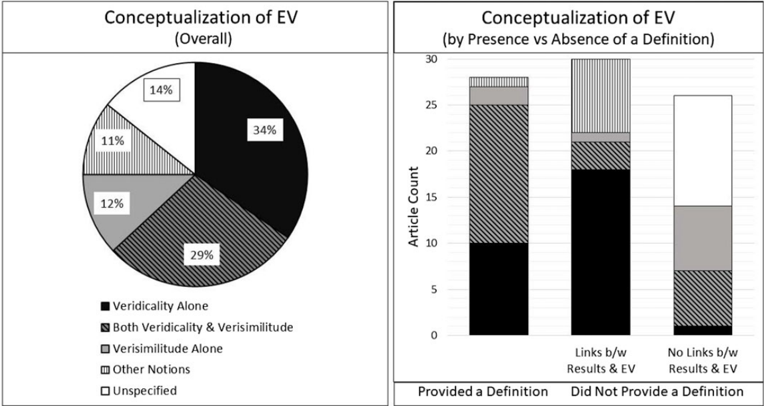
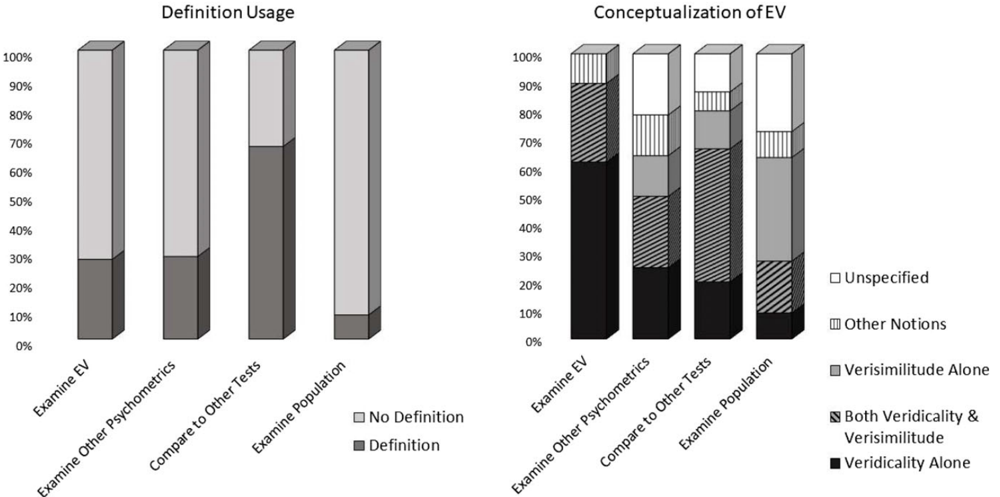
- Among 90 included articles, only 28 (31%) provided a formal EV definition; of those, 14 (50%) required both veridicality and verisimilitude, 10 (36%) required veridicality only, and 4 (14%) required verisimilitude only.
- Across all studies, about two-thirds subscribed to one of the two classic conceptualizations (veridicality alone or veridicality plus verisimilitude), while about one-third used verisimilitude alone, other notions, or were unclear.
- Among 30 articles that did not define EV but linked results to EV conclusions, 18 (60%) cited prediction of functional outcome alone, 5 (17%) cited prediction plus test appearance, and 7 (23%) did not rely on prediction of functional outcomes.
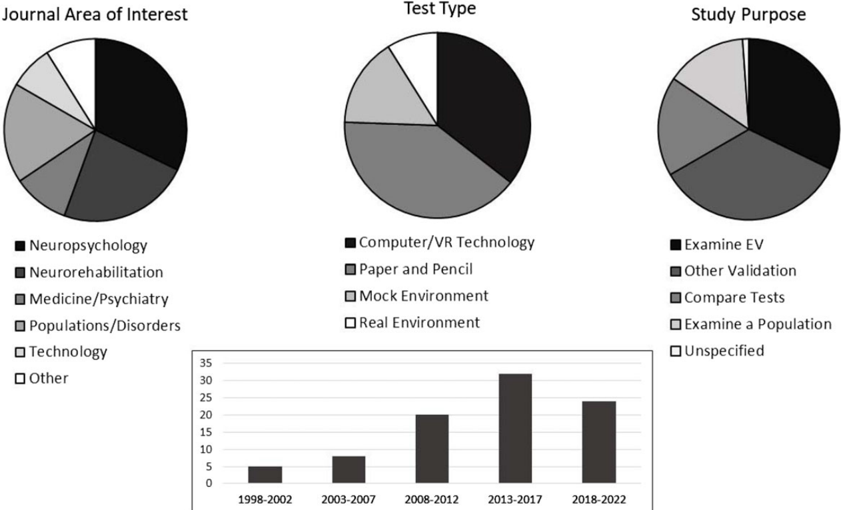
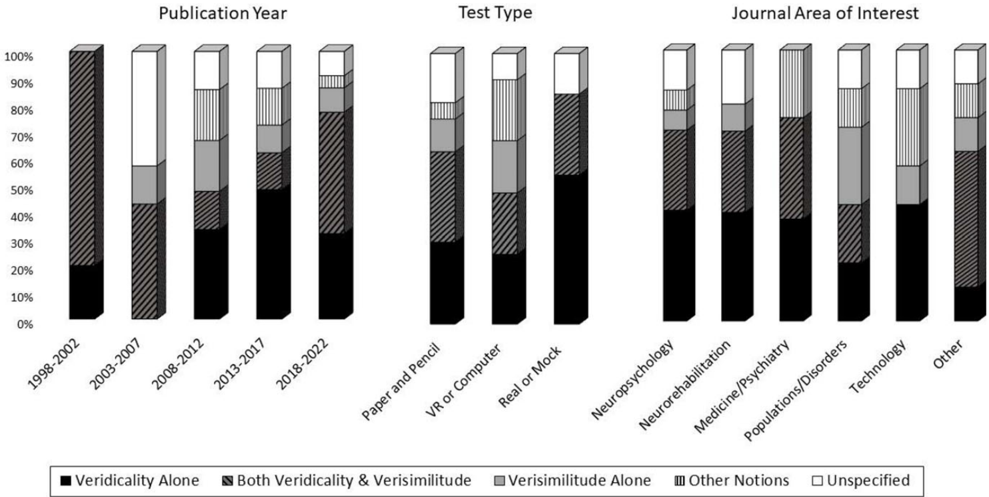
- Conceptualization varied by study purpose [Likelihood Ratio (12) = 34.92, p < .001, Cramer’s V = .37], publication year [Likelihood Ratio (16) = 28.25, p = .030, Cramer’s V = .29], and test type [Likelihood Ratio (8) = 18.65, p = .017, Cramer’s V = .30]; virtual reality and computer tests were most likely to rely on nontraditional definitions.
Methods
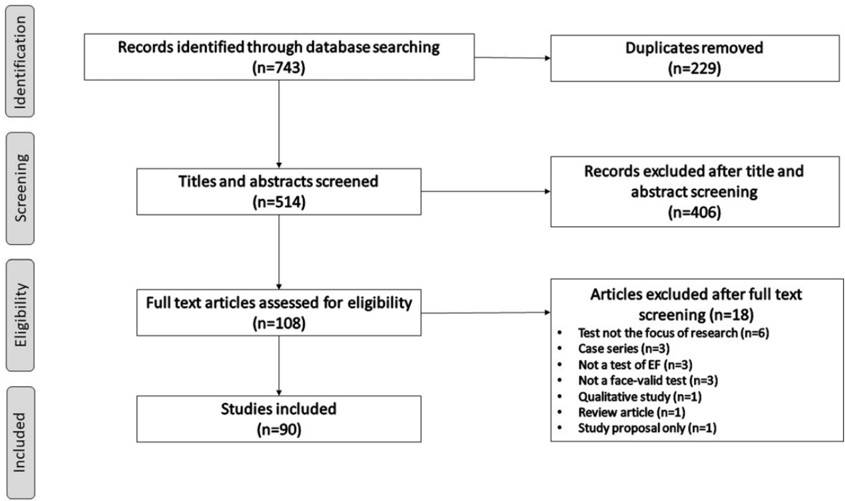
- PRISMA-guided systematic review; MEDLINE and PsychINFO were searched on February 18, 2023, with no date limits, using terms targeting “ecologic*,” neuropsychology, and executive function. After screening, 90 articles were included.
- Articles were screened by the first author and independently reviewed by at least one of four coauthors; discrepancies were adjudicated by discussion. Data extraction was done by two authors, with disagreements resolved by discussion or coded as “unspecified.”
- Deductive content analysis coded EV conceptualizations as veridicality, verisimilitude, other notions, or unspecified; correlates included publication year, journal type, test type, and study aims, analyzed with likelihood ratios and Cramer’s V.
Limitations
- The authors state that interpretation of EV conceptualization was sometimes based on subjective impressions because many articles were not explicit; they addressed this with independent double reading and adjudication, and coded 12 articles as “unspecified.”
- The authors state that the deductive approach imposed verisimilitude and veridicality categories, potentially overlooking nuances; the molar approach was conservative, so divergence may be even greater. They also note the search did not include all databases, search terms may have missed articles, and a larger sample would increase power.
- The authors state they examined only articles using EV in the context of novel, face-valid EF tests, did not offer a recommended EV definition, and did not examine methodology or scientific rigor of reviewed articles. Evident from the text: some coding agreement was moderate (e.g., Kappa = .617 for inclusion/exclusion; Kappa = .63 for presence of definition), though disagreements were resolved by discussion.
Model-written summary. Check it against the paper before relying on it.
Integrity signals
Registry
Cites
Statistics
Figures
Verification
Claims the paper makes
8 Valid · 2 Not valid · 24 Not checked · 102 Own results and interpretations
Some cited sources support this claim and some don’t — read each source’s verdict below.
In the paper
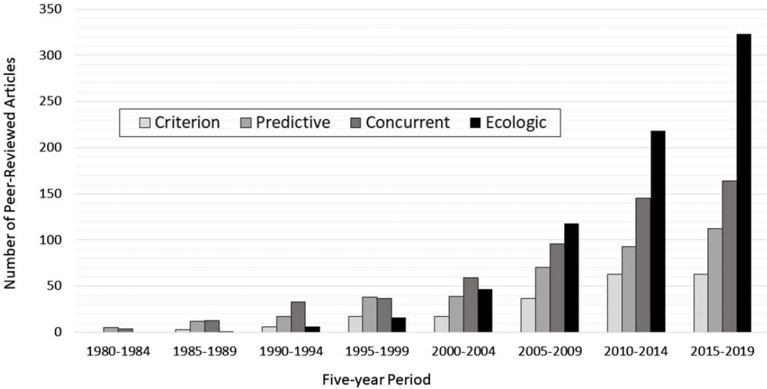
“That said, as seen in Figure 6, the past decade evidences an apparent trend toward returning to the original twopronged conceptualization, perhaps as a function of emerging criticisms of confusing usage (Araújo et al., 2007; Dunlosky et al., 2009; Holleman et al., 2020; Schmuckler, 2001).”
What the sources say
- Supportedcites Araújo et al., 2007 matched to “Ecological Validity, Representative Design, and Correspondence Between Experimental Task Constraints and Behavioral Setting: Comment on Rogers, Kadar, and Costall (2005)” (2007) source
The citing sentence presents the decade-long trend as its own interpretation of Figure 6; this citation supports the proposed explanation involving criticism of confusing terminology. In the Abstract, Araújo et al. say that “ecological validity” has often been used incorrectly, and in “Representative experimental design” they criticize its interchangeable use with “representative design.” (LLM, conf=0.87)
- Not checked — no full text of the sourcecites Dunlosky et al., 2009 matched to “Sins Committed in the Name of Ecological Validity” (2009) source
- Disputedcites Holleman et al., 2020 matched to “The ‘Real-World Approach’ and Its Problems: A Critique of the Term Ecological Validity” (2020) sourceExperimental — accuracy not yet measured
In “The Historical Roots of Ecological Validity” (page unavailable), Holleman et al. describe Brunswik’s original meaning as a specific correlation between a sensory cue and an environmental variable, not a two-pronged conceptualization. The Introduction (page unavailable) says earlier criticisms have largely been overlooked; it does not report a past-decade trend of returning to an original conception. (LLM, conf=0.86)
Checked by a reasoning model — may be wrong.
hedgedstates a possible cause- Asserted: passes — The authors put it forward as true.
- Checkable: passes — It can be checked against evidence.
- Load-bearing: unclear — It is unclear whether the paper’s conclusions depend on it.
- Based: passes — The paper gives a reason why it holds.
- Supported
The cited sources support only part of this claim — read each source’s verdict below.
In the paper
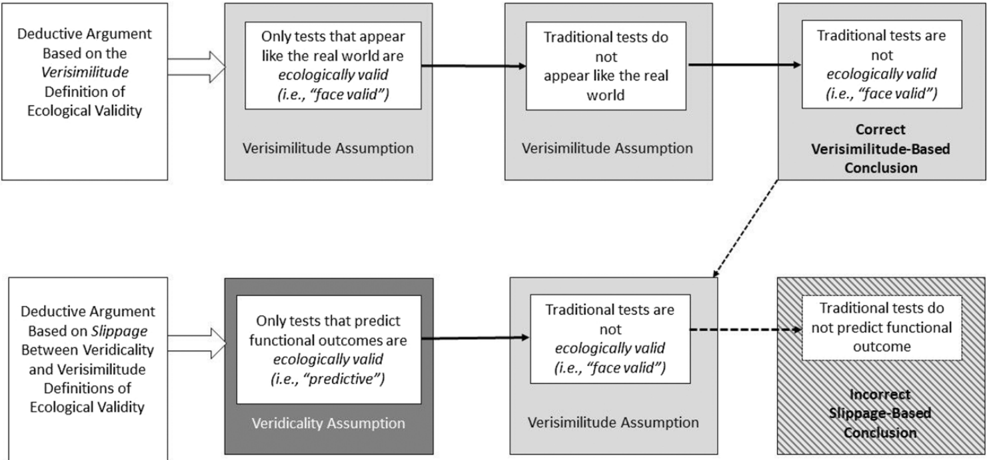
“However, this conceptualization appears to have morphed over the years to confound EV with face validity.”
What the sources say
- Could not verifycites Burgess et al., 1998 matched to “The ecological validity of tests of executive function” (1998) sourceExperimental — accuracy not yet measured
The Introduction discusses ecological validity in terms of how test performance relates to everyday functioning and describes some tests as formalized real-world activities. It does not address whether the concept changed over time or became confused with face validity; searches for those terms found no such discussion. (LLM, conf=0.70)
- Partly supportedcites Alderman et al., 2003 matched to “Ecological validity of a simplified version of the multiple errands shopping test” (2003) sourceExperimental — accuracy not yet measured
In “Ecological Validity of the MET-SV” (p. 7), the authors call the test inherently ecologically valid because it resembles an everyday activity. That supports the claim’s point about treating resemblance to real life as ecological validity, but the paper does not discuss face validity or establish that the conceptualization changed over the years. (LLM, conf=0.78)
- Not checked — no full text of the sourcecites Zartman et al., 2013 matched to “The Pillbox Test: An Ecological Measure of Executive Functioning and Estimate of Medication Management Abilities” (2013) source
hedgedstates a cause- Asserted: passes — The authors put it forward as true.
- Checkable: passes — It can be checked against evidence.
- Load-bearing: passes — The paper’s conclusions depend on it.
- Based: passes — The paper gives a reason why it holds.
- Could not verify
The sources with a verdict support this claim; the rest weren’t checked yet, have no full text we could read, or their verdicts aren’t rated yet.
In the paper
“Criticisms of inconsistent and confusing usage of the term EV in psychological research have been repeatedly raised (Araújo et al., 2007; Dunlosky et al., 2009; Holleman et al., 2020; Schmuckler, 2001).”
What the sources say
- Supportedcites Araújo et al., 2007 matched to “Ecological Validity, Representative Design, and Correspondence Between Experimental Task Constraints and Behavioral Setting: Comment on Rogers, Kadar, and Costall (2005)” (2007) source
The Abstract says that “ecological validity” has often been used incorrectly in psychology and that Rogers et al. confused it with representative design, as others had before them. The “Representative experimental design” section also criticizes the frequent interchangeable use of the two terms. These passages support the claim that criticisms of confusing usage have been raised repeatedly. (LLM, conf=0.92)
- Not checked — no full text of the sourcecites Dunlosky et al., 2009 matched to “Sins Committed in the Name of Ecological Validity” (2009) source
- Supportedcites Holleman et al., 2020 matched to “The ‘Real-World Approach’ and Its Problems: A Critique of the Term Ecological Validity” (2020) source
The Introduction says the term is widely used but subject to conceptual and methodological confusion. In “The ‘Real World’ or the ‘Laboratory’: Psychology’s False Dilemma?” (page not provided), the authors describe inconsistent judgments and definitions over several decades and note an earlier criticism by Hammond (1998). This supports the claim that such criticisms have been raised repeatedly. (LLM, conf=0.91)
plain- Asserted: passes — The authors put it forward as true.
- Checkable: passes — It can be checked against evidence.
- Load-bearing: passes — The paper’s conclusions depend on it.
- Based: passes — The paper gives a reason why it holds.
- Supported
The cited sources support only part of this claim — read each source’s verdict below.
In the paper
“Interestingly, as mentioned earlier, some studies that did find evidence for the test ' s ability to predict functional outcome did not link their study results with the term EV, referring instead to convergent or concurrent validity (Chevignard et al., 2010; Finnanger et al., 2022; Gilboa et al., 2019; Kenworthy et al., 2020; Oliveira et al., 2016; Orkin Simon et al., 2022; Pishdadian et al., 202”
What the sources say
- Not checked — no full text of the sourcecites Chevignard et al., 2010 matched to “Development and Evaluation of an Ecological Task to Assess Executive Functioning Post Childhood TBI: The Children's Cooking Task” (2010) source
- Partly supportedcites Finnanger et al., 2022 matched to “Assessment of Executive Function in Everyday Life—Psychometric Properties of the Norwegian Adaptation of the Children’s Cooking Task” (2022) sourceExperimental — accuracy not yet measured
The Results section (Convergent Validity—Association Between CCT and Other Measures of EF; page unavailable) reports that better Children’s Cooking Task performance was associated with less disability and better functional outcome, and presents this finding under convergent validity. That supports the claim about terminology and an outcome relationship, but the reported association does not establish that the test predicts future functional outcome. (LLM, conf=0.86)
- Not matchedcites Gilboa et al., 2019
An author–year citation the paper’s reference list doesn’t settle. We don’t search these by name.
plainstates an association- Asserted: passes — The authors put it forward as true.
- Checkable: passes — It can be checked against evidence.
- Load-bearing: passes — The paper’s conclusions depend on it.
- Based: passes — The paper gives a reason why it holds.
The sources with a verdict support this claim; the rest weren’t checked yet, have no full text we could read, or their verdicts aren’t rated yet.
In the paper
“Indeed, as reviewed above, the notion that highly naturalistic tests can be assumed to be ecologically valid has been repeatedly propagated in the literature (Burgess et al., 1998; Zartman et al., 2013).”
What the sources say
- Supportedcites Burgess et al., 1998 matched to “The ecological validity of tests of executive function” (1998) source
The Introduction (page unavailable) explicitly calls tests that formalize real-world activities inherently ‘ecologically valid.’ Burgess et al. thus provide an example of the notion the citing sentence says has appeared in the literature; the paper need not establish how often it has appeared. (LLM, conf=0.90)
- Not checked — no full text of the sourcecites Zartman et al., 2013 matched to “The Pillbox Test: An Ecological Measure of Executive Functioning and Estimate of Medication Management Abilities” (2013) source
boosted- Asserted: passes — The authors put it forward as true.
- Checkable: passes — It can be checked against evidence.
- Load-bearing: passes — The paper’s conclusions depend on it.
- Based: passes — The paper gives a reason why it holds.
- Supported
70 more claims
Create a free account to see all 136 claims and to verify the 2 references still open.
- Probably not a substantial claim. 42
- It may state two separate claims as one. 36
Claims other papers make about this one
Each is checked against this paper’s own text: does it say what the citing paper says it does?
The cited source says what the claim attributes to it.
In the citing paper
“a recent review noted that a substantial proportion of studies claiming ‘ecological validity’ of clinic-based measures were based on qualitative evaluation rather than quantitative comparison of the measures’ relation with relevant real-world outcomes (Suchy et al., 2024).”
From Ecological Validity of Clinic-Based Actigraphy for Assessing Hyperactivity in Clinically Evaluated Children with and without ADHD (2025) · cites this paper as Suchy et al., 2024
Self-check
Percentages, sums and reported differences re-computed from the paper’s own numbers.
Each contradiction between two passages listed here was confirmed by an independent check.
Rated minor: it would not touch a result — a value no result rests on, a p-value that stays on the same side of the significance level, or a conflict that is clerical, resolved elsewhere in the paper, or outside its own findings.
In the paper
§ Communication breakdown and a call to action
“some studies in the present review that failed to find any associations between the test and functional outcome nevertheless continued to describe their tests as ecologically valid (Chevignard et al., 2009; Clark et al., 2017; Gilboa et al., 2019)”
§ Psychometric misconceptions
“however, a study exploring the [test] ability to predict real-world functioning was not conducted. (p. 1377)”
Citations
Cites
The Ecology of Human Development: Experiments by Nature and Design
Bronfenbrenner, U. (1979) · Harvard University Press eBooks · doi:10.4159/9780674028845 · Cited by 26,084
The PRISMA 2020 Statement: An Updated Guideline for Reporting Systematic Reviews
Page, M. J., McKenzie, J. E., Bossuyt, P. M., Boutron, I., Hoffmann, T. C., Mulrow, C. D., Shamseer, L., Tetzlaff, J. M., Akl, E. A., Brennan, S. E., et al. (2021) · International Journal of Surgery · doi:10.1016/j.ijsu.2021.105906 · Cited by 11,748
Toward an experimental ecology of human development.
Bronfenbrenner, U. (1977) · American Psychologist · doi:10.1037/0003-066x.32.7.513 · Cited by 10,853
The ecology of human development: Experiments by nature and design
Garbarino, J. (1980) · Children and Youth Services Review · doi:10.1016/0190-7409(80)90036-5 · Cited by 5,527
(1996) · Institutional Research Information System University of Turin (University of Turin) · doi:10.1111/j · Cited by 5,486
Perception and the Representative Design of Psychological Experiments
Brunswik, E. (1956) · doi:10.1525/9780520350519 · Cited by 2,974
Perception and the Representative Design of Psychological Experiments
Brunswik, E. (1957) · doi:10.2307/1419597 · Cited by 2,386
BRST Cohomology of the Chapline-Manton Model
Barnich, G., Leclercq, S., & Spindel, P. (1997) · Dépôt institutionnel de l'Université libre de Bruxelles (Université Libre de Bruxelles) · doi:10.1023/b · Cited by 2,179
DEFICITS IN STRATEGY APPLICATION FOLLOWING FRONTAL LOBE DAMAGE IN MAN
SHALLICE, T., & BURGESS, P. W. (1991) · Brain · doi:10.1093/brain/114.2.727 · Cited by 2,017
Handbook of Metacognition in Education
Hacker, D. J., Dunlosky, J., & Graesser, A. C. (2009) · doi:10.4324/9780203876428 · Cited by 1,509
Chaytor, N., & Schmitter-Edgecombe, M. (2003) · Neuropsychology Review · doi:10.1023/b:nerv.0000009483.91468.fb · Cited by 1,055
The ecological validity of tests of executive function
BURGESS, P. W., ALDERMAN, N., EVANS, J., EMSLIE, H., & WILSON, B. A. (1998) · Journal of the International Neuropsychological Society · doi:10.1017/s1355617798466037 · Cited by 932
The cognitive and neuroanatomical correlates of multitasking
Burgess, P. W., Veitch, E., de Lacy Costello, A., & Shallice, T. (2000) · Neuropsychologia · doi:10.1016/s0028-3932(99)00134-7 · Cited by 708 · cited 1×
“…these are closely associated with real-life complex situations (such as shopping or preparing a meal) that require organization and structuring (Burgess et al., 2000) . x Wood & Liossi (2006, p. 429) Chaytor and Schmitter-Edgecombe (2003) propose two concepts upon which ecologically valid…”
BURGESS, P. W., ALDERMAN, N., FORBES, C., COSTELLO, A., M-A.COATES, L., DAWSON, D. R., ANDERSON, N. D., GILBERT, S. J., DUMONTHEIL, I., & CHANNON, S. (2006) · Journal of the International Neuropsychological Society · doi:10.1017/s1355617706060310 · Cited by 663
Executive functions: what they are, how they work, and why they evolved
(2012) · Choice Reviews Online · doi:10.5860/choice.50-2366 · Cited by 622
What Is Ecological Validity? A Dimensional Analysis
Schmuckler, M. A. (2001) · Infancy · doi:10.1207/s15327078in0204_02 · Cited by 562
Improving the ecological validity of executive functioning assessment
CHAYTOR, N., SCHMITTEREDGECOMBE, M., & BURR, R. (2006) · Archives of Clinical Neuropsychology · doi:10.1016/j.acn.2005.12.002 · Cited by 462 · cited 4×
“Given that, within neuropsychology, EV is most often discussed in the context of assessment of executive functions 3 (EFs; e.g, Barkley, 2012; Chaytor et al., 2006; Cripe, 1996; Manchester et al., 2004; Salimpoor & Desrocher, 2006; Wood & Bigler, 2017), we focused our review on articles that used…”
BackgroundInfluentialEcological Validity of Neuropsychological Testing
Long, C. J., & Sbordone, R. J. (1996) · Cited by 425
The ecological validity of laboratory and analogue assessment methods of ADHD symptoms
Barkley, R. A. (1991) · Journal of Abnormal Child Psychology · doi:10.1007/bf00909976 · Cited by 419 · cited 1×
“…Ecological validity refers to the degree to which performance on standardized tests corresponds to the actual behavior of interest in natural settings (Barkley, 1991; Chaytor et al., 2006; Franzen and Wilhelm, 1996), and should therefore have characteristics similar to a naturally occurring…”
Ecological assessment of executive function in traumatic brain injury
Gioia, G. A., & Isquith, P. K. (2004) · Developmental Neuropsychology · doi:10.1080/87565641.2004.9651925 · Cited by 407
Behavioural assessment of the dysexecutive syndrome (BADS)
Spikman, J. M., & Saan, R. (2012) · University of Groningen research database (University of Groningen / Centre for Information Technology) · Cited by 395
The ‘Real-World Approach’ and Its Problems: A Critique of the Term Ecological Validity
Holleman, G. A., Hooge, I. T. C., Kemner, C., & Hessels, R. S. (2020) · Frontiers in Psychology · doi:10.3389/fpsyg.2020.00721 · Cited by 345 · cited 6×
“While we strongly support the call put forth by Holleman et al. (2020) that editors and reviewers ensure that the usage of the term EV in publications be accompanied by clear definitions and operation-alizations, the present review suggests that provision of a definition may simply not be enough to…”
BackgroundResultInfluentialEcological validity of a simplified version of the multiple errands shopping test
ALDERMAN, N., BURGESS, P. W., KNIGHT, C., & HENMAN, C. (2003) · Journal of the International Neuropsychological Society · doi:10.1017/s1355617703910046 · Cited by 337
SPOONER, D., & PACHANA, N. (2006) · Archives of Clinical Neuropsychology · doi:10.1016/j.acn.2006.04.004 · Cited by 323
Executive function and fluid intelligence after frontal lobe lesions
Roca, M., Parr, A., Thompson, R., Woolgar, A., Torralva, T., Antoun, N., Manes, F., & Duncan, J. (2010) · Brain · doi:10.1093/brain/awp269 · Cited by 308
Araújo, D., Davids, K., & Passos, P. (2007) · Ecological Psychology · doi:10.1080/10407410709336951 · Cited by 306 · cited 4×
“These findings suggest that the literature on EV of face-valid EF tests is unclear and potentially highly misleading, consistent with similar concerns raised within the broader field of psychology (Araújo et al., 2007; Dunlosky et al., 2009; Holleman et al., 2020; Schmuckler, 2001).”
BackgroundResultInfluentialNeurobehavioral Recovery from Head Injury
Wishik, J. (1988) · Neurology · doi:10.1212/wnl.38.7.1169-c · Cited by 306
Torralva, T., Roca, M., Gleichgerrcht, E., Bekinschtein, T., & Manes, F. (2009) · Brain · doi:10.1093/brain/awp041 · Cited by 302 · cited 2×
“…mimic real-life scenarios and have proven to be sensitive in the detection of frontal dysfunction in various neurological and psychiatric conditions (Torralva et al., 2009, 2012; Roca et al., 2008, 2010). x Tyson et al., (2008, p Chaytor and Schmitter-Edgecombe (2003) have proposed that…”
BackgroundThe Development of an Ecologically Valid Test for Assessing Patients with a Dysexecutive Syndrome
Wilson, B. A., Evans, J. J., Emslie, H., Alderman, N., & Burgess, P. (1998) · Neuropsychological Rehabilitation · doi:10.1080/713755570 · Cited by 285
Norris, G., & Tate, R. L. (2000) · Neuropsychological Rehabilitation · doi:10.1080/096020100389282 · Cited by 250
Executive processes in Asperger syndrome: Patterns of performance in a multiple case series
Hill, E. L., & Bird, C. M. (2006) · Neuropsychologia · doi:10.1016/j.neuropsychologia.2006.06.007 · Cited by 228
The assessment of executive functions: coming out of the office
Manchester, D., Priestley, N., & Jackson, H. (2004) · Brain Injury · doi:10.1080/02699050410001672387 · Cited by 219 · cited 1×
“…EV is most often discussed in the context of assessment of executive functions 3 (EFs; e.g, Barkley, 2012; Chaytor et al., 2006; Cripe, 1996; Manchester et al., 2004; Salimpoor & Desrocher, 2006; Wood & Bigler, 2017), we focused our review on articles that used the term EV in conjunction…”
BackgroundClark, C., Prior, M., & Kinsella, G. J. (2000) · Journal of Abnormal Child Psychology · doi:10.1023/a:1005176320912 · Cited by 211
Wilson, B. A. (1993) · Applied and Preventive Psychology · doi:10.1016/s0962-1849(05)80091-5 · Cited by 182
Executive function, impulsivity, and risky behaviors in young adults.
Reynolds, B. W., Basso, M. R., Miller, A. K., Whiteside, D. M., & Combs, D. R. (2018) · Neuropsychology · doi:10.1037/neu0000510 · Cited by 159
Validation of the Virtual MET as an assessment tool for executive functions
Rand, D., Rukan, S. B.-A., (Tamar) Weiss, P. L., & Katz, N. (2009) · Neuropsychological Rehabilitation · doi:10.1080/09602010802469074 · Cited by 147
Allain, P., Foloppe, D. A., Besnard, J., Yamaguchi, T., Etcharry-Bouyx, F., Le Gall, D., Nolin, P., & Richard, P. (2014) · Journal of the International Neuropsychological Society · doi:10.1017/s1355617714000344 · Cited by 138 · cited 2×
“%) cited prediction of functional outcome in combination with the test ’ s appearance (i.e., verisimilitude; Allain et al., 2014; Burgess et al., 1998; Gilboa (cid:129) The coders were not able to identify any statements pertaining to why a test was described as being ecologically valid, or the…”
Use of the Virtual Action Planning Supermarket for the Diagnosis of Mild Cognitive Impairment
Werner, P., Rabinowitz, S., Klinger, E., Korczyn, A. D., & Josman, N. (2009) · Dementia and Geriatric Cognitive Disorders · doi:10.1159/000204915 · Cited by 135 · cited 1×
“…Allain et al., 2014; Chevignard et al., 2008; Jovanovski et al., 2012; La Paglia et al., 2012; Longaud-Valès et al., 2016; Renison et al., 2012; Rosetti et al., 2018; Shimoni et al., 2012; Torralva et al., 2012; Valls-Serrano et al., 2018; Verdejo-García & Pérez-García, 2007; Werner et al., 2009).”
BackgroundEcological Validity of Neuropsychological Assessment in Childhood Traumatic Brain Injury
Silver, C. H. (2000) · Journal of Head Trauma Rehabilitation · doi:10.1097/00001199-200008000-00002 · Cited by 135
The ecological validity of executive tests in a severely brain injured sample
WOOD, R., & LIOSSI, C. (2006) · Archives of Clinical Neuropsychology · doi:10.1016/j.acn.2005.06.014 · Cited by 118 · cited 1×
“…with real-life complex situations (such as shopping or preparing a meal) that require organization and structuring (Burgess et al., 2000) . x Wood & Liossi (2006, p. 429) Chaytor and Schmitter-Edgecombe (2003) propose two concepts upon which ecologically valid tests rely, verisimilitude and…”
BackgroundEcological assessment of the dysexecutive syndrome using execution of a cooking task
Chevignard, M. P., Taillefer, C., Picq, C., Poncet, F., Noulhiane, M., & Pradat-Diehl, P. (2008) · Neuropsychological Rehabilitation · doi:10.1080/09602010701643472 · Cited by 114
The Neuropsychology of Everyday Life: Assessment and Basic Competencies
(1990) · Foundations of neuropsychology · doi:10.1007/978-1-4613-1503-2 · Cited by 109
Kourtesis, P., Collina, S., Doumas, L. A. A., & MacPherson, S. E. (2021) · Journal of the International Neuropsychological Society · doi:10.1017/s1355617720000764 · Cited by 107
Ecological assessment of executive functions in substance dependent individuals
Verdejo‐García, A., & Pérez-García, M. (2007) · Drug and Alcohol Dependence · doi:10.1016/j.drugalcdep.2007.02.010 · Cited by 105
Impairments on “open‐ended” executive function tests in autism
White, S. J., Burgess, P. W., & Hill, E. L. (2009) · Autism Research · doi:10.1002/aur.78 · Cited by 105
Parsons, T. D. (2011) · Studies in computational intelligence · doi:10.1007/978-3-642-17824-5_13 · Cited by 105
Ecological validity of measures of executive functioning
Odhuba, R. A., van den Broek, M. D., & Johns, L. C. (2005) · British Journal of Clinical Psychology · doi:10.1348/014466505x29431 · Cited by 104
Cognitive deficits in multiple sclerosis correlate with changes in fronto-subcortical tracts
Roca, M., Torralva, T., Meli, F., Fiol, M., Calcagno, M., Carpintiero, S., De Pino, G., Ventrice, F., Martín, M., Vita, L., et al. (2008) · Multiple Sclerosis Journal · doi:10.1177/1352458507084270 · Cited by 96
Espinosa, A., Alegret, M., Boada, M., Vinyes‐Junque, G., Valero, S., Martínez‐Lage, P., Peña‐Casanova, J., Becker, J. T., Wilson, B. A., & Tárraga, L. (2009) · Journal of the International Neuropsychological Society · doi:10.1017/s135561770999035x · Cited by 95
Cipresso, P., Albani, G., Serino, S., Pedroli, E., Pallavicini, F., Mauro, A., & Riva, G. (2014) · Frontiers in Behavioral Neuroscience · doi:10.3389/fnbeh.2014.00405 · Cited by 95
Renison, B., Ponsford, J., Testa, R., Richardson, B., & Brownfield, K. (2012) · Journal of the International Neuropsychological Society · doi:10.1017/s1355617711001883 · Cited by 93
Josman, N., Kizony, R., Hof, E., Goldenberg, K., Weiss, P. L., & Klinger, É. (2013) · Journal of Stroke and Cerebrovascular Diseases · doi:10.1016/j.jstrokecerebrovasdis.2013.07.013 · Cited by 93
Ware, A. L., Crocker, N., O'Brien, J. W., Deweese, B. N., Roesch, S. C., Coles, C. D., Kable, J. A., May, P. A., Kalberg, W. O., Sowell, E. R., et al. (2012) · Alcoholism: Clinical and Experimental Research · doi:10.1111/j.1530-0277.2011.01718.x · Cited by 91
Kibby, M. (1998) · Archives of Clinical Neuropsychology · doi:10.1016/s0887-6177(97)00038-3 · Cited by 90
Preventing Depression After Stroke: Results From a Randomized Placebo-Controlled Trial
Almeida, O. P., Waterreus, A., & Hankey, G. J. (2006) · The Journal of Clinical Psychiatry · doi:10.4088/jcp.v67n0713 · Cited by 88
Van der Elst, W., Van Boxtel, M. P. J., Van Breukelen, G. J. P., & Jolles, J. (2008) · Archives of Clinical Neuropsychology · doi:10.1016/j.acn.2008.09.002 · Cited by 88
Executive Dysfunction and Clinical Outcome in Chronic Alcoholics
Moriyama, Y., Mimura, M., Kato, M., Yoshino, A., Hara, T., Kashima, H., Kato, A., & Watanabe, A. (2002) · Alcoholism: Clinical & Experimental Research · doi:10.1097/00000374-200208000-00016 · Cited by 86
Mitchell, M., & Miller, L. S. (2008) · Journal of Clinical and Experimental Neuropsychology · doi:10.1080/13803390701679893 · Cited by 85
Jovanovski, D., Zakzanis, K., Campbell, Z., Erb, S., & Nussbaum, D. (2012) · Applied Neuropsychology: Adult · doi:10.1080/09084282.2011.643955 · Cited by 77
Brahnam, S., & Jain, L. C. (2011) · Studies in computational intelligence · doi:10.1007/978-3-642-17824-5 · Cited by 75
Chevignard, M. P., Catroppa, C., Galvin, J., & Anderson, V. (2010) · Brain Impairment · doi:10.1375/brim.11.2.125 · Cited by 72 · cited 2×
“…’ s ability to predict functional outcome did not link their study results with the term EV, referring instead to convergent or concurrent validity (Chevignard et al., 2010; Finnanger et al., 2022; Gilboa et al., 2019; Kenworthy et al., 2020; Oliveira et al., 2016; Orkin Simon et al., 2022;…”
ResultScott, J. C., The San Diego HIV Neurobehavioral Research Center (HNRC) Group, Woods, S. P., Vigil, O., Heaton, R. K., Schweinsburg, B. C., Ellis, R. J., Grant, I., & Marcotte, T. D. (2011) · Neuropsychology · doi:10.1037/a0022491 · Cited by 71
Chevignard, M. P., Servant, V., Mariller, A., Abada, G., Pradat-Diehl, P., & Laurent-Vannier, A. (2009) · Developmental Neurorehabilitation · doi:10.1080/17518420902777019 · Cited by 69 · cited 5×
“…that failed to find any associations between the test and functional outcome nevertheless continued to describe their tests as ecologically valid (Chevignard et al., 2009; Clark et al., 2017; Gilboa et al., 2019), contradicting the most prevalent conceptualizations of EV, at least as evidenced…”
BackgroundResultInfluentialA real-life, ecologically valid test of executive functioning: The executive secretarial task
Lamberts, K. F., Evans, J. J., & Spikman, J. M. (2010) · Journal of Clinical and Experimental Neuropsychology · doi:10.1080/13803390902806550 · Cited by 68
Shimoni, M., Engel-Yeger, B., & Tirosh, E. (2012) · Research in Developmental Disabilities · doi:10.1016/j.ridd.2011.12.014 · Cited by 67
Introduction to the Neuropsychology of Everyday Life
Tupper, D. E., & Cicerone, K. D. (1990) · Foundations of neuropsychology · doi:10.1007/978-1-4613-1503-2_1 · Cited by 67
A virtual shopping task for the assessment of executive functions: Validity for people with stroke
Nir-Hadad, S. Y., Weiss, P. L., Waizman, A., Schwartz, N., & Kizony, R. (2017) · Neuropsychological Rehabilitation · doi:10.1080/09602011.2015.1109523 · Cited by 66
Utilization Rates of Ecologically Oriented Instruments Among Clinical Neuropsychologists
Rabin, L. A., Burton, L. A., & Barr, W. B. (2007) · The Clinical Neuropsychologist · doi:10.1080/13854040600888776 · Cited by 65
Ecological Validity in Virtual Reality-Based Neuropsychological Assessment
Parsons, T. D. (2014) · Advances in information quality and management · doi:10.4018/978-1-4666-5888-2.ch095 · Cited by 63
Jovanovski, D., Zakzanis, K., Ruttan, L., Campbell, Z., Erb, S., & Nussbaum, D. (2012) · Applied Neuropsychology: Adult · doi:10.1080/09084282.2011.643956 · Cited by 62
Zartman, A. L., Hilsabeck, R. C., Guarnaccia, C. A., & Houtz, A. (2013) · Archives of Clinical Neuropsychology · doi:10.1093/arclin/act014 · Cited by 59 · cited 6×
“Indeed, as reviewed above, the notion that highly naturalistic tests can be assumed to be ecologically valid has been repeatedly propagated in the literature (Burgess et al., 1998; Zartman et al., 2013).”
BackgroundInfluentialBesnard, J., Richard, P., Banville, F., Nolin, P., Aubin, G., Le Gall, D., Richard, I., & Allain, P. (2016) · Applied Neuropsychology: Adult · doi:10.1080/23279095.2015.1048514 · Cited by 56
Assessing the functional significance of ecstasy‐related memory deficits using a virtual paradigm
Montgomery, C., Hatton, N. P., Fisk, J. E., Ogden, R., & Jansari, A. S. (2010) · Human Psychopharmacology Clinical and Experimental · doi:10.1002/hup.1119 · Cited by 54
Impaired behavior on real-world tasks following damage to the ventromedial prefrontal cortex
Tranel, D., Hathaway-Nepple, J., & Anderson, S. W. (2007) · Journal of Clinical and Experimental Neuropsychology · doi:10.1080/13803390600701376 · Cited by 53
Raspelli, S., Pallavicini, F., Carelli, L., Morganti, F., Poletti, B., Corrà, B., Silani, V., & Giuseppe, R. (2011) · Studies in health technology and informatics · doi:10.3233/978-1-60750-766-6-92 · Cited by 53
Ecological Assessment of Executive Functions: A New Virtual Reality Paradigm
Jansari, A. S., Devlin, A., Agnew, R., Akesson, K., Murphy, L., & Leadbetter, T. (2014) · Brain Impairment · doi:10.1017/brimp.2014.14 · Cited by 53
Urbano, G. C., Caracuel, A., Vilar‐López, R., Valls-Serrano, C., Bateman, A., & Verdejo‐García, A. (2013) · Journal of Clinical and Experimental Neuropsychology · doi:10.1080/13803395.2013.776011 · Cited by 49
Torralva, T., Gleichgerrcht, E., Lischinsky, A., Roca, M., & Manes, F. (2013) · Journal of Attention Disorders · doi:10.1177/1087054710389988 · Cited by 48
Olfactory Learning Set in Two Varieties of Domestic Rat
Jennings, J. W., & Keefer, L. H. (1969) · Psychological Reports · doi:10.2466/pr0.1969.24.1.3 · Cited by 46
Engel‐Yeger, B., Josman, N., & Rosenblum, S. (2009) · Neuropsychological Rehabilitation · doi:10.1080/09602010802622730 · Cited by 44
Ecologically valid cognitive tests and everyday functioning in euthymic bipolar disorder patients
O'Shea, R., Poz, R., Michael, A., Berríos, G. E., Evans, J. J., & Rubinsztein, J. S. (2010) · Journal of Affective Disorders · doi:10.1016/j.jad.2009.12.012 · Cited by 41
Toussaint-Thorin, M., Marchal, F., Benkhaled, O., Pradat-Diehl, P., Boyer, F. C., & Chevignard, M. (2013) · Annals of Physical and Rehabilitation Medicine · doi:10.1016/j.rehab.2013.02.006 · Cited by 40
García-Molina, A., Tormos, J. M., Bernabeu, M., Junqué, C., & Roig-Rovira, T. (2012) · Brain Injury · doi:10.3109/02699052.2012.655362 · Cited by 39
Increasing the Utility of EF Assessment of Executive Function in Children.
Salimpoor, V. N., & Desrocher, M. E. (2006) · Cited by 38
Deficits in tasks of executive functioning that mimic real‐life scenarios in bipolar disorder
Torralva, T., Strejilevich, S., Gleichgerrcht, E., Roca, M., Martino, D., Cetkovich, M., & Manes, F. (2012) · Bipolar Disorders · doi:10.1111/j.1399-5618.2012.00987.x · Cited by 36
EXPANSE: A novel narrative serious game for the behavioral assessment of cognitive abilities
Giglioli, I. A. C., de-Juan-Ripoll, C., Parra, E., & Alcañíz, M. (2018) · PLoS ONE · doi:10.1371/journal.pone.0206925 · Cited by 36
Wolf, T., Dahl, A., Auen, C., & Doherty, M. (2015) · Neuropsychological Rehabilitation · doi:10.1080/09602011.2015.1037771 · Cited by 36
Tyson, P. J., Laws, K. R., Flowers, K. A., Mortimer, A. M., & Schulz, J. (2008) · International Journal of Psychiatry in Clinical Practice · doi:10.1080/13651500701687133 · Cited by 35
Canali, F., Brucki, S. M. D., & Bueno, O. F. A. (2007) · Dementia & Neuropsychologia · doi:10.1590/s1980-57642008dn10200007 · Cited by 34
Ecological Validity and Neuroanatomical Correlates of the NIH EXAMINER Executive Composite Score
Possin, K. L., LaMarre, A. K., Wood, K. A., Mungas, D. M., & Kramer, J. H. (2014) · Journal of the International Neuropsychological Society · doi:10.1017/s1355617713000611 · Cited by 34
de Oliveira, C. R., Filho, B. J. P. L., Sugarman, M. A., Esteves, C. S., de Lima, M. P., Moret‐Tatay, C., Irigaray, T. Q., & Argimon, I. I. D. L. (2016) · The Spanish Journal of Psychology · doi:10.1017/sjp.2016.96 · Cited by 34
WOOD, R. L., & LIOSSI, C. (2007) · Journal of the International Neuropsychological Society · doi:10.1017/s1355617707070129 · Cited by 32
Ziemnik, R. E., & Suchy, Y. (2019) · Psychological Assessment · doi:10.1037/pas0000751 · Cited by 31
Self-citationThe cooking task: making a meal of executive functions
Doherty, T. A., Barker, L. A., Denniss, R. J., Jalil, A., & Beer, M. D. (2015) · Frontiers in Behavioral Neuroscience · doi:10.3389/fnbeh.2015.00022 · Cited by 31
Using Virtual Reality to investigate multitasking ability in individuals with frontal lobe lesions
Denmark, T., Fish, J. E., Jansari, A. S., Tailor, J. K., Ashkan, K., & Morris, R. G. (2017) · Neuropsychological Rehabilitation · doi:10.1080/09602011.2017.1330695 · Cited by 31
Farmer, J. E., & Eakman, A. M. (1995) · Applied Neuropsychology · doi:10.1080/09084282.1995.9645347 · Cited by 31
Reliability and construct validity of a revised Baycrest Multiple Errands Test
Clark, A. J., Anderson, N. D., Nalder, E. J., Arshad, S., & DAWSON, D. R. (2015) · Neuropsychological Rehabilitation · doi:10.1080/09602011.2015.1117981 · Cited by 30
Chevalère, J., Postal, V., Jauregui, J., Copet, P., Laurier, V., & Thuilleaux, D. (2013) · Journal of Applied Research in Intellectual Disabilities · doi:10.1111/jar.12044 · Cited by 30
Maeir, A., Krauss, S., & Katz, N. (2011) · OTJR: Occupational Therapy Journal of Research · doi:10.3928/15394492-20101108-07 · Cited by 29
Longaud-Valès, A., Chevignard, M., Dufour, C., Grill, J., Puget, S., Sainte‐Rose, C., Valteau‐Couanet, D., & Dellatolas, G. (2015) · Neuropsychological Rehabilitation · doi:10.1080/09602011.2015.1048253 · Cited by 29
Information Science and Technology
(2019) · doi:10.4135/9781544352879.n114 · Cited by 28
Reliability of the Cooking Task in adults with acquired brain injury
Poncet, F., SWAINE, B. R., Taillefer, C., Lamoureux, J., Pradat-Diehl, P., & Chevignard, M. (2014) · Neuropsychological Rehabilitation · doi:10.1080/09602011.2014.971819 · Cited by 28
Pinto, J. O., Dores, A. R., Peixoto, B., & Barbosa, F. (2025) · Applied Neuropsychology: Adult · doi:10.1080/23279095.2023.2170800 · Cited by 28 · cited 7×
“” To address the need for a better understanding of EV, Pinto et al. (2023) conducted a literature review with the stated goal of examining how the term EV is defined in articles on neuropsychological assessment.”
BackgroundMethodResultInfluentialAccuracy of MMPI-based inferences regarding memory and concentration in closed-head-trauma patients.
Gass, C. S., Russell, E. W., & Hamilton, R. A. (1990) · Psychological Assessment · doi:10.1037/1040-3590.2.2.175 · Cited by 26
Assessment of Executive Functions in Patients with Obsessive Compulsive Disorder by NeuroVR
Paglia, F. L., Cascia, C. L., Rizzo, R., Giuseppe, R., & Daniele, L. B. (2012) · Studies in health technology and informatics · doi:10.3233/978-1-61499-121-2-98 · Cited by 26
Chicchi Giglioli, I. A., Pérez Gálvez, B., Gil Granados, A., & Alcañiz Raya, M. (2021) · Cyberpsychology, Behavior, and Social Networking · doi:10.1089/cyber.2020.0560 · Cited by 26
Cognitive estimation in traumatic brain injury
Silverberg, N. D., Hanks, R. A., & McKay, C. (2007) · Journal of the International Neuropsychological Society · doi:10.1017/s1355617707071135 · Cited by 25
Webb, S. S., Jespersen, A., Chiu, E. G., Payne, F., Basting, R., Duta, M. D., & Demeyere, N. (2021) · Neuropsychological Rehabilitation · doi:10.1080/09602011.2020.1862679 · Cited by 25
Schmitter-Edgecombe, M., Cunningham, R., McAlister, C., Arrotta, K., & Weakley, A. (2021) · Archives of Clinical Neuropsychology · doi:10.1093/arclin/acaa080 · Cited by 24
The multiple validities of neuropsychological assessment
Larrabee, G. J. (2015) · American Psychologist · doi:10.1037/a0039835 · Cited by 24
Virtual Kitchen Test: Assessing Frontal Lobe Functions in Patients with Alcohol Dependence Syndrome
Oliveira, J., Caires, C., Morais, D., Brito, R., Lopes, P., Saraiva, T., Soares, F., Sottomayor, C., Barata, F., Picareli, L. F., et al. (2015) · Methods of Information in Medicine · doi:10.3414/me14-01-0003 · Cited by 24
Roy, A., Allain, P., Roulin, J.-L., Fournet, N., & Le Gall, D. (2015) · Journal of Clinical and Experimental Neuropsychology · doi:10.1080/13803395.2015.1072138 · Cited by 23
Canali, F., Brucki, S. M. D., Bertolucci, P. H. F., & Bueno, O. F. A. (2011) · Brazilian Journal of Psychiatry · doi:10.1590/s1516-44462011005000015 · Cited by 23
Rosenblum, S., Frisch, C., Deutsh-Castel, T., & Josman, N. (2015) · Neuropsychological Rehabilitation · doi:10.1080/09602011.2014.940980 · Cited by 22
Hoskin, K. M., Jackson, M., & Crowe, S. F. (2005) · Psychiatry Psychology and Law · doi:10.1375/pplt.2005.12.1.56 · Cited by 22
Validity of the Wisconsin Card Sorting Test in patients with stroke
Chiu, E., Wu, W.-C., Hung, J.-W., & Tseng, Y.-H. (2017) · Disability and Rehabilitation · doi:10.1080/09638288.2017.1323020 · Cited by 22
Choice behavior in dynamic environments
(1973) · doi:10.1016/0030-5073(73)90056-1 · Cited by 22
Gilboa, Y., Jansari, A. S., Kerrouche, B., Uçak, E., Tiberghien, A., Benkhaled, O., Aligon, D., Mariller, A., Verdier, V., Mintegui, A., et al. (2017) · Neuropsychological Rehabilitation · doi:10.1080/09602011.2017.1411819 · Cited by 22
Laloyaux, J., der Linden, M. V., Levaux, M., Mourad, H., Pirri, A., Bertrand, H., Domken, M.-A., Adam, S., & Larøi, F. (2014) · Psychiatry Research · doi:10.1016/j.psychres.2014.03.026 · Cited by 22
Goal-directed planning and action impairments in schizophrenia evaluated in a virtual environment
Siddiqui, I., Saperia, S., Fervaha, G., Silva, S. D., Jeffay, E., Zakzanis, K. K., Agid, O., Remington, G. J., & Foussias, G. (2018) · Schizophrenia Research · doi:10.1016/j.schres.2018.10.012 · Cited by 20
A Novel Ecological Approach Reveals Early Executive Function Impairments in Huntington’s Disease
Júlio, F., Ribeiro, M. J., Patrício, M., Malhão, A., Pedrosa, F., Gonçalves, H., Simões, M. A., van Asselen, M., Simões, M. R., Castelo-Branco, M. S., et al. (2019) · Frontiers in Psychology · doi:10.3389/fpsyg.2019.00585 · Cited by 19
Clinical utility of the Multiple Errands Test in schizophrenia: A preliminary assessment
Bulzacka, E., Delourme, G., Hutin, V., Burban, N., Méary, A., Lajnef, M., Leboyer, M., & Schürhoff, F. (2016) · Psychiatry Research · doi:10.1016/j.psychres.2016.04.056 · Cited by 19
Finnanger, T. G., Andersson, S., Chevignard, M., Johansen, G. O., Brandt, A. E., Hypher, R. E., Risnes, K., Rø, T. B., & Stubberud, J. (2022) · Frontiers in Human Neuroscience · doi:10.3389/fnhum.2021.761755 · Cited by 19 · cited 2×
“…functional outcome did not link their study results with the term EV, referring instead to convergent or concurrent validity (Chevignard et al., 2010; Finnanger et al., 2022; Gilboa et al., 2019; Kenworthy et al., 2020; Oliveira et al., 2016; Orkin Simon et al., 2022; Pishdadian et al., 2022;…”
Laloyaux, J., Pellegrini, N., Mourad, H., Bertrand, H., Domken, M.-A., der Linden, M. V., & Larøi, F. (2013) · Psychiatry Research · doi:10.1016/j.psychres.2013.06.032 · Cited by 18
Suchy, Y., Mora, M. G., DesRuisseaux, L. A., Niermeyer, M. A., & Brothers, S. L. (2024) · Psychological Assessment · doi:10.1037/pas0001297 · Cited by 18
Self-citationCognitive Assessment of OCD Patients: NeuroVR vs Neuropsychological Test
Filippo, L. P., Caterina, L. C., Rosalinda, R., Flavia, C., Margherita, S., Giuseppe, R., & Daniele, L. B. (2014) · Studies in Health Technology and Informatics · doi:10.3233/978-1-61499-401-5-40 · Cited by 18
Radomski, M. V., Davidson, L., Smith, L., Finkelstein, M. J., Cecchini, A., Heaton, K. J., McCulloch, K. L., Scherer, M. R., & Weightman, M. M. (2018) · Military Medicine · doi:10.1093/milmed/usx045 · Cited by 18
An ecological approach to the behavioral assessment of executive functions in anorexia nervosa
Spitoni, G. F., Aragonaa, M., Bevacqua, S., Cotugno, A., & Antonucci, G. (2017) · Psychiatry Research · doi:10.1016/j.psychres.2017.10.029 · Cited by 18
Brazilian adaptation of the Hotel Task: a tool for the ecological assessment of executive functions
Cardoso, C. D. O., Zimmermann, N., Borges-Paraná, C. M. D. O., Gindri, G., de Pereira, A. P. A., & Fonseca, R. P. (2015) · Dementia & Neuropsychologia · doi:10.1590/1980-57642015dn92000010 · Cited by 17
Kenworthy, L., Freeman, A., Ratto, A., Dudley, K., Powell, K. K., Pugliese, C. E., Strang, J. F., Verbalis, A., & Anthony, L. G. (2020) · Journal of the International Neuropsychological Society · doi:10.1017/s135561772000017x · Cited by 15
Ecological validity reconsidered: the Night Out Task versus the D-KEFS
Suchy, Y., Lipio Brothers, S., DesRuisseaux, L. A., Gereau, M. M., Davis, J. R., Chilton, R. L. C., & Schmitter-Edgecombe, M. (2022) · Journal of Clinical and Experimental Neuropsychology · doi:10.1080/13803395.2022.2142527 · Cited by 13
Self-citationEpisodic memory deficits in Alzheimer's disease: A behaviorally anchored scale
Johnson, J. (1994) · Archives of Clinical Neuropsychology · doi:10.1016/0887-6177(94)90021-3 · Cited by 12
Kallweit, C., Paucke, M., Strauß, M., & Exner, C. (2020) · Journal of Clinical and Experimental Neuropsychology · doi:10.1080/13803395.2020.1779188 · Cited by 12
Bertens, D., Fasotti, L., Egger, J. I. M., Boelen, D. H. E., & Kessels, R. P. C. (2015) · Applied Neuropsychology Adult · doi:10.1080/23279095.2015.1012258 · Cited by 11
Siu, A. F. Y., & Zhou, Y. (2014) · Journal of Child Neurology · doi:10.1177/0883073813516191 · Cited by 10
Sanders, C., & Schmitter‐Edgecombe, M. (2015) · Neuropsychological Rehabilitation · doi:10.1080/09602011.2015.1107599 · Cited by 9
Planning Abilities in Patients with Anorexia Nervosa Compared with Healthy Controls
Carral-Fernández, L., González‐Blanch, C., Goddard, E., Gómez, J. G., Benito-González, P., Bustamante-Cruz, E., & del Barrio, A. G. (2016) · The Clinical Neuropsychologist · doi:10.1080/13854046.2016.1147603 · Cited by 9
Romundstad, B., Solem, S., Brandt, A. E., Hypher, R. E., Risnes, K. R., Rø, T. B., Stubberud, J., & Finnanger, T. G. (2022) · Neuropsychological Rehabilitation · doi:10.1080/09602011.2022.2034649 · Cited by 9
Simon, N. O., Jansari, A. S., & Gilboa, Y. (2020) · Neuropsychological Rehabilitation · doi:10.1080/09602011.2020.1821718 · Cited by 9
Steverson, T., Adlam, A., & Langdon, P. E. (2016) · Journal of Applied Research in Intellectual Disabilities · doi:10.1111/jar.12236 · Cited by 9
Valls-Serrano, C., Verdejo‐García, A., Noël, X., & Caracuel, A. (2017) · Journal of the International Neuropsychological Society · doi:10.1017/s1355617717001023 · Cited by 8
Six elements test vs D-KEFS: what does “Ecological Validity” tell us?
Suchy, Y., Mora, M. G., Brothers, S. L., & DesRuisseaux, L. A. (2024) · Journal of the International Neuropsychological Society · doi:10.1017/s1355617723000723 · Cited by 7
Self-citationTzadok, Y. N., Eliav, R., Portnoy, S., & Rand, D. (2022) · American Journal of Occupational Therapy · doi:10.5014/ajot.2022.047266 · Cited by 7
Further Validation of the Pillbox Test in a Mixed Clinical Sample
Logue, E. M., Marceaux, J. C., Balldin, V. H., & Hilsabeck, R. C. (2015) · The Clinical Neuropsychologist · doi:10.1080/13854046.2015.1061054 · Cited by 6
Fisher, O., Berger, I., Grossman, E. S., Tal‐Saban, M., & Maeir, A. (2022) · American Journal of Occupational Therapy · doi:10.5014/ajot.2022.049028 · Cited by 6
Construct and ecological validity of short-term memory measures in retarded persons.
Latham, L. L. (1978) · PubMed · Cited by 6
Lea, R., Benge, J. F., Adler, C. H., Beach, T. G., Belden, C. M., Zhang, N., Shill, H. A., Driver‐Dunckley, E. D., Mehta, S. H., & Atri, A. (2021) · Journal of Clinical and Experimental Neuropsychology · doi:10.1080/13803395.2022.2034753 · Cited by 5
Executive testing predicts functional loss in subjects with white matter lesions
Sudo, F. K., Alves, G. S., Ericeira-Valente, L., Alves, C. E. D. O., Tiel, C., Moreira, D. M., Laks, J., & Engelhardt, E. (2014) · Neurocase · doi:10.1080/13554794.2014.973884 · Cited by 5
Rosetti, M., Ulloa, R. E., Reyes-Zamorano, E., Palacios‐Cruz, L., de la Peña, F., & Hudson, R. (2017) · Journal of Clinical and Experimental Neuropsychology · doi:10.1080/13803395.2017.1393501 · Cited by 5
(1968) · doi:10.1080/00221309.1968.9710436 · Cited by 5
Virtual Kitchen Test: Assessing Frontal Lobe Functions in Patients with Alcohol Dependence Syndrome
Gamito, P. S., Oliveira, J., Caires, C., Morais, D., Lopes, P., Saraiva, T., Soares, F., Sottomayor, C., Barata, A., & Picareli, F. (2015) · COPELABS Scientific commons (Universidade Lusófona) · Cited by 3
Pishdadian, S., Parlar, M. E., Heinrichs, R. W., & Vaz, S. M. (2020) · Applied Neuropsychology Adult · doi:10.1080/23279095.2020.1821029 · Cited by 2
Barbero (2014) · doi:10.1016/j · Cited by 1
Sins Committed in the Name of Ecological Validity
Dunlosky, J., Bottiroli, S., & Hartwig, M. (2009) · Handbook of Metacognition in Education · doi:10.4324/9780203876428-32 · Cited by 1
Laloyaux, J., der Linden, M. V., Levaux, M.-N., et al. (2014) · Schizophrenia Research · doi:10.1016/s0920-9964(14)70945-4
Research works printed but not linked: 9
- Portney, L. G., & Gross, K. D. (2020). Concept measurement validity. In L. G. Portney (Ed.), Foundations of clinical research: Applications to evidencebased practice (4th ed., pp. 127 -140). Philadelphia, PA: F. A. Davis.
- Wiedl, K. H., & Herrig, D. (1978). Ecological validity and scholastic success prognosis in learning and intelligence tests: A specimen study. Diagnostica , 24 (2), 175 -186. https://search.ebscohost.com/login.aspx?direct = true&db = psyh&AN = 1979-32402-001&site = ehost-live
- Cripe, L. I. (1996). The ecological validity of executive function testing. In Ecological validity of neuropsychological testing (pp. 171 -202). Gr Press/St Lucie Press, Inc.
- Torralva, T., Gleichgerrcht, E., Lischinsky, A., Roca, M., Manes, F. (2012). ' Ecological ' and highly demanding executive tasks detect real life deficits in high functioning adult ADHD patients. Journal of Attentional Disorders , 17 (1), 1 -10. https://doi.org/10.1177/1087054710389988 · DOI · Paper page
- Franzen, 1996, Ecological validity of neuropsychological testing, 91
- Klinger, E., Chemin, I., Lebreton, S., & Marié, R. M. (2004). A virtual supermarket to assess cognitive planning. Annual Review of CyberTherapy and Telemedicine , 2 , 49 -57, http://search.ebscohost.com/login.aspx? direct = true&db = psyh&AN = 2008-04557-007&site = ehost-live
- Long, C. J. (1996). Neuropsychological tests: A look at our past and the impact that ecological issues may have on our future. In R. J. Sbordone, & C. J. Long (Eds.), Ecological validity of neuropsychological testing (pp. 1 -14). Gr Press/St Lucie Press, Inc, https://search.ebscohost.com/login.aspx?direct = true&db = psyh&AN = 1996-98718-001&site = ehost-live
- Suchy, Y. (2015). Executive functions: A comprehensive guide for clinical practice . Oxford University Press.
- Long, 1996, Ecological validity of neuropsychological testing, 1
Cited by
Horan, W. P., Moore, R. C., Belanger, H. G., & Harvey, P. D. (2024) · Schizophrenia Bulletin Open · doi:10.1093/schizbullopen/sgae025 · Cited by 18
Schlosser, K. K., Cinelli, I., Waelde, T., Álvarez, L. L., Pokorádi, G., Pósch, K., & Whiteley, I. (2025) · Frontiers in Space Technologies · doi:10.3389/frspt.2025.1391331 · Cited by 8
Selective cognitive effects of multilingualism emerge in visuospatial working memory in later life
Maurice, O. R., Jones, C., & Harris, C. B. (2025) · Scientific Reports · doi:10.1038/s41598-025-32091-x · Cited by 6
Manuhuwa, D. M., Boer, M. S.-D., de Graaf, J. W., & Fleer, J. (2024) · European Journal of Educational Research · doi:10.12973/eu-jer.13.4.1647 · Cited by 9
Hug, A., Spingler, T., Pleines, V., Heutehaus, L., Schoenfeld, M. A., Hauptmann, B., Moosburger, J., Thietje, R., Pade, O., Rössy, W., et al. (2025) · Neurological Research and Practice · doi:10.1186/s42466-025-00386-z · Cited by 3
Metadata
- Authors
- Suchy, Y., DesRuisseaux, L. A., Gereau Mora, M., Brothers, S. L., & Niermeyer, M. A.
- Affiliations
- University of Utah (US)
- Corresponding author
- Suchy, Yana
- Venue
- Journal of the International Neuropsychological Society
- Publisher
- Cambridge University Press (CUP)
- Published
- 2024-01-22
- Volume
- 30
- Issue
- 5
- Pages
- 499-522
- ISSN
- 1355-6177 (ISSN-L)
- 1469-7661
- OpenAlex
- W4391109212
- Cited by
- 32
- References
- 157
- Citations by year
- 2026: 20 · 2025: 10 · 2024: 2
- FWCI
- 2.84
- Type
- journal article
- Language
- en
- Open access
- hybrid
- doi.org
- Locations
- Journal of the International Neuropsychological Society (publishedVersion, cc-by)
- PubMed (publishedVersion)
- Topics
- Social Sciences › Psychology › Clinical Psychology › Historical and Modern Theater Studies
- Social Sciences › Psychology › Applied Psychology › Psychological Testing and Assessment
- Social Sciences › Psychology › Experimental and Cognitive Psychology › Cognitive Functions and Memory
- Keywords
- ecological validity, executive function assessment, neuropsychological assessment, criterion validity, construct validity, face validity, sensitivity and specificity, terminology consistency
- MeSH terms
- Humans, Neuropsychological Tests, Reproducibility of Results, Executive Function
About these checks
Registry, retraction, Cites and statistics results are computed, not judged, with one exception: a printed reference that no index lists is read once by a model before it counts as a citation error. Claims are extracted by a model and kept only when their quote appears verbatim in the text; each cited source is then checked, with a model’s help, for whether it says what the claim relies on. Those verdicts can be wrong — read the claim’s quote and the cited source before relying on one.
The claim verdicts this report counts are experimental: their accuracy is not yet measured.
A language model drew the claims from the paper on 2026-09-29, under version 3 of the claim definition (model deepseek-v4.1-flash, prompt extract-v3).
A second model labelled each claim on 2026-09-29 (model jev-1.13-20260917, definition revision gold-guideline-v0.2).
Cited sources are checked with a language model’s help (gpt-6-sol).
Statistics and arithmetic are recomputed, not judged.
Confidence bands are shown only for fields calibrated on our annotated test set. None is calibrated yet, so no band is shown.
What counts as a claim ›How we measure confidence ›How we check this ›
Are you an author, or do you see a problem with this page? Request a review
Data sources
Bibliographic data: Semantic Scholar, OpenAlex, Crossref.
Contains information from the Semantic Scholar Academic Graph Datasets, made available under the ODC Attribution License (ODC-BY 1.0).
Semantic Scholar’s data is described in: Kinney, R., et al. (2023). The Semantic Scholar Open Data Platform. arXiv:2301.10140.
