

Brief psychological intervention for distress tolerance in an adult secondary care community mental health service: an evaluation
Open accessThe DOI matches its Crossref record; 50 of the 52 references it cites were found in a registry or an index, and 2 are not checked yet; 6 of the 28 sources its claims cite were checked for support.
Abstract
Distress intolerance has been suggested to be a maintaining factor in several mental health conditions. Distress tolerance skills training has been found to be beneficial in emotionally unstable personality disorder (EUPD) and post-traumatic stress disorder (PTSD). Short-term targeted interventions are increasingly being implemented in response to demand. This study investigates the efficacy of a distress tolerance brief psychological intervention (DT BPI) delivered by non-psychologists within an adult secondary care mental health service. Questionnaire data (pre and post) are reported from 43 participants who completed the intervention. Results suggest that the intervention was associated with significant improvements in distress tolerance, mood, anxiety and wellbeing. This indicates that a DT BPI can be effective when delivered by non-psychologists to real-world adult secondary care clients. The findings offer promising evidence that DT BPI could be a beneficial, cost-effective intervention and warrants further large-scale investigation. Key learning aims (1) To enhance practitioners’ awareness of distress intolerance as a potential maintaining factor and therefore treatment target. (2) To outline a transdiagnostic distress tolerance brief psychological intervention. (3) To illustrate the potential of this distress tolerance brief psychological intervention to produce positive reliable change with real-world clients when delivered by non-psychologists. © British Association for Behavioural and Cognitive Psychotherapies 2020.
Verified 2026-11-22 · 2 references not checked yet
Overview
CoChat Summary
TL;DR
This service evaluation examined a manualised distress tolerance brief psychological intervention (DT BPI) delivered by non-psychologists in two adult secondary care community mental health teams. Among the 43 participants who completed the intervention, pre-post scores improved significantly on distress tolerance, emotion regulation, anxiety, depression, wellbeing, and functioning.
Key findings
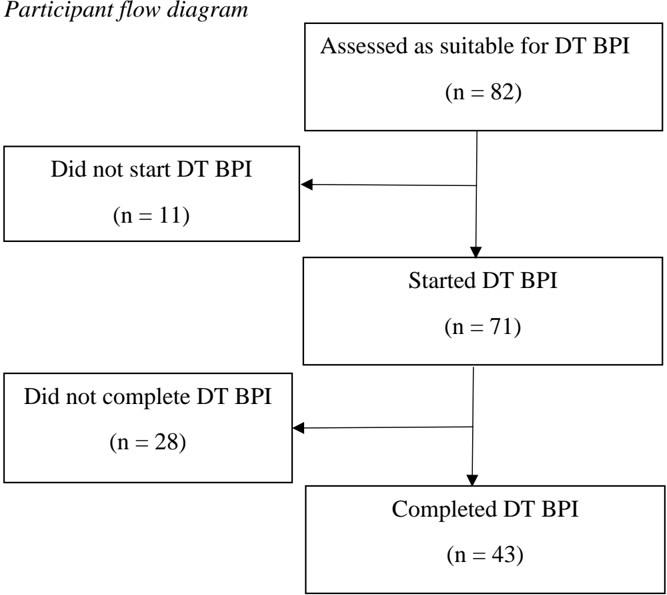
- Of 82 consecutive clients allocated to DT BPI, 39.4% did not complete the intervention; among non-starters, the documented reasons were disengagement (81.8%) or accessing another service (18.2%).
- Among the 43 completers, paired t-tests showed significant pre-post improvements on all reported measures: DTS, \(t_{26} = -2.934, p = .007, d = -0.56\); DERS, \(t_{22} = 3.448, p = .002, d = 0.72\); GAD-7, \(t_{38} = 4.956, p < .001, d = 0.79\); PHQ-9, \(t_{38} = 4.150, p < .001, d = 0.66\); SWEMWBS, \(t_{33} = -7.262, p < .001, d = -1.25\); WSAS, \(t_{26} = 2.078, p = .048, d = 0.40\).
- Reliable improvement among completers was reported for 46.2% on DTS, 36.4% on DERS, 51.4% on GAD-7, 46.0% on PHQ-9, 65.7% on SWEMWBS, and 34.6% on WSAS; clinically significant improvement was 38.5%, 22.7%, 27.0%, 18.9%, 31.4%, and 11.5%, respectively.
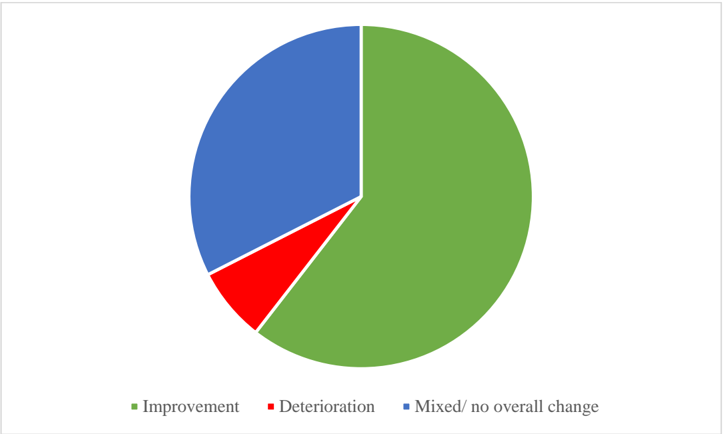
- Overall reliable change across measures showed 60.5% of completers improved overall, 7.0% deteriorated overall, and 32.5% had no reliable change or mixed change.
Methods
- Within-subject repeated-measures service evaluation comparing pre- and post-intervention questionnaire scores.
- Sample: 82 consecutive adult clients referred to DT BPI across two secondary care multidisciplinary community mental health teams (March 2017 to March 2018); 43 completed the intervention.
- Main analyses: comparisons of starters/non-starters and completers/non-completers, paired-sample t-tests for pre-post change among completers, and reliable/clinical change calculations using Jacobson and Truax methods.
Limitations
- The paper states there was no control group, so causality cannot be established.
- The paper states there was a high rate of missing data and a 39.4% non-completion rate; it also notes lack of long-term follow-up.
- The paper states the sample was mostly female, especially among completers, limiting generalisability; it also notes the DTS clinical/non-clinical norms used for clinically significant change were not ideal.
- Evident from the text: outcomes are based on completers only, so the reported benefits may overestimate effectiveness for all referred clients.
Model-written summary. Check it against the paper before relying on it.
Integrity signals
Registry
Cites
Statistics
Figures
Verification
Claims the paper makes
6 Valid · 2 Not valid · 18 Not checked · 41 Own results and interpretations
Every source the paper cites for this claim was checked and supports it.
In the paper
“Similarly, inability to tolerate distress may be a maintaining factor in Post-Traumatic Stress Disorder (PTSD), as distress intolerance has been found to be associated with global PTSD symptom severity (Vujanovic et al. 2013).”
What the sources say
- Supportedcites Vujanovic et al. 2013 matched to “Main and interactive effects of distress tolerance and negative affect intensity in relation to PTSD symptoms among trauma-exposed adults” (2013) source
The Abstract reports that lower distress tolerance was associated with greater global PTSD symptom severity in 190 trauma-exposed community adults. The Discussion describes distress tolerance as a candidate factor for PTSD maintenance, while noting that further research is needed; the citing sentence's 'may' preserves that uncertainty. Page numbers were not provided in our copy. (LLM, conf=0.93)
hedgedstates a possible cause- Asserted: passes — The authors put it forward as true.
- Checkable: passes — It can be checked against evidence.
- Load-bearing: passes — The paper’s conclusions depend on it.
- Based: passes — The paper gives a reason why it holds.
- Rests on an assumption not shown here.
- Supported
Every source the paper cites for this claim was checked and supports it.
In the paper
“A study investigating Cognitive Behaviour Therapy (CBT) for depression found that patients with lower initial distress tolerance scores had higher symptomatology at baseline and post-treatment (Williams et al. 2013).”
What the sources say
- Supportedcites Williams et al. 2013 matched to “The impact of psychological distress tolerance in the treatment of depression” (2013) source
The Study 1 results state that patients with low baseline distress tolerance had higher PHQ9 depression and K10 psychological-distress scores both before and after internet-based CBT than patients with high distress tolerance. The discussion likewise says that patients with lower DTS scores entered and completed treatment with higher depression scores. (LLM, conf=0.94)
plainstates an association- Asserted: passes — The authors put it forward as true.
- Checkable: passes — It can be checked against evidence.
- Load-bearing: passes — The paper’s conclusions depend on it.
- Based: passes — The paper gives a reason why it holds.
- Supported
Every source the paper cites for this claim was checked and supports it.
In the paper
“Increased skills use has been statistically shown to be a mechanism for change in suicidal behaviour, depression and anger control (Neacsiu et al. 2010).”
What the sources say
- Supportedcites Neacsiu et al. 2010 matched to “Dialectical behavior therapy skills use as a mediator and outcome of treatment for borderline personality disorder” (2010) source
The Results report that increased DBT skills use mediated the decrease in suicide attempts. The Discussion reports full mediation of the decrease in depression and the increase in anger control, matching the three outcomes attributed to the paper. (LLM, conf=0.94)
boostedstates a cause- Asserted: passes — The authors put it forward as true.
- Checkable: passes — It can be checked against evidence.
- Load-bearing: passes — The paper’s conclusions depend on it.
- Based: passes — The paper gives a reason why it holds.
- Supported
A result the paper reports from its own data — it cites no other source for it, so there is none to check. The quote shows it is in the paper.
In the paper
“Results suggest that the intervention was associated with significant improvements in distress tolerance, mood, anxiety and wellbeing.”
- Also stated in: § Table 4. Pre and post intervention measures for participants who completed the intervention to be positioned here · plain
“There were significant differences between the pre and post intervention scores on all measures in the direction of improvement and reduced symptoms (a higher score indicates greater wellbeing on the SWEMWBS and greater ability to tolerate distress on the DTS).”
- Also stated in: § Discussion · hedged
“Data showed significant differences pre-post intervention on all measures, indicating improvements in distress tolerance, anxiety, mood, wellbeing and functioning.”
plainstates an associationn = 43 ·- Asserted: passes — The authors put it forward as true.
- Checkable: passes — It can be checked against evidence.
- Load-bearing: passes — The paper’s conclusions depend on it.
- Based: passes — The paper gives a reason why it holds.
- Also stated in: § Table 4. Pre and post intervention measures for participants who completed the intervention to be positioned here · plain
A result the paper reports from its own data — it cites no other source for it, so there is none to check. The quote shows it is in the paper.
In the paper
“PHQ-9 (n=39) | 18.44 (4.77) | 14.31 (6.38) | t 38 = 4.150, p <.001 | d = 0.66 (medium)”
plainn = 39 ·- Asserted: passes — The authors put it forward as true.
- Checkable: passes — It can be checked against evidence.
- Load-bearing: passes — The paper’s conclusions depend on it.
- Based: passes — The paper gives a reason why it holds.
28 more claims
Create a free account to see all 67 claims and every source verdict.
- Probably not a substantial claim. 20
- It may state two separate claims as one. 16
- The quote only partly states this claim. 5
Citations
Cites
The PHQ-9: Validity of a brief depression severity measure
Kroenke, K., Spitzer, R. L., & Williams, J. B. W. (2001) · Journal of General Internal Medicine · doi:10.1046/j.1525-1497.2001.016009606.x · Cited by 44,910
Gratz, K. L., & Roemer, L. (2004) · Journal of Psychopathology and Behavioral Assessment · doi:10.1023/b:joba.0000007455.08539.94 · Cited by 8,942 · cited 1×
“The Difficulties in Emotion Regulation Scale (DERS; Gratz and Roemer, 2004) has 36 items, and higher scores indicate more problems with emotion regulation.”
BackgroundJacobson, N. S., & Truax, P. (1991) · Journal of Consulting and Clinical Psychology · doi:10.1037/0022-006x.59.1.12 · Cited by 7,770
Löwe, B., Decker, O., Müller, S., Brähler, E., Schellberg, D., Herzog, W., & Herzberg, P. Y. (2008) · Medical Care · doi:10.1097/mlr.0b013e318160d093 · Cited by 4,527 · cited 1×
“It has evidence of validity and good internal consistency (Löwe et al., 2008).”
BackgroundThe Work and Social Adjustment Scale: a simple measure of impairment in functioning
Mundt, J. C., Marks, I. M., Shear, M. K., & Greist, J. M. (2002) · British Journal of Psychiatry · doi:10.1192/bjp.180.5.461 · Cited by 2,515
(1993) · Medical Entomology and Zoology · Cited by 2,491
The Distress Tolerance Scale: Development and Validation of a Self-Report Measure
Simons, J. S., & Gaher, R. M. (2005) · Motivation and Emotion · doi:10.1007/s11031-005-7955-3 · Cited by 1,730
Löwe, B., Kroenke, K., Herzog, W., & Gräfe, K. (2004) · Journal of Affective Disorders · doi:10.1016/s0165-0327(03)00198-8 · Cited by 1,558 · cited 1×
“It is sensitive to change over time (Löwe et al., 2004).”
Background(2014) · Cited by 1,541
A meta-analysis of psychotherapy dropout
Wierzbicki, M., & Pekarik, G. (1993) · Professional Psychology: Research and Practice · doi:10.1037/0735-7028.24.2.190 · Cited by 1,118
Bjureberg, J., Ljótsson, B., Tull, M. T., Hedman, E., Sahlin, H., Lundh, L.-G., Bjärehed, J., DiLillo, D., Messman-Moore, T., Gumpert, C. H., et al. (2016) · Journal of Psychopathology and Behavioral Assessment · doi:10.1007/s10862-015-9514-x · Cited by 1,081 · cited 1×
“Healthy norms for the DERS were taken from a prospective study of emotional dysregulation (Bjureberg et al., 2016); clinical norms were taken from an out-patient sample (Hallion et al.”
MethodPremature discontinuation in adult psychotherapy: A meta-analysis
Swift, J. K., & Greenberg, R. P. (2012) · Journal of Consulting and Clinical Psychology · doi:10.1037/a0028226 · Cited by 978 · cited 1×
“Overall reliable change. by meta-analyses have decreased over time, from 47% (Wierzbicki and Pekarik, 1993) to 19.7% (Swift and Greenberg, 2012).”
BackgroundInfluentialNaturalistic Follow-up of a Behavioral Treatment for Chronically Parasuicidal Borderline Patients
Linehan, M. M. (1993) · Archives of General Psychiatry · doi:10.1001/archpsyc.1993.01820240055007 · Cited by 910
Mackenzie, C. S., Gekoski, W. L., & Knox, V. J. (2006) · Aging & Mental Health · doi:10.1080/13607860600641200 · Cited by 878 · cited 2×
“…include negative attitudes related to psychological openness and less favourable intentions to seek help from mental health professionals in men than women (Mackenzie et al., 2006) and gender differences in coping strategies and preferences for psychological treatment (Liddon et al., 2018).”
BackgroundNock, M. K., & Mendes, W. B. (2008) · Journal of Consulting and Clinical Psychology · doi:10.1037/0022-006x.76.1.28 · Cited by 572
Ng Fat, L., Scholes, S., Boniface, S., Mindell, J., & Stewart-Brown, S. (2017) · Quality of Life Research · doi:10.1007/s11136-016-1454-8 · Cited by 548
An experimental investigation of emotion dysregulation in borderline personality disorder
Gratz, K. L., Rosenthal, M. Z., Tull, M. T., Lejuez, C. W., & Gunderson, J. G. (2006) · Journal of Abnormal Psychology · doi:10.1037/0021-843x.115.4.850 · Cited by 518
Hallion, L. S., Steinman, S. A., Tolin, D. F., & Diefenbach, G. J. (2018) · Frontiers in Psychology · doi:10.3389/fpsyg.2018.00539 · Cited by 464
Neacsiu, A. D., Rizvi, S. L., & Linehan, M. M. (2010) · Behaviour Research and Therapy · doi:10.1016/j.brat.2010.05.017 · Cited by 426
Liddon, L., Kingerlee, R., & Barry, J. A. (2018) · British Journal of Clinical Psychology · doi:10.1111/bjc.12147 · Cited by 387 · cited 1×
“, 2006) and gender differences in coping strategies and preferences for psychological treatment (Liddon et al., 2018).”
BackgroundJacobson, N. S., & Truax, P. (1992) · Methodological issues & strategies in clinical research. · doi:10.1037/10109-042 · Cited by 384
Enhancing recovery rates: Lessons from year one of IAPT
Gyani, A., Shafran, R., Layard, R., & Clark, D. M. (2013) · Behaviour Research and Therapy · doi:10.1016/j.brat.2013.06.004 · Cited by 345
Soler, J., Pascual, J. C., Tiana, T., Cebrià, A., Barrachina, J., Campins, M. J., Gich, I., Alvarez, E., & Pérez, V. (2009) · Behaviour Research and Therapy · doi:10.1016/j.brat.2009.01.013 · Cited by 267
Fowler, J. C., Charak, R., Elhai, J. D., Allen, J. G., Frueh, B. C., & Oldham, J. M. (2014) · Journal of Psychiatric Research · doi:10.1016/j.jpsychires.2014.07.029 · Cited by 216 · cited 1×
“Excellent internal consistency and good construct validity have also been found (Fowler et al., 2014).”
BackgroundIntegrating DBT-based techniques and concepts to facilitate exposure treatment for PTSD
Becker, C. B., & Zayfert, C. (2001) · Cognitive and Behavioral Practice · doi:10.1016/s1077-7229(01)80017-1 · Cited by 138
Iverson, K. M., Follette, V. M., Pistorello, J., & Fruzzetti, A. E. (2012) · Personality Disorders: Theory, Research, and Treatment · doi:10.1037/a0023703 · Cited by 133
Group therapy for incarcerated women who experienced interpersonal violence: A pilot study
Bradley, R. G., & Follingstad, D. R. (2003) · Journal of Traumatic Stress · doi:10.1023/a:1024409817437 · Cited by 130 · cited 3×
“There is a growing body of evidence that targeting these skills directly may be beneficial for specific diagnoses (e.g. Bradley and Follingstad, 2003; Harley et al., 2007).”
BackgroundEnhanced Anger Reactivity and Reduced Distress Tolerance in Major Depressive Disorder
Ellis, A. J., Vanderlind, W. M., & Beevers, C. G. (2013) · Cognitive Therapy and Research · doi:10.1007/s10608-012-9494-z · Cited by 99 · cited 1×
“Higher emotional reactivity and lower DT have been found in depression compared with healthy controls (Ellis et al., 2013).”
ResultVaingankar, J. A., Abdin, E., Chong, S. A., Sambasivam, R., Seow, E., Jeyagurunathan, A., Picco, L., Stewart-Brown, S., & Subramaniam, M. (2017) · Health and Quality of Life Outcomes · doi:10.1186/s12955-017-0728-3 · Cited by 96
Vujanovic, A. A., Hart, A. S., Potter, C. M., Berenz, E. C., Niles, B., & Bernstein, A. (2013) · Journal of Psychopathology and Behavioral Assessment · doi:10.1007/s10862-012-9325-2 · Cited by 88 · cited 1×
“Similarly, inability to tolerate distress may be a maintaining factor in post-traumatic stress disorder (PTSD), as distress intolerance has been found to be associated with global PTSD symptom severity (Vujanovic et al., 2013).”
BackgroundAllan, N. P., Macatee, R. J., Norr, A. M., & Schmidt, N. B. (2014) · Cognitive Therapy and Research · doi:10.1007/s10608-014-9623-y · Cited by 78
The impact of psychological distress tolerance in the treatment of depression
Williams, A. D., Thompson, J., & Andrews, G. (2013) · Behaviour Research and Therapy · doi:10.1016/j.brat.2013.05.005 · Cited by 77 · cited 1×
“A study investigating cognitive behaviour therapy (CBT) for depression found that patients with lower initial distress tolerance (DT) © British Association for Behavioural and Cognitive Psychotherapies 2020 scores had higher symptomatology at baseline and post-treatment (Williams et al., 2013).”
BackgroundBartram, D. J., Sinclair, J. M., & Baldwin, D. S. (2013) · Quality of Life Research · doi:10.1007/s11136-012-0144-4 · Cited by 76
Low intensity cognitive behavioural therapy for psychosis: A pilot study
Waller, H., Garety, P. A., Jolley, S., Fornells‐Ambrojo, M., Kuipers, E., Onwumere, J., Woodall, A., Emsley, R., & Craig, T. (2012) · Journal of Behavior Therapy and Experimental Psychiatry · doi:10.1016/j.jbtep.2012.07.013 · Cited by 68
Brooks Holliday, S., Pedersen, E. R., & Leventhal, A. M. (2016) · Drug and Alcohol Dependence · doi:10.1016/j.drugalcdep.2016.02.030 · Cited by 63
Harley, R. M., Baity, M. R., Blais, M. A., & Jacobo, M. C. (2007) · Psychotherapy Research · doi:10.1080/10503300600830710 · Cited by 56 · cited 10×
“There is a growing body of evidence that targeting these skills directly may be beneficial for specific diagnoses (e.g. Bradley and Follingstad, 2003; Harley et al., 2007).”
BackgroundInfluentialAnestis, M. D., Gratz, K. L., Bagge, C. L., & Tull, M. T. (2012) · Comprehensive Psychiatry · doi:10.1016/j.comppsych.2012.04.004 · Cited by 55 · cited 1×
“Distress intolerance can lead to ineffective attempts to regulate emotional arousal which may create new problems (Linehan, 1993; Saulsman and Nathan, 2012) and this includes self-destructive coping strategies such as self-harm and suicidal behaviour (Anestis et al., 2012).”
BackgroundDistress tolerance and experiential avoidance in compulsive acquisition behaviours
Williams, A. D. (2012) · Australian Journal of Psychology · doi:10.1111/j.1742-9536.2012.00055.x · Cited by 39
Do Indicated Preventive Interventions for Depression Represent Good Value for Money?
Mihalopoulos, C., Vos, T., Pirkis, J., Smit, F., & Carter, R. (2011) · Australian & New Zealand Journal of Psychiatry · doi:10.3109/00048674.2010.501024 · Cited by 37
Bostick, G. P. (2017) · The Spine Journal · doi:10.1016/j.spinee.2017.07.006 · Cited by 36
Dimensions of distress tolerance and the moderating effects on mindfulness-based stress reduction
Gawrysiak, M. J., Leong, S. H., Grassetti, S. N., Wai, M., Shorey, R. C., & Baime, M. J. (2016) · Anxiety, Stress, & Coping · doi:10.1080/10615806.2015.1085513 · Cited by 34
Dell'Osso, L., Carmassi, C., Corsi, M., Pergentini, I., Socci, C., Maremmani, A. G., & Perugi, G. (2011) · Annals of General Psychiatry · doi:10.1186/1744-859x-10-29 · Cited by 32
Lessard, M.-J., Marchand, A., Pelland, M.-È., Belleville, G., Vadeboncoeur, A., Chauny, J.-M., Poitras, J., Dupuis, G., Fleet, R., Foldes-Busque, G., et al. (2012) · Behavioural and Cognitive Psychotherapy · doi:10.1017/s1352465811000506 · Cited by 32
Hill, R. J., McKernan, L. C., Wang, L., & Coronado, R. A. (2017) · Journal of Manual & Manipulative Therapy · doi:10.1080/10669817.2017.1323608 · Cited by 25
Russell, B. S., Lincoln, C. R., & Starkweather, A. R. (2018) · Journal of Holistic Nursing · doi:10.1177/0898010118777327 · Cited by 24
Yardley, P., McCall, A., Savage, A., & Newton, R. (2019) · Australasian Psychiatry · doi:10.1177/1039856219848835 · Cited by 21
Cunningham, M. L., Szabó, M., Rodgers, R. F., Franko, D. L., Eddy, K. T., Thomas, J. J., Murray, S. B., & Griffiths, S. (2020) · Body Image · doi:10.1016/j.bodyim.2020.03.004 · Cited by 18
Roberts, K., Travers-Hill, E., Coker, S., Troup, J., Casey, S., Parkin, K., & Kim, Y. (2021) · The Cognitive Behaviour Therapist · doi:10.1017/s1754470x21000258 · Cited by 11 · cited 1×
“Efficacy of the other BPIs (anxiety management and behavioural activation) has been reported separately (Roberts et al., 2018).”
BackgroundSelf-citationDistress Intolerance in Relation to Reliance on Cigarettes for Weight, Shape, and Appetite Control
Burr, E. K., O’Keeffe, B., Kibbey, M. M., Coniglio, K., Leyro, T. M., & Farris, S. G. (2020) · International Journal of Behavioral Medicine · doi:10.1007/s12529-020-09858-9 · Cited by 8
Difficulties in Emotion Regulation Scale-16
Bjureberg, J., Ljótsson, B., Tull, M. T., Hedman‐Lagerlöf, E., Sahlin, H., Lundh, L., Bjärehed, J., DiLillo, D., Messman‐Moore, T. L., Gumpert, C. H., et al. (2016) · PsycTESTS Dataset · doi:10.1037/t57299-000 · Cited by 8
Levy, H. C., Wanklyn, S. G., Voluse, A. C., & Connolly, K. M. (2018) · Military Psychology · doi:10.1080/08995605.2018.1478548 · Cited by 7
Garner, E., Gillmore, C., & Lomax, C. L. (2016) · The Cognitive Behaviour Therapist · doi:10.1017/s1754470x16000015 · Cited by 1
Research works printed but not linked: 2
- Brosan, 2017, An Introduction to Coping with Extreme Emotions: A Guide to Borderline or Emotionally Unstable Personality Disorder.
- Allan N.P., Macatee R.J., Norr A.M., & Schmidt N.B. (2014). Direct and interactive effects of distress tolerance and anxiety sensitivity on generalized anxiety and depression. Cognitive Therapy and Research 38 , 530-540. · DOI · Paper page
Cited by
Mattingley, S., Youssef, G. J., Manning, V., Graeme, L., & Hall, K. (2022) · Journal of Affective Disorders · doi:10.1016/j.jad.2021.12.126 · Cited by 65
Rippon, D., Shepherd, J., Wakefield, S., Lee, A., & Pollet, T. V. (2022) · Journal of Mental Health · doi:10.1080/09638237.2022.2069695 · Cited by 74
A mixed methods study of an online intervention to reduce perfectionism
Visvalingam, S., McHardy, H. L., Norder, S. J., Magson, N. R., & Norberg, M. M. (2022) · Current Psychology · doi:10.1007/s12144-022-02953-y · Cited by 25
Reductions in Distress Intolerance via Intervention: A Review
Heiland, A. M., & Veilleux, J. C. (2023) · Cognitive Therapy and Research · doi:10.1007/s10608-023-10425-1 · Cited by 16
“…spanning multiple sessions ( n = 13; Bloom et al., 2020; Bornovalova et al., 2012; Brown et al., 2014, 2018; Correa, 2020; Kraemer et al., 2016; Lotan et al., 2013; Macatee and Cougle, 2015; Macatee et al., 2021; McHugh et al., 2014; Otto et al., 2020; Wright et al., 2020; Yardley et al., 2019).”
InfluentialRoberts, K., Travers-Hill, E., Coker, S., Troup, J., Casey, S., Parkin, K., & Kim, Y. (2021) · The Cognitive Behaviour Therapist · doi:10.1017/s1754470x21000258 · Cited by 11
“However, recent studies have shown that BPIs can be effective in reducing symptomatology in secondary care services (e.g. Wright et al., 2020), in reducing suicide risk in emergency departments (see synthesis by McCabe et al., 2018), and for the treatment of eating disorders in non-underweight…”
BackgroundSelf-citation
Metadata
- Authors
- Wright, I., Travers-Hill, E., Gracey, F., Troup, J., Parkin, K., Casey, S., & Kim, Y.
- Affiliations
- University of East Anglia (GB)
- Cambridgeshire and Peterborough NHS Foundation Trust (GB)
- Venue
- The Cognitive Behaviour Therapist
- Publisher
- Cambridge University Press (CUP)
- Published
- 2020
- Volume
- 13
- ISSN
- 1754-470X (ISSN-L)
- OpenAlex
- W3098191212
- Cited by
- 16
- References
- 46
- Citations by year
- 2026: 4 · 2025: 3 · 2024: 1 · 2023: 2 · 2022: 5 · 2021: 1
- FWCI
- 0.79
- Type
- journal article
- Language
- en
- Open access
- green
- ueaeprints.uea.ac.uk
- Locations
- The Cognitive Behaviour Therapist (publishedVersion)
- UEA Digital Repository (University of East Anglia) (submittedVersion)
- Topics
- Social Sciences › Psychology › Clinical Psychology › Personality Disorders and Psychopathology
- Social Sciences › Psychology › Clinical Psychology › Psychotherapy Techniques and Applications
- Social Sciences › Psychology › Experimental and Cognitive Psychology › Anxiety, Depression, Psychometrics, Treatment, Cognitive Processes
- Keywords
- distress tolerance, distress intolerance, brief psychological intervention, community mental health, transdiagnostic treatment, borderline personality disorder, post-traumatic stress disorder, mood, anxiety, well-being, cost-effective interventions
About these checks
Registry, retraction, Cites and statistics results are computed, not judged, with one exception: a printed reference that no index lists is read once by a model before it counts as a citation error. Claims are extracted by a model and kept only when their quote appears verbatim in the text; each cited source is then checked, with a model’s help, for whether it says what the claim relies on. Those verdicts can be wrong — read the claim’s quote and the cited source before relying on one.
A language model drew the claims from the paper on 2026-10-11, under version 3 of the claim definition (model deepseek-v4.1-flash, prompt extract-v3).
A second model labelled each claim on 2026-10-11 (model jev-1.13-20260917, definition revision gold-guideline-v0.2).
Cited sources are checked with a language model’s help (gpt-6-sol).
Statistics and arithmetic are recomputed, not judged.
Confidence bands are shown only for fields calibrated on our annotated test set. None is calibrated yet, so no band is shown.
What counts as a claim ›How we measure confidence ›How we check this ›
Are you an author, or do you see a problem with this page? Request a review
Data sources
Bibliographic data: Semantic Scholar, OpenAlex, Crossref.
Contains information from the Semantic Scholar Academic Graph Datasets, made available under the ODC Attribution License (ODC-BY 1.0).
Semantic Scholar’s data is described in: Kinney, R., et al. (2023). The Semantic Scholar Open Data Platform. arXiv:2301.10140.
