

The DOI matches its Crossref record; 74 of the 74 references it cites were found in a registry or an index; none of the 36 sources its claims cite is checked for support yet.
Facile and Green Synthesis of Novel Fluorescent Carbon Quantum Dots and Their Silver Heterostructure: An In Vitro Anticancer Activity and Imaging on Colorectal Carcinoma
Open accessAbstract
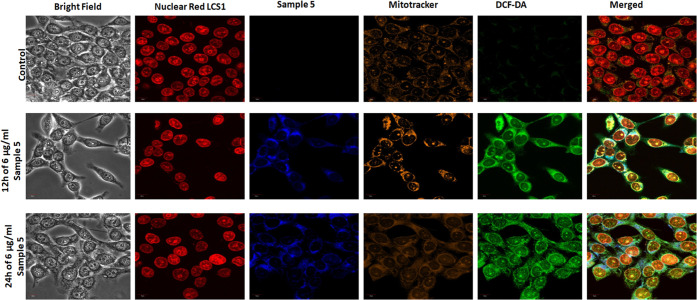
High Resolution Image Download MS PowerPoint Slide Carbon dots (CQDs) have been widely investigated as prime candidates for developing a tumor theranostic platform due to their tunable fluorescence emission and excitation, high water solubility, good photostability, and biocompatibility. Among the CQDs, natural CQDs are an emerging class of nanomaterials in the carbon family. Herein, highly fluorescent carbon quantum dots (CQDs) were synthesized from orange juice using a one-step hydrothermal method and characterized by different techniques. After that, CQD/Ag heterostructures were synthesized by the reduction of silver salt, in particular silver nitrate (AgNO 3 ) solution using sodium borohydride (NaBH 4 ) in different ratios. The photostability and characterization of CQD/Ag heterostructures were investigated. At last, a comparative cellular toxicity measurement was done to select the superior CQD/Ag heterostructure in the human colorectal carcinoma (HCT 116) cell line along with the imaging property. The detailed cell death signaling was also observed in the HCT 116 cell line via the ROS-dependent mitochondrial-mediated pathway, where Akt (RAC-α serine/threonine-protein kinase) played a important role.
Overview
AI snapshot
Written from the paper’s full text.
TL;DR
Carbon quantum dots (CQDs) were synthesized from orange juice by a one-step hydrothermal method and converted into CQD/Ag heterostructures. Sample 5 at 6 μg/mL induced >60% death in HCT 116 colorectal carcinoma cells via ROS-dependent mitochondrial apoptosis and also showed fluorescence imaging potential.
Key findings
- CQDs showed UV absorption at 271 nm and photoluminescence emission at 467 nm with excitation at 415.8 nm; TEM gave an average diameter of ~12 nm and amorphous character, while CQD/Ag heterostructures had an average diameter of ~10 nm and crystalline HRTEM features.
- CQD/Ag heterostructures (samples 1–5) showed surface plasmon resonance around 450 nm; TCSPC lifetimes decreased across samples 1–5, with T1 = 2.24, 2.17, 2.08, 1.99, and 1.96 ns and T2 = 8.96, 8.69, 8.34, 7.96, and 7.86 ns, respectively.
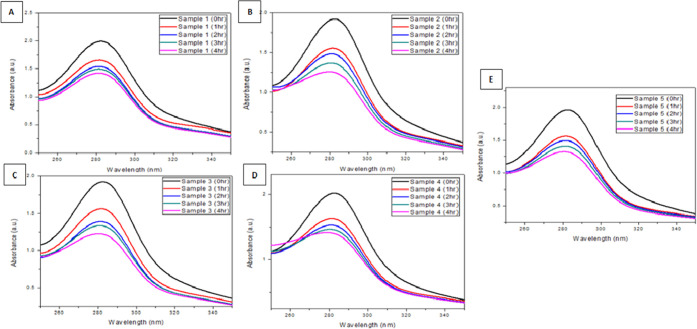
- Under 4 h UV exposure, samples degraded by a maximum of 37% and a minimum of 29%, which the authors describe as promising for cellular imaging.
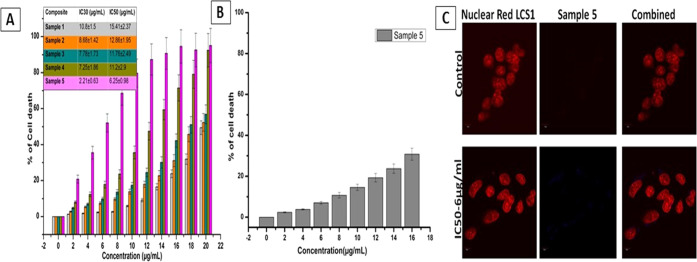
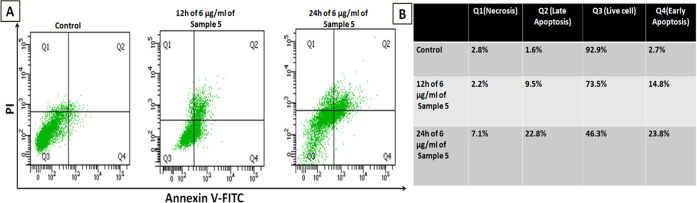
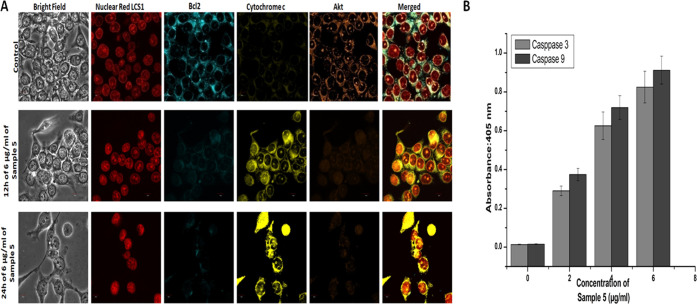
- MTT assays showed sample 5 at 6 μg/mL induced >60% HCT 116 cell death (p < 0.01), whereas samples 1–4 required 20, 18, 14, and 12 μg/mL, respectively; Annexin-V/PI flow cytometry showed 24.3% apoptotic cells after 12 h (14.8% early, 9.5% late) and 46.4% after 24 h (22.8% early, 23.6% late), with only 2.2% necrotic cells at 12 h. Caspase 3 and 9 activity increased significantly (p < 0.01), and cytochrome c increased while Bcl2 and Akt decreased.
Methods
- CQDs were synthesized by mixing orange juice with 2-propanol and heating at 120 °C for 2.5 h; CQD/Ag heterostructures were made by reducing AgNO3 with NaBH4 in different ratios at 120 °C for 2.5 h, yielding samples 1–5.
- Characterization included UV–vis, photoluminescence, FTIR, TEM/HRTEM/SAED, FESEM-EDX elemental mapping, TCSPC, and photostability measurements.
- In vitro studies used HCT 116, HEK 293, and BJ-5ta cells with MTT assay, Annexin-V FITC/PI flow cytometry, confocal live-cell imaging, H2DCFDA ROS detection, caspase 3/9 activity assays, and immunofluorescence for BCL2, AKT, and cytochrome c; statistical significance was assessed by ANOVA with p < 0.05.
Limitations
- The paper does not include an explicit limitations section.
- Evident from the text: all anticancer and imaging findings are in vitro only, using HCT 116, HEK 293, and BJ-5ta cell lines, with no in vivo animal or clinical data.
- The text contains minor inconsistencies, such as referring to “lemon juice” in the synthesis section despite using orange juice, and stating that 6 μg/mL of sample 4 was tested in HEK 293 cells while the selected optimal sample was sample 5.
Model-written summary. Check it against the paper before relying on it.
Integrity signals
Registry
Cites
Statistics
Figures
Verification
Claims the paper makes
46 Own result · 25 Own interpretation · 15 Check pending · 11 No full text of the sources · 6 No basis given · 3 Not checked yet · 1 Own method
A result the paper reports from its own data — it cites no other source for it, so there is none to check. The quote shows it is in the paper.
In the paper
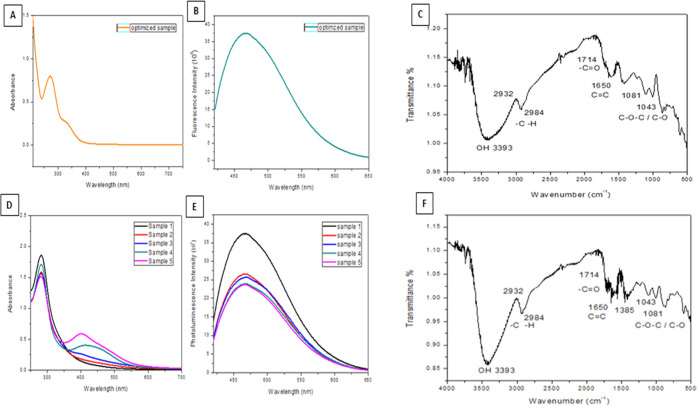
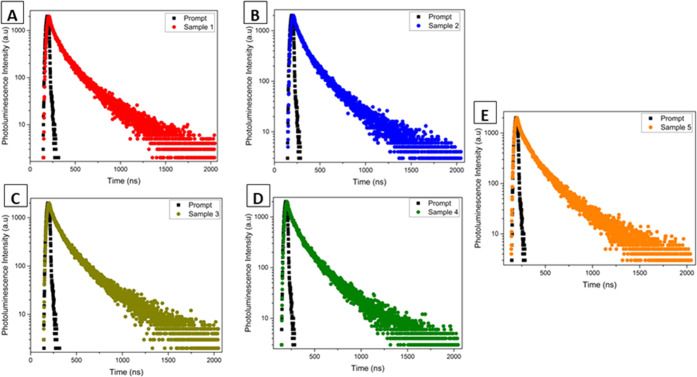
“8.96, 8.69, 8.34, 7.96, and 7.86 ns are the corresponding lifetimes associated with samples 1, 2, 3, 4, and 5, respectively.”
§ Facile and Green Synthesis of Novel Fluorescent Carbon Quantum Dots and Their Silver Heterostructure: An In Vitro Anticancer Activity and Imaging on Colorectal Carcinoma > Results and Discussion > Photoluminescence Decay Profile of the CQD/Ag Heterostructure
plaincorrelationaln = 5- Asserted: passes — The authors put it forward as true.
- Checkable: passes — It can be checked against evidence.
- Load-bearing: passes — The paper’s conclusions depend on it.
- Based: passes — The paper gives a reason why it holds.
A result the paper reports from its own data — it cites no other source for it, so there is none to check. The quote shows it is in the paper.
In the paper
“The photoluminescence spectra (Figure 1B) of CQDs reflected a prominent emission peak at 467 nm with an excitation wavelength of 415.8 nm.”
§ Facile and Green Synthesis of Novel Fluorescent Carbon Quantum Dots and Their Silver Heterostructure: An In Vitro Anticancer Activity and Imaging on Colorectal Carcinoma > Results and Discussion > UV–Visible Absorption and Photoluminescence Property
plain- Asserted: passes — The authors put it forward as true.
- Checkable: passes — It can be checked against evidence.
- Load-bearing: unclear — It is unclear whether the paper’s conclusions depend on it.
- Based: passes — The paper gives a reason why it holds.
A result the paper reports from its own data — it cites no other source for it, so there is none to check. The quote shows it is in the paper.
In the paper
“The results further portrayed a gradual increase in both caspases’ activity with increasing drug concentration.”
§ Facile and Green Synthesis of Novel Fluorescent Carbon Quantum Dots and Their Silver Heterostructure: An In Vitro Anticancer Activity and Imaging on Colorectal Carcinoma > Results and Discussion > Evaluation of the Status of Apoptosis-Modulatory Caspases after Sample 5 Administration
plaindirect- Asserted: passes — The authors put it forward as true.
- Checkable: passes — It can be checked against evidence.
- Load-bearing: passes — The paper’s conclusions depend on it.
- Based: passes — The paper gives a reason why it holds.
A result the paper reports from its own data — it cites no other source for it, so there is none to check. The quote shows it is in the paper.
In the paper
“In the present study, the data depicted a significant amount of reduction in Bcl2 level in the treated groups in comparison with untreated HCT 116 cells (p < 0.05).”
§ Facile and Green Synthesis of Novel Fluorescent Carbon Quantum Dots and Their Silver Heterostructure: An In Vitro Anticancer Activity and Imaging on Colorectal Carcinoma > Results and Discussion > Elevation in the Pro-apoptotic Regulatory Cytochrome c Triggers the Apoptotis Procedure in HCT 116 cells after Sample 5 Treatment
plaindirect- Asserted: passes — The authors put it forward as true.
- Checkable: passes — It can be checked against evidence.
- Load-bearing: passes — The paper’s conclusions depend on it.
- Based: passes — The paper gives a reason why it holds.
A result the paper reports from its own data — it cites no other source for it, so there is none to check. The quote shows it is in the paper.
In the paper
“administration of a lower concentration of sample 5 (0, 2, and 4 μg/mL) was not able to induce a significant amount of cell death within a 24 h experimental tenure.”
§ Facile and Green Synthesis of Novel Fluorescent Carbon Quantum Dots and Their Silver Heterostructure: An In Vitro Anticancer Activity and Imaging on Colorectal Carcinoma > Results and Discussion > Estimation of Effective Remedial Dose of CQD/Ag against Colon Cancer Cells
plain- Asserted: passes — The authors put it forward as true.
- Checkable: passes — It can be checked against evidence.
- Load-bearing: passes — The paper’s conclusions depend on it.
- Based: passes — The paper gives a reason why it holds.
The paper states this without a source or data behind it here, so there is nothing to check it against. The quote shows it is in the paper.
In the paper
“Herein, highly fluorescent carbon quantum dots (CQDs) were synthesized from orange juice using a one-step hydrothermal method and characterized by different techniques.”
§ Facile and Green Synthesis of Novel Fluorescent Carbon Quantum Dots and Their Silver Heterostructure: An In Vitro Anticancer Activity and Imaging on Colorectal Carcinoma > Abstract
plaindirect- Asserted: passes — The authors put it forward as true.
- Checkable: passes — It can be checked against evidence.
- Load-bearing: passes — The paper’s conclusions depend on it.
- Based: passes — The paper gives a reason why it holds.
A result the paper reports from its own data — it cites no other source for it, so there is none to check. The quote shows it is in the paper.
In the paper
“In the current analysis, the data clearly showed a significant amount of reduction of the Akt level in the treated group of cells, especially in the 12 and 24 h sample 5-administered groups.”
§ Facile and Green Synthesis of Novel Fluorescent Carbon Quantum Dots and Their Silver Heterostructure: An In Vitro Anticancer Activity and Imaging on Colorectal Carcinoma > Results and Discussion > Elevation in the Pro-apoptotic Regulatory Cytochrome c Triggers the Apoptotis Procedure in HCT 116 cells after Sample 5 Treatment
boosteddirect- Asserted: passes — The authors put it forward as true.
- Checkable: passes — It can be checked against evidence.
- Load-bearing: passes — The paper’s conclusions depend on it.
- Based: passes — The paper gives a reason why it holds.
A result the paper reports from its own data — it cites no other source for it, so there is none to check. The quote shows it is in the paper.
In the paper
“A similar analysis with noncancerous HEK 293 cells evidently demonstrated that 6 μg/mL of sample 4 administration induces a very negligible [>10%] (p < 0.01) amount of cell death (Figure 6C).”
§ Facile and Green Synthesis of Novel Fluorescent Carbon Quantum Dots and Their Silver Heterostructure: An In Vitro Anticancer Activity and Imaging on Colorectal Carcinoma > Results and Discussion > Estimation of Effective Remedial Dose of CQD/Ag against Colon Cancer Cells
boosteddirect- Asserted: passes — The authors put it forward as true.
- Checkable: passes — It can be checked against evidence.
- Load-bearing: unclear — It is unclear whether the paper’s conclusions depend on it.
- Based: passes — The paper gives a reason why it holds.
- Rests on an assumption: BJ-5ta and HEK 293 cells represent healthy noncancerous cells.
A result the paper reports from its own data — it cites no other source for it, so there is none to check. The quote shows it is in the paper.
In the paper
“but above 12 μg/mL the heterostructure exhibits cell death.”
§ Facile and Green Synthesis of Novel Fluorescent Carbon Quantum Dots and Their Silver Heterostructure: An In Vitro Anticancer Activity and Imaging on Colorectal Carcinoma > Results and Discussion > Estimation of Effective Remedial Dose of CQD/Ag against Colon Cancer Cells
plaindirect- Asserted: passes — The authors put it forward as true.
- Checkable: passes — It can be checked against evidence.
- Load-bearing: passes — The paper’s conclusions depend on it.
- Based: passes — The paper gives a reason why it holds.
A result the paper reports from its own data — it cites no other source for it, so there is none to check. The quote shows it is in the paper.
In the paper
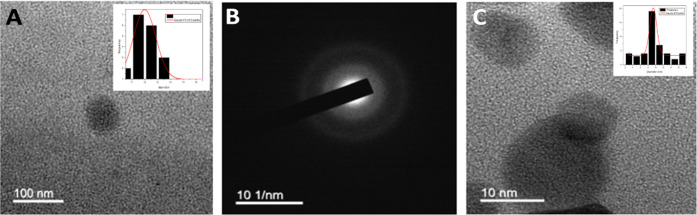
“The high-resolution TEM (HRTEM) images of single particles are amorphous in nature.”
§ Facile and Green Synthesis of Novel Fluorescent Carbon Quantum Dots and Their Silver Heterostructure: An In Vitro Anticancer Activity and Imaging on Colorectal Carcinoma > Results and Discussion > FESEM-EDX and TEM Analysis
plain- Asserted: passes — The authors put it forward as true.
- Checkable: passes — It can be checked against evidence.
- Load-bearing: unclear — It is unclear whether the paper’s conclusions depend on it.
- Based: passes — The paper gives a reason why it holds.
- The quote only partly states this claim. 3
- It may state two separate claims as one. 36
- Probably not a substantial claim. 24
A result the paper reports from its own data — it cites no other source for it, so there is none to check. The quote shows it is in the paper.
In the paper
“while samples 1, 2, 3, and 4 displayed similar effects at notably higher concentrations of 20, 18, 14, and 12 μg/mL, respectively (p < 0.01).”
§ Facile and Green Synthesis of Novel Fluorescent Carbon Quantum Dots and Their Silver Heterostructure: An In Vitro Anticancer Activity and Imaging on Colorectal Carcinoma > Results and Discussion > Estimation of Effective Remedial Dose of CQD/Ag against Colon Cancer Cells
plaindirect- Asserted: passes — The authors put it forward as true.
- Checkable: passes — It can be checked against evidence.
- Load-bearing: passes — The paper’s conclusions depend on it.
- Based: passes — The paper gives a reason why it holds.
The quote only partly states this claim.
The paper states this without a source or data behind it here, so there is nothing to check it against. The quote shows it is in the paper.
In the paper
“The intensity of the greenish-blue emission decreased for the CQD/Ag heterostructure with no change in peak position.”
§ Facile and Green Synthesis of Novel Fluorescent Carbon Quantum Dots and Their Silver Heterostructure: An In Vitro Anticancer Activity and Imaging on Colorectal Carcinoma > Results and Discussion > UV–Visible Absorption and Photoluminescence Property
plain- Asserted: passes — The authors put it forward as true.
- Checkable: passes — It can be checked against evidence.
- Load-bearing: unclear — It is unclear whether the paper’s conclusions depend on it.
- Based: passes — The paper gives a reason why it holds.
It may state two separate claims as one.
In the paper
“The data displayed a surface plasmon resonance peak at 450 nm, which is consistent with the results obtained by Hyosung Choi et al.52”
§ Facile and Green Synthesis of Novel Fluorescent Carbon Quantum Dots and Their Silver Heterostructure: An In Vitro Anticancer Activity and Imaging on Colorectal Carcinoma > Results and Discussion > UV–Visible Absorption and Photoluminescence Property
What the sources say
- Not checked — no full text of the sourcecites [52] source
plaincorrelational- Asserted: passes — The authors put it forward as true.
- Checkable: passes — It can be checked against evidence.
- Load-bearing: unclear — It is unclear whether the paper’s conclusions depend on it.
- Based: passes — The paper gives a reason why it holds.
It may state two separate claims as one.
A result the paper reports from its own data — it cites no other source for it, so there is none to check. The quote shows it is in the paper.
In the paper
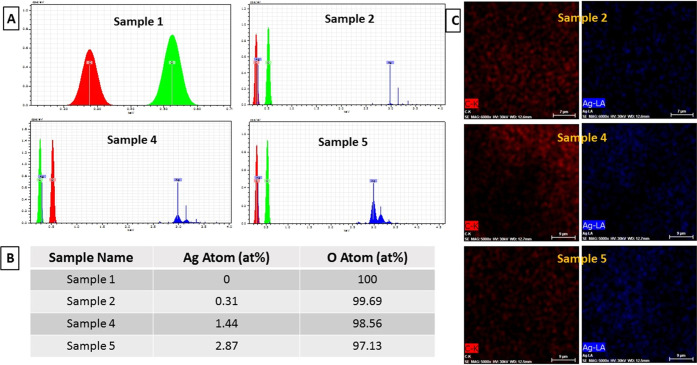
“No other elements were observed in the results of elemental analysis; hence, it proves that the sample was prepared in pure.”
§ Facile and Green Synthesis of Novel Fluorescent Carbon Quantum Dots and Their Silver Heterostructure: An In Vitro Anticancer Activity and Imaging on Colorectal Carcinoma > Results and Discussion > FESEM-EDX and TEM Analysis
boosteddirect- Asserted: passes — The authors put it forward as true.
- Checkable: passes — It can be checked against evidence.
- Load-bearing: unclear — It is unclear whether the paper’s conclusions depend on it.
- Based: passes — The paper gives a reason why it holds.
It may state two separate claims as one.
A result the paper reports from its own data — it cites no other source for it, so there is none to check. The quote shows it is in the paper.
In the paper
“In the case of the CQD/Ag heterostructure (Figure 1F), a sharp peak centered at 1650 cm–1 was also obtained. The appearance of a broad peak centered at 3300–3500 cm–1 (O–H vibrational stretch), a sharp peak at 1708 cm–1 (C=O vibrational stretch), and peaks at 1081 and 1043 cm–1 (C–O–C/C–O vibrational stretch) suggested the existence of carboxylate and hydroxyl groups on the surfaces.”
§ Facile and Green Synthesis of Novel Fluorescent Carbon Quantum Dots and Their Silver Heterostructure: An In Vitro Anticancer Activity and Imaging on Colorectal Carcinoma > Results and Discussion > FTIR Spectroscopy
hedgedcorrelational- Asserted: passes — The authors put it forward as true.
- Checkable: passes — It can be checked against evidence.
- Load-bearing: unclear — It is unclear whether the paper’s conclusions depend on it.
- Based: passes — The paper gives a reason why it holds.
It may state two separate claims as one.
A result the paper reports from its own data — it cites no other source for it, so there is none to check. The quote shows it is in the paper.
In the paper
“MTT analysis suggested that administration of 6, 8, 10, 12, 14, 16, 18, and 20 μg/mL concentrations of samples 1–5 for 24 h can induce more than 50% of cell death”
§ Facile and Green Synthesis of Novel Fluorescent Carbon Quantum Dots and Their Silver Heterostructure: An In Vitro Anticancer Activity and Imaging on Colorectal Carcinoma > Results and Discussion > Estimation of Effective Remedial Dose of CQD/Ag against Colon Cancer Cells
hedgeddirect- Asserted: passes — The authors put it forward as true.
- Checkable: passes — It can be checked against evidence.
- Load-bearing: passes — The paper’s conclusions depend on it.
- Based: passes — The paper gives a reason why it holds.
The quote only partly states this claim.
A result the paper reports from its own data — it cites no other source for it, so there is none to check. The quote shows it is in the paper.
In the paper
“Meanwhile, in the morphological investigation as shown in Figure 3A, the TEM images of CQDs prepared from the orange juice extract reveal that they had uniform dispersion without apparent aggregation and all of them are spherical in shape.”
§ Facile and Green Synthesis of Novel Fluorescent Carbon Quantum Dots and Their Silver Heterostructure: An In Vitro Anticancer Activity and Imaging on Colorectal Carcinoma > Results and Discussion > FESEM-EDX and TEM Analysis
plain- Asserted: passes — The authors put it forward as true.
- Checkable: passes — It can be checked against evidence.
- Load-bearing: unclear — It is unclear whether the paper’s conclusions depend on it.
- Based: passes — The paper gives a reason why it holds.
It may state two separate claims as one.
A result the paper reports from its own data — it cites no other source for it, so there is none to check. The quote shows it is in the paper.
In the paper
“Confocal microscopical analysis portrayed a significant increase in cytochrome c level and its cytoplasmic localization after 12 h of sample 5 treatment, while the increase was extremely high after 24 h of treatment schedule.”
§ Facile and Green Synthesis of Novel Fluorescent Carbon Quantum Dots and Their Silver Heterostructure: An In Vitro Anticancer Activity and Imaging on Colorectal Carcinoma > Results and Discussion > Elevation in the Pro-apoptotic Regulatory Cytochrome c Triggers the Apoptotis Procedure in HCT 116 cells after Sample 5 Treatment
plaindirect- Asserted: passes — The authors put it forward as true.
- Checkable: passes — It can be checked against evidence.
- Load-bearing: passes — The paper’s conclusions depend on it.
- Based: passes — The paper gives a reason why it holds.
It may state two separate claims as one.
A result the paper reports from its own data — it cites no other source for it, so there is none to check. The quote shows it is in the paper.
In the paper
“Annexin-V/PI staining followed by flow-cytometric study demonstrated 24.3% (14.8% early apoptotic and 9.5% late apoptotic) cells after 12 h of drug administration, whereas only 2.2% of the cell population were in the necrotic quadrate.”
§ Facile and Green Synthesis of Novel Fluorescent Carbon Quantum Dots and Their Silver Heterostructure: An In Vitro Anticancer Activity and Imaging on Colorectal Carcinoma > Results and Discussion > Exploration of Cell Death at the Lowest Effective Dose of Sample 5 in Colon Cancer Cells
boosteddirect- Asserted: passes — The authors put it forward as true.
- Checkable: passes — It can be checked against evidence.
- Load-bearing: passes — The paper’s conclusions depend on it.
- Based: passes — The paper gives a reason why it holds.
It may state two separate claims as one.
A result the paper reports from its own data — it cites no other source for it, so there is none to check. The quote shows it is in the paper.
In the paper
“The absorbance plots of all of the samples in Figure 5 A–E showed that the absorbance center wavelength and the absorbance peak remained unaffected, whereas the absorbance intensity reduced to less than 40% after 4 h of exposure compared to the native intensity.”
§ Facile and Green Synthesis of Novel Fluorescent Carbon Quantum Dots and Their Silver Heterostructure: An In Vitro Anticancer Activity and Imaging on Colorectal Carcinoma > Results and Discussion > Photostability Study
plaindirectSingle case- Asserted: passes — The authors put it forward as true.
- Checkable: passes — It can be checked against evidence.
- Load-bearing: passes — The paper’s conclusions depend on it.
- Based: passes — The paper gives a reason why it holds.
It may state two separate claims as one.
A result the paper reports from its own data — it cites no other source for it, so there is none to check. The quote shows it is in the paper.
In the paper
“In addition, CQDs showed a broad band in between 3300 and 3500 cm–1 due to the O–H stretching vibration and three sharp peaks at 1708, 1081, and 1043 cm–1 assigned to C=O, C–O–-C, and C–O stretching vibrations, which confirmed the existence of carboxylate and hydroxyl groups on the surfaces.”
§ Facile and Green Synthesis of Novel Fluorescent Carbon Quantum Dots and Their Silver Heterostructure: An In Vitro Anticancer Activity and Imaging on Colorectal Carcinoma > Results and Discussion > FTIR Spectroscopy
plaindirect- Asserted: passes — The authors put it forward as true.
- Checkable: passes — It can be checked against evidence.
- Load-bearing: passes — The paper’s conclusions depend on it.
- Based: passes — The paper gives a reason why it holds.
It may state two separate claims as one.
The paper states this without a source or data behind it here, so there is nothing to check it against. The quote shows it is in the paper.
In the paper
“Here the “O” atom assigned to the surface-adsorbed oxygen arose from the experimental sample preparation condition.”
§ Facile and Green Synthesis of Novel Fluorescent Carbon Quantum Dots and Their Silver Heterostructure: An In Vitro Anticancer Activity and Imaging on Colorectal Carcinoma > Results and Discussion > FESEM-EDX and TEM Analysis
plaindirect- Asserted: passes — The authors put it forward as true.
- Checkable: passes — It can be checked against evidence.
- Load-bearing: fails — The paper’s conclusions may not depend on it.
- Based: fails — The paper may give no reason why it holds.
Probably not a substantial claim. The paper’s conclusions may not depend on it. The paper may give no reason why it holds.
A result the paper reports from its own data — it cites no other source for it, so there is none to check. The quote shows it is in the paper.
In the paper
“In our study, the results depicted that administration of our drug suppresses cell survivability in a significant manner.”
§ Facile and Green Synthesis of Novel Fluorescent Carbon Quantum Dots and Their Silver Heterostructure: An In Vitro Anticancer Activity and Imaging on Colorectal Carcinoma > Results and Discussion > Elevation in the Pro-apoptotic Regulatory Cytochrome c Triggers the Apoptotis Procedure in HCT 116 cells after Sample 5 Treatment
plaindirect- Asserted: passes — The authors put it forward as true.
- Checkable: passes — It can be checked against evidence.
- Load-bearing: passes — The paper’s conclusions depend on it.
- Based: passes — The paper gives a reason why it holds.
The quote only partly states this claim.
A result the paper reports from its own data — it cites no other source for it, so there is none to check. The quote shows it is in the paper.
In the paper
“In Figure 3C, the TEM images of the CQD/Ag heterostructure prepared from the orange juice extract reveal that they have uniform dispersion without apparent aggregation and all of them are spherical in shape.”
§ Facile and Green Synthesis of Novel Fluorescent Carbon Quantum Dots and Their Silver Heterostructure: An In Vitro Anticancer Activity and Imaging on Colorectal Carcinoma > Results and Discussion > FESEM-EDX and TEM Analysis
plain- Asserted: passes — The authors put it forward as true.
- Checkable: passes — It can be checked against evidence.
- Load-bearing: unclear — It is unclear whether the paper’s conclusions depend on it.
- Based: passes — The paper gives a reason why it holds.
It may state two separate claims as one.
A result the paper reports from its own data — it cites no other source for it, so there is none to check. The quote shows it is in the paper.
In the paper
“Additionally, it had been observed that the intensity of the Ag atom in the images gradually increases with increasing Ag concentration, which further confirmed the enhancement of Ag from sample 2 to sample 5.”
§ Facile and Green Synthesis of Novel Fluorescent Carbon Quantum Dots and Their Silver Heterostructure: An In Vitro Anticancer Activity and Imaging on Colorectal Carcinoma > Results and Discussion > FESEM-EDX and TEM Analysis
plaindirectn = 2- Asserted: passes — The authors put it forward as true.
- Checkable: passes — It can be checked against evidence.
- Load-bearing: unclear — It is unclear whether the paper’s conclusions depend on it.
- Based: passes — The paper gives a reason why it holds.
It may state two separate claims as one.
A result the paper reports from its own data — it cites no other source for it, so there is none to check. The quote shows it is in the paper.
In the paper
“its colocalization with Mitotracker Orange, a fluorescence marker specialized for denoting mitochondria, and sample 5 indicated a significant level of mitochondrial penetrance of the said CQD (Figure 9) as compared with the control HEK 293 cells (Figure 6C).”
§ Facile and Green Synthesis of Novel Fluorescent Carbon Quantum Dots and Their Silver Heterostructure: An In Vitro Anticancer Activity and Imaging on Colorectal Carcinoma > Results and Discussion > Elevation in the Pro-apoptotic Regulatory Cytochrome c Triggers the Apoptotis Procedure in HCT 116 cells after Sample 5 Treatment
hedgedcorrelational- Asserted: passes — The authors put it forward as true.
- Checkable: passes — It can be checked against evidence.
- Load-bearing: passes — The paper’s conclusions depend on it.
- Based: passes — The paper gives a reason why it holds.
It may state two separate claims as one.
A result the paper reports from its own data — it cites no other source for it, so there is none to check. The quote shows it is in the paper.
In the paper
“Surprisingly, our results also showed an unaltered control cell population and did not show any significant effect on the HEK 293 cell line.”
§ Facile and Green Synthesis of Novel Fluorescent Carbon Quantum Dots and Their Silver Heterostructure: An In Vitro Anticancer Activity and Imaging on Colorectal Carcinoma > Results and Discussion > Elevation in the Pro-apoptotic Regulatory Cytochrome c Triggers the Apoptotis Procedure in HCT 116 cells after Sample 5 Treatment
plain- Asserted: passes — The authors put it forward as true.
- Checkable: passes — It can be checked against evidence.
- Load-bearing: passes — The paper’s conclusions depend on it.
- Based: passes — The paper gives a reason why it holds.
It may state two separate claims as one.
A conclusion the paper draws from its own results — it cites no other source for it, so there is none to check. The quote shows it is in the paper.
In the paper
“From the figure, it is found that the SPR peak was at around 450 nm for all of the samples, which confirmed the proposed CQD/Ag heterostructure formation.”
§ Facile and Green Synthesis of Novel Fluorescent Carbon Quantum Dots and Their Silver Heterostructure: An In Vitro Anticancer Activity and Imaging on Colorectal Carcinoma > Results and Discussion > UV–Visible Absorption and Photoluminescence Property
plaindirect- Asserted: passes — The authors put it forward as true.
- Checkable: passes — It can be checked against evidence.
- Load-bearing: passes — The paper’s conclusions depend on it.
- Based: passes — The paper gives a reason why it holds.
It may state two separate claims as one.
In the paper
“Several studies show augmented expression of antiapoptotic proteins like Akt, PKC, and Bcl2 in colorectal cancer tumors.67”
§ Facile and Green Synthesis of Novel Fluorescent Carbon Quantum Dots and Their Silver Heterostructure: An In Vitro Anticancer Activity and Imaging on Colorectal Carcinoma > Results and Discussion > Elevation in the Pro-apoptotic Regulatory Cytochrome c Triggers the Apoptotis Procedure in HCT 116 cells after Sample 5 Treatment
What the sources say
- Not checked yetcites [67] source
plaincorrelational- Asserted: passes — The authors put it forward as true.
- Checkable: passes — It can be checked against evidence.
- Load-bearing: fails — The paper’s conclusions may not depend on it.
- Based: passes — The paper gives a reason why it holds.
Probably not a substantial claim. The paper’s conclusions may not depend on it.
A conclusion the paper draws from its own results — it cites no other source for it, so there is none to check. The quote shows it is in the paper.
In the paper
“The data from Table 2 suggested that the lifetimes of radiative transitions and lifetimes of nonradiative transitions are both reduced subsequently, which indicates the electron transfer between the carbon dots and silver nanoparticles.”
§ Facile and Green Synthesis of Novel Fluorescent Carbon Quantum Dots and Their Silver Heterostructure: An In Vitro Anticancer Activity and Imaging on Colorectal Carcinoma > Results and Discussion > Photoluminescence Decay Profile of the CQD/Ag Heterostructure
hedgeddirectn = 5- Asserted: passes — The authors put it forward as true.
- Checkable: passes — It can be checked against evidence.
- Load-bearing: passes — The paper’s conclusions depend on it.
- Based: passes — The paper gives a reason why it holds.
It may state two separate claims as one.
A conclusion the paper draws from its own results — it cites no other source for it, so there is none to check. The quote shows it is in the paper.
In the paper
“The optical properties of the CQDs vary with size, which could also result in the variation in density and nature of sp2 sites available in the CQDs.”
§ Facile and Green Synthesis of Novel Fluorescent Carbon Quantum Dots and Their Silver Heterostructure: An In Vitro Anticancer Activity and Imaging on Colorectal Carcinoma > Results and Discussion > UV–Visible Absorption and Photoluminescence Property
hedgedconditional- Asserted: passes — The authors put it forward as true.
- Checkable: passes — It can be checked against evidence.
- Load-bearing: fails — The paper’s conclusions may not depend on it.
- Based: passes — The paper gives a reason why it holds.
Probably not a substantial claim. The paper’s conclusions may not depend on it. It may state two separate claims as one.
In the paper
“While the main organic acids are malic, citric, and ascorbic, the most important sugars are glucose, sucrose, and fructose.”
§ Facile and Green Synthesis of Novel Fluorescent Carbon Quantum Dots and Their Silver Heterostructure: An In Vitro Anticancer Activity and Imaging on Colorectal Carcinoma > Introduction
plain- Asserted: passes — The authors put it forward as true.
- Checkable: passes — It can be checked against evidence.
- Load-bearing: fails — The paper’s conclusions may not depend on it.
- Based: passes — The paper gives a reason why it holds.
Probably not a substantial claim. The paper’s conclusions may not depend on it. It may state two separate claims as one.
In the paper
“Nowadays, naturally occurring phytochemicals and secondary metabolites are widely used in therapeutics due to their specificity and tissue-protective nature.21”
§ Facile and Green Synthesis of Novel Fluorescent Carbon Quantum Dots and Their Silver Heterostructure: An In Vitro Anticancer Activity and Imaging on Colorectal Carcinoma > Introduction
What the sources say
- Not checked — no full text of the sourcecites [21] source
plaindirect- Asserted: passes — The authors put it forward as true.
- Checkable: passes — It can be checked against evidence.
- Load-bearing: fails — The paper’s conclusions may not depend on it.
- Based: passes — The paper gives a reason why it holds.
Probably not a substantial claim. The paper’s conclusions may not depend on it.
In the paper
“According to many researchers, caspases play a cardinal role in the apoptosis procedure.59”
§ Facile and Green Synthesis of Novel Fluorescent Carbon Quantum Dots and Their Silver Heterostructure: An In Vitro Anticancer Activity and Imaging on Colorectal Carcinoma > Results and Discussion > Evaluation of the Status of Apoptosis-Modulatory Caspases after Sample 5 Administration
What the sources say
- Check pendingcites [59] source
boosteddirect- Asserted: passes — The authors put it forward as true.
- Checkable: passes — It can be checked against evidence.
- Load-bearing: passes — The paper’s conclusions depend on it.
- Based: passes — The paper gives a reason why it holds.
Probably not a substantial claim.
In the paper
“The cytochrome c–caspase 9 axis plays a guardian role in programmed cell death by inducing factors of the intrinsic apoptotic pathway.62”
§ Facile and Green Synthesis of Novel Fluorescent Carbon Quantum Dots and Their Silver Heterostructure: An In Vitro Anticancer Activity and Imaging on Colorectal Carcinoma > Results and Discussion > Elevation in the Pro-apoptotic Regulatory Cytochrome c Triggers the Apoptotis Procedure in HCT 116 cells after Sample 5 Treatment
What the sources say
- Not checked — no full text of the sourcecites [62] source
plaindirect- Asserted: passes — The authors put it forward as true.
- Checkable: passes — It can be checked against evidence.
- Load-bearing: passes — The paper’s conclusions depend on it.
- Based: passes — The paper gives a reason why it holds.
Probably not a substantial claim.
In the paper
“Caspase 3, which is an executioner caspase, can be activated by the initiator caspase, Caspase 9-appropriate intrinsic cues.60”
§ Facile and Green Synthesis of Novel Fluorescent Carbon Quantum Dots and Their Silver Heterostructure: An In Vitro Anticancer Activity and Imaging on Colorectal Carcinoma > Results and Discussion > Evaluation of the Status of Apoptosis-Modulatory Caspases after Sample 5 Administration
What the sources say
- Not checked — no full text of the sourcecites [60] source
plaindirect- Asserted: passes — The authors put it forward as true.
- Checkable: passes — It can be checked against evidence.
- Load-bearing: fails — The paper’s conclusions may not depend on it.
- Based: passes — The paper gives a reason why it holds.
Probably not a substantial claim. The paper’s conclusions may not depend on it.
In the paper
“Activated by intrinsic cues like elevated reactive oxygen species (ROS) level, cytochrome c is released from the mitochondria to cytoplasm and induces apoptotic process by targeting initiator caspases.63”
§ Facile and Green Synthesis of Novel Fluorescent Carbon Quantum Dots and Their Silver Heterostructure: An In Vitro Anticancer Activity and Imaging on Colorectal Carcinoma > Results and Discussion > Elevation in the Pro-apoptotic Regulatory Cytochrome c Triggers the Apoptotis Procedure in HCT 116 cells after Sample 5 Treatment
What the sources say
- Check pendingcites [63] source
plaindirect- Asserted: passes — The authors put it forward as true.
- Checkable: passes — It can be checked against evidence.
- Load-bearing: passes — The paper’s conclusions depend on it.
- Based: passes — The paper gives a reason why it holds.
Probably not a substantial claim. It may state two separate claims as one.
A conclusion the paper draws from its own results — it cites no other source for it, so there is none to check. The quote shows it is in the paper.
In the paper
“Therefore, it may be said that our drug induced apoptosis in the colon cancer cell line by attenuating the Akt-BCL2 axis and also turned on the Cytochrome c-mediated intrinsic apoptosis pathway.”
§ Facile and Green Synthesis of Novel Fluorescent Carbon Quantum Dots and Their Silver Heterostructure: An In Vitro Anticancer Activity and Imaging on Colorectal Carcinoma > Results and Discussion > Elevation in the Pro-apoptotic Regulatory Cytochrome c Triggers the Apoptotis Procedure in HCT 116 cells after Sample 5 Treatment
hedgeddirect- Asserted: passes — The authors put it forward as true.
- Checkable: passes — It can be checked against evidence.
- Load-bearing: passes — The paper’s conclusions depend on it.
- Based: passes — The paper gives a reason why it holds.
It may state two separate claims as one.
In the paper
“Recent studies have also suggested that berberine attenuates cancer cell proliferation by restricting the cell cycle and inducing the apoptotic process.39”
§ Facile and Green Synthesis of Novel Fluorescent Carbon Quantum Dots and Their Silver Heterostructure: An In Vitro Anticancer Activity and Imaging on Colorectal Carcinoma > Results and Discussion > Estimation of Effective Remedial Dose of CQD/Ag against Colon Cancer Cells
What the sources say
- Not checked — no full text of the sourcecites [39] source
hedgeddirect- Asserted: passes — The authors put it forward as true.
- Checkable: passes — It can be checked against evidence.
- Load-bearing: fails — The paper’s conclusions may not depend on it.
- Based: passes — The paper gives a reason why it holds.
Probably not a substantial claim. The paper’s conclusions may not depend on it. It may state two separate claims as one.
In the paper
“According to Wang et al., berberine, a small isoquinoline alkaloid, shows its therapeutic efficacy on diarrhea, and bacterial and fungal diseases.56”
§ Facile and Green Synthesis of Novel Fluorescent Carbon Quantum Dots and Their Silver Heterostructure: An In Vitro Anticancer Activity and Imaging on Colorectal Carcinoma > Results and Discussion > Estimation of Effective Remedial Dose of CQD/Ag against Colon Cancer Cells
What the sources say
- Check pendingcites [56] source
plaindirect- Asserted: passes — The authors put it forward as true.
- Checkable: passes — It can be checked against evidence.
- Load-bearing: fails — The paper’s conclusions may not depend on it.
- Based: passes — The paper gives a reason why it holds.
Probably not a substantial claim. The paper’s conclusions may not depend on it. It may state two separate claims as one.
In the paper
“Clinical studies have shown overexpression of Akt in various types of cancer, especially in colorectal cancer.65”
§ Facile and Green Synthesis of Novel Fluorescent Carbon Quantum Dots and Their Silver Heterostructure: An In Vitro Anticancer Activity and Imaging on Colorectal Carcinoma > Results and Discussion > Elevation in the Pro-apoptotic Regulatory Cytochrome c Triggers the Apoptotis Procedure in HCT 116 cells after Sample 5 Treatment
What the sources say
- Not checked yetcites [65] source
plaincorrelational- Asserted: passes — The authors put it forward as true.
- Checkable: passes — It can be checked against evidence.
- Load-bearing: fails — The paper’s conclusions may not depend on it.
- Based: passes — The paper gives a reason why it holds.
Probably not a substantial claim. The paper’s conclusions may not depend on it.
In the paper
“Additional factors influencing the absorbance of samples are pH and ionic strength of the solvent, leading to changes in the surface status of the CQDs.54”
§ Facile and Green Synthesis of Novel Fluorescent Carbon Quantum Dots and Their Silver Heterostructure: An In Vitro Anticancer Activity and Imaging on Colorectal Carcinoma > Results and Discussion > Photostability Study
What the sources say
- Not checked — no full text of the sourcecites [54] source
plaindirect- Asserted: passes — The authors put it forward as true.
- Checkable: passes — It can be checked against evidence.
- Load-bearing: fails — The paper’s conclusions may not depend on it.
- Based: passes — The paper gives a reason why it holds.
Probably not a substantial claim. The paper’s conclusions may not depend on it.
In the paper
“There are also some reports that have demonstrated that silver nanoparticles have anticancer potential.23”
§ Facile and Green Synthesis of Novel Fluorescent Carbon Quantum Dots and Their Silver Heterostructure: An In Vitro Anticancer Activity and Imaging on Colorectal Carcinoma > Introduction
What the sources say
- Check pendingcites [23] source
boostedconditional- Asserted: passes — The authors put it forward as true.
- Checkable: passes — It can be checked against evidence.
- Load-bearing: passes — The paper’s conclusions depend on it.
- Based: passes — The paper gives a reason why it holds.
Probably not a substantial claim.
What the paper did — it cites no source for this, so there is none to check. The quote shows it is in the paper.
In the paper
“This was also demonstrated in a repetition of the experiment.”
§ Facile and Green Synthesis of Novel Fluorescent Carbon Quantum Dots and Their Silver Heterostructure: An In Vitro Anticancer Activity and Imaging on Colorectal Carcinoma > Results and Discussion > UV–Visible Absorption and Photoluminescence Property
boosted- Asserted: passes — The authors put it forward as true.
- Checkable: passes — It can be checked against evidence.
- Load-bearing: fails — The paper’s conclusions may not depend on it.
- Based: passes — The paper gives a reason why it holds.
Probably not a substantial claim. The paper’s conclusions may not depend on it.
In the paper
“Increase in the caspase 9 level is mainly controlled by various apoptotic pathways.61”
§ Facile and Green Synthesis of Novel Fluorescent Carbon Quantum Dots and Their Silver Heterostructure: An In Vitro Anticancer Activity and Imaging on Colorectal Carcinoma > Results and Discussion > Elevation in the Pro-apoptotic Regulatory Cytochrome c Triggers the Apoptotis Procedure in HCT 116 cells after Sample 5 Treatment
What the sources say
- Not checked — no full text of the sourcecites [61] Brattain M. G., 1981, Cancer Res.
plaindirect- Asserted: passes — The authors put it forward as true.
- Checkable: passes — It can be checked against evidence.
- Load-bearing: fails — The paper’s conclusions may not depend on it.
- Based: passes — The paper gives a reason why it holds.
Probably not a substantial claim. The paper’s conclusions may not depend on it.
In the paper
“Bcl2 restricts the mitochondrial localization of cytochrome c and attenuates apoptosis (Figure 8A).”
§ Facile and Green Synthesis of Novel Fluorescent Carbon Quantum Dots and Their Silver Heterostructure: An In Vitro Anticancer Activity and Imaging on Colorectal Carcinoma > Results and Discussion > Elevation in the Pro-apoptotic Regulatory Cytochrome c Triggers the Apoptotis Procedure in HCT 116 cells after Sample 5 Treatment
What the sources say
- Check pendingcites [64] source
plaindirect- Asserted: passes — The authors put it forward as true.
- Checkable: passes — It can be checked against evidence.
- Load-bearing: fails — The paper’s conclusions may not depend on it.
- Based: passes — The paper gives a reason why it holds.
Probably not a substantial claim. The paper’s conclusions may not depend on it. It may state two separate claims as one.
A conclusion the paper draws from its own results — it cites no other source for it, so there is none to check. The quote shows it is in the paper.
In the paper
“The Ag nanoparticles attached over CQDs act as traps for the photogenerated electrons and quench the PL emission.”
§ Facile and Green Synthesis of Novel Fluorescent Carbon Quantum Dots and Their Silver Heterostructure: An In Vitro Anticancer Activity and Imaging on Colorectal Carcinoma > Results and Discussion > UV–Visible Absorption and Photoluminescence Property
plaindirect- Asserted: passes — The authors put it forward as true.
- Checkable: passes — It can be checked against evidence.
- Load-bearing: passes — The paper’s conclusions depend on it.
- Based: passes — The paper gives a reason why it holds.
It may state two separate claims as one.
A claim is checked only against the cited paper’s full text, never its abstract, and none is available for its sources.
In the paper
“Among these, CQDs have become interesting because of their exceptional chemical and physical properties such as thermal and electrical conductivity, high mechanical strength, and their unique optical and fluorescence features.14,15”
§ Facile and Green Synthesis of Novel Fluorescent Carbon Quantum Dots and Their Silver Heterostructure: An In Vitro Anticancer Activity and Imaging on Colorectal Carcinoma > Introduction
What the sources say
plain- Asserted: passes — The authors put it forward as true.
- Checkable: passes — It can be checked against evidence.
- Load-bearing: fails — The paper’s conclusions may not depend on it.
- Based: passes — The paper gives a reason why it holds.
Probably not a substantial claim. The paper’s conclusions may not depend on it. It may state two separate claims as one.
In the paper
“A recent analysis by Liu et al. suggested that heterostructures/hybrid metallic CQDs have more remedial as well as theranostics efficacy than the uni-structure of either metallic NPs or CQDs.57”
§ Facile and Green Synthesis of Novel Fluorescent Carbon Quantum Dots and Their Silver Heterostructure: An In Vitro Anticancer Activity and Imaging on Colorectal Carcinoma > Results and Discussion > Estimation of Effective Remedial Dose of CQD/Ag against Colon Cancer Cells
What the sources say
- Check pendingcites [57] source
hedgeddirect- Asserted: passes — The authors put it forward as true.
- Checkable: passes — It can be checked against evidence.
- Load-bearing: fails — The paper’s conclusions may not depend on it.
- Based: passes — The paper gives a reason why it holds.
Probably not a substantial claim. The paper’s conclusions may not depend on it.
In the paper
“In recent times, available reports have suggested that CQDs exhibit anticancer potential in various types of cancer.22”
§ Facile and Green Synthesis of Novel Fluorescent Carbon Quantum Dots and Their Silver Heterostructure: An In Vitro Anticancer Activity and Imaging on Colorectal Carcinoma > Introduction
What the sources say
- Check pendingcites [22] source
hedgedcorrelational- Asserted: passes — The authors put it forward as true.
- Checkable: passes — It can be checked against evidence.
- Load-bearing: passes — The paper’s conclusions depend on it.
- Based: passes — The paper gives a reason why it holds.
Probably not a substantial claim.
A conclusion the paper draws from its own results — it cites no other source for it, so there is none to check. The quote shows it is in the paper.
In the paper
“The synthesized samples show excellent photostability, degraded up to a maximum of 37 and a minimum of 29%, which is very promising for use as a cellular imaging agent.”
§ Facile and Green Synthesis of Novel Fluorescent Carbon Quantum Dots and Their Silver Heterostructure: An In Vitro Anticancer Activity and Imaging on Colorectal Carcinoma > Results and Discussion > Photostability Study
plainSingle case- Asserted: passes — The authors put it forward as true.
- Checkable: passes — It can be checked against evidence.
- Load-bearing: passes — The paper’s conclusions depend on it.
- Based: passes — The paper gives a reason why it holds.
It may state two separate claims as one.
A conclusion the paper draws from its own results — it cites no other source for it, so there is none to check. The quote shows it is in the paper.
In the paper
“24 h of sample 5 treatment was considered to specifically induce apoptosis, the prime reason for suppression of HCT 116 cell survivability, as evaluated by analyzing the externalization of phosphatidylserine.”
§ Facile and Green Synthesis of Novel Fluorescent Carbon Quantum Dots and Their Silver Heterostructure: An In Vitro Anticancer Activity and Imaging on Colorectal Carcinoma > Results and Discussion > Exploration of Cell Death at the Lowest Effective Dose of Sample 5 in Colon Cancer Cells
plaindirect- Asserted: passes — The authors put it forward as true.
- Checkable: passes — It can be checked against evidence.
- Load-bearing: passes — The paper’s conclusions depend on it.
- Based: passes — The paper gives a reason why it holds.
It may state two separate claims as one.
A conclusion the paper draws from its own results — it cites no other source for it, so there is none to check. The quote shows it is in the paper.
In the paper
“It is also expected that degrading absorbance is a consequence of changes in the structure of functional groups at the surface.”
§ Facile and Green Synthesis of Novel Fluorescent Carbon Quantum Dots and Their Silver Heterostructure: An In Vitro Anticancer Activity and Imaging on Colorectal Carcinoma > Results and Discussion > Photostability Study
hedgedconditional- Asserted: passes — The authors put it forward as true.
- Checkable: passes — It can be checked against evidence.
- Load-bearing: fails — The paper’s conclusions may not depend on it.
- Based: fails — The paper may give no reason why it holds.
Probably not a substantial claim. The paper’s conclusions may not depend on it. The paper may give no reason why it holds.
In the paper
“Researchers have also demonstrated that berberine can induce autophagy and also stops the invasion process as well as metastasis in various types of cancer.57”
§ Facile and Green Synthesis of Novel Fluorescent Carbon Quantum Dots and Their Silver Heterostructure: An In Vitro Anticancer Activity and Imaging on Colorectal Carcinoma > Results and Discussion > Estimation of Effective Remedial Dose of CQD/Ag against Colon Cancer Cells
What the sources say
- Check pendingcites [57] source
boosteddirect- Asserted: passes — The authors put it forward as true.
- Checkable: passes — It can be checked against evidence.
- Load-bearing: fails — The paper’s conclusions may not depend on it.
- Based: passes — The paper gives a reason why it holds.
Probably not a substantial claim. The paper’s conclusions may not depend on it. It may state two separate claims as one.
A conclusion the paper draws from its own results — it cites no other source for it, so there is none to check. The quote shows it is in the paper.
In the paper
“The recombination rate of electrons and holes decreased, which resulted in low PL intensity.”
§ Facile and Green Synthesis of Novel Fluorescent Carbon Quantum Dots and Their Silver Heterostructure: An In Vitro Anticancer Activity and Imaging on Colorectal Carcinoma > Results and Discussion > UV–Visible Absorption and Photoluminescence Property
plaindirect- Asserted: passes — The authors put it forward as true.
- Checkable: passes — It can be checked against evidence.
- Load-bearing: passes — The paper’s conclusions depend on it.
- Based: passes — The paper gives a reason why it holds.
It may state two separate claims as one.
A conclusion the paper draws from its own results — it cites no other source for it, so there is none to check. The quote shows it is in the paper.
In the paper
“The increased cytochrome c expression along with its cytoplasmic localization in a dose-dependent manner indicated drug-induced modulation in pro- and antiapoptotic modulatory proteins as well as its causative inducing mechanism.”
§ Facile and Green Synthesis of Novel Fluorescent Carbon Quantum Dots and Their Silver Heterostructure: An In Vitro Anticancer Activity and Imaging on Colorectal Carcinoma > Results and Discussion > Elevation in the Pro-apoptotic Regulatory Cytochrome c Triggers the Apoptotis Procedure in HCT 116 cells after Sample 5 Treatment
hedgeddirect- Asserted: passes — The authors put it forward as true.
- Checkable: passes — It can be checked against evidence.
- Load-bearing: passes — The paper’s conclusions depend on it.
- Based: passes — The paper gives a reason why it holds.
It may state two separate claims as one.
A conclusion the paper draws from its own results — it cites no other source for it, so there is none to check. The quote shows it is in the paper.
In the paper
“Accumulation of sample 5-mediated mitochondrial ROS played a key therapeutic as well as theranostic role that not only induced apoptosis but also illuminated the fluorescence after entry into HCT 116 cells.”
§ Facile and Green Synthesis of Novel Fluorescent Carbon Quantum Dots and Their Silver Heterostructure: An In Vitro Anticancer Activity and Imaging on Colorectal Carcinoma > Results and Discussion > Elevation in the Pro-apoptotic Regulatory Cytochrome c Triggers the Apoptotis Procedure in HCT 116 cells after Sample 5 Treatment
plaindirect- Asserted: passes — The authors put it forward as true.
- Checkable: passes — It can be checked against evidence.
- Load-bearing: passes — The paper’s conclusions depend on it.
- Based: passes — The paper gives a reason why it holds.
It may state two separate claims as one.
A conclusion the paper draws from its own results — it cites no other source for it, so there is none to check. The quote shows it is in the paper.
In the paper
“Therefore, our drug after entering into mitochondria destabilized its membrane.”
§ Facile and Green Synthesis of Novel Fluorescent Carbon Quantum Dots and Their Silver Heterostructure: An In Vitro Anticancer Activity and Imaging on Colorectal Carcinoma > Results and Discussion > Elevation in the Pro-apoptotic Regulatory Cytochrome c Triggers the Apoptotis Procedure in HCT 116 cells after Sample 5 Treatment
plaindirect- Asserted: passes — The authors put it forward as true.
- Checkable: passes — It can be checked against evidence.
- Load-bearing: passes — The paper’s conclusions depend on it.
- Based: passes — The paper gives a reason why it holds.
It may state two separate claims as one.
A conclusion the paper draws from its own results — it cites no other source for it, so there is none to check. The quote shows it is in the paper.
In the paper
“Moreover, the flow-cytometric data and confocal microscopic images confirmed that the heterostructure showed a strong anticancer potential at 6 μg/mL via the ROS-dependent mitochondrial-mediated apoptosis pathway, where Akt plays an important role.”
§ Facile and Green Synthesis of Novel Fluorescent Carbon Quantum Dots and Their Silver Heterostructure: An In Vitro Anticancer Activity and Imaging on Colorectal Carcinoma > Conclusions
boosteddirect- Asserted: passes — The authors put it forward as true.
- Checkable: passes — It can be checked against evidence.
- Load-bearing: passes — The paper’s conclusions depend on it.
- Based: passes — The paper gives a reason why it holds.
It may state two separate claims as one.
A check of a cited source is scheduled, or we don’t hold its full text yet; the claim is checked once it runs.
In the paper
“Several studies have pointed out that release of cytochrome c in the cytosol requires an ROS-mediated destabilized mitochondrial membrane.72−75”
§ Facile and Green Synthesis of Novel Fluorescent Carbon Quantum Dots and Their Silver Heterostructure: An In Vitro Anticancer Activity and Imaging on Colorectal Carcinoma > Results and Discussion > Elevation in the Pro-apoptotic Regulatory Cytochrome c Triggers the Apoptotis Procedure in HCT 116 cells after Sample 5 Treatment
What the sources say
plaindirect- Asserted: passes — The authors put it forward as true.
- Checkable: passes — It can be checked against evidence.
- Load-bearing: passes — The paper’s conclusions depend on it.
- Based: passes — The paper gives a reason why it holds.
Probably not a substantial claim.
In the paper
“increase in stabilized p53 attenuates the antiapoptotic Bcl2 group of proteins and also restricts cell survival modulatory proteins like Akt.69”
§ Facile and Green Synthesis of Novel Fluorescent Carbon Quantum Dots and Their Silver Heterostructure: An In Vitro Anticancer Activity and Imaging on Colorectal Carcinoma > Results and Discussion > Elevation in the Pro-apoptotic Regulatory Cytochrome c Triggers the Apoptotis Procedure in HCT 116 cells after Sample 5 Treatment
What the sources say
- Not checked — no full text of the sourcecites [69] source
plaindirect- Asserted: passes — The authors put it forward as true.
- Checkable: passes — It can be checked against evidence.
- Load-bearing: passes — The paper’s conclusions depend on it.
- Based: passes — The paper gives a reason why it holds.
It may state two separate claims as one.
In the paper
“ROS-mediated DNA damage induces p53 phosphorylation, which in turn stabilizes p53, indispensable to counter tumorigenic growth and differentiation.68”
§ Facile and Green Synthesis of Novel Fluorescent Carbon Quantum Dots and Their Silver Heterostructure: An In Vitro Anticancer Activity and Imaging on Colorectal Carcinoma > Results and Discussion > Elevation in the Pro-apoptotic Regulatory Cytochrome c Triggers the Apoptotis Procedure in HCT 116 cells after Sample 5 Treatment
What the sources say
- Not checked yetcites [68] source
plaindirect- Asserted: passes — The authors put it forward as true.
- Checkable: passes — It can be checked against evidence.
- Load-bearing: passes — The paper’s conclusions depend on it.
- Based: passes — The paper gives a reason why it holds.
It may state two separate claims as one.
A conclusion the paper draws from its own results — it cites no other source for it, so there is none to check. The quote shows it is in the paper.
In the paper
“The results also clearly suggested that the restriction of HCT 116 survivability by sample 5 was due to the turning on of apoptotic pathways, which was not seen in the control cell lines.”
§ Facile and Green Synthesis of Novel Fluorescent Carbon Quantum Dots and Their Silver Heterostructure: An In Vitro Anticancer Activity and Imaging on Colorectal Carcinoma > Results and Discussion > Elevation in the Pro-apoptotic Regulatory Cytochrome c Triggers the Apoptotis Procedure in HCT 116 cells after Sample 5 Treatment
boosteddirect- Asserted: passes — The authors put it forward as true.
- Checkable: passes — It can be checked against evidence.
- Load-bearing: passes — The paper’s conclusions depend on it.
- Based: passes — The paper gives a reason why it holds.
It may state two separate claims as one.
In the paper
“Studies have also noted that increase in stabilized p53 increases the expression of the pro-apoptotic Bax protein,70 which destabilizes the mitochondrial membrane potential and makes it porous in nature, which in turn augments release of the apoptotic inducer cytochrome C proteins in the cytoplasm.71”
§ Facile and Green Synthesis of Novel Fluorescent Carbon Quantum Dots and Their Silver Heterostructure: An In Vitro Anticancer Activity and Imaging on Colorectal Carcinoma > Results and Discussion > Elevation in the Pro-apoptotic Regulatory Cytochrome c Triggers the Apoptotis Procedure in HCT 116 cells after Sample 5 Treatment
plaindirect- Asserted: passes — The authors put it forward as true.
- Checkable: passes — It can be checked against evidence.
- Load-bearing: passes — The paper’s conclusions depend on it.
- Based: passes — The paper gives a reason why it holds.
Probably not a substantial claim. It may state two separate claims as one.
The paper relies on this without support.
The main constituents of orange juice (sucrose, glucose, fructose, citric acid, and ascorbic acid) carbonize under the hydrothermal synthesis conditions to form CQDs.
“This mechanism mainly involves the carbonization of sucrose, glucose, fructose, citric acid, and ascorbic acid, which are the leading constituents of orange juice.”
The paper relies on this without support.
Orange extract contains a high content of berberine.
“According to reports, the extract of orange contains a high content of berberine, an alkaloid with a high therapeutic application.”
The paper relies on this without support.
BJ-5ta and HEK 293 cells represent healthy noncancerous cells.
“The biocompatibility of sample 5 was also checked in the BJ-5ta cell line (Figure 6B)”
“A similar analysis with noncancerous HEK 293 cells”
Self-check
Percentages, sums and reported differences re-computed from the paper’s own numbers.
Each contradiction between two passages listed here was confirmed by an independent check.
Rated major: it would touch a result — a value a result rests on, reported and recomputed p-values on opposite sides of the significance level, two passages that conflict with no sign which is right, or a cited work retracted before this paper was published.
In the paper
§ Facile and Green Synthesis of Novel Fluorescent Carbon Quantum Dots and Their Silver Heterostructure: An In Vitro Anticancer Activity and Imaging on Colorectal Carcinoma > Experimental Section > Chemicals for Synthesis
“Pulp-free lemon juice was used as a carbon source for CD synthesis.”
§ Facile and Green Synthesis of Novel Fluorescent Carbon Quantum Dots and Their Silver Heterostructure: An In Vitro Anticancer Activity and Imaging on Colorectal Carcinoma > Experimental Section > Synthesis of Carbon Quantum Dots (CQDs) from Orange Juice (OJ)
“Freshly bought oranges from the local market were crushed and the juice was extracted.”
Rated minor: it would not touch a result — a value no result rests on, a p-value that stays on the same side of the significance level, or a conflict that is clerical, resolved elsewhere in the paper, or outside its own findings.
In the paper
§ Facile and Green Synthesis of Novel Fluorescent Carbon Quantum Dots and Their Silver Heterostructure: An In Vitro Anticancer Activity and Imaging on Colorectal Carcinoma > Experimental Section > MTT Assay
“The HCT 116 and HEK 293 cells were plated in a 96-well plate and treated with or without different concentrations of samples 1, 2, 3, 4, and 5 and incubated for 12 h”
§ Facile and Green Synthesis of Novel Fluorescent Carbon Quantum Dots and Their Silver Heterostructure: An In Vitro Anticancer Activity and Imaging on Colorectal Carcinoma > Results and Discussion > Estimation of Effective Remedial Dose of CQD/Ag against Colon Cancer Cells
“MTT analysis suggested that administration of 6, 8, 10, 12, 14, 16, 18, and 20 μg/mL concentrations of samples 1–5 for 24 h can induce more than 50% of cell death”
Rated minor: it would not touch a result — a value no result rests on, a p-value that stays on the same side of the significance level, or a conflict that is clerical, resolved elsewhere in the paper, or outside its own findings.
In the paper
§ Facile and Green Synthesis of Novel Fluorescent Carbon Quantum Dots and Their Silver Heterostructure: An In Vitro Anticancer Activity and Imaging on Colorectal Carcinoma > Conclusions
“The CQD/Ag heterostructure does not show any cytotoxicity to healthy cells”
§ Facile and Green Synthesis of Novel Fluorescent Carbon Quantum Dots and Their Silver Heterostructure: An In Vitro Anticancer Activity and Imaging on Colorectal Carcinoma > Results and Discussion > Estimation of Effective Remedial Dose of CQD/Ag against Colon Cancer Cells
“up to 12 μg/mL sample 5 is biocompatible, but above 12 μg/mL the heterostructure exhibits cell death.”
Rated minor: it would not touch a result — a value no result rests on, a p-value that stays on the same side of the significance level, or a conflict that is clerical, resolved elsewhere in the paper, or outside its own findings.
In the paper
§ Facile and Green Synthesis of Novel Fluorescent Carbon Quantum Dots and Their Silver Heterostructure: An In Vitro Anticancer Activity and Imaging on Colorectal Carcinoma > Results and Discussion > Photostability Study
“the absorbance intensity reduced to less than 40% after 4 h of exposure compared to the native intensity.”
§ Facile and Green Synthesis of Novel Fluorescent Carbon Quantum Dots and Their Silver Heterostructure: An In Vitro Anticancer Activity and Imaging on Colorectal Carcinoma > Results and Discussion > Photostability Study
“The synthesized samples show excellent photostability, degraded up to a maximum of 37 and a minimum of 29%”
Rated minor: it would not touch a result — a value no result rests on, a p-value that stays on the same side of the significance level, or a conflict that is clerical, resolved elsewhere in the paper, or outside its own findings.
In the paper
§ Facile and Green Synthesis of Novel Fluorescent Carbon Quantum Dots and Their Silver Heterostructure: An In Vitro Anticancer Activity and Imaging on Colorectal Carcinoma > Results and Discussion > Estimation of Effective Remedial Dose of CQD/Ag against Colon Cancer Cells
“administration of 6, 8, 10, 12, 14, 16, 18, and 20 μg/mL concentrations of samples 1–5 for 24 h can induce more than 50% of cell death”
§ Facile and Green Synthesis of Novel Fluorescent Carbon Quantum Dots and Their Silver Heterostructure: An In Vitro Anticancer Activity and Imaging on Colorectal Carcinoma > Results and Discussion > Estimation of Effective Remedial Dose of CQD/Ag against Colon Cancer Cells
“samples 1, 2, 3, and 4 displayed similar effects at notably higher concentrations of 20, 18, 14, and 12 μg/mL, respectively”
Citations
Cites
Ror2 signaling regulates Golgi structure and transport through IFT20 for tumor invasiveness
Nishita, M., Park, S.-Y., Nishio, T., Kamizaki, K., Wang, Z., Tamada, K., Takumi, T., Hashimoto, R., Otani, H., Pazour, G. J., et al. (2017) · Scientific Reports · doi:10.1038/s41598-016-0028-x · Cited by 15,947
Apoptosis: A Review of Programmed Cell Death
Elmore, S. (2007) · Toxicologic Pathology · doi:10.1080/01926230701320337 · Cited by 13,853
Mitochondrial Reactive Oxygen Species (ROS) and ROS-Induced ROS Release
Zorov, D. B., Juhaszova, M., & Sollott, S. J. (2014) · Physiological Reviews · doi:10.1152/physrev.00026.2013 · Cited by 5,383
Dekker, E., Tanis, P. J., Vleugels, J. L. A., Kasi, P. M., & Wallace, M. B. (2019) · The Lancet · doi:10.1016/s0140-6736(19)32319-0 · Cited by 5,313
Plant Polyphenols as Dietary Antioxidants in Human Health and Disease
Pandey, K. B., & Rizvi, S. I. (2009) · Oxidative Medicine and Cellular Longevity · doi:10.4161/oxim.2.5.9498 · Cited by 3,942
Activation of apoptosis signalling pathways by reactive oxygen species
Redza-Dutordoir, M., & Averill-Bates, D. A. (2016) · Biochimica et Biophysica Acta (BBA) - Molecular Cell Research · doi:10.1016/j.bbamcr.2016.09.012 · Cited by 3,731
Lung Cancer: Epidemiology, Etiology, and Prevention
Cruz, C. S. D., Tanoue, L. T., & Matthay, R. A. (2011) · Clinics in Chest Medicine · doi:10.1016/j.ccm.2011.09.001 · Cited by 2,561
Extrinsic versus intrinsic apoptosis pathways in anticancer chemotherapy
Fulda, S., & Debatin, K.-M. (2006) · Oncogene · doi:10.1038/sj.onc.1209608 · Cited by 2,312
Colorectal Cancer Epidemiology: Incidence, Mortality, Survival, and Risk Factors
Haggar, F. A., & Boushey, R. P. (2009) · Clinics in Colon and Rectal Surgery · doi:10.1055/s-0029-1242458 · Cited by 2,018
The Role of Mitochondria in Apoptosis
Wang, C., & Youle, R. J. (2009) · Annual Review of Genetics · doi:10.1146/annurev-genet-102108-134850 · Cited by 1,987
Carbon Dots: A New Type of Carbon-Based Nanomaterial with Wide Applications
Liu, J., Li, R., & Yang, B. (2020) · ACS Central Science · doi:10.1021/acscentsci.0c01306 · Cited by 1,936
Sahu, S., Behera, B., Maiti, T. K., & Mohapatra, S. (2012) · Chemical Communications · doi:10.1039/c2cc33796g · Cited by 1,808
Biomedical Applications of Graphene and Graphene Oxide
Chung, C., Kim, Y., Shin, D., Ryoo, S., Hong, B. H., & Min, D. (2013) · Accounts of Chemical Research · doi:10.1021/ar300159f · Cited by 1,708
Comprehensive review of targeted therapy for colorectal cancer
Xie, Y.-H., Chen, Y.-X., & Fang, J.-Y. (2020) · Signal Transduction and Targeted Therapy · doi:10.1038/s41392-020-0116-z · Cited by 1,687
Management and Prevention Strategies for Non-communicable Diseases (NCDs) and Their Risk Factors
Budrevičiūtė, A., Damiati, S., Sabir, D. K., Önder, K., Schuller‐Götzburg, P., Plakys, G., Katileviciute, A., Khoja, S. M., & Kodzius, R. (2020) · Frontiers in Public Health · doi:10.3389/fpubh.2020.574111 · Cited by 1,158
Caspase-9, caspase-3 and caspase-7 have distinct roles during intrinsic apoptosis
Brentnall, M., Rodriguez-Menocal, L., De Guevara, R. L., Cepero, E., & Boise, L. H. (2013) · BMC Cell Biology · doi:10.1186/1471-2121-14-32 · Cited by 1,147
Biomedical Applications of Graphene
Shen, H., Zhang, L., Liu, M., & Zhang, Z. (2012) · Theranostics · doi:10.7150/thno.3642 · Cited by 942
From dead leaves to high energy density supercapacitors
Biswal, M., Banerjee, A., Deo, M. S., & Ogale, S. (2013) · Energy & Environmental Science · doi:10.1039/c3ee22325f · Cited by 903
Carbon-Based Nanomaterials: Multifunctional Materials for Biomedical Engineering
Cha, C., Shin, S. R., Annabi, N., Dokmeci, M. R., & Khademhosseini, A. (2013) · ACS Nano · doi:10.1021/nn401196a · Cited by 833
Mechanisms of Action of Bcl-2 Family Proteins
Shamas-Din, A., Kale, J., Leber, B., & Andrews, D. W. (2013) · Cold Spring Harbor Perspectives in Biology · doi:10.1101/cshperspect.a008714 · Cited by 705
Medicinal applications of fullerenes.
Bakry, R. S., Vallant, R. M., Haq, M. N. U., Rainer, M., Szabo, Z., Huck, C. W., & Bonn, G. K. (2007) · PubMed Central · Cited by 694
Akt/Protein Kinase B Up-regulates Bcl-2 Expression through cAMP-response Element-binding Protein
Pugazhenthi, S., Nesterova, A., Sable, C., Heidenreich, K. A., Boxer, L. M., Heasley, L. E., & Reusch, J. E.-B. (2000) · Journal of Biological Chemistry · doi:10.1074/jbc.275.15.10761 · Cited by 679
Role of p53 in Cell Death and Human Cancers
Ozaki, T., & Nakagawara, A. (2011) · Cancers · doi:10.3390/cancers3010994 · Cited by 650
Multiple Functions of BCL-2 Family Proteins
Hardwick, J. M., & Soane, L. (2013) · Cold Spring Harbor Perspectives in Biology · doi:10.1101/cshperspect.a008722 · Cited by 564
Carbon quantum dots and their biomedical and therapeutic applications: a review
Molaei, M. J. (2019) · RSC Advances · doi:10.1039/c8ra08088g · Cited by 538
Choi, H., Ko, S.-J., Choi, Y., Joo, P., Kim, T., Lee, B. R., Jung, J.-W., Choi, H. J., Cha, M., Jeong, J.-R., et al. (2013) · Nature Photonics · doi:10.1038/nphoton.2013.181 · Cited by 530
Biomedical applications of diamond‐like carbon coatings: A review
Roy, R. K., & Lee, K. (2007) · Journal of Biomedical Materials Research Part B: Applied Biomaterials · doi:10.1002/jbm.b.30768 · Cited by 496
Carbon Nanotubes in Biomedical Applications: Factors, Mechanisms, and Remedies of Toxicity
Alshehri, R. A., Ilyas, A. M., Hasan, A., Arnaout, A., Ahmed, F., & Memić, A. (2016) · Journal of Medicinal Chemistry · doi:10.1021/acs.jmedchem.5b01770 · Cited by 390
One-step microwave-assisted polyol synthesis of green luminescent carbon dots as optical nanoprobes
Liu, Y., Xiao, N., Gong, N., Wang, H., Shi, X., Gu, W., & Ye, L. (2013) · Carbon · doi:10.1016/j.carbon.2013.10.086 · Cited by 366
The advanced role of carbon quantum dots in nanomedical applications
Devi, P., Saini, S., & Kim, K. (2019) · Biosensors and Bioelectronics · doi:10.1016/j.bios.2019.02.059 · Cited by 351
Gu, D., Shang, S., Yu, Q., & Shen, J. (2016) · Applied Surface Science · doi:10.1016/j.apsusc.2016.08.012 · Cited by 325
Caspase-9: structure, mechanisms and clinical application
Li, P., Zhou, L., Zhao, T., Liu, X., Zhang, P., Liu, Y., Zheng, X., & Li, Q. (2017) · Oncotarget · doi:10.18632/oncotarget.15098 · Cited by 319
Teng, X., Ma, C., Ge, C., Yan, M., Yang, J., Zhang, Y., Morais, P. C., & Bi, H. (2014) · Journal of Materials Chemistry B · doi:10.1039/c4tb00368c · Cited by 304
Penniston, K. L., Nakada, S. Y., Holmes, R. P., & Assimos, D. G. (2008) · Journal of Endourology · doi:10.1089/end.2007.0304 · Cited by 302
Gomathi, A. C., Xavier Rajarathinam, S. R., Mohammed Sadiq, A., & Rajeshkumar, S. (2020) · Journal of Drug Delivery Science and Technology · doi:10.1016/j.jddst.2019.101376 · Cited by 262
Carbon dots: a booming material for biomedical applications
Su, W., Wu, H., Xu, H., Zhang, Y., Li, Y., Li, X., & Fan, L. (2019) · Materials Chemistry Frontiers · doi:10.1039/c9qm00658c · Cited by 244
Bhatt, S., Bhatt, M., Kumar, A., Vyas, G., Gajaria, T. K., & Paul, P. (2018) · Colloids and Surfaces B Biointerfaces · doi:10.1016/j.colsurfb.2018.04.008 · Cited by 236
Cancer Targeting and Drug Delivery Using Carbon-Based Quantum Dots and Nanotubes
Pardo, J., Peng, Z., & Leblanc, R. (2018) · Molecules · doi:10.3390/molecules23020378 · Cited by 226
Devaraj, P., Kumari, P., Aarti, C., & Renganathan, A. (2013) · Journal of Nanotechnology · doi:10.1155/2013/598328 · Cited by 208
Green Synthesis of Highly Luminescent Carbon Quantum Dots from Lemon Juice
Hoan, B. T., Tam, P. D., & Pham, V. (2019) · Journal of Nanotechnology · doi:10.1155/2019/2852816 · Cited by 206
Gong, N., Wang, H., Li, S., Deng, Y., Chen, X., Ye, L., & Gu, W. (2014) · Langmuir · doi:10.1021/la502705g · Cited by 200
Arumugham, T., Alagumuthu, M., Amimodu, R. G., Munusamy, S., & Iyer, S. K. (2019) · Sustainable materials and technologies · doi:10.1016/j.susmat.2019.e00138 · Cited by 187
Nguyen, D. D., & Lai, J.-Y. (2022) · Chemical Engineering Journal · doi:10.1016/j.cej.2022.134970 · Cited by 178
Kasibabu, B. S. B., D’souza, S. L., Jha, S. K., & Kailasa, S. K. (2015) · Journal of Fluorescence · doi:10.1007/s10895-015-1595-0 · Cited by 173
Wang, M., Shi, R., Gao, M., Zhang, K., Deng, L., Fu, Q., Wang, L., & Gao, D. (2020) · Food Chemistry · doi:10.1016/j.foodchem.2020.126506 · Cited by 169
Berberine as a potential autophagy modulator
Mohammadinejad, R., Ahmadi, Z., Tavakol, S., & Ashrafizadeh, M. (2019) · Journal of Cellular Physiology · doi:10.1002/jcp.28325 · Cited by 132
Photobleaching and stabilization of carbon nanodots produced by solvothermal synthesis
Wang, W., Damm, C., Walter, J., Nacken, T. J., & Peukert, W. (2016) · Physical Chemistry Chemical Physics · doi:10.1039/c5cp04942c · Cited by 124
Biocompatibility and Bioimaging Potential of Fruit-Based Carbon Dots
Dias, C., Vasimalai, N., Sárria, M. P., Pinheiro, I., Vilas‐Boas, V., Peixoto, J., & Espiña, B. (2019) · Nanomaterials · doi:10.3390/nano9020199 · Cited by 116
Highly adhesive carbon quantum dots from biogenic amines for prevention of biofilm formation
Jian, H.-J., Yu, J., Li, Y.-J., Unnikrishnan, B., Huang, Y.-F., Luo, L.-J., Hui-Kang Ma, D., Harroun, S. G., Chang, H.-T., Lin, H.-J., et al. (2020) · Chemical Engineering Journal · doi:10.1016/j.cej.2019.123913 · Cited by 115
New Insights toward Colorectal Cancer Chemotherapy Using Natural Bioactive Compounds
Redondo-Blanco, S., Fernández, J., Gutiérrez-del-Río, I., Villar, C. J., & Lombó, F. (2017) · Frontiers in Pharmacology · doi:10.3389/fphar.2017.00109 · Cited by 113
Green synthesis of fluorescent carbon dots from carrot juice for in vitro cellular imaging
Liu, Y., Liu, Y., Park, M., Park, S., Zhang, Y., Akanda, M. R., Park, B., & Kim, H. Y. (2017) · Carbon letters · doi:10.5714/cl.2017.21.061 · Cited by 109
Carbonized nanogels for simultaneous antibacterial and antioxidant treatment of bacterial keratitis
Lin, H., Wang, S.-W., Mao, J., Chang, H., Harroun, S. G., Lin, H. ‐., Huang, C., & Lai, J. (2021) · Chemical Engineering Journal · doi:10.1016/j.cej.2021.128469 · Cited by 107
New insights into p53 activation
Brooks, C. L., & Gu, W. (2010) · Cell Research · doi:10.1038/cr.2010.53 · Cited by 102
Effects of Berberine and Its Derivatives on Cancer: A Systems Pharmacology Review
Zhang, C., Sheng, J., Li, G., Zhao, L., Wang, Y., Yang, W., Yao, X., Sun, L., Zhang, Z., & Cui, R. (2020) · Frontiers in Pharmacology · doi:10.3389/fphar.2019.01461 · Cited by 102
Du, T., Dong, N., Fang, L., Lu, J. H., Bi, J., Xiao, S., & Han, H. (2020) · ACS Applied Nano Materials · doi:10.1021/acsanm.0c00970 · Cited by 91
Medina Cruz, D., Tien-Street, W., Zhang, B., Huang, X., Vernet Crua, A., Nieto-Argüello, A., Cholula-Díaz, J. L., Martínez, L., Huttel, Y., González, M. U., et al. (2019) · Green Chemistry · doi:10.1039/c9gc00131j · Cited by 88
Xiao, D., Yuan, D., He, H., & Lu, J. (2013) · Luminescence · doi:10.1002/bio.2486 · Cited by 87
Kong, W., Wu, D., Li, G., Chen, X., Gong, P., Sun, Z., Chen, G., Xia, L., You, J., & Wu, Y. (2017) · Talanta · doi:10.1016/j.talanta.2017.01.022 · Cited by 77
Mishra, S., Manna, K., Kayal, U., Saha, M., Chatterjee, S., Chandra, D., Hara, M., Datta, S., Bhaumik, A., & Saha, K. D. (2020) · RSC Advances · doi:10.1039/d0ra00664e · Cited by 74
Self-citationSynthesis and Characterization of Carbon Quantum Dots from Orange Juice
Kumar, D., Singh, K., Verma, V., & Bhatti, H. S. (2014) · Journal of Bionanoscience · doi:10.1166/jbns.2014.1236 · Cited by 73
Shi, Y., Li, C., Liu, S., Liu, Z., Zhu, J., Yang, J., & Hu, X. (2015) · RSC Advances · doi:10.1039/c5ra13404h · Cited by 63
Nandi, R., Mishra, S., Maji, T. K., Manna, K., Kar, P., Banerjee, S., Dutta, S., Sharma, S., Lemmens, P., Saha, K. D., et al. (2017) · Journal of Materials Chemistry B · doi:10.1039/c6tb03292c · Cited by 56
Self-citationHigh expression of HSP90 is associated with poor prognosis in patients with colorectal cancer
Zhang, S., Guo, S., Li, Z., Li, D., & Zhan, Q. (2019) · PeerJ · doi:10.7717/peerj.7946 · Cited by 47
Zhang, D., Zhang, F., Liao, Y., Wang, F., & Liu, H. (2022) · Molecules · doi:10.3390/molecules27134099 · Cited by 47
Pterostilbene suppresses human endometrial cancer cells in vitro by down-regulating miR-663b
Wang, Y., Shen, Y., Xu, J., Han, K., Zhou, Y., Yang, S., Yin, J., Min, D., & Hu, H. (2017) · Acta Pharmacologica Sinica · doi:10.1038/aps.2017.60 · Cited by 32
Abbasi, B. H., Khan, T., Khurshid, R., Nadeem, M., Drouet, S., & Hano, C. (2021) · Scientific Reports · doi:10.1038/s41598-020-79896-6 · Cited by 32
Mukherjee, T., Soppina, V., Richert, L., Mély, Y., Klymchenko, A. S., Collot, M., & Kanvah, S. (2021) · Organic & Biomolecular Chemistry · doi:10.1039/d0ob02378g · Cited by 28
TiO 2 nanoparticles generate superoxide and alter gene expression in human lung cells
Jayaram, D. T., Kumar, A., Kippner, L. E., Ho, P.-Y., Kemp, M. L., Fan, Y., & Payne, C. K. (2019) · RSC Advances · doi:10.1039/c9ra04037d · Cited by 27
Pandey, S., Patil, S., Ballav, N., & Basu, S. (2020) · Journal of Materials Chemistry B · doi:10.1039/d0tb00408a · Cited by 26
Wang, B., Deng, A.-J., Li, Z.-H., Wang, N., & Qin, H.-L. (2020) · Molecules · doi:10.3390/molecules25081871 · Cited by 23
Photothermal therapy with silver nanoplates in HeLa cells studied by in situ fluorescence microscopy
Aiello, M. B. R., Azcárate, J. C., Zelaya, E., Gara, P. M. D., Bosio, G. N., Gensch, T., & Mártire, D. O. (2021) · Biomaterials Science · doi:10.1039/d0bm01952f · Cited by 20
Hu, Y., Ji, W., Sun, J., Liu, X., Zhou, R., Yan, J., & Zhang, N. (2021) · Luminescence · doi:10.1002/bio.4064 · Cited by 19
Anand, A., Unnikrishnan, B., Mao, J., Lin, C., Lai, J., & Huang, C. (2022) · Water Research · doi:10.1016/j.watres.2022.118121 · Cited by 19
(1981) · PubMed
Research works printed but not linked: 4
- Bakry R., 2007, Int. J. Nanomed., 2, 639
- Pires N. R., 2015, J. Braz. Chem. Soc., 26, 1274
- Brattain M. G., 1981, Cancer Res., 41, 1751
- Redza-Dutordoir M., 1863, Biochim. Biophys. Acta, Mol. Cell Res., 2016, 2977
Cited by
Sorted by citations
Narayana, S., Gowda, B. H. J., Hani, U., Shimu, S. S., Paul, K., Das, A., Ashique, S., Ahmed, M. G., Tarighat, M. A., & Abdi, G. (2024) · Journal of Nanobiotechnology · doi:10.1186/s12951-024-02701-3 · Cited by 87
Prasanthi, S., Kumarachari, R. K., Bukke, S. P. N., Rajasekhar, E. S. K., Ashokkumar, J. A., & Eftekhari, Z. (2025) · Discover Oncology · doi:10.1007/s12672-025-02469-4 · Cited by 83
Basha, Z. W., Muniraj, S., & Kumar, A. S. (2024) · Scientific Reports · doi:10.1038/s41598-024-59483-9 · Cited by 50
Hedau, B. S., Park, S., Kang, B.-C., & Ha, T. (2023) · Carbon · doi:10.1016/j.carbon.2023.118527 · Cited by 48
Nature inspired nanomaterials, advancements in green synthesis for biological sustainability
Rasool, A., Sri, S., Zulfajri, M., & Krismastuti, F. S. H. (2024) · Inorganic Chemistry Communications · doi:10.1016/j.inoche.2024.112954 · Cited by 44
Metadata
- Authors
- Mishra, S., das, K., Chatterjee, S., Sahoo, P., Kundu, S., Pal, M., Bhaumik, A., & Ghosh, C. K.
- Affiliations
- Jadavpur University (IN)
- Vidyasagar College (IN)
- Central Glass and Ceramic Research Institute (IN)
- Indian Association for the Cultivation of Science (IN)
- Corresponding author
- Ghosh, Chandan Kumar
- ORCID
- Venue
- ACS Omega
- Publisher
- American Chemical Society (ACS)
- Published
- 2023-01-27
- Volume
- 8
- Issue
- 5
- Pages
- 4566-4577
- ISSN
- 2470-1343 (ISSN-L)
- PMC
- PMC9909815
- OpenAlex
- W4318220662
- Semantic Scholar
- 5d7fe9ed14d3bbdb74566ba1d6510356ea30aec5
- Cited by
- 65
- References
- 74
- Citations by year
- 2026: 17 · 2025: 24 · 2024: 18 · 2023: 6
- FWCI
- 4.38
- Type
- journal article
- Language
- en
- Open access
- gold
- doi.org
- Licence
- Locations
- ACS Omega (publishedVersion, cc-by-nc-nd)
- PubMed Central (publishedVersion, cc-by-nc-nd)
- PubMed (publishedVersion)
- Funders
- Council of Scientific and Industrial Research
- Department of Science and Technology, Ministry of Science and Technology, India
- Topics
- Physical Sciences › Materials Science › Materials Chemistry › Carbon and Quantum Dots Applications
- Physical Sciences › Engineering › Biomedical Engineering › Nanoplatforms for cancer theranostics
- Physical Sciences › Materials Science › Materials Chemistry › Luminescence and Fluorescent Materials
- Keywords
- carbon quantum dots, green synthesis, orange juice, silver nanoparticles, fluorescent nanomaterials, photostability, anticancer activity, colorectal cancer, HCT116 cells, in vitro imaging, reactive oxygen species, mitochondrial apoptosis, Akt signaling, theranostics
About these checks
Registry, retraction, Cites and statistics results are computed, not judged, with one exception: a printed reference that no index lists is read once by a model before it counts as a citation error. Claims are extracted by a model and kept only when their quote appears verbatim in the text; each cited source is then checked, with a model’s help, for whether it says what the claim relies on. Those verdicts can be wrong — read the claim’s quote and the cited source before relying on one.
A language model drew the claims from the paper on 2026-11-10, under version 3 of the claim definition (model deepseek-v4.1-flash, prompt extract-v3).
A second model labelled each claim on 2026-11-10 (model jev-1.13-20260917, definition revision gold-guideline-v0.2).
Statistics and arithmetic are recomputed, not judged.
Confidence bands are shown only for fields calibrated on our annotated test set. None is calibrated yet, so no band is shown.
What counts as a claim ›How we measure confidence ›How we check this ›
Are you an author, or do you see a problem with this page? Request a review
