

The DOI matches its Crossref record; 5 of the 5 references it cites were found in a registry or an index.
Chemical Strategy and AI-Enabled Peptide Vaccine Development
Open accessAbstract
High Resolution Image Download MS PowerPoint Slide Peptide vaccines have emerged as a versatile platform complementing traditional vaccines by offering high safety, precise epitope targeting, and ease of manufacturing; however, they suffer from intrinsically weak immunogenicity, human leukocyte antigen (HLA) restriction, and poor in vivo stability. Recent progress in immunoinformatics and artificial intelligence (AI) has transformed epitope discovery from empirical trial-and-error screening toward rational, systems-level design. Machine learning models trained on binding assays, liquid chromatography–tandem mass spectrometry–derived ligandomes, and T-cell response data now enable increasingly accurate prediction of peptide–major histocompatibility complex binding, T-cell receptor recognition, and even the integrated antigen-presentation cascade, spanning sequence-based, structure-informed, and pan-allelic frameworks. In parallel, medicinal chemistry strategies─including cyclization, lipidation, glycosylation, stapling, incorporation of noncanonical amino acids, and construction of multicomponent or tolerogenic conjugates─address key biopharmaceutical bottlenecks by enhancing immunogenicity, extending half-life, and enabling organ- and cell-type–specific delivery. Together, these computational and chemical advances are beginning to bridge the gap between in silico performance and clinical efficacy, supporting the development of peptide vaccines that can be tailored to diverse HLA backgrounds, disease settings, and therapeutic goals. This review summarizes current progress at the interface of AI-driven epitope prediction and chemical modification with a focus on how their integration can yield next-generation peptide vaccines with improved potency, durability, and safety.
Overview
The claims and statistics of this paper haven’t been checked yet.
Run the check — free, no account needed. It reads the open-access text and checks the sources it cites.
Integrity signals
Registry
Cites
Statistics
Figures
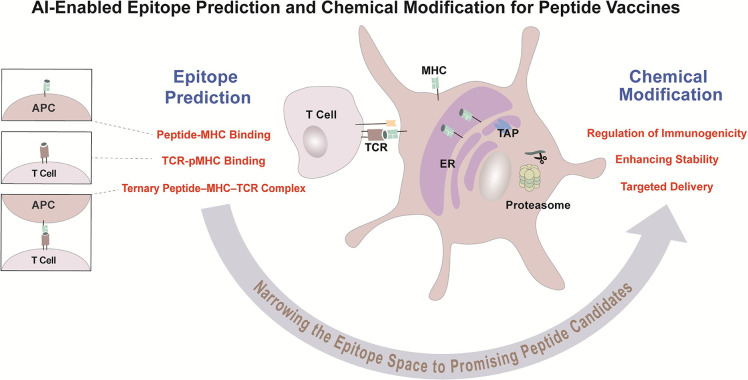
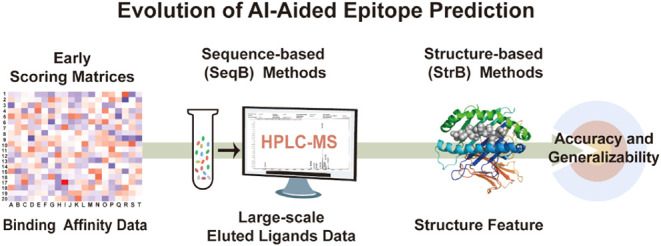
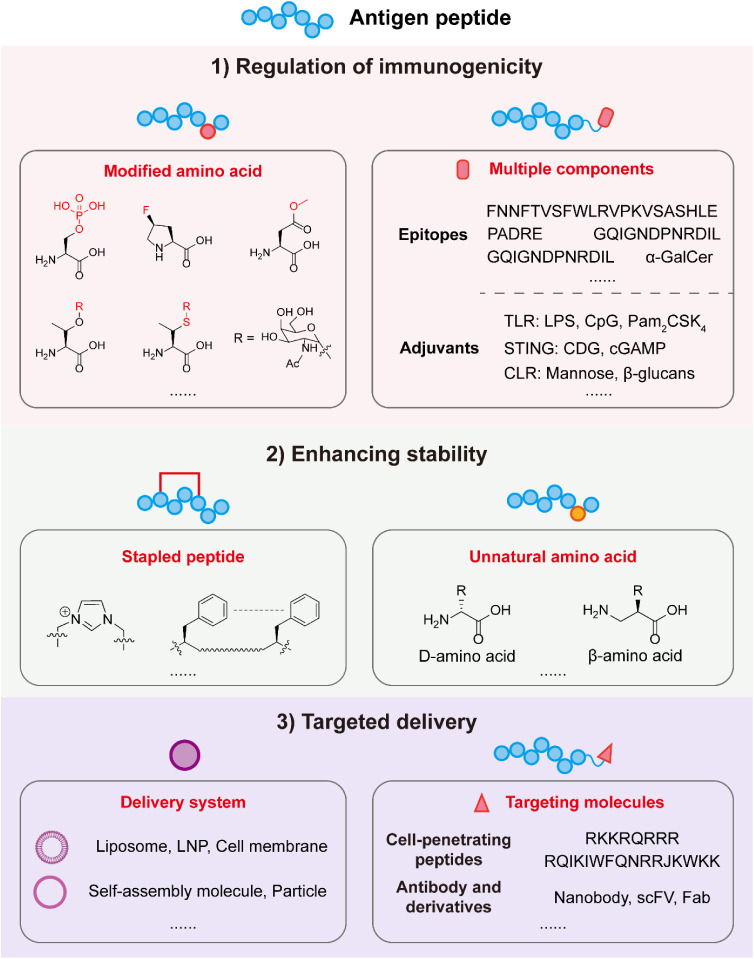
Verification
Claims the paper makes
The claims and statistics of this paper haven’t been checked yet.
Run the check — free, no account needed. It reads the open-access text and checks the sources it cites.
Self-check
Percentages, sums and reported differences re-computed from the paper’s own numbers.
The self-check needs the paper’s full text.
Citations
Cites
Highly accurate protein structure prediction with AlphaFold
Jumper, J., Evans, R., Pritzel, A., Green, T., Figurnov, M., Ronneberger, O., Tunyasuvunakool, K., Bates, R., Žídek, A., Potapenko, A., et al. (2021) · Nature · doi:10.1038/s41586-021-03819-2 · Cited by 43,764
Safety and Efficacy of the BNT162b2 mRNA Covid-19 Vaccine
Polack, F. P., Thomas, S. J., Kitchin, N., Absalon, J., Gurtman, A., Lockhart, S., Perez, J. L., Pérez Marc, G., Moreira, E. D., Zerbini, C., et al. (2020) · New England Journal of Medicine · doi:10.1056/nejmoa2034577 · Cited by 14,592
Weber, J. S., Carlino, M. S., Khattak, A., Meniawy, T., Ansstas, G., Taylor, M. H., Kim, K. B., McKean, M., Long, G. V., Sullivan, R. J., et al. (2024) · The Lancet · doi:10.1016/s0140-6736(23)02268-7 · Cited by 916
Peptide-Based Vaccines: Current Progress and Future Challenges
Malonis, R. J., Lai, J. R., & Vergnolle, O. (2020) · Chemical Reviews · doi:10.1021/acs.chemrev.9b00472 · Cited by 602
Pant, S., Wainberg, Z. A., Weekes, C. D., Furqan, M., Kasi, P. M., Devoe, C. E., Leal, A. D., Chung, V., Basturk, O., VanWyk, H., et al. (2024) · Nature Medicine · doi:10.1038/s41591-023-02760-3 · Cited by 267
Research works printed but not linked: 120
- 10.1002/emmm.201403876 · DOI
- 10.1038/nri2454 · DOI
- 10.1016/S0140-6736(19)32682-0 · DOI
- 10.1007/s12274-021-4012-9 · DOI
- 10.3390/medsci12020028 · DOI
- 10.1186/s12967-024-06033-6 · DOI
- 10.1038/s41467-024-46877-6 · DOI
- 10.1038/s41467-024-51315-8 · DOI
- 10.3390/cells9122673 · DOI
- 10.1038/s41467-023-42155-z · DOI
- 10.1038/s41467-023-40758-0 · DOI
- 10.1016/j.vaccine.2007.01.111 · DOI
- 10.1080/10717544.2025.2517137 · DOI
- 10.1038/nrd2224 · DOI
- 10.1038/s41392-024-02107-5 · DOI · Paper page
- 10.1038/s41541-025-01258-y · DOI
- 10.3389/fimmu.2025.1567116 · DOI
- 10.1021/ja211725s · DOI
- 10.1038/ni1516 · DOI
- 10.1146/annurev.immunol.23.021704.115625 · DOI
- 10.1146/annurev.iy.07.040189.003125 · DOI
- 10.1084/jem.158.2.303 · DOI
- 10.1146/annurev.immunol.24.021605.090517 · DOI
- 10.1016/j.it.2016.08.010 · DOI · Paper page
- 10.1186/1745-7580-6-9 · DOI
- 10.1038/364033a0 · DOI
- 10.1002/0471142735.ima01is36 · DOI
- 10.1016/0022-1759(95)00111-M · DOI
- 10.2174/138161209789105162 · DOI
- Wang X., 2021, Am. J. Cancer Res, 11, 2401
- 10.1073/pnas.86.9.3296 · DOI
- 10.1016/0092-8674(93)90472-3 · DOI
- 10.1146/annurev-biodatasci-021920-100259 · DOI
- 10.4049/jimmunol.152.1.163 · DOI
- 10.1110/ps.0239403 · DOI
- 10.4049/jimmunol.1700893 · DOI
- 10.1038/s41587-019-0322-9 · DOI
- 10.1038/s41467-024-53296-0 · DOI
- 10.1016/j.cels.2020.06.010 · DOI · Paper page
- 10.1038/s42256-024-00971-y · DOI
- 10.1146/annurev-immunol-082119-124838 · DOI
- 10.1371/journal.pone.0000796 · DOI
- 10.2174/1568026619666181224101744 · DOI
- 10.1016/j.cellimm.2012.04.005 · DOI
- 10.7554/eLife.93695 · DOI · Paper page
- 10.1038/s41598-022-14526-x · DOI
- 10.1016/j.cels.2024.03.001 · DOI
- 10.1073/pnas.2216697120 · DOI · Paper page
- 10.1038/s42003-024-07292-1 · DOI
- 10.1038/nature22991 · DOI · Paper page
- 10.1111/j.1365-2567.2010.03268.x · DOI
- 10.1084/jem.180.6.2353 · DOI
- 10.3390/vaccines2030515 · DOI
- 10.1093/bioinformatics/bth100 · DOI
- 10.1016/j.compbiolchem.2020.107281 · DOI
- 10.1101/433706 · DOI
- 10.1038/s42003-021-02610-3 · DOI
- 10.1038/s43588-024-00653-0 · DOI
- 10.1038/s42256-023-00619-3 · DOI · Paper page
- Finn C., 2017, Proceedings of the 34th International Conference on Machine Learning, 1126
- 10.1038/s42256-021-00383-2 · DOI · Paper page
- 10.1038/s42256-025-01002-0 · DOI
- 10.1038/s41392-023-01644-9 · DOI
- 10.1021/acs.accounts.2c00360 · DOI
- 10.1039/D2CS00486K · DOI
- 10.3390/pharmaceutics17010046 · DOI
- 10.1021/acs.chemrev.9b00833 · DOI
- 10.1002/anie.202411009 · DOI · Paper page
- 10.1038/s42256-022-00459-7 · DOI
- 10.1021/jacsau.5c00224 · DOI · Paper page
- 10.1080/15384047.2025.2486141 · DOI · Paper page
- 10.1016/j.mcpro.2025.100971 · DOI · Paper page
- 10.1021/acscentsci.3c00265 · DOI
- 10.1021/acsmacrolett.2c00742 · DOI
- 10.1126/sciadv.abm7833 · DOI
- 10.1016/j.jhepr.2024.101038 · DOI
- 10.1039/D1CB00251A · DOI
- 10.1038/s41586-023-06525-3 · DOI
- 10.1002/adfm.202303537 · DOI
- 10.1002/adma.202410715 · DOI
- 10.1002/anie.202301147 · DOI
- 10.1021/acsnano.2c09708 · DOI
- 10.1002/smtd.202201409 · DOI
- 10.1016/j.scib.2024.02.042 · DOI
- 10.1021/acsami.4c00296 · DOI
- 10.1002/adma.202207719 · DOI
- 10.1002/psc.70020 · DOI
- 10.1038/s41570-024-00591-5 · DOI
- 10.1021/jacs.3c02743 · DOI
- 10.1002/advs.202307754 · DOI
- 10.1002/advs.202409567 · DOI
- 10.1021/jacs.1c00016 · DOI · Paper page
- 10.1172/JCI91512 · DOI
- 10.1021/jacs.3c05300 · DOI · Paper page
- 10.1007/s42114-024-01053-8 · DOI
- 10.1073/pnas.2204078119 · DOI · Paper page
- 10.1021/acscentsci.3c00625 · DOI
- 10.31635/ccschem.023.202302751 · DOI
- 10.1002/adhm.202402055 · DOI
- 10.1021/acsbiomaterials.4c00525 · DOI
- 10.1002/advs.202201496 · DOI
- 10.1021/acsnano.3c00764 · DOI
- 10.1038/s41541-024-01050-4 · DOI
- 10.1002/adhm.202200905 · DOI
- 10.1002/anie.202407037 · DOI
- 10.18632/oncotarget.16952 · DOI
- 10.1073/pnas.0812901106 · DOI
- 10.1016/j.jvacx.2019.100017 · DOI
- 10.1016/j.immuno.2021.100005 · DOI · Paper page
- 10.1021/acschembio.4c00312 · DOI · Paper page
- 10.1002/pro.4497 · DOI · Paper page
- 10.1093/bioinformatics/btaa773 · DOI
- 10.1016/j.gpb.2022.11.009 · DOI
- 10.1038/s41598-022-18021-1 · DOI
- 10.1093/nar/gkx346 · DOI
- 10.3389/fimmu.2024.1322712 · DOI · Paper page
- 10.1093/bioinformatics/btad187 · DOI · Paper page
- 10.1016/j.drudis.2025.104489 · DOI
- 10.3389/fimmu.2024.1463931 · DOI
- 10.1002/pro.4785 · DOI
Metadata
- Authors
- Wang, X.-X., Su, J.-Y., & Li, Y.-M.
- Affiliations
- Tsinghua University (CN)
- Key Laboratory of Bioorganic Phosphorus Chemistry and Chemical Biology (Ministry of Education), Department of Chemistry
- Corresponding author
- Li, Yan-Mei
- ORCID
- Li, Yan-Mei
- Venue
- JACS Au
- Publisher
- American Chemical Society (ACS)
- Published
- 2026-03-03
- Volume
- 6
- Issue
- 3
- Pages
- 1461-1472
- ISSN
- 2691-3704 (ISSN-L)
- PMC
- PMC13014197
- OpenAlex
- W7133556746
- Cited by
- 5
- References
- 5
- Citations by year
- 2026: 5
- FWCI
- 3.34
- Type
- journal article
- Language
- en
- Open access
- gold
- doi.org
- Licence
- Locations
- JACS Au (publishedVersion, cc-by-nc-nd)
- PubMed Central (publishedVersion, cc-by-nc-nd)
- PubMed (publishedVersion)
- DOAJ (DOAJ: Directory of Open Access Journals) (submittedVersion, cc-by-sa)
- Funders
- National Natural Science Foundation of China (22237003)
- Tsinghua-Toyota Joint Research Fund (20253930081)
- Topics
- Life Sciences › Biochemistry, Genetics and Molecular Biology › Molecular Biology › vaccines and immunoinformatics approaches
- Physical Sciences › Chemistry › Organic Chemistry › Chemical Synthesis and Analysis
- Life Sciences › Immunology and Microbiology › Immunology › Immunotherapy and Immune Responses
- Keywords
- peptide vaccine, epitope prediction, machine learning, peptide-MHC binding, T cell receptor recognition, immunoinformatics, peptide modification, cyclization, lipid modification, glycosylation, stapling, unnatural amino acids, HLA restriction, immunogenicity, multicomponent vaccine, peptide stability
About these checks
Registry, retraction, Cites and statistics results are computed, not judged, with one exception: a printed reference that no index lists is read once by a model before it counts as a citation error. Claims are extracted by a model and kept only when their quote appears verbatim in the text; each cited source is then checked, with a model’s help, for whether it says what the claim relies on. Those verdicts can be wrong — read the claim’s quote and the cited source before relying on one.
Statistics and arithmetic are recomputed, not judged.
Confidence bands are shown only for fields calibrated on our annotated test set. None is calibrated yet, so no band is shown.
What counts as a claim ›How we measure confidence ›How we check this ›
Are you an author, or do you see a problem with this page? Request a review
