

Space Weather on the Surface of Mars: Impact of the September 2017 Events
Open accessThe DOI matches its Crossref record; 28 of the 28 references it cites were found in a registry or an index.
Abstract
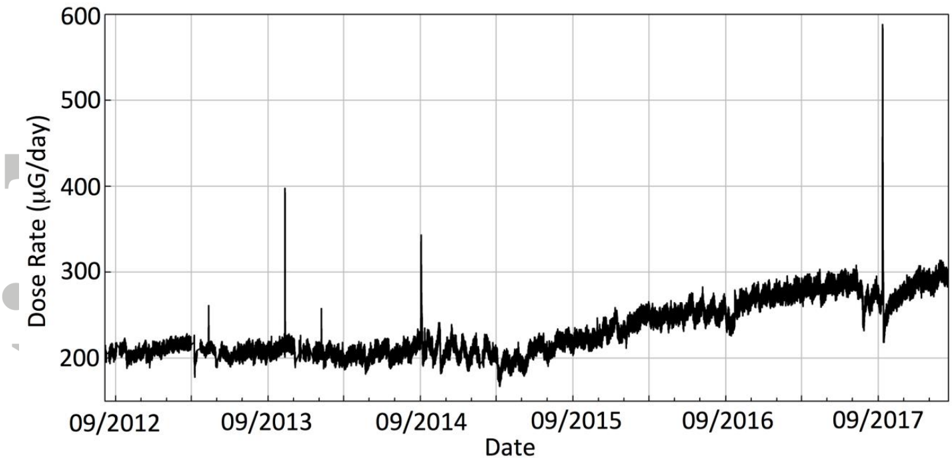
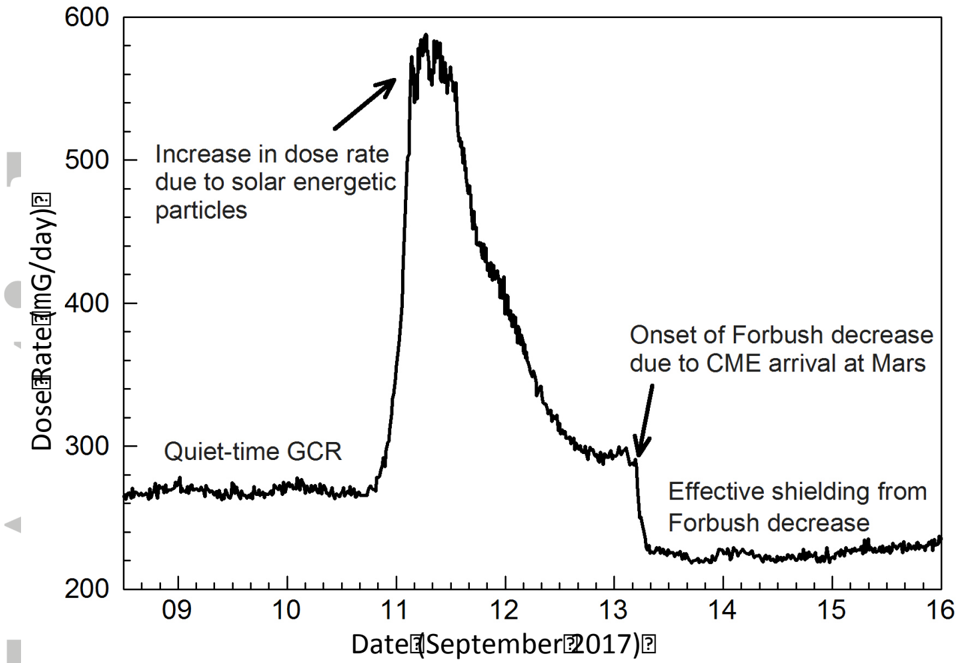
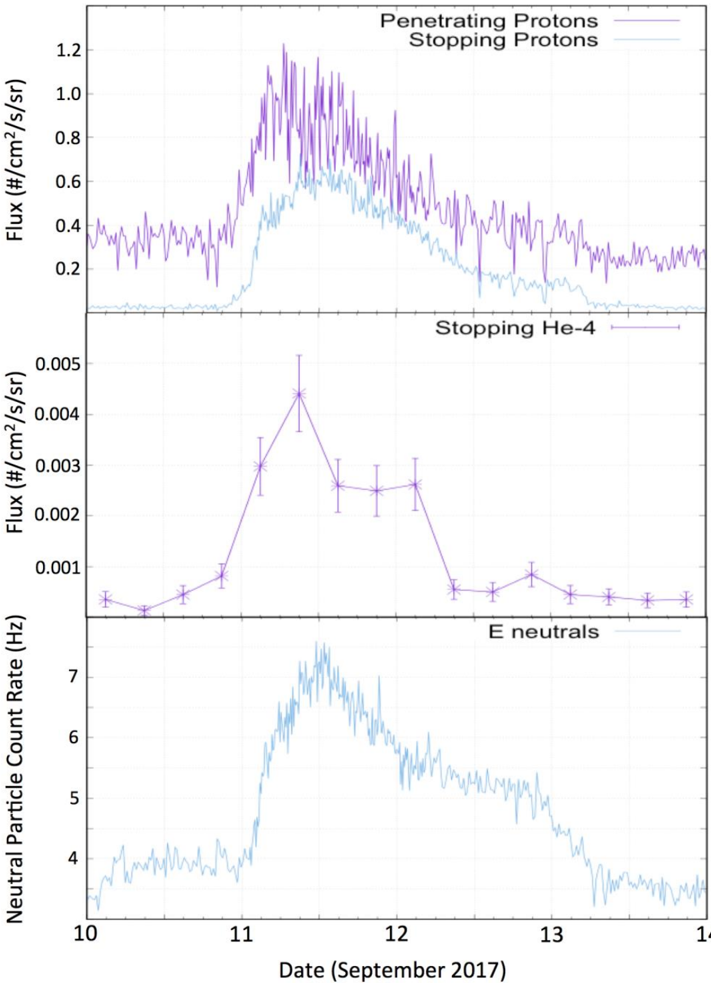
Although solar activity is declining as the Sun approaches solar minimum, a series of large solar storms occurred in September 2017 that impacted both Earth and Mars. This was the largest event seen on the surface of Mars by the Radiation Assessment Detector on the Mars Science Laboratory Curiosity rover since landing in 2012 and was also observed as Ground Level Enhancement 72 on Earth, making it the first event observed to produce a Ground Level Enhancement on two planets at the same time. We present Radiation Assessment Detector observations of the surface radiation environment since 2012 and discuss the impact of the September 2017 events on this environment and its implications for human exploration and for mitigating the risk of space radiation and space weather events for future manned missions to Mars.
Overview
The claims and statistics of this paper haven’t been checked yet.
Free: it reads the open-access text and checks the first 5 claims that cite a source we can check. Create a free account to check every claim.
Integrity signals
Registry
Cites
Statistics
Figures
Verification
Claims the paper makes
The claims and statistics of this paper haven’t been checked yet.
Free: it reads the open-access text and checks the first 5 claims that cite a source we can check. Create a free account to check every claim.
Claims other papers make about this one
Each is checked against this paper’s own text: does it say what the citing paper says it does?
The cited source says what the claim attributes to it.
In the citing paper
“RAD observed that the flux of protons with energies below about 100 MeV was increased by a factor of 30 (Ehresmann et al. 2018;Hassler et al. 2018), and the dose rate doubled over the course of several hours after the event onset.”
From Radiation environment for future human exploration on the surface of Mars: the current understanding based on MSL/RAD dose measurements (2021) · cites this paper as Hassler et al. 2018
Self-check
Percentages, sums and reported differences re-computed from the paper’s own numbers.
The self-check needs the paper’s full text.
Citations
Cites
Agostinelli, S., Allison, J., Amako, K., Apostolakis, J., Araujo, H., Arce, P., Asai, M., Axen, D., Banerjee, S., Barrand, G., et al. (2003) · Nuclear Instruments and Methods in Physics Research Section A: Accelerators, Spectrometers, Detectors and Associated Equipment · doi:10.1016/s0168-9002(03)01368-8 · Cited by 25,106
Geant4 developments and applications
Allison, J., Amako, K., Apostolakis, J., Araujo, H., Arce Dubois, P., Asai, M., Barrand, G., Capra, R., Chauvie, S., Chytracek, R., et al. (2006) · IEEE Transactions on Nuclear Science · doi:10.1109/tns.2006.869826 · Cited by 6,946
Allison, J., Amako, K., Apostolakis, J., Arce, P., Asai, M., Aso, T., Bagli, E., Bagulya, A., Banerjee, S., Barrand, G., et al. (2016) · Nuclear Instruments and Methods in Physics Research Section A: Accelerators, Spectrometers, Detectors and Associated Equipment · doi:10.1016/j.nima.2016.06.125 · Cited by 4,194
The 2007 recommendations of the International Commission on Radiological Protection
Valentin, J. (2007) · Elsevier eBooks · Cited by 4,105
Mars Orbiter Laser Altimeter: Experiment summary after the first year of global mapping of Mars
Smith, D. E., Zuber, M. T., Frey, H. V., Garvin, J. B., Head, J. W., Muhleman, D. O., Pettengill, G. H., Phillips, R. J., Solomon, S. C., Zwally, H. J., et al. (2001) · Journal of Geophysical Research: Planets · doi:10.1029/2000je001364 · Cited by 1,722 · cited 1×
“The mean Martian surface or elevation is defined by measurements from the Mars Orbiter Laser Altimeter whereby the average value of the equipotential surface at the equator equals themean radius of Mars (Smith et al., 2001).”
MethodMars Science Laboratory Mission and Science Investigation
Grotzinger, J. P., Crisp, J., Vasavada, A. R., Anderson, R. C., Baker, C. J., Barry, R., Blake, D. F., Conrad, P., Edgett, K. S., Ferdowski, B., et al. (2012) · Space Science Reviews · doi:10.1007/s11214-012-9892-2 · Cited by 829
Self-citationMars' surface radiation environment measured with the Mars Science Laboratory's Curiosity rover
Hassler, D. M., Zeitlin, C., Wimmer-Schweingruber, R. F., Ehresmann, B., Rafkin, S., Eigenbrode, J. L., Brinza, D. E., Weigle, G., Böttcher, S., Böhm, E., et al. (2014) · Science · doi:10.1126/science.1244797 · Cited by 727
Self-citationElemental and isotopic composition of the galactic cosmic rays
Simpson, J. A. (1983) · Annual Review of Nuclear and Particle Science · doi:10.1146/annurev.ns.33.120183.001543 · Cited by 724 · cited 1×
“GCR are very high energy charged particles made up of roughly 87% protons, 12% helium, and ~1% heavier nuclei (Simpson, 1983), most of which propagate through the Martian atmosphere.”
BackgroundMeasurements of energetic particle radiation in transit to Mars on the Mars Science Laboratory
Zeitlin, C., Hassler, D. M., Cucinotta, F. A., Ehresmann, B., Wimmer-Schweingruber, R. F., Brinza, D. E., Kang, S., Weigle, G., Böttcher, S., Böhm, E., et al. (2013) · Science · doi:10.1126/science.1235989 · Cited by 641
Self-citationThe Radiation Assessment Detector (RAD) Investigation
Hassler, D. M., Zeitlin, C., Wimmer-Schweingruber, R. F., Böttcher, S., Martin, C., Andrews, J., Böhm, E., Brinza, D. E., Bullock, M. A., Burmeister, S., et al. (2012) · Space Science Reviews · doi:10.1007/s11214-012-9913-1 · Cited by 247
Self-citationFaster and more accurate transport procedures for HZETRN
Slaba, T. C., Blattnig, S. R., & Badavi, F. F. (2010) · Journal of Computational Physics · doi:10.1016/j.jcp.2010.09.010 · Cited by 123 · cited 2×
“These flux and spectra measurements provide important input to validate and evaluate radiation transport model calculations of the expected radiation environment and exposures for exploration missions, from codes such as High Charge and Energy Transport (Slaba et al., 2010) or PLANETOCOSMICS (Desorgher et al., 2006),…”
BackgroundLee, C. O., Jakosky, B. M., Luhmann, J. G., Brain, D. A., Mays, M. L., Hassler, D. M., Holmström, M., Larson, D. E., Mitchell, D. L., Mazelle, C., et al. (2018) · Geophysical Research Letters · doi:10.1029/2018gl079162 · Cited by 107
Self-citationGuo, J., Dumbović, M., Wimmer‐Schweingruber, R. F., Temmer, M., Lohf, H., Wang, Y., Veronig, A., Hassler, D. M., Mays, L. M., Zeitlin, C., et al. (2018) · Space Weather · doi:10.1029/2018sw001973 · Cited by 84 · cited 1×
“2 flare and a solar particle event and CME which impacted both Earth and Mars, separated more than 170° in longitude (Guo et al., 2018, Lee et al., 2018).”
BackgroundSelf-citationEhresmann, B., Zeitlin, C., Hassler, D. M., Wimmer‐Schweingruber, R. F., Böhm, E., Böttcher, S., Brinza, D. E., Burmeister, S., Guo, J., Köhler, J., et al. (2014) · Journal of Geophysical Research: Planets · doi:10.1002/2013je004547 · Cited by 79
Self-citationMeasurements of the neutron spectrum on the Martian surface with MSL/RAD
Köhler, J., Zeitlin, C., Ehresmann, B., Wimmer‐Schweingruber, R. F., Hassler, D. M., Reitz, G., Brinza, D. E., Weigle, G., Appel, J., Böttcher, S., et al. (2014) · Journal of Geophysical Research: Planets · doi:10.1002/2013je004539 · Cited by 71
Self-citationGlobal Aurora on Mars During the September 2017 Space Weather Event
Schneider, N. M., Jain, S. K., Deighan, J., Nasr, C., Brain, D. A., Larson, D. E., Lillis, R. J., Rahmati, A., Halekas, J. S., Lee, C. O., et al. (2018) · Geophysical Research Letters · doi:10.1029/2018gl077772 · Cited by 63
Rafkin, S. C. R., Zeitlin, C., Ehresmann, B., Hassler, D., Guo, J., Köhler, J., Wimmer‐Schweingruber, R., Gomez‐Elvira, J., Harri, A., Kahanpää, H., et al. (2014) · Journal of Geophysical Research: Planets · doi:10.1002/2013je004525 · Cited by 56
Self-citationMeasurements of the neutron spectrum in transit to Mars on the Mars Science Laboratory
Köhler, J., Ehresmann, B., Zeitlin, C. J., Wimmer-Schweingruber, R. F., Hassler, D. M., Reitz, G., Brinza, D. E., Appel, J. K., Böttcher, S. I., Böhm, E., et al. (2015) · Life Sciences in Space Research · doi:10.1016/j.lssr.2015.03.001 · Cited by 56
Self-citationMODELING THE VARIATIONS OF DOSE RATE MEASURED BY RAD DURING THE FIRST MSL MARTIAN YEAR: 2012–2014
Guo, J., Zeitlin, C., Wimmer-Schweingruber, R. F., Rafkin, S., Hassler, D. M., Posner, A., Heber, B., Köhler, J., Ehresmann, B., Appel, J. K., et al. (2015) · The Astrophysical Journal · doi:10.1088/0004-637x/810/1/24 · Cited by 54
Self-citationSolar-Particle Energy Spectra during the Large Events of October-November 2003 and January 2005
Labrador, A. W., Cohen, C. M. S., Cummings, A. C., Leske, R. A., Mewaldt, R. A., Stone, E. C., von Rosenvinge, T. T., & Wiedenbeck, M. E. (2005) · CaltechAUTHORS (California Institute of Technology) · Cited by 44
Ehresmann, B., Hassler, D. M., Zeitlin, C. J., Guo, J., Köhler, J., Wimmer-Schweingruber, R. F., Appel, J. K., Brinza, D. E., Rafkin, S., Böttcher, S. I., et al. (2016) · Life Sciences in Space Research · doi:10.1016/j.lssr.2016.07.001 · Cited by 39
Self-citationEhresmann, B., Hassler, D. M., Zeitlin, C., Guo, J., Wimmer‐Schweingruber, R. F., Matthiä, D., Lohf, H., Burmeister, S., Rafkin, S. C. R., Berger, T., et al. (2018) · Geophysical Research Letters · doi:10.1029/2018gl077801 · Cited by 38
Self-citationZeitlin, C., Hassler, D. M., Guo, J., Ehresmann, B., Wimmer‐Schweingruber, R. F., Rafkin, S. C. R., Freiherr von Forstner, J. L., Lohf, H., Berger, T., Matthiae, D., et al. (2018) · Geophysical Research Letters · doi:10.1029/2018gl077760 · Cited by 38 · cited 1×
“In solar quiet times, the average quality factor, <Q>, measured by RAD on the Martian surface is found to be in the range between 2 and 3 (Hassler et al., 2014; Zeitlin et al., 2018).”
BackgroundSelf-citationCalibration and Characterization of the Radiation Assessment Detector (RAD) on Curiosity
Zeitlin, C., Hassler, D. M., Wimmer-Schweingruber, R. F., Ehresmann, B., Appel, J., Berger, T., Böhm, E., Böttcher, S., Brinza, D. E., Burmeister, S., et al. (2016) · Space Science Reviews · doi:10.1007/s11214-016-0303-y · Cited by 37 · cited 2×
“…radiation environment on the surface of Mars for almost 6 years (>2,000 sols; A sol is a Martian day with a duration of ~24 hr 40 min; Ehresmann et al., 2014; Guo et al., 2015a; Hassler et al., 2014; Köhler et al., 2014; Rafkin et al., 2014; Wimmer-Schweingruber et al., 2015; Zeitlin et al., 2016).”
BackgroundMethodSelf-citationBerger, T., Matthiä, D., Burmeister, S., Rios, R., Lee, K., Semones, E., Hassler, D. M., Stoffle, N., & Zeitlin, C. (2018) · Space Weather · doi:10.1029/2018sw001920 · Cited by 31
Self-citationWimmer‐Schweingruber, R. F., Köhler, J., Hassler, D. M., Guo, J., Appel, J., Zeitlin, C., Böhm, E., Ehresmann, B., Lohf, H., Böttcher, S. I., et al. (2015) · Geophysical Research Letters · doi:10.1002/2015gl066664 · Cited by 28 · cited 1×
“…radiation environment on the surface of Mars for almost 6 years (>2,000 sols; A sol is a Martian day with a duration of ~24 hr 40 min; Ehresmann et al., 2014; Guo et al., 2015a; Hassler et al., 2014; Köhler et al., 2014; Rafkin et al., 2014; Wimmer-Schweingruber et al., 2015; Zeitlin et al., 2016).”
BackgroundSelf-citationMSL-RAD radiation environment measurements
Guo, J., Zeitlin, C., Wimmer-Schweingruber, R. F., Hassler, D. M., Ehresmann, B., Köhler, J., Böhm, E., Böttcher, S., Brinza, D., Burmeister, S., et al. (2015) · Radiation Protection Dosimetry · doi:10.1093/rpd/ncv297 · Cited by 23
Self-citation(2006) · BORIS (University Library Bern) · Cited by 19
Research works printed but not linked: 2
- 16. th International Cosmic Ray Conference, Pune (2005), 00, 101-104.
- 20. Share, G., and R. Murphy, 2018. Gamma-ray and Neutron Monitor Observations of the 2017 September 10 Solar Eruptive Event. AMS-2 Workshop #3, Washington, D.C., 24 Apr., 2018.
Cited by
Space weather: the solar perspective: An update to Schwenn (2006)
Temmer, M. (2021) · Living Reviews in Solar Physics · doi:10.1007/s41116-021-00030-3 · Cited by 283
Vasavada, A. R. (2022) · Space Science Reviews · doi:10.1007/s11214-022-00882-7 · Cited by 162
Redmon, R. J., Seaton, D. B., Steenburgh, R. A., He, J., & Rodriguez, J. V. (2018) · Space Weather · doi:10.1029/2018sw001897 · Cited by 104
Physics of Space Weather Phenomena: A Review
Singh, A. K., Bhargawa, A., Siingh, D., & Singh, R. P. (2021) · Geosciences · doi:10.3390/geosciences11070286 · Cited by 101
Guo, J., Zeitlin, C., Wimmer-Schweingruber, R. F., Hassler, D. M., Ehresmann, B., Rafkin, S., Freiherr von Forstner, J. L., Khaksarighiri, S., Liu, W., & Wang, Y. (2021) · The Astronomy and Astrophysics Review · doi:10.1007/s00159-021-00136-5 · Cited by 73
“RAD observed that the flux of protons with energies below about 100 MeV was increased by a factor of 30 (Ehresmann et al. 2018; Hassler et al. 2018), and the dose rate doubled over the course of several hours after the event onset.”
BackgroundSelf-citation
Metadata
- Authors
- Hassler, D. M., Zeitlin, C., Ehresmann, B., Wimmer‐Schweingruber, R. F., Guo, J., Matthiä, D., Rafkin, S., Berger, T., & Reitz, G.
- Affiliations
- Southwest Research Institute (US)
- Leidos (United States) (US)
- Department of Extraterrestrial Physics Christian Albrechts University Kiel Germany
- Christian-Albrechts-Universität zu Kiel (DE)
- Deutsches Zentrum für Luft- und Raumfahrt e. V. (DLR) (DE)
- Corresponding author
- Hassler, D. M.
- ORCID
- Venue
- Space Weather
- Publisher
- American Geophysical Union (AGU)
- Published
- 2018-11
- Volume
- 16
- Issue
- 11
- Pages
- 1702-1708
- ISSN
- 1542-7390 (ISSN-L)
- OpenAlex
- W2889150912
- Cited by
- 25
- References
- 25
- Citations by year
- 2026: 1 · 2025: 1 · 2023: 2 · 2022: 4 · 2021: 7 · 2020: 4 · 2019: 3 · 2018: 3
- FWCI
- 2.29
- Type
- journal article
- Language
- en
- Open access
- hybrid
- doi.org
- Licence
- Locations
- Space Weather (publishedVersion, cc-by-nc-nd)
- elib (German Aerospace Center) (acceptedVersion)
- Funders
- Deutsches Zentrum für Luft- und Raumfahrt
- Jet Propulsion Laboratory
- Topics
- Physical Sciences › Physics and Astronomy › Astronomy and Astrophysics › Solar and Space Plasma Dynamics
- Physical Sciences › Earth and Planetary Sciences › Space and Planetary Science › Planetary Science and Exploration
- Physical Sciences › Earth and Planetary Sciences › Space and Planetary Science › Ionosphere and magnetosphere dynamics
- Keywords
- ground level enhancement, Radiation Assessment Detector, Curiosity rover, solar storms, space radiation risk, human Mars exploration, radiation mitigation, solar minimum
About these checks
Registry, retraction, Cites and statistics results are computed, not judged, with one exception: a printed reference that no index lists is read once by a model before it counts as a citation error. Claims are extracted by a model and kept only when their quote appears verbatim in the text; each cited source is then checked, with a model’s help, for whether it says what the claim relies on. Those verdicts can be wrong — read the claim’s quote and the cited source before relying on one.
Statistics and arithmetic are recomputed, not judged.
Confidence bands are shown only for fields calibrated on our annotated test set. None is calibrated yet, so no band is shown.
What counts as a claim ›How we measure confidence ›How we check this ›
Are you an author, or do you see a problem with this page? Request a review
Data sources
Bibliographic data: Semantic Scholar, OpenAlex, Crossref.
Contains information from the Semantic Scholar Academic Graph Datasets, made available under the ODC Attribution License (ODC-BY 1.0).
Semantic Scholar’s data is described in: Kinney, R., et al. (2023). The Semantic Scholar Open Data Platform. arXiv:2301.10140.
