

The DOI matches its Crossref record; 105 of the 105 references it cites were found in a registry or an index; 10 of the 81 sources its claims cite were checked for support.
Do growth mindset interventions impact students’ academic achievement? A systematic review and meta-analysis with recommendations for best practices.
Open accessPublished version of a preprint
Abstract
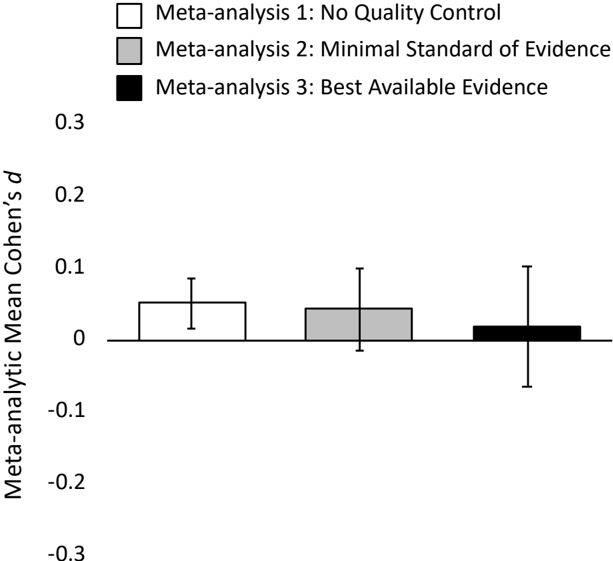
According to mindset theory, students who believe their personal characteristics can change—that is, those who hold a growth mindset—will achieve more than students who believe their characteristics are fixed. Proponents of the theory have developed interventions to influence students’ mindsets, claiming that these interventions lead to large gains in academic achievement. Despite their popularity, the evidence for growth mindset intervention benefits has not been systematically evaluated considering both the quantity and quality of the evidence. Here, we provide such a review by (a) evaluating empirical studies’ adherence to a set of best practices essential for drawing causal conclusions and (b) conducting three meta-analyses. When examining all studies (63 studies, N = 97,672), we found major shortcomings in study design, analysis, and reporting, and suggestions of researcher and publication bias: Authors with a financial incentive to report positive findings published significantly larger effects than authors without this incentive. Across all studies, we observed a small overall effect: d ̅ = 0.05, 95% CI = [0.02, 0.09], which was non-significant after correcting for potential publication bias. No theoretically-meaningful moderators were significant. When examining only studies demonstrating the intervention influenced students’ mindsets as intended (13 studies, N = 18,355), the effect was non-significant: d ̅ = 0.04, 95% CI = [-0.01, 0.10]. When examining the highest-quality evidence (6 studies, N = 13,571), the effect was non-significant: d ̅ = 0.02, 95% CI = [-0.06, 0.10]. We conclude that apparent effects of growth mindset interventions on academic achievement are likely attributable to inadequate study design, reporting flaws, and bias.
Overview
AI snapshot
Written from the paper’s full text.
TL;DR
This systematic review and meta-analysis finds that growth mindset interventions show only a small overall effect on academic achievement, and that effect becomes non-significant after correcting for publication bias. When analyses are restricted to studies that changed students’ mindsets as intended or to the highest-quality evidence, effects are non-significant.
Key findings
- Across all studies (63 studies, N = 97,672), the overall effect was small and significant: *d* = 0.05, 95% CI [0.02, 0.09], *p* = .004; after publication-bias correction, estimates were non-significant (*d* = 0.03 trim-and-fill; *d* = 0.01 PET).
- Among studies showing the intervention changed students’ mindsets as intended (13 studies, N = 18,355), the effect was non-significant: *d* = 0.04, 95% CI [−0.01, 0.10], *p* = .146.
- Among the highest-quality evidence (6 studies, N = 13,571), the effect was non-significant: *d* = 0.02, 95% CI [−0.06, 0.10], *p* = .666.
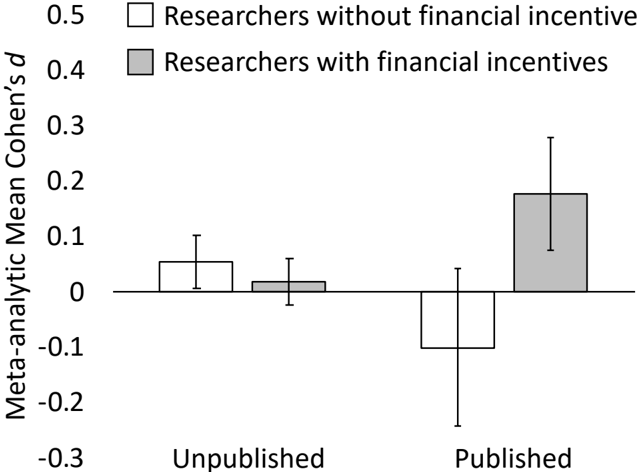
- Authors with a financial incentive to report positive findings published significantly larger effects than authors without this incentive; for financially incentivized authors, published effects averaged *d* = 0.18 versus unpublished *d* = 0.02, while for non-incentivized authors published effects averaged *d* = −0.10 versus unpublished *d* = 0.05.
Methods
- Systematic review and three random-effects meta-analyses of treatment-vs.-control growth mindset intervention studies measuring academic achievement (grades or standardized test scores), updating Sisk et al. (2018) through August 7, 2019.
- Meta-Analysis 1 included all eligible studies regardless of quality; Meta-Analysis 2 included only studies with evidence that the intervention significantly shifted treatment students’ mindsets toward growth mindset; Meta-Analysis 3 included studies with such mindset evidence and at least 60% of 10 best-practices criteria.
- Effect sizes were Cohen’s *d*, adjusted where possible for baseline achievement, dependent effects, and cluster design effects; analyses included moderator tests and publication-bias assessments (funnel plot, Egger’s regression, trim-and-fill, PET-PEESE).
Limitations
- Stated by the authors: search timeframe and inaccessible unpublished studies; English-language restriction; preregistered scope decisions; reliance on the assumption that mindset measures are valid and reliable; heterogeneity across models; and the generally low quality of included studies, which required lowering standards for Meta-Analysis 3.
- Evident in the text: no studies met all best-practices criteria; Meta-Analysis 3 still included studies that failed multiple best practices and may still overestimate effects; some alternate best-practices models were not preregistered but suggested by a reviewer; and the authors could not publish analysis code because they used Comprehensive Meta-Analysis software.
Model-written summary. Check it against the paper before relying on it.
Integrity signals
Registry
Cites
Statistics
Figures
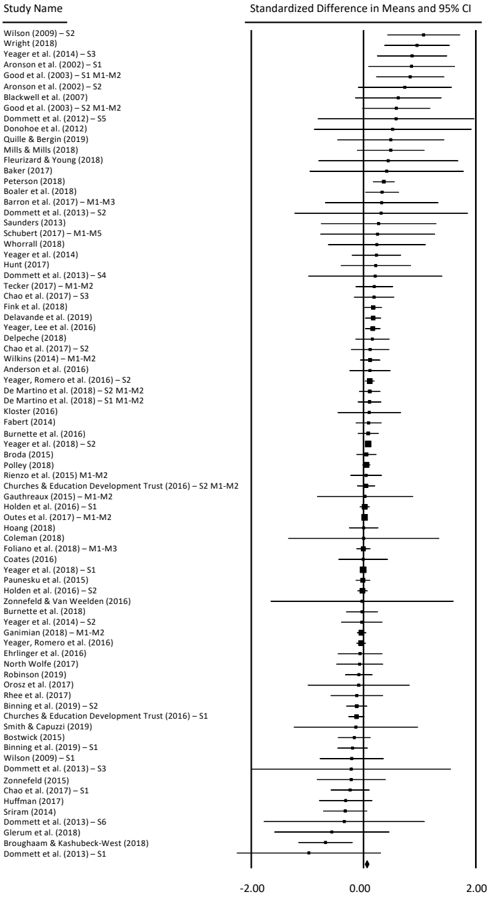
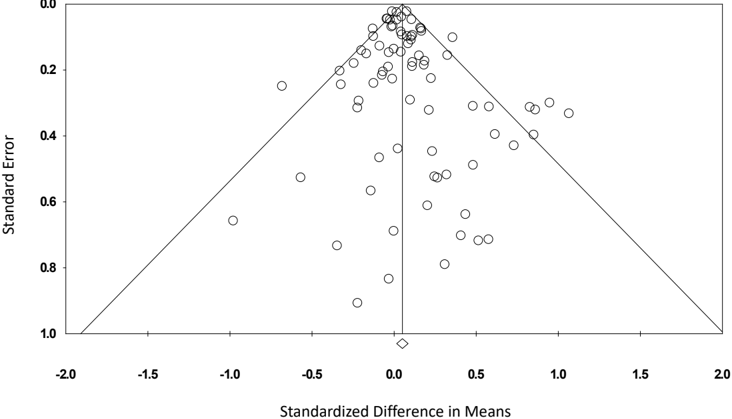
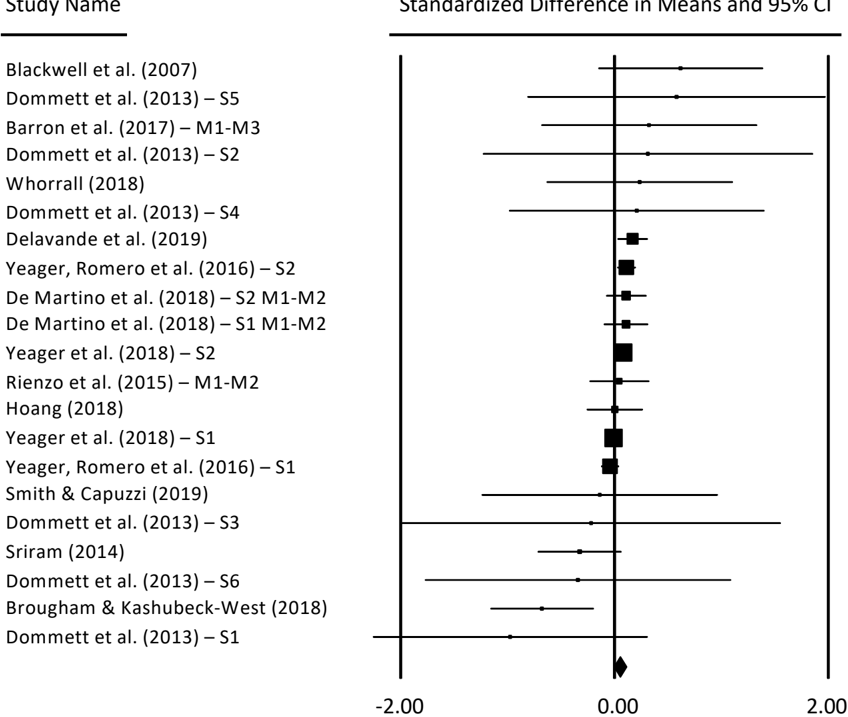
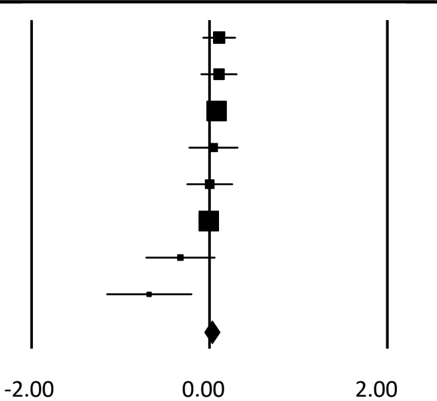
Verification
Claims the paper makes
97 Own interpretation · 87 Own result · 25 Sources not found · 21 No full text of the sources · 18 No basis given · 16 Own method · 7 Not checked yet · 4 Supported · 4 Partly supported · 2 Not supported · accuracy not yet measured
The cited sources support only part of this claim — read each source’s verdict below.
In the paper
“Finally, blinding teachers to students' conditions reduces the chance that teachers' beliefs about condition effectiveness and knowledge of student assignment will influence their behavior toward the student or their evaluation of student performance (e.g., Ainsworth et al., 2015;Rosenthal & Jacobson, 1968).”
§ DO GROWTH MINDSET INTERVENTIONS WORK? 1 Do Growth Mindset Interventions Impact Students' Academic Achievement? A Systematic Review and Meta-Analysis with Recommendations for Best Practices > Blinding
What the sources say
- Partly supportedcites Ainsworth et al., 2015 sourceExperimental — accuracy not yet measured
The Background to Every Child Counts evaluation (page not provided) says that teachers’ knowledge of assignment and beliefs about the programme could lead them to award higher marks, supporting the claim about evaluation of performance. The paper addresses bias in outcome assessment, not whether blinding changes teachers’ behavior toward students; it also notes that blinding teachers to allocation is extremely difficult. (LLM, conf=0.88)
- Not checked — no full text of the sourcecites Rosenthal & Jacobson, 1968 source
hedgeddirect- Asserted: passes — The authors put it forward as true.
- Checkable: passes — It can be checked against evidence.
- Load-bearing: passes — The paper’s conclusions depend on it.
- Based: passes — The paper gives a reason why it holds.
- Partly supported
The cited sources support only part of this claim — read each source’s verdict below.
In the paper
“However, given the weak links between mindset and motivational processes (e.g., Burgoyne et al., 2020;Burnette et al., 2013;Payne et a., 2007) and between these motivational processes and achievement (e.g., Burnette et al., 2013), one cannot infer the effect of mindset on academic achievement based on mindset's relationship to a motivational process.”
§ DO GROWTH MINDSET INTERVENTIONS WORK? 1 Do Growth Mindset Interventions Impact Students' Academic Achievement? A Systematic Review and Meta-Analysis with Recommendations for Best Practices > Measuring Direct Outcomes Rather Than Indirect Outcomes
What the sources say
- Not checked — no full text of the sourcecites Burgoyne et al., 2020 source
- Partly supportedcites Burnette et al., 2013 sourceExperimental — accuracy not yet measured
Split into 2 atoms — 0 confirmed, 2 partially supported, 0 disputed, 0 misattributed, 0 unverifiable. Expand the claim to see per-atom verdicts.
- Not checked — no full text of the sourcecites Payne et a., 2007 source
plain- Asserted: passes — The authors put it forward as true.
- Checkable: passes — It can be checked against evidence.
- Load-bearing: passes — The paper’s conclusions depend on it.
- Based: passes — The paper gives a reason why it holds.
The cited sources support only part of this claim — read each source’s verdict below.
In the paper
“Recent research (Burgoyne et al., 2018;Limeri et al., 2020) has questioned this assumption.”
§ DO GROWTH MINDSET INTERVENTIONS WORK? 1 Do Growth Mindset Interventions Impact Students' Academic Achievement? A Systematic Review and Meta-Analysis with Recommendations for Best Practices > Limitations
What the sources say
- Not checked — no full text of the sourcecites Burgoyne et al., 2018 source
- Partly supportedcites Limeri et al., 2020 sourceExperimental — accuracy not yet measured
The Introduction (page unavailable) questions the validity of the mindset scale for undergraduates, and the Discussion (page unavailable) suggests that differing interpretations of its items may introduce measurement error. The paper does not specifically assess measures collected before and after an intervention or establish that those measures are unreliable; it notes that some studies have reported test–retest reliability. (LLM, conf=0.86)
plain- Asserted: passes — The authors put it forward as true.
- Checkable: passes — It can be checked against evidence.
- Load-bearing: passes — The paper’s conclusions depend on it.
- Based: passes — The paper gives a reason why it holds.
A result the paper reports from its own data — it cites no other source for it, so there is none to check. The quote shows it is in the paper.
In the paper
“When examining the highest-quality evidence (6 studies, N = 13,571), the effect was non-significant: 𝑑 ̅ = 0.02, 95% CI = [-0.06,0.10].”
§ DO GROWTH MINDSET INTERVENTIONS WORK? 1 Do Growth Mindset Interventions Impact Students' Academic Achievement? A Systematic Review and Meta-Analysis with Recommendations for Best Practices > Abstract
plainn = 13,571- Asserted: passes — The authors put it forward as true.
- Checkable: passes — It can be checked against evidence.
- Load-bearing: passes — The paper’s conclusions depend on it.
- Based: passes — The paper gives a reason why it holds.
A result the paper reports from its own data — it cites no other source for it, so there is none to check. The quote shows it is in the paper.
In the paper
“Authors with a financial incentive to report positive findings published significantly larger effects than authors without this incentive.”
§ DO GROWTH MINDSET INTERVENTIONS WORK? 1 Do Growth Mindset Interventions Impact Students' Academic Achievement? A Systematic Review and Meta-Analysis with Recommendations for Best Practices > Abstract
plaincorrelationaln = 97,672- Asserted: passes — The authors put it forward as true.
- Checkable: passes — It can be checked against evidence.
- Load-bearing: passes — The paper’s conclusions depend on it.
- Based: passes — The paper gives a reason why it holds.
A result the paper reports from its own data — it cites no other source for it, so there is none to check. The quote shows it is in the paper.
In the paper
“which was non-significant after correcting for potential publication bias.”
§ DO GROWTH MINDSET INTERVENTIONS WORK? 1 Do Growth Mindset Interventions Impact Students' Academic Achievement? A Systematic Review and Meta-Analysis with Recommendations for Best Practices > Abstract
plainn = 97,672- Asserted: passes — The authors put it forward as true.
- Checkable: passes — It can be checked against evidence.
- Load-bearing: passes — The paper’s conclusions depend on it.
- Based: passes — The paper gives a reason why it holds.
A result the paper reports from its own data — it cites no other source for it, so there is none to check. The quote shows it is in the paper.
In the paper
“When examining only studies demonstrating the intervention influenced students' mindsets as intended (13 studies, N = 18,355), the effect was non-significant: 𝑑 ̅ = 0.04, 95% CI = [-0.01,0.10].”
§ DO GROWTH MINDSET INTERVENTIONS WORK? 1 Do Growth Mindset Interventions Impact Students' Academic Achievement? A Systematic Review and Meta-Analysis with Recommendations for Best Practices > Abstract
plainn = 18,355- Asserted: passes — The authors put it forward as true.
- Checkable: passes — It can be checked against evidence.
- Load-bearing: passes — The paper’s conclusions depend on it.
- Based: passes — The paper gives a reason why it holds.
- The authors state this as an assumption: The second meta-analysis model assumes that measures of mindset are valid and reliable, and that other factors are not the key mechanisms driving effects.
A result the paper reports from its own data — it cites no other source for it, so there is none to check. The quote shows it is in the paper.
In the paper
“No theoretically-meaningful moderators were significant.”
§ DO GROWTH MINDSET INTERVENTIONS WORK? 1 Do Growth Mindset Interventions Impact Students' Academic Achievement? A Systematic Review and Meta-Analysis with Recommendations for Best Practices > Abstract
plainn = 97,672- Asserted: passes — The authors put it forward as true.
- Checkable: passes — It can be checked against evidence.
- Load-bearing: passes — The paper’s conclusions depend on it.
- Based: passes — The paper gives a reason why it holds.
A result the paper reports from its own data — it cites no other source for it, so there is none to check. The quote shows it is in the paper.
In the paper
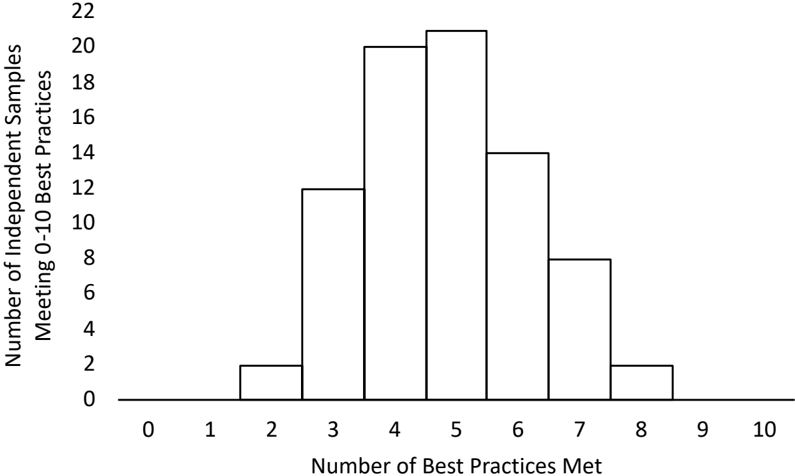
“This process resulted in six studies meeting at least 60% of the best practices criteria.”
§ DO GROWTH MINDSET INTERVENTIONS WORK? 1 Do Growth Mindset Interventions Impact Students' Academic Achievement? A Systematic Review and Meta-Analysis with Recommendations for Best Practices > The Present Study
plain- Asserted: passes — The authors put it forward as true.
- Checkable: passes — It can be checked against evidence.
- Load-bearing: passes — The paper’s conclusions depend on it.
- Based: passes — The paper gives a reason why it holds.
A result the paper reports from its own data — it cites no other source for it, so there is none to check. The quote shows it is in the paper.
In the paper
“When examining all studies (63 studies, N = 97,672), we found major shortcomings in study design, analysis, and reporting”
§ DO GROWTH MINDSET INTERVENTIONS WORK? 1 Do Growth Mindset Interventions Impact Students' Academic Achievement? A Systematic Review and Meta-Analysis with Recommendations for Best Practices > Abstract
plainn = 97,672- Asserted: passes — The authors put it forward as true.
- Checkable: passes — It can be checked against evidence.
- Load-bearing: passes — The paper’s conclusions depend on it.
- Based: passes — The paper gives a reason why it holds.
- It may state two separate claims as one. 37
- Probably not a substantial claim. 98
At least one cited source doesn’t support this claim or points to a different paper, and none confirmed it — see the verdicts below.
In the paper
“Yet, the overall empirical evidence does not support this claim.”
§ DO GROWTH MINDSET INTERVENTIONS WORK? 1 Do Growth Mindset Interventions Impact Students' Academic Achievement? A Systematic Review and Meta-Analysis with Recommendations for Best Practices > 2. Does Holding a Growth Mindset Lead Students to Adopt Learning Goals, Increase
What the sources say
- Not checked — no full text of the sourcecites Payne et al. (2007) source
- Disputedcites Burnette et al. (2013) sourceExperimental — accuracy not yet measured
The paper reports the opposite of the attributed conclusion. Its goal-setting results find a positive association between incremental beliefs and learning goals; its goal-operating results find greater use of mastery-oriented and less use of helpless-oriented strategies. The Moderation by Ego-Threat results report that these associations were stronger when people faced a threat. These are associations rather than proof of causation, but the paper does not conclude that the overall evidence fails to support the proposed pattern. (LLM, conf=0.90)
Checked by a reasoning model — may be wrong.
- Not checked — no full text of the sourcecites Burgoyne, Hambrick, & Macnamara, 2020 source
plain- Asserted: passes — The authors put it forward as true.
- Checkable: passes — It can be checked against evidence.
- Load-bearing: passes — The paper’s conclusions depend on it.
- Based: passes — The paper gives a reason why it holds.
It may state two separate claims as one.
At least one cited source doesn’t support this claim or points to a different paper, and none confirmed it — see the verdicts below.
In the paper
“As another example, Yeager et al. (2019) only reported the results of the 50% of students performing below their school's median.They stated this was in part because lower-achieving students may have more academic difficulties and therefore may benefit more from a growth mindset intervention than higher-achieving students.Yet, they did not report a test of whether the treatment effect for lower-”
§ DO GROWTH MINDSET INTERVENTIONS WORK? 1 Do Growth Mindset Interventions Impact Students' Academic Achievement? A Systematic Review and Meta-Analysis with Recommendations for Best Practices > Testing for Differences Between Groups When Claiming Group Differences
What the sources say
- Disputedcites Yeager et al. (2019) sourceExperimental — accuracy not yet measured
Split into 2 atoms — 1 confirmed, 0 partially supported, 1 disputed, 0 misattributed, 0 unverifiable. Expand the claim to see per-atom verdicts.
Checked by a reasoning model — may be wrong.
plain- Asserted: passes — The authors put it forward as true.
- Checkable: passes — It can be checked against evidence.
- Load-bearing: unclear — It is unclear whether the paper’s conclusions depend on it.
- Based: passes — The paper gives a reason why it holds.
It may state two separate claims as one.
- Disputed
Every source the paper cites for this claim was checked and supports it.
In the paper
“Non-compliers might have certain characteristics that differ from compliers that would impact the effect of treatment (Shaya & Gu, 2007) and non-compliance might be higher in the treatment condition than in the control condition, violating the goal of random assignment.”
§ DO GROWTH MINDSET INTERVENTIONS WORK? 1 Do Growth Mindset Interventions Impact Students' Academic Achievement? A Systematic Review and Meta-Analysis with Recommendations for Best Practices > Reporting the Results of the Participants Who Participated
What the sources say
- Supportedcites Shaya & Gu, 2007 source
Split into 2 atoms — 2 confirmed, 0 partially supported, 0 disputed, 0 misattributed, 0 unverifiable. Expand the claim to see per-atom verdicts.
hedgedconditional- Asserted: passes — The authors put it forward as true.
- Checkable: passes — It can be checked against evidence.
- Load-bearing: passes — The paper’s conclusions depend on it.
- Based: passes — The paper gives a reason why it holds.
It may state two separate claims as one.
- Supported
Every source the paper cites for this claim was checked and supports it.
In the paper
“In an analysis of randomized controlled trials reported as using intent-to-treat analyses, Hollis and Campbell (1999) note that there is no standard definition of intent-to-treat and researchers vary widely in their interpretation.”
§ DO GROWTH MINDSET INTERVENTIONS WORK? 1 Do Growth Mindset Interventions Impact Students' Academic Achievement? A Systematic Review and Meta-Analysis with Recommendations for Best Practices > Reporting the Results of the Participants Who Participated
What the sources say
- Supportedcites Hollis and Campbell (1999) source
The Introduction states that there is 'no single definition' of intention-to-treat analysis and that the phrase seems to have different meanings for different authors. The Key messages also report that handling of deviations from randomised allocation varied widely among published trials. (LLM, conf=0.94)
plain- Asserted: passes — The authors put it forward as true.
- Checkable: passes — It can be checked against evidence.
- Load-bearing: fails — The paper’s conclusions may not depend on it.
- Based: passes — The paper gives a reason why it holds.
Probably not a substantial claim. The paper’s conclusions may not depend on it. It may state two separate claims as one.
- Supported
The cited sources support only part of this claim — read each source’s verdict below.
In the paper
“Preregistration is required for all government-funded medical clinical trials in the United States (Food and Drug Administration, 2007; see also Kaplan & Irvin, 2015).”
§ DO GROWTH MINDSET INTERVENTIONS WORK? 1 Do Growth Mindset Interventions Impact Students' Academic Achievement? A Systematic Review and Meta-Analysis with Recommendations for Best Practices > Following Detailed Preregistered Hypotheses, Design, and Analysis Plans
What the sources say
- Not matchedcites Food and Drug Administration, 2007
Couldn’t be matched to a paper in Crossref, so it can’t be checked.
- Partly supportedcites Kaplan & Irvin, 2015 sourceExperimental — accuracy not yet measured
The Discussion (Implications; page not provided) says registration was required for studies of drugs, biologics, or devices treating serious or life-threatening diseases. It also says many journals required prospective registration and that large NHLBI trials published after 2000 were preregistered. It does not support a requirement covering all government-funded medical clinical trials in the United States. (LLM, conf=0.88)
plain- Asserted: passes — The authors put it forward as true.
- Checkable: passes — It can be checked against evidence.
- Load-bearing: fails — The paper’s conclusions may not depend on it.
- Based: passes — The paper gives a reason why it holds.
Probably not a substantial claim. The paper’s conclusions may not depend on it.
- Not matched
Every source the paper cites for this claim was checked and supports it.
In the paper
“Artificially dichotomizing continuous measures is rarely conceptually or statistically defensible, and frequently yields misleading results (MacCallum et al., 2002).”
§ DO GROWTH MINDSET INTERVENTIONS WORK? 1 Do Growth Mindset Interventions Impact Students' Academic Achievement? A Systematic Review and Meta-Analysis with Recommendations for Best Practices > Using Continuous Variables Over Artificially Dichotomized Variables
What the sources say
- Supportedcites MacCallum et al., 2002 source
The paper’s opening passage (p. 1) says dichotomization is rarely defensible and often yields misleading results. The Summary and Conclusions (p. 20) explains that common justifications are invalid and lists substantial statistical consequences, supporting the paraphrase. (LLM, conf=0.95)
plain- Asserted: passes — The authors put it forward as true.
- Checkable: passes — It can be checked against evidence.
- Load-bearing: unclear — It is unclear whether the paper’s conclusions depend on it.
- Based: passes — The paper gives a reason why it holds.
It may state two separate claims as one.
- Supported
Every source the paper cites for this claim was checked and supports it.
In the paper
“Yeager and Dweck (2020)suggest that the largest effect one can expect from an educational intervention on real-world outcomes is d = 0.20.”
§ DO GROWTH MINDSET INTERVENTIONS WORK? 1 Do Growth Mindset Interventions Impact Students' Academic Achievement? A Systematic Review and Meta-Analysis with Recommendations for Best Practices > Additional information
What the sources say
- Supportedcites Yeager and Dweck (2020) source
In “Controversy #3: Are Mindset Effect Sizes Too Small to Be Interesting?”, the paper says that, when using best-evidence syntheses as the benchmark, about the best effect expected from an educational intervention on real-world outcomes is .20 SD. This supports the citing sentence’s paraphrase. (LLM, conf=0.94)
hedged- Asserted: passes — The authors put it forward as true.
- Checkable: passes — It can be checked against evidence.
- Load-bearing: fails — The paper’s conclusions may not depend on it.
- Based: passes — The paper gives a reason why it holds.
Probably not a substantial claim. The paper’s conclusions may not depend on it.
- Supported
A result the paper reports from its own data — it cites no other source for it, so there is none to check. The quote shows it is in the paper.
In the paper
“Relatively few studies demonstrated that the intervention influenced students' mindsets.Therefore, in some cases, not enough effects were available to conduct moderator analyses.”
§ DO GROWTH MINDSET INTERVENTIONS WORK? 1 Do Growth Mindset Interventions Impact Students' Academic Achievement? A Systematic Review and Meta-Analysis with Recommendations for Best Practices > The Present Study
plain- Asserted: passes — The authors put it forward as true.
- Checkable: passes — It can be checked against evidence.
- Load-bearing: passes — The paper’s conclusions depend on it.
- Based: passes — The paper gives a reason why it holds.
It may state two separate claims as one.
A result the paper reports from its own data — it cites no other source for it, so there is none to check. The quote shows it is in the paper.
In the paper
“For around ten percent of the studies included in this systematic review, we discovered both published and unpublished versions.”
§ DO GROWTH MINDSET INTERVENTIONS WORK? 1 Do Growth Mindset Interventions Impact Students' Academic Achievement? A Systematic Review and Meta-Analysis with Recommendations for Best Practices > Figure 2
plain- Asserted: passes — The authors put it forward as true.
- Checkable: passes — It can be checked against evidence.
- Load-bearing: fails — The paper’s conclusions may not depend on it.
- Based: passes — The paper gives a reason why it holds.
Probably not a substantial claim. The paper’s conclusions may not depend on it.
A result the paper reports from its own data — it cites no other source for it, so there is none to check. The quote shows it is in the paper.
In the paper
“That said, as we systematically reviewed the literature, we found multiple instances of practices that inflate the Type I error rate as well as inappropriate interpretations of significance levels.”
§ DO GROWTH MINDSET INTERVENTIONS WORK? 1 Do Growth Mindset Interventions Impact Students' Academic Achievement? A Systematic Review and Meta-Analysis with Recommendations for Best Practices > Controlling for the Familywise Error Rate
plain- Asserted: passes — The authors put it forward as true.
- Checkable: passes — It can be checked against evidence.
- Load-bearing: fails — The paper’s conclusions may not depend on it.
- Based: passes — The paper gives a reason why it holds.
Probably not a substantial claim. The paper’s conclusions may not depend on it. It may state two separate claims as one.
A result the paper reports from its own data — it cites no other source for it, so there is none to check. The quote shows it is in the paper.
In the paper
“The number of excluded participants ranged from four (2% of the sample) to 6,222 (50% of the sample).”
§ DO GROWTH MINDSET INTERVENTIONS WORK? 1 Do Growth Mindset Interventions Impact Students' Academic Achievement? A Systematic Review and Meta-Analysis with Recommendations for Best Practices > Figure 2
plainn = 5- Asserted: passes — The authors put it forward as true.
- Checkable: passes — It can be checked against evidence.
- Load-bearing: fails — The paper’s conclusions may not depend on it.
- Based: passes — The paper gives a reason why it holds.
Probably not a substantial claim. The paper’s conclusions may not depend on it.
In the paper
“Thus, relative to Sisk et al. (2018), the present meta-analysis includes more than double the number of records and nearly double the total number of participants.”
§ DO GROWTH MINDSET INTERVENTIONS WORK? 1 Do Growth Mindset Interventions Impact Students' Academic Achievement? A Systematic Review and Meta-Analysis with Recommendations for Best Practices > Inclusion Criteria and Literature Search
What the sources say
- Not checked — no full text of the sourcecites Sisk et al. (2018) source
plainn = 79- Asserted: passes — The authors put it forward as true.
- Checkable: passes — It can be checked against evidence.
- Load-bearing: unclear — It is unclear whether the paper’s conclusions depend on it.
- Based: passes — The paper gives a reason why it holds.
It may state two separate claims as one.
A result the paper reports from its own data — it cites no other source for it, so there is none to check. The quote shows it is in the paper.
In the paper
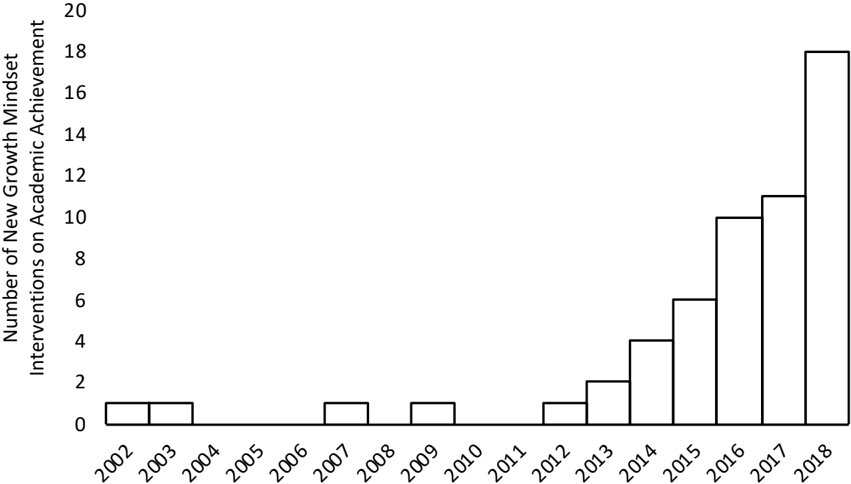
“Of the 61 independent records (e.g., articles) included in the present study, 44 were from 2016 or later.”
§ DO GROWTH MINDSET INTERVENTIONS WORK? 1 Do Growth Mindset Interventions Impact Students' Academic Achievement? A Systematic Review and Meta-Analysis with Recommendations for Best Practices > Rate of Growth Mindset Interventions Entering the Literature
plain- Asserted: passes — The authors put it forward as true.
- Checkable: passes — It can be checked against evidence.
- Load-bearing: fails — The paper’s conclusions may not depend on it.
- Based: passes — The paper gives a reason why it holds.
Probably not a substantial claim. The paper’s conclusions may not depend on it.
The paper states this without a source or data behind it here, so there is nothing to check it against. The quote shows it is in the paper.
In the paper
“All studies included in our systematic review and metaanalyses examined the effect of growth mindset interventions on grades (exam grades, course grades, grade averages) and standardized test scores.”
§ DO GROWTH MINDSET INTERVENTIONS WORK? 1 Do Growth Mindset Interventions Impact Students' Academic Achievement? A Systematic Review and Meta-Analysis with Recommendations for Best Practices > Measuring Direct Outcomes Rather Than Indirect Outcomes
plain- Asserted: passes — The authors put it forward as true.
- Checkable: passes — It can be checked against evidence.
- Load-bearing: passes — The paper’s conclusions depend on it.
- Based: passes — The paper gives a reason why it holds.
Probably not a substantial claim.
A result the paper reports from its own data — it cites no other source for it, so there is none to check. The quote shows it is in the paper.
In the paper
“The number of growth mindset intervention studies examining academic achievement appears to be increasing rapidly, see Figure 2.”
§ DO GROWTH MINDSET INTERVENTIONS WORK? 1 Do Growth Mindset Interventions Impact Students' Academic Achievement? A Systematic Review and Meta-Analysis with Recommendations for Best Practices > Rate of Growth Mindset Interventions Entering the Literature
hedged- Asserted: passes — The authors put it forward as true.
- Checkable: passes — It can be checked against evidence.
- Load-bearing: fails — The paper’s conclusions may not depend on it.
- Based: passes — The paper gives a reason why it holds.
Probably not a substantial claim. The paper’s conclusions may not depend on it.
A result the paper reports from its own data — it cites no other source for it, so there is none to check. The quote shows it is in the paper.
In the paper
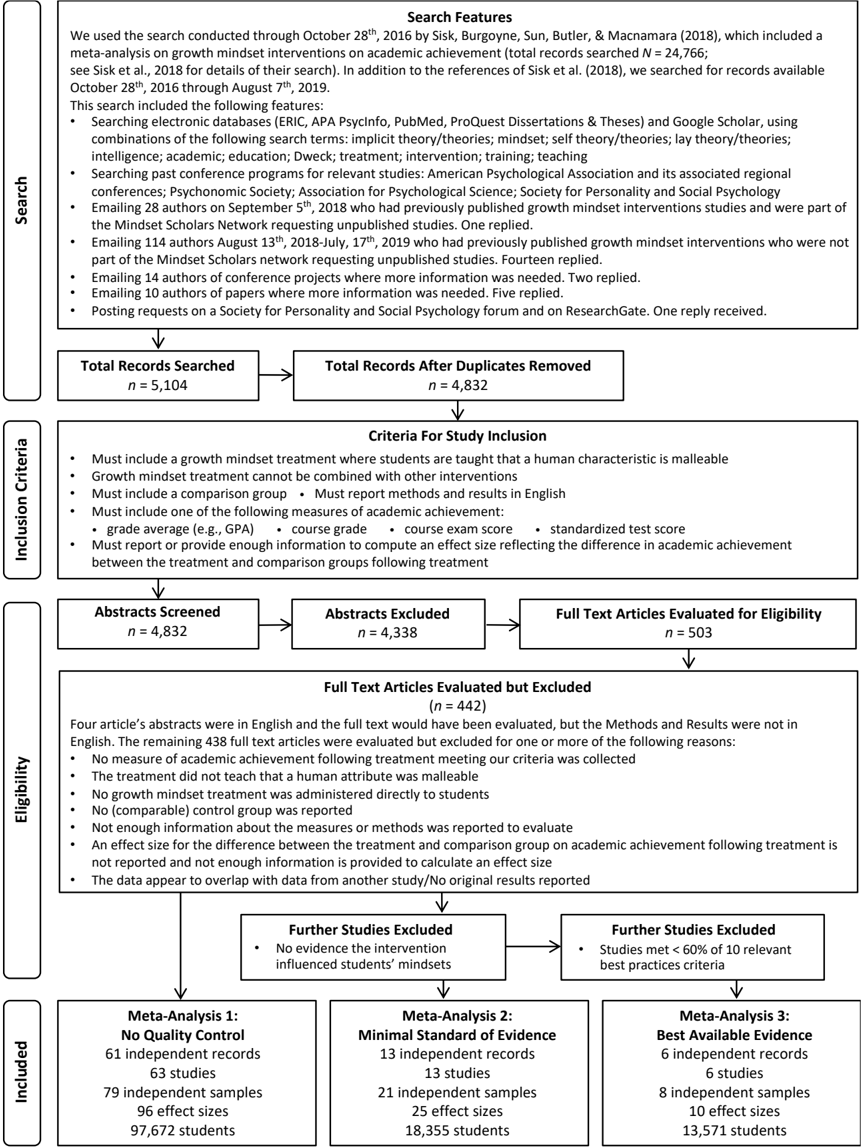
“Including the records previously identified by Sisk et al. (2018), altogether we identified 61 independent records, which included 63 studies and 79 independent samples with a total sample size of 97,672 students.”
- Also stated in: § Criteria For Study Inclusion · plain
“Meta-Analysis 1: No Quality Control 61 independent records 63 studies 79 independent samples 96 effect sizes 97,672 students”
§ DO GROWTH MINDSET INTERVENTIONS WORK? 1 Do Growth Mindset Interventions Impact Students' Academic Achievement? A Systematic Review and Meta-Analysis with Recommendations for Best Practices > Inclusion Criteria and Literature Search
plainn = 79- Asserted: passes — The authors put it forward as true.
- Checkable: passes — It can be checked against evidence.
- Load-bearing: passes — The paper’s conclusions depend on it.
- Based: passes — The paper gives a reason why it holds.
It may state two separate claims as one.
- Also stated in: § Criteria For Study Inclusion · plain
A result the paper reports from its own data — it cites no other source for it, so there is none to check. The quote shows it is in the paper.
In the paper
“However, 89% of the reports in the present study were produced after this date.”
§ DO GROWTH MINDSET INTERVENTIONS WORK? 1 Do Growth Mindset Interventions Impact Students' Academic Achievement? A Systematic Review and Meta-Analysis with Recommendations for Best Practices > Study Hypothesis, Planned Sample (and Stopping Rule), Intervention Design, and
plain- Asserted: passes — The authors put it forward as true.
- Checkable: passes — It can be checked against evidence.
- Load-bearing: fails — The paper’s conclusions may not depend on it.
- Based: passes — The paper gives a reason why it holds.
Probably not a substantial claim. The paper’s conclusions may not depend on it.
A result the paper reports from its own data — it cites no other source for it, so there is none to check. The quote shows it is in the paper.
In the paper
“Counter to this assumption, no theoretically meaningful moderators were significant, indicating that the effect sizes did not differ significantly across levels of the moderator.”
§ DO GROWTH MINDSET INTERVENTIONS WORK? 1 Do Growth Mindset Interventions Impact Students' Academic Achievement? A Systematic Review and Meta-Analysis with Recommendations for Best Practices > Standardized Difference in Means and 95% CI Study Name
hedged- Asserted: passes — The authors put it forward as true.
- Checkable: passes — It can be checked against evidence.
- Load-bearing: passes — The paper’s conclusions depend on it.
- Based: passes — The paper gives a reason why it holds.
It may state two separate claims as one.
A result the paper reports from its own data — it cites no other source for it, so there is none to check. The quote shows it is in the paper.
In the paper
“Six other studies reported that they were preregistered, but we did not code them as such for reasons outlined in Table 3.”
§ DO GROWTH MINDSET INTERVENTIONS WORK? 1 Do Growth Mindset Interventions Impact Students' Academic Achievement? A Systematic Review and Meta-Analysis with Recommendations for Best Practices > Figure 4
plain- Asserted: passes — The authors put it forward as true.
- Checkable: passes — It can be checked against evidence.
- Load-bearing: fails — The paper’s conclusions may not depend on it.
- Based: passes — The paper gives a reason why it holds.
Probably not a substantial claim. The paper’s conclusions may not depend on it.
- Rests on an assumption: Studies without the best-practice characteristics increase the risk to internal validity in individual study results.
The paper states this without a source or data behind it here, so there is nothing to check it against. The quote shows it is in the paper.
In the paper
“For multiple studies reporting significant effects, the researchers assigned students to condition by group (e.g., by classroom) rather than on an individual basis and did so without correction.”
§ DO GROWTH MINDSET INTERVENTIONS WORK? 1 Do Growth Mindset Interventions Impact Students' Academic Achievement? A Systematic Review and Meta-Analysis with Recommendations for Best Practices > Type I Error
plain- Asserted: passes — The authors put it forward as true.
- Checkable: passes — It can be checked against evidence.
- Load-bearing: passes — The paper’s conclusions depend on it.
- Based: passes — The paper gives a reason why it holds.
It may state two separate claims as one.
A result the paper reports from its own data — it cites no other source for it, so there is none to check. The quote shows it is in the paper.
In the paper
“Of the 4,832 independent records revealed in our search, 138 were in a language other than English.”
§ DO GROWTH MINDSET INTERVENTIONS WORK? 1 Do Growth Mindset Interventions Impact Students' Academic Achievement? A Systematic Review and Meta-Analysis with Recommendations for Best Practices > Limitations
plain- Asserted: passes — The authors put it forward as true.
- Checkable: passes — It can be checked against evidence.
- Load-bearing: fails — The paper’s conclusions may not depend on it.
- Based: passes — The paper gives a reason why it holds.
Probably not a substantial claim. The paper’s conclusions may not depend on it.
The paper states this without a source or data behind it here, so there is nothing to check it against. The quote shows it is in the paper.
In the paper
“This study is the most comprehensive systematic review of the empirical evidence of growth mindset interventions on academic achievement to date, assessing both the quantity and quality of the evidence.”
§ DO GROWTH MINDSET INTERVENTIONS WORK? 1 Do Growth Mindset Interventions Impact Students' Academic Achievement? A Systematic Review and Meta-Analysis with Recommendations for Best Practices > Limitations
plain- Asserted: passes — The authors put it forward as true.
- Checkable: passes — It can be checked against evidence.
- Load-bearing: fails — The paper’s conclusions may not depend on it.
- Based: fails — The paper may give no reason why it holds.
Probably not a substantial claim. The paper’s conclusions may not depend on it. The paper may give no reason why it holds.
The paper states this without a source or data behind it here, so there is nothing to check it against. The quote shows it is in the paper.
In the paper
“To our knowledge, no studies have tested whether growth mindset intervention benefits are compounded over longer timescales (i.e., over years).”
§ DO GROWTH MINDSET INTERVENTIONS WORK? 1 Do Growth Mindset Interventions Impact Students' Academic Achievement? A Systematic Review and Meta-Analysis with Recommendations for Best Practices > Implications
hedged- Asserted: passes — The authors put it forward as true.
- Checkable: passes — It can be checked against evidence.
- Load-bearing: fails — The paper’s conclusions may not depend on it.
- Based: passes — The paper gives a reason why it holds.
Probably not a substantial claim. The paper’s conclusions may not depend on it.
The paper states this without a source or data behind it here, so there is nothing to check it against. The quote shows it is in the paper.
In the paper
“most studies included major threats to internal validity, preventing any significant effects from being clearly attributable to growth mindset as the mechanism.”
§ DO GROWTH MINDSET INTERVENTIONS WORK? 1 Do Growth Mindset Interventions Impact Students' Academic Achievement? A Systematic Review and Meta-Analysis with Recommendations for Best Practices > Conclusions
plain- Asserted: passes — The authors put it forward as true.
- Checkable: passes — It can be checked against evidence.
- Load-bearing: passes — The paper’s conclusions depend on it.
- Based: passes — The paper gives a reason why it holds.
It may state two separate claims as one.
A result the paper reports from its own data — it cites no other source for it, so there is none to check. The quote shows it is in the paper.
In the paper
“Authors with financial incentives found both positive and null results, yet, often, only their larger, significant effects were published.”
§ DO GROWTH MINDSET INTERVENTIONS WORK? 1 Do Growth Mindset Interventions Impact Students' Academic Achievement? A Systematic Review and Meta-Analysis with Recommendations for Best Practices > Financial Incentives.
plaindirect- Asserted: passes — The authors put it forward as true.
- Checkable: passes — It can be checked against evidence.
- Load-bearing: unclear — It is unclear whether the paper’s conclusions depend on it.
- Based: passes — The paper gives a reason why it holds.
It may state two separate claims as one.
The paper states this without a source or data behind it here, so there is nothing to check it against. The quote shows it is in the paper.
In the paper
“There is no known evidence suggesting there are many non-English articles relevant to the current meta-analysis or that such studies would produce very different results from the studies currently included in the present-meta-analysis.”
§ DO GROWTH MINDSET INTERVENTIONS WORK? 1 Do Growth Mindset Interventions Impact Students' Academic Achievement? A Systematic Review and Meta-Analysis with Recommendations for Best Practices > Limitations
hedged- Asserted: passes — The authors put it forward as true.
- Checkable: passes — It can be checked against evidence.
- Load-bearing: fails — The paper’s conclusions may not depend on it.
- Based: fails — The paper may give no reason why it holds.
Probably not a substantial claim. The paper’s conclusions may not depend on it. The paper may give no reason why it holds. It may state two separate claims as one.
None of the sources cited for this claim have been checked yet.
In the paper
“Additionally, as described in The State of the Literature, claims about growth mindset interventions being particularly beneficial for particular student subgroups are often not properly tested.”
§ DO GROWTH MINDSET INTERVENTIONS WORK? 1 Do Growth Mindset Interventions Impact Students' Academic Achievement? A Systematic Review and Meta-Analysis with Recommendations for Best Practices > Implications
plain- Asserted: passes — The authors put it forward as true.
- Checkable: passes — It can be checked against evidence.
- Load-bearing: passes — The paper’s conclusions depend on it.
- Based: passes — The paper gives a reason why it holds.
Probably not a substantial claim.
A result the paper reports from its own data — it cites no other source for it, so there is none to check. The quote shows it is in the paper.
In the paper
“Yet, no theoretically meaningful moderators were significant, indicating that the effect sizes did not differ significantly across levels of the moderator.”
§ DO GROWTH MINDSET INTERVENTIONS WORK? 1 Do Growth Mindset Interventions Impact Students' Academic Achievement? A Systematic Review and Meta-Analysis with Recommendations for Best Practices > Standardized Difference in Means and 95% CI Study Name
hedged- Asserted: passes — The authors put it forward as true.
- Checkable: passes — It can be checked against evidence.
- Load-bearing: passes — The paper’s conclusions depend on it.
- Based: passes — The paper gives a reason why it holds.
It may state two separate claims as one.
In the paper
“many studies failed to adjust for the design effect, calling into question the veracity of some reported significant effects (e.g., Blackwell et al., 2007)”
§ DO GROWTH MINDSET INTERVENTIONS WORK? 1 Do Growth Mindset Interventions Impact Students' Academic Achievement? A Systematic Review and Meta-Analysis with Recommendations for Best Practices > Conclusions
What the sources say
- Not matchedcites Blackwell et al., 2007
Couldn’t be matched to a paper in Crossref, so it can’t be checked.
plain- Asserted: passes — The authors put it forward as true.
- Checkable: passes — It can be checked against evidence.
- Load-bearing: passes — The paper’s conclusions depend on it.
- Based: passes — The paper gives a reason why it holds.
It may state two separate claims as one.
- Not matched
A result the paper reports from its own data — it cites no other source for it, so there is none to check. The quote shows it is in the paper.
In the paper
“Zero studies that measurably changed students' mindsets met 100% or 90% best practices criteria, one study met 80% best practices criteria, two studies met 70% best practices criteria, and three met 60% best practices criteria.”
§ DO GROWTH MINDSET INTERVENTIONS WORK? 1 Do Growth Mindset Interventions Impact Students' Academic Achievement? A Systematic Review and Meta-Analysis with Recommendations for Best Practices > Meta-Analysis 3: Best Available Evidence
plainn = 6- Asserted: passes — The authors put it forward as true.
- Checkable: passes — It can be checked against evidence.
- Load-bearing: passes — The paper’s conclusions depend on it.
- Based: passes — The paper gives a reason why it holds.
It may state two separate claims as one.
The paper states this without a source or data behind it here, so there is nothing to check it against. The quote shows it is in the paper.
In the paper
“Furthermore, most studies collect postintervention measures of mindset within a year of administering a growth mindset intervention.”
§ DO GROWTH MINDSET INTERVENTIONS WORK? 1 Do Growth Mindset Interventions Impact Students' Academic Achievement? A Systematic Review and Meta-Analysis with Recommendations for Best Practices > Implications
plain- Asserted: passes — The authors put it forward as true.
- Checkable: passes — It can be checked against evidence.
- Load-bearing: fails — The paper’s conclusions may not depend on it.
- Based: passes — The paper gives a reason why it holds.
Probably not a substantial claim. The paper’s conclusions may not depend on it.
In the paper
“Porta et al. concluded that using a single statistical approach of either per protocol or intent-to-treat analyses does not protect against bias.”
§ DO GROWTH MINDSET INTERVENTIONS WORK? 1 Do Growth Mindset Interventions Impact Students' Academic Achievement? A Systematic Review and Meta-Analysis with Recommendations for Best Practices > Reporting the Results of the Participants Who Participated
What the sources say
- Not matchedcites Porta et al.
Couldn’t be matched to a paper in Crossref, so it can’t be checked.
plain- Asserted: passes — The authors put it forward as true.
- Checkable: passes — It can be checked against evidence.
- Load-bearing: fails — The paper’s conclusions may not depend on it.
- Based: passes — The paper gives a reason why it holds.
Probably not a substantial claim. The paper’s conclusions may not depend on it.
- Not matched
A conclusion the paper draws from its own results — it cites no other source for it, so there is none to check. The quote shows it is in the paper.
In the paper
“Reporting a power analysis does not ensure the study is adequately powered.”
§ DO GROWTH MINDSET INTERVENTIONS WORK? 1 Do Growth Mindset Interventions Impact Students' Academic Achievement? A Systematic Review and Meta-Analysis with Recommendations for Best Practices > A Priori Power Analysis
plain- Asserted: passes — The authors put it forward as true.
- Checkable: passes — It can be checked against evidence.
- Load-bearing: fails — The paper’s conclusions may not depend on it.
- Based: fails — The paper may give no reason why it holds.
Probably not a substantial claim. The paper’s conclusions may not depend on it. The paper may give no reason why it holds.
A conclusion the paper draws from its own results — it cites no other source for it, so there is none to check. The quote shows it is in the paper.
In the paper
“Some might argue that insisting on preregistrations will suppress discoveries.This need not be the case.”
§ DO GROWTH MINDSET INTERVENTIONS WORK? 1 Do Growth Mindset Interventions Impact Students' Academic Achievement? A Systematic Review and Meta-Analysis with Recommendations for Best Practices > Following Detailed Preregistered Hypotheses, Design, and Analysis Plans
plain- Asserted: passes — The authors put it forward as true.
- Checkable: fails — It may be too vague to check against evidence.
- Load-bearing: fails — The paper’s conclusions may not depend on it.
- Based: passes — The paper gives a reason why it holds.
Probably not a substantial claim. It may be too vague to check against evidence. The paper’s conclusions may not depend on it.
None of the sources cited for this claim have been checked yet.
In the paper
“Overall, the relationship between students' mindsets and academic achievement appears to be, at most, weak, and not always in the hypothesized direction.”
§ DO GROWTH MINDSET INTERVENTIONS WORK? 1 Do Growth Mindset Interventions Impact Students' Academic Achievement? A Systematic Review and Meta-Analysis with Recommendations for Best Practices > 3. Do Traits and Behaviors Originating from a Growth Mindset Lead to Higher Levels of Achievement?
What the sources say
- Not checked — no full text of the sourcecites Sisk et al. (2018) source
- Not matchedcites Li & Bates, 2019, 2020
Couldn’t be matched to a paper in Crossref, so it can’t be checked.
hedgedcorrelationaln = 365,915- Asserted: passes — The authors put it forward as true.
- Checkable: passes — It can be checked against evidence.
- Load-bearing: passes — The paper’s conclusions depend on it.
- Based: passes — The paper gives a reason why it holds.
It may state two separate claims as one.
In the paper
“Preregistering in psychology is a newer practice-for instance, the badge identifying preregistered studies was introduced by Psychological Science in 2013 (Eich, 2014)-and is not mandated.”
§ DO GROWTH MINDSET INTERVENTIONS WORK? 1 Do Growth Mindset Interventions Impact Students' Academic Achievement? A Systematic Review and Meta-Analysis with Recommendations for Best Practices > Following Detailed Preregistered Hypotheses, Design, and Analysis Plans
What the sources say
- Not matchedcites Eich, 2014
Couldn’t be matched to a paper in Crossref, so it can’t be checked.
plain- Asserted: passes — The authors put it forward as true.
- Checkable: passes — It can be checked against evidence.
- Load-bearing: fails — The paper’s conclusions may not depend on it.
- Based: passes — The paper gives a reason why it holds.
Probably not a substantial claim. The paper’s conclusions may not depend on it. It may state two separate claims as one.
- Not matched
A conclusion the paper draws from its own results — it cites no other source for it, so there is none to check. The quote shows it is in the paper.
In the paper
“With a large enough sample, on average, the groups should be roughly equivalent regarding extraneous factors (e.g., ability, personality, motivation) that could affect the outcome of the intervention.”
§ DO GROWTH MINDSET INTERVENTIONS WORK? 1 Do Growth Mindset Interventions Impact Students' Academic Achievement? A Systematic Review and Meta-Analysis with Recommendations for Best Practices > Random Assignment to Condition at the Individual Level
plain- Asserted: passes — The authors put it forward as true.
- Checkable: passes — It can be checked against evidence.
- Load-bearing: passes — The paper’s conclusions depend on it.
- Based: passes — The paper gives a reason why it holds.
Probably not a substantial claim.
A conclusion the paper draws from its own results — it cites no other source for it, so there is none to check. The quote shows it is in the paper.
In the paper
“Otherwise, readers cannot evaluate whether differences between the treatment and control groups are due to the treatment or these extraneous variables.”
§ DO GROWTH MINDSET INTERVENTIONS WORK? 1 Do Growth Mindset Interventions Impact Students' Academic Achievement? A Systematic Review and Meta-Analysis with Recommendations for Best Practices > Blinding
plain- Asserted: passes — The authors put it forward as true.
- Checkable: fails — It may be too vague to check against evidence.
- Load-bearing: fails — The paper’s conclusions may not depend on it.
- Based: passes — The paper gives a reason why it holds.
Probably not a substantial claim. It may be too vague to check against evidence. The paper’s conclusions may not depend on it.
A conclusion the paper draws from its own results — it cites no other source for it, so there is none to check. The quote shows it is in the paper.
In the paper
“If reported and followed, conducting a priori power analyses also protects against questionable research practices such as p-hacking and data-peeking.”
§ DO GROWTH MINDSET INTERVENTIONS WORK? 1 Do Growth Mindset Interventions Impact Students' Academic Achievement? A Systematic Review and Meta-Analysis with Recommendations for Best Practices > A Priori Power Analysis
plaindirect- Asserted: passes — The authors put it forward as true.
- Checkable: passes — It can be checked against evidence.
- Load-bearing: fails — The paper’s conclusions may not depend on it.
- Based: passes — The paper gives a reason why it holds.
Probably not a substantial claim. The paper’s conclusions may not depend on it.
A conclusion the paper draws from its own results — it cites no other source for it, so there is none to check. The quote shows it is in the paper.
In the paper
“However, reporting an a priori power analysis requires researchers to determine the expected effect size or smallest effect size of interest and plan the study accordingly.”
§ DO GROWTH MINDSET INTERVENTIONS WORK? 1 Do Growth Mindset Interventions Impact Students' Academic Achievement? A Systematic Review and Meta-Analysis with Recommendations for Best Practices > A Priori Power Analysis
plain- Asserted: passes — The authors put it forward as true.
- Checkable: passes — It can be checked against evidence.
- Load-bearing: fails — The paper’s conclusions may not depend on it.
- Based: passes — The paper gives a reason why it holds.
Probably not a substantial claim. The paper’s conclusions may not depend on it.
A conclusion the paper draws from its own results — it cites no other source for it, so there is none to check. The quote shows it is in the paper.
In the paper
“Researchers must also keep in mind that manipulation check results are only as valid as their measures.”
§ DO GROWTH MINDSET INTERVENTIONS WORK? 1 Do Growth Mindset Interventions Impact Students' Academic Achievement? A Systematic Review and Meta-Analysis with Recommendations for Best Practices > Testing Whether the Intervention Influenced Treatment Students' Mindsets
plaincorrelational- Asserted: passes — The authors put it forward as true.
- Checkable: passes — It can be checked against evidence.
- Load-bearing: passes — The paper’s conclusions depend on it.
- Based: passes — The paper gives a reason why it holds.
Probably not a substantial claim.
None of the sources cited for this claim have been checked yet.
In the paper
“Blinding study administrators to condition assignment may also help reduce observer-expectancy effects-when study administrators consciously or unconsciously influence participants (e.g., Rosenthal, 1976;Rosenthal & Rubin, 1978).”
§ DO GROWTH MINDSET INTERVENTIONS WORK? 1 Do Growth Mindset Interventions Impact Students' Academic Achievement? A Systematic Review and Meta-Analysis with Recommendations for Best Practices > Blinding
What the sources say
- Not matchedcites Rosenthal, 1976
Couldn’t be matched to a paper in Crossref, so it can’t be checked.
- Not checked — no full text of the sourcecites Rosenthal & Rubin, 1978 source
hedgedconditional- Asserted: passes — The authors put it forward as true.
- Checkable: passes — It can be checked against evidence.
- Load-bearing: fails — The paper’s conclusions may not depend on it.
- Based: passes — The paper gives a reason why it holds.
Probably not a substantial claim. The paper’s conclusions may not depend on it.
- Not matched
A conclusion the paper draws from its own results — it cites no other source for it, so there is none to check. The quote shows it is in the paper.
In the paper
“Along with adequate sample sizes, random assignment to conditions at the individual level helps ensure that the treatment and control groups are comparable.”
§ DO GROWTH MINDSET INTERVENTIONS WORK? 1 Do Growth Mindset Interventions Impact Students' Academic Achievement? A Systematic Review and Meta-Analysis with Recommendations for Best Practices > Random Assignment to Condition at the Individual Level
plaindirect- Asserted: passes — The authors put it forward as true.
- Checkable: passes — It can be checked against evidence.
- Load-bearing: passes — The paper’s conclusions depend on it.
- Based: passes — The paper gives a reason why it holds.
Probably not a substantial claim.
A conclusion the paper draws from its own results — it cites no other source for it, so there is none to check. The quote shows it is in the paper.
In the paper
“When the treatment and control groups differ in multiple ways this precludes interpretation of the mechanism driving any effects.”
§ DO GROWTH MINDSET INTERVENTIONS WORK? 1 Do Growth Mindset Interventions Impact Students' Academic Achievement? A Systematic Review and Meta-Analysis with Recommendations for Best Practices > Group Should Be Introduced
plain- Asserted: passes — The authors put it forward as true.
- Checkable: passes — It can be checked against evidence.
- Load-bearing: passes — The paper’s conclusions depend on it.
- Based: fails — The paper may give no reason why it holds.
Probably not a substantial claim. The paper may give no reason why it holds.
A conclusion the paper draws from its own results — it cites no other source for it, so there is none to check. The quote shows it is in the paper.
In the paper
“To determine if the intervention's impact is from a change in growth mindset augmented with encouragement, strategies and/or tips-rather than only due to the encouragement, strategies, and/or tips-the control group needs to receive the same information as the treatment group except information about attribute malleability (growth mindset).”
§ DO GROWTH MINDSET INTERVENTIONS WORK? 1 Do Growth Mindset Interventions Impact Students' Academic Achievement? A Systematic Review and Meta-Analysis with Recommendations for Best Practices > Group Should Be Introduced
plain- Asserted: passes — The authors put it forward as true.
- Checkable: passes — It can be checked against evidence.
- Load-bearing: passes — The paper’s conclusions depend on it.
- Based: passes — The paper gives a reason why it holds.
Probably not a substantial claim.
A conclusion the paper draws from its own results — it cites no other source for it, so there is none to check. The quote shows it is in the paper.
In the paper
“Participants not blinded to condition may also behave according to their beliefs about the study administrators' expectations (i.e., demand characteristics).”
§ DO GROWTH MINDSET INTERVENTIONS WORK? 1 Do Growth Mindset Interventions Impact Students' Academic Achievement? A Systematic Review and Meta-Analysis with Recommendations for Best Practices > Blinding
hedgedconditional- Asserted: passes — The authors put it forward as true.
- Checkable: passes — It can be checked against evidence.
- Load-bearing: fails — The paper’s conclusions may not depend on it.
- Based: passes — The paper gives a reason why it holds.
Probably not a substantial claim. The paper’s conclusions may not depend on it.
The paper states this without a source or data behind it here, so there is nothing to check it against. The quote shows it is in the paper.
In the paper
“Thus, choosing an active (non-fixed-mindset) control group is the best type of comparison group for isolating the critical ingredient of a growth mindset.”
§ DO GROWTH MINDSET INTERVENTIONS WORK? 1 Do Growth Mindset Interventions Impact Students' Academic Achievement? A Systematic Review and Meta-Analysis with Recommendations for Best Practices > The Intervention is Compared to an Active Control Condition
plain- Asserted: passes — The authors put it forward as true.
- Checkable: fails — It may be too vague to check against evidence.
- Load-bearing: passes — The paper’s conclusions depend on it.
- Based: passes — The paper gives a reason why it holds.
Probably not a substantial claim. It may be too vague to check against evidence.
A conclusion the paper draws from its own results — it cites no other source for it, so there is none to check. The quote shows it is in the paper.
In the paper
“Nonetheless, more trust can be placed in the veracity of results from studies that adhere to detailed preregistrations than similar studies that do not.”
§ DO GROWTH MINDSET INTERVENTIONS WORK? 1 Do Growth Mindset Interventions Impact Students' Academic Achievement? A Systematic Review and Meta-Analysis with Recommendations for Best Practices > Following Detailed Preregistered Hypotheses, Design, and Analysis Plans
plaincorrelational- Asserted: passes — The authors put it forward as true.
- Checkable: passes — It can be checked against evidence.
- Load-bearing: fails — The paper’s conclusions may not depend on it.
- Based: passes — The paper gives a reason why it holds.
Probably not a substantial claim. The paper’s conclusions may not depend on it.
In the paper
“Sisk et al. (2018) found that about 1 /3 of growth mindset intervention studies did not report whether the growth mindset intervention influenced students to have more of a growth mindset.Of those that did, around half failed to demonstrate the intervention changed students' mindsets as intended.”
§ DO GROWTH MINDSET INTERVENTIONS WORK? 1 Do Growth Mindset Interventions Impact Students' Academic Achievement? A Systematic Review and Meta-Analysis with Recommendations for Best Practices > 1. Can Interventions Teach Students to
What the sources say
- Not checked — no full text of the sourcecites Sisk et al. (2018) source
plain- Asserted: passes — The authors put it forward as true.
- Checkable: passes — It can be checked against evidence.
- Load-bearing: passes — The paper’s conclusions depend on it.
- Based: passes — The paper gives a reason why it holds.
It may state two separate claims as one.
In the paper
“An active control group is necessary but not sufficient to attribute differences in achievement to the intervention (Simons et al., 2016).”
§ DO GROWTH MINDSET INTERVENTIONS WORK? 1 Do Growth Mindset Interventions Impact Students' Academic Achievement? A Systematic Review and Meta-Analysis with Recommendations for Best Practices > The Intervention is Compared to an Active Control Condition
What the sources say
- Not checked — no full text of the sourcecites Simons et al., 2016 source
plainconditional- Asserted: passes — The authors put it forward as true.
- Checkable: passes — It can be checked against evidence.
- Load-bearing: passes — The paper’s conclusions depend on it.
- Based: passes — The paper gives a reason why it holds.
It may state two separate claims as one.
A conclusion the paper draws from its own results — it cites no other source for it, so there is none to check. The quote shows it is in the paper.
In the paper
“Blinding study administrators to condition assignment may reduce demand characteristics if administrators do not have informed expectations for participants to intuit.”
§ DO GROWTH MINDSET INTERVENTIONS WORK? 1 Do Growth Mindset Interventions Impact Students' Academic Achievement? A Systematic Review and Meta-Analysis with Recommendations for Best Practices > Blinding
hedgedconditional- Asserted: passes — The authors put it forward as true.
- Checkable: passes — It can be checked against evidence.
- Load-bearing: fails — The paper’s conclusions may not depend on it.
- Based: passes — The paper gives a reason why it holds.
Probably not a substantial claim. The paper’s conclusions may not depend on it.
In the paper
“among the studies that reported manipulation checks, the meta-analytic effect on academic achievement was significant for studies where the manipulation checks failed but non-significant for studies where the manipulation checks succeeded.”
§ DO GROWTH MINDSET INTERVENTIONS WORK? 1 Do Growth Mindset Interventions Impact Students' Academic Achievement? A Systematic Review and Meta-Analysis with Recommendations for Best Practices > Do Growth Mindset Interventions Improve Students' Academic Achievement?
What the sources say
- Not checked — no full text of the sourcecites Sisk et al. (2018) source
plaincorrelational- Asserted: passes — The authors put it forward as true.
- Checkable: passes — It can be checked against evidence.
- Load-bearing: passes — The paper’s conclusions depend on it.
- Based: passes — The paper gives a reason why it holds.
It may state two separate claims as one.
In the paper
“The effect on academic achievement was significant for studies that did not report manipulation checks but nonsignificant for studies that did report manipulation checks.”
§ DO GROWTH MINDSET INTERVENTIONS WORK? 1 Do Growth Mindset Interventions Impact Students' Academic Achievement? A Systematic Review and Meta-Analysis with Recommendations for Best Practices > Do Growth Mindset Interventions Improve Students' Academic Achievement?
What the sources say
- Not checked — no full text of the sourcecites Sisk et al. (2018) source
plaincorrelational- Asserted: passes — The authors put it forward as true.
- Checkable: passes — It can be checked against evidence.
- Load-bearing: passes — The paper’s conclusions depend on it.
- Based: passes — The paper gives a reason why it holds.
It may state two separate claims as one.
A conclusion the paper draws from its own results — it cites no other source for it, so there is none to check. The quote shows it is in the paper.
In the paper
“Discoveries can continue to be made via exploratory studies or exploratory analyses.”
§ DO GROWTH MINDSET INTERVENTIONS WORK? 1 Do Growth Mindset Interventions Impact Students' Academic Achievement? A Systematic Review and Meta-Analysis with Recommendations for Best Practices > Following Detailed Preregistered Hypotheses, Design, and Analysis Plans
plain- Asserted: passes — The authors put it forward as true.
- Checkable: fails — It may be too vague to check against evidence.
- Load-bearing: fails — The paper’s conclusions may not depend on it.
- Based: passes — The paper gives a reason why it holds.
Probably not a substantial claim. It may be too vague to check against evidence. The paper’s conclusions may not depend on it.
A conclusion the paper draws from its own results — it cites no other source for it, so there is none to check. The quote shows it is in the paper.
In the paper
“If no measures accurately reflect the underlying construct (e.g., due to demand characteristics, variable response processes), then the responsible mechanism cannot be determined until a valid and reliable measure has been developed.”
§ DO GROWTH MINDSET INTERVENTIONS WORK? 1 Do Growth Mindset Interventions Impact Students' Academic Achievement? A Systematic Review and Meta-Analysis with Recommendations for Best Practices > Testing Whether the Intervention Influenced Treatment Students' Mindsets
plain- Asserted: passes — The authors put it forward as true.
- Checkable: fails — It may be too vague to check against evidence.
- Load-bearing: passes — The paper’s conclusions depend on it.
- Based: passes — The paper gives a reason why it holds.
Probably not a substantial claim. It may be too vague to check against evidence.
A conclusion the paper draws from its own results — it cites no other source for it, so there is none to check. The quote shows it is in the paper.
In the paper
“Preregistered studies are not necessarily welldesigned studies.”
§ DO GROWTH MINDSET INTERVENTIONS WORK? 1 Do Growth Mindset Interventions Impact Students' Academic Achievement? A Systematic Review and Meta-Analysis with Recommendations for Best Practices > Following Detailed Preregistered Hypotheses, Design, and Analysis Plans
plain- Asserted: passes — The authors put it forward as true.
- Checkable: passes — It can be checked against evidence.
- Load-bearing: fails — The paper’s conclusions may not depend on it.
- Based: fails — The paper may give no reason why it holds.
Probably not a substantial claim. The paper’s conclusions may not depend on it. The paper may give no reason why it holds.
The paper states this without a source or data behind it here, so there is nothing to check it against. The quote shows it is in the paper.
In the paper
“Passive comparison groups (no-contact, waitlist, and teachingas-usual controls) differ from the treatment group in students' and teachers' expectations, attention, and engagement.Differences between treatment and passive control groups could account for perceived treatment effects, rather than growth mindset messages.”
§ DO GROWTH MINDSET INTERVENTIONS WORK? 1 Do Growth Mindset Interventions Impact Students' Academic Achievement? A Systematic Review and Meta-Analysis with Recommendations for Best Practices > The Intervention is Compared to an Active Control Condition
hedgedconditional- Asserted: passes — The authors put it forward as true.
- Checkable: passes — It can be checked against evidence.
- Load-bearing: passes — The paper’s conclusions depend on it.
- Based: passes — The paper gives a reason why it holds.
It may state two separate claims as one.
In the paper
“They found poor agreement between the two approaches due to the uncertainty that protocol deviations and missing values introduce.”
§ DO GROWTH MINDSET INTERVENTIONS WORK? 1 Do Growth Mindset Interventions Impact Students' Academic Achievement? A Systematic Review and Meta-Analysis with Recommendations for Best Practices > Reporting the Results of the Participants Who Participated
What the sources say
- Not matchedcites Porta and colleagues (2007)
Couldn’t be matched to a paper in Crossref, so it can’t be checked.
plaindirect- Asserted: passes — The authors put it forward as true.
- Checkable: passes — It can be checked against evidence.
- Load-bearing: fails — The paper’s conclusions may not depend on it.
- Based: passes — The paper gives a reason why it holds.
Probably not a substantial claim. The paper’s conclusions may not depend on it.
- Not matched
None of the sources cited for this claim have been checked yet.
In the paper
“The control condition should be identical to the treatment condition in every way except for the critical ingredient of the treatment (Simons et al., 2016), including matching participant expectations (Boot et al., 2013).”
§ DO GROWTH MINDSET INTERVENTIONS WORK? 1 Do Growth Mindset Interventions Impact Students' Academic Achievement? A Systematic Review and Meta-Analysis with Recommendations for Best Practices > The Intervention is Compared to an Active Control Condition
What the sources say
- Not checked — no full text of the sourcecites Simons et al., 2016 source
- Not matchedcites Boot et al., 2013
Couldn’t be matched to a paper in Crossref, so it can’t be checked.
plain- Asserted: passes — The authors put it forward as true.
- Checkable: passes — It can be checked against evidence.
- Load-bearing: passes — The paper’s conclusions depend on it.
- Based: passes — The paper gives a reason why it holds.
Probably not a substantial claim. It may state two separate claims as one.
In the paper
“Although psychology has no clear financial conflict of interest standards about this type of monetary earnings, the medical field would consider not disclosing this revenue stream in publications a violation of their ethical guidelines: readers should be alerted to financial interests they might perceive as potentially influencing findings (Chivers, 2019).”
§ DO GROWTH MINDSET INTERVENTIONS WORK? 1 Do Growth Mindset Interventions Impact Students' Academic Achievement? A Systematic Review and Meta-Analysis with Recommendations for Best Practices > Best Practices in Avoiding Financial Conflicts of Interest
What the sources say
- Not checked — no full text of the sourcecites Chivers, 2019 source
hedged- Asserted: passes — The authors put it forward as true.
- Checkable: passes — It can be checked against evidence.
- Load-bearing: fails — The paper’s conclusions may not depend on it.
- Based: passes — The paper gives a reason why it holds.
Probably not a substantial claim. The paper’s conclusions may not depend on it.
A conclusion the paper draws from its own results — it cites no other source for it, so there is none to check. The quote shows it is in the paper.
In the paper
“A perceived conflict of interest is introduced when one's income is tied to promoting a particular outcome, in this case, positive effects of growth mindset.”
§ DO GROWTH MINDSET INTERVENTIONS WORK? 1 Do Growth Mindset Interventions Impact Students' Academic Achievement? A Systematic Review and Meta-Analysis with Recommendations for Best Practices > Best Practices in Avoiding Financial Conflicts of Interest
plaindirect- Asserted: passes — The authors put it forward as true.
- Checkable: fails — It may be too vague to check against evidence.
- Load-bearing: fails — The paper’s conclusions may not depend on it.
- Based: passes — The paper gives a reason why it holds.
Probably not a substantial claim. It may be too vague to check against evidence. The paper’s conclusions may not depend on it.
A conclusion the paper draws from its own results — it cites no other source for it, so there is none to check. The quote shows it is in the paper.
In the paper
“Thus, book authors subsequently conducting research on growth mindsets may be, perhaps without awareness, more likely to look for evidence supporting their book's claims (confirmation bias) and less likely to publish contradictory findings (contributing to publication bias).”
§ DO GROWTH MINDSET INTERVENTIONS WORK? 1 Do Growth Mindset Interventions Impact Students' Academic Achievement? A Systematic Review and Meta-Analysis with Recommendations for Best Practices > Best Practices in Avoiding Financial Conflicts of Interest
hedgedconditional- Asserted: passes — The authors put it forward as true.
- Checkable: passes — It can be checked against evidence.
- Load-bearing: fails — The paper’s conclusions may not depend on it.
- Based: passes — The paper gives a reason why it holds.
Probably not a substantial claim. The paper’s conclusions may not depend on it. It may state two separate claims as one.
A conclusion the paper draws from its own results — it cites no other source for it, so there is none to check. The quote shows it is in the paper.
In the paper
“In the case of growth mindset interventions in education, much of the time, the outcome of interest is students' academic achievement.”
§ DO GROWTH MINDSET INTERVENTIONS WORK? 1 Do Growth Mindset Interventions Impact Students' Academic Achievement? A Systematic Review and Meta-Analysis with Recommendations for Best Practices > Measuring Direct Outcomes Rather Than Indirect Outcomes
plain- Asserted: passes — The authors put it forward as true.
- Checkable: passes — It can be checked against evidence.
- Load-bearing: passes — The paper’s conclusions depend on it.
- Based: passes — The paper gives a reason why it holds.
Probably not a substantial claim.
None of the sources cited for this claim could be matched to a paper in Crossref, so there is nothing to check it against.
In the paper
“Mindset theory holds that academically struggling students (e.g., Paunesku et al., 2015) and students facing situational challenges such as transitioning to a new school (e.g., Blackwell et al., 2007) are especially likely to benefit from a growth mindset, more so than students without these risk factors.”
§ DO GROWTH MINDSET INTERVENTIONS WORK? 1 Do Growth Mindset Interventions Impact Students' Academic Achievement? A Systematic Review and Meta-Analysis with Recommendations for Best Practices > Academic Challenge Status.
What the sources say
- Not matchedcites Paunesku et al., 2015
Couldn’t be matched to a paper in Crossref, so it can’t be checked.
- Not matchedcites Blackwell et al., 2007
Couldn’t be matched to a paper in Crossref, so it can’t be checked.
hedgeddirect- Asserted: passes — The authors put it forward as true.
- Checkable: passes — It can be checked against evidence.
- Load-bearing: passes — The paper’s conclusions depend on it.
- Based: passes — The paper gives a reason why it holds.
Probably not a substantial claim.
- Not matched
In the paper
“For studies where assignment to condition occurred at the classroom or school level rather than at the student level, we adjusted the variance associated with these effect sizes by applying Kish's (1965) design effect adjustment, which accounts for the average cluster size (e.g., average number of students per cluster) and the intraclass correlation.”
§ DO GROWTH MINDSET INTERVENTIONS WORK? 1 Do Growth Mindset Interventions Impact Students' Academic Achievement? A Systematic Review and Meta-Analysis with Recommendations for Best Practices > Effect Sizes and Associated Variances
What the sources say
- Not matchedcites Kish's (1965)
Couldn’t be matched to a paper in Crossref, so it can’t be checked.
plain- Asserted: passes — The authors put it forward as true.
- Checkable: passes — It can be checked against evidence.
- Load-bearing: passes — The paper’s conclusions depend on it.
- Based: passes — The paper gives a reason why it holds.
Probably not a substantial claim.
- Not matched
A conclusion the paper draws from its own results — it cites no other source for it, so there is none to check. The quote shows it is in the paper.
In the paper
“For instance, when a growth mindset intervention has a null effect, growth mindset proponents with a financial incentive may be likely to question the timing, the training of the administers, contextual factors, or other nuances and assume one of these issues suppressed the result.”
§ DO GROWTH MINDSET INTERVENTIONS WORK? 1 Do Growth Mindset Interventions Impact Students' Academic Achievement? A Systematic Review and Meta-Analysis with Recommendations for Best Practices > Best Practices in Avoiding Financial Conflicts of Interest
hedgedconditional- Asserted: passes — The authors put it forward as true.
- Checkable: fails — It may be too vague to check against evidence.
- Load-bearing: fails — The paper’s conclusions may not depend on it.
- Based: fails — The paper may give no reason why it holds.
Probably not a substantial claim. It may be too vague to check against evidence. The paper’s conclusions may not depend on it. The paper may give no reason why it holds.
A conclusion the paper draws from its own results — it cites no other source for it, so there is none to check. The quote shows it is in the paper.
In the paper
“To attribute effects to changes in growth mindset, researchers need to provide evidence that the intervention changed students' mindsets.”
§ DO GROWTH MINDSET INTERVENTIONS WORK? 1 Do Growth Mindset Interventions Impact Students' Academic Achievement? A Systematic Review and Meta-Analysis with Recommendations for Best Practices > Significant Effect Interpretation Issues
plainconditional- Asserted: passes — The authors put it forward as true.
- Checkable: passes — It can be checked against evidence.
- Load-bearing: passes — The paper’s conclusions depend on it.
- Based: passes — The paper gives a reason why it holds.
Probably not a substantial claim.
In the paper
“Despite the assumption that intent-to-treat analyses should yield more conservative estimates than per-protocol analyses, the reported intent-to-treat effects were ds = 0.11 and 0.08: nearly four times and eight times the size of the per protocol results.”
§ DO GROWTH MINDSET INTERVENTIONS WORK? 1 Do Growth Mindset Interventions Impact Students' Academic Achievement? A Systematic Review and Meta-Analysis with Recommendations for Best Practices > Reporting the Results of the Participants Who Participated
What the sources say
- Not matchedcites Outes et al. (2017)
Couldn’t be matched to a paper in Crossref, so it can’t be checked.
plain- Asserted: passes — The authors put it forward as true.
- Checkable: passes — It can be checked against evidence.
- Load-bearing: passes — The paper’s conclusions depend on it.
- Based: passes — The paper gives a reason why it holds.
It may state two separate claims as one.
- Not matched
What the paper did — it cites no source for this, so there is none to check. The quote shows it is in the paper.
In the paper
“This criterion excluded studies where the apparent goal was to induce growth mindsets, but the manipulation only involved praising effort or attributing success to effort.”
§ DO GROWTH MINDSET INTERVENTIONS WORK? 1 Do Growth Mindset Interventions Impact Students' Academic Achievement? A Systematic Review and Meta-Analysis with Recommendations for Best Practices > Inclusion Criteria and Literature Search
plain- Asserted: passes — The authors put it forward as true.
- Checkable: passes — It can be checked against evidence.
- Load-bearing: passes — The paper’s conclusions depend on it.
- Based: passes — The paper gives a reason why it holds.
Probably not a substantial claim.
A conclusion the paper draws from its own results — it cites no other source for it, so there is none to check. The quote shows it is in the paper.
In the paper
“Many mindset researchers have a financial interest in demonstrating the benefits of growth mindsets.”
§ DO GROWTH MINDSET INTERVENTIONS WORK? 1 Do Growth Mindset Interventions Impact Students' Academic Achievement? A Systematic Review and Meta-Analysis with Recommendations for Best Practices > Best Practices in Avoiding Financial Conflicts of Interest
plain- Asserted: passes — The authors put it forward as true.
- Checkable: passes — It can be checked against evidence.
- Load-bearing: fails — The paper’s conclusions may not depend on it.
- Based: passes — The paper gives a reason why it holds.
Probably not a substantial claim. The paper’s conclusions may not depend on it.
In the paper
“Otherwise, the results may be difficult to interpret (Redick & Webster, 2014).”
§ DO GROWTH MINDSET INTERVENTIONS WORK? 1 Do Growth Mindset Interventions Impact Students' Academic Achievement? A Systematic Review and Meta-Analysis with Recommendations for Best Practices > Equivalent Control Group at Baseline
What the sources say
- Not matchedcites Redick & Webster, 2014
Couldn’t be matched to a paper in Crossref, so it can’t be checked.
hedged- Asserted: passes — The authors put it forward as true.
- Checkable: fails — It may be too vague to check against evidence.
- Load-bearing: fails — The paper’s conclusions may not depend on it.
- Based: passes — The paper gives a reason why it holds.
Probably not a substantial claim. It may be too vague to check against evidence. The paper’s conclusions may not depend on it.
- Not matched
What the paper did — it cites no source for this, so there is none to check. The quote shows it is in the paper.
In the paper
“The meta-analytic data are openly available at https://osf.io/ajhxv/.”
§ DO GROWTH MINDSET INTERVENTIONS WORK? 1 Do Growth Mindset Interventions Impact Students' Academic Achievement? A Systematic Review and Meta-Analysis with Recommendations for Best Practices > General Method Transparency and Openness
plain- Asserted: passes — The authors put it forward as true.
- Checkable: passes — It can be checked against evidence.
- Load-bearing: fails — The paper’s conclusions may not depend on it.
- Based: passes — The paper gives a reason why it holds.
Probably not a substantial claim. The paper’s conclusions may not depend on it.
A conclusion the paper draws from its own results — it cites no other source for it, so there is none to check. The quote shows it is in the paper.
In the paper
“Critically, if a positive effect is found, this same level of criticism may not be applied.”
§ DO GROWTH MINDSET INTERVENTIONS WORK? 1 Do Growth Mindset Interventions Impact Students' Academic Achievement? A Systematic Review and Meta-Analysis with Recommendations for Best Practices > Best Practices in Avoiding Financial Conflicts of Interest
hedgedconditional- Asserted: passes — The authors put it forward as true.
- Checkable: fails — It may be too vague to check against evidence.
- Load-bearing: fails — The paper’s conclusions may not depend on it.
- Based: passes — The paper gives a reason why it holds.
Probably not a substantial claim. It may be too vague to check against evidence. The paper’s conclusions may not depend on it.
What the paper did — it cites no source for this, so there is none to check. The quote shows it is in the paper.
In the paper
“We coded for student factors and methodological factors that served as preregistered potential moderators (described in the following subsections).”
§ DO GROWTH MINDSET INTERVENTIONS WORK? 1 Do Growth Mindset Interventions Impact Students' Academic Achievement? A Systematic Review and Meta-Analysis with Recommendations for Best Practices > Coding
plain- Asserted: passes — The authors put it forward as true.
- Checkable: passes — It can be checked against evidence.
- Load-bearing: fails — The paper’s conclusions may not depend on it.
- Based: passes — The paper gives a reason why it holds.
Probably not a substantial claim. The paper’s conclusions may not depend on it.
A conclusion the paper draws from its own results — it cites no other source for it, so there is none to check. The quote shows it is in the paper.
In the paper
“If only one significance test is conducted per hypothesis, then there is only a small chance that it will reveal a significant effect when none truly exists.”
§ DO GROWTH MINDSET INTERVENTIONS WORK? 1 Do Growth Mindset Interventions Impact Students' Academic Achievement? A Systematic Review and Meta-Analysis with Recommendations for Best Practices > Controlling for the Familywise Error Rate
plain- Asserted: passes — The authors put it forward as true.
- Checkable: passes — It can be checked against evidence.
- Load-bearing: fails — The paper’s conclusions may not depend on it.
- Based: passes — The paper gives a reason why it holds.
Probably not a substantial claim. The paper’s conclusions may not depend on it.
In the paper
“That said, in the presence of protocol deviations, the conclusion of the effect of treatment cannot rest on either per protocol or intent-to-treat analyses alone (Porta et al., 2007).”
§ DO GROWTH MINDSET INTERVENTIONS WORK? 1 Do Growth Mindset Interventions Impact Students' Academic Achievement? A Systematic Review and Meta-Analysis with Recommendations for Best Practices > Reporting the Results of the Participants Who Participated
What the sources say
- Not checked — no full text of the sourcecites Porta et al., 2007 source
plain- Asserted: passes — The authors put it forward as true.
- Checkable: passes — It can be checked against evidence.
- Load-bearing: fails — The paper’s conclusions may not depend on it.
- Based: passes — The paper gives a reason why it holds.
Probably not a substantial claim. The paper’s conclusions may not depend on it.
A conclusion the paper draws from its own results — it cites no other source for it, so there is none to check. The quote shows it is in the paper.
In the paper
“Though the measurement of indirect effects are useful for testing mediation, conclusions about an unmeasured outcome should not be drawn from indirect effects.”
§ DO GROWTH MINDSET INTERVENTIONS WORK? 1 Do Growth Mindset Interventions Impact Students' Academic Achievement? A Systematic Review and Meta-Analysis with Recommendations for Best Practices > Measuring Direct Outcomes Rather Than Indirect Outcomes
plain- Asserted: passes — The authors put it forward as true.
- Checkable: passes — It can be checked against evidence.
- Load-bearing: passes — The paper’s conclusions depend on it.
- Based: passes — The paper gives a reason why it holds.
Probably not a substantial claim.
A conclusion the paper draws from its own results — it cites no other source for it, so there is none to check. The quote shows it is in the paper.
In the paper
“Like any type of underreporting, selectively excluding the results of subsamples provides an incomplete picture of the treatment effects.”
§ DO GROWTH MINDSET INTERVENTIONS WORK? 1 Do Growth Mindset Interventions Impact Students' Academic Achievement? A Systematic Review and Meta-Analysis with Recommendations for Best Practices > Reporting the Results of All Subsamples
plain- Asserted: passes — The authors put it forward as true.
- Checkable: fails — It may be too vague to check against evidence.
- Load-bearing: fails — The paper’s conclusions may not depend on it.
- Based: passes — The paper gives a reason why it holds.
Probably not a substantial claim. It may be too vague to check against evidence. The paper’s conclusions may not depend on it.
What the paper did — it cites no source for this, so there is none to check. The quote shows it is in the paper.
In the paper
“We only included studies where the effect of the growth mindset intervention could be evaluated independently of other interventions' effects.”
§ DO GROWTH MINDSET INTERVENTIONS WORK? 1 Do Growth Mindset Interventions Impact Students' Academic Achievement? A Systematic Review and Meta-Analysis with Recommendations for Best Practices > The Intervention of Interest is Isolated from Other Treatments
plain- Asserted: passes — The authors put it forward as true.
- Checkable: passes — It can be checked against evidence.
- Load-bearing: passes — The paper’s conclusions depend on it.
- Based: passes — The paper gives a reason why it holds.
Probably not a substantial claim.
What the paper did — it cites no source for this, so there is none to check. The quote shows it is in the paper.
In the paper
“Following our preregistration, we used the effect reported in the unpublished version when it contained a larger sample than the published version.”
§ DO GROWTH MINDSET INTERVENTIONS WORK? 1 Do Growth Mindset Interventions Impact Students' Academic Achievement? A Systematic Review and Meta-Analysis with Recommendations for Best Practices > Figure 2
plainn = 5- Asserted: passes — The authors put it forward as true.
- Checkable: passes — It can be checked against evidence.
- Load-bearing: fails — The paper’s conclusions may not depend on it.
- Based: passes — The paper gives a reason why it holds.
Probably not a substantial claim. The paper’s conclusions may not depend on it.
A conclusion the paper draws from its own results — it cites no other source for it, so there is none to check. The quote shows it is in the paper.
In the paper
“Additionally, several growth mindset researchers have co-founded, are employed by, or serve as paid consultants to organizations that sell or promote growth mindset interventions or services.”
§ DO GROWTH MINDSET INTERVENTIONS WORK? 1 Do Growth Mindset Interventions Impact Students' Academic Achievement? A Systematic Review and Meta-Analysis with Recommendations for Best Practices > Best Practices in Avoiding Financial Conflicts of Interest
plain- Asserted: passes — The authors put it forward as true.
- Checkable: passes — It can be checked against evidence.
- Load-bearing: fails — The paper’s conclusions may not depend on it.
- Based: fails — The paper may give no reason why it holds.
Probably not a substantial claim. The paper’s conclusions may not depend on it. The paper may give no reason why it holds.
In the paper
“This income is not often acknowledged in scientific publications (Chivers, 2019).”
§ DO GROWTH MINDSET INTERVENTIONS WORK? 1 Do Growth Mindset Interventions Impact Students' Academic Achievement? A Systematic Review and Meta-Analysis with Recommendations for Best Practices > Best Practices in Avoiding Financial Conflicts of Interest
What the sources say
- Not checked — no full text of the sourcecites Chivers, 2019 source
plain- Asserted: passes — The authors put it forward as true.
- Checkable: passes — It can be checked against evidence.
- Load-bearing: fails — The paper’s conclusions may not depend on it.
- Based: passes — The paper gives a reason why it holds.
Probably not a substantial claim. The paper’s conclusions may not depend on it.
A conclusion the paper draws from its own results — it cites no other source for it, so there is none to check. The quote shows it is in the paper.
In the paper
“An equivalent control group at baseline is critical for interpreting the treatment mechanism.”
§ DO GROWTH MINDSET INTERVENTIONS WORK? 1 Do Growth Mindset Interventions Impact Students' Academic Achievement? A Systematic Review and Meta-Analysis with Recommendations for Best Practices > Equivalent Control Group at Baseline
plain- Asserted: passes — The authors put it forward as true.
- Checkable: fails — It may be too vague to check against evidence.
- Load-bearing: fails — The paper’s conclusions may not depend on it.
- Based: fails — The paper may give no reason why it holds.
Probably not a substantial claim. It may be too vague to check against evidence. The paper’s conclusions may not depend on it. The paper may give no reason why it holds.
A conclusion the paper draws from its own results — it cites no other source for it, so there is none to check. The quote shows it is in the paper.
In the paper
“That is, presumably, companies hire mindset researchers as motivational speakers to hear about the benefits of growth mindsets; knowledge of weak, mixed, null, or counter-evidence to the benefits of growth mindset reduces that appeal, which would reduce the number of invitations for these lucrative speaking engagements.”
§ DO GROWTH MINDSET INTERVENTIONS WORK? 1 Do Growth Mindset Interventions Impact Students' Academic Achievement? A Systematic Review and Meta-Analysis with Recommendations for Best Practices > Best Practices in Avoiding Financial Conflicts of Interest
hedgeddirect- Asserted: passes — The authors put it forward as true.
- Checkable: fails — It may be too vague to check against evidence.
- Load-bearing: fails — The paper’s conclusions may not depend on it.
- Based: fails — The paper may give no reason why it holds.
Probably not a substantial claim. It may be too vague to check against evidence. The paper’s conclusions may not depend on it. The paper may give no reason why it holds. It may state two separate claims as one.
In the paper
“Mindset researchers suggest that growth mindsets are especially beneficial for students coming from low socioeconomic-status (SES) households (e.g., Claro et al., 2016).”
§ DO GROWTH MINDSET INTERVENTIONS WORK? 1 Do Growth Mindset Interventions Impact Students' Academic Achievement? A Systematic Review and Meta-Analysis with Recommendations for Best Practices > Socioeconomic Status.
What the sources say
- Not matchedcites Claro et al., 2016
Couldn’t be matched to a paper in Crossref, so it can’t be checked.
hedgedconditional- Asserted: passes — The authors put it forward as true.
- Checkable: passes — It can be checked against evidence.
- Load-bearing: fails — The paper’s conclusions may not depend on it.
- Based: passes — The paper gives a reason why it holds.
Probably not a substantial claim. The paper’s conclusions may not depend on it.
- Not matched
What the paper did — it cites no source for this, so there is none to check. The quote shows it is in the paper.
In the paper
“The second is that we only included interventions that directly taught that a human characteristic could change.”
§ DO GROWTH MINDSET INTERVENTIONS WORK? 1 Do Growth Mindset Interventions Impact Students' Academic Achievement? A Systematic Review and Meta-Analysis with Recommendations for Best Practices > Inclusion Criteria and Literature Search
plain- Asserted: passes — The authors put it forward as true.
- Checkable: passes — It can be checked against evidence.
- Load-bearing: passes — The paper’s conclusions depend on it.
- Based: passes — The paper gives a reason why it holds.
Probably not a substantial claim.
What the paper did — it cites no source for this, so there is none to check. The quote shows it is in the paper.
In the paper
“We only included studies where the growth mindset intervention was administered independent of other intervention protocols.”
§ DO GROWTH MINDSET INTERVENTIONS WORK? 1 Do Growth Mindset Interventions Impact Students' Academic Achievement? A Systematic Review and Meta-Analysis with Recommendations for Best Practices > The Intervention of Interest is Isolated from Other Treatments
plain- Asserted: passes — The authors put it forward as true.
- Checkable: passes — It can be checked against evidence.
- Load-bearing: passes — The paper’s conclusions depend on it.
- Based: passes — The paper gives a reason why it holds.
Probably not a substantial claim.
A conclusion the paper draws from its own results — it cites no other source for it, so there is none to check. The quote shows it is in the paper.
In the paper
“That is, despite random assignment to condition, the treatment and control groups could still differ on pre-intervention academic achievement due to chance.”
§ DO GROWTH MINDSET INTERVENTIONS WORK? 1 Do Growth Mindset Interventions Impact Students' Academic Achievement? A Systematic Review and Meta-Analysis with Recommendations for Best Practices > Equivalent Control Group at Baseline
hedged- Asserted: passes — The authors put it forward as true.
- Checkable: passes — It can be checked against evidence.
- Load-bearing: passes — The paper’s conclusions depend on it.
- Based: passes — The paper gives a reason why it holds.
Probably not a substantial claim.
A conclusion the paper draws from its own results — it cites no other source for it, so there is none to check. The quote shows it is in the paper.
In the paper
“Mindset researchers earning income from either type of organization are incentivized to report positive effects of growth mindset in their research.”
§ DO GROWTH MINDSET INTERVENTIONS WORK? 1 Do Growth Mindset Interventions Impact Students' Academic Achievement? A Systematic Review and Meta-Analysis with Recommendations for Best Practices > Best Practices in Avoiding Financial Conflicts of Interest
plaindirect- Asserted: passes — The authors put it forward as true.
- Checkable: passes — It can be checked against evidence.
- Load-bearing: fails — The paper’s conclusions may not depend on it.
- Based: fails — The paper may give no reason why it holds.
Probably not a substantial claim. The paper’s conclusions may not depend on it. The paper may give no reason why it holds.
What the paper did — it cites no source for this, so there is none to check. The quote shows it is in the paper.
In the paper
“A team of three coded the study features.First, each author coded half the studies independently.Second, the first author and a research assistant checked all studies and made any necessary coding adjustments, including a detailed description of the reason for the adjustment.”
§ DO GROWTH MINDSET INTERVENTIONS WORK? 1 Do Growth Mindset Interventions Impact Students' Academic Achievement? A Systematic Review and Meta-Analysis with Recommendations for Best Practices > Coding
plain- Asserted: passes — The authors put it forward as true.
- Checkable: passes — It can be checked against evidence.
- Load-bearing: fails — The paper’s conclusions may not depend on it.
- Based: passes — The paper gives a reason why it holds.
Probably not a substantial claim. The paper’s conclusions may not depend on it. It may state two separate claims as one.
In the paper
“These inclusion criteria are identical to Sisk et al.'s (2018) inclusion criteria, with two exceptions.”
§ DO GROWTH MINDSET INTERVENTIONS WORK? 1 Do Growth Mindset Interventions Impact Students' Academic Achievement? A Systematic Review and Meta-Analysis with Recommendations for Best Practices > Inclusion Criteria and Literature Search
What the sources say
- Not checked — no full text of the sourcecites Sisk et al.'s (2018) source
plain- Asserted: passes — The authors put it forward as true.
- Checkable: passes — It can be checked against evidence.
- Load-bearing: fails — The paper’s conclusions may not depend on it.
- Based: passes — The paper gives a reason why it holds.
Probably not a substantial claim. The paper’s conclusions may not depend on it.
What the paper did — it cites no source for this, so there is none to check. The quote shows it is in the paper.
In the paper
“Deviations and decisions not explicit in the preregistration are reported in the Appendix.”
§ DO GROWTH MINDSET INTERVENTIONS WORK? 1 Do Growth Mindset Interventions Impact Students' Academic Achievement? A Systematic Review and Meta-Analysis with Recommendations for Best Practices > General Method Transparency and Openness
plain- Asserted: passes — The authors put it forward as true.
- Checkable: passes — It can be checked against evidence.
- Load-bearing: fails — The paper’s conclusions may not depend on it.
- Based: passes — The paper gives a reason why it holds.
Probably not a substantial claim. The paper’s conclusions may not depend on it.
None of the sources cited for this claim have been checked yet.
In the paper
“We designed the meta-analyses and report the results in accordance with the Preferred Reporting Items for Systematic Reviews and Meta-Analyses (PRISMA) statement (Moher et al., 2009) and the American Psychological Association's Quantitative Meta-Analysis Article Reporting Standards (Appelbaum et al., 2018).”
§ DO GROWTH MINDSET INTERVENTIONS WORK? 1 Do Growth Mindset Interventions Impact Students' Academic Achievement? A Systematic Review and Meta-Analysis with Recommendations for Best Practices > General Method Transparency and Openness
What the sources say
- Not matchedcites Moher et al., 2009
Couldn’t be matched to a paper in Crossref, so it can’t be checked.
- Not checked — no full text of the sourcecites Appelbaum et al., 2018 source
plain- Asserted: passes — The authors put it forward as true.
- Checkable: passes — It can be checked against evidence.
- Load-bearing: fails — The paper’s conclusions may not depend on it.
- Based: passes — The paper gives a reason why it holds.
Probably not a substantial claim. The paper’s conclusions may not depend on it. It may state two separate claims as one.
- Not matched
A conclusion the paper draws from its own results — it cites no other source for it, so there is none to check. The quote shows it is in the paper.
In the paper
“If an intervention is combined with another treatment, either by design or during analysis, readers cannot evaluate whether the intervention is effective or whether effects are due to the other treatment or their combination.”
§ DO GROWTH MINDSET INTERVENTIONS WORK? 1 Do Growth Mindset Interventions Impact Students' Academic Achievement? A Systematic Review and Meta-Analysis with Recommendations for Best Practices > The Intervention of Interest is Isolated from Other Treatments
plain- Asserted: passes — The authors put it forward as true.
- Checkable: passes — It can be checked against evidence.
- Load-bearing: passes — The paper’s conclusions depend on it.
- Based: passes — The paper gives a reason why it holds.
Probably not a substantial claim.
What the paper did — it cites no source for this, so there is none to check. The quote shows it is in the paper.
In the paper
“As such, all studies included in the subsequent systematic review and meta-analyses met these criteria and we do not count them when examining the number of best practices criteria studies met.”
§ DO GROWTH MINDSET INTERVENTIONS WORK? 1 Do Growth Mindset Interventions Impact Students' Academic Achievement? A Systematic Review and Meta-Analysis with Recommendations for Best Practices > Best Practices That Were Inclusion Criteria
plain- Asserted: passes — The authors put it forward as true.
- Checkable: passes — It can be checked against evidence.
- Load-bearing: fails — The paper’s conclusions may not depend on it.
- Based: passes — The paper gives a reason why it holds.
Probably not a substantial claim. The paper’s conclusions may not depend on it.
In the paper
“Despite the increase in attention paid to some unpublished studies, many unpublished studies are largely unknown, and publication bias remains a major problem in psychological science (Friese & Frankenbach, 2020).”
§ DO GROWTH MINDSET INTERVENTIONS WORK? 1 Do Growth Mindset Interventions Impact Students' Academic Achievement? A Systematic Review and Meta-Analysis with Recommendations for Best Practices > Figure 2
What the sources say
- Not checked — no full text of the sourcecites Friese & Frankenbach, 2020 source
plain- Asserted: passes — The authors put it forward as true.
- Checkable: passes — It can be checked against evidence.
- Load-bearing: fails — The paper’s conclusions may not depend on it.
- Based: passes — The paper gives a reason why it holds.
Probably not a substantial claim. The paper’s conclusions may not depend on it.
In the paper
“For example, Tillis (2019) randomly assigned students to a treatment group or a control group.The treatment group students received a growth mindset intervention, a stereotype threat intervention, and a relevance and cognitive dissonance intervention.”
§ DO GROWTH MINDSET INTERVENTIONS WORK? 1 Do Growth Mindset Interventions Impact Students' Academic Achievement? A Systematic Review and Meta-Analysis with Recommendations for Best Practices > The Intervention of Interest is Isolated from Other Treatments
What the sources say
- Not matchedcites Tillis (2019)
Couldn’t be matched to a paper in Crossref, so it can’t be checked.
plain- Asserted: passes — The authors put it forward as true.
- Checkable: passes — It can be checked against evidence.
- Load-bearing: passes — The paper’s conclusions depend on it.
- Based: passes — The paper gives a reason why it holds.
It may state two separate claims as one.
- Not matched
What the paper did — it cites no source for this, so there is none to check. The quote shows it is in the paper.
In the paper
“Hypotheses, methods, and planned analyses were preregistered at https://osf.io/ga9jk.”
§ DO GROWTH MINDSET INTERVENTIONS WORK? 1 Do Growth Mindset Interventions Impact Students' Academic Achievement? A Systematic Review and Meta-Analysis with Recommendations for Best Practices > General Method Transparency and Openness
plain- Asserted: passes — The authors put it forward as true.
- Checkable: passes — It can be checked against evidence.
- Load-bearing: fails — The paper’s conclusions may not depend on it.
- Based: passes — The paper gives a reason why it holds.
Probably not a substantial claim. The paper’s conclusions may not depend on it.
A conclusion the paper draws from its own results — it cites no other source for it, so there is none to check. The quote shows it is in the paper.
In the paper
“Combining all three intervention conditions to compare with the control group obfuscates the effects of the individual treatment conditions as well as the effects of the combined mindset and sense-of-purpose condition.”
§ DO GROWTH MINDSET INTERVENTIONS WORK? 1 Do Growth Mindset Interventions Impact Students' Academic Achievement? A Systematic Review and Meta-Analysis with Recommendations for Best Practices > The Intervention of Interest is Isolated from Other Treatments
plaindirectSingle case- Asserted: passes — The authors put it forward as true.
- Checkable: passes — It can be checked against evidence.
- Load-bearing: passes — The paper’s conclusions depend on it.
- Based: passes — The paper gives a reason why it holds.
It may state two separate claims as one.
A conclusion the paper draws from its own results — it cites no other source for it, so there is none to check. The quote shows it is in the paper.
In the paper
“Otherwise, the chance of erroneously observing a significant effect increases beyond the alpha level.”
§ DO GROWTH MINDSET INTERVENTIONS WORK? 1 Do Growth Mindset Interventions Impact Students' Academic Achievement? A Systematic Review and Meta-Analysis with Recommendations for Best Practices > Controlling for the Familywise Error Rate
plaindirect- Asserted: passes — The authors put it forward as true.
- Checkable: passes — It can be checked against evidence.
- Load-bearing: fails — The paper’s conclusions may not depend on it.
- Based: passes — The paper gives a reason why it holds.
Probably not a substantial claim. The paper’s conclusions may not depend on it.
A claim is checked only against the cited paper’s full text, never its abstract, and none is available for its sources.
In the paper
“According to mindset theory, growth mindset interventions interact with recursive processes (Yeager & Walton, 2011), producing enduring changes that compound benefits over time (Dweck et al., 2014).”
§ DO GROWTH MINDSET INTERVENTIONS WORK? 1 Do Growth Mindset Interventions Impact Students' Academic Achievement? A Systematic Review and Meta-Analysis with Recommendations for Best Practices > Time Interval between the Intervention and the Measure of Academic Achievement.
What the sources say
- Not checked — no full text of the sourcecites Yeager & Walton, 2011 source
- Not checked — no full text of the sourcecites Dweck et al., 2014
plaindirect- Asserted: passes — The authors put it forward as true.
- Checkable: passes — It can be checked against evidence.
- Load-bearing: passes — The paper’s conclusions depend on it.
- Based: passes — The paper gives a reason why it holds.
Probably not a substantial claim.
What the paper did — it cites no source for this, so there is none to check. The quote shows it is in the paper.
In the paper
“When possible, we accounted for baseline academic achievement.”
§ DO GROWTH MINDSET INTERVENTIONS WORK? 1 Do Growth Mindset Interventions Impact Students' Academic Achievement? A Systematic Review and Meta-Analysis with Recommendations for Best Practices > Effect Sizes and Associated Variances
hedged- Asserted: passes — The authors put it forward as true.
- Checkable: passes — It can be checked against evidence.
- Load-bearing: fails — The paper’s conclusions may not depend on it.
- Based: passes — The paper gives a reason why it holds.
Probably not a substantial claim. The paper’s conclusions may not depend on it.
A conclusion the paper draws from its own results — it cites no other source for it, so there is none to check. The quote shows it is in the paper.
In the paper
“Multiple growth mindset researchers are registered with speakers' bureaus as motivational, inspirational, and keynote speakers, where they charge $10,000 to $50,000 per talk to speak about growth mindset.”
§ DO GROWTH MINDSET INTERVENTIONS WORK? 1 Do Growth Mindset Interventions Impact Students' Academic Achievement? A Systematic Review and Meta-Analysis with Recommendations for Best Practices > Best Practices in Avoiding Financial Conflicts of Interest
plain- Asserted: passes — The authors put it forward as true.
- Checkable: passes — It can be checked against evidence.
- Load-bearing: fails — The paper’s conclusions may not depend on it.
- Based: fails — The paper may give no reason why it holds.
Probably not a substantial claim. The paper’s conclusions may not depend on it. The paper may give no reason why it holds.
A conclusion the paper draws from its own results — it cites no other source for it, so there is none to check. The quote shows it is in the paper.
In the paper
“Readers cannot evaluate the full set of results when subgroups are excluded.”
§ DO GROWTH MINDSET INTERVENTIONS WORK? 1 Do Growth Mindset Interventions Impact Students' Academic Achievement? A Systematic Review and Meta-Analysis with Recommendations for Best Practices > Reporting the Results of All Subsamples
plain- Asserted: passes — The authors put it forward as true.
- Checkable: fails — It may be too vague to check against evidence.
- Load-bearing: fails — The paper’s conclusions may not depend on it.
- Based: passes — The paper gives a reason why it holds.
Probably not a substantial claim. It may be too vague to check against evidence. The paper’s conclusions may not depend on it.
A conclusion the paper draws from its own results — it cites no other source for it, so there is none to check. The quote shows it is in the paper.
In the paper
“To test the efficacy of a particular intervention, there must be a condition in which participants only receive the intervention of interest for comparison with a control group.”
§ DO GROWTH MINDSET INTERVENTIONS WORK? 1 Do Growth Mindset Interventions Impact Students' Academic Achievement? A Systematic Review and Meta-Analysis with Recommendations for Best Practices > The Intervention of Interest is Isolated from Other Treatments
plain- Asserted: passes — The authors put it forward as true.
- Checkable: passes — It can be checked against evidence.
- Load-bearing: passes — The paper’s conclusions depend on it.
- Based: fails — The paper may give no reason why it holds.
Probably not a substantial claim. The paper may give no reason why it holds.
In the paper
“If a study did not report the intraclass correlation, we used the intraclass correlation default used by the What Works Clearinghouse (2020) for achievement measures (ρ = .20).”
§ DO GROWTH MINDSET INTERVENTIONS WORK? 1 Do Growth Mindset Interventions Impact Students' Academic Achievement? A Systematic Review and Meta-Analysis with Recommendations for Best Practices > Effect Sizes and Associated Variances
What the sources say
- Not matchedcites What Works Clearinghouse (2020)
Couldn’t be matched to a paper in Crossref, so it can’t be checked.
plain- Asserted: passes — The authors put it forward as true.
- Checkable: passes — It can be checked against evidence.
- Load-bearing: fails — The paper’s conclusions may not depend on it.
- Based: passes — The paper gives a reason why it holds.
Probably not a substantial claim. The paper’s conclusions may not depend on it.
- Not matched
A conclusion the paper draws from its own results — it cites no other source for it, so there is none to check. The quote shows it is in the paper.
In the paper
“Testing for group differences when claiming or implying group differences is a best practice in analyses.”
§ DO GROWTH MINDSET INTERVENTIONS WORK? 1 Do Growth Mindset Interventions Impact Students' Academic Achievement? A Systematic Review and Meta-Analysis with Recommendations for Best Practices > Testing for Differences Between Groups When Claiming Group Differences
plain- Asserted: passes — The authors put it forward as true.
- Checkable: fails — It may be too vague to check against evidence.
- Load-bearing: fails — The paper’s conclusions may not depend on it.
- Based: fails — The paper may give no reason why it holds.
Probably not a substantial claim. It may be too vague to check against evidence. The paper’s conclusions may not depend on it. The paper may give no reason why it holds.
What the paper did — it cites no source for this, so there is none to check. The quote shows it is in the paper.
In the paper
“The first is that we included studies that only reported intent-to-treat analyses when we could not obtain the effects for students who completed the intervention (i.e., per-protocol analyses).”
§ DO GROWTH MINDSET INTERVENTIONS WORK? 1 Do Growth Mindset Interventions Impact Students' Academic Achievement? A Systematic Review and Meta-Analysis with Recommendations for Best Practices > Inclusion Criteria and Literature Search
plain- Asserted: passes — The authors put it forward as true.
- Checkable: passes — It can be checked against evidence.
- Load-bearing: fails — The paper’s conclusions may not depend on it.
- Based: passes — The paper gives a reason why it holds.
Probably not a substantial claim. The paper’s conclusions may not depend on it.
In the paper
“With millions of books in print, author profits likely exceed $1 million (Peterson, 2019).”
§ DO GROWTH MINDSET INTERVENTIONS WORK? 1 Do Growth Mindset Interventions Impact Students' Academic Achievement? A Systematic Review and Meta-Analysis with Recommendations for Best Practices > Best Practices in Avoiding Financial Conflicts of Interest
What the sources say
- Not matchedcites Peterson, 2019
Couldn’t be matched to a paper in Crossref, so it can’t be checked.
hedgeddirect- Asserted: passes — The authors put it forward as true.
- Checkable: passes — It can be checked against evidence.
- Load-bearing: fails — The paper’s conclusions may not depend on it.
- Based: passes — The paper gives a reason why it holds.
Probably not a substantial claim. The paper’s conclusions may not depend on it.
- Not matched
A conclusion the paper draws from its own results — it cites no other source for it, so there is none to check. The quote shows it is in the paper.
In the paper
“These biases may be unintentional.”
§ DO GROWTH MINDSET INTERVENTIONS WORK? 1 Do Growth Mindset Interventions Impact Students' Academic Achievement? A Systematic Review and Meta-Analysis with Recommendations for Best Practices > Best Practices in Avoiding Financial Conflicts of Interest
hedged- Asserted: passes — The authors put it forward as true.
- Checkable: fails — It may be too vague to check against evidence.
- Load-bearing: fails — The paper’s conclusions may not depend on it.
- Based: passes — The paper gives a reason why it holds.
Probably not a substantial claim. It may be too vague to check against evidence. The paper’s conclusions may not depend on it.
What the paper did — it cites no source for this, so there is none to check. The quote shows it is in the paper.
In the paper
“We also were limited in our ability to assess documents in languages other than English.”
§ DO GROWTH MINDSET INTERVENTIONS WORK? 1 Do Growth Mindset Interventions Impact Students' Academic Achievement? A Systematic Review and Meta-Analysis with Recommendations for Best Practices > Limitations
plain- Asserted: passes — The authors put it forward as true.
- Checkable: passes — It can be checked against evidence.
- Load-bearing: fails — The paper’s conclusions may not depend on it.
- Based: passes — The paper gives a reason why it holds.
Probably not a substantial claim. The paper’s conclusions may not depend on it.
What the paper did — it cites no source for this, so there is none to check. The quote shows it is in the paper.
In the paper
“A further limitation is that we used Comprehensive Meta-Analysis software and therefore cannot publish our code.”
§ DO GROWTH MINDSET INTERVENTIONS WORK? 1 Do Growth Mindset Interventions Impact Students' Academic Achievement? A Systematic Review and Meta-Analysis with Recommendations for Best Practices > Limitations
plain- Asserted: passes — The authors put it forward as true.
- Checkable: passes — It can be checked against evidence.
- Load-bearing: fails — The paper’s conclusions may not depend on it.
- Based: passes — The paper gives a reason why it holds.
Probably not a substantial claim. The paper’s conclusions may not depend on it. It may state two separate claims as one.
A conclusion the paper draws from its own results — it cites no other source for it, so there is none to check. The quote shows it is in the paper.
In the paper
“Thus, researchers should be able to reproduce all our results.”
§ DO GROWTH MINDSET INTERVENTIONS WORK? 1 Do Growth Mindset Interventions Impact Students' Academic Achievement? A Systematic Review and Meta-Analysis with Recommendations for Best Practices > Limitations
plain- Asserted: passes — The authors put it forward as true.
- Checkable: passes — It can be checked against evidence.
- Load-bearing: fails — The paper’s conclusions may not depend on it.
- Based: passes — The paper gives a reason why it holds.
Probably not a substantial claim. The paper’s conclusions may not depend on it.
A conclusion the paper draws from its own results — it cites no other source for it, so there is none to check. The quote shows it is in the paper.
In the paper
“When study authors discuss null effects as though they were significant, readers may come away with a mistaken understanding of growth mindset intervention effectiveness.”
§ DO GROWTH MINDSET INTERVENTIONS WORK? 1 Do Growth Mindset Interventions Impact Students' Academic Achievement? A Systematic Review and Meta-Analysis with Recommendations for Best Practices > Additional information
hedgedconditional- Asserted: passes — The authors put it forward as true.
- Checkable: passes — It can be checked against evidence.
- Load-bearing: fails — The paper’s conclusions may not depend on it.
- Based: passes — The paper gives a reason why it holds.
Probably not a substantial claim. The paper’s conclusions may not depend on it.
A conclusion the paper draws from its own results — it cites no other source for it, so there is none to check. The quote shows it is in the paper.
In the paper
“Thus, we may not be missing any relevant studies for this reason.”
§ DO GROWTH MINDSET INTERVENTIONS WORK? 1 Do Growth Mindset Interventions Impact Students' Academic Achievement? A Systematic Review and Meta-Analysis with Recommendations for Best Practices > Limitations
hedged- Asserted: passes — The authors put it forward as true.
- Checkable: passes — It can be checked against evidence.
- Load-bearing: fails — The paper’s conclusions may not depend on it.
- Based: passes — The paper gives a reason why it holds.
Probably not a substantial claim. The paper’s conclusions may not depend on it.
A conclusion the paper draws from its own results — it cites no other source for it, so there is none to check. The quote shows it is in the paper.
In the paper
“Likewise, claims that the effect of holding a growth mindset varies based on students' level of challenge or claims that the benefits of a growth mindset compound over time are undermined by the null results for all theoretical moderators, including student level of challenge and amount of time from the intervention to the measure of achievement.”
§ DO GROWTH MINDSET INTERVENTIONS WORK? 1 Do Growth Mindset Interventions Impact Students' Academic Achievement? A Systematic Review and Meta-Analysis with Recommendations for Best Practices > Conclusions
plain- Asserted: passes — The authors put it forward as true.
- Checkable: passes — It can be checked against evidence.
- Load-bearing: passes — The paper’s conclusions depend on it.
- Based: passes — The paper gives a reason why it holds.
It may state two separate claims as one.
A claim is checked only against the cited paper’s full text, never its abstract, and none is available for its sources.
In the paper
“The first meta-analysis of growth mindset interventions in 2018 (which did not account for study quality) elicited conflicting conclusions: The meta-analysis authors (Sisk et al., 2018) concluded that effects of growth mindset interventions on academic achievement were small and cautioned they may be due to extraneous factors; Dweck (2018), the developer of mindset theory, concluded that the same”
§ DO GROWTH MINDSET INTERVENTIONS WORK? 1 Do Growth Mindset Interventions Impact Students' Academic Achievement? A Systematic Review and Meta-Analysis with Recommendations for Best Practices > Conclusions
What the sources say
plain- Asserted: passes — The authors put it forward as true.
- Checkable: passes — It can be checked against evidence.
- Load-bearing: passes — The paper’s conclusions depend on it.
- Based: passes — The paper gives a reason why it holds.
It may state two separate claims as one.
The paper states this without a source or data behind it here, so there is nothing to check it against. The quote shows it is in the paper.
In the paper
“However, post-hoc power does not reflect the true power of the test and is more”
§ DO GROWTH MINDSET INTERVENTIONS WORK? 1 Do Growth Mindset Interventions Impact Students' Academic Achievement? A Systematic Review and Meta-Analysis with Recommendations for Best Practices > Additional information
plain- Asserted: passes — The authors put it forward as true.
- Checkable: passes — It can be checked against evidence.
- Load-bearing: fails — The paper’s conclusions may not depend on it.
- Based: fails — The paper may give no reason why it holds.
Probably not a substantial claim. The paper’s conclusions may not depend on it. The paper may give no reason why it holds.
In the paper
“Cohen's d = 0.05 means there is a 51.4/48.6 chance that a randomly selected student from the treatment group will have a higher score on the measure of academic achievement than a randomly selected student from the control group (Magnusson, 2020).”
§ DO GROWTH MINDSET INTERVENTIONS WORK? 1 Do Growth Mindset Interventions Impact Students' Academic Achievement? A Systematic Review and Meta-Analysis with Recommendations for Best Practices > Additional information
What the sources say
- Not matchedcites Magnusson, 2020
Couldn’t be matched to a paper in Crossref, so it can’t be checked.
plain- Asserted: passes — The authors put it forward as true.
- Checkable: passes — It can be checked against evidence.
- Load-bearing: fails — The paper’s conclusions may not depend on it.
- Based: passes — The paper gives a reason why it holds.
Probably not a substantial claim. The paper’s conclusions may not depend on it.
- Not matched
A conclusion the paper draws from its own results — it cites no other source for it, so there is none to check. The quote shows it is in the paper.
In the paper
“Based on this percentage, we would expect one additional study to have been included if we were able to evaluate articles written in all languages.”
§ DO GROWTH MINDSET INTERVENTIONS WORK? 1 Do Growth Mindset Interventions Impact Students' Academic Achievement? A Systematic Review and Meta-Analysis with Recommendations for Best Practices > Limitations
hedgedconditional- Asserted: passes — The authors put it forward as true.
- Checkable: passes — It can be checked against evidence.
- Load-bearing: fails — The paper’s conclusions may not depend on it.
- Based: passes — The paper gives a reason why it holds.
Probably not a substantial claim. The paper’s conclusions may not depend on it.
In the paper
“We concluded,”
§ DO GROWTH MINDSET INTERVENTIONS WORK? 1 Do Growth Mindset Interventions Impact Students' Academic Achievement? A Systematic Review and Meta-Analysis with Recommendations for Best Practices > Implications
What the sources say
- Not checked — no full text of the sourcecites Burgoyne et al., 2020 source
plain- Asserted: passes — The authors put it forward as true.
- Checkable: passes — It can be checked against evidence.
- Load-bearing: passes — The paper’s conclusions depend on it.
- Based: passes — The paper gives a reason why it holds.
Probably not a substantial claim. It may state two separate claims as one.
A conclusion the paper draws from its own results — it cites no other source for it, so there is none to check. The quote shows it is in the paper.
In the paper
“Alternatively, we might be missing more than one otherwise relevant study because non-English articles were likely underrepresented in our search given the databases we used (e.g., APA PsycInfo), though Google Scholar searches across languages.”
§ DO GROWTH MINDSET INTERVENTIONS WORK? 1 Do Growth Mindset Interventions Impact Students' Academic Achievement? A Systematic Review and Meta-Analysis with Recommendations for Best Practices > Limitations
hedged- Asserted: passes — The authors put it forward as true.
- Checkable: passes — It can be checked against evidence.
- Load-bearing: fails — The paper’s conclusions may not depend on it.
- Based: passes — The paper gives a reason why it holds.
Probably not a substantial claim. The paper’s conclusions may not depend on it.
What the paper did — it cites no source for this, so there is none to check. The quote shows it is in the paper.
In the paper
“We provide open data (https://osf.io/ajhxv/)that includes study characteristics, effect sizes, and variances, along with information and explanations for which studies were included in each model.”
§ DO GROWTH MINDSET INTERVENTIONS WORK? 1 Do Growth Mindset Interventions Impact Students' Academic Achievement? A Systematic Review and Meta-Analysis with Recommendations for Best Practices > Limitations
plain- Asserted: passes — The authors put it forward as true.
- Checkable: passes — It can be checked against evidence.
- Load-bearing: fails — The paper’s conclusions may not depend on it.
- Based: passes — The paper gives a reason why it holds.
Probably not a substantial claim. The paper’s conclusions may not depend on it. It may state two separate claims as one.
The authors state this as an assumption.
The second meta-analysis model assumes that measures of mindset are valid and reliable, and that other factors are not the key mechanisms driving effects.
“We note, however, that this model rests on the assumption that measures of mindset are valid and reliable, and that other factors are not the key mechanisms driving effects.”
The authors state this as an assumption.
Construct measures are valid and reliable.
“Assuming construct measures are valid and reliable”
The authors state this as an assumption.
Intent-to-treat analyses should yield more conservative estimates than per-protocol analyses.
“Despite the assumption that intent-to-treat analyses should yield more conservative estimates than per-protocol analyses”
The authors state this as an assumption.
The effect of growth mindset interventions on academic achievement occurs via motivational processes, such as motivation to learn and seek challenges.
“In the case of mindset, the effect of growth mindset interventions on academic achievement is assumed to occur via motivational processes, such as motivation to learn and seek challenges.”
The paper relies on this without support.
Studies without the best-practice characteristics increase the risk to internal validity in individual study results.
“Studies without these characteristics increase the risk to internal validity in individual study results.”
The authors state this as an assumption.
Measures of mindset are valid and reliable.
“Thus, if we assume measures of mindset are valid and reliable, a better test of the importance of growth mindset is to only meta-analyze studies with evidence the intervention influenced students' mindsets as intended.”
The authors state this as an assumption.
Measures of mindset accurately reflect students' beliefs.
“Thus, assuming measures of mindset accurately reflect students' beliefs, studies included in Meta-Analysis 2 meet the minimal standard of evidence to attribute effects to growth mindset.”
The authors state this as an assumption.
Measures of mindset collected before and after an intervention are valid and reliable.
“We based Meta-Analysis 2: Minimal Standard of Evidence and Meta-Analysis 3: Best Available Evidence on the assumption that measures of mindset collected before and after an intervention are valid and reliable.”
Statistics that don’t add up
Each reported p-value recomputed from its test statistic and degrees of freedom.
Rated minor: it would not touch a result — a value no result rests on, a p-value that stays on the same side of the significance level, or a conflict that is clerical, resolved elsewhere in the paper, or outside its own findings.
In the paper
“χ 2 (1, N = 61) = 0.13, p = .911”
§ DO GROWTH MINDSET INTERVENTIONS WORK? 1 Do Growth Mindset Interventions Impact Students' Academic Achievement? A Systematic Review and Meta-Analysis with Recommendations for Best Practices > Additional information
Reported p = .911 · recomputed p = .718
Statistics recomputed
Every reported test result, recomputed from its test statistic and degrees of freedom. A result shows as not adding up only once an independent check has confirmed it.
- Doesn’t add upχ²(1) = 0.13reported p = .911 · recomputed p = .718
“χ 2 (1, N = 61) = 0.13, p = .911”
- Not confirmedt(77) = 1.86reported p = .034 · recomputed p = .067
“t(77) = 1.86, p = .034”
- Not confirmedt(19) = 0.25reported p = .402 · recomputed p = .805
“t(19) = 0.25, p = .402”
- ConsistentQ(1) = 0.96reported p = .328 · recomputed p = .327
“Q(1) = 0.96, p = .328”
- ConsistentQ(1) = 7.9reported p = .005 · recomputed p = .005
“Q(1) = 7.90, p = .005”
- ConsistentQ(1) = 4.04reported p = .044 · recomputed p = .044
“Q(1) = 4.04, p = .044”
- ConsistentF(1, 75) = 6.35reported p = .014 · recomputed p = .014
“F(1, 75) = 6.35, p = .014”
- Consistentχ²(1) = 7.09reported p = .008 · recomputed p = .008
“χ 2 (1, N = 61) = 7.09, p = .008”
- ConsistentQ(2) = 0.47reported p = .791 · recomputed p = .791
“Q(2) = 0.47, p = .791”
- ConsistentQ(2) = 0.28reported p = .87 · recomputed p = .869
“Q(2) = 0.28, p = .870”
- ConsistentQ(1) = 2.1reported p = .147 · recomputed p = .147
“Q(1) = 2.10, p = .147”
- ConsistentQ(1) = 0.21reported p = .647 · recomputed p = .647
“Q(1) = 0.21, p = .647”
- ConsistentQ(1) = 0.39reported p = .534 · recomputed p = .532
“Q(1) = 0.39, p = .534”
- ConsistentQ(1) = 6.01reported p = .014 · recomputed p = .014
“Q(1) = 6.01, p = .014”
- ConsistentQ(3) = 4.33reported p = .228 · recomputed p = .228
“Q(3) = 4.33, p = .228”
- ConsistentQ(3) = 0.4reported p = .939 · recomputed p = .940
“Q(3) = 0.40, p = .939”
- ConsistentQ(1) = 2.99reported p = .084 · recomputed p = .084
“Q(1) = 2.99, p = .084”
- ConsistentQ(3) = 1.61reported p = .657 · recomputed p = .657
“Q(3) = 1.61, p = .657”
- ConsistentQ(1) = 0.18reported p = .674 · recomputed p = .671
“Q(1) = 0.18, p = .674”
- ConsistentQ(1) = 0.16reported p = .686 · recomputed p = .689
“Q(1) = 0.16, p = .686”
- ConsistentQ(2) = 3.98reported p = .137 · recomputed p = .137
“Q(2) = 3.98, p = .137”
- ConsistentQ(1) = 0.04reported p = .838 · recomputed p = .841
“Q(1) = 0.04, p = .838”
- ConsistentQ(1) = 1.29reported p = .256 · recomputed p = .256
“Q(1) = 1.29, p = .256”
- ConsistentQ(1) = 9.66reported p = .002 · recomputed p = .002
“Q(1) = 9.66, p = .002”
- ConsistentQ(1) = 0.08reported p = .781 · recomputed p = .777
“Q(1) = 0.08, p = .781”
Self-check
Percentages, sums and reported differences re-computed from the paper’s own numbers.
Self-check results appear here once an independent check has confirmed them.
Citations
Cites
(2000) · Cited by 9,198
The file drawer problem and tolerance for null results.
Rosenthal, R. (1979) · Psychological Bulletin · doi:10.1037/0033-2909.86.3.638 · Cited by 9,068 · cited 1×
“Publication bias is bias in effect size estimates that occurs when the likelihood of publication depends on the direction or magnitude of the study ’ s results (e.g., Dickerson, 2005); typically, null or small effects are systematically suppressed from publication (Rosenthal, 1979).”
BackgroundMindset: The New Psychology of Success
(2006) · Choice Reviews Online · doi:10.5860/choice.44-2397 · Cited by 7,804
Motivational processes affecting learning.
Dweck, C. S. (1986) · American Psychologist · doi:10.1037/0003-066x.41.10.1040 · Cited by 6,971
Simmons, J. P., Nelson, L. D., & Simonsohn, U. (2011) · Psychological Science · doi:10.1177/0956797611417632 · Cited by 6,567
(1999) · Cited by 6,308
Distribution Theory for Glass's Estimator of Effect Size and Related Estimators
Hedges, L. V. (1981) · Journal of Educational Statistics · doi:10.2307/1164588 · Cited by 5,695
Rosenthal, R., & Jacobson, L. (1968) · The Urban Review · doi:10.1007/bf02322211 · Cited by 3,878
On the practice of dichotomization of quantitative variables.
MacCallum, R. C., Zhang, S., Preacher, K. J., & Rucker, D. D. (2002) · Psychological Methods · doi:10.1037/1082-989x.7.1.19 · Cited by 3,538 · cited 4×
“Although arti fi cial dichotomiza-tion is most often performed on the predictor variable in correlational psychological research (e.g., a median split), some researchers will arti fi cially dichotomize the outcome variable (MacCallum et al., 2002).”
BackgroundInfluentialGarg, A. X., Adhikari, N. K. J., McDonald, H., Rosas-Arellano, M. P., Devereaux, P. J., Beyene, J., Sam, J., & Haynes, R. B. (2005) · JAMA · doi:10.1001/jama.293.10.1223 · Cited by 2,936
Implicit Theories and Their Role in Judgments and Reactions: A Word From Two Perspectives
Dweck, C. S., Chiu, C., & Hong, Y. (1995) · Psychological Inquiry · doi:10.1207/s15327965pli0604_1 · Cited by 2,607
Yeager, D. S., & Dweck, C. S. (2012) · Educational Psychologist · doi:10.1080/00461520.2012.722805 · Cited by 2,334
Measuring the Prevalence of Questionable Research Practices With Incentives for Truth Telling
John, L. K., Loewenstein, G., & Prelec, D. (2012) · Psychological Science · doi:10.1177/0956797611430953 · Cited by 2,239
What is meant by intention to treat analysis? Survey of published randomised controlled trials
Hollis, S., & Campbell, F. (1999) · BMJ · doi:10.1136/bmj.319.7211.670 · Cited by 2,160
Quantifying publication bias in meta-analysis
Lin, L., & Chu, H. (2018) · Biometrics · doi:10.1111/biom.12817 · Cited by 1,674
Publication bias in the social sciences: Unlocking the file drawer
Franco, A., Malhotra, N., & Simonovits, G. (2014) · Science · doi:10.1126/science.1255484 · Cited by 1,542
A national experiment reveals where a growth mindset improves achievement
Yeager, D. S., Hanselman, P., Walton, G. M., Murray, J. S., Crosnoe, R., Muller, C., Tipton, E., Schneider, B., Hulleman, C. S., Hinojosa, C. P., et al. (2019) · Nature · doi:10.1038/s41586-019-1466-y · Cited by 1,513 · cited 8×
“…scores or factors associated with baseline scores could interact with the effect of the intervention — for example, some mindset proponents have suggested that growth mindset interventions may be more effective for lower-achieving students than higher-achieving students (e.g., Yeager et al., 2019).”
BackgroundMethodResultInfluentialAppelbaum, M., Cooper, H., Kline, R. B., Mayo-Wilson, E., Nezu, A. M., & Rao, S. M. (2018) · American Psychologist · doi:10.1037/amp0000191 · Cited by 1,449
Mind-sets matter: A meta-analytic review of implicit theories and self-regulation.
Burnette, J. L., O'Boyle, E. H., VanEpps, E. M., Pollack, J. M., & Finkel, E. J. (2013) · Psychological Bulletin · doi:10.1037/a0029531 · Cited by 1,367
Social-Psychological Interventions in Education: They’re Not Magic
Yeager, D. S., & Walton, G. M. (2011) · Review of Educational Research · doi:10.3102/0034654311405999 · Cited by 1,345
A meta-analytic examination of the goal orientation nomological net.
Payne, S. C., Youngcourt, S. S., & Beaubien, J. M. (2007) · Journal of Applied Psychology · doi:10.1037/0021-9010.92.1.128 · Cited by 1,242
Do “brain-training” programs work?
Simons, D. J., Boot, W. R., Charness, N., Gathercole, S. E., Chabris, C. F., Hambrick, D. Z., & Stine-Morrow, E. A. L. (2016) · Psychological Science in the Public Interest · doi:10.1177/1529100616661983 · Cited by 1,183
Sisk, V. F., Burgoyne, A. P., Sun, J., Butler, J. L., & Macnamara, B. N. (2018) · Psychological Science · doi:10.1177/0956797617739704 · Cited by 1,159
Self-citationInterpersonal expectancy effects: the first 345 studies
Rosenthal, R., & Rubin, D. B. (1978) · Behavioral and Brain Sciences · doi:10.1017/s0140525x00075506 · Cited by 1,158
Good, C., Aronson, J., & Inzlicht, M. (2003) · Journal of Applied Developmental Psychology · doi:10.1016/j.appdev.2003.09.002 · Cited by 1,096
Stanley, T. D., & Doucouliagos, H. (2014) · Research Synthesis Methods · doi:10.1002/jrsm.1095 · Cited by 916
What can be learned from growth mindset controversies?
Yeager, D. S., & Dweck, C. S. (2020) · American Psychologist · doi:10.1037/amp0000794 · Cited by 868
Yeager, D. S., Romero, C., Paunesku, D., Hulleman, C. S., Schneider, B., Hinojosa, C., Lee, H. Y., O'Brien, J., Flint, K., Roberts, A., et al. (2016) · Journal of Educational Psychology · doi:10.1037/edu0000098 · Cited by 691
A paradox in the interpretation of group comparisons.
Lord, F. M. (1967) · Psychological Bulletin · doi:10.1037/h0025105 · Cited by 627
Wise interventions: Psychological remedies for social and personal problems.
Walton, G. M., & Wilson, T. D. (2018) · Psychological Review · doi:10.1037/rev0000115 · Cited by 617
Correcting for Bias in Psychology: A Comparison of Meta-Analytic Methods
Carter, E. C., Schönbrodt, F. D., Gervais, W. M., & Hilgard, J. (2019) · Advances in Methods and Practices in Psychological Science · doi:10.1177/2515245919847196 · Cited by 588
Reporting standards for research in psychology: why do we need them? What might they be?
APA Publications and Communications Board Working Group on Journal Article Reporting Standards (2008) · American Psychologist · doi:10.1037/0003-066x.63.9.839 · Cited by 571
Teaching a lay theory before college narrows achievement gaps at scale
Yeager, D. S., Walton, G. M., Brady, S. T., Akcinar, E. N., Paunesku, D., Keane, L., Kamentz, D., Ritter, G., Duckworth, A. L., Urstein, R., et al. (2016) · Proceedings of the National Academy of Sciences · doi:10.1073/pnas.1524360113 · Cited by 554
The Origins of Children's Growth and Fixed Mindsets: New Research and a New Proposal
Haimovitz, K., & Dweck, C. S. (2017) · Child Development · doi:10.1111/cdev.12955 · Cited by 523
Dweck, C. S. (2012) · American Psychologist · doi:10.1037/a0029783 · Cited by 519
Terrin, N. C., Schmid, C. H., & Lau, J. (2005) · Journal of Clinical Epidemiology · doi:10.1016/j.jclinepi.2005.01.006 · Cited by 502
Multilevel Modeling: When and Why
Hox, J. (1998) · Studies in Classification, Data Analysis, and Knowledge Organization · doi:10.1007/978-3-642-72087-1_17 · Cited by 500
Likelihood of Null Effects of Large NHLBI Clinical Trials Has Increased over Time
Kaplan, R. M., & Irvin, V. L. (2015) · PLOS ONE · doi:10.1371/journal.pone.0132382 · Cited by 356
(2014) · Cited by 353
Reaching and teaching students in poverty: strategies for erasing the opportunity gap
(2014) · Choice Reviews Online · doi:10.5860/choice.51-5715 · Cited by 330
Promoting the Middle East Peace Process by Changing Beliefs About Group Malleability
Halperin, E., Russell, A. G., Trzesniewski, K. H., Gross, J. J., & Dweck, C. S. (2011) · Science · doi:10.1126/science.1202925 · Cited by 326
Perlis, R. H., Perlis, C. S., Wu, Y., Hwang, C., Joseph, M., & Nierenberg, A. A. (2005) · American Journal of Psychiatry · doi:10.1176/appi.ajp.162.10.1957 · Cited by 318
The Perils and Promises of Praise
Dweck, C. S. (2007) · Educational leadership · Cited by 312
Is Math a Gift? Beliefs That Put Females at Risk.
Dweck, C. S. (2007) · American Psychological Association eBooks · doi:10.1037/11546-004 · Cited by 266
Quantifying the risk of error when interpreting funnel plots
Simmonds, M. C. (2015) · Systematic Reviews · doi:10.1186/s13643-015-0004-8 · Cited by 262
FRANCES, R. J. (2007) · Yearbook of Psychiatry and Applied Mental Health · doi:10.1016/s0084-3970(08)70411-0 · Cited by 223
Li, Y., & Bates, T. C. (2019) · Journal of Experimental Psychology: General · doi:10.1037/xge0000669 · Cited by 215
The Impact of Children's Static versus Dynamic Conceptions of People on Stereotype Formation
Levy, S. R., & Dweck, C. S. (1999) · Child Development · doi:10.1111/1467-8624.00085 · Cited by 201
Discordance between reported intention-to-treat and per protocol analyses
Porta, N., Bonet, C., & Cobo, E. (2007) · Journal of Clinical Epidemiology · doi:10.1016/j.jclinepi.2006.09.013 · Cited by 189
Habits and beliefs that guide self-regulated learning: Do they vary with mindset?
Yan, V. X., Thai, K.-P., & Bjork, R. A. (2014) · Journal of Applied Research in Memory and Cognition · doi:10.1016/j.jarmac.2014.04.003 · Cited by 175
(2010) · Cited by 173
Dealing With Dependence (Part I): Understanding the Effects of Clustered Data
McCoach, D. B., & Adelson, J. L. (2010) · Gifted Child Quarterly · doi:10.1177/0016986210363076 · Cited by 166
How Firm Are the Foundations of Mind-Set Theory? The Claims Appear Stronger Than the Evidence
Burgoyne, A. P., Hambrick, D. Z., & Macnamara, B. N. (2020) · Psychological Science · doi:10.1177/0956797619897588 · Cited by 164
Self-citationBoosting Achievement with Messages that Motivate.
Dweck, C. S. (2007) · Education Canada · Cited by 155
An online growth mindset intervention in a sample of rural adolescent girls
Burnette, J. L., Russell, V. M., Hoyt, C. L., Orvidas, K., & Widman, L. M. (2017) · British Journal of Educational Psychology · doi:10.1111/bjep.12192 · Cited by 146
Comparing groups in a before–after design: When t test and ANCOVA produce different results
Wright, D. B. (2006) · British Journal of Educational Psychology · doi:10.1348/000709905x52210 · Cited by 145
Mind-Sets and Equitable Education.
Dweck, C. S. (2010) · Principal leadership · Cited by 129
Buffering against weight gain following dieting setbacks: An implicit theory intervention
Burnette, J. L., & Finkel, E. J. (2012) · Journal of Experimental Social Psychology · doi:10.1016/j.jesp.2011.12.020 · Cited by 129
P-hacking and publication bias interact to distort meta-analytic effect size estimates
Friese, M., & Frankenbach, J. (2020) · Psychological Methods · doi:10.1037/met0000246 · Cited by 122
Dependent Effect Sizes in Meta-Analysis: Incorporating the Degree of Interdependence.
Cheung, S. F., & Chan, D. K. ‐. (2004) · Journal of Applied Psychology · doi:10.1037/0021-9010.89.5.780 · Cited by 118
Burnette, J. L., Hoyt, C. L., Russell, V. M., Lawson, B. G., Dweck, C. S., & Finkel, E. J. (2019) · Social Psychological and Personality Science · doi:10.1177/1948550619841631 · Cited by 113
The relationship between intelligence and mindset
Macnamara, B. N., & Rupani, N. S. (2017) · Intelligence · doi:10.1016/j.intell.2017.07.003 · Cited by 104
Self-citationAvoiding Racial Equity Detours.
Gorski, P. C. (2019) · Educational leadership · Cited by 85
Sriram, R. R. (2014) · Journal of College Student Retention Research Theory & Practice · doi:10.2190/cs.15.4.c · Cited by 78
Chao, M. M., Visaria, S., Mukhopadhyay, A., & Dehejia, R. (2017) · Journal of Experimental Psychology General · doi:10.1037/xge0000355 · Cited by 75
Hoyt, C. L., Burnette, J. L., Auster‐Gussman, L. A., Blodorn, A., & Major, B. (2016) · Stigma and Health · doi:10.1037/sah0000026 · Cited by 73
Li, Y., & Bates, T. C. (2020) · Intelligence · doi:10.1016/j.intell.2020.101471 · Cited by 73
Measuring Success in Education: The Role of Effort on the Test Itself
Uri Gneezy, B., List, J. A., Livingston, J. A., Qin, X., Sadoff, S., & Xu, Y. (2019) · American Economic Review Insights · doi:10.1257/aeri.20180633 · Cited by 67
Using a Mindset Intervention to Reduce Anxiety in the Statistics Classroom
Smith, T., & Capuzzi, G. (2019) · Psychology Learning & Teaching · doi:10.1177/1475725719836641 · Cited by 66
Meta‐analysis and publication bias: How well does the FAT‐PET‐PEESE procedure work?
Alinaghi, N., & Reed, W. R. (2018) · Research Synthesis Methods · doi:10.1002/jrsm.1298 · Cited by 65
Goldenberg, A., Cohen‐Chen, S., Goyer, J. P., Dweck, C. S., Gross, J. J., & Halperin, E. (2018) · Proceedings of the National Academy of Sciences · doi:10.1073/pnas.1706800115 · Cited by 65
Brougham, L., & Kashubeck‐West, S. (2017) · Professional School Counseling · doi:10.1177/2156759x18764934 · Cited by 63
Knowledge or Abilities? How Undergraduates Define Intelligence
Limeri, L. B., Choe, J., Harper, H. G., Martin, H. R., Benton, A., & Dolan, E. L. (2020) · CBE—Life Sciences Education · doi:10.1187/cbe.19-09-0169 · Cited by 59
Analysis of a mindset intervention
Burgoyne, A. P., Hambrick, D. Z., Moser, J. S., & Burt, S. A. (2018) · Journal of Research in Personality · doi:10.1016/j.jrp.2018.09.004 · Cited by 54
Self-citationIs intent‐to‐treat analysis always (ever) enough?
Sheiner, L. B. (2002) · British Journal of Clinical Pharmacology · doi:10.1046/j.1365-2125.2002.01628.x · Cited by 53
Growth Mindset Messaging in Stigma-Relevant Contexts: Harnessing Benefits Without Costs
Hoyt, C. L., & Burnette, J. L. (2020) · Policy Insights from the Behavioral and Brain Sciences · doi:10.1177/2372732220941216 · Cited by 48
Dependent Correlations in Meta-Analysis
Cheung, S. F., & Chan, D. K. ‐. (2008) · Educational and Psychological Measurement · doi:10.1177/0013164408315263 · Cited by 45
Hoewe, J. (2017) · The International Encyclopedia of Communication Research Methods · doi:10.1002/9781118901731.iecrm0135 · Cited by 42
Does psychology have a conflict-of-interest problem?
Chivers, T. (2019) · Nature · doi:10.1038/d41586-019-02041-5 · Cited by 40
Growth-Mindset Interventions at Scale: Experimental Evidence From Argentina
Ganimian, A. (2020) · Educational Evaluation and Policy Analysis · doi:10.3102/0162373720938041 · Cited by 37
Mindsets: How Praise Is Harming Youth and What Can Be Done about It
Dweck, C. S. (2008) · Cited by 30
Insufficient evidence: mindset intervention in developmental college math
Mills, I. M., & Mills, B. (2018) · Social Psychology of Education · doi:10.1007/s11218-018-9453-y · Cited by 23
Saunders, S. A. (2013) · doi:10.18130/v3tz8f · Cited by 21
Changing Mindsets: Effectiveness trial
Foliano, F., Rolfe, H., Buzzeo, J., Runge, J., & Wilkinson, D. (2019) · UCL Discovery (University College London) · Cited by 17
Reconsidering the Use of the Mindset Assessment Profile in Educational Contexts
Burgoyne, A. P., & Macnamara, B. N. (2021) · Journal of Intelligence · doi:10.3390/jintelligence9030039 · Cited by 15
Self-citationIs an online mindset intervention effective in vocational education?
Glerum, J., Loyens, S. M. M., & Rikers, R. M. J. P. (2018) · Interactive Learning Environments · doi:10.1080/10494820.2018.1552877 · Cited by 13
Sources of bias in outcome assessment in randomised controlled trials: a case study
Ainsworth, H., Hewitt, C. E., Higgins, S., Wiggins, A., Torgerson, D. J., & Torgerson, C. J. (2015) · Educational Research and Evaluation · doi:10.1080/13803611.2014.985316 · Cited by 12
Yeager, D. S., Hanselman, P., Paunesku, D., Hulleman, C. S., Dweck, C. S., Muller, C., Crosnoe, R. L., Walton, G. M., Tipton, E., & Duckworth, A. L. (2018) · doi:10.31234/osf.io/md2qa · Cited by 11
Growth mindset interventions yield impressive results
Dweck, C. (2018) · doi:10.64628/aai.apnnnxxe5 · Cited by 11
Efficacy of a Growth Mindset Intervention to Increase Student Achievement
Wilkins, P. B. B. (2014) · Digital Commons - Gardner-Webb University (Gardner–Webb University) · Cited by 10
Critical assessment of intent-to-treat analyses
Shaya, F. T., & Gu, A. (2007) · Journal of Medical Economics · doi:10.3111/200710171177 · Cited by 8
Observed power, and what to do if your editor asks for post-hoc power analyses
Lakens, D. (2014) · doi:10.59350/c02qc-4bv22 · Cited by 6
Mindsets, Attitudes, and Achievement in Undergraduate Statistics Courses
Zonnefeld, V. L. (2015) · Dordt Digital Collections (Dordt College) · Cited by 5
Growth Mindset and Task Value Interventions in College Algebra
Hoang, T. (2018) · Cited by 4
Schubert, L. K. (2017) · Cited by 3
Zonnefeld, V. L. (2019) · ICME-13 monographs · doi:10.1007/978-3-030-13761-8_9 · Cited by 3
Wilson, A. R. (2009) · The Scholarship East Carolina University's Institutional Repository (East Carolina University) · Cited by 2
Kloster, K. R. (2016) · Cited by 2
Bridging the Gap: Growth Mindset Research and Educators' Practice.
Tecker, S. S. (2017) · ProQuest Demo Repository · Cited by 2
Mindset Training for Undergraduates in Developmental Mathematics
Zonnefeld, V. L., & Weelden, K. V. (2016) · Dordt Digital Collections (Dordt College) · Cited by 1
Academic math mindset interventions in first-year college calculus
Hunt, J. F. (2017) · Texas ScholarWorks (Texas Digital Library) · doi:10.15781/t22r3pd21 · Cited by 1
THE CHALLENGE OF COMMUNITY COLLEGE STUDENT ACADEMIC MOTIVATION: THE GO FOR GROWTH! INTERVENTION
Wright, J. C. (2018) · Carolina Digital Repository (University of North Carolina at Chapel Hill) · doi:10.17615/nn6f-n477 · Cited by 1
Tillis, G. E. (2019) · Emerald Group Publishing Limited eBooks · doi:10.1108/s2055-364120190000016015 · Cited by 1
Hong, S. (2019) · RePEc: Research Papers in Economics · doi:10.18718/81781.13 · Cited by 1
BPMMPreprint
Macnamara, B. N., & Burgoyne, A. P. (2018) · OSF Preprints (OSF Preprints) · doi:10.17605/osf.io/ajhxv · Cited by 1
Self-citation
Research works printed but not linked: 15
- Barron, Hulleman, Hartka, & Inouye (2017) -M1-M3 Dommett, Devonshire, Sewter, & Greenfield (2013) -S2 Saunders (2013)
- Barron et al. (2017) -M1-M3 Dommett et al. (2013) -S2 Saunders (2013)
- Alimohamadi, Y., & Sepandi, M. (2019). Considering the design effect in cluster sampling. Journal of Cardiovascular and Thoracic Research, 11(1), 78. https://doi.org/10.15171/jcvtr.2019. · DOI
- Burnette, J. L., Hoyt, C. L., Russell, V. M., Lawson, B., Dweck, C. S., & Finkel, E. (2016). A growth mind-set intervention improves interest but not academic performance in the field of computer science. Unpublished preprint of methods and results.
- Dweck, C. S. (2009). Mindsets: Developing talent through a growth mindset. Olympic Coach, 21(1), 4-7.
- Dweck, C. S. (2016). Mindset: The new psychology of success (2 nd ed.). New York: Random House.
- Dweck, C. S., & Yeager, D. S. (2019a). A simple re-analysis overturns a "failure to replicate" and highlights an opportunity to improve scientific practice: Commentary on Li and Bates (in press). Unpublished manuscript. Retrieved from [https://www.researchgate.net/profile/David- Yeager/publication/337856605_A_Simple_Re- Analysis_Overturns_a_Failure_to_Replicate_and_Highlights_an_Opportunity_to_Impro ve_Scientific_Practice_Commentary_on_Li_and_Bates_2019/links/5def33d292851c8364 7068f8/A-Simple-Re-Analysis-Overturns-a-Failure-to-Replicate-and-Highlights-an- Opportunity-to-Improve-Scientific-Practice-Commentary-on-Li-and-Bates-2019.pdf] remedial math. Journal of Counseling and Psychology, 2(1), 3. https://digitalcommons.gardner-webb.edu/jcp/vol2/iss1/3
- Gauthreaux, E. F. (2015). Effect of specific feedback on growth mindset and achievement. (Unpublished doctoral dissertation). Louisiana State University.
- Huffman, G. C. (2017). An intelligence mindset intervention for first semester college students. [Unpublished doctoral dissertation]. Indiana University of Pennsylvania.
- Kish, L. (1965). Survey sampling. New York: Wiley.
- Macnamara, B. N., & Burgoyne, A. P. (2018, August 11). Preregistration for Do growth mindset interventions impact students' academic achievement? A systematic review and meta- analysis with recommendations for best practices. Open Science Framework. <www. osf.io/ga9jk>. https://doi.org/10.17605/osf.io/ga9jk · DOI
- Moher, D., Liberati, A., Tetzlaff, J., Altman, D. G., & The PRISMA Group (2009). Preferred reporting items for systematic reviews and meta-analyses: The PRISMA statement. PLoS Medicine 6(7): e1000097. https://doi.org/10.1371/journal.pmed1000097 underachievement. Psychological Science, 26, 784-793. https://doi.org/10.1177/0956797615571017 · DOI
- Peterson, L. (2018). Can explicit teaching of a growth mindset in early elementary increase student ability? (Unpublished doctoral dissertation). Concordia University.
- Tillis, G. E. (2019). Toward a transformative transition: A critical pedagogical approach to social-psychological interventions in first-year seminar. In J. Hoffman, P. Blessinger, & M. Makhanya (Eds.), Strategies for Fostering Inclusive Classrooms in Higher Education: International Perspectives on Equity and Inclusion (Innovations in Higher Education Teaching and Learning, Vol. 16), (pp. 183-195).
- * Whorrall, A. L. (2018). Academic motivation and achievement of middle school Hispanic students: Exploring the use of mindset and Brainology in education. [Unpublished doctoral dissertation]. Northcentral University.
Cited by
Sorted by citations
Determinants of behaviour and their efficacy as targets of behavioural change interventions
Albarracín, D., Farkhad, B. F., & Samayoa, J. A. G. (2024) · Nature Reviews Psychology · doi:10.1038/s44159-024-00305-0 · Cited by 313
The Psychology of Framing: How Everyday Language Shapes the Way We Think, Feel, and Act
Flusberg, S. J., Holmes, K. J., Thibodeau, P. H., Nabi, R. L., & Matlock, T. (2024) · Gothic.net · doi:10.1177/15291006241246966 · Cited by 120
Zhi, Z., Ping, R., & Yang, Q. (2023) · Journal of Integrated Social Sciences and Humanities · doi:10.62836/jissh.v1i1.159 · Cited by 100
Tipton, E., Bryan, C. J., Murray, J. S., McDaniel, M. A., Schneider, B., & Yeager, D. S. (2023) · Psychological Bulletin · doi:10.1037/bul0000384 · Cited by 90
A meta-analysis on the relationship between climate anxiety and wellbeing
Gago, T., Sargisson, R. J., & Milfont, T. L. (2024) · Journal of Environmental Psychology · doi:10.1016/j.jenvp.2024.102230 · Cited by 87
Metadata
- Authors
- Macnamara, B. N., & Burgoyne, A. P.
- Affiliations
- Case Western Reserve University (US)
- Georgia Institute of Technology (US)
- Venue
- Psychological Bulletin
- Published
- 2023-03
- Volume
- 149
- Issue
- 3-4
- Pages
- 133-173
- ISSN
- 0033-2909 (ISSN-L)
- 1939-1455
- OpenAlex
- W4308060187
- Semantic Scholar
- 873e51943c93c47b23e00e8b0b5e9e9a16492056
- Cited by
- 415
- References
- 103
- Citations by year
- 2026: 141 · 2025: 141 · 2024: 88 · 2023: 45
- FWCI
- 68.23
- Type
- journal article
- Language
- en
- Open access
- green
- doi.org
- Licence
- cc-by
- Locations
- Psychological Bulletin (publishedVersion)
- PubMed (publishedVersion)
- PsyArXiv (OSF Preprints) (submittedVersion, cc-by)
- OSF Preprints (OSF Preprints) (submittedVersion)
- PsyArXiv (OSF Preprints) (submittedVersion)
- Funders
- Education Development Trust
- Topics
- Social Sciences › Psychology › Developmental and Educational Psychology › Education, Achievement, and Giftedness
- Social Sciences › Psychology › Social Psychology › Grit, Self-Efficacy, and Motivation
- Social Sciences › Psychology › Developmental and Educational Psychology › Innovative Teaching and Learning Methods
- Keywords
- growth mindset intervention, academic performance, study design flaws, reporting bias, intervention effectiveness, best practices
About these checks
Registry, retraction, Cites and statistics results are computed, not judged, with one exception: a printed reference that no index lists is read once by a model before it counts as a citation error. Claims are extracted by a model and kept only when their quote appears verbatim in the text; each cited source is then checked, with a model’s help, for whether it says what the claim relies on. Those verdicts can be wrong — read the claim’s quote and the cited source before relying on one.
A language model drew the claims from the paper on 2026-11-08, under version 3 of the claim definition (model deepseek-v4.1-flash, prompt extract-v3).
A second model labelled each claim on 2026-11-08 (model jev-1.13-20260917, definition revision gold-guideline-v0.2).
Cited sources are checked with a language model’s help (gpt-6-sol).
Statistics and arithmetic are recomputed, not judged.
Confidence bands are shown only for fields calibrated on our annotated test set. None is calibrated yet, so no band is shown.
What counts as a claim ›How we measure confidence ›How we check this ›
Are you an author, or do you see a problem with this page? Request a review
