

Algorithm aversion: People erroneously avoid algorithms after seeing them err.
Open accessThe DOI matches its Crossref record; 23 of the 23 references it cites were found in a registry or an index; none of the 22 sources its claims cite is checked for support yet.
Abstract
Research shows that evidence-based algorithms more accurately predict the future than do human forecasters. Yet when forecasters are deciding whether to use a human forecaster or a statistical algorithm, they often choose the human forecaster. This phenomenon, which we call algorithm aversion, is costly, and it is important to understand its causes. We show that people are especially averse to algorithmic forecasters after seeing them perform, even when they see them outperform a human forecaster. This is because people more quickly lose confidence in algorithmic than human forecasters after seeing them make the same mistake. In 5 studies, participants either saw an algorithm make forecasts, a human make forecasts, both, or neither. They then decided whether to tie their incentives to the future predictions of the algorithm or the human. Participants who saw the algorithm perform were less confident in it, and less likely to choose it over an inferior human forecaster. This was true even among those who saw the algorithm outperform the human.
Overview
CoChat Summary
TL;DR
People become less willing to use a statistical algorithm after seeing it perform and make mistakes, even when it outperforms a human forecaster. This “algorithm aversion” is driven partly by people losing confidence in algorithms more quickly than in humans after observing errors.
Key findings
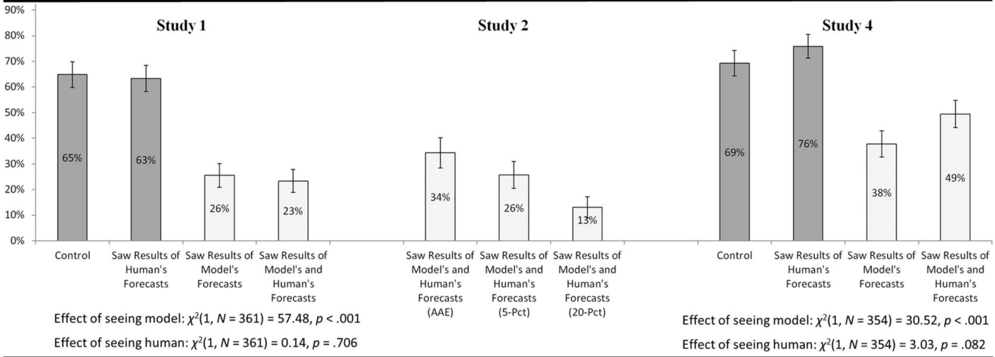
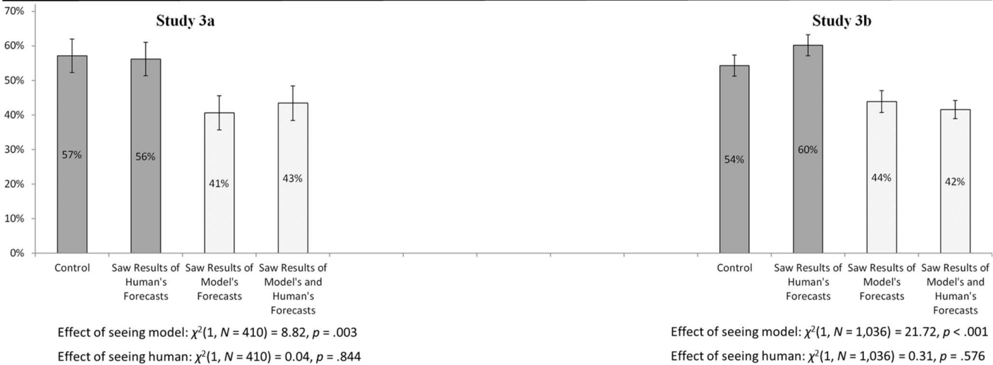
- Across five studies, seeing the algorithm perform reduced participants’ likelihood of choosing it over a human forecaster. In the model-and-human conditions, 610 of 741 participants (83%) saw the model outperform the human, yet these participants were among the least likely to choose the model.
- The model outperformed humans in all five studies. For example, bonuses if choosing model vs. human were Study 1: $1.78 vs. $1.38; Study 2: $1.77 vs. $1.09; Study 3a: $0.48 vs. $0.31; Study 3b: $0.49 vs. $0.30; Study 4: $1.79 vs. $1.38. Human forecasters produced 15–29% more error in the MBA task and 90–97% more error in the airline-passenger task.
- Seeing the model perform significantly decreased confidence in the model’s forecasts in all four studies where this was tested, whereas seeing the human perform significantly decreased confidence in the human only in Study 4. Confidence in the model’s forecasts significantly mediated the effect of seeing the model perform on choosing the model; confidence in the human did not.
- In Study 2, participants paid for forecasts within 20 percentiles were less likely to choose the model than those paid within 5 percentiles, χ²(1, N = 139) = 3.56, p = .059, and those paid by average absolute error, χ²(1, N = 136) = 8.56, p = .003; this effect was mediated by confidence in their own forecasts, not confidence in the model’s forecasts.
Methods
- Five studies had participants forecast real outcomes: MBA student success (Studies 1, 2, and 4) or U.S. state rank in airline passengers (Studies 3a and 3b). Participants were assigned to control, human, model, or model-and-human conditions, then chose whether to tie incentivized bonuses to the model or the human forecaster (themselves in Studies 1–3, another participant in Study 4).
- Final samples were Study 1: 361; Study 2: 206; Study 3a: 410; Study 3b: 1,036; Study 4: 354. Studies 1, 2, and 4 were run in the Wharton Behavioral Lab; Studies 3a and 3b used Amazon Mechanical Turk.
- Main analyses compared forecasting performance and choice rates, measured confidence and beliefs, and used binary mediation analyses with Preacher and Hayes’s bootstrapping procedure.
Limitations
- The paper states it did not explore all boundaries of the effect, including whether it would persist if algorithms were many times more accurate than humans, and whether results depend on features shared by the two forecasting tasks.
- The paper states it did not explore how algorithm variations—complexity, transparency, forecaster involvement in construction, and designer expertise—affect algorithm aversion.
- The paper states algorithm aversion is not entirely driven by seeing algorithms err, and it has little to say about how best to reduce aversion among those who have seen an algorithm err. The text also cautions that cross-experiment comparisons should be made cautiously.
Model-written summary. Check it against the paper before relying on it.
Integrity signals
Registry
Cites
Statistics
Figures
Verification
Claims the paper makes
0 Valid · 2 Not valid · 16 Not checked · 90 Own results and interpretations
A result the paper reports from its own data — it cites no other source for it, so there is none to check. The quote shows it is in the paper.
In the paper
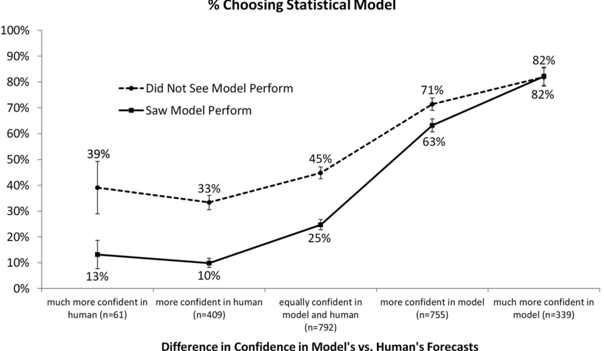
“the majority of people who were equally confident in the model's and human's forecasts chose to tie their bonuses to the human's forecasts, particularly when they had seen the model perform.”
plainstates an association- Asserted: passes — The authors put it forward as true.
- Checkable: passes — It can be checked against evidence.
- Load-bearing: passes — The paper’s conclusions depend on it.
- Based: passes — The paper gives a reason why it holds.
A result the paper reports from its own data — it cites no other source for it, so there is none to check. The quote shows it is in the paper.
In the paper
“Consistent with research on the adoption of decision aids (see Highhouse, 2008), participants thought that the human forecasters were better than the model at getting better with practice, learning from mistakes, and finding underappreciated candidates.”
plain- Asserted: passes — The authors put it forward as true.
- Checkable: passes — It can be checked against evidence.
- Load-bearing: passes — The paper’s conclusions depend on it.
- Based: passes — The paper gives a reason why it holds.
A result the paper reports from its own data — it cites no other source for it, so there is none to check. The quote shows it is in the paper.
In the paper
“Our studies show that this resistance at least partially arises from greater intolerance for error from algorithms than from humans.”
plainstates a possible cause- Asserted: passes — The authors put it forward as true.
- Checkable: passes — It can be checked against evidence.
- Load-bearing: passes — The paper’s conclusions depend on it.
- Based: passes — The paper gives a reason why it holds.
A result the paper reports from its own data — it cites no other source for it, so there is none to check. The quote shows it is in the paper.
In the paper
“Participants rightfully thought that the model was better than human forecasters at avoiding obvious mistakes, appropriately weighing various attributes, and consistently weighing information.”
plain- Asserted: passes — The authors put it forward as true.
- Checkable: passes — It can be checked against evidence.
- Load-bearing: unclear — It is unclear whether the paper’s conclusions depend on it.
- Based: passes — The paper gives a reason why it holds.
A result the paper reports from its own data — it cites no other source for it, so there is none to check. The quote shows it is in the paper.
In the paper
“This effect was evident in two distinct domains of judgment, including one in which the human forecasters produced nearly twice as much error as the algorithm.”
plain- Asserted: passes — The authors put it forward as true.
- Checkable: passes — It can be checked against evidence.
- Load-bearing: unclear — It is unclear whether the paper’s conclusions depend on it.
- Based: passes — The paper gives a reason why it holds.
75 more claims
Create a free account to see all 108 claims and to verify the 12 references still open.
- It may state two separate claims as one. 13
- Probably not a substantial claim. 16
Claims other papers make about this one
Each is checked against this paper’s own text: does it say what the citing paper says it does?
The source backs part of the claim, not all of it — or backs it for a different population, condition or comparison.
In the citing paper
“Traditional theorizing assumes trade-offs between trust and skepticism (Dietvorst et al., 2015), automation and engagement (Freeman et al., 2014), or efficiency and depth (Ishowo-Oloko et al., 2019)”
From Pedagogical partnerships with generative AI in higher education: how dual cognitive pathways paradoxically enable transformative learning (2026) · cites this paper as Dietvorst et al., 2015
Experimental — accuracy not yet measuredThe source backs part of the claim, not all of it — or backs it for a different population, condition or comparison.
In the citing paper
“Existing research typically examines trust versus skepticism in human-AI interactions as binary constructs (Dietvorst et al., 2015; Logg et al., 2019), missing the possibility that partnerships might simultaneously activate both vigilant and offloading behaviors.”
From Pedagogical partnerships with generative AI in higher education: how dual cognitive pathways paradoxically enable transformative learning (2026) · cites this paper as Dietvorst et al., 2015
Experimental — accuracy not yet measuredThe source backs part of the claim, not all of it — or backs it for a different population, condition or comparison.
In the citing paper
“It aligns with the theoretical rationale on algorithm aversion (Dietvorst et al. 2015;Hohensinn et al. 2024) and appreciation (Logg et al. 2019), which suggests that people are more likely to accept and trust AI systems when they produce desirable results but become skeptical when outcomes are unfavorable.”
From Holding AI Accountable Like Herding Cats: The Contingent Impact on the Legitimacy of Algorithmic Bureaucracy (2026) · cites this paper as Dietvorst et al. 2015
Experimental — accuracy not yet measuredThe source backs part of the claim, not all of it — or backs it for a different population, condition or comparison.
In the citing paper
“Research on algorithm appreciation and algorithm aversion further suggests that people may either defer to algorithms or reject them depending on prior experience, perceived expertise, and error visibility (Dietvorst et al., 2015; Logg et al., 2019).”
From College students' metacognitive awareness of generative-AI reliance: an experimental study of decision confidence and attribution bias (2026) · cites this paper as Dietvorst et al., 2015
Experimental — accuracy not yet measuredThe source backs part of the claim, not all of it — or backs it for a different population, condition or comparison.
In the citing paper
“Earlier research has mentioned gender, self-confidence, expertise, and general algorithm aversion or appreciation.15,28”
From Appropriate trust in artificial intelligence for the optical diagnosis of colorectal polyps: the role of human/artificial intelligence interaction (2024) · cites this paper as [28]
Experimental — accuracy not yet measured
22 more claims about this paper
Create a free account to see every claim other papers make about this one.
Statistics recomputed
Every reported test result, recomputed from its test statistic and degrees of freedom. A result shows as not adding up only once an independent check has confirmed it.
- Consistentt(360) = 4.98reported p < .001 · recomputed p < .001
“t (360) = 4.98, p < .001”
- Consistentt(204) = 6.26reported p < .001 · recomputed p < .001
“t (204) = 6.26, p < .001”
- Consistentt(405) = 7.73reported p < .001 · recomputed p < .001
“t (405) = 7.73, p < .001”
- Consistentt(353) = 5.11reported p < .001 · recomputed p < .001
“t (353) = 5.11, p < .001”
- Consistentχ²(1) = 39.94reported p < .001 · recomputed p < .001
“χ 2 (1, N = 271) = 39.94, p < .001”
19 more recomputed tests
Create a free account to see every test the Stats check recomputed.
Self-check
Percentages, sums and reported differences re-computed from the paper’s own numbers.
Self-check results appear here once an independent check has confirmed them.
Citations
Cites
Preacher, K. J., & Hayes, A. F. (2008) · Behavior Research Methods · doi:10.3758/brm.40.3.879 · Cited by 34,117 · cited 1×
“We then used Preacher and Hayes’s (2008) bootstrapping procedure to obtain unbiased 95% confidence intervals around the mediated effects.”
Method(2023) · doi:10.1126/science · Cited by 6,063
The trouble with overconfidence.
Moore, D. A., & Healy, P. J. (2008) · Psychological Review · doi:10.1037/0033-295x.115.2.502 · Cited by 2,358
“Clinical versus Actuarial Judgment.”
Dawes, R. M., Faust, D., & Meehl, P. E. (1989) · Science · doi:10.1126/science.2648573 · Cited by 2,298
The robust beauty of improper linear models in decision making.
Dawes, R. M. (1979) · American Psychologist · doi:10.1037/0003-066x.34.7.571 · Cited by 1,966
Preference and belief: Ambiguity and competence in choice under uncertainty
Heath, C., & Tversky, A. (1991) · Journal of Risk and Uncertainty · doi:10.1007/bf00057884 · Cited by 1,654
Clinical versus mechanical prediction: a meta-analysis
Grove, W. M., Zald, D. H., Lebow, B. S., Snitz, B. E., & Nelson, C. (2000) · Psychological Assessment · doi:10.1037/1040-3590.12.1.19 · Cited by 1,640
Grove, W. M., & Meehl, P. E. (1996) · Psychology, Public Policy, and Law · doi:10.1037/1076-8971.2.2.293 · Cited by 1,457 · cited 4×
“…1996), the notion that algorithms cannot properly consider individual targets (Grove & Meehl, 1996), concerns about the ethicality of relying on algorithms to make important decisions (Dawes, 1979), and the presumed inability of algorithms to incorporate qualitative data (Grove & Meehl, 1996).”
BackgroundMethodInfluential(2007) · Cited by 1,133
Competing on analytics: the new science of winning
(2007) · Choice Reviews Online · doi:10.5860/choice.44-6322 · Cited by 941
Research works printed but not linked: 1
- Clark, D. (2012, November 7). How Nate Silver won the 2012 presidential election. Harvard Business Review Blog . Retrieved from http://blogs .hbr.org/cs/2012/11/how\_nate\_silver\_won\_the\_2012\_p.html
Cited by
Items 1,401–1,500 of 3,918
The Challenges of Deploying an Algorithmic Pricing Tool: Evidence from Airbnb
Foroughifar, M., & Mehta, N. (2026) · Marketing Science · doi:10.1287/mksc.2024.0964 · Cited by 10
Das Geschäftsmodell Data Facilitator im Consulting
Nissen, V. (2021) · HMD Praxis der Wirtschaftsinformatik · doi:10.1365/s40702-021-00723-1 · Cited by 8
Assembled Bias: Beyond Transparent Algorithmic Bias
Waller, R. L., & Waller, R. L. (2022) · Minds and Machines · doi:10.1007/s11023-022-09605-x · Cited by 12
Enhancing the Integrity of the Sentencing Process through the Use of Artificial Intelligence
Bagaric, M., & Hunter, D. (2022) · Oxford University Press eBooks · doi:10.1093/oso/9780197539538.003.0007 · Cited by 12
Busch, P. A. (2024) · Computers in Human Behavior Reports · doi:10.1016/j.chbr.2024.100490 · Cited by 12
Bouwer, A. (2022) · Smart innovation, systems and technologies · doi:10.1007/978-981-16-9268-0_4 · Cited by 10
Rossmann, L., & Wald, A. E. (2023) · International Journal of Information Technology & Decision Making · doi:10.1142/s021962202330001x · Cited by 9
Artificial Intelligence and SentencingHumans against Machines
van Wingerden, S., & Plesničar, M. M. (2022) · Oxford University Press eBooks · doi:10.1093/oso/9780197539538.003.0012 · Cited by 11
When do people rely on algorithms
Logg, J. M. (2016) · eScholarship (California Digital Library) · Cited by 10
Shaikh, S. J., & Cruz, I. (2019) · arXiv (Cornell University) · doi:10.48550/arxiv.1912.12914 · Cited by 10
Keeping the Patient at the Center of Machine Learning in Healthcare
Findley, J., Woods, A. K., Robertson, C. T., & Slepian, M. J. (2020) · The American Journal of Bioethics · doi:10.1080/15265161.2020.1820100 · Cited by 11
From Forced to Voluntary AI AdoptionPreprint
Cao, X., & Zhang, D. (2020) · SSRN Electronic Journal · doi:10.2139/ssrn.3640862 · Cited by 8
Delegated Decision-Making in FinancePreprint
Holzmeister, F., Holmén, M., Kirchler, M., Stefan, M., & Wengström, E. (2019) · SSRN Electronic Journal · doi:10.2139/ssrn.3498890 · Cited by 10
Shermohammed, M., Goren, A., Lanyado, A., Yesharim, R., Wolk, D. M., Doyle, J. J., Meyer, M. N., & Chabris, C. F. (2021) · medRxiv · doi:10.1101/2021.02.20.21252015 · Cited by 8
AI as the Court: Assessing AI Deployment in Civil CasesPreprint
Themeli, E., & Philipsen, S. (2021) · SSRN Electronic Journal · doi:10.2139/ssrn.3791553 · Cited by 8
Die Tragik der Algorithm Aversion
Filiz, I., Judek, J. R., Lorenz, M., & Spiwoks, M. (2021) · doi:10.46850/sofia.9783941627888 · Cited by 8
Expose Uncertainty, Instill Distrust, Avoid Explanations: Towards Ethical Guidelines for AIPreprint
Pinhanez, C. S. (2021) · arXiv (Cornell University) · doi:10.48550/arxiv.2112.01281 · Cited by 9
Auditor Automation Usage and Professional SkepticismPreprint
Peters, C. (2022) · SSRN Electronic Journal · doi:10.2139/ssrn.4309348 · Cited by 13
Algorithmic Pricing: Implications for Consumers, Managers, and RegulatorsPreprint
Spann, M., Bertini, M., Koenigsberg, O., Zeithammer, R., Aparicio, D., Chen, Y., Fantini, F., Jin, G. Z., Morwitz, V. G., Leszczyc, P. T. L. P., et al. (2024) · SSRN Electronic Journal · doi:10.2139/ssrn.4849019 · Cited by 27
Rajaram, K., & Tinguely, P. N. (2024) · SSRN Electronic Journal · doi:10.2139/ssrn.4867904 · Cited by 11
Ou, C., Buschek, D., Mayer, S., & Butz, A. (2022) · Mensch und Computer 2022 · doi:10.1145/3543758.3543761 · Cited by 7
The Role of Personality in Trust in Public Policy Automation
Waggoner, P., & Kennedy, R. (2022) · Journal of Behavioral Data Science · doi:10.35566/v2n1/p4/ · Cited by 7
“Further, some have debated whether individuals place low levels of trust in algorithms, “algorithm aversion” (Dietvorst, Simmons, & Massey, 2015), or high levels of trust, “algorithm bias” (Logg, 2016).”
BackgroundResultEvaluating Trust in AI, Human, and Co-produced Feedback Among Undergraduate Students
Zhang, A., Gao, Y., Suraworachet, W., Nazaretsky, T., & Cukurova, M. (2025) · arXiv · doi:10.48550/arxiv.2504.10961 · Cited by 7
“These factors can slow down the process of AI feedback adoption in higher education and mitigate gaining its potential benefits for students and educators (Dietvorst et al., 2014; Nazaretsky et al., 2024b).”
Catch me if you search: When contextual web search results affect the detection of hallucinations
Nahar, M., Lee, E.-J., Park, J. W., & Lee, D. (2025) · Computers in Human Behavior · doi:10.1016/j.chb.2025.108763 · Cited by 7
Learning Representations by Humans, for HumansPreprint
Rosenfeld, N., Cao, J., Hilgard, S., Parkes, D., & Banaji, M. R. (2020) · PsyArXiv (OSF Preprints) · doi:10.31234/osf.io/4nvts · Cited by 15
Xiao-ping, Z., & Cheng, X. (2024) · CHI Conference on Human Factors in Computing Systems · doi:10.1145/3613904.3642280 · Cited by 9
Li, H. (2025) · Current Psychology · doi:10.1007/s12144-025-07492-w · Cited by 7
Yong, Y., Li, Y., Zhao, X., Law, R., & Song, H. (2025) · International Journal of Contemporary Hospitality Management · doi:10.1108/ijchm-05-2024-0651 · Cited by 8
The Artificial Bureaucrat: Artificial Intelligence in Street-Level Work
Busch, P. A. (2025) · Digital Government Research and Practice · doi:10.1145/3721138 · Cited by 8
Pe, S., Famiglini, L., Gallazzi, E., Bortolotto, C., Carone, L., Cisarri, A., Salina, A., Preda, L., Bellazzi, R., Cabitza, F., et al. (2024) · Methods of Information in Medicine · doi:10.1055/a-2562-2163 · Cited by 7
Li, T. W., Song, Y., Sundaram, H., & Karahalios, K. G. (2025) · ACM Conference on Learning @ Scale (L@S) · doi:10.1145/3698205.3729550 · Cited by 7
Customer behavior in the presence of algorithmic marketing agents: The role of hedonic values
Chacon, A., Martínez, C., & Kausel, E. E. (2025) · Technological Forecasting and Social Change · doi:10.1016/j.techfore.2025.124322 · Cited by 7
Wang, Y., Chen, H., Wei, X., Chang, C., & Zuo, X. (2025) · Computers in Human Behavior Artificial Humans · doi:10.1016/j.chbah.2025.100198 · Cited by 8
Why Investors Resist: A Psychological Perspective on Adoption Resistance to Financial Robo-Advisors
Goswami, D., & Verma, B. (2025) · Journal of Internet Commerce · doi:10.1080/15332861.2025.2566660 · Cited by 8
The construction and validation of the AI mindset scale (AIMS)
Ibrahim, F., Telle, N.-T., Herzberg, P. Y., & Münscher, J. (2025) · Computers in Human Behavior Artificial Humans · doi:10.1016/j.chbah.2025.100220 · Cited by 10
Beyond algorithm aversion: The impact of psychological readiness on algorithmic advice
Kim, H. (2025) · Computers in Human Behavior · doi:10.1016/j.chb.2025.108824 · Cited by 12
Green-curious retail investors and unmediated interactions with GenAI
Boni, L. A. (2025) · Finance research letters · doi:10.1016/j.frl.2025.108725 · Cited by 7
Liu, H., Han, X., Li, S., Lin, W., & Zhang, M. (2025) · Aslib Journal of Information Management · doi:10.1108/ajim-12-2024-0957 · Cited by 8
The ABCs of Who Benefits from Working with AI: Ability, Beliefs, and Calibration
Caplin, A., Deming, D. J., Li, S., Martin, D., Marx, P., Weidmann, B., & Ye, K. J. (2025) · Management Science · doi:10.1287/mnsc.2024.08994 · Cited by 26
AI as a Group Mediator: A Conceptual Framework for Triadic Chat-Based Therapy
Gazit, L. (2025) · International Journal of Systemic Therapy · doi:10.1080/2692398x.2025.2587315 · Cited by 9
Bureaucratic accountability: enabler or barrier for algorithm use?
Weerheijm, B., Galdames, M., & Giest, S. N. (2025) · Policy Design and Practice · doi:10.1080/25741292.2025.2578064 · Cited by 7
Collaborative Robotics, Mobile Platforms, and Total Laboratory Automation in Clinical Diagnostics
Mukherjee, S., Lambert, C., Zhou, Y., Kan, S., Yang, J., Liao, G., Flygare, S. D., & Ohgami, R. S. (2026) · Diagnostics · doi:10.3390/diagnostics16040518 · Cited by 8
Luo, X., Lim, W. M., Suh, A., Idris, I., Soon, P., Ma, L., & Cheah, J. (2026) · Journal of Business Research · doi:10.1016/j.jbusres.2026.116049 · Cited by 11
Leszczyński, G., Gaczek, P., & Munzel, A. (2026) · Technovation · doi:10.1016/j.technovation.2026.103519 · Cited by 8
Sundarasen, S., Kamaludin, K., & Nakiran, D. (2026) · Journal of risk and financial management · doi:10.3390/jrfm19030209 · Cited by 13
Rahman, M. J., & Liang, H. (2026) · International Journal of Information Management · doi:10.1016/j.ijinfomgt.2026.103060 · Cited by 8
Seeger, F., Wessel, M., & Lehrer, C. (2026) · Electronic Markets · doi:10.1007/s12525-026-00883-2 · Cited by 13
A meta-analysis of the effects of AI agent implementation on customer-level outcomes
Raja, S. V. S., Orazi, D. C., Cheng, Y., & Belli, A. (2026) · Journal of Business Research · doi:10.1016/j.jbusres.2026.116172 · Cited by 8
Erlei, A., Cau, F. M., Georgiev, R., Kumar, S. C., Bizer, K., & Gadiraju, U. (2026) · CHI Conference on Human Factors in Computing Systems · doi:10.1145/3772318.3791420 · Cited by 7
Luong, A., Kumar, N., & Lang, K. R. (2026) · Information & Management · doi:10.1016/j.im.2026.104384 · Cited by 7
Fairness as adequacy: a sociotechnical view on model evaluation in machine learning
Grote, T. (2023) · AI and Ethics · doi:10.1007/s43681-023-00280-x · Cited by 9
Wilms, L. K., Gerl, K., Stoll, A., & Ziegele, M. (2024) · Human-Computer Interaction · doi:10.1080/07370024.2024.2307610 · Cited by 7
Pavone, G., & Desveaud, K. (2024) · Emerald Group Publishing Limited eBooks · doi:10.1108/978-1-83753-686-320241001 · Cited by 8
Artificial Intelligence and Fair Trial Rights
Molbæk-Steensig, H., & Quemy, A. (2023) · Oxford University Press eBooks · doi:10.1093/law/9780192882486.003.0018 · Cited by 10
Artificial intelligence (AI) transforming the financial sector operations
Bhattacharjee, R. K., & Rroy, A. D. (2024) · ESG Studies Review. · doi:10.37497/esg.v7iesg.1624 · Cited by 9
The Digital Siren’s Call: Accepting Unethical AI Advice
Xu, C., Xu, H., Sun, Y., & Xiong, W. (2024) · International Journal of Human-Computer Interaction · doi:10.1080/10447318.2024.2400396 · Cited by 8
Treating differently or equally: A study exploring attitudes towards AI moral advisors
Liu, Y., & Wang, T. Y. (2025) · Technology in Society · doi:10.1016/j.techsoc.2025.102862 · Cited by 9
Overcoming medical overuse with AI assistance: An experimental investigation
Wang, Z., Wei, L., & Xue, L. (2025) · Journal of Health Economics · doi:10.1016/j.jhealeco.2025.103043 · Cited by 7
Rodemann, J., Croppi, F., Arens, P., Sale, Y., Herbinger, J., Bischl, B., Hüllermeier, E., Augustin, T., Walsh, C. J., & Casalicchio, G. (2025) · Lecture notes in computer science · doi:10.1007/978-3-662-72243-5_30 · Cited by 13
Distribution neglect in performance evaluations
Awtrey, E. C., Thornley, N., Dannals, J. E., Barnes, C. M., & Uhlmann, E. L. (2021) · Organizational Behavior and Human Decision Processes · doi:10.1016/j.obhdp.2021.04.007 · Cited by 7
Attitudinal Tensions in the Joint Pursuit of Explainable and Trusted AI
Narayanan, D., & Tan, Z. M. (2023) · Minds and Machines · doi:10.1007/s11023-023-09628-y · Cited by 11
Lukashova-Sanz, O., Dechant, M., & Wahl, S. (2023) · Applied Sciences · doi:10.3390/app13063572 · Cited by 8
Welfarist Moral Grounding for Transparent AI
Narayanan, D. (2023) · ACM Conference on Fairness, Accountability, and Transparency (FAccT) · doi:10.1145/3593013.3593977 · Cited by 8
The Role of Heuristics and Biases during Complex Choices with an AI Teammate
Gurney, N., Miller, J. H., & Pynadath, D. V. (2023) · Proceedings of the AAAI Conference on Artificial Intelligence · doi:10.1609/aaai.v37i5.25741 · Cited by 10
Experimental Investigation of Human Acceptance of AI Suggestions with Heatmap and Pointing-based XAI
Maehigashi, A., Fukuchi, Y., & Yamada, S. (2023) · International Conference on Human-Agent Interaction (HAI) · doi:10.1145/3623809.3623834 · Cited by 11
Hinks, T. (2024) · AI & Society · doi:10.1007/s00146-024-01962-8 · Cited by 7
Design Principles for Collaborative Generative AI Systems in Software Development
Chen, J., & Zacharias, J. (2024) · Lecture notes in computer science · doi:10.1007/978-3-031-61175-9_23 · Cited by 10
Measuring preferences for algorithms — How willing are people to cede control to algorithms?
Ivanova‐Stenzel, R., & Tolksdorf, M. (2024) · Journal of Behavioral and Experimental Economics · doi:10.1016/j.socec.2024.102270 · Cited by 10
A Machine Walks into an Exhibit: A Technical Analysis of Art Curation
von Davier, T. Ş., Herman, L. M., & Moruzzi, C. (2024) · Arts · doi:10.3390/arts13050138 · Cited by 12
Expertise matters: why consumers are less likely to follow AI recommendations in sports betting
Buechner, B. M., Blank, A. S., Escoe, B., & Blaney, I. (2025) · International Journal of Sports Marketing and Sponsorship · doi:10.1108/ijsms-09-2024-0267 · Cited by 9
Rosenberger, J., Kuhlemann, S., Tiefenbeck, V., Kraus, M., & Zschech, P. (2026) · Lecture notes in information systems and organisation · doi:10.1007/978-3-032-08480-4_30 · Cited by 8
Generation of Evidence and Translation Into Practice: Lessons Learned and Future Directions
McCabe, A., & Kuppermann, N. (2015) · Academic Emergency Medicine · doi:10.1111/acem.12819 · Cited by 7
Milkau, U., & Bott, J. (2018) · Risks · doi:10.3390/risks6020041 · Cited by 10
Brown, V. L., Dennis, S. A., Dickins, D. E., Higgs, J. L., & Schaefer, T. J. (2019) · Current Issues in Auditing · doi:10.2308/ciia-52493 · Cited by 8
Artificial Intelligence in PET
Sitek, A., Ahn, S., Asma, E., Chandler, A. G., Ihsani, A., Prevrhal, S., Rahmim, A., Saboury, B., & Thielemans, K. (2021) · PET Clinics · doi:10.1016/j.cpet.2021.06.006 · Cited by 7
Consumers’ Trust Mechanism and Trust Boundary on Humanizing Customer Service Chatbots in E-commerce
Qi, Y., Du, R., & Yang, R. (2022) · Lecture notes in computer science · doi:10.1007/978-3-031-05544-7_36 · Cited by 8
Folkmedical Technologies and the Sociotechnical Systems of Healthcare
Schoenherr, J. R. (2022) · IEEE Technology and Society Magazine · doi:10.1109/mts.2022.3197273 · Cited by 7
The State of AI Research in Marketing: Active, Fertile, and Ready for Explosive Growth
Sudhir, K., & Toubia, O. (2023) · Emerald Group Publishing Limited eBooks · doi:10.1108/s1548-643520230000020001 · Cited by 8
Liao, M. (2023) · Journal of Broadcasting & Electronic Media · doi:10.1080/08838151.2023.2206662 · Cited by 7
The Role of Response Time for Algorithm Aversion in Fast and Slow Thinking Tasks
Lebedeva, A., Kornowicz, J., Lammert, O., & Papenkordt, J. (2023) · Lecture notes in computer science · doi:10.1007/978-3-031-35891-3_9 · Cited by 8
Explanation to Avert Surprise.
Gervasio, M. T., Myers, K. L., Yeh, E., & Adkins, B. (2018) · IUI Workshops · Cited by 10
Human Trust Factors in Image Analysis
Williams, A., Sherman, I. N., Smarr, S. A., Posadas, B. B., & Gilbert, J. E. (2018) · Advances in intelligent systems and computing · doi:10.1007/978-3-319-94391-6_1 · Cited by 7
Using Machine Learning To Inform Decisions in Drug Discovery: An Industry Perspective
Green, D. V. S. (2019) · ACS symposium series · doi:10.1021/bk-2019-1326.ch005 · Cited by 8
Comerford, D. A., & Lades, L. K. (2021) · Social Choice and Welfare · doi:10.1007/s00355-021-01352-9 · Cited by 7
Man vs. Machine: When is Automation Inferior to Human Labor?
Dogan, M., & Yıldırım, P. (2017) · Journal of Economics & Management Strategy · doi:10.1111/jems.12456 · Cited by 7
People Reject (Superior) Algorithms Because They Compare Them to Counter-Normative Reference PointsPreprint
Dietvorst, B. J. (2016) · SSRN Electronic Journal · doi:10.2139/ssrn.2881503 · Cited by 7
Self-citationHuman-Machine Communication: Complete Volume. Volume 12
(2021) · Human-Machine Communication · doi:10.30658/hmc.2 · Cited by 8
Effective Generative AI: The Human-Algorithm CentaurPreprint
Saghafian, S. (2023) · SSRN Electronic Journal · doi:10.2139/ssrn.4587250 · Cited by 7
Value of Autonomous Last-mile Delivery: Evidence from AlibabaPreprint
Han, B. R., Li, M., Zhang, Y., & Li, P. (2024) · SSRN Electronic Journal · doi:10.2139/ssrn.4730263 · Cited by 8
Rosenbacke, R. (2024) · SSRN Electronic Journal · doi:10.2139/ssrn.4773350 · Cited by 9
Using Large Language Models for Financial AdvicePreprint
Fieberg, C., Hornuf, L., & Streich, D. J. (2024) · SSRN Electronic Journal · doi:10.2139/ssrn.4850039 · Cited by 21
Law Enforcement and Legal Professionals’ Trust in Algorithms
Kennedy, R., Tiede, L. B., Austin, A., & Ismael, K. (2025) · Journal of law & empirical analysis. · doi:10.1177/2755323x251325594 · Cited by 6
Almutairi, W. A., & Ibrahim Almatrodi, N. A. (2025) · SAGE Open · doi:10.1177/21582440251380135 · Cited by 9
Lee, K., Cho, W., Woo, H., & de Jong, S. B. (2025) · Journal of Management Studies · doi:10.1111/joms.70009 · Cited by 8
Systematic Literature Review On Explainable AI In Finance: Methods, Applications, And Research Gaps
Bhardwaj, A. (2025) · International Journal For Multidisciplinary Research · doi:10.36948/ijfmr.2025.v07i05.58963 · Cited by 6
Trust-Mediated adoption of AI Robo-Advisors in inland china: an extended UTAUT perspective
Guo, Y., & Waked, H. N. (2025) · Journal of Financial Services Marketing · doi:10.1057/s41264-025-00339-2 · Cited by 6
AI term aversion in career decision-making: contextual reactions to algorithmic labels
Chacon, A., & Larraín, M. (2025) · Journal of Decision System · doi:10.1080/12460125.2025.2599916 · Cited by 7
Gong, Z., Han, X. Z., & Zheng, Y. (2025) · Government Information Quarterly · doi:10.1016/j.giq.2025.102087 · Cited by 6
Trusting machines with morality — Delegating moral decisions to AI
Hüholt, N., & Szech, N. (2026) · European Economic Review · doi:10.1016/j.euroecorev.2025.105255 · Cited by 8
Retamal-Saavedra, C. D., Andrade-Valbuena, N. A., Navarro, J. E. C., Caceres, F. I., & Vidal-Rebolledo, I. (2026) · Journal of Management & Organization · doi:10.1017/jmo.2026.10082 · Cited by 6
Metadata
- Authors
- Dietvorst, B. J., Simmons, J. P., & Massey, C.
- Affiliations
- University of Pennsylvania (US)
- Venue
- Journal of Experimental Psychology: General
- Published
- 2015
- Volume
- 144
- Issue
- 1
- Pages
- 114-126
- ISSN
- 0096-3445 (ISSN-L)
- 1939-2222
- OpenAlex
- W3125633690
- Cited by
- 3,232
- References
- 22
- Citations by year
- 2026: 1025 · 2025: 563 · 2024: 445 · 2023: 404 · 2022: 266 · 2021: 216 · 2020: 137 · 2019: 88 · 2018: 41 · 2017: 26 · 2016: 14 · 2015: 5
- FWCI
- 13.96
- Type
- journal article
- Language
- en
- Open access
- green
- doi.org
- Locations
- Journal of Experimental Psychology General (publishedVersion)
- SSRN Electronic Journal (publishedVersion)
- PubMed (publishedVersion)
- ScholarlyCommons (University of Pennsylvania) (submittedVersion)
- Funders
- Wharton Behavioral Laboratory
- Wharton Risk Center Ackoff Doctoral Student Fellowship
- Topics
- Social Sciences › Decision Sciences › General Decision Sciences › Decision-Making and Behavioral Economics
- Social Sciences › Decision Sciences › Management Science and Operations Research › Forecasting Techniques and Applications
- Social Sciences › Human Factors and Ergonomics › Human-Automation Interaction and Safety
- Keywords
- algorithm aversion, trust in algorithms, prediction confidence, evidence-based algorithm, decision-making
- MeSH terms
- Algorithms, Avoidance Learning, Culture, Decision Making, Female, Forecasting, Humans, Male, Motivation, Comprehension, Young Adult
About these checks
Registry, retraction, Cites and statistics results are computed, not judged, with one exception: a printed reference that no index lists is read once by a model before it counts as a citation error. Claims are extracted by a model and kept only when their quote appears verbatim in the text; each cited source is then checked, with a model’s help, for whether it says what the claim relies on. Those verdicts can be wrong — read the claim’s quote and the cited source before relying on one.
A language model drew the claims from the paper on 2026-11-14, under version 3 of the claim definition (model deepseek-v4.1-flash, prompt extract-v3).
A second model labelled each claim on 2026-11-14 (model jev-1.13-20260917, definition revision gold-guideline-v0.2).
Statistics and arithmetic are recomputed, not judged.
Confidence bands are shown only for fields calibrated on our annotated test set. None is calibrated yet, so no band is shown.
What counts as a claim ›How we measure confidence ›How we check this ›
Are you an author, or do you see a problem with this page? Request a review
Data sources
Bibliographic data: Semantic Scholar, OpenAlex, Crossref.
Contains information from the Semantic Scholar Academic Graph Datasets, made available under the ODC Attribution License (ODC-BY 1.0).
Semantic Scholar’s data is described in: Kinney, R., et al. (2023). The Semantic Scholar Open Data Platform. arXiv:2301.10140.
