

Algorithm aversion: People erroneously avoid algorithms after seeing them err.
Open accessThe DOI matches its Crossref record; 23 of the 23 references it cites were found in a registry or an index; none of the 22 sources its claims cite is checked for support yet.
Abstract
Research shows that evidence-based algorithms more accurately predict the future than do human forecasters. Yet when forecasters are deciding whether to use a human forecaster or a statistical algorithm, they often choose the human forecaster. This phenomenon, which we call algorithm aversion, is costly, and it is important to understand its causes. We show that people are especially averse to algorithmic forecasters after seeing them perform, even when they see them outperform a human forecaster. This is because people more quickly lose confidence in algorithmic than human forecasters after seeing them make the same mistake. In 5 studies, participants either saw an algorithm make forecasts, a human make forecasts, both, or neither. They then decided whether to tie their incentives to the future predictions of the algorithm or the human. Participants who saw the algorithm perform were less confident in it, and less likely to choose it over an inferior human forecaster. This was true even among those who saw the algorithm outperform the human.
Overview
CoChat Summary
TL;DR
People become less willing to use a statistical algorithm after seeing it perform and make mistakes, even when it outperforms a human forecaster. This “algorithm aversion” is driven partly by people losing confidence in algorithms more quickly than in humans after observing errors.
Key findings
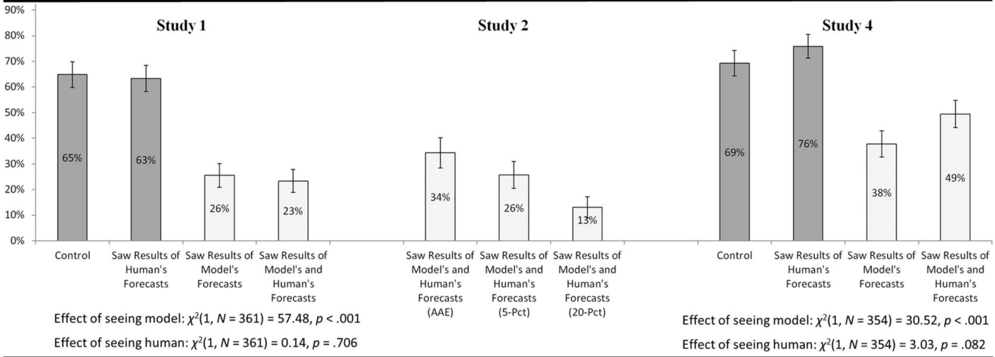
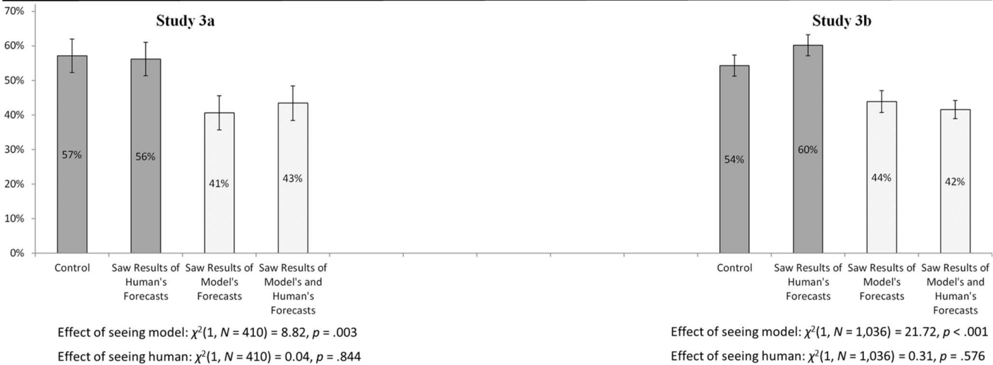
- Across five studies, seeing the algorithm perform reduced participants’ likelihood of choosing it over a human forecaster. In the model-and-human conditions, 610 of 741 participants (83%) saw the model outperform the human, yet these participants were among the least likely to choose the model.
- The model outperformed humans in all five studies. For example, bonuses if choosing model vs. human were Study 1: $1.78 vs. $1.38; Study 2: $1.77 vs. $1.09; Study 3a: $0.48 vs. $0.31; Study 3b: $0.49 vs. $0.30; Study 4: $1.79 vs. $1.38. Human forecasters produced 15–29% more error in the MBA task and 90–97% more error in the airline-passenger task.
- Seeing the model perform significantly decreased confidence in the model’s forecasts in all four studies where this was tested, whereas seeing the human perform significantly decreased confidence in the human only in Study 4. Confidence in the model’s forecasts significantly mediated the effect of seeing the model perform on choosing the model; confidence in the human did not.
- In Study 2, participants paid for forecasts within 20 percentiles were less likely to choose the model than those paid within 5 percentiles, χ²(1, N = 139) = 3.56, p = .059, and those paid by average absolute error, χ²(1, N = 136) = 8.56, p = .003; this effect was mediated by confidence in their own forecasts, not confidence in the model’s forecasts.
Methods
- Five studies had participants forecast real outcomes: MBA student success (Studies 1, 2, and 4) or U.S. state rank in airline passengers (Studies 3a and 3b). Participants were assigned to control, human, model, or model-and-human conditions, then chose whether to tie incentivized bonuses to the model or the human forecaster (themselves in Studies 1–3, another participant in Study 4).
- Final samples were Study 1: 361; Study 2: 206; Study 3a: 410; Study 3b: 1,036; Study 4: 354. Studies 1, 2, and 4 were run in the Wharton Behavioral Lab; Studies 3a and 3b used Amazon Mechanical Turk.
- Main analyses compared forecasting performance and choice rates, measured confidence and beliefs, and used binary mediation analyses with Preacher and Hayes’s bootstrapping procedure.
Limitations
- The paper states it did not explore all boundaries of the effect, including whether it would persist if algorithms were many times more accurate than humans, and whether results depend on features shared by the two forecasting tasks.
- The paper states it did not explore how algorithm variations—complexity, transparency, forecaster involvement in construction, and designer expertise—affect algorithm aversion.
- The paper states algorithm aversion is not entirely driven by seeing algorithms err, and it has little to say about how best to reduce aversion among those who have seen an algorithm err. The text also cautions that cross-experiment comparisons should be made cautiously.
Model-written summary. Check it against the paper before relying on it.
Integrity signals
Registry
Cites
Statistics
Figures
Verification
Claims the paper makes
0 Valid · 2 Not valid · 16 Not checked · 90 Own results and interpretations
A result the paper reports from its own data — it cites no other source for it, so there is none to check. The quote shows it is in the paper.
In the paper
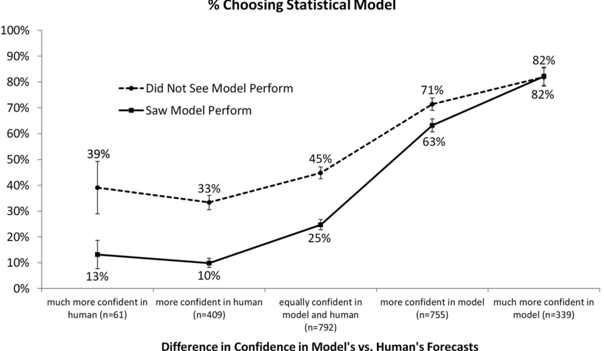
“the majority of people who were equally confident in the model's and human's forecasts chose to tie their bonuses to the human's forecasts, particularly when they had seen the model perform.”
plainstates an association- Asserted: passes — The authors put it forward as true.
- Checkable: passes — It can be checked against evidence.
- Load-bearing: passes — The paper’s conclusions depend on it.
- Based: passes — The paper gives a reason why it holds.
A result the paper reports from its own data — it cites no other source for it, so there is none to check. The quote shows it is in the paper.
In the paper
“Consistent with research on the adoption of decision aids (see Highhouse, 2008), participants thought that the human forecasters were better than the model at getting better with practice, learning from mistakes, and finding underappreciated candidates.”
plain- Asserted: passes — The authors put it forward as true.
- Checkable: passes — It can be checked against evidence.
- Load-bearing: passes — The paper’s conclusions depend on it.
- Based: passes — The paper gives a reason why it holds.
A result the paper reports from its own data — it cites no other source for it, so there is none to check. The quote shows it is in the paper.
In the paper
“Our studies show that this resistance at least partially arises from greater intolerance for error from algorithms than from humans.”
plainstates a possible cause- Asserted: passes — The authors put it forward as true.
- Checkable: passes — It can be checked against evidence.
- Load-bearing: passes — The paper’s conclusions depend on it.
- Based: passes — The paper gives a reason why it holds.
A result the paper reports from its own data — it cites no other source for it, so there is none to check. The quote shows it is in the paper.
In the paper
“Participants rightfully thought that the model was better than human forecasters at avoiding obvious mistakes, appropriately weighing various attributes, and consistently weighing information.”
plain- Asserted: passes — The authors put it forward as true.
- Checkable: passes — It can be checked against evidence.
- Load-bearing: unclear — It is unclear whether the paper’s conclusions depend on it.
- Based: passes — The paper gives a reason why it holds.
A result the paper reports from its own data — it cites no other source for it, so there is none to check. The quote shows it is in the paper.
In the paper
“This effect was evident in two distinct domains of judgment, including one in which the human forecasters produced nearly twice as much error as the algorithm.”
plain- Asserted: passes — The authors put it forward as true.
- Checkable: passes — It can be checked against evidence.
- Load-bearing: unclear — It is unclear whether the paper’s conclusions depend on it.
- Based: passes — The paper gives a reason why it holds.
75 more claims
Create a free account to see all 108 claims and to verify the 12 references still open.
- It may state two separate claims as one. 13
- Probably not a substantial claim. 16
Claims other papers make about this one
Each is checked against this paper’s own text: does it say what the citing paper says it does?
The source backs part of the claim, not all of it — or backs it for a different population, condition or comparison.
In the citing paper
“Traditional theorizing assumes trade-offs between trust and skepticism (Dietvorst et al., 2015), automation and engagement (Freeman et al., 2014), or efficiency and depth (Ishowo-Oloko et al., 2019)”
From Pedagogical partnerships with generative AI in higher education: how dual cognitive pathways paradoxically enable transformative learning (2026) · cites this paper as Dietvorst et al., 2015
Experimental — accuracy not yet measuredThe source backs part of the claim, not all of it — or backs it for a different population, condition or comparison.
In the citing paper
“Existing research typically examines trust versus skepticism in human-AI interactions as binary constructs (Dietvorst et al., 2015; Logg et al., 2019), missing the possibility that partnerships might simultaneously activate both vigilant and offloading behaviors.”
From Pedagogical partnerships with generative AI in higher education: how dual cognitive pathways paradoxically enable transformative learning (2026) · cites this paper as Dietvorst et al., 2015
Experimental — accuracy not yet measuredThe source backs part of the claim, not all of it — or backs it for a different population, condition or comparison.
In the citing paper
“It aligns with the theoretical rationale on algorithm aversion (Dietvorst et al. 2015;Hohensinn et al. 2024) and appreciation (Logg et al. 2019), which suggests that people are more likely to accept and trust AI systems when they produce desirable results but become skeptical when outcomes are unfavorable.”
From Holding AI Accountable Like Herding Cats: The Contingent Impact on the Legitimacy of Algorithmic Bureaucracy (2026) · cites this paper as Dietvorst et al. 2015
Experimental — accuracy not yet measuredThe source backs part of the claim, not all of it — or backs it for a different population, condition or comparison.
In the citing paper
“Research on algorithm appreciation and algorithm aversion further suggests that people may either defer to algorithms or reject them depending on prior experience, perceived expertise, and error visibility (Dietvorst et al., 2015; Logg et al., 2019).”
From College students' metacognitive awareness of generative-AI reliance: an experimental study of decision confidence and attribution bias (2026) · cites this paper as Dietvorst et al., 2015
Experimental — accuracy not yet measuredThe source backs part of the claim, not all of it — or backs it for a different population, condition or comparison.
In the citing paper
“Earlier research has mentioned gender, self-confidence, expertise, and general algorithm aversion or appreciation.15,28”
From Appropriate trust in artificial intelligence for the optical diagnosis of colorectal polyps: the role of human/artificial intelligence interaction (2024) · cites this paper as [28]
Experimental — accuracy not yet measured
22 more claims about this paper
Create a free account to see every claim other papers make about this one.
Statistics recomputed
Every reported test result, recomputed from its test statistic and degrees of freedom. A result shows as not adding up only once an independent check has confirmed it.
- Consistentt(360) = 4.98reported p < .001 · recomputed p < .001
“t (360) = 4.98, p < .001”
- Consistentt(204) = 6.26reported p < .001 · recomputed p < .001
“t (204) = 6.26, p < .001”
- Consistentt(405) = 7.73reported p < .001 · recomputed p < .001
“t (405) = 7.73, p < .001”
- Consistentt(353) = 5.11reported p < .001 · recomputed p < .001
“t (353) = 5.11, p < .001”
- Consistentχ²(1) = 39.94reported p < .001 · recomputed p < .001
“χ 2 (1, N = 271) = 39.94, p < .001”
19 more recomputed tests
Create a free account to see every test the Stats check recomputed.
Self-check
Percentages, sums and reported differences re-computed from the paper’s own numbers.
Self-check results appear here once an independent check has confirmed them.
Citations
Cites
Preacher, K. J., & Hayes, A. F. (2008) · Behavior Research Methods · doi:10.3758/brm.40.3.879 · Cited by 34,117 · cited 1×
“We then used Preacher and Hayes’s (2008) bootstrapping procedure to obtain unbiased 95% confidence intervals around the mediated effects.”
Method(2023) · doi:10.1126/science · Cited by 6,063
The trouble with overconfidence.
Moore, D. A., & Healy, P. J. (2008) · Psychological Review · doi:10.1037/0033-295x.115.2.502 · Cited by 2,358
“Clinical versus Actuarial Judgment.”
Dawes, R. M., Faust, D., & Meehl, P. E. (1989) · Science · doi:10.1126/science.2648573 · Cited by 2,298
The robust beauty of improper linear models in decision making.
Dawes, R. M. (1979) · American Psychologist · doi:10.1037/0003-066x.34.7.571 · Cited by 1,966
Preference and belief: Ambiguity and competence in choice under uncertainty
Heath, C., & Tversky, A. (1991) · Journal of Risk and Uncertainty · doi:10.1007/bf00057884 · Cited by 1,654
Clinical versus mechanical prediction: a meta-analysis
Grove, W. M., Zald, D. H., Lebow, B. S., Snitz, B. E., & Nelson, C. (2000) · Psychological Assessment · doi:10.1037/1040-3590.12.1.19 · Cited by 1,640
Grove, W. M., & Meehl, P. E. (1996) · Psychology, Public Policy, and Law · doi:10.1037/1076-8971.2.2.293 · Cited by 1,457 · cited 4×
“…1996), the notion that algorithms cannot properly consider individual targets (Grove & Meehl, 1996), concerns about the ethicality of relying on algorithms to make important decisions (Dawes, 1979), and the presumed inability of algorithms to incorporate qualitative data (Grove & Meehl, 1996).”
BackgroundMethodInfluential(2007) · Cited by 1,133
Competing on analytics: the new science of winning
(2007) · Choice Reviews Online · doi:10.5860/choice.44-6322 · Cited by 941
Research works printed but not linked: 1
- Clark, D. (2012, November 7). How Nate Silver won the 2012 presidential election. Harvard Business Review Blog . Retrieved from http://blogs .hbr.org/cs/2012/11/how\_nate\_silver\_won\_the\_2012\_p.html
Cited by
Items 1,101–1,200 of 3,918
English language teachers' perspectives on digital trust in AI ‐supported education
Yeşilel, D. B. A. (2025) · British Educational Research Journal · doi:10.1002/berj.4209 · Cited by 19
Föhr, T. L., Schreyer, M., Moffitt, K. C., & Marten, K.-U. (2026) · International Journal of Accounting Information Systems · doi:10.1016/j.accinf.2025.100758 · Cited by 16
Political Machines: Ethical Governance in the Age of AI
McEvoy, F. J. (2019) · Moral Philosophy and Politics · doi:10.1515/mopp-2019-0004 · Cited by 16
Governance and Communication of Algorithmic Decision Making: A Case Study on Public Sector
Jonk, E., & İren, D. (2021) · IEEE Conference on Business Informatics · doi:10.1109/cbi52690.2021.00026 · Cited by 19
Underspecified Human Decision Experiments Considered Harmful
Hullman, J. R., Kale, A. M., & Hartline, J. D. (2025) · CHI Conference on Human Factors in Computing Systems · doi:10.1145/3706598.3714063 · Cited by 16
The best option illusion in self and social assessment
Dunning, D. A. (2018) · Self and Identity · doi:10.1080/15298868.2018.1465460 · Cited by 14
Kim, S., Thakur, A., & Kim, J. (2020) · CHI Conference on Human Factors in Computing Systems · doi:10.1145/3313831.3376250 · Cited by 16
Trust in chatbots for customer service – findings from a questionnaire study
Nordheim, C. B. (2018) · NVA (Nasjonalt vitenarkiv) · Cited by 30
Cawthorpe, D. (2023) · Qeios · doi:10.32388/wvguqe · Cited by 14
Fang, X., Zhou, H., & Chen, S. (2025) · Public Administration · doi:10.1111/padm.70015 · Cited by 13
Trust in self-driving vehicles is lower than in human drivers when both drive almost perfectly
Yokoi, R. (2024) · Transportation Research Part F Traffic Psychology and Behaviour · doi:10.1016/j.trf.2024.03.019 · Cited by 13
von Walter, B., Wentzel, D., & Raff, S. (2023) · Journal of Retailing · doi:10.1016/j.jretai.2023.05.001 · Cited by 13
Extending Assisted Audio Capabilities of TIAGo Service Robot
Grama, L., & Rusu, C. (2019) · International Conference on Speech Technology and Human-Computer Dialogue (SpeD) · doi:10.1109/sped.2019.8906635 · Cited by 13
Önkal, D., Gonul, M. S., & Baets, S. D. (2019) · Futures & Foresight Science · doi:10.1002/ffo2.19 · Cited by 16
Measuring demand chasing behavior
Kirshner, S. N., & Moritz, B. B. (2021) · Decision Sciences · doi:10.1111/deci.12518 · Cited by 15
Huang, Y., Jiao, J., & Zhu, D. (2025) · Asia Pacific Journal of Tourism Research · doi:10.1080/10941665.2025.2523339 · Cited by 13
“Conversely, when users perceive a lack of transparency in algorithmic decision-making, they often exhibit “algorithm aversion”, meaning they are less willing to accept or trust algorithmic decisions (Dietvorst et al., 2015).”
Nostalgia encourages exploration and fosters uncertainty in response to AI technology
Dang, J., Sedikides, C., Wildschut, T., & Liu, L. (2024) · British Journal of Social Psychology · doi:10.1111/bjso.12843 · Cited by 15
Bragging About Valuable Resources? The Dual Effect of Companies’ AI and Human Self‐Promotion
Vorobeva, D., Pinto, D. C., González‐Jiménez, H., & António, N. (2025) · Psychology and Marketing · doi:10.1002/mar.22198 · Cited by 15
Shopping goal specificity matters: How algorithmic recommendations influence adoption intention
Xin, J., Qin, P., Li, T., & Yang, Z. (2025) · Journal of Retailing and Consumer Services · doi:10.1016/j.jretconser.2025.104509 · Cited by 14
A meta-analysis on reactions to algorithmic decision-making in human resource management
Moritz, J. M., Pomrehn, L., Steinmetz, H., & Wehner, M. (2026) · Human Resource Management Review · doi:10.1016/j.hrmr.2026.101135 · Cited by 20
The effects of social presence on cooperative trust with algorithms
Liefooghe, B., Min, E., & Aarts, H. (2023) · Scientific Reports · doi:10.1038/s41598-023-44354-6 · Cited by 19
Chen, C., & Zheng, Y. (2023) · Behaviour and Information Technology · doi:10.1080/0144929x.2023.2279658 · Cited by 14
Trust Through Recommendation in E-commerce
Saxborn, M., Pan, Y., & Said, A. (2024) · Conference on Human Information Interaction and Retrieval · doi:10.1145/3627508.3638294 · Cited by 18
Adjusting Amount of AI Explanation for Visual Tasks
Maehigashi, A., Fukuchi, Y., & Yamada, S. (2024) · CHI Conference Extended Abstracts on Human Factors in Computing Systems (CHI EA) · doi:10.1145/3613905.3650802 · Cited by 13
Liu, M., Liu, X., Li, L., Zhou, J., & Liu, S. (2024) · Current Issues in Tourism · doi:10.1080/13683500.2024.2376208 · Cited by 13
Wischnewski, M., & Krämer, N. C. (2024) · Journal of Media Psychology Theories Methods and Applications · doi:10.1027/1864-1105/a000441 · Cited by 14
The existence of manual mode increases human blame for AI mistakes
Arnestad, M. N., Meyers, S., Gray, K. J., & Bigman, Y. (2024) · Cognition · doi:10.1016/j.cognition.2024.105931 · Cited by 14
Towards Understanding AI Delegation: The Role of Self-Efficacy and Visual Processing Ability
Westphal, M., Hemmer, P., Vössing, M., Schemmer, M., Vetter, S., & Satzger, G. (2025) · ACM Transactions on Interactive Intelligent Systems · doi:10.1145/3696423 · Cited by 16
Kim, H. Y., & Park, Y. S. (2024) · Behavioral Sciences · doi:10.3390/bs14100964 · Cited by 16
Jain, R. M., Garg, N., & Khera, S. N. (2025) · Journal of Organizational Change Management · doi:10.1108/jocm-09-2023-0397 · Cited by 14
Time is shrinking in the eye of AI: AI agents influence intertemporal choice
Li, Y. J., Lin, S., Gong, H., Xiang, W., & Janiszewski, C. A. (2025) · Journal of Consumer Psychology · doi:10.1002/jcpy.1455 · Cited by 19
Keppler, S. M., Sinchaisri, W. P., & Snyder, C. (2025) · Proceedings of the ACM on Human-Computer Interaction · doi:10.1145/3711026 · Cited by 14
Deep mechanism design: Learning social and economic policies for human benefit
Tacchetti, A., Koster, R., Balaguer, J., Leqi, L., Pislar, M., Botvinick, M., Tuyls, K., Parkes, D. C., & Summerfield, C. (2025) · Proceedings of the National Academy of Sciences · doi:10.1073/pnas.2319949121 · Cited by 18
Zhang, Y., Özsomer, A., Gürhan‐Canlı, Z., & Baghirov, F. (2026) · Journal of Interactive Marketing · doi:10.1177/10949968251366265 · Cited by 35
How consumer market orientations shape algorithmic appreciation and avoidance in fashion
Geyik, P., & Weijo, H. A. (2025) · International Journal of Research in Marketing · doi:10.1016/j.ijresmar.2025.07.007 · Cited by 15
Ulla, J. W., & Commerford, B. P. (2025) · The Accounting Review · doi:10.2308/tar-2024-0109 · Cited by 15
Enhancing AI-Assisted Purchase Decisions: The Role of the Sense of Autonomy
Hou, J., Yang, S., Xiong, G., & Pavlou, P. A. (2026) · MIS Quarterly · doi:10.25300/misq/2025/17607 · Cited by 21
Deng, J., Wu, F., & Qi, J. (2025) · Applied Sciences · doi:10.3390/app151910322 · Cited by 15
Gu, C.-Y., Li, X.-X., & Xiang, Q. (2025) · Journal of Research in Interactive Marketing · doi:10.1108/jrim-05-2025-0265 · Cited by 10
Wenn Algorithmen für uns entscheiden: Chancen und Risiken der künstlichen Intelligenz
Christen, M., Mader, C., Čas, J., Abou‐Chadi, T., Bernstein, A., Binder, N. B., Dell’Aglio, D., Fabbian, L., George, D., Gohdes, A., et al. (2020) · vdf Hochschulverlag AG an der ETH Zürich eBooks · doi:10.1553/10.3218/4002-9 · Cited by 22
Caviola, L., Schubert, S., & Mogensen, A. L. (2020) · Cognition · doi:10.1016/j.cognition.2020.104501 · Cited by 13
Utz, S., Wolfers, L. N., & Göritz, A. S. (2021) · Human-Machine Communication · doi:10.30658/hmc.3.3 · Cited by 16
The Rule of Law, Science Fiction, and Fears of Artificial Intelligence
Burgess, P. (2022) · Law Technology and Humans · doi:10.5204/lthj.2461 · Cited by 16
Grgić-Hlača, N., Castelluccia, C., & Gummadi, K. P. (2022) · Proceedings of the AAAI Conference on Human Computation and Crowdsourcing · doi:10.1609/hcomp.v10i1.21989 · Cited by 26
Technology Aspects of Artificial Intelligence: Industry 5.0 for Organization Decision Making
Chandel, A., & Sharma, B. (2022) · Lecture notes in networks and systems · doi:10.1007/978-3-031-13150-9_7 · Cited by 20
Artificial intelligence challenging core State functions: A focus on law-making and rule-making
Rangone, N. (2023) · Revista de Derecho Público Teoría y método · doi:10.37417/rdp/vol_8_2023_1949 · Cited by 25
Lay economic reasoning: An integrative review and call to action
Bhattacharjee, A., & Dana, J. D. (2024) · Consumer Psychology Review · doi:10.1002/arcp.1096 · Cited by 14
(Ir)rationality in AI: state of the art, research challenges and open questions
Macmillan-Scott, O., & Musolesi, M. (2025) · Artificial Intelligence Review · doi:10.1007/s10462-025-11341-4 · Cited by 16
Explaining Interpretable Machine Learning: Theory, Methods and ApplicationsPreprint
Benk, M., & Ferrario, A. (2020) · SSRN Electronic Journal · doi:10.2139/ssrn.3748268 · Cited by 15
Revisiting the Cause of Algorithm Aversion: Algorithm Feedback Asymmetry in the Field and LabPreprint
Lin, W., Kim, S., & Tong, J. D. (2021) · SSRN Electronic Journal · doi:10.2139/ssrn.3891832 · Cited by 15
Creative Together: Human-AI Ensembling for Idea GenerationPreprint
He, V. F., Shrestha, Y. R., Puranam, P., & Miron‐Spektor, E. (2025) · SSRN Electronic Journal · doi:10.2139/ssrn.4603650 · Cited by 15
AI in Disguise - How AI-Generated Ads' Visual Cues Shape Consumer Perception and PerformancePreprint
Exner, Y., Hartmann, J., Netzer, O., & Zhang, S. (2025) · SSRN Electronic Journal · doi:10.2139/ssrn.5096969 · Cited by 24
Banker, S., & Khetani, S. (2019) · Sage Journals Data · doi:10.25384/sage.c.4577924 · Cited by 13
The Law of AI for GoodPreprint
Lobel, O. (2023) · SSRN Electronic Journal · doi:10.2139/ssrn.4338862 · Cited by 24
The AI Double Standard: Humans Judge All AIs for the Actions of One
Manoli, A., Pauketat, J. V. T., & Anthis, J. R. (2025) · Proceedings of the ACM on Human-Computer Interaction · doi:10.1145/3711083 · Cited by 12
“Other HCI studies suggest that AIs are blamed more than humans when moral harm occurs [19, 27, 41, 42], and in non-moral contexts people exhibit a general pattern of “algorithmic aversion” by preferring human advice over that of an algorithm, even when the algorithm has better performance [15, 44].”
Xu, Z., Wang, G., Zhai, S., & Liu, P. (2025) · International Journal of Human–Computer Interaction · doi:10.1080/10447318.2023.2176986 · Cited by 12
“…versus humans can produce more negative consequences, which are called the phenomena of “ perfect automation schema ” (Dzindolet et al., 2002; Merritt et al., 2015), “ algorithm aversion ” (Dietvorst et al., 2015), and “ blame attribution asymmetry ” (Liu & Du, 2022) in different disciplines.”
Co-experiencing with AI: effects on social bonding and empathy in human–AI relationships
Qian, Y., & Wan, X. (2025) · Technology in Society · doi:10.1016/j.techsoc.2025.103009 · Cited by 12
Algorithm Aversion: Theory and Evidence from Robo-AdvicePreprint
Pagliaro, C. A., Ramadorai, T., Rossi, A. G. P., Utkus, S. P., & Walther, A. (2022) · SSRN Electronic Journal · doi:10.2139/ssrn.4301514 · Cited by 12
Zhang, L., Mao, M., Li, J., & Zhang, D. (2025) · Information Technology and People · doi:10.1108/itp-08-2024-1030 · Cited by 14
The moderating effect of algorithm literacy on Over-The-Top platform adoption
Liu, L., Costa, M. F. S. D. C. B. M. F. D., Muhammad, S., Gong, S., & Liu, B. (2023) · Entertainment Computing · doi:10.1016/j.entcom.2023.100623 · Cited by 12
Pyle, C., Zhang, Z., Haimson, O. L., & Andalibi, N. (2024) · Proceedings of the ACM on Human-Computer Interaction · doi:10.1145/3637342 · Cited by 13
Why do citizens support algorithmic government?
Sidhu, D., Magistro, B., Stevens, B. A., & Loewen, P. J. (2024) · Journal of Public Policy · doi:10.1017/s0143814x24000114 · Cited by 16
Trust in AI Chatbots: The Perceived Expertise of ChatGPT in Subjective and Objective Tasks
Ramrath, M., Scharmann, A., Ridder, A., Kühn, T., Weller, S., & Krämer, N. C. (2024) · Frontiers in artificial intelligence and applications · doi:10.3233/faia240200 · Cited by 13
Implementing AI in Your Leadership Strategy
(2024) · Advances in logistics, operations, and management science book series · doi:10.4018/979-8-3693-2695-4.ch010 · Cited by 13
Minimum levels of interpretability for artificial moral agents
Vijayaraghavan, A., & Badea, C. (2024) · AI and Ethics · doi:10.1007/s43681-024-00536-0 · Cited by 17
To Err is Automation: Can Trust be Repaired by the Automated Driving System After its Failure?
Liu, P., Chu, Y., Wang, G., & Xu, Z. (2024) · IEEE Transactions on Human-Machine Systems · doi:10.1109/thms.2024.3434680 · Cited by 15
Raisch, S., & Fomina, K. (2024) · Academy of Management Review · doi:10.5465/amr.2024.0300 · Cited by 12
Hoebers, F. J. P., Wee, L., Likitlersuang, J., Mak, R. H., Bitterman, D. S., Huang, Y., Dekker, A. L. A. J., Aerts, H. J. W. L., & Kann, B. H. (2023) · BJR|Open · doi:10.1093/bjro/tzae039 · Cited by 14
An overview of the effects of algorithm use on judgmental biases affecting forecasting
Chacon, A., & Kaufmann, E. (2024) · International Journal of Forecasting · doi:10.1016/j.ijforecast.2024.09.007 · Cited by 13
Lee, J., Wang, N. O., & Britt, R. K. (2024) · Online Information Review · doi:10.1108/oir-03-2024-0155 · Cited by 13
Ferraz, V., Houf, L., Pitz, T., Schwieren, C., & Sickmann, J. (2024) · Computers in Human Behavior Reports · doi:10.1016/j.chbr.2024.100578 · Cited by 15
Phillips, V. J. (2025) · AI & Society · doi:10.1007/s00146-025-02337-3 · Cited by 16
Impact of Agent-Generated Rationales on Online Social Conformity
de Jong, S., Jacobsen, R. M., Wester, J., Wijenayake, S., Gonçalves, J., & van Berkel, N. (2025) · ACM Conference on Fairness, Accountability, and Transparency (FAccT) · doi:10.1145/3715275.3732217 · Cited by 13
Socially (un)acceptable errors of AI: Consumer perceptions of different AI-induced errors
Mueller, A., Kuester, S., & von Janda, S. (2025) · Journal of Business Research · doi:10.1016/j.jbusres.2025.115673 · Cited by 14
Cortiñas-Lorenzo, K., Cai, W., & Doherty, G. J. (2025) · ACM Transactions on Computer-Human Interaction · doi:10.1145/3769678 · Cited by 14
Engaging Customers with AI in Online Chats: Evidence from a Randomized Field Experiment
Zhang, S., & Narayandas, D. (2025) · Management Science · doi:10.1287/mnsc.2022.03920 · Cited by 26
Mahmud, H., Islam, A. K. M. N., & Krishnan, S. (2025) · Decision Support Systems · doi:10.1016/j.dss.2025.114541 · Cited by 15
The Credibility Gap: Why 68% of Marketers Reject Superior AI Reports (200-CMO Blind Test)
Dzreke, S. S., & Dzreke, S. E. (2025) · Advances in Business & Industrial Marketing Research · doi:10.60079/abim.v3i3.625 · Cited by 12
Bridging the research–practice gap in construction contract management with NLP and LLMs
Tang, Y., Zheng, C., Kassem, M., Xie, X., & Su, X. (2025) · Automation in Construction · doi:10.1016/j.autcon.2025.106614 · Cited by 12
Pickering, S., Hansen, M. E., & Sunahara, Y. (2025) · Parliamentary Affairs · doi:10.1093/pa/gsaf050 · Cited by 13
von Sikorski, C., Merz, P., Heiss, R., Bassler, M., Buyny, C., Hildebrand, S., Streller, C., & Wicki, E. (2025) · Computers in Human Behavior · doi:10.1016/j.chb.2025.108845 · Cited by 17
Under pressure: how time constraints, task complexity, and AI reliability shape human-AI interaction
Hermanns, L., & Teubner, T. (2025) · Behaviour and Information Technology · doi:10.1080/0144929x.2025.2587732 · Cited by 15
Jiang, N., & Meng, N. (2025) · SAGE Open · doi:10.1177/21582440251396497 · Cited by 16
Duan, H., Dawod, A. Y., & Wan, G. (2026) · Journal of theoretical and applied electronic commerce research · doi:10.3390/jtaer21040127 · Cited by 13
Jain, P., Shajit, D., Maini, A., Shahin, Y., & Panda, A. (2026) · Cognitive Processing · doi:10.1007/s10339-026-01375-z · Cited by 17
Akter, S. (2025) · American Journal of Scholarly Research and Innovation · doi:10.63125/j7tfr242 · Cited by 15
Planning to Fairly Allocate: Probabilistic Fairness in the Restless Bandit Setting
Herlihy, C. P., Prins, A., Srinivasan, A., & Dickerson, J. P. (2023) · ACM SIGKDD Conference on Knowledge Discovery and Data Mining (KDD) · doi:10.1145/3580305.3599467 · Cited by 20
Identifying Group-Specific Mental Models of Recommender Systems: A Novel Quantitative Approach
Kunkel, J., Ngo, T., Ziegler, J., & Krämer, N. (2021) · Lecture notes in computer science · doi:10.1007/978-3-030-85610-6_23 · Cited by 13
Merle, A., St-Onge, A., & Sénécal, S. (2022) · Journal of Business Research · doi:10.1016/j.jbusres.2022.03.031 · Cited by 14
Machine Behaviour (Originally Published 2019 by Springer Nature)
Rahwan, I., Cebrián, M., Obradovich, N., Bongard, J., Bonnefon, J., Breazeal, C., Crandall, J. W., Christakis, N. A., Couzin, I. D., Jackson, M. O., et al. (2022) · Wiley eBooks · doi:10.1002/9781119815075.ch10 · Cited by 13
The presence of automation enhances deontological considerations in moral judgments
Schurr, A., & Moran, S. (2022) · Computers in Human Behavior · doi:10.1016/j.chb.2022.107590 · Cited by 12
Nurek, M., & Kostopoulou, O. (2023) · Journal of the American Medical Informatics Association · doi:10.1093/jamia/ocad019 · Cited by 13
Managerial advice‐taking—Sharing responsibility with (non)human advisors trumps decision accuracy
Aschauer, F., Sohn, M., & Hirsch, B. (2023) · European Management Review · doi:10.1111/emre.12575 · Cited by 13
Lu, Y., Wang, Y., Chen, Y., & Xiong, Y. (2023) · Production and Operations Management · doi:10.1111/poms.14056 · Cited by 13
Rebholz, T. R., Koop, A., & Hütter, M. (2024) · Technology Mind and Behavior · doi:10.1037/tmb0000136 · Cited by 15
AI in Marketing Management: Executive Perspectives from Companies
Maldonado-Canca, L.-A., Cabrera-Sánchez, J.-P., Robles, E. M. G., & Molina, A. M. C. (2024) · Marketing and Management of Innovations · doi:10.21272/mmi.2024.4-04 · Cited by 17
The Politics of Using AI in Policy Implementation: Evidence from a Field Experiment
Margalit, Y. M., & Raviv, S. (2026) · British Journal of Political Science · doi:10.1017/s0007123425101282 · Cited by 16
Ambition patterns in strategic decision-making
van de Poll, J. M. (2018) · TU/e Research Portal · Cited by 12
Pinhanez, C. S., Candello, H. C. D. S. P., Pichiliani, M. C., Vasconcelos, M., Guerra, M. A., de Bayser, M. G., & Cavalin, P. (2018) · arXiv (Cornell University) · doi:10.13140/rg.2.2.13506.22728 · Cited by 15
Tomaino, G., Abdulhalim, H., Kireyev, P., & Wertenbroch, K. (2020) · SSRN Electronic Journal · doi:10.2139/ssrn.3683754 · Cited by 17
Metadata
- Authors
- Dietvorst, B. J., Simmons, J. P., & Massey, C.
- Affiliations
- University of Pennsylvania (US)
- Venue
- Journal of Experimental Psychology: General
- Published
- 2015
- Volume
- 144
- Issue
- 1
- Pages
- 114-126
- ISSN
- 0096-3445 (ISSN-L)
- 1939-2222
- OpenAlex
- W3125633690
- Cited by
- 3,232
- References
- 22
- Citations by year
- 2026: 1025 · 2025: 563 · 2024: 445 · 2023: 404 · 2022: 266 · 2021: 216 · 2020: 137 · 2019: 88 · 2018: 41 · 2017: 26 · 2016: 14 · 2015: 5
- FWCI
- 13.96
- Type
- journal article
- Language
- en
- Open access
- green
- doi.org
- Locations
- Journal of Experimental Psychology General (publishedVersion)
- SSRN Electronic Journal (publishedVersion)
- PubMed (publishedVersion)
- ScholarlyCommons (University of Pennsylvania) (submittedVersion)
- Funders
- Wharton Behavioral Laboratory
- Wharton Risk Center Ackoff Doctoral Student Fellowship
- Topics
- Social Sciences › Decision Sciences › General Decision Sciences › Decision-Making and Behavioral Economics
- Social Sciences › Decision Sciences › Management Science and Operations Research › Forecasting Techniques and Applications
- Social Sciences › Human Factors and Ergonomics › Human-Automation Interaction and Safety
- Keywords
- algorithm aversion, trust in algorithms, prediction confidence, evidence-based algorithm, decision-making
- MeSH terms
- Algorithms, Avoidance Learning, Culture, Decision Making, Female, Forecasting, Humans, Male, Motivation, Comprehension, Young Adult
About these checks
Registry, retraction, Cites and statistics results are computed, not judged, with one exception: a printed reference that no index lists is read once by a model before it counts as a citation error. Claims are extracted by a model and kept only when their quote appears verbatim in the text; each cited source is then checked, with a model’s help, for whether it says what the claim relies on. Those verdicts can be wrong — read the claim’s quote and the cited source before relying on one.
A language model drew the claims from the paper on 2026-11-14, under version 3 of the claim definition (model deepseek-v4.1-flash, prompt extract-v3).
A second model labelled each claim on 2026-11-14 (model jev-1.13-20260917, definition revision gold-guideline-v0.2).
Statistics and arithmetic are recomputed, not judged.
Confidence bands are shown only for fields calibrated on our annotated test set. None is calibrated yet, so no band is shown.
What counts as a claim ›How we measure confidence ›How we check this ›
Are you an author, or do you see a problem with this page? Request a review
Data sources
Bibliographic data: Semantic Scholar, OpenAlex, Crossref.
Contains information from the Semantic Scholar Academic Graph Datasets, made available under the ODC Attribution License (ODC-BY 1.0).
Semantic Scholar’s data is described in: Kinney, R., et al. (2023). The Semantic Scholar Open Data Platform. arXiv:2301.10140.
