

Algorithm aversion: People erroneously avoid algorithms after seeing them err.
Open accessThe DOI matches its Crossref record; 23 of the 23 references it cites were found in a registry or an index; none of the 22 sources its claims cite is checked for support yet.
Abstract
Research shows that evidence-based algorithms more accurately predict the future than do human forecasters. Yet when forecasters are deciding whether to use a human forecaster or a statistical algorithm, they often choose the human forecaster. This phenomenon, which we call algorithm aversion, is costly, and it is important to understand its causes. We show that people are especially averse to algorithmic forecasters after seeing them perform, even when they see them outperform a human forecaster. This is because people more quickly lose confidence in algorithmic than human forecasters after seeing them make the same mistake. In 5 studies, participants either saw an algorithm make forecasts, a human make forecasts, both, or neither. They then decided whether to tie their incentives to the future predictions of the algorithm or the human. Participants who saw the algorithm perform were less confident in it, and less likely to choose it over an inferior human forecaster. This was true even among those who saw the algorithm outperform the human.
Overview
CoChat Summary
TL;DR
People become less willing to use a statistical algorithm after seeing it perform and make mistakes, even when it outperforms a human forecaster. This “algorithm aversion” is driven partly by people losing confidence in algorithms more quickly than in humans after observing errors.
Key findings
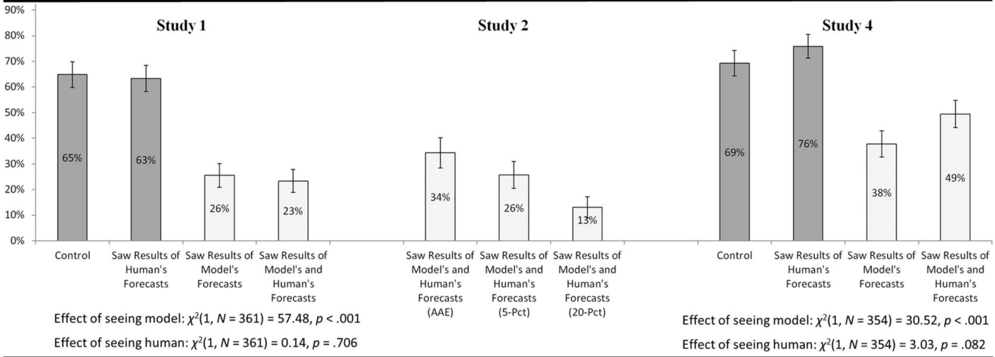
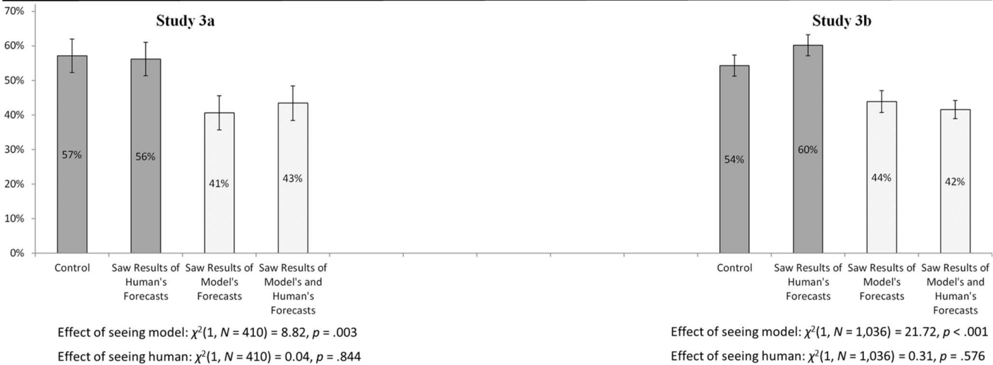
- Across five studies, seeing the algorithm perform reduced participants’ likelihood of choosing it over a human forecaster. In the model-and-human conditions, 610 of 741 participants (83%) saw the model outperform the human, yet these participants were among the least likely to choose the model.
- The model outperformed humans in all five studies. For example, bonuses if choosing model vs. human were Study 1: $1.78 vs. $1.38; Study 2: $1.77 vs. $1.09; Study 3a: $0.48 vs. $0.31; Study 3b: $0.49 vs. $0.30; Study 4: $1.79 vs. $1.38. Human forecasters produced 15–29% more error in the MBA task and 90–97% more error in the airline-passenger task.
- Seeing the model perform significantly decreased confidence in the model’s forecasts in all four studies where this was tested, whereas seeing the human perform significantly decreased confidence in the human only in Study 4. Confidence in the model’s forecasts significantly mediated the effect of seeing the model perform on choosing the model; confidence in the human did not.
- In Study 2, participants paid for forecasts within 20 percentiles were less likely to choose the model than those paid within 5 percentiles, χ²(1, N = 139) = 3.56, p = .059, and those paid by average absolute error, χ²(1, N = 136) = 8.56, p = .003; this effect was mediated by confidence in their own forecasts, not confidence in the model’s forecasts.
Methods
- Five studies had participants forecast real outcomes: MBA student success (Studies 1, 2, and 4) or U.S. state rank in airline passengers (Studies 3a and 3b). Participants were assigned to control, human, model, or model-and-human conditions, then chose whether to tie incentivized bonuses to the model or the human forecaster (themselves in Studies 1–3, another participant in Study 4).
- Final samples were Study 1: 361; Study 2: 206; Study 3a: 410; Study 3b: 1,036; Study 4: 354. Studies 1, 2, and 4 were run in the Wharton Behavioral Lab; Studies 3a and 3b used Amazon Mechanical Turk.
- Main analyses compared forecasting performance and choice rates, measured confidence and beliefs, and used binary mediation analyses with Preacher and Hayes’s bootstrapping procedure.
Limitations
- The paper states it did not explore all boundaries of the effect, including whether it would persist if algorithms were many times more accurate than humans, and whether results depend on features shared by the two forecasting tasks.
- The paper states it did not explore how algorithm variations—complexity, transparency, forecaster involvement in construction, and designer expertise—affect algorithm aversion.
- The paper states algorithm aversion is not entirely driven by seeing algorithms err, and it has little to say about how best to reduce aversion among those who have seen an algorithm err. The text also cautions that cross-experiment comparisons should be made cautiously.
Model-written summary. Check it against the paper before relying on it.
Integrity signals
Registry
Cites
Statistics
Figures
Verification
Claims the paper makes
0 Valid · 2 Not valid · 16 Not checked · 90 Own results and interpretations
A result the paper reports from its own data — it cites no other source for it, so there is none to check. The quote shows it is in the paper.
In the paper
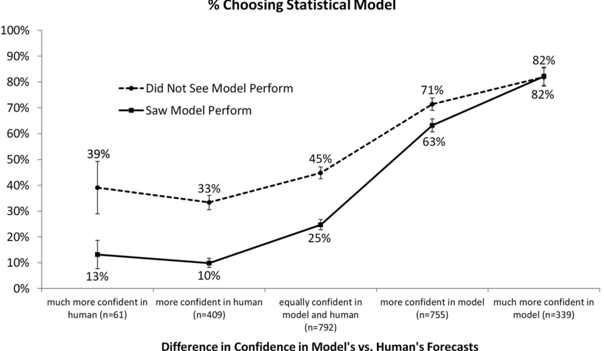
“the majority of people who were equally confident in the model's and human's forecasts chose to tie their bonuses to the human's forecasts, particularly when they had seen the model perform.”
plainstates an association- Asserted: passes — The authors put it forward as true.
- Checkable: passes — It can be checked against evidence.
- Load-bearing: passes — The paper’s conclusions depend on it.
- Based: passes — The paper gives a reason why it holds.
A result the paper reports from its own data — it cites no other source for it, so there is none to check. The quote shows it is in the paper.
In the paper
“Consistent with research on the adoption of decision aids (see Highhouse, 2008), participants thought that the human forecasters were better than the model at getting better with practice, learning from mistakes, and finding underappreciated candidates.”
plain- Asserted: passes — The authors put it forward as true.
- Checkable: passes — It can be checked against evidence.
- Load-bearing: passes — The paper’s conclusions depend on it.
- Based: passes — The paper gives a reason why it holds.
A result the paper reports from its own data — it cites no other source for it, so there is none to check. The quote shows it is in the paper.
In the paper
“Our studies show that this resistance at least partially arises from greater intolerance for error from algorithms than from humans.”
plainstates a possible cause- Asserted: passes — The authors put it forward as true.
- Checkable: passes — It can be checked against evidence.
- Load-bearing: passes — The paper’s conclusions depend on it.
- Based: passes — The paper gives a reason why it holds.
A result the paper reports from its own data — it cites no other source for it, so there is none to check. The quote shows it is in the paper.
In the paper
“Participants rightfully thought that the model was better than human forecasters at avoiding obvious mistakes, appropriately weighing various attributes, and consistently weighing information.”
plain- Asserted: passes — The authors put it forward as true.
- Checkable: passes — It can be checked against evidence.
- Load-bearing: unclear — It is unclear whether the paper’s conclusions depend on it.
- Based: passes — The paper gives a reason why it holds.
A result the paper reports from its own data — it cites no other source for it, so there is none to check. The quote shows it is in the paper.
In the paper
“This effect was evident in two distinct domains of judgment, including one in which the human forecasters produced nearly twice as much error as the algorithm.”
plain- Asserted: passes — The authors put it forward as true.
- Checkable: passes — It can be checked against evidence.
- Load-bearing: unclear — It is unclear whether the paper’s conclusions depend on it.
- Based: passes — The paper gives a reason why it holds.
75 more claims
Create a free account to see all 108 claims and to verify the 12 references still open.
- It may state two separate claims as one. 13
- Probably not a substantial claim. 16
Claims other papers make about this one
Each is checked against this paper’s own text: does it say what the citing paper says it does?
The source backs part of the claim, not all of it — or backs it for a different population, condition or comparison.
In the citing paper
“Traditional theorizing assumes trade-offs between trust and skepticism (Dietvorst et al., 2015), automation and engagement (Freeman et al., 2014), or efficiency and depth (Ishowo-Oloko et al., 2019)”
From Pedagogical partnerships with generative AI in higher education: how dual cognitive pathways paradoxically enable transformative learning (2026) · cites this paper as Dietvorst et al., 2015
Experimental — accuracy not yet measuredThe source backs part of the claim, not all of it — or backs it for a different population, condition or comparison.
In the citing paper
“Existing research typically examines trust versus skepticism in human-AI interactions as binary constructs (Dietvorst et al., 2015; Logg et al., 2019), missing the possibility that partnerships might simultaneously activate both vigilant and offloading behaviors.”
From Pedagogical partnerships with generative AI in higher education: how dual cognitive pathways paradoxically enable transformative learning (2026) · cites this paper as Dietvorst et al., 2015
Experimental — accuracy not yet measuredThe source backs part of the claim, not all of it — or backs it for a different population, condition or comparison.
In the citing paper
“It aligns with the theoretical rationale on algorithm aversion (Dietvorst et al. 2015;Hohensinn et al. 2024) and appreciation (Logg et al. 2019), which suggests that people are more likely to accept and trust AI systems when they produce desirable results but become skeptical when outcomes are unfavorable.”
From Holding AI Accountable Like Herding Cats: The Contingent Impact on the Legitimacy of Algorithmic Bureaucracy (2026) · cites this paper as Dietvorst et al. 2015
Experimental — accuracy not yet measuredThe source backs part of the claim, not all of it — or backs it for a different population, condition or comparison.
In the citing paper
“Research on algorithm appreciation and algorithm aversion further suggests that people may either defer to algorithms or reject them depending on prior experience, perceived expertise, and error visibility (Dietvorst et al., 2015; Logg et al., 2019).”
From College students' metacognitive awareness of generative-AI reliance: an experimental study of decision confidence and attribution bias (2026) · cites this paper as Dietvorst et al., 2015
Experimental — accuracy not yet measuredThe source backs part of the claim, not all of it — or backs it for a different population, condition or comparison.
In the citing paper
“Earlier research has mentioned gender, self-confidence, expertise, and general algorithm aversion or appreciation.15,28”
From Appropriate trust in artificial intelligence for the optical diagnosis of colorectal polyps: the role of human/artificial intelligence interaction (2024) · cites this paper as [28]
Experimental — accuracy not yet measured
22 more claims about this paper
Create a free account to see every claim other papers make about this one.
Statistics recomputed
Every reported test result, recomputed from its test statistic and degrees of freedom. A result shows as not adding up only once an independent check has confirmed it.
- Consistentt(360) = 4.98reported p < .001 · recomputed p < .001
“t (360) = 4.98, p < .001”
- Consistentt(204) = 6.26reported p < .001 · recomputed p < .001
“t (204) = 6.26, p < .001”
- Consistentt(405) = 7.73reported p < .001 · recomputed p < .001
“t (405) = 7.73, p < .001”
- Consistentt(353) = 5.11reported p < .001 · recomputed p < .001
“t (353) = 5.11, p < .001”
- Consistentχ²(1) = 39.94reported p < .001 · recomputed p < .001
“χ 2 (1, N = 271) = 39.94, p < .001”
19 more recomputed tests
Create a free account to see every test the Stats check recomputed.
Self-check
Percentages, sums and reported differences re-computed from the paper’s own numbers.
Self-check results appear here once an independent check has confirmed them.
Citations
Cites
Preacher, K. J., & Hayes, A. F. (2008) · Behavior Research Methods · doi:10.3758/brm.40.3.879 · Cited by 34,117 · cited 1×
“We then used Preacher and Hayes’s (2008) bootstrapping procedure to obtain unbiased 95% confidence intervals around the mediated effects.”
Method(2023) · doi:10.1126/science · Cited by 6,063
The trouble with overconfidence.
Moore, D. A., & Healy, P. J. (2008) · Psychological Review · doi:10.1037/0033-295x.115.2.502 · Cited by 2,358
“Clinical versus Actuarial Judgment.”
Dawes, R. M., Faust, D., & Meehl, P. E. (1989) · Science · doi:10.1126/science.2648573 · Cited by 2,298
The robust beauty of improper linear models in decision making.
Dawes, R. M. (1979) · American Psychologist · doi:10.1037/0003-066x.34.7.571 · Cited by 1,966
Preference and belief: Ambiguity and competence in choice under uncertainty
Heath, C., & Tversky, A. (1991) · Journal of Risk and Uncertainty · doi:10.1007/bf00057884 · Cited by 1,654
Clinical versus mechanical prediction: a meta-analysis
Grove, W. M., Zald, D. H., Lebow, B. S., Snitz, B. E., & Nelson, C. (2000) · Psychological Assessment · doi:10.1037/1040-3590.12.1.19 · Cited by 1,640
Grove, W. M., & Meehl, P. E. (1996) · Psychology, Public Policy, and Law · doi:10.1037/1076-8971.2.2.293 · Cited by 1,457 · cited 4×
“…1996), the notion that algorithms cannot properly consider individual targets (Grove & Meehl, 1996), concerns about the ethicality of relying on algorithms to make important decisions (Dawes, 1979), and the presumed inability of algorithms to incorporate qualitative data (Grove & Meehl, 1996).”
BackgroundMethodInfluential(2007) · Cited by 1,133
Competing on analytics: the new science of winning
(2007) · Choice Reviews Online · doi:10.5860/choice.44-6322 · Cited by 941
Research works printed but not linked: 1
- Clark, D. (2012, November 7). How Nate Silver won the 2012 presidential election. Harvard Business Review Blog . Retrieved from http://blogs .hbr.org/cs/2012/11/how\_nate\_silver\_won\_the\_2012\_p.html
Cited by
Items 1,501–1,600 of 3,918
Under what influence: Measuring AI influence to fit user profiles in decision-making
Campagner, A., Fregosi, C., Natali, C., & Cabitza, F. (2026) · International Journal of Human-Computer Studies · doi:10.1016/j.ijhcs.2026.103763 · Cited by 7
Generative AI in digital engagement: a quasi-experimental study of tourist sentiment
Ali, W., Kasturiratne, D., Ameer, I., & Bhaskar, S. (2026) · Service Industries Journal · doi:10.1080/02642069.2026.2638226 · Cited by 7
Algorithmic Transparency and Consumer Trade-Offs in AI-Based Financial E-Commerce Services
Choi, J., Kang, S., Moon, J., Jeon, S., & Lim, S. (2026) · Journal of theoretical and applied electronic commerce research · doi:10.3390/jtaer21030086 · Cited by 6
Fan, X., & Kwon, S. (2026) · Technological Forecasting and Social Change · doi:10.1016/j.techfore.2026.124622 · Cited by 6
Optimising Human– AI Decision Performance: A Trust and Capability Framework for Knowledge Management
Dittmar, E. C., & Sposato, M. (2026) · Knowledge and Process Management · doi:10.1002/kpm.70059 · Cited by 7
Mapping the use of large language models in hiring decisions: a scoping review
Tripathi, A., Tripathi, A., Dařena, F., & Mishra, P. K. (2026) · Frontiers in Artificial Intelligence · doi:10.3389/frai.2026.1798519 · Cited by 11
Kaufmann, E., & Chacon, A. (2026) · Cognitive Systems Research · doi:10.1016/j.cogsys.2026.101462 · Cited by 6
Zhang, W., Huang, L., Ding, J., Xie, C., Mu, J., & Hao, N. (2026) · Computers in Human Behavior Reports · doi:10.1016/j.chbr.2026.101023 · Cited by 9
When humans stop thinking: tackling the silent threat of AI complacency in service operations
Le, K. B. Q., & Kunz, W. H. (2026) · Journal of service management · doi:10.1108/josm-05-2025-0262 · Cited by 10
Instant health or long-term wellness? A lay belief perspective on AI vs. human recipe recommenders
Shu, B., Mei, Y., Liu, W., & Wang, R. F. (2026) · Food Quality and Preference · doi:10.1016/j.foodqual.2026.105950 · Cited by 6
Tanveer, M. (2026) · Discover Psychology · doi:10.1007/s44202-026-00697-5 · Cited by 8
Zhang, J., Cao, J., & Meng, T. (2026) · Journal of Chinese Political Science · doi:10.1007/s11366-026-09944-x · Cited by 6
Israfilzade, K. (2026) · Sustainability · doi:10.3390/su18147270 · Cited by 7
Казакова, Т. В., & Горшкова, Л. А. (2022) · Creative Economy · doi:10.18334/ce.16.5.114693 · Cited by 6
Flösch, K., Flaisch, T., Imhof, M. A., & Schupp, H. T. (2023) · Psychophysiology · doi:10.1111/psyp.14433 · Cited by 6
Haas, S., & Hüllermeier, E. (2024) · International Journal of Data Science and Analytics · doi:10.1007/s41060-024-00573-2 · Cited by 10
Measurable Trust: The Key to Unlocking User Confidence in Black-Box AI
Palazzolo, P., Stahl, B. C., & Webb, H. (2024) · International Symposium on Trustworthy Autonomous Systems (TAS) · doi:10.1145/3686038.3686058 · Cited by 7
Pan, S., & Mou, Y. (2024) · International Journal of Human-Computer Interaction · doi:10.1080/10447318.2024.2408511 · Cited by 8
Simon, L., Rauffet, P., & Guerin, C. (2024) · Cognition Technology & Work · doi:10.1007/s10111-024-00782-6 · Cited by 7
Das, P., & Das, S. (2024) · Vision The Journal of Business Perspective · doi:10.1177/09722629241291731 · Cited by 7
Performance rather than reputation affects humans’ trust towards an artificial agent
Becker, F., Spannagl, C. I., Buder, J., & Huff, M. (2025) · Computers in Human Behavior Artificial Humans · doi:10.1016/j.chbah.2025.100122 · Cited by 10
Do I spy AI? The impact of AI-generated images on trust and donation behaviors
Monahan, L., Martin, M. W., Zaitsev, A., Bartelt, V. L., & Noordeen, A. R. (2025) · First Monday · doi:10.5210/fm.v30i4.13799 · Cited by 8
Can Providing Algorithmic Performance Information Facilitate Humans’ Inventory Ordering Behaviors?
Lu, Y., Luo, X., Huang, L., & Wang, D. (2025) · Information Systems Research · doi:10.1287/isre.2022.0621 · Cited by 9
The Role of Initial Acceptance Attitudes Toward AI Decisions in Algorithmic Recourse
Tominaga, T., Yamashita, N., & Kurashima, T. (2025) · CHI Conference on Human Factors in Computing Systems · doi:10.1145/3706598.3713573 · Cited by 8
Trust in AI is dynamically updated based on users' expectations
Cooper, P. S., Lim, A., Irons, J. L., McGrath, M. J., Jarvis, H., & Duenser, A. (2025) · CHI Conference Extended Abstracts on Human Factors in Computing Systems (CHI EA) · doi:10.1145/3706599.3719870 · Cited by 7
Said, N., Schumacher, L., & Huff, M. (2025) · Journal of Risk Research · doi:10.1080/13669877.2025.2493859 · Cited by 9
Interacting with fallible AI: is distrust helpful when receiving AI misclassifications?
Peters, T. M., & Scharlau, I. (2025) · Frontiers in Psychology · doi:10.3389/fpsyg.2025.1574809 · Cited by 9
Training Users Against Human and GPT-4 Generated Social Engineering Attacks
Malloy, T., Ferreira, M. J., Fang, F., & González, C. (2025) · Lecture notes in computer science · doi:10.1007/978-3-031-92833-8_4 · Cited by 9
A Conceptual Framework for User Trust in AI Biosensors: Integrating Cognition, Context, and Contrast
Prahl, A. (2025) · Sensors · doi:10.3390/s25154766 · Cited by 7
AI transformation and AI adoption intention in B2B environment
Park, D. H., Jiang, Q., Ko, E., Son, S.-C., & Kim, K. H. (2025) · Journal of Global Scholars of Marketing Science · doi:10.1080/21639159.2025.2554280 · Cited by 10
Technical and clinical challenges of A.I. in retinal image analysis
Lim, G., Hsu, W., Lee, M. L., Ting, D. S. W., & Wong, T. Y. (2019) · Elsevier eBooks · doi:10.1016/b978-0-08-102816-2.00022-8 · Cited by 7
Yu, H. (2023) · Psychology Research and Behavior Management · doi:10.2147/prbm.s430936 · Cited by 14
RetractedGendered competencies and gender composition: A human versus algorithm evaluator comparison
Merritt, S. M., Ryan, A. M., Gardner, C. L., Liff, J., & Mondragon, N. J. (2023) · International Journal of Selection and Assessment · doi:10.1111/ijsa.12459 · Cited by 6
Kianpisheh, M., Mariakakis, A. T., & Truong, K. N. (2024) · Proceedings of the ACM on Interactive Mobile Wearable and Ubiquitous Technologies · doi:10.1145/3643500 · Cited by 8
Jensen, T., Theofanos, M. F., Greene, K. K., Williams, O., Goad, K., & Fofang, J. S. B. E. (2024) · Proceedings of the AAAI/ACM Conference on AI Ethics and Society · doi:10.1609/aies.v7i1.31667 · Cited by 10
Beyond the Prisoner’s Dilemma: the Social Dilemmas of Cybersecurity
Schoenherr, J. R., & Thomson, R. (2020) · International Conference on Cyber Situational Awareness, Data Analytics and Assessment (CyberSA) · doi:10.1109/cybersa49311.2020.9139644 · Cited by 7
Algorithms, human decision-making and predictive policing
Phillips, P. J., & Pohl, G. (2021) · SN Social Sciences · doi:10.1007/s43545-021-00109-6 · Cited by 6
Thompson, T. L., & Graham, B. P. (2021) · Research in networked learning · doi:10.1007/978-3-030-85241-2_10 · Cited by 6
A three-dimensional motivation model of algorithm aversion
ZAHNG, Y., Xu, L., Yu, F., Xiaojun, D. I. N. G., Wu, J., Zhao, L., 邬, 家., & 赵, 靓. (2022) · Advances in Psychological Science · doi:10.3724/sp.j.1042.2022.01093 · Cited by 9
The Impact of Functional and Psychological Barriers on Algorithm Aversion – An IRT Perspective
Mahmud, H., Islam, A. K. M. N., Mitra, R. K., & Hasan, A. R. (2022) · Lecture notes in computer science · doi:10.1007/978-3-031-15342-6_8 · Cited by 11
COVID-19 and public support for autonomous technologies—Did the pandemic catalyze a world of robots?
Horowitz, M. C., Kahn, L., Macdonald, J. M., & Schneider, J. G. (2022) · PLoS ONE · doi:10.1371/journal.pone.0273941 · Cited by 6
Predicting the future with humans and AI
Mellers, B. A., Lu, L., & McCoy, J. P. (2022) · Consumer Psychology Review · doi:10.1002/arcp.1089 · Cited by 7
Morrison, B. W., Kelson, J. N., Morrison, N. M. V., Innes, J. M., Zelic, G., Al‐Saggaf, Y., & Paul, M. (2023) · Interacting with Computers · doi:10.1093/iwc/iwad028 · Cited by 6
The Learning Electronic Health Record
Clermont, G. (2023) · Critical Care Clinics · doi:10.1016/j.ccc.2023.03.004 · Cited by 6
A Q-Learning Approach for Adherence-Aware Recommendations
Faros, I., Dave, A., & Malikopoulos, A. A. (2023) · IEEE Control Systems Letters · doi:10.1109/lcsys.2023.3339591 · Cited by 6
Versicherungsfremde Leistungen in der Sozialversicherung
Stapf-Finé, H. (2024) · Sozialer Fortschritt · doi:10.3790/sfo.73.1.55 · Cited by 6
Do People Recover from Algorithm Aversion? An Experimental Study of Algorithm Aversion over Time
Leffrang, D., Bösch, K., & Müller, O. (2023) · Hawaii International Conference on System Sciences (HICSS) · doi:10.24251/hicss.2023.491 · Cited by 7
Tse, T. T. K., Hanaki, N., & Mao, B. (2024) · Journal of Economic Psychology · doi:10.1016/j.joep.2024.102727 · Cited by 6
The Paradox of Algorithms and Blame on Public Decision-makers
Ozer, A. L., Waggoner, P., & Kennedy, R. (2024) · Business and Politics · doi:10.1017/bap.2023.35 · Cited by 8
Artificial Intelligence and Human Rights at Work
Atkinson, J., & Collins, P. (2023) · Oxford University Press eBooks · doi:10.1093/law/9780192882486.003.0025 · Cited by 8
Artificial Intelligence and Freedom of Expression
Gregorio, G. D., & Dunn, P. (2023) · Oxford University Press eBooks · doi:10.1093/law/9780192882486.003.0005 · Cited by 10
Maximizing benefits in project selection: a hybrid approach
Wu, S., Toussaint, J., & Messer, K. D. (2017) · Applied Economics · doi:10.1080/00036846.2016.1276267 · Cited by 6
Jang, J., & Tak, J. (2013) · Korean Journal of Industrial and Organizational Psychology · doi:10.24230/ksiop.26.1.201302.1 · Cited by 7
Implementing Artificial Intelligence in Organizations and the Special Role of Trust
Bruhn, J., & Anderer, M. (2019) · Springer eBooks · doi:10.1007/978-3-030-30774-5_14 · Cited by 6
Acceptance of AI for delegating emotional intelligence: Results from an experiment
Aysolmaz, B., Leyer, M., & İren, D. (2021) · Hawaii International Conference on System Sciences (HICSS) · doi:10.24251/hicss.2021.761 · Cited by 8
A psychophysics approach for quantitative comparison of interpretable computer vision modelsPreprint
Bießmann, F., & Refiano, D. I. (2019) · arXiv (Cornell University) · doi:10.48550/arxiv.1912.05011 · Cited by 7
Ford, C., Kenny, E. M., & Keane, M. T. (2020) · arXiv (Cornell University) · doi:10.48550/arxiv.2009.06349 · Cited by 8
Cognitive challenges in human-AI collaboration: Investigating the path towards productive delegationPreprint
Fügener, A., Grahl, J., Gupta, A., & Ketter, W. (2019) · ERIM Report Series Research in Management · Cited by 11
News from Artificial Intelligence is Believed LessPreprint
Longoni, C., Fradkin, A., Cian, L., & Pennycook, G. (2021) · SSRN Electronic Journal · doi:10.2139/ssrn.3787064 · Cited by 6
Trust in Traditional Finance and Consumer Fintech AdoptionPreprint
Paaso, M., Okat, D., & Pursiainen, V. (2021) · SSRN Electronic Journal · doi:10.2139/ssrn.3947888 · Cited by 6
Guo, Y., Jing, Z., Tong, S., Chen, T., Kumar, S., & Ouyang, S. (2023) · SSRN Electronic Journal · doi:10.2139/ssrn.4316416 · Cited by 7
Questioning AI: How Racial Identity Shapes the Perceptions of Algorithmic BiasPreprint
Kim, S., Lee, J., & Oh, P. (2023) · PsyArXiv (OSF Preprints) · doi:10.31234/osf.io/afcdn · Cited by 6
Schultze, T., Kumar, V. S., McKeown, G. J., O'Connor, P. A., Rychlowska, M., & Šparemblek, K. (2024) · PsyArXiv (OSF Preprints) · doi:10.31234/osf.io/tvcag · Cited by 6
What People Think of Machines as Doctors: Unveiling the Value of Gen-AI for e-HealthPreprint
Ozdemir, D. Y., Ayvaci, M., & Zentner, A. (2024) · SSRN Electronic Journal · doi:10.2139/ssrn.4765222 · Cited by 9
Simkute, A., Luger, E. A., Evans, M., & Jones, R. (2024) · arXiv (Cornell University) · doi:10.48550/arxiv.2403.16895 · Cited by 6
Progress and challenges in the symbiosis of AI with science and medicine
Lin, Z. (2024) · European Journal of Clinical Investigation · doi:10.1111/eci.14222 · Cited by 7
Human-Algorithm Interactions in Labor Scheduling DecisionsPreprint
Kwon, C., Raman, A., & Tamayo, J. (2024) · SSRN Electronic Journal · doi:10.2139/ssrn.4773773 · Cited by 11
Algorithmic Pricing: Implications for Marketing Strategy and RegulationPreprint
Spann, M., Bertini, M., Koenigsberg, O., Zeithammer, R., Aparicio, D., Chen, Y., Fantini, F., Jin, G. Z., Morwitz, V. G., Leszczyc, P. T. L. P., et al. (2024) · SSRN Electronic Journal · doi:10.2139/ssrn.4859392 · Cited by 6
The Challenges of Deploying an Algorithmic Pricing Tool: Evidence from AirbnbPreprint
Foroughifar, M., & Mehta, N. (2024) · SSRN Electronic Journal · doi:10.2139/ssrn.4857320 · Cited by 10
Chacon, A. (2024) · AI & Society · doi:10.1007/s00146-024-02066-z · Cited by 8
The human-authorship halo: attribution bias in literary style evaluation by humans and AIPreprint
Haverals, W., & Martin, M. J. (2025) · arXiv (Cornell University) · doi:10.48550/arxiv.2510.08831 · Cited by 6
Purpose not prediction: the role of managers in the age of AI
Goldberg, A., & Puranam, P. (2026) · Journal of Organization Design · doi:10.1007/s41469-026-00205-y · Cited by 7
The AI Agent in the Room: Rethinking Consumer Decision‐Making in the Age of Autonomous AI
Bilgihan, A., Ostinelli, M., Lorenz, M. P., & Zhang, Y. (2026) · Psychology and Marketing · doi:10.1002/mar.70165 · Cited by 6
Dell'Acqua, F., Kogut, B., & Perkowski, P. (2020) · SSRN Electronic Journal · doi:10.2139/ssrn.3746564 · Cited by 5
Raees, M., Khan, V.-J., Lykourentzou, I., & Papangelis, K. (2026) · Proceedings of the 2026 CHI Conference on Human Factors in Computing Systems · doi:10.1145/3772318.3791467 · Cited by 5
“Conversely, users may refrain from using the AI system due to performance bias , perceptions of self-efficacy (the ability to make decisions without advice), or purposefully considering the system’s advice as inferior, demonstrating algorithmic aversion [42, 143].”
InfluentialFrom Trust to Appropriate Reliance: Measurement Constructs in Human-AI Decision-Making
Raees, M., & Papangelis, K. (2026) · arXiv · doi:10.48550/arxiv.2604.23896 · Cited by 5
“Conversely, users may refrain from using the AI system due to performance bias , perceptions of self-efficacy (the ability to make decisions without advice), or purposefully considering the system’s advice as inferior, demonstrating algorithmic aversion [22, 81].”
Artificial Intelligence and Data Analytics: A Recipe for Human Rights Violations
Laukyte, M. (2023) · Oxford University Press eBooks · doi:10.1093/law/9780192882486.003.0019 · Cited by 5
Trust and Dependence on Robotic Decision Support
Natarajan, M., & Gombolay, M. (2024) · IEEE Transactions on Robotics · doi:10.1109/tro.2024.3484628 · Cited by 8
Haas, S., Hegestweiler, K., Rapp, M. T., Muschalik, M., & Hüllermeier, E. (2024) · Frontiers in Artificial Intelligence · doi:10.3389/frai.2024.1471208 · Cited by 6
Cha, Y. (2025) · Journal of Information Systems · doi:10.2308/isys-2023-011 · Cited by 7
Lay Perceptions of Algorithmic Discrimination in the Context of Systemic Injustice
Lima, G., Grgić-Hlača, N., Langer, M., & Zou, Y. (2025) · CHI Conference on Human Factors in Computing Systems · doi:10.1145/3706598.3713536 · Cited by 7
Mitigating the judicial human–AI fairness gap
Chen, B. M., Hermstrüwer, Y., Langenbach, P., Stremitzer, A., & Tobia, K. P. (2026) · The Journal of Legal Analysis · doi:10.1093/jla/laag007 · Cited by 5
The taming of sociodigital anticipations: AI in the digital welfare state
Zenkl, T. (2025) · Frontiers in Sociology · doi:10.3389/fsoc.2025.1556675 · Cited by 5
Role of CADx in colonoscopy: lessons from real-life studies
Bustamante, M. (2025) · Best Practice & Research Clinical Gastroenterology · doi:10.1016/j.bpg.2025.102020 · Cited by 6
When algorithms and human experts contradict, whom do users follow?
Pal, A., Chua, A. Y. K., & Banerjee, S. (2025) · Behaviour and Information Technology · doi:10.1080/0144929x.2025.2525306 · Cited by 6
Raddatz, N. I., Raddatz, P. A., Ogunade, K. M., Kim, S.-H., & Williams, D. L. (2026) · Accounting Horizons · doi:10.2308/horizons-2023-103 · Cited by 5
Higher education readiness to implement artifi cial intelligence: a bibliometric analysis
Tunkevichus, O. (2025) · Lomonosov Economics Journal · doi:10.55959/msu0130-0105-6-60-3-14 · Cited by 7
Identifying Effective Praise in Tutoring: Large Language Models with Transparent Explanations
Chen, E., Li, J. J.-P., Huang, S., Tang, X., Lin, J., Carvalho, P. F., & Koedinger, K. R. (2025) · Lecture notes in computer science · doi:10.1007/978-3-031-98465-5_20 · Cited by 6
When utility meets ethics: A stakeholder perspective on agentic information systems delegation
Saeed, K., & Prybutok, V. R. (2025) · International Journal of Information Management · doi:10.1016/j.ijinfomgt.2025.102976 · Cited by 6
‘Hey Siri, ask them out:’ investigating the use of artificial intelligence in date request messaging
Roaché, D. J., Sharabi, L. L., Hicks, L. L., & Hurley, M. M. (2025) · Behaviour and Information Technology · doi:10.1080/0144929x.2025.2559289 · Cited by 6
Large language models (LLMs) as jurors: Assessing the potential of LLMs in legal contexts.
Sun, Y., Zappalà, A., Maso, E. D., Pompedda, F., Nyman, T. J., & Santtila, P. O. (2025) · Law and Human Behavior · doi:10.1037/lhb0000620 · Cited by 5
Voiseux, G., Zhou, R. T., & Huang, H. (2025) · Behavioral Science & Policy · doi:10.1177/23794607251384574 · Cited by 5
The impact of interactional justice on service evaluations in the banking context
Liu, J., Yang, G., Lyu, Y., & Wei, Q. (2025) · Acta Psychologica · doi:10.1016/j.actpsy.2025.105805 · Cited by 5
Development and validation of a scale assessing perceived trustworthiness in large language models
Yankouskaya, A., Barajeeh, B., Babiker, A., Alshakhsi, S. A. A., Ma, Y. T., Ho, C. S. M., & Ali, R. (2026) · Discover Artificial Intelligence · doi:10.21203/rs.3.rs-7738215/v1 · Cited by 5
ArchiveGPT: A human-centered evaluation of using a vision language model for image cataloguing
Abele, L., Anders, G., Aydın, T., Buder, J., Fischer, H., Kimmel, D., & Huff, M. (2026) · Humanities and Social Sciences Communications · doi:10.1057/s41599-026-08367-6 · Cited by 5
Lee, G., Kim, J., Kim, K., Huh, J. Y., & Park, J. J. (2025) · Journal of Fashion Marketing and Management · doi:10.1108/jfmm-11-2024-0431 · Cited by 8
Sreejesh, S., & Singha, S. D. (2025) · Journal of Retailing and Consumer Services · doi:10.1016/j.jretconser.2025.104660 · Cited by 6
Du, H. S., Chen, T., & Ke, X. (2025) · International Journal of Human-Computer Interaction · doi:10.1080/10447318.2025.2598452 · Cited by 6
AI labeling reduces the perceived accuracy of online content but has limited broader effects
Wang, C., Sturgis, P., & de Kadt, D. (2026) · Telematics and Informatics · doi:10.1016/j.tele.2026.102416 · Cited by 6
Sudo, H., Noborimoto, Y., & Takahashi, J. (2025) · JMIR Medical Education · doi:10.2196/85614 · Cited by 8
Metadata
- Authors
- Dietvorst, B. J., Simmons, J. P., & Massey, C.
- Affiliations
- University of Pennsylvania (US)
- Venue
- Journal of Experimental Psychology: General
- Published
- 2015
- Volume
- 144
- Issue
- 1
- Pages
- 114-126
- ISSN
- 0096-3445 (ISSN-L)
- 1939-2222
- OpenAlex
- W3125633690
- Cited by
- 3,232
- References
- 22
- Citations by year
- 2026: 1025 · 2025: 563 · 2024: 445 · 2023: 404 · 2022: 266 · 2021: 216 · 2020: 137 · 2019: 88 · 2018: 41 · 2017: 26 · 2016: 14 · 2015: 5
- FWCI
- 13.96
- Type
- journal article
- Language
- en
- Open access
- green
- doi.org
- Locations
- Journal of Experimental Psychology General (publishedVersion)
- SSRN Electronic Journal (publishedVersion)
- PubMed (publishedVersion)
- ScholarlyCommons (University of Pennsylvania) (submittedVersion)
- Funders
- Wharton Behavioral Laboratory
- Wharton Risk Center Ackoff Doctoral Student Fellowship
- Topics
- Social Sciences › Decision Sciences › General Decision Sciences › Decision-Making and Behavioral Economics
- Social Sciences › Decision Sciences › Management Science and Operations Research › Forecasting Techniques and Applications
- Social Sciences › Human Factors and Ergonomics › Human-Automation Interaction and Safety
- Keywords
- algorithm aversion, trust in algorithms, prediction confidence, evidence-based algorithm, decision-making
- MeSH terms
- Algorithms, Avoidance Learning, Culture, Decision Making, Female, Forecasting, Humans, Male, Motivation, Comprehension, Young Adult
About these checks
Registry, retraction, Cites and statistics results are computed, not judged, with one exception: a printed reference that no index lists is read once by a model before it counts as a citation error. Claims are extracted by a model and kept only when their quote appears verbatim in the text; each cited source is then checked, with a model’s help, for whether it says what the claim relies on. Those verdicts can be wrong — read the claim’s quote and the cited source before relying on one.
A language model drew the claims from the paper on 2026-11-14, under version 3 of the claim definition (model deepseek-v4.1-flash, prompt extract-v3).
A second model labelled each claim on 2026-11-14 (model jev-1.13-20260917, definition revision gold-guideline-v0.2).
Statistics and arithmetic are recomputed, not judged.
Confidence bands are shown only for fields calibrated on our annotated test set. None is calibrated yet, so no band is shown.
What counts as a claim ›How we measure confidence ›How we check this ›
Are you an author, or do you see a problem with this page? Request a review
Data sources
Bibliographic data: Semantic Scholar, OpenAlex, Crossref.
Contains information from the Semantic Scholar Academic Graph Datasets, made available under the ODC Attribution License (ODC-BY 1.0).
Semantic Scholar’s data is described in: Kinney, R., et al. (2023). The Semantic Scholar Open Data Platform. arXiv:2301.10140.
