

Algorithm aversion: People erroneously avoid algorithms after seeing them err.
Open accessThe DOI matches its Crossref record; 23 of the 23 references it cites were found in a registry or an index; none of the 22 sources its claims cite is checked for support yet.
Abstract
Research shows that evidence-based algorithms more accurately predict the future than do human forecasters. Yet when forecasters are deciding whether to use a human forecaster or a statistical algorithm, they often choose the human forecaster. This phenomenon, which we call algorithm aversion, is costly, and it is important to understand its causes. We show that people are especially averse to algorithmic forecasters after seeing them perform, even when they see them outperform a human forecaster. This is because people more quickly lose confidence in algorithmic than human forecasters after seeing them make the same mistake. In 5 studies, participants either saw an algorithm make forecasts, a human make forecasts, both, or neither. They then decided whether to tie their incentives to the future predictions of the algorithm or the human. Participants who saw the algorithm perform were less confident in it, and less likely to choose it over an inferior human forecaster. This was true even among those who saw the algorithm outperform the human.
Overview
CoChat Summary
TL;DR
People become less willing to use a statistical algorithm after seeing it perform and make mistakes, even when it outperforms a human forecaster. This “algorithm aversion” is driven partly by people losing confidence in algorithms more quickly than in humans after observing errors.
Key findings
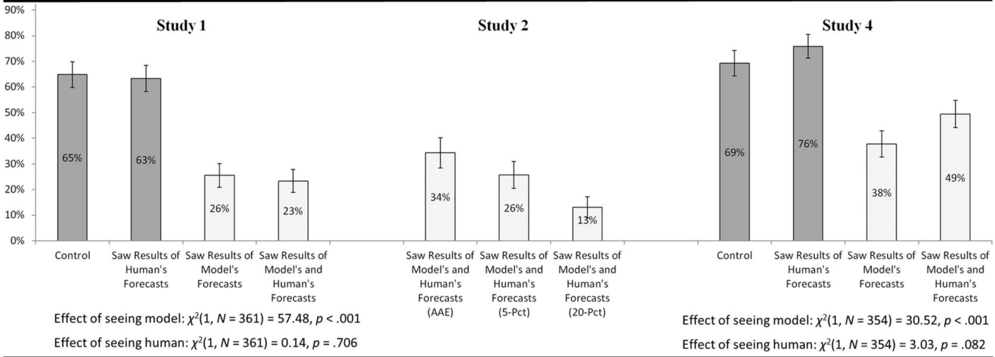
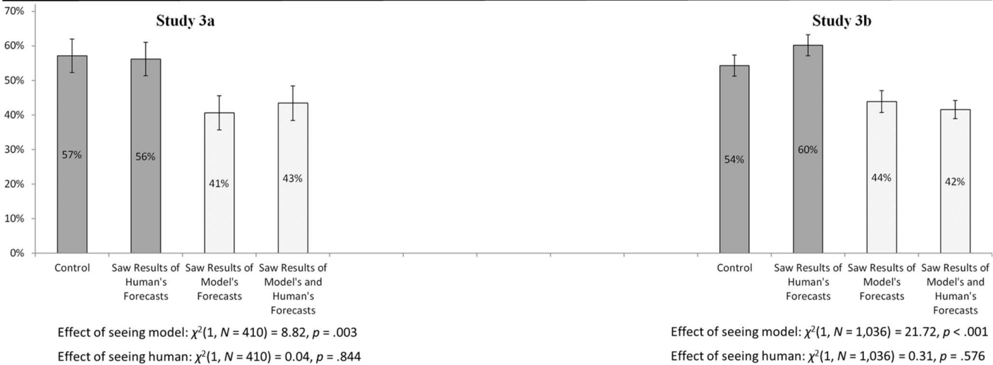
- Across five studies, seeing the algorithm perform reduced participants’ likelihood of choosing it over a human forecaster. In the model-and-human conditions, 610 of 741 participants (83%) saw the model outperform the human, yet these participants were among the least likely to choose the model.
- The model outperformed humans in all five studies. For example, bonuses if choosing model vs. human were Study 1: $1.78 vs. $1.38; Study 2: $1.77 vs. $1.09; Study 3a: $0.48 vs. $0.31; Study 3b: $0.49 vs. $0.30; Study 4: $1.79 vs. $1.38. Human forecasters produced 15–29% more error in the MBA task and 90–97% more error in the airline-passenger task.
- Seeing the model perform significantly decreased confidence in the model’s forecasts in all four studies where this was tested, whereas seeing the human perform significantly decreased confidence in the human only in Study 4. Confidence in the model’s forecasts significantly mediated the effect of seeing the model perform on choosing the model; confidence in the human did not.
- In Study 2, participants paid for forecasts within 20 percentiles were less likely to choose the model than those paid within 5 percentiles, χ²(1, N = 139) = 3.56, p = .059, and those paid by average absolute error, χ²(1, N = 136) = 8.56, p = .003; this effect was mediated by confidence in their own forecasts, not confidence in the model’s forecasts.
Methods
- Five studies had participants forecast real outcomes: MBA student success (Studies 1, 2, and 4) or U.S. state rank in airline passengers (Studies 3a and 3b). Participants were assigned to control, human, model, or model-and-human conditions, then chose whether to tie incentivized bonuses to the model or the human forecaster (themselves in Studies 1–3, another participant in Study 4).
- Final samples were Study 1: 361; Study 2: 206; Study 3a: 410; Study 3b: 1,036; Study 4: 354. Studies 1, 2, and 4 were run in the Wharton Behavioral Lab; Studies 3a and 3b used Amazon Mechanical Turk.
- Main analyses compared forecasting performance and choice rates, measured confidence and beliefs, and used binary mediation analyses with Preacher and Hayes’s bootstrapping procedure.
Limitations
- The paper states it did not explore all boundaries of the effect, including whether it would persist if algorithms were many times more accurate than humans, and whether results depend on features shared by the two forecasting tasks.
- The paper states it did not explore how algorithm variations—complexity, transparency, forecaster involvement in construction, and designer expertise—affect algorithm aversion.
- The paper states algorithm aversion is not entirely driven by seeing algorithms err, and it has little to say about how best to reduce aversion among those who have seen an algorithm err. The text also cautions that cross-experiment comparisons should be made cautiously.
Model-written summary. Check it against the paper before relying on it.
Integrity signals
Registry
Cites
Statistics
Figures
Verification
Claims the paper makes
0 Valid · 2 Not valid · 16 Not checked · 90 Own results and interpretations
A result the paper reports from its own data — it cites no other source for it, so there is none to check. The quote shows it is in the paper.
In the paper
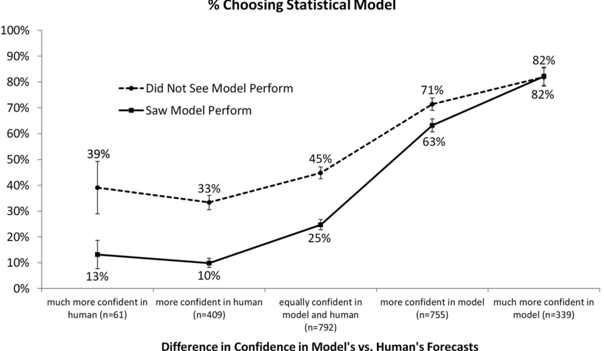
“the majority of people who were equally confident in the model's and human's forecasts chose to tie their bonuses to the human's forecasts, particularly when they had seen the model perform.”
plainstates an association- Asserted: passes — The authors put it forward as true.
- Checkable: passes — It can be checked against evidence.
- Load-bearing: passes — The paper’s conclusions depend on it.
- Based: passes — The paper gives a reason why it holds.
A result the paper reports from its own data — it cites no other source for it, so there is none to check. The quote shows it is in the paper.
In the paper
“Consistent with research on the adoption of decision aids (see Highhouse, 2008), participants thought that the human forecasters were better than the model at getting better with practice, learning from mistakes, and finding underappreciated candidates.”
plain- Asserted: passes — The authors put it forward as true.
- Checkable: passes — It can be checked against evidence.
- Load-bearing: passes — The paper’s conclusions depend on it.
- Based: passes — The paper gives a reason why it holds.
A result the paper reports from its own data — it cites no other source for it, so there is none to check. The quote shows it is in the paper.
In the paper
“Our studies show that this resistance at least partially arises from greater intolerance for error from algorithms than from humans.”
plainstates a possible cause- Asserted: passes — The authors put it forward as true.
- Checkable: passes — It can be checked against evidence.
- Load-bearing: passes — The paper’s conclusions depend on it.
- Based: passes — The paper gives a reason why it holds.
A result the paper reports from its own data — it cites no other source for it, so there is none to check. The quote shows it is in the paper.
In the paper
“Participants rightfully thought that the model was better than human forecasters at avoiding obvious mistakes, appropriately weighing various attributes, and consistently weighing information.”
plain- Asserted: passes — The authors put it forward as true.
- Checkable: passes — It can be checked against evidence.
- Load-bearing: unclear — It is unclear whether the paper’s conclusions depend on it.
- Based: passes — The paper gives a reason why it holds.
A result the paper reports from its own data — it cites no other source for it, so there is none to check. The quote shows it is in the paper.
In the paper
“This effect was evident in two distinct domains of judgment, including one in which the human forecasters produced nearly twice as much error as the algorithm.”
plain- Asserted: passes — The authors put it forward as true.
- Checkable: passes — It can be checked against evidence.
- Load-bearing: unclear — It is unclear whether the paper’s conclusions depend on it.
- Based: passes — The paper gives a reason why it holds.
75 more claims
Create a free account to see all 108 claims and to verify the 12 references still open.
- It may state two separate claims as one. 13
- Probably not a substantial claim. 16
Claims other papers make about this one
Each is checked against this paper’s own text: does it say what the citing paper says it does?
The source backs part of the claim, not all of it — or backs it for a different population, condition or comparison.
In the citing paper
“Traditional theorizing assumes trade-offs between trust and skepticism (Dietvorst et al., 2015), automation and engagement (Freeman et al., 2014), or efficiency and depth (Ishowo-Oloko et al., 2019)”
From Pedagogical partnerships with generative AI in higher education: how dual cognitive pathways paradoxically enable transformative learning (2026) · cites this paper as Dietvorst et al., 2015
Experimental — accuracy not yet measuredThe source backs part of the claim, not all of it — or backs it for a different population, condition or comparison.
In the citing paper
“Existing research typically examines trust versus skepticism in human-AI interactions as binary constructs (Dietvorst et al., 2015; Logg et al., 2019), missing the possibility that partnerships might simultaneously activate both vigilant and offloading behaviors.”
From Pedagogical partnerships with generative AI in higher education: how dual cognitive pathways paradoxically enable transformative learning (2026) · cites this paper as Dietvorst et al., 2015
Experimental — accuracy not yet measuredThe source backs part of the claim, not all of it — or backs it for a different population, condition or comparison.
In the citing paper
“It aligns with the theoretical rationale on algorithm aversion (Dietvorst et al. 2015;Hohensinn et al. 2024) and appreciation (Logg et al. 2019), which suggests that people are more likely to accept and trust AI systems when they produce desirable results but become skeptical when outcomes are unfavorable.”
From Holding AI Accountable Like Herding Cats: The Contingent Impact on the Legitimacy of Algorithmic Bureaucracy (2026) · cites this paper as Dietvorst et al. 2015
Experimental — accuracy not yet measuredThe source backs part of the claim, not all of it — or backs it for a different population, condition or comparison.
In the citing paper
“Research on algorithm appreciation and algorithm aversion further suggests that people may either defer to algorithms or reject them depending on prior experience, perceived expertise, and error visibility (Dietvorst et al., 2015; Logg et al., 2019).”
From College students' metacognitive awareness of generative-AI reliance: an experimental study of decision confidence and attribution bias (2026) · cites this paper as Dietvorst et al., 2015
Experimental — accuracy not yet measuredThe source backs part of the claim, not all of it — or backs it for a different population, condition or comparison.
In the citing paper
“Earlier research has mentioned gender, self-confidence, expertise, and general algorithm aversion or appreciation.15,28”
From Appropriate trust in artificial intelligence for the optical diagnosis of colorectal polyps: the role of human/artificial intelligence interaction (2024) · cites this paper as [28]
Experimental — accuracy not yet measured
22 more claims about this paper
Create a free account to see every claim other papers make about this one.
Statistics recomputed
Every reported test result, recomputed from its test statistic and degrees of freedom. A result shows as not adding up only once an independent check has confirmed it.
- Consistentt(360) = 4.98reported p < .001 · recomputed p < .001
“t (360) = 4.98, p < .001”
- Consistentt(204) = 6.26reported p < .001 · recomputed p < .001
“t (204) = 6.26, p < .001”
- Consistentt(405) = 7.73reported p < .001 · recomputed p < .001
“t (405) = 7.73, p < .001”
- Consistentt(353) = 5.11reported p < .001 · recomputed p < .001
“t (353) = 5.11, p < .001”
- Consistentχ²(1) = 39.94reported p < .001 · recomputed p < .001
“χ 2 (1, N = 271) = 39.94, p < .001”
19 more recomputed tests
Create a free account to see every test the Stats check recomputed.
Self-check
Percentages, sums and reported differences re-computed from the paper’s own numbers.
Self-check results appear here once an independent check has confirmed them.
Citations
Cites
Preacher, K. J., & Hayes, A. F. (2008) · Behavior Research Methods · doi:10.3758/brm.40.3.879 · Cited by 34,117 · cited 1×
“We then used Preacher and Hayes’s (2008) bootstrapping procedure to obtain unbiased 95% confidence intervals around the mediated effects.”
Method(2023) · doi:10.1126/science · Cited by 6,063
The trouble with overconfidence.
Moore, D. A., & Healy, P. J. (2008) · Psychological Review · doi:10.1037/0033-295x.115.2.502 · Cited by 2,358
“Clinical versus Actuarial Judgment.”
Dawes, R. M., Faust, D., & Meehl, P. E. (1989) · Science · doi:10.1126/science.2648573 · Cited by 2,298
The robust beauty of improper linear models in decision making.
Dawes, R. M. (1979) · American Psychologist · doi:10.1037/0003-066x.34.7.571 · Cited by 1,966
Preference and belief: Ambiguity and competence in choice under uncertainty
Heath, C., & Tversky, A. (1991) · Journal of Risk and Uncertainty · doi:10.1007/bf00057884 · Cited by 1,654
Clinical versus mechanical prediction: a meta-analysis
Grove, W. M., Zald, D. H., Lebow, B. S., Snitz, B. E., & Nelson, C. (2000) · Psychological Assessment · doi:10.1037/1040-3590.12.1.19 · Cited by 1,640
Grove, W. M., & Meehl, P. E. (1996) · Psychology, Public Policy, and Law · doi:10.1037/1076-8971.2.2.293 · Cited by 1,457 · cited 4×
“…1996), the notion that algorithms cannot properly consider individual targets (Grove & Meehl, 1996), concerns about the ethicality of relying on algorithms to make important decisions (Dawes, 1979), and the presumed inability of algorithms to incorporate qualitative data (Grove & Meehl, 1996).”
BackgroundMethodInfluential(2007) · Cited by 1,133
Competing on analytics: the new science of winning
(2007) · Choice Reviews Online · doi:10.5860/choice.44-6322 · Cited by 941
Research works printed but not linked: 1
- Clark, D. (2012, November 7). How Nate Silver won the 2012 presidential election. Harvard Business Review Blog . Retrieved from http://blogs .hbr.org/cs/2012/11/how\_nate\_silver\_won\_the\_2012\_p.html
Cited by
Items 1,001–1,100 of 3,918
Schoeffer, J., Machowski, Y., & Kühl, N. (2022) · Proceedings of the Annual Hawaii International Conference on System Sciences · doi:10.24251/hicss.2022.134 · Cited by 14
Avery, M., Leibbrandt, A., & Vecci, J. (2024) · SSRN Electronic Journal · doi:10.2139/ssrn.4764343 · Cited by 34
User-generated content-driven smart tourism: system review and future prospects
Wu, W., Meng, X., Xu, C., Zhao, M., Ye, Q., & Law, R. (2025) · Asia Pacific Journal of Tourism Research · doi:10.1080/10941665.2025.2486017 · Cited by 17
“Referring to the uncanny valley theory and its significance, technophobia, and algorithm aversion (Dietvorst et al., 2015) can help scholars further understand tourists’ attitudes toward digital technology in the travel environment.”
Public trust in artificial intelligence users
Dang, J., & Liu, L. (2025) · Current Opinion in Psychology · doi:10.1016/j.copsyc.2025.102148 · Cited by 23
Blažević, V., & Sidaoui, K. (2022) · Journal of service management · doi:10.1108/josm-10-2021-0402 · Cited by 19
Predicting decision-makers’ algorithm use
Neumann, M., Niessen, A. S. M., & Meijer, R. R. (2023) · Computers in Human Behavior · doi:10.1016/j.chb.2023.107759 · Cited by 19
Who are you talking to? How chatbot identity disclosure affects service satisfaction
Yu, R., Feng, J., Wang, K., Yang, L., & Feng, J. (2024) · Journal of Travel & Tourism Marketing · doi:10.1080/10548408.2024.2369755 · Cited by 18
Wang, Z., Yuan, R., & Li, B. (2024) · Journal of Consumer Behaviour · doi:10.1002/cb.2408 · Cited by 18
Dong, X., Zhou, R., & Liao, J. (2024) · European Journal of Marketing · doi:10.1108/ejm-04-2023-0278 · Cited by 21
Leading Artificial Intelligence at Work: A Matter of Facilitating Human‐Algorithm Cocreation
Cremer, D. D. (2019) · Journal of Leadership Studies · doi:10.1002/jls.21637 · Cited by 18
Cognitive challenges in human-AI collaboration: Investigating the path towards productive delegationPreprint
Fügener, A., Grahl, J., Gupta, A., & Ketter, W. (2019) · SSRN Electronic Journal · doi:10.2139/ssrn.3368813 · Cited by 21
Heimstad, S. B., Wien, A. H., & Gaustad, T. B. (2025) · Computers in Human Behavior Artificial Humans · doi:10.1016/j.chbah.2025.100190 · Cited by 31
Choosing between human and algorithmic advisors: The role of responsibility sharing
Gazit, L., Arazy, O., & Hertz, U. (2023) · Computers in Human Behavior Artificial Humans · doi:10.1016/j.chbah.2023.100009 · Cited by 23
“People show less likelihood of following algorithmic advice after seeing the algorithm make a mistake, a phenomenon referred to as “algorithm aversion”, as even one mistake indicates that the algorithm is imperfect 5 .”
BackgroundInfluentialKlein, S. H., & Utz, S. (2024) · Human-Machine Communication · doi:10.30658/hmc.8.4 · Cited by 19
Salehi, P., Ba, Y., Kim, N., Mosallanezhad, A., Pan, A., Cohen, M. C., Wang, Y., Zhao, J. L., Bhatti, S. A., Sung, J., et al. (2024) · Journal of Artificial Intelligence Research · doi:10.1613/jair.1.14990 · Cited by 17
“However, upon recognizing errors in AI recommendations, there is then the tendency to over-correct in rejecting future AI recommendations (e.g., automation aversion; Dietvorst et al., 2015), especially by experts (Snow, 2021).”
BackgroundThe AI transparency dilemma: when more is less for trust and adoption
Ngo, V. M. (2025) · Information Discovery and Delivery · doi:10.1108/idd-03-2025-0056 · Cited by 23
Transparency Fallacy: Perceived Fairness in Algorithmic Management
Mirbabaie, M., Langer, M., Rieskamp, J., & Hofeditz, L. (2026) · Business & Information Systems Engineering · doi:10.1007/s12599-025-00963-1 · Cited by 17
Yu, T., Pan, Y., & Jang, W. (2025) · Journal of theoretical and applied electronic commerce research · doi:10.3390/jtaer20040257 · Cited by 25
Chen, C., & Cheng, J. M.-S. (2025) · Journal of Retailing and Consumer Services · doi:10.1016/j.jretconser.2025.104699 · Cited by 19
Knowledge workers’ trust and reception of generative AI’s advice in complex tasks
Amrollahi, A., Yang, J., Fazal‐e‐Hasan, S. M., & Badreddine, B. (2026) · International Journal of Information Management · doi:10.1016/j.ijinfomgt.2026.103031 · Cited by 19
AI Hallucinations in Tourism: How Errors Impact Consumer Trust and Recommendation Acceptance
Rejón‐Guardia, F., Molinillo, S., & Anaya‐Sánchez, R. (2026) · Journal of Consumer Behaviour · doi:10.1002/cb.70105 · Cited by 17
Bridging the civilian-military divide in responsible AI principles and practices
Azafrani, R., & Gupta, A. (2023) · Ethics and Information Technology · doi:10.1007/s10676-023-09693-y · Cited by 18
Morrison, B. W., Bergin, K., Kelson, J. N., Morrison, N. M. V., Innes, J. M., Zelic, G., Al‐Saggaf, Y., & Paul, M. (2023) · Journal of Cognitive Engineering and Decision Making · doi:10.1177/15553434231191385 · Cited by 19
Testing behaviour change with an artificial intelligence chatbot in a randomized controlled study
van Baal, S. T., Le, S. T. T., Fatehi, F., Verdejo‐García, A., & Hohwy, J. (2024) · Journal of Public Health Policy · doi:10.1057/s41271-024-00500-6 · Cited by 18
Gonzalez, K., Kanitz, R., & Briker, R. (2024) · The Journal of Applied Behavioral Science · doi:10.1177/00218863241279916 · Cited by 18
Why Do Swiss HR Departments Dislike Algorithms in Their Recruitment Process? An Empirical Analysis
Revillod, G. (2024) · Administrative Sciences · doi:10.3390/admsci14100253 · Cited by 20
Biswas, S., Erlei, A., & Gadiraju, U. (2025) · CHI Conference on Human Factors in Computing Systems · doi:10.1145/3706598.3713201 · Cited by 20
Wang, Z., Song, R., Shen, C., Yin, S., Song, Z., Battu, B., Shi, L., Jia, D., Rahwan, T., & Hu, S. (2026) · National Science Review · doi:10.1093/nsr/nwag223 · Cited by 17
Chy, M. T. I. (2024) · American Journal of Advanced Technology and Engineering Solutions · doi:10.63125/kwfvzw68 · Cited by 26
Herath, S., Bashardoust, A., Bole, Y., & Shrestha, Y. R. (2026) · European Journal of Information Systems · doi:10.1080/0960085x.2026.2616042 · Cited by 16
“Algorithmic aversion is a prominent topic in the human-AI collaboration literature (Castelo et al., 2019; Dietvorst et al., 2015, 2018).”
Engel, C., & Grgić-Hlača, N. (2021) · Journal of Legal Analysis · doi:10.1093/jla/laab001 · Cited by 16
Risk Preference Elicitation and Financial Advice Taking
Streich, D. J. (2021) · Journal of Behavioral Finance · doi:10.1080/15427560.2021.1974444 · Cited by 20
Guiding the Release of Safer E2E Conversational AI through Value Sensitive Design
Bergman, A. S., Abercrombie, G., Spruit, S. L., Hovy, D., Dinan, E., Boureau, Y.-L., & Rieser, V. (2022) · Annual Meeting of the Special Interest Group on Discourse and Dialogue · doi:10.18653/v1/2022.sigdial-1.4 · Cited by 33
Langer, M., König, C. J., Back, C., & Hemsing, V. (2021) · doi:10.31234/osf.io/r9y3t · Cited by 16
The autonomy‐validity dilemma in mechanical prediction procedures: The quest for a compromise
Neumann, M., Niessen, A. S. M., Tendeiro, J. N., & Meijer, R. R. (2021) · Journal of Behavioral Decision Making · doi:10.1002/bdm.2270 · Cited by 17
Hemesath, S., & Tepe, M. (2024) · Regulation & Governance · doi:10.1111/rego.12578 · Cited by 17
Martinesco, A., Netto, M., Neto, A. M., & Etgens, V. H. (2019) · IFAC-PapersOnLine · doi:10.1016/j.ifacol.2019.01.003 · Cited by 16
Palmeira, M. M. (2019) · Organizational Behavior and Human Decision Processes · doi:10.1016/j.obhdp.2019.11.009 · Cited by 17
Mental profile mapping: A psychological single-candidate authorship attribution method
Boyd, R. L. (2018) · PLoS ONE · doi:10.1371/journal.pone.0200588 · Cited by 16
Ganbold, O., Rose, A. M., Rose, J. M., & Rotaru, K. (2021) · Journal of Information Systems · doi:10.2308/isys-2021-002 · Cited by 19
Pálfi, B., Arora, K., & Kostopoulou, O. (2022) · Cognitive Research Principles and Implications · doi:10.1186/s41235-022-00421-6 · Cited by 27
Artificial Intelligence in Customer Service Strategy for Seamless Customer Experiences
Cui, Y. G., & van Esch, P. (2023) · Springer eBooks · doi:10.1007/978-3-031-33898-4_4 · Cited by 18
Complement or substitute? A study of the impact of artificial intelligence on consumers’ resistance
Mou, Y., Gong, Y., & Ding, Z. (2024) · Marketing Intelligence & Planning · doi:10.1108/mip-04-2023-0187 · Cited by 18
Gift giving in the age of AI: The role of social closeness in using AI gift recommendation tools
Fu, Y., Dose, D. B., & Dimitriu, R. (2024) · Psychology and Marketing · doi:10.1002/mar.22050 · Cited by 19
Personalized Robo-Advising: Enhancing Investment through Client InteractionsPreprint
Capponi, A., Olafsson, S., & Zariphopoulou, T. (2019) · SSRN Electronic Journal · doi:10.2139/ssrn.3453975 · Cited by 17
Exploring social media users’ experiences with algorithmic transparency cues
Oeldorf-Hirsch, A., Romann, L. R., Witkowich, I., & Chen, J. (2025) · New Media & Society · doi:10.1177/14614448251339493 · Cited by 21
Lin, C.-Y., & Wang, C. (2025) · Current Psychology · doi:10.1007/s12144-025-08003-7 · Cited by 17
AI-Generated Empathy: Opportunities, Limits, and Future Directions
Ong, D. C., Goldenberg, A., Inzlicht, M., & Perry, A. (2026) · Current Directions in Psychological Science · doi:10.1177/09637214261444274 · Cited by 20
Key Information Influencing Patient Decision-Making About AI in Health Care: Survey Experiment Study
Zhu, X., Stroud, A. M., Minteer, S. A., Yoo, D. W., Ridgeway, J. L., Mooghali, M., Miller, J. E., & Barry, B. A. (2026) · Journal of Medical Internet Research · doi:10.2196/75615 · Cited by 20
Wang, S., & Hew, K. F. (2026) · Computers & Education · doi:10.1016/j.compedu.2026.105621 · Cited by 16
Downes, P. E., Harris, T. B., & Allen, D. G. (2023) · Human Resource Management · doi:10.1002/hrm.22179 · Cited by 16
Fair Machine Guidance to Enhance Fair Decision Making in Biased People
Yang, M., Arai, H., Yamashita, N., & Baba, Y. (2024) · CHI Conference on Human Factors in Computing Systems · doi:10.1145/3613904.3642627 · Cited by 19
AI is not careful: approach to the stock market and preference for AI advisor
Koo, J. (2024) · International Journal of Bank Marketing · doi:10.1108/ijbm-10-2023-0568 · Cited by 16
Hierarchical neural additive models for interpretable demand forecasts
Feddersen, L., & Cleophas, C. (2025) · International Journal of Forecasting · doi:10.1016/j.ijforecast.2025.03.003 · Cited by 17
Wang, H., Zhang, Y., & Lu, T. (2025) · Management Science · doi:10.1287/mnsc.2022.03844 · Cited by 27
Disparate Impact Diminishes Consumer Trust Even for Advantaged Users
Draws, T., Szlávik, Z., Timmermans, B., Tintarev, N., Varshney, K. R., & Hind, M. (2021) · Lecture notes in computer science · doi:10.1007/978-3-030-79460-6_11 · Cited by 18
A pragmatic perspective on AI transparency at workplace
Al-Sulaiti, G., Sadeghi, M. A., Chauhan, L. P. S., Lucas, J., Chawla, S., & Elmagarmid, A. K. (2023) · AI and Ethics · doi:10.1007/s43681-023-00257-w · Cited by 19
Automated feedback for participants of hands-on cybersecurity training
Švábenský, V., Vykopal, J., Čeleda, P., & Dovjak, J. (2023) · Education and Information Technologies · doi:10.1007/s10639-023-12265-8 · Cited by 21
The Role of Accuracy in Algorithmic Process Fairness Across Multiple Domains
Albach, M., & Wright, J. R. (2021) · ACM Conference on Economics and Computation (EC) · doi:10.1145/3465456.3467620 · Cited by 18
Kwong, J. C. C., Nguyen, D.-D., Khondker, A., Kim, J. K., Johnson, A. E. W., McCradden, M. M., Kulkarni, G. S., Lorenzo, A., Erdman, L., & Rickard, M. (2024) · NEJM AI · doi:10.1056/aics2300004 · Cited by 15
The Impact of Recommender Type on Tourist Price Sensitivity to Travel Plans
Xu, J., Tang, X., Lin, H., & Yong, L. (2024) · Journal of Travel Research · doi:10.1177/00472875241261633 · Cited by 17
“Because AI recommenders, as a type of technology, are perceived differently from human recommenders (Dietvorst et al., 2015), tourists may generate different price sensitivities to the travel plans provided by these two types of recommenders.”
To reveal or conceal: AI identity disclosure strategies for merchants
Ding, Z., Zhang, Y., Sun, J., Goh, M., & Yang, Z. (2025) · International Journal of Production Economics · doi:10.1016/j.ijpe.2025.109564 · Cited by 16
Newsvendor Competition with Endogenous Biases
Long, X., & Wu, Y. (2024) · Production and Operations Management · doi:10.1177/10591478241252157 · Cited by 16
“…by algorithms (Flicker, 2018; Van Donselaar et al., 2010); on the other hand, human decision-makers may be prone to decision biases, which is particularly problematic when they also suffer from “algorithm aversion” (Dietvorst et al., 2015) and therefore ignore the software’s recommendations.”
Wang, H., Jiang, S., Li, X., Alipour, O., & Agag, G. (2025) · Journal of Retailing and Consumer Services · doi:10.1016/j.jretconser.2025.104696 · Cited by 16
Machine learning in healthcare and the methodological priority of epistemology over ethics
Grote, T. (2024) · Inquiry · doi:10.1080/0020174x.2024.2312207 · Cited by 19
Service task compatibility for human staff vs. service robots: Roles of product type and brand level
Lee, S. A., & Oh, H. (2024) · International Journal of Hospitality Management · doi:10.1016/j.ijhm.2024.103952 · Cited by 16
He, Z., Yang, Y., Mu, Y., & Qu, X. (2025) · Communications in Transportation Research · doi:10.1016/j.commtr.2025.100167 · Cited by 17
Why Does My Model Fail? Contrastive Local Explanations for Retail Forecasting
Lučić, A., Haned, H., & de Rijke, M. (2019) · UvA-DARE (University of Amsterdam) · doi:10.48550/arxiv.1908.00085 · Cited by 16
Zhang, W., Yu, Y., & Dai, S. (2025) · Public Management Review · doi:10.1080/14719037.2025.2559862 · Cited by 20
“If AI is perceived as a ‘black box’ replacing human decision-making, it can trigger algorithm aversion (Dietvorst, Simmons, and Massey 2015; Keppeler 2024).”
Taking Algorithmic (Vs. Human) Advice Reveals Different Goals to Others
Efendić, E., de Calseyde, P. P. F. M. V., Bahník, Š., & Vranka, M. A. (2023) · International Journal of Human-Computer Interaction · doi:10.1080/10447318.2023.2210886 · Cited by 17
“However, while much research has focused on understanding how people view algorithmic advice (Dawes, 1971; Dietvorst et al., 2015; Longoni et al., 2019), little is known about how people view others who take advice from algorithms.”
BackgroundSchwede, M., Mozafari), N. M. (., Schnakenburg, N. V., & Hammerschmidt, M. (2023) · Hawaii International Conference on System Sciences (HICSS) · doi:10.24251/hicss.2023.425 · Cited by 21
The Amplifying Effect of Explainability in AI-assisted Decision-making in Groups
Duarte, R. D. B., Abreu, M. C., Campos, J., & Paiva, A. (2025) · CHI Conference on Human Factors in Computing Systems · doi:10.1145/3706598.3713534 · Cited by 19
Li, L., & Yan, B. (2026) · Academy of Management Review · doi:10.5465/amr.2024.0546 · Cited by 21
Gain-loss separability in human- but not computer-based changes of mind
Lin, Y., Xu, P., Fan, J., Gu, R., & Luo, Y. (2023) · Computers in Human Behavior · doi:10.1016/j.chb.2023.107712 · Cited by 15
Automated Decision-Making in the Public Sector: A Multidisciplinary Literature Review
Rizk, A., & Lindgren, I. (2024) · Lecture notes in computer science · doi:10.1007/978-3-031-70274-7_15 · Cited by 15
Realizing the Promise of AI Governance Involving Humans-in-the-Loop
McKay, M. H. (2024) · Lecture notes in computer science · doi:10.1007/978-3-031-76827-9_7 · Cited by 20
Watamura, E., Liu, Y., & Ioku, T. (2025) · PLoS ONE · doi:10.1371/journal.pone.0318486 · Cited by 18
To Solicit or Not to Solicit? Impact of AI Assistance Delivery Mechanisms on Decision-Making
Nair, P., Gressel, G., Anand, M. N., & Achuthan, K. (2025) · International Journal of Human-Computer Interaction · doi:10.1080/10447318.2025.2536617 · Cited by 17
Warming Up to Cold Start Personalization
Banović, N., & Krumm, J. C. (2018) · Proceedings of the ACM on Interactive Mobile Wearable and Ubiquitous Technologies · doi:10.1145/3161175 · Cited by 15
Improving Human Decision-Making with Machine Learning
Bastani, H., Bastani, O., & Sinchaisri, W. P. (2022) · Academy of Management Proceedings · doi:10.5465/ambpp.2022.17725abstract · Cited by 19
Taking the help or going alone: ChatGPT and class assignmentsPreprint
Hill, B. (2023) · PsyArXiv (OSF Preprints) · doi:10.31234/osf.io/n8wf7 · Cited by 19
Breaking Taboos in Fair Machine Learning: An Experimental Study
Nyarko, J., Goel, S., & Sommers, R. (2021) · ACM Conference on Equity and Access in Algorithms, Mechanisms, and Optimization (EAAMO) · doi:10.1145/3465416.3483291 · Cited by 20
Cicco, R. D., Elmashhara, M. G., Silva, S. C. L. D. C. E., & Hammerschmidt, M. (2025) · European Journal of Marketing · doi:10.1108/ejm-01-2022-0066 · Cited by 15
Automating the B2B Salesperson Pricing Decisions: A Human-Machine Hybrid ApproachPreprint
Karlinsky-Shichor, Y., & Netzer, O. (2019) · SSRN Electronic Journal · doi:10.2139/ssrn.3368402 · Cited by 14
Ortega, B. H., & Lucia‐Palacios, L. (2023) · Marketing Intelligence & Planning · doi:10.1108/mip-10-2022-0466 · Cited by 16
Not a good judge of talent: the influence of subjective socioeconomic status on AI aversion
Xie, C., Fu, T., Yang, C., Chang, E.-C., & Zhao, M. (2024) · Marketing Letters · doi:10.1007/s11002-024-09725-7 · Cited by 14
“Dietvorst et al. ( 2014) found that humans are more capable of learning from errors, adapting through experience, uncovering hidden insights, and detecting deviations from established patterns than algorithms.”
Effect of Having, but Not Consulting, a Computerized Diagnostic Aid
Pezzo, M. V., Nash, B. E. D., Vieux, P., & Foster-Grammer, H. W. (2021) · Medical Decision Making · doi:10.1177/0272989x211011160 · Cited by 14
Lin, S., Li, L., Zou, H., Xu, Y., & Lu, L. (2022) · Journal of Medical Internet Research · doi:10.2196/40249 · Cited by 16
Explainable subgradient tree boosting for prescriptive analytics in operations management
Notz, P. M., & Pibernik, R. (2023) · European Journal of Operational Research · doi:10.1016/j.ejor.2023.08.037 · Cited by 17
Do We Trust Artificially Intelligent Assistants at Work? An Experimental Study
Cvetkovic, A., Savela, N., Latikka, R., & Oksanen, A. (2024) · Human Behavior and Emerging Technologies · doi:10.1155/2024/1602237 · Cited by 16
“This is aligned with the results of one experiment in which the participants opted to trust the forecasts made by people more, despite AI being far more precise in the forecasting tasks, because they witnessed it making mistakes [37].”
BackgroundResultInfluentialAugmented Learning for Joint Creativity in Human-GenAI Co-Creation
Luan, Y. L., Kim, Y. J., & Zhou, J. (2025) · Information Systems Research · doi:10.1287/isre.2024.0984 · Cited by 22
The feeling skills gap: the role of empathy in voice-driven AI for service recovery
Carrilho, M. G., Wagner, R., Pinto, D. C., González‐Jiménez, H., & Akdim, K. (2025) · Journal of Business Research · doi:10.1016/j.jbusres.2025.115703 · Cited by 14
Xu, L., Pardos, Z. A., & Pai, A. (2023) · ACM Conference on Learning @ Scale (L@S) · doi:10.1145/3573051.3593378 · Cited by 18
Automation Bias and the “Goldilocks Effect” in Auditing Blockchain
Campbell, C. A., Ramamoorti, S., & Calderon, T. G. (2023) · Journal of Emerging Technologies in Accounting · doi:10.2308/jeta-2022-062 · Cited by 15
Wingate, T. G., Rasheed, S., Risavy, S. D., & Robie, C. (2024) · International Journal of Selection and Assessment · doi:10.1111/ijsa.12467 · Cited by 17
Dorsch, J., & Moll, M. (2026) · Synthese Library/Synthese library · doi:10.1007/978-3-032-10073-3_5 · Cited by 14
Are companies better off with AI? The effect of AI service failure events on firm value
Song, D., Deng, Z., & Wang, B. (2024) · Industrial Management & Data Systems · doi:10.1108/imds-02-2024-0076 · Cited by 15
YAPAY ZEKANIN DENETİMDE KULLANILMASI VE ETİK SORUNLAR
Polat, M. (2024) · Sayıştay Dergisi · doi:10.52836/sayistay.1554497 · Cited by 14
Kornowicz, J., & Thommes, K. (2025) · PLoS ONE · doi:10.1371/journal.pone.0318874 · Cited by 20
Stakeholder engagement with AI service interactions
Chong, T., Yu, T., Keeling, D. I., de Ruyter, K., & Hilken, T. (2025) · Journal of Product Innovation Management · doi:10.1111/jpim.12786 · Cited by 19
Metadata
- Authors
- Dietvorst, B. J., Simmons, J. P., & Massey, C.
- Affiliations
- University of Pennsylvania (US)
- Venue
- Journal of Experimental Psychology: General
- Published
- 2015
- Volume
- 144
- Issue
- 1
- Pages
- 114-126
- ISSN
- 0096-3445 (ISSN-L)
- 1939-2222
- OpenAlex
- W3125633690
- Cited by
- 3,232
- References
- 22
- Citations by year
- 2026: 1025 · 2025: 563 · 2024: 445 · 2023: 404 · 2022: 266 · 2021: 216 · 2020: 137 · 2019: 88 · 2018: 41 · 2017: 26 · 2016: 14 · 2015: 5
- FWCI
- 13.96
- Type
- journal article
- Language
- en
- Open access
- green
- doi.org
- Locations
- Journal of Experimental Psychology General (publishedVersion)
- SSRN Electronic Journal (publishedVersion)
- PubMed (publishedVersion)
- ScholarlyCommons (University of Pennsylvania) (submittedVersion)
- Funders
- Wharton Behavioral Laboratory
- Wharton Risk Center Ackoff Doctoral Student Fellowship
- Topics
- Social Sciences › Decision Sciences › General Decision Sciences › Decision-Making and Behavioral Economics
- Social Sciences › Decision Sciences › Management Science and Operations Research › Forecasting Techniques and Applications
- Social Sciences › Human Factors and Ergonomics › Human-Automation Interaction and Safety
- Keywords
- algorithm aversion, trust in algorithms, prediction confidence, evidence-based algorithm, decision-making
- MeSH terms
- Algorithms, Avoidance Learning, Culture, Decision Making, Female, Forecasting, Humans, Male, Motivation, Comprehension, Young Adult
About these checks
Registry, retraction, Cites and statistics results are computed, not judged, with one exception: a printed reference that no index lists is read once by a model before it counts as a citation error. Claims are extracted by a model and kept only when their quote appears verbatim in the text; each cited source is then checked, with a model’s help, for whether it says what the claim relies on. Those verdicts can be wrong — read the claim’s quote and the cited source before relying on one.
A language model drew the claims from the paper on 2026-11-14, under version 3 of the claim definition (model deepseek-v4.1-flash, prompt extract-v3).
A second model labelled each claim on 2026-11-14 (model jev-1.13-20260917, definition revision gold-guideline-v0.2).
Statistics and arithmetic are recomputed, not judged.
Confidence bands are shown only for fields calibrated on our annotated test set. None is calibrated yet, so no band is shown.
What counts as a claim ›How we measure confidence ›How we check this ›
Are you an author, or do you see a problem with this page? Request a review
Data sources
Bibliographic data: Semantic Scholar, OpenAlex, Crossref.
Contains information from the Semantic Scholar Academic Graph Datasets, made available under the ODC Attribution License (ODC-BY 1.0).
Semantic Scholar’s data is described in: Kinney, R., et al. (2023). The Semantic Scholar Open Data Platform. arXiv:2301.10140.
