

Algorithm aversion: People erroneously avoid algorithms after seeing them err.
Open accessThe DOI matches its Crossref record; 23 of the 23 references it cites were found in a registry or an index; none of the 22 sources its claims cite is checked for support yet.
Abstract
Research shows that evidence-based algorithms more accurately predict the future than do human forecasters. Yet when forecasters are deciding whether to use a human forecaster or a statistical algorithm, they often choose the human forecaster. This phenomenon, which we call algorithm aversion, is costly, and it is important to understand its causes. We show that people are especially averse to algorithmic forecasters after seeing them perform, even when they see them outperform a human forecaster. This is because people more quickly lose confidence in algorithmic than human forecasters after seeing them make the same mistake. In 5 studies, participants either saw an algorithm make forecasts, a human make forecasts, both, or neither. They then decided whether to tie their incentives to the future predictions of the algorithm or the human. Participants who saw the algorithm perform were less confident in it, and less likely to choose it over an inferior human forecaster. This was true even among those who saw the algorithm outperform the human.
Overview
CoChat Summary
TL;DR
People become less willing to use a statistical algorithm after seeing it perform and make mistakes, even when it outperforms a human forecaster. This “algorithm aversion” is driven partly by people losing confidence in algorithms more quickly than in humans after observing errors.
Key findings
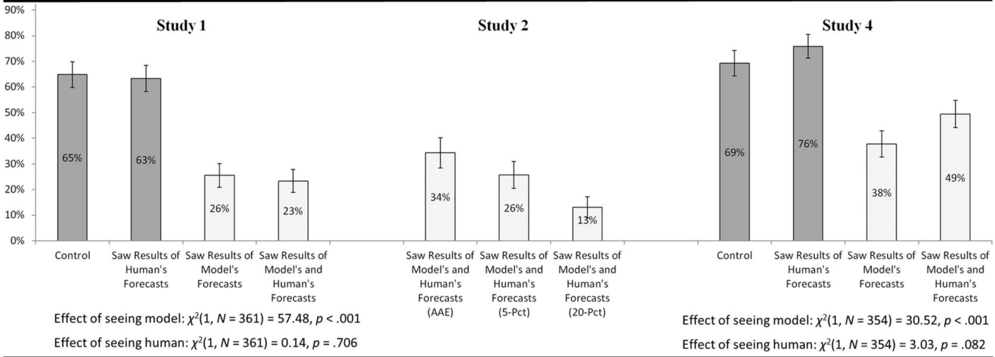
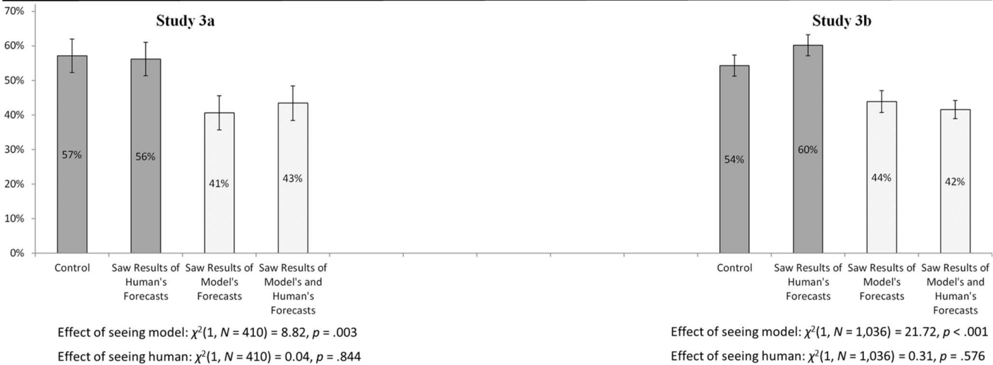
- Across five studies, seeing the algorithm perform reduced participants’ likelihood of choosing it over a human forecaster. In the model-and-human conditions, 610 of 741 participants (83%) saw the model outperform the human, yet these participants were among the least likely to choose the model.
- The model outperformed humans in all five studies. For example, bonuses if choosing model vs. human were Study 1: $1.78 vs. $1.38; Study 2: $1.77 vs. $1.09; Study 3a: $0.48 vs. $0.31; Study 3b: $0.49 vs. $0.30; Study 4: $1.79 vs. $1.38. Human forecasters produced 15–29% more error in the MBA task and 90–97% more error in the airline-passenger task.
- Seeing the model perform significantly decreased confidence in the model’s forecasts in all four studies where this was tested, whereas seeing the human perform significantly decreased confidence in the human only in Study 4. Confidence in the model’s forecasts significantly mediated the effect of seeing the model perform on choosing the model; confidence in the human did not.
- In Study 2, participants paid for forecasts within 20 percentiles were less likely to choose the model than those paid within 5 percentiles, χ²(1, N = 139) = 3.56, p = .059, and those paid by average absolute error, χ²(1, N = 136) = 8.56, p = .003; this effect was mediated by confidence in their own forecasts, not confidence in the model’s forecasts.
Methods
- Five studies had participants forecast real outcomes: MBA student success (Studies 1, 2, and 4) or U.S. state rank in airline passengers (Studies 3a and 3b). Participants were assigned to control, human, model, or model-and-human conditions, then chose whether to tie incentivized bonuses to the model or the human forecaster (themselves in Studies 1–3, another participant in Study 4).
- Final samples were Study 1: 361; Study 2: 206; Study 3a: 410; Study 3b: 1,036; Study 4: 354. Studies 1, 2, and 4 were run in the Wharton Behavioral Lab; Studies 3a and 3b used Amazon Mechanical Turk.
- Main analyses compared forecasting performance and choice rates, measured confidence and beliefs, and used binary mediation analyses with Preacher and Hayes’s bootstrapping procedure.
Limitations
- The paper states it did not explore all boundaries of the effect, including whether it would persist if algorithms were many times more accurate than humans, and whether results depend on features shared by the two forecasting tasks.
- The paper states it did not explore how algorithm variations—complexity, transparency, forecaster involvement in construction, and designer expertise—affect algorithm aversion.
- The paper states algorithm aversion is not entirely driven by seeing algorithms err, and it has little to say about how best to reduce aversion among those who have seen an algorithm err. The text also cautions that cross-experiment comparisons should be made cautiously.
Model-written summary. Check it against the paper before relying on it.
Integrity signals
Registry
Cites
Statistics
Figures
Verification
Claims the paper makes
0 Valid · 2 Not valid · 16 Not checked · 90 Own results and interpretations
A result the paper reports from its own data — it cites no other source for it, so there is none to check. The quote shows it is in the paper.
In the paper
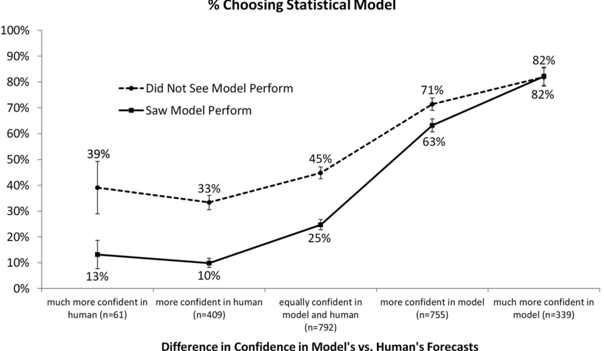
“the majority of people who were equally confident in the model's and human's forecasts chose to tie their bonuses to the human's forecasts, particularly when they had seen the model perform.”
plainstates an association- Asserted: passes — The authors put it forward as true.
- Checkable: passes — It can be checked against evidence.
- Load-bearing: passes — The paper’s conclusions depend on it.
- Based: passes — The paper gives a reason why it holds.
A result the paper reports from its own data — it cites no other source for it, so there is none to check. The quote shows it is in the paper.
In the paper
“Consistent with research on the adoption of decision aids (see Highhouse, 2008), participants thought that the human forecasters were better than the model at getting better with practice, learning from mistakes, and finding underappreciated candidates.”
plain- Asserted: passes — The authors put it forward as true.
- Checkable: passes — It can be checked against evidence.
- Load-bearing: passes — The paper’s conclusions depend on it.
- Based: passes — The paper gives a reason why it holds.
A result the paper reports from its own data — it cites no other source for it, so there is none to check. The quote shows it is in the paper.
In the paper
“Our studies show that this resistance at least partially arises from greater intolerance for error from algorithms than from humans.”
plainstates a possible cause- Asserted: passes — The authors put it forward as true.
- Checkable: passes — It can be checked against evidence.
- Load-bearing: passes — The paper’s conclusions depend on it.
- Based: passes — The paper gives a reason why it holds.
A result the paper reports from its own data — it cites no other source for it, so there is none to check. The quote shows it is in the paper.
In the paper
“Participants rightfully thought that the model was better than human forecasters at avoiding obvious mistakes, appropriately weighing various attributes, and consistently weighing information.”
plain- Asserted: passes — The authors put it forward as true.
- Checkable: passes — It can be checked against evidence.
- Load-bearing: unclear — It is unclear whether the paper’s conclusions depend on it.
- Based: passes — The paper gives a reason why it holds.
A result the paper reports from its own data — it cites no other source for it, so there is none to check. The quote shows it is in the paper.
In the paper
“This effect was evident in two distinct domains of judgment, including one in which the human forecasters produced nearly twice as much error as the algorithm.”
plain- Asserted: passes — The authors put it forward as true.
- Checkable: passes — It can be checked against evidence.
- Load-bearing: unclear — It is unclear whether the paper’s conclusions depend on it.
- Based: passes — The paper gives a reason why it holds.
75 more claims
Create a free account to see all 108 claims and to verify the 12 references still open.
- It may state two separate claims as one. 13
- Probably not a substantial claim. 16
Claims other papers make about this one
Each is checked against this paper’s own text: does it say what the citing paper says it does?
The source backs part of the claim, not all of it — or backs it for a different population, condition or comparison.
In the citing paper
“Traditional theorizing assumes trade-offs between trust and skepticism (Dietvorst et al., 2015), automation and engagement (Freeman et al., 2014), or efficiency and depth (Ishowo-Oloko et al., 2019)”
From Pedagogical partnerships with generative AI in higher education: how dual cognitive pathways paradoxically enable transformative learning (2026) · cites this paper as Dietvorst et al., 2015
Experimental — accuracy not yet measuredThe source backs part of the claim, not all of it — or backs it for a different population, condition or comparison.
In the citing paper
“Existing research typically examines trust versus skepticism in human-AI interactions as binary constructs (Dietvorst et al., 2015; Logg et al., 2019), missing the possibility that partnerships might simultaneously activate both vigilant and offloading behaviors.”
From Pedagogical partnerships with generative AI in higher education: how dual cognitive pathways paradoxically enable transformative learning (2026) · cites this paper as Dietvorst et al., 2015
Experimental — accuracy not yet measuredThe source backs part of the claim, not all of it — or backs it for a different population, condition or comparison.
In the citing paper
“It aligns with the theoretical rationale on algorithm aversion (Dietvorst et al. 2015;Hohensinn et al. 2024) and appreciation (Logg et al. 2019), which suggests that people are more likely to accept and trust AI systems when they produce desirable results but become skeptical when outcomes are unfavorable.”
From Holding AI Accountable Like Herding Cats: The Contingent Impact on the Legitimacy of Algorithmic Bureaucracy (2026) · cites this paper as Dietvorst et al. 2015
Experimental — accuracy not yet measuredThe source backs part of the claim, not all of it — or backs it for a different population, condition or comparison.
In the citing paper
“Research on algorithm appreciation and algorithm aversion further suggests that people may either defer to algorithms or reject them depending on prior experience, perceived expertise, and error visibility (Dietvorst et al., 2015; Logg et al., 2019).”
From College students' metacognitive awareness of generative-AI reliance: an experimental study of decision confidence and attribution bias (2026) · cites this paper as Dietvorst et al., 2015
Experimental — accuracy not yet measuredThe source backs part of the claim, not all of it — or backs it for a different population, condition or comparison.
In the citing paper
“Earlier research has mentioned gender, self-confidence, expertise, and general algorithm aversion or appreciation.15,28”
From Appropriate trust in artificial intelligence for the optical diagnosis of colorectal polyps: the role of human/artificial intelligence interaction (2024) · cites this paper as [28]
Experimental — accuracy not yet measured
22 more claims about this paper
Create a free account to see every claim other papers make about this one.
Statistics recomputed
Every reported test result, recomputed from its test statistic and degrees of freedom. A result shows as not adding up only once an independent check has confirmed it.
- Consistentt(360) = 4.98reported p < .001 · recomputed p < .001
“t (360) = 4.98, p < .001”
- Consistentt(204) = 6.26reported p < .001 · recomputed p < .001
“t (204) = 6.26, p < .001”
- Consistentt(405) = 7.73reported p < .001 · recomputed p < .001
“t (405) = 7.73, p < .001”
- Consistentt(353) = 5.11reported p < .001 · recomputed p < .001
“t (353) = 5.11, p < .001”
- Consistentχ²(1) = 39.94reported p < .001 · recomputed p < .001
“χ 2 (1, N = 271) = 39.94, p < .001”
19 more recomputed tests
Create a free account to see every test the Stats check recomputed.
Self-check
Percentages, sums and reported differences re-computed from the paper’s own numbers.
Self-check results appear here once an independent check has confirmed them.
Citations
Cites
Preacher, K. J., & Hayes, A. F. (2008) · Behavior Research Methods · doi:10.3758/brm.40.3.879 · Cited by 34,117 · cited 1×
“We then used Preacher and Hayes’s (2008) bootstrapping procedure to obtain unbiased 95% confidence intervals around the mediated effects.”
Method(2023) · doi:10.1126/science · Cited by 6,063
The trouble with overconfidence.
Moore, D. A., & Healy, P. J. (2008) · Psychological Review · doi:10.1037/0033-295x.115.2.502 · Cited by 2,358
“Clinical versus Actuarial Judgment.”
Dawes, R. M., Faust, D., & Meehl, P. E. (1989) · Science · doi:10.1126/science.2648573 · Cited by 2,298
The robust beauty of improper linear models in decision making.
Dawes, R. M. (1979) · American Psychologist · doi:10.1037/0003-066x.34.7.571 · Cited by 1,966
Preference and belief: Ambiguity and competence in choice under uncertainty
Heath, C., & Tversky, A. (1991) · Journal of Risk and Uncertainty · doi:10.1007/bf00057884 · Cited by 1,654
Clinical versus mechanical prediction: a meta-analysis
Grove, W. M., Zald, D. H., Lebow, B. S., Snitz, B. E., & Nelson, C. (2000) · Psychological Assessment · doi:10.1037/1040-3590.12.1.19 · Cited by 1,640
Grove, W. M., & Meehl, P. E. (1996) · Psychology, Public Policy, and Law · doi:10.1037/1076-8971.2.2.293 · Cited by 1,457 · cited 4×
“…1996), the notion that algorithms cannot properly consider individual targets (Grove & Meehl, 1996), concerns about the ethicality of relying on algorithms to make important decisions (Dawes, 1979), and the presumed inability of algorithms to incorporate qualitative data (Grove & Meehl, 1996).”
BackgroundMethodInfluential(2007) · Cited by 1,133
Competing on analytics: the new science of winning
(2007) · Choice Reviews Online · doi:10.5860/choice.44-6322 · Cited by 941
Research works printed but not linked: 1
- Clark, D. (2012, November 7). How Nate Silver won the 2012 presidential election. Harvard Business Review Blog . Retrieved from http://blogs .hbr.org/cs/2012/11/how\_nate\_silver\_won\_the\_2012\_p.html
Cited by
Items 1,201–1,300 of 3,918
Ho, Y., Jabr, W., & Zhang, Y. (2023) · SSRN Electronic Journal · doi:10.2139/ssrn.4533047 · Cited by 12
Generative AI and the Perceived Quality of User-Generated Content: Evidence from Online ReviewsPreprint
Knight, S., Bart, Y., & Yang, M. (2023) · SSRN Electronic Journal · doi:10.2139/ssrn.4621982 · Cited by 26
Decline, adopt or compromise? A dual hurdle model for advice utilization
Himmelstein, M. (2022) · Journal of Mathematical Psychology · doi:10.1016/j.jmp.2022.102695 · Cited by 15
Hohensinn, L., Willems, J., Soliman, M., Vanderelst, D., & Stoll, J. (2024) · Public Management Review · doi:10.1080/14719037.2023.2269203 · Cited by 11
Human Emotions in AI Explanations
Thommes, K., Lammert, O., Schütze, C., Richter, B., & Wrede, B. (2024) · Communications in computer and information science · doi:10.1007/978-3-031-63803-9_15 · Cited by 14
Hatherley, J. J. (2024) · Journal of Medical Ethics · doi:10.1136/jme-2024-109905 · Cited by 12
Rindfleisch, A., Kim, M., & Lee, E. J. H. (2024) · Journal of Macromarketing · doi:10.1177/02761467241285322 · Cited by 12
Liao, G., Wang, F., Zhu, W., & Zhang, Q. (2024) · BMC Medical Ethics · doi:10.1186/s12910-024-01121-0 · Cited by 13
Dorsch, J., & Deroy, O. D. (2025) · Scientific Reports · doi:10.1038/s41598-025-85558-2 · Cited by 14
Lee, J. L., Choi, S. H., Jeong, S., & Ko, N. (2025) · International Journal of Sports Marketing and Sponsorship · doi:10.1108/ijsms-06-2024-0147 · Cited by 11
A Bibliometric Analysis to Study the Evolution of Artificial Intelligence in Business Ethics
Tani, M., Muto, V., Basile, G., & Nevi, G. (2025) · Business Ethics the Environment & Responsibility · doi:10.1111/beer.12797 · Cited by 15
Chatbots in education: Outperforming students but perceived as less trustworthy
Laun, M., Puderbach, L., Hirt, K., Wyss, E., Friemert, D., Hartmann, U., & Wolff, F. (2025) · Contemporary Educational Psychology · doi:10.1016/j.cedpsych.2025.102373 · Cited by 13
Yurrita, M., Verma, H., Balayn, A., Gadiraju, U., Pont, S. C., & Bozzon, A. (2025) · CHI Conference on Human Factors in Computing Systems · doi:10.1145/3706598.3713145 · Cited by 14
Checks and balances: leveraging artificial intelligence for tri-balance personnel selection systems
Zhang, Q. (2025) · The International Journal of Human Resource Management · doi:10.1080/09585192.2025.2498563 · Cited by 13
Parrish, J., & Saeed, K. (2025) · Technological Forecasting and Social Change · doi:10.1016/j.techfore.2025.124247 · Cited by 12
How locus of causality shapes human-AI decision-making
Gaczek, P., Leszczyński, G., Kot, M., & Pozharliev, R. (2025) · Management Decision · doi:10.1108/md-07-2024-1635 · Cited by 13
Understanding how users may work around algorithmic bias
Overbye-Thompson, H. E., & Rice, R. E. (2025) · AI & Society · doi:10.1007/s00146-025-02498-1 · Cited by 14
Leading AI Adoption in Organizations: Introducing a Behavioral Human-Centered Approach
Schweitzer, S., Narayanan, D., McGuire, J., & Cremer, D. D. (2025) · International Journal of Human-Computer Interaction · doi:10.1080/10447318.2025.2531287 · Cited by 15
Teychenié, T., Cloarec, J., & Meyer‐Waarden, L. (2025) · Technovation · doi:10.1016/j.technovation.2025.103428 · Cited by 11
Henning, A., & Langenbach, P. (2025) · Journal of Empirical Legal Studies · doi:10.1111/jels.70019 · Cited by 13
Mental Models of Autonomy and Sentience Shape Reactions to AI
Pauketat, J. V. T., Shank, D. B., Manoli, A., & Anthis, J. R. (2026) · CHI Conference on Human Factors in Computing Systems · doi:10.1145/3772318.3790351 · Cited by 14
Ahdadou, M., Ahdadou, A., Aajly, A., & Tahrouch, M. (2025) · Data Science and Management · doi:10.1016/j.dsm.2025.12.001 · Cited by 12
Primartadi, A., Suyitno, S., Abdillah, F., Kamin, Y., Riyadi, S., & Nugroho, S. (2026) · European Journal of Educational Research · doi:10.12973/eu-jer.15.2.481 · Cited by 11
Wong, P. N. Y. (2019) · International Conference on Automotive User Interfaces and Interactive Vehicular Applications (AutomotiveUI) · doi:10.1145/3342197.3344536 · Cited by 13
Fortuna, P., Łysiak, M., Chumak, M., & McNeill, M. (2023) · Journal for Perspectives of Economic Political and Social Integration · doi:10.18290/pepsi-2022-0010 · Cited by 14
The Impact of Expertise in the Loop for Exploring Machine Rationality
Ou, C., Mayer, S., & Butz, A. M. (2023) · ACM International Conference on Intelligent User Interfaces (IUI) · doi:10.1145/3581641.3584040 · Cited by 16
Resilience Through Appropriation: Pilots’ View on Complex Decision Support
Zhang, Z. T., Storath, C., Liu, Y., & Butz, A. M. (2023) · ACM International Conference on Intelligent User Interfaces (IUI) · doi:10.1145/3581641.3584056 · Cited by 13
Beyond Algorithm Aversion in Human-Machine Decision-Making
Burton, J. W., Stein, M., & Jensen, T. B. (2023) · International series in management science/operations research/International series in operations research & management science · doi:10.1007/978-3-031-30085-1_1 · Cited by 17
How Terminology Affects Users’ Responses to System Failures
Candrian, C., & Scherer, A. (2023) · Human Factors The Journal of the Human Factors and Ergonomics Society · doi:10.1177/00187208231202572 · Cited by 11
Knowledge and Digital Technology
Glückler, J., & Panitz, R. (2024) · Knowledge and space · doi:10.1007/978-3-031-39101-9 · Cited by 13
Rebholz, T. R., Biella, M., & Hütter, M. (2024) · Journal of Behavioral Decision Making · doi:10.1002/bdm.2369 · Cited by 13
Are engineers more likely to avoid algorithms after they see them err? A longitudinal study
Chacon, A., Reyes, T. H., & Kausel, E. E. (2024) · Behaviour and Information Technology · doi:10.1080/0144929x.2024.2344092 · Cited by 12
Gill, G. S., Bigazzi, A. Y., Honey‐Rosés, J., & Bardutz, E. (2024) · Transportation Research Part F Traffic Psychology and Behaviour · doi:10.1016/j.trf.2024.05.020 · Cited by 11
Making moral decisions with artificial agents as advisors. A fNIRS study
Fabre, E. F., Mouratille, D., Bonnemains, V., Palmiotti, G. P., & Causse, M. (2024) · Computers in Human Behavior Artificial Humans · doi:10.1016/j.chbah.2024.100096 · Cited by 17
Public attitudes on performance for algorithmic and human decision-makers
Bansak, K. C., & Paulson, E. (2024) · PNAS Nexus · doi:10.1093/pnasnexus/pgae520 · Cited by 13
Graefe, J., Engelhardt, D., & Bengler, K. J. (2021) · International Conference on Automotive User Interfaces and Interactive Vehicular Applications (AutomotiveUI) · doi:10.1145/3473682.3480261 · Cited by 13
Lavorgna, A., Ugwudike, P., Carr, L. A., Benitez, Y. S., & Rekha, G. S. (2021) · Law Technology and Humans · doi:10.5204/lthj.2012 · Cited by 12
Gadzinski, G., & Castello, A. (2022) · Judgment and Decision Making · doi:10.1017/s1930297500003594 · Cited by 13
Too Much Trust in Group Decisions: Uncovering Hidden Profiles by Groups and Markets
Maciejovsky, B., & Budescu, D. V. (2020) · Organization Science · doi:10.1287/orsc.2020.1363 · Cited by 11
Collaborating with Technology-Based Autonomous Agents: Issues and Research OpportunitiesPreprint
Seeber, I., Waizenegger, L., Seidel, S., Morana, S., Benbasat, I., & Lowry, P. B. (2020) · SSRN Electronic Journal · doi:10.2139/ssrn.3504587 · Cited by 11
A Bandit Model for Human-Machine Decision Making with Private Information and OpacityPreprint
Bordt, S., & von Luxburg, U. (2020) · arXiv (Cornell University) · doi:10.48550/arxiv.2007.04800 · Cited by 12
Algorithmic Pricing: Implications for Marketing Strategy and Regulation
Spann, M., Bertini, M., Koenigsberg, O., Zeithammer, R., Aparicio, D., Chen, Y., Fantini, F., Jin, G. Z., Morwitz, V. G., Leszczyc, P. T. L. P., et al. (2024) · National Bureau of Economic Research · doi:10.3386/w32540 · Cited by 14
The ABC’s of Who Benefits from Working with AI: Ability, Beliefs, and Calibration
Caplin, A., Deming, D. J., Li, S., Martín, D., Marx, P., Weidmann, B., & Ye, K. J. (2024) · National Bureau of Economic Research · doi:10.3386/w33021 · Cited by 26
Using Large Language Models for Financial AdvicePreprint
Fieberg, C., Hornuf, L., Meiler, M., & Streich, D. (2025) · SSRN Electronic Journal · doi:10.2139/ssrn.5133294 · Cited by 21
Puppart, B., & Aru, J. (2025) · arXiv (Cornell University) · doi:10.48550/arxiv.2503.10556 · Cited by 11
Emergent Risks in Generative Multi-Agent SystemsPreprint
Huang, Y., Jiang, Y., Wang, W., Zhuang, H., Luo, X., Ma, Y., Xu, Z., Chen, Z., Moniz, N., Lin, Z., et al. (2026) · arXiv (Cornell University) · doi:10.48550/arxiv.2603.27771 · Cited by 17
Nguyen, M. K., & Phan, T. A. (2026) · International Journal of Hospitality & Tourism Administration · doi:10.1080/15256480.2026.2646652 · Cited by 10
Sonographer interaction with artificial intelligence: collaboration or conflict?
Day, T. G., Matthew, J., Budd, S., Hajnal, J. V., Simpson, J. M., Razavi, R., & Kainz, B. (2023) · Ultrasound in Obstetrics and Gynecology · doi:10.1002/uog.26238 · Cited by 12
Behavioral Finance in the Digital Era: Saving and Investment Decisions
Kubińska, E. A., Adamczyk-Kowalczuk, M., & Macko, A. (2023) · Routledge eBooks · doi:10.4324/9781003400066 · Cited by 12
Overcome Medical Algorithm Aversion: Conditional Joint Effect of Direct and Indirect Information
Zhao, Y., & Xiao, C. (2024) · International Journal of Human-Computer Interaction · doi:10.1080/10447318.2024.2344146 · Cited by 12
Jenkin, T. A., Kelley, S., Ovchinnikov, A. S., & Ying, C. (2024) · Decision Sciences · doi:10.1111/deci.12658 · Cited by 10
Talebi, A., Mukherjee, S., Gera, N., Kaur, K., & Das, G. (2025) · Journal of Product Innovation Management · doi:10.1111/jpim.12774 · Cited by 18
Revisiting Rogers’ Paradox in the context of human–AI interaction
Collins, K. M., Bhatt, U., & Sucholutsky, I. (2026) · Philosophical Transactions of the Royal Society A Mathematical Physical and Engineering Sciences · doi:10.1098/rsta.2025.0149 · Cited by 11
Till Tech Do Us Part: Betrayal Aversion and Its Role in Algorithm Use
Kormylo, C., Adjerid, I., Ball, S. B., & Dogan, C. (2025) · Management Science · doi:10.1287/mnsc.2022.03510 · Cited by 14
Towards Trustable Intelligent Clinical Decision Support Systems: A User Study with Ophthalmologists
Leist, R. A., Profitlich, H.-J., Hunsicker, T., & Sonntag, D. (2025) · ACM International Conference on Intelligent User Interfaces (IUI) · doi:10.1145/3708359.3712136 · Cited by 10
Nian, P., Pei, J., Shanshi, L., Min, L., & Li, X. (2025) · Asia Pacific Journal of Human Resources · doi:10.1111/1744-7941.70005 · Cited by 10
Speciesism toward AI: The mechanism of AI affection expression on user satisfaction
Chen, A., Yu, Y., & Lu, Y. (2025) · Information & Management · doi:10.1016/j.im.2025.104145 · Cited by 10
Can AI-Attributed News Challenge Partisan News Selection? Evidence from a Conjoint Experiment
Zoizner, A., Matthes, J., Corbu, N., de Vreese, C. H., Esser, F., Koç-Michalska, K., Schemer, C., Theocharis, Y., & Zilinsky, J. (2025) · The International Journal of Press/Politics · doi:10.1177/19401612251342679 · Cited by 11
Algorithm Delegation: How Embedded AI Facilitates Agency Transference in Medical Services
Wagner, R., Pinto, D. C., Hildebrand, D. F. N., Pacheco, N. A., Dhillon, G. S., & Herter, M. M. (2025) · Psychology and Marketing · doi:10.1002/mar.70016 · Cited by 12
Keung, W. M., & So, T. Y. (2025) · Frontiers in Psychology · doi:10.3389/fpsyg.2025.1538387 · Cited by 13
Wang, B., Shibo, B. W., & Kafle, J. (2025) · Journal of Health Communication · doi:10.1080/10810730.2025.2540864 · Cited by 13
Warnings and Endorsements: Improving Human–AI Collaboration in the Presence of Outliers
DiSorbo, M. D., Ferreira, K., Balakrishnan, M., & Tong, J. D. (2025) · Manufacturing & Service Operations Management · doi:10.1287/msom.2024.0854 · Cited by 18
Social Misattributions in Conversations with Large Language Models
Ferrario, A., Termine, A., & Facchini, A. (2025) · Proceedings of the AAAI/ACM Conference on AI Ethics and Society · doi:10.1609/aies.v8i1.36600 · Cited by 14
Cagiza, C., Faustino, M., Cagiza, I., & Cajiza, A. (2025) · Sustainability · doi:10.3390/su17209336 · Cited by 14
Passi, S., Dhanorkar, S., & Vorvoreanu, M. (2025) · Springer eBooks · doi:10.1007/978-981-95-3658-0_98 · Cited by 15
Akben, M., & Dong, S. (2025) · Behavioral Sciences · doi:10.3390/bs15121659 · Cited by 12
When AI takes the wheel: The effectiveness of AI versus human-generated content in tourism marketing
Li, C., Cao, Q., Hua, S., & Tao, C.-W. (2025) · Journal Of Vacation Marketing · doi:10.1177/13567667251393512 · Cited by 12
Laupichler, M. C., Knoth, N., Schleiß, J., & Raupach, T. (2025) · British Journal of Educational Technology · doi:10.1111/bjet.70035 · Cited by 14
Biswas, S., Erlei, A., & Gadiraju, U. (2026) · CHI Conference on Human Factors in Computing Systems · doi:10.1145/3772318.3790775 · Cited by 15
Ghasemaghaei, M. (2026) · Journal of Management Information Systems · doi:10.1080/07421222.2025.2602397 · Cited by 10
Advice quality and source disclosure shape trust in AI-generated ethical advice
Meincke, L., Nave, G., & Terwiesch, C. (2026) · Scientific Reports · doi:10.1038/s41598-026-44258-1 · Cited by 12
The care-full craft of feedback in an age of generative AI
Winstone, N., Gravett, K., Bearman, M., Noble, C., Jensen, L. X., Jones, A., & Nicola‐Richmond, K. (2026) · Assessment & Evaluation in Higher Education · doi:10.1080/02602938.2026.2643333 · Cited by 12
Sugahara, S., & Kano, K. (2026) · Journal of Business Ethics · doi:10.1007/s10551-026-06365-x · Cited by 13
Receiving Robot’s Advice: Does It Matter When and for What?
Straßmann, C., Eimler, S. C., Arntz, A., Grewe, A., Kowalczyk, C., & Sommer, S. (2020) · Lecture notes in computer science · doi:10.1007/978-3-030-62056-1_23 · Cited by 10
Trust in Clinical AI: Expanding the Unit of Analysis
Browne, J., Bakker, S., Yu, B., Lloyd, P. A., & Allouch, S. B. (2022) · Frontiers in artificial intelligence and applications · doi:10.3233/faia220192 · Cited by 16
Sutanto, S. J., Paparrizos, S., Kumar, U., Datta, D. K., & Ludwig, F. (2024) · Climate Services · doi:10.1016/j.cliser.2024.100459 · Cited by 13
Artificial Intelligence and Human Rights
Quintavalla, A., & Temperman, J. (2023) · Oxford University Press eBooks · doi:10.1093/law/9780192882486.001.0001 · Cited by 16
AI-initiated second opinions: a framework for advanced caries treatment planning
Dascalu, T., Ramezanzade, S., Bakhshandeh, A., Bjørndal, L., & Ibragimov, B. (2024) · BMC Oral Health · doi:10.1186/s12903-024-04551-9 · Cited by 12
Cohen, M. C., Kim, N., Ba, Y., Pan, A., Bhatti, S. A., Salehi, P., Sung, J., Blasch, E., Mancenido, M. V., & Chiou, E. K. (2025) · AI Magazine · doi:10.1002/aaai.70000 · Cited by 11
Poets Over Quants: Automation and AI Threats Increase the Value People Place on Creativity
Gamez-Djokic, M., Waytz, A. G., & Kouchaki, M. (2025) · Personality and Social Psychology Bulletin · doi:10.1177/01461672251337126 · Cited by 13
Examining Factors Influencing Use of a Decision Aid in Personnel Selection
Jackson, A., Young, M. E., Howes, S. S., Knight, P. A., & Reichin, S. L. (2019) · Personnel Assessment and Decisions · doi:10.25035/pad.2019.01.001 · Cited by 11
Advice: Communication with Consequence
MacGeorge, E. L., & Swol, L. M. V. (2018) · Oxford University Press eBooks · doi:10.1093/oxfordhb/9780190630188.013.21 · Cited by 11
Chung, K., Park, J. Y., Park, K., & Kim, Y. (2020) · Sensors · doi:10.3390/s20175016 · Cited by 10
Keep It Mystic? - The Effects of Algorithm Transparency on the Use of Advice.
Lehmann, C. A., Haubitz, C. B., Fügener, A., & Thonemann, U. W. (2020) · Kölner Universitäts PublikationsServer (Universität zu Köln) · Cited by 12
Does Political Orientation Affect the Evaluation of Artificial Intelligence?
Han, H., Park, S., & Lee, K. (2021) · ASIA MARKETING JOURNAL · doi:10.53728/2765-6500.1180 · Cited by 11
Park, J., & Jung, Y. (2020) · Korean Journal of Industrial and Organizational Psychology · doi:10.24230/kjiop.v33i2.145-175 · Cited by 10
Machine Ethics and Artificial Moral Agents
Corea, F. (2018) · SpringerBriefs in complexity · doi:10.1007/978-3-319-77252-3_6 · Cited by 10
Perceptions of the adoption of Clinical Decision Support Systems in the Saudi Healthcare Sector
Aljarboa, S., Miah, S. J., & Kerr, D. V. (2019) · Victoria University Research Repository (Victoria University) · Cited by 10
Cascalheira, C. J., Flinn, R. E., Zhao, Y., Klooster, D., Laprade, D., Hamdi, S. M., Scheer, J. R., González, A., Lund, E. M., Gomez, I. N., et al. (2023) · JMIR Formative Research · doi:10.2196/47256 · Cited by 12
A Turing Test for TransparencyPreprint
Bießmann, F., & Treu, V. (2021) · arXiv (Cornell University) · doi:10.48550/arxiv.2106.11394 · Cited by 11
Human Discernment of Algorithmic Errors: A Case Study in Child WelfarePreprint
Fogliato, R., De‐Arteaga, M., & Chouldechova, A. (2025) · SSRN Electronic Journal · doi:10.2139/ssrn.4050125 · Cited by 10
Interacting with Man or Machine: When Do Humans Reason Better?
Bayer, R., & Renou, L. (2024) · Management Science · doi:10.1287/mnsc.2023.03315 · Cited by 19
Opening the moral machine’s cover: How algorithmic aversion shapes autonomous vehicle adoption
Chávez, D. G., Cloarec, J., & Meyer‐Waarden, L. (2024) · Transportation Research Part A Policy and Practice · doi:10.1016/j.tra.2024.104193 · Cited by 14
Dynamics of Reliance on Algorithmic Advice
Gill, A., Gillenkirch, R. M., Ortner, J., & Velthuis, L. J. (2024) · Journal of Behavioral Decision Making · doi:10.1002/bdm.2414 · Cited by 15
Marrying math and mind: towards production planning systems for industry 5.0
Azani, M., Tan, L., Basten, R., & de Kok, A. G. (2025) · International Journal of Production Research · doi:10.1080/00207543.2024.2443800 · Cited by 10
Horne, B. D., & Nevo, D. (2025) · Scientific Reports · doi:10.1038/s41598-025-98221-7 · Cited by 12
Sadri, S. R., Payne, J. L., Brown, K. A., & Billings, A. C. (2025) · International Journal of Sport Communication · doi:10.1123/ijsc.2024-0208 · Cited by 9
Sun, Y., Freeman, J., Shoenberger, H., & Shen, F. (2025) · International Journal of Human-Computer Interaction · doi:10.1080/10447318.2025.2495847 · Cited by 10
How the elderly tackle age discrimination from human or AI servers
Jia, G., Luo, X., & Wan, L. C. (2025) · Annals of Tourism Research · doi:10.1016/j.annals.2025.103975 · Cited by 10
Zhao, H., Han, Z., Yin, S., yang, N., & Hansen, P. (2025) · Telematics and Informatics · doi:10.1016/j.tele.2025.102299 · Cited by 12
Metadata
- Authors
- Dietvorst, B. J., Simmons, J. P., & Massey, C.
- Affiliations
- University of Pennsylvania (US)
- Venue
- Journal of Experimental Psychology: General
- Published
- 2015
- Volume
- 144
- Issue
- 1
- Pages
- 114-126
- ISSN
- 0096-3445 (ISSN-L)
- 1939-2222
- OpenAlex
- W3125633690
- Cited by
- 3,232
- References
- 22
- Citations by year
- 2026: 1025 · 2025: 563 · 2024: 445 · 2023: 404 · 2022: 266 · 2021: 216 · 2020: 137 · 2019: 88 · 2018: 41 · 2017: 26 · 2016: 14 · 2015: 5
- FWCI
- 13.96
- Type
- journal article
- Language
- en
- Open access
- green
- doi.org
- Locations
- Journal of Experimental Psychology General (publishedVersion)
- SSRN Electronic Journal (publishedVersion)
- PubMed (publishedVersion)
- ScholarlyCommons (University of Pennsylvania) (submittedVersion)
- Funders
- Wharton Behavioral Laboratory
- Wharton Risk Center Ackoff Doctoral Student Fellowship
- Topics
- Social Sciences › Decision Sciences › General Decision Sciences › Decision-Making and Behavioral Economics
- Social Sciences › Decision Sciences › Management Science and Operations Research › Forecasting Techniques and Applications
- Social Sciences › Human Factors and Ergonomics › Human-Automation Interaction and Safety
- Keywords
- algorithm aversion, trust in algorithms, prediction confidence, evidence-based algorithm, decision-making
- MeSH terms
- Algorithms, Avoidance Learning, Culture, Decision Making, Female, Forecasting, Humans, Male, Motivation, Comprehension, Young Adult
About these checks
Registry, retraction, Cites and statistics results are computed, not judged, with one exception: a printed reference that no index lists is read once by a model before it counts as a citation error. Claims are extracted by a model and kept only when their quote appears verbatim in the text; each cited source is then checked, with a model’s help, for whether it says what the claim relies on. Those verdicts can be wrong — read the claim’s quote and the cited source before relying on one.
A language model drew the claims from the paper on 2026-11-14, under version 3 of the claim definition (model deepseek-v4.1-flash, prompt extract-v3).
A second model labelled each claim on 2026-11-14 (model jev-1.13-20260917, definition revision gold-guideline-v0.2).
Statistics and arithmetic are recomputed, not judged.
Confidence bands are shown only for fields calibrated on our annotated test set. None is calibrated yet, so no band is shown.
What counts as a claim ›How we measure confidence ›How we check this ›
Are you an author, or do you see a problem with this page? Request a review
Data sources
Bibliographic data: Semantic Scholar, OpenAlex, Crossref.
Contains information from the Semantic Scholar Academic Graph Datasets, made available under the ODC Attribution License (ODC-BY 1.0).
Semantic Scholar’s data is described in: Kinney, R., et al. (2023). The Semantic Scholar Open Data Platform. arXiv:2301.10140.
