

The DOI matches its Crossref record; 68 of the 68 references it cites were found in a registry or an index.
Screen for DNA‐damage‐responsive histone modifications identifies H3K9Ac and H3K56Ac in human cells
Open accessAbstract
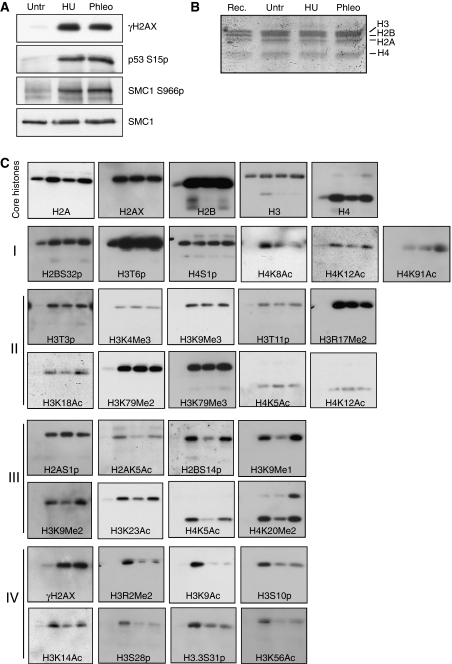
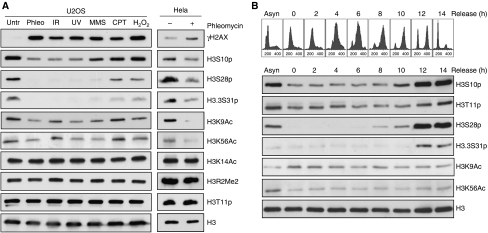
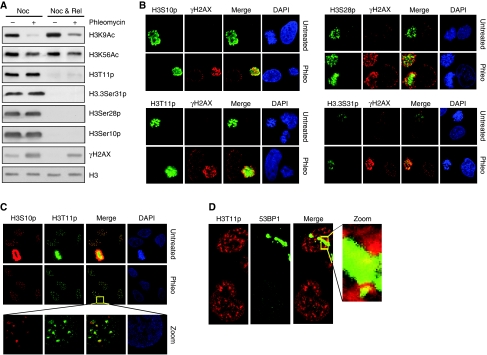
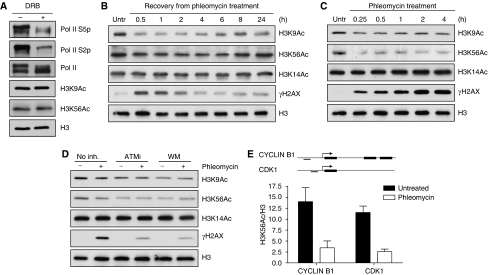
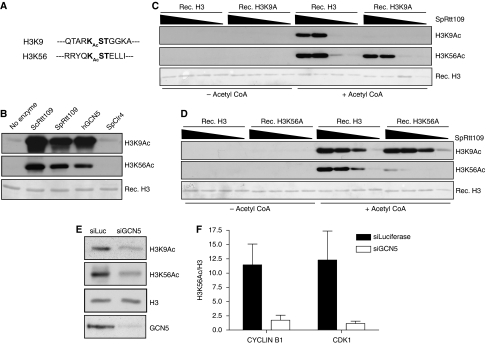
Recognition and repair of damaged DNA occurs within the context of chromatin. The key protein components of chromatin are histones, whose post-translational modifications control diverse chromatin functions. Here, we report our findings from a large-scale screen for DNA-damage-responsive histone modifications in human cells. We have identified specific phosphorylations and acetylations on histone H3 that decrease in response to DNA damage. Significantly, we find that DNA-damage-induced changes in H3S10p, H3S28p and H3.3S31p are a consequence of cell-cycle re-positioning rather than DNA damage per se. In contrast, H3K9Ac and H3K56Ac, a mark previously uncharacterized in human cells, are rapidly and reversibly reduced in response to DNA damage. Finally, we show that the histone acetyl-transferase GCN5/KAT2A acetylates H3K56 in vitro and in vivo. Collectively, our data indicate that though most histone modifications do not change appreciably after genotoxic stress, H3K9Ac and H3K56Ac are reduced in response to DNA damage in human cells.
Overview
The claims and statistics of this paper haven’t been checked yet.
Run the check — free, no account needed. It reads the open-access text and checks the sources it cites.
Integrity signals
Registry
Cites
Statistics
Figures
Verification
Claims the paper makes
The claims and statistics of this paper haven’t been checked yet.
Run the check — free, no account needed. It reads the open-access text and checks the sources it cites.
Claims other papers make about this one
Each is checked against this paper’s own text: does it say what the citing paper says it does?
In the citing paper
“we recently found that H3K9 and H3K56 acetylations (H3K9Ac and H3K56Ac) are negatively regulated by DNA damage20.”
From Human HDAC1 and HDAC2 function in the DNA-damage response to promote DNA nonhomologous end-joining (2010) · cites this paper as [20]
In the citing paper
“the observed decrease in H3K56Ac levels were not due to effects of DNA damage on cell-cycle distributions, as this histone mark is not cell cycle regulated20,35”
From Human HDAC1 and HDAC2 function in the DNA-damage response to promote DNA nonhomologous end-joining (2010) · cites this paper as [20]
Self-check
Percentages, sums and reported differences re-computed from the paper’s own numbers.
The self-check needs the paper’s full text.
Citations
Cites
Chromatin modifications and their function
Kouzarides, T. (2007) · Cell · doi:10.1016/j.cell.2007.02.005 · Cited by 10,883
DNA double-stranded breaks induce histone H2AX phosphorylation on serine 139
Rogakou, E. P., Pilch, D. R., Orr, A. H., Ivanova, V. S., & Bonner, W. M. (1998) · Journal of Biological Chemistry · doi:10.1074/jbc.273.10.5858 · Cited by 5,438
ATM and ATR Substrate Analysis Reveals Extensive Protein Networks Responsive to DNA Damage
Matsuoka, S., Ballif, B. A., Smogorzewska, A., McDonald, E. R., Hurov, K. E., Luo, J., Bakalarski, C. E., Zhao, Z., Solimini, N., Lerenthal, Y., et al. (2007) · Science · doi:10.1126/science.1140321 · Cited by 3,075
Checkpoints: Controls That Ensure the Order of Cell Cycle Events
Hartwell, L. H., & Weinert, T. A. (1989) · Science · doi:10.1126/science.2683079 · Cited by 3,053
The complex language of chromatin regulation during transcription
Berger, S. L. (2007) · Nature · doi:10.1038/nature05915 · Cited by 2,768
Combinatorial patterns of histone acetylations and methylations in the human genome
Wang, Z., Zang, C., Rosenfeld, J. A., Schones, D. E., Barski, A., Cuddapah, S., Cui, K., Roh, T.-Y., Peng, W., Zhang, M. Q., et al. (2008) · Nature Genetics · doi:10.1038/ng.154 · Cited by 2,331
The DNA Damage Response: Ten Years After
Harper, J. W., & Elledge, S. J. (2007) · Molecular Cell · doi:10.1016/j.molcel.2007.11.015 · Cited by 1,705
Functions of Site-Specific Histone Acetylation and Deacetylation
Shahbazian, M. D., & Grunstein, M. (2007) · Annual Review of Biochemistry · doi:10.1146/annurev.biochem.76.052705.162114 · Cited by 1,635
Hickson, I., Zhao, Y., Richardson, C. J., Green, S. J., Martin, N. M. B., Orr, A. I., Reaper, P. M., Jackson, S. P., Curtin, N. J., & Smith, G. C. M. (2004) · Cancer Research · doi:10.1158/0008-5472.can-04-2727 · Cited by 1,220
Self-citationPartitioning and Plasticity of Repressive Histone Methylation States in Mammalian Chromatin
Peters, A. H. F. M., Kubicek, S., Mechtler, K., O’Sullivan, R. J., Derijck, A. A. H. A., Perez-Burgos, L., Kohlmaier, A., Opravil, S., Tachibana, M., Shinkai, Y., et al. (2003) · Molecular Cell · doi:10.1016/s1097-2765(03)00477-5 · Cited by 1,208
Cited by
Sorted by citations
Regulation of chromatin by histone modifications
Bannister, A. J., & Kouzarides, T. (2011) · Cell Research · doi:10.1038/cr.2011.22 · Cited by 6,012
Lateral Thinking: How Histone Modifications Regulate Gene Expression
Lawrence, M., Daujat, S., & Schneider, R. (2015) · Trends in Genetics · doi:10.1016/j.tig.2015.10.007 · Cited by 967
Jin, Q., Yu, L., Wang, L., Zhang, Z., Kasper, L. H., Lee, J., Wang, C., Brindle, P. K., Dent, S. Y. R., & Ge, K. (2011) · The EMBO Journal · doi:10.1038/emboj.2010.318 · Cited by 877
Chromatin structure and the inheritance of epigenetic information
Margueron, R., & Reinberg, D. (2010) · Nature Reviews Genetics · doi:10.1038/nrg2752 · Cited by 761
Human HDAC1 and HDAC2 function in the DNA-damage response to promote DNA nonhomologous end-joining
Miller, K. M., Tjeertes, J. V., Coates, J., Legube, G., Polo, S. E., Britton, S., & Jackson, S. P. (2010) · Nature Structural & Molecular Biology · doi:10.1038/nsmb.1899 · Cited by 629
Self-citation
Metadata
- Authors
- Tjeertes, J. V., Miller, K. M., & Jackson, S. P.
- Affiliations
- University of Cambridge (GB)
- Corresponding author
- Miller, Kyle M
- Jackson, Stephen P
- Venue
- The EMBO Journal
- Published
- 2009-04-30
- Volume
- 28
- Issue
- 13
- Pages
- 1878-1889
- ISSN
- 0261-4189 (ISSN-L)
- 1460-2075
- PMC
- PMC2684025
- OpenAlex
- W2046691617
- Cited by
- 347
- References
- 68
- Citations by year
- 2026: 7 · 2025: 10 · 2024: 21 · 2023: 15 · 2022: 16 · 2021: 18 · 2020: 14 · 2019: 17 · 2018: 13 · 2017: 21 · 2016: 21 · 2015: 22 · 2014: 20 · 2013: 31 · 2012: 31
- FWCI
- 13.54
- Type
- journal article
- Language
- en
- Open access
- hybrid
- doi.org
- Licence
- Locations
- The EMBO Journal (publishedVersion, cc-by-nc-nd)
- PubMed Central (publishedVersion, cc-by-nc-nd)
- PubMed (publishedVersion)
- Funders
- Wellcome Trust (086861/Z/08/Z, 086861)
- Cancer Research UK (A5290)
- Directorate for Biological Sciences
- Biotechnology and Biological Sciences Research Council
- Topics
- Life Sciences › Biochemistry, Genetics and Molecular Biology › Molecular Biology › Genomics and Chromatin Dynamics
- Life Sciences › Biochemistry, Genetics and Molecular Biology › Molecular Biology › DNA Repair Mechanisms
- Life Sciences › Biochemistry, Genetics and Molecular Biology › Molecular Biology › Epigenetics and DNA Methylation
- Keywords
- DNA damage response, histone modifications, H3K9 acetylation, H3K56 acetylation, histone acetylation, histone phosphorylation, histone acetyltransferase, chromatin, genotoxic stress
- MeSH terms
- p300-CBP-Associated Factor, Acetylation, Cell Cycle, DNA Damage, DNA Repair, HeLa Cells, Histones, Humans, Phosphorylation, Protein Processing, Post-Translational, Histone Code, Cell Line, Tumor, Histone Acetyltransferases
About these checks
Registry, retraction, Cites and statistics results are computed, not judged, with one exception: a printed reference that no index lists is read once by a model before it counts as a citation error. Claims are extracted by a model and kept only when their quote appears verbatim in the text; each cited source is then checked, with a model’s help, for whether it says what the claim relies on. Those verdicts can be wrong — read the claim’s quote and the cited source before relying on one.
Statistics and arithmetic are recomputed, not judged.
Confidence bands are shown only for fields calibrated on our annotated test set. None is calibrated yet, so no band is shown.
What counts as a claim ›How we measure confidence ›How we check this ›
Are you an author, or do you see a problem with this page? Request a review
