

The DOI matches its Crossref record; 68 of the 68 references it cites were found in a registry or an index.
Screen for DNA‐damage‐responsive histone modifications identifies H3K9Ac and H3K56Ac in human cells
Open accessAbstract
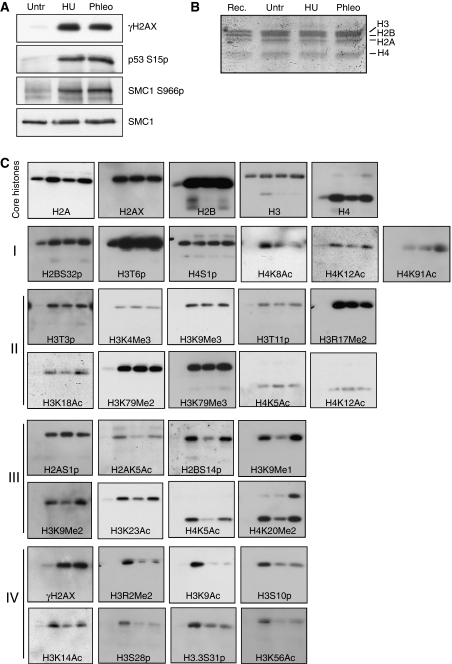
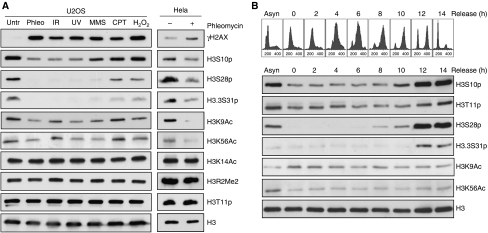
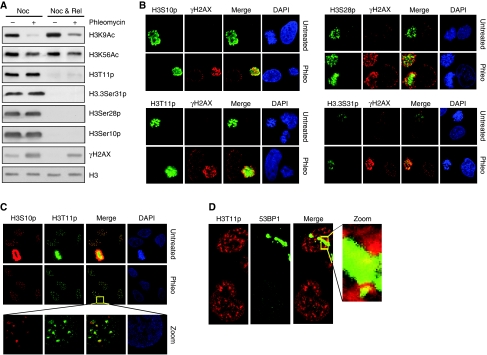
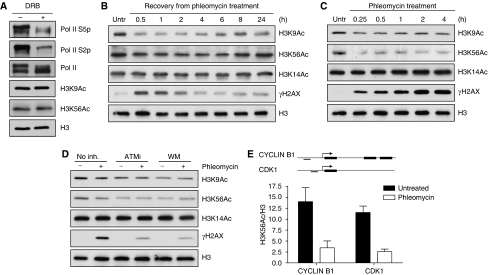
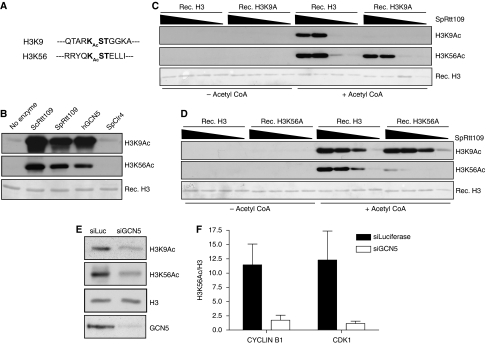
Recognition and repair of damaged DNA occurs within the context of chromatin. The key protein components of chromatin are histones, whose post-translational modifications control diverse chromatin functions. Here, we report our findings from a large-scale screen for DNA-damage-responsive histone modifications in human cells. We have identified specific phosphorylations and acetylations on histone H3 that decrease in response to DNA damage. Significantly, we find that DNA-damage-induced changes in H3S10p, H3S28p and H3.3S31p are a consequence of cell-cycle re-positioning rather than DNA damage per se. In contrast, H3K9Ac and H3K56Ac, a mark previously uncharacterized in human cells, are rapidly and reversibly reduced in response to DNA damage. Finally, we show that the histone acetyl-transferase GCN5/KAT2A acetylates H3K56 in vitro and in vivo. Collectively, our data indicate that though most histone modifications do not change appreciably after genotoxic stress, H3K9Ac and H3K56Ac are reduced in response to DNA damage in human cells.
Overview
The claims and statistics of this paper haven’t been checked yet.
Run the check — free, no account needed. It reads the open-access text and checks the sources it cites.
Integrity signals
Registry
Cites
Statistics
Figures
Verification
Claims the paper makes
The claims and statistics of this paper haven’t been checked yet.
Run the check — free, no account needed. It reads the open-access text and checks the sources it cites.
Claims other papers make about this one
Each is checked against this paper’s own text: does it say what the citing paper says it does?
In the citing paper
“we recently found that H3K9 and H3K56 acetylations (H3K9Ac and H3K56Ac) are negatively regulated by DNA damage20.”
From Human HDAC1 and HDAC2 function in the DNA-damage response to promote DNA nonhomologous end-joining (2010) · cites this paper as [20]
In the citing paper
“the observed decrease in H3K56Ac levels were not due to effects of DNA damage on cell-cycle distributions, as this histone mark is not cell cycle regulated20,35”
From Human HDAC1 and HDAC2 function in the DNA-damage response to promote DNA nonhomologous end-joining (2010) · cites this paper as [20]
Self-check
Percentages, sums and reported differences re-computed from the paper’s own numbers.
The self-check needs the paper’s full text.
Citations
Cites
Chromatin modifications and their function
Kouzarides, T. (2007) · Cell · doi:10.1016/j.cell.2007.02.005 · Cited by 10,883
DNA double-stranded breaks induce histone H2AX phosphorylation on serine 139
Rogakou, E. P., Pilch, D. R., Orr, A. H., Ivanova, V. S., & Bonner, W. M. (1998) · Journal of Biological Chemistry · doi:10.1074/jbc.273.10.5858 · Cited by 5,438
ATM and ATR Substrate Analysis Reveals Extensive Protein Networks Responsive to DNA Damage
Matsuoka, S., Ballif, B. A., Smogorzewska, A., McDonald, E. R., Hurov, K. E., Luo, J., Bakalarski, C. E., Zhao, Z., Solimini, N., Lerenthal, Y., et al. (2007) · Science · doi:10.1126/science.1140321 · Cited by 3,075
Checkpoints: Controls That Ensure the Order of Cell Cycle Events
Hartwell, L. H., & Weinert, T. A. (1989) · Science · doi:10.1126/science.2683079 · Cited by 3,053
The complex language of chromatin regulation during transcription
Berger, S. L. (2007) · Nature · doi:10.1038/nature05915 · Cited by 2,768
Combinatorial patterns of histone acetylations and methylations in the human genome
Wang, Z., Zang, C., Rosenfeld, J. A., Schones, D. E., Barski, A., Cuddapah, S., Cui, K., Roh, T.-Y., Peng, W., Zhang, M. Q., et al. (2008) · Nature Genetics · doi:10.1038/ng.154 · Cited by 2,331
The DNA Damage Response: Ten Years After
Harper, J. W., & Elledge, S. J. (2007) · Molecular Cell · doi:10.1016/j.molcel.2007.11.015 · Cited by 1,705
Functions of Site-Specific Histone Acetylation and Deacetylation
Shahbazian, M. D., & Grunstein, M. (2007) · Annual Review of Biochemistry · doi:10.1146/annurev.biochem.76.052705.162114 · Cited by 1,635
Hickson, I., Zhao, Y., Richardson, C. J., Green, S. J., Martin, N. M. B., Orr, A. I., Reaper, P. M., Jackson, S. P., Curtin, N. J., & Smith, G. C. M. (2004) · Cancer Research · doi:10.1158/0008-5472.can-04-2727 · Cited by 1,220
Self-citationPartitioning and Plasticity of Repressive Histone Methylation States in Mammalian Chromatin
Peters, A. H. F. M., Kubicek, S., Mechtler, K., O’Sullivan, R. J., Derijck, A. A. H. A., Perez-Burgos, L., Kohlmaier, A., Opravil, S., Tachibana, M., Shinkai, Y., et al. (2003) · Molecular Cell · doi:10.1016/s1097-2765(03)00477-5 · Cited by 1,208
RNF8 Ubiquitylates Histones at DNA Double-Strand Breaks and Promotes Assembly of Repair Proteins
Mailand, N., Bekker‐Jensen, S., Kildegaard, H. F., Melander, F., Bártek, J., Lukas, C., & Lukas, J. (2007) · Cell · doi:10.1016/j.cell.2007.09.040 · Cited by 1,193
SIRT6 is a histone H3 lysine 9 deacetylase that modulates telomeric chromatin
Michishita, E., McCord, R. A., Berber, E., Kioi, M., Padilla-Nash, H., Damian, M., Cheung, P., Kusumoto, R., Kawahara, T. L. A., Barrett, J. C., et al. (2008) · Nature · doi:10.1038/nature06736 · Cited by 1,111
RNF8 Transduces the DNA-Damage Signal via Histone Ubiquitylation and Checkpoint Protein Assembly
Huen, M. S. Y., Grant, R. A., Manke, I. A., Minn, K. T., Yu, X., Yaffe, M. B., & Chen, J. (2007) · Cell · doi:10.1016/j.cell.2007.09.041 · Cited by 1,068
Extraction, purification and analysis of histones
Shechter, D., Dormann, H. L., Allis, C. D., & Hake, S. B. (2007) · Nature Protocols · doi:10.1038/nprot.2007.202 · Cited by 1,054
Histone H2AX phosphorylation is dispensable for the initial recognition of DNA breaks
Celeste, A., Fernandez-Capetillo, O., Kruhlak, M. J., Pilch, D. R., Staudt, D. W., Lee, A., Bonner, R. F., Bonner, W. M., & Nussenzweig, A. (2003) · Nature Cell Biology · doi:10.1038/ncb1004 · Cited by 989
Orchestration of the DNA-Damage Response by the RNF8 Ubiquitin Ligase
Kolas, N. K., Chapman, J. R., Nakada, S., Ylanko, J., Chahwan, R., Sweeney, F. D., Panier, S., Mendez, M., Wildenhain, J., Thomson, T. M., et al. (2007) · Science · doi:10.1126/science.1150034 · Cited by 932
Self-citationCollins, S. R., Miller, K. M., Maas, N. L., Roguev, A., Fillingham, J., Chu, C. S., Schuldiner, M., Gebbia, M., Recht, J., Shales, M., et al. (2007) · Nature · doi:10.1038/nature05649 · Cited by 869
Self-citationGenome instability: a mechanistic view of its causes and consequences
Aguilera, A., & Gómez‐González, B. (2008) · Nature Reviews Genetics · doi:10.1038/nrg2268 · Cited by 830
Cheung, P., Tanner, K. G., Cheung, W. L., Sassone‐Corsi, P., Denu, J. M., & Allis, C. D. (2000) · Molecular Cell · doi:10.1016/s1097-2765(00)80256-7 · Cited by 803
Ziv, Y., Bielopolski, D., Galanty, Y., Lukas, C., Taya, Y., Schultz, D. C., Lukas, J., Bekker-Jensen, S., Bartek, J., & Shiloh, Y. (2006) · Nature Cell Biology · doi:10.1038/ncb1446 · Cited by 735
Chromatin Challenges during DNA Replication and Repair
Groth, A., Rocha, W., Verreault, A., & Almouzni, G. (2007) · Cell · doi:10.1016/j.cell.2007.01.030 · Cited by 733
CBP/p300-mediated acetylation of histone H3 on lysine 56
Das, C., Lucia, M. S., Hansen, K. C., & Tyler, J. K. (2009) · Nature · doi:10.1038/nature07861 · Cited by 698
Wortmannin, a potent and selective inhibitor of phosphatidylinositol-3-kinase.
Powis, G., Bonjouklian, R., Berggren, M. M., Gallegos, A. C., Abraham, R. T., Ashendel, C. L., Zalkow, L. H., Matter, W. F., Dodge, J. A., & Grindey, G. B. (1994) · PubMed · Cited by 687
Spatial organization of the mammalian genome surveillance machinery in response to DNA strand breaks
Bekker‐Jensen, S., Lukas, C., Kitagawa, R., Melander, F., Kastan, M. B., Bártek, J., & Lukas, J. (2006) · The Journal of Cell Biology · doi:10.1083/jcb.200510130 · Cited by 647
Analysis of Chromatin Structure byin VivoFormaldehyde Cross-Linking
Orlando, V., Strutt, H. L., & Paro, R. (1997) · Methods · doi:10.1006/meth.1996.0407 · Cited by 607
Dynamics of Replication-Independent Histone Turnover in Budding Yeast
Dion, M. F., Kaplan, T., Kim, M., Buratowski, S., Friedman, N., & Rando, O. J. (2007) · Science · doi:10.1126/science.1134053 · Cited by 556
A role for cell-cycle-regulated histone H3 lysine 56 acetylation in the DNA damage response
Masumoto, H., Hawke, D., Kobayashi, R., & Verreault, A. (2005) · Nature · doi:10.1038/nature03714 · Cited by 544
Wang, H., Zhai, L., Xu, J., Joo, H.-Y., Jackson, S., Erdjument‐Bromage, H., Tempst, P., Xiong, Y., & Zhang, Y. (2006) · Molecular Cell · doi:10.1016/j.molcel.2006.03.035 · Cited by 520
Self-citationExpression and Purification of Recombinant Histones and Nucleosome Reconstitution
Luger, K., Rechsteiner, T. J., & Richmond, T. J. (2003) · Humana Press eBooks · doi:10.1385/1-59259-681-9:1 · Cited by 468
Acetylation of Histone H3 Lysine 56 Regulates Replication-Coupled Nucleosome Assembly
Li, Q., Zhou, H., Wurtele, H., Davies, B., Horazdovsky, B., Verreault, A., & Zhang, Z. (2008) · Cell · doi:10.1016/j.cell.2008.06.018 · Cited by 447 · cited 1×
“In yeast, H3K56Ac is abundant, occurs in S-phase on newly synthesized histones and is required for DNA-damage tolerance through a role in chromatin assembly (Masumoto et al, 2005; Driscoll et al, 2007; Xhemalce et al, 2007; Chen et al, 2008; Li et al, 2008).”
Yeast Rtt109 Promotes Genome Stability by Acetylating Histone H3 on Lysine 56
Driscoll, R., Hudson, A., & Jackson, S. P. (2007) · Science · doi:10.1126/science.1135862 · Cited by 439
Self-citationChen, C., Carson, J. J., Feser, J., Tamburini, B. A. J., Zabaronick, S., Linger, J. G., & Tyler, J. K. (2008) · Cell · doi:10.1016/j.cell.2008.06.035 · Cited by 426
Rtt109 Acetylates Histone H3 Lysine 56 and Functions in DNA Replication
Han, J., Zhou, H., Horazdovsky, B. F., Zhang, K., Xu, R.-M., & Zhang, Z. (2007) · Science · doi:10.1126/science.1133234 · Cited by 421
γH2AX and MDC1: Anchoring the DNA-damage-response machinery to broken chromosomes
Stucki, M., & Jackson, S. P. (2006) · DNA Repair · doi:10.1016/j.dnarep.2006.01.012 · Cited by 412
Self-citationAcetylation in Histone H3 Globular Domain Regulates Gene Expression in Yeast
Xu, F., Zhang, K., & Grunstein, M. R. (2005) · Cell · doi:10.1016/j.cell.2005.03.011 · Cited by 394
Mammalian cell cycle checkpoints: signalling pathways and their organization in space and time
Lukas, J., Lukas, C., & Bartek, J. (2004) · DNA Repair · doi:10.1016/j.dnarep.2004.03.006 · Cited by 381
DNA Double-Strand Breaks Trigger Genome-Wide Sister-Chromatid Cohesion Through Eco1 (Ctf7)
Ünal, E., Heidinger-Pauli, J. M., & Koshland, D. E. (2007) · Science · doi:10.1126/science.1140637 · Cited by 333
Postreplicative Formation of Cohesion Is Required for Repair and Induced by a Single DNA Break
Ström, L., Karlsson, C., Lindroos, H. B., Wedahl, S., Katou, Y., Shirahige, K., & Sjögren, C. (2007) · Science · doi:10.1126/science.1140649 · Cited by 320
Organismal Differences in Post-translational Modifications in Histones H3 and H4
Garcia, B. A., Hake, S. B., Diaz, R. L., Kauer, M., Morris, S. A., Recht, J., Shabanowitz, J., Mishra, N., Strahl, B. D., Allis, C. D., et al. (2006) · Journal of Biological Chemistry · doi:10.1074/jbc.m607900200 · Cited by 314
The ATM repair pathway inhibits RNA polymerase I transcription in response to chromosome breaks
Kruhlak, M., Crouch, E. E., Orlov, M., Montaño, C., Gorski, S. A., Nussenzweig, A., Misteli, T., Phair, R. D., & Casellas, R. (2007) · Nature · doi:10.1038/nature05842 · Cited by 305
Celic, I., Masumoto, H., Griffith, W. P., Meluh, P. B., Cotter, R. J., Boeke, J. D., & Verreault, A. (2006) · Current Biology · doi:10.1016/j.cub.2006.06.023 · Cited by 296
Chromatin dynamics and the preservation of genetic information
Downs, J. A., Nussenzweig, M. C., & Nussenzweig, A. (2007) · Nature · doi:10.1038/nature05980 · Cited by 296
Shimada, M., Niida, H., Zineldeen, D. H., Tagami, H., Tanaka, M., Saito, H., & Nakanishi, M. (2008) · Cell · doi:10.1016/j.cell.2007.12.013 · Cited by 263
Cell Cycle and Checkpoint Regulation of Histone H3 K56 Acetylation by Hst3 and Hst4
Maas, N. L., Miller, K. M., DeFazio, L. G., & Toczyski, D. P. (2006) · Molecular Cell · doi:10.1016/j.molcel.2006.06.006 · Cited by 237
Self-citationMetzger, E., Yin, N., Wissmann, M., Kunowska, N., Fischer, K. J., Friedrichs, N., Patnaik, D., Higgins, J. M. G., Potier, N., Scheidtmann, K., et al. (2007) · Nature Cell Biology · doi:10.1038/ncb1668 · Cited by 233
Involvement of Human MOF in ATM Function
Gupta, A. K. D., Sharma, G. G., Young, C. S. H., Agarwal, M., Smith, E. R., Paull, T. T., Lucchesi, J. C., Khanna, K. K., Ludwig, T., & Pandita, T. K. (2005) · Molecular and Cellular Biology · doi:10.1128/mcb.25.12.5292-5305.2005 · Cited by 225
Rtt109 Is Required for Proper H3K56 Acetylation
Schneider, J., Bajwa, P., Johnson, F. C., Bhaumik, S. R., & Shilatifard, A. (2006) · Journal of Biological Chemistry · doi:10.1074/jbc.c600265200 · Cited by 209
Chromatin in Need of a Fix: Phosphorylation of H2AX Connects Chromatin to DNA Repair
Thiriet, C., & Hayes, J. J. (2005) · Molecular Cell · doi:10.1016/j.molcel.2005.05.008 · Cited by 205
Xie, W., Song, C., Young, N. L., Sperling, A. S., Xu, F., Sridharan, R., Conway, A. E., Garcia, B. A., Plath, K., Clark, A. T., et al. (2009) · Molecular Cell · doi:10.1016/j.molcel.2009.02.004 · Cited by 197
Phosphorylation of Histone H2B at DNA Double-Strand Breaks
Fernández-Capetillo, Ó., Allis, C. D., & Nussenzweig, A. (2004) · The Journal of Experimental Medicine · doi:10.1084/jem.20032247 · Cited by 192
Nicolas, E., Yamada, T., Cam, H. P., FitzGerald, P. C., Kobayashi, R., & Grewal, S. I. S. (2007) · Nature Structural & Molecular Biology · doi:10.1038/nsmb1239 · Cited by 188
Chaperone Control of the Activity and Specificity of the Histone H3 Acetyltransferase Rtt109
Fillingham, J., Recht, J., Silva, A. C., Suter, B., Emili, A., Štagljar, I., Krogan, N. J., Allis, C. D., Keogh, M., & Greenblatt, J. (2008) · Molecular and Cellular Biology · doi:10.1128/mcb.00182-08 · Cited by 188
Gentile, M. (2003) · Nucleic Acids Research · doi:10.1093/nar/gkg675 · Cited by 185
Wang, L. Y., Mizzen, C. A., Ying, C. Y., Candau, R., Barlev, N. A., Brownell, J., Allis, C. D., & Berger, S. L. (1997) · Molecular and Cellular Biology · doi:10.1128/mcb.17.1.519 · Cited by 173
Single-molecule studies of fork dynamics in Escherichia coli DNA replication
Tanner, N. A., Hamdan, S. M., Jergic, S., Loscha, K. V., Schaeffer, P. M., Dixon, N. E., & van Oijen, A. M. (2008) · Nature Structural & Molecular Biology · doi:10.1038/nsmb.1381 · Cited by 171
Hirose, Y., & Ohkuma, Y. (2007) · The Journal of Biochemistry · doi:10.1093/jb/mvm090 · Cited by 168
Inhibition of Histone Deacetylation: A Strategy for Tumor Radiosensitization
Camphausen, K., & Tofilon, P. J. (2007) · Journal of Clinical Oncology · doi:10.1200/jco.2007.11.6202 · Cited by 162
Saccharomyces cerevisiae Sin3p facilitates DNA double-strand break repair
Jazayeri, A. R., McAinsh, A. D., & Jackson, S. P. (2004) · Proceedings of the National Academy of Sciences · doi:10.1073/pnas.0304797101 · Cited by 147
Self-citationFreitas, M. A., Sklenar, A. R., & Parthun, M. R. (2004) · Journal of Cellular Biochemistry · doi:10.1002/jcb.20106 · Cited by 140
Fungal Rtt109 histone acetyltransferase is an unexpected structural homolog of metazoan p300/CBP
Tang, Y., Holbert, M. A., Würtele, H., Meeth, K. M., Rocha, W., Gharib, M., Jiang, E., Thibault, P., Verreault, A., Cole, P. A., et al. (2008) · Nature Structural & Molecular Biology · doi:10.1038/nsmb.1448 · Cited by 134
Role of Histone Modification in Chromatin Dynamics
Ito, T. (2007) · The Journal of Biochemistry · doi:10.1093/jb/mvm091 · Cited by 132
What histone code for DNA repair?
Escargueil, A. E., Soares, D. G., Salvador, M. M., Larsen, A. K., & Henriques, J. A. P. (2008) · Mutation Research/Reviews in Mutation Research · doi:10.1016/j.mrrev.2008.01.004 · Cited by 101
Changes in nuclear protein acetylation in u.v.-damaged human cells
Ramanathan, B., & Smerdon, M. J. (1986) · Carcinogenesis · doi:10.1093/carcin/7.7.1087 · Cited by 94
Regulation of Histone H3 Lysine 56 Acetylation in Schizosaccharomyces pombe
Xhemalçe, B., Miller, K. M., Driscoll, R., Masumoto, H., Jackson, S. P., Kouzarides, T., Verreault, A., & Arcangioli, B. (2007) · Journal of Biological Chemistry · doi:10.1074/jbc.m701197200 · Cited by 76
Self-citationHistone Deacetylation as a Target for Radiosensitization
Cerna, D., Camphausen, K. A., & Tofilon, P. J. (2006) · Current topics in developmental biology/Current Topics in Developmental Biology · doi:10.1016/s0070-2153(05)73006-4 · Cited by 56
Allison, S. J., & Milner, J. (2003) · PubMed · Cited by 42
Taking It Off: Regulation of H3 K56 Acetylation by Hst3 and Hst4
Miller, K. M., Maas, N. L., & Toczyski, D. P. (2006) · Cell Cycle · doi:10.4161/cc.5.22.3501 · Cited by 33
Self-citationTang, Y., Holbert, M. A., Würtele, H., Meeth, K. M., Rocha, W., Gharib, M., Jiang, E., Thibault, P., Verreault, A., Cole, P. A., et al. (2008) · Nature Structural & Molecular Biology · doi:10.1038/nsmb0908-998d · Cited by 27
Cited by
Sorted by citations
Regulation of chromatin by histone modifications
Bannister, A. J., & Kouzarides, T. (2011) · Cell Research · doi:10.1038/cr.2011.22 · Cited by 6,012
Lateral Thinking: How Histone Modifications Regulate Gene Expression
Lawrence, M., Daujat, S., & Schneider, R. (2015) · Trends in Genetics · doi:10.1016/j.tig.2015.10.007 · Cited by 967
Jin, Q., Yu, L., Wang, L., Zhang, Z., Kasper, L. H., Lee, J., Wang, C., Brindle, P. K., Dent, S. Y. R., & Ge, K. (2011) · The EMBO Journal · doi:10.1038/emboj.2010.318 · Cited by 877
Chromatin structure and the inheritance of epigenetic information
Margueron, R., & Reinberg, D. (2010) · Nature Reviews Genetics · doi:10.1038/nrg2752 · Cited by 761
Human HDAC1 and HDAC2 function in the DNA-damage response to promote DNA nonhomologous end-joining
Miller, K. M., Tjeertes, J. V., Coates, J., Legube, G., Polo, S. E., Britton, S., & Jackson, S. P. (2010) · Nature Structural & Molecular Biology · doi:10.1038/nsmb.1899 · Cited by 629
Self-citation
Metadata
- Authors
- Tjeertes, J. V., Miller, K. M., & Jackson, S. P.
- Affiliations
- University of Cambridge (GB)
- Corresponding author
- Miller, Kyle M
- Jackson, Stephen P
- Venue
- The EMBO Journal
- Published
- 2009-04-30
- Volume
- 28
- Issue
- 13
- Pages
- 1878-1889
- ISSN
- 0261-4189 (ISSN-L)
- 1460-2075
- PMC
- PMC2684025
- OpenAlex
- W2046691617
- Cited by
- 347
- References
- 68
- Citations by year
- 2026: 7 · 2025: 10 · 2024: 21 · 2023: 15 · 2022: 16 · 2021: 18 · 2020: 14 · 2019: 17 · 2018: 13 · 2017: 21 · 2016: 21 · 2015: 22 · 2014: 20 · 2013: 31 · 2012: 31
- FWCI
- 13.54
- Type
- journal article
- Language
- en
- Open access
- hybrid
- doi.org
- Licence
- Locations
- The EMBO Journal (publishedVersion, cc-by-nc-nd)
- PubMed Central (publishedVersion, cc-by-nc-nd)
- PubMed (publishedVersion)
- Funders
- Wellcome Trust (086861/Z/08/Z, 086861)
- Cancer Research UK (A5290)
- Directorate for Biological Sciences
- Biotechnology and Biological Sciences Research Council
- Topics
- Life Sciences › Biochemistry, Genetics and Molecular Biology › Molecular Biology › Genomics and Chromatin Dynamics
- Life Sciences › Biochemistry, Genetics and Molecular Biology › Molecular Biology › DNA Repair Mechanisms
- Life Sciences › Biochemistry, Genetics and Molecular Biology › Molecular Biology › Epigenetics and DNA Methylation
- Keywords
- DNA damage response, histone modifications, H3K9 acetylation, H3K56 acetylation, histone acetylation, histone phosphorylation, histone acetyltransferase, chromatin, genotoxic stress
- MeSH terms
- p300-CBP-Associated Factor, Acetylation, Cell Cycle, DNA Damage, DNA Repair, HeLa Cells, Histones, Humans, Phosphorylation, Protein Processing, Post-Translational, Histone Code, Cell Line, Tumor, Histone Acetyltransferases
About these checks
Registry, retraction, Cites and statistics results are computed, not judged, with one exception: a printed reference that no index lists is read once by a model before it counts as a citation error. Claims are extracted by a model and kept only when their quote appears verbatim in the text; each cited source is then checked, with a model’s help, for whether it says what the claim relies on. Those verdicts can be wrong — read the claim’s quote and the cited source before relying on one.
Statistics and arithmetic are recomputed, not judged.
Confidence bands are shown only for fields calibrated on our annotated test set. None is calibrated yet, so no band is shown.
What counts as a claim ›How we measure confidence ›How we check this ›
Are you an author, or do you see a problem with this page? Request a review
