

Mutational landscape and significance across 12 major cancer types
Open accessThe DOI matches its Crossref record; 39 of the 40 references it cites were found in a registry or an index.
Abstract
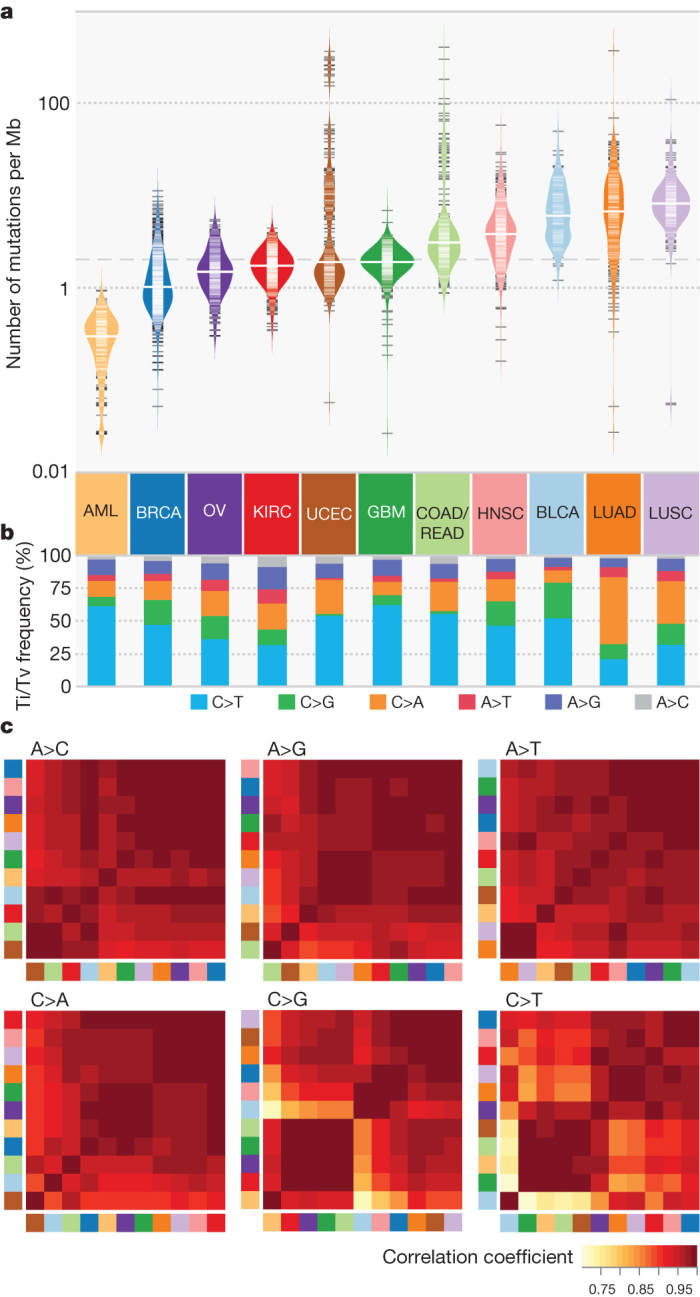
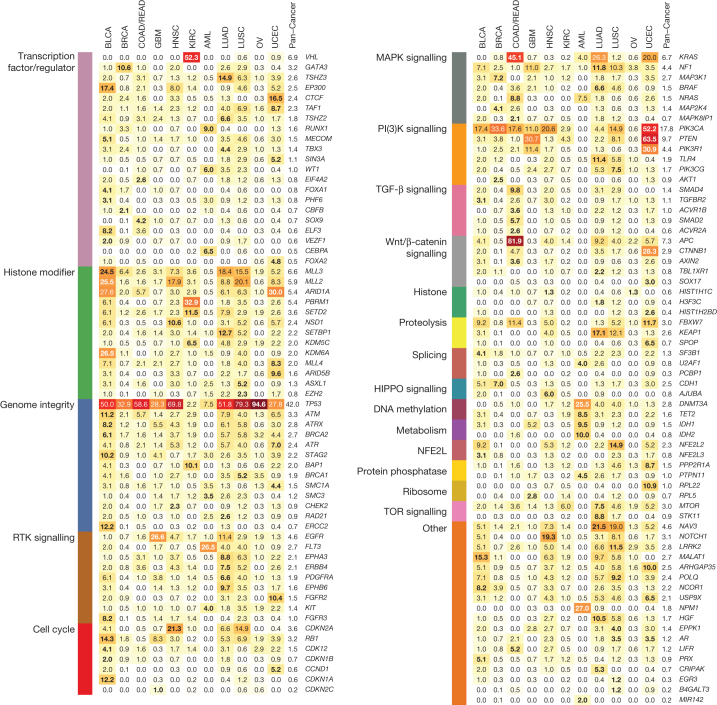
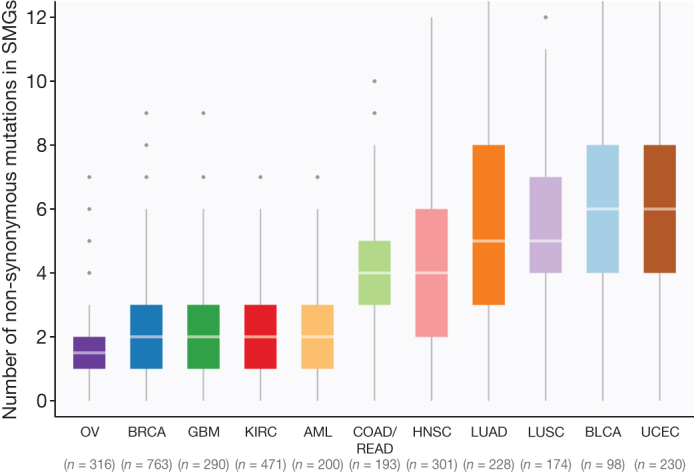
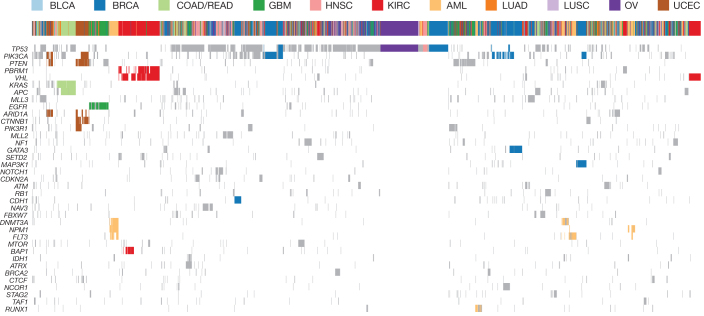
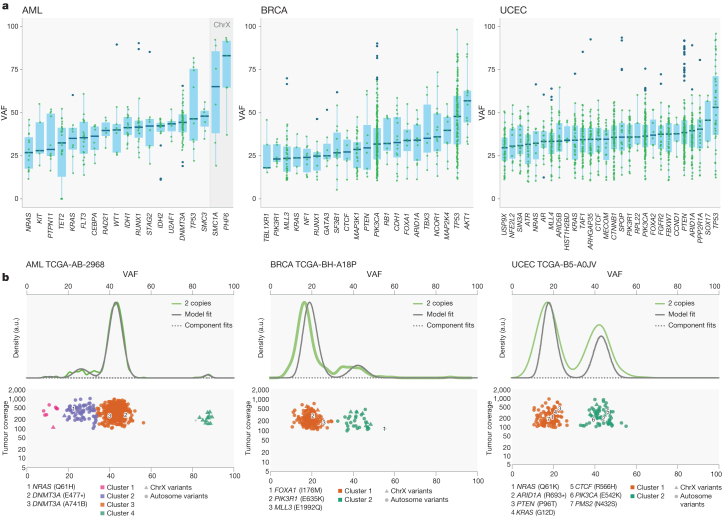
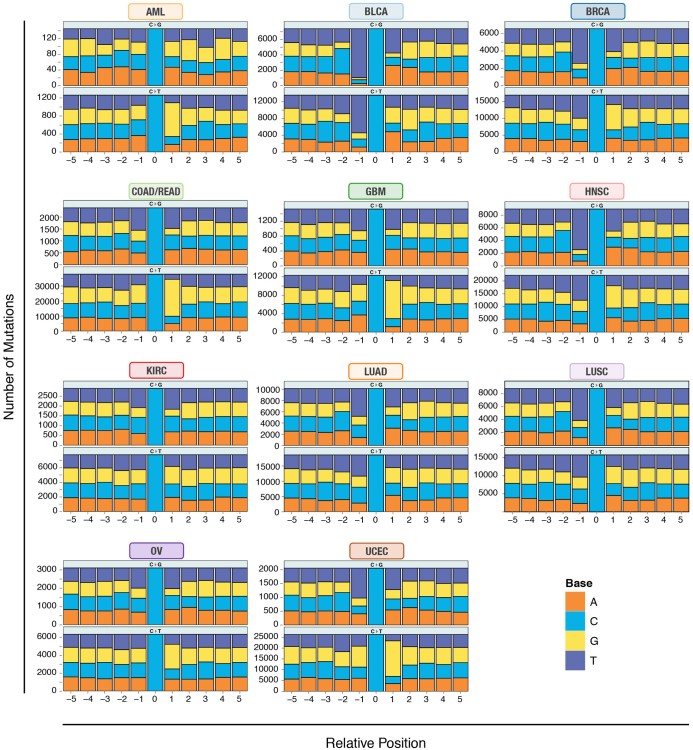
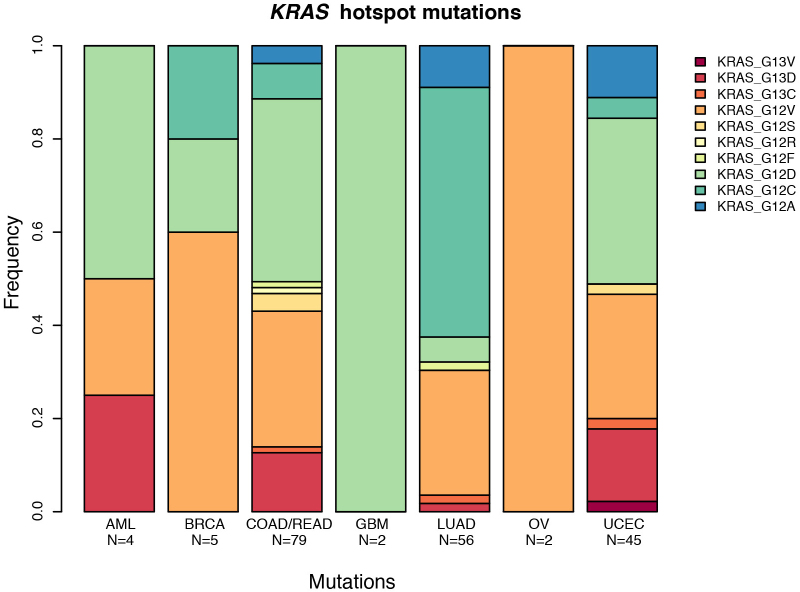
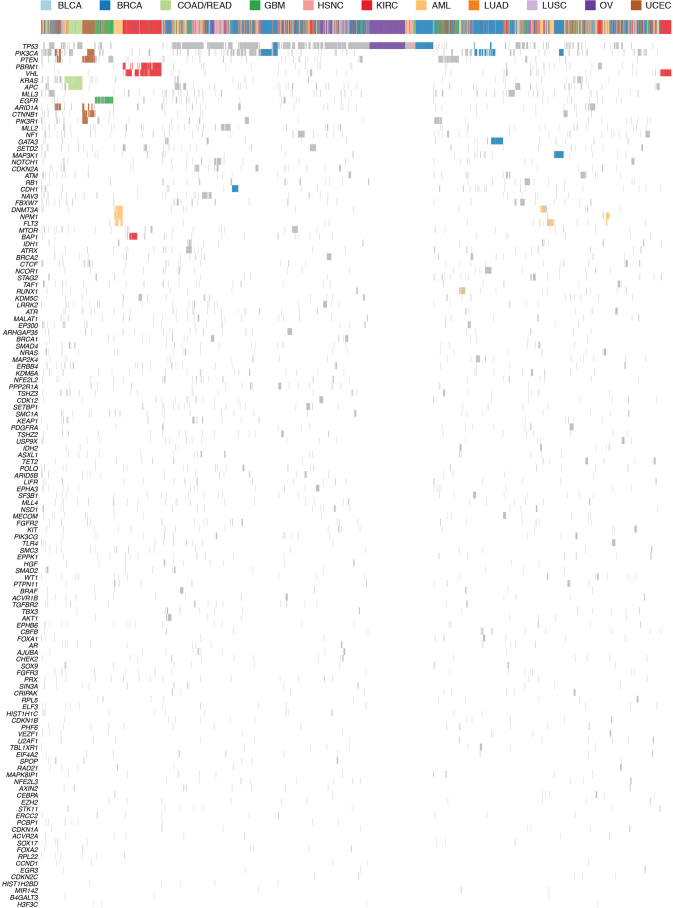
The Cancer Genome Atlas (TCGA) has used the latest sequencing and analysis methods to identify somatic variants across thousands of tumours. Here we present data and analytical results for point mutations and small insertions/deletions from 3,281 tumours across 12 tumour types as part of the TCGA Pan-Cancer effort. We illustrate the distributions of mutation frequencies, types and contexts across tumour types, and establish their links to tissues of origin, environmental/carcinogen influences, and DNA repair defects. Using the integrated data sets, we identified 127 significantly mutated genes from well-known (for example, mitogen-activated protein kinase, phosphatidylinositol-3-OH kinase, Wnt/β-catenin and receptor tyrosine kinase signalling pathways, and cell cycle control) and emerging (for example, histone, histone modification, splicing, metabolism and proteolysis) cellular processes in cancer. The average number of mutations in these significantly mutated genes varies across tumour types; most tumours have two to six, indicating that the number of driver mutations required during oncogenesis is relatively small. Mutations in transcriptional factors/regulators show tissue specificity, whereas histone modifiers are often mutated across several cancer types. Clinical association analysis identifies genes having a significant effect on survival, and investigations of mutations with respect to clonal/subclonal architecture delineate their temporal orders during tumorigenesis. Taken together, these results lay the groundwork for developing new diagnostics and individualizing cancer treatment. As part of The Cancer Genome Atlas Pan-Cancer effort, data analysis for point mutations and small indels from 3,281 tumours and 12 tumour types is presented; among the findings are 127 significantly mutated genes from cellular processes with both established and emerging links in cancer, and an indication that the number of driver mutations required for oncogenesis is relatively small. As part of The Cancer Genome Atlas Pan-Cancer project, these authors present data analysis for point mutations and small indels from more than 3,000 tumours representing 12 tumour types. Among the findings are 127 significantly mutated genes from cellular processes with both established and emerging links to cancer, and an indication that the number of driver mutations required for oncogenesis is relatively small. Additional analyses also identify genes with significant impact on survival and a likely temporal order of mutational events during tumorigenesis.
Overview
The claims and statistics of this paper haven’t been checked yet.
Free: it reads the open-access text and checks the first 5 claims that cite a source we can check. Create a free account to check every claim.
Integrity signals
Registry
Cites
Statistics
Figures
Verification
Claims the paper makes
The claims and statistics of this paper haven’t been checked yet.
Free: it reads the open-access text and checks the first 5 claims that cite a source we can check. Create a free account to check every claim.
Claims other papers make about this one
Each is checked against this paper’s own text: does it say what the citing paper says it does?
The source backs part of the claim, not all of it — or backs it for a different population, condition or comparison.
In the citing paper
“However, TP53 is inactivated in a major fraction of human tumors, mainly by missense mutations in the DNA-binding core domain of p533,4, leading to loss of DNA binding and p53-dependent transactivation of target genes such as p21, Bax and Puma.”
From Inhibition of the glutaredoxin and thioredoxin systems and ribonucleotide reductase by mutant p53-targeting compound APR-246 (2018) · cites this paper as [3]
Experimental — accuracy not yet measuredThe check wasn’t confident either way, so it gives no verdict — never disputed.
In the citing paper
“Current next-generation sequencing (NGS) technology is limited in the detection of rare variant alleles due to an intrinsic sequencing error rate of ~ 0.1%19.”
From Role of TP53 mutations in the origin and evolution of therapy-related acute myeloid leukaemia (2015) · cites this paper as [19]
Experimental — accuracy not yet measuredThe check wasn’t confident either way, so it gives no verdict — never disputed.
In the citing paper
“Yet, these mutations occur significantly more often in human disease than transversion mutations (62% transition vs 38% transversion29,63).”
From One-step generation of tumor models by base editor multiplexing in adult stem cell-derived organoids (2023) · cites this paper as [63]
Experimental — accuracy not yet measuredIn the citing paper
“Mutations in TP53 are thought to occur in more than 50% of all human malignancies.6,7”
From p53: from understanding its structure to advances in therapeutic targeting (2026) · cites this paper as [6]
In the citing paper
“Among somatically mutated genes, TP53 mutations are the most common.6”
From p53: from understanding its structure to advances in therapeutic targeting (2026) · cites this paper as [6]
Self-check
Percentages, sums and reported differences re-computed from the paper’s own numbers.
The self-check needs the paper’s full text.
Citations
Cites
Hanahan, D., & Weinberg, R. A. (2000) · Cell · doi:10.1016/s0092-8674(00)81683-9 · Cited by 29,219
Comprehensive molecular portraits of human breast tumours
The Cancer Genome Atlas Network (2012) · Nature · doi:10.1038/nature11412 · Cited by 12,129
Comprehensive molecular characterization of human colon and rectal cancer
The Cancer Genome Atlas Network (2012) · Nature · doi:10.1038/nature11252 · Cited by 8,499
Integrated genomic analyses of ovarian carcinoma
Perou, C. M. (2019) · Carolina Digital Repository (University of North Carolina at Chapel Hill) · doi:10.17615/hvp3-wg08 · Cited by 7,925
Vogelstein, B., Papadopoulos, N., Velculescu, V. E., Zhou, S., Diaz, L. A., & Kinzler, K. W. (2013) · Science · doi:10.1126/science.1235122 · Cited by 7,863
Comprehensive genomic characterization defines human glioblastoma genes and core pathways
The Cancer Genome Atlas Research Network (2008) · Nature · doi:10.1038/nature07385 · Cited by 7,735
Self-citationAn Integrated Genomic Analysis of Human Glioblastoma Multiforme
Parsons, D. W., Jones, S., Zhang, X., Lin, J. C.-H., Leary, R. J., Angenendt, P., Mankoo, P., Carter, H., Siu, I.-M., Gallia, G. L., et al. (2008) · Science · doi:10.1126/science.1164382 · Cited by 5,857
Integrated genomic characterization of endometrial carcinoma
The Cancer Genome Atlas Research Network, & Levine, D. A. (2013) · Nature · doi:10.1038/nature12113 · Cited by 5,784
Mutational heterogeneity in cancer and the search for new cancer-associated genes
Lawrence, M. S., Stojanov, P., Polak, P., Kryukov, G. V., Cibulskis, K., Sivachenko, A., Carter, S. L., Stewart, C., Mermel, C. H., Roberts, S. A., et al. (2013) · Nature · doi:10.1038/nature12213 · Cited by 5,461
Genomic and Epigenomic Landscapes of Adult De Novo Acute Myeloid Leukemia
The Cancer Genome Atlas Research Network (2013) · New England Journal of Medicine · doi:10.1056/nejmoa1301689 · Cited by 5,078
Cited by
Items 401–500 of 1,028
dbEMT: an epithelial-mesenchymal transition associated gene resource
Zhao, M., Kong, L., Liu, Y., & Qu, H. (2015) · Scientific Reports · doi:10.1038/srep11459 · Cited by 158
The Impact of miRNA in Colorectal Cancer Progression and Its Liver Metastases
Balacescu, O., Sur, D., Cainap, C., Visan, S., Cruceriu, D., Manzat-Saplacan, R., Muresan, M.-S., Balacescu, L., Lisencu, C., & Irimie, A. (2018) · International Journal of Molecular Sciences · doi:10.3390/ijms19123711 · Cited by 158
The inflammatory inception of gallbladder cancer
Espinoza, J. A., Bizama, C., García, P., Ferreccio, C., Javle, M. M., Miquel, J. F., Koshiol, J. E., & Roa, J. C. (2016) · Biochimica et Biophysica Acta (BBA) - Reviews on Cancer · doi:10.1016/j.bbcan.2016.03.004 · Cited by 159
Cytolytic Activity Score to Assess Anticancer Immunity in Colorectal Cancer
Narayanan, S., Kawaguchi, T., Yan, L., Peng, X., Qi, Q., & Takabe, K. (2018) · Annals of Surgical Oncology · doi:10.1245/s10434-018-6506-6 · Cited by 157
Hepatocyte Growth Factor, a Key Tumor-Promoting Factor in the Tumor Microenvironment
Owusu, B., Galemmo, R., Janetka, J., & Klampfer, L. (2017) · Cancers · doi:10.3390/cancers9040035 · Cited by 130
Molecular targets of curcumin in breast cancer (Review)
Song, X., Zhang, M., Dai, E., & Luo, Y. (2018) · Molecular Medicine Reports · doi:10.3892/mmr.2018.9665 · Cited by 156
Mission Possible: Advances in MYC Therapeutic Targeting in Cancer
Allen-Petersen, B. L., & Sears, R. C. (2019) · BioDrugs · doi:10.1007/s40259-019-00370-5 · Cited by 148
Blueprint for cancer research: Critical gaps and opportunities
Elmore, L. W., Greer, S. F., Daniels, E. C., Saxe, C. C., Melner, M. H., Krawiec, G. M., Cance, W. G., & Phelps, W. C. (2020) · CA A Cancer Journal for Clinicians · doi:10.3322/caac.21652 · Cited by 157
New Insight into microRNA Functions in Cancer: Oncogene–microRNA–Tumor Suppressor Gene Network
Zhou, K., Liu, M., & Cao, Y. (2017) · Frontiers in Molecular Biosciences · doi:10.3389/fmolb.2017.00046 · Cited by 155
Prognostic significance of frequent CLDN18-ARHGAP26/6 fusion in gastric signet-ring cell cancer
Shu, Y., Zhang, W., Hou, Q., Zhao, L.-Y., Zhang, S., Zhou, J., Song, X.-H., Zhang, Y., Jiang, D., Chen, X., et al. (2018) · Nature Communications · doi:10.1038/s41467-018-04907-0 · Cited by 155
Signaling pathways and therapeutic approaches in glioblastoma multiforme (Review)
Khabibov, M., Гарифуллин, А., Boumber, Y., Khaddour, K., Fernandez, M., Khamitov, F., Халикова, Л. В., Kuznetsova, N. S., Kit, O. I., & Kharin, L. V. (2022) · International Journal of Oncology · doi:10.3892/ijo.2022.5359 · Cited by 156
Small molecule promotes β-catenin citrullination and inhibits Wnt signaling in cancer
Qu, Y., Olsen, J. R., Xing, Y., Cheng, P. F., Levesque, M. P., Brokstad, K. A., Hoffman, P. S., Oyan, A. M., Zhang, W., Kalland, K., et al. (2017) · Nature Chemical Biology · doi:10.1038/nchembio.2510 · Cited by 154
Genomic alterations in thyroid cancer: biological and clinical insights
Landa, I., & Cabanillas, M. E. (2023) · Nature Reviews Endocrinology · doi:10.1038/s41574-023-00920-6 · Cited by 155
Grosso, A. R., Leite, A. P., Carvalho, S., Matos, M. R., Martins, F. B., Vítor, A. C., Desterro, J. M., Carmo-Fonseca, M., & de Almeida, S. F. (2015) · eLife · doi:10.7554/elife.09214 · Cited by 152
The role of ASXL1 in hematopoiesis and myeloid malignancies
Asada, S., Fujino, T., Goyama, S., & Kitamura, T. (2019) · Cellular and Molecular Life Sciences · doi:10.1007/s00018-019-03084-7 · Cited by 152
Nowosad, A., Jeannot, P., Callot, C., Creff, J., Perchey, R. T., Joffre, C., Codogno, P., Manenti, S., & Besson, A. (2020) · Nature Cell Biology · doi:10.1038/s41556-020-0554-4 · Cited by 152
RNA editing derived epitopes function as cancer antigens to elicit immune responses
Zhang, M., Fritsche, J., Roszik, J., Williams, L. J., Peng, X., Chiu, Y., Tsou, C.-C., Hoffgaard, F., Goldfinger, V., Schoor, O., et al. (2018) · Nature Communications · doi:10.1038/s41467-018-06405-9 · Cited by 151
Molecular classification of gastric cancer: Towards a pathway-driven targeted therapy
Riquelme, I., Saavedra, K., Espinoza, J. A., Weber, H. L., García, P., Nervi, B., Garrido, M., Corvalán, A. H., Roa, J. C., & Bizama, C. (2015) · Oncotarget · doi:10.18632/oncotarget.4990 · Cited by 153
Ratiometric Array of Conjugated Polymers–Fluorescent Protein Provides a Robust Mammalian Cell Sensor
Rana, S., Elci, S. G., Mout, R., Singla, A. K., Yazdani, M., Bender, M., Bajaj, A., Saha, K., Bunz, U. H. F., Jirik, F. R., et al. (2016) · Journal of the American Chemical Society · doi:10.1021/jacs.6b00067 · Cited by 151
Cancer-mutation network and the number and specificity of driver mutations
Iranzo, J., Martincorena, I., & Koonin, E. V. (2018) · Proceedings of the National Academy of Sciences · doi:10.1073/pnas.1803155115 · Cited by 155
KMT2C mediates the estrogen dependence of breast cancer through regulation of ERα enhancer function
Gala, K., Li, Q., Sinha, A., Razavi, P., Dorso, M., Sanchez-Vega, F., Chung, Y. R., Hendrickson, R., Hsieh, J. J., Berger, M., et al. (2018) · Oncogene · doi:10.1038/s41388-018-0273-5 · Cited by 138
Hierarchical HotNet: identifying hierarchies of altered subnetworks
Reyna, M. A., Leiserson, M. D. M., & Raphael, B. J. (2018) · Bioinformatics · doi:10.1093/bioinformatics/bty613 · Cited by 138
Self-citationStarvation and Pseudo-Starvation as Drivers of Cancer Metastasis through Translation Reprogramming
García-Jiménez, C., & Goding, C. R. (2019) · Cell Metabolism · doi:10.1016/j.cmet.2018.11.018 · Cited by 150
TP53 mutations, expression and interaction networks in human cancers
Wang, X., & Sun, Q. (2017) · Oncotarget · doi:10.18632/oncotarget.13483 · Cited by 132
The lysine‐specific methyltransferase KMT2C/MLL3 regulates DNA repair components in cancer
Rampias, T. N., Karagiannis, D., Avgeris, M., Polyzos, A., Kokkalis, A., Kanaki, Z., Kousidou, E., Tzetis, M., Kanavakis, E., STRAVODIMOS, K. G., et al. (2019) · EMBO Reports · doi:10.15252/embr.201846821 · Cited by 154
Mutant p53-Associated Molecular Mechanisms of ROS Regulation in Cancer Cells
Cordani, M., Butera, G., Pacchiana, R., Masetto, F., Mullappilly, N., Riganti, C., & Donadelli, M. (2020) · Biomolecules · doi:10.3390/biom10030361 · Cited by 150
Antill, Y. C., Kok, P., Robledo, K. P., Yip, S., Cummins, M. M., Smith, D. S., Spurdle, A. B., Barnes, E. H., Lee, Y. C., Friedlander, M. L., et al. (2021) · Journal for ImmunoTherapy of Cancer · doi:10.1136/jitc-2020-002255 · Cited by 150
Molecularly Targeted Therapies in Non–Small-Cell Lung Cancer Annual Update 2014
Morgensztern, D., Campo, M. J., Dahlberg, S. E., Doebele, R. C., Garon, E. B., Gerber, D. E., Goldberg, S. B., Hammerman, P. S., Heist, R. S., Hensing, T. A., et al. (2015) · Journal of Thoracic Oncology · doi:10.1097/jto.0000000000000405 · Cited by 153
Boscolo, E., Coma, S., Luks, V. L., Greene, A. K., Klagsbrun, M., Warman, M. L., & Bischoff, J. E. (2014) · Angiogenesis · doi:10.1007/s10456-014-9453-2 · Cited by 149
Tumour-infiltrating lymphocytes and the emerging role of immunotherapy in breast cancer
Luen, S. J., Savas, P. S., Fox, S. B., Salgado, R., & Loi, S. (2017) · Pathology · doi:10.1016/j.pathol.2016.10.010 · Cited by 149
The importance of p53 pathway genetics in inherited and somatic cancer genomes
Stracquadanio, G., Wang, X., Wallace, M. D., Grawenda, A. M., Zhang, P., Hewitt, J., Zerón-Medina-Cuairán, J., Castro-Giner, F., Tomlinson, I. P. M., Goding, C. R., et al. (2016) · Nature reviews. Cancer · doi:10.1038/nrc.2016.15 · Cited by 150
Rogers, Z. N., McFarland, C. D., Winters, I. P., Naranjo, S., Chuang, C.-H., Petrov, D., & Winslow, M. M. (2017) · Nature Methods · doi:10.1038/nmeth.4297 · Cited by 147
Hosen, N., Matsunaga, Y., Hasegawa, K., Matsuno, H., Nakamura, Y., Makita, M., Watanabe, K., Yoshida, M., Satoh, K., Morimoto, S., et al. (2017) · Nature Medicine · doi:10.1038/nm.4431 · Cited by 150
Wang, G., Chow, R. D.-W., Zhu, L., Bai, Z., Ye, L., Zhang, F., Renauer, P. A., Dong, M. B., Dai, X., Zhang, X., et al. (2020) · Cancer Discovery · doi:10.1158/2159-8290.cd-19-1448 · Cited by 149
A survey on graph-based deep learning for computational histopathology
Ahmedt-Aristizabal, D., Armin, M. A., Denman, S., Fookes, C., & Petersson, L. (2022) · Computerized Medical Imaging and Graphics · doi:10.1016/j.compmedimag.2021.102027 · Cited by 147
Moschos, S. J., Sullivan, R. J., Hwu, W.-J., Ramanathan, R. K., Adjei, A. A., Fong, P. C., Shapira-Frommer, R., Tawbi, H. A., Rubino, J., Rush, T. S., et al. (2018) · JCI Insight · doi:10.1172/jci.insight.92352 · Cited by 147
Histone Demethylases and Their Roles in Cancer Epigenetics
D’Oto, A., Tian, Q., Davidoff, A. M., & Yang, J. (2016) · Journal of medical oncology and therapeutics · doi:10.35841/medical-oncology.1.2.34-40 · Cited by 147
The epigenetic landscape of renal cancer
Morris, M. R., & Latif, F. (2016) · Nature Reviews Nephrology · doi:10.1038/nrneph.2016.168 · Cited by 148
Yoon, J.-H., Yu, B., Park, C. H., Kim, Y. J., Nam, J., & Lee, S. K. (2017) · Cancer Letters · doi:10.1016/j.canlet.2017.12.016 · Cited by 147
How mutations shape p53 interactions with the genome to promote tumorigenesis and drug resistance
Stiewe, T., & Haran, T. E. (2018) · Drug Resistance Updates · doi:10.1016/j.drup.2018.05.001 · Cited by 148
SUMO-2 Orchestrates Chromatin Modifiers in Response to DNA Damage
Hendriks, I. A., Treffers, L. W., Verlaan-de Vries, M., Olsen, J. V., & Vertegaal, A. C. O. (2015) · Cell Reports · doi:10.1016/j.celrep.2015.02.033 · Cited by 136
Melotti, A., Mas, C., Kuciak, M., Lorente‐Trigos, A., Borges, I., & Altaba, A. R. I. (2014) · EMBO Molecular Medicine · doi:10.15252/emmm.201404084 · Cited by 148
iUUCD 2.0: an update with rich annotations for ubiquitin and ubiquitin-like conjugations
Zhou, J., Xu, Y., Lin, S., Guo, Y., Deng, W., Zhang, Y. W., Guo, A., & Xue, Y. (2017) · Nucleic Acids Research · doi:10.1093/nar/gkx1041 · Cited by 146
Nussinov, R., Jang, H., Tsai, C.-J., & Cheng, F. (2019) · PLOS Computational Biology · doi:10.1371/journal.pcbi.1006658 · Cited by 130
A comparison of epigenetic mitotic-like clocks for cancer risk prediction
Teschendorff, A. E. (2020) · Genome Medicine · doi:10.1186/s13073-020-00752-3 · Cited by 145
Onco-proteogenomics: cancer proteomics joins forces with genomics
Alfaro, J. A., Sinha, A., Kislinger, T., & Boutros, P. C. (2014) · Nature Methods · doi:10.1038/nmeth.3138 · Cited by 147
do Valle, Í. F., Giampieri, E., Simonetti, G., Padella, A., Manfrini, M., Ferrari, A., Papayannidis, C., Zironi, I., Garonzi, M., Bernardi, S., et al. (2016) · BMC Bioinformatics · doi:10.1186/s12859-016-1190-7 · Cited by 145
Kuentz, P., St‐Onge, J., Duffourd, Y., Courcet, J., Carmignac, V., Jouan, T., Sorlin, A., Abasq‐Thomas, C., Albuisson, J., Amiel, J., et al. (2017) · Genetics in Medicine · doi:10.1038/gim.2016.220 · Cited by 146
TET2 coactivates gene expression through demethylation of enhancers
Wang, L., Ozark, P. A., Smith, E. R., Zhao, Z., Marshall, S. A., Rendleman, E. J., Piunti, A., Ryan, C., Whelan, A. L., Helmin, K. A., et al. (2018) · Science Advances · doi:10.1126/sciadv.aau6986 · Cited by 136
Piscuoglio, S., Ng, C. K. Y., Murray, M. P., Burke, K. A., Edelweiss, M., Geyer, F. C., Macedo, G. S., Inagaki, A., Papanastasiou, A. D., Martelotto, L. G., et al. (2016) · The Journal of Pathology · doi:10.1002/path.4672 · Cited by 145
Allison, K. H., & Sledge, G. W. (2014) · PubMed · Cited by 146
Splicing factor gene mutations in hematologic malignancies
Sáez, B., Walter, M. J., & Graubert, T. A. (2016) · Blood · doi:10.1182/blood-2016-10-692400 · Cited by 144
Self-citationTWIST1-WDR5- Hottip Regulates Hoxa9 Chromatin to Facilitate Prostate Cancer Metastasis
Malek, R. A., Gajula, R. P., Williams, R. D., Nghiem, B., Simons, B. W., Nugent, K. M., Wang, H., Taparra, K., Lemtiri-Chlieh, G., Yoon, A. R., et al. (2017) · Cancer Research · doi:10.1158/0008-5472.can-16-2797 · Cited by 144
Sanders, A. D., Falconer, E., Hills, M., Spierings, D. C. J., & Lansdorp, P. M. (2017) · Nature Protocols · doi:10.1038/nprot.2017.029 · Cited by 144
Understanding cell cycle and cell death regulation provides novel weapons against human diseases
Wiman, K. G., & Zhivotovsky, B. (2017) · Journal of Internal Medicine · doi:10.1111/joim.12609 · Cited by 144
Epigenetic Biomarkers in Cell-Free DNA and Applications in Liquid Biopsy
Gai, W., & Sun, K. (2019) · Genes · doi:10.3390/genes10010032 · Cited by 143
Cheng, J., Zhang, J., Han, Y., Wang, X., Ye, X., Meng, Y., Parwani, A., Han, Z., Feng, Q., & Huang, K. (2017) · Cancer Research · doi:10.1158/0008-5472.can-17-0313 · Cited by 142
e-Driver: a novel method to identify protein regions driving cancer
Porta-Pardo, E., & Godzik, A. (2014) · Bioinformatics · doi:10.1093/bioinformatics/btu499 · Cited by 130
Adversarial Domain Adaptation for Classification of Prostate Histopathology Whole-Slide Images
Ren, J., Hacihaliloglu, I., Singer, E. A., Foran, D. J., & Qi, X. (2018) · Lecture notes in computer science · doi:10.1007/978-3-030-00934-2_23 · Cited by 142
Long non‐coding RNAs and prostate cancer
Misawa, A., Takayama, K., & Inoue, S. (2017) · Cancer Science · doi:10.1111/cas.13352 · Cited by 141
Progress towards a clinically-successful ATR inhibitor for cancer therapy
Barnieh, F. M., Loadman, P. M., & Falconer, R. A. (2021) · Current Research in Pharmacology and Drug Discovery · doi:10.1016/j.crphar.2021.100017 · Cited by 143
Martelotto, L. G., Ng, C., De Filippo, M. R., Zhang, Y., Piscuoglio, S., Lim, R., Shen, R., Norton, L., Reis-Filho, J. S., & Weigelt, B. (2014) · Genome Biology · doi:10.1186/preaccept-6413622551325626 · Cited by 140
Crosstalk between Estrogen Signaling and Breast Cancer Metabolism
Kulkoyluoglu‐Cotul, E., Blanco, A. A., & Madak‐Erdogan, Z. (2018) · Trends in Endocrinology and Metabolism · doi:10.1016/j.tem.2018.10.006 · Cited by 140
Sternberg, C. N., Loriot, Y., James, N. D., Choy, E., Castellano, D., López‐Ríos, F., Banna, G. L., Giorgi, U. D., Masini, C., Bamias, A., et al. (2019) · European Urology · doi:10.1016/j.eururo.2019.03.015 · Cited by 140
Sánchez-Ortega, M., Carrera, A. C., & Garrido, A. (2021) · Cells · doi:10.3390/cells10081879 · Cited by 141
Na, F., Pan, X., Chen, J., Chen, X., Wang, M., Chi, P., You, L., Zhang, L., Zhong, A., Zhao, L., et al. (2022) · Nature Cancer · doi:10.1038/s43018-022-00361-6 · Cited by 140
Karnezis, A. N., Leung, S. C. Y., Magrill, J., McConechy, M. K., Yang, W., Chow, C., Köbel, M., Lee, C., Huntsman, D. D., Talhouk, A., et al. (2017) · The Journal of Pathology Clinical Research · doi:10.1002/cjp2.82 · Cited by 139
Pasmant, É., Parfait, B., Luscan, A., Goussard, P., Briand‐Suleau, A., Laurendeau, I., Fouveaut, C., Leroy, C., Montadert, A., Wolkenstein, P., et al. (2014) · European Journal of Human Genetics · doi:10.1038/ejhg.2014.145 · Cited by 138
Bykov, V. J. N., Zhang, Q., Zhang, M., Ceder, S., Abrahmsen, L., & Wiman, K. G. (2016) · Frontiers in Oncology · doi:10.3389/fonc.2016.00021 · Cited by 137
Self-citationLow Mutation Burden in Ovarian Cancer May Limit the Utility of Neoantigen-Targeted Vaccines
Martin, S. D., Brown, S. D., Wick, D. A., Nielsen, J. S., Kroeger, D. R., Twumasi-Boateng, K., Holt, R. A., & Nelson, B. H. (2016) · PLOS ONE · doi:10.1371/journal.pone.0155189 · Cited by 137
Colli, L. M., Machiela, M. J., Myers, T. A., Jessop, L., Yu, K., & Chanock, S. J. (2016) · Cancer Research · doi:10.1158/0008-5472.can-16-0170 · Cited by 137
Genomic characterization of sarcomatoid transformation in clear cell renal cell carcinoma
Zhao, B., Zhao, S., Said, J. W., Merino, M. J., Adeniran, A., Xie, Z., Nawaf, C., Choi, J., Belldegrun, A. S., Pantuck, A. J., et al. (2016) · Proceedings of the National Academy of Sciences · doi:10.1073/pnas.1525735113 · Cited by 137
Oncogenic Deregulation of EZH2 as an Opportunity for Targeted Therapy in Lung Cancer
Zhang, H., Qi, J., Reyes, J. M., Li, L., Rao, P. K., Li, F., Lin, C. Y., Perry, J. A., Lawlor, M. A., Alexander Joel Federation, et al. (2016) · Cancer Discovery · doi:10.1158/2159-8290.cd-16-0164 · Cited by 137
Molecular Classification of Endometrial Cancer and Its Impact on Therapy Selection
Galant, N., Krawczyk, P. A., Monist, M. J., Obara, A., Gajek, Ł., Grenda, A., Nicoś, M., Kalinka‐Warzocha, E., & Milanowski, J. (2024) · International Journal of Molecular Sciences · doi:10.3390/ijms25115893 · Cited by 138
Overcoming Wnt–β-catenin dependent anticancer therapy resistance in leukaemia stem cells
Perry, J. M., Tao, F., Roy, A., Lin, T., He, X. C., Chen, S., Lu, X., Nemechek, J., Ruan, L., Yu, X., et al. (2020) · Nature Cell Biology · doi:10.1038/s41556-020-0507-y · Cited by 136
Werner, S. L., Graf, R. P., Landers, M. A., Valenta, D. T., Schroeder, M. J., Greene, S. B., Bales, N., Dittamore, R. V., & Marrinucci, D. C. (2015) · Journal of Circulating Biomarkers · doi:10.5772/60725 · Cited by 137
Kovac, M., Navas, C., Horswell, S., Salm, M., Bardella, C., Rowan, A., Stares, M., Castro-Giner, F., Fisher, R., de Bruin, E. C., et al. (2015) · Nature Communications · doi:10.1038/ncomms7336 · Cited by 121
Outlook on PI3K/AKT/mTOR inhibition in acute leukemia
Fransecky, L. R., Mochmann, L. H., & Baldus, C. D. (2015) · Molecular and Cellular Therapies · doi:10.1186/s40591-015-0040-8 · Cited by 135
Ribosomal Proteins Regulate MHC Class I Peptide Generation for Immunosurveillance
Wei, J., Kishton, R. J., Angel, M., Conn, C. S., Venezia, N. D., Marcel, V., Vincent, A., Catez, F., Ferré, S., Ayadi, L., et al. (2019) · Molecular Cell · doi:10.1016/j.molcel.2018.12.020 · Cited by 135
The evolving genomic landscape of urothelial carcinoma
Glaser, A. P., Fantini, D., Shilatifard, A., Schaeffer, E. M., & Meeks, J. J. (2017) · Nature Reviews Urology · doi:10.1038/nrurol.2017.11 · Cited by 134
Pan-cancer proteogenomics connects oncogenic drivers to functional states
Li, Y., Porta‐Pardo, E., Tokheim, C. J., Bailey, M. H., Yaron, T. M., Stathias, V., Geffen, Y., Imbach, K. J., Cao, S., Anand, S. K., et al. (2023) · Cell · doi:10.1016/j.cell.2023.07.014 · Cited by 136
Self-citationIdentification of Druggable Cancer Driver Genes Amplified across TCGA Datasets
Chen, Y., McGee, J., Chen, X., Doman, T. N., Gong, X., Zhang, Y., Hamm, N., Ma, X., Higgs, R. E., Bhagwat, S. V., et al. (2014) · PLoS ONE · doi:10.1371/journal.pone.0098293 · Cited by 133
The ribosomal protein gene RPL5 is a haploinsufficient tumor suppressor in multiple cancer types
Fancello, L., Kampen, K. R., Hofman, I. J. F., Verbeeck, J., & Keersmaecker, K. D. (2017) · Oncotarget · doi:10.18632/oncotarget.14895 · Cited by 122
Targeting DNA repair, DNA metabolism and replication stress as anti‐cancer strategies
Puigvert, J. C., Sanjiv, K., & Helleday, T. (2016) · The FEBS Journal · doi:10.1111/febs.13574 · Cited by 113
Scarfò, I., Pellegrino, E., Mereu, E., Kwee, I., Agnelli, L., Bergaggio, E., Garaffo, G., Vitale, N., Caputo, M., Machiorlatti, R., et al. (2016) · Blood · doi:10.1182/blood-2014-12-614503 · Cited by 115
Li, X., Wu, W. K. K., Xing, R., Wong, S. H., Liu, Y., Fang, X., Zhang, Y., Wang, M., Wang, J., Li, L., et al. (2016) · Cancer Research · doi:10.1158/0008-5472.can-15-2443 · Cited by 132
Towards Precision Medicine in the Clinic: From Biomarker Discovery to Novel Therapeutics
Collins, D. C., Sundar, R., Lim, J. S. J., & Yap, T. A. (2016) · Trends in Pharmacological Sciences · doi:10.1016/j.tips.2016.10.012 · Cited by 133
A Non-catalytic Function of SETD1A Regulates Cyclin K and the DNA Damage Response
Hoshii, T., Cifani, P., Feng, Z., Huang, C., Koche, R. P., Chen, C.-W. D., Delaney, C. D., Lowe, S. W., Kentsis, A., & Armstrong, S. A. (2018) · Cell · doi:10.1016/j.cell.2018.01.032 · Cited by 133
Zapata, L., Pich, O., Serrano, L., Kondrashov, F. A., Ossowski, S., & Schaefer, M. H. (2018) · Genome biology · doi:10.1186/s13059-018-1434-0 · Cited by 135
Extracellular Matrix Remodeling and Stiffening Modulate Tumor Phenotype and Treatment Response
Leight, J. L., Drain, A. P., & Weaver, V. M. (2017) · Annual Review of Cancer Biology · doi:10.1146/annurev-cancerbio-050216-034431 · Cited by 131
Identification of a pan-cancer oncogenic microRNA superfamily anchored by a central core seed motif
Hamilton, M. P., Rajapakshe, K., Hartig, S. M., Reva, B. A., McLellan, M. D., Kandoth, C., Ding, L., Zack, T. I., Gunaratne, P. H., Wheeler, D. A., et al. (2013) · Nature Communications · doi:10.1038/ncomms3730 · Cited by 133
Self-citationEvolving Lessons on the Complex Role of AMPK in Normal Physiology and Cancer
Dasgupta, B., & Chhipa, R. R. (2016) · Trends in Pharmacological Sciences · doi:10.1016/j.tips.2015.11.007 · Cited by 118
Disease-Causing Mutations in SF3B1 Alter Splicing by Disrupting Interaction with SUGP1
Zhang, J., Ali, A. M., Lieu, Y. K., Liu, Z., Gao, J., Rabadán, R., Raza, A., Mukherjee, S., & Manley, J. L. (2019) · Molecular Cell · doi:10.1016/j.molcel.2019.07.017 · Cited by 131
Deciphering UV‐induced DNA Damage Responses to Prevent and Treat Skin Cancer
Lee, J. W., Ratnakumar, K., Hung, K., Rokunohe, D., & Kawasumi, M. (2020) · Photochemistry and Photobiology · doi:10.1111/php.13245 · Cited by 132
Li, L., Wei, Y., To, C., Zhu, C., Tong, J., Pham, N., Taylor, P. P., Ignatchenko, V., Ignatchenko, A., Zhang, W., et al. (2014) · Nature Communications · doi:10.1038/ncomms6469 · Cited by 130
Dreßler, L., Bortolomeazzi, M., Keddar, M. R., Mišetić, H., Sartini, G., Acha‐Sagredo, A., Montorsi, L., Wijewardhane, N., Repana, D., Nulsen, J., et al. (2022) · Genome biology · doi:10.1186/s13059-022-02607-z · Cited by 131
Whole-genome mutational burden analysis of three pluripotency induction methods
Bhutani, K., Nazor, K. L., Williams, R., Tran, H., Dai, H., Džakula, Ž., Cho, E. H., Pang, A. W. C., Rao, M., Cao, H., et al. (2016) · Nature Communications · doi:10.1038/ncomms10536 · Cited by 129
Chia, S., Gandhi, S., Joy, A. A., Edwards, S., Gorr, M., Hopkins, S. P., Kondejewski, J., Ayoub, J.-P., Califaretti, N., Rayson, D., et al. (2015) · Current Oncology · doi:10.3747/co.22.2393 · Cited by 129
Gollner, A., Rudolph, D., Arnhof, H., Bauer, M., Blake, S. M., Boehmelt, G., Cockroft, X.-L., Dahmann, G., Ettmayer, P., Gerstberger, T., et al. (2016) · Journal of Medicinal Chemistry · doi:10.1021/acs.jmedchem.6b00900 · Cited by 121
Circulating breast-derived DNA allows universal detection and monitoring of localized breast cancer
Moss, J., Zick, A., Grinshpun, A., Carmon, E., Maoz, M., Ochana, B. L., Abraham, O. A., Arieli, O., Germansky, L., Meir, K., et al. (2020) · Annals of Oncology · doi:10.1016/j.annonc.2019.11.014 · Cited by 129
Metadata
- Authors
- Kandoth, C., McLellan, M. D., Vandin, F., Ye, K., Niu, B., Lu, C., Xie, M., Zhang, Q., McMichael, J. F., Wyczalkowski, M. A., Leiserson, M. D. M., Miller, C. A., Welch, J. S., Walter, M. J., Wendl, M. C., Ley, T. J., Wilson, R. K., Raphael, B. J., & Ding, L.
- Affiliations
- Washington University in St. Louis (US)
- Brown University (US)
- Corresponding author
- Ding, Li
- ORCID
- Venue
- Nature
- Published
- 2013-10-16
- Volume
- 502
- Issue
- 7471
- Pages
- 333-339
- ISSN
- 0028-0836 (ISSN-L)
- 1476-4687
- PMC
- PMC3927368
- OpenAlex
- W2022495797
- Cited by
- 4,419
- References
- 40
- Citations by year
- 2026: 162 · 2025: 243 · 2024: 311 · 2023: 324 · 2022: 380 · 2021: 395 · 2020: 417 · 2019: 377 · 2018: 410 · 2017: 414 · 2016: 407 · 2015: 327 · 2014: 237 · 2013: 8
- FWCI
- 114.79
- Type
- journal article
- Language
- en
- Open access
- hybrid
- doi.org
- Licence
- cc-by-nc-sa
- creativecommons.org/licenses/by-nc-sa/3.0/ (tdm)
- creativecommons.org/licenses/by-nc-sa/3.0/ (vor)
- Locations
- Nature (publishedVersion, cc-by-nc-sa)
- PubMed Central (publishedVersion, cc-by-nc-sa)
- PubMed (publishedVersion)
- Europe PMC (PubMed Central) (acceptedVersion, cc-by-nc-sa)
- Padua Research Archive (University of Padova) (submittedVersion, cc-by-nc-sa)
- RePEc: Research Papers in Economics (submittedVersion)
- Funders
- National Science Foundation (1016648)
- National Human Genome Research Institute (U01HG006517, U54HG003079, R01HG005690)
- National Cancer Institute (PO1CA101937, R01CA180006, P01CA101937)
- Topics
- Life Sciences › Biochemistry, Genetics and Molecular Biology › Cancer Research › Cancer Genomics and Diagnostics
- Life Sciences › Biochemistry, Genetics and Molecular Biology › Molecular Biology › Chromatin Remodeling and Cancer
- Life Sciences › Biochemistry, Genetics and Molecular Biology › Genetics › Genomics and Rare Diseases
- Keywords
- somatic mutations, point mutations, small insertions and deletions, significantly mutated genes, driver mutations, pan-cancer analysis, histone modifiers, transcription factors, histone modifications, splicing, carcinogenesis, clonal architecture, subclonal evolution, tissue specificity, DNA repair deficiency, carcinogens, cancer pathways, cancer metabolism
- MeSH terms
- Cell Cycle, Clone Cells, DNA Repair, Humans, Models, Genetic, Mutation, Neoplasms, Oncogenes, Time Factors, Cohort Studies, Survival Analysis, Point Mutation, Phosphatidylinositol 3-Kinases, Receptor Protein-Tyrosine Kinases, Mitogen-Activated Protein Kinases, INDEL Mutation, Carcinogenesis
About these checks
Registry, retraction, Cites and statistics results are computed, not judged, with one exception: a printed reference that no index lists is read once by a model before it counts as a citation error. Claims are extracted by a model and kept only when their quote appears verbatim in the text; each cited source is then checked, with a model’s help, for whether it says what the claim relies on. Those verdicts can be wrong — read the claim’s quote and the cited source before relying on one.
Statistics and arithmetic are recomputed, not judged.
Confidence bands are shown only for fields calibrated on our annotated test set. None is calibrated yet, so no band is shown.
What counts as a claim ›How we measure confidence ›How we check this ›
Are you an author, or do you see a problem with this page? Request a review
Data sources
Bibliographic data: Semantic Scholar, OpenAlex, Crossref.
Contains information from the Semantic Scholar Academic Graph Datasets, made available under the ODC Attribution License (ODC-BY 1.0).
Semantic Scholar’s data is described in: Kinney, R., et al. (2023). The Semantic Scholar Open Data Platform. arXiv:2301.10140.
