

Mutational landscape and significance across 12 major cancer types
Open accessThe DOI matches its Crossref record; 39 of the 40 references it cites were found in a registry or an index.
Abstract
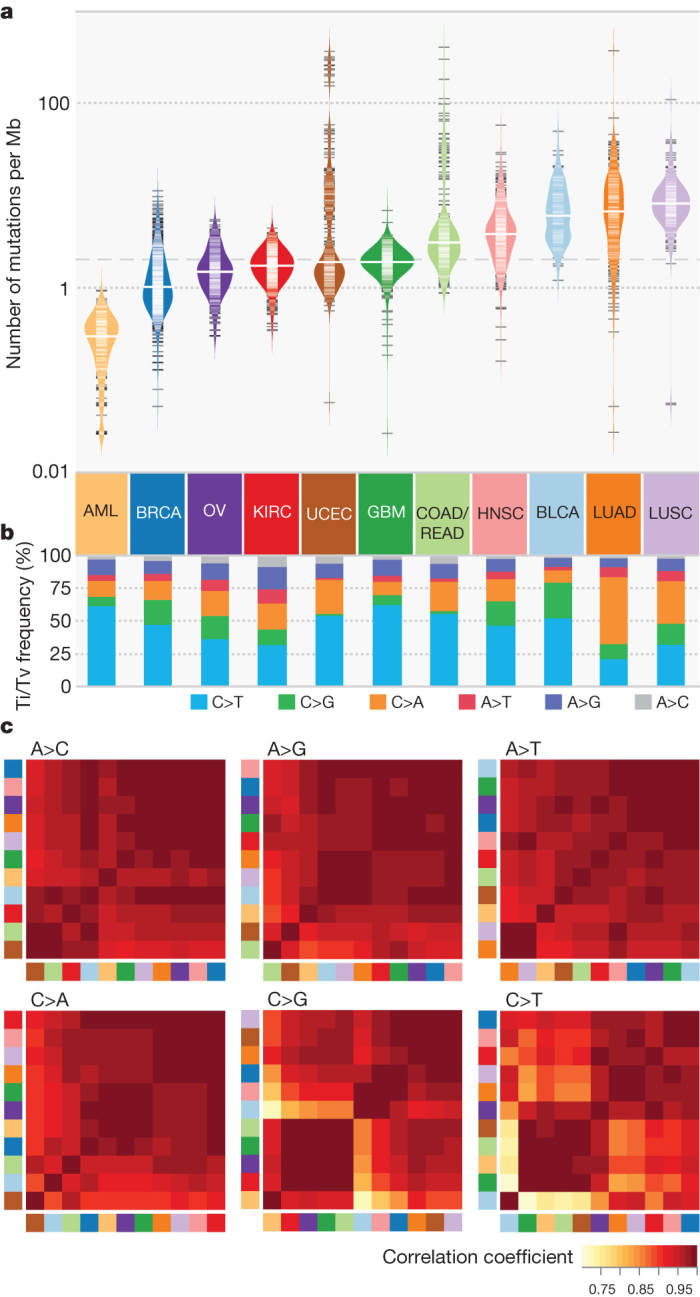
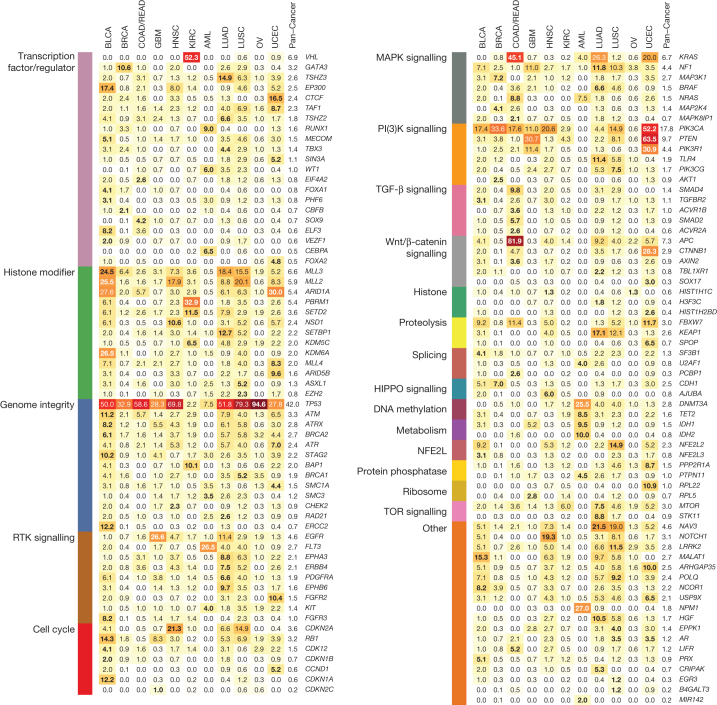
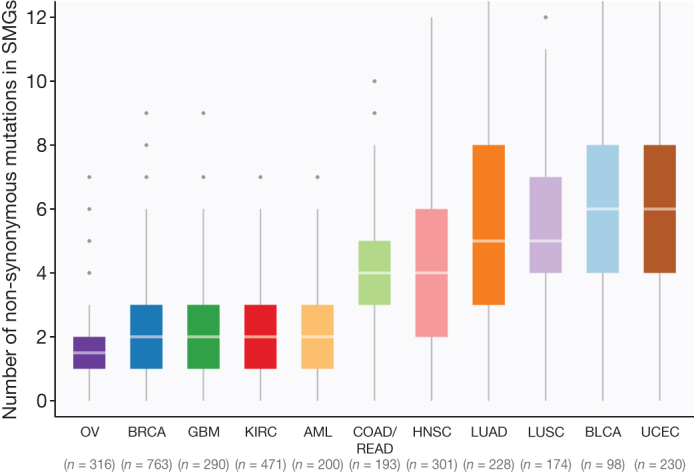
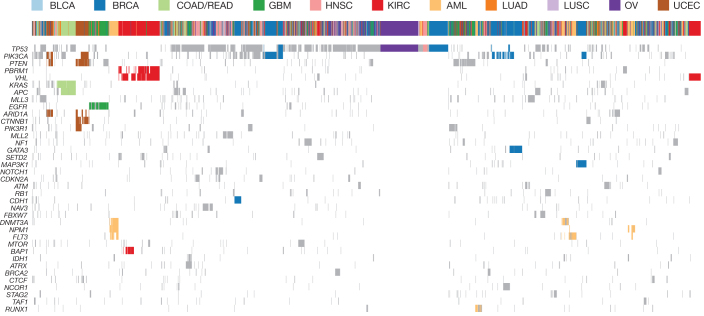
The Cancer Genome Atlas (TCGA) has used the latest sequencing and analysis methods to identify somatic variants across thousands of tumours. Here we present data and analytical results for point mutations and small insertions/deletions from 3,281 tumours across 12 tumour types as part of the TCGA Pan-Cancer effort. We illustrate the distributions of mutation frequencies, types and contexts across tumour types, and establish their links to tissues of origin, environmental/carcinogen influences, and DNA repair defects. Using the integrated data sets, we identified 127 significantly mutated genes from well-known (for example, mitogen-activated protein kinase, phosphatidylinositol-3-OH kinase, Wnt/β-catenin and receptor tyrosine kinase signalling pathways, and cell cycle control) and emerging (for example, histone, histone modification, splicing, metabolism and proteolysis) cellular processes in cancer. The average number of mutations in these significantly mutated genes varies across tumour types; most tumours have two to six, indicating that the number of driver mutations required during oncogenesis is relatively small. Mutations in transcriptional factors/regulators show tissue specificity, whereas histone modifiers are often mutated across several cancer types. Clinical association analysis identifies genes having a significant effect on survival, and investigations of mutations with respect to clonal/subclonal architecture delineate their temporal orders during tumorigenesis. Taken together, these results lay the groundwork for developing new diagnostics and individualizing cancer treatment. As part of The Cancer Genome Atlas Pan-Cancer effort, data analysis for point mutations and small indels from 3,281 tumours and 12 tumour types is presented; among the findings are 127 significantly mutated genes from cellular processes with both established and emerging links in cancer, and an indication that the number of driver mutations required for oncogenesis is relatively small. As part of The Cancer Genome Atlas Pan-Cancer project, these authors present data analysis for point mutations and small indels from more than 3,000 tumours representing 12 tumour types. Among the findings are 127 significantly mutated genes from cellular processes with both established and emerging links to cancer, and an indication that the number of driver mutations required for oncogenesis is relatively small. Additional analyses also identify genes with significant impact on survival and a likely temporal order of mutational events during tumorigenesis.
Overview
The claims and statistics of this paper haven’t been checked yet.
Free: it reads the open-access text and checks the first 5 claims that cite a source we can check. Create a free account to check every claim.
Integrity signals
Registry
Cites
Statistics
Figures
Verification
Claims the paper makes
The claims and statistics of this paper haven’t been checked yet.
Free: it reads the open-access text and checks the first 5 claims that cite a source we can check. Create a free account to check every claim.
Claims other papers make about this one
Each is checked against this paper’s own text: does it say what the citing paper says it does?
The source backs part of the claim, not all of it — or backs it for a different population, condition or comparison.
In the citing paper
“However, TP53 is inactivated in a major fraction of human tumors, mainly by missense mutations in the DNA-binding core domain of p533,4, leading to loss of DNA binding and p53-dependent transactivation of target genes such as p21, Bax and Puma.”
From Inhibition of the glutaredoxin and thioredoxin systems and ribonucleotide reductase by mutant p53-targeting compound APR-246 (2018) · cites this paper as [3]
Experimental — accuracy not yet measuredThe check wasn’t confident either way, so it gives no verdict — never disputed.
In the citing paper
“Current next-generation sequencing (NGS) technology is limited in the detection of rare variant alleles due to an intrinsic sequencing error rate of ~ 0.1%19.”
From Role of TP53 mutations in the origin and evolution of therapy-related acute myeloid leukaemia (2015) · cites this paper as [19]
Experimental — accuracy not yet measuredThe check wasn’t confident either way, so it gives no verdict — never disputed.
In the citing paper
“Yet, these mutations occur significantly more often in human disease than transversion mutations (62% transition vs 38% transversion29,63).”
From One-step generation of tumor models by base editor multiplexing in adult stem cell-derived organoids (2023) · cites this paper as [63]
Experimental — accuracy not yet measuredIn the citing paper
“Mutations in TP53 are thought to occur in more than 50% of all human malignancies.6,7”
From p53: from understanding its structure to advances in therapeutic targeting (2026) · cites this paper as [6]
In the citing paper
“Among somatically mutated genes, TP53 mutations are the most common.6”
From p53: from understanding its structure to advances in therapeutic targeting (2026) · cites this paper as [6]
Self-check
Percentages, sums and reported differences re-computed from the paper’s own numbers.
The self-check needs the paper’s full text.
Citations
Cites
Hanahan, D., & Weinberg, R. A. (2000) · Cell · doi:10.1016/s0092-8674(00)81683-9 · Cited by 29,219
Comprehensive molecular portraits of human breast tumours
The Cancer Genome Atlas Network (2012) · Nature · doi:10.1038/nature11412 · Cited by 12,129
Comprehensive molecular characterization of human colon and rectal cancer
The Cancer Genome Atlas Network (2012) · Nature · doi:10.1038/nature11252 · Cited by 8,499
Integrated genomic analyses of ovarian carcinoma
Perou, C. M. (2019) · Carolina Digital Repository (University of North Carolina at Chapel Hill) · doi:10.17615/hvp3-wg08 · Cited by 7,925
Vogelstein, B., Papadopoulos, N., Velculescu, V. E., Zhou, S., Diaz, L. A., & Kinzler, K. W. (2013) · Science · doi:10.1126/science.1235122 · Cited by 7,863
Comprehensive genomic characterization defines human glioblastoma genes and core pathways
The Cancer Genome Atlas Research Network (2008) · Nature · doi:10.1038/nature07385 · Cited by 7,735
Self-citationAn Integrated Genomic Analysis of Human Glioblastoma Multiforme
Parsons, D. W., Jones, S., Zhang, X., Lin, J. C.-H., Leary, R. J., Angenendt, P., Mankoo, P., Carter, H., Siu, I.-M., Gallia, G. L., et al. (2008) · Science · doi:10.1126/science.1164382 · Cited by 5,857
Integrated genomic characterization of endometrial carcinoma
The Cancer Genome Atlas Research Network, & Levine, D. A. (2013) · Nature · doi:10.1038/nature12113 · Cited by 5,784
Mutational heterogeneity in cancer and the search for new cancer-associated genes
Lawrence, M. S., Stojanov, P., Polak, P., Kryukov, G. V., Cibulskis, K., Sivachenko, A., Carter, S. L., Stewart, C., Mermel, C. H., Roberts, S. A., et al. (2013) · Nature · doi:10.1038/nature12213 · Cited by 5,461
Genomic and Epigenomic Landscapes of Adult De Novo Acute Myeloid Leukemia
The Cancer Genome Atlas Research Network (2013) · New England Journal of Medicine · doi:10.1056/nejmoa1301689 · Cited by 5,078
Cited by
Items 601–700 of 1,028
Genomic EWSR1 Fusion Sequence as Highly Sensitive and Dynamic Plasma Tumor Marker in Ewing Sarcoma
Krumbholz, M., Hellberg, J., Steif, B., Bäuerle, T., Gillmann, C., Fritscher, T., Agaimy, A., Frey, B., Juengert, J., Wardelmann, E., et al. (2016) · Clinical Cancer Research · doi:10.1158/1078-0432.ccr-15-3028 · Cited by 96
Enhancing Next-Generation Sequencing-Guided Cancer Care Through Cognitive Computing
Patel, N. M., Michelini, V. V., Snell, J. M., Balu, S., Hoyle, A. P., Parker, J. S., Hayward, M. C., Eberhard, D. A., Salazar, A. H., McNeillie, P., et al. (2018) · The Oncologist · doi:10.1634/theoncologist.2017-0170 · Cited by 103
Driver Gene Mutations and Epigenetics in Colorectal Cancer
Raskov, H., Søby, J. H., Troelsen, J. T., Bojesen, R. D., & Gögenür, I. (2019) · Annals of Surgery · doi:10.1097/sla.0000000000003393 · Cited by 107
Lundby, A., Franciosa, G., Emdal, K. B., Refsgaard, J. C., Gnosa, S. P., Bekker‐Jensen, D. B., Secher, A., Maurya, S. R., Paul, I., Mendez, B. L., et al. (2019) · Cell · doi:10.1016/j.cell.2019.09.008 · Cited by 107
Molecular Mechanisms of Cutaneous Squamous Cell Carcinoma
Hedberg, M. L., Berry, C. T., Moshiri, A. S., Xiang, Y., Yeh, C. J., Atillasoy, C., Capell, B. C., & Seykora, J. T. (2022) · International Journal of Molecular Sciences · doi:10.3390/ijms23073478 · Cited by 109
Cell fate regulation governed by p53: Friends or reversible foes in cancer therapy
Song, B., Yang, P., & Zhang, S. (2024) · 癌症:英文版 · doi:10.1002/cac2.12520 · Cited by 109
Gröschel, S., Sanders, M. A., Hoogenboezem, R. M., Zeilemaker, A., Havermans, M., Erpelinck-Verschueren, C. A. J., Bindels, E. M., Beverloo, H. B., Döhner, H., Löwenberg, B., et al. (2014) · Blood · doi:10.1182/blood-2014-07-591461 · Cited by 107
Ma, X., Teuff, G. L., Lacas, B., Tsao, M., Graziano, S. L., Pignon, J., Douillard, J.-Y., Chevalier, T. L., Seymour, L., Filipits, M., et al. (2016) · Journal of Thoracic Oncology · doi:10.1016/j.jtho.2016.02.002 · Cited by 109
Molecular regulation and pharmacological targeting of the β‐catenin destruction complex
van Kappel, E. C., & Maurice, M. M. (2017) · British Journal of Pharmacology · doi:10.1111/bph.13922 · Cited by 108
Iivanainen, S., Ahvonen, J., Knuuttila, A., Tiainen, S., & Koivunen, J. P. (2019) · ESMO Open · doi:10.1136/esmoopen-2019-000531 · Cited by 107
Aberrant phase separation and cancer
Taniue, K., & Akimitsu, N. (2021) · FEBS Journal · doi:10.1111/febs.15765 · Cited by 106
Uddin, M. B., Roy, K. R., Hosain, S. B., Khiste, S., Hill, R. A., Jois, S. D. S., Zhao, Y., Tackett, A. J., & Liu, Y. (2018) · Biochemical Pharmacology · doi:10.1016/j.bcp.2018.12.014 · Cited by 105
Histone lysine demethylases and their functions in cancer
Sterling, J., Menezes, S. V., Abbassi, R. H., & Munoz, L. (2020) · International Journal of Cancer · doi:10.1002/ijc.33375 · Cited by 105
Zheng, Q., Li, P., Zhou, X., Qiang, Y., Fan, J., Lin, Y., Chen, Y., Guo, J., Wang, F., Xue, H., et al. (2021) · Theranostics · doi:10.7150/thno.60233 · Cited by 105
Oncogenes and tumor suppressor genes: comparative genomics and network perspectives
Zhu, K., Liu, Q., Zhou, Y., Tao, C., Zhao, Z., Sun, J., & Xu, H. (2015) · BMC Genomics · doi:10.1186/1471-2164-16-s7-s8 · Cited by 106
Antioxidants in the Treatment of Cancer
Athreya, K., & Xavier, M. F. (2017) · Nutrition and Cancer · doi:10.1080/01635581.2017.1362445 · Cited by 104
Batalini, F., Peacock, E. G., Stobie, L., Robertson, A., Garber, J. E., Weitzel, J. N., & Tung, N. (2019) · Breast Cancer Research · doi:10.1186/s13058-019-1193-1 · Cited by 104
Li, X., Wen, D., Li, X., Yao, C., Chong, W., & Chen, H. (2020) · Frontiers in Immunology · doi:10.3389/fimmu.2020.01678 · Cited by 106
Furukawa, T., Sakamoto, H., Takeuchi, S., Ameri, M., Kuboki, Y., Yamamoto, T., Hatori, T., Yamamoto, M., Sugiyama, M., Ohike, N., et al. (2015) · Scientific Reports · doi:10.1038/srep08829 · Cited by 104
Ji, Z., Mohammed, H., Webber, A., Ridsdale, J., Han, N., Carroll, J. S., & Sharrocks, A. D. (2014) · Nucleic Acids Research · doi:10.1093/nar/gku274 · Cited by 88
Whole-Exome Sequencing of Salivary Gland Mucoepidermoid Carcinoma
Kang, H., Tan, M., Bishop, J. A., Jones, S., Sausen, M., Ha, P. K., & Agrawal, N. (2017) · Clinical Cancer Research · doi:10.1158/1078-0432.ccr-16-0720 · Cited by 107
A Short History of Chromosome Rearrangements and Gene Fusions in Cancer
Mitelman, F. (2015) · Springer eBooks · doi:10.1007/978-3-319-19983-2_1 · Cited by 103
Wang, G., Chow, R. D.-W., Ye, L., Guzman, C. D., Dai, X., Dong, M. B., Zhang, F., Sharp, P. A., Platt, R. J., & Chen, S. (2018) · Science Advances · doi:10.1126/sciadv.aao5508 · Cited by 105
Long Non-Coding RNA and Breast Cancer
Zhang, T., Hu, H., Ge, Y., Wu, T., Liu, S., Chen, W., Ning, Y., & Lu, Z. (2019) · Technology in Cancer Research & Treatment · doi:10.1177/1533033819843889 · Cited by 103
Lin, G., Revia, R. A., & Zhang, M. (2020) · Advanced Functional Materials · doi:10.1002/adfm.202007096 · Cited by 103
Eichenlaub, T., Cohen, S. M., & Herranz, H. (2016) · Current Biology · doi:10.1016/j.cub.2015.12.042 · Cited by 106
Targeting tumor mitochondrial metabolism overcomes resistance to antiangiogenics
Navarro, P., Bueno, M. J., Zagorac, I., Mondejar, T., Sanchez, J., Mourón, S., Muñoz, J., Gómez-López, G., Jimenez-Renard, V., Mulero, F., et al. (2016) · Cell Reports · doi:10.1016/j.celrep.2016.05.052 · Cited by 102
“…the CC BY-N agents may elicit their effect by reversting the abnormal physiology of tumor blood vessels (caused by a disequilibrium between pro- and antiangiogenic factors), normalizing tumor oxygenation, and correcting other features that support tumor progression (Jain, 2005, 2013; Kerbel, 2006).”
BackgroundYu, X., Blanden, A. R., Narayanan, S., Jayakumar, L., Lubin, D., Augeri, D., David Kimball, S., Loh, S. N., & Carpizo, D. R. (2014) · Oncotarget · doi:10.18632/oncotarget.2432 · Cited by 102
Hitting cancers’ weak spots: vulnerabilities imposed by p53 mutation
Gurpinar, E., & Vousden, K. H. (2015) · Trends in Cell Biology · doi:10.1016/j.tcb.2015.04.001 · Cited by 103
The impact of next-generation sequencing on the DNA methylation–based translational cancer research
Soto, J. A., Rodríguez‐Antolín, C., Vallespín, E., de Castro, J., & de Cáceres, I. I. (2015) · Translational research · doi:10.1016/j.trsl.2015.11.003 · Cited by 104
Measuring Clonal Evolution in Cancer with Genomics
Williams, M. J., Sottoriva, A., & Graham, T. A. (2019) · Annual Review of Genomics and Human Genetics · doi:10.1146/annurev-genom-083117-021712 · Cited by 103
Chen, J., Wu, S., Shi, Z.-M., & Hu, B. (2023) · Chinese Medicine · doi:10.1186/s13020-023-00719-7 · Cited by 102
Bernard, M., McConnery, J. R., & Hoskin, D. W. (2017) · Experimental and Molecular Pathology · doi:10.1016/j.yexmp.2017.03.006 · Cited by 102
Genomic alterations underlie a pan-cancer metabolic shift associated with tumour hypoxia
Haider, S., McIntyre, A., van Stiphout, R. G. P. M., Winchester, L. M., Wigfield, S., Harris, A. L., & Buffa, F. M. (2016) · Genome Biology · doi:10.1186/s13059-016-0999-8 · Cited by 93
Transcriptional landscape of human cancers
Li, M., Sun, Q., & Wang, X. (2017) · Oncotarget · doi:10.18632/oncotarget.15837 · Cited by 101
The neoepitope landscape of breast cancer: implications for immunotherapy
Narang, P., Chen, M., Sharma, A. A., Anderson, K. S., & Wilson, M. A. (2019) · BMC Cancer · doi:10.1186/s12885-019-5402-1 · Cited by 101
Analytical tools and current challenges in the modern era of neuroepigenomics
Maze, I., Shen, L., Zhang, B., Garcia, B. A., Shao, N., Mitchell, A., Sun, H., Akbarian, S., Allis, C. D., & Nestler, E. J. (2014) · Nature Neuroscience · doi:10.1038/nn.3816 · Cited by 100
Integration of Genomic Data Enables Selective Discovery of Breast Cancer Drivers
Sanchez-Garcia, F., Villagrasa, P., Matsui, J., Kotliar, D., Castro, V., Akavia, U.-D., Chen, B.-J., Saucedo-Cuevas, L. P., Barrueco, R. R., Llobet‐Navàs, D., et al. (2014) · Cell · doi:10.1016/j.cell.2014.10.048 · Cited by 100
Enrichment of PI3K-AKT–mTOR Pathway Activation in Hepatic Metastases from Breast Cancer
Pierobon, M., Ramos, C., Wong, S., Hodge, K. A., Aldrich, J., Byron, S., Anthony, S. P., Robert, N. J., Northfelt, D. W., Jahanzeb, M., et al. (2017) · Clinical Cancer Research · doi:10.1158/1078-0432.ccr-16-2656 · Cited by 98
Huang, L., Liu, D., Wang, N., Ling, S., Tang, Y., Wu, J., Hao, L., Luo, H., Hu, X., Sheng, L., et al. (2017) · Cell Research · doi:10.1038/cr.2017.146 · Cited by 102
Neurofibromin and suppression of tumorigenesis: beyond the GAP
Mo, J., Moye, S. L., McKay, R. M., & Le, L. Q. (2022) · Oncogene · doi:10.1038/s41388-021-02156-y · Cited by 100
The International Consensus Classification of acute myeloid leukemia
Weinberg, O. K., Porwit‐MacDonald, A., Orazi, A., Hasserjian, R. P., Foucar, K. K., Duncavage, E. J., & Arber, D. A. (2022) · Archiv für Pathologische Anatomie und Physiologie und für Klinische Medicin · doi:10.1007/s00428-022-03430-4 · Cited by 101
ACVR1 Mutations in DIPG: Lessons Learned from FOP
Taylor, K. R., Vinci, M., Bullock, A. N., & Jones, C. (2014) · Cancer Research · doi:10.1158/0008-5472.can-14-1298 · Cited by 87
Mutant p53: One, No One, and One Hundred Thousand
Walerych, D., Lisek, K., & Sal, G. D. (2015) · Frontiers in Oncology · doi:10.3389/fonc.2015.00289 · Cited by 103
Cell type-specific properties and environment shape tissue specificity of cancer genes
Schaefer, M. H., & Serrano, L. (2016) · Scientific Reports · doi:10.1038/srep20707 · Cited by 100
The Cellular Origin and Evolution of Breast Cancer
Zhang, M., Lee, A. V., & Rosen, J. M. (2017) · Cold Spring Harbor Perspectives in Medicine · doi:10.1101/cshperspect.a027128 · Cited by 101
Leroy, B., Ballinger, M. L., Baran-Marszak, F., Bond, G. L., Braithwaite, A., Concin, N., Donehower, L. A., El-Deiry, W. S., Fenaux, P., Gaidano, G., et al. (2017) · Cancer Research · doi:10.1158/0008-5472.can-16-2179 · Cited by 91
Translational research in oncology—10 years of progress and future prospects
Doroshow, J. H., & Kummar, S. (2014) · Nature Reviews Clinical Oncology · doi:10.1038/nrclinonc.2014.158 · Cited by 99
Pharmacogenomic biomarkers for personalized cancer treatment
Rodríguez‐Antona, C., & Tarón, M. (2015) · Journal of Internal Medicine · doi:10.1111/joim.12321 · Cited by 100
The Evolving Genomic Landscape of Barrett’s Esophagus and Esophageal Adenocarcinoma
Contino, G., Vaughan, T. L., Whiteman, D. C., & Fitzgerald, R. C. (2017) · Gastroenterology · doi:10.1053/j.gastro.2017.07.007 · Cited by 102
Targeting RNA helicases in cancer: The translation trap
van Voss, M. R. H., van Diest, P. J., & Raman, V. (2017) · Biochimica et Biophysica Acta (BBA) - Reviews on Cancer · doi:10.1016/j.bbcan.2017.09.006 · Cited by 99
HSP90: Enabler of Cancer Adaptation
Jaeger, A. M., & Whitesell, L. J. (2018) · Annual Review of Cancer Biology · doi:10.1146/annurev-cancerbio-030518-055533 · Cited by 100
Zhao, Q., Lei, P., Zhang, X., Zheng, J., Wang, H.-Y., Zhao, J., Li, Y., Ye, M., Li, L., Wei, G., et al. (2016) · Clinical Epigenetics · doi:10.1186/s13148-016-0201-x · Cited by 100
Aneuploidy in Cancer: Seq-ing Answers to Old Questions
Knouse, K. A., Davoli, T., Elledge, S. J., & Amon, A. (2016) · Annual Review of Cancer Biology · doi:10.1146/annurev-cancerbio-042616-072231 · Cited by 99
Pan-cancer transcriptome analysis reveals long noncoding RNAs with conserved function
Cabanski, C. R., White, N. M. A., Dang, H. X., Silva-Fisher, J., Rauck, C. E., Cicka, D., & Maher, C. A. (2015) · RNA Biology · doi:10.1080/15476286.2015.1038012 · Cited by 99
Mutational landscape of RNA-binding proteins in human cancers
Neelamraju, Y., González-Pérez, A., Bhat‐Nakshatri, P., Nakshatri, H., & Janga, S. C. (2017) · RNA Biology · doi:10.1080/15476286.2017.1391436 · Cited by 99
Class IA PI3K regulatory subunits: p110-independent roles and structures
Fox, M., Mott, H. R., & Owen, D. (2020) · Biochemical Society Transactions · doi:10.1042/bst20190845 · Cited by 99
TPL2 kinase regulates the inflammatory milieu of the myeloma niche
Hope, C. L., Ollar, S. J., Héninger, E., Hebron, E., Jensen, J. L., Kim, J., Maroulakou, I. G., Miyamoto, S., Leith, C. P., Yang, D. T., et al. (2014) · Blood · doi:10.1182/blood-2014-02-554071 · Cited by 99
Wang, Z., Kim, T. B., Peng, B., Karam, J. A., Creighton, C. J., Joon, A. Y., Kawakami, F., Trevisan, P., Jonasch, E. W., Chow, C.-W. B., et al. (2017) · Clinical Cancer Research · doi:10.1158/1078-0432.ccr-17-1057 · Cited by 98
Functional variomics and network perturbation: connecting genotype to phenotype in cancer
Yi, S., Lin, S., Li, Y., Zhao, W., Mills, G. B., & Sahni, N. (2017) · Nature Reviews Genetics · doi:10.1038/nrg.2017.8 · Cited by 97
Clinical Actionability Enhanced through Deep Targeted Sequencing of Solid Tumors
Chen, K., Meric-Bernstam, F., Zhao, H., Zhang, Q., Ezzeddine, N., Tang, L.-Y., Qi, Y., Mao, Y., Chen, T., Chong, Z., et al. (2015) · Clinical Chemistry · doi:10.1373/clinchem.2014.231100 · Cited by 97
Self-citationGenome-wide identification of transcription factors that are critical to non-small cell lung cancer
Zhang, D.-L., Qu, L.-W., Ma, L., Zhou, Y., Wang, G., Zhao, X., Zhang, C., Zhang, Y., Wang, M., Zhang, M., et al. (2018) · Cancer Letters · doi:10.1016/j.canlet.2018.07.020 · Cited by 97
Role of immunotherapy in Ewing sarcoma
Morales, E., Olson, M., Cardenas, F. I., Dahiya, S., Luetkens, T., & Atanackovic, D. (2020) · Journal for ImmunoTherapy of Cancer · doi:10.1136/jitc-2020-000653 · Cited by 98
Modulation of RNA splicing enhances response to BCL2 inhibition in leukemia
Wang, E., Pineda, J. M. B., Kim, W. J., Chen, S., Bourcier, J., Stahl, M. F., Hogg, S. J., Bewersdorf, J. P., Han, C., Singer, M., et al. (2022) · Cancer Cell · doi:10.1016/j.ccell.2022.12.002 · Cited by 97
Kim, Y.-A., Cho, D.-Y., Dao, P., & Przytycka, T. M. (2015) · Bioinformatics · doi:10.1093/bioinformatics/btv247 · Cited by 97
Dysregulation of the Keap1–Nrf2 pathway in cancer
Leinonen, H. M., Kansanen, E., Pölönen, P., Heinäniemi, M., & Levonen, A.-L. (2015) · Biochemical Society Transactions · doi:10.1042/bst20150048 · Cited by 92
Loss of cohesin complex components STAG2 or STAG3 confers resistance to BRAF inhibition in melanoma
Shen, C., Kim, S. H., Trousil, S., Frederick, D. T., Piris, A., Yuan, P., Cai, L., Gu, L., Li, M., Lee, J. H., et al. (2016) · Nature Medicine · doi:10.1038/nm.4155 · Cited by 97
Compromised BRCA1–PALB2 interaction is associated with breast cancer risk
Foo, T. K., Tischkowitz, M. D., Simhadri, S. R., Boshari, T., Zayed, N., Burke, K. A., Berman, S. H., Blecua, P., Riaz, N., Huo, Y., et al. (2017) · Oncogene · doi:10.1038/onc.2017.46 · Cited by 96
Ma, F., Guan, Y., Yi, Z., Chang, L., Li, Q., Chen, S., Zhu, W., Guan, X., Li, C., Qian, H., et al. (2019) · International Journal of Cancer · doi:10.1002/ijc.32536 · Cited by 96
Emerging next-generation sequencing-based discoveries for targeted osteosarcoma therapy
Zhao, J., Dean, D. C., Hornicek, F. J., Yu, X., & Duan, Z. (2020) · Cancer Letters · doi:10.1016/j.canlet.2020.01.020 · Cited by 98
Caspi, M., Wittenstein, A., Kazelnik, M., Shor-Nareznoy, Y., & Rosin‐Arbesfeld, R. (2020) · Advanced Drug Delivery Reviews · doi:10.1016/j.addr.2020.12.010 · Cited by 96
The paradigm of drug resistance in cancer: an epigenetic perspective
Adhikari, S., Bhattacharya, A., Adhikary, S., Singh, V., Gadad, S. S., Roy, S., & Das, C. (2022) · Bioscience Reports · doi:10.1042/bsr20211812 · Cited by 97
What have we learned about TP53-mutated acute myeloid leukemia?
Shahzad, M., Amin, M. K., Daver, N. G., Shah, M. V., Hiwase, D., Arber, D. A., Kharfan‐Dabaja, M. A., & Badar, T. (2024) · Blood Cancer Journal · doi:10.1038/s41408-024-01186-5 · Cited by 96
Servant, N., Roméjon, J., Gestraud, P., Rosa, P. L., Lucotte, G., Lair, S., Bernard, V., Zeitouni, B., Coffin, F., Jules-Clément, G., et al. (2014) · Frontiers in Genetics · doi:10.3389/fgene.2014.00152 · Cited by 96
Smith, M. L., Murphy, K., Doucette, C. D., Greenshields, A. L., & Hoskin, D. W. (2016) · Journal of Cellular Biochemistry · doi:10.1002/jcb.25490 · Cited by 96
Whole-exome sequencing reveals the origin and evolution of hepato-cholangiocarcinoma
Wang, A., Wu, L., Lin, J., Han, L., Bian, J., Wu, Y., Robson, S. C., Xue, L., Ge, Y., Sang, X., et al. (2018) · Nature Communications · doi:10.1038/s41467-018-03276-y · Cited by 90
Selecting causal genes from genome-wide association studies via functionally coherent subnetworks
Taşan, M., Musso, G., Hao, T., Vidal, M., MacRae, C. A., & Roth, F. P. (2015) · Nature Methods · doi:10.1038/nmeth.3215 · Cited by 95
CRISPR-Cas9–based target validation for p53-reactivating model compounds
Wanzel, M., Vischedyk, J. B., Gittler, M. P., Gremke, N., Seiz, J. R., Hefter, M., Noack, M., Savai, R., Mernberger, M., Charles, J. P., et al. (2016) · Nature Chemical Biology · doi:10.1038/nchembio.1965 · Cited by 88
Furth, N., Aylon, Y., & Oren, M. (2017) · Cell Death and Differentiation · doi:10.1038/cdd.2017.163 · Cited by 96
The clonal evolution of metastatic colorectal cancer
Dang, H. X., Krasnick, B. A., White, B. S., Grossman, J. G., Strand, M. S., Zhang, J., Cabanski, C. R., Miller, C. A., Fulton, R. S., Goedegebuure, S. P., et al. (2020) · Science Advances · doi:10.1126/sciadv.aay9691 · Cited by 95
Self-citationAnalysis and Interpretation of the Impact of Missense Variants in Cancer
Petrosino, M., Novak, L., Pasquo, A., Chiaraluce, R., Turina, P., Capriotti, E., & Consalvi, V. (2021) · International Journal of Molecular Sciences · doi:10.3390/ijms22115416 · Cited by 96
lncRNA PVT1: a novel oncogene in multiple cancers
Li, R., Wang, X., Zhu, C., & Wang, K. (2022) · Cellular & Molecular Biology Letters · doi:10.1186/s11658-022-00385-x · Cited by 96
Computational approaches for the identification of cancer genes and pathways
Dimitrakopoulos, C. M., & Beerenwinkel, N. (2016) · WIREs Systems Biology and Medicine · doi:10.1002/wsbm.1364 · Cited by 96
Kanesvaran, R., Córdoba, R., & Maggiore, R. J. (2018) · American Society of Clinical Oncology Educational Book · doi:10.1200/edbk_201435 · Cited by 99
Zaidi, S. H. E., Harrison, T. A., Phipps, A. I., Steinfelder, R. S., Trinh, Q. M., Qu, C., Banbury, B. L., Georgeson, P., Grasso, C. S., Giannakis, M., et al. (2020) · Nature Communications · doi:10.1038/s41467-020-17386-z · Cited by 95
Enhancer remodeling promotes tumor-initiating activity in NRF2-activated non-small cell lung cancers
Okazaki, K., Anzawa, H., Liu, Z., Ota, N., Kitamura, H., Onodera, Y., Alam, M. M., Matsumaru, D., Suzuki, T., Katsuoka, F., et al. (2020) · Nature Communications · doi:10.1038/s41467-020-19593-0 · Cited by 94
Human Radiosensitivity and Radiosusceptibility: What Are the Differences?
Nachef, L. E., Al-Choboq, J., Restier-Verlet, J., Granzotto, A., Berthel, É., Sonzogni, L., Ferlazzo, M. L., Bouchet, A., Leblond, P., Combemale, P., et al. (2021) · International Journal of Molecular Sciences · doi:10.3390/ijms22137158 · Cited by 95
Di, D., Zou, C., Feng, Y., Zhou, H., Ji, R., Dai, Q., & Gao, Y. (2022) · IEEE Transactions on Pattern Analysis and Machine Intelligence · doi:10.1109/tpami.2022.3209652 · Cited by 94
Prognostic value of a newly identified MALAT1 alternatively spliced transcript in breast cancer
Meseure, D., Vacher, S., Lallemand, F., Alsibai, K. D., Hatem, R., Chemlali, W., Nicolas, A., de Koning, L., Pasmant, É., Callens, C., et al. (2016) · British Journal of Cancer · doi:10.1038/bjc.2016.123 · Cited by 94
Pharmacological reactivation of p53 in the era of precision anticancer medicine
Tuval, A., Strandgren, C., Heldin, A., Palomar-Siles, M., & Wiman, K. G. (2024) · Nature Reviews Clinical Oncology · doi:10.1038/s41571-023-00842-2 · Cited by 93
Koues, O. I., Kowalewski, R., Chang, L., Pyfrom, S., Schmidt, J. A., Luo, H., Sandoval, L., Hughes, T. B., Bednarski, J. J., Cashen, A. F., et al. (2014) · Immunity · doi:10.1016/j.immuni.2014.12.021 · Cited by 94
Aberrant RSPO3-LGR4 signaling in Keap1-deficient lung adenocarcinomas promotes tumor aggressiveness
Gong, X., Yi, J., Carmon, K. S., Crumbley, C., Xiong, W., Thomas, A., Fan, X., Guo, S., An, Z., Chang, J. T., et al. (2014) · Oncogene · doi:10.1038/onc.2014.417 · Cited by 93
Computational drug repositioning for rare diseases in the era of precision medicine
Delavan, B., Roberts, R., Huang, R., Bao, W., Tong, W., & Liu, Z. (2018) · Drug Discovery Today · doi:10.1016/j.drudis.2017.10.009 · Cited by 85
The effects of PI3K-mediated signalling on glioblastoma cell behaviour
Langhans, J., Schneele, L., Trenkler, N., von Bandemer, H., Nonnenmacher, L., Karpel‐Massler, G., Siegelin, M. D., Zhou, S., Halatsch, M., Debatin, K., et al. (2017) · Oncogenesis · doi:10.1038/s41389-017-0004-8 · Cited by 93
Lang, G., Jiang, Y., Shi, J., Yang, F., Li, X., Pei, Y., Zhang, C., Ma, D., Xiao, Y., Hu, P.-C., et al. (2020) · Nature Communications · doi:10.1038/s41467-020-19342-3 · Cited by 93
Genomically Driven Tumors and Actionability across Histologies:BRAF-Mutant Cancers as a Paradigm
Turski, M. L., Vidwans, S. J., Jankú, F., Garrido‐Laguna, I., Munoz, J., Schwab, R. B., Subbiah, V., Rodon, J. A., & Kurzrock, R. (2016) · Molecular Cancer Therapeutics · doi:10.1158/1535-7163.mct-15-0643 · Cited by 94
Prevalence and role of HER2 mutations in cancer
Cocco, E., Lopez, S., Santin, A. D., & Scaltriti, M. (2019) · Pharmacology & Therapeutics · doi:10.1016/j.pharmthera.2019.03.010 · Cited by 92
Comparison and integration of computational methods for deleterious synonymous mutation prediction
Cheng, N., Li, M., Zhao, L., Zhang, B., Yang, Y., Zheng, C.-H., & Xia, J. (2019) · Briefings in Bioinformatics · doi:10.1093/bib/bbz047 · Cited by 92
Jiang, Q., Zheng, N., Bu, L., Zhang, X., Zhang, X., Wu, Y., Su, Y., Wang, L., Zhang, X., Ren, S., et al. (2021) · Molecular Cancer · doi:10.1186/s12943-021-01397-5 · Cited by 92
Small cell lung cancer: Subtypes and therapeutic implications
Wang, W., Shulman, A., Amann, J. M., Carbone, D. P., & Tsichlis, P. N. (2022) · Seminars in Cancer Biology · doi:10.1016/j.semcancer.2022.04.001 · Cited by 93
Metadata
- Authors
- Kandoth, C., McLellan, M. D., Vandin, F., Ye, K., Niu, B., Lu, C., Xie, M., Zhang, Q., McMichael, J. F., Wyczalkowski, M. A., Leiserson, M. D. M., Miller, C. A., Welch, J. S., Walter, M. J., Wendl, M. C., Ley, T. J., Wilson, R. K., Raphael, B. J., & Ding, L.
- Affiliations
- Washington University in St. Louis (US)
- Brown University (US)
- Corresponding author
- Ding, Li
- ORCID
- Venue
- Nature
- Published
- 2013-10-16
- Volume
- 502
- Issue
- 7471
- Pages
- 333-339
- ISSN
- 0028-0836 (ISSN-L)
- 1476-4687
- PMC
- PMC3927368
- OpenAlex
- W2022495797
- Cited by
- 4,419
- References
- 40
- Citations by year
- 2026: 162 · 2025: 243 · 2024: 311 · 2023: 324 · 2022: 380 · 2021: 395 · 2020: 417 · 2019: 377 · 2018: 410 · 2017: 414 · 2016: 407 · 2015: 327 · 2014: 237 · 2013: 8
- FWCI
- 114.79
- Type
- journal article
- Language
- en
- Open access
- hybrid
- doi.org
- Licence
- cc-by-nc-sa
- creativecommons.org/licenses/by-nc-sa/3.0/ (tdm)
- creativecommons.org/licenses/by-nc-sa/3.0/ (vor)
- Locations
- Nature (publishedVersion, cc-by-nc-sa)
- PubMed Central (publishedVersion, cc-by-nc-sa)
- PubMed (publishedVersion)
- Europe PMC (PubMed Central) (acceptedVersion, cc-by-nc-sa)
- Padua Research Archive (University of Padova) (submittedVersion, cc-by-nc-sa)
- RePEc: Research Papers in Economics (submittedVersion)
- Funders
- National Science Foundation (1016648)
- National Human Genome Research Institute (U01HG006517, U54HG003079, R01HG005690)
- National Cancer Institute (PO1CA101937, R01CA180006, P01CA101937)
- Topics
- Life Sciences › Biochemistry, Genetics and Molecular Biology › Cancer Research › Cancer Genomics and Diagnostics
- Life Sciences › Biochemistry, Genetics and Molecular Biology › Molecular Biology › Chromatin Remodeling and Cancer
- Life Sciences › Biochemistry, Genetics and Molecular Biology › Genetics › Genomics and Rare Diseases
- Keywords
- somatic mutations, point mutations, small insertions and deletions, significantly mutated genes, driver mutations, pan-cancer analysis, histone modifiers, transcription factors, histone modifications, splicing, carcinogenesis, clonal architecture, subclonal evolution, tissue specificity, DNA repair deficiency, carcinogens, cancer pathways, cancer metabolism
- MeSH terms
- Cell Cycle, Clone Cells, DNA Repair, Humans, Models, Genetic, Mutation, Neoplasms, Oncogenes, Time Factors, Cohort Studies, Survival Analysis, Point Mutation, Phosphatidylinositol 3-Kinases, Receptor Protein-Tyrosine Kinases, Mitogen-Activated Protein Kinases, INDEL Mutation, Carcinogenesis
About these checks
Registry, retraction, Cites and statistics results are computed, not judged, with one exception: a printed reference that no index lists is read once by a model before it counts as a citation error. Claims are extracted by a model and kept only when their quote appears verbatim in the text; each cited source is then checked, with a model’s help, for whether it says what the claim relies on. Those verdicts can be wrong — read the claim’s quote and the cited source before relying on one.
Statistics and arithmetic are recomputed, not judged.
Confidence bands are shown only for fields calibrated on our annotated test set. None is calibrated yet, so no band is shown.
What counts as a claim ›How we measure confidence ›How we check this ›
Are you an author, or do you see a problem with this page? Request a review
Data sources
Bibliographic data: Semantic Scholar, OpenAlex, Crossref.
Contains information from the Semantic Scholar Academic Graph Datasets, made available under the ODC Attribution License (ODC-BY 1.0).
Semantic Scholar’s data is described in: Kinney, R., et al. (2023). The Semantic Scholar Open Data Platform. arXiv:2301.10140.
