

The DOI matches its Crossref record; 44 of the 44 references it cites were found in a registry or an index; 15 of the 24 sources its claims cite were checked for support.
Photonic polarization gears for ultra-sensitive angular measurements
Open accessAbstract
Quantum metrology bears a great promise in enhancing measurement precision, but is unlikely to become practical in the near future. Its concepts can nevertheless inspire classical or hybrid methods of immediate value. Here we demonstrate NOON-like photonic states of m quanta of angular momentum up to m=100, in a setup that acts as a ‘photonic gear’, converting, for each photon, a mechanical rotation of an angle θ into an amplified rotation of the optical polarization by mθ, corresponding to a ‘super-resolving’ Malus’ law. We show that this effect leads to single-photon angular measurements with the same precision of polarization-only quantum strategies with m photons, but robust to photon losses. Moreover, we combine the gear effect with the quantum enhancement due to entanglement, thus exploiting the advantages of both approaches. The high ‘gear ratio’ m boosts the current state of the art of optical non-contact angular measurements by almost two orders of magnitude. Beating the standard measurement limits is a goal of metrology, as it would allow for more precise estimation of physical quantities. Borrowing concepts from NOON-state quantum metrology, this work presents a single-photon scheme to measure rotation angles of light with super-resolution precision.
Overview
AI snapshot
Written from the paper’s full text.
TL;DR
The paper demonstrates a photonic gear using q-plates that converts a mechanical rotation θ into an amplified polarization rotation mθ, enabling super-resolving Malus-law angular measurements with SAM–OAM states up to m≈100. It reports single-photon precision matching polarization-only quantum strategies with m photons while being loss-robust, and combines the gear with two-photon entanglement for hybrid enhancement.
Key findings
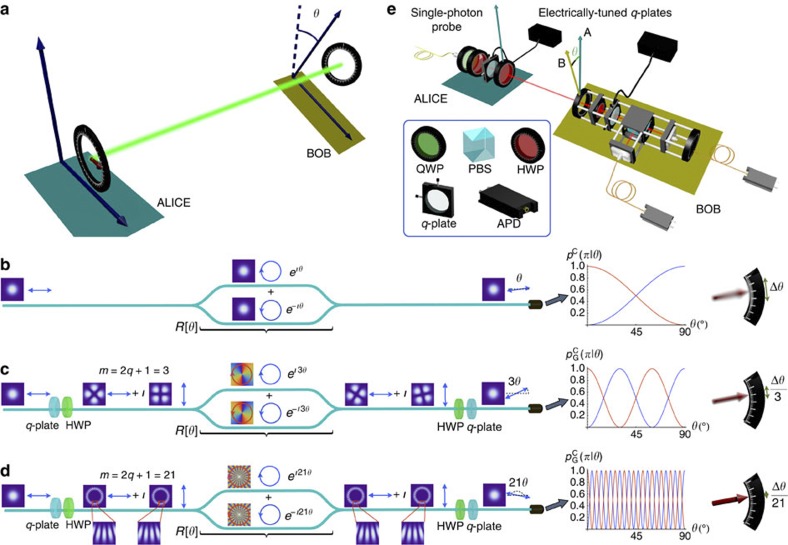
- A q-plate generates SAM–OAM superpositions with m=2q±1 quanta of total angular momentum; q-plates with q up to 50 produced m as large as 101 (abstract states up to m=100), so a relative rotation θ becomes a polarization rotation mθ.
- In the single-photon regime, the maximum enhancement over the polarization-only strategy was ≈55; matching this precision would require 55²=3,025 more trials or polarization-only NOON states with N≈55 photons. The precision was attained for total photon numbers νN≈10² to 10⁴, and total losses with transmissivity η simply rescale the photon number to νNη, unlike NOON states where one lost photon destroys phase information.
- Two-photon entangled states with total angular momentum up to m₁+m₂=18 showed HH correlations with hybrid enhancement factor mN=mA+mB=2qA+2qB+2; a quantum enhancement factor of 2 was superimposed on the classical photonic gear effect.
- The gear effect also appeared with intense classical laser light; combining it with existing polarization-based roll-angle methods is predicted to improve sensitivity to 10⁻⁶ degrees (≈0.01 arcsec), from typical values of about 10⁻² degrees for 30–360° dynamic range or 10⁻⁴ degrees for ~1° range.
Methods
- q-plates were fabricated from nematic liquid crystals using photoalignment, with optical-axis orientation θ=qφ+α; q-plates map circular polarization to OAM changes of ±2q, and a half-wave plate yields m=2q±1 states.
- Single photons came from a Ti:sapphire mode-locked laser (120 fs pulses, 76 MHz, 795 nm), frequency-doubled to 397.5 nm at 700 mW, then type-II spontaneous parametric down-conversion in a 1.5 mm beta-barium-borate crystal, followed by filtering and single-mode fiber coupling.
- Experiments tested classical intense laser light, single-photon states, and two-photon entangled states; measurements used polarization fringes/super-resolving Malus law and HH correlations, with statistical errors compared to shot-noise and Heisenberg limits.
Limitations
- Stated: experimental imperfections reduce fringe visibility; all curves showed visibility greater than 0.73, and loss of visibility increases the statistical error. The hybrid entangled strategy bears the same loss-sensitivity problems as polarization-only quantum strategies for large N, though these can be dealt with for small N.
- Stated/evident: the entangled demonstration is a proof-of-principle with N=2 and total angular momentum up to 18, not large N. High-q q-plate fabrication required finer rotation steps (up to 0.1° for q≥25) and careful control of the central defect, and the observed maximum enhancement ≈55 is below the full gear ratio m because of visibility and detection efficiency.
Model-written summary. Check it against the paper before relying on it.
Integrity signals
Registry
Cites
Statistics
Figures
Verification
Claims the paper makes
28 Own interpretation · 20 Own result · 10 No basis given · 4 Supported · 4 Partly supported · 4 Not checked yet · 1 Supported so far · 1 No full text of the sources · accuracy not yet measured
Every source the paper cites for this claim was checked and supports it.
In the paper
“The right-hand side is the standard quantum limit, and can always be reached in the asymptotic limit of large νN (ref. 1).”
§ Photonic polarization gears for ultra-sensitive angular measurements > Results > Photonic gear concept
What the sources say
- Supportedcites [1] Giovannetti, V., Lloyd, S. & Maccone, L. Advances in quantum metrology. Nat. Photon. 5, 222–229 (2011). source
The introduction (p. 1) says that averaging a large number of independent measurements yields the standard quantum limit’s 1/√n scaling. The interferometry section (p. 5) likewise describes standard procedures in which the νN photons contribute independently and achieve SQL scaling of 1/√(νN). (LLM, conf=0.88)
plaindirect- Asserted: passes — The authors put it forward as true.
- Checkable: passes — It can be checked against evidence.
- Load-bearing: passes — The paper’s conclusions depend on it.
- Based: passes — The paper gives a reason why it holds.
- Supported
The cited sources support only part of this claim — read each source’s verdict below.
In the paper
“Moreover, as N grows, N-photon entangled states become increasingly sensitive to losses, as the loss of a single photon is enough to destroy all the phase information11.”
§ Photonic polarization gears for ultra-sensitive angular measurements > Abstract
What the sources say
- Partly supportedcites [11] Dorner, U. et al. Optimal quantum phase estimation. Phys. Rev. Lett. 102, 040403 (2009). sourceExperimental — accuracy not yet measured
On p. 1, the paper says that losing one photon destroys the phase information in a N00N state. On p. 3, it reports that N00N-state precision worsens at larger photon numbers, but also describes other states designed so that losing a photon does not completely destroy coherence. The claim overgeneralizes the single-photon result from N00N states to N-photon entangled states generally. (LLM, conf=0.88)
plaindirect- Asserted: passes — The authors put it forward as true.
- Checkable: passes — It can be checked against evidence.
- Load-bearing: passes — The paper’s conclusions depend on it.
- Based: passes — The paper gives a reason why it holds.
- Partly supported
The cited sources support only part of this claim — read each source’s verdict below.
In the paper
“To our knowledge, this constitutes the highest precision per-particle reported so far47918.”
§ Photonic polarization gears for ultra-sensitive angular measurements > Discussion
What the sources say
- Partly supportedcites [4] Nagata, T., Okamoto, R., O‘Brien, J. L., Sasaki, K. & Takeuchi, S. Beating the standard quantum limit with four-entangled photons. Science 316, 726–729 (2007). sourceExperimental — accuracy not yet measured
The paper’s Abstract (page unavailable) reports a four-photon phase measurement that beats the standard quantum limit and says earlier demonstrations had done so only with two photons. It does not establish that this was the highest precision per particle reported so far; it also notes that source and detector inefficiencies meant many photons passed through the interferometer without contributing to a detection event. (LLM, conf=0.78)
- Not checked — no full text of the sourcecites [7] Leibfried, D. et al. Creation of a six-atom ‘Schrödinger cat’ state. Nature 438, 639–642 (2005). source
- Could not verifycites [9] Jones, J. A. et al. Magnetic field sensing beyond the standard quantum limit using 10-spin NOON states. Science 324, 1166–1168 (2009). sourceExperimental — accuracy not yet measured
The cited paper reports a 9.4-fold enhancement in magnetic-field sensitivity for its 10-spin state (Abstract, page unavailable). The passages found for “highest precision per-particle” and related terms do not establish that the citing authors’ result was the highest precision per particle reported so far. (LLM, conf=0.73)
hedged- Asserted: passes — The authors put it forward as true.
- Checkable: passes — It can be checked against evidence.
- Load-bearing: passes — The paper’s conclusions depend on it.
- Based: passes — The paper gives a reason why it holds.
- Partly supported
The cited sources support only part of this claim — read each source’s verdict below.
In the paper
“It has been proved that, in the presence of losses or other types of noise, no two-mode quantum state can beat the standard limit by more than just a constant factor in the limit of large N12131415.”
§ Photonic polarization gears for ultra-sensitive angular measurements > Abstract
What the sources say
- Partly supportedcites [12] Kołodyński, J. & Demkowicz-Dobrzański, R. Phase estimation without a priori phase knowledge in the presence of loss. Phys. Rev. A 82, 053804 (2010). sourceExperimental — accuracy not yet measured
The Introduction (p. 1) proves that, for phase estimation with loss, quantum strategies retain the standard-limit 1/√N scaling as N grows and gain only a smaller multiplicative constant. The Model (p. 1) specifies a two-mode photon state. The paper does not establish the sentence’s extension to other types of noise. (LLM, conf=0.87)
- Partly supportedcites [13] Escher, B., Matos Filho, R. L. & Davidovich, L. General framework for estimating the ultimate precision limit in noisy quantum-enhanced metrology. Nat. Phys. 7, 406–411 (2011). sourceExperimental — accuracy not yet measured
The section on lossy optical interferometry (p. 4) says that, even with the best strategy, losses limit the asymptotic improvement over standard light sources to a constant factor. The paper also establishes this behavior for dephasing (p. 5), but its introduction (p. 1) says the limit is not known in general for noisy processes. The claim is therefore too broad if “other types of noise” means noise of any kind. (LLM, conf=0.86)
- Partly supportedcites [14] Knysh, S., Smelyanskiy, V. N. & Durkin, G. A. Scaling laws for precision in quantum interferometry and bifurcation landscape of optimal state. Phys. Rev. A 83, 021804(R) (2011). sourceExperimental — accuracy not yet measured
The discussion on p. 2 states that, for fixed nonzero photon loss, the upper bound on quantum Fisher information scales linearly with N, matching shot-noise scaling up to a constant factor. The paper studies losses in one or both modes and notes broader applications of dissipation (p. 4), but it does not establish this bound for every other type of noise. (LLM, conf=0.86)
boosted- Asserted: passes — The authors put it forward as true.
- Checkable: passes — It can be checked against evidence.
- Load-bearing: passes — The paper’s conclusions depend on it.
- Based: passes — The paper gives a reason why it holds.
- Partly supported
Every source the paper cites for this claim was checked and supports it.
In the paper
“The right-hand side is now the Heisenberg limit, which can always be reached in the asymptotic limit of large ν (ref. 1).”
§ Photonic polarization gears for ultra-sensitive angular measurements > Results > Photonic gear concept
What the sources say
- Supportedcites [1] Giovannetti, V., Lloyd, S. & Maccone, L. Advances in quantum metrology. Nat. Photon. 5, 222–229 (2011). source
In “Quantum parameter estimation for channels” (p. 4), the paper calls the right-hand term the Heisenberg bound and says that this threshold is asymptotically attainable for ν ≫ 1. “Applications in Quantum interferometry” (p. 5) likewise says its corresponding bound is achievable for any given N in the limit of large ν. (LLM, conf=0.92)
plaindirect- Asserted: passes — The authors put it forward as true.
- Checkable: passes — It can be checked against evidence.
- Load-bearing: passes — The paper’s conclusions depend on it.
- Based: passes — The paper gives a reason why it holds.
- Supported
A result the paper reports from its own data — it cites no other source for it, so there is none to check. The quote shows it is in the paper.
In the paper
“In addition, we demonstrated ultra-sensitive two-photon entangled probes tailored for different target estimations.”
§ Photonic polarization gears for ultra-sensitive angular measurements > Discussion
boosted- Asserted: passes — The authors put it forward as true.
- Checkable: passes — It can be checked against evidence.
- Load-bearing: passes — The paper’s conclusions depend on it.
- Based: passes — The paper gives a reason why it holds.
A result the paper reports from its own data — it cites no other source for it, so there is none to check. The quote shows it is in the paper.
In the paper
“Furthermore, in Supplementary Fig. S2 and Supplementary Note 2, we discuss a three-step adaptive protocol which permits efficient and unambiguous estimation of such θ even when it is a completely unknown rotation in the full [0, 2π] interval.”
§ Photonic polarization gears for ultra-sensitive angular measurements > Results > Experimental single-photon gear enhancement
plaindirect- Asserted: passes — The authors put it forward as true.
- Checkable: passes — It can be checked against evidence.
- Load-bearing: passes — The paper’s conclusions depend on it.
- Based: passes — The paper gives a reason why it holds.
A result the paper reports from its own data — it cites no other source for it, so there is none to check. The quote shows it is in the paper.
In the paper
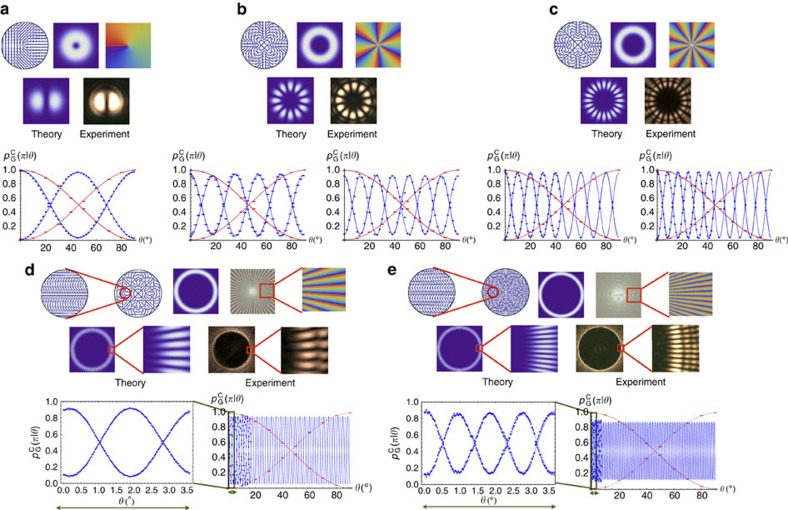
“Here we demonstrate NOON-like photonic states of m quanta of angular momentum up to m=100, in a setup that acts as a ‘photonic gear’, converting, for each photon, a mechanical rotation of an angle θ into an amplified rotation of the optical polarization by mθ, corresponding to a ‘super-resolving’ Malus’ law.”
§ Photonic polarization gears for ultra-sensitive angular measurements > Abstract
boosteddirect- Asserted: passes — The authors put it forward as true.
- Checkable: passes — It can be checked against evidence.
- Load-bearing: passes — The paper’s conclusions depend on it.
- Based: passes — The paper gives a reason why it holds.
A result the paper reports from its own data — it cites no other source for it, so there is none to check. The quote shows it is in the paper.
In the paper
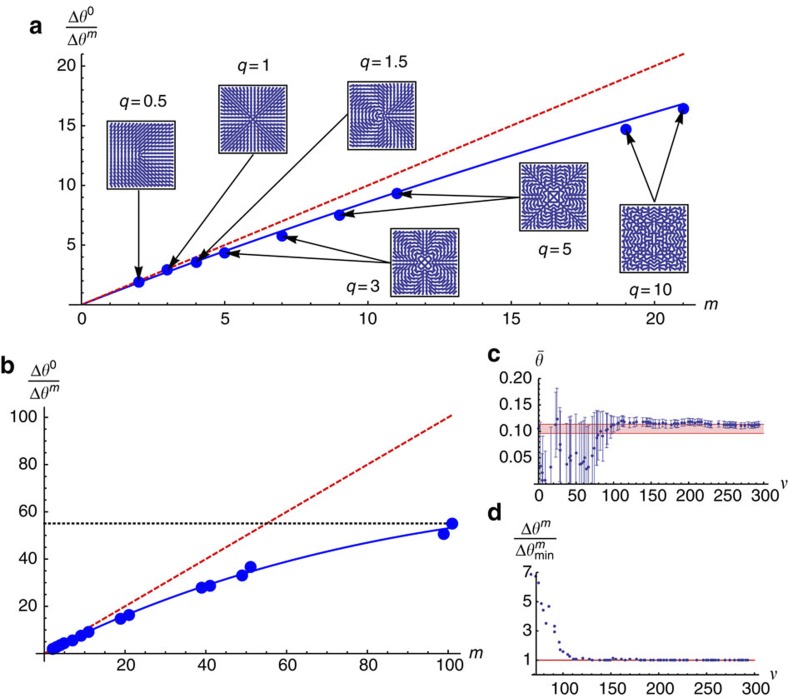
“Notably, rather than in an asymptotic limit, this precision was attained already for total photon numbers as small as νN ≈102 to 104.”
§ Photonic polarization gears for ultra-sensitive angular measurements > Discussion
plain- Asserted: passes — The authors put it forward as true.
- Checkable: passes — It can be checked against evidence.
- Load-bearing: passes — The paper’s conclusions depend on it.
- Based: passes — The paper gives a reason why it holds.
A result the paper reports from its own data — it cites no other source for it, so there is none to check. The quote shows it is in the paper.
In the paper
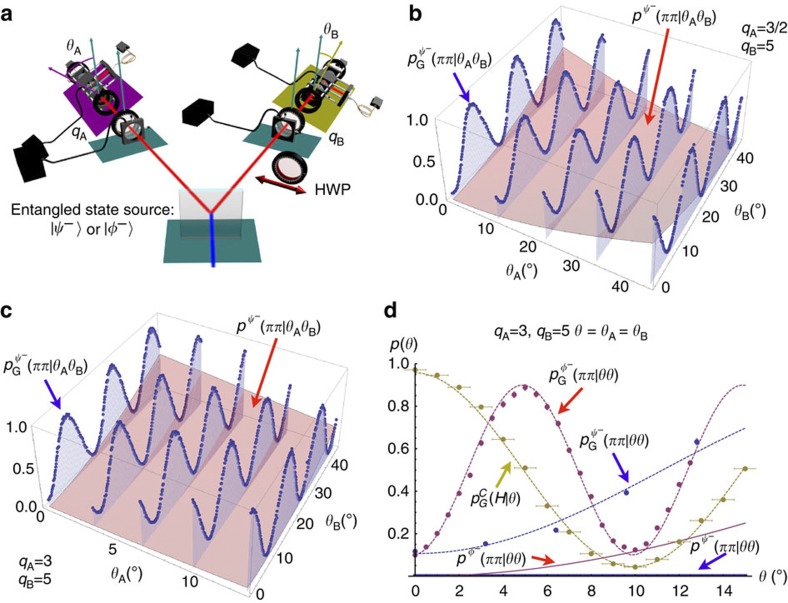
“We demonstrate two-photon entangled states where each photon has a different total angular momentum, m1 and m2, with a maximum of m1+m2=18.”
§ Photonic polarization gears for ultra-sensitive angular measurements > Results > Experimental photonic gears on two-photon entangled states
boosted- Asserted: passes — The authors put it forward as true.
- Checkable: passes — It can be checked against evidence.
- Load-bearing: passes — The paper’s conclusions depend on it.
- Based: passes — The paper gives a reason why it holds.
- It may state two separate claims as one. 23
- Probably not a substantial claim. 8
The cited sources support only part of this claim — read each source’s verdict below.
In the paper
“The key element for our photon state manipulations is the q-plate, a novel liquid crystal (LC) device that efficiently maps pure polarization states into hybrid SAM–OAM states and vice versa242526”
§ Photonic polarization gears for ultra-sensitive angular measurements > Results > Photonic gear concept
What the sources say
- Partly supportedcites [24] Marrucci, L., Manzo, C. & Paparo, D. Optical spin-to-orbital angular momentum conversion in inhomogeneous anisotropic media. Phys. Rev. Lett. 96, 163905 (2006). sourceExperimental — accuracy not yet measured
The q-plate analysis (p. 3) shows that circular input polarization produces an output with changed polarization and orbital angular momentum, and the experiment (p. 5) verifies the helical output. The copy does not demonstrate the reverse mapping from hybrid SAM–OAM states to pure polarization states. It also notes residual unchanged polarization in the experimental output, so it does not establish efficient conversion without the specified half-wave-retardation condition. (LLM, conf=0.84)
- Supportedcites [25] Nagali, E. et al. Quantum information transfer from spin to orbital angular momentum of photons. Phys. Rev. Lett. 103, 013601 (2009). source
The paper describes the q-plate’s coupling of polarization and OAM, including generation of an entangled state from a polarization input (p. 1). It reports approximately 85% conversion efficiency (p. 1) and demonstrates transfer in both directions using q-plate-based arrangements (p. 3). The full information-transfer arrangements are probabilistic, rather than deterministic. (LLM, conf=0.90)
- Supportedcites [26] Marrucci, L. et al. Spin-to-orbital conversion of the angular momentum of light and its classical and quantum applications. J. Opt. 13, 064001 (2011). source
Section 5 gives the q-plate’s action on photon states: at optimal tuning, a purely polarized input with zero OAM becomes a hybrid SAM–OAM state. The same transformation rules map that resulting state back to a pure polarization state. Section 2 reports optimal conversion efficiency exceeding 99% before reflection and diffraction losses. (LLM, conf=0.90)
plaindirect- Asserted: passes — The authors put it forward as true.
- Checkable: passes — It can be checked against evidence.
- Load-bearing: passes — The paper’s conclusions depend on it.
- Based: passes — The paper gives a reason why it holds.
It may state two separate claims as one.
- Partly supported
The sources with a verdict support this claim; the rest weren’t checked yet, have no full text we could read, or their verdicts aren’t rated yet.
In the paper
“In addition to metrological applications, the capability we have demonstrated to efficiently generate and detect hybrid polarization−OAM quantum states with very large OAM creates interesting prospects for high-rate classical communication33, coupling with atomic systems34, quantum information processing35 and fundamental tests of quantum mechanics3637.”
§ Photonic polarization gears for ultra-sensitive angular measurements > Discussion
What the sources say
- Not checked — no full text of the sourcecites [33] Wang, J. et al. Terabit free-space data transmission employing orbital angular momentum multiplexing. Nat. Photon 6, 488–496 (2012). source
- Supportedcites [34] Andersen, M. F. et al. Quantized rotation of atoms from photons with orbital angular momentum. Phys. Rev. Lett. 97, 170406 (2006). source
Citation 34 is attached to the prospect of coupling with atomic systems, not to the citing authors’ own demonstration of hybrid polarization–OAM states. The source’s Abstract reports coherent transfer of photon OAM to sodium atoms in a Bose–Einstein condensate, directly supporting that prospect. (LLM, conf=0.91)
- Supportedcites [35] Dada, A. C., Leach, J., Buller, G. S., Padgett, M. J. & Andersson, E. Experimental high-dimensional two-photon entanglement and violations of generalized Bell inequalities. Nat. Phys. 7, 677–680 (2011). source
Split into 2 atoms — 2 confirmed, 0 partially supported, 0 disputed, 0 misattributed, 0 unverifiable. Expand the claim to see per-atom verdicts.
hedged- Asserted: passes — The authors put it forward as true.
- Checkable: fails — It may be too vague to check against evidence.
- Load-bearing: fails — The paper’s conclusions may not depend on it.
- Based: passes — The paper gives a reason why it holds.
Probably not a substantial claim. It may be too vague to check against evidence. The paper’s conclusions may not depend on it. It may state two separate claims as one.
Every source the paper cites for this claim was checked and supports it.
In the paper
“Remarkably, using certain N-particle entangled states it could be possible to attain a precision that scales as N. This is known as the Heisenberg limit, and is the ultimate bound set by the laws of quantum mechanics1.”
§ Photonic polarization gears for ultra-sensitive angular measurements > Abstract
What the sources say
- Supportedcites [1] Giovannetti, V., Lloyd, S. & Maccone, L. Advances in quantum metrology. Nat. Photon. 5, 222–229 (2011). source
The Applications in Quantum interferometry section (p. 5) says suitable states can achieve error scaling as N⁻¹, equivalent to precision scaling as N. The introduction (p. 1) describes Heisenberg bounds as ultimate limits on precision set by quantum mechanics. (LLM, conf=0.92)
hedgedconditional- Asserted: passes — The authors put it forward as true.
- Checkable: passes — It can be checked against evidence.
- Load-bearing: passes — The paper’s conclusions depend on it.
- Based: passes — The paper gives a reason why it holds.
Probably not a substantial claim.
- Supported
Every source the paper cites for this claim was checked and supports it.
In the paper
“When inserting the photonic gears between polarizers, we observe a ‘super-resolving’ Malus’ law, reminiscent of the polarization correlations visible with multi-photon quantum states23, but which appears in both the classical light or single photon regimes.”
§ Photonic polarization gears for ultra-sensitive angular measurements > Abstract
What the sources say
- Supportedcites [23] Leach, J. et al. Violation of a Bell inequality in two-dimensional orbital angular momentum state-spaces. Opt. Express. 17, 8287–8293 (2009). source
The citation is attached to the comparison with two-photon polarization correlations, not to the citing authors’ observation with photonic gears. The source derives a cos² angular dependence for correlated photon pairs and says that the angle between its OAM phase patterns is equivalent to the angle between polarizers in polarization Bell experiments (passages 6 and 3). (LLM, conf=0.86)
plaindirectn = 2- Asserted: passes — The authors put it forward as true.
- Checkable: passes — It can be checked against evidence.
- Load-bearing: passes — The paper’s conclusions depend on it.
- Based: passes — The paper gives a reason why it holds.
It may state two separate claims as one.
- Supported
A result the paper reports from its own data — it cites no other source for it, so there is none to check. The quote shows it is in the paper.
In the paper
“Figure 2 shows the polarization fringes obtained for several values of q, corresponding to the ‘super-resolving’ Malus’ law (5).”
§ Photonic polarization gears for ultra-sensitive angular measurements > Results > Experimental single-photon gear enhancement
plaincorrelational- Asserted: passes — The authors put it forward as true.
- Checkable: passes — It can be checked against evidence.
- Load-bearing: passes — The paper’s conclusions depend on it.
- Based: passes — The paper gives a reason why it holds.
Probably not a substantial claim.
A result the paper reports from its own data — it cites no other source for it, so there is none to check. The quote shows it is in the paper.
In the paper
“The enhancement in oscillation frequency in both the θA and the θB directions with respect to the polarization-only case is clearly observed and matches our theoretical predictions.”
§ Photonic polarization gears for ultra-sensitive angular measurements > Results > Experimental photonic gears on two-photon entangled states
boostedcorrelational- Asserted: passes — The authors put it forward as true.
- Checkable: passes — It can be checked against evidence.
- Load-bearing: passes — The paper’s conclusions depend on it.
- Based: passes — The paper gives a reason why it holds.
It may state two separate claims as one.
The paper states this without a source or data behind it here, so there is nothing to check it against. The quote shows it is in the paper.
In the paper
“Finally, Bob measures the probability of detecting the H linear polarization conditioned on θ as in the classical strategy. This is again given by Malus’ law: but shows now the m-fold resolution enhancement over the polarization-only strategy.”
§ Photonic polarization gears for ultra-sensitive angular measurements > Results > Photonic gear concept
plaindirect- Asserted: passes — The authors put it forward as true.
- Checkable: passes — It can be checked against evidence.
- Load-bearing: passes — The paper’s conclusions depend on it.
- Based: passes — The paper gives a reason why it holds.
It may state two separate claims as one.
A result the paper reports from its own data — it cites no other source for it, so there is none to check. The quote shows it is in the paper.
In the paper
“In Supplementary Fig. S2, we also show that the initial phase of the oscillation can be tuned by choosing the appropriate input polarization state, and that this allows one in turn to optimize the sensitivity for any angle θ.”
§ Photonic polarization gears for ultra-sensitive angular measurements > Results > Experimental single-photon gear enhancement
plaindirect- Asserted: passes — The authors put it forward as true.
- Checkable: passes — It can be checked against evidence.
- Load-bearing: unclear — It is unclear whether the paper’s conclusions depend on it.
- Based: passes — The paper gives a reason why it holds.
It may state two separate claims as one.
A result the paper reports from its own data — it cites no other source for it, so there is none to check. The quote shows it is in the paper.
In the paper
“The hybrid quantum-classical sensitivity enhancement by the factor mN=mA+mB=2qA+2qB+2 is clearly observed, confirming again our predictions.”
§ Photonic polarization gears for ultra-sensitive angular measurements > Results > Experimental photonic gears on two-photon entangled states
boosteddirect- Asserted: passes — The authors put it forward as true.
- Checkable: passes — It can be checked against evidence.
- Load-bearing: passes — The paper’s conclusions depend on it.
- Based: passes — The paper gives a reason why it holds.
It may state two separate claims as one.
A result the paper reports from its own data — it cites no other source for it, so there is none to check. The quote shows it is in the paper.
In the paper
“We perform a proof-of-principle demonstration with N=2 and total angular momentum up to 18.”
§ Photonic polarization gears for ultra-sensitive angular measurements > Abstract
plainn = 2- Asserted: passes — The authors put it forward as true.
- Checkable: passes — It can be checked against evidence.
- Load-bearing: passes — The paper’s conclusions depend on it.
- Based: passes — The paper gives a reason why it holds.
It may state two separate claims as one.
The paper states this without a source or data behind it here, so there is nothing to check it against. The quote shows it is in the paper.
In the paper
“Here, we introduce a new family of devices with q ranging up to 50, producing angular momentum values as large as m=101.”
§ Photonic polarization gears for ultra-sensitive angular measurements > Results > Photonic gear concept
plaindirect- Asserted: passes — The authors put it forward as true.
- Checkable: passes — It can be checked against evidence.
- Load-bearing: passes — The paper’s conclusions depend on it.
- Based: passes — The paper gives a reason why it holds.
It may state two separate claims as one.
A result the paper reports from its own data — it cites no other source for it, so there is none to check. The quote shows it is in the paper.
In the paper
“In particular, we produce a quantum state that is metrologically equivalent to a NOON state, leading to a hybrid quantum-classical enhancement of the angular sensitivity.”
§ Photonic polarization gears for ultra-sensitive angular measurements > Abstract
plaindirectn = 2- Asserted: passes — The authors put it forward as true.
- Checkable: passes — It can be checked against evidence.
- Load-bearing: passes — The paper’s conclusions depend on it.
- Based: passes — The paper gives a reason why it holds.
It may state two separate claims as one.
A conclusion the paper draws from its own results — it cites no other source for it, so there is none to check. The quote shows it is in the paper.
In the paper
“However, for small N, these problems can still be efficiently dealt with and interesting applications can be achieved, as we demonstrate below.”
§ Photonic polarization gears for ultra-sensitive angular measurements > Results > Combining photonic gears and quantum enhancement
plainconditional- Asserted: passes — The authors put it forward as true.
- Checkable: passes — It can be checked against evidence.
- Load-bearing: passes — The paper’s conclusions depend on it.
- Based: unclear — It is unclear why the paper says it holds.
It may state two separate claims as one.
A conclusion the paper draws from its own results — it cites no other source for it, so there is none to check. The quote shows it is in the paper.
In the paper
“The dynamical range is also reduced by a similar factor, but the full dynamical range can be recovered by the adaptive protocol discussed in Supplementary Note 2.”
§ Photonic polarization gears for ultra-sensitive angular measurements > Results > Experimental single-photon gear enhancement
plaindirect- Asserted: passes — The authors put it forward as true.
- Checkable: passes — It can be checked against evidence.
- Load-bearing: passes — The paper’s conclusions depend on it.
- Based: passes — The paper gives a reason why it holds.
It may state two separate claims as one.
None of the sources cited for this claim have been checked yet.
In the paper
“In photonic approaches, the optimal measurement strategy typically relies on the preparation of ‘NOON’ states10, in which all N photons propagate in one arm or the other of an interferometer.”
§ Photonic polarization gears for ultra-sensitive angular measurements > Abstract
What the sources say
- Not checked yetcites [10] Lee, H., Kok, P. & Dowling, J. P. A quantum Rosetta stone for interferometry. J. Mod. Opt. 49, 2325–2338 (2002). source
Checked before — its earlier verdict is held back until a new check runs.
plain- Asserted: passes — The authors put it forward as true.
- Checkable: passes — It can be checked against evidence.
- Load-bearing: passes — The paper’s conclusions depend on it.
- Based: passes — The paper gives a reason why it holds.
Probably not a substantial claim.
- Not checked yet
A conclusion the paper draws from its own results — it cites no other source for it, so there is none to check. The quote shows it is in the paper.
In the paper
“In particular, for N=2 photons, θ can be estimated from the HH-correlation measurements with just half the efficiency as from , which would require two-photon interference detection. Full efficiency in the estimation process can be recovered by simply registering and considering the four possible two-photon polarization correlations (HH,HV,VH,VV), which requires no extra measurements.”
§ Photonic polarization gears for ultra-sensitive angular measurements > Results > Combining photonic gears and quantum enhancement
plaindirectn = 2- Asserted: passes — The authors put it forward as true.
- Checkable: passes — It can be checked against evidence.
- Load-bearing: passes — The paper’s conclusions depend on it.
- Based: passes — The paper gives a reason why it holds.
It may state two separate claims as one.
A conclusion the paper draws from its own results — it cites no other source for it, so there is none to check. The quote shows it is in the paper.
In the paper
“These values provide substantial progress over the current state of the art.”
§ Photonic polarization gears for ultra-sensitive angular measurements > Discussion
plain- Asserted: passes — The authors put it forward as true.
- Checkable: fails — It may be too vague to check against evidence.
- Load-bearing: passes — The paper’s conclusions depend on it.
- Based: passes — The paper gives a reason why it holds.
Probably not a substantial claim. It may be too vague to check against evidence.
None of the sources cited for this claim have been checked yet.
In the paper
“Previous achievements were limited to q-plates with low q (up to 3)27.”
§ Photonic polarization gears for ultra-sensitive angular measurements > Results > Photonic gear concept
What the sources say
- Not checked yetcites [27] Slussarenko, S. et al. Tunable liquid crystal q-plates with arbitrary topological charge. Opt. Express. 19, 4085–4090 (2011). source
Checked before — its earlier verdict is held back until a new check runs.
plain- Asserted: passes — The authors put it forward as true.
- Checkable: passes — It can be checked against evidence.
- Load-bearing: fails — The paper’s conclusions may not depend on it.
- Based: passes — The paper gives a reason why it holds.
Probably not a substantial claim. The paper’s conclusions may not depend on it.
- Not checked yet
None of the sources cited for this claim have been checked yet.
In the paper
“However, the experimental preparation of NOON states with large N is extremely challenging, and to date only N=3, 4 and 5 photonic NOON states have been reported2345.”
§ Photonic polarization gears for ultra-sensitive angular measurements > Abstract
What the sources say
- Not checked — no full text of the sourcecites [2] Mitchell, M. W., Lundeen, J. S. & Steinberg, A. M. Super-resolving phase measurements with a multiphoton entangled state. Nature 429, 161–164 (2004). source
- Not checked yetcites [3] Walther, P., Pan, J.-W., Aspelmeyer, M., Ursin, R., Gasparoni, S. & Zeilinger, A. De Broglie wavelength of a non-local four-photon state. Nature 429, 158–161 (2004). source
- Not checked yetcites [4] Nagata, T., Okamoto, R., O‘Brien, J. L., Sasaki, K. & Takeuchi, S. Beating the standard quantum limit with four-entangled photons. Science 316, 726–729 (2007). source
Checked before — its earlier verdict is held back until a new check runs.
plainn = 3- Asserted: passes — The authors put it forward as true.
- Checkable: passes — It can be checked against evidence.
- Load-bearing: passes — The paper’s conclusions depend on it.
- Based: passes — The paper gives a reason why it holds.
It may state two separate claims as one.
A conclusion the paper draws from its own results — it cites no other source for it, so there is none to check. The quote shows it is in the paper.
In the paper
“To obtain the same precision Δθ with the polarization-only classical strategy, one would have to increase the number of trials by a factor of 552=3,025, whereas for the polarization-only quantum NOON-state strategy, one would require entangled states of N ≈55 photons each.”
§ Photonic polarization gears for ultra-sensitive angular measurements > Results > Experimental single-photon gear enhancement
hedgeddirect- Asserted: passes — The authors put it forward as true.
- Checkable: passes — It can be checked against evidence.
- Load-bearing: passes — The paper’s conclusions depend on it.
- Based: passes — The paper gives a reason why it holds.
It may state two separate claims as one.
A conclusion the paper draws from its own results — it cites no other source for it, so there is none to check. The quote shows it is in the paper.
In the paper
“Notably, in this regime every photon is disentangled from all others and hence the loss of a photon does not affect the overall phase coherence, making the scheme loss-robust.”
§ Photonic polarization gears for ultra-sensitive angular measurements > Abstract
plaindirect- Asserted: passes — The authors put it forward as true.
- Checkable: passes — It can be checked against evidence.
- Load-bearing: passes — The paper’s conclusions depend on it.
- Based: passes — The paper gives a reason why it holds.
It may state two separate claims as one.
The paper states this without a source or data behind it here, so there is nothing to check it against. The quote shows it is in the paper.
In the paper
“Depending on the details of the scheme, this typically leads to a sensitivity of about 10−2 degrees for a dynamical range of 30–360°, or about 10−4 degrees when restricting the range to ~1°.”
§ Photonic polarization gears for ultra-sensitive angular measurements > Results > Experimental single-photon gear enhancement
plaindirect- Asserted: passes — The authors put it forward as true.
- Checkable: passes — It can be checked against evidence.
- Load-bearing: passes — The paper’s conclusions depend on it.
- Based: passes — The paper gives a reason why it holds.
It may state two separate claims as one.
A conclusion the paper draws from its own results — it cites no other source for it, so there is none to check. The quote shows it is in the paper.
In the paper
“Thus, ideally, this strategy features the Heisenberg precision scaling for hybrid SAM–OAM approaches, but it bears in practice the same loss-sensitivity problems as the polarization-only quantum strategy.”
§ Photonic polarization gears for ultra-sensitive angular measurements > Results > Combining photonic gears and quantum enhancement
plaindirect- Asserted: passes — The authors put it forward as true.
- Checkable: passes — It can be checked against evidence.
- Load-bearing: passes — The paper’s conclusions depend on it.
- Based: passes — The paper gives a reason why it holds.
It may state two separate claims as one.
A conclusion the paper draws from its own results — it cites no other source for it, so there is none to check. The quote shows it is in the paper.
In the paper
“We anticipate that immediate application of the photonic-gear concept in a classical regime can improve current polarization-based methods for measuring roll angles to a sensitivity of less than 0.01 arcsec.”
§ Photonic polarization gears for ultra-sensitive angular measurements > Discussion
plaindirect- Asserted: passes — The authors put it forward as true.
- Checkable: passes — It can be checked against evidence.
- Load-bearing: passes — The paper’s conclusions depend on it.
- Based: fails — The paper may give no reason why it holds.
Probably not a substantial claim. The paper may give no reason why it holds.
In the paper
“Second, as state (3) does not bear any multi-photon coherences, losses reduce the total number of photons, but leave the remaining ones unaltered. That is, total losses characterized by an overall transmissivity 0≤ η ≤1 enter as a constant multiplicative factor, simply rescaling in equation (6) the total number of photons to νNη (see Supplementary Note 1), in striking contrast to NOON states11.”
§ Photonic polarization gears for ultra-sensitive angular measurements > Results > Photonic gear concept
What the sources say
- Not checked yetcites [11] Dorner, U. et al. Optimal quantum phase estimation. Phys. Rev. Lett. 102, 040403 (2009). source
plaindirect- Asserted: passes — The authors put it forward as true.
- Checkable: passes — It can be checked against evidence.
- Load-bearing: passes — The paper’s conclusions depend on it.
- Based: passes — The paper gives a reason why it holds.
It may state two separate claims as one.
A conclusion the paper draws from its own results — it cites no other source for it, so there is none to check. The quote shows it is in the paper.
In the paper
“All these polarization-based methods, irrespective of the details, can be combined with our photonic gear tool without changes. Their sensitivity is therefore predicted to be improved approximately by the factor m × Vm, which we have shown can be made larger than 50.”
§ Photonic polarization gears for ultra-sensitive angular measurements > Results > Experimental single-photon gear enhancement
boosteddirect- Asserted: passes — The authors put it forward as true.
- Checkable: passes — It can be checked against evidence.
- Load-bearing: passes — The paper’s conclusions depend on it.
- Based: passes — The paper gives a reason why it holds.
It may state two separate claims as one.
A conclusion the paper draws from its own results — it cites no other source for it, so there is none to check. The quote shows it is in the paper.
In the paper
“Choosing qA=qB, one can, for example, use these correlations (in combination with classical communication channels) to precisely estimate the relative misalignment θA–θB and remotely align the two distant frames.”
§ Photonic polarization gears for ultra-sensitive angular measurements > Results > Combining photonic gears and quantum enhancement
plaindirect- Asserted: passes — The authors put it forward as true.
- Checkable: passes — It can be checked against evidence.
- Load-bearing: passes — The paper’s conclusions depend on it.
- Based: passes — The paper gives a reason why it holds.
It may state two separate claims as one.
A conclusion the paper draws from its own results — it cites no other source for it, so there is none to check. The quote shows it is in the paper.
In the paper
“Their statistical error is now bounded as follows: and can always saturate the bound in the asymptotic limit of large νN, as shown in Supplementary Note 1. This represents an improvement over the standard limit (1) for polarization-only strategies by a factor of m.”
§ Photonic polarization gears for ultra-sensitive angular measurements > Results > Photonic gear concept
plaindirect- Asserted: passes — The authors put it forward as true.
- Checkable: passes — It can be checked against evidence.
- Load-bearing: passes — The paper’s conclusions depend on it.
- Based: passes — The paper gives a reason why it holds.
It may state two separate claims as one.
A conclusion the paper draws from its own results — it cites no other source for it, so there is none to check. The quote shows it is in the paper.
In the paper
“We show that this effect leads to single-photon angular measurements with the same precision of polarization-only quantum strategies with m photons, but robust to photon losses.”
§ Photonic polarization gears for ultra-sensitive angular measurements > Abstract
boosteddirect- Asserted: passes — The authors put it forward as true.
- Checkable: passes — It can be checked against evidence.
- Load-bearing: passes — The paper’s conclusions depend on it.
- Based: passes — The paper gives a reason why it holds.
It may state two separate claims as one.
A conclusion the paper draws from its own results — it cites no other source for it, so there is none to check. The quote shows it is in the paper.
In the paper
“The same result can be generalized to N-photon entangled states.”
§ Photonic polarization gears for ultra-sensitive angular measurements > Results > Combining photonic gears and quantum enhancement
plainn = 2- Asserted: passes — The authors put it forward as true.
- Checkable: passes — It can be checked against evidence.
- Load-bearing: passes — The paper’s conclusions depend on it.
- Based: fails — The paper may give no reason why it holds.
Probably not a substantial claim. The paper may give no reason why it holds.
The authors state this as an assumption.
The photons are generated in the maximally entangled polarization Bell state.
“let us assume that the photons are generated in the maximally entangled polarization Bell state”
Claims other papers make about this one
Each is checked against this paper’s own text: does it say what the citing paper says it does?
The source backs part of the claim, not all of it — or backs it for a different population, condition or comparison.
In the citing paper
“In particular, the QP raises or lowers the OAM of the incoming photon according to its SAM state, while leaving the photon in the same optical beam, that is, with no deflections or diffractions.”
From Quantum walks and wavepacket dynamics on a lattice with twisted photons (2015) · cites this paper as [33]
Experimental — accuracy not yet measured
Self-check
Percentages, sums and reported differences re-computed from the paper’s own numbers.
Each contradiction between two passages listed here was confirmed by an independent check.
Rated minor: it would not touch a result — a value no result rests on, a p-value that stays on the same side of the significance level, or a conflict that is clerical, resolved elsewhere in the paper, or outside its own findings.
In the paper
§ Photonic polarization gears for ultra-sensitive angular measurements > Abstract
“Here we demonstrate NOON-like photonic states of m quanta of angular momentum up to m=100”
§ Photonic polarization gears for ultra-sensitive angular measurements > Results > Photonic gear concept
“Here, we introduce a new family of devices with q ranging up to 50, producing angular momentum values as large as m=101.”
Citations
Cites
Terabit free-space data transmission employing orbital angular momentum multiplexing
Wang, J., Yang, J.-Y., Fazal, I. M., Ahmed, N., Yan, Y., Huang, H., Ren, Y., Yue, Y., Dolinar, S., Tur, M., et al. (2012) · Nature Photonics · doi:10.1038/nphoton.2012.138 · Cited by 4,633
Giovannetti, V., Lloyd, S., & Maccone, L. (2011) · Nature Photonics · doi:10.1038/nphoton.2011.35 · Cited by 3,894
Optical Spin-to-Orbital Angular Momentum Conversion in Inhomogeneous Anisotropic Media
Marrucci, L., Manzo, C., & Paparo, D. (2006) · Physical Review Letters · doi:10.1103/physrevlett.96.163905 · Cited by 2,115
Self-citationMolina‐Terriza, G., Torres, J. P., & Torner, L. (2007) · Nature Physics · doi:10.1038/nphys607 · Cited by 1,335
General framework for estimating the ultimate precision limit in noisy quantum-enhanced metrology
Escher, B. M., de Matos Filho, R. L., & Davidovich, L. (2011) · Nature Physics · doi:10.1038/nphys1958 · Cited by 928
Advances in optical angular momentum
Franke‐Arnold, S., Allen, L., & Padgett, M. J. (2008) · Laser & Photonics Review · doi:10.1002/lpor.200810007 · Cited by 921
Super-resolving phase measurements with a multiphoton entangled state
Mitchell, M. W., Lundeen, J. S., & Steinberg, A. M. (2004) · Nature · doi:10.1038/nature02493 · Cited by 830
Creation of a six-atom ‘Schrödinger cat’ state
Leibfried, D., Knill, E., Seidelin, S., Britton, J., Blakestad, R. B., Chiaverini, J., Hume, D. B., Itano, W. M., Jost, J. D., Langer, C., et al. (2005) · Nature · doi:10.1038/nature04251 · Cited by 805
Quantum Entanglement of High Angular Momenta
Fickler, R., Lapkiewicz, R., Plick, W. N., Krenn, M., Schaeff, C., Ramelow, S., & Zeilinger, A. (2012) · Science · doi:10.1126/science.1227193 · Cited by 800
The elusive Heisenberg limit in quantum-enhanced metrology
Demkowicz-Dobrzański, R., Kołodyński, J., & Guţă, M. (2012) · Nature Communications · doi:10.1038/ncomms2067 · Cited by 773
Cited by
Sorted by citations
Generating optical orbital angular momentum at visible wavelengths using a plasmonic metasurface
Karimi, E., Schulz, S. A., Leon, I. D., Qassim, H., Upham, J., & Boyd, R. W. (2014) · Light Science & Applications · doi:10.1038/lsa.2014.48 · Cited by 836
Photonic quantum information processing: a review
Flamini, F., Spagnolo, N., & Sciarrino, F. (2019) · Reports on Progress in Physics · doi:10.1088/1361-6633/aad5b2 · Cited by 770
Self-citationFree-Space Quantum Key Distribution by Rotation-Invariant Twisted Photons
Vallone, G., D’Ambrosio, V., Sponselli, A., Slussarenko, S., Marrucci, L., Sciarrino, F., & Villoresi, P. (2014) · Physical Review Letters · doi:10.1103/physrevlett.113.060503 · Cited by 442
Self-citationPolino, E., Valeri, M., Spagnolo, N., & Sciarrino, F. (2020) · AVS Quantum Science · doi:10.1116/5.0007577 · Cited by 443
Self-citationCharacterizing quantum channels with non-separable states of classical light
Ndagano, B., Perez-Garcia, B., Roux, F. S., McLaren, M., Rosales-Guzman, C., Zhang, Y., Mouane, O., Hernandez-Aranda, R. I., Konrad, T., & Forbes, A. (2017) · Nature Physics · doi:10.1038/nphys4003 · Cited by 325
Metadata
- Authors
- D'Ambrosio, V., Spagnolo, N., Del Re, L., Slussarenko, S., Li, Y., Kwek, L. C., Marrucci, L., Walborn, S. P., Aolita, L., & Sciarrino, F.
- Affiliations
- Sapienza University of Rome (IT)
- University of Naples Federico II (IT)
- Centre for Quantum Technologies (SG)
- Universidade Federal do Rio de Janeiro (BR)
- Institute of Photonic Sciences (ES)
- National Institute of Optics (IT)
- Corresponding author
- Sciarrino, Fabio
- ORCID
- Venue
- Nature Communications
- Published
- 2013-09-18
- Volume
- 4
- Issue
- 1
- Pages
- 2432-2432
- ISSN
- 2041-1723 (ISSN-L)
- PMC
- PMC3791460
- OpenAlex
- W2104690772
- Cited by
- 351
- References
- 44
- Citations by year
- 2026: 28 · 2025: 31 · 2024: 26 · 2023: 33 · 2022: 24 · 2021: 37 · 2020: 30 · 2019: 29 · 2018: 17 · 2017: 27 · 2016: 21 · 2015: 28 · 2014: 18 · 2013: 2
- FWCI
- 11.14
- Type
- journal article
- Language
- en
- Open access
- hybrid
- doi.org
- Licence
- Locations
- Nature Communications (publishedVersion, cc-by-nc-nd)
- Europe PMC (PubMed Central) (publishedVersion, cc-by-nc-nd)
- PubMed Central (publishedVersion, cc-by-nc-nd)
- PubMed (publishedVersion)
- arXiv (Cornell University) (submittedVersion)
- National University of Singapore (submittedVersion)
- RePEc: Research Papers in Economics (submittedVersion)
- IRIS Research product catalog (Sapienza University of Rome) (submittedVersion)
- Refubium (Universitätsbibliothek der Freien Universität Berlin) (submittedVersion, cc-by-nc-nd)
- Griffith Research Online (submittedVersion, cc-by-nc-nd)
- arXiv (Cornell University)
- Universitätsbibliothek der FU Berlin Hochschulschriftenstelle u. Dokumentenserver
- Funders
- European Commission (255914, 299141)
- National Research Foundation
- Conselho Nacional de Desenvolvimento Científico e Tecnológico
- Sapienza Università di Roma
- Fundação Carlos Chagas Filho de Amparo à Pesquisa do Estado do Rio de Janeiro
- Topics
- Physical Sciences › Physics and Astronomy › Atomic and Molecular Physics, and Optics › Quantum Information and Cryptography
- Physical Sciences › Physics and Astronomy › Atomic and Molecular Physics, and Optics › Orbital Angular Momentum in Optics
- Physical Sciences › Physics and Astronomy › Atomic and Molecular Physics, and Optics › Quantum Mechanics and Applications
- Keywords
- angular momentum of light, NOON states, super-resolution, Malus's law, quantum metrology, entanglement, photon loss robustness
About these checks
Registry, retraction, Cites and statistics results are computed, not judged, with one exception: a printed reference that no index lists is read once by a model before it counts as a citation error. Claims are extracted by a model and kept only when their quote appears verbatim in the text; each cited source is then checked, with a model’s help, for whether it says what the claim relies on. Those verdicts can be wrong — read the claim’s quote and the cited source before relying on one.
A language model drew the claims from the paper on 2026-11-10, under version 3 of the claim definition (model deepseek-v4.1-flash, prompt extract-v3).
A second model labelled each claim on 2026-11-10 (model jev-1.13-20260917, definition revision gold-guideline-v0.2).
Cited sources are checked with a language model’s help (gpt-6-sol).
Statistics and arithmetic are recomputed, not judged.
Confidence bands are shown only for fields calibrated on our annotated test set. None is calibrated yet, so no band is shown.
What counts as a claim ›How we measure confidence ›How we check this ›
Are you an author, or do you see a problem with this page? Request a review
