

A variational eigenvalue solver on a photonic quantum processor
Open accessThe DOI matches its Crossref record; 47 of the 48 references it cites were found in a registry or an index; 14 of the 31 sources its claims cite were checked for support.
Abstract
Quantum computers promise to efficiently solve important problems that are intractable on a conventional computer. For quantum systems, where the physical dimension grows exponentially, finding the eigenvalues of certain operators is one such intractable problem and remains a fundamental challenge. The quantum phase estimation algorithm efficiently finds the eigenvalue of a given eigenvector but requires fully coherent evolution. Here we present an alternative approach that greatly reduces the requirements for coherent evolution and combine this method with a new approach to state preparation based on ansätze and classical optimization. We implement the algorithm by combining a highly reconfigurable photonic quantum processor with a conventional computer. We experimentally demonstrate the feasibility of this approach with an example from quantum chemistry—calculating the ground-state molecular energy for He–H+. The proposed approach drastically reduces the coherence time requirements, enhancing the potential of quantum resources available today and in the near future. Quantum computers promise to efficiently solve problems that would be practically impossible with a normal computer. Peruzzo et al. develop a variational computation approach that uses any available quantum resources and, with a photonic quantum processing unit, find the ground-state molecular energy of He–H+.
Overview
CoChat Summary
## TL;DR
The paper introduces a variational alternative to quantum phase estimation for finding eigenvalues, combining short coherent quantum measurements with classical optimization. It experimentally demonstrates the approach on a photonic processor by estimating the ground-state energy curve of He–H\(^+\).
## Key findings
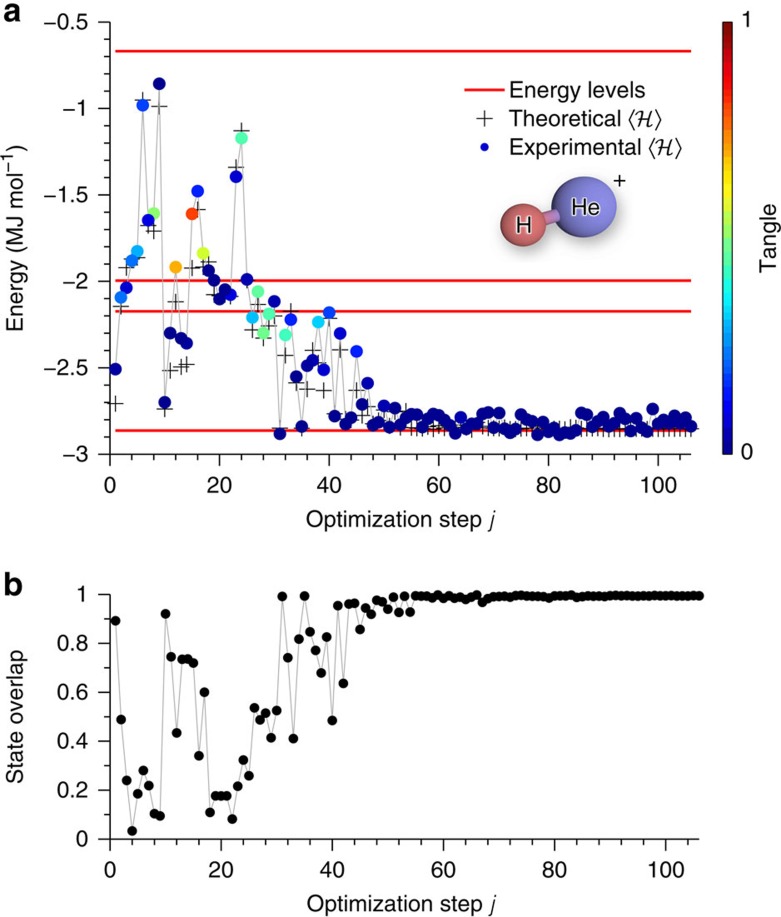
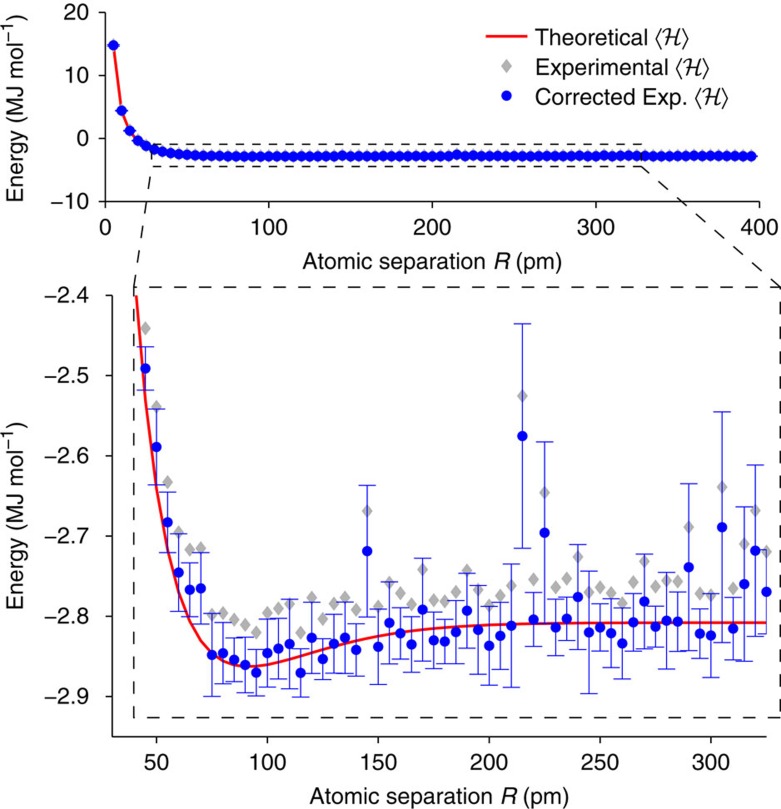
- The authors report an experimental ground-state result for He–H\(^+\): after correcting for experimental errors, they estimate the equilibrium bond length as \(R = 92.3 \pm 0.1\) pm and the ground-state electronic energy as \(E = -2.865 \pm 0.008\) MJ mol\(^{-1}\).
- For the bond dissociation curve, more than 96% of the experimental data are within chemical accuracy of the theoretical values.
- In the discussion, they state that for a 4 × 4 Hamiltonian like the one demonstrated, the QPE circuit would require at least 12 CNOT gates, whereas their method requires one.
- The full experiment was performed in about 158 h, and the bond dissociation curve was obtained by finding the ground states of 79 Hamiltonians.
## Methods
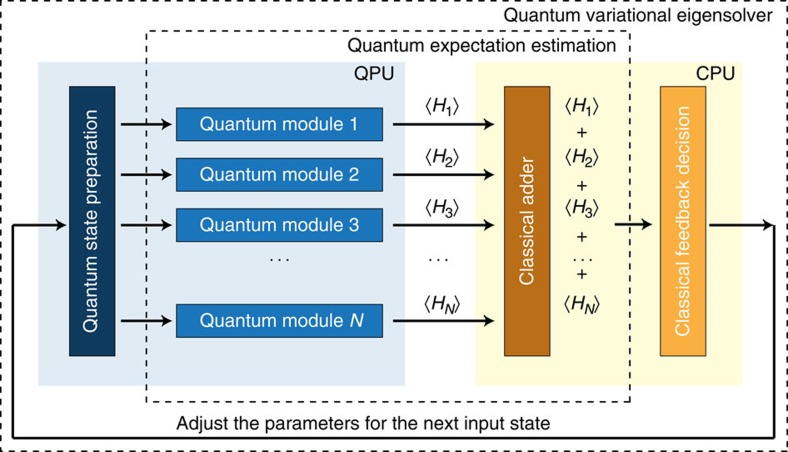
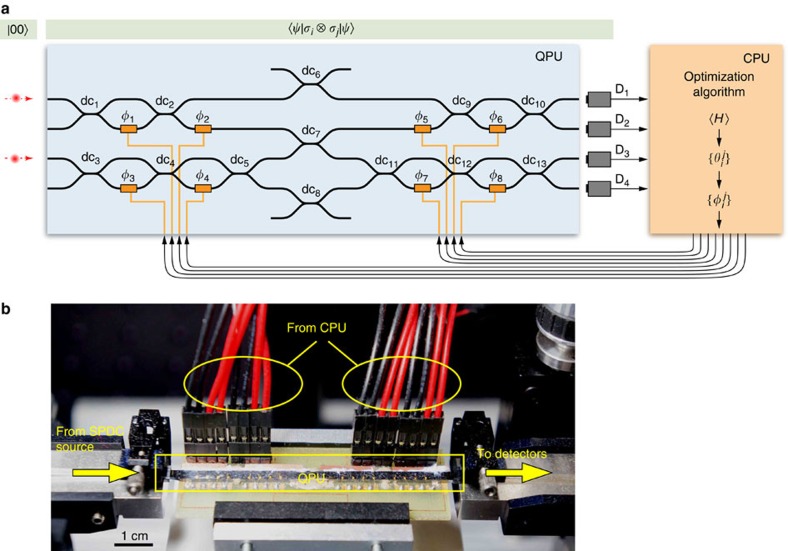
- The paper combines a reconfigurable integrated photonic quantum processor with a classical optimization algorithm: the quantum device estimates Hamiltonian expectation values, and the classical processor updates the state parameters variationally.
- The photonic chip prepares and measures arbitrary two-qubit pure states using single-qubit rotations and one two-qubit entangling gate; the experimental demonstration uses the He–H\(^+\) molecule in a minimal basis.
- For the classical optimization, they use the Nelder–Mead algorithm; expectation values are reconstructed from four two-qubit Pauli measurements at each point.
## Limitations
- The paper states that the method still requires a good approximation to the ground state as input/initialization, and the reliance on multiple separate measurements makes it sensitive to variations in state preparation between calculations.
- The authors report a constant systematic shift of \(\varepsilon = 50\) kJ mol\(^{-1}\) in the measured expectation values; they attribute this to photon-source impurity/distinguishability, circuit imperfections, and unbalanced coupling efficiencies.
- Evident from the text: the demonstration is limited to a two-qubit / 4 × 4 Hamiltonian prototype, so the scalability claim is not experimentally validated here.
Model-written summary. Check it against the paper before relying on it.
Integrity signals
Registry
Cites
Statistics
Figures
Verification
Claims the paper makes
7 Valid · 4 Not valid · 11 Not checked · 59 Own results and interpretations
The cited sources support only part of this claim — read each source’s verdict below.
In the paper
“Recent developments in the field of quantum computation offer a way forward for determining efficient solutions of many instances of large eigenvalue problems that are classically intractable6789101112”
§ A variational eigenvalue solver on a photonic quantum processor > Abstract
What the sources say
- Not matchedcites [6] Nielsen, M. A. & Chuang, I. L. Quantum Computation and Quantum Information Cambridge University Press (2000).
Couldn’t be matched to a paper in Crossref, so it can’t be checked.
- Could not verifycites [7] Kitaev, A. Quantum measurements and the Abelian stabilizer problem. Electronic Colloquium on Computational Complexity (ECCC) 3 (1996). sourceExperimental — accuracy not yet measured
Our copy under this DOI is the ISAAC 2021 paper 'Effective Resistance and Capacitance in Simplicial Complexes and a Quantum Algorithm' (Kitaev's 1995 work appears only as reference [9] in its bibliography), and it nowhere asserts that quantum computation gives efficient solutions to classically intractable large eigenvalue problems. Eigenvalues enter only as complexity parameters — λ, the smallest eigenvalue of the normalized up-Laplacian, in Lemma 31 and Theorem 26 (Section 6.3, 'Time efficient implementations') and in the phase-estimation machinery of Appendix A — and Section 1.1 ('Our Contributions') actually reports the opposite direction for its own problem: 'the quantum algorithm is slower than the classical algorithm in the worst case'. Searched: 'eigenvalue problems classically intractable', 'quantum speedup / exponential advantage', 'phase estimation', 'faster than classical'; no passage addresses the claim's point. (LLM, conf=0.70)
- Partly supportedcites [8] Griffiths, R. B. & Niu, C.-S. Semiclassical fourier transform for quantum computation. Phys. Rev. Lett. 76, 3228–3231 (1996). sourceExperimental — accuracy not yet measured
On p. 1, the paper says a quantum computer, if built, could solve certain problems such as factoring long numbers much faster than conventional algorithms. It also describes a simpler Fourier transform for Shor’s factorization and discrete-logarithm algorithms (p. 1). The copy does not support the claim about efficient solutions to many large eigenvalue problems. (LLM, conf=0.84)
plainstates a cause- Asserted: passes — The authors put it forward as true.
- Checkable: passes — It can be checked against evidence.
- Load-bearing: passes — The paper’s conclusions depend on it.
- Based: passes — The paper gives a reason why it holds.
- Not matched
Every source the paper cites for this claim was checked and supports it.
In the paper
“this would suffer from the N-representability problem, which is known to be intractable for both classical and quantum computers (it is in the quantum complexity class QMA-Hard24).”
§ A variational eigenvalue solver on a photonic quantum processor > Results > Quantum expectation estimation
What the sources say
- Supportedcites [24] Liu, Y.-K., Christandl, M. & Verstraete, F. Quantum computational complexity of the n-representability problem: Qma complete. Phys. Rev. Lett. 98, 110503 (2007). source
The paper states that N-representability is QMA-complete and hence QMA-hard and NP-hard (Abstract). Its discussion of quantum-chemistry relevance says the problem is intractable in the worst case even on a quantum computer, while allowing that particular physical systems may be easier. (LLM, conf=0.93)
boosted- Asserted: passes — The authors put it forward as true.
- Checkable: passes — It can be checked against evidence.
- Load-bearing: passes — The paper’s conclusions depend on it.
- Based: passes — The paper gives a reason why it holds.
- Supported
Every source the paper cites for this claim was checked and supports it.
In the paper
“We have implemented the QPU using integrated quantum photonics technology30.”
§ A variational eigenvalue solver on a photonic quantum processor > Results > Prototype demonstration
What the sources say
- Supportedcites [30] O'Brien, J. L., Furusawa, A. & Vuckovic, J. Photonic quantum technologies. Nat. Photon. 3, 687–695 (2009). source
The citation identifies integrated quantum photonics as the technology used, rather than attributing the citing authors’ QPU implementation to this review. The “Integrated quantum optical circuits” section (p. 6) describes on-chip waveguide circuits performing quantum logic gates and a compiled quantum factoring algorithm. (LLM, conf=0.87)
plain- Asserted: passes — The authors put it forward as true.
- Checkable: passes — It can be checked against evidence.
- Load-bearing: passes — The paper’s conclusions depend on it.
- Based: passes — The paper gives a reason why it holds.
- Supported
The cited sources support only part of this claim — read each source’s verdict below.
In the paper
“The time the quantum computer must remain coherent is determined by the necessity of O(p−1) successive applications of , each of which can require on the order of millions or billions of quantum gates for practical applications1719, as compared to the tens to hundreds of gates achievable in the short term.”
§ A variational eigenvalue solver on a photonic quantum processor > Abstract
What the sources say
- Partly supportedcites [17] Whitfield, J. D., Biamonte, J. & Aspuru-Guzik, A. Simulation of electronic structure hamiltonians using quantum computers. Mol. Phys. 109, 735–750 (2011). sourceExperimental — accuracy not yet measured
Split into 2 atoms — 1 confirmed, 1 partially supported, 0 disputed, 0 misattributed, 0 unverifiable. Expand the claim to see per-atom verdicts.
- Partly supportedcites [19] Jones, N. C. et al. Faster quantum chemistry simulation on fault-tolerant quantum computers. New J. Phys. 14, 115023 (2012). sourceExperimental — accuracy not yet measured
Split into 2 atoms — 0 confirmed, 2 partially supported, 0 disputed, 0 misattributed, 0 unverifiable. Expand the claim to see per-atom verdicts.
plainstates a cause- Asserted: passes — The authors put it forward as true.
- Checkable: passes — It can be checked against evidence.
- Load-bearing: passes — The paper’s conclusions depend on it.
- Based: passes — The paper gives a reason why it holds.
- Partly supported
A result the paper reports from its own data — it cites no other source for it, so there is none to check. The quote shows it is in the paper.
In the paper
“We experimentally demonstrate the feasibility of this approach with an example from quantum chemistry—calculating the ground-state molecular energy for He–H+.”
§ A variational eigenvalue solver on a photonic quantum processor > Abstract
boostedstates a causeSingle case- Asserted: passes — The authors put it forward as true.
- Checkable: passes — It can be checked against evidence.
- Load-bearing: passes — The paper’s conclusions depend on it.
- Based: passes — The paper gives a reason why it holds.
31 more claims
Create a free account to see all 81 claims and to verify the 4 references still open.
- It may state two separate claims as one. 28
- Probably not a substantial claim. 24
Claims other papers make about this one
Each is checked against this paper’s own text: does it say what the citing paper says it does?
The cited source doesn’t support the claim as written.
In the citing paper
“Leveraging quantum resources, the UCC ansatz was instead realized as a PQC on a photonic processor (Peruzzo et al. , 2014).”
From Noisy intermediate-scale quantum algorithms (2022) · cites this paper as Peruzzo et al., 2014
Checked by a reasoning model — may be wrong.
Experimental — accuracy not yet measuredThe cited source doesn’t support the claim as written.
In the citing paper
“The first on-chip GMM of four-qubit cluster state was realised in a laser-writing chip ( Fig.4e ), by manipulating both the polarisation and path DoFs of two photons [85].”
From Integrated photonic quantum technologies (2020) · cites this paper as [85]
Checked by a reasoning model — may be wrong.
Experimental — accuracy not yet measuredThe cited source doesn’t support the claim as written.
In the citing paper
“four-qubit linear- and box-cluster states are generated in a laser-writing photonic chip. This is enabled by on-chip manipulating the two-photon four-qubit hyperentangled state and cluster state, that are encoded in photon's path and polarisation DoFs. The Grover's search algorithm on a four-element database was implemented by controlling the device.”
From Integrated photonic quantum technologies (2020) · cites this paper as [85]
Checked by a reasoning model — may be wrong.
Experimental — accuracy not yet measuredThe source backs part of the claim, not all of it — or backs it for a different population, condition or comparison.
In the citing paper
“Due to its versatility, the variational Hamiltonian ansatz has been implemented for quantum chemistry [21, 29], optimization [24], and for quantum simulation problems [30].”
From Variational quantum algorithms (2021) · cites this paper as [29]
Experimental — accuracy not yet measuredThe source backs part of the claim, not all of it — or backs it for a different population, condition or comparison.
In the citing paper
“For the original VQE (Peruzzo et al. , 2014) and QAOA (Farhi et al. , 2014) it can, for example, be described as a single expectation value min θ ⟨ H ⟩ U ( θ ) , where the differences solely appear in the specific form and construction of the qubit Hamiltonian.”
From Noisy intermediate-scale quantum algorithms (2022) · cites this paper as Peruzzo et al., 2014
Experimental — accuracy not yet measured
12 more claims about this paper
Create a free account to see every claim other papers make about this one.
Citations
Cites
A Simplex Method for Function Minimization
Nelder, J. A., & Mead, R. (1965) · The Computer Journal · doi:10.1093/comjnl/7.4.308 · Cited by 28,905
Quantum computation and quantum information
Law, J. (2001) · ACM SIGSOFT Software Engineering Notes · doi:10.1145/505482.505499 · Cited by 18,842
(1999) · Cited by 12,854
Practical Methods of Optimization
Fletcher, R. (2000) · Wiley eBooks · doi:10.1002/9781118723203 · Cited by 7,605 · cited 3×
“[12] S.”
BackgroundMethodPractical methods of optimization
(1988) · Mathematics and Computers in Simulation · doi:10.1016/0378-4754(88)90129-2 · Cited by 5,818
Quantum Algorithm for Linear Systems of Equations
Harrow, A. W., Hassidim, A., & Lloyd, S. (2009) · Physical Review Letters · doi:10.1103/physrevlett.103.150502 · Cited by 3,325
Conn, A. R., Gould, N. I. M., & Toint, P. L. (2000) · Society for Industrial and Applied Mathematics eBooks · doi:10.1137/1.9780898719857 · Cited by 2,981 · cited 3×
“[14] D.”
MethodInfluential�ber das Paulische �quivalenzverbot
Jordan, P., & Wigner, E. (1928) · Zeitschrift f�r Physik · doi:10.1007/bf01331938 · Cited by 2,597
Molecular Electronic‐Structure Theory
Helgaker, T., Jørgensen, P., & Olsen, J. (2000) · doi:10.1002/9781119019572 · Cited by 2,594
O'Brien, J. L., Furusawa, A., & Vučković, J. (2009) · Nature Photonics · doi:10.1038/nphoton.2009.229 · Cited by 2,388
Self-citation
Research works printed but not linked: 3
- Helgaker, T., Jorgensen, P. & Olsen, J. Mol. Electronic Struct. Theory Wiley, Sussex (2002).
- Saad, Y. Numerical Methods for Large Eigenvalue Problems Vol. 158, (SIAM (1992).
- Rayleigh, J. W. In finding the correction for the open end of an organ-pipe. Phil. Trans. 161, 77 (1870).
Cited by
Items 2,601–2,700 of 4,573
Quantum circuits for discrete graphical models
Piatkowski, N., & Zoufal, C. (2024) · Quantum Machine Intelligence · doi:10.1007/s42484-024-00175-y · Cited by 7
“Heuristic algorithms like the variational quantum eigensolver [30] can, thus, be directly applied to our Hamiltonian in order to approximate the MAP state.”
A qubit-efficient variational selected configuration-interaction method
Yoffe, D., Entin, N., Natan, A., & Makmal, A. (2024) · Quantum Science and Technology · doi:10.1088/2058-9565/ad7d32 · Cited by 13
“The VQE method [7] searches for the system’s groundstate by optimizing a parameterized quantum state ψ(θ) to minimize the energy expectation value:”
Kocher, C. D., & McGuigan, M. (2018) · New York Scientific Data Summit (NYSDS) · doi:10.1109/nysds.2018.8538963 · Cited by 11
“Many algorithms for quantum computers have been developed to calculate various quantities; one algorithm is the variational quantum eigensolver (VQE) algorithm [5], [21].”
MethodAlgorithmic Primitives for Quantum-Assisted Quantum Control
Policharla, G.-V., & Vinjanampathy, S. (2021) · Physical Review Letters · doi:10.1103/physrevlett.127.220504 · Cited by 6
Quantum Humanities: A First Use Case for Quantum-ML in Media Science
Barzen, J., & Leymann, F. (2019) · Digitale Welt · doi:10.1007/s42354-019-0243-2 · Cited by 5
Variational Quantum Chemistry Programs in JaqalPaq
Maupin, O. G., Baczewski, A., Love, P. J., & Landahl, A. J. (2021) · Entropy · doi:10.3390/e23060657 · Cited by 10
“After briefly covering how to install the relevant python packages in Section 2, we review the variational quantum eigensolver (VQE) [3] algorithm in Section 3.”
MethodInfluentialSelf-citationCalculation of Gibbs partition function with imaginary time evolution on near-term quantum computers
Matsumoto, K. T., Shingu, Y., Endo, S., Kawabata, S., Watabe, S., Nikuni, T., Hakoshima, H., & Matsuzaki, Y. (2022) · Japanese Journal of Applied Physics · doi:10.35848/1347-4065/ac5152 · Cited by 10
A Full Quantum Eigensolver for Quantum Chemistry SimulationsPreprint
Wei, S., Li, H., & Long, G. (2019) · arXiv (Cornell University) · doi:10.48550/arxiv.1908.07927 · Cited by 5
“Here we adopt the standard gradient descent method as the classical optimizer in VQE.”
BackgroundInfluentialSolving Quantum Statistical Mechanics with Variational Autoregressive Networks and Quantum CircuitsPreprint
Liu, J.-G., Mao, L., Zhang, P., et al. (2019) · arXiv (Cornell University) · doi:10.48550/arxiv.1912.11381 · Cited by 5
Compressed variational quantum eigensolver for the Fermi-Hubbard modelPreprint
Montanaro, A., & Stanisic, S. (2020) · arXiv (Cornell University) · doi:10.48550/arxiv.2006.01179 · Cited by 22
“It is plausible that this problem could be solved using the variational quantum eigensolver [5, 6] (VQE) approach, a method based on the use of a classical algorithm to optimize over the space of quantum circuits for producing the ground state.”
MethodSlackQ : Approaching the Qubit Mapping Problem with A Slack-aware Swap Insertion SchemePreprint
Zhang, C., Chen, Y., Jin, Y., Ahn, W., Zhang, Y., & Zhang, E. Z. (2020) · arXiv (Cornell University) · doi:10.48550/arxiv.2009.02346 · Cited by 5
“In general, quantum computing has significant advantage over classical computing for applications including large number factoring [5], database search [6], and quantum simulation [7].”
BackgroundGonzález-Zalba, M. F., Franceschi, S. D., Edoardo Charbon, A., Meunier, T., Vinet, M., & Dzurak, A. S. (2020) · arXiv (Cornell University) · doi:10.48550/arxiv.2011.11753 · Cited by 5
“FPGAs will likely be used to enable fast back and forth communication in QEC but also in hybrid quantum-classical algorithms like the Variational Quantum Eigensolvers (VQE) [24] and quantum approximate optimization algorithms (QAOA) [25].”
MethodNonlinear Quantum Optimization Algorithms via Efficient Ising Model EncodingsPreprint
Patti, T. L., Kossaifi, J., Anandkumar, A., & Yelin, S. F. (2021) · Research Square · doi:10.21203/rs.3.rs-654802/v1 · Cited by 6
ChemiQ: A Chemistry Simulator for Quantum ComputerPreprint
Wang, Q., Liu, H., Li, Q., Zhao, J., Gong, Q., Li, Y., Wu, Y.-C., & Guo, G. (2021) · arXiv (Cornell University) · doi:10.48550/arxiv.2106.10162 · Cited by 12
“22 VQE uses a quantum computer to prepare and manipulate a parameterized wave function, and the measured result and the associated parameters are sent to a classical optimizer to determine the ideal parameters, such that the energy of the molecule is minimized:”
MethodA Leap among Entanglement and Neural Networks: A Quantum Survey.Preprint
Massoli, F. V., Vadicamo, L., Amato, G. M., & Falchi, F. (2021) · arXiv (Cornell University) · Cited by 5
Parrish, R. M., Anselmetti, G.-L., & Gogolin, C. (2021) · arXiv (Cornell University) · doi:10.48550/arxiv.2110.05040 · Cited by 18
RoQNN: Noise-Aware Training for Robust Quantum Neural Networks.Preprint
Wang, H., Gu, J., Ding, Y., Li, Z., Chong, F. T., Pan, D. Z., & Han, S. (2021) · arXiv (Cornell University) · Cited by 11
Optimal fermion-qubit mappingsPreprint
Chiew, M., & Strelchuk, S. (2021) · arXiv (Cornell University) · Cited by 5
Evaluating the impact of noise on the performance of the Variational Quantum EigensolverPreprint
Oliv, M., Matic-Flierl, A., Messerer, T., & Lorenz, J. M. (2023) · Research Square · doi:10.21203/rs.3.rs-2640456/v1 · Cited by 18
From Quantum Computing to Quantum-inspired Computation for Neuromorphic Advancement -- A SurveyPreprint
Jha, R. K. (2023) · doi:10.36227/techrxiv.24053250.v1 · Cited by 5
Efficient classical calculation of the Quantum Natural Gradient
Jones, T. (2020) · arXiv · doi:10.48550/arxiv.2011.02991 · Cited by 5
“Variational quantum eigensolving (VQE) is a promising application of first generation quantum computers [9, 10, 11], with consequences for chemistry and material science [12, 13].”
BackgroundLeakage Reduces Device Coherence Demands for Pulse-Level Molecular Simulations
Asthana, A., Liu, C., Meitei, O. R., Economou, S. E., Barnes, E., & Mayhall, N. J. (2023) · Physical Review Applied · doi:10.1103/physrevapplied.19.064071 · Cited by 28
Market informed portfolio optimization methods with hybrid quantum computing
nez, G. S. M., Gao, J., Yu, A., & Verma, A. R. (2024) · Review of Financial Economics · doi:10.1002/rfe.1219 · Cited by 5
Variational Quantum Algorithms via Measurement-Induced Passive Steering
Sanjaya, S., Volya, D., & Mishra, P. (2024) · IEEE International Conference on Quantum Computing and Engineering (QCE) · doi:10.1109/qce60285.2024.00063 · Cited by 5
“Specifically, variational quantum algorithms, such as Variational Quantum Eigensolver (VQE) [7], [8], [9], harness the precise control and optimization capabilities of classical computing alongside the parallel processing power and quantum state manipulation offered by quantum computing.”
Quantum Computing for Photosensitizer Design in Photodynamic Therapy
Zehr, H., Baiardi, A., Tacchino, F., Gandon, A., Fischer, L. E., Xu, Y., DiFilippo, F. P., Guidoni, L., Haase, P. A. B., Talarico, N. W., et al. (2025) · Annual Review of Biomedical Data Science · doi:10.1146/annurev-biodatasci-103123-095644 · Cited by 10
Quantum Computing for Quantum Chemistry
Schleich, P., Calderón, L. M., Sun, C., Bagherimehrab, M., Aldossary, A., Kottmann, J. S., & Aspuru‐Guzik, A. (2025) · ACS in focus · doi:10.1021/acsinfocus.7e9012 · Cited by 10
Self-citationRobust, fast, and high-fidelity composite single-qubit gates for superconducting transmon qubits
Tonchev, H. G., Torosov, B. T., & Vitanov, N. V. (2025) · Physical Review A · doi:10.1103/s7h1-lqc1 · Cited by 7
HornBro: Homotopy-Like Method for Automated Quantum Program Repair
Tan, S., Lu, L., Xiang, D., Chu, T., Lang, C., Chen, J., Hu, X., & Yin, J. (2025) · Proceedings of the ACM on software engineering. · doi:10.1145/3715751 · Cited by 12
Korhonen, K. T., Vappula, H., Glos, A., Cattaneo, M., Zimborás, Z., Borrelli, E.-M., Rossi, M. A. C., García-Pérez, G., & Cavalcanti, D. (2025) · npj Quantum Information · doi:10.1038/s41534-025-01066-1 · Cited by 12
“Simulationsofsuchchemical compoundsoftenaim toevaluatethe molecular ground state energy, which can be done by preparing an ansatz state on the quantum computer using e.g . the Variational Quantum Eigensolver(VQE)algorithm 1,2 .”
Fu, W., Xie, H., & Xin, Y. (2025) · Reliability Engineering & System Safety · doi:10.1016/j.ress.2025.111656 · Cited by 5
Quantum architecture search with neural predictor based on ZX-calculus
Li, S., Tsukayama, D., Shirakashi, J., Shibuya, T., & Imai, H. (2025) · EPJ Quantum Technology · doi:10.1140/epjqt/s40507-025-00410-w · Cited by 10
“VQAs have shown promising results in quantum chemistry [6, 7], combinatorial optimization [8, 9], and quantum machine learning [10, 11].”
Improving qubit reduction for molecular simulations with randomized orbital sampling
Darmawan, Y. A., Fauzi, A. D., Sarwono, Y. P., & Zhang, R. Q. (2025) · AAPPS bulletin · doi:10.1007/s43673-025-00167-5 · Cited by 5
“These constraints have motivated hybrid quantum–classical algorithms [11–13], notably the variational quantum eigensolver (VQE) [14–17], which are more resilient to qubit limitations and noise compared to purely quantum algorithms.”
Understanding decoherence in molecular spin qudits
Ratini, L., Sansone, G., Garlatti, E., Petiziol, F., Carretta, S., & Santini, P. M. (2025) · Physical Review Research · doi:10.1103/16rd-tv1q · Cited by 7
Quantum memristor with vacuum-one-photon qubits
Micco, S. D., Polacchi, B., Giordani, T., & Sciarrino, F. (2025) · Physical Review Research · doi:10.1103/4kpy-xfq2 · Cited by 6
“In particular, we mention works on proof-of-concept quantum variational circuits [13–22], kernel estimation [23–25], neural networks and reservoir computing [26–29].”
Akanbi, O. S., Shannon, J. P., Delhommelle, J., & Desgranges, C. (2025) · The Journal of Physical Chemistry Letters · doi:10.1021/acs.jpclett.5c02390 · Cited by 5
Large-Scale Efficient Molecule Geometry Optimization with Hybrid Quantum–Classical Computing
Hao, Y., Ding, Q.-M., Wang, X., & Yuan, X. (2026) · Journal of Chemical Theory and Computation · doi:10.1021/acs.jctc.5c01435 · Cited by 9
“19,24,25,29 The key component in VQE is to design an appropriate circuit ansatz to approximate the unknown ground state of the chemical system.”
Extending quantum computing through subspace, embedding and classical molecular dynamics techniques
Bickley, T. M., Mingare, A., Weaving, T., de la Bastida, M. W., Wan, S., Nibbi, M., Seitz, P., Ralli, A., Love, P. J., Chung, M. T., et al. (2025) · Digital Discovery · doi:10.1039/d5dd00225g · Cited by 22
Self-citationToward Personalized Quantum Federated Learning for Anomaly Detection
Rahman, R., Shaham, S., & Nguyen, D. C. (2025) · IEEE Transactions on Network Science and Engineering · doi:10.1109/tnse.2025.3631526 · Cited by 12
“The projection operators onto the eigenspaces of H can also be used to express this loss function The optimal loss value is denoted as f ∗ n can be described as The eigendecomposition of the observable defined by the Hermitian matrix H may be expressed as where N h ≤ 2 n and { Π y } N h y =1 are the…”
Shen, R., Chen, T., Yang, B., Zhong, Y., & Lee, C. H. (2025) · npj Quantum Information · doi:10.1038/s41534-025-01122-w · Cited by 28
“This signi fi cantly offsets inevitable noise effects in present-day quantum processors, offering more robust measurements compared to using the variational quantum eigensolver (VQE) approach alone 81,92,93 .”
Adaptive Non-Local Observable on Quantum Neural Networks
Lin, H.-Y., Tseng, H.-H., Chen, S. Y.-C., & Yoo, S. (2025) · IEEE International Conference on Quantum Computing and Engineering (QCE) · doi:10.1109/qce65121.2025.00206 · Cited by 8
“Variational Quantum Eigensolver (VQE) [10]–[12] is one such example, leveraging the VQA approach to approximate the ground state energy of a given Hamiltonian, making it particularly useful for quantum chemistry and material science.”
Efficient quantum simulation of non-adiabatic molecular dynamics with precise electronic structure
Li, T., Zeng, Y., Ding, Q.-M., Huo, Z., Xu, X., Ren, J., Tang, D., Cai, X., & Yuan, X. (2026) · Digital Discovery · doi:10.1039/d5dd00433k · Cited by 5
Sakuma, R., Wada, K., Kanno, S., Keithley, K., Sugisaki, K., Abe, T., Nakamura, H., & Yamamoto, N. (2025) · Physical Review A · doi:10.1103/m85k-7q32 · Cited by 10
“The last decade has seen rapid development of quantum-classical hybrid approaches that leverage currently available noisy intermediate-scale quantum computers, such as the variational quantum eigensolver [1] and sampling-based approaches [2, 3].”
Comparison of variational quantum eigensolvers in light nuclei
Carrasco-Codina, M., Costa, E., Romero, A. M., Menéndez, J., & Rios, A. (2025) · Physical Review C · doi:10.1103/17n2-xh6k · Cited by 18
Ladder Operator Block-Encoding
Simon, W., Gustin, C. M., Serafin, K., Ralli, A., Goldstein, G. R., & Love, P. J. (2025) · Quantum · doi:10.22331/q-2025-12-22-1953 · Cited by 24
“Many previous works have numerically investigated various quantum simulation algorithms of purely fermionic systems, with a particular emphasis on the simulation of molecules in quantum chemistry [9, 27, 30–36].”
Self-citationAmaral, C. A., Oliveira, V. L., Salazar, J. P. L. C., & Duzzioni, E. I. (2025) · Brazilian Journal of Physics · doi:10.1007/s13538-025-01959-8 · Cited by 13
de Lima, A. M., Teixeira, E. S., Silva, E. D. R. D. A., & Longo, R. L. (2026) · Journal of Computational Chemistry · doi:10.1002/jcc.70289 · Cited by 5
“Alternatively, the Variational Quantum Eigensolver (VQE) stands out as a hybrid algorithm that combines measurements on quantum computers with optimizations on classical computers [14, 15].”
Quantum medicine: A quantum–mechanical framework for redox biology, disease and precision medicine
Sung, J., & Cheong, J. (2026) · Clinical and Translational Medicine · doi:10.1002/ctm2.70598 · Cited by 7
“34 By encoding molecular wavefunctions directly into qubits, quantum hardware bypasses the exponential scaling barrier that limits classical methods such as DFT or coupled-cluster calculations.”
The Grover Dilemma and Three Fundamental Barriers to Oracle-Based Quantum Search Algorithms
Liu, Y. (2026) · Journal of Quantum Information Science · doi:10.4236/jqis.2026.161002 · Cited by 5
Research progress of integrated photonic quantum simulation
Chen, Y., Zhang, T., Guo, G., & Ren, X. (2022) · Acta Physica Sinica · doi:10.7498/aps.71.20221938 · Cited by 6
Offline Quantum Circuit Pruning for Quantum Chemical Calculations
Imamura, S., Kasagi, A., & Yoshida, E. (2023) · IEEE International Conference on Quantum Computing and Engineering (QCE) · doi:10.1109/qce57702.2023.00047 · Cited by 8
“VQE is a hybrid quantum-classical eigensolver designed for NISQ computers and can be used to calculate the ground-state energies of molecules [1], [2].”
MethodComputing electronic correlation energies using linear depth quantum circuits
Chee, C. H., Mak, A. M., Leykam, D., Barkoutsos, P. K., & Angelakis, D. G. (2024) · Quantum Science and Technology · doi:10.1088/2058-9565/ad1f3a · Cited by 7
“Variational quantum algorithms (VQA) are one popular approach [16, 19] which has seen many experimental NISQ demonstrations in estimating molecular energies of small molecules [6, 29, 42, 44], often the ground state energy, using various types of quantum circuit ansatz and classical optimizers.”
BackgroundTridiagonal matrix decomposition for Hamiltonian simulation on a quantum computer
Arseniev, B., Guskov, D., Sengupta, R., Biamonte, J., & Zacharov, I. (2024) · Physical Review A · doi:10.1103/physreva.109.052629 · Cited by 10
Exploring thermal equilibria of the Fermi-Hubbard model with variational quantum algorithms
Araz, J. Y., Spannowsky, M., & Wingate, M. (2024) · Physical Review A · doi:10.1103/physreva.109.062422 · Cited by 8
Quantum Computing Potentials for Drug Discovery
Kandula, S. K., Katam, N., Kangari, P. R., Hijmal, A., Gurrala, R., & Mahmoud, M. (2023) · International Conference on Computational Science and Computational Intelligence (CSCI) · doi:10.1109/csci62032.2023.00240 · Cited by 5
“Quantum algorithms for molecular simulation, such as the VQE algorithm, have demonstrated the ability to accurately predict the properties of complex molecules with a speedup compared to classical methods [1].”
MethodA Layerwise-Multi-Angle Approach to Fine-Tuning the Quantum Approximate Optimization Algorithm
Lavagna, L., Ceschini, A., Rosato, A., & Panella, M. (2024) · International Joint Conference on Neural Networks (IJCNN) · doi:10.1109/ijcnn60899.2024.10650075 · Cited by 6
Quantum-inspired clustering with light
Varga, J. J. M., Bermejo, P., Pellicer-Guridi, R., Orús, R., & Molina‐Terriza, G. (2024) · Scientific Reports · doi:10.1038/s41598-024-73053-z · Cited by 5
Baid, S., Sáiz, Á., Lamata, L., Pérez-Fernández, P., Romero, A. M., Rios, A., Arias, J. M., & García-Ramos, J. E. (2024) · Physical Review C · doi:10.1103/physrevc.110.044318 · Cited by 8
One-Time Compilation of Device-Level Instructions for Quantum Subroutines
Dalvi, A. S., Whitlow, J., D’Onofrio, M., Riesebos, L., Chen, T., Phiri, S., Brown, K. R., & Baker, J. M. (2024) · IEEE International Conference on Quantum Computing and Engineering (QCE) · doi:10.1109/qce60285.2024.00107 · Cited by 11
“VQE is a hybrid, iterative algorithm that uses the variational method [21] and can be used to find the ground state energy of a molecule [1].”
BackgroundMethodGeneralized Quantum Data-Syndrome Codes and Belief Propagation Decoding for Phenomenological Noise
Kuo, K.-Y., & Lai, C. (2025) · IEEE Transactions on Information Theory · doi:10.1109/tit.2025.3529773 · Cited by 11
“Quantum information has found applications beyond classical systems [2]–[10].”
Dhara, B., Agrawal, M., & Roy, S. D. (2025) · IET Quantum Communication · doi:10.1049/qtc2.12120 · Cited by 4
Energy Landscapes for the Unitary Coupled Cluster Ansatz
Boy, C., Filip, M.-A., & Wales, D. J. (2025) · Journal of Chemical Theory and Computation · doi:10.1021/acs.jctc.4c01667 · Cited by 9
Mondal, D., & Maitra, R. (2025) · International Journal of Quantum Chemistry · doi:10.1002/qua.70029 · Cited by 5
Inductive Construction of Variational Quantum Circuit for Constrained Combinatorial Optimization
Nakada, H., Tanahashi, K., & Tanaka, S. (2025) · IEEE Access · doi:10.1109/access.2025.3563960 · Cited by 7
“Variational Quantum Eigensolver (VQE) [7]–[11] and Quantum Approximate Optimization Algorithm (QAOA) [12], [13] are typical examples of such methods.”
Lins, I. D., Araújo, L. M. M., Maior, C. B. S., Teixeira, E. S., Bezerra, P. T. L., Moura, M. J. D. C., & Droguett, E. L. (2025) · Reliability Engineering & System Safety · doi:10.1016/j.ress.2025.111153 · Cited by 5
Systematic many-fermion Hamiltonian input scheme and spectral calculations on quantum computers
Du, W., & Vary, J. P. (2025) · Physics Letters B · doi:10.1016/j.physletb.2025.139548 · Cited by 14
“Compared to the conventional variational quantum eigensolver [46, 47] where the measurement overhead and optimization are in general challenging, our hybrid framework does not require extensive parameter optimizations and enables access to excited states as well.”
Kanasugi, S., Hidaka, Y., Nakagawa, Y. O., Tsutsui, S., Matsumoto, N., Maruyama, K., Oshima, H., & Sato, S. (2025) · Physical Review Research · doi:10.1103/kb94-tf7t · Cited by 8
Quantum algorithm for protein-ligand docking sites identification in the interaction space
Liliopoulos, I., Varsamis, G. D., Karamanidou, T., Papalitsas, C., Koulouras, G., Pantazopoulos, V., Stavropoulos, T. G., & Karafyllidis, I. G. (2025) · Journal of Computer-Aided Molecular Design · doi:10.1007/s10822-025-00620-5 · Cited by 9
Graves, V., Sünderhauf, C., Blunt, N. S., Izsák, R., & Szöri, M. (2025) · ACS Physical Chemistry Au · doi:10.1021/acsphyschemau.5c00030 · Cited by 8
A systematic review of strategic approaches and applications in quantum computing
Sharma, N. V., & Saxena, V. (2025) · Optical and Quantum Electronics · doi:10.1007/s11082-025-08364-0 · Cited by 5
“• Quantum approximate optimization algorithm (QAOA): Targets combinatorial optimization problems using parameterized quantum circuits (Peruzzo et al. 2014).”
A Simulation Framework for Workload Management in Hybrid Quantum-HPC Cloud System
Luo, W., Lu, C.-C., Zhan, T., & Guan, Q. (2025) · International Conference for High Performance Computing, Networking, Storage and Analysis (SC) · doi:10.1145/3731599.3767548 · Cited by 7
Quantum Large Language Model Fine-Tuning
Kim, S. H., Mei, J., Girotto, C., Yamada, M., & Roetteler, M. (2025) · IEEE International Conference on Quantum Computing and Engineering (QCE) · doi:10.1109/qce65121.2025.00258 · Cited by 10
“The advent of optimization-based approximation methods in chemistry such as the variational eigensolver [21] and analytic techniques for evaluating gradients on gate-based quantum computers [22] connected these quantum methods to the nascent differentiable revolution happening in the classical…”
Composable Programming of Hybrid Workflows for Quantum Simulation
Nguyen, T., Oftelie, L. B., Lyakh, D. I., McCaskey, A., Leyton‐Ortega, V., Pooser, R. C., Elwasif, W. R., Humble, T. S., & de Jong, W. A. (2021) · IEEE International Conference on Software Architecture Companion (ICSA-C) · doi:10.1109/icsa-c52384.2021.00028 · Cited by 5
“The VQE is a quantum-classic hybrid algorithm used to find a Hamiltonian’s eigenvalues, where the quantum process side is represented by a parametrized quantum circuit whose parameters are updated by a classical optimization process [40].”
MethodQuOp_MPI: A framework for parallel simulation of quantum variational algorithms
Matwiejew, E., & Wang, J. B. (2022) · Journal of Computational Science · doi:10.1016/j.jocs.2022.101711 · Cited by 9
“Compared to many exclusively quantum algorithms, these quantum variational algorithms (QVAs) require minimal quantum operations and are inherently resilient to sys-tem noise [2, 8].”
BackgroundGeometric quantum adiabatic methods for quantum chemistry
Yu, H., Lu, D., Wu, Q., & Wei, T.-C. (2022) · Physical Review Research · doi:10.1103/physrevresearch.4.033045 · Cited by 6
Contextuality in infinite one-dimensional translation-invariant local Hamiltonians
Yang, K., Zeng, X., Luo, Y., Yang, G., Shu, L., Navascués, M., & Wang, Z. (2022) · npj Quantum Information · doi:10.1038/s41534-022-00598-0 · Cited by 8
“By estimating the gradient of the Bell functional with respect to the variables θ , we can sequentially update the latter so as to minimize the observed value of the Bell functional in the device (effectively mimicking the working principle of the variational quantum eigensolver 14 ).”
SSQEM: Semi-Supervised Quantum Error Mitigation
Sayar, A., Arslan, Ş. S., & Çakar, T. E. (2022) · International Conference on Computer Science and Engineering (UBMK) · doi:10.1109/ubmk55850.2022.9919474 · Cited by 6
“Although NISQ computers are not omnipresent, we may use them to combine quantum and classical computers to handle some computational tasks [17], such chemical modeling, much more quickly than with classical computers [18].”
MethodTowards Quantum Control with Advanced Quantum Computing: A Perspective
Ding, Y., Ban, Y., & Chen, X. (2022) · Entropy · doi:10.3390/e24121743 · Cited by 5
“For generality, one can use a variational quantum eigensolver (VQE) [11] to prepare the input state for DQS.”
MethodA QCNN Algorithm Deployed on A Quantum Computer
Chen, X., Jiang, B., Wu, Y., & Ye, Y. (2022) · International Conference on Computing, Communication, Perception and Quantum Technology (CCPQT) · doi:10.1109/ccpqt56151.2022.00074 · Cited by 6
Non-Hermitian ground-state-searching algorithm enhanced by a variational toolbox
Chen, Y., Zhang, S., Hsieh, C., & Zhang, S. (2023) · Physical Review A · doi:10.1103/physreva.107.042418 · Cited by 8
Quantum imaginary-time control for accelerating the ground-state preparation
Chen, Y., Chen, Y., Hu, A., Hsieh, C., & Zhang, S. (2023) · Physical Review Research · doi:10.1103/physrevresearch.5.023087 · Cited by 6
“σ2 Hp(τ)≡ 〈 ψ ∣Hp ∣ψ 2− 〈 ψ ∣H2 p ∣ψ 〉 , T (τ)≡ 〈 ψ ∣Hp,Hd }∣ψ 〉 −2 〈 ψ ∣Hp ∣ψ 〉 〈ψ |Hd |ψ〉 , (6)”
CoolMomentum mitigating local minima in variational quantum eigensolvers
Tsukayama, D., Shirakashi, J., & Imai, H. (2023) · Japanese Journal of Applied Physics · doi:10.35848/1347-4065/acea0a · Cited by 4
Execution of a quantum algorithm for calculating energies of some quantum mechanical systems
Chaganti, S. K., Kesari, A. S., & Chowdhury, C. (2023) · Chemical Physics · doi:10.1016/j.chemphys.2023.112082 · Cited by 4
Exploring Models, Training Methods, and Quantum Supremacy in Machine Learning and Quantum Computing
Muthusamy, A. (2023) · Advances in computer and electrical engineering book series · doi:10.4018/978-1-6684-7535-5.ch002 · Cited by 4
Peddireddy, D., Priyam, U., & Aggarwal, V. (2023) · Physical Review A · doi:10.1103/physreva.108.042429 · Cited by 6
Quantum techniques for eigenvalue problems
Lee, D. (2023) · The European Physical Journal A · doi:10.1140/epja/s10050-023-01183-5 · Cited by 6
“The most common example is the search for the ground state of a quantum Hamiltonian H by minimizing a cost function C(θ) given by the energy expectation value C(θ) = 〈θ|H |θ〉 [71, 72].”
Differentiable matrix product states for simulating variational quantum computational chemistry
Guo, C., Fan, Y., Xu, Z., & Shang, H. (2023) · Quantum · doi:10.22331/q-2023-12-04-1192 · Cited by 10
“In recent years, quantum chemistry calculations for molecular systems using VQE has been demonstrated using numerical simulations on most of the leading quantum computer architectures [28, 35–42].”
MethodMurta, B., & Fernández-Rossier, J. (2024) · Physical review. B./Physical review. B · doi:10.1103/physrevb.109.035128 · Cited by 8
Solvent Distribution Effects on Quantum Chemical Calculations with Quantum Computers
Yoshida, Y., Mizukami, W., & Yoshida, N. (2024) · Journal of Chemical Theory and Computation · doi:10.1021/acs.jctc.3c01189 · Cited by 5
Parallelized variational quantum classifier with shallow QRAM circuit
Duan, B., Sun, X., & Hsieh, C. (2024) · Quantum Information Processing · doi:10.1007/s11128-024-04295-z · Cited by 6
Photonic variational quantum eigensolver using entanglement measurements
Lee, J., Song, W., Lee, D., Kim, Y., Lee, S.-W., Lim, H., Jung, H., Han, S.-W., & Kim, Y. (2024) · Quantum Science and Technology · doi:10.1088/2058-9565/ad6d87 · Cited by 6
Exactly solvable Hamiltonian fragments obtained from a direct sum of Lie algebras
Patel, S. M., & Izmaylov, A. F. (2024) · The Journal of Chemical Physics · doi:10.1063/5.0207195 · Cited by 4
“For the variational quantum eigensolver (VQE), [15] one approach to compute ⟨ ˆ H ⟩ via quantum measurements is to sum estimates of ⟨ ˆ H α ⟩ which can be measured directly due to their exact solvability.”
MethodModel-Driven Engineering for Quantum Programming: A Case Study on Ground State Energy Calculation
Polat, F., Tuncer, H., Moin, A., & Challenger, M. (2024) · IEEE Annual International Computer Software and Applications Conference (COMPSAC) · doi:10.1109/compsac61105.2024.00378 · Cited by 5
“…the gate-based model forms the foundation for various quantum algorithms, including Shor’s algorithm [12] for prime factorization, Grover’s algorithm for database searching [13] and Variational Quantum Algorithms (VQA) for optimization [14], eigenvalue estimation [15] and machine learning [16].”
BackgroundMethodImproving the full quantum eigensolver with exponentiated operators
Wang, B., Wen, J., Wu, J., Xie, H., Yang, F., Ruan, D., Wei, S., & Long, G. (2024) · Physical review. B./Physical review. B · doi:10.1103/physrevb.109.245117 · Cited by 6
Probing Quantum Efficiency: Exploring System Hardness in Electronic Ground State Energy Estimation
Choi, S., Loaiza, I., Lang, R. A., Martínez-Martínez, L. Á., & Izmaylov, A. F. (2024) · Journal of Chemical Theory and Computation · doi:10.1021/acs.jctc.4c00298 · Cited by 10
“9 In the earlier phase of quantum algorithm development, the variational quantum eigensolver (VQE) 10–14 was regarded as a promising hybrid quantum-classical algo-rithm for finding E 0 on noisy quantum computers of to-day.”
BackgroundMayfield, J. D., & Naqa, I. E. (2024) · Quantum Machine Intelligence · doi:10.1007/s42484-024-00171-2 · Cited by 6
The quantum Ising model for perfect matching and solving it with variational quantum eigensolver
Zheng, Q., Zhu, P., Wu, C., Yu, M., Luo, W., & Xu, P. (2024) · Science China Information Sciences · doi:10.1007/s11432-023-4039-y · Cited by 7
“According to [19], the eigenvalue problem of observable values represented by the operator H can be reformulated as the variational problem on the Rayleigh-Ritz quotient, such that the linear combination i ∈ M β i | φ i i of all eigenvectors corresponding to the smallest eigenvalue is the optimal…”
BackgroundMethodNon-iterative disentangled unitary coupled-cluster based on lie-algebraic structure
Haidar, M., Adjoua, O., Badreddine, S., Peruzzo, A., & Piquemal, J. (2025) · Quantum Science and Technology · doi:10.1088/2058-9565/adb3c5 · Cited by 12
“Quantum algorithms specifically designed for quantum chemistry include, for example, quantum phase estimation [5], variational quantum eigensolvers (VQE) [6], and quantum imaginary time evolution among others [3, 7–9].”
InfluentialSelf-citationPermutation-equivariant quantum convolutional neural networks
Das, S., & Caruso, F. (2024) · Quantum Science and Technology · doi:10.1088/2058-9565/ad8e80 · Cited by 9
“It has been widely known as parametric quantum circuit (PQC) or variational quantum circuit [6–10].”
Simulation of a Three‐Nucleons System Transition on Quantum Circuits
Nigro, L., Barbieri, C., & Prati, E. (2024) · Advanced Quantum Technologies · doi:10.1002/qute.202400371 · Cited by 5
Experimental computations of atomic properties on a superconducting quantum processor
Singh, A. P., Sugisaki, K., Prasannaa, V. S., Sahoo, B. K., Das, B. P., & Nakamura, Y. (2024) · Physical Review A · doi:10.1103/physreva.110.062620 · Cited by 6
Metadata
- Authors
- Peruzzo, A., McClean, J., Shadbolt, P., Yung, M.-H., Zhou, X.-Q., Love, P. J., Aspuru-Guzik, A., & O’Brien, J. L.
- Affiliations
- The University of Sydney (AU)
- Harvard University (US)
- University of Bristol (GB)
- Haverford College (US)
- Corresponding author
- Peruzzo, Alberto
- O’Brien, Jeremy L.
- Venue
- Nature Communications
- Published
- 2014-07-23
- Volume
- 5
- Issue
- 1
- Pages
- 4213-4213
- ISSN
- 2041-1723 (ISSN-L)
- PMC
- PMC4124861
- OpenAlex
- W2161685427
- Cited by
- 4,552
- References
- 48
- Citations by year
- 2026: 591 · 2025: 765 · 2024: 722 · 2023: 658 · 2022: 564 · 2021: 561 · 2020: 346 · 2019: 191 · 2018: 83 · 2017: 29 · 2016: 18 · 2015: 16 · 2014: 4
- FWCI
- 22.24
- Type
- journal article
- Language
- en
- Open access
- hybrid
- doi.org
- Licence
- cc-by-nc-nd
- creativecommons.org/licenses/by-nc-nd/4.0 (tdm)
- creativecommons.org/licenses/by-nc-nd/4.0 (vor)
- Locations
- Nature Communications (publishedVersion, cc-by-nc-nd)
- Europe PMC (PubMed Central) (publishedVersion, cc-by-nc-nd)
- PubMed Central (publishedVersion, cc-by-nc-nd)
- PubMed (publishedVersion)
- arXiv (Cornell University) (submittedVersion)
- OSTI OAI (U.S. Department of Energy Office of Scientific and Technical Information) (submittedVersion, cc-by-nc-nd)
- Digital Access to Scholarship at Harvard (DASH) (Harvard University) (submittedVersion, cc-by)
- RePEc: Research Papers in Economics (submittedVersion)
- RMIT Research Repository (RMIT University Library) (submittedVersion, cc-by-nc-nd)
- Figshare (submittedVersion, cc-by-nc-nd)
- UWA Profiles and Research Repository (UWA) (submittedVersion, cc-by-nc-nd)
- Bristol Research (University of Bristol) (submittedVersion)
- arXiv (Cornell University)
- Funders
- National Science Foundation (DE-FG02-97ER25308, 0955518, 1037992)
- U.S. Department of Energy (DEFG0297ER25308, DE‐FG02‐, FG02-97ER25308)
- Alfred P. Sloan Foundation
- John Templeton Foundation
- Camille and Henry Dreyfus Foundation
- Royal Academy of Engineering
- National Natural Science Foundation of China (61033001, 61361136003)
- Engineering and Physical Sciences Research Council (EP/J017175/1, EP/L024020/1, EP/K021931/1)
- Australian Research Council (DE140101700)
- National Key Research and Development Program of China (61033001, 2011CBA00301, 61361136003, 2011CBA00300)
- Division of Chemistry (CHE-1037992)
- Air Force Office of Scientific Research (FA 9550-12-1-0046, FA9550-, FA9550-12, FA9550‐12‐1)
- Topics
- Physical Sciences › Computer Science › Artificial Intelligence › Quantum Computing Algorithms and Architecture
- Physical Sciences › Physics and Astronomy › Atomic and Molecular Physics, and Optics › Quantum Information and Cryptography
- Physical Sciences › Physics and Astronomy › Atomic and Molecular Physics, and Optics › Quantum many-body systems
- Keywords
- variational quantum eigensolver, photonic quantum processors, quantum chemistry, classical optimization, hybrid quantum-classical computation
About these checks
Registry, retraction, Cites and statistics results are computed, not judged, with one exception: a printed reference that no index lists is read once by a model before it counts as a citation error. Claims are extracted by a model and kept only when their quote appears verbatim in the text; each cited source is then checked, with a model’s help, for whether it says what the claim relies on. Those verdicts can be wrong — read the claim’s quote and the cited source before relying on one.
The claim verdicts this report counts are experimental: their accuracy is not yet measured.
A language model drew the claims from the paper on 2026-10-10, under version 3 of the claim definition (model deepseek-v4.1-flash, prompt extract-v3).
A second model labelled each claim on 2026-10-10 (model jev-1.13-20260917, definition revision gold-guideline-v0.2).
Cited sources are checked with a language model’s help (qwen3.8-omni-flash and gpt-6-sol).
Statistics and arithmetic are recomputed, not judged.
Confidence bands are shown only for fields calibrated on our annotated test set. None is calibrated yet, so no band is shown.
What counts as a claim ›How we measure confidence ›How we check this ›
Are you an author, or do you see a problem with this page? Request a review
Data sources
Bibliographic data: Semantic Scholar, OpenAlex, Crossref.
Contains information from the Semantic Scholar Academic Graph Datasets, made available under the ODC Attribution License (ODC-BY 1.0).
Semantic Scholar’s data is described in: Kinney, R., et al. (2023). The Semantic Scholar Open Data Platform. arXiv:2301.10140.
