

A variational eigenvalue solver on a photonic quantum processor
Open accessThe DOI matches its Crossref record; 47 of the 48 references it cites were found in a registry or an index; 14 of the 31 sources its claims cite were checked for support.
Abstract
Quantum computers promise to efficiently solve important problems that are intractable on a conventional computer. For quantum systems, where the physical dimension grows exponentially, finding the eigenvalues of certain operators is one such intractable problem and remains a fundamental challenge. The quantum phase estimation algorithm efficiently finds the eigenvalue of a given eigenvector but requires fully coherent evolution. Here we present an alternative approach that greatly reduces the requirements for coherent evolution and combine this method with a new approach to state preparation based on ansätze and classical optimization. We implement the algorithm by combining a highly reconfigurable photonic quantum processor with a conventional computer. We experimentally demonstrate the feasibility of this approach with an example from quantum chemistry—calculating the ground-state molecular energy for He–H+. The proposed approach drastically reduces the coherence time requirements, enhancing the potential of quantum resources available today and in the near future. Quantum computers promise to efficiently solve problems that would be practically impossible with a normal computer. Peruzzo et al. develop a variational computation approach that uses any available quantum resources and, with a photonic quantum processing unit, find the ground-state molecular energy of He–H+.
Overview
CoChat Summary
## TL;DR
The paper introduces a variational alternative to quantum phase estimation for finding eigenvalues, combining short coherent quantum measurements with classical optimization. It experimentally demonstrates the approach on a photonic processor by estimating the ground-state energy curve of He–H\(^+\).
## Key findings
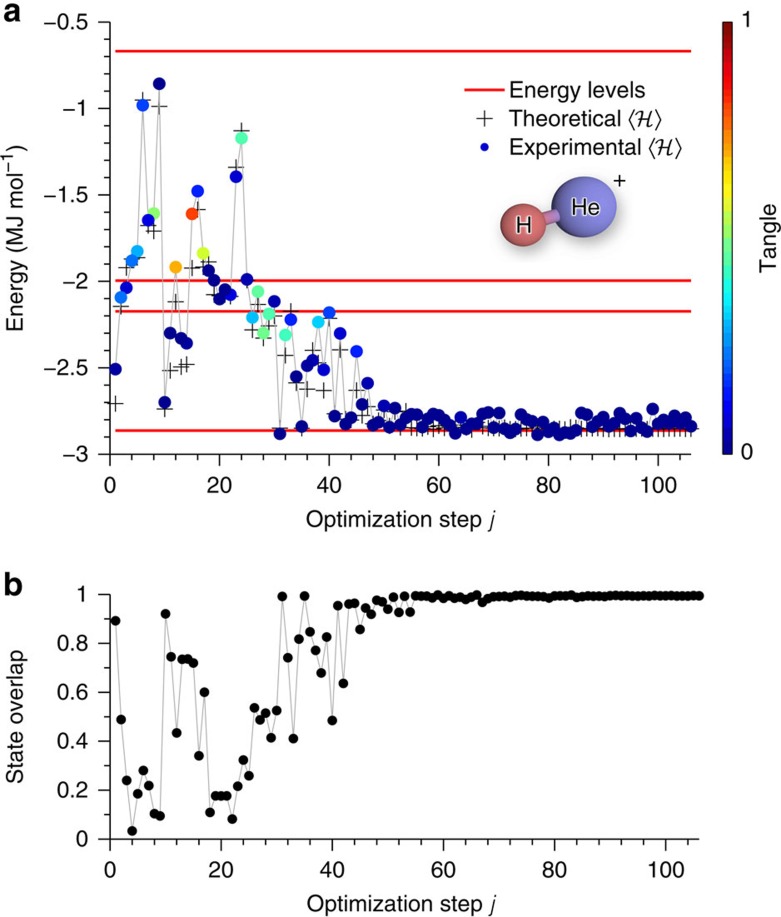
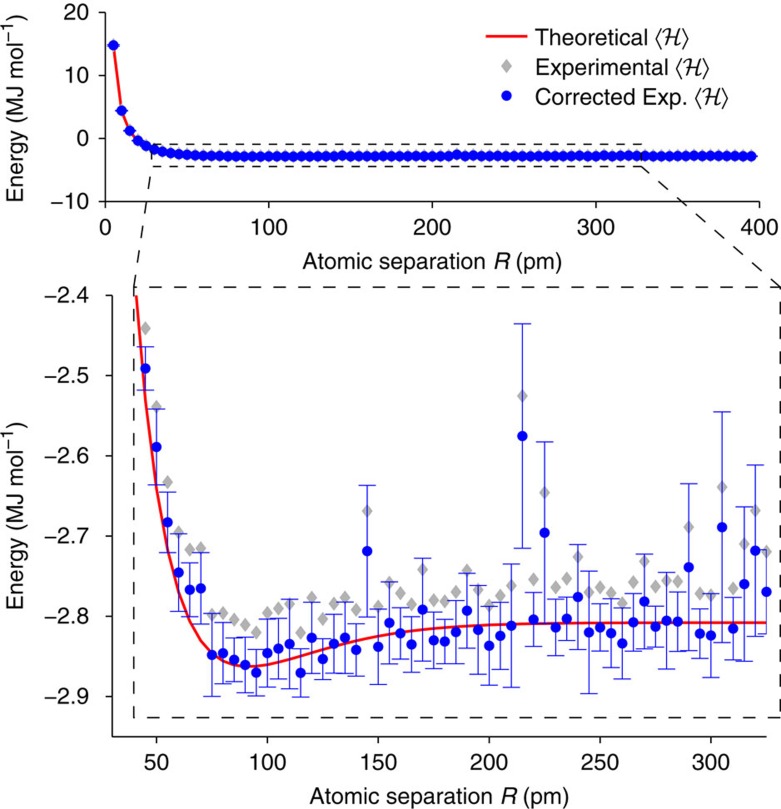
- The authors report an experimental ground-state result for He–H\(^+\): after correcting for experimental errors, they estimate the equilibrium bond length as \(R = 92.3 \pm 0.1\) pm and the ground-state electronic energy as \(E = -2.865 \pm 0.008\) MJ mol\(^{-1}\).
- For the bond dissociation curve, more than 96% of the experimental data are within chemical accuracy of the theoretical values.
- In the discussion, they state that for a 4 × 4 Hamiltonian like the one demonstrated, the QPE circuit would require at least 12 CNOT gates, whereas their method requires one.
- The full experiment was performed in about 158 h, and the bond dissociation curve was obtained by finding the ground states of 79 Hamiltonians.
## Methods
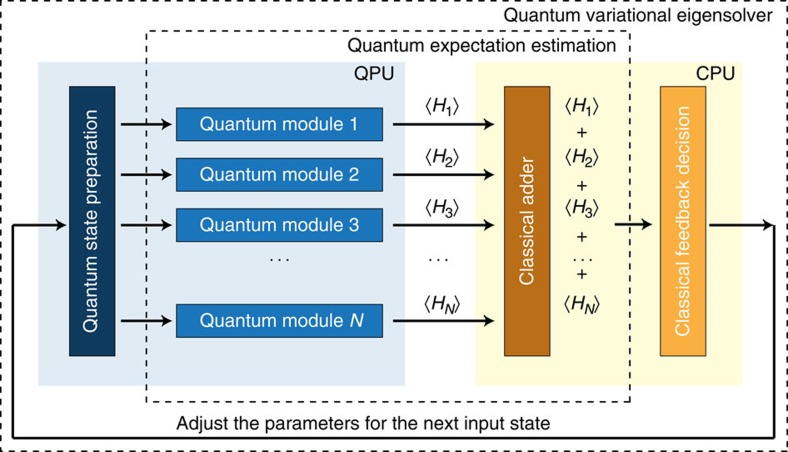
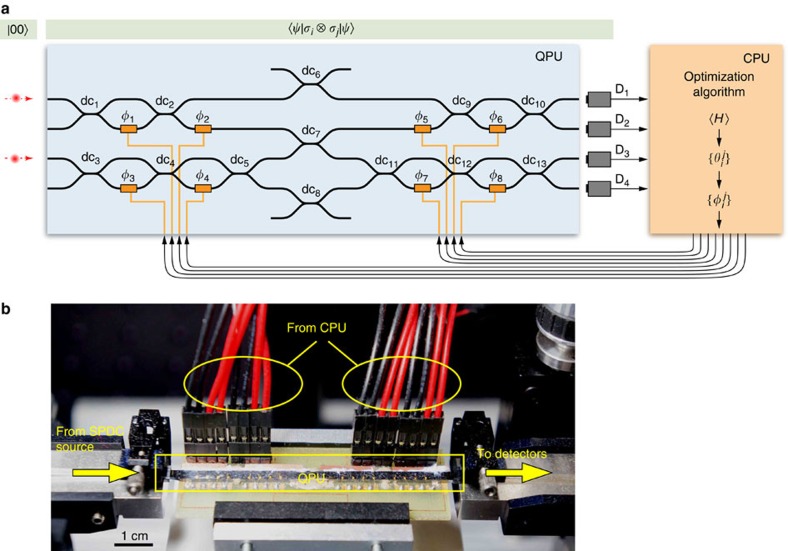
- The paper combines a reconfigurable integrated photonic quantum processor with a classical optimization algorithm: the quantum device estimates Hamiltonian expectation values, and the classical processor updates the state parameters variationally.
- The photonic chip prepares and measures arbitrary two-qubit pure states using single-qubit rotations and one two-qubit entangling gate; the experimental demonstration uses the He–H\(^+\) molecule in a minimal basis.
- For the classical optimization, they use the Nelder–Mead algorithm; expectation values are reconstructed from four two-qubit Pauli measurements at each point.
## Limitations
- The paper states that the method still requires a good approximation to the ground state as input/initialization, and the reliance on multiple separate measurements makes it sensitive to variations in state preparation between calculations.
- The authors report a constant systematic shift of \(\varepsilon = 50\) kJ mol\(^{-1}\) in the measured expectation values; they attribute this to photon-source impurity/distinguishability, circuit imperfections, and unbalanced coupling efficiencies.
- Evident from the text: the demonstration is limited to a two-qubit / 4 × 4 Hamiltonian prototype, so the scalability claim is not experimentally validated here.
Model-written summary. Check it against the paper before relying on it.
Integrity signals
Registry
Cites
Statistics
Figures
Verification
Claims the paper makes
7 Valid · 4 Not valid · 11 Not checked · 59 Own results and interpretations
The cited sources support only part of this claim — read each source’s verdict below.
In the paper
“Recent developments in the field of quantum computation offer a way forward for determining efficient solutions of many instances of large eigenvalue problems that are classically intractable6789101112”
§ A variational eigenvalue solver on a photonic quantum processor > Abstract
What the sources say
- Not matchedcites [6] Nielsen, M. A. & Chuang, I. L. Quantum Computation and Quantum Information Cambridge University Press (2000).
Couldn’t be matched to a paper in Crossref, so it can’t be checked.
- Could not verifycites [7] Kitaev, A. Quantum measurements and the Abelian stabilizer problem. Electronic Colloquium on Computational Complexity (ECCC) 3 (1996). sourceExperimental — accuracy not yet measured
Our copy under this DOI is the ISAAC 2021 paper 'Effective Resistance and Capacitance in Simplicial Complexes and a Quantum Algorithm' (Kitaev's 1995 work appears only as reference [9] in its bibliography), and it nowhere asserts that quantum computation gives efficient solutions to classically intractable large eigenvalue problems. Eigenvalues enter only as complexity parameters — λ, the smallest eigenvalue of the normalized up-Laplacian, in Lemma 31 and Theorem 26 (Section 6.3, 'Time efficient implementations') and in the phase-estimation machinery of Appendix A — and Section 1.1 ('Our Contributions') actually reports the opposite direction for its own problem: 'the quantum algorithm is slower than the classical algorithm in the worst case'. Searched: 'eigenvalue problems classically intractable', 'quantum speedup / exponential advantage', 'phase estimation', 'faster than classical'; no passage addresses the claim's point. (LLM, conf=0.70)
- Partly supportedcites [8] Griffiths, R. B. & Niu, C.-S. Semiclassical fourier transform for quantum computation. Phys. Rev. Lett. 76, 3228–3231 (1996). sourceExperimental — accuracy not yet measured
On p. 1, the paper says a quantum computer, if built, could solve certain problems such as factoring long numbers much faster than conventional algorithms. It also describes a simpler Fourier transform for Shor’s factorization and discrete-logarithm algorithms (p. 1). The copy does not support the claim about efficient solutions to many large eigenvalue problems. (LLM, conf=0.84)
plainstates a cause- Asserted: passes — The authors put it forward as true.
- Checkable: passes — It can be checked against evidence.
- Load-bearing: passes — The paper’s conclusions depend on it.
- Based: passes — The paper gives a reason why it holds.
- Not matched
Every source the paper cites for this claim was checked and supports it.
In the paper
“this would suffer from the N-representability problem, which is known to be intractable for both classical and quantum computers (it is in the quantum complexity class QMA-Hard24).”
§ A variational eigenvalue solver on a photonic quantum processor > Results > Quantum expectation estimation
What the sources say
- Supportedcites [24] Liu, Y.-K., Christandl, M. & Verstraete, F. Quantum computational complexity of the n-representability problem: Qma complete. Phys. Rev. Lett. 98, 110503 (2007). source
The paper states that N-representability is QMA-complete and hence QMA-hard and NP-hard (Abstract). Its discussion of quantum-chemistry relevance says the problem is intractable in the worst case even on a quantum computer, while allowing that particular physical systems may be easier. (LLM, conf=0.93)
boosted- Asserted: passes — The authors put it forward as true.
- Checkable: passes — It can be checked against evidence.
- Load-bearing: passes — The paper’s conclusions depend on it.
- Based: passes — The paper gives a reason why it holds.
- Supported
Every source the paper cites for this claim was checked and supports it.
In the paper
“We have implemented the QPU using integrated quantum photonics technology30.”
§ A variational eigenvalue solver on a photonic quantum processor > Results > Prototype demonstration
What the sources say
- Supportedcites [30] O'Brien, J. L., Furusawa, A. & Vuckovic, J. Photonic quantum technologies. Nat. Photon. 3, 687–695 (2009). source
The citation identifies integrated quantum photonics as the technology used, rather than attributing the citing authors’ QPU implementation to this review. The “Integrated quantum optical circuits” section (p. 6) describes on-chip waveguide circuits performing quantum logic gates and a compiled quantum factoring algorithm. (LLM, conf=0.87)
plain- Asserted: passes — The authors put it forward as true.
- Checkable: passes — It can be checked against evidence.
- Load-bearing: passes — The paper’s conclusions depend on it.
- Based: passes — The paper gives a reason why it holds.
- Supported
The cited sources support only part of this claim — read each source’s verdict below.
In the paper
“The time the quantum computer must remain coherent is determined by the necessity of O(p−1) successive applications of , each of which can require on the order of millions or billions of quantum gates for practical applications1719, as compared to the tens to hundreds of gates achievable in the short term.”
§ A variational eigenvalue solver on a photonic quantum processor > Abstract
What the sources say
- Partly supportedcites [17] Whitfield, J. D., Biamonte, J. & Aspuru-Guzik, A. Simulation of electronic structure hamiltonians using quantum computers. Mol. Phys. 109, 735–750 (2011). sourceExperimental — accuracy not yet measured
Split into 2 atoms — 1 confirmed, 1 partially supported, 0 disputed, 0 misattributed, 0 unverifiable. Expand the claim to see per-atom verdicts.
- Partly supportedcites [19] Jones, N. C. et al. Faster quantum chemistry simulation on fault-tolerant quantum computers. New J. Phys. 14, 115023 (2012). sourceExperimental — accuracy not yet measured
Split into 2 atoms — 0 confirmed, 2 partially supported, 0 disputed, 0 misattributed, 0 unverifiable. Expand the claim to see per-atom verdicts.
plainstates a cause- Asserted: passes — The authors put it forward as true.
- Checkable: passes — It can be checked against evidence.
- Load-bearing: passes — The paper’s conclusions depend on it.
- Based: passes — The paper gives a reason why it holds.
- Partly supported
A result the paper reports from its own data — it cites no other source for it, so there is none to check. The quote shows it is in the paper.
In the paper
“We experimentally demonstrate the feasibility of this approach with an example from quantum chemistry—calculating the ground-state molecular energy for He–H+.”
§ A variational eigenvalue solver on a photonic quantum processor > Abstract
boostedstates a causeSingle case- Asserted: passes — The authors put it forward as true.
- Checkable: passes — It can be checked against evidence.
- Load-bearing: passes — The paper’s conclusions depend on it.
- Based: passes — The paper gives a reason why it holds.
31 more claims
Create a free account to see all 81 claims and to verify the 4 references still open.
- It may state two separate claims as one. 28
- Probably not a substantial claim. 24
Claims other papers make about this one
Each is checked against this paper’s own text: does it say what the citing paper says it does?
The cited source doesn’t support the claim as written.
In the citing paper
“Leveraging quantum resources, the UCC ansatz was instead realized as a PQC on a photonic processor (Peruzzo et al. , 2014).”
From Noisy intermediate-scale quantum algorithms (2022) · cites this paper as Peruzzo et al., 2014
Checked by a reasoning model — may be wrong.
Experimental — accuracy not yet measuredThe cited source doesn’t support the claim as written.
In the citing paper
“The first on-chip GMM of four-qubit cluster state was realised in a laser-writing chip ( Fig.4e ), by manipulating both the polarisation and path DoFs of two photons [85].”
From Integrated photonic quantum technologies (2020) · cites this paper as [85]
Checked by a reasoning model — may be wrong.
Experimental — accuracy not yet measuredThe cited source doesn’t support the claim as written.
In the citing paper
“four-qubit linear- and box-cluster states are generated in a laser-writing photonic chip. This is enabled by on-chip manipulating the two-photon four-qubit hyperentangled state and cluster state, that are encoded in photon's path and polarisation DoFs. The Grover's search algorithm on a four-element database was implemented by controlling the device.”
From Integrated photonic quantum technologies (2020) · cites this paper as [85]
Checked by a reasoning model — may be wrong.
Experimental — accuracy not yet measuredThe source backs part of the claim, not all of it — or backs it for a different population, condition or comparison.
In the citing paper
“Due to its versatility, the variational Hamiltonian ansatz has been implemented for quantum chemistry [21, 29], optimization [24], and for quantum simulation problems [30].”
From Variational quantum algorithms (2021) · cites this paper as [29]
Experimental — accuracy not yet measuredThe source backs part of the claim, not all of it — or backs it for a different population, condition or comparison.
In the citing paper
“For the original VQE (Peruzzo et al. , 2014) and QAOA (Farhi et al. , 2014) it can, for example, be described as a single expectation value min θ ⟨ H ⟩ U ( θ ) , where the differences solely appear in the specific form and construction of the qubit Hamiltonian.”
From Noisy intermediate-scale quantum algorithms (2022) · cites this paper as Peruzzo et al., 2014
Experimental — accuracy not yet measured
12 more claims about this paper
Create a free account to see every claim other papers make about this one.
Citations
Cites
A Simplex Method for Function Minimization
Nelder, J. A., & Mead, R. (1965) · The Computer Journal · doi:10.1093/comjnl/7.4.308 · Cited by 28,905
Quantum computation and quantum information
Law, J. (2001) · ACM SIGSOFT Software Engineering Notes · doi:10.1145/505482.505499 · Cited by 18,842
(1999) · Cited by 12,854
Practical Methods of Optimization
Fletcher, R. (2000) · Wiley eBooks · doi:10.1002/9781118723203 · Cited by 7,605 · cited 3×
“[12] S.”
BackgroundMethodPractical methods of optimization
(1988) · Mathematics and Computers in Simulation · doi:10.1016/0378-4754(88)90129-2 · Cited by 5,818
Quantum Algorithm for Linear Systems of Equations
Harrow, A. W., Hassidim, A., & Lloyd, S. (2009) · Physical Review Letters · doi:10.1103/physrevlett.103.150502 · Cited by 3,325
Conn, A. R., Gould, N. I. M., & Toint, P. L. (2000) · Society for Industrial and Applied Mathematics eBooks · doi:10.1137/1.9780898719857 · Cited by 2,981 · cited 3×
“[14] D.”
MethodInfluential�ber das Paulische �quivalenzverbot
Jordan, P., & Wigner, E. (1928) · Zeitschrift f�r Physik · doi:10.1007/bf01331938 · Cited by 2,597
Molecular Electronic‐Structure Theory
Helgaker, T., Jørgensen, P., & Olsen, J. (2000) · doi:10.1002/9781119019572 · Cited by 2,594
O'Brien, J. L., Furusawa, A., & Vučković, J. (2009) · Nature Photonics · doi:10.1038/nphoton.2009.229 · Cited by 2,388
Self-citation
Research works printed but not linked: 3
- Helgaker, T., Jorgensen, P. & Olsen, J. Mol. Electronic Struct. Theory Wiley, Sussex (2002).
- Saad, Y. Numerical Methods for Large Eigenvalue Problems Vol. 158, (SIAM (1992).
- Rayleigh, J. W. In finding the correction for the open end of an organ-pipe. Phil. Trans. 161, 77 (1870).
Cited by
Items 2,501–2,600 of 4,573
An Introduction to Variational Quantum Eigensolver Applied to Chemistry
Fonseca, M. D. S., Porto, C. M., Carpio, N. A. C., Morais, G. D., Morgon, N. H., Nome, R. A., & Villas-Bôas, C. J. (2025) · Brazilian Journal of Physics · doi:10.1007/s13538-025-01892-w · Cited by 7
Gomez-Tejedor, A., Osaba, E., & Villar-Rodríguez, E. (2026) · Future Generation Computer Systems · doi:10.1016/j.future.2026.108481 · Cited by 17
Applications of quantum computing to optimization
Sotelo, R. (2021) · IEEE CHILEAN Conference on Electrical, Electronics Engineering, Information and Communication Technologies (CHILECON) · doi:10.1109/chilecon54041.2021.9703081 · Cited by 6
New Local Explorations of the Unitary Coupled Cluster Energy Landscape
Grimsley, H. R., & Mayhall, N. J. (2022) · Journal of Chemical Theory and Computation · doi:10.1021/acs.jctc.2c00751 · Cited by 6
Quantum computation of phase transition in interacting scalar quantum field theory
Thompson, S., & Siopsis, G. (2023) · Quantum Information Processing · doi:10.1007/s11128-023-04149-0 · Cited by 8
“[33] Alberto Peruzzo, Jarrod McClean, Peter Shadbolt, Man-Hong Yung, Xiao-Qi Zhou, Peter J.”
MethodBierman, J., Li, Y., & Lu, J. (2024) · Journal of Chemical Theory and Computation · doi:10.1021/acs.jctc.3c01297 · Cited by 7
“As was done for OptOrbVQE, we explicitly state the super and subscript notation used for the total problem to avoid confusion: • The subscript l will index the iteration number in the minimization problem where ˆ V is varied.”
MethodInfluentialNear-term distributed quantum computation using mean-field corrections and auxiliary qubits
Gomez, A. M., Patti, T. L., Anandkumar, A., & Yelin, S. F. (2024) · Quantum Science and Technology · doi:10.1088/2058-9565/ad3f45 · Cited by 9
“Any separation between the fidelity curves corresponding to different auxiliary choices indicates that the v ( a ) metric meaningfully separates the potential auxiliary choices according to fidelity performance.”
BackgroundDiscovering quantum circuit components with program synthesis
Sarra, L., Ellis, K., & Marquardt, F. (2024) · Machine Learning Science and Technology · doi:10.1088/2632-2153/ad4252 · Cited by 14
“Consider for example Shor’s algorithm for factorization [2] or Grover’s algorithm for search [3], the variational quantum eigensolver [4] or other quantum machine learning algorithms [5], which can all have a large impact on important problems.”
BackgroundMethodMeta-optimization of resources on quantum computers
Mohammad, I. A., Pivoluska, M., & Plesch, M. (2024) · Scientific Reports · doi:10.1038/s41598-024-59618-y · Cited by 10
“In this paper we study variational quantum eigensolver, introduced by Peruzzo et al. 15 , and subsequently thoroughly studied by many authors (see review papers 8,9,17 on the topic of VQE and the references therein).”
MethodParallel quantum computing simulations via quantum accelerator platform virtualization
Claudino, D., Lyakh, D. I., & McCaskey, A. (2024) · Future Generation Computer Systems · doi:10.1016/j.future.2024.06.007 · Cited by 9
“[7] This al-gorithm alleviates the circuit depth requirement of more precise alternatives (i.e. quantum phase estimation) by performing classical optimization of quantum circuit parameters, where the search for optimal parameters is informed by the classical outcomes of a much larger number of…”
BackgroundMorrone, D., Talarico, N. W., Cattaneo, M., & Rossi, M. A. C. (2024) · Entropy · doi:10.3390/e26090722 · Cited by 7
“Doing so improves the efficiency in preparing the GS [1, 36].”
BackgroundMethodUvarov, A., Rabinovich, D., Lakhmanskaya, O., Lakhmanskiy, K., Biamonte, J., & Adhikary, S. (2024) · Physical Review A · doi:10.1103/physreva.110.012404 · Cited by 10
“Equipped with these practical advantages, variational algorithms have found several applications, such as quantum approximate optimization (QAOA) [5– 17], variational eigensolvers (VQE) [18–22] and quantum assisted machine learning [23–27].”
BackgroundTiled unitary product states for strongly correlated Hamiltonians
Burton, H. G. A. (2024) · Faraday Discussions · doi:10.1039/d4fd00064a · Cited by 9
Exploring qubit-ADAPT-VQE for materials discovery in direct air capture
Barroca, M. A., Ferreira, R. N. B., & Steiner, M. B. (2024) · APL Quantum · doi:10.1063/5.0219500 · Cited by 10
Molecular electronic structure calculation via a quantum computer
Naeij, H. R., Mahmoudi, E., Yeganeh, H. D., & Akbari, M. (2024) · Computational and Theoretical Chemistry · doi:10.1016/j.comptc.2024.114945 · Cited by 12
“veloped in 2014 to estimate the molecular ground state properties on NISQ era computer [26].”
BackgroundMethodLan, Z., & Liang, W. (2024) · Journal of Chemical Theory and Computation · doi:10.1021/acs.jctc.4c00490 · Cited by 6
Full band-structure calculation of semiconducting materials on a noisy quantum processor
Zhang, S., Karim, A., Quiney, H. M., & Usman, M. (2024) · Physical Review A · doi:10.1103/physreva.110.062415 · Cited by 8
“The Variational Quantum Eigensolver[8–11] (VQE) has shown success for ground state calculations of small molecular systems, which has inbuilt robustness to coherent errors and can achieve high accuracy calculations with additional quantum error mitigating methods[10, 12–25].”
BackgroundExpressive quantum perceptrons for quantum neuromorphic computing
Bravo, R. A., Patti, T. L., Najafi, K., Gao, X., & Yelin, S. F. (2024) · Quantum Science and Technology · doi:10.1088/2058-9565/ad9fa4 · Cited by 11
“This is far less expensive than traditional circuit-based variational quantum algorithms [50– 52] methods where O ( N ) two-point correlators need to be measured directly on a the many-body input system.”
Towards Equivalence Checking of Classical Circuits Using Quantum Computing
Quetschlich, N., Forster, T. V., Osterwind, A., Helms, D., & Wille, R. (2024) · IEEE International Conference on Quantum Computing and Engineering (QCE) · doi:10.1109/qce60285.2024.00040 · Cited by 5
“Although still in its infancy, recent achievements have already sparked interest in many application domains, such as finance [10], chemistry [11], machine learning [12], and optimization [13].”
BackgroundQuantum Relaxation for Solving Multiple Knapsack Problems
Sharma, M., Jin, Y., Lau, H. C., & Raymond, R. (2024) · IEEE International Conference on Quantum Computing and Engineering (QCE) · doi:10.1109/qce60285.2024.00086 · Cited by 11
“This foundational idea evolved into the Quantum Approximate Optimization Algorithm (QAOA) [2] and Variational Quantum Eigensolver (VQE)[3], which entails variational optimization of quantum parameters [4].”
BackgroundMethodA Predictive Approach for Selecting the Best Quantum Solver for an Optimization Problem
Volpe, D., Quetschlich, N., Graziano, M., Turvani, G., & Wille, R. (2024) · IEEE International Conference on Quantum Computing and Engineering (QCE) · doi:10.1109/qce60285.2024.00121 · Cited by 6
“3) Variational Quantum Eigensolver (VQE, [25], [26]) is a hybrid quantum-classical algorithm that aims to minimize a scalar cost function mapped onto a Hamiltonian.”
Sobhani, M., Chai, Y., Hartung, T., & Jansen, K. (2025) · Physical Review A · doi:10.1103/physreva.111.042413 · Cited by 13
“The Variational Quantum Eigensolver (VQE) is a promising hybrid quantum-classical algorithm for NISQ devices, as outlined in [7].”
Hu, J., Wang, Q., & Li, S. (2025) · Journal of Chemical Theory and Computation · doi:10.1021/acs.jctc.5c00239 · Cited by 8
Molecular Properties from Quantum Krylov Subspace Diagonalization
Oumarou, O., Ollitrault, P. J., Cortes, C. L., Scheurer, M., Parrish, R. M., & Gogolin, C. (2025) · Journal of Chemical Theory and Computation · doi:10.1021/acs.jctc.5c00194 · Cited by 18
“First, it requires shallower quantum circuits than QPE while avoiding the challenging parameter optimization problem inherent to other variational methods, such as the variational quantum eigensolver (VQE) [28, 29].”
Lai, C.-T., Blank, C., Schmelcher, P., & Mukherjee, R. (2025) · Machine Learning Science and Technology · doi:10.1088/2632-2153/addb97 · Cited by 6
“…[31], Grover’s algorithm [32], variational algorithms such as quantum approximate optimization algorithm [33] and variational quantum eigensolver [34], quantum reservoir computing [35], quantum walk [36], quantum imaginary time evolution [37], and a variety of hybrid quantum–classical algorithms…”
Multireference error mitigation for quantum computation of chemistry
Zou, H., Magnusson, E., Brunander, H., Dobrautz, W., & Rahm, M. (2025) · Digital Discovery · doi:10.1039/d5dd00202h · Cited by 11
“Even for NISQ algorithms featuring shallow circuits, such as the variational quantum eigensolver (VQE) [15, 16] or variational quantum imaginary time evolution (VarQITE) [17–19], errors inevitably accumulate during computation, leading to unreliable results.”
Optimal compilation of parametrised quantum circuits
van de Wetering, J., Yeung, R. W. K., Laakkonen, T., & Kissinger, A. (2025) · Quantum · doi:10.22331/q-2025-08-27-1828 · Cited by 36
“For instance, variational algorithms such as QAOA [13] and VQE [24] use a feedback loop between a classical side and a quantum side where the parameters are updated by a classical optimisation procedure, based on measurement outcomes of the quantum device.”
Quantum Computing for Chemical Applications: Variational Algorithms and Beyond
Kumar, S., Ghosh, K., Lee, S., & Yamijala, S. S. R. K. C. (2025) · Journal of the Indian Institute of Science · doi:10.1007/s41745-025-00488-2 · Cited by 9
“Among quantum algorithms, the Variational Quantum Eigensolver (VQE) 25,26 and Quantum Phase Estimation (QPE) 23,24 have shown particular promise for calculating ground-and excited-state energies.”
Towards Supporting QIR: Steps for Adopting the Quantum Intermediate Representation
Stade, Y., Burgholzer, L., & Wille, R. (2025) · International Conference for High Performance Computing, Networking, Storage and Analysis (SC) · doi:10.1145/3731599.3767546 · Cited by 12
Hybrid quantum error correction in qubit architectures
Kristensen, L. B., Kjærgaard, M., Andersen, C. K., & Zinner, N. T. (2023) · Physical Review A · doi:10.1103/physreva.108.022403 · Cited by 10
“[4] A.”
BackgroundHybrid Helmholtz machines: a gate-based quantum circuit implementation
van Dam, T. J., Neumann, N. M. P., Phillipson, F., & van den Berg, H. (2020) · Quantum Information Processing · doi:10.1007/s11128-020-02660-2 · Cited by 10
Engineering a Cost Function for Real-world Implementation of a Variational Quantum Algorithm
Premaratne, S., & Matsuura, A. Y. (2020) · IEEE International Conference on Quantum Computing and Engineering (QCE) · doi:10.1109/qce49297.2020.00042 · Cited by 9
“Hybrid classical-quantum variational algorithms are promising implementations for NISQ systems and include the quantum approximate optimization algorithm (QAOA) [5], and Variational Quantum Eigensolver (VQE) [10], [12].”
MethodEfficient Parabolic Optimisation Algorithm for Adaptive VQE Implementations
Armaos, V., Badounas, D. A., Deligiannis, P., Lianos, K., & Yordanov, Y. S. (2022) · SN Computer Science · doi:10.1007/s42979-022-01346-z · Cited by 7
“That is because the Qubit-ADAPT pool consists of many more excitations than the other pools (one UCC double excitation corresponds to eight Qubit-ADAPT excitations).”
MethodInfluentialIntelligent pharmaceutical patent search on a near-term gate-based quantum computer
Wang, P., Chen, J., & Tseng, Y. J. (2022) · Scientific Reports · doi:10.1038/s41598-021-04031-y · Cited by 5
“The hybrid approach needs to perform only a short sequence of operations on the quantum computer and can offload some amount of the computation to the classical computer 31, 32 .”
BackgroundVariational estimation of capacity bounds for quantum channels
Rehman, J. U., Hong, S., Kim, Y., & Shin, H. (2022) · Physical Review A · doi:10.1103/physreva.105.032616 · Cited by 5
Quantum sampling for the Euclidean path integral of lattice gauge theory
Yamamoto, A. (2022) · Physical review. D/Physical review. D. · doi:10.1103/physrevd.105.094501 · Cited by 5
Xie, Q., Zhang, W., Xu, X., Liu, S., & Zhao, Y. (2022) · International Journal of Quantum Chemistry · doi:10.1002/qua.27001 · Cited by 8
Zhou, Y., Zhang, X., Liu, L., Liu, T., & Wang, X. (2022) · Progress of Theoretical and Experimental Physics · doi:10.1093/ptep/ptac149 · Cited by 6
Quantum computing for data-centric engineering and science
Herbert, S. (2022) · Data-Centric Engineering · doi:10.1017/dce.2022.36 · Cited by 6
“The variational quantum eigensolver (VQE) [21] is widely acknowledged as one of the most promising NISQ algorithms; and Google’s demonstration of (superconducting) quantum supremacy may be taken as the start of the NISQ-era (in the sense that this was the first demonstration of a quantum algorithm significantly outper…”
BackgroundNew Directions in Quantum Music: Concepts for a Quantum Keyboard and the Sound of the Ising Model
Clemente, G., Crippa, A., Jansen, K., & Tüysüz, C. (2022) · Springer eBooks · doi:10.1007/978-3-031-13909-3_17 · Cited by 5
Advances in quantum error correction based on superconducting quantum systems
Chen, Z.-J., Pan, X., Hua, Z., Wang, W., Ma, Y., Li, M., Zou, X., Sun, L., & Zou, C. (2022) · Acta Physica Sinica · doi:10.7498/aps.71.20221824 · Cited by 5
Symmetric Trotterization in digital quantum simulation of quantum spin dynamics
Lee, Y. (2023) · Journal of the Korean Physical Society · doi:10.1007/s40042-023-00722-z · Cited by 6
“In DQS, the Trotterization is a common approach not only to simulate unitary time evolution for quantum dynamics but also to find the ground state using the variational quantum eigensolver (VQE) [19, 20] or quantum imaginary time evolution (QITE) [21].”
Exploring the phase structure of the multi-flavor Schwinger model with quantum computing
Kühn, S., Funcke, L., Hartung, T., et al. (2023) · International Symposium on Lattice Field Theory (LATTICE) · doi:10.22323/1.430.0020 · Cited by 5
Artificial neural network encoding of molecular wavefunctions for quantum computing
Hagai, M., Sugiyama, M., Tsuda, K., & Yanai, T. (2023) · Digital Discovery · doi:10.1039/d2dd00093h · Cited by 5
Bauman, N. P., Peng, B., & Kowalski, K. (2023) · Advances in quantum chemistry · doi:10.1016/bs.aiq.2023.03.006 · Cited by 10
Quantum gradient evaluation through quantum non-demolition measurements
Solinas, P., Caletti, S., & Minuto, G. (2023) · The European Physical Journal D · doi:10.1140/epjd/s10053-023-00648-y · Cited by 7
“Among these hybrid algorithms, the most relevant ones are the variational quantum circuit, the variational quantum eigensolver [1,2] and the quantum approximate optimization algorithm [3].”
Time-optimal control of driven oscillators by variational circuit learning
Huang, T., Ding, Y., Dupays, L., Ban, Y., Yung, M., del Campo, A., & Chen, X. (2023) · Physical Review Research · doi:10.1103/physrevresearch.5.023173 · Cited by 9
Self-citationExploiting subspace constraints and ab initio variational methods for quantum chemistry
Gustiani, C., Meister, R., & Benjamin, S. C. (2023) · New Journal of Physics · doi:10.1088/1367-2630/ace182 · Cited by 7
“An eigensolver—finding the ground or other eigenstates of a Hamiltonian of interest—was the first VQA that was proposed nearly a decade ago [2].”
BackgroundJensen, P. W. K., Johnson, P. D., & Kunitsa, A. A. (2023) · Physical Review A · doi:10.1103/physreva.108.022422 · Cited by 6
Basic Research Perspective on Quantum Information Science for the Aerospace Community
Metcalfe, G. D., Tabakov, B., Nguyen, T., Lu, J., & Sayir, A. (2023) · AIAA Journal · doi:10.2514/1.j062978 · Cited by 6
Ratini, L., Capecci, C., & Guidoni, L. (2023) · Electronic Structure · doi:10.1088/2516-1075/ad018e · Cited by 6
“One of the leading quantum algorithms for addressing quantum chemistry problems [8, 16, 17] is the variational quantum eigensolver (VQE) [18–22].”
BackgroundPreparing a Fast Pauli Decomposition for Variational Quantum Solving Linear Equations
Ying, J., Shen, J., Zhou, L., Zhong, W., Du, M., & Sheng, Y. (2023) · Annalen der Physik · doi:10.1002/andp.202300212 · Cited by 8
Diagrammatic Analysis for Parameterized Quantum Circuits
Stollenwerk, T., & Hadfield, S. (2023) · Electronic Proceedings in Theoretical Computer Science · doi:10.4204/eptcs.394.15 · Cited by 19
“Note that we explicitly keep the phase factors. the QAOA (quantum alternating operator ansatz [26], which generalizes the quantum approximate optimization algorithm [21]) and VQE (variational quantum eigensolver [37, 39]) paradigms, as well as a number of more recent variants of these approaches.”
MethodState preparation in a Jaynes-Cummings lattice with quantum optimal control
Parajuli, P., Govindarajan, A., & Tian, L. (2023) · Scientific Reports · doi:10.1038/s41598-023-47002-1 · Cited by 7
“The qubit-cavity coupling g induces a built-in nonlinearity in the energy spectrum of a single JC model 59 , which can be viewed as an effective onsite interaction with strength U , as shown in Fig.”
MethodBenchmarking Adaptative Variational Quantum Algorithms on QUBO Instances
Turati, G., Dacrema, M. F., & Cremonesi, P. (2023) · IEEE International Conference on Quantum Computing and Engineering (QCE) · doi:10.1109/qce57702.2023.00053 · Cited by 11
“…ADAPT-VQE [2], qubit-ADAPT-VQE [3], and qubit-excitation-based-ADAPT-VQE [4], adaptative versions of the Variational Quantum Eigensolver (VQE) [5], [6], which are designed for the same purpose (i.e., finding the ground state of a Hamiltonian operator), but do not rely on a fixed-structure…”
Exploring the Potential of Qutrits for Quantum Optimization of Graph Coloring
Bottrill, G., Pandey, M., & Matteo, O. D. (2023) · IEEE International Conference on Quantum Computing and Engineering (QCE) · doi:10.1109/qce57702.2023.00028 · Cited by 21
“Flagship algorithms such as the variational quantum eigen-solver (VQE) [1] and quantum approximate optimization algorithm [2] have been applied in a variety of use cases and demonstrated using multiple hardware modalities.”
MethodQuantum Simulations for Carbon Capture on Metal-Organic Frameworks
Dahale, G. R. (2023) · IEEE International Conference on Quantum Computing and Engineering (QCE) · doi:10.1109/qce57702.2023.10189 · Cited by 8
“Variational Quantum Eigensolver (VQE) [5] is one of the successful quantum algorithms for calculating the ground state energy of molecules.”
BackgroundReducing the Compilation Time of Quantum Circuits Using Pre-Compilation on the Gate Level
Quetschlich, N., Burgholzer, L., & Wille, R. (2023) · IEEE International Conference on Quantum Computing and Engineering (QCE) · doi:10.1109/qce57702.2023.00091 · Cited by 6
“As a result, many approaches have emerged that try to use quantum computing to solve problems from various application domains such as finance (e.g., [1]), machine learning (e.g., [2]), optimization (e.g., [3]), and chemistry (e.g., [4]).”
BackgroundMethodAccurate harmonic vibrational frequencies for diatomic molecules via quantum computing
Chou, S.-K., Chou, J., Hu, A., Cheng, Y., & Goan, H. (2023) · Physical Review Research · doi:10.1103/physrevresearch.5.043216 · Cited by 5
“This circuit can be efficiently implemented on a quantum computer [7–10], making UCCSD a powerful tool for simulating chemical systems.”
MethodPractical circuit optimization algorithm for quantum simulation based on template matching
Liu, Y., Zhang, Z., Hu, Y. Y., Meng, F., Luan, T., Zhang, X., & Yu, X. (2024) · Quantum Information Processing · doi:10.1007/s11128-023-04252-2 · Cited by 10
Training iterated protocols for distillation of GHZ states with variational quantum algorithms
Rozgonyi, Á., Széchenyi, G., Kálmán, O., & Kiss, T. (2024) · Physics Letters A · doi:10.1016/j.physleta.2024.129349 · Cited by 5
“…the computational complexity grows exponentially with the size of the system e.g. calculation of the ground state energy of a given Hamiltonian [13, 14], learning probability distributions [15], generating error correction code [16], compressing quantum data [17], solving combinatorial…”
BackgroundExponential Hardness of Optimization from the Locality in Quantum Neural Networks
Zhang, H.-K., Zhu, C., Liu, G., & Wang, X. (2024) · Proceedings of the AAAI Conference on Artificial Intelligence · doi:10.1609/aaai.v38i15.29614 · Cited by 11
“The variational quantum eigen-solver is the most famous implementation of a hybrid quantum-classical algorithm with the goal of preparing the ground state of a given Hamiltonian ˆ H of a physical sys-tem (Peruzzo et al. 2014).”
MethodVariational quantum eigensolver with embedded entanglement using a tensor-network ansatz
Watanabe, R., Fujii, K., & Ueda, H. (2024) · Physical Review Research · doi:10.1103/physrevresearch.6.023009 · Cited by 9
“VQAs, specifically the variational quantum eigensolver (VQE), have been applied to search for the ground state of quantum systems [6].”
MethodConstruction and volumetric benchmarking of quantum computing noise models
Weber, T., Borras, K., Jansen, K., Krücker, D., & Riebisch, M. (2024) · Physica Scripta · doi:10.1088/1402-4896/ad406c · Cited by 9
Fast Emulation of Fermionic Circuits with Matrix Product States
Provazza, J., Gunst, K., Zhai, H., Chan, G. K., Shiozaki, T., Rubin, N. C., & White, A. F. (2024) · Journal of Chemical Theory and Computation · doi:10.1021/acs.jctc.4c00200 · Cited by 10
“The Variational Quantum Eigensolver (VQE) is a popular hybrid algorithm designed to report a variational upper bound on the ground state energy of a quantum system [61–63].”
Optimal depth and a novel approach to variational unitary quantum process tomography
Galetsky, V., Farré, P. J., Ghosh, S., Deppe, C., & Ferrara, R. (2024) · New Journal of Physics · doi:10.1088/1367-2630/ad5df1 · Cited by 5
Sketching phase diagrams using low-depth variational quantum algorithms
Bosse, J. L., Santos, R. A., & Montanaro, A. (2024) · Quantum Science and Technology · doi:10.1088/2058-9565/ad4979 · Cited by 7
“The Variational Quantum Eigensolver (VQE) [5, 15] is a prominent method for finding ground states | ψ 0 (cid:105) of quantum Hamiltonians by classically optimising the parameters of a parametric unitary U ( θ ).”
MethodResource-efficient quantum-classical hybrid algorithm for energy gap evaluation
Yang, Y., Li, Y., Xu, X., & Yuan, X. (2024) · Physical Review A · doi:10.1103/physreva.109.052416 · Cited by 7
Deterministic Ansätze for the measurement-based variational quantum eigensolver
Schroeder, A. K., Heller, M., & Gachechiladze, M. (2024) · New Journal of Physics · doi:10.1088/1367-2630/ad51e5 · Cited by 8
“The Variational Quantum Eigensolver (VQE) is a quantum-classical hybrid algorithm that approximates the lowest eigenvalue and its corresponding eigenvector of a given hermitian operator, typically the Hamiltonian of the investigated quantum sys-tem [9].”
BackgroundWindom, Z. W., Claudino, D., & Bartlett, R. J. (2024) · The Journal of Physical Chemistry A · doi:10.1021/acs.jpca.4c03935 · Cited by 6
Quantum annealer accelerates the variational quantum eigensolver in a triple-hybrid algorithm
Jattana, M. S. (2024) · Physica Scripta · doi:10.1088/1402-4896/ad6aea · Cited by 11
Noise-Aware Variational Eigensolvers: A Dissipative Route for Lattice Gauge Theories
Cobos, J., Locher, D. F., Bermúdez, A., Müller, M., & Rico, E. (2024) · PRX Quantum · doi:10.1103/prxquantum.5.030340 · Cited by 7
Exploring the topological sector optimization on quantum computers
Ding, Y.-M., Wang, Y.-C., Zhang, S., & Zheng, Y. Q. (2024) · Physical Review Applied · doi:10.1103/physrevapplied.22.034031 · Cited by 6
“Since the form of VQITE is similar to variational quantum algorithms, we additionally compare it with the gradient-based variational quantum eigensolver (VQE) [46, 47], which is a frequently-used quantum algo-rithm for ground states searching.”
MethodQuantum contextual bandits and recommender systems for quantum data
Brahmachari, S., Lumbreras, J., & Tomamichel, M. (2024) · Quantum Machine Intelligence · doi:10.1007/s42484-024-00189-6 · Cited by 15
“Now, by measuring each of these Pauli observables (since these measurements are conceivable, Peruzzo et al. (2014)), and taking the appropriately weighted sum of the measurement outcomes, we can simulate such a measurement.”
Study of Using Variational Quantum Linear Solver for Solving Poisson Equation
Govindugari, N. R., & Wong, H. Y. (2024) · International Conference on Simulation of Semiconductor Processes and Devices · doi:10.1109/sispad62626.2024.10732984 · Cited by 5
Javanmard, Y., Liaubaitė, U., Osborne, T. J., Xu, X., & Yung, M. (2024) · APL Quantum · doi:10.1063/5.0215573 · Cited by 10
Self-citationOptimizing Feature Selection for Predictive Analytics With Quantum Algorithms
Manushree, C. N., Putluru, H. D., Khajuria, H., Singh, C., & Nayak, B. P. (2024) · Advances in marketing, customer relationship management, and e-services book series · doi:10.4018/979-8-3693-7673-7.ch009 · Cited by 5
Hamiltonian-based graph-state ansatz for variational quantum algorithms
Anand, A., & Brown, K. R. (2025) · Physical Review A · doi:10.1103/physreva.111.012437 · Cited by 10
Hacking Cryptographic Protocols with Advanced Variational Quantum Attacks
Aizpurua, B., Bermejo, P., Martínez, J. E., & Orús, R. (2025) · ACM Transactions on Quantum Computing · doi:10.1145/3718349 · Cited by 16
“This quantum circuit depends on a set of variational parameters β , similar to e.g. the Variational Quantum Eigensolver (VQE) algorithm for optimizing cost functions [15].”
Efficient Quantum Cooling Algorithm for Fermionic Systems
Marti, L., Mansuroglu, R., & Hartmann, M. J. (2025) · Quantum · doi:10.22331/q-2025-02-18-1635 · Cited by 18
Exact block encoding of imaginary time evolution with universal quantum neural networks
Rrapaj, E., & Rule, E. (2025) · Physical Review Research · doi:10.1103/physrevresearch.7.013306 · Cited by 10
“Due to the recent rapid developments in quantum technology, these wave-function ansatzes have been ported to quantum circuits, with the Variational Quantum Eigen-solver (VQE) being one of the most prominent examples [56–58], paving the way for variational hybrid quantum-classical algorithms.”
Clifford circuit initialization for variational quantum algorithms
Cheng, M. H., Khosla, K. E., Self, C. N., Lin, M., Li, B. X., Medina, A. C., & Kim, M. S. (2025) · Physical Review A · doi:10.1103/physreva.111.062413 · Cited by 31
Zhang, B., Fang, B., Ye, F., Guo, L., Song, F., Tallent, N. R., & Tao, D. (2025) · International Conference on Supercomputing · doi:10.1145/3721145.3725747 · Cited by 9
“For instance, using tensor network simulators to execute the Quantum Approximate Optimization Algorithm (QAOA) [13] and the Variational Quantum Eigensolver (VQE) [43], the most representative quantum algorithms in the NISQ era, faces significant limitations.”
Demonstration of hardware efficient photonic variational quantum algorithm
Agresti, I., Paul, K., Schiansky, P., Steiner, S., Yin, Z., Pentangelo, C., Piacentini, S., Crespi, A., Ban, Y., Ceccarelli, F., et al. (2025) · Physical Review Research · doi:10.1103/d7bb-ybfh · Cited by 10
Q Learning with Quantum Neural Networks
Hu, W., & Hu, J. L. (2019) · Natural Science · doi:10.4236/ns.2019.111005 · Cited by 9
“Therefore, the ability to compute gradients of variational quantum circuits is essential for this technique [5].”
BackgroundBenchmarking quantum processors with a single qubit
Göktaş, O., Tham, W. K., Bonsma-Fisher, K., & Brodutch, A. (2020) · Quantum Information Processing · doi:10.1007/s11128-020-02642-4 · Cited by 8
Circuit Lower Bounds for Low-Energy States of Quantum Code Hamiltonians
Anshu, A., & Nirkhe, C. (2020) · DROPS (Schloss Dagstuhl – Leibniz Center for Informatics) · doi:10.4230/lipics.itcs.2022.6 · Cited by 19
Wang, H., & Yu, S. (2021) · Quantum Information Processing · doi:10.1007/s11128-020-02984-z · Cited by 6
Quantum neural networks with multi-qubit potentials
Ban, Y., Torrontegui, E., & Casanova, J. (2023) · Scientific Reports · doi:10.1038/s41598-023-35867-1 · Cited by 12
Quantum algorithm for the calculation of transition amplitudes in hybrid tensor networks
Kanno, S., Endo, S., Suzuki, Y., & Tokunaga, Y. (2021) · Physical Review A · doi:10.1103/physreva.104.042424 · Cited by 6
Using gradient-based algorithms to determine ground-state energies on a quantum computer
Piskor, T., Reiner, J.-M., Zanker, S., Vogt, N., Marthaler, M., Wilhelm, F. K., & Eich, F. G. (2022) · Physical Review A · doi:10.1103/physreva.105.062415 · Cited by 10
Flexibility of the factorized form of the unitary coupled cluster Ansatz
Chen, J., Cheng, H., & Freericks, J. K. (2022) · The Journal of Chemical Physics · doi:10.1063/5.0074311 · Cited by 5
Optimisation-free density estimation and classification with quantum circuits
Vargas-Calderón, V., Gonzalez, F. A., & Vinck-Posada, H. (2022) · Quantum Machine Intelligence · doi:10.1007/s42484-022-00074-0 · Cited by 6
“For this reason, there has also been a general interest of using gradient-free techniques to train variational quantum circuits (Franken et al. 2020; Benedetti et al. 2019b; Peruzzo et al. 2014; Khatri et al. 2019; Leyton-Ortega et al. 2021) (despite some controversy (Arrasmith et al.”
BackgroundIterative quantum optimization with an adaptive problem Hamiltonian for the shortest vector problem
Zhu, Y. R., Joseph, D., Ling, C., & Mintert, F. (2022) · Physical Review A · doi:10.1103/physreva.106.022435 · Cited by 5
“…its eigenvectors and eigenvalues correspond to lattice vectors and their squared lengths, it can readily be formulated as a quantum mechanical algorithm such as an adiabatic algorithm [6, 7], variational quantum eigensolver [8–11] or a quantum approximate optimization algorithm (QAOA) [12, 13].”
BackgroundA construction of combinatorial NLTS
Anshu, A., & Breuckmann, N. P. (2022) · Journal of Mathematical Physics · doi:10.1063/5.0113731 · Cited by 16
Machine Learning for Quantum Hardware Performance Assessment
Saravanan, V., & Saeed, S. M. (2022) · IEEE International Conference on Computer Design: VLSI in Computers and Processors (ICCD) · doi:10.1109/iccd56317.2022.00030 · Cited by 6
“While NISQ computers fail to support quantum applications that require error correction, they can be beneficial for other quantum applications, which tolerate some noise (e.g. [1], [2]).”
BackgroundMethodOn the Road to Quantum Communications
Chandra, D., Botsinis, P., Alanis, D., Babar, Z., Ng, S. X., & Hanzo, L. (2022) · Híradástechnika/Infocommunications journal · doi:10.36244/icj.2022.3.1 · Cited by 8
“29ºC 28ºC 30ºC”
Nishio, S., Oba, Y., & Kurashige, Y. (2023) · Physical Chemistry Chemical Physics · doi:10.1039/d3cp03520d · Cited by 9
Hierarchical Multigrid Ansatz for Variational Quantum Algorithms
Keller, C. M., Eidenbenz, S., Bärtschi, A., O’Malley, D., Golden, J. K., & Misra, S. (2024) · ISC High Performance (ISC) · doi:10.23919/isc.2024.10528934 · Cited by 8
“Important VQAs include the Variational Quantum Eigen-solver (VQE) for finding the ground state of a Hamiltonian [24], and the Quantum Approximate Optimization Algorithm (QAOA) for combinatorial optimization problems [10].”
BackgroundMethodKowalski, K., Peng, B., & Bauman, N. P. (2024) · The Journal of Chemical Physics · doi:10.1063/5.0207534 · Cited by 7
Metadata
- Authors
- Peruzzo, A., McClean, J., Shadbolt, P., Yung, M.-H., Zhou, X.-Q., Love, P. J., Aspuru-Guzik, A., & O’Brien, J. L.
- Affiliations
- The University of Sydney (AU)
- Harvard University (US)
- University of Bristol (GB)
- Haverford College (US)
- Corresponding author
- Peruzzo, Alberto
- O’Brien, Jeremy L.
- Venue
- Nature Communications
- Published
- 2014-07-23
- Volume
- 5
- Issue
- 1
- Pages
- 4213-4213
- ISSN
- 2041-1723 (ISSN-L)
- PMC
- PMC4124861
- OpenAlex
- W2161685427
- Cited by
- 4,552
- References
- 48
- Citations by year
- 2026: 591 · 2025: 765 · 2024: 722 · 2023: 658 · 2022: 564 · 2021: 561 · 2020: 346 · 2019: 191 · 2018: 83 · 2017: 29 · 2016: 18 · 2015: 16 · 2014: 4
- FWCI
- 22.24
- Type
- journal article
- Language
- en
- Open access
- hybrid
- doi.org
- Licence
- cc-by-nc-nd
- creativecommons.org/licenses/by-nc-nd/4.0 (tdm)
- creativecommons.org/licenses/by-nc-nd/4.0 (vor)
- Locations
- Nature Communications (publishedVersion, cc-by-nc-nd)
- Europe PMC (PubMed Central) (publishedVersion, cc-by-nc-nd)
- PubMed Central (publishedVersion, cc-by-nc-nd)
- PubMed (publishedVersion)
- arXiv (Cornell University) (submittedVersion)
- OSTI OAI (U.S. Department of Energy Office of Scientific and Technical Information) (submittedVersion, cc-by-nc-nd)
- Digital Access to Scholarship at Harvard (DASH) (Harvard University) (submittedVersion, cc-by)
- RePEc: Research Papers in Economics (submittedVersion)
- RMIT Research Repository (RMIT University Library) (submittedVersion, cc-by-nc-nd)
- Figshare (submittedVersion, cc-by-nc-nd)
- UWA Profiles and Research Repository (UWA) (submittedVersion, cc-by-nc-nd)
- Bristol Research (University of Bristol) (submittedVersion)
- arXiv (Cornell University)
- Funders
- National Science Foundation (DE-FG02-97ER25308, 0955518, 1037992)
- U.S. Department of Energy (DEFG0297ER25308, DE‐FG02‐, FG02-97ER25308)
- Alfred P. Sloan Foundation
- John Templeton Foundation
- Camille and Henry Dreyfus Foundation
- Royal Academy of Engineering
- National Natural Science Foundation of China (61033001, 61361136003)
- Engineering and Physical Sciences Research Council (EP/J017175/1, EP/L024020/1, EP/K021931/1)
- Australian Research Council (DE140101700)
- National Key Research and Development Program of China (61033001, 2011CBA00301, 61361136003, 2011CBA00300)
- Division of Chemistry (CHE-1037992)
- Air Force Office of Scientific Research (FA 9550-12-1-0046, FA9550-, FA9550-12, FA9550‐12‐1)
- Topics
- Physical Sciences › Computer Science › Artificial Intelligence › Quantum Computing Algorithms and Architecture
- Physical Sciences › Physics and Astronomy › Atomic and Molecular Physics, and Optics › Quantum Information and Cryptography
- Physical Sciences › Physics and Astronomy › Atomic and Molecular Physics, and Optics › Quantum many-body systems
- Keywords
- variational quantum eigensolver, photonic quantum processors, quantum chemistry, classical optimization, hybrid quantum-classical computation
About these checks
Registry, retraction, Cites and statistics results are computed, not judged, with one exception: a printed reference that no index lists is read once by a model before it counts as a citation error. Claims are extracted by a model and kept only when their quote appears verbatim in the text; each cited source is then checked, with a model’s help, for whether it says what the claim relies on. Those verdicts can be wrong — read the claim’s quote and the cited source before relying on one.
The claim verdicts this report counts are experimental: their accuracy is not yet measured.
A language model drew the claims from the paper on 2026-10-10, under version 3 of the claim definition (model deepseek-v4.1-flash, prompt extract-v3).
A second model labelled each claim on 2026-10-10 (model jev-1.13-20260917, definition revision gold-guideline-v0.2).
Cited sources are checked with a language model’s help (qwen3.8-omni-flash and gpt-6-sol).
Statistics and arithmetic are recomputed, not judged.
Confidence bands are shown only for fields calibrated on our annotated test set. None is calibrated yet, so no band is shown.
What counts as a claim ›How we measure confidence ›How we check this ›
Are you an author, or do you see a problem with this page? Request a review
Data sources
Bibliographic data: Semantic Scholar, OpenAlex, Crossref.
Contains information from the Semantic Scholar Academic Graph Datasets, made available under the ODC Attribution License (ODC-BY 1.0).
Semantic Scholar’s data is described in: Kinney, R., et al. (2023). The Semantic Scholar Open Data Platform. arXiv:2301.10140.
