

A variational eigenvalue solver on a photonic quantum processor
Open accessThe DOI matches its Crossref record; 47 of the 48 references it cites were found in a registry or an index; 14 of the 31 sources its claims cite were checked for support.
Abstract
Quantum computers promise to efficiently solve important problems that are intractable on a conventional computer. For quantum systems, where the physical dimension grows exponentially, finding the eigenvalues of certain operators is one such intractable problem and remains a fundamental challenge. The quantum phase estimation algorithm efficiently finds the eigenvalue of a given eigenvector but requires fully coherent evolution. Here we present an alternative approach that greatly reduces the requirements for coherent evolution and combine this method with a new approach to state preparation based on ansätze and classical optimization. We implement the algorithm by combining a highly reconfigurable photonic quantum processor with a conventional computer. We experimentally demonstrate the feasibility of this approach with an example from quantum chemistry—calculating the ground-state molecular energy for He–H+. The proposed approach drastically reduces the coherence time requirements, enhancing the potential of quantum resources available today and in the near future. Quantum computers promise to efficiently solve problems that would be practically impossible with a normal computer. Peruzzo et al. develop a variational computation approach that uses any available quantum resources and, with a photonic quantum processing unit, find the ground-state molecular energy of He–H+.
Overview
CoChat Summary
## TL;DR
The paper introduces a variational alternative to quantum phase estimation for finding eigenvalues, combining short coherent quantum measurements with classical optimization. It experimentally demonstrates the approach on a photonic processor by estimating the ground-state energy curve of He–H\(^+\).
## Key findings
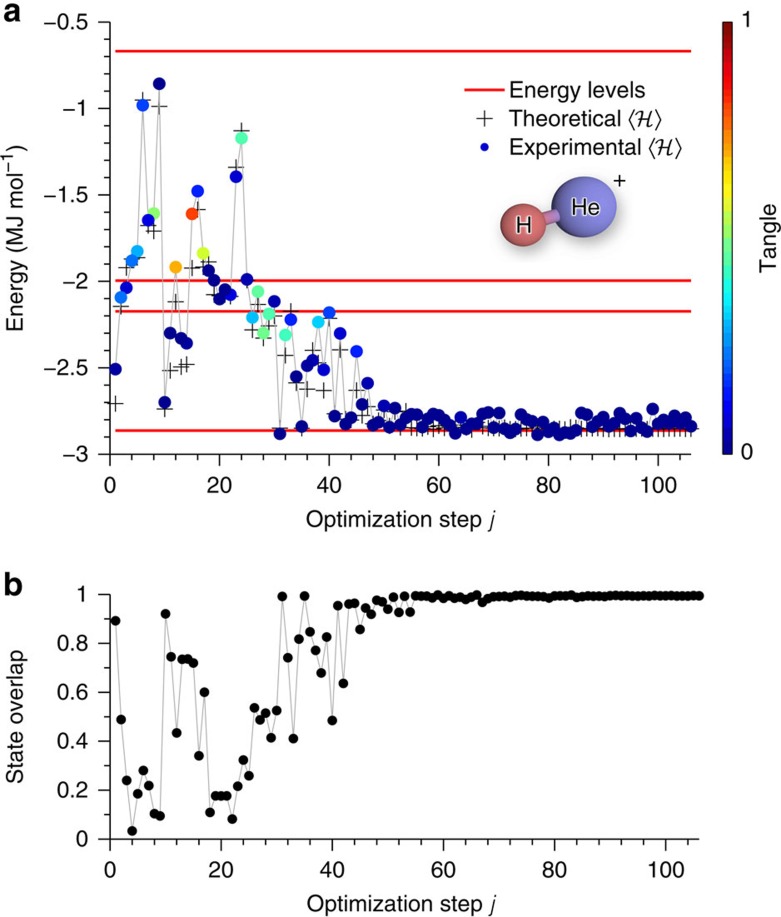
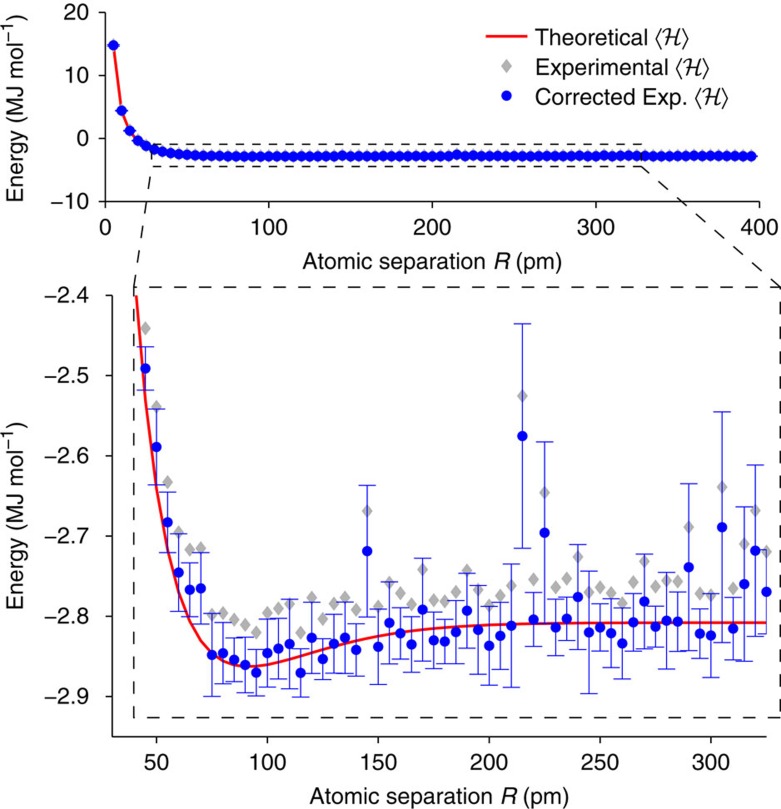
- The authors report an experimental ground-state result for He–H\(^+\): after correcting for experimental errors, they estimate the equilibrium bond length as \(R = 92.3 \pm 0.1\) pm and the ground-state electronic energy as \(E = -2.865 \pm 0.008\) MJ mol\(^{-1}\).
- For the bond dissociation curve, more than 96% of the experimental data are within chemical accuracy of the theoretical values.
- In the discussion, they state that for a 4 × 4 Hamiltonian like the one demonstrated, the QPE circuit would require at least 12 CNOT gates, whereas their method requires one.
- The full experiment was performed in about 158 h, and the bond dissociation curve was obtained by finding the ground states of 79 Hamiltonians.
## Methods
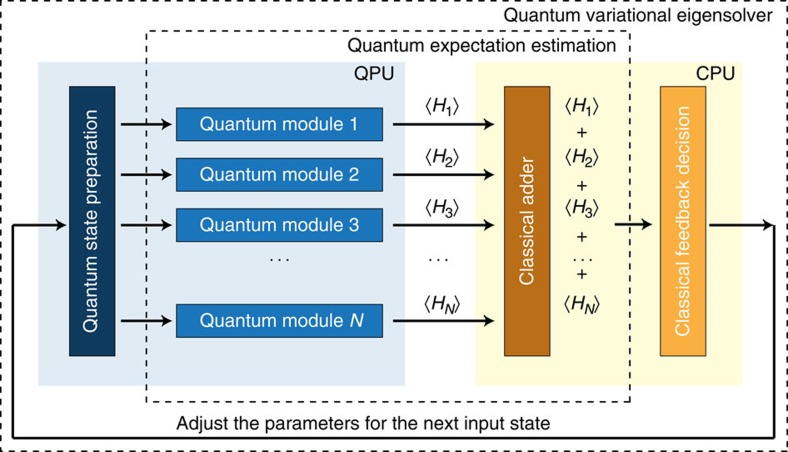
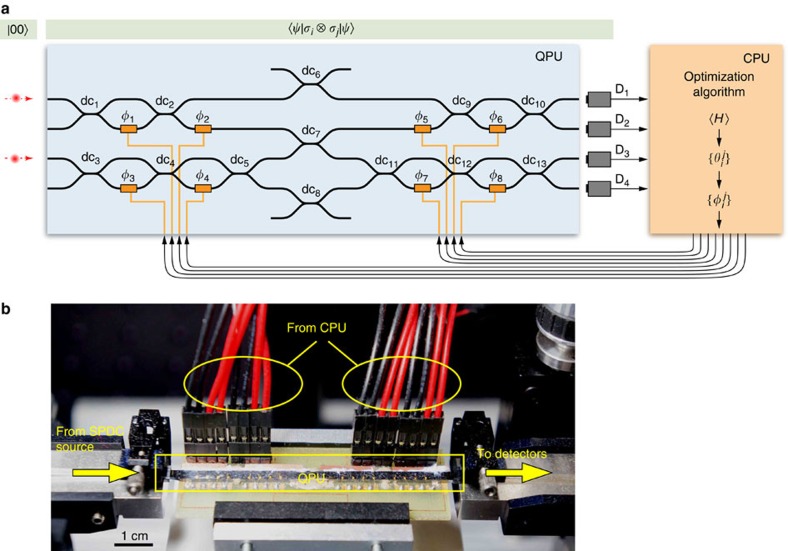
- The paper combines a reconfigurable integrated photonic quantum processor with a classical optimization algorithm: the quantum device estimates Hamiltonian expectation values, and the classical processor updates the state parameters variationally.
- The photonic chip prepares and measures arbitrary two-qubit pure states using single-qubit rotations and one two-qubit entangling gate; the experimental demonstration uses the He–H\(^+\) molecule in a minimal basis.
- For the classical optimization, they use the Nelder–Mead algorithm; expectation values are reconstructed from four two-qubit Pauli measurements at each point.
## Limitations
- The paper states that the method still requires a good approximation to the ground state as input/initialization, and the reliance on multiple separate measurements makes it sensitive to variations in state preparation between calculations.
- The authors report a constant systematic shift of \(\varepsilon = 50\) kJ mol\(^{-1}\) in the measured expectation values; they attribute this to photon-source impurity/distinguishability, circuit imperfections, and unbalanced coupling efficiencies.
- Evident from the text: the demonstration is limited to a two-qubit / 4 × 4 Hamiltonian prototype, so the scalability claim is not experimentally validated here.
Model-written summary. Check it against the paper before relying on it.
Integrity signals
Registry
Cites
Statistics
Figures
Verification
Claims the paper makes
7 Valid · 4 Not valid · 11 Not checked · 59 Own results and interpretations
The cited sources support only part of this claim — read each source’s verdict below.
In the paper
“Recent developments in the field of quantum computation offer a way forward for determining efficient solutions of many instances of large eigenvalue problems that are classically intractable6789101112”
§ A variational eigenvalue solver on a photonic quantum processor > Abstract
What the sources say
- Not matchedcites [6] Nielsen, M. A. & Chuang, I. L. Quantum Computation and Quantum Information Cambridge University Press (2000).
Couldn’t be matched to a paper in Crossref, so it can’t be checked.
- Could not verifycites [7] Kitaev, A. Quantum measurements and the Abelian stabilizer problem. Electronic Colloquium on Computational Complexity (ECCC) 3 (1996). sourceExperimental — accuracy not yet measured
Our copy under this DOI is the ISAAC 2021 paper 'Effective Resistance and Capacitance in Simplicial Complexes and a Quantum Algorithm' (Kitaev's 1995 work appears only as reference [9] in its bibliography), and it nowhere asserts that quantum computation gives efficient solutions to classically intractable large eigenvalue problems. Eigenvalues enter only as complexity parameters — λ, the smallest eigenvalue of the normalized up-Laplacian, in Lemma 31 and Theorem 26 (Section 6.3, 'Time efficient implementations') and in the phase-estimation machinery of Appendix A — and Section 1.1 ('Our Contributions') actually reports the opposite direction for its own problem: 'the quantum algorithm is slower than the classical algorithm in the worst case'. Searched: 'eigenvalue problems classically intractable', 'quantum speedup / exponential advantage', 'phase estimation', 'faster than classical'; no passage addresses the claim's point. (LLM, conf=0.70)
- Partly supportedcites [8] Griffiths, R. B. & Niu, C.-S. Semiclassical fourier transform for quantum computation. Phys. Rev. Lett. 76, 3228–3231 (1996). sourceExperimental — accuracy not yet measured
On p. 1, the paper says a quantum computer, if built, could solve certain problems such as factoring long numbers much faster than conventional algorithms. It also describes a simpler Fourier transform for Shor’s factorization and discrete-logarithm algorithms (p. 1). The copy does not support the claim about efficient solutions to many large eigenvalue problems. (LLM, conf=0.84)
plainstates a cause- Asserted: passes — The authors put it forward as true.
- Checkable: passes — It can be checked against evidence.
- Load-bearing: passes — The paper’s conclusions depend on it.
- Based: passes — The paper gives a reason why it holds.
- Not matched
Every source the paper cites for this claim was checked and supports it.
In the paper
“this would suffer from the N-representability problem, which is known to be intractable for both classical and quantum computers (it is in the quantum complexity class QMA-Hard24).”
§ A variational eigenvalue solver on a photonic quantum processor > Results > Quantum expectation estimation
What the sources say
- Supportedcites [24] Liu, Y.-K., Christandl, M. & Verstraete, F. Quantum computational complexity of the n-representability problem: Qma complete. Phys. Rev. Lett. 98, 110503 (2007). source
The paper states that N-representability is QMA-complete and hence QMA-hard and NP-hard (Abstract). Its discussion of quantum-chemistry relevance says the problem is intractable in the worst case even on a quantum computer, while allowing that particular physical systems may be easier. (LLM, conf=0.93)
boosted- Asserted: passes — The authors put it forward as true.
- Checkable: passes — It can be checked against evidence.
- Load-bearing: passes — The paper’s conclusions depend on it.
- Based: passes — The paper gives a reason why it holds.
- Supported
Every source the paper cites for this claim was checked and supports it.
In the paper
“We have implemented the QPU using integrated quantum photonics technology30.”
§ A variational eigenvalue solver on a photonic quantum processor > Results > Prototype demonstration
What the sources say
- Supportedcites [30] O'Brien, J. L., Furusawa, A. & Vuckovic, J. Photonic quantum technologies. Nat. Photon. 3, 687–695 (2009). source
The citation identifies integrated quantum photonics as the technology used, rather than attributing the citing authors’ QPU implementation to this review. The “Integrated quantum optical circuits” section (p. 6) describes on-chip waveguide circuits performing quantum logic gates and a compiled quantum factoring algorithm. (LLM, conf=0.87)
plain- Asserted: passes — The authors put it forward as true.
- Checkable: passes — It can be checked against evidence.
- Load-bearing: passes — The paper’s conclusions depend on it.
- Based: passes — The paper gives a reason why it holds.
- Supported
The cited sources support only part of this claim — read each source’s verdict below.
In the paper
“The time the quantum computer must remain coherent is determined by the necessity of O(p−1) successive applications of , each of which can require on the order of millions or billions of quantum gates for practical applications1719, as compared to the tens to hundreds of gates achievable in the short term.”
§ A variational eigenvalue solver on a photonic quantum processor > Abstract
What the sources say
- Partly supportedcites [17] Whitfield, J. D., Biamonte, J. & Aspuru-Guzik, A. Simulation of electronic structure hamiltonians using quantum computers. Mol. Phys. 109, 735–750 (2011). sourceExperimental — accuracy not yet measured
Split into 2 atoms — 1 confirmed, 1 partially supported, 0 disputed, 0 misattributed, 0 unverifiable. Expand the claim to see per-atom verdicts.
- Partly supportedcites [19] Jones, N. C. et al. Faster quantum chemistry simulation on fault-tolerant quantum computers. New J. Phys. 14, 115023 (2012). sourceExperimental — accuracy not yet measured
Split into 2 atoms — 0 confirmed, 2 partially supported, 0 disputed, 0 misattributed, 0 unverifiable. Expand the claim to see per-atom verdicts.
plainstates a cause- Asserted: passes — The authors put it forward as true.
- Checkable: passes — It can be checked against evidence.
- Load-bearing: passes — The paper’s conclusions depend on it.
- Based: passes — The paper gives a reason why it holds.
- Partly supported
A result the paper reports from its own data — it cites no other source for it, so there is none to check. The quote shows it is in the paper.
In the paper
“We experimentally demonstrate the feasibility of this approach with an example from quantum chemistry—calculating the ground-state molecular energy for He–H+.”
§ A variational eigenvalue solver on a photonic quantum processor > Abstract
boostedstates a causeSingle case- Asserted: passes — The authors put it forward as true.
- Checkable: passes — It can be checked against evidence.
- Load-bearing: passes — The paper’s conclusions depend on it.
- Based: passes — The paper gives a reason why it holds.
31 more claims
Create a free account to see all 81 claims and to verify the 4 references still open.
- It may state two separate claims as one. 28
- Probably not a substantial claim. 24
Claims other papers make about this one
Each is checked against this paper’s own text: does it say what the citing paper says it does?
The cited source doesn’t support the claim as written.
In the citing paper
“Leveraging quantum resources, the UCC ansatz was instead realized as a PQC on a photonic processor (Peruzzo et al. , 2014).”
From Noisy intermediate-scale quantum algorithms (2022) · cites this paper as Peruzzo et al., 2014
Checked by a reasoning model — may be wrong.
Experimental — accuracy not yet measuredThe cited source doesn’t support the claim as written.
In the citing paper
“The first on-chip GMM of four-qubit cluster state was realised in a laser-writing chip ( Fig.4e ), by manipulating both the polarisation and path DoFs of two photons [85].”
From Integrated photonic quantum technologies (2020) · cites this paper as [85]
Checked by a reasoning model — may be wrong.
Experimental — accuracy not yet measuredThe cited source doesn’t support the claim as written.
In the citing paper
“four-qubit linear- and box-cluster states are generated in a laser-writing photonic chip. This is enabled by on-chip manipulating the two-photon four-qubit hyperentangled state and cluster state, that are encoded in photon's path and polarisation DoFs. The Grover's search algorithm on a four-element database was implemented by controlling the device.”
From Integrated photonic quantum technologies (2020) · cites this paper as [85]
Checked by a reasoning model — may be wrong.
Experimental — accuracy not yet measuredThe source backs part of the claim, not all of it — or backs it for a different population, condition or comparison.
In the citing paper
“Due to its versatility, the variational Hamiltonian ansatz has been implemented for quantum chemistry [21, 29], optimization [24], and for quantum simulation problems [30].”
From Variational quantum algorithms (2021) · cites this paper as [29]
Experimental — accuracy not yet measuredThe source backs part of the claim, not all of it — or backs it for a different population, condition or comparison.
In the citing paper
“For the original VQE (Peruzzo et al. , 2014) and QAOA (Farhi et al. , 2014) it can, for example, be described as a single expectation value min θ ⟨ H ⟩ U ( θ ) , where the differences solely appear in the specific form and construction of the qubit Hamiltonian.”
From Noisy intermediate-scale quantum algorithms (2022) · cites this paper as Peruzzo et al., 2014
Experimental — accuracy not yet measured
12 more claims about this paper
Create a free account to see every claim other papers make about this one.
Citations
Cites
A Simplex Method for Function Minimization
Nelder, J. A., & Mead, R. (1965) · The Computer Journal · doi:10.1093/comjnl/7.4.308 · Cited by 28,905
Quantum computation and quantum information
Law, J. (2001) · ACM SIGSOFT Software Engineering Notes · doi:10.1145/505482.505499 · Cited by 18,842
(1999) · Cited by 12,854
Practical Methods of Optimization
Fletcher, R. (2000) · Wiley eBooks · doi:10.1002/9781118723203 · Cited by 7,605 · cited 3×
“[12] S.”
BackgroundMethodPractical methods of optimization
(1988) · Mathematics and Computers in Simulation · doi:10.1016/0378-4754(88)90129-2 · Cited by 5,818
Quantum Algorithm for Linear Systems of Equations
Harrow, A. W., Hassidim, A., & Lloyd, S. (2009) · Physical Review Letters · doi:10.1103/physrevlett.103.150502 · Cited by 3,325
Conn, A. R., Gould, N. I. M., & Toint, P. L. (2000) · Society for Industrial and Applied Mathematics eBooks · doi:10.1137/1.9780898719857 · Cited by 2,981 · cited 3×
“[14] D.”
MethodInfluential�ber das Paulische �quivalenzverbot
Jordan, P., & Wigner, E. (1928) · Zeitschrift f�r Physik · doi:10.1007/bf01331938 · Cited by 2,597
Molecular Electronic‐Structure Theory
Helgaker, T., Jørgensen, P., & Olsen, J. (2000) · doi:10.1002/9781119019572 · Cited by 2,594
O'Brien, J. L., Furusawa, A., & Vučković, J. (2009) · Nature Photonics · doi:10.1038/nphoton.2009.229 · Cited by 2,388
Self-citation
Research works printed but not linked: 3
- Helgaker, T., Jorgensen, P. & Olsen, J. Mol. Electronic Struct. Theory Wiley, Sussex (2002).
- Saad, Y. Numerical Methods for Large Eigenvalue Problems Vol. 158, (SIAM (1992).
- Rayleigh, J. W. In finding the correction for the open end of an organ-pipe. Phil. Trans. 161, 77 (1870).
Cited by
Items 2,701–2,800 of 4,572
QPI: A Programming Interface for Quantum Computers
Kaya, E., Mete, B., Schulz, L. B., Farooqi, M. N., Echavarria, J., & Schulz, M. (2024) · IEEE International Conference on Quantum Computing and Engineering (QCE) · doi:10.1109/qce60285.2024.10293 · Cited by 11
“For instance, Variational Quantum Eigensolver [11], [12] requires an expectation value calculation of a certain molecular Hamiltonian within each iteration.”
Hardware-efficient preparation of architecture-specific graph states on near-term quantum computers
Brandhofer, S., Polian, I., Barz, S., & Bhatti, D. (2025) · Scientific Reports · doi:10.1038/s41598-024-82715-x · Cited by 7
Quantum resources of quantum and classical variational methods
Spriggs, T., Ahmadi, A., Chen, B., & Greplová, E. (2025) · Machine Learning Science and Technology · doi:10.1088/2632-2153/adaca2 · Cited by 9
“There are, however, implementations on quantum hardware [43–48].”
Self-consistent Quantum Linear Response with a Polarizable Embedding Environment
Reinholdt, P., Kjellgren, E. R., Ziems, K. M., Coriani, S., Sauer, S. P. A., & Kongsted, J. (2025) · The Journal of Physical Chemistry A · doi:10.1021/acs.jpca.4c07534 · Cited by 10
“5,6 Though less focus has been given to the treatment of general molecular properties and excited states, there is an increasing amount of proposed approaches for accessing excited states.”
BackgroundA Quantum Framework for Combinatorial Optimization Problem over Graphs
Shi, M., Wu, S., Li, Y., Yuan, G., Yao, C., & Chen, G. (2025) · Data Science and Engineering · doi:10.1007/s41019-024-00269-4 · Cited by 4
“In recent years, variational quantum algorithms like VQE [21] and QAOA [9] have been investigated for solving graph problems.”
Parallel circuit implementation of variational quantum algorithms
Cattelan, M., Yarkoni, S., & Lechner, W. (2025) · npj Quantum Information · doi:10.1038/s41534-025-00982-6 · Cited by 18
“Originally proposed in 43 , VQEs have been used in practice to solve a variety of problems in quantum chemistry and combinatorial optimization 43 – 45 .”
Quantum Feasibility Labeling for NP-Complete Vertex Coloring Problem
Zhan, J. (2025) · IEEE Access · doi:10.1109/access.2025.3545262 · Cited by 10
“Researchers have made significant advances in the design and construction of quantum computer hardware [27], [28], [30], [31], [32], [33], and several companies have released commercial quantum computers that are available for use by researchers and businesses [34], [35], [36].”
Predicting properties of quantum systems by regression on a quantum computer
Kardashin, A., Balkybek, Y., Palyulin, V. V., & Antipin, K. V. (2025) · Physical Review Research · doi:10.1103/physrevresearch.7.013201 · Cited by 6
“For instance, one can find the ground state of a given Hamiltonian [24–26], solve linear algebra problems [27, 28], perform state [29] and Hamiltonian diag-onalization [30–32], etc. Additionally, variational quantum computing methods have been applied for quantum metrology and parameter estimation…”
Berberich, J., Kosut, R. L., & Schulte‐Herbrüggen, T. (2024) · IEEE Conference on Decision and Control (CDC) · doi:10.1109/cdc56724.2024.10886787 · Cited by 8
“The variational quantum eigensolver (VQE) [27] aims to determine the minimum eigenvalue of a matrix H , which is a challenging problem of central importance in various domains, in particular in quantum chemistry.”
Unitary vibrational coupled cluster: General theory and implementation
Jensen, R. B., & Christiansen, O. (2025) · The Journal of Chemical Physics · doi:10.1063/5.0249469 · Cited by 4
Nishi, H., Takei, Y., Kosugi, T., Mieda, S., Natsume, Y., Aoyagi, T., & Matsushita, Y. (2025) · Physical Review Applied · doi:10.1103/physrevapplied.23.034016 · Cited by 11
“…is a prerequisite for QPE, and a number of approaches have been proposed, including adiabatic time evolution [12–15], variational quantum eigensolver (VQE) [16, 17], quantum eigenvalue transformation of unitary matrices (QETU) [18], and imaginary-time evolution (ITE) on quantum computers [19–25].”
Imaginary Hamiltonian variational Ansatz for combinatorial optimization problems
Wang, X., Chai, Y., Feng, X., Guo, Y., Jansen, K., & Tüysüz, C. (2025) · Physical Review A · doi:10.1103/physreva.111.032612 · Cited by 16
“The idea of arranging quantum gates using directed graphs can be adapted to other variational ansatz such as the Hamiltonian variational ansatz (HVA) and the unitary coupled cluster (UCC) ansatz [9].”
Q‐fid: Quantum Circuit Fidelity Improvement with LSTM Networks
Mao, Y., Shresthamali, S., & Kondo, M. (2025) · Advanced Quantum Technologies · doi:10.1002/qute.202500022 · Cited by 12
“However, they do not offer a clear definition when multiple correct states are expected, which often happens for common NISQ algorithms like QAOA [30] and VQE [31].”
Mixed Grover: A Hybrid Version to Improve Grover's Algorithm for Unstructured Database Search
Piron, R., Habibie, M. I., & Goursaud, C. (2025) · IEEE Transactions on Quantum Engineering · doi:10.1109/tqe.2025.3555562 · Cited by 5
A Monte Carlo Tree Search approach to QAOA: finding a needle in the haystack
Agirre, A., van Nieuwenburg, E., & Wauters, M. M. (2025) · New Journal of Physics · doi:10.1088/1367-2630/adc765 · Cited by 9
“VQAs employ a hybrid approach, combining classical optimization loops with (shallow) parameterized quantum circuits, offering a practical means of quantum computation with existing hardware.”
Quantum computing for molecular vibrational energies: A comprehensive study
Somasundaram, R., Jayaharish, R., Ramanan, R., & Chowdhury, C. (2025) · Materials Today Quantum · doi:10.1016/j.mtquan.2025.100031 · Cited by 7
Cheng, L.-X., & Zhang, D.-B. (2025) · Physics Letters A · doi:10.1016/j.physleta.2025.130516 · Cited by 9
“…minimization of energy or free energy, variational quantum algorithms are feasible for the simulation of static properties of generic quantum many-body systems, e.g, eigensolver (VQE) for preparing eigenstates [12–15] and variational quantum thermalizer(VQT) for generating thermal states [16–19].”
Kowalski, K., & Bauman, N. P. (2025) · Molecular Physics · doi:10.1080/00268976.2025.2489774 · Cited by 7
Equation-of-motion internally contracted multireference unitary coupled-cluster theory
Li, S., Zhao, Z., & Evangelista, F. A. (2025) · The Journal of Chemical Physics · doi:10.1063/5.0261000 · Cited by 4
Probing Many-Body Bell Correlation Depth with Superconducting Qubits
Wang, K., Li, W., Xu, S., Hu, M., Chen, J., Wu, Y., Zhang, C., Jin, F., Zhu, X., Gao, Y. Q., et al. (2025) · Physical Review X · doi:10.1103/physrevx.15.021024 · Cited by 22
Mondal, D., Patra, C., Halder, D., & Maitra, R. (2025) · The Journal of Chemical Physics · doi:10.1063/5.0258899 · Cited by 4
Quantum natural gradient with geodesic corrections for small shallow quantum circuits
Halla, M. (2025) · Physica Scripta · doi:10.1088/1402-4896/add05e · Cited by 7
“Our objective is to determine the ground state energy of the Transverse Field Ising Model [23] under open boundary conditions: R Y [2] R Y [3] R Y [4] R Z [5] R Z [6] R Z [7] R Z [8] R Y [9] R Y [10] R Y [11] R Y [12] R Z [13] R Z [14] R Z [15] R Z where Z i and X i are Pauli operators acting on…”
BackgroundMethodEfficient Pauli Channel Estimation with Logarithmic Quantum Memory
Chen, S., & Gong, W. (2025) · PRX Quantum · doi:10.1103/prxquantum.6.020323 · Cited by 44
Resource-efficient generalized quantum subspace expansion
Yang, B., Yoshioka, N., Harada, H., Hakkaku, S., Tokunaga, Y., Hakoshima, H., Yamamoto, K., & Endo, S. (2025) · Physical Review Applied · doi:10.1103/physrevapplied.23.054021 · Cited by 25
“In contrast, the QSE-based methods effectively suppress coherent errors that may derive from erroneous pulse controls or insufficient optimization of parameters in the variational quantum eigensolver (VQE) [37–40].”
Quantum Computer Simulation of Molecules in Optical Cavity
Sheng, Z., Ge, Y., Chen, J., Li, W., & Shuai, Z. (2025) · Precision Chemistry · doi:10.1021/prechem.4c00108 · Cited by 6
Liu, D., Yang, W., Wang, H., Du, Y., Wang, Y., Lü, Z., & Hao, J. (2025) · Computers & Operations Research · doi:10.1016/j.cor.2025.107137 · Cited by 5
On the similarity of bandwidth-tuned quantum kernels and classical kernels
Flórez-Ablan, R., Roth, M., & Schnabel, J. (2025) · Quantum Science and Technology · doi:10.1088/2058-9565/ade7ad · Cited by 15
Warm-start adaptive-bias quantum approximate optimization algorithm
Yu, Y., Wang, X., Shannon, N., & Joynt, R. (2025) · Physical Review A · doi:10.1103/nt3w-j4mj · Cited by 12
“On this intermediate time scale, hybrid quantum-classical algorithms such as the variational quantum algorithm (VQA) [14–17] are some of the most promising quantum algorithms to realize a quantum advantage.”
Quantum machine learning of molecular energies with hybrid quantum-neural wavefunction
Li, W., Zhang, S., Sheng, Z., Gong, C., Chen, J., & Shuai, Z. (2025) · Digital Discovery · doi:10.1039/d5dd00222b · Cited by 12
“The Variational Quantum Eigensolver (VQE) algorithm is the most widely adopted framework for quantum computational chemistry [4–9].”
Leveraging commuting groups for an efficient variational Hamiltonian ansatz
Anand, A., & Brown, K. R. (2025) · Quantum Science and Technology · doi:10.1088/2058-9565/adf507 · Cited by 10
Quantum Artificial Intelligence: Some Strategies and Perspectives
Baioletti, M., Fagiolo, F., Loglisci, C. A. A. M. D., Losavio, V. N., Oddi, A., Rasconi, R., & Gentili, P. L. (2025) · AI · doi:10.3390/ai6080175 · Cited by 9
Stabilizer configuration interaction: Finding molecular subspaces with error detection properties
Anand, A., & Brown, K. R. (2025) · Physical Review A · doi:10.1103/jkcp-6km5 · Cited by 11
Li, Z., Grabowska, D. M., & Savage, M. J. (2025) · Quantum · doi:10.22331/q-2025-09-29-1865 · Cited by 52
“While methods continue to become available for preparing the ground state and optimizing time evolution circuits, including variational quantum eigensolver (VQE) [94, 168–174], ADAPT-VQE and more (for example Refs.”
Mazumder, A. R., & TAYUR, S. R. (2025) · doi:10.1287/educ.2025.0288 · Cited by 9
QuSplit: achieving both high fidelity and throughput via job splitting on noisy quantum computers
Li, J., Song, Y., Liu, Y., Pan, J., Yang, L., Humble, T. S., & Jiang, W. (2025) · Quantum Machine Intelligence · doi:10.1007/s42484-025-00319-8 · Cited by 13
“Quantum computing holds great promise to revolutionize domain applications, such as computational chemistry [5, 7, 11, 12, 16, 19, 22, 28, 32]and material science [1, 3, 4, 6, 9, 25, 31, 34],and optimizations [8, 13–15, 29, 30, 33, 35, 36], outperforming state-of-the-art classical…”
Feasibility of performing quantum chemistry calculations on quantum computers
Louvet, T., Ayral, T., & Waintal, X. (2025) · Physical review. B./Physical review. B · doi:10.1103/hpt6-9tnk · Cited by 21
“…less specialized, and whose practical relevance has been questioned, see [3] and references therein), to near-term algorithms such as the variational quantum eigensolver (VQE) [4], which have no a priori parametric advantage over their classical counterparts, but might have a practical one [5].”
Scattering quantum random walks on square grids and randomly generated mazes
Koch, D. (2019) · Physical Review A · doi:10.1103/physreva.99.012330 · Cited by 4
Variational quantum algorithms and geometry
Napp, J. C. (2020) · doi:10.22331/qv-2020-06-04-37 · Cited by 5
The future of the correlated electron problem
Alexandradinata, A., Armitage, N. P., Baydin, A., Bi, W., Cao, Y., Changlani, H. J., Chertkov, E., Neto, E. H. D. S., Delacrétaz, L. V., Baggari, I. E., et al. (2025) · SciPost Physics Community Reports · doi:10.21468/scipostphyscommrep.8 · Cited by 38
Zhan, Z., Run, C., Zong, Z., Xiang, L., Fei, Y., Sun, Z., Wu, Y., Jia, Z.-L., Duan, P., Wu, J., et al. (2021) · Physical Review Applied · doi:10.1103/physrevapplied.16.034050 · Cited by 9
Multiple‐Qubit CkUm Logic Gates of Rydberg Atoms via Optimized Geometric Quantum Operations
Li, M., Li, J., Guo, F.-Q., Zhu, X., Liang, E., Zhang, S., Yan, L.-L., Feng, M., & Su, S. (2022) · Annalen der Physik · doi:10.1002/andp.202100506 · Cited by 4
Metropolis-style random sampling of quantum gates for the estimation of low-energy observables
Unmuth-Yockey, J. (2022) · Physical review. D/Physical review. D. · doi:10.1103/physrevd.105.034515 · Cited by 5
Quantum Orbital Minimization Method for Excited States Calculation on a Quantum Computer
Bierman, J., Li, Y., & Lu, J. (2022) · Journal of Chemical Theory and Computation · doi:10.1021/acs.jctc.2c00218 · Cited by 12
Hybrid quantum-classical multi-cut Benders approach with a power system application
Paterakis, N. G. (2023) · Computers & Chemical Engineering · doi:10.1016/j.compchemeng.2023.108161 · Cited by 60
“The QUBO problem was solved using the variational quantum eigensolver (VQE) and the quantum approximate optimization algorithm (QAOA), while the constrained convex SPs were solved with a classical solver.”
MethodSchuld, M., & Petruccione, F. (2021) · Quantum science and technology · doi:10.1007/978-3-030-83098-4_3 · Cited by 5
Anschuetz, E. R., Funcke, L., Komiske, P., Kryhin, S., & Thaler, J. (2022) · Physical review. D/Physical review. D. · doi:10.1103/physrevd.106.056008 · Cited by 4
Fast-QTrain: an algorithm for fast training of variational classifiers
Dangwal, S., Sharma, R., & Bhowmik, D. (2022) · Quantum Information Processing · doi:10.1007/s11128-022-03508-7 · Cited by 7
“It is to be noted that since we follow the quantum-classical-hybrid variational algorithm approach in our proposed algorithm, quantum-to-classical and classical-to-quantum interfacing is needed to be implemented for our algorithm, just like for any other variational algorithm [6, 21, 22, 24, 48].”
BackgroundMethodInfluentialEnergy landscape structure of small graph isomorphism under variational optimization
Chatterjee, T., Mohtashim, S. I., & Kundu, A. (2026) · AIP Advances · doi:10.1063/5.0305337 · Cited by 4
“Typically in VQAs, like the Variational Quantum Eigensolver (VQE) 12 and Quantum Approximate Optimization Algorithm (QAOA) 13 , the goal is to find a quantum state which minimizes the energy of a problem Hamiltonian.”
Quantum phase recognition using quantum tensor networks
Sahoo, S., Azad, U., & Singh, H. (2022) · The European Physical Journal Plus · doi:10.1140/epjp/s13360-022-03587-6 · Cited by 6
Benchmarking and Analysis of Noisy Intermediate-Scale Trapped Ion Quantum Computing Architectures
Kurlej, A., Alterman, S., & Obenland, K. (2022) · IEEE International Conference on Quantum Computing and Engineering (QCE) · doi:10.1109/qce53715.2022.00044 · Cited by 6
“The variational quantum eigensolver (VQE) is a popularly studied method for estimating the ground-state energy of a given Hamiltonian ˆ H designed for NISQ devices [14], [38].”
MethodKowalski, K., & Bauman, N. P. (2022) · Applied Sciences · doi:10.3390/app13010539 · Cited by 6
Application benchmark for quantum optimization on electromobility use case
Federer, M., Müssig, D., Klaiber, S., Lässig, J., Bretschneider, P., & Lenk, S. (2022) · IEEE Vehicle Power and Propulsion Conference (VPPC) · doi:10.1109/vppc55846.2022.10003292 · Cited by 6
“…common route to overcome these limitations partially is the use of hybrid quantum-classical algorithms [5] like variational algorithms [6] as the variational quantum eigensolver (VQE) [7] and the quantum approximate optimization algorithm (QAOA) [8], [9] or quantum alternating operator ansatz [10].”
MethodQuantum Bayesian inference for parameter estimation using quantum generative model
Ohno, H. (2023) · Quantum Information Processing · doi:10.1007/s11128-022-03809-x · Cited by 5
Circuit Symmetry Verification Mitigates Quantum-Domain Impairments
Xiong, Y., Chandra, D., Ng, S. X., & Hanzo, L. (2023) · IEEE Transactions on Signal Processing · doi:10.1109/tsp.2023.3244666 · Cited by 7
“Variational quantum algorithms [6], [7], [8], [9], [10], [11] are thus designed to share their computational tasks between a classical device and a quantum processor, which”
Ryabinkin, I. G., Jena, A., & Genin, S. N. (2023) · Journal of Chemical Theory and Computation · doi:10.1021/acs.jctc.2c01155 · Cited by 10
Sequence of penalties method to study excited states using VQE
Carobene, R., Barison, S., & Giachero, A. (2023) · Quantum Science and Technology · doi:10.1088/2058-9565/acd1a9 · Cited by 5
Chiang, C.-F., & Alsing, P. M. (2023) · Quantum Information Processing · doi:10.1007/s11128-023-03968-5 · Cited by 7
“Hybrid, short shallow circuit algorithms, such as Variational Quantum Eigensolver (VQE) [1] and Quantum Approximate Optimization Algorithm (QAOA) [2], are two near-term answers.”
MethodA Variational Ansatz for Taylorized Imaginary Time Evolution
Koch, M., Schaudt, O., Mogk, G., Mrziglod, T., Berg, H., & Beck, M. E. (2023) · ACS Omega · doi:10.1021/acsomega.3c01060 · Cited by 7
Kernel function based quantum algorithms for finite temperature quantum simulation
Wang, H., Nan, J., Zhang, T., Qiu, X., Chen, W., & Li, X. (2023) · Physical review. B./Physical review. B · doi:10.1103/physrevb.108.085102 · Cited by 7
Calculation of the moscovium ground‐state energy by quantum algorithms
Zaytsev, V. A., Groshev, M. E., Maltsev, I. A., Durova, A. V., & Шабаев, В. М. (2023) · International Journal of Quantum Chemistry · doi:10.1002/qua.27232 · Cited by 5
Sugimoto, T., & Tohyama, T. (2023) · Communications Physics · doi:10.1038/s42005-023-01399-3 · Cited by 6
QuantumSEA: In-Time Sparse Exploration for Noise Adaptive Quantum Circuits
Chen, T., Zhang, Z., Wang, H., Gu, J., Li, Z., Pan, D. Z., Chong, F. T., Han, S., & Wang, Z. (2023) · IEEE International Conference on Quantum Computing and Engineering (QCE) · doi:10.1109/qce57702.2023.00015 · Cited by 9
“VQE [42], [49], [58] is another representative example of NISQ algorithms, whose goal is to estimate the Hamiltonian’s ground-state energy, serving as the first step towards investigating the energetic properties of molecules [13], [26], [65] and materials [10], [59].”
BackgroundRahmaniar, W., Ramzan, B., & Ma’arif, A. (2024) · Astronomy and Computing · doi:10.1016/j.ascom.2024.100802 · Cited by 5
Sequential quantum simulation of spin chains with a single circuit QED device
Zhang, Y., Jahanbani, S., Riswadkar, A., Shankar, S., & Potter, A. C. (2024) · Physical Review A · doi:10.1103/physreva.109.022606 · Cited by 9
Quantum circuit distillation and compression
Daimon, S., Tsunekawa, K., Takeuchi, R., Sagawa, T., Yamamoto, N., & Saitoh, E. (2024) · Japanese Journal of Applied Physics · doi:10.35848/1347-4065/ad29d8 · Cited by 5
Grover’s search with learning oracle for constrained binary optimization problems
Ohno, H. (2024) · Quantum Machine Intelligence · doi:10.1007/s42484-024-00148-1 · Cited by 7
Many-Body-Expansion Based on Variational Quantum Eigensolver and Deflation for Dynamical Correlation
Xu, E., Shimomoto, Y., Ten‐no, S., & Tsuchimochi, T. (2024) · The Journal of Physical Chemistry A · doi:10.1021/acs.jpca.4c00351 · Cited by 8
Ground state property calculations of LiHn complexes using IBM Qiskit’s quantum simulator
Avramidis, B., Paudel, H. P., Alfonso, D. R., Duan, Y., & Jordan, K. D. (2024) · AIP Advances · doi:10.1063/5.0188249 · Cited by 9
Variational denoising for variational quantum eigensolver
Tran, Q. H., Kikuchi, S., & Oshima, H. (2024) · Physical Review Research · doi:10.1103/physrevresearch.6.023181 · Cited by 16
Classical Simulation of Peaked Shallow Quantum Circuits
Bravyi, S., Gosset, D., & Liu, Y. (2024) · ACM Symposium on Theory of Computing (STOC) · doi:10.1145/3618260.3649638 · Cited by 4
Beyond the Buzz: Strategic Paths for Enabling Useful NISQ Applications
Hegde, P. R., Kyriienko, O., Heimonen, H., Tolias, P. B., Netzer, G., Barkoutsos, P. K., Vinuesa, R., Peng, I. B., & Markidis, S. (2024) · ACM International Conference on Computing Frontiers (CF) · doi:10.1145/3649153.3649182 · Cited by 11
Noise Robustness of Quantum Relaxation for Combinatorial Optimization
Tamura, K., Suzuki, Y., Raymond, R., Watanabe, H. C., Sato, Y., Kondo, R., Sugawara, M., & Yamamoto, N. (2024) · IEEE Transactions on Quantum Engineering · doi:10.1109/tqe.2024.3439135 · Cited by 10
“Quantum algorithms for optimization such as VQE (Variational Quantum Eigensolver) [6] and QAOA (Quantum Ap-proximate Optimization Algorithm) [7, 8] share a common concern when executed on a noisy intermediate-scale quantum (NISQ) device, which is the problem of scalability [9].”
MethodThreats Related to the Use of Quantum Effects in Cryptography
Cherepnev, M. A., & Gracheva, S. S. (2024) · INFORMACIONNYE TEHNOLOGII · doi:10.17587/it.30.417-424 · Cited by 4
Quantum-enhanced mean value estimation via adaptive measurement
Wada, K., Fukuchi, K., & Yamamoto, N. (2024) · Quantum · doi:10.22331/q-2024-09-09-1463 · Cited by 8
Patterns for Quantum Software Engineering
Bączyk, M., Pérez‐Castillo, R., & Piattini, M. G. (2024) · doi:10.1145/3665870.3665871 · Cited by 4
“It VQA, QAOA [30–32] Architectural patterns e.g. Model View Controller (MVC), Microservices Architecture, Layered (n-tier) Architecture [18] N/A Orchestration of hybrid work-flows, cloud computing with quantum resources[39, 40, 40, 41] is crucial to notice that while algorithm families are not…”
Quantum Nuclear Dynamics on a Distributed Set of Ion-Trap Quantum Computing Systems
Dwivedi, A., Rasmusson, A. J., Richerme, P., & Iyengar, S. S. (2024) · Journal of the American Chemical Society · doi:10.1021/jacs.4c07670 · Cited by 7
Variational quantum simulation using non-Gaussian continuous-variable systems
Stornati, P., Acín, A., Chabaud, U., Dauphin, A., Parigi, V., & Centrone, F. (2024) · Physical Review Research · doi:10.1103/physrevresearch.6.043212 · Cited by 15
“[43] is a promising algorithm for implementing quantum simulations on emerging noisy intermediate-scale quantum (NISQ) computers [44].”
Quantum Circuit Architecture Search on a Superconducting Processor
Linghu, K., Qian, Y., Wang, R., Hu, M., Li, Z., Li, X., Xu, H., Zhang, J.-N., Ma, T., Zhao, P., et al. (2024) · Entropy · doi:10.3390/e26121025 · Cited by 19
“In these two areas, the employed ansatz is generally Hamiltonian dependent [48,49,74].”
Bridging Quantum Computing and Differential Privacy: Insights into Quantum Computing Privacy
Zhao, Y., Zhong, H., Zhang, X., Li, Y., Zhang, C., & Pan, M. (2024) · IEEE International Conference on Quantum Computing and Engineering (QCE) · doi:10.1109/qce60285.2024.00012 · Cited by 17
“…computers, several practical quantum algorithms have been developed, with the most well-known being the variational quantum algorithm (VQA) [6], including variational quantum eigensolver (VQE) [7], quantum approximate optimization algorithm (QAOA) [8] and quantum machine learning (QML) [9]–[12].”
Qonductor: A Cloud Orchestrator for Quantum Computing
Giortamis, E., Romão, F., Tornow, N., Lugovoy, D., & Bhatotia, P. (2025) · International Conference for High Performance Computing, Networking, Storage and Analysis (SC) · doi:10.1145/3712285.3759785 · Cited by 33
Quantum technologies and the National Quantum Initiative
Brown, K. R. (2019) · Quantum Engineering · doi:10.1002/que2.7 · Cited by 4
Thermo Field Dynamics on a Quantum Computer
Miceli, R., & McGuigan, M. (2019) · New York Scientific Data Summit (NYSDS) · doi:10.1109/nysds.2019.8909787 · Cited by 4
Ellerbrock, R., & Martínez, T. J. (2020) · The Journal of Chemical Physics · doi:10.1063/5.0013123 · Cited by 4
Inverse iteration quantum eigensolvers assisted with a continuous variable
He, M.-Q., Zhang, D.-B., & Wang, Z. D. (2022) · Quantum Science and Technology · doi:10.1088/2058-9565/ac5b30 · Cited by 5
Quantum Zeno approach for molecular energies with maximum commuting initial Hamiltonians
Yu, H., & Wei, T.-C. (2021) · Physical Review Research · doi:10.1103/physrevresearch.3.013104 · Cited by 5
ArsoNISQ: Analyzing Quantum Algorithms on Near-Term Architectures
Brandhofer, S., Devitt, S. J., & Polian, I. (2021) · IEEE European Test Symposium (ETS) · doi:10.1109/ets50041.2021.9465414 · Cited by 6
“problems in cryptography [1], chemistry and material science [2], [3].”
BackgroundBest-approximation error for parametric quantum circuits
Funcke, L., Hartung, T., Jansen, K., Kühn, S., Schneider, M., & Stornati, P. (2021) · IEEE International Conference on Web Services (ICWS) · doi:10.1109/icws53863.2021.00096 · Cited by 5
LAWS: Look Around and Warm-Start Natural Gradient Descent for Quantum Neural Networks
Tao, Z., Wu, J., Xia, Q., & Li, Q. (2023) · IEEE International Conference on Quantum Software (QSW) · doi:10.1109/qsw59989.2023.00019 · Cited by 14
“In QNN, a task of interest is prepared and evaluated via a parameterized quantum circuit (PQC) on a quantum computer, with iteratively updating the parameters by a classical optimizer to find the optimum for the objective function [1]–[3].”
MethodOptimally stopped variational quantum algorithms
Vinci, W., & Shabani, A. (2018) · Physical Review A · doi:10.1103/physreva.97.042346 · Cited by 4
Chiral topologically ordered insulating phases in arrays of interacting integer quantum Hall islands
Ebisu, H., Kalloor, R. R., Tsvelik, A. M., & Oreg, Y. (2020) · Physical review. B./Physical review. B · doi:10.1103/physrevb.102.165112 · Cited by 6
Forecasting Election Polls with Spin Systems
Ibarrondo, R., Sanz, M., & Orús, R. (2022) · SN Computer Science · doi:10.1007/s42979-021-00942-9 · Cited by 4
Song, W., Wieśniak, M., Liu, N., Pawłowski, M., Lee, J., Kim, J., & Bang, J. (2021) · Quantum Information Processing · doi:10.1007/s11128-021-03217-7 · Cited by 8
“Such approaches have received increasing attention, an example being the consideration of variational formulations [11,12,13,14,15].”
BackgroundBayesian Quantum CircuitPreprint
Du, Y., Liu, T., & Tao, D. (2018) · arXiv (Cornell University) · doi:10.48550/arxiv.1805.11089 · Cited by 6
Quantum supremacy with analog quantum processors for material science and machine learningPreprint
Tangpanitanon, J., Thanasilp, S., Lemonde, M.-A., & Angelakis, D. G. (2019) · arXiv (Cornell University) · doi:10.48550/arxiv.1906.03860 · Cited by 8
“These approaches have been used to solve problems in quantum chemistry [10– 13], machine learning [16–18], and high-energy physics [15].”
MethodQuantum locally linear embedding for nonlinear dimensionality reductionPreprint
He, X., Li, S., Lyu, C., et al. (2019) · arXiv (Cornell University) · doi:10.48550/arxiv.1910.07854 · Cited by 4
“[15,16].”
BackgroundThe Future of Computing: Bits + Neurons + QubitsPreprint
Gil, D., & Green, W. M. J. (2019) · arXiv (Cornell University) · doi:10.48550/arxiv.1911.08446 · Cited by 4
“In near-term quantum computers, we have developed a variational quantum eigensolver (VQE) [59] [60] employing short depth quantum circuits, which combines “qubits + bits” to build a hybrid quantum-classical algorithm [61].”
MethodZeta-regularized vacuum expectation values from quantum computing simulationsPreprint
Jansen, K., & Hartung, T. (2019) · arXiv (Cornell University) · doi:10.3204/pubdb-2020-00051 · Cited by 4
Optimizing Quantum Annealing Schedules: From Monte Carlo Tree Search to QuantumZeroPreprint
Chen, Y., Chen, Y., Lee, C., Zhang, S., & Hsieh, C. (2020) · arXiv (Cornell University) · Cited by 4
Extending C++ for Heterogeneous Quantum-Classical ComputingPreprint
Nguyen, T., SANTANA, A., Kharazi, T., Claudino, D., Finkel, H., & McCaskey, A. (2020) · arXiv (Cornell University) · doi:10.48550/arxiv.2010.03935 · Cited by 13
“We demonstrate how this library enables the integration of the VQE [39] and ADAPT [18] algorithms within existing C++ applications.”
BackgroundMethodInfluentialOptimizing Noisy-Intermediate Scale Quantum Circuits: A Block-Based SynthesisPreprint
Wu, X.-C., Davis, M., Chong, F. T., & Iancu, C. (2020) · arXiv (Cornell University) · Cited by 3
Metadata
- Authors
- Peruzzo, A., McClean, J., Shadbolt, P., Yung, M.-H., Zhou, X.-Q., Love, P. J., Aspuru-Guzik, A., & O’Brien, J. L.
- Affiliations
- The University of Sydney (AU)
- Harvard University (US)
- University of Bristol (GB)
- Haverford College (US)
- Corresponding author
- Peruzzo, Alberto
- O’Brien, Jeremy L.
- Venue
- Nature Communications
- Published
- 2014-07-23
- Volume
- 5
- Issue
- 1
- Pages
- 4213-4213
- ISSN
- 2041-1723 (ISSN-L)
- PMC
- PMC4124861
- OpenAlex
- W2161685427
- Cited by
- 4,552
- References
- 48
- Citations by year
- 2026: 591 · 2025: 765 · 2024: 722 · 2023: 658 · 2022: 564 · 2021: 561 · 2020: 346 · 2019: 191 · 2018: 83 · 2017: 29 · 2016: 18 · 2015: 16 · 2014: 4
- FWCI
- 22.24
- Type
- journal article
- Language
- en
- Open access
- hybrid
- doi.org
- Licence
- cc-by-nc-nd
- creativecommons.org/licenses/by-nc-nd/4.0 (tdm)
- creativecommons.org/licenses/by-nc-nd/4.0 (vor)
- Locations
- Nature Communications (publishedVersion, cc-by-nc-nd)
- Europe PMC (PubMed Central) (publishedVersion, cc-by-nc-nd)
- PubMed Central (publishedVersion, cc-by-nc-nd)
- PubMed (publishedVersion)
- arXiv (Cornell University) (submittedVersion)
- OSTI OAI (U.S. Department of Energy Office of Scientific and Technical Information) (submittedVersion, cc-by-nc-nd)
- Digital Access to Scholarship at Harvard (DASH) (Harvard University) (submittedVersion, cc-by)
- RePEc: Research Papers in Economics (submittedVersion)
- RMIT Research Repository (RMIT University Library) (submittedVersion, cc-by-nc-nd)
- Figshare (submittedVersion, cc-by-nc-nd)
- UWA Profiles and Research Repository (UWA) (submittedVersion, cc-by-nc-nd)
- Bristol Research (University of Bristol) (submittedVersion)
- arXiv (Cornell University)
- Funders
- National Science Foundation (DE-FG02-97ER25308, 0955518, 1037992)
- U.S. Department of Energy (DEFG0297ER25308, DE‐FG02‐, FG02-97ER25308)
- Alfred P. Sloan Foundation
- John Templeton Foundation
- Camille and Henry Dreyfus Foundation
- Royal Academy of Engineering
- National Natural Science Foundation of China (61033001, 61361136003)
- Engineering and Physical Sciences Research Council (EP/J017175/1, EP/L024020/1, EP/K021931/1)
- Australian Research Council (DE140101700)
- National Key Research and Development Program of China (61033001, 2011CBA00301, 61361136003, 2011CBA00300)
- Division of Chemistry (CHE-1037992)
- Air Force Office of Scientific Research (FA 9550-12-1-0046, FA9550-, FA9550-12, FA9550‐12‐1)
- Topics
- Physical Sciences › Computer Science › Artificial Intelligence › Quantum Computing Algorithms and Architecture
- Physical Sciences › Physics and Astronomy › Atomic and Molecular Physics, and Optics › Quantum Information and Cryptography
- Physical Sciences › Physics and Astronomy › Atomic and Molecular Physics, and Optics › Quantum many-body systems
- Keywords
- variational quantum eigensolver, photonic quantum processors, quantum chemistry, classical optimization, hybrid quantum-classical computation
About these checks
Registry, retraction, Cites and statistics results are computed, not judged, with one exception: a printed reference that no index lists is read once by a model before it counts as a citation error. Claims are extracted by a model and kept only when their quote appears verbatim in the text; each cited source is then checked, with a model’s help, for whether it says what the claim relies on. Those verdicts can be wrong — read the claim’s quote and the cited source before relying on one.
The claim verdicts this report counts are experimental: their accuracy is not yet measured.
A language model drew the claims from the paper on 2026-10-10, under version 3 of the claim definition (model deepseek-v4.1-flash, prompt extract-v3).
A second model labelled each claim on 2026-10-10 (model jev-1.13-20260917, definition revision gold-guideline-v0.2).
Cited sources are checked with a language model’s help (qwen3.8-omni-flash and gpt-6-sol).
Statistics and arithmetic are recomputed, not judged.
Confidence bands are shown only for fields calibrated on our annotated test set. None is calibrated yet, so no band is shown.
What counts as a claim ›How we measure confidence ›How we check this ›
Are you an author, or do you see a problem with this page? Request a review
Data sources
Bibliographic data: Semantic Scholar, OpenAlex, Crossref.
Contains information from the Semantic Scholar Academic Graph Datasets, made available under the ODC Attribution License (ODC-BY 1.0).
Semantic Scholar’s data is described in: Kinney, R., et al. (2023). The Semantic Scholar Open Data Platform. arXiv:2301.10140.
