

Fasting appetite-related gut hormone responses after weight loss induced by calorie restriction, exercise, or both in people with overweight or obesity: a meta-analysis
Open accessThe DOI matches its Crossref record; 182 of the 182 references it cites were found in a registry or an index.
Abstract
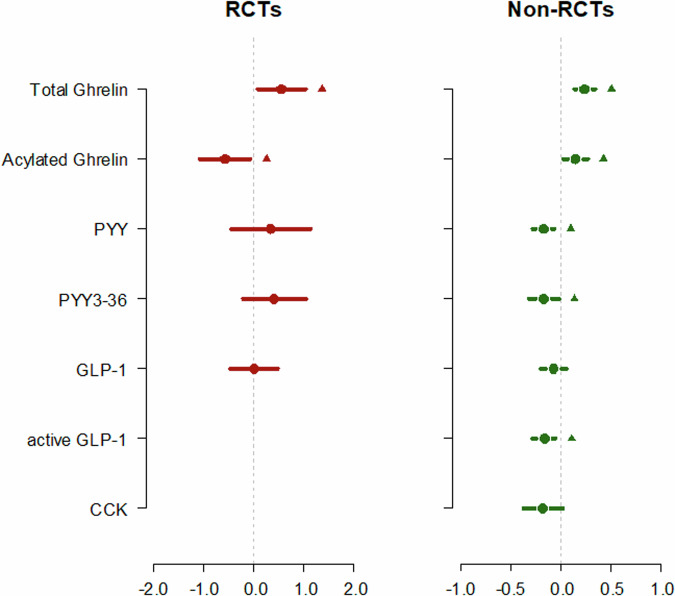
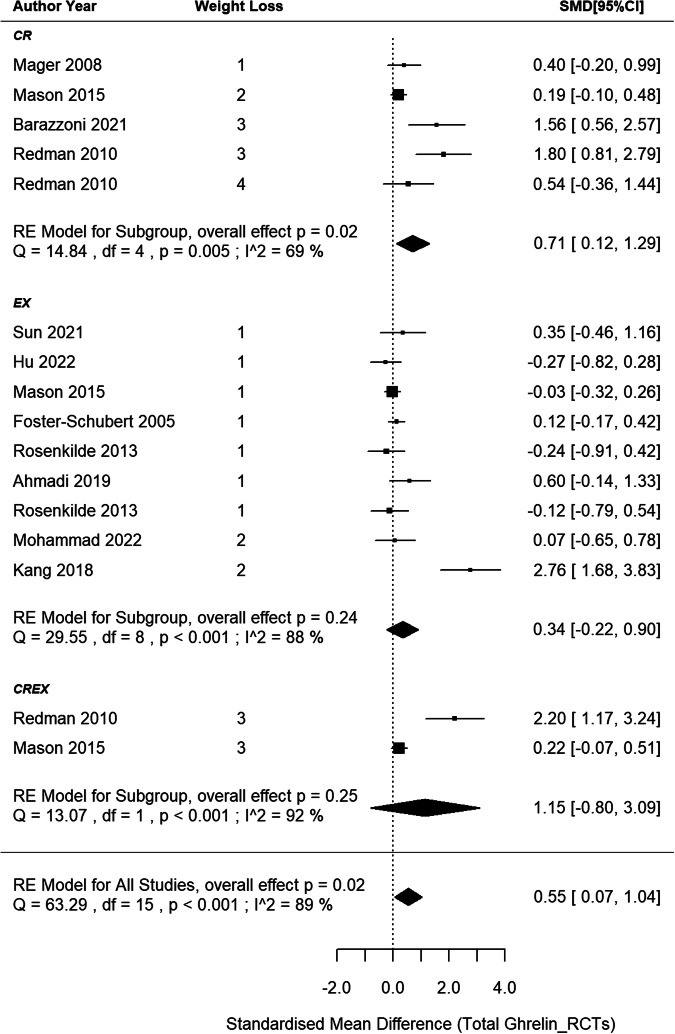
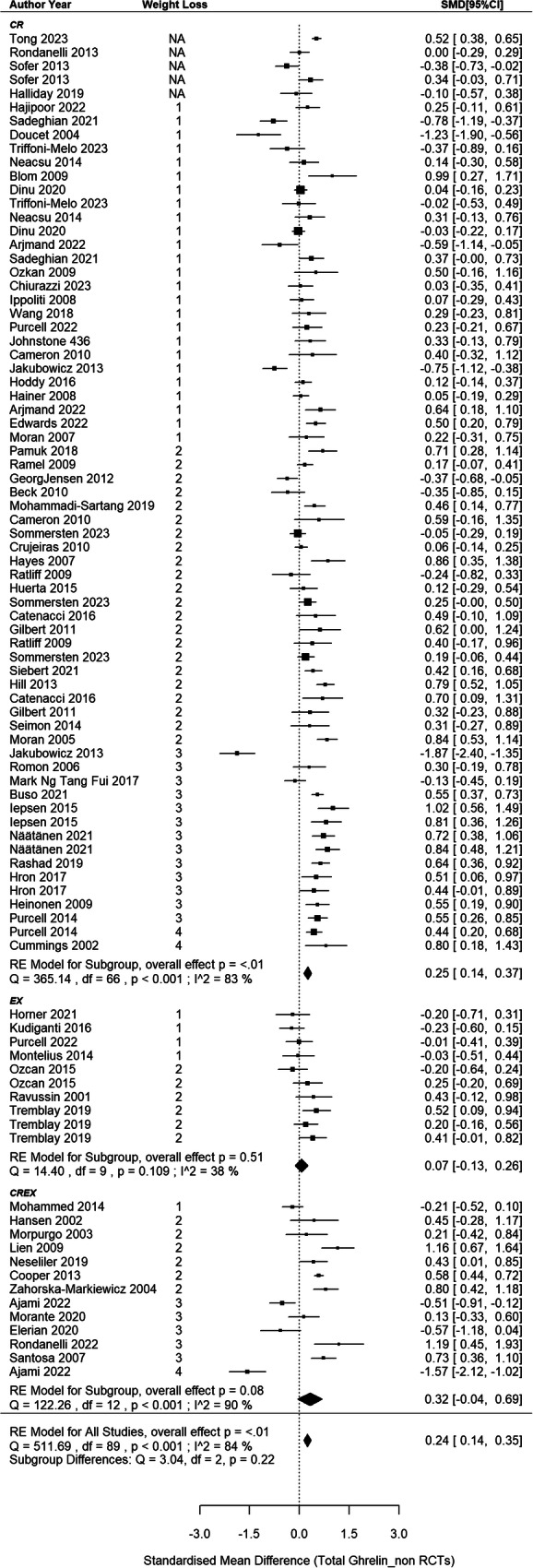
Objectives: Altered appetite-related gut hormone concentrations may reflect a physiological adaptation facilitating weight regain after weight loss. This review investigates hormonal changes after weight loss achieved through calorie restriction (CR), exercise (EX), or both combined (CREX). Methods: A systematic search of PubMed (MEDLINE), EMBASE, SPORTDiscus, Cochrane Library, Web of Science, and ClinicalTrials.gov was conducted to identify randomised controlled trials (RCTs) and non-RCTs reporting in a fasting state either pre- and post-intervention appetite-related hormone concentrations or the changes therein after weight loss. The hormones examined were ghrelin, peptide tyrosine tyrosine (PYY), glucagon-like peptide -1 (GLP-1), and cholecystokinin (CCK), in their total and/or active form. Standardised mean differences (SMD) were extracted as the effect size. Results: 127 studies were identified: 19 RCTs, 108 non-RCTs, 1305 and 4725 participants, respectively. In response to weight loss induced by CR, EX or CREX, the meta-analysis revealed an increase in total ghrelin from both RCTs (SMD: 0.55, 95% CI: 0.07–1.04) and non-RCTs (SMD: 0.24, 95% CI: 0.14–0.35). A decrease in acylated ghrelin was identified for RCTs (SMD: –0.58, 95% CI: –1.09 to –0.06) but an increase was observed for non-RCTs (SMD: 0.15, 95% CI: 0.03 to 0.27). Findings also revealed a decrease in PYY (total PYY: SMD: –0.17, 95%CI: –0.28 to –0.06; PYY 3-36 : SMD: –0.17, 95%CI: –0.32 to –0.02) and active GLP-1 (SMD: -0.16, 95% CI: –0.28 to –0.05) from non-RCTs. Changes in hormones did not differ among the three interventions when controlling for weight loss. Meta-regression indicated that greater weight loss was associated with a greater increase in total ghrelin. Conclusions: Weight loss induced by CR, EX, or CREX elicits an increase in total ghrelin, but varied responses in other appetite-related hormones. The extent of weight loss influences changes in appetite-related gut hormone concentrations.
Overview
The claims and statistics of this paper haven’t been checked yet.
Free: it reads the open-access text and checks the first 5 claims that cite a source we can check. Create a free account to check every claim.
Integrity signals
Registry
Cites
Statistics
Figures
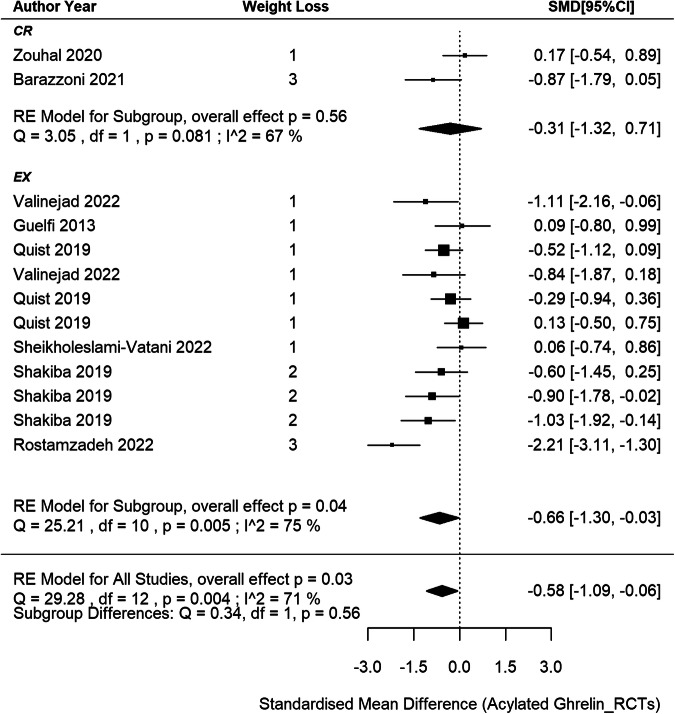
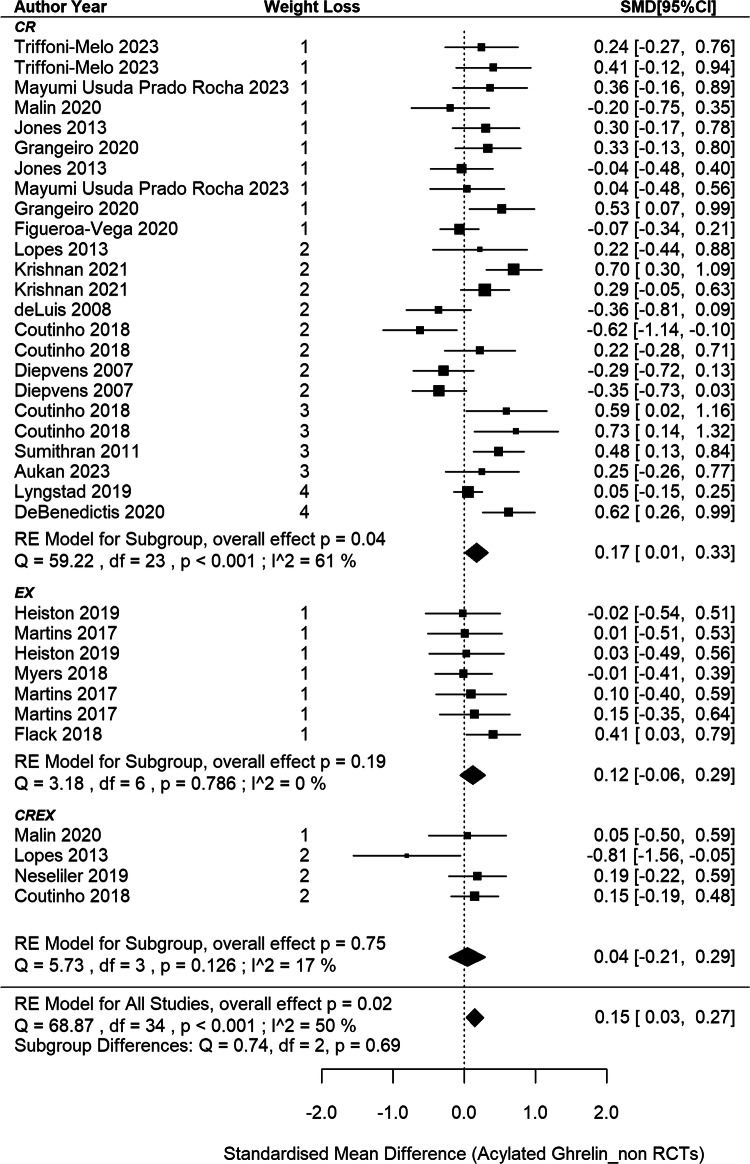
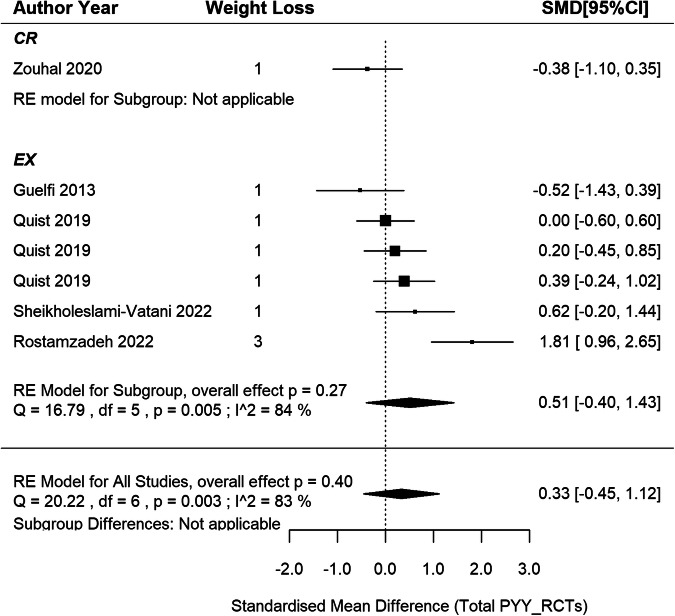
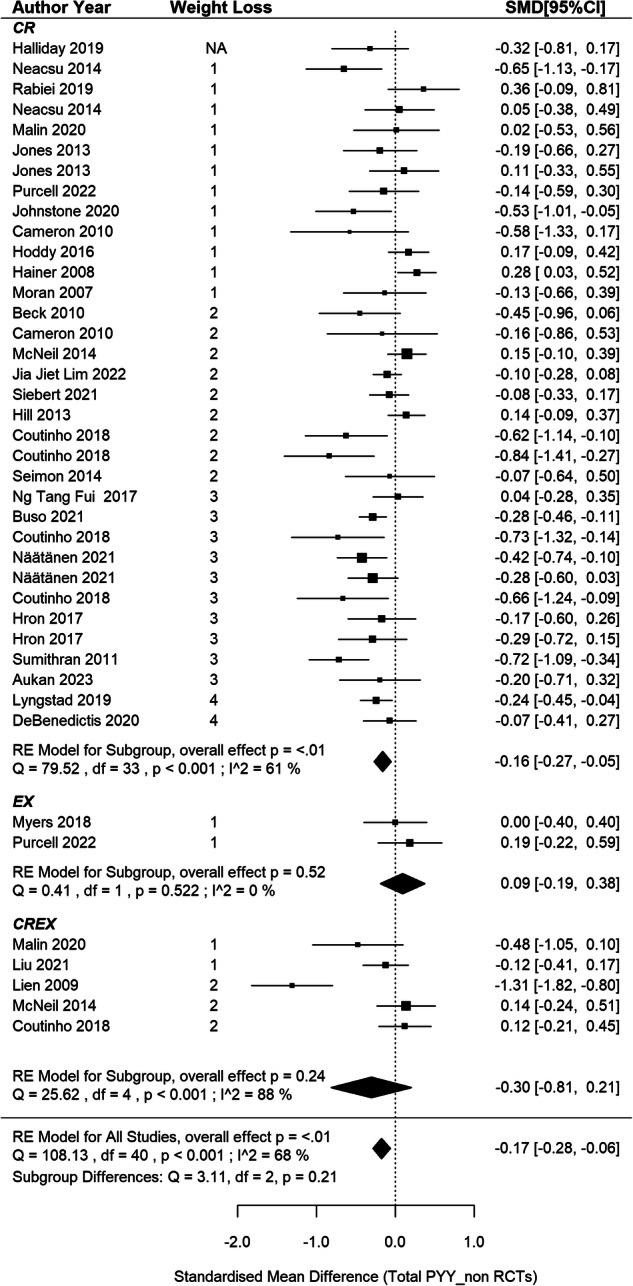
Verification
Claims the paper makes
The claims and statistics of this paper haven’t been checked yet.
Free: it reads the open-access text and checks the first 5 claims that cite a source we can check. Create a free account to check every claim.
Claims other papers make about this one
Each is checked against this paper’s own text: does it say what the citing paper says it does?
The source backs part of the claim, not all of it — or backs it for a different population, condition or comparison.
In the citing paper
“Weight loss induced by CR, with or without exercise training, upregulates counterregulatory hormones such as ghrelin, causing an increase in hunger as the body tries to return to its previous weight (24).”
From The Benefits of Exercise Training in Combination With Weight Loss Therapies (2025) · cites this paper as [24]
Experimental — accuracy not yet measuredThe source backs part of the claim, not all of it — or backs it for a different population, condition or comparison.
In the citing paper
“These alterations in appetite-regulatory hormone levels occurred at similar magnitude regardless of the method of weight loss (caloric restriction, exercise, or a combination).”
From International Society of Sports Nutrition position stand: diets for body weight reduction (2026) · cites this paper as [189]
Experimental — accuracy not yet measuredThe source backs part of the claim, not all of it — or backs it for a different population, condition or comparison.
In the citing paper
“A systematic review and meta-analysis by Jin et al. [189] examined appetite-related gut hormone changes after weight loss. An average weight loss of 6%–7% was observed across studies, and this loss was associated with increased ghrelin and decreased peptide YY (PYY) GLP-1.”
From International Society of Sports Nutrition position stand: diets for body weight reduction (2026) · cites this paper as [189]
Experimental — accuracy not yet measuredThe source backs part of the claim, not all of it — or backs it for a different population, condition or comparison.
In the citing paper
“Greater weight loss was associated with greater increases in ghrelin levels.”
From International Society of Sports Nutrition position stand: diets for body weight reduction (2026) · cites this paper as [189]
Experimental — accuracy not yet measured
Self-check
Percentages, sums and reported differences re-computed from the paper’s own numbers.
The self-check needs the paper’s full text.
Citations
Cites
The PRISMA 2020 statement: An updated guideline for reporting systematic reviews
Page, M. J., McKenzie, J. E., Bossuyt, P. M., Boutron, I., Hoffmann, T. C., Mulrow, C. D., Shamseer, L., Tetzlaff, J. M., Akl, E. A., Brennan, S. E., et al. (2021) · BMJ · doi:10.1136/bmj.n71 · Cited by 108,283
RoB 2: a revised tool for assessing risk of bias in randomised trials
Sterne, J. A. C., Savović, J., Page, M. J., Elbers, R. G., Blencowe, N. S., Boutron, I., Cates, C. J., Cheng, H.-Y., Corbett, M. S., Eldridge, S. M., et al. (2019) · BMJ · doi:10.1136/bmj.l4898 · Cited by 34,787 · cited 1×
“Cochrane ’ s risk-of-bias tool 2.0 [33] was used for assessing RCTs. Items were evaluated in three categories: low risk of bias, some concerns and high risk of bias.”
InfluentialConducting Meta-Analyses in R with the metafor Package
Viechtbauer, W. (2010) · Journal of Statistical Software · doi:10.18637/jss.v036.i03 · Cited by 20,464
ROBINS-I: a tool for assessing risk of bias in non-randomised studies of interventions
Sterne, J. A., Hernán, M. A., Reeves, B. C., Savović, J., Berkman, N. D., Viswanathan, M., Henry, D., Altman, D. G., Ansari, M. T., Boutron, I., et al. (2016) · BMJ · doi:10.1136/bmj.i4919 · Cited by 20,329 · cited 1×
“The ROBINS-I tool [34] was used to assess risk of bias for non-RCTs.”
Wan, X., Wang, W., Liu, J., & Tong, T. (2014) · BMC Medical Research Methodology · doi:10.1186/1471-2288-14-135 · Cited by 11,735 · cited 1×
“Median and IQR were also back transformed using standard methods [38].”
‘Small Changes' to Diet and Physical Activity Behaviors for Weight Management
Hills, A. P., Byrne, N. M., Lindstrom, R., & Hill, J. O. (2013) · Obesity Facts · doi:10.1159/000345030 · Cited by 9,493
Sensitivity analysis in observational research: Introducing the E-value
VanderWeele, T. J., & Ding, P. (2017) · Annals of Internal Medicine · doi:10.7326/m16-2607 · Cited by 6,350
Ghrelin induces adiposity in rodents
Tschöp, M., Smiley, D. L., & Heiman, M. L. (2000) · Nature · doi:10.1038/35038090 · Cited by 3,949
Chapter 9: Analysing Data and Undertaking Meta-Analyses
Deeks, J. J., Higgins, J. P. T., & Altman, D. G. (2008) · Cited by 2,782
Phelps, N. H., Singleton, R. K., Zhou, B., Heap, R. A., Mishra, A., Bennett, J. E., Paciorek, C. J., Lhoste, V. P., Carrillo-Larco, R. M., Stevens, G. A., et al. (2024) · The Lancet · doi:10.1016/s0140-6736(23)02750-2 · Cited by 2,544 · cited 2×
“S1).”
Plasma Ghrelin Levels after Diet-Induced Weight Loss or Gastric Bypass Surgery
Cummings, D. E., Weigle, D. S., Frayo, R. S., Breen, P. A., Ma, M. K., Dellinger, E. P., & Purnell, J. Q. (2002) · New England Journal of Medicine · doi:10.1056/nejmoa012908 · Cited by 2,241
Inhibition of Food Intake in Obese Subjects by Peptide YY 3–36
Batterham, R. L., Cohen, M. A., Ellis, S. M., Le Roux, C. W., Withers, D. J., Frost, G. S., Ghatei, M. A., & Bloom, S. R. (2003) · New England Journal of Medicine · doi:10.1056/nejmoa030204 · Cited by 1,604 · cited 1×
“4 RCTs [45, 50, 52, 54] were included in the meta-analysis, comprising 8 independent groups across the studies (1 CR; 6 EX; 1 CREX), and involving 233 participants (SI3 - Figure S11).”
Long-term persistence of hormonal adaptations to weight loss
Sumithran, P., Prendergast, L. A., Delbridge, E., Purcell, K., Shulkes, A., Kriketos, A., & Proietto, J. (2011) · New England Journal of Medicine · doi:10.1056/nejmoa1105816 · Cited by 1,449
Long-term weight-loss maintenance: a meta-analysis of US studies
Anderson, J. W., Konz, E. C., Frederich, R. C., & Wood, C. L. (2001) · The American Journal of Clinical Nutrition · doi:10.1093/ajcn/74.5.579 · Cited by 1,351 · cited 1×
“Among people who are successful at losing weight through diet alone or diet combined with exercise, individuals regain, on average, 80% of the lost weight within 5 years [3].”
Ellingsgaard, H., Hauselmann, I., Schuler, B., Habib, A. M., Baggio, L. L., Meier, D. T., Eppler, E., Bouzakri, K., Wueest, S., Muller, Y. D., et al. (2011) · Nature Medicine · doi:10.1038/nm.2513 · Cited by 922 · cited 1×
“This may be because elevated interleukin-6 (IL-6) concentrations in response to exercise stimulate PYY and GLP-1 levels [16] and suppress ghrelin expression [17], along with a redistribution of blood fl ow from gut hormone release sites to active muscles that may decrease acylated ghrelin due to…”
Web Site and R Package for Computing E-values
Mathur, M. B., Ding, P., Riddell, C. A., & VanderWeele, T. J. (2018) · Epidemiology · doi:10.1097/ede.0000000000000864 · Cited by 761 · cited 1×
“In non-RCTs, sensitivity analyses were conducted using a published method [39 – 41] to evaluate the potential in fl uence of unmeasured confounding and other sources of bias.”
Jakubowicz, D., Barnea, M., Wainstein, J., & Froy, O. (2013) · Obesity · doi:10.1002/oby.20460 · Cited by 593
Glucagon-like peptide-1: a potent regulator of food intake in humans
Gutzwiller, J.-P., Göke, B., Drewe, J., Hildebrand, P., Ketterer, S., Handschin, D., Winterhalder, R., Conen, D., & Beglinger, C. (1999) · Gut · doi:10.1136/gut.44.1.81 · Cited by 576
Weight loss increases circulating levels of ghrelin in human obesity
Hansen, T. K., Dall, R., Hosoda, H., Kojima, M., Kangawa, K., Christiansen, J. S., & Jørgensen, J. O. L. (2002) · Clinical Endocrinology · doi:10.1046/j.0300-0664.2001.01456.x · Cited by 494
Changes in fat-free mass during significant weight loss: a systematic review
Chaston, T. B., Dixon, J. B., & O'Brien, P. E. (2007) · International Journal of Obesity · doi:10.1038/sj.ijo.0803483 · Cited by 493
Nicklas, B. J., Ambrosius, W., Messier, S. P., Miller, G. D., Penninx, B. W., Loeser, R. F., Palla, S., Bleecker, E., & Pahor, M. (2004) · The American Journal of Clinical Nutrition · doi:10.1093/ajcn/79.4.544 · Cited by 443
Obesity as a multisystem disease: Trends in obesity rates and obesity‐related complications
Sarma, S., Sockalingam, S., & Dash, S. (2021) · Diabetes, Obesity and Metabolism · doi:10.1111/dom.14290 · Cited by 435
GOAT links dietary lipids with the endocrine control of energy balance
Kirchner, H., Gutierrez, J. A., Solenberg, P. J., Pfluger, P. T., Czyzyk, T. A., Willency, J. A., Schürmann, A., Joost, H.-G., Jandacek, R. J., Hale, J. E., et al. (2009) · Nature Medicine · doi:10.1038/nm.1997 · Cited by 401
Toshinai, K., Yamaguchi, H., Sun, Y., Smith, R. G., Yamanaka, A., Sakurai, T., Date, Y., Mondal, M. S., Shimbara, T., Kawagoe, T., et al. (2006) · Endocrinology · doi:10.1210/en.2005-1357 · Cited by 375
Catenacci, V. A., Pan, Z., Ostendorf, D., Brannon, S., Gozansky, W. S., Mattson, M. P., Martin, B., MacLean, P. S., Melanson, E. L., & Troy Donahoo, W. (2016) · Obesity · doi:10.1002/oby.21581 · Cited by 332
Exercise-induced suppression of acylated ghrelin in humans
Broom, D. R., Stensel, D. J., Bishop, N. C., Burns, S. F., & Miyashita, M. (2007) · Journal of Applied Physiology · doi:10.1152/japplphysiol.00759.2006 · Cited by 294
Sobrino Crespo, C., Perianes Cachero, A., Puebla Jiménez, L., Barrios, V., & Arilla Ferreiro, E. (2014) · Frontiers in Endocrinology · doi:10.3389/fendo.2014.00058 · Cited by 256
Imayama, I., Ulrich, C. M., Alfano, C. M., Wang, C., Xiao, L., Wener, M. H., Campbell, K. L., Duggan, C., Foster-Schubert, K. E., Kong, A., et al. (2012) · Cancer Research · doi:10.1158/0008-5472.can-11-3092 · Cited by 249
Acute exercise and subsequent energy intake. A meta-analysis
Schubert, M. M., Desbrow, B., Sabapathy, S., & Leveritt, M. (2013) · Appetite · doi:10.1016/j.appet.2012.12.010 · Cited by 240 · cited 1×
“However, it is important to note that a direct association between these hormonal changes and weight regain remains inconclusive, as some studies have reported an uncoupling effect where hormone fl uctuations do not consistently align with changes in appetite or food intake [12 – 14].”
Appetite after weight loss by energy restriction and a low-fat diet–exercise follow-up
Doucet, E., Imbeault, P., St-Pierre, S., Alméras, N., Mauriège, P., Richard, D., & Tremblay, A. (2000) · International Journal of Obesity · doi:10.1038/sj.ijo.0801251 · Cited by 236 · cited 1×
“In the long-term, chronic CR has been shown to enhance perceived and physiological urges to eat [19, 20].”
The Effects of Exercise-Induced Weight Loss on Appetite-Related Peptides and Motivation to Eat
Martins, C., Kulseng, B., King, N. A., Holst, J. J., & Blundell, J. E. (2010) · The Journal of Clinical Endocrinology & Metabolism · doi:10.1210/jc.2009-2082 · Cited by 236 · cited 1×
“Conversely, habitual exercise appears to exert a dual effect on subjective appetite sensations and appetite-related hormones by increasing motivation to eat in a fasted state but enhancing postprandial satiety [21, 22].”
King, N. A., Caudwell, P. P., Hopkins, M., Stubbs, J. R., Naslund, E., & Blundell, J. E. (2009) · The American Journal of Clinical Nutrition · doi:10.3945/ajcn.2009.27706 · Cited by 226 · cited 1×
“Conversely, habitual exercise appears to exert a dual effect on subjective appetite sensations and appetite-related hormones by increasing motivation to eat in a fasted state but enhancing postprandial satiety [21, 22].”
Ghrelin and Des-Acyl Ghrelin Promote Differentiation and Fusion of C2C12 Skeletal Muscle Cells
Filigheddu, N., Gnocchi, V. F., Coscia, M., Cappelli, M., Porporato, P. E., Taulli, R., Traini, S., Baldanzi, G., Chianale, F., Cutrupi, S., et al. (2007) · Molecular Biology of the Cell · doi:10.1091/mbc.e06-05-0402 · Cited by 222 · cited 1×
“Furthermore, ghrelin, which is associated with muscle growth, has been implicated in myocyte proliferation [28].”
The effect of rate of weight loss on long-term weight management: a randomised controlled trial
Purcell, K., Sumithran, P., Prendergast, L. A., Bouniu, C. J., Delbridge, E., & Proietto, J. (2014) · The Lancet Diabetes & Endocrinology · doi:10.1016/s2213-8587(14)70200-1 · Cited by 201
Human Plasma Ghrelin Levels Increase during a One-Year Exercise Program
Foster-Schubert, K. E., McTiernan, A., Frayo, R. S., Schwartz, R. S., Rajan, K. B., Yasui, Y., Tworoger, S. S., & Cummings, D. E. (2005) · The Journal of Clinical Endocrinology & Metabolism · doi:10.1210/jc.2004-2081 · Cited by 192
Effects of exercise on energy-regulating hormones and appetite in men and women
Hagobian, T. A., Sharoff, C. G., Stephens, B. R., Wade, G. N., Silva, J. E., Chipkin, S. R., & Braun, B. (2009) · American Journal of Physiology-Regulatory, Integrative and Comparative Physiology · doi:10.1152/ajpregu.90671.2008 · Cited by 173 · cited 1×
“Additionally, women tend to exhibit greater compensatory responses to CR, likely driven by hormone-mediated energy conservation mechanisms aimed at preserving fat stores for reproductive function [30].”
Ravussin, E. (2001) · Journal of Clinical Endocrinology & Metabolism · doi:10.1210/jc.86.9.4547 · Cited by 170
Crujeiras, A. B., Goyenechea, E., Abete, I., Lage, M., Carreira, M. C., Martínez, J. A., & Casanueva, F. F. (2010) · The Journal of Clinical Endocrinology & Metabolism · doi:10.1210/jc.2009-2566 · Cited by 167
King, J. A., Wasse, L. K., Ewens, J., Crystallis, K., Emmanuel, J., Batterham, R. L., & Stensel, D. J. (2011) · The Journal of Clinical Endocrinology & Metabolism · doi:10.1210/jc.2010-2735 · Cited by 159 · cited 1×
“One study has demonstrated that acute periods of energy restriction via diet elicit compensatory changes in appetite perceptions and appetite related hormones favouring increases in energy intake that were not observed after acute increases in energy expenditure via exercise [15].”
Self-citationBusetto, L., Bettini, S., Makaronidis, J., Roberts, C. A., Halford, J. C. G., & Batterham, R. L. (2021) · European Journal of Internal Medicine · doi:10.1016/j.ejim.2021.01.002 · Cited by 159 · cited 1×
“The reasons for weight regain after weight loss are multifactorial and include compensatory physiological mechanisms aimed at resisting weight loss and promoting weight regain [4].”
Clark, J. E. (2015) · Journal of Diabetes & Metabolic Disorders · doi:10.1186/s40200-015-0154-1 · Cited by 158
Body Fat Content Influences the Body Composition Response to Nutrition and Exercise
FORBES, G. B. (2000) · Annals of the New York Academy of Sciences · doi:10.1111/j.1749-6632.2000.tb06482.x · Cited by 144
Guelfi, K. J., Donges, C. E., & Duffield, R. (2012) · Metabolism · doi:10.1016/j.metabol.2012.08.002 · Cited by 138
Jensen, M. G., Kristensen, M., & Astrup, A. V. (2012) · American Journal of Clinical Nutrition · doi:10.3945/ajcn.111.025312 · Cited by 137
Ghrelin – Physiological Functions and Regulation
Ibrahim Abdalla, M. M., & Senior Lecturer, P. D. (2015) · European Endocrinology · doi:10.17925/ee.2015.11.02.90 · Cited by 130 · cited 1×
“Ghrelin, functions as an orexigenic hormone, stimulating appetite by acting on the hypothalamus [5].”
Body fat and fat-free mass inter-relationships: Forbes's theory revisited
Hall, K. D. (2007) · British Journal of Nutrition · doi:10.1017/s0007114507691946 · Cited by 129
Effect of weight loss and ketosis on postprandial cholecystokinin and free fatty acid concentrations
Chearskul, S., Delbridge, E., Shulkes, A., Proietto, J., & Kriketos, A. D. (2008) · American Journal of Clinical Nutrition · doi:10.1093/ajcn/87.5.1238 · Cited by 127 · cited 1×
“Where possible we employed subgroup analysis to gain greater insight into potential differences in the effects of the three interventions (CR, EX, CREX) on appetite related gut hormone concentrations.”
Iepsen, E. W., Lundgren, J., Dirksen, C., Jensen, J.-E., Pedersen, O., Hansen, T., Madsbad, S., Holst, J. J., & Torekov, S. S. (2015) · International Journal of Obesity · doi:10.1038/ijo.2014.177 · Cited by 118 · cited 1×
“4 RCTs [45, 50, 52, 54] were included in the meta-analysis, comprising 8 independent groups across the studies (1 CR; 6 EX; 1 CREX), and involving 233 participants (SI3 - Figure S11).”
Heinonen, M. V., Laaksonen, D. E., Karhu, T., Karhunen, L. J., Laitinen, T. P., Kainulainen, S., Rissanen, A., NISKANEN, L. K., & Herzig, K. (2009) · Nutrition Metabolism and Cardiovascular Diseases · doi:10.1016/j.numecd.2008.12.008 · Cited by 116
Huerta, A. E., Navas-Carretero, S., Prieto-Hontoria, P. L., Martínez, J. A., & Moreno-Aliaga, M. J. (2015) · Obesity · doi:10.1002/oby.20966 · Cited by 113
Beck, E. J., Tapsell, L. C., Batterham, M. J., Tosh, S. M., & Huang, X.-F. (2010) · British Journal of Nutrition · doi:10.1017/s0007114509992856 · Cited by 108 · cited 3×
“Where possible we employed subgroup analysis to gain greater insight into potential differences in the effects of the three interventions (CR, EX, CREX) on appetite related gut hormone concentrations.”
Compensatory mechanisms activated with intermittent energy restriction: A randomized control trial
Coutinho, S. R., Halset, E. H., Gåsbakk, S., Rehfeld, J. F., Kulseng, B., Truby, H., & Martins, C. (2018) · Clinical Nutrition · doi:10.1016/j.clnu.2017.04.002 · Cited by 108 · cited 4×
“This meta-analysis included 31 non-randomised studies [11, 66, 69, 70, 73, 82, 87, 90, 91, 94, 97, 104, 108, 109, 117, 126, 130, 139, 142, 144, 146 – 153, 155, 156, 158], aggregating data from 41 independent intervention groups and 2 cross-over groups (34 CR, 2EX and 5 CREX), recruiting 1385…”
InfluentialNeacsu, M., Fyfe, C., Horgan, G. W., & Johnstone, A. M. (2014) · American Journal of Clinical Nutrition · doi:10.3945/ajcn.113.077503 · Cited by 107 · cited 2×
“In the analysis of non-RCTs, 8 [73, 92, 93, 98, 115, 128, 143, 149] with 14 intervention groups (8 CR, 5 EX and 1 CREX) were included, recruiting Fig.”
Meier, J. J., Gethmann, A., Nauck, M. A., Götze, O., Schmitz, F., Deacon, C. F., Gallwitz, B., Schmidt, W. E., & Holst, J. J. (2006) · American Journal of Physiology-Endocrinology and Metabolism · doi:10.1152/ajpendo.00576.2005 · Cited by 104
Moran, L., Noakes, M., Clifton, P. M., Wittert, G., le Roux, C. W., Ghatei, M. A., Bloom, S. R., & Norman, R. J. (2007) · American Journal of Clinical Nutrition · doi:10.1093/ajcn/86.5.1603 · Cited by 100 · cited 2×
“In the analysis of non-RCTs, 8 [73, 92, 93, 98, 115, 128, 143, 149] with 14 intervention groups (8 CR, 5 EX and 1 CREX) were included, recruiting Fig.”
Islam, H., Townsend, L. K., McKie, G. L., Medeiros, P. J., Gurd, B. J., & Hazell, T. J. (2017) · Journal of Applied Physiology · doi:10.1152/japplphysiol.00218.2017 · Cited by 100
Satiety effects of cholecystokinin in humans
Lieverse, R. J., Jansen, J. B. �. �., Masclee, A., & Lamers, C. B. H. W. (1994) · Gastroenterology · doi:10.1016/0016-5085(94)90397-2 · Cited by 98 · cited 1×
“Exogenous infusion of these appetite hormones may increase/decrease subjective appetite feelings and energy intake [7 – 10].”
Lien, L. F., Haqq, A. M., Arlotto, M., Slentz, C. A., Muehlbauer, M. J., McMahon, R. L., Rochon, J., Gallup, D., Bain, J. R., Ilkayeva, O., et al. (2009) · OMICS: A Journal of Integrative Biology · doi:10.1089/omi.2008.0035 · Cited by 97 · cited 1×
“In the analysis of non-RCTs, 8 [73, 92, 93, 98, 115, 128, 143, 149] with 14 intervention groups (8 CR, 5 EX and 1 CREX) were included, recruiting Fig.”
Wu, R., Dong, W., Ji, Y., Zhou, M., Marini, C. P., Ravikumar, T. S., & Wang, P. (2008) · PLoS ONE · doi:10.1371/journal.pone.0002026 · Cited by 94 · cited 1×
“…suppress ghrelin expression [17], along with a redistribution of blood fl ow from gut hormone release sites to active muscles that may decrease acylated ghrelin due to decreased activity of the ghrelin O-acyl transferase (GOAT) enzyme, which is required to acylate ghrelin into its active form [18].”
Jones, K. W., Eller, L. K., Parnell, J. A., Doyle–Baker, P. K., Edwards, A. L., & Reimer, R. A. (2013) · European Journal of Clinical Nutrition · doi:10.1038/ejcn.2013.52 · Cited by 93
Cameron, J. D., Cyr, M.-J., & Doucet, É. (2010) · British Journal of Nutrition · doi:10.1017/s0007114509992984 · Cited by 89 · cited 1×
“In the analysis of non-RCTs, 8 [73, 92, 93, 98, 115, 128, 143, 149] with 14 intervention groups (8 CR, 5 EX and 1 CREX) were included, recruiting Fig.”
Morpurgo, P. S., Resnik, M., Agosti, F., Cappiello, V., Sartório, A., & Spada, A. (2003) · Journal of Endocrinological Investigation · doi:10.1007/bf03347353 · Cited by 88
The Satiating Effect of Dietary Protein Is Unrelated to Postprandial Ghrelin Secretion
Moran, L. J., Luscombe-Marsh, N. D., Noakes, M., Wittert, G. A., Keogh, J. B., & Clifton, P. M. (2005) · The Journal of Clinical Endocrinology & Metabolism · doi:10.1210/jc.2005-0701 · Cited by 88
Gilbert, J.-A., Joanisse, D. R., Chaput, J.-P., Miegueu, P., Cianflone, K., Alméras, N., & Tremblay, A. (2011) · British Journal of Nutrition · doi:10.1017/s0007114510003119 · Cited by 88
Methods to Address Confounding and Other Biases in Meta-Analyses: Review and Recommendations
Mathur, M. B., & VanderWeele, T. J. (2022) · Annual Review of Public Health · doi:10.1146/annurev-publhealth-051920-114020 · Cited by 85
Nobile, V., Duclos, E., Michelotti, A., Bizzaro, G., Negro, M., & Soisson, F. (2016) · Food & Nutrition Research · doi:10.3402/fnr.v60.29857 · Cited by 84 · cited 2×
“Where possible we employed subgroup analysis to gain greater insight into potential differences in the effects of the three interventions (CR, EX, CREX) on appetite related gut hormone concentrations.”
Effects of Ramadan Intermittent Fasting on Gut Hormones and Body Composition in Males with Obesity
Zouhal, H., Bagheri, R., Triki, R., Saeidi, A., Wong, A., Hackney, A. C., Laher, I., Suzuki, K., & Abderrahman, A. B. (2020) · International Journal of Environmental Research and Public Health · doi:10.3390/ijerph17155600 · Cited by 83 · cited 5×
“This observation is supported by the Egger ’ s test (z = – 0.58; p = 0.562).”
InfluentialNeurocognitive and Hormonal Correlates of Voluntary Weight Loss in Humans
Neseliler, S., Hu, W., Larcher, K., Zacchia, M., Dadar, M., Scala, S. G., Lamarche, M., Zeighami, Y., Stotland, S. C., Larocque, M., et al. (2019) · Cell Metabolism · doi:10.1016/j.cmet.2018.09.024 · Cited by 80 · cited 1×
“This meta-analysis included 31 non-randomised studies [11, 66, 69, 70, 73, 82, 87, 90, 91, 94, 97, 104, 108, 109, 117, 126, 130, 139, 142, 144, 146 – 153, 155, 156, 158], aggregating data from 41 independent intervention groups and 2 cross-over groups (34 CR, 2EX and 5 CREX), recruiting 1385…”
Rabiei, S., Hedayati, M., Rashidkhani, B., Saadat, N., & Shakerhossini, R. (2019) · Journal of Dietary Supplements · doi:10.1080/19390211.2018.1455788 · Cited by 76
Long-term effects of consumption of a novel fat emulsion in relation to body-weight management
Diepvens, K., Soenen, S., Steijns, J. M., Arnold, M., & Westerterp‐Plantenga, M. S. (2007) · International Journal of Obesity · doi:10.1038/sj.ijo.0803532 · Cited by 73 · cited 3×
“This meta-analysis included 31 non-randomised studies [11, 66, 69, 70, 73, 82, 87, 90, 91, 94, 97, 104, 108, 109, 117, 126, 130, 139, 142, 144, 146 – 153, 155, 156, 158], aggregating data from 41 independent intervention groups and 2 cross-over groups (34 CR, 2EX and 5 CREX), recruiting 1385…”
Montelius, C., Erlandsson, D., Vitija, E., Stenblom, E.-L., Egecioglu, E., & Erlanson-Albertsson, C. (2014) · Appetite · doi:10.1016/j.appet.2014.06.101 · Cited by 72 · cited 1×
“19 studies [11, 50, 54, 67, 69, 70, 73, 76, 93, 100, 101, 104, 111, 117, 142, 149, 153, 156, 159] were included in this quantitative synthesis, of which 2 studies [50, 54] were RCTs, and 17 studies were non-RCTs.”
Ashtary-Larky, D., Bagheri, R., Abbasnezhad, A., Tinsley, G. M., Alipour, M., & Wong, A. (2020) · British Journal of Nutrition · doi:10.1017/s000711452000224x · Cited by 72
Investigation of the long-term sustainability of changes in appetite after weight loss
Nymo, S., Coutinho, Sr., Eknes, P., Vestbostad, I., Rehfeld, J., Truby, H., Kulseng, B., & Martins, C. (2018) · International Journal of Obesity · doi:10.1038/s41366-018-0119-9 · Cited by 68 · cited 1×
“In the long-term, chronic CR has been shown to enhance perceived and physiological urges to eat [19, 20].”
Energy compensation in response to aerobic exercise training in overweight adults
Flack, K. D., Ufholz, K., Johnson, L., Fitzgerald, J. S., & Roemmich, J. N. (2018) · American Journal of Physiology-Regulatory, Integrative and Comparative Physiology · doi:10.1152/ajpregu.00071.2018 · Cited by 67 · cited 1×
“4 RCTs [45, 50, 52, 54] were included in the meta-analysis, comprising 8 independent groups across the studies (1 CR; 6 EX; 1 CREX), and involving 233 participants (SI3 - Figure S11).”
High-Intensity Interval Training, Appetite, and Reward Value of Food in the Obese
MARTINS, C., ASCHEHOUG, I., LUDVIKSEN, M., HOLST, J., FINLAYSON, G., WISLOFF, U., MORGAN, L., KING, N., & KULSENG, B. (2017) · Medicine & Science in Sports & Exercise · doi:10.1249/mss.0000000000001296 · Cited by 65 · cited 3×
“This meta-analysis included 31 non-randomised studies [11, 66, 69, 70, 73, 82, 87, 90, 91, 94, 97, 104, 108, 109, 117, 126, 130, 139, 142, 144, 146 – 153, 155, 156, 158], aggregating data from 41 independent intervention groups and 2 cross-over groups (34 CR, 2EX and 5 CREX), recruiting 1385…”
Effect of Chronic Exercise on Appetite Control in Overweight and Obese Individuals
MARTINS, C., KULSENG, B., REHFELD, J. F., KING, N. A., & BLUNDELL, J. E. (2013) · Medicine & Science in Sports & Exercise · doi:10.1249/mss.0b013e31827d1618 · Cited by 62 · cited 1×
“Where possible we employed subgroup analysis to gain greater insight into potential differences in the effects of the three interventions (CR, EX, CREX) on appetite related gut hormone concentrations.”
Appetite, food intake and gut hormone responses to intense aerobic exercise of different duration
Holliday, A., & Blannin, A. (2017) · Journal of Endocrinology · doi:10.1530/joe-16-0570 · Cited by 62 · cited 1×
“However, it is important to note that a direct association between these hormonal changes and weight regain remains inconclusive, as some studies have reported an uncoupling effect where hormone fl uctuations do not consistently align with changes in appetite or food intake [12 – 14].”
Redman, L. M., Veldhuis, J. D., Rood, J., Smith, S. R., Williamson, D., Ravussin, E., & for the Pennington CALERIE Team (2010) · Aging Cell · doi:10.1111/j.1474-9726.2009.00530.x · Cited by 61
Coutinho, S. R., With, E., Rehfeld, J. F., Kulseng, B., Truby, H., & Martins, C. (2018) · Clinical Nutrition · doi:10.1016/j.clnu.2017.04.008 · Cited by 61
Kelly, K. R., Brooks, L. M., Solomon, T. P. J., Kashyap, S. R., O'Leary, V. B., & Kirwan, J. P. (2009) · American Journal of Physiology-Endocrinology and Metabolism · doi:10.1152/ajpendo.00112.2009 · Cited by 60 · cited 1×
“4 RCTs [45, 50, 52, 54] were included in the meta-analysis, comprising 8 independent groups across the studies (1 CR; 6 EX; 1 CREX), and involving 233 participants (SI3 - Figure S11).”
Hoddy, K. K., Gibbons, C., Kroeger, C. M., Trepanowski, J. F., Barnosky, A., Bhutani, S., Gabel, K., Finlayson, G., & Varady, K. A. (2016) · Clinical Nutrition · doi:10.1016/j.clnu.2016.03.011 · Cited by 60 · cited 2×
“In the analysis of non-RCTs, 8 [73, 92, 93, 98, 115, 128, 143, 149] with 14 intervention groups (8 CR, 5 EX and 1 CREX) were included, recruiting Fig.”
Ratliff, J. C., Mutungi, G., Puglisi, M. J., Volek, J. S., & Fernández, M. L. (2009) · Nutrition Research · doi:10.1016/j.nutres.2009.03.007 · Cited by 55 · cited 1×
“4 RCTs [45, 50, 52, 54] were included in the meta-analysis, comprising 8 independent groups across the studies (1 CR; 6 EX; 1 CREX), and involving 233 participants (SI3 - Figure S11).”
Adam, T. C. M., Lejeune, M. P. G. M., & Westerterp-Plantenga, M. S. (2006) · British Journal of Nutrition · doi:10.1079/bjn20051614 · Cited by 54 · cited 2×
“19 studies [11, 50, 54, 67, 69, 70, 73, 76, 93, 100, 101, 104, 111, 117, 142, 149, 153, 156, 159] were included in this quantitative synthesis, of which 2 studies [50, 54] were RCTs, and 17 studies were non-RCTs.”
InfluentialInfluence of sleep restriction on weight loss outcomes associated with caloric restriction
Wang, X., Sparks, J. R., Bowyer, K. P., & Youngstedt, S. D. (2018) · Sleep · doi:10.1093/sleep/zsy027 · Cited by 54
Ramel, A., Parra, D., Martínez, J. A., Kiely, M. E., & Þórsdóttir, I. (2009) · European Journal of Nutrition · doi:10.1007/s00394-008-0769-9 · Cited by 53
Rosenkilde, M., Reichkendler, M. H., Auerbach, P., Toräng, S., Gram, A. S., Ploug, T., Holst, J. J., Sjödin, A. M., & Stallknecht, B. M. (2013) · Journal of Applied Physiology · doi:10.1152/japplphysiol.00680.2013 · Cited by 51 · cited 2×
“The degree of heterogeneity was small and non-signi fi cant (I 2 = 23%, p = 0.420).”
InfluentialMason, C., Xiao, L., Imayama, I., Duggan, C. R., Campbell, K. L., Kong, A., Wang, C., Alfano, C. M., Blackburn, G. L., Foster‐Schubert, K. E., et al. (2015) · Clinical Endocrinology · doi:10.1111/cen.12483 · Cited by 50 · cited 1×
“The meta-analysis synthesized data from 68 non-RCTs sample size of 3194 participants (Fig.”
Mager, U., Kolehmainen, M., de Mello, V. D. F., Schwab, U., Laaksonen, D. E., Rauramaa, R., Gylling, H., Atalay, M., Pulkkinen, L., & Uusitupa, M. (2008) · European Journal of Endocrinology · doi:10.1530/eje-07-0862 · Cited by 49 · cited 1×
“The meta-analysis synthesized data from 68 non-RCTs sample size of 3194 participants (Fig.”
Rondanelli, M., Opizzi, A., Perna, S., Faliva, M. A., Solerte, S. B., Fioravanti, M., Klersy, C., Cava, E., Maddalena, P., Luciano, S., et al. (2012) · Endocrine · doi:10.1007/s12020-012-9863-0 · Cited by 48
Fasting and Postprandial Total Ghrelin Remain Unchanged after Short-Term Energy Restriction
Doucet, E., Pomerleau, M., & Harper, M.-E. (2004) · The Journal of Clinical Endocrinology & Metabolism · doi:10.1210/jc.2003-031459 · Cited by 48
Hayes, M. R., Miller, C. K., Ulbrecht, J. S., Mauger, J. L., Parker-Klees, L., Gutschall, M. D., Mitchell, D. C., Smiciklas‐Wright, H., & Covașă, M. (2007) · Journal of Nutrition · doi:10.1093/jn/137.8.1944 · Cited by 48
Myers, A., Dalton, M., Gibbons, C., Finlayson, G., & Blundell, J. E. (2018) · Physiology & Behavior · doi:10.1016/j.physbeh.2018.11.005 · Cited by 47 · cited 2×
“In the analysis of non-RCTs, 8 [73, 92, 93, 98, 115, 128, 143, 149] with 14 intervention groups (8 CR, 5 EX and 1 CREX) were included, recruiting Fig.”
The Impact of the Rate of Weight Loss on Body Composition and Metabolism
Fogarasi, A., Gonzalez, K. D., Dalamaga, Μ., & Magkos, F. (2022) · Current Obesity Reports · doi:10.1007/s13679-022-00470-4 · Cited by 47
Coutinho, S. R., Rehfeld, J. F., Holst, J. J., Kulseng, B., & Martins, C. (2018) · American Journal of Physiology-Endocrinology and Metabolism · doi:10.1152/ajpendo.00322.2017 · Cited by 44 · cited 4×
“This meta-analysis included 31 non-randomised studies [11, 66, 69, 70, 73, 82, 87, 90, 91, 94, 97, 104, 108, 109, 117, 126, 130, 139, 142, 144, 146 – 153, 155, 156, 158], aggregating data from 41 independent intervention groups and 2 cross-over groups (34 CR, 2EX and 5 CREX), recruiting 1385…”
InfluentialAukan, M. I., Skårvold, S., Brandsæter, I. Ø., Rehfeld, J. F., Holst, J. J., Nymo, S., Coutinho, S. R., & Martins, C. (2022) · Obesity · doi:10.1002/oby.23655 · Cited by 43 · cited 4×
“This meta-analysis included 31 non-randomised studies [11, 66, 69, 70, 73, 82, 87, 90, 91, 94, 97, 104, 108, 109, 117, 126, 130, 139, 142, 144, 146 – 153, 155, 156, 158], aggregating data from 41 independent intervention groups and 2 cross-over groups (34 CR, 2EX and 5 CREX), recruiting 1385…”
InfluentialHopkins, M., Gibbons, C., & Blundell, J. E. (2023) · Philosophical Transactions of the Royal Society B Biological Sciences · doi:10.1098/rstb.2022.0213 · Cited by 43 · cited 1×
“Research suggests that fat-free mass (FFM) is a major driver of energy intake compared to fat mass (FM), particularly under conditions of energy balance and negative energy balance [26].”
Satiety Associated with Calorie Restriction and Time-Restricted Feeding: Peripheral Hormones
Tacad, D. K. M., Tovar, A. P., Richardson, C. E., Horn, W. F., Krishnan, G. P., Keim, N. L., & Krishnan, S. (2022) · Advances in Nutrition · doi:10.1093/advances/nmac014 · Cited by 41
Romon, M., Gomila, S., Hincker, P., Soudan, B., & Dallongeville, J. (2006) · The Journal of Clinical Endocrinology & Metabolism · doi:10.1210/jc.2005-1050 · Cited by 40
Investigating the effect of sex and ketosis on weight-loss-induced changes in appetite
Lyngstad, A., Nymo, S., Coutinho, S. R., Rehfeld, J. F., Truby, H., Kulseng, B., & Martins, C. (2019) · The American Journal of Clinical Nutrition · doi:10.1093/ajcn/nqz002 · Cited by 40
DeBenedictis, J. N., Nymo, S., Ollestad, K. H., Boyesen, G. A., Rehfeld, J. F., Holst, J. J., Truby, H., Kulseng, B., & Martins, C. (2020) · The Journal of Clinical Endocrinology & Metabolism · doi:10.1210/clinem/dgaa202 · Cited by 40
Diurnal variation of default mode network in patients with restless legs syndrome
Ku, J. H., Lee, Y. S., Chang, H. W., Earley, C. J., Allen, R. P., & Cho, Y. W. (2017) · Sleep Medicine · doi:10.1016/j.sleep.2017.09.031 · Cited by 39
Effect of weight reduction on serum ghrelin and TNFα concentrations in obese women
Zahorska‐Markiewicz, B., Mizia‐Stec, K., Olszanecka‐Glinianowicz, M., & Janowska, J. (2004) · European Journal of Internal Medicine · doi:10.1016/j.ejim.2004.02.002 · Cited by 37
Johnstone, A. M., Kelly, J., Ryan, S., Romero-Gonzalez, R., McKinnon, H., Fyfe, C., Näslund, E. B., López‐Nicolás, R., Bosscher, D., Bonnema, A. L., et al. (2020) · Journal of Nutrition · doi:10.1093/jn/nxaa124 · Cited by 37 · cited 2×
“In the analysis of non-RCTs, 8 [73, 92, 93, 98, 115, 128, 143, 149] with 14 intervention groups (8 CR, 5 EX and 1 CREX) were included, recruiting Fig.”
Roux-en-Y gastric bypass and gastric sleeve surgery result in long term bone loss
Brzozowska, M. M., Tran, T. S., Bliuc, D., Jorgensen, J. O., Talbot, M. L., Fenton‐Lee, D., Chen, W., Hong, A., Viardot, A., White, C., et al. (2020) · International Journal of Obesity · doi:10.1038/s41366-020-00660-x · Cited by 37 · cited 1×
“19 studies [11, 50, 54, 67, 69, 70, 73, 76, 93, 100, 101, 104, 111, 117, 142, 149, 153, 156, 159] were included in this quantitative synthesis, of which 2 studies [50, 54] were RCTs, and 17 studies were non-RCTs.”
Effects of Three Different Modes of Resistance Training on Appetite Hormones in Males With Obesity
Ataeinosrat, A., Haghighi, M. M., Abednatanzi, H., Soltani, M., Ghanbari–Niaki, A., Habashi, A. N., Amani-Shalamzari, S., Mossayebi, A., Khademosharie, M., Johnson, K. E., et al. (2022) · Frontiers in Physiology · doi:10.3389/fphys.2022.827335 · Cited by 37 · cited 1×
“11 RCTs [44, 48, 49, 51, 55 – 59, 61, 62] were included in the meta-analysis, comprising 5 CR, 9 EX and 2 CREX independent intervention groups, and involving a total of 895 participants (Fig.”
Biemann, R., Penner, M., Borucki, K., Westphal, S., Luley, C., Rönicke, R., Biemann, K., Weikert, C., Lux, A., Goncharenko, N., et al. (2016) · Scientific Reports · doi:10.1038/srep30173 · Cited by 36 · cited 1×
“This meta-analysis included 22 non-RCTs [73, 82, 87, 90, 98, 99, 111, 121, 142 – 144, 146 – 149, 154, 156, 158, 160, 163, 167, 169], aggregating data from 27 independent intervention groups (18 CR, 7 EX; 2 CREX) and comprising 790 individuals (SI3 - Fig.”
Kudiganti, V., Kodur, R. R., Kodur, S. R., Halemane, M., & Deep, D. K. (2016) · Lipids in Health and Disease · doi:10.1186/s12944-016-0306-4 · Cited by 36
Berggren, J., Lindqvist, A., Hedenbro, J., Groop, L., & Wierup, N. (2016) · Surgery for Obesity and Related Diseases · doi:10.1016/j.soard.2016.09.017 · Cited by 36
Kang, S.-J., Kim, J.-H., Gang, Z., Yook, Y.-S., Yoon, J.-R., Ha, G.-C., & Ko, K.-J. (2018) · Journal of Physical Therapy Science · doi:10.1589/jpts.30.169 · Cited by 36 · cited 2×
“No signi fi cant differences were identi fi ed among the interventions i.e., CR, EX and CREX.”
Tremblay, A., Dutheil, F., Drapeau, V., Metz, L., Lesour, B., Chapier, R., Pereira, B., Verney, J., Baker, J. S., Vinet, A., et al. (2019) · Applied Physiology, Nutrition, and Metabolism · doi:10.1139/apnm-2019-0019 · Cited by 36
Otten, J., Ryberg, M., Mellberg, C., Andersson, T., Chorell, E., Lindahl, B., Larsson, C., Holst, J. J., & Olsson, T. (2019) · European Journal of Endocrinology · doi:10.1530/eje-19-0082 · Cited by 36 · cited 1×
“18 non-RCTs [11, 63 – 65, 69, 70, 73, 74, 76, 86, 91, 93, 96, 103, 109, 153, 161, 164] were included, with 27 independent and 2 cross-over intervention groups (24 CR and 5 EX groups), involving 757 participants.”
Sadeghian, M., Hosseini, S. A., Zare Javid, A., Ahmadi Angali, K., & Mashkournia, A. (2021) · Obesity Surgery · doi:10.1007/s11695-020-05202-y · Cited by 35
Hill, B. R., Rolls, B. J., Roe, L. S., Souza, M. J. D., & Williams, N. I. (2013) · Peptides · doi:10.1016/j.peptides.2013.09.009 · Cited by 34 · cited 1×
“In the analysis of non-RCTs, 8 [73, 92, 93, 98, 115, 128, 143, 149] with 14 intervention groups (8 CR, 5 EX and 1 CREX) were included, recruiting Fig.”
Two weeks of exercise training intensity on appetite regulation in obese adults with prediabetes
Heiston, E. M., Eichner, N. Z. M., Gilbertson, N. M., Gaitán, J. M., Kranz, S., WELTMAN, A. L., & Malin, S. K. (2019) · Journal of Applied Physiology · doi:10.1152/japplphysiol.00655.2018 · Cited by 34 · cited 2×
“This meta-analysis included 31 non-randomised studies [11, 66, 69, 70, 73, 82, 87, 90, 91, 94, 97, 104, 108, 109, 117, 126, 130, 139, 142, 144, 146 – 153, 155, 156, 158], aggregating data from 41 independent intervention groups and 2 cross-over groups (34 CR, 2EX and 5 CREX), recruiting 1385…”
Cooper, J. N., Fried, L. F., Tepper, P. G., Barinas‐Mitchell, E., Conroy, M. B., Evans, R. G., Brooks, M. M., Woodard, G. A., & Sutton‐Tyrrell, K. (2013) · Hypertension Research · doi:10.1038/hr.2013.45 · Cited by 33
An Investigation of Hormone and Lipid Associations after Weight Loss in Women
Santosa, S., Demonty, I., Lichtenstein, A. H., Cianflone, K., & Jones, P. J. H. (2007) · Journal of the American College of Nutrition · doi:10.1080/07315724.2007.10719608 · Cited by 31
Seimon, R. V., Taylor, P. J., Little, T. J., Noakes, M., Standfield, S., Clifton, P. M., Horowitz, M., & Feinle‐Bisset, C. (2013) · American Journal of Clinical Nutrition · doi:10.3945/ajcn.113.067090 · Cited by 31 · cited 2×
“In the analysis of non-RCTs, 8 [73, 92, 93, 98, 115, 128, 143, 149] with 14 intervention groups (8 CR, 5 EX and 1 CREX) were included, recruiting Fig.”
Sofer, S., Eliraz, A., Kaplan, S. A., Voet, H., Fink, G., Kima, T., & Madar, Z. (2012) · Nutrition Metabolism and Cardiovascular Diseases · doi:10.1016/j.numecd.2012.04.008 · Cited by 29
The Role of Gut Hormones in Diet-Induced Weight Change: A Systematic Review
Zhao, X., Han, Q., Gang, X., Lv, Y., Liu, Y., Sun, C., & Wang, G. (2017) · Hormone and Metabolic Research · doi:10.1055/s-0043-115646 · Cited by 29
Morante, J. J. H., Soler, I. D., Muñoz, J. S. G., Pérez‐Sánchez, H., Ortega, M. D. C. B., Martínez, C. M., & Ruiz, J. M. M. (2020) · Nutrients · doi:10.3390/nu12040916 · Cited by 29
Hassanzadeh-Rostami, Z., Abbasi, A., & Faghih, S. (2020) · Journal of Functional Foods · doi:10.1016/j.jff.2019.103743 · Cited by 29
McNeil, J., Schwartz, A., Rabasa-Lhoret, R., Lavoie, J.-M., Brochu, M., & Doucet, É. (2015) · The Journal of Clinical Endocrinology & Metabolism · doi:10.1210/jc.2014-2210 · Cited by 28 · cited 1×
“4 Total ghrelin changes after weight loss from non-RCTs.”
Quist, J. S., Blond, M. B., Gram, A. S., Steenholt, C. B., Janus, C., Holst, J. J., Rehfeld, J. F., Sjödin, A., Stallknecht, B., & Rosenkilde, M. (2019) · Journal of Applied Physiology · doi:10.1152/japplphysiol.00239.2018 · Cited by 28 · cited 5×
“This observation is supported by the Egger ’ s test (z = – 0.58; p = 0.562).”
InfluentialRondanelli, M., Perna, S., Ilyas, Z., Peroni, G., Bazire, P., Sajuox, I., Maugeri, R., Nichetti, M., & Gasparri, C. (2021) · Endocrine · doi:10.1007/s12020-021-02860-5 · Cited by 28
Malin, S. K., François, M. E., Eichner, N. Z. M., Gilbertson, N. M., Heiston, E. M., Fabris, C., & Breton, M. D. (2018) · Journal of Applied Physiology · doi:10.1152/japplphysiol.00680.2018 · Cited by 27 · cited 1×
“19 studies [11, 50, 54, 67, 69, 70, 73, 76, 93, 100, 101, 104, 111, 117, 142, 149, 153, 156, 159] were included in this quantitative synthesis, of which 2 studies [50, 54] were RCTs, and 17 studies were non-RCTs.”
Dinu, M., Colombini, B., Pagliai, G., Cesari, F., Gori, A. M., Giusti, B., Marcucci, R., & Sofi, F. (2019) · International Journal of Food Sciences and Nutrition · doi:10.1080/09637486.2019.1658723 · Cited by 27
Rocha, D. M. U. P., Caldas, A. P. S., Silva, A. C. S. E., Bressan, J., & Hermsdorff, H. H. M. (2022) · Nutrition Research · doi:10.1016/j.nutres.2022.11.003 · Cited by 27 · cited 2×
“This meta-analysis included 31 non-randomised studies [11, 66, 69, 70, 73, 82, 87, 90, 91, 94, 97, 104, 108, 109, 117, 126, 130, 139, 142, 144, 146 – 153, 155, 156, 158], aggregating data from 41 independent intervention groups and 2 cross-over groups (34 CR, 2EX and 5 CREX), recruiting 1385…”
Shakiba, E., Sheikholeslami‐Vatani, D., Rostamzadeh, N., & Karim, H. (2018) · Applied Physiology, Nutrition, and Metabolism · doi:10.1139/apnm-2018-0197 · Cited by 26 · cited 3×
“The degree of heterogeneity was small and non-signi fi cant (I 2 = 23%, p = 0.420).”
InfluentialMalin, S. K., Heiston, E. M., Gilbertson, N. M., & Eichner, N. Z. M. (2020) · Physiology & Behavior · doi:10.1016/j.physbeh.2020.112978 · Cited by 26 · cited 2×
“This meta-analysis included 31 non-randomised studies [11, 66, 69, 70, 73, 82, 87, 90, 91, 94, 97, 104, 108, 109, 117, 126, 130, 139, 142, 144, 146 – 153, 155, 156, 158], aggregating data from 41 independent intervention groups and 2 cross-over groups (34 CR, 2EX and 5 CREX), recruiting 1385…”
Halliday, T. M., Polsky, S., Schoen, J. A., Legget, K. T., Tregellas, J. R., Williamson, K. M., & Cornier, M. (2019) · Physiological Reports · doi:10.14814/phy2.14048 · Cited by 25 · cited 2×
“In the analysis of non-RCTs, 8 [73, 92, 93, 98, 115, 128, 143, 149] with 14 intervention groups (8 CR, 5 EX and 1 CREX) were included, recruiting Fig.”
Myokines in Appetite Control and Energy Balance
Grannell, A., Kokkinos, A. D., & le Roux, C. W. (2022) · Muscles · doi:10.3390/muscles1010003 · Cited by 25
Malekaneh, M., Dehghani, K., Mogharnasi, M., Saghebjoo, M., Sarir, H., & Nayebifar, S. (2022) · Mediators of Inflammation · doi:10.1155/2022/9539286 · Cited by 25 · cited 2×
“Meta-regression analysis identi fi ed that each 1% increase in weight loss was associated with a 0.09 (95% CI: 0.01 – 0.17; p = 0.020) unit increase in the SMD of total ghrelin, which explained 29% of the heterogeneity.”
InfluentialHainer, V., Hlavatá, K., Gojová, M., Kunešová, M., Wagenknecht, M., Kopský, V., Pařízková, J., Hill, M., & Nedvidkova, J. (2008) · Physiological Research · doi:10.33549/physiolres.931486 · Cited by 24
Mohammed, M. A., Anwar, R., Mansour, A. H., Elmasry, E., & Othman, G. (2014) · Trends in Medical Research · doi:10.3923/tmr.2014.58.80 · Cited by 24
Effect of orlistat on the total ghrelin and leptin levels in obese patients
Ozkan, Y., Aydın, S., Dönder, E., Koca, S. S., Aydin, S., Özkan, B., & Şahin, İ. (2009) · Journal of Physiology and Biochemistry · doi:10.1007/bf03180574 · Cited by 22
Effect of Testosterone Treatment on Adipokines and Gut Hormones in Obese Men on a Hypocaloric Diet
Ng Tang Fui, M., Hoermann, R., & Grossmann, M. (2017) · Journal of the Endocrine Society · doi:10.1210/js.2017-00062 · Cited by 22
Barazzoni, R., Cappellari, G. G., Zanetti, M., Klaus, K. A., Semolic, A., Johnson, M. L., & Nair, K. S. (2020) · Clinical Nutrition · doi:10.1016/j.clnu.2020.06.014 · Cited by 22
Maurer, L., Mai, K., Krude, H., Haynes, J., Weygandt, M., & Spranger, J. (2019) · Molecular Metabolism · doi:10.1016/j.molmet.2019.08.014 · Cited by 21 · cited 1×
“No RCTs were found exploring active GLP-1 changes after weight loss.”
Lopes, A., Fayh, A. P. T., Campos, L. S., Teixeira, B. C., Carteri, R. B., Ribeiro, J. L., Friedman, R., & Reischak-Oliveira, Á. (2013) · Diabetes Metabolic Syndrome and Obesity · doi:10.2147/dmso.s53501 · Cited by 20 · cited 1×
“This meta-analysis included 31 non-randomised studies [11, 66, 69, 70, 73, 82, 87, 90, 91, 94, 97, 104, 108, 109, 117, 126, 130, 139, 142, 144, 146 – 153, 155, 156, 158], aggregating data from 41 independent intervention groups and 2 cross-over groups (34 CR, 2EX and 5 CREX), recruiting 1385…”
Angelino, E., Reano, S., Bollo, A., Ferrara, M., Feudis, M. D., Šustová, H., Agosti, E., Clerici, S., Prodam, F., Tomasetto, C., et al. (2018) · Endocrine · doi:10.1007/s12020-018-1606-4 · Cited by 20 · cited 1×
“FFM loss after energy restriction may activate the preproghrelin gene, thereby stimulating ghrelin production and promoting myoblast differentiation [29].”
Siebert, J., Stanislawski, M. A., Zaman, A., Ostendorf, D. M., Konigsberg, I. R., Jambal, P., Ir, D., Bing, K., Wayland, L. T., Scorsone, J. J., et al. (2021) · Obesity · doi:10.1002/oby.23127 · Cited by 20 · cited 1×
“In the analysis of non-RCTs, 8 [73, 92, 93, 98, 115, 128, 143, 149] with 14 intervention groups (8 CR, 5 EX and 1 CREX) were included, recruiting Fig.”
Grangeiro, É. D., Trigueiro, M. S., Siais, L. D. O., Paiva, H. M., Sola‐Penna, M., Alves, M. R., & Rosado, E. L. (2021) · Food & Function · doi:10.1039/d1fo00484k · Cited by 20 · cited 1×
“This meta-analysis included 31 non-randomised studies [11, 66, 69, 70, 73, 82, 87, 90, 91, 94, 97, 104, 108, 109, 117, 126, 130, 139, 142, 144, 146 – 153, 155, 156, 158], aggregating data from 41 independent intervention groups and 2 cross-over groups (34 CR, 2EX and 5 CREX), recruiting 1385…”
Changes of ghrelin and leptin in response to hypocaloric diet in obese patients
de Luis, D. A., Sagrado, M. G., Conde, R., Aller, R., & Izaola, O. (2008) · Nutrition · doi:10.1016/j.nut.2007.11.001 · Cited by 19 · cited 1×
“This meta-analysis included 31 non-randomised studies [11, 66, 69, 70, 73, 82, 87, 90, 91, 94, 97, 104, 108, 109, 117, 126, 130, 139, 142, 144, 146 – 153, 155, 156, 158], aggregating data from 41 independent intervention groups and 2 cross-over groups (34 CR, 2EX and 5 CREX), recruiting 1385…”
Blom, W. A. M., de Graaf, C., Lluch, A., Stafleu, A., Schaafsma, G., & Hendriks, H. (2009) · Physiology & Behavior · doi:10.1016/j.physbeh.2009.01.016 · Cited by 19
Hajipoor, S., Hekmatdoost, A., Pasdar, Y., Mohammadi, R., Alipour, M., Rezaie, M., Nachvak, S. M., Balthazar, C. F., Sobhiyeh, M. R., Mortazavian, A. M., et al. (2022) · Food Science & Nutrition · doi:10.1002/fsn3.2816 · Cited by 19 · cited 1×
“18 non-RCTs [11, 63 – 65, 69, 70, 73, 74, 76, 86, 91, 93, 96, 103, 109, 153, 161, 164] were included, with 27 independent and 2 cross-over intervention groups (24 CR and 5 EX groups), involving 757 participants.”
de Luis, D. A., Sagrado, M. G., Conde, R., Aller, R., & Izaola, O. (2008) · Journal of Diabetes and its Complications · doi:10.1016/j.jdiacomp.2007.12.006 · Cited by 18 · cited 1×
“19 studies [11, 50, 54, 67, 69, 70, 73, 76, 93, 100, 101, 104, 111, 117, 142, 149, 153, 156, 159] were included in this quantitative synthesis, of which 2 studies [50, 54] were RCTs, and 17 studies were non-RCTs.”
Buso, M. E. C., Seimon, R. V., McClintock, S., Muirhead, R., Atkinson, F. S., Brodie, S., Dodds, J., Zibellini, J., Das, A., Wild-Taylor, A. L., et al. (2021) · Frontiers in Nutrition · doi:10.3389/fnut.2021.640538 · Cited by 17
Sheikholeslami‐Vatani, D., & Rostamzadeh, N. (2022) · Frontiers in Nutrition · doi:10.3389/fnut.2022.827630 · Cited by 17 · cited 1×
“S6) and the Egger ’ s test (z = – 3.05, p = 0.002) demonstrated potential publication bias.”
InfluentialMartins, C., Nymo, S., Coutinho, S. R., Rehfeld, J. F., Hunter, G. R., & Gower, B. A. (2023) · Journal of Nutrition · doi:10.1016/j.tjnut.2023.03.026 · Cited by 17
Rigamonti, A. E., Agosti, F., Col, A. D., Marazzi, N., Lafortuna, C. L., Cella, S. G., Müller, E. E., & Sartório, A. (2010) · Journal of Endocrinological Investigation · doi:10.1007/bf03346662 · Cited by 16
Hron, B. M., Ebbeling, C. B., Feldman, H. A., & Ludwig, D. S. (2017) · Nutrition & Metabolism · doi:10.1186/s12986-017-0198-y · Cited by 16
Figueroa‐Vega, N., Marín-Aragón, C. I., López-Aguilar, I., Ibarra‐Reynoso, L. D. R., Pérez-Luque, E. L., & Malacara, J. M. (2020) · PLoS ONE · doi:10.1371/journal.pone.0228637 · Cited by 16 · cited 1×
“This meta-analysis included 31 non-randomised studies [11, 66, 69, 70, 73, 82, 87, 90, 91, 94, 97, 104, 108, 109, 117, 126, 130, 139, 142, 144, 146 – 153, 155, 156, 158], aggregating data from 41 independent intervention groups and 2 cross-over groups (34 CR, 2EX and 5 CREX), recruiting 1385…”
Näätänen, M., Kolehmainen, M., Laaksonen, D. E., Herzig, K., Poutanen, K. S., & Karhunen, L. J. (2020) · European Journal of Nutrition · doi:10.1007/s00394-020-02438-3 · Cited by 16 · cited 1×
“In the analysis of non-RCTs, 8 [73, 92, 93, 98, 115, 128, 143, 149] with 14 intervention groups (8 CR, 5 EX and 1 CREX) were included, recruiting Fig.”
Arjmand, G., Abbaszadeh, M., Fardaei, M., & Eftekhari, M. H. (2022) · PubMed Central · doi:10.30476/ijms.2021.90829.2180 · Cited by 16 · cited 1×
“18 non-RCTs [11, 63 – 65, 69, 70, 73, 74, 76, 86, 91, 93, 96, 103, 109, 153, 161, 164] were included, with 27 independent and 2 cross-over intervention groups (24 CR and 5 EX groups), involving 757 participants.”
Lim, J. J., Liu, Y., Lu, L. W., Barnett, D., Sequeira, I. R., & Poppitt, S. D. (2022) · Nutrients · doi:10.3390/nu14030538 · Cited by 15 · cited 2×
“In the analysis of non-RCTs, 8 [73, 92, 93, 98, 115, 128, 143, 149] with 14 intervention groups (8 CR, 5 EX and 1 CREX) were included, recruiting Fig.”
Endurance Training Improves GLP-1 Sensitivity and Glucose Tolerance in Overweight Women
Åkerström, T., Stolpe, M. N., Widmer, R., Dejgaard, T. F., Højberg, J. M., Møller, K., Hansen, J. S., Trinh, B., Holst, J. J., Thomsen, C., et al. (2022) · Journal of the Endocrine Society · doi:10.1210/jendso/bvac111 · Cited by 15 · cited 1×
“18 non-RCTs [11, 63 – 65, 69, 70, 73, 74, 76, 86, 91, 93, 96, 103, 109, 153, 161, 164] were included, with 27 independent and 2 cross-over intervention groups (24 CR and 5 EX groups), involving 757 participants.”
Valinejad, A., & Khodaei, K. (2022) · Experimental Biology and Medicine · doi:10.1177/15353702221113862 · Cited by 15 · cited 1×
“This observation is supported by the Egger ’ s test (z = – 0.58; p = 0.562).”
InfluentialAlmesbehi, T., Harris, L., McGarty, A. M., Alqallaf, S., Westrop, S. C., Edwards, C. A., Dorling, J. L., & Malkova, D. (2022) · Appetite · doi:10.1016/j.appet.2022.106424 · Cited by 15
Plasma LEAP-2 Following a Low-Calorie Diet with or without Interval Exercise in Women with Obesity
Ragland, T. J., & Malin, S. K. (2023) · Nutrients · doi:10.3390/nu15030655 · Cited by 15
Özcan, O., Bostanci, M. Ö., Çiçek, G., & Yamaner, F. (2015) · Archives of Physiology and Biochemistry · doi:10.3109/13813455.2014.1003567 · Cited by 14
Rostamzadeh, N., & Sheikholeslami‐Vatani, D. (2021) · Sport Sciences for Health · doi:10.1007/s11332-021-00781-4 · Cited by 14
Sun, S., Kong, Z., Shi, Q., Zhang, H., Lei, O.-K., & Nie, J. (2021) · Healthcare · doi:10.3390/healthcare9060637 · Cited by 14
Hu, M., Shi, Q., Sun, S., Hong, H. I., Zhang, H., Qi, F., Zou, L., & Nie, J. (2022) · Frontiers in Nutrition · doi:10.3389/fnut.2022.894916 · Cited by 14 · cited 1×
“The meta-analysis synthesized data from 68 non-RCTs sample size of 3194 participants (Fig.”
Triffoni‐Melo, A. D. T., de Castro, M., Jordão, A. A., Leandro‐Merhi, V. A., Dick‐de‐Paula, I., & Garcia, R. W. D. (2023) · Arquivos de Gastroenterologia · doi:10.1590/s0004-2803.202302022-96 · Cited by 14 · cited 1×
“This meta-analysis included 31 non-randomised studies [11, 66, 69, 70, 73, 82, 87, 90, 91, 94, 97, 104, 108, 109, 117, 126, 130, 139, 142, 144, 146 – 153, 155, 156, 158], aggregating data from 41 independent intervention groups and 2 cross-over groups (34 CR, 2EX and 5 CREX), recruiting 1385…”
Sommersten, C. H., Gjerde, E. S., Laupsa‐Borge, J., Andersen, A. I., Lawrence‐Archer, L., McCann, A., Hansson, P., Raza, G. S., Herzig, K., Lied, G. A., et al. (2022) · Journal of Nutrition · doi:10.1016/j.tjnut.2022.12.030 · Cited by 13
Hengist, A., Sciarrillo, C. M., Guo, J., Walter, M. F., & Hall, K. D. (2024) · Obesity · doi:10.1002/oby.24104 · Cited by 13
Influences of fat restriction and lipase inhibition on gastric emptying in obesity
Mathus-Vliegen, E. M. H., Leeuwen, M. L. V. I., & Bennink, R. J. (2006) · International Journal of Obesity · doi:10.1038/sj.ijo.0803255 · Cited by 12 · cited 1×
“Where possible we employed subgroup analysis to gain greater insight into potential differences in the effects of the three interventions (CR, EX, CREX) on appetite related gut hormone concentrations.”
Edwards, K. L., Prendergast, L. A., Kalfas, S., Sumithran, P., & Proietto, J. (2022) · Obesity · doi:10.1002/oby.23404 · Cited by 12 · cited 1×
“19 studies [11, 50, 54, 67, 69, 70, 73, 76, 93, 100, 101, 104, 111, 117, 142, 149, 153, 156, 159] were included in this quantitative synthesis, of which 2 studies [50, 54] were RCTs, and 17 studies were non-RCTs.”
The effect of orlistat and weight loss diet on plasma ghrelin and obestatin
Yilmaz, H., Pamuk, B. Ö., Kebapçılar, L., Kırbıyık, H., Alacacıoğlu, A., Bozkaya, G., Pamuk, G., & Demirpençe, M. (2018) · Journal of Research in Medical Sciences · doi:10.4103/jrms.jrms_928_17 · Cited by 11
Horner, K. M., Byrne, N. M., & King, N. A. (2021) · Frontiers in Nutrition · doi:10.3389/fnut.2021.654902 · Cited by 11
Bowes, A., Begley, J., & Kerr, D. E. (2017) · Journal of Human Nutrition and Dietetics · doi:10.1111/jhn.12440 · Cited by 10 · cited 1×
“18 non-RCTs [11, 63 – 65, 69, 70, 73, 74, 76, 86, 91, 93, 96, 103, 109, 153, 161, 164] were included, with 27 independent and 2 cross-over intervention groups (24 CR and 5 EX groups), involving 757 participants.”
Ippoliti, F., Liguori, A., Petti, F., Canitano, N., & Rughini, S. (2008) · 中医杂志:英文版 · doi:10.1016/s0254-6272(08)60009-6 · Cited by 9
Rashad, N. M., Saraya, Y. S., Afifi, S. A., Ali, A. E., & Al-sayed, R. M. (2019) · Middle East Fertility Society Journal · doi:10.1186/s43043-019-0006-x · Cited by 9
Appetitive and Metabolic Responses to an Exercise versus Dietary Intervention in Adults with Obesity
Purcell, S. A., Legget, K. T., Halliday, T. M., Pan, Z., Creasy, S. A., Blankenship, J. M., Hild, A., Tregellas, J. R., Melanson, E. L., & Cornier, M. (2022) · Translational Journal of the American College of Sports Medicine · doi:10.1249/tjx.0000000000000211 · Cited by 9 · cited 2×
“4 Total ghrelin changes after weight loss from non-RCTs.”
Ahmadi, S. M., Fathi, M., Rashidlamir, A., & Aminian, F. (2019) · Salmand · doi:10.32598/sija.13.4.494 · Cited by 8 · cited 1×
“The meta-analysis synthesized data from 68 non-RCTs sample size of 3194 participants (Fig.”
Elerian, A. E., Abdeen, H. A. A., Elmakaky, A. M., & Mostafa, M. S. (2020) · Obesity Medicine · doi:10.1016/j.obmed.2020.100213 · Cited by 8
Chew, C.-H., Choo, Q.-C., Lim, W.-S., Lao, K.-M., Wong, S.-Y., & Chow, X.-H. (2014) · Cytokine · doi:10.1016/j.cyto.2014.07.034 · Cited by 7 · cited 1×
“…be because elevated interleukin-6 (IL-6) concentrations in response to exercise stimulate PYY and GLP-1 levels [16] and suppress ghrelin expression [17], along with a redistribution of blood fl ow from gut hormone release sites to active muscles that may decrease acylated ghrelin due to decreased…”
Krishnan, S., Adams, S. H., Witbracht, M. G., Woodhouse, L. R., Piccolo, B. D., Thomas, A. P., de Souza, E. C. L., Horn, W. F., Gertz, E., Loan, M. D. V., et al. (2020) · Journal of Nutrition · doi:10.1093/jn/nxaa327 · Cited by 7 · cited 4×
“This meta-analysis included 31 non-randomised studies [11, 66, 69, 70, 73, 82, 87, 90, 91, 94, 97, 104, 108, 109, 117, 126, 130, 139, 142, 144, 146 – 153, 155, 156, 158], aggregating data from 41 independent intervention groups and 2 cross-over groups (34 CR, 2EX and 5 CREX), recruiting 1385…”
InfluentialChiurazzi, M., Conno, B. D., Lauro, M. D., Guida, B., Nasti, G., Schiano, E., Stornaiuolo, M., Tenore, G. C., Colantuoni, A., & Novellino, E. (2023) · Nutrients · doi:10.3390/nu15245033 · Cited by 6 · cited 1×
“Where possible we employed subgroup analysis to gain greater insight into potential differences in the effects of the three interventions (CR, EX, CREX) on appetite related gut hormone concentrations.”
Effect of acupuncture on serum PYY and nesfatin-1 in obese patients with insulin resistance
Liu, M.-Z., Liu, Y., & Yang, L.-B. (2021) · Journal of Acupuncture and Tuina Science · doi:10.1007/s11726-021-1280-6 · Cited by 3 · cited 1×
“In the analysis of non-RCTs, 8 [73, 92, 93, 98, 115, 128, 143, 149] with 14 intervention groups (8 CR, 5 EX and 1 CREX) were included, recruiting Fig.”
Narrative-focused Group Counseling Improves Intervention Outcomes in Women With Obesity
Ajami, M., Kagawa, M., Roshanmehr, F., McKian, S. S., Radfar, M., Vazirijavid, R., Houshiarrad, A., Esmaeili, M., Taghizadeh‐Hesary, F., Lovell, L. E., et al. (2022) · Journal of Nutrition Education and Behavior · doi:10.1016/j.jneb.2022.04.005 · Cited by 2
Tong, J., Heianza, Y., Schur, E. A., Sacks, F., Qi, L., & Boyko, E. J. (2023) · Journal of the Endocrine Society · doi:10.1210/jendso/bvad114.084 · Cited by 2 · cited 1×
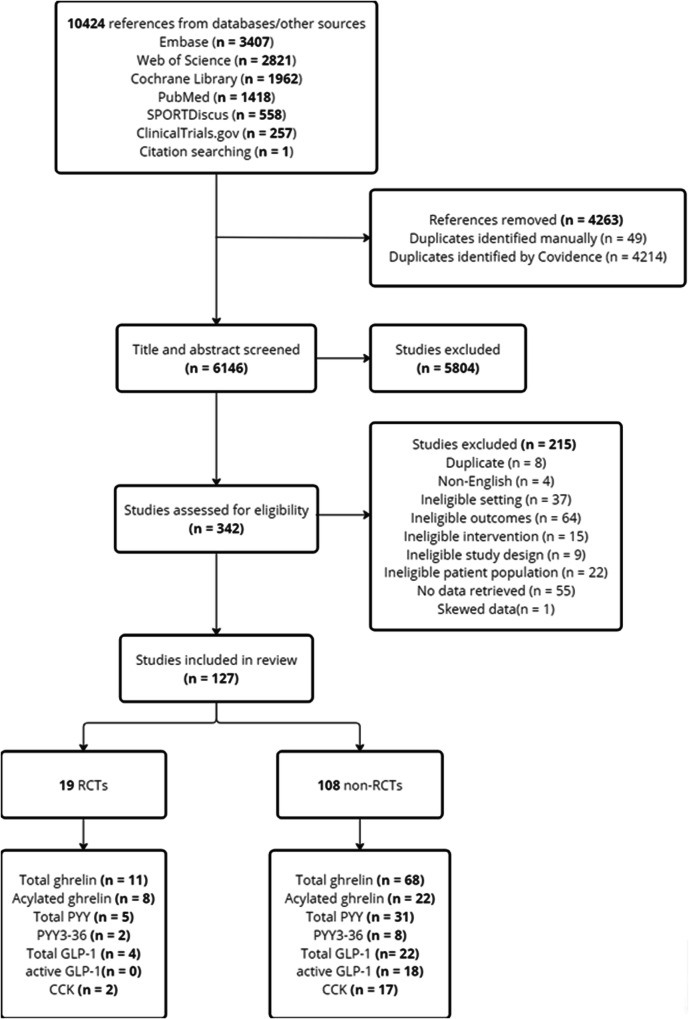
“This review summarises: (1) appetite-related gut hormone changes after weight loss in people with overweight or obesity and (2) the differences among interventions involving CR, EX or their combination.”
Research works printed but not linked: 2
- Higgins JPT, Li T, Deeks JJ. Chapter 6: Choosing effect measures and computing estimates of effect. In: Higgins JPT, Thomas J, Chandler J, Cumpston M, Li T, Page MJ, Welch VA (editors). Cochrane Handbook for Systematic Reviews of Interventions version 6.5 (last updated August 2023). Cochrane, (2024).
- Mohammadi-Sartang M, Mazloomi SM, Fararouie M, Bedeltavana A, Famouri M, Mazloom Z. Daily fortified-synbiotic yogurt consumption facilitates appetite control in overweight and obese adults with metabolic syndrome during a weight-loss program: a 10-week randomized controlled trial. Prog Nutr. 2019;21:135–44.
Cited by
The Benefits of Exercise Training in Combination With Weight Loss Therapies
Jiang, B. C., & Villareal, D. T. (2025) · Diabetes · doi:10.2337/dbi25-0001 · Cited by 9
Breit, M. J., Caldwell, A. E., Ostendorf, D. M., Pan, Z., Creasy, S. A., Swanson, B., Clark, K., Hill, E. B., MacLean, P. S., Bessesen, D. H., et al. (2025) · Nutrients · doi:10.3390/nu17142385 · Cited by 9
Ingestive Behavior and Precision Nutrition: Part of the Puzzle
Biruete, A., Buobu, P. S., Considine, R. V., Hoxha, E. M., Eicher‐Miller, H. A., Kinzig, K. P., Panjwani, A. A., Running, C. A., Rutigliani, G., Savaiano, D. A., et al. (2025) · Advances in Nutrition · doi:10.1016/j.advnut.2025.100531 · Cited by 7
“A recent meta-analysis indicated that fasting ghrelin increased, but PYY and GLP-1 decreased, with weight loss achieved by energy restriction, exercise, or the combination of energy restriction and exercise [337].”
Li, Z., Yao, J., Wang, S., Xu, J., & Wu, X. (2026) · Frontiers in Nutrition · doi:10.3389/fnut.2026.1799041 · Cited by 1
“Exercise consistently elevates circulating PYY levels and suppresses appetite (193).”
Purcell, S. A., Halliday, T. M., Melanson, E. L., Afghahi, A., Borges, V. F., Sinelli, I., & Cornier, M. (2025) · Nutrition and Cancer · doi:10.1080/01635581.2025.2518611
“Breast cancer survivors with varied treatment histories and menopausal statuses show increased fasted total ghrelin in response to weight loss (49) – a similar pattern to populations without previous cancer (50–52).”
Metadata
- Authors
- Jin, Z., Li, J., Thackray, A. E., Shen, T., Deighton, K., King, J. A., & Stensel, D. J.
- Affiliations
- Loughborough University (GB)
- National Health Service (GB)
- Nuffield Health (GB)
- Corresponding author
- Stensel, David J.
- Venue
- International Journal of Obesity
- Published
- 2025-02-10
- Volume
- 49
- Issue
- 5
- Pages
- 776-792
- ISSN
- 0307-0565 (ISSN-L)
- 1476-5497
- PMC
- PMC12095072
- OpenAlex
- W4407302396
- Cited by
- 20
- References
- 181
- Citations by year
- 2026: 15 · 2025: 5
- FWCI
- 2.26
- Type
- journal article
- Language
- en
- Open access
- hybrid
- doi.org
- Licence
- cc-by
- creativecommons.org/licenses/by/4.0 (tdm)
- creativecommons.org/licenses/by/4.0 (vor)
- Locations
- International Journal of Obesity (publishedVersion, cc-by)
- PubMed Central (publishedVersion, cc-by)
- PubMed (publishedVersion)
- Figshare (submittedVersion, cc-by)
- Funders
- National Institute for Health and Care Research
- NIHR Leicester Biomedical Research Centre
- Topics
- Life Sciences › Neuroscience › Endocrine and Autonomic Systems › Regulation of Appetite and Obesity
- Health Sciences › Medicine › Endocrinology, Diabetes and Metabolism › Adipokines, Inflammation, and Metabolic Diseases
- Health Sciences › Medicine › Pharmacology (medical) › Pharmacology and Obesity Treatment
- Keywords
- weight loss, caloric restriction, physical activity, ghrelin, acylated ghrelin, peptide YY, glucagon-like peptide-1, cholecystokinin, fasting state, obesity, overweight, weight regain, appetite regulation
- MeSH terms
- Appetite, Fasting, Gastrointestinal Hormones, Humans, Obesity, Weight Loss, Exercise, Randomized Controlled Trials as Topic, Peptide YY, Caloric Restriction, Overweight, Ghrelin
About these checks
Registry, retraction, Cites and statistics results are computed, not judged, with one exception: a printed reference that no index lists is read once by a model before it counts as a citation error. Claims are extracted by a model and kept only when their quote appears verbatim in the text; each cited source is then checked, with a model’s help, for whether it says what the claim relies on. Those verdicts can be wrong — read the claim’s quote and the cited source before relying on one.
Statistics and arithmetic are recomputed, not judged.
Confidence bands are shown only for fields calibrated on our annotated test set. None is calibrated yet, so no band is shown.
What counts as a claim ›How we measure confidence ›How we check this ›
Are you an author, or do you see a problem with this page? Request a review
Data sources
Bibliographic data: Semantic Scholar, OpenAlex, Crossref.
Contains information from the Semantic Scholar Academic Graph Datasets, made available under the ODC Attribution License (ODC-BY 1.0).
Semantic Scholar’s data is described in: Kinney, R., et al. (2023). The Semantic Scholar Open Data Platform. arXiv:2301.10140.
