

The DOI matches its Crossref record; 53 of the 53 references it cites were found in a registry or an index.
Targeting the affective brain—a randomized controlled trial of real-time fMRI neurofeedback in patients with depression
Open accessAbstract
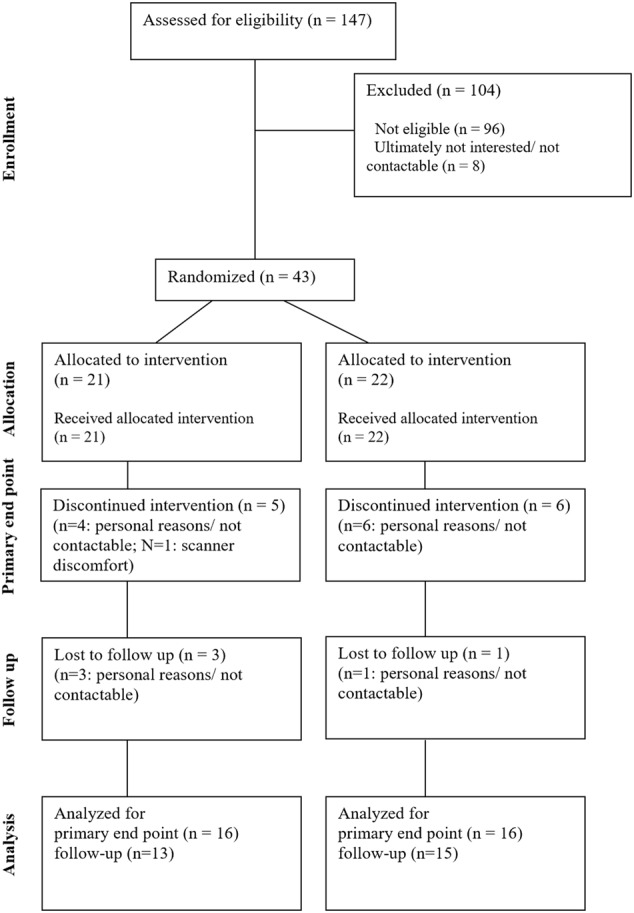
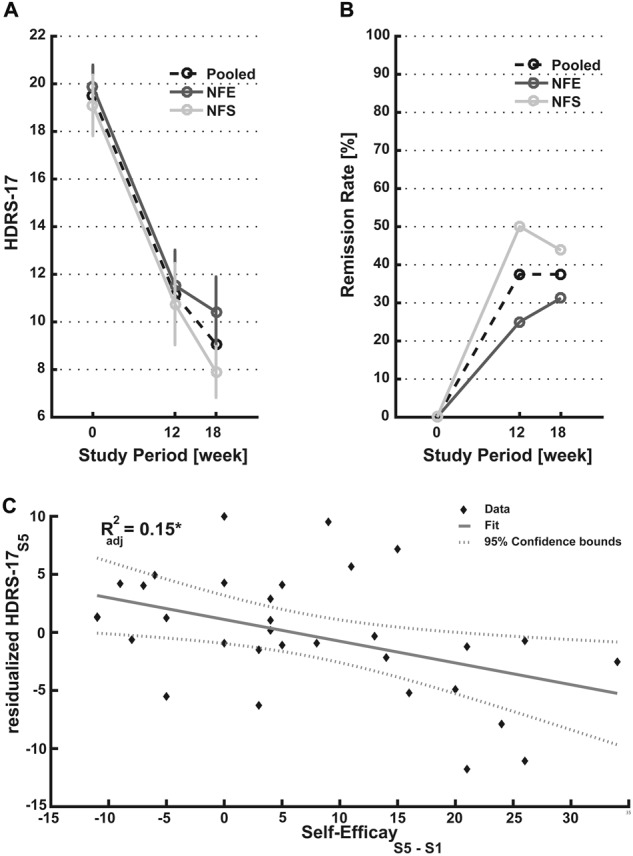
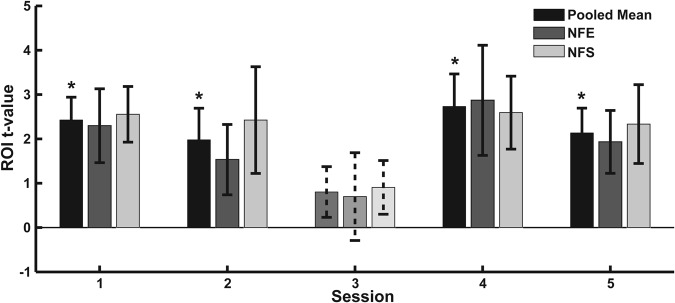
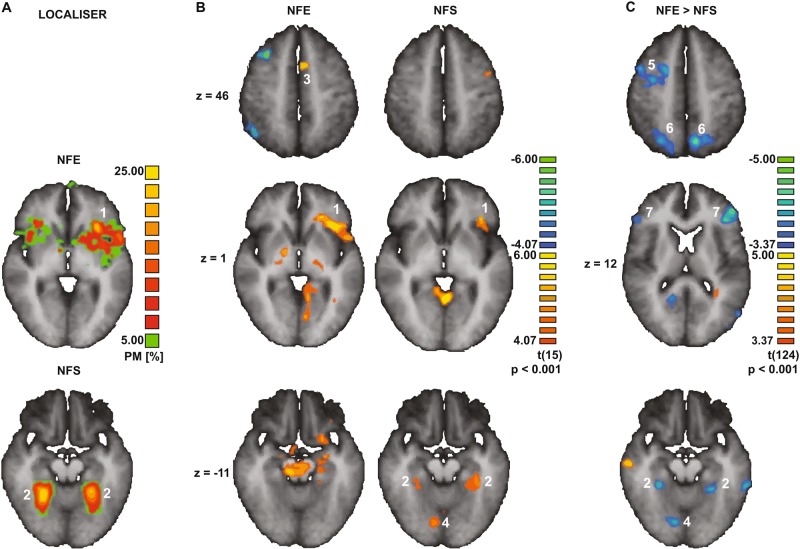
Functional magnetic resonance imaging neurofeedback (fMRI-NF) training of areas involved in emotion processing can reduce depressive symptoms by over 40% on the Hamilton Depression Rating Scale (HDRS). However, it remains unclear if this efficacy is specific to feedback from emotion-regulating regions. We tested in a single-blind, randomized, controlled trial if upregulation of emotion areas (NFE) yields superior efficacy compared to upregulation of a control region activated by visual scenes (NFS). Forty-three moderately to severely depressed medicated patients were randomly assigned to five sessions augmentation treatment of either NFE or NFS training. At primary outcome (week 12) no significant group mean HDRS difference was found (B = -0.415 [95% CI -4.847 to 4.016], p = 0.848) for the 32 completers (16 per group). However, across groups depressive symptoms decreased by 43%, and 38% of patients remitted. These improvements lasted until follow-up (week 18). Both groups upregulated target regions to a similar extent. Further, clinical improvement was correlated with an increase in self-efficacy scores. However, the interpretation of clinical improvements remains limited due to lack of a sham-control group. We thus surveyed effects reported for accepted augmentation therapies in depression. Data indicated that our findings exceed expected regression to the mean and placebo effects that have been reported for drug trials and other sham-controlled high-technology interventions. Taken together, we suggest that the experience of successful self-regulation during fMRI-NF training may be therapeutic. We conclude that if fMRI-NF is effective for depression, self-regulation training of higher visual areas may provide an effective alternative.
Overview
The claims and statistics of this paper haven’t been checked yet.
Run the check — free, no account needed. It reads the open-access text and checks the sources it cites.
Integrity signals
Registry
Cites
Statistics
Figures
Verification
Claims the paper makes
The claims and statistics of this paper haven’t been checked yet.
Run the check — free, no account needed. It reads the open-access text and checks the sources it cites.
Claims other papers make about this one
Each is checked against this paper’s own text: does it say what the citing paper says it does?
The source backs part of the claim, not all of it — or backs it for a different population, condition or comparison.
In the citing paper
“Rt-fMRI NF trainings have been shown to support perceived control (Zweerings et al., 2018) and self-efficacy (Mehler et al., 2018), thus potentially motivating behavioral change (MacDuffie et al., 2018).”
From Rt-fMRI neurofeedback-guided cognitive reappraisal training modulates amygdala responsivity in posttraumatic stress disorder (2020) · cites this paper as Mehler et al., 2018
Experimental — accuracy not yet measured
Self-check
Percentages, sums and reported differences re-computed from the paper’s own numbers.
The self-check needs the paper’s full text.
Citations
Cites
The Hospital Anxiety and Depression Scale
Zigmond, A. S., & Snaith, R. P. (1983) · Acta Psychiatrica Scandinavica · doi:10.1111/j.1600-0447.1983.tb09716.x · Cited by 47,139
Self-efficacy mechanism in human agency
Bandura, A. (1982) · American Psychologist · doi:10.1037/0003-066x.37.2.122 · Cited by 15,975
Depression and quality of life in older persons: A review
Sivertsen, H., Bjørkløf, G. H., Engedal, K., Selbæk, G., & Helvik, A.-S. (2015) · Dementia and Geriatric Cognitive Disorders · doi:10.1159/000437299 · Cited by 14,152
The control of the false discovery rate in multiple testing under dependency
Benjamini, Y., & Yekutieli, D. (2001) · The Annals of Statistics · doi:10.1214/aos/1013699998 · Cited by 10,490
Carver, C. S., & White, T. L. (1994) · Journal of Personality and Social Psychology · doi:10.1037/0022-3514.67.2.319 · Cited by 7,306
Robust Regression and Outlier Detection
Piepel, G. F., Rousseeuw, P. J., & Leroy, A. M. (1989) · Technometrics · doi:10.2307/1268828 · Cited by 6,183
Rush, A. J., Trivedi, M. H., Wisniewski, S. R., Nierenberg, A. A., Stewart, J. W., Warden, D., Niederehe, G., Thase, M. E., Lavori, P. W., Lebowitz, B. D., et al. (2006) · American Journal of Psychiatry · doi:10.1176/ajp.2006.163.11.1905 · Cited by 5,643 · cited 3×
“5% for secondary augmentation therapy [43].”
InfluentialRobust Regression and Outlier Detection
Rousseeuw, P. J., & Leroy, A. M. (1987) · Wiley Series in Probability and Statistics · doi:10.1002/0471725382 · Cited by 5,609
The Self-Efficacy Scale: Construction and Validation
Sherer, M., Maddux, J. E., Mercandante, B., Prentice-Dunn, S., Jacobs, B., & Rogers, R. W. (1982) · Psychological Reports · doi:10.2466/pr0.1982.51.2.663 · Cited by 4,028
Rush, A. J., Trivedi, M. H., Ibrahim, H. M., Carmody, T. J., Arnow, B., Klein, D. N., Markowitz, J. C., Ninan, P. T., Kornstein, S., Manber, R., et al. (2003) · Biological Psychiatry · doi:10.1016/s0006-3223(02)01866-8 · Cited by 3,829
A cortical representation of the local visual environment
Epstein, R. A., & Kanwisher, N. (1998) · Nature · doi:10.1038/33402 · Cited by 3,096
Lakens, D. (2017) · Social Psychological and Personality Science · doi:10.1177/1948550617697177 · Cited by 2,161 · cited 1×
“Given the absence of a group effect in upregulation and the similar clinical effects observed in both groups we also conducted equivalence tests based on participants ’ median ROI t values across the four neurofeedback training sessions [26].”
Antidepressant Drug Effects and Depression Severity: A Patient-Level Meta-analysis
Fournier, J. C., DeRubeis, R. J., Hollon, S. D., Dimidjian, S., Amsterdam, J. D., Shelton, R. C., & Fawcett, J. (2010) · JAMA · doi:10.1001/jama.2009.1943 · Cited by 2,009
Cognitive Reappraisal of Emotion: A Meta-Analysis of Human Neuroimaging Studies
Buhle, J. T., Silvers, J. A., Wager, T. D., Lopez, R., Onyemekwu, C., Kober, H., Weber, J., & Ochsner, K. N. (2014) · Cerebral Cortex · doi:10.1093/cercor/bht154 · Cited by 1,896 · cited 1×
“This is encouraging because striatal areas and the insula have been linked to positive reappraisal of emotions [29].”
Phillips, M. L., Ladouceur, C. D., & Drevets, W. C. (2008) · Molecular Psychiatry · doi:10.1038/mp.2008.65 · Cited by 1,383 · cited 1×
“Target ROIs in the NFE group were limited to limbic and frontal portions of the anterior cerebrum based on models of emotion processing in the human brain [19].”
Closed-loop brain training: the science of neurofeedback
Sitaram, R., Ros, T., Stoeckel, L., Haller, S., Scharnowski, F., Lewis-Peacock, J., Weiskopf, N., Blefari, M. L., Rana, M., Oblak, E., et al. (2017) · Nature Reviews Neuroscience · doi:10.1038/nrn.2016.164 · Cited by 1,306
A Comprehensive Review of the Placebo Effect: Recent Advances and Current Thought
Price, D. D., Finniss, D. G., & Benedetti, F. (2008) · Annual Review of Psychology · doi:10.1146/annurev.psych.59.113006.095941 · Cited by 1,146
Mental Imagery of Faces and Places Activates Corresponding Stimulus-Specific Brain Regions
O’Craven, K. M., & Kanwisher, N. (2000) · Journal of Cognitive Neuroscience · doi:10.1162/08989290051137549 · Cited by 1,078
Interoception in anxiety and depression
Paulus, M. P., & Stein, M. B. (2010) · Brain Structure and Function · doi:10.1007/s00429-010-0258-9 · Cited by 952
Chang, L. J., Yarkoni, T., Khaw, M. W., & Sanfey, A. G. (2013) · Cerebral Cortex · doi:10.1093/cercor/bhs065 · Cited by 879
Keller, M. B. (1992) · Archives of General Psychiatry · doi:10.1001/archpsyc.1992.01820100053010 · Cited by 864
Emotional category data on images from the international affective picture system
Mikels, J. A., Fredrickson, B. L., Samanez-Larkin, G. R., Lindberg, C. M., Maglio, S. J., & Reuter‐Lorenz, P. A. (2005) · Behavior Research Methods · doi:10.3758/bf03192732 · Cited by 702
Resting-state fMRI confounds and cleanup
Murphy, K., Birn, R. M., & Bandettini, P. A. (2013) · NeuroImage · doi:10.1016/j.neuroimage.2013.04.001 · Cited by 666
Wells, A., & Davies, M. I. (1994) · Behaviour Research and Therapy · doi:10.1016/0005-7967(94)90168-6 · Cited by 640
Berlim, M. T., van den Eynde, F., Tovar-Perdomo, S., & Daskalakis, Z. J. (2014) · Psychological Medicine · doi:10.1017/s0033291713000512 · Cited by 620
Holtzheimer, P. E., Husain, M. M., Lisanby, S. H., Taylor, S. F., Whitworth, L. A., McClintock, S., Slavin, K. V., Berman, J., McKhann, G. M., Patil, P. G., et al. (2017) · The Lancet Psychiatry · doi:10.1016/s2215-0366(17)30371-1 · Cited by 577
Hamilton, M. (1980) · PubMed · Cited by 471
Real-time fMRI neurofeedback: Progress and challenges
Sulzer, J., Haller, S., Scharnowski, F., Weiskopf, N., Birbaumer, N., Blefari, M. L., Bruehl, A. B., Cohen, L. G., deCharms, R. C., Gassert, R., et al. (2013) · NeuroImage · doi:10.1016/j.neuroimage.2013.03.033 · Cited by 453
Self-citationMeasurement of quality of life: current state of the art.
Flanagan, J. C. (1982) · PubMed · Cited by 440
Real-Time Self-Regulation of Emotion Networks in Patients with Depression
Linden, D. E. J., Isabelle, H., Johnston, S. J., Linden, S. C., Ranjit, T., Subramanian, L., Sorger, B., Healy, D., & Goebel, R. (2012) · PLoS ONE · doi:10.1371/journal.pone.0038115 · Cited by 438
Self-citationSelf-efficacy as a mediator between stressful life events and depressive symptoms
Maciejewski, P. K., Prigerson, H. G., & Mazure, C. M. (2000) · The British Journal of Psychiatry · doi:10.1192/bjp.176.4.373 · Cited by 386
Viewpoint-Specific Scene Representations in Human Parahippocampal Cortex
Epstein, R., Graham, K. S., & Downing, P. E. (2003) · Neuron · doi:10.1016/s0896-6273(03)00117-x · Cited by 360
Zilverstand, A., Parvaz, M. A., & Goldstein, R. Z. (2017) · NeuroImage · doi:10.1016/j.neuroimage.2016.06.009 · Cited by 360
Young, K. D., Siegle, G. J., Zotev, V., Phillips, R., Misaki, M., Yuan, H., Drevets, W. C., & Bodurka, J. (2017) · American Journal of Psychiatry · doi:10.1176/appi.ajp.2017.16060637 · Cited by 331
Mental Imagery in Depression: Phenomenology, Potential Mechanisms, and Treatment Implications
Holmes, E. A., Blackwell, S. E., Burnett Heyes, S., Renner, F., & Raes, F. (2016) · Annual Review of Clinical Psychology · doi:10.1146/annurev-clinpsy-021815-092925 · Cited by 325
Berlim, M. T., den Eynde, F. V., & Daskalakis, Z. J. (2012) · Neuropsychopharmacology · doi:10.1038/npp.2012.237 · Cited by 305
The self-regulating brain and neurofeedback: experimental science and clinical promise
Thibault, R. T., Lifshitz, M., & Raz, A. (2016) · Cortex · doi:10.1016/j.cortex.2015.10.024 · Cited by 272
RECOVERY, CHRONICITY, AND LEVELS OF PSYCHOPATHOLOGY IN MAJOR DEPRESSION
Mueller, T. I., & Leon, A. C. (1996) · Psychiatric Clinics of North America · doi:10.1016/s0193-953x(05)70275-6 · Cited by 234
Is Alpha Wave Neurofeedback Effective with Randomized Clinical Trials in Depression? A Pilot Study
Choi, S. W., Chi, S. E., Chung, S.-Y., Kim, J. W., Ahn, C. Y., & Kim, H. T. (2010) · Neuropsychobiology · doi:10.1159/000322290 · Cited by 177
Langner, R., Leiberg, S., Hoffstaedter, F., & Eickhoff, S. B. (2018) · Neuroscience & Biobehavioral Reviews · doi:10.1016/j.neubiorev.2018.04.022 · Cited by 156
Whole-Body Hyperthermia for the Treatment of Major Depressive Disorder
Janssen, C., Lowry, C. A., Mehl, M. R., Allen, J. J. B., Kelly, K. L., Gartner, D. E., Medrano, A., Begay, T. K., Rentscher, K. E., White, J. J., et al. (2016) · JAMA Psychiatry · doi:10.1001/jamapsychiatry.2016.1031 · Cited by 151
Neurofeedback and networks of depression
Linden, D. E. J. (2014) · Dialogues in Clinical Neuroscience · doi:10.31887/dcns.2014.16.1/dlinden · Cited by 125
Self-citationTime course of clinical change following neurofeedback
Rance, M., Walsh, C., Sukhodolsky, D. G., Pittman, B., Qiu, M., Kichuk, S. A., Wasylink, S., Koller, W. N., Bloch, M., Gruner, P., et al. (2018) · NeuroImage · doi:10.1016/j.neuroimage.2018.05.001 · Cited by 124
Neurofeedback: One of today's techniques in psychiatry?
Arns, M., Batail, J.-M., Bioulac, S., Congedo, M., Daudet, C., Drapier, D., Fovet, T., Jardri, R., Le-Van-Quyen, M., Lotte, F., et al. (2017) · L'Encéphale · doi:10.1016/j.encep.2016.11.003 · Cited by 117
Self-citationKeynan, J. N., Meir-Hasson, Y., Gilam, G., Cohen, A., Jackont, G., Kinreich, S., Ikar, L., Or‐Borichev, A., Etkin, A., Gyurak, A., et al. (2016) · Biological Psychiatry · doi:10.1016/j.biopsych.2015.12.024 · Cited by 112
Treatment of Depressed In-Patients
Bowers, W. A. (1990) · The British Journal of Psychiatry · doi:10.1192/bjp.156.1.73 · Cited by 108
Development and validation of the thought control ability questionnaire
Luciano, J. V., Algarabel, S., Tomás, J. M., & Martinez, J. L. T. (2004) · Personality and Individual Differences · doi:10.1016/j.paid.2004.06.020 · Cited by 98
Cheon, E., Koo, B., & Choi, J.-H. (2015) · Applied Psychophysiology and Biofeedback · doi:10.1007/s10484-015-9315-8 · Cited by 70
Integration of “what” and “where” in frontal cortex during visual imagery of scenes
de Borst, A. W., Sack, A. T., Jansma, B. M., Esposito, F., Martino, F. D., Valente, G., Roebroeck, A. F., Salle, F. D., Goebel, R., & Formisano, E. (2011) · NeuroImage · doi:10.1016/j.neuroimage.2011.12.005 · Cited by 59
Self-citationMeister, R., Jansen, A., Härter, M. C., Nestoriuc, Y., & Kriston, L. (2017) · Journal of Affective Disorders · doi:10.1016/j.jad.2017.03.024 · Cited by 41
Self-Efficacy Mediates the Effect of Depression on Smoking Susceptibility in Adolescents
Minnix, J. A., Blalock, J. A., Marani, S. K., Prokhorov, A. V., & Cinciripini, P. M. (2011) · Nicotine & Tobacco Research · doi:10.1093/ntr/ntr061 · Cited by 38
Golding, K., Fife‐Schaw, C., & Kneebone, I. (2016) · Clinical Rehabilitation · doi:10.1177/0269215516682820 · Cited by 22
fMRI neurofeedback of higher visual areas and perceptual biases
Habes, I., Rushton, S. K., Johnston, S. J., Sokunbi, M. O., Barawi, K., Brosnan, M. B., Daly, T., Ihssen, N., & Linden, D. E. J. (2016) · Neuropsychologia · doi:10.1016/j.neuropsychologia.2016.03.031 · Cited by 18
Self-citation
Research works printed but not linked: 1
- Qids S, Qids-c CR, Rush aJ, Trivedi MH, Ibrahim HM, Carmody TJ, et al. The 16-Item quick inventory of depressive. Depression. 2003;54:573–83.
Cited by
Sorted by citations
Ros, T., Enriquez-Geppert, S., Zotev, V., Young, K. D., Wood, G., Whitfield-Gabrieli, S., Wan, F., Vuilleumier, P., Vialatte, F., Van De Ville, D., et al. (2020) · Brain · doi:10.1093/brain/awaa009 · Cited by 399
Self-citationfMRI neurofeedback in emotion regulation: A literature review
Linhartová, P., Látalová, A., Kóša, B., Kašpárek, T., Schmahl, C. G., & Paret, C. (2019) · NeuroImage · doi:10.1016/j.neuroimage.2019.03.011 · Cited by 162
Brain Neuroplasticity Leveraging Virtual Reality and Brain–Computer Interface Technologies
Drigas, A. S., & Sideraki, A. (2024) · Sensors · doi:10.3390/s24175725 · Cited by 155
Efficacy of bio- and neurofeedback for depression: a meta-analysis
Fernández‐Álvarez, J., Grassi, M., Colombo, D., Botella, C., Cipresso, P., Perna, G., & Riva, G. (2021) · Psychological Medicine · doi:10.1017/s0033291721004396 · Cited by 109
Kohl, S. H., Veit, R., Spetter, M. S., Günther, A., Andriani, R., Lührs, M., Birbaumer, N., Preissl, H. T., & Hallschmid, M. (2019) · NeuroImage · doi:10.1016/j.neuroimage.2019.02.033 · Cited by 79
Self-citation
Metadata
- Authors
- Mehler, D. M. A., Sokunbi, M. O., Habes, I., Barawi, K., Subramanian, L., Range, M., Evans, J., Hood, K., Lührs, M., Keedwell, P., Goebel, R., & Linden, D. E. J.
- Affiliations
- Cardiff University (GB)
- De Montfort University (GB)
- Maastricht University (NL)
- King's College London (GB)
- Corresponding author
- Linden, David E. J.
- ORCID
- Venue
- Neuropsychopharmacology
- Published
- 2018-06-23
- Volume
- 43
- Issue
- 13
- Pages
- 2578-2585
- ISSN
- 0893-133X (ISSN-L)
- 1740-634X
- PMC
- PMC6186421
- OpenAlex
- W2808876118
- Cited by
- 175
- References
- 53
- Citations by year
- 2026: 9 · 2025: 14 · 2024: 16 · 2023: 19 · 2022: 25 · 2021: 54 · 2020: 21 · 2019: 13 · 2018: 4
- FWCI
- 10.35
- Type
- journal article
- Language
- en
- Open access
- hybrid
- doi.org
- Licence
- Locations
- Neuropsychopharmacology (publishedVersion, cc-by)
- Europe PMC (PubMed Central) (publishedVersion, other-oa)
- PubMed Central (publishedVersion, cc-by)
- PubMed (publishedVersion)
- Research Publications (Maastricht University) (publishedVersion, cc-by)
- ORCA Online Research @Cardiff (Cardiff University) (acceptedVersion)
- DMU Open Research Archive (De Montfort University) (submittedVersion)
- Research Publications (Maastricht University) (submittedVersion, other-oa)
- Funders
- National Institute for Social Care and Health Research (HS/10/25)
- Health and Care Research Wales (HS/14/20)
- Cancer Research UK
- European Commission (602186)
- Medical Research Council (MR/L010305/1)
- Topics
- Life Sciences › Neuroscience › Neurology › Transcranial Magnetic Stimulation Studies
- Health Sciences › Medicine › Pharmacology (medical) › Treatment of Major Depression
- Life Sciences › Neuroscience › Cognitive Neuroscience › Neural and Behavioral Psychology Studies
- Keywords
- fMRI neurofeedback, depression, emotion regulation, real-time fMRI, visual scene processing, antidepressant augmentation, self-efficacy, placebo effect, regression to the mean, self-regulation training
- MeSH terms
- Adult, Brain, Computer Systems, Depressive Disorder, Female, Follow-Up Studies, Humans, Magnetic Resonance Imaging, Male, Middle Aged, Pilot Projects, Treatment Outcome, Self Efficacy, Neurofeedback
About these checks
Registry, retraction, Cites and statistics results are computed, not judged, with one exception: a printed reference that no index lists is read once by a model before it counts as a citation error. Claims are extracted by a model and kept only when their quote appears verbatim in the text; each cited source is then checked, with a model’s help, for whether it says what the claim relies on. Those verdicts can be wrong — read the claim’s quote and the cited source before relying on one.
Statistics and arithmetic are recomputed, not judged.
Confidence bands are shown only for fields calibrated on our annotated test set. None is calibrated yet, so no band is shown.
What counts as a claim ›How we measure confidence ›How we check this ›
Are you an author, or do you see a problem with this page? Request a review
