

The BET family in immunity and disease
Open accessThe DOI matches its Crossref record; 200 of the 200 references it cites were found in a registry or an index.
Abstract
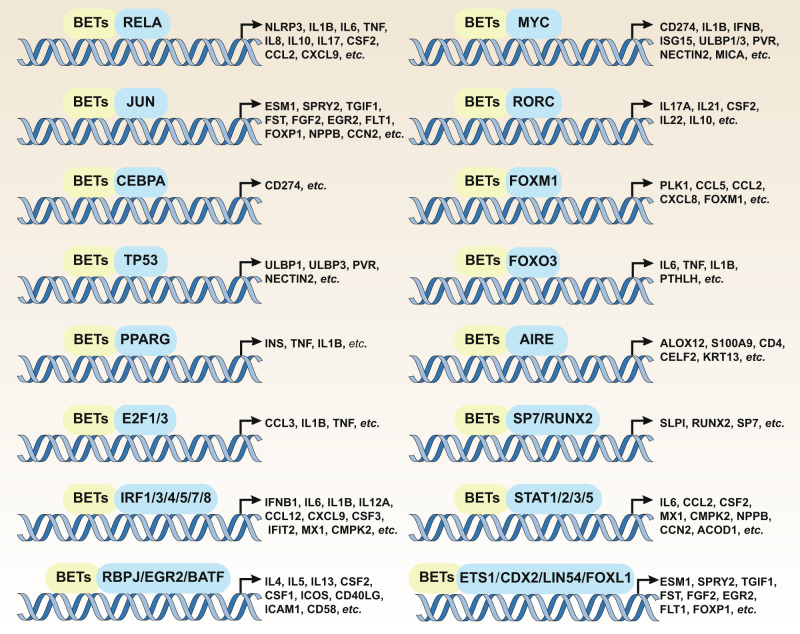
Innate immunity serves as the rapid and first-line defense against invading pathogens, and this process can be regulated at various levels, including epigenetic mechanisms. The bromodomain and extraterminal domain (BET) family of proteins consists of four conserved mammalian members (BRD2, BRD3, BRD4, and BRDT) that regulate the expression of many immunity-associated genes and pathways. In particular, in response to infection and sterile inflammation, abnormally expressed or dysfunctional BETs are involved in the activation of pattern recognition receptor (e.g., TLR, NLR, and CGAS) pathways, thereby linking chromatin machinery to innate immunity under disease or pathological conditions. Mechanistically, the BET family controls the transcription of a wide range of proinflammatory and immunoregulatory genes by recognizing acetylated histones (mainly H3 and H4) and recruiting transcription factors (e.g., RELA) and transcription elongation complex (e.g., P-TEFb) to the chromatin, thereby promoting the phosphorylation of RNA polymerase II and subsequent transcription initiation and elongation. This review covers the accumulating data about the roles of the BET family in innate immunity, and discusses the attractive prospect of manipulating the BET family as a new treatment for disease.
Overview
The claims and statistics of this paper haven’t been checked yet.
Free: it reads the open-access text and checks the first 5 claims that cite a source we can check. Create a free account to check every claim.
Integrity signals
Registry
Cites
Statistics
Figures
Verification
Claims the paper makes
The claims and statistics of this paper haven’t been checked yet.
Free: it reads the open-access text and checks the first 5 claims that cite a source we can check. Create a free account to check every claim.
Claims other papers make about this one
Each is checked against this paper’s own text: does it say what the citing paper says it does?
The cited source says what the claim attributes to it.
In the citing paper
“We previously demonstrated that pharmacological inhibition of bromodomain and extra-terminal domain (BET) proteins, critical mediators of stress-activated chromatin signaling in various diseases3, modulates a reversible transcriptional switch that governs fibroblast activation in chronic heart failure through the transcription factor (TF) MEOX14.”
From Chromatin remodelling drives immune cell–fibroblast communication in heart failure (2024) · cites this paper as [3]
Self-check
Percentages, sums and reported differences re-computed from the paper’s own numbers.
The self-check needs the paper’s full text.
Citations
Cites
Recognition of double-stranded RNA and activation of NF-κB by Toll-like receptor 3
Alexopoulou, L., Holt, A. C., Medzhitov, R., & Flavell, R. A. (2001) · Nature · doi:10.1038/35099560 · Cited by 6,129
The Nuclear Factor NF- B Pathway in Inflammation
Lawrence, T. (2009) · Cold Spring Harbor Perspectives in Biology · doi:10.1101/cshperspect.a001651 · Cited by 4,898 · cited 1×
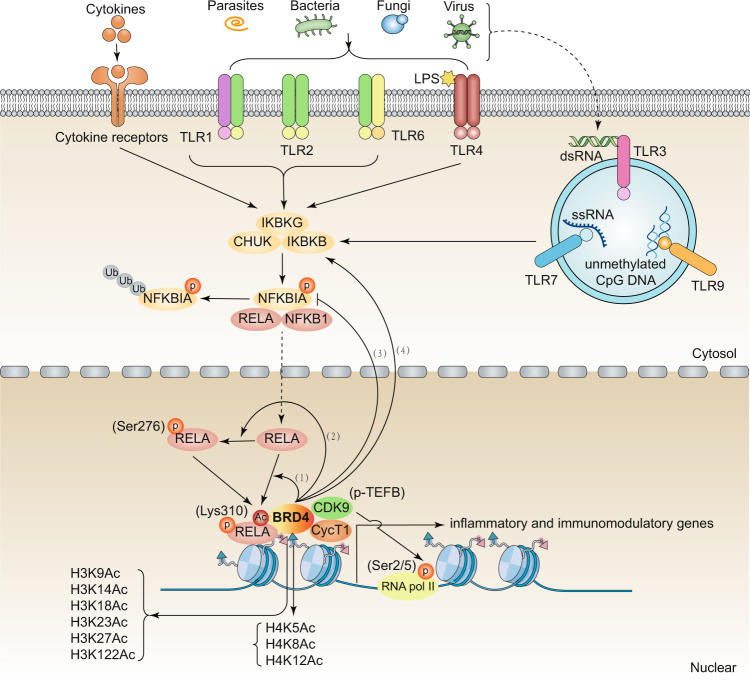
“This dynamic modification and expression change of IκBα further promotes the transport of RELA from the cytoplasm to the nucleus, where it can bind to the promoters of various related genes and regulate their transcription.(81) Both acetylation and phosphorylation are essential for the transcriptional activity of RELA.”
BackgroundThe complexity of NF-κB signaling in inflammation and cancer
Hoesel, B., & Schmid, J. A. (2013) · Molecular Cancer · doi:10.1186/1476-4598-12-86 · Cited by 3,165
Pathogen Recognition and Inflammatory Signaling in Innate Immune Defenses
Mogensen, T. H. (2009) · Clinical Microbiology Reviews · doi:10.1128/cmr.00046-08 · Cited by 3,111 · cited 1×
“TLR4 is expressed in almost all innate immune cells, and it specifically recognizes bacterial LPS, several other components of pathogens, and DAMPs derived from tissue damage.(60) TLR4 binds to its ligands, which ultimately leads to the activation of the nuclear factor kappa light-chain enhancer of activated B cells (…”
BackgroundBET Bromodomain Inhibition as a Therapeutic Strategy to Target c-Myc
Delmore, J. E., Issa, G. C., Lemieux, M. E., Rahl, P. B., Shi, J., Jacobs, H. M., Kastritis, E., Gilpatrick, T., Paranal, R. M., Qi, J., et al. (2011) · Cell · doi:10.1016/j.cell.2011.08.017 · Cited by 2,813
Coactivator condensation at super-enhancers links phase separation and gene control
Sabari, B. R., Dall’Agnese, A., Boija, A., Klein, I. A., Coffey, E. L., Shrinivas, K., Abraham, B. J., Hannett, N. M., Zamudio, A. V., Manteiga, J. C., et al. (2018) · Science · doi:10.1126/science.aar3958 · Cited by 2,595 · cited 1×
“The inherent disordered regions of BRD4 and MED1 can form phase-separated droplets, and then separate and concentrate the nuclear extract transcription device and control key cellidentity genes.(184) In addition, LncRNA DIGIT can promote BRD3 to form a phase-separated condensate, which occupies the enhancer of endoder…”
BackgroundRegulation and function of the cGAS–STING pathway of cytosolic DNA sensing
Chen, Q., Sun, L., & Chen, Z. J. (2016) · Nature Immunology · doi:10.1038/ni.3558 · Cited by 2,333 · cited 1×
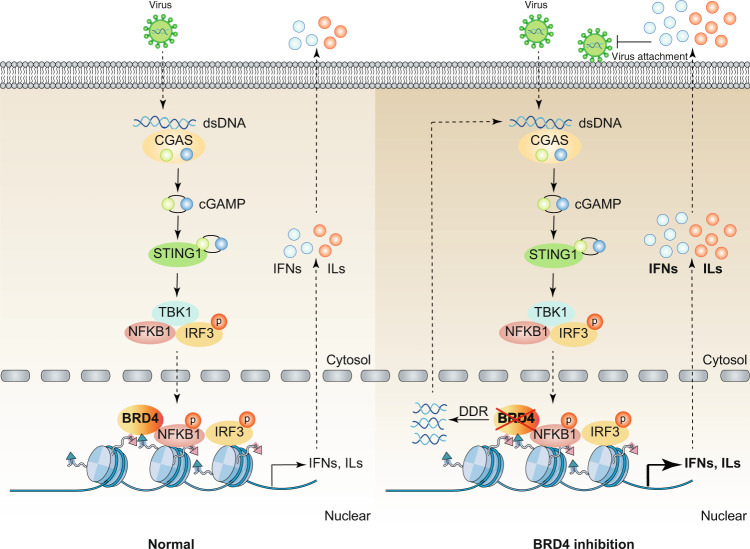
“The CGAS-STING1 pathway-mediated DNA-sensing signaling pathway is crucial for the production of type I IFNs and host antiviral responses.(78) Interestingly, blocking BRD4 widely inhibits the attachment of various DNA and RNA viruses (e.”
BackgroundPathogen Recognition by the Innate Immune System
Kumar, H., Kawai, T., & Akira, S. (2011) · International Reviews of Immunology · doi:10.3109/08830185.2010.529976 · Cited by 2,257 · cited 1×
“Function of BETs in innate immunity The innate immune response is mainly triggered by the recognition of various extracellular or intracellular danger signals through PRRs expressed in immune and non-immune cells.(52) The surface-expressed PRRs include toll-like receptors (TLRs), C-type lectin receptors (CLRs), and ad…”
BackgroundMedzhitov, R., & Janeway, C. (2000) · New England Journal of Medicine · doi:10.1056/nejm200008033430506 · Cited by 1,825
Structure and ligand of a histone acetyltransferase bromodomain
Dhalluin, C., Carlson, J. E., Zeng, L., He, C., Aggarwal, A. K., Zhou, M.-M., & Zhou, M.-M. (1999) · Nature · doi:10.1038/20974 · Cited by 1,732 · cited 1×
“It is worth noting that BETs can recognize not only residues in histones, but also other acetylated nuclear proteins to control gene transcription.(181) It can be supposed that other acetylationregulated TFs, including cAMP response element binding protein 1 (CREB1), heat shock transcription factor 1 (HSF1), sterol re…”
Background
Cited by
Items 301–329 of 329
Bhagat, P. P., Sharma, T. G., Shirasath, K. R., Goyal, S. N., & Awathale, S. N. (2026) · Neuroscience · doi:10.1016/j.neuroscience.2026.06.033
BET Bromodomain Targeting by NSAIDs : Structural, Biophysical, and Computational Insights
Sridhar, A., Kandhasami, N., Mathur, S., Krishnappa, G., Thiyagarajan, S., & Padmanabhan, B. (2026) · Proteins Structure Function and Bioinformatics · doi:10.1002/prot.70154
Moral‐Morales, A. D., Díaz-Dionisio, E. D., & Medina‐Franco, J. L. (2026) · Expert Opinion on Drug Discovery · doi:10.1080/17460441.2026.2727574
“…shape of a target’s pocket [97], a strategy well suited to epigenetic readers and writers such as the bromo-domains or lysine methyltransferases, where selectivity is highly desired because of the high similarity in binding pock-ets among members of the same family of proteins [98,99].”
ÁLVAREZ, G., Martínez‐Noa, Y., Singh, B., Gaza, J. T., Liu, Q., & Perez, A. (2026) · Wiley eBooks · doi:10.1002/9781394316632.ch07
BET Protein Selectivity in Epigenetic RegulationPreprint
Akkaya, H., & Özmaldar, A. (2026) · SSRN Electronic Journal · doi:10.2139/ssrn.7289620
Qian, Z., Yang, C., Wu, Y., Zhao, Y., Huang, J., Li, Y., Li, X., Yu, Y., & Lu, Y. (2026) · Cellular and Molecular Life Sciences · doi:10.1007/s00018-026-06386-9
Lu, Z., Shi, S., Xia, F., Chandran, A. M. K., Lin, J. L., Iniguez, D. J., Motamedi, M., Liu, H., & Zhang, W. (2026) · Molecular Therapy · doi:10.1016/j.ymthe.2026.08.045
MAPK signaling links BRD2 chromatin occupancy to PI3K/AKT inhibitor sensitivityPreprint
Mendez, J., Bruno, S., Indeglia, A., Khan, T., Ranieri, I., Wang, J., Högström, J., Hillis, A. L., Lee, J., Clohessy, J. G., et al. (2026) · bioRxiv (Cold Spring Harbor Laboratory) · doi:10.64898/2026.09.21.753236
Inhibition of Endothelial BRD4 Alleviates Lupus Nephritis Partly Through Interacting With FLI ‐1
Wang, X., Zhang, X. K., Chen, C., Zhang, W., & Ni, X. (2026) · Arthritis & Rheumatology · doi:10.1002/art.70324
Ullah, A., & Zaman, W. (2026) · Immunologic Research · doi:10.1007/s12026-026-09845-4
“BET inhibitors, HDAC inhibitors, methyltransferase modulators and other chro-matin-active drugs can suppress inflammatory transcrip - tional programs [39].”
Diab, M. K., Yassen, A. S. A., Fahmy, S. A., Ashour, H. F., & Nafie, M. S. (2026) · RSC Medicinal Chemistry · doi:10.1039/d6md00450d
Vadak, N., & Bhatt, L. K. (2026) · Cell Biology International · doi:10.1002/cbin.70223
“These two domains play different roles; BD1 maintains steady state gene expression, whereas BD2 is involved in interacting with transcription factors during the inflammatory response (Wang et al. 2021b; Gilan et al. 2020).”
Rastgar, S., Hanachi, P., & Walker, T. R. (2026) · Water Air & Soil Pollution · doi:10.1007/s11270-026-10034-0
“The specific surface area, pore volume and pore size distribution were measured by the Brunauer–Emmett–Teller (BET) method (BELSORP MINI II with BELPREP VAC II, Japan) (Wang et al., 2021a, b).”
InfluentialWater-Model Dependence of Absolute Binding Free Energies across the Bromodomain FamilyPreprint
Altun, E., Sarıbal, İ., Sezer, A., & Çınaroğlu, S. S. (2026) · ChemRxiv · doi:10.26434/chemrxiv.15010882/v1
Liu, Z., Cui, Z., Zhang, X., Wang, R., Dai, X., & Shi, L. (2026) · European Journal of Medicinal Chemistry · doi:10.1016/j.ejmech.2026.119457
BindingDB (2026) · UC San Diego · doi:10.7270/q2xg9wzj
Influenza vaccination response is associated with the DNA methylation of T cell pathways
Reed, E. (2025) · ImmPort · doi:10.21430/m38djzggzy
BindingDB Entry 50022752: Covalent inhibitors meet epigenetics: New opportunities.
BindingDB (2026) · UC San Diego · doi:10.7270/q2k64pxv
BindingDB Entry 50023737: Macrocyclic dihydropyridine analogs as pan-BET BD2-preferred inhibitors.
BindingDB (2026) · UC San Diego · doi:10.7270/q2xp79wx
Li, K., Tan, Y.-K., Li, Z., Xiang, R., Deng, X., Jin, J., & Li, Y. (2026) · Biochimica et Biophysica Acta (BBA) - Molecular Basis of Disease · doi:10.1016/j.bbadis.2026.168510
Yang, Y., Hua, Y., Chen, W., Zheng, H., Wu, H., Qin, S., & Huang, S. (2022) · doi:10.3389/fphar.2022.1037856.s004
Fu, R., Qin, P., Zou, X., Hu, Z., Hong, N., Wang, Y., & Jin, W. (2021) · doi:10.3389/fcell.2021.702897.s002
Banham, G. D., Lee, C. Y. C., Ferdinand, J. R., Matthews, R. J., Jing, C., Smithers, N., Prinjha, R. K., & Clatworthy, M. R. (2022) · doi:10.3389/fimmu.2022.885101.s006
Nord, J. A., Wynia-Smith, S. L., Gehant, A. L., Lipinski, R. A. J., Naatz, A., Rioja, I., Prinjha, R. K., Corbett, J. A., & Smith, B. C. (2022) · doi:10.3389/fendo.2022.923925.s001
Metadata
- Authors
- Wang, N., Wu, R., Tang, D., & Kang, R.
- Affiliations
- The University of Texas Southwestern Medical Center (US)
- Corresponding author
- Tang, Daolin
- Kang, Rui
- Venue
- Signal Transduction and Targeted Therapy
- Published
- 2021-01-19
- Volume
- 6
- Issue
- 1
- Pages
- 23-23
- ISSN
- 2059-3635 (ISSN-L)
- PMC
- PMC7813845
- OpenAlex
- W3121466164
- Cited by
- 295
- References
- 200
- Citations by year
- 2026: 33 · 2025: 67 · 2024: 60 · 2023: 57 · 2022: 50 · 2021: 28
- FWCI
- 5.20
- Type
- journal article
- Language
- en
- Open access
- gold
- doi.org
- Licence
- cc-by
- creativecommons.org/licenses/by/4.0 (tdm)
- creativecommons.org/licenses/by/4.0 (vor)
- Locations
- Signal Transduction and Targeted Therapy (publishedVersion, cc-by)
- PubMed Central (publishedVersion, cc-by)
- PubMed (publishedVersion)
- DOAJ (DOAJ: Directory of Open Access Journals) (submittedVersion, cc-by-sa)
- Funders
- University of Texas Southwestern Medical Center
- National Institutes of Health
- National Cancer Institute (R01CA211070)
- National Institute of General Medical Sciences (R01GM127791)
- Topics
- Life Sciences › Biochemistry, Genetics and Molecular Biology › Molecular Biology › Protein Degradation and Inhibitors
- Life Sciences › Biochemistry, Genetics and Molecular Biology › Molecular Biology › Genomics and Chromatin Dynamics
- Life Sciences › Immunology and Microbiology › Immunology › Immune Response and Inflammation
- Keywords
- BET proteins, BRD2, BRD3, BRD4, BRDT, innate immunity, epigenetic regulation, histone acetylation, pattern recognition receptors, Toll-like receptors, sterile inflammation, P-TEFb, RNA polymerase II elongation, RelA, chromatin regulation, BET inhibitors, immunotherapy
- MeSH terms
- Animals, Chromatin, Humans, Immunity, Innate, Transcription Factors, Transcription, Genetic, Epigenesis, Genetic
About these checks
Registry, retraction, Cites and statistics results are computed, not judged, with one exception: a printed reference that no index lists is read once by a model before it counts as a citation error. Claims are extracted by a model and kept only when their quote appears verbatim in the text; each cited source is then checked, with a model’s help, for whether it says what the claim relies on. Those verdicts can be wrong — read the claim’s quote and the cited source before relying on one.
Statistics and arithmetic are recomputed, not judged.
Confidence bands are shown only for fields calibrated on our annotated test set. None is calibrated yet, so no band is shown.
What counts as a claim ›How we measure confidence ›How we check this ›
Are you an author, or do you see a problem with this page? Request a review
Data sources
Bibliographic data: Semantic Scholar, OpenAlex, Crossref.
Contains information from the Semantic Scholar Academic Graph Datasets, made available under the ODC Attribution License (ODC-BY 1.0).
Semantic Scholar’s data is described in: Kinney, R., et al. (2023). The Semantic Scholar Open Data Platform. arXiv:2301.10140.
