

Moderators of inflammation-related depression: a prospective study of breast cancer survivors
Open accessThe DOI matches its Crossref record; 78 of the 79 references it cites were found in a registry or an index; 5 of the 79 sources its claims cite were checked for support.
Abstract
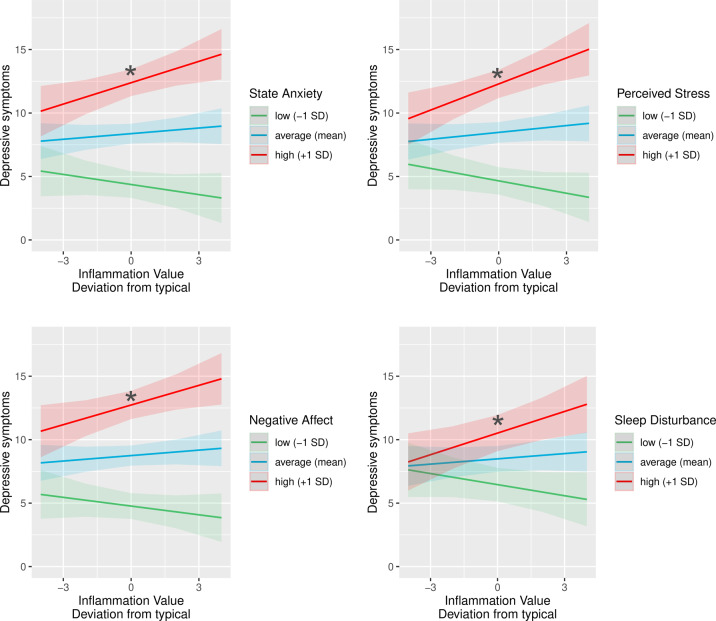
Inflammation has been shown to predict depression, but sensitivity to inflammation varies across individuals. Experimental studies administering potent pro-inflammatory agents have begun to characterize this sensitivity. However, risk factors for inflammation-associated depression in naturalistic contexts have not been determined. The present study examined key psychological and behavioral risk factors (state anxiety, perceived stress, negative affect, disturbed sleep, and childhood adversity) as potential moderators of the relationship between inflammation and depressive symptoms in a prospective longitudinal study of breast cancer survivors. Women with early stage breast cancer were recruited after completing primary cancer treatment (nfinal = 161). Depressive symptoms, inflammatory markers (CRP, IL-6, and sTNF-RII), and key risk factors were assessed post treatment (T1), at 6 and 12-month follow-ups (T2 and T3), and during a final follow-up (TF) 3−6 years after T1; childhood adversity was measured only at T3. Inflammatory markers were combined into a single inflammatory index prior to analyses. Women who reported higher levels of state anxiety, perceived stress, negative affect, and/or sleep disturbance at T1 (post-treatment) exhibited higher depressive symptoms at times when inflammation was higher than typical (interaction βs ranged from .06 to .08; all p s < .014). Results demonstrate the relevance of these risk factors for understanding inflammation-associated depression in a clinical context and could inform targeted strategies for prevention and treatment among at-risk populations.
Overview
CoChat Summary
TL;DR
In a prospective cohort of 161 early-stage breast cancer survivors, post-treatment state anxiety, perceived stress, negative affect, and sleep disturbance moderated the within-person association between inflammation and depressive symptoms over 3–6 years. Childhood adversity did not moderate this association.
Key findings
- Higher post-treatment (T1) state anxiety, perceived stress, negative affect, and sleep disturbance each strengthened the association between person-centered inflammation and depressive symptoms at any given assessment (interaction βs ranged from .06 to .08; all ps < .014).
- Simple slopes showed inflammation was positively associated with depressive symptoms among women at high (+1 SD) levels of state anxiety (b = 0.57, p = 0.004), perceived stress (b = 0.70, p < 0.001), negative affect (b = 0.53, p = 0.007), and sleep disturbance (b = 0.54, p = 0.006), but not at low (−1 SD) or average levels.
- Childhood adversity did not moderate the inflammation–depression association (b = 0.001, β = 0.001, p = 0.94).
- Secondary analyses found effects were primarily driven by sTNF-RII rather than CRP or IL-6, and interactive effects were significant in women of average age (~51.6 years) or younger (~43.5 years) but non-significant in older (~59.7 years) women.
Methods
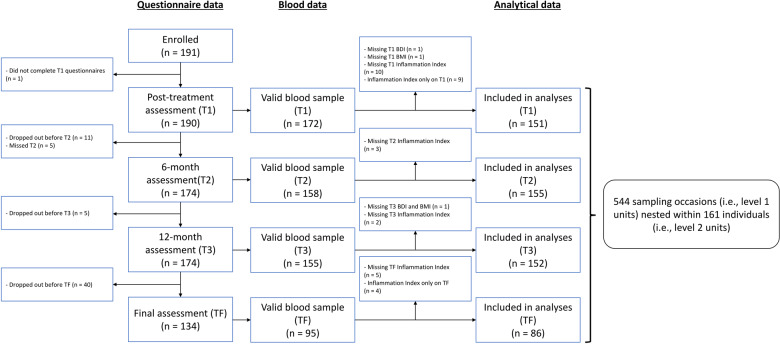
- Secondary analysis of the Mind Body Study, a prospective longitudinal cohort of women with early-stage breast cancer recruited after primary treatment; final analytic sample was 161 women contributing 544 sampling occasions across T1 (post-treatment), T2 (6 months), T3 (12 months), and TF (3–6 years after T1).
- Inflammatory markers CRP, IL-6, and sTNF-RII were assayed from fasting morning blood samples and combined into a single standardized inflammatory index; depressive symptoms were measured with the BDI-II, and risk factors with STAI, PSS, PANAS negative affect, PSQI, and Risky Families questionnaire (childhood adversity measured only at T3).
- Primary hypotheses used 2-level robust multilevel models with person-centered inflammation at level 1 and T1 risk factors (or T3 childhood adversity) at level 2, testing inflammation × risk factor interactions and simple slopes at −1 SD, mean, and +1 SD, controlling for age, BMI, race, chemotherapy, radiation, endocrine therapy, cancer stage, and surgery type.
Limitations
- Stated: the study excluded clinically depressed individuals at recruitment, which may have limited the range of depressive symptoms; it focused on depressive symptoms rather than onset of major depressive disorder; the assessment schedule was not designed to capture acute effects of diagnosis and treatment; the sample was primarily well-educated White breast cancer survivors, limiting generalizability; risk factor measures overlapped with depressive symptom items; and the design does not address temporality or causality.
- Evident from the text: childhood adversity was measured only at T3, so its lack of moderation may reflect timing or measurement rather than a true absence of effect; the analytic sample was a subset of the parent study and included women more likely to have received endocrine therapy than excluded participants.
Model-written summary. Check it against the paper before relying on it.
Integrity signals
Registry
Cites
Statistics
Figures
Verification
Claims the paper makes
2 Valid · 0 Not valid · 33 Not checked · 62 Own results and interpretations
The cited sources support only part of this claim — read each source’s verdict below.
In the paper
“that were found to predict inflammation-related depression in experimental studies [16, 19, 27–30]”
§ Moderators of inflammation-related depression: a prospective study of breast cancer survivors > Introduction
What the sources say
- Not checked yetcites [16] Irwin MR Cole S Olmstead R Breen EC Cho JJ Moieni M Moderators for depressed mood and systemic and transcriptional inflammatory responses: a randomized controlled trial of endotoxin Neuropsychopharmacology 2019 44 635 41 30391995 PMC6333799 source
- Partly supportedcites [19] Cho HJ Eisenberger NI Olmstead R Breen EC Irwin MR Preexisting mild sleep disturbance as a vulnerability factor for inflammation-induced depressed mood: a human experimental study Transl Psychiatry 2016 6 e750 e750 26954978 PMC4872448 sourceExperimental — accuracy not yet measured
Cho et al. (2016) is indeed a human experimental study (randomized, double-blind, placebo-controlled endotoxin challenge, N=111) in which preexisting mild sleep disturbance (PSQI median split) significantly moderated/enhanced inflammation-induced depressed mood — supporting the claim's core attribution (Results, 'Depressed mood changes in response to endotoxin and moderation by sleep disturbance'; Abstract). But the effect was confined to females: the Abstract and Results state 'Among males, no moderating effect of sleep disturbance was observed,' and the Discussion caveats that the two-hit model 'may apply to females only.' Further, the outcome was transient experimentally induced depressed mood, not clinical depression — the Discussion (limitations) states 'endotoxin-induced depressed mood in healthy volunteers cannot be equated with clinical depression.' So the unqualified plural claim that these risk factors 'predict inflammation-related depression in experimental studies' overstates this source on population (sex) and on outcome severity. (LLM, conf=0.75)
- Not checked yetcites [27] Capuron L Ravaud A Miller AH Dantzer R Baseline mood and psychosocial characteristics of patients developing depressive symptoms during interleukin-2 and/or interferon-alpha cancer therapy Brain Behav Immun. 2004 18 205 13 15050647 source
- Supportedcites [28] Franzen PL Buysse DJ Rabinovitz M Pollock BG Lotrich FE Poor sleep quality predicts onset of either major depression or subsyndromal depression with irritability during interferon-alpha treatment Psychiatry Res 2010 177 240 5 20381876 PMC2861158 source
The Abstract and Results of Franzen et al. (2010) report exactly what the citing sentence attributes: in 86 hepatitis-C adults without current MDD, pre-treatment poor sleep quality (PSQI≥10) predicted shorter time to MDD during interferon-α (a cytokine/inflammation-induced depression model), hazard ratio 10.58 (95% CI 3.43–32.63), and to any severe psychiatric problem (HR 6.20), even controlling for baseline depression symptoms and past depression history. The Discussion (Section 4) states that 'Individuals reporting poor sleep quality prior to IFN-α were more likely to subsequently develop either MDD and/or require psychiatric intervention for any mood disorder,' and frames this as a pre-treatment risk factor for inflammation-related depression. The only wording nuance is 'experimental studies': this is a prospective clinical cohort during iatrogenic cytokine administration rather than a laboratory experiment, but the paper is a study of a risk factor predicting cytokine-induced depression, which is what the citation is offered for. (LLM, conf=0.85)
- Not checked yetcites [29] Lotrich FE Rabinovitz M Gironda P Pollock BG Depression following pegylated interferon-alpha: characteristics and vulnerability J Psychosom Res. 2007 63 131 5 17662748 PMC2104514 source
- Not checked yetcites [30] Kuhlman KR Robles TF Haydon MD Dooley L Boyle CC Bower JE Early life stress sensitizes individuals to the psychological correlates of mild fluctuations in inflammation Dev Psychobiol. 2020 62 400 8 31489628 PMC8211401 source
plainstates a cause- Asserted: passes — The authors put it forward as true.
- Checkable: passes — It can be checked against evidence.
- Load-bearing: passes — The paper’s conclusions depend on it.
- Based: passes — The paper gives a reason why it holds.
Every source the paper cites for this claim was checked and supports it.
In the paper
“inflammatory stimulation causes sickness behaviors that include depressive symptoms [7–9]”
§ Moderators of inflammation-related depression: a prospective study of breast cancer survivors > Introduction
What the sources say
- Supportedcites [7] Eisenberger NI Berkman ET Inagaki TK Rameson LT Mashal NM Irwin MR Inflammation-induced anhedonia: endotoxin reduces ventral striatum responses to reward Biol Psychiatry 2010 68 748 54 20719303 PMC3025604 source
The paper's opening/Abstract-Introduction material states as fact that 'experimental work has shown that exposure to inflammatory challenge increases depressed or negative mood in healthy samples (2–4)' and that inflammation 'plays a critical role in the onset and perpetuation of depression and depressive symptoms,' and it links this to sickness behavior: 'proinflammatory cytokines can signal the brain to initiate “sickness behavior,” … anhedonia may be an adaptive response to sickness' (Abstract > Conclusions). The Discussion reinforces it ('previous research has demonstrated that inflammatory activity contributes to depressive symptoms (1–4)'; 'inflammatory activity can increase anhedonic-like behavior (7)'), and anhedonia is framed as a key depressive symptom. Minor hedge: the source phrases the depressive-component-of-sickness-behavior step as 'may be an adaptive response,' whereas the citing sentence states it outright, but the causal inflammatory→depressive-symptoms point is asserted in our copy. (LLM, conf=0.82)
- Supportedcites [8] Dooley LN Kuhlman KR Robles TF Eisenberger NI Craske MG Bower JE The role of inflammation in core features of depression: Insights from paradigms using exogenously-induced inflammation Neurosci Biobehav Rev. 2018 94 219 37 30201219 PMC6192535 source
The 'Mechanisms linking inflammation and depression' section states that peripheral cytokines communicate with the brain and produce emotional, cognitive and behavioral changes collectively termed 'sickness behaviors,' and that peripheral inflammation induces depressive-like behaviors (anhedonia, reduced exploration/social behavior, reduced food intake, sleep disturbance). The Summary and integration section likewise reports that mild, short-term increases in inflammation are sufficient to cause somatic depressive symptoms (fatigue) after endotoxin/typhoid vaccine challenge and IFN-α treatment. As a review of exogenously-induced inflammation paradigms, this source reports these findings rather than being the original experiment, which is sufficient for a paraphrase of this scope. (LLM, conf=0.88)
- Supportedcites [9] DellaGioia N Hannestad J A critical review of human endotoxin administration as an experimental paradigm of depression Neurosci Biobehav Rev. 2010 34 130 43 19666048 PMC2795398 source
Section 1.4 ('Can inflammatory cytokines "cause" depressive symptoms?') states it is well-established that peripherally released inflammatory cytokines have profound effects on mood and behavior, that experimental immune activation can cause depressive-like symptoms, and that mild immune stimuli can elicit depressive symptoms in humans. Section 2.1 ties this to sickness behavior, describing endotoxin-induced innate immune activation as producing a constellation of sickness behaviors similar to depression (anhedonia, reduced novelty-seeking and social behavior, reduced food intake, sleep disturbance), and Section 2.4 states it is clearly established that peripherally released cytokines affect emotions, cognition and behavior and refers to 'depressive symptoms ... as a consequence of an inflammatory stimulus'. The paraphrase therefore matches the source, including its causal framing. (LLM, conf=0.85)
plainstates a cause- Asserted: passes — The authors put it forward as true.
- Checkable: passes — It can be checked against evidence.
- Load-bearing: passes — The paper’s conclusions depend on it.
- Based: passes — The paper gives a reason why it holds.
- Supported
A result the paper reports from its own data — it cites no other source for it, so there is none to check. The quote shows it is in the paper.
In the paper
“perceived stress (b = −0.25, SE = 0.19, β = −0.04, t(383) = 1.34, p = 0.18, and b = 0.22, SE = 0.14, β = 0.04, t(389) = 1.65, p = 0.09, respectively)”
§ Moderators of inflammation-related depression: a prospective study of breast cancer survivors > Results > Moderators of the link between depressive symptoms and person-centered inflammation
plain- Asserted: passes — The authors put it forward as true.
- Checkable: passes — It can be checked against evidence.
- Load-bearing: passes — The paper’s conclusions depend on it.
- Based: passes — The paper gives a reason why it holds.
A result the paper reports from its own data — it cites no other source for it, so there is none to check. The quote shows it is in the paper.
In the paper
“Women who reported higher levels of state anxiety, perceived stress, negative affect, and/or sleep disturbance at T1 (post-treatment) exhibited higher depressive symptoms at times when inflammation was higher than typical (interaction βs ranged from .06 to .08; all ps < .014).”
- Also stated in: § Moderators of the link between depressive symptoms and person-centered inflammation · plain
“sleep disturbance (b = 0.11, SE = 0.04, β = 0.06, t(376) = 2.81, p = 0.005)”
§ Moderators of inflammation-related depression: a prospective study of breast cancer survivors > Abstract
plainstates an association- Asserted: passes — The authors put it forward as true.
- Checkable: passes — It can be checked against evidence.
- Load-bearing: passes — The paper’s conclusions depend on it.
- Based: passes — The paper gives a reason why it holds.
- Also stated in: § Moderators of the link between depressive symptoms and person-centered inflammation · plain
A result the paper reports from its own data — it cites no other source for it, so there is none to check. The quote shows it is in the paper.
In the paper
“levels of the inflammatory index showed a non-significant association with time in months since T1 (b = −0.004, SE = 0.003, β = −0.04, t(399) = 1.34, p = 0.18), suggesting that, across the full sample, inflammation remained relatively stable across time.”
§ Moderators of inflammation-related depression: a prospective study of breast cancer survivors > Results > Stability and temporal effects
hedged- Asserted: passes — The authors put it forward as true.
- Checkable: passes — It can be checked against evidence.
- Load-bearing: unclear — It is unclear whether the paper’s conclusions depend on it.
- Based: passes — The paper gives a reason why it holds.
49 more claims
Create a free account to see all 97 claims and to verify the 74 references still open.
- It may state two separate claims as one. 19
- Probably not a substantial claim. 30
Statistics that don’t add up
Each reported p-value recomputed from its test statistic and degrees of freedom, each partial η² from its F, and each ratio, mean difference or B printed with a p checked against its own confidence interval.
Rated minor: it would not touch a result — a value no result rests on, a p-value that stays on the same side of the significance level, or a conflict that is clerical, resolved elsewhere in the paper, or outside its own findings.
In the paper
“t(389) = 1.65, p = 0.09”
§ Moderators of inflammation-related depression: a prospective study of breast cancer survivors > Results > Moderators of the link between depressive symptoms and person-centered inflammation
Reported p = .09 · recomputed p = .100
Statistics recomputed
Every reported test result, recomputed from its test statistic and degrees of freedom. A result shows as not adding up only once an independent check has confirmed it.
- Doesn’t add upt(389) = 1.65reported p = .09 · recomputed p = .100
“t(389) = 1.65, p = .09”
- Consistentχ²(1) = 7.6reported p = .006 · recomputed p = .006
“X2(1, N = 191) = 7.6, p = .006”
- Consistentt(442) = 1.5reported p = .13 · recomputed p = .134
“t(442) = 1.5, p = .13”
- Consistentt(399) = 1.34reported p = .18 · recomputed p = .181
“t(399) = 1.34, p = .18”
- Consistentt(153) = 11.97reported p < .001 · recomputed p < .001
“t(153) = 11.97, p < .001”
24 more recomputed tests
Create a free account to see every test the Stats check recomputed.
Self-check
Percentages, sums and reported differences re-computed from the paper’s own numbers.
Each contradiction between two passages listed here was confirmed by an independent check.
Rated minor: it would not touch a result — a value no result rests on, a p-value that stays on the same side of the significance level, or a conflict that is clerical, resolved elsewhere in the paper, or outside its own findings.
In the paper
§ Moderators of inflammation-related depression: a prospective study of breast cancer survivors > Results > Associations between depressive symptoms, risk factors, and markers of inflammation
“T1 levels of the inflammatory index (and each inflammatory marker) were not significantly correlated with T1 risk factors (r range: −0.07−0.16), but were positively correlated with childhood adversity (r = 0.19).”
§ Moderators of inflammation-related depression: a prospective study of breast cancer survivors > Results > Sample characteristics
“| 8. CRP (mg/L) | 2.14 | 2.83 | 0.07 | 0.07 | 0.06 | −0.05 | 0.12 | −0.00 | 0.59** | | |”
Citations
Cites
A Global Measure of Perceived Stress
Cohen, S., Kamarck, T., & Mermelstein, R. (1983) · Journal of Health and Social Behavior · doi:10.2307/2136404 · Cited by 32,807
Development and validation of brief measures of positive and negative affect: The PANAS scales.
Watson, D., Clark, L. A., & Tellegen, A. (1988) · Journal of Personality and Social Psychology · doi:10.1037/0022-3514.54.6.1063 · Cited by 32,433
A Simple Sequentially Rejective Multiple Test Procedure
(1979) · Scandinavian Journal of Statistics · doi:10.2307/4615733 · Cited by 21,526
Kessler, R. C., Berglund, P., Demler, O., Jin, R., Merikangas, K. R., & Walters, E. E. (2005) · Archives of General Psychiatry · doi:10.1001/archpsyc.62.6.593 · Cited by 20,391
James, S. L., Abate, D., Abate, K. H., Abay, S. M., Abbafati, C., Abbasi, N., Abbastabar, H., Abd-Allah, F., Abdela, J., Abdelalim, A., et al. (2018) · The Lancet · doi:10.1016/s0140-6736(18)32279-7 · Cited by 13,867
Immunity, Inflammation, and Cancer
Grivennikov, S. I., Greten, F. R., & Karin, M. (2010) · Cell · doi:10.1016/j.cell.2010.01.025 · Cited by 10,755
Beck, A. T., Steer, R. A., & Brown, G. (2011) · PsycTESTS Dataset · doi:10.1037/t00742-000 · Cited by 7,535
From inflammation to sickness and depression: when the immune system subjugates the brain
Dantzer, R., O'Connor, J. C., Freund, G. G., Johnson, R. W., & Kelley, K. W. (2008) · Nature Reviews Neuroscience · doi:10.1038/nrn2297 · Cited by 7,395
Baglioni, C., Battagliese, G., Feige, B., Spiegelhalder, K., Nissen, C., Voderholzer, U., Lombardo, C., & Riemann, D. (2011) · Journal of Affective Disorders · doi:10.1016/j.jad.2011.01.011 · Cited by 2,779
Causal Relationship Between Stressful Life Events and the Onset of Major Depression
Kendler, K. S., Karkowski, L. M., & Prescott, C. A. (1999) · American Journal of Psychiatry · doi:10.1176/ajp.156.6.837 · Cited by 2,566
Slavich, G. M., & Irwin, M. R. (2014) · Psychological Bulletin · doi:10.1037/a0035302 · Cited by 2,206
Self-citationJulian, L. J. (2011) · Arthritis Care & Research · doi:10.1002/acr.20561 · Cited by 1,794
Miller, G. E., Chen, E., & Parker, K. J. (2011) · Psychological Bulletin · doi:10.1037/a0024768 · Cited by 1,785
Patient Adherence and Medical Treatment Outcomes: A Meta-Analysis
Robin DiMatteo, M., Giordani, P. J., Lepper, H. S., & Croghan, T. W. (2002) · Medical Care · doi:10.1097/00005650-200209000-00009 · Cited by 1,490
RMediation: An R package for mediation analysis confidence intervals
Tofighi, D., & MacKinnon, D. P. (2011) · Behavior Research Methods · doi:10.3758/s13428-011-0076-x · Cited by 1,419 · cited 1×
“To model how inflammation fluctuates around a person’s typical levels, the inflammatory index was centered relative to persons, consistent with prior work [32, 59].”
ResultAnxiety and depression after cancer diagnosis: Prevalence rates by cancer type, gender, and age
Linden, W., Vodermaier, A., MacKenzie, R., & Greig, D. (2012) · Journal of Affective Disorders · doi:10.1016/j.jad.2012.03.025 · Cited by 1,245 · cited 1×
“Understanding risk factors for depression in breast cancer survivors is particularly important because depression prevalence is increased in this population [42] and is known to impact treatment adherence [43], health care utilization [44], and mortality [45].”
BackgroundParoxetine for the prevention of depression induced by high-dose interferon alfa.
Musselman, D. L., Lawson, D. H., Gumnick, J. F., Manatunga, A. K., Penna, S., Goodkin, R. S., Greiner, K., Nemeroff, C. B., & Miller, A. H. (2001) · New England Journal of Medicine · doi:10.1056/nejm200103293441303 · Cited by 1,120 · cited 1×
“For example, only a subset of individuals develops major depressive disorder following interferon-alpha (IFN-α) treatment —a potent and chronic pro-inflammatory agent [14].”
BackgroundInfluentialDepression and cancer mortality: a meta-analysis
Pinquart, M., & Duberstein, P. R. (2010) · Psychological Medicine · doi:10.1017/s0033291709992285 · Cited by 1,083 · cited 1×
“Understanding risk factors for depression in breast cancer survivors is particularly important because depression prevalence is increased in this population [42] and is known to impact treatment adherence [43], health care utilization [44], and mortality [45].”
BackgroundOsimo, E. F., Pillinger, T., Rodriguez, I. M., Khandaker, G. M., Pariante, C. M., & Howes, O. D. (2020) · Brain, Behavior, and Immunity · doi:10.1016/j.bbi.2020.02.010 · Cited by 937 · cited 1×
“Notably, depression is linked to inflammation [3–6], such that inflammatory stimulation causes sickness behaviors that include depressive symptoms [7–9], inflammatory markers are elevated among depressed individuals [6], and inflammation precedes depressive symptoms in large longitudinal studies [10] (although these p…”
Background(1991) · Sleep · doi:10.1093/sleep/14.4.331 · Cited by 874 · cited 4×
“Of interest, high (+1 SD) levels of state anxiety, perceived stress and sleep disturbance correspond to probable clinical anxiety levels (>40) [64], moderate stress (14−26) [52], and clinically-relevant sleep disturbance (>5) [54].”
BackgroundMethodInfluentialHoward-Anderson, J., Ganz, P. A., Bower, J. E., & Stanton, A. L. (2012) · JNCI Journal of the National Cancer Institute · doi:10.1093/jnci/djr541 · Cited by 830 · cited 1×
“Younger survivors (<50) are at the highest risk for depression following breast cancer diagnosis and treatment [76], and the present results could serve to characterize this trend.”
BackgroundSelf-citationrobustlmm: An R Package for Robust Estimation of Linear Mixed-Effects Models
Koller, M. (2016) · Journal of Statistical Software · doi:10.18637/jss.v075.i06 · Cited by 713
Knight, R. G., Waal‐Manning, H. J., & Spears, G. F. (1983) · British Journal of Clinical Psychology · doi:10.1111/j.2044-8260.1983.tb00610.x · Cited by 693
Personality and Major Depression: A Swedish Longitudinal, Population-Based Twin Study
Kendler, K. S., Gatz, M., Gardner, C. O., & Pedersen, N. L. (2006) · Archives of General Psychiatry · doi:10.1001/archpsyc.63.10.1113 · Cited by 663
Effect size measures for multilevel models: definition, interpretation, and TIMSS example
Lorah, J. (2018) · Large-scale Assessments in Education · doi:10.1186/s40536-018-0061-2 · Cited by 650
Wohleb, E. S., Hanke, M. L., Corona, A. W., Powell, N. D., Stiner, L. M., Bailey, M. T., Nelson, R. J., Godbout, J. P., & Sheridan, J. F. (2011) · The Journal of Neuroscience · doi:10.1523/jneurosci.0450-11.2011 · Cited by 638
Neuroendocrine-Immune Mechanisms of Behavioral Comorbidities in Patients With Cancer
Miller, A. H., Ancoli-Israel, S., Bower, J. E., Capuron, L., & Irwin, M. R. (2008) · Journal of Clinical Oncology · doi:10.1200/jco.2007.10.7805 · Cited by 608
Self-citationInflammation-Induced Anhedonia: Endotoxin Reduces Ventral Striatum Responses to Reward
Eisenberger, N. I., Berkman, E. T., Inagaki, T. K., Rameson, L. T., Mashal, N. M., & Irwin, M. R. (2010) · Biological Psychiatry · doi:10.1016/j.biopsych.2010.06.010 · Cited by 596
Self-citationWohleb, E. S., Powell, N. D., Godbout, J. P., & Sheridan, J. F. (2013) · The Journal of Neuroscience · doi:10.1523/jneurosci.1671-13.2013 · Cited by 563
Gimeno, D., Kivimäki, M., Brunner, E. J., Elovainio, M., De Vogli, R., Steptoe, A., Kumari, M., Lowe, G. D. O., Rumley, A., Marmot, M. G., et al. (2009) · Psychological Medicine · doi:10.1017/s0033291708003723 · Cited by 561
Fatigue and Proinflammatory Cytokine Activity in Breast Cancer Survivors
Bower, J. E., Ganz, P. A., Aziz, N., & Fahey, J. L. (2002) · Psychosomatic Medicine · doi:10.1097/00006842-200207000-00010 · Cited by 540
Self-citationLife stressors as risk factors in depression.
Mazure, C. M. (1998) · Clinical Psychology: Science and Practice · doi:10.1111/j.1468-2850.1998.tb00151.x · Cited by 535
Is depression an inflammatory disorder?
Raison, C. L., & Miller, A. H. (2011) · Current Psychiatry Reports · doi:10.1007/s11920-011-0232-0 · Cited by 524 · cited 1×
“However, there is growing recognition that inflammation is not an “equal opportunity” inducer of depressive symptoms [12, 13].”
BackgroundO’Connor, M.-F., Bower, J. E., Cho, H. J., Creswell, J. D., Dimitrov, S., Hamby, M. E., Hoyt, M. A., Martin, J. L., Robles, T. F., Sloan, E. K., et al. (2009) · Brain, Behavior, and Immunity · doi:10.1016/j.bbi.2009.04.005 · Cited by 500 · cited 1×
“These variables were used as covariates, consistent with prior work [32, 56].”
MethodSelf-citationBower, J. E., Ganz, P. A., Irwin, M. R., Kwan, L., Breen, E. C., & Cole, S. W. (2011) · Journal of Clinical Oncology · doi:10.1200/jco.2011.36.1154 · Cited by 486
Self-citationEarly Environment, Emotions, Responses to Stress, and Health
Taylor, S. E., Lerner, J. S., Sage, R. M., Lehman, B. J., & Seeman, T. E. (2004) · Journal of Personality · doi:10.1111/j.1467-6494.2004.00300.x · Cited by 390 · cited 1×
“Childhood adversity was measured using the 13-item Risky Families (RF) questionnaire [55].”
MethodBower, J. E., & Lamkin, D. M. (2013) · Brain, Behavior, and Immunity · doi:10.1016/j.bbi.2012.06.011 · Cited by 372
Self-citationRaison, C. L., Borisov, A. S., Majer, M., Drake, D. F., Pagnoni, G., Woolwine, B. J., Vogt, G. J., Massung, B., & Miller, A. H. (2009) · Biological Psychiatry · doi:10.1016/j.biopsych.2008.08.010 · Cited by 367
Molecular adaptations of the blood–brain barrier promote stress resilience vs. depression
Dudek, K. A., Dion-Albert, L., Lebel, M., LeClair, K., Labrecque, S., Tuck, E., Ferrer Perez, C., Golden, S. A., Tamminga, C., Turecki, G., et al. (2020) · Proceedings of the National Academy of Sciences · doi:10.1073/pnas.1914655117 · Cited by 361 · cited 1×
“Stressed animals exhibit loss of blood brain barrier integrity [67], increased monocyte trafficking to the brain [68], and microglial cell priming [69].”
BackgroundMac Giollabhui, N., Ng, T. H., Ellman, L. M., & Alloy, L. B. (2021) · Molecular Psychiatry · doi:10.1038/s41380-020-00867-4 · Cited by 361
Clustering of depression and inflammation in adolescents previously exposed to childhood adversity
Miller, G. E., & Cole, S. W. (2012) · Biological Psychiatry · doi:10.1016/j.biopsych.2012.02.034 · Cited by 331 · cited 1×
“One study found a potentiating effect of childhood stress exposure in adolescents [31], where greater childhood stress was associated with a stronger coupling of inflammation and depression over a 2.”
BackgroundSelf-citationCapuron, L., Raison, C. L., Musselman, D. L., Lawson, D. H., Nemeroff, C. B., & Miller, A. H. (2003) · American Journal of Psychiatry · doi:10.1176/appi.ajp.160.7.1342 · Cited by 308 · cited 3×
“CONCLUSIONS Experimental evidence suggests that vulnerability to inflamed depression may be indexed by increased anxiety, stress, depressed mood, disturbed sleep, and childhood adversity [16, 19, 25, 27, 28, 30].”
BackgroundMoieni, M., Irwin, M. R., Jevtic, I., Olmstead, R., Breen, E. C., & Eisenberger, N. I. (2015) · Neuropsychopharmacology · doi:10.1038/npp.2015.17 · Cited by 273 · cited 1×
“Notably, endotoxin studies find that a range of risk factors, including female sex [17], baseline activity of inflammatory, beta-adrenergic, and glucocorticoid signaling transcription factors [18], sleep disturbance [19], perceived stress, trait sensitivity to social disconnection, and pre-existing symptoms of depress…”
BackgroundSelf-citationMiller, A. H. (2009) · Brain, Behavior, and Immunity · doi:10.1016/j.bbi.2008.08.006 · Cited by 261
Bonaccorso, S., Puzella, A., Marino, V., Pasquini, M., Biondi, M., Artini, M., Almerighi, C., Levrero, M., Egyed, B., Bosmans, E., et al. (2001) · Psychiatry Research · doi:10.1016/s0165-1781(01)00315-8 · Cited by 236
Capuron, L., Ravaud, A., Miller, A. H., & Dantzer, R. (2004) · Brain, Behavior, and Immunity · doi:10.1016/j.bbi.2003.11.004 · Cited by 236
Ganz, P. A., Kwan, L., Castellon, S. A., Oppenheim, A., Bower, J. E., Silverman, D. H. S., Cole, S. W., Irwin, M. R., Ancoli-Israel, S., & Belin, T. R. (2013) · JNCI: Journal of the National Cancer Institute · doi:10.1093/jnci/djt073 · Cited by 218
Self-citationStanton, A. L., Rowland, J. H., & Ganz, P. A. (2015) · American Psychologist · doi:10.1037/a0037875 · Cited by 214
Self-citationWohleb, E. S., Patterson, J. M., Sharma, V., Quan, N., Godbout, J. P., & Sheridan, J. F. (2014) · The Journal of Neuroscience · doi:10.1523/jneurosci.3723-13.2014 · Cited by 209 · cited 1×
“Furthermore, these stress effects are linked with anxiety, such that stressed animals who exhibit greater monocyte migration to the brain and microglial priming also show more anxiety-like behaviors [68, 71, 72].”
BackgroundGenetic risk of depression and stress-induced negative affect in daily life
Wichers, M., Myin-Germeys, I., Jacobs, N., Peeters, F., Kenis, G., Derom, C., Vlietinck, R., Delespaul, P., & Van Os, J. (2007) · British Journal of Psychiatry · doi:10.1192/bjp.bp.106.032201 · Cited by 178
Dooley, L. N., Kuhlman, K. R., Robles, T. F., Eisenberger, N. I., Craske, M. G., & Bower, J. E. (2018) · Neuroscience & Biobehavioral Reviews · doi:10.1016/j.neubiorev.2018.09.006 · Cited by 176
Self-citationA critical review of human endotoxin administration as an experimental paradigm of depression.
DellaGioia, N., & Hannestad, J. (2010) · Neuroscience & Biobehavioral Reviews · doi:10.1016/j.neubiorev.2009.07.014 · Cited by 175 · cited 1×
“, hepatitis C/malignant melanoma patients) [8, 9, 25].”
Cancer-related fatigue in women with breast cancer: outcomes of a 5-year prospective cohort study
Goldstein, D., Bennett, B. K., Webber, K., Boyle, F., de Souza, P. L., Wilcken, N. R. C., Scott, E. M., Toppler, R., Murie, P., O'Malley, L., et al. (2012) · Journal of Clinical Oncology · doi:10.1200/jco.2011.34.6148 · Cited by 140 · cited 1×
“Understanding risk factors for depression in breast cancer survivors is particularly important because depression prevalence is increased in this population [42] and is known to impact treatment adherence [43], health care utilization [44], and mortality [45].”
BackgroundDoes tumor necrosis factor-alpha (TNF-α) play a role in post-chemotherapy cerebral dysfunction?
Ganz, P. A., Bower, J. E., Kwan, L., Castellon, S. A., Silverman, D. H. S., Geist, C., Breen, E. C., Irwin, M. R., & Cole, S. W. (2013) · Brain, Behavior, and Immunity · doi:10.1016/j.bbi.2012.07.015 · Cited by 140
Self-citationGanz, P. A., Petersen, L., Bower, J. E., & Crespi, C. M. (2016) · Journal of Clinical Oncology · doi:10.1200/jco.2015.64.3866 · Cited by 103
Self-citationDepression following pegylated interferon-alpha: Characteristics and vulnerability
Lotrich, F. E., Rabinovitz, M., Gironda, P., & Pollock, B. G. (2007) · Journal of Psychosomatic Research · doi:10.1016/j.jpsychores.2007.05.013 · Cited by 100 · cited 1×
“Notably, future work in this area may benefit from including neuroticism measures [29] and/or experience sampling methods to better characterize the cause of negative affect reactivity.”
BackgroundGanz, P. A., Petersen, L., Castellon, S. A., Bower, J. E., Silverman, D. H. S., Cole, S. W., Irwin, M. R., & Belin, T. R. (2014) · Journal of Clinical Oncology · doi:10.1200/jco.2014.56.1662 · Cited by 96
Self-citationREM Sleep Loss and Recovery Regulates Blood-Brain Barrier Function
Gomez-Gonzalez, B., Hurtado-Alvarado, G., Esqueda-Leon, E., Santana- Miranda, R., Rojas-Zamorano, J., & Velazquez-Moctezuma, J. (2013) · Current Neurovascular Research · doi:10.2174/15672026113109990002 · Cited by 89
Miller, G. E., White, S. F., Chen, E., & Nusslock, R. (2020) · American Journal of Psychiatry · doi:10.1176/appi.ajp.2020.20050635 · Cited by 68
Insomnia and inflammation: A two hit model of depression risk and prevention
Irwin, M. R., & Piber, D. (2018) · World Psychiatry · doi:10.1002/wps.20556 · Cited by 65 · cited 1×
“To explain this variability, emerging theories have adopted a “two hit” view of depression where the combination of inflammation and select vulnerability factors is hypothesized to predict depression [5, 15, 16].”
BackgroundSelf-citationDyk, K. V., Crespi, C. M., Bower, J. E., Castellon, S. A., Petersen, L., & Ganz, P. A. (2018) · Cancer · doi:10.1002/cncr.31858 · Cited by 65
Self-citationCho, H. J., Eisenberger, N. I., Olmstead, R., Breen, E. C., & Irwin, M. R. (2016) · Translational Psychiatry · doi:10.1038/tp.2016.23 · Cited by 64
Self-citationFrank, M. G., Fonken, L. K., Watkins, L. R., & Maier, S. F. (2020) · Brain, Behavior, and Immunity · doi:10.1016/j.bbi.2020.05.063 · Cited by 64
Depression as sickness behavior? A test of the host defense hypothesis in a high pathogen population
Stieglitz, J., Trumble, B. C., Thompson, M. E., Blackwell, A. D., Kaplan, H., & Gurven, M. (2015) · Brain, Behavior, and Immunity · doi:10.1016/j.bbi.2015.05.008 · Cited by 62
Franzen, P. L., Buysse, D. J., Rabinovitz, M., Pollock, B. G., & Lotrich, F. E. (2010) · Psychiatry Research · doi:10.1016/j.psychres.2009.02.011 · Cited by 62 · cited 1×
“CONCLUSIONS Experimental evidence suggests that vulnerability to inflamed depression may be indexed by increased anxiety, stress, depressed mood, disturbed sleep, and childhood adversity [16, 19, 25, 27, 28, 30].”
BackgroundTorres, M. A., Pace, T. W., Liu, T., Felger, J. C., Mister, D., Doho, G. H., Kohn, J. N., Barsevick, A. M., Long, Q., & Miller, A. H. (2013) · Cancer · doi:10.1002/cncr.28003 · Cited by 62
Transcriptomic predictors of inflammation-induced depressed mood
Cho, J. H.-J., Irwin, M. R., Eisenberger, N. I., Lamkin, D. M., & Cole, S. W. (2019) · Neuropsychopharmacology · doi:10.1038/s41386-019-0316-9 · Cited by 54 · cited 1×
“Notably, endotoxin studies find that a range of risk factors, including female sex [17], baseline activity of inflammatory, beta-adrenergic, and glucocorticoid signaling transcription factors [18], sleep disturbance [19], perceived stress, trait sensitivity to social disconnection, and pre-existing symptoms of depress…”
BackgroundSelf-citationJehn, C. F., Flath, B., Strux, A., Krebs, M., Possinger, K., Pezzutto, A., & Lüftner, D. (2012) · Breast Cancer Research and Treatment · doi:10.1007/s10549-012-2311-2 · Cited by 53
Irwin, M. R., Cole, S., Olmstead, R., Breen, E. C., Cho, J. J., Moieni, M., & Eisenberger, N. I. (2019) · Neuropsychopharmacology · doi:10.1038/s41386-018-0259-6 · Cited by 51
Self-citationGiollabhui, N. M., Ng, T. H., Ellman, L. M., & Alloy, L. B. (2020) · Biological Psychiatry · doi:10.1016/j.biopsych.2020.02.1146 · Cited by 51
Felger, J. C., Haroon, E., Woolwine, B. J., Raison, C. L., & Miller, A. H. (2016) · Physiology & Behavior · doi:10.1016/j.physbeh.2015.12.013 · Cited by 42
Felger, J. C., Alagbe, O., Pace, T. W. W., Woolwine, B. J., Hu, F., Raison, C. L., & Miller, A. H. (2011) · Brain, Behavior, and Immunity · doi:10.1016/j.bbi.2011.02.015 · Cited by 41
Risk factors for the development of depression in patients with hepatitis C taking interferon-α
Smith, K. J., Norris, S., O’Farrelly, C., & O’Mara, S. M. (2011) · Neuropsychiatric Disease and Treatment · doi:10.2147/ndt.s13917 · Cited by 39
Kuhlman, K. R., Robles, T. F., Haydon, M. D., Dooley, L., Boyle, C. C., & Bower, J. E. (2020) · Developmental Psychobiology · doi:10.1002/dev.21908 · Cited by 37
Self-citationManigault, A. W., Kuhlman, K. R., Irwin, M. R., Cole, S. W., Ganz, P. A., Crespi, C. M., & Bower, J. E. (2021) · Brain, Behavior, and Immunity · doi:10.1016/j.bbi.2021.03.004 · Cited by 23
Self-citationKrueger, C., Hawkins, K., Wong, S., Enns, M. W., Minuk, G., & Rempel, J. D. (2011) · Journal of Viral Hepatitis · doi:10.1111/j.1365-2893.2010.01408.x · Cited by 16
Generalized anxiety disorder – a risk factor for depression?
Wittchen, H., Hoyer, J., & Friis, R. (2001) · International Journal of Methods in Psychiatric Research · doi:10.1002/mpr.100 · Cited by 15
Raison, C. L. (2020) · Biological Psychiatry · doi:10.1016/j.biopsych.2020.08.003 · Cited by 2
Cited by
Bower, J. E., & Kuhlman, K. R. (2023) · Annual Review of Clinical Psychology · doi:10.1146/annurev-clinpsy-080621-045153 · Cited by 155
Self-citationCancer‐related inflammation and depressive symptoms: Systematic review and meta‐analysis
McFarland, D. C., Doherty, M. J., Atkinson, T. M., O’Hanlon, R., BREITBART, W. S., Nelson, C. J., & Miller, A. H. (2022) · Cancer · doi:10.1002/cncr.34193 · Cited by 99
Bower, J. E., Radin, A. S., & Kuhlman, K. R. (2022) · Behaviour Research and Therapy · doi:10.1016/j.brat.2022.104104 · Cited by 45
Self-citationNeuroprotective Effects of Phenolic Antioxidant Tert-butylhydroquinone (tBHQ) in Brain Diseases
Liu, X., Yang, L., Zhang, G., & Ling, J. (2023) · Molecular Neurobiology · doi:10.1007/s12035-023-03370-3 · Cited by 29
Kaempferol Improves Breast Cancer-Related Depression through the COX-2/PGE2 Pathway
Zhu, Q., Han, Y., He, Y., Fu, Y., Yang, H., Chen, Y., & Shi, Y. (2023) · Frontiers in Bioscience-Landmark · doi:10.31083/j.fbl2811311 · Cited by 28
Metadata
- Authors
- Manigault, A. W., Ganz, P. A., Irwin, M. R., Cole, S. W., Kuhlman, K. R., & Bower, J. E.
- Affiliations
- University of California, Los Angeles (US)
- Corresponding author
- Manigault, Andrew W.
- ORCID
- Venue
- Translational Psychiatry
- Published
- 2021-12-06
- Volume
- 11
- Issue
- 1
- Pages
- 615-615
- ISSN
- 2158-3188 (ISSN-L)
- PMC
- PMC8648787
- OpenAlex
- W4200244638
- Cited by
- 29
- References
- 79
- Citations by year
- 2026: 8 · 2025: 4 · 2024: 3 · 2023: 8 · 2022: 6
- FWCI
- 1.30
- Type
- journal article
- Language
- en
- Open access
- gold
- doi.org
- Licence
- cc-by
- creativecommons.org/licenses/by/4.0 (tdm)
- creativecommons.org/licenses/by/4.0 (vor)
- Locations
- Translational Psychiatry (publishedVersion, cc-by)
- PubMed (publishedVersion)
- PubMed Central (publishedVersion, cc-by)
- DOAJ (DOAJ: Directory of Open Access Journals) (submittedVersion, cc-by-sa)
- eScholarship (California Digital Library) (submittedVersion, cc-by)
- Funders
- U.S. Department of Health & Human Services | NIH | National Institute of Mental Health (T32MH015750, K08MH112773)
- U.S. Department of Health & Human Services | NIH | National Cancer Institute (R01-CA10950)
- Topics
- Life Sciences › Neuroscience › Biological Psychiatry › Tryptophan and brain disorders
- Health Sciences › Medicine › Oncology › Cancer survivorship and care
- Life Sciences › Biochemistry, Genetics and Molecular Biology › Cancer Research › Cancer, Stress, Anesthesia, and Immune Response
- Keywords
- inflammation, depression, breast cancer survivors, inflammatory markers, C-reactive protein, interleukin-6, soluble TNF receptors, state anxiety, perceived stress, negative affect, sleep disorders, childhood adversity, moderators, inflammatory indices, depressive symptoms
- MeSH terms
- Cancer Survivors, Breast Neoplasms, Depression, Female, Humans, Inflammation, Longitudinal Studies, Prospective Studies
About these checks
Registry, retraction, Cites and statistics results are computed, not judged, with one exception: a printed reference that no index lists is read once by a model before it counts as a citation error. Claims are extracted by a model and kept only when their quote appears verbatim in the text; each cited source is then checked, with a model’s help, for whether it says what the claim relies on. Those verdicts can be wrong — read the claim’s quote and the cited source before relying on one.
The claim verdicts this report counts are experimental: their accuracy is not yet measured.
A language model drew the claims from the paper on 2026-11-19, under version 3 of the claim definition (model deepseek-v4.1-flash, prompt extract-v3).
A second model labelled each claim on 2026-11-19 (model jev-1.13-20260917, definition revision gold-guideline-v0.2).
Cited sources are checked with a language model’s help (qwen3.8-omni-flash).
Statistics and arithmetic are recomputed, not judged.
Confidence bands are shown only for fields calibrated on our annotated test set. None is calibrated yet, so no band is shown.
What counts as a claim ›How we measure confidence ›How we check this ›
Are you an author, or do you see a problem with this page? Request a review
Data sources
Bibliographic data: Semantic Scholar, OpenAlex, Crossref.
Contains information from the Semantic Scholar Academic Graph Datasets, made available under the ODC Attribution License (ODC-BY 1.0).
Semantic Scholar’s data is described in: Kinney, R., et al. (2023). The Semantic Scholar Open Data Platform. arXiv:2301.10140.
