

Parp mutations protect from mitochondrial toxicity in Alzheimer’s disease
Open accessThe DOI matches its Crossref record; 43 of the 43 references it cites were found in a registry or an index.
Abstract
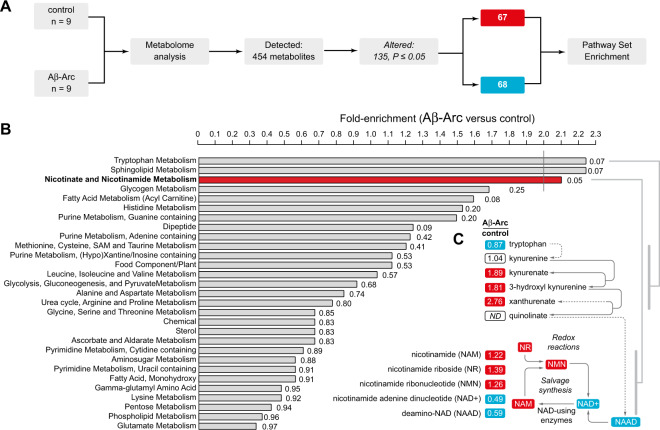
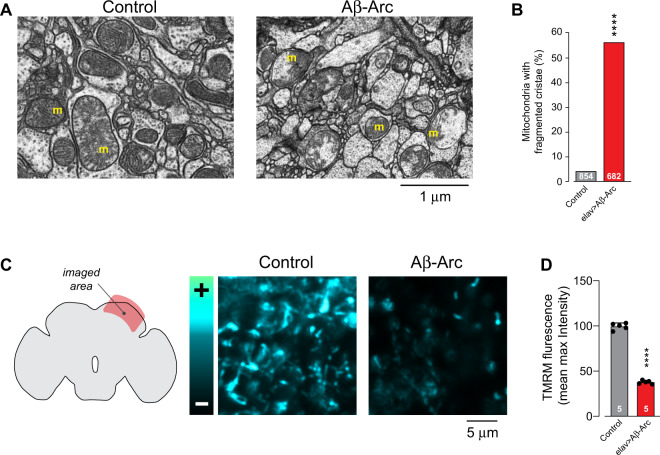
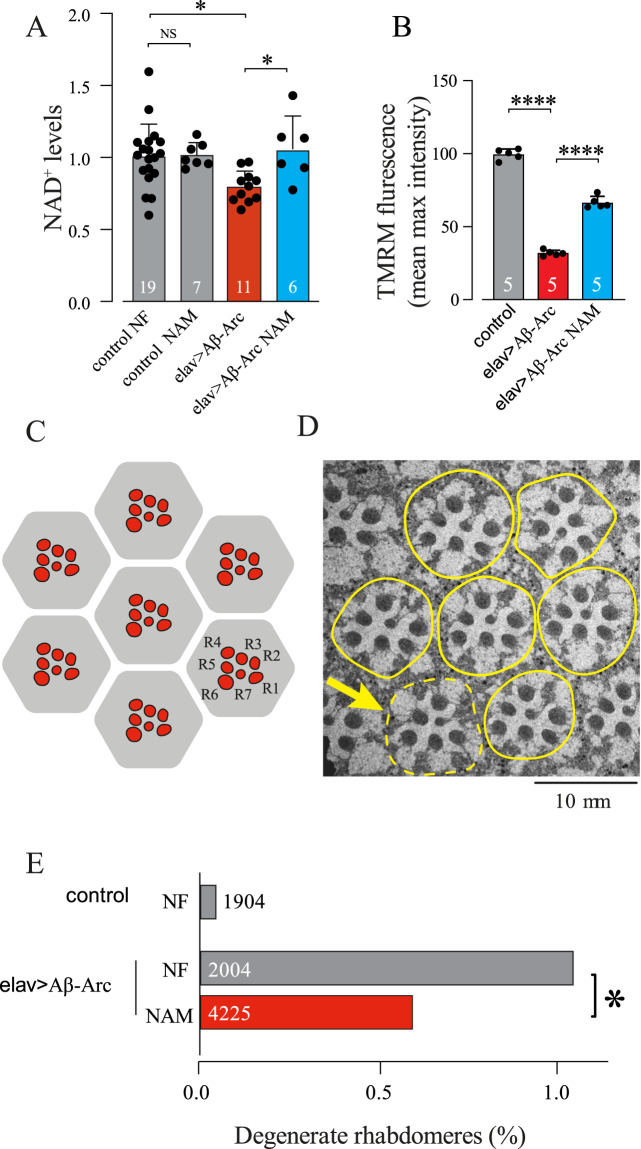
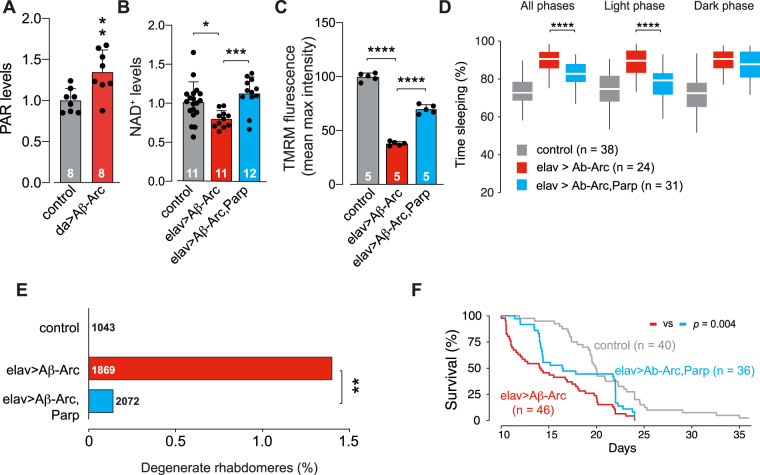
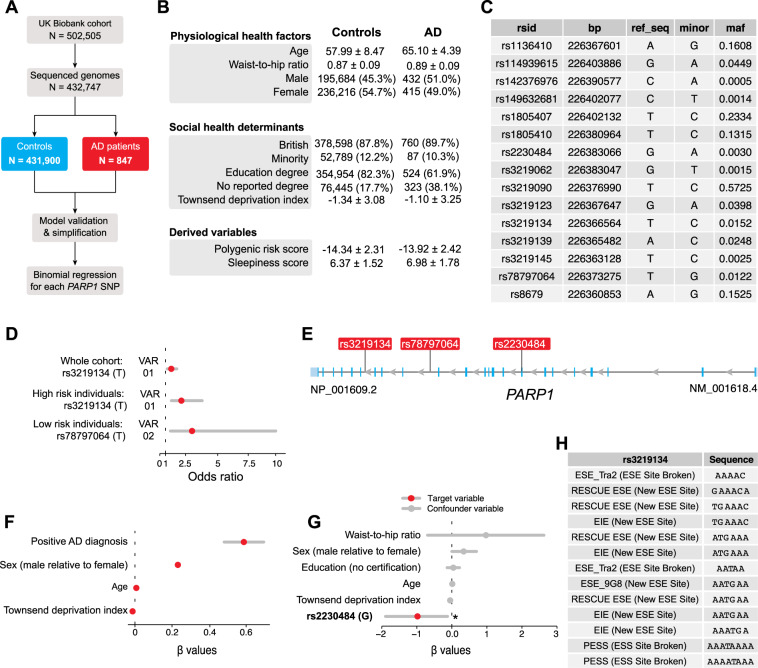
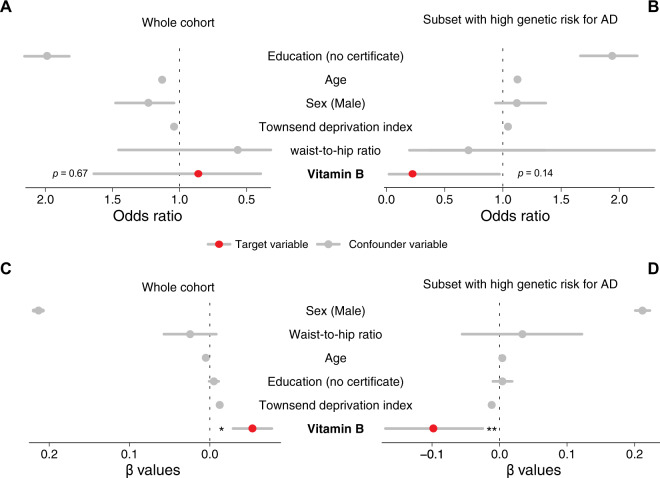
Alzheimer’s disease is the most common age-related neurodegenerative disorder. Familial forms of Alzheimer’s disease associated with the accumulation of a toxic form of amyloid-β (Aβ) peptides are linked to mitochondrial impairment. The coenzyme nicotinamide adenine dinucleotide (NAD+) is essential for both mitochondrial bioenergetics and nuclear DNA repair through NAD+-consuming poly (ADP-ribose) polymerases (PARPs). Here we analysed the metabolomic changes in flies overexpressing Aβ and showed a decrease of metabolites associated with nicotinate and nicotinamide metabolism, which is critical for mitochondrial function in neurons. We show that increasing the bioavailability of NAD+ protects against Aβ toxicity. Pharmacological supplementation using NAM, a form of vitamin B that acts as a precursor for NAD+ or a genetic mutation of PARP rescues mitochondrial defects, protects neurons against degeneration and reduces behavioural impairments in a fly model of Alzheimer’s disease. Next, we looked at links between PARP polymorphisms and vitamin B intake in patients with Alzheimer’s disease. We show that polymorphisms in the human PARP1 gene or the intake of vitamin B are associated with a decrease in the risk and severity of Alzheimer’s disease. We suggest that enhancing the availability of NAD+ by either vitamin B supplements or the inhibition of NAD+-dependent enzymes such as PARPs are potential therapies for Alzheimer’s disease.
Overview
The claims and statistics of this paper haven’t been checked yet.
Free: it reads the open-access text and checks the first 5 claims that cite a source we can check. Create a free account to check every claim.
Integrity signals
Registry
Cites
Statistics
Figures
Verification
Claims the paper makes
The claims and statistics of this paper haven’t been checked yet.
Free: it reads the open-access text and checks the first 5 claims that cite a source we can check. Create a free account to check every claim.
Claims other papers make about this one
Each is checked against this paper’s own text: does it say what the citing paper says it does?
The source backs part of the claim, not all of it — or backs it for a different population, condition or comparison.
In the citing paper
“Supplementation with the NAD+ precursor NAM rescues mitochondrial defects and behavioural impairments in AD models410 but suppresses dopaminergic neurodegeneration in a Drosophila PD model.411”
From Antiageing strategy for neurodegenerative diseases: from mechanisms to clinical advances (2025) · cites this paper as [410]
Experimental — accuracy not yet measuredIn the citing paper
“Three studies were drawn from an adolescent population aged 12–18 years, potentially introducing heterogeneity when compared to the student population [46,47,48].”
From Concussion Disrupts Sleep in Adolescents: A Systematic Review and Meta-Analysis (2025) · cites this paper as [47]
Self-check
Percentages, sums and reported differences re-computed from the paper’s own numbers.
The self-check needs the paper’s full text.
Citations
Cites
Modern Applied Statistics with S
Venables, W. N., & Ripley, B. D. (2002) · Statistics and Computing · doi:10.1007/978-0-387-21706-2 · Cited by 24,305
The Amyloid Hypothesis of Alzheimer’s Disease: Progress and Problems on the Road to Therapeutics
Hardy, J., & Selkoe, D. J. (2002) · Science · doi:10.1126/science.1072994 · Cited by 13,864
Amyloid oligomers exacerbate tau pathology in a mouse model of tauopathy
Selenica, M.-L. B., Brownlow, M., Jimenez, J. P., Lee, D. C., Pena, G., Dickey, C. A., Gordon, M. N., & Morgan, D. (2013) · Neurodegenerative Diseases · doi:10.1159/000337230 · Cited by 10,359
The UK Biobank resource with deep phenotyping and genomic data
Bycroft, C., Freeman, C., Petkova, D., Band, G., Elliott, L. T., Sharp, K., Motyer, A., Vukcevic, D., Delaneau, O., O’Connell, J., et al. (2018) · Nature · doi:10.1038/s41586-018-0579-z · Cited by 8,876
The amyloid hypothesis of Alzheimer's disease at 25 years
Selkoe, D. J., & Hardy, J. (2016) · EMBO Molecular Medicine · doi:10.15252/emmm.201606210 · Cited by 6,164
Alzheimer Disease Genetics Consortium (ADGC), Kunkle, B. W., The European Alzheimer’s Disease Initiative (EADI), Cohorts for Heart and Aging Research in Genomic Epidemiology Consortium (CHARGE), Genetic and Environmental Risk in AD/Defining Genetic, P. A. E. R. F. A. D. C. (., Grenier-Boley, B., Sims, R., Bis, J. C., Damotte, V., Naj, A. C., et al. (2019) · Nature Genetics · doi:10.1038/s41588-019-0358-2 · Cited by 2,946
The molecular pathology of Alzheimer's disease
Selkoe, D. J. (1991) · Neuron · doi:10.1016/0896-6273(91)90052-2 · Cited by 2,708
Human Splicing Finder: an online bioinformatics tool to predict splicing signals
Desmet, F.-O., Hamroun, D., Lalande, M., Collod-Béroud, G., Claustres, M., & Béroud, C. (2009) · Nucleic Acids Research · doi:10.1093/nar/gkp215 · Cited by 2,512
Jansen, I. E., Savage, J. E., Watanabe, K., Bryois, J., Williams, D. M., Steinberg, S., Sealock, J., Karlsson, I. K., Hägg, S., Athanasiu, L., et al. (2019) · Nature Genetics · doi:10.1038/s41588-018-0311-9 · Cited by 2,277
Using MetaboAnalyst 4.0 for Comprehensive and Integrative Metabolomics Data Analysis
Chong, J., Wishart, D. S., & Xia, J. (2019) · Current Protocols in Bioinformatics · doi:10.1002/cpbi.86 · Cited by 2,166
A Drosophila model of Parkinson's disease
Feany, M. B., & Bender, W. W. (2000) · Nature · doi:10.1038/35006074 · Cited by 2,118
Krämer, W. (2003) · Computational Statistics & Data Analysis · Cited by 1,858
Defeating Alzheimer's disease and other dementias: a priority for European science and society
Winblad, B., Amouyel, P., Andrieu, S., Ballard, C., Brayne, C., Brodaty, H., Cedazo-Minguez, A., Dubois, B., Edvardsson, D., Feldman, H., et al. (2016) · The Lancet Neurology · doi:10.1016/s1474-4422(16)00062-4 · Cited by 1,676
Mutation of the Alzheimer's Disease Amyloid Gene in Hereditary Cerebral Hemorrhage, Dutch Type
Levy, E., Carman, M. D., Fernandez-Madrid, I. J., Power, M. D., Lieberburg, I., van Duinen, S. G., Bots, G. T. A. M., Luyendijk, W., & Frangione, B. (1990) · Science · doi:10.1126/science.2111584 · Cited by 1,381
NAD+ metabolism: pathophysiologic mechanisms and therapeutic potential
Xie, N., Zhang, L., Gao, W., Huang, C., Huber, P. E., Zhou, X., Li, C., Shen, G., & Zou, B. (2020) · Signal Transduction and Targeted Therapy · doi:10.1038/s41392-020-00311-7 · Cited by 1,052
Sleep and Alzheimer disease pathology--a bidirectional relationship
Ju, Y.-E. S., Lucey, B. P., & Holtzman, D. M. (2014) · Nature Reviews Neurology · doi:10.1038/nrneurol.2013.269 · Cited by 996
Sleep Quality and Preclinical Alzheimer Disease
Ju, Y.-E. S., McLeland, J. S., Toedebusch, C. D., Xiong, C., Fagan, A. M., Duntley, S. P., Morris, J. C., & Holtzman, D. M. (2013) · JAMA Neurology · doi:10.1001/jamaneurol.2013.2334 · Cited by 744
Potential roles of gut microbiome and metabolites in modulating ALS in mice
Blacher, E., Bashiardes, S., Shapiro, H., Rothschild, D., Mor, U., Dori-Bachash, M., Kleimeyer, C., Moresi, C., Harnik, Y., Zur, M., et al. (2019) · Nature · doi:10.1038/s41586-019-1443-5 · Cited by 700
Drosophila tools and assays for the study of human diseases
Ugur, B., Chen, K., & Bellen, H. J. (2016) · Disease Models & Mechanisms · doi:10.1242/dmm.023762 · Cited by 524
Biobank, O. B. O. D. P. U. A. U., Wilkinson, T., Schnier, C., Bush, K., Rannikmäe, K., Henshall, D. E., Lerpiniere, C., Allen, N. E., Flaig, R., Russ, T. C., et al. (2019) · European Journal of Epidemiology · doi:10.1007/s10654-019-00499-1 · Cited by 452
Crowther, D. C., Kinghorn, K. J., Miranda, E., Page, R., Curry, J. A., Duthie, F. A. I., Gubb, D. C., & Lomas, D. A. (2005) · Neuroscience · doi:10.1016/j.neuroscience.2004.12.025 · Cited by 351
Sleep disturbance in mild to moderate Alzheimer’s disease
MORAN, M., LYNCH, C., WALSH, C., COEN, R., COAKLEY, D., & LAWLOR, B. (2005) · Sleep Medicine · doi:10.1016/j.sleep.2004.12.005 · Cited by 346
Structural basis for allosteric PARP-1 retention on DNA breaks
Zandarashvili, L., Langelier, M.-F., Velagapudi, U. K., Hancock, M. A., Steffen, J. D., Billur, R., Hannan, Z. M., Wicks, A. J., Krastev, D. B., Pettitt, S. J., et al. (2020) · Science · doi:10.1126/science.aax6367 · Cited by 320 · cited 1×
“The structure of this region has not been determined [25] so we did not pursue further analyses on VAR03.”
BackgroundPirinen, E., Auranen, M., Khan, N. A., Brilhante, V., Urho, N., Pessia, A., Hakkarainen, A., Kuula, J., Heinonen, U., Schmidt, M. S., et al. (2020) · Cell Metabolism · doi:10.1016/j.cmet.2020.04.008 · Cited by 278
The Kynurenine Pathway Modulates Neurodegeneration in a Drosophila Model of Huntington's Disease
Campesan, S., Green, E. W., Breda, C., Sathyasaikumar, K. V., Muchowski, P. J., Schwarcz, R., Kyriacou, C. P., & Giorgini, F. (2011) · Current Biology · doi:10.1016/j.cub.2011.04.028 · Cited by 258
Dietary niacin and the risk of incident Alzheimer’s disease and of cognitive decline
Morris, M. C. (2004) · Journal of Neurology, Neurosurgery & Psychiatry · doi:10.1136/jnnp.2003.025858 · Cited by 196
Palliative care for people with dementia
Sampson, E. L. (2010) · British Medical Bulletin · doi:10.1093/bmb/ldq024 · Cited by 164
Tufi, R., Gandhi, S., de Castro, I. P., Lehmann, S., Angelova, P. R., Dinsdale, D., Deas, E., Plun-Favreau, H., Nicotera, P., Abramov, A. Y., et al. (2014) · Nature Cell Biology · doi:10.1038/ncb2901 · Cited by 152
Self-citationRethomics: An R framework to analyse high-throughput behavioural data
Geissmann, Q., Garcia Rodriguez, L., Beckwith, E. J., & Gilestro, G. F. (2019) · PLOS ONE · doi:10.1371/journal.pone.0209331 · Cited by 149
Mitochondrial DNA and primary mitochondrial dysfunction in Parkinson's disease
Giannoccaro, M. P., La Morgia, C., Rizzo, G., & Carelli, V. (2017) · Movement Disorders · doi:10.1002/mds.26966 · Cited by 135
Miller, S., & Muqit, M. M. K. (2019) · Neuroscience Letters · doi:10.1016/j.neulet.2019.04.029 · Cited by 129
Alzheimer's disease pathology is attenuated in a CD 38‐deficient mouse model
Blacher, E., Dadali, T., Bespalko, A., Haupenthal, V. J., Grimm, M. O. W., Hartmann, T., Lund, F. E., Stein, R., & Levy, A. (2015) · Annals of Neurology · doi:10.1002/ana.24425 · Cited by 117
Mitochondria Dysfunction and Neurodegenerative Disorders: Cause or Consequence
Morais, V. A., & De Strooper, B. (2010) · Journal of Alzheimer's Disease · doi:10.3233/jad-2010-100345 · Cited by 111
Enhancing NAD+ salvage metabolism is neuroprotective in a PINK1 model of Parkinson's disease
Lehmann, S., Loh, S. H. Y., & Martins, L. M. (2016) · Biology Open · doi:10.1242/bio.022186 · Cited by 96 · cited 1×
“The inhibition of major NAD-consuming enzymes, such as PARP, or the dietary supplementation of its precursor increases NAD levels, protects against mitochondrial dysfunction and improves lifespan in fly models of neurodegeneration linked to Parkinson’s disease [14, 15].”
BackgroundSelf-citationAlzheimer’s and Parkinson’s Diseases Predict Different COVID-19 Outcomes: A UK Biobank Study
Yu, Y., Travaglio, M., Popovic, R., Leal, N. S., & Martins, L. M. (2021) · Geriatrics · doi:10.3390/geriatrics6010010 · Cited by 74
Self-citationLehmann, S., Costa, A. C., Celardo, I., Loh, S. H. Y., & Martins, L. M. (2016) · Cell Death & Disease · doi:10.1038/cddis.2016.72 · Cited by 69
Self-citationCause of death in Alzheimer's disease: a cohort study
Todd, S., Barr, S., & Passmore, A. P. (2013) · QJM · doi:10.1093/qjmed/hct103 · Cited by 55
Amyloid‐β induces sleep fragmentation that is rescued by fatty acid binding proteins in Drosophila
Gerstner, J. R., Lenz, O., Vanderheyden, W. M., Chan, M. T., Pfeiffenberger, C., & Pack, A. I. (2017) · Journal of Neuroscience Research · doi:10.1002/jnr.23778 · Cited by 40
Effects of vitamin B12 on bright light on cognitive and sleep–wake rhythm in Alzheimer‐type dementia
Ito, T., Yamadera, H., Ito, R., Suzuki, H., Asayama, K., & Endo, S. (2001) · Psychiatry and Clinical Neurosciences · doi:10.1046/j.1440-1819.2001.00860.x · Cited by 36
Implications of NAD + boosters in translational medicine
Kang, B. E., Choi, J., Stein, S., & Ryu, D. (2020) · European Journal of Clinical Investigation · doi:10.1111/eci.13334 · Cited by 36
Kunkle, B., Grenier-Boley, B., Sims, R., Bis, J., Naj, A., Boland, A., Vronskaya, M., van der Lee, S., Amlie-Wolf, A., Bellenguez, C., et al. (2018) · doi:10.1101/294629 · Cited by 35
Vitamin B12 Deficiency: A Rare Cause of Excessive Daytime Sleepiness
Khawaja, I., Yingling, K. W., Bukamur, H. S., & Abusnina, W. A. (2019) · Journal of Clinical Sleep Medicine · doi:10.5664/jcsm.7936 · Cited by 20
PET Imaging of Mitochondrial Function in the Living Brain
Tsukada, H. (2020) · IntechOpen eBooks · doi:10.5772/intechopen.86492 · Cited by 5 · cited 1×
“Novel positron emission tomography probes can be used to quantify the function of mitochondrial complex 1 non-invasively [32].”
Method
Cited by
Antiageing strategy for neurodegenerative diseases: from mechanisms to clinical advances
Jiang, Q., Liu, J., Huang, S., Wang, X.-Y., Chen, X., Liu, G.-H., Ye, K., Song, W., Masters, C. L., Wang, J., et al. (2025) · Signal Transduction and Targeted Therapy · doi:10.1038/s41392-025-02145-7 · Cited by 165
“125 Supplementation with the NAD + precursor NAM rescues mitochondrial defects and behavioural impairments in AD models 410 but suppresses dopaminergic neurodegeneration in a Drosophila PD model.”
Xu, X., Sun, B., & Zhao, C. (2023) · Neurobiology of Disease · doi:10.1016/j.nbd.2023.106314 · Cited by 74
Liu, Y., Guttman, L. C., Dawson, V. L., & Dawson, T. M. (2024) · Biochemical Pharmacology · doi:10.1016/j.bcp.2024.116174 · Cited by 73
Chiu, L., Huang, D.-Y., & Lin, W. (2022) · Cellular and Molecular Life Sciences · doi:10.1007/s00018-022-04138-z · Cited by 48
Poly (ADP-ribose) polymerase 1 and neurodegenerative diseases: past, present, and future
Hu, M.-L., Pan, Y.-R., Yong, Y.-Y., Liu, Y., Yu, L., Qin, D.-L., Qiao, G., Law, B. Y.-K., Wu, J.-M., Zhou, X.-G., et al. (2023) · Ageing Research Reviews · doi:10.1016/j.arr.2023.102078 · Cited by 44
Metadata
- Authors
- Yu, Y., Fedele, G., Celardo, I., Loh, S. H. Y., & Martins, L. M.
- Affiliations
- University of Cambridge (GB)
- Corresponding author
- Loh, Samantha H. Y.
- Martins, L. Miguel
- Venue
- Cell Death & Disease
- Published
- 2021-06-25
- Volume
- 12
- Issue
- 7
- Pages
- 651-651
- ISSN
- 2041-4889 (ISSN-L)
- PMC
- PMC8233423
- OpenAlex
- W3174624813
- Cited by
- 46
- References
- 42
- Citations by year
- 2026: 6 · 2025: 12 · 2024: 10 · 2023: 14 · 2022: 3 · 2021: 1
- FWCI
- 4.40
- Type
- journal article
- Language
- en
- Update notices
- correction (2021-07-20)
- Open access
- gold
- doi.org
- Licence
- cc-by
- creativecommons.org/licenses/by/4.0 (tdm)
- creativecommons.org/licenses/by/4.0 (vor)
- Locations
- Cell Death and Disease (publishedVersion, cc-by)
- PubMed Central (publishedVersion, cc-by)
- PubMed (publishedVersion)
- Apollo (University of Cambridge) (submittedVersion, cc-by)
- DOAJ (DOAJ: Directory of Open Access Journals) (submittedVersion, cc-by-sa)
- Archive of Doctoral Theses and Digital Collections (University of Calabria) (submittedVersion)
- Apollo
- Apollo (cc-by)
- Funders
- RCUK | Medical Research Council (MC_UU_00025/3 (RG94521))
- Topics
- Life Sciences › Neuroscience › Cellular and Molecular Neuroscience › Alzheimer's disease research and treatments
- Health Sciences › Medicine › Geriatrics and Gerontology › Sirtuins and Resveratrol in Medicine
- Health Sciences › Medicine › Psychiatry and Mental health › Dementia and Cognitive Impairment Research
- Keywords
- Alzheimer's disease, amyloid-beta toxicity, PARP1, NAD+, nicotinate and nicotinamide metabolism, mitochondrial dysfunction, Drosophila model, neurodegeneration, genetic polymorphism, neuroprotection
- MeSH terms
- Poly (ADP-Ribose) Polymerase-1, Alzheimer Disease, Animals, Behavior, Animal, Disease Models, Animal, Drosophila melanogaster, Humans, Mitochondria, Motor Activity, Mutation, NAD, Nerve Degeneration, Neurons, Niacinamide, Amyloid beta-Peptides, Polymorphism, Single Nucleotide, Drosophila Proteins, Animals, Genetically Modified, Metabolomics, Metabolome
About these checks
Registry, retraction, Cites and statistics results are computed, not judged, with one exception: a printed reference that no index lists is read once by a model before it counts as a citation error. Claims are extracted by a model and kept only when their quote appears verbatim in the text; each cited source is then checked, with a model’s help, for whether it says what the claim relies on. Those verdicts can be wrong — read the claim’s quote and the cited source before relying on one.
Statistics and arithmetic are recomputed, not judged.
Confidence bands are shown only for fields calibrated on our annotated test set. None is calibrated yet, so no band is shown.
What counts as a claim ›How we measure confidence ›How we check this ›
Are you an author, or do you see a problem with this page? Request a review
Data sources
Bibliographic data: Semantic Scholar, OpenAlex, Crossref.
Contains information from the Semantic Scholar Academic Graph Datasets, made available under the ODC Attribution License (ODC-BY 1.0).
Semantic Scholar’s data is described in: Kinney, R., et al. (2023). The Semantic Scholar Open Data Platform. arXiv:2301.10140.
