

Multi-laboratory assessment of reproducibility, qualitative and quantitative performance of SWATH-mass spectrometry
Open accessPublished version of a preprint
The DOI matches its Crossref record; 82 of the 82 references it cites were found in a registry or an index; 19 of the 48 sources its claims cite were checked for support.
Abstract
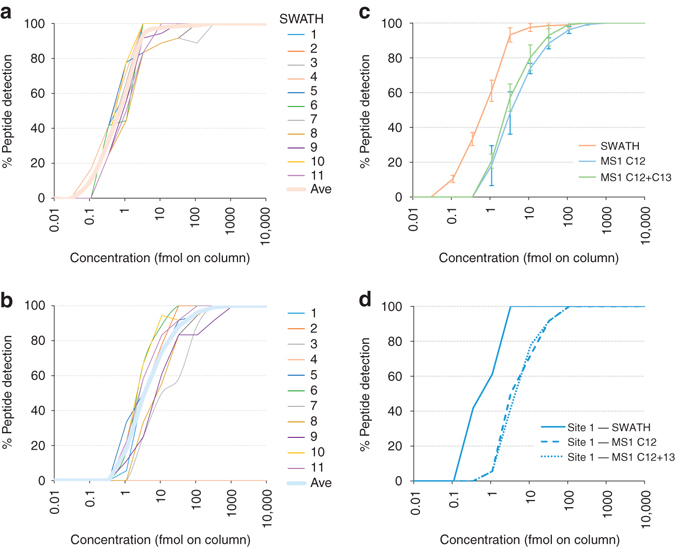
Quantitative proteomics employing mass spectrometry is an indispensable tool in life science research. Targeted proteomics has emerged as a powerful approach for reproducible quantification but is limited in the number of proteins quantified. SWATH-mass spectrometry consists of data-independent acquisition and a targeted data analysis strategy that aims to maintain the favorable quantitative characteristics (accuracy, sensitivity, and selectivity) of targeted proteomics at large scale. While previous SWATH-mass spectrometry studies have shown high intra-lab reproducibility, this has not been evaluated between labs. In this multi-laboratory evaluation study including 11 sites worldwide, we demonstrate that using SWATH-mass spectrometry data acquisition we can consistently detect and reproducibly quantify >4000 proteins from HEK293 cells. Using synthetic peptide dilution series, we show that the sensitivity, dynamic range and reproducibility established with SWATH-mass spectrometry are uniformly achieved. This study demonstrates that the acquisition of reproducible quantitative proteomics data by multiple labs is achievable, and broadly serves to increase confidence in SWATH-mass spectrometry data acquisition as a reproducible method for large-scale protein quantification.
Overview
CoChat Summary
TL;DR
This multi-laboratory study shows that SWATH-MS data acquisition can reproducibly detect and quantify thousands of proteins across 11 sites, with quantitative performance approaching targeted proteomics. The authors conclude that SWATH-MS is suitable for large-scale, reproducible protein quantification across laboratories.
Key findings
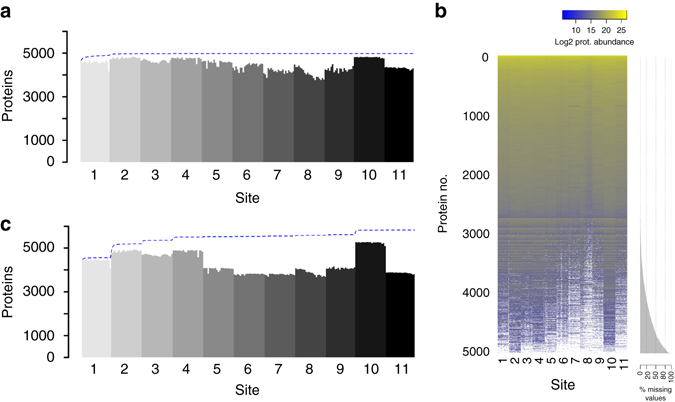
- Across 229 SWATH-MS files from 11 laboratories, 4,984 proteins were detected at 1% FDR; the median per file was 4,548 proteins, and 4,077 proteins were detected in >80% of all samples.
- Median repeatability was 91.6% at the protein level and 79.5% at the peptide level across all sites; within-site median repeatability ranged from 90.0–98.2% (protein) and 79.5–95.5% (peptide).
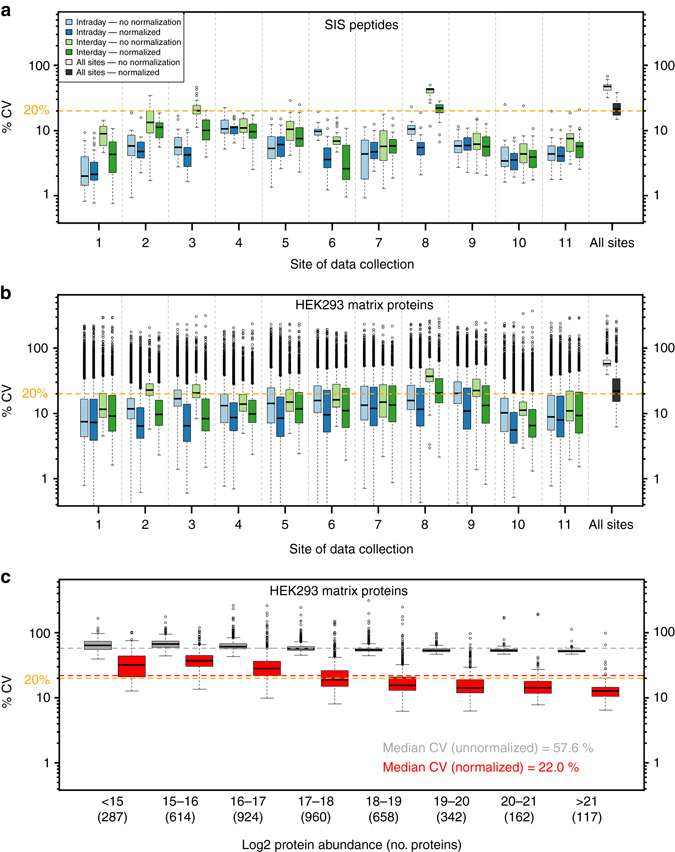
- For SIS peptides in sample S4, median intra-day CV was 5.5 ± 2.9%, inter-day CV was 8.9 ± 11.1%, and inter-site CV was 47.3 ± 13.9% without normalization, reduced to 21.3 ± 10.3% after normalization.
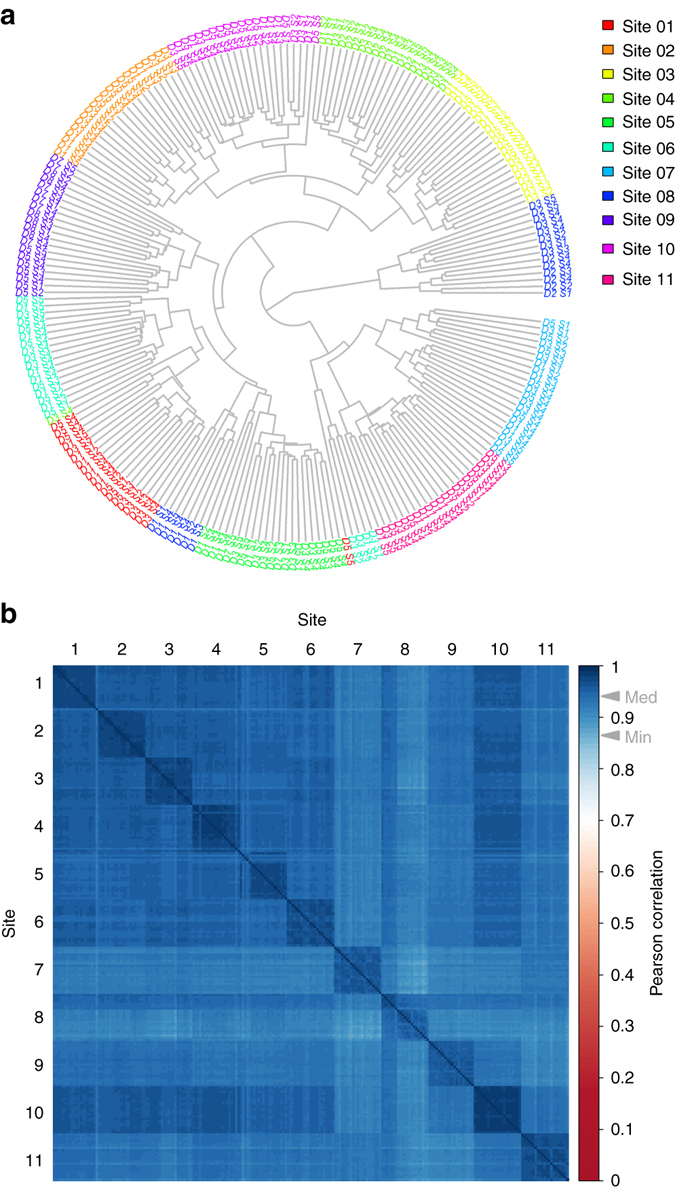
- Protein-level CVs for the 4,077 proteins detected in >80% of samples were 8.3 ± 16.2% intra-day, 11.9 ± 17.2% inter-day, and 22.0 ± 17.4% inter-site; median Pearson correlation across all runs was 0.940, with within-site median 0.971 and minimum pairwise 0.868.
Methods
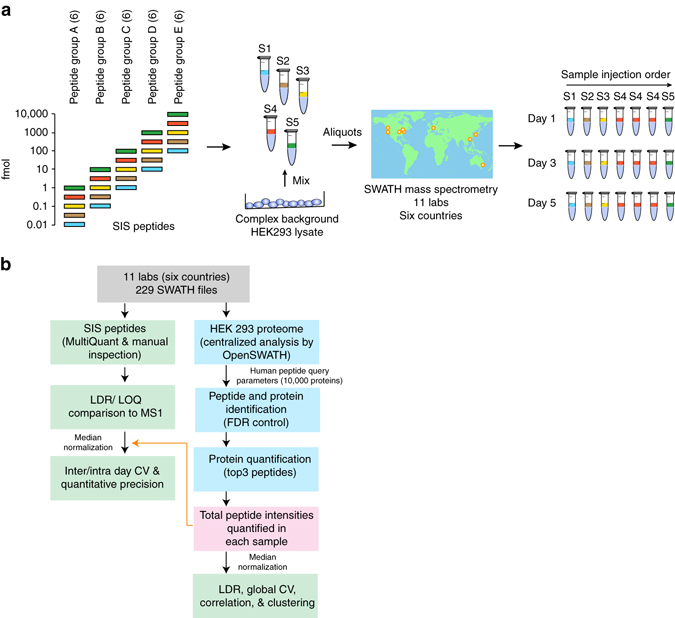
- Benchmarking sample: 30 stable isotope-labeled standard peptides partitioned into five groups and serially diluted into 1 µg HEK293 cell lysate, creating samples S1–S5 spanning 0.012–10,000 fmol on column; distributed to 11 laboratories worldwide.
- Acquisition: SWATH-MS on SCIEX TripleTOF 5600/5600+ systems using 64 variable-width Q1 windows; samples S1–S5 acquired with S4 in technical triplicate on days 1, 3, and 5, yielding 229 SWATH-MS files.
- Analysis: OpenSWATH with a 10,000+ human protein spectral library, PyProphet for 1% FDR control at peptide query and protein levels, aLFQ for protein abundance inference, MultiQuant for SIS peptide XIC analysis, and median normalization based on HEK293 background peptides.
Limitations
- Stated: the study did not evaluate variance in sample preparation between sites, so no conclusions can be made on that topic; only one instrument type/model was used, limiting tested variables mainly to site of data acquisition.
- Stated: high peptide loads at the upper end of the dilution series caused some MS signal saturation; a newer instrument platform (TripleTOF 6600) would be expected to reduce this.
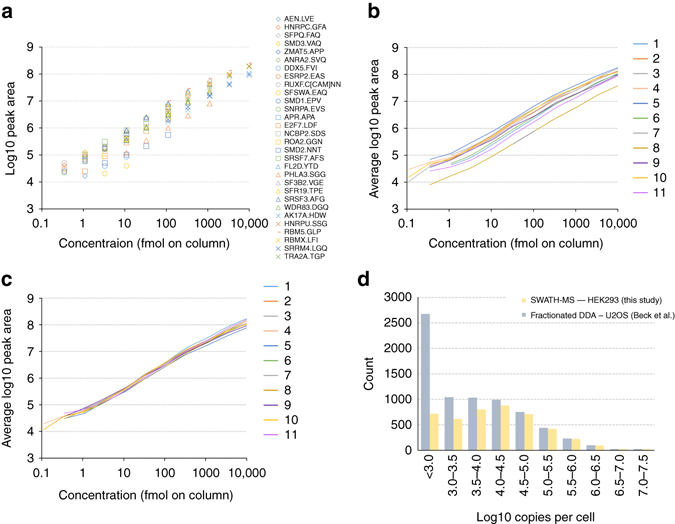
- Stated/evident: no internal standard was available for protein-level dynamic range, so U2OS copy-number data from a different cell line was used as a surrogate; the study is also limited to HEK293 background and SIS peptides, so generalizability to other sample types and platforms is not established.
Model-written summary. Check it against the paper before relying on it.
Integrity signals
Registry
Cites
Statistics
Figures
Verification
Claims the paper makes
10 Valid · 1 Not valid · 16 Not checked · 81 Own results and interpretations
The cited sources support only part of this claim — read each source’s verdict below.
In the paper
“In general, these studies confirmed that a high degree of reproducibility is difficult to achieve for complex samples10.”
§ Multi-laboratory assessment of reproducibility, qualitative and quantitative performance of SWATH-mass spectrometry > Introduction
What the sources say
- Partly supportedcites [10] Rudnick PA Performance metrics for liquid chromatography-tandem mass spectrometry systems in proteomics analyses Mol. Cell. Proteomics 2010 9 225 241 10.1074/mcp.M900223-MCP200 19837981 PMC2830836 sourceExperimental — accuracy not yet measured
The Abstract identifies stochastic sampling of lower-abundance peptides as a source of variability in LC-MS/MS identifications, which supports the DDA-related concern. But the Results report stable metrics across analytical replicates and highly reproducible chromatography metrics across instruments; they do not establish that high reproducibility is generally difficult to achieve for complex samples. Page numbers are unavailable in our copy. (LLM, conf=0.78)
plain- Asserted: passes — The authors put it forward as true.
- Checkable: passes — It can be checked against evidence.
- Load-bearing: passes — The paper’s conclusions depend on it.
- Based: passes — The paper gives a reason why it holds.
- Partly supported
Every source the paper cites for this claim was checked and supports it.
In the paper
“SWATH-MS and related DIA approaches have achieved a high degree of reproducibility in intra-laboratory studies in a variety of research questions such as interaction proteomics40, 41, plasma proteomics42, tissue proteomics43, microbial proteomics44, 45, pre-clinical toxicology9, analysis of genetic reference strains46, and many others.”
§ Multi-laboratory assessment of reproducibility, qualitative and quantitative performance of SWATH-mass spectrometry > Introduction
What the sources say
- Supportedcites [40] Collins BC Quantifying protein interaction dynamics by SWATH mass spectrometry: application to the 14-3-3 system Nat. Methods 2013 10 1246 1253 10.1038/nmeth.2703 24162925 source
Our copy of Collins et al. (2013) is precisely the intra-laboratory interaction-proteomics application the citing sentence offers this reference for: SWATH-MS (a DIA implementation) applied to affinity-purified 14-3-3β complexes, yielding an essentially complete quantitative matrix for 1,967 proteins across 27 samples in biological triplicate (Generation and analysis of AP-SWATH maps; Abstract: dynamics 'robustly followed'). The Introduction states SWATH-MS 'provides SRM-like performance in terms of quantitative accuracy, data completeness and dynamic range', against the explicit contrast that DDA identification is not reproducible while SRM reproducibly targets a predetermined peptide set. The paper's detailed quantitative-reproducibility figures are referred to its Supplementary Results from the same section, so the magnitude is asserted here qualitatively rather than numerically, but the source plainly supports the exemplified point. (LLM, conf=0.80)
- Supportedcites [41] Lambert J-P Mapping differential interactomes by affinity purification coupled with data-independent mass spectrometry acquisition Nat. Methods 2013 10 1239 1245 10.1038/nmeth.2702 24162924 PMC3882083 source
The citation is attached to the 'interaction proteomics' instance of the citing sentence, and our copy is exactly an interaction-proteomics (AP-SWATH) study reporting reproducibility. Results ('A pipeline for quantitative interactome monitoring', p. ~3) give 79% of peptides and 87% of proteins quantified within 20% CV across CDK4 AP biological replicates (plus three technical replicates each), a higher proportion of peptides at CV ≤ 20% than DDA (82.1% vs 74.5%), and conclude the extraction/normalization pipeline 'is reliable'. The Discussion states the pipeline studies interactome changes 'in an unbiased and reproducible manner', and the Abstract calls AP-SWATH 'a robust label-free approach'. The 'related DIA approaches … variety of research questions' breadth rests on the other citations, not this one, so nothing here is unsupported. (LLM, conf=0.85)
- Supportedcites [42] Liu Y Quantitative variability of 342 plasma proteins in a human twin population Mol. Syst. Biol. 2015 11 786 10.15252/msb.20145728 25652787 PMC4358658 source
The citation is offered as an exemplar of SWATH-MS/DIA applied to plasma proteomics with high reproducibility, and our copy is exactly that: the Results subsection 'The reproducible quantification of plasma proteins across a longitudinal twin cohort by SWATH-MS' reports median CVs of 7.2% (technical) and 14.2% (whole-process) replicates with 84.5%/76.0% of proteins below 25% CV, and states the study 'significantly exceeds the previous studies in terms of reproducibility and quantitative accuracy'. All measurements were run on the same in-house LC-MS/MS system and analysed on an internal computing cluster (Materials and Methods), i.e. a single-laboratory study, matching the 'intra-laboratory' qualifier. The list of other application areas (interaction, tissue, microbial proteomics, toxicology, genetic reference strains) belongs to the other citations and the citing authors' own framing, not to this source. (LLM, conf=0.88)
- Supportedcites [43] Guo T Rapid mass spectrometric conversion of tissue biopsy samples into permanent quantitative digital proteome maps Nat. Med. 2015 21 407 413 10.1038/nm.3807 25730263 PMC4390165 source
The cited sentence attaches this source to the 'tissue proteomics' instance of high reproducibility in intra-laboratory SWATH-MS/DIA studies, and our copy is exactly that: the Abstract (p. 1) reports converting 18 renal biopsy samples into SWATH-MS maps and quantifying >2,000 proteins 'with a high degree of reproducibility across all samples', and the Discussion states the pipeline performs 'high throughput, quantitative and highly reproducible proteomic analyses of clinical tumor biopsies' with 'a median CV of technical replicates below 20%'. The Results (Generation of SWATH-MS maps) quantify that reproducibility as a single-laboratory technical-replicate experiment (median CV 10-12% for repeat MS injections, 24% overall including PCT digestion), matching the 'intra-laboratory' qualifier. The wider list of application areas (interaction, plasma, microbial proteomics, toxicology, genetic reference strains) is carried by the sentence's other citations, not by this one, so nothing here is overstated. (LLM, conf=0.85)
boosted- Asserted: passes — The authors put it forward as true.
- Checkable: passes — It can be checked against evidence.
- Load-bearing: passes — The paper’s conclusions depend on it.
- Based: passes — The paper gives a reason why it holds.
- Supported
Every source the paper cites for this claim was checked and supports it.
In the paper
“Notably, the spectral library and peptide query parameters we used to perform the analysis of the SWATH-MS data were previously published49 and built by a single lab independent of the current study, illustrating the generic applicability of such spectral libraries.”
§ Multi-laboratory assessment of reproducibility, qualitative and quantitative performance of SWATH-mass spectrometry > Discussion
What the sources say
- Supportedcites [49] Rosenberger G A repository of assays to quantify 10,000 human proteins by SWATH-MS Sci. Data 2014 1 140031 10.1038/sdata.2014.31 25977788 PMC4322573 source
The Background & Summary of Rosenberger et al. (2014) presents 'a generic large-scale human assay library' built by the authors' group from 331 fraction measurements, stating its results are 'applicable across laboratories', and Data Record 2 confirms that both spectral libraries (SpectraST format) and assay libraries (CSV, TraML, converted to formats for OpenSWATH/PeakView/Skyline/Spectronaut) were published. The Technical Validation section 'Portability of the combined assay library to different sample types and laboratories' explicitly demonstrates the library working on data acquired in a different laboratory, at a different time and under different chromatographic conditions — i.e., the generic applicability the citing sentence attributes to it. Only the exact term 'peptide query parameters' is absent from our copy (the paper describes the equivalent assay-library content: precursor/fragment ion m/z, normalized RT and relative ion intensities), which is a wording difference rather than an unsupported element. (LLM, conf=0.85)
plainstates a cause- Asserted: passes — The authors put it forward as true.
- Checkable: passes — It can be checked against evidence.
- Load-bearing: unclear — It is unclear whether the paper’s conclusions depend on it.
- Based: passes — The paper gives a reason why it holds.
- Supported
The cited sources support only part of this claim — read each source’s verdict below.
In the paper
“Here, we highlight an advantage of SWATH-MS data; i.e., as with MS1/DDA-based quantification and, unlike more classical targeted methods such as SRM, there are large numbers of peptides available for global normalization that can be used in sample types where the assumptions underlying this type of normalization are valid65, 66.”
§ Multi-laboratory assessment of reproducibility, qualitative and quantitative performance of SWATH-mass spectrometry > Discussion
What the sources say
- Partly supportedcites [65] Välikangas, T., Suomi, T. & Elo, L. L. A systematic evaluation of normalization methods in quantitative label-free proteomics. Brief Bioinform. 10.1093/bib/bbw095 (2016). PMC5862339 27694351 sourceExperimental — accuracy not yet measured
Our copy of Välikangas et al. (2016) supports only the qualifier of the claim: the Discussion states that all the normalization methods studied, excluding EigenMS, 'assume that only a small portion of the proteins are differentially expressed between samples and force the total intensity levels of the samples to be on the same level', which 'might be problematic if in fact a large number of proteins are differentially expressed' — i.e. global normalization is usable only where its assumptions hold. The Introduction and Materials and methods (Description of the data sets) frame this entirely in shotgun/DDA label-free data (UPS1, CPTAC, SGSD, mouse liver). The distinctive part of the claim — that SWATH-MS, unlike classical targeted SRM, yields large numbers of peptides available for global normalization — is absent: no passage in our copy mentions SWATH, DIA-based targeted quantification or SRM/MRM at all (searched: SWATH, data-independent acquisition targeted, SRM/MRM, number of peptides for global normalization). (LLM, conf=0.65)
- Partly supportedcites [66] Karpievitch YV Dabney AR Smith RD Normalization and missing value imputation for label-free LC-MS analysis BMC Bioinformatics 2012 13 S5 10.1186/1471-2105-13-S16-S5 23176322 PMC3489534 sourceExperimental — accuracy not yet measured
Our copy supports the normalization half of the attributed point: Methods > Normalization states that global adjustment centers log-intensity distributions on a constant and rests on 'an assumption... that most peptide abundances do not change', and the Background notes high-throughput MS quantifies 'thousands of peptides', which is the label-free shotgun setting the citing authors equate with MS1/DDA and SWATH. However, the paper never mentions SWATH-MS, DIA, or a comparison with targeted SRM/MRM (searched: 'SWATH data independent acquisition targeted MS/MS SRM MRM'; only Background/Methods normalization passages returned), so the specific claim of an advantage over classical targeted methods is not in our copy. It also frames validity of the normalization assumption as a property of the data rather than of particular 'sample types'. (LLM, conf=0.72)
plainstates a cause- Asserted: passes — The authors put it forward as true.
- Checkable: passes — It can be checked against evidence.
- Load-bearing: passes — The paper’s conclusions depend on it.
- Based: passes — The paper gives a reason why it holds.
- Partly supported
A result the paper reports from its own data — it cites no other source for it, so there is none to check. The quote shows it is in the paper.
In the paper
“In this multi-laboratory evaluation study including 11 sites worldwide, we demonstrate that using SWATH-mass spectrometry data acquisition we can consistently detect and reproducibly quantify >4000 proteins from HEK293 cells.”
§ Multi-laboratory assessment of reproducibility, qualitative and quantitative performance of SWATH-mass spectrometry > Abstract
boostedstates a cause- Asserted: passes — The authors put it forward as true.
- Checkable: passes — It can be checked against evidence.
- Load-bearing: passes — The paper’s conclusions depend on it.
- Based: passes — The paper gives a reason why it holds.
46 more claims
Create a free account to see all 108 claims and to verify the 29 references still open.
- It may state two separate claims as one. 42
- Probably not a substantial claim. 21
Claims other papers make about this one
Each is checked against this paper’s own text: does it say what the citing paper says it does?
The source backs part of the claim, not all of it — or backs it for a different population, condition or comparison.
In the citing paper
“Proteomic technologies, including mass spectrometry–based proteomics, aptamer-based arrays (SomaLogic), and proximity extension assay technology (Olink), are now available for the large-scale quantification and validation of thousands of proteins in human biological fluids or tissues (122–127).”
From Connecting aging biology and inflammation in the omics era (2022) · cites this paper as [124]
Experimental — accuracy not yet measured
Self-check
Percentages, sums and reported differences re-computed from the paper’s own numbers.
Each contradiction between two passages listed here was confirmed by an independent check.
Rated minor: it would not touch a result — a value no result rests on, a p-value that stays on the same side of the significance level, or a conflict that is clerical, resolved elsewhere in the paper, or outside its own findings.
In the paper
§ Multi-laboratory assessment of reproducibility, qualitative and quantitative performance of SWATH-mass spectrometry > Results > Reproducibility of quantification
“The median for site intra-day and inter-day CVs (expressed as median ± standard deviation) were 5.5 ± 2.9% and 8.9 ± 11.1%, respectively”
§ Multi-laboratory assessment of reproducibility, qualitative and quantitative performance of SWATH-mass spectrometry > Results > Reproducibility of quantification
“Normalization also reduced the median within site inter-day CV from 8.9 ± 11.0 to 5.8 ± 5.4%”
Rated minor: it would not touch a result — a value no result rests on, a p-value that stays on the same side of the significance level, or a conflict that is clerical, resolved elsewhere in the paper, or outside its own findings.
In the paper
§ Multi-laboratory assessment of reproducibility, qualitative and quantitative performance of SWATH-mass spectrometry > Results > Linearity and dynamic range
“A representative example for a single site is shown in Fig 4a (remaining sites in Supplementary Fig. 15; equivalent plots separated by peptide are shown in Supplementary Fig. 16; source data in Supplementary Data 8).”
§ Multi-laboratory assessment of reproducibility, qualitative and quantitative performance of SWATH-mass spectrometry > Results > Linearity and dynamic range
“a The response curves for each of the 30 SIS peptides for Site 1 were determined and plotted together (corresponding plots for all other sites are shown in Supplementary Fig. 13).”
Citations
Cites
Statistical significance for genomewide studies
Storey, J. D., & Tibshirani, R. (2003) · Proceedings of the National Academy of Sciences · doi:10.1073/pnas.1530509100 · Cited by 9,692
Cox, J., Hein, M. Y., Luber, C. A., Paron, I., Nagaraj, N., & Mann, M. (2014) · Molecular & Cellular Proteomics · doi:10.1074/mcp.m113.031591 · Cited by 5,180
Raise standards for preclinical cancer research
Begley, C. G., & Ellis, L. M. (2012) · Nature · doi:10.1038/483531a · Cited by 2,979
Gillet, L. C., Navarro, P., Tate, S., Röst, H., Selevsek, N., Reiter, L., Bonner, R., & Aebersold, R. (2012) · Molecular & Cellular Proteomics · doi:10.1074/mcp.o111.016717 · Cited by 2,877
Self-citationSemi-supervised learning for peptide identification from shotgun proteomics datasets
Käll, L., Canterbury, J. D., Weston, J., Noble, W. S., & MacCoss, M. J. (2007) · Nature Methods · doi:10.1038/nmeth1113 · Cited by 2,424
A draft map of the human proteome
Kim, M.-S., Pinto, S. M., Getnet, D., Nirujogi, R. S., Manda, S. S., Chaerkady, R., Madugundu, A. K., Kelkar, D. S., Isserlin, R., Jain, S., et al. (2014) · Nature · doi:10.1038/nature13302 · Cited by 2,198
The Proteomics Identifications (PRIDE) database and associated tools: status in 2013
Vizcaíno, J. A., Côté, R. G., Csordas, A., Dianes, J. A., Fabregat, A., Foster, J. M., Griss, J., Alpi, E., Birim, M., Contell, J., et al. (2012) · Nucleic Acids Research · doi:10.1093/nar/gks1262 · Cited by 1,918
Believe it or not: how much can we rely on published data on potential drug targets?
Prinz, F., Schlange, T., & Asadullah, K. (2011) · Nature Reviews Drug Discovery · doi:10.1038/nrd3439-c1 · Cited by 1,888
Mass-spectrometry-based draft of the human proteome
Wilhelm, M., Schlegl, J., Hahne, H., Gholami, A. M., Lieberenz, M., Savitski, M. M., Ziegler, E., Butzmann, L., Gessulat, S., Marx, H., et al. (2014) · Nature · doi:10.1038/nature13319 · Cited by 1,820
Peterson, A. C., Russell, J. D., Bailey, D. J., Westphall, M. S., & Coon, J. J. (2012) · Molecular & Cellular Proteomics · doi:10.1074/mcp.o112.020131 · Cited by 1,288
Research works printed but not linked: 1
- Ting YS Peptide-centric proteome analysis: an alternative strategy for the analysis of tandem mass spectrometry data Mol. Cell. Proteomics 2015 14 2301 2307 10.1074/mcp.O114.047035 26217018 PMC4563716 · DOI · Paper page
Cited by
Items 201–300 of 601
da Silva, A. R. M., Toyoshima, M. T. K., Passarelli, M., Mascio, P. D., & Ronsein, G. E. (2019) · Journal of Proteome Research · doi:10.1021/acs.jproteome.9b00511 · Cited by 28
Taylor, S. K., Houshdaran, S., Robinson, J. F., Gormley, M. J., Kwan, E. Y., Kapidzic, M., Schilling, B., Giudice, L. C., & Fisher, S. J. (2020) · Development · doi:10.1242/dev.187013 · Cited by 27
“All samples were analyzed by data-independent acquisitions (DIA), specifically using variable window DIA acquisitions (Collins et al., 2017).”
MethodSelf-citationComprehensive spectral libraries for various rabbit eye tissue proteomes
Qin, G., Zhang, P., Sun, M., Fu, W., & Cai, C. (2022) · Scientific Data · doi:10.1038/s41597-022-01241-5 · Cited by 24
Koenig, C., Bortel, P., Paterson, R. S., Rendl, B., Madupe, P. P., Troché, G., Hermann, N. V., de Pinillos, M. M., Martinón‐Torres, M., Mularczyk, S., et al. (2024) · Journal of Proteome Research · doi:10.1021/acs.jproteome.4c00557 · Cited by 24
Bisconti, M., Leroy, B., Gallagher, M. T., Senet, C., Martinet, B., Arcolia, V., Wattiez, R., Kirkman‐Brown, J., Simon, J.-F., & Hennebert, E. (2022) · Frontiers in Cell and Developmental Biology · doi:10.3389/fcell.2022.965076 · Cited by 23
Proteotype coevolution and quantitative diversity across 11 mammalian species
Ba, Q., Hei, Y., Dighe, A., Li, W., Maziarz, J. D., Pak, I., Wang, S., Wagner, G. P., & Liu, Y. (2022) · Science Advances · doi:10.1126/sciadv.abn0756 · Cited by 24
Self-citationCreus‐Muncunill, J., Haure‐Mirande, J., Mattei, D., Bons, J., Jimenez, A. V. R., Hamilton, B. W., Corwin, C., Chowdhury, S., Schilling, B., Ellerby, L., et al. (2024) · Journal of Neuroinflammation · doi:10.1186/s12974-024-03052-4 · Cited by 22
“We performed a comprehensive and quantitative workflow using data-independent acquisition (DIA) [75–77] on striatal tissue samples from 10-month-old WT, Q175, Q175; Tyrobp ( − / − ) and Tyrobp ( − / − ) mice.”
Self-citationDashatan, N. A., Rezaei–Tavirani, M., & Ahmadi, N. (2019) · Acta Tropica · doi:10.1016/j.actatropica.2019.105227 · Cited by 23
SWATH label-free proteomics for cystic fibrosis research
Braccia, C., Tomati, V., Caci, E., Pedemonte, N., & Armirotti, A. (2018) · Journal of Cystic Fibrosis · doi:10.1016/j.jcf.2018.10.004 · Cited by 32
Patel, S. K., Bons, J., Rose, J., Chappel, J. R., Beres, R. L., Watson, M. A., Webster, C. M., Burton, J. B., Bruderer, R., Desprez, P. Y., et al. (2025) · Aging · doi:10.18632/aging.206292 · Cited by 25
Self-citationAhn, S. B., Kamath, K. S., Mohamedali, A., Noor, Z., Wu, J. X., Pascovici, D., Adhikari, S., Cheruku, H. R., Guillemin, G. J., McKay, M. J., et al. (2021) · Journal of Proteome Research · doi:10.1021/acs.jproteome.0c00898 · Cited by 27
Chang, D. K., Klein, J., Nalehua, M. R., Hackett, W. E., & Zaia, J. (2021) · Analytical and Bioanalytical Chemistry · doi:10.1007/s00216-021-03643-7 · Cited by 22
The incongruity of validating quantitative proteomics using western blots
Mehta, D., Ahkami, A. H., Walley, J., Xu, S., & Uhrig, R. G. (2022) · Nature Plants · doi:10.1038/s41477-022-01314-8 · Cited by 23
Chen, L., Shi, H., Li, Z., Yang, F., Zhang, X., Xue, Y., Zhang, H., & Xue, C. (2022) · Food Chemistry · doi:10.1016/j.foodchem.2022.133454 · Cited by 22
Self-citationRose, J., Schurman, C. A., King, C. D., Bons, J., Burton, J. B., Srivastava, S., O’Broin, A., Alliston, T. N., & Schilling, B. (2023) · PLoS ONE · doi:10.1371/journal.pone.0292268 · Cited by 23
Self-citationDicarboxylic Acid Dietary Supplementation Protects against AKI
Barbosa, A. C. S., Pfister, K. E., Chiba, T., Bons, J., Rose, J., Burton, J. B., King, C. D., O’Broin, A., Young, V., Zhang, B. B., et al. (2023) · Journal of the American Society of Nephrology · doi:10.1681/asn.0000000000000266 · Cited by 22
Self-citationRosenberger, G., Li, W., Turunen, M. M., He, J., Subramaniam, P. S., Pampou, S., Griffin, A. T., Karan, C., Kerwin, P., Murray, D., et al. (2024) · Nature Communications · doi:10.1038/s41467-024-47957-3 · Cited by 24
Self-citationPD-1/LAG-3 co-signaling profiling uncovers CBL ubiquitin ligases as key immunotherapy targets
Chocarro, L., Blanco, E., Fernández, L., Garnica, M., Zuazo, M., Garcia, M. J., Bocanegra, A., Echaide, M., Johnston, C. M., Edwards, C., et al. (2024) · EMBO Molecular Medicine · doi:10.1038/s44321-024-00098-y · Cited by 23
“For SWATH-MS-based experiments, the instrument (Sciex Triple-TOF 5600 + ) was con fi gured as described elsewhere (Gillet et al, 2012).”
Mass Defect-Based DiLeu Tagging for Multiplexed Data-Independent Acquisition
Zhong, X., Frost, D. C., Yu, Q., Li, M., Gu, T., & Li, L. (2020) · Analytical Chemistry · doi:10.1021/acs.analchem.0c01136 · Cited by 25
Li, J., & Zhan, X. (2020) · Biochimica et Biophysica Acta (BBA) - Proteins and Proteomics · doi:10.1016/j.bbapap.2020.140584 · Cited by 24
Fossati, A., Frommelt, F., Uliana, F., Martelli, C., Vizovišek, M., Gillet, L. C. J., Collins, B. C., Gstaiger, M., & Aebersold, R. H. (2021) · Methods in molecular biology · doi:10.1007/978-1-0716-1178-4_18 · Cited by 22
Self-citationBar, S., Wilson, K. A., Hilsabeck, T. A. U., Alderfer, S. A., Dammer, E. B., Burton, J. B., Shah, S., Holtz, A. N., Carrera, E. M., Beck, J. N., et al. (2025) · Nature Metabolism · doi:10.1038/s42255-025-01314-w · Cited by 22
“An unbiased proteomics technology to assess differential protein expression using label-free quantification (data-independent acquisitions; DIA), which allowed for comprehensive sampling in a highly quantitative and unbiased fashion, was used 32,84,85 .”
Self-citationPickens, C. A., Sternberg, M., Seeterlin, M. A., Jesús, V. R. D., Morrissey, M. A., Manning, A., Bhakta, S., Held, P. K., Mei, J. V., Cuthbert, C. D., et al. (2020) · International Journal of Neonatal Screening · doi:10.3390/ijns6030075 · Cited by 21
“Recent work demonstrated that QC samples could be used to standardize MS results across laboratories using the same extraction protocol and type of mass spectrometer [28].”
BackgroundA Novel Blood Proteomic Signature for Prostate Cancer
Muazzam, A., Spick, M. P., Cexus, O., Geary, B., Azhar, F., Pandha, H., Michael, A., Reed, R., Lennon, S., Gethings, L. A., et al. (2023) · Cancers · doi:10.3390/cancers15041051 · Cited by 21
Wu, L., Zhou, L., An, J., Shao, X., Zhang, H., Wang, C., Zhao, G., Chen, S., Cui, X., Zhang, X., et al. (2023) · Journal of Translational Medicine · doi:10.1186/s12967-023-04228-x · Cited by 21
“The median coefficient of variation [25, 26] values for protein quantification in sEVs/lEVs/plasma samples were 16.”
BackgroundSelf-citationMahoney, S. A., Dey, A. K., Basisty, N., & Herman, A. B. (2023) · American Journal of Physiology-Heart and Circulatory Physiology · doi:10.1152/ajpheart.00352.2023 · Cited by 21
Mandad, S., Rahman, R., Centeno, T. P., Vidal, R. O., Wildhagen, H., Rammner, B., Keihani, S., Opazo, F., Urban, I., Ischebeck, T., et al. (2018) · Scientific Reports · doi:10.1038/s41598-018-35277-8 · Cited by 22
Clostridium cellulovorans metabolism of cellulose as studied by comparative proteomic approach
Usai, G., Cirrincione, S., Re, A., Manfredi, M., Pagnani, A., Pessione, E., & Mazzoli, R. (2020) · Journal of Proteomics · doi:10.1016/j.jprot.2020.103667 · Cited by 21
The Vital Role of Proteomics in Characterizing Novel Protein Degraders
Zhang, A. X., Cassidy, K. B., Dahl, G., Moreau, K., Pachl, F., & Zuhl, A. M. (2021) · SLAS DISCOVERY · doi:10.1177/2472555220985776 · Cited by 23
Wang, X., Jin, L., Hu, C., Shen, S., Qian, S., Ma, M., Zhu, X., Li, F., Wang, J., Tian, Y., et al. (2021) · Analytical Chemistry · doi:10.1021/acs.analchem.0c05002 · Cited by 21
Proteomic profiling of giant skeletal muscle proteins
Murphy, S., Dowling, P., Zweyer, M., Swandulla, D., & Ohlendieck, K. (2019) · Expert Review of Proteomics · doi:10.1080/14789450.2019.1575205 · Cited by 23
Generation of a murine SWATH-MS spectral library to quantify more than 11,000 proteins
Zhong, C., Wu, J., Qiu, X., Chen, X., Xie, C., & Han, J. (2020) · Scientific Data · doi:10.1038/s41597-020-0449-z · Cited by 21
Burton, J. B., Barbosa, A. C. S., Bons, J., Rose, J., Pfister, K. E., Simona, F., Gandhi, T., Reiter, L., Bernhardt, O. M., Hunter, C. L., et al. (2023) · PROTEOMICS · doi:10.1002/pmic.202300162 · Cited by 20
“Forallgradientlengths,eachofthesampleswereacquiredinDIAmode (Zeno SWATH DIA) as a single technical replicate with the Zeno trap enabled[11,12,15].”
MethodSelf-citationNemeth, J., Vongrad, V., Metzner, K. J., Strouvelle, V. P., Weber, R. K., Pedrioli, P. G. A., Aebersold, R. H., Günthard, H. F., & Collins, B. C. (2017) · Molecular & Cellular Proteomics · doi:10.1074/mcp.m116.065235 · Cited by 22
“SWATH-MS provides selected reaction monitoring-like performance in terms of reproducibility, quantitative accuracy, data completeness, and dynamic range (16).”
BackgroundMethodSelf-citationProteomic study of skeletal muscle in obesity and type 2 diabetes: progress and potential
Kruse, R., & Højlund, K. (2018) · Expert Review of Proteomics · doi:10.1080/14789450.2018.1528147 · Cited by 21
“Contrary to strategies based on data-dependent acquisition, data-independent acquisition-based strategies, such as sequential window acquisition of all theoretical spectra (SWATH), involves fragmentation of all detected precursor ions and therefore does not involve any loss of information [30,31].”
MethodProteomic studies of bone and skeletal health outcomes
Nielson, C. M., Jacobs, J., & ORWOLL, E. S. (2019) · Bone · doi:10.1016/j.bone.2019.03.032 · Cited by 20
“These include data-dependent acquisition (DDA) and data-independent acquisition (DIA) approaches[29] as well as various fragmentation strategies (CID, ETD, HCD, ECD, among others – see Key Terms for definitions).”
MethodZhu, Y., Bian, J., Lu, D., To, C. H., Lam, C. S. Y., Li, K. K., Yu, F., Gong, B., Wang, Q., Ji, X. W., et al. (2022) · Frontiers in Pharmacology · doi:10.3389/fphar.2022.814814 · Cited by 23
Self-citationLee, H.-J., Kadokami, K., & Oh, J. (2020) · The Science of The Total Environment · doi:10.1016/j.scitotenv.2020.136508 · Cited by 20
SWATH‐Proteomics of Ibrutinib's Action in Myeloid Leukemia Initiating Mutated G‐CSFR Signaling
Dwivedi, P., Chutipongtanate, S., Muench, D. E., Azam, M., Grimes, H. L., & Greis, K. D. (2020) · PROTEOMICS - CLINICAL APPLICATIONS · doi:10.1002/prca.201900144 · Cited by 20
Penny, J., Arefian, M., Schroeder, G. N., Bengoechea, J. A., & Collins, B. C. (2023) · PROTEOMICS · doi:10.1002/pmic.202200038 · Cited by 19
Self-citationSingh, V. K., Srivastava, M., & Seed, T. M. (2023) · Expert Review of Proteomics · doi:10.1080/14789450.2023.2263652 · Cited by 19
“SWATH is known for its comprehensive coverage [46], PRM is specialized for targeted quantification, and MSX [25,47,48] enhances through-put by simultaneously fragmenting multiple precursor ions.”
BackgroundOXR1 maintains the retromer to delay brain aging under dietary restriction
Wilson, K. A., Bar, S., Dammer, E. B., Carrera, E. M., Hodge, B. A., Hilsabeck, T. A. U., Bons, J., Brownridge, G. W., Beck, J. N., Rose, J., et al. (2024) · Nature Communications · doi:10.1038/s41467-023-44343-3 · Cited by 20
“Samples were analyzed by nanoLC-MS/MS in DIA mode 63,64 using a variable window isolation scheme 26 on the Orbitrap Eclipse Tribrid platform (Thermo Fisher Scienti fi c, San Jose, CA).”
MethodSelf-citationDu, H., Rose, J., Bons, J., Guo, L., Valentino, T. R., Wu, F., Burton, J. B., Basisty, N., Manwaring-Mueller, M., Makhijani, P., et al. (2025) · GeroScience · doi:10.1007/s11357-025-01507-x · Cited by 19
“All samples were analyzed by data-independent acquisition (DIA), specifically using variable window DIA acquisitions [25] In these DIA acquisitions, 64 windows of variable width (5–90 m/z) were passed Vol.: (0123456789) in incremental steps over the full mass range (m/z 400–1250) with an overlap of…”
Self-citationDeconvolution in mass spectrometry based proteomics
Guang, X., Stupak, J., Li, Y., Hu, L., Guo, B., & Li, J. (2018) · Rapid Communications in Mass Spectrometry · doi:10.1002/rcm.8103 · Cited by 22
Krásný, L., Bland, P. J., Burns, J., Lima, N. C., Harrison, P. T., Pacini, L., Elms, M. L., Ning, J., Martínez, V. G., Yu, Y.-R., et al. (2020) · Disease Models & Mechanisms · doi:10.1242/dmm.044586 · Cited by 22
“Sequential window acquisition of all 7 theoretical mass spectra (SWATH-MS) or data-independent acquisition mass spectrometry 8 (DIA-MS) is a next-generation label-free quantification method that enables highly 9 reproducible peptide identification and more accurate quantification in large-scale proteomic 10 analyses a…”
MethodThe Mitochondrial Proteomic Signatures of Human Skeletal Muscle Linked to Insulin Resistance
Kruse, R., Sahebekhtiari, N., & Højlund, K. (2020) · International Journal of Molecular Sciences · doi:10.3390/ijms21155374 · Cited by 19
The separation sciences, the front end to proteomics: An historical perspective
Nice, E. C. (2020) · Biomedical Chromatography · doi:10.1002/bmc.4995 · Cited by 19
Developing mass spectrometry for the quantitative analysis of neuropeptides
Sauer, C. S., Phetsanthad, A., Riusech, O., & Li, L. (2021) · Expert Review of Proteomics · doi:10.1080/14789450.2021.1967146 · Cited by 19
“quantitative performance of DIA MS methods was evaluated by 11 sites worldwide, and reproducible quantitation of proteins was observed [75].”
BackgroundMethodFlexible adaptation of task-positive brain networks predicts efficiency of evidence accumulation
Weigard, A. S., Angstadt, M., Taxali, A., Heathcote, A., Heitzeg, M. M., & Sripada, C. (2024) · Communications Biology · doi:10.1038/s42003-024-06506-w · Cited by 18
Devrukhkar, P. R., Watson, M. A., Soygur, B., Wu, F., Bons, J., Anvari, H., Atazhanova, T., Martin, N., Tran, T., Schneider, K., et al. (2025) · Aging Cell · doi:10.1111/acel.70111 · Cited by 18
“All samples were acquired in data-independent acquisition (DIA) mode (Bruderer et al. 2017; Collins et al. 2017; Gillet et al. 2012).”
Self-citationHuang, S., Wang, J., Guo, Z.-Q., Wang, Y., & Liu, C. (2020) · Toxins · doi:10.3390/toxins12070437 · Cited by 18
“Modern HRMS instruments can also perform quantitative analysis in the multiple reaction monitoring (MRM)-like mode, which has been widely used for the simultaneous characterization, comprehensive qualitative exploration [33,34], and quantitation of peptides and proteins [35,36].”
MethodCoenzyme A binding sites induce proximal acylation across protein families
Carrico, C., Cruz, A., Walter, M., Meyer, J. G., Wehrfritz, C., Shah, S., Wei, L., Schilling, B., & Verdin, E. M. (2023) · Scientific Reports · doi:10.1038/s41598-023-31900-5 · Cited by 20
“Data-independent acquisitions: For quantification, all peptide samples were analyzed by data-independent acquisition (DIA, e.g., SWATH), using 64 variable-width isolation windows (Collins et al. 2017; Schilling et al. 2017).”
MethodSelf-citationLi, H., Deng, N., Puopolo, T., Jiang, X. L., Seeram, N. P., Liu, C., & Ma, H. (2023) · Nutrients · doi:10.3390/nu15214565 · Cited by 19
“Protein digestion was conducted as described previously with modifications [32].”
Pauper, M., Hentschel, A., Tiburcy, M., Beltrán, S., Ruck, T., Schara, U., & Roos, A. (2025) · Biomolecules · doi:10.3390/biom15010130 · Cited by 18
Tong, Y., Ku, X., Wu, C., Liu, J., Yang, C., Tang, W., Yan, W., & Tang, J. (2019) · Scandinavian Journal of Immunology · doi:10.1111/sji.12748 · Cited by 18
“We use the classic DIA method.(18) The DIA mode analysis consisted of a full MS1 scan with the resolution of 35 000 full width at half‐maximum (FWHM) with a scan range from 400 to 1200 m/z, with the AGC set to 3E6, followed by 32 DIA windows acquired at a resolution of 17 500 FWHM, with the AGC set to 1E6.”
MethodRana, R., Rathi, V., & Ganguly, N. K. (2020) · Journal of Proteins and Proteomics · doi:10.1007/s42485-020-00052-9 · Cited by 18
Measuring Amber Initiator tRNA Orthogonality in a Genomically Recoded Organism
Vincent, R. M., Wright, B. W., & Jaschke, P. R. (2019) · ACS Synthetic Biology · doi:10.1021/acssynbio.9b00021 · Cited by 18
Ketone body metabolism declines with age in mice in a sex-dependent mannerPreprint
Eap, B., Nomura, M., Panda, O., Garcia, T. Y., King, C. D., Rose, J., Leone, T. C., Kelly, D. P., Schilling, B., & Newman, J. C. (2022) · bioRxiv (Cold Spring Harbor Laboratory) · doi:10.1101/2022.10.05.511032 · Cited by 18
Self-citationLiu, X., Sun, H., Hou, X., Sun, J., Tang, M., Zhang, Y., Zhang, Y., Sun, W., Liu, C., Urine Test Sample Working Group, et al. (2025) · Nature Communications · doi:10.1038/s41467-025-56337-4 · Cited by 17
Pathology, proteomics and the pathway to personalised medicine
Jin, P., Lan, J., Wang, K., Baker, M. S., Huang, C., & Nice, E. C. (2018) · Expert Review of Proteomics · doi:10.1080/14789450.2018.1425618 · Cited by 20
“The use of data independent acquisition methods (DIA), such as OpenSWATH3 (Sciex) MSPLIT-DIA4MSE (Waters), AIF (All-ions fragmentation (Thermo)), can provide unbiased and reproducible measurement of complex protein mixtures.”
MethodInfluentialRapid determination of isoflavones and other bioactive compounds in soybean using SWATH-MS
Chien, H., Wang, C.-S., Chen, Y., Toh, J., Zheng, Y., Hong, X., Lin, H., & Lai, C. (2019) · Analytica Chimica Acta · doi:10.1016/j.aca.2019.12.054 · Cited by 17
Improving Proteomics Data Reproducibility with a Dual-Search Strategy
Fernández-Costa, C., Martínez‐Bartolomé, S., McClatchy, D. B., & Yates, J. R. (2019) · Analytical Chemistry · doi:10.1021/acs.analchem.9b04955 · Cited by 20
Zhu, X., Wang, Y., Chang, J., Li, X., Sun, L., Wang, G., & Fu, X. (2021) · International Journal of Radiation Oncology*Biology*Physics · doi:10.1016/j.ijrobp.2021.08.041 · Cited by 17
Bustamante‐Filho, I. C., Pasini, M., & Moura, A. A. (2022) · Animal Reproduction Science · doi:10.1016/j.anireprosci.2022.107075 · Cited by 19
A rapid methods development workflow for high-throughput quantitative proteomic applications
Chen, Y., Vu, J. T., Thompson, M. G., Sharpless, W. A., Chan, L. J. G., Gin, J., Keasling, J. D., Adams, P. D., & Petzold, C. J. (2019) · PLoS ONE · doi:10.1371/journal.pone.0211582 · Cited by 17
Scardaci, R., Varese, F., Manfredi, M., Marengo, E., Mazzoli, R., & Pessione, E. (2020) · Journal of Proteomics · doi:10.1016/j.jprot.2020.104003 · Cited by 17
Comparative Evaluation of Plasma Metabolomic Data from Multiple Laboratories
Nishiumi, S., Izumi, Y., Hirayama, A., Takahashi, M., Nakao, M., Hata, K., Saigusa, D., Hishinuma, E., Matsukawa, N., Tokuoka, S. M., et al. (2022) · Metabolites · doi:10.3390/metabo12020135 · Cited by 16
The mouse multi-organ proteome from infancy to adulthood
Wang, Q., Ding, X., Xu, Z., Wang, B., Wang, A., Wang, L., Ding, Y., Song, S., Chen, Y., Zhang, S., et al. (2024) · Nature Communications · doi:10.1038/s41467-024-50183-6 · Cited by 17
“Sex-related DEPs expressed in both organs were involved in basic life processes such as mRNA processing, translation and intracellular protein transport (Supplement Data 17).”
InfluentialVanderwall, D., Poudel, S., Fu, Y., Cho, J., Shaw, T. I., Mishra, A., High, A. A., Peng, J., & Li, Y. (2021) · Journal of Visualized Experiments · doi:10.3791/62796 · Cited by 16
Differential Phospho‐Signatures in Blood Cells Identify LRRK2 G2019S Carriers in Parkinson's Disease
Garrido, A., Santamaría, E., Fernández‐Irigoyen, J., Soto, M., Simonet, C., Fernández, M., Obiang, D., TOLOSA, E. S., Martí, M. J., Padmanabhan, S., et al. (2022) · Movement Disorders · doi:10.1002/mds.28927 · Cited by 17
“window acquisition of all theoretical mass spectra (SWATH-MS).(73) In summary, we performed an unbiased phosphoproteomic screening in PBMCs from a large G2019S LRRK2 cohort.”
MethodBons, J., Pan, D., Shah, S., Bai, R., Chen-Tanyolac, C., Wang, X., Elliott, D. R. F., Urisman, A., O'Broin, A., Basisty, N., et al. (2022) · bioRxiv · doi:10.1002/pmic.202200021 · Cited by 13
Self-citationSun, W., Lin, Y., Huang, Y., Chan, J., Terrillon, S., Rosenbaum, A. I., & Contrepois, K. (2023) · Molecular & Cellular Proteomics · doi:10.1016/j.mcpro.2023.100562 · Cited by 18
Li, Q. K., Chen, J., Hu, Y., Höti, N., Lih, T. M., Thomas, S. N., Chen, L., Roy, S., Meeker, A. K., Shah, P., et al. (2021) · Scientific Reports · doi:10.1038/s41598-021-98410-0 · Cited by 17
“A recent study involving 11 institutions worldwide, demonstrated that SWATH-MS is a rapid, simple and reproducible method for large-scale proteomic quantitative analysis [20].”
BackgroundMethodSelf-citationCarne, N. A., Bell, S., Brown, A. P., Määttå, A., Flagler, M. J., & Benham, A. M. (2019) · Molecular & Cellular Proteomics · doi:10.1074/mcp.ra118.001140 · Cited by 18
“Data-independent acquisition (DIA) is a robust and reproducible mass spectrometry method (10) for label-free relative quantification of all detectable analytes within a defined range based on their fragment ion spectra.”
A new SWATH ion library for mouse adult hippocampal neural stem cells
Braccia, C., Pons‐Espinal, M., Pini, M., Tonelli, D. D. P., & Armirotti, A. (2018) · Data in Brief · doi:10.1016/j.dib.2018.02.062 · Cited by 16
Clinical Microbiome Analysis by Mass Spectrometry–Based Metaproteomics
Zhang, X., Ning, Z., Mayne, J., & Figeys, D. (2025) · Annual Review of Analytical Chemistry · doi:10.1146/annurev-anchem-071124-113819 · Cited by 17
Schurman, C. A., Bons, J., Woo, J. J., Yee, C. S., Liu, Q., Tao, N., Alliston, T. N., Angel, P. M., & Schilling, B. (2026) · Bone Research · doi:10.1038/s41413-025-00495-0 · Cited by 15
Self-citationAn Overview of Mass Spectrometry-Based Methods for Functional Proteomics
O’Neill, J. R. (2018) · Methods in molecular biology · doi:10.1007/978-1-4939-8814-3_13 · Cited by 18
Palmowski, P., Watson, R., Europe‐Finner, G. N., Karolczak‐Bayatti, M., Porter, A., Treumann, A., & Taggart, M. J. (2019) · PROTEOMICS · doi:10.1002/pmic.201900156 · Cited by 16
Burnie, J., Fernandes, C., Chaphekar, D., Wei, D., Ahmed, S., Persaud, A. T., Khader, N., Cicala, C., Arthos, J. A., Tang, V. A., et al. (2023) · Scientific Reports · doi:10.1038/s41598-023-50365-0 · Cited by 15
Logical MS/MS scans: a new set of operations for tandem mass spectrometry
Snyder, D. T., Szalwinski, L. J., Wells, J. M., & Cooks, R. G. (2018) · The Analyst · doi:10.1039/c8an01661e · Cited by 15
Erozenci, L. A., Piersma, S. R., Pham, T. V., Bijnsdorp, I. V., & Jiménez, C. R. (2021) · Scientific Reports · doi:10.1038/s41598-021-95082-8 · Cited by 15
High-pH reversed-phase fractionated neural retina proteome of normal growing C57BL/6 mouse
Sze, Y. H., Zhao, Q. C., Cheung, J. K.-W., Li, K. K., Tse, D. Y., To, C. H., & Lam, T. C. (2021) · Scientific Data · doi:10.1038/s41597-021-00813-1 · Cited by 17
López-Valverde, L., Vázquez-Mosquera, M. E., Colón, C., Bravo, S. B., Gouveia, S., Álvarez, J. V., Sánchez‐Martínez, R., Mendoza, M. L., Rodriguez, M. L., Villacorta, E., et al. (2024) · Translational research · doi:10.1016/j.trsl.2024.02.006 · Cited by 15
Wnt5 controls splenic myelopoiesis and neutrophil functional ambivalency during DSS-induced colitis
Luan, Y., Hu, J., Wang, Q., Wang, X., Li, W., Qu, R., Yang, C., Rajendran, B. K., Zhou, H., Liu, P., et al. (2024) · Cell Reports · doi:10.1016/j.celrep.2024.113934 · Cited by 14
“A VialTweeter device (Hielscher-Ultrasound Technology) 72,73 was used for sonication at 4 °C for two cycle (1 min per cycle), and then centrifuged at 20,000 × g for 1 h to remove the insoluble materials.”
MethodSelf-citationMulticenter Longitudinal Quality Assessment of MS-Based Proteomics in Plasma and Serum
Kardell, O., Gronauer, T., von Toerne, C., Merl‐Pham, J., König, A., Barth, T. K., Mergner, J., Ludwig, C., Tüshaus, J., Giesbertz, P., et al. (2025) · Journal of Proteome Research · doi:10.1021/acs.jproteome.4c00644 · Cited by 14
The plant proteome delivers from discovery to innovation
Geddes‐McAlister, J., & Uhrig, R. G. (2025) · Trends in Plant Science · doi:10.1016/j.tplants.2025.03.003 · Cited by 14
Clostridium cellulovorans Proteomic Responses to Butanol Stress
Costa, P., Usai, G., Re, A., Manfredi, M., Mannino, G., Bertea, C. M., Pessione, E., & Mazzoli, R. (2021) · Frontiers in Microbiology · doi:10.3389/fmicb.2021.674639 · Cited by 16
Targeted proteomics analyses of phosphorylation-dependent signalling networks
Banerjee, S. L., Dionne, U., Lambert, J., & Bisson, N. (2018) · Journal of Proteomics · doi:10.1016/j.jprot.2018.02.004 · Cited by 14
Sajic, T., Ciuffa, R., Lemos, V., Xu, P., Leone, V., Li, C., Williams, E. G., Makris, G., Banaei‐Esfahani, A., Heikenwälder, M. F., et al. (2019) · Scientific Reports · doi:10.1038/s41598-019-43091-z · Cited by 15
Self-citationCellular Senescence Exacerbates Features of Aging in the Eyes
Kitazawa, K., Campisi, J., Numa, K., Patel, S. K., King, C. D., Matsumoto, A., Sotozono, C., Desprez, P., & Schilling, B. (2023) · doi:10.59368/agingbio.20230014 · Cited by 14
Self-citationBons, J., Rose, J., Zhang, R., Burton, J. B., Carrico, C., Verdin, E. M., & Schilling, B. (2022) · PROTEOMICS · doi:10.1002/pmic.202100371 · Cited by 14
“DIA thus provides a deep and robust profiling of peptides, with highly accurate quantification [44, 45].”
Self-citationBlood Biomarkers for Healthy Aging
Ubaida‐Mohien, C., Tanaka, T., Tian, Q., Moore, A. Z., Moaddel, R., Basisty, N., Simonsick, E. M., & Ferrucci, L. (2023) · Gerontology · doi:10.1159/000530795 · Cited by 14
“Huge leaps in standardization have been made in increasing the adoption of data-independent acquisition/SWATH protocols, which have been validated in clinical cohorts [20] and large multisite consortium studies [15].”
BackgroundAnemonefishes: A model system for evolutionary genomics
Herrera, M., Ravasi, T., & Laudet, V. (2023) · F1000Research · doi:10.12688/f1000research.130752.1 · Cited by 16
Systematic Assessment of the Effect of Internal Library in Targeted Analysis of SWATH-MS
Zhong, C., Wu, R., Chen, X., Wu, S., Shuai, J., & Han, J. (2019) · Journal of Proteome Research · doi:10.1021/acs.jproteome.9b00669 · Cited by 13
Ku, X., Sun, Q., Zhu, L., Gu, Z., Han, Y., Xu, N., Meng, C., Yang, X., Yan, W., & Fang, W. (2020) · Molecular Oncology · doi:10.1002/1878-0261.12642 · Cited by 14
“…by FEBS Press and John Wiley & Sons Ltd. analyzed sample proteome with high reproducibility, the acquired data can be analyzed, re-analyzed, and mined in silico to identify and quantify thousands of proteins across multiple samples (Collins et al., 2017; Gillet et al., 2016; Guo et al., 2015).”
BackgroundPyFragMS─A Web Tool for the Investigation of the Collision-Induced Fragmentation Pathways
Kostyukevich, Y., Sosnin, S., Osipenko, S. V., Kovaleva, O. A., Rumiantseva, L., Kireev, A., Zherebker, A., Fedorov, M. V., & Николаев, Е. Н. (2022) · ACS Omega · doi:10.1021/acsomega.1c07272 · Cited by 13
Mass spectrometry-based clinical proteomics – a revival
Pauwels, J., & Gevaert, K. (2021) · Expert Review of Proteomics · doi:10.1080/14789450.2021.1950536 · Cited by 13
“Inconsistency between findings from different labs seems to obstruct the validation of biomarker leads via MS-based proteomics [4].”
BackgroundAbsolute quantification of all identified plasma proteins from SWATH data for biomarker discovery
Rice, S. J., Liu, X., Zhang, J., & Belani, C. P. (2019) · PROTEOMICS · doi:10.1002/pmic.201800135 · Cited by 12
Multisite assessment of reproducibility in high‐content cell migration imaging data
Hu, J., Serra‐Picamal, X., Bakker, G., Troys, M. V., Winograd-Katz, S. E., Ege, N., Gong, X., Didan, Y., Grosheva, I., Polansky, O., et al. (2023) · Molecular Systems Biology · doi:10.15252/msb.202211490 · Cited by 13
“…terms of the CC BY 4.0 license Molecular Systems Biology 19: e11490 | 2023 1 of 15 addressed the reproducibility of data produced by different laboratories, for instance of mass spectrometry and RNA-seq based data (Addona et al, 2009; ’t Hoen et al, 2013; Collins et al, 2017; Giraldez et al, 2018).”
Influential
Metadata
- Authors
- Collins, B. C., Hunter, C. L., Liu, Y., Schilling, B., Rosenberger, G., Bader, S. L., Chan, D. W., Gibson, B. W., Gingras, A.-C., Held, J. M., Hirayama-Kurogi, M., Hou, G., Krisp, C., Larsen, B., Lin, L., Liu, S., Molloy, M. P., Moritz, R. L., Ohtsuki, S., Schlapbach, R., Selevsek, N., Thomas, S. N., Tzeng, S.-C., Zhang, H., & Aebersold, R.
- Affiliations
- ETH Zurich (CH)
- Buck Institute for Research on Aging (US)
- University of Zurich (CH)
- Institute for Systems Biology (US)
- Johns Hopkins University (US)
- University of Toronto (CA)
- Washington University in St. Louis (US)
- BGI Group (China) (CN)
- Macquarie University (AU)
- Lunenfeld-Tanenbaum Research Institute (CA)
- Kumamoto University (JP)
- Corresponding author
- Aebersold, Ruedi
- ORCID
- Collins, Ben C.
- Hunter, Christie L.
- Liu, Yansheng
- Schilling, Birgit
- Rosenberger, George
- Bader, Samuel L.
- Chan, Daniel W.
- Gibson, Bradford W.
- Gingras, Anne-Claude
- Held, Jason M.
- Hou, Guixue
- Krisp, Christoph
- Liu, Siqi
- Molloy, Mark P.
- Moritz, Robert L.
- Ohtsuki, Sumio
- Schlapbach, Ralph
- Thomas, Stefani N.
- Tzeng, Shin-Cheng
- Zhang, Hui
- Aebersold, Ruedi
- Venue
- Nature Communications
- Published
- 2017-08-21
- Volume
- 8
- Issue
- 1
- Pages
- 291-291
- ISSN
- 2041-1723 (ISSN-L)
- PMC
- PMC5566333
- OpenAlex
- W2950557897
- Semantic Scholar
- 9c55acff92bfc3dfc5b12eddbb845c075896d866
- Cited by
- 576
- References
- 80
- Citations by year
- 2026: 37 · 2025: 60 · 2024: 77 · 2023: 81 · 2022: 66 · 2021: 71 · 2020: 60 · 2019: 66 · 2018: 45 · 2017: 11
- FWCI
- 25.37
- Type
- journal article
- Language
- en
- Open access
- gold
- doi.org
- Licence
- cc-by
- creativecommons.org/licenses/by/4.0 (tdm)
- creativecommons.org/licenses/by/4.0 (vor)
- Locations
- Nature Communications (publishedVersion, cc-by)
- bioRxiv (Cold Spring Harbor Laboratory) (acceptedVersion, cc-by-nc-nd)
- Europe PMC (PubMed Central) (publishedVersion, cc-by)
- PubMed Central (publishedVersion, cc-by)
- PubMed (publishedVersion)
- Research Portal (Queen's University Belfast) (publishedVersion, cc-by)
- Digital Commons@Becker (Washington University School of Medicine) (submittedVersion)
- RePEc: Research Papers in Economics (submittedVersion)
- DOAJ (DOAJ: Directory of Open Access Journals) (submittedVersion, cc-by-sa)
- Repository for Publications and Research Data (ETH Zurich) (submittedVersion, cc-by)
- ETH Zürich Research Collection (cc-by)
- Funders
- National Science Foundation (1330912, 1S10 OD016281)
- Genome Canada (OGI-097)
- Japan Agency for Medical Research and Development (CREST)
- Ontario Genomics (OGI-097)
- Buck Institute for Research on Aging
- Australian Government
- Government of Canada (FDN 143301, 143301)
- European Commission (233226, 602156)
- Schweizerischer Nationalfonds zur Förderung der Wissenschaftlichen Forschung (143301, 166435, 161435)
- SystemsX.ch
- National Institutes of Health (1s10od016281-01)
- Canadian Institutes of Health Research (14330_1, FDN143301)
- Functional Genomics Center Zurich
- National Human Genome Research Institute (RC2HG005805, HG005805)
- National Cancer Institute (U24CA160036)
- National Institute of General Medical Sciences (R01GM087221, R01GM087221, S10RR027584 and 2P50GM076547, P50GM076547)
- National Center for Research Resources (S10RR027584)
- Core Research for Evolutional Science and Technology
- H2020 European Research Council (670821)
- Topics
- Physical Sciences › Chemistry › Spectroscopy › Advanced Proteomics Techniques and Applications
- Physical Sciences › Chemistry › Spectroscopy › Mass Spectrometry Techniques and Applications
- Life Sciences › Biochemistry, Genetics and Molecular Biology › Molecular Biology › Advanced Biosensing Techniques and Applications
- Keywords
- SWATH mass spectrometry, reproducibility, quantitative proteomics, targeted proteomics, data-independent acquisition, protein quantification, HEK293 cells, sensitivity, dynamic range
- MeSH terms
- Humans, Laboratories, Mass Spectrometry, Reproducibility of Results, Proteome, Proteomics, HEK293 Cells, Laboratory Proficiency Testing
About these checks
Registry, retraction, Cites and statistics results are computed, not judged, with one exception: a printed reference that no index lists is read once by a model before it counts as a citation error. Claims are extracted by a model and kept only when their quote appears verbatim in the text; each cited source is then checked, with a model’s help, for whether it says what the claim relies on. Those verdicts can be wrong — read the claim’s quote and the cited source before relying on one.
The claim verdicts this report counts are experimental: their accuracy is not yet measured.
A language model drew the claims from the paper on 2026-10-05, under version 3 of the claim definition (model deepseek-v4.1-flash, prompt extract-v3).
A second model labelled each claim on 2026-10-05 (model jev-1.13-20260917, definition revision gold-guideline-v0.2).
Cited sources are checked with a language model’s help (gpt-6-sol and qwen3.8-omni-flash).
Statistics and arithmetic are recomputed, not judged.
Confidence bands are shown only for fields calibrated on our annotated test set. None is calibrated yet, so no band is shown.
What counts as a claim ›How we measure confidence ›How we check this ›
Are you an author, or do you see a problem with this page? Request a review
Data sources
Bibliographic data: Semantic Scholar, OpenAlex, Crossref.
Contains information from the Semantic Scholar Academic Graph Datasets, made available under the ODC Attribution License (ODC-BY 1.0).
Semantic Scholar’s data is described in: Kinney, R., et al. (2023). The Semantic Scholar Open Data Platform. arXiv:2301.10140.
