

Hypoxia inducible factor HIF-1 promotes myeloid-derived suppressor cells accumulation through ENTPD2/CD39L1 in hepatocellular carcinoma
Open accessThe DOI matches its Crossref record; 57 of the 57 references it cites were found in a registry or an index.
Abstract
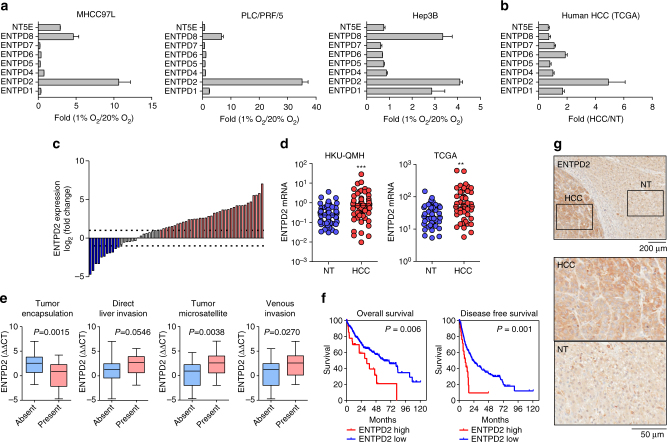
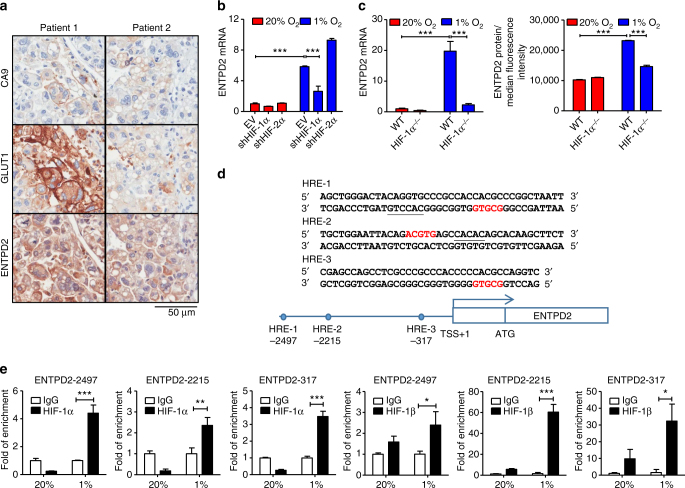
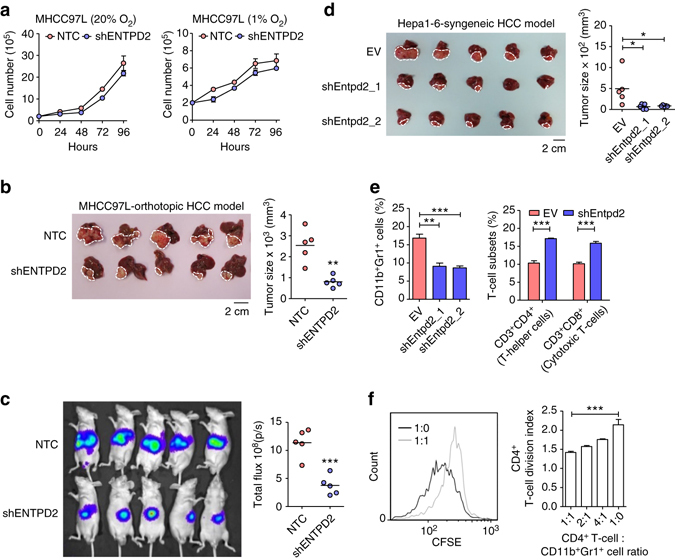
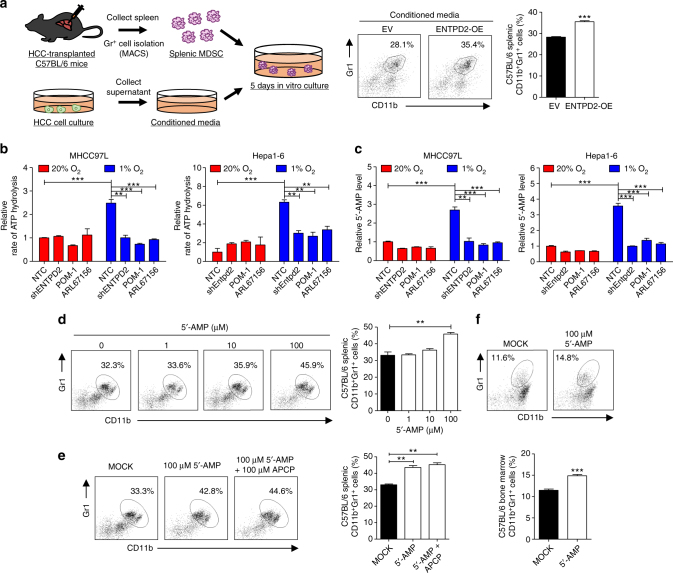
Myeloid-derived suppressor cells (MDSCs) possess immunosuppressive activities, which allow cancers to escape immune surveillance and become non-responsive to immune checkpoints blockade. Here we report hypoxia as a cause of MDSC accumulation. Using hepatocellular carcinoma (HCC) as a cancer model, we show that hypoxia, through stabilization of hypoxia-inducible factor-1 (HIF-1), induces ectoenzyme, ectonucleoside triphosphate diphosphohydrolase 2 (ENTPD2/CD39L1), in cancer cells, causing its overexpression in HCC clinical specimens. Overexpression of ENTPD2 is found as a poor prognostic indicator for HCC. Mechanistically, we demonstrate that ENTPD2 converts extracellular ATP to 5′-AMP, which prevents the differentiation of MDSCs and therefore promotes the maintenance of MDSCs. We further find that ENTPD2 inhibition is able to mitigate cancer growth and enhance the efficiency and efficacy of immune checkpoint inhibitors. Our data suggest that ENTPD2 may be a good prognostic marker and therapeutic target for cancer patients, especially those receiving immune therapy.
Overview
The claims and statistics of this paper haven’t been checked yet.
Free: it reads the open-access text and checks the first 5 claims that cite a source we can check. Create a free account to check every claim.
Integrity signals
Registry
Cites
Statistics
Figures
Verification
Claims the paper makes
The claims and statistics of this paper haven’t been checked yet.
Free: it reads the open-access text and checks the first 5 claims that cite a source we can check. Create a free account to check every claim.
Claims other papers make about this one
Each is checked against this paper’s own text: does it say what the citing paper says it does?
The source backs part of the claim, not all of it — or backs it for a different population, condition or comparison.
In the citing paper
“For example, hypoxia promotes the secretion of CCL28 by tumor cells in a HIF-1α-dependent manner, which enhances recruitment of CCR10+ T reg cells to the tumor site, suppressing the functions of cytotoxic T cells and promoting tumor growth (Fig. 2C) [81,82].”
From Revisiting the HIF switch in the tumor and its immune microenvironment. (2022) · cites this paper as [82]
Experimental — accuracy not yet measuredThe source backs part of the claim, not all of it — or backs it for a different population, condition or comparison.
In the citing paper
“Independent of glycolysis, the HIFs can induce the production of immunosuppressive metabolites such as adenosine by transcriptionally activating ectoenzymes such as ENTPD2/CD39L1, CD39, and CD73 (Table 1), which contribute to the multistep conversion of extracellular ATP through ADP/AMP to adenosine, thus promoting the maintenance of MDSCs, which limits the activity of immune checkpoint inhibitors”
From The HIF Axes in Cancer - Angiogenesis, Metabolism and Immune-Modulation (2025) · cites this paper as [90]
Experimental — accuracy not yet measuredThe source backs part of the claim, not all of it — or backs it for a different population, condition or comparison.
In the citing paper
“which together with CXCL1, mediate recruitment or maintenance of immunosuppressive MDSCs and TAMs (72, 73)”
From HIF inhibitor 32-134D eradicates murine hepatocellular carcinoma in combination with anti-PD1 therapy (2022) · cites this paper as [72]
Experimental — accuracy not yet measuredThe cited source says what the claim attributes to it.
In the citing paper
“Inhibition of either ENTPD2 or ADK enhanced the activity of immune checkpoint inhibitors, which highlights their significance in driving immunosuppression and their potential utility as therapeutic targets to enhance the efficacy of immune checkpoint inhibitors [90, 93].”
From The HIF Axes in Cancer - Angiogenesis, Metabolism and Immune-Modulation (2025) · cites this paper as [90]
Self-check
Percentages, sums and reported differences re-computed from the paper’s own numbers.
The self-check needs the paper’s full text.
Citations
Cites
PD-1 and PD-L1 Immune Checkpoint Blockade to Treat Breast Cancer
Hartkopf, A. D., Taran, F.-A., Wallwiener, M., Walter, C. B., Krämer, B., Grischke, E.-M., & Brucker, S. Y. (2016) · Breast Care · doi:10.1159/000453569 · Cited by 30,845
Trapnell, C., Williams, B. A., Pertea, G., Mortazavi, A., Kwan, G., van Baren, M. J., Salzberg, S. L., Wold, B. J., & Pachter, L. (2010) · Nature Biotechnology · doi:10.1038/nbt.1621 · Cited by 15,556
The blockade of immune checkpoints in cancer immunotherapy
Pardoll, D. M. (2012) · Nature Reviews Cancer · doi:10.1038/nrc3239 · Cited by 13,838
Myeloid-derived-suppressor cells as regulators of the immune system
Gabrilovich, D. I., & Nagaraj, S. (2009) · Nature Reviews Immunology · doi:10.1038/nri2506 · Cited by 6,753
Wang, G. L., Jiang, B. H., Rue, E. A., & Semenza, G. L. (1995) · Proceedings of the National Academy of Sciences · doi:10.1073/pnas.92.12.5510 · Cited by 6,212
Improved vectors and genome-wide libraries for CRISPR screening
Sanjana, N. E., Shalem, O., & Zhang, F. (2014) · Nature Methods · doi:10.1038/nmeth.3047 · Cited by 5,239
Innate and adaptive immune cells in the tumor microenvironment
Gajewski, T. F., Schreiber, H., & Fu, Y.-X. (2013) · Nature Immunology · doi:10.1038/ni.2703 · Cited by 4,148
Hypoxia-inducible factors in physiology and medicine
Semenza, G. L. (2012) · Cell · doi:10.1016/j.cell.2012.01.021 · Cited by 3,645
Epstein, A. C. R., Gleadle, J. M., McNeill, L. A., Hewitson, K. S., O'Rourke, J., Mole, D. R., Mukherji, M., Metzen, E., Wilson, M. I., Dhanda, A., et al. (2001) · Cell · doi:10.1016/s0092-8674(01)00507-4 · Cited by 3,333
Oxygen sensing by metazoans: the central role of the HIF hydroxylase pathway.
Kaelin, W. G., & Ratcliffe, P. J. (2008) · Molecular Cell · doi:10.1016/j.molcel.2008.04.009 · Cited by 3,251
Research works printed but not linked: 1
- 33. Chiu DK, et al. Hypoxia induces myeloid-derived suppressor cell recruitment to hepatocellular carcinoma through chemokine (C-C motif) ligand 26. Hepatology. 2016;64:797–813. doi: 10.1002/hep.28655. · DOI · Paper page
Cited by
Items 401–469 of 469
The Effects of Angiotensin-Converting Enzyme Inhibitors on Metastasis-Associated Myeloid Cells
Vallejo-Ardila, D. L., Parra-Medina, R. S., Cómbita, A. L., Cardona, A. F., & Paquet‐Fifield, S. (2022) · Interdisciplinary cancer research · doi:10.1007/16833_2022_91
Introduction to Tumor Microenvironment
Momtazmanesh, S., & Rezaei, N. (2023) · Springer eBooks · doi:10.1007/978-3-030-80962-1_82-1
Xu, X., Zhang, C., Trotter, T. N., Gowda, P. S., Lu, Y., Ponnazhagan, S., Javed, A., Li, J., & Yang, Y. (2023) · doi:10.1158/0008-5472.c.6512397
Seki, M., Sano, T., Ogawa, M., Yokoo, S., & Oyama, T. (2023) · The Egyptian Journal of Radiology and Nuclear Medicine · doi:10.1186/s43055-023-01025-w
“Interestingly, HIF-1α has also been revealed to promote the accumulation of MDSCs, which is consistent with our findings [40].”
ResultJoseph, E. L. M. (2019) · theses.fr (ABES) · doi:10.70675/bba1a27bz36bdz488cza60azf58fa2e47702
Myeloid-Derived Suppressive Cells in the Tumor Contexture
Derré, L. (2024) · Springer eBooks · doi:10.1007/978-3-030-80962-1_381-1
Lan, C., Wei, Y., Huang, H., Qin, H., Huang, K., Zhou, X., Yang, C., Liao, X., Zhu, G., & Peng, T. (2024) · Research Square · doi:10.21203/rs.3.rs-4247606/v1
Exploring Mechanisms of Immunosuppression in Colorectal Cancer: Interaction of MDSCs with TGF-β1
陈, 鹏. (2025) · Advances in Clinical Medicine · doi:10.12677/acm.2025.152546
Molecular Mechanisms and Multimodality Treatments for Liver Cancer Recurrence and Metastasis
Ding, Z., & Zhang, B. (2025) · Springer eBooks · doi:10.1007/978-981-97-7969-7_27
Cellular Immune Responses in Tumor Microenvironment
Khamaru, S., Tung, K. S., & Chattopadhyay, S. (2025) · Springer eBooks · doi:10.1007/978-3-031-88695-9_1 · Cited by 1
Li, Y., Du, J., Wei, L., Tan, T., Bao, L., Su, J., & Wang, H. (2025) · Discover Oncology · doi:10.1007/s12672-025-02924-2
“Thus, blocking ENTPD2 in cancer cells significantly inhibited hepatocellular carcinoma growth in vivo [7].”
Self-citationLan, C., Gao, D., Wei, Y., Huang, H., Lv, X., Zhou, X., Qin, W., Liao, X., Zhu, G., & Peng, T. (2025) · Journal of Cancer · doi:10.7150/jca.117247
Introduction to Tumor Microenvironment
Momtazmanesh, S., & Rezaei, N. (2025) · Springer eBooks · doi:10.1007/978-3-032-00761-2_82
Myeloid-Derived Suppressive Cells in the Tumor Contexture
Derré, L. (2025) · Springer eBooks · doi:10.1007/978-3-032-00759-9_381
Anti-obesity effects of Wumeishanzhayin: an integrated lipidomics and transcriptomics study
Huang, X., Liao, C., Peng, B., Wang, J., Zhang, Y., He, Q., Dang, S., & Zhao, M. (2025) · Frontiers in Pharmacology · doi:10.3389/fphar.2025.1697683
Huang, A., Sun, Z., Hong, H., Yang, Y., Chen, J., Gao, Z., & Gu, J. (2024) · Figshare · doi:10.6084/m9.figshare.26737023
Shi, M., Ye, L., Zhao, L., He, L., Chen, J., Zhang, J., Su, Y., Dong, H., Liu, J., Liang, L., et al. (2024) · Figshare · doi:10.6084/m9.figshare.26721567
Huang, A., Sun, Z., Hong, H., Yang, Y., Chen, J., Gao, Z., & Gu, J. (2024) · Figshare · doi:10.6084/m9.figshare.26737026
Regulation of tumor progression by myeloid cells
Jaya, F. N. M., & Gabrilovich, D. I. (2025) · Elsevier eBooks · doi:10.1016/b978-0-443-14064-8.00038-2
Zheng, Y., Huang, C., Lu, L., Yu, K., Zhao, J., Chen, M., Liu, L., Sun, Q., Lin, Z., Zheng, J., et al. (2021) · Figshare · doi:10.6084/m9.figshare.13578954
Wang, Z., Embaye, K. S., Yang, Q., Qin, L., Zhang, C., Liu, L., Zhan, X., Zhang, F., Wang, X., & Qin, S. (2021) · Figshare · doi:10.6084/m9.figshare.14429516
Zhuang, H., Zhang, Z., Chen, B., Tang, C., Chen, X., Tan, W., Yang, L., Xie, Z., Ma, X., Wang, Q., et al. (2024) · Figshare · doi:10.6084/m9.figshare.26590802
Huang, W., Zhu, L., Huang, H., Li, Y., Wang, G., & Zhang, C. (2023) · Figshare · doi:10.6084/m9.figshare.22615034
Zheng, Y., Huang, C., Lu, L., Yu, K., Zhao, J., Chen, M., Liu, L., Sun, Q., Lin, Z., Zheng, J., et al. (2021) · Figshare · doi:10.6084/m9.figshare.13578972
Shi, M., Ye, L., Zhao, L., He, L., Chen, J., Zhang, J., Su, Y., Dong, H., Liu, J., Liang, L., et al. (2024) · Figshare · doi:10.6084/m9.figshare.26721564
Zhuang, H., Zhang, Z., Chen, B., Tang, C., Chen, X., Tan, W., Yang, L., Xie, Z., Ma, X., Wang, Q., et al. (2024) · Figshare · doi:10.6084/m9.figshare.26590799
Zheng, Y., Huang, C., Lu, L., Yu, K., Zhao, J., Chen, M., Liu, L., Sun, Q., Lin, Z., Zheng, J., et al. (2021) · Figshare · doi:10.6084/m9.figshare.13578966
Zheng, Y., Huang, C., Lu, L., Yu, K., Zhao, J., Chen, M., Liu, L., Sun, Q., Lin, Z., Zheng, J., et al. (2021) · Figshare · doi:10.6084/m9.figshare.13578969
Zheng, Y., Huang, C., Lu, L., Yu, K., Zhao, J., Chen, M., Liu, L., Sun, Q., Lin, Z., Zheng, J., et al. (2021) · Figshare · doi:10.6084/m9.figshare.13578960
Wang, Z., Embaye, K. S., Yang, Q., Qin, L., Zhang, C., Liu, L., Zhan, X., Zhang, F., Wang, X., & Qin, S. (2021) · Figshare · doi:10.6084/m9.figshare.14429519
Zheng, Y., Huang, C., Lu, L., Yu, K., Zhao, J., Chen, M., Liu, L., Sun, Q., Lin, Z., Zheng, J., et al. (2021) · Figshare · doi:10.6084/m9.figshare.13578963
Zheng, Y., Huang, C., Lu, L., Yu, K., Zhao, J., Chen, M., Liu, L., Sun, Q., Lin, Z., Zheng, J., et al. (2021) · Figshare · doi:10.6084/m9.figshare.13578957
Zheng, Y., Huang, C., Lu, L., Yu, K., Zhao, J., Chen, M., Liu, L., Sun, Q., Lin, Z., Zheng, J., et al. (2021) · Figshare · doi:10.6084/m9.figshare.13578975
Zhuang, H., Zhang, Z., Chen, B., Tang, C., Chen, X., Tan, W., Yang, L., Xie, Z., Ma, X., Wang, Q., et al. (2024) · Figshare · doi:10.6084/m9.figshare.26590796
Shi, M., Ye, L., Zhao, L., He, L., Chen, J., Zhang, J., Su, Y., Dong, H., Liu, J., Liang, L., et al. (2024) · Figshare · doi:10.6084/m9.figshare.25844432
Wang, Z., Embaye, K. S., Yang, Q., Qin, L., Zhang, C., Liu, L., Zhan, X., Zhang, F., Wang, X., & Qin, S. (2021) · Figshare · doi:10.6084/m9.figshare.14429510
Shi, M., Ye, L., Zhao, L., He, L., Chen, J., Zhang, J., Su, Y., Dong, H., Liu, J., Liang, L., et al. (2024) · Figshare · doi:10.6084/m9.figshare.25844532
Zhuang, H., Zhang, Z., Chen, B., Tang, C., Chen, X., Tan, W., Yang, L., Xie, Z., Ma, X., Wang, Q., et al. (2024) · Figshare · doi:10.6084/m9.figshare.26590793
Relación entre las proteínas parp-1 y hif-1α durante la respuesta a hipoxia tumoral
Martí, J. M. (2021) · Institutional Repository of the University of Granada (University of Granada)
Earnshaw, C. (2024) · Research at York St John (York St John University)
He, Y., & Yeo, Y. (2026) · Wiley Interdisciplinary Reviews Nanomedicine and Nanobiotechnology · doi:10.1002/wnan.70052
“…various tumor-expressed factors, including in-doleamine 2,3-dioxygenase (IDO), colony-stimulating factor-1 (CSF-1), hypoxia-inducible factor-1 (HIF-1), and vascular endothelial growth factor (VEGF) recruit MDSCs to the tumor (Chiu et al. 2017; Holmgaard et al. 2016, 2015; Horikawa et al. 2017).”
Fu, Y., & Xiao, L. (2026) · Frontiers in Medicine · doi:10.3389/fmed.2026.1703966
Zhang, L., Qi, Q., Dai, Y., Tang, X., Wu, Y., Lin, S., & Li, N. (2026) · Translational Cancer Research · doi:10.21037/tcr-2025-aw-2213
“In addition, ENTPD2 is overexpressed in hepatocellular carcinoma and lung adenocarcinoma (26,27).”
Ciblage pharmacologique du microenvironnement de l'adénocarcinome canalaire pancréatique
Samain, R. (2018) · theses.fr (ABES) · doi:10.70675/e35639a1z6534z4cb6z9efbza38473efebed
Turon‐Lagot, V. (2020) · theses.fr (ABES) · doi:10.70675/16003efbze1bdz457azbf3bza20690c3a3d5
Leveraging the replication stress response to optimize hepatocarcinoma therapy
Fang, J. (2024) · theses.fr (ABES) · doi:10.70675/e829496azb11ez4563zb5c8z74b7e8e8ff61
Luo, J., Tang, B., Zhang, X., Hu, Y., Fang, S., Yang, Y., Shu, G., Song, J., Zhao, Z., Karimi, H. R., et al. (2026) · Engineering · doi:10.1016/j.eng.2026.04.007
Razavi, A., Mojtahedi, H., Aghakhani, F., Khani, H. H. K., Rezaei, R., & Amani, D. (2026) · PubMed Central · doi:10.22038/ijbms.2025.90209.19446 · Cited by 1
Li, J., Wu, M., Guo, Q., Gong, Y., Gao, Z., Zhao, Y., Zhang, X., & Li, X. (2026) · Materials Today Advances · doi:10.1016/j.mtadv.2026.100803
Cancer and Immune Cells: A Metabolic Battle in the Tumor Microenvironment
Pournezhad, S., Azar, R., & Taghizadeh‐Hesary, F. (2026) · Cancer treatment and research · doi:10.1007/978-3-032-21861-2_11
黄, 真. (2026) · Advances in Clinical Medicine · doi:10.12677/acm.2026.1651950
Doğan, L. A. (2026) · OMICS A Journal of Integrative Biology · doi:10.1177/15578100261463392
“…that ENTPD2 overexpression on cancer cells converts extracellular ATP to 5 ¢ -AMP, which sustains the immunosuppressive myeloid-derived suppressor cell (MDSC) pool by blocking MDSC differentiation, and that ENTPD2 inhibition restored sensitivity to immune checkpoint blockade (Chiu et al., 2017).”
Chowdhury, S., Sarkar, S., & Das, A. (2026) · Gene Reports · doi:10.1016/j.genrep.2026.102575
Feng, T., Li, Y. D., Hu, J., Zhao, L. J., & Yao, X. (2026) · Translational Cancer Research · doi:10.21037/tcr-2026-0590
“ENTPD2 is upregulated in HCC and stimulates the proliferation of HCC cell lines (35).”
Tabish, M. S., Li, Y., Zhao, N., Hong, Y., Shu, J., Yang, C., Sun, Z., Liu, X., Sun, M., & Chen, K. (2026) · International Journal of Clinical Oncology · doi:10.1007/s10147-026-03132-w
“HIF-1 enhances the accumulation of myeloid-derived suppressor cells (MDSCs) in the tumor microenvironment by upregulating ectonucleoside triphosphate diphosphohydrolase 2 (ENT-PD2) expression, which facilitates the conversion of ATP to 5′-AMP [ 37].”
Mao, Y., Lin, Q., Liu, Y., Wei, X., Zhou, Z., Wen, Q., Jiang, Y., Chen, P., Liang, X., Wei, Y., et al. (2026) · Cancers · doi:10.3390/cancers18142253
“A key mechanism underlying its pro-tumorigenic effect involves the elevation of extracellular 5 ′ -AMP in HCC, which maintains myeloid-derived suppressor cells by preventing their differentiation, thereby possibly contributing to immune evasion [51].”
Lin, Z., Liu, Q., Li, X., Wang, W., Luo, H., Xia, W., Yuan, Y., Zheng, H., & Luo, W. (2026) · Materials Today Bio · doi:10.1016/j.mtbio.2026.103528
“Hypoxia re-cruits and activates immunosuppressive myeloid populations, notably myeloid-derived suppressor cells (MDSCs) and M2-polarized tumor-associated macrophages (TAMs), which undermine immune checkpoint blockade (ICB) and accelerate disease progression [6,7].”
O 2 -sensing and HIF regulation: from oxygen homeostasis to tumor-associated immune responses
Schneider, V., Fandrey, J., & Winning, S. (2026) · American Journal of Physiology-Cell Physiology · doi:10.1152/ajpcell.00185.2026
Su, P., Zhang, Y., Yu, T., 王元宇, 牟一平, & Jin, W. (2026) · International Immunopharmacology · doi:10.1016/j.intimp.2026.117338
An efficient functional screening method for anti ATP hydrolase antibody based on fluorescent probes
Yue, Y., He, W., Yin, H., Li, X., & Shen, H. (2026) · Frontiers in Immunology · doi:10.3389/fimmu.2026.1906242
Xiong, J., Mou, G., 泽塔多吉, Li, X., & Zhao, H. (2026) · Frontiers in Immunology · doi:10.3389/fimmu.2026.1959235
Maranou, E. (2026) · UTUPub (University of Turku)
Wu, H., Wang, F., Sun, W., & Zhang, H. (2026) · International Journal of Nanomedicine · doi:10.2147/ijn.s650413
Spatial transcriptomics of pediatric tuberculosis lymph nodes reveals a conserved hypoxia–SPP1 nichePreprint
Adebiyi, S. O., Goussard, P., Wet, D. R. D., Janson, J., Jooste, T., Shabangu, A., Dorhoi, A., Bondoc, S., Nekorchuk, M. D., Chao, M. C., et al. (2026) · bioRxiv (Cold Spring Harbor Laboratory) · doi:10.64898/2026.10.28.762471
Targeting hypoxia-inducible factors to overcome immunotherapy resistance
Salman, S., & Semenza, G. L. (2026) · Targetome · doi:10.48130/targetome-0026-0065
Metadata
- Authors
- Chiu, D. K.-C., Tse, A. P.-W., Xu, I. M.-J., Di Cui, J., Lai, R. K.-H., Li, L. L., Koh, H.-Y., Tsang, F. H.-C., Wei, L. L., Wong, C.-M., Ng, I. O.-L., & Wong, C. C.-L.
- Affiliations
- University of Hong Kong (HK)
- Venue
- Nature Communications
- Published
- 2017-09-11
- Volume
- 8
- Issue
- 1
- Pages
- 517-517
- ISSN
- 2041-1723 (ISSN-L)
- PMC
- PMC5593860
- OpenAlex
- W2753173755
- Cited by
- 448
- References
- 56
- Citations by year
- 2026: 25 · 2025: 43 · 2024: 57 · 2023: 61 · 2022: 71 · 2021: 76 · 2020: 71 · 2019: 28 · 2018: 16
- FWCI
- 14.23
- Type
- journal article
- Language
- en
- Open access
- gold
- doi.org
- Licence
- cc-by
- creativecommons.org/licenses/by/4.0 (tdm)
- creativecommons.org/licenses/by/4.0 (vor)
- Locations
- Nature Communications (publishedVersion, cc-by)
- PubMed Central (publishedVersion, cc-by)
- PubMed (publishedVersion)
- RePEc: Research Papers in Economics (submittedVersion)
- DOAJ (DOAJ: Directory of Open Access Journals) (submittedVersion, cc-by-sa)
- DOAJ (DOAJ: Directory of Open Access Journals) (submittedVersion)
- The HKU Scholars Hub (University of Hong Kong) (submittedVersion, cc-by-nc-nd)
- Funders
- University of Hong Kong
- Health and Medical Research Fund (03142926, T12-704/16-R)
- Topics
- Life Sciences › Immunology and Microbiology › Immunology › Immune cells in cancer
- Life Sciences › Biochemistry, Genetics and Molecular Biology › Physiology › Adenosine and Purinergic Signaling
- Life Sciences › Biochemistry, Genetics and Molecular Biology › Cancer Research › Cancer, Hypoxia, and Metabolism
- Keywords
- myeloid-derived suppressor cells, hepatocellular carcinoma, hypoxia, HIF-1, extracellular ATP, 5'-AMP, tumor immune evasion, immune checkpoint inhibitors, prognostic factors, therapeutic target, MDSC differentiation
- MeSH terms
- Myeloid-Derived Suppressor Cells, Adenosine Triphosphatases, Hypoxia, Cell Differentiation, Carcinoma, Hepatocellular, Humans, Liver Neoplasms, Cell Proliferation, Hypoxia-Inducible Factor 1
About these checks
Registry, retraction, Cites and statistics results are computed, not judged, with one exception: a printed reference that no index lists is read once by a model before it counts as a citation error. Claims are extracted by a model and kept only when their quote appears verbatim in the text; each cited source is then checked, with a model’s help, for whether it says what the claim relies on. Those verdicts can be wrong — read the claim’s quote and the cited source before relying on one.
Statistics and arithmetic are recomputed, not judged.
Confidence bands are shown only for fields calibrated on our annotated test set. None is calibrated yet, so no band is shown.
What counts as a claim ›How we measure confidence ›How we check this ›
Are you an author, or do you see a problem with this page? Request a review
Data sources
Bibliographic data: Semantic Scholar, OpenAlex, Crossref.
Contains information from the Semantic Scholar Academic Graph Datasets, made available under the ODC Attribution License (ODC-BY 1.0).
Semantic Scholar’s data is described in: Kinney, R., et al. (2023). The Semantic Scholar Open Data Platform. arXiv:2301.10140.
