

Resistance to checkpoint blockade therapy through inactivation of antigen presentation
Open accessThe DOI matches its Crossref record; 44 of the 44 references it cites were found in a registry or an index.
Abstract
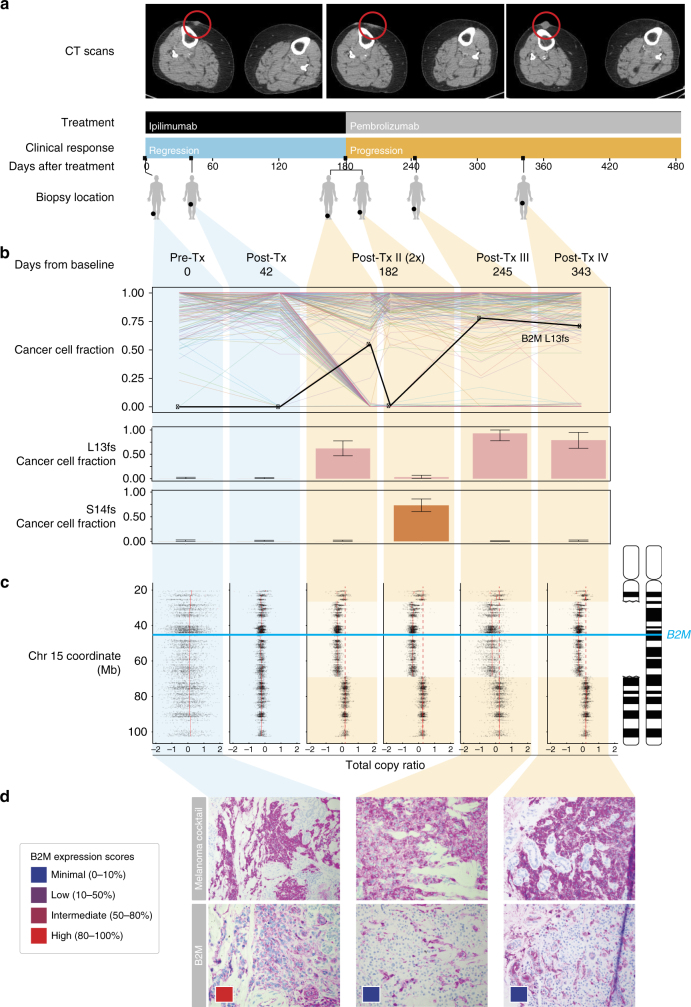
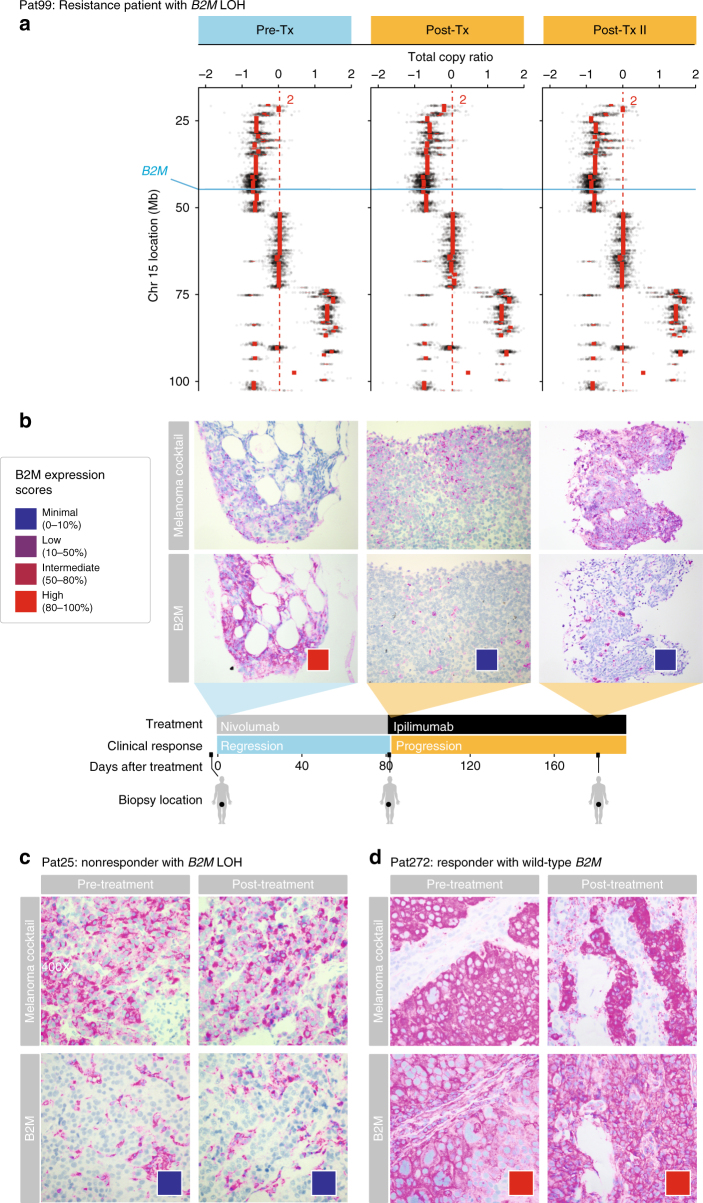
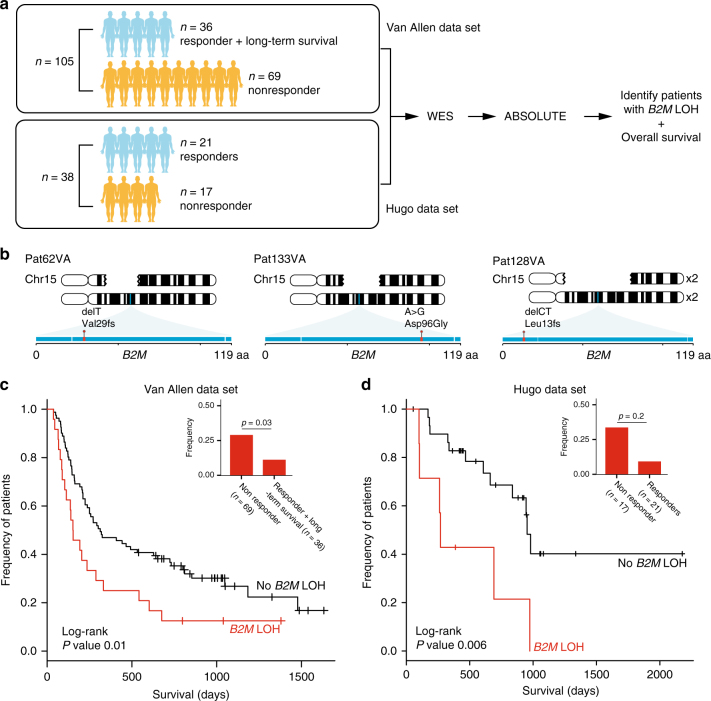
Treatment with immune checkpoint blockade (CPB) therapies often leads to prolonged responses in patients with metastatic melanoma, but the common mechanisms of primary and acquired resistance to these agents remain incompletely characterized and have yet to be validated in large cohorts. By analyzing longitudinal tumor biopsies from 17 metastatic melanoma patients treated with CPB therapies, we observed point mutations, deletions or loss of heterozygosity (LOH) in beta-2-microglobulin ( B2M ), an essential component of MHC class I antigen presentation, in 29.4% of patients with progressing disease. In two independent cohorts of melanoma patients treated with anti-CTLA4 and anti-PD1, respectively, we find that B2M LOH is enriched threefold in non-responders (~30%) compared to responders (~10%) and associated with poorer overall survival. Loss of both copies of B2M is found only in non-responders. B2M loss is likely a common mechanism of resistance to therapies targeting CTLA4 or PD1.
Overview
The claims and statistics of this paper haven’t been checked yet.
Free: it reads the open-access text and checks the first 5 claims that cite a source we can check. Create a free account to check every claim.
Integrity signals
Registry
Cites
Statistics
Figures
Verification
Claims the paper makes
The claims and statistics of this paper haven’t been checked yet.
Free: it reads the open-access text and checks the first 5 claims that cite a source we can check. Create a free account to check every claim.
Claims other papers make about this one
Each is checked against this paper’s own text: does it say what the citing paper says it does?
The source backs part of the claim, not all of it — or backs it for a different population, condition or comparison.
In the citing paper
“perturbations of B2M, HLA-A, JAK1, JAK2, STAT1, IFNGR1 and IFNGR2 (Fig. 2d,e, Extended Data Fig. 3e,f, Supplementary Table 2) conferred immune evasion, consistent with clinical mechanisms of resistance to immunotherapy7–9.”
From Multimodal pooled Perturb-CITE-seq screens in patient models define mechanisms of cancer immune evasion (2021) · cites this paper as [8]
Experimental — accuracy not yet measuredIn the citing paper
“Clinically relevant mechanisms of include mutations in beta-2-microglobulin (B2M) resulting in loss of MHC Class I presentation, downregulation of the antigen presentation machinery, and mutations in the IFNγ-JAK/STAT pathway that impair response to T cell mediated anti-tumor activity7–9.”
From Multimodal pooled Perturb-CITE-seq screens in patient models define mechanisms of cancer immune evasion (2021) · cites this paper as [8]
Self-check
Percentages, sums and reported differences re-computed from the paper’s own numbers.
The self-check needs the paper’s full text.
Citations
Cites
Fiji: an open-source platform for biological-image analysis
Schindelin, J., Arganda-Carreras, I., Frise, E., Kaynig, V., Longair, M., Pietzsch, T., Preibisch, S., Rueden, C., Saalfeld, S., Schmid, B., et al. (2012) · Nature Methods · doi:10.1038/nmeth.2019 · Cited by 66,890
STAR: ultrafast universal RNA-seq aligner
Dobin, A., Davis, C. A., Schlesinger, F., Drenkow, J., Zaleski, C., Jha, S., Batut, P., Chaisson, M., & Gingeras, T. R. (2013) · Bioinformatics · doi:10.1093/bioinformatics/bts635 · Cited by 51,709
PD-1 and PD-L1 Immune Checkpoint Blockade to Treat Breast Cancer
Hartkopf, A. D., Taran, F.-A., Wallwiener, M., Walter, C. B., Krämer, B., Grischke, E.-M., & Brucker, S. Y. (2016) · Breast Care · doi:10.1159/000453569 · Cited by 30,845
RSEM: accurate transcript quantification from RNA-Seq data with or without a reference genome
Li, B., & Dewey, C. N. (2011) · BMC Bioinformatics · doi:10.1186/1471-2105-12-323 · Cited by 22,179
Self-citationCerami, E., Gao, J., Dogrusoz, U., Gross, B. E., Sumer, S. O., Aksoy, B. A., Jacobsen, A., Byrne, C. J., Heuer, M. L., Larsson, E., et al. (2012) · Cancer Discovery · doi:10.1158/2159-8290.cd-12-0095 · Cited by 17,455
Adverse Renal Effects of Immune Checkpoint Inhibitors: A Narrative Review
Wanchoo, R., Karam, S., Uppal, N. N., Barta, V. S., Deray, G., Devoe, C., Launay-Vacher, V., Jhaveri, K. D., & on behalf of Cancer and Kidney International Network Workgroup on Immune Checkpoint Inhibitors (2017) · American Journal of Nephrology · doi:10.1159/000455014 · Cited by 15,256
Integrative Analysis of Complex Cancer Genomics and Clinical Profiles Using the cBioPortal
Gao, J., Aksoy, B. A., Dogrusoz, U., Dresdner, G., Gross, B., Sumer, S. O., Sun, Y., Jacobsen, A., Sinha, R., Larsson, E., et al. (2013) · Science Signaling · doi:10.1126/scisignal.2004088 · Cited by 15,160
The blockade of immune checkpoints in cancer immunotherapy
Pardoll, D. M. (2012) · Nature Reviews Cancer · doi:10.1038/nrc3239 · Cited by 13,838
PD-1 blockade induces responses by inhibiting adaptive immune resistance
Tumeh, P. C., Harview, C. L., Yearley, J. H., Shintaku, I. P., Taylor, E. J. M., Robert, L., Chmielowski, B., Spasic, M., Henry, G., Ciobanu, V., et al. (2014) · Nature · doi:10.1038/nature13954 · Cited by 6,609
Pembrolizumab versus Ipilimumab in Advanced Melanoma
Robert, C., Schachter, J., Long, G. V., Arance, A., Grob, J. J., Mortier, L., Daud, A., Carlino, M. S., McNeil, C., Lotem, M., et al. (2015) · New England Journal of Medicine · doi:10.1056/nejmoa1503093 · Cited by 5,887
Cited by
Items 201–300 of 998
Chen, Y., Huang, Y., Gao, X., Li, Y., Lin, J., Chen, L., Chang, L., Chen, G., Guan, Y., Pan, L. K., et al. (2020) · Frontiers in Immunology · doi:10.3389/fimmu.2020.01620 · Cited by 101
“CCND1 Amplification Is Significantly Associated With a Signature of Tumor Immunosuppression and Immune Cell Exclusion Remarkable associations have been observed between the presence of immune cells, especially with tumor-specific T cell infiltration, and/or a T cell-associated inflammatory gene expression signature an…”
BackgroundCD4 T Cell–Dependent Rejection of Beta-2 Microglobulin Null Mismatch Repair–Deficient Tumors
Germano, G., Lu, S., Rospo, G., Lamba, S., Rousseau, B., Fanelli, S., Stenech, D., Le, D. T., Hays, J. L., Totaro, M. G., et al. (2021) · Cancer Discovery · doi:10.1158/2159-8290.cd-20-0987 · Cited by 88
The Tumor Microenvironment Factors That Promote Resistance to Immune Checkpoint Blockade Therapy
Russell, B. L., Sooklal, S. A., Malindisa, S. T., Daka, L. J., & Ntwasa, M. M. (2021) · Frontiers in Oncology · doi:10.3389/fonc.2021.641428 · Cited by 86
Molecular patterns of resistance to immune checkpoint blockade in melanoma
Lauss, M., Phung, B., Borch, T. H., Harbst, K., Kaminska, K. K., Ebbesson, A., Hedenfalk, I. A., Yuan, J., Nielsen, K., Ingvar, C., et al. (2024) · Nature Communications · doi:10.1038/s41467-024-47425-y · Cited by 96
“In addition, anti-PD1 resistant tumors have reduced fractions of PD1 + CD8 + T cells as compared to ICB naïve metastases.”
InfluentialWu, W., Liu, Y., Zeng, S., Han, Y., & Shen, H. (2021) · Journal of Hematology & Oncology · doi:10.1186/s13045-021-01166-3 · Cited by 89
Microsatellite instability: A 2024 update
Yamamoto, H., Watanabe, Y., Arai, H., Umemoto, K., Tateishi, K., & Sunakawa, Y. (2024) · Cancer Science · doi:10.1111/cas.16160 · Cited by 97
Hamid, O., Molinero, L., Bolen, C. R., Sosman, J. A., Muñoz-Couselo, E., Kluger, H. M., McDermott, D. F., Powderly, J. D., Sarkar, I., Ballinger, M., et al. (2019) · Clinical Cancer Research · doi:10.1158/1078-0432.ccr-18-3488 · Cited by 80
“Activation of the PTEN/PIK3CA pathway and loss of IFNg/ JAK1/JAK3/STAT1 signaling and antigen presentation have been reported as mechanisms of resistance to checkpoint inhibitors in melanoma (32, 33, 46).”
BackgroundWang, B., Yin, H., Zhang, Y., Zhao, Q., Wang, H., Wei, J., Meng, L., Xin, Y., & Jiang, X. M. (2023) · Cell & Bioscience · doi:10.1186/s13578-023-01073-9 · Cited by 92
“Several studies have shown that the loss of JAK/STAT signaling leads to resistance to CTLA-4 and PD-1 inhibitors because of the inability to upregulate PD-L1 and MHC-I expression [48, 49, 51].”
BackgroundInfluentialHyperglycosylation of prosaposin in tumor dendritic cells drives immune escape
Sharma, P., Zhang, X., Ly, K., Kim, J. H., Wan, Q., Kim, J., Lou, M., Kain, L., Teyton, L., & Winau, F. (2024) · Science · doi:10.1126/science.adg1955 · Cited by 91
B2M overexpression correlates with malignancy and immune signatures in human gliomas
Zhang, H., Cui, B., Zhou, Y., Wang, X., Wu, W., Wang, Z., Dai, Z., Cheng, Q., & Yang, K. (2021) · Scientific Reports · doi:10.1038/s41598-021-84465-6 · Cited by 87
Current Strategies for Tumor Photodynamic Therapy Combined With Immunotherapy
Hua, J., Wu, P., Gan, L., Zhang, Z., He, J., Zhong, L., Zhao, Y., & Huang, Y. (2021) · Frontiers in Oncology · doi:10.3389/fonc.2021.738323 · Cited by 90
Lin, Q., Wang, X., & Hu, Y. (2023) · Cancer Letters · doi:10.1016/j.canlet.2023.216318 · Cited by 78
Zhou, B., Gao, Y., Zhang, P., & Chu, Q. (2021) · Frontiers in Immunology · doi:10.3389/fimmu.2021.693609 · Cited by 91
“The biallelic loss of B2M (homozygous mutation or heterozygous mutation combined with LOH) in the resistant tumor is also confirmed by other groups (13, 59).”
BackgroundInfluentialChen, X., Feng, L., Huang, Y., Wu, Y., & Xie, N. (2022) · Cancers · doi:10.3390/cancers15010104 · Cited by 94
“The CTLA-4 on Treg cells binds to co-stimulatory molecules CD80 and CD86 on APCs to inhibit the secondary signaling, suppressing antigen presentation [61].”
BackgroundRegulation of Innate and Adaptive Antitumor Immunity by IAP Antagonists
Dougan, S. K., & Dougan, M. (2018) · Immunotherapy · doi:10.2217/imt-2017-0185 · Cited by 78
Combining Cancer Vaccines with Immunotherapy: Establishing a New Immunological Approach
Kim, C.-G., Sang, Y. B., Lee, J. H., & Chon, H. J. (2021) · International Journal of Molecular Sciences · doi:10.3390/ijms22158035 · Cited by 83
“Tumor‐intrinsic resistance that hinders the efficacy of immunotherapies, including ICIs, adoptive cell transfer, and therapeutic vaccines, can be attributed to insufficient tu‐ mor antigen expression [83], modified antigen processing pathways [84], and the deple‐ tion of human leukocyte antigen (HLA) expression linked…”
BackgroundCheon, H., Holvey-Bates, E. G., McGrail, D. J., & Stark, G. R. (2021) · Proceedings of the National Academy of Sciences · doi:10.1073/pnas.2112258118 · Cited by 78
Targeting MHC-I inhibitory pathways for cancer immunotherapy
Wang, J., Qiao, L., Chen, X., & Aifantis, I. (2024) · Trends in Immunology · doi:10.1016/j.it.2024.01.009 · Cited by 85
Acquired mechanisms of immune escape in cancer following immunotherapy
Iorgulescu, J. B., Braun, D. A., Oliveira, G., Keskin, D. B., & Wu, C. J. (2018) · Genome Medicine · doi:10.1186/s13073-018-0598-2 · Cited by 82
Inactivation of Fbxw7 Impairs dsRNA Sensing and Confers Resistance to PD-1 Blockade
Gstalder, C., Liu, D., Miao, D., Lutterbach, B. A., DeVine, A. L., Lin, C., Shettigar, M., Pancholi, P., Buchbinder, E. I., Carter, S. L., et al. (2020) · Cancer Discovery · doi:10.1158/2159-8290.cd-19-1416 · Cited by 79
“Prior studies have identified decreased CD8+ T cell infiltration(3), defects in interferon signaling (4,5) or antigen presentation (6), as well as alteration of viral sensing pathways (7–9) as mechanisms leading to therapeutic resistance.”
BackgroundTargeting loss of heterozygosity for cancer-specific immunotherapy
Hwang, M. S., Mog, B. J., Douglass, J., Pearlman, A. H., Hsiue, E. H.-C., Paul, S., DiNapoli, S. R., Konig, M. F., Pardoll, D. M., Gabelli, S. B., et al. (2021) · Proceedings of the National Academy of Sciences · doi:10.1073/pnas.2022410118 · Cited by 83
“Recently, LOH has been implicated as both a resistance mechanism and a negative clinical correlate for immunotherapies (113, 114).”
BackgroundImmune checkpoint inhibitors in colorectal cancer: limitation and challenges
Yan, S., Wang, W., Feng, Z., Xue, J., Liang, W., Wu, X., Tan, Z., Zhang, X., Zhang, S., Li, X., et al. (2024) · Frontiers in Immunology · doi:10.3389/fimmu.2024.1403533 · Cited by 93
“…loss-of-function mutations and genomic modi fi cations in the IFN-g signaling pathway and antigen presentation signaling pathway result in cancer immune evasion, and IFN-g may promote tumor antigen loss and induce tumor immune editing, resulting in tumor progression and recurrence (49, 65, 110).”
BackgroundAndersen, R. S., Borch, T. H., Draghi, A., Gokuldass, A., Rana, M. A. H., Pedersen, M., Nielsen, M., Kongsted, P., Kjeldsen, J. W., Westergaard, M. C. W., et al. (2018) · Annals of Oncology · doi:10.1093/annonc/mdy139 · Cited by 79
Taylor, B. C., Sun, X., Ericsson, P. I. G., Sanchez, V. M., Sanders, M. E., Wescott, E. C., Opalenik, S. R., Hanna, A., Chou, S.-T., Kaer, L. V., et al. (2023) · Cancer Discovery · doi:10.1158/2159-8290.cd-23-0519 · Cited by 82
“Genetic deletion of B2M results in an immunologically cold tumor microenvironment and complete lack of response to PD-1/ L1-targeted therapy (15, 24, 25), or other therapies targeting adaptive responses requiring antigen recognition (13, 26).”
Wu, C.-C., Wang, Y., Livingston, J. A., Zhang, J., & Futreal, P. A. (2022) · Nature Communications · doi:10.1038/s41467-021-27651-4 · Cited by 86
Bu, M. T., Chandrasekhar, P., Ding, L., & Hugo, W. (2022) · Pharmacology & Therapeutics · doi:10.1016/j.pharmthera.2022.108211 · Cited by 84
Beck, J. D., Diken, M., Suchan, M., Streuber, M., Diken, E., KOLB, L. D., Allnoch, L., Vascotto, F., Peters, D., Beißert, T., et al. (2024) · Cancer Cell · doi:10.1016/j.ccell.2024.02.013 · Cited by 78
Zhang, Q., Zheng, D., Dong, X., Pan, P., Zeng, S.-M., Gao, F., Cheng, S., & Zhang, X. (2021) · Journal of the American Chemical Society · doi:10.1021/jacs.1c00945 · Cited by 70
HLA class I antigen processing machinery defects in antitumor immunity and immunotherapy
Maggs, L., Sadagopan, A., Moghaddam, A. S., & Ferrone, S. (2021) · Trends in cancer · doi:10.1016/j.trecan.2021.07.006 · Cited by 80
Ballesteros, P. Á., Chamorro, J., Román, M. S., Pozas, J., Santos, V. G. D., Granados, Á. R., Grande, E., Alonso‐Gordoa, T., & Molina‐Cerrillo, J. (2021) · Cancers · doi:10.3390/cancers13235981 · Cited by 83
“In addition, loss of heterozygosity at the B2-microglobulin locus was associated with lower overall survival in melanoma patients receiving immune checkpoint inhibitors [92].”
BackgroundImmune checkpoint receptors: homeostatic regulators of immunity
Riva, A., & Chokshi, S. (2018) · Hepatology International · doi:10.1007/s12072-018-9867-9 · Cited by 74
Role of CXCR3 signaling in response to anti-PD-1 therapy
Han, X., Wang, Y., Sun, J., Tan, T., Cai, X., Lin, P., Tan, Y., Zheng, B., Wang, B., Wang, J., et al. (2019) · EBioMedicine · doi:10.1016/j.ebiom.2019.08.067 · Cited by 75
“Studies aiming to reveal the mechanistic basis of resistance focus on the tumor microenvironment and tumor mutations, such as the characterization of genomic and transcriptomic features [9], JAK1/2 mutations [8,10], biallelic PTEN loss [11], the IFN-γ-related mRNA profile [12], the tumor microenvironment [13], and ina…”
BackgroundPulanco, M. C., Madsen, A. T., Tanwar, A., Corrigan, D. T., & Zang, X. (2023) · Cellular and Molecular Immunology · doi:10.1038/s41423-023-01019-8 · Cited by 75
Navigating established and emerging biomarkers for immune checkpoint inhibitor therapy
Wang, S. L., & Chan, T. A.-T. (2025) · Cancer Cell · doi:10.1016/j.ccell.2025.03.006 · Cited by 87
Jaiswal, A. R., Liu, A. J., Pudakalakatti, S., Dutta, P., Jayaprakash, P., Bartkowiak, T., Ager, C. R., Wang, Z., Reuben, A., Cooper, Z. A., et al. (2020) · Cancer Immunology Research · doi:10.1158/2326-6066.cir-19-0005 · Cited by 75
“We also did not observe downregulation of MHC class I or II complexes on the surface of resistant tumors (14, 51, 52).”
BackgroundFriedrich, M., Jasinski‐Bergner, S., Lazaridou, M., Subbarayan, K., Massa, C., Tretbar, S., Mueller, A., Handke, D., Biehl, K., Bukur, J., et al. (2019) · Cancer Immunology Immunotherapy · doi:10.1007/s00262-019-02373-1 · Cited by 73
Sensitizing the Tumor Microenvironment to Immune Checkpoint Therapy
Zemek, R. M., Chin, W. L., Nowak, A. K., Millward, M., Lake, R., & Lesterhuis, W. J. (2020) · Frontiers in Immunology · doi:10.3389/fimmu.2020.00223 · Cited by 75
“In humans, secondary resistance to ICB has also been associated with T cell deficits, including mutations in cancer cells associated with decreased sensitivity to T cell-mediated killing, or reduced antigen presentation to T cells (30, 31).”
BackgroundLaSalle, T. J., Austin, E. E., Rigney, G. H., Wehrenberg-Klee, E. P., Nesti, S., Larimer, B. M., & Mahmood, U. (2020) · Journal for ImmunoTherapy of Cancer · doi:10.1136/jitc-2019-000291 · Cited by 74
MHC Class I Deficiency in Solid Tumors and Therapeutic Strategies to Overcome It
Shklovskaya, E., & Rizos, H. (2021) · International Journal of Molecular Sciences · doi:10.3390/ijms22136741 · Cited by 78
“A complete loss of B2M conferred immunotherapy resistance in some [60,62,63] but not in other studies [14].”
BackgroundResultPérez-Núñez, I., Rozalén, C., Palomeque, J. Á., Sangrador, I., Dalmau, M., Comerma, L., Hernández‐Prat, A., Casadevall, D., Menéndez, S., Liu, D. D., et al. (2022) · Nature Cancer · doi:10.1038/s43018-022-00339-4 · Cited by 69
Immunotherapy resistance in esophageal cancer: Possible mechanisms and clinical implications
Fang, P., Zhou, J., Liang, Z., Yang, Y., Luan, S., Xiao, X., Li, X., Zhang, H., Shang, Q., Zeng, X., et al. (2022) · Frontiers in Immunology · doi:10.3389/fimmu.2022.975986 · Cited by 73
“showed that B2M alterations were enriched in cancer patients insensitive to anti-CTLA4 therapy compared to responders (116).”
BackgroundYu, L., Zhang, J., & Li, Y. (2022) · Frontiers in Immunology · doi:10.3389/fimmu.2022.871076 · Cited by 73
Nejo, T., Matsushita, H., Karasaki, T., Nomura, M., Saito, K., Tanaka, S., Takayanagi, S., Hana, T., Takahashi, S., Kitagawa, Y., et al. (2019) · Cancer Immunology Research · doi:10.1158/2326-6066.cir-18-0599 · Cited by 73
“32 Other than loss of the antigen itself, downregulation of HLA or 2-microgrobulin chains is 1 known to be a mechanism of tumor evasion (50).”
BackgroundMechanisms of immune modulation in the tumor microenvironment and implications for targeted therapy
Czajka‐Francuz, P., Prendes, M. J., Mankan, A. K., Quintana, Á., Pabla, S., Ramkissoon, S. H., Jensen, T. J., Peiró, S., Severson, E. A., Achyut, B. R., et al. (2023) · Frontiers in Oncology · doi:10.3389/fonc.2023.1200646 · Cited by 76
“In such cancer cells an inactivating mutation in the remaining MHC-I gene leads to a null phenotype (23).”
BackgroundThe Role of Long Non-coding RNAs in Immunotherapy Resistance
Zhou, Y., Zhu, Y., Xie, Y., & Ma, X. (2019) · Frontiers in Oncology · doi:10.3389/fonc.2019.01292 · Cited by 70
“If β-2M function is aberrant, CD8+ T cells may lose the ability for recognition of cancer antigens, thus inducing immunotherapy resistance (51, 52).”
BackgroundThe Role of PTEN Loss in Immune Escape, Melanoma Prognosis and Therapy Response
Cabrita, R., Mitra, S., Sanna, A., Ekedahl, H., Lövgren, K., Olsson, H. L., Ingvar, C., Isaksson, K., Lauss, M., Carneiro, A., et al. (2020) · Cancers · doi:10.3390/cancers12030742 · Cited by 75
“Loss of MHC molecules has previously been described as an immune evasion mechanism and resistance to ICB [27], supporting our findings that MITFlow/PTENneg tumors downregulated MHC related genes.”
ResultAmodio, V., Mauri, G., Reilly, N. M., Bianchi, A. S., Siena, S., Bardelli, A., & Germano, G. (2021) · Cancers · doi:10.3390/cancers13112638 · Cited by 74
Kato, S., Okamura, R., Kumaki, Y., Ikeda, S., Nikanjam, M., Eskander, R. N., Goodman, A. M., Lee, S., Glenn, S. T., Dressman, D. C., et al. (2020) · OncoImmunology · doi:10.1080/2162402x.2019.1708065 · Cited by 70
Cao, C., Hong, P., Huang, X., Lin, D., Cao, G., Wang, L., Feng, B., Wu, P., Shen, H., Xu, Q., et al. (2020) · Journal of genetics and genomics/Journal of Genetics and Genomics · doi:10.1016/j.jgg.2020.05.006 · Cited by 69
Bar, J., Ofek, E., Barshack, I., Gottfried, T., Zadok, O., Kamer, I., Urban, D., Perelman, M., & Onn, A. (2019) · Lung Cancer · doi:10.1016/j.lungcan.2019.09.025 · Cited by 75
Immune-resistant mechanisms in cancer immunotherapy
Kawakami, Y., Ohta, S., Sayem, M. A., Tsukamoto, N., & Yaguchi, T. (2020) · International Journal of Clinical Oncology · doi:10.1007/s10147-019-01611-x · Cited by 69
Image-guided intratumoral immunotherapy: Developing a clinically practical technology
Som, A., Rosenboom, J., Chandler, A., Sheth, R. A., & Wehrenberg-Klee, E. P. (2022) · Advanced Drug Delivery Reviews · doi:10.1016/j.addr.2022.114505 · Cited by 66
Polo-Like Kinase 4’s Critical Role in Cancer Development and Strategies for Plk4-Targeted Therapy
Zhang, X., Wei, C., Liang, H., & Han, L. (2021) · Frontiers in Oncology · doi:10.3389/fonc.2021.587554 · Cited by 69
Davies, D., Kamdar, S., Woolf, R., Zlatareva, I., Iannitto, M. L., Morton, C., Haque, Y., Martin, H., Biswas, D., Ndagire, S., et al. (2024) · Nature Cancer · doi:10.1038/s43018-023-00690-0 · Cited by 76
Such, L., Zhao, F., Liu, D. H., Thier, B., Le‐Trilling, V. T. K., Sucker, A., Coch, C., Pieper, N., Howe, S., Bhat, H., et al. (2020) · Journal of Clinical Investigation · doi:10.1172/jci131572 · Cited by 69
“For generation of DNA-template-dependent in vitro-transcribed RNA (3pRNA), the T7promoter region 5′-CAGTAATACGACTCACTATAG-3′ was hybridized with the promoter + template strand (5′-TTGTAATACGACTCACTATAGGGACGCTGACCCAGAAGATCTA CTAGAAATAGTAGATCTTCTGGGTCAGCGTCCC) and directly used as a template for in vitro transcription r…”
BackgroundRebalancing Protein Homeostasis Enhances Tumor Antigen Presentation
Jaeger, A. M., Stopfer, L., Lee, S., Gaglia, G., Sandel, D., Santagata, S., Lin, N. U., Trepel, J. B., White, F., Jacks, T., et al. (2019) · Clinical Cancer Research · doi:10.1158/1078-0432.ccr-19-0596 · Cited by 61
Fujiwara, Y., Mittra, A., Naqash, A. R., & Takebe, N. (2020) · Cancer Drug Resistance · doi:10.20517/cdr.2020.11 · Cited by 87
“Truncating alterations, loss of heterozygosity, frameshift mutations, and loss of function alterations in B2M were found in human tumor cells that showed resistance to ICI([32,33]).”
BackgroundBiomarker Discovery in Patients with Immunotherapy-Treated Melanoma with Imaging Mass Cytometry
Martínez-Morilla, S., Villarroel‐Espíndola, F., Wong, P. F., Toki, M. I., Aung, T. N., Pelekanou, V., Bourke-Martin, B., Schalper, K. A., Kluger, H. M., & Rimm, D. L. (2021) · Clinical Cancer Research · doi:10.1158/1078-0432.ccr-20-3340 · Cited by 65
“Loss of B2M expression has been described as a mechanism of intrinsic and acquired resistance to ICI therapy in patients with metastatic melanoma (30), where about 30% of patients with PD harbored mutations or LOH of B2M.”
BackgroundIGSF8 is an innate immune checkpoint and cancer immunotherapy target
Li, Y., Wu, X., Sheng, C., Liu, H., Liu, H., Tang, Y., Liu, C., Ding, Q., Xie, B., Xiao, X., et al. (2024) · Cell · doi:10.1016/j.cell.2024.03.039 · Cited by 70
Wu, T., Wu, C., Zhao, X., Wang, G., Wei, N., Tao, Z., Chen, F., & Liu, X. (2022) · Scientific Reports · doi:10.1038/s41598-022-07530-8 · Cited by 70
Deletion of the deISGylating enzyme USP18 enhances tumour cell antigenicity and radiosensitivity
Pinto-Fernández, A., Salio, M., Partridge, T., Chen, J., Vere, G., Greenwood, H., Olie, C. S., Damianou, A., Scott, H. C., Pegg, H. J., et al. (2020) · British Journal of Cancer · doi:10.1038/s41416-020-01167-y · Cited by 68
Self-citationMolecular predictors of response to pembrolizumab in thymic carcinoma
He, Y., Ramesh, A., Gusev, Y., Bhuvaneshwar, K., & Giaccone, G. (2021) · Cell Reports Medicine · doi:10.1016/j.xcrm.2021.100392 · Cited by 67
Almawash, S. (2025) · Cancers · doi:10.3390/cancers17050880 · Cited by 80
Mandal, K., Barik, G. K., & Santra, M. K. (2025) · Molecular Cancer · doi:10.1186/s12943-025-02400-z · Cited by 78
Cotto, K. C., Feng, Y.-Y., Ramu, A., Richters, M., Freshour, S. L., Skidmore, Z. L., Xia, H., McMichael, J. F., Kunisaki, J., Campbell, K. M., et al. (2018) · bioRxiv (Cold Spring Harbor Laboratory) · doi:10.1101/436634 · Cited by 55
Genomics and the Immune Landscape of Osteosarcoma
Wu, C.-C., & Livingston, J. A. (2020) · Advances in Experimental Medicine and Biology · doi:10.1007/978-3-030-43085-6_2 · Cited by 58
Pagadala, M. S., Sears, T. J., Wu, V. H., Pérez‐Guijarro, E., Kim, H., Castro, A., Talwar, J. V., González-Colín, C., Cao, S., Schmiedel, B. J., et al. (2023) · Nature Communications · doi:10.1038/s41467-023-38271-5 · Cited by 66
RNA vaccines for cancer: Principles to practice
Guasp, P., Reiche, C., Sethna, Z. M., & Balachandran, V. P. (2024) · Cancer Cell · doi:10.1016/j.ccell.2024.05.005 · Cited by 69
Huemer, F., Leisch, M., Geisberger, R., Melchardt, T., Rinnerthaler, G., Zaborsky, N., & Greil, R. (2020) · International Journal of Molecular Sciences · doi:10.3390/ijms21082856 · Cited by 62
Inhibition of MAN2A1 Enhances the Immune Response to Anti–PD-L1 in Human Tumors
Shi, S., Gu, S. S., Han, T., Zhang, W., Huang, L., Li, Z., Pan, D., Fu, J., Ge, J., Brown, M. A., et al. (2020) · Clinical Cancer Research · doi:10.1158/1078-0432.ccr-20-0778 · Cited by 61
“Multiple factors have been reported to affect ICB response and resistance, including cytotoxic T cell infiltration (7), mutation load (8-10), antigen presentation (11-14), PD-L1 expression (15, 16), gut microbiome (17), interferon signaling (14, 18, 19), PI3K pathway (20, 21), and beta-catenin signaling (22).”
BackgroundTransient cell-in-cell formation underlies tumor relapse and resistance to immunotherapy
Gutwillig, A., Santana-Magal, N., Farhat-Younis, L., Rasoulouniriana, D., Madi, A., Luxenburg, C., Cohen, J., Padmanabhan, K., Shomron, N., Shapira, G., et al. (2022) · eLife · doi:10.7554/elife.80315 · Cited by 62
Abbott, C. W., Boyle, S. M., Pyke, R. M., McDaniel, L., Levy, É., Navarro, F. C. P., Mellacheruvu, D., Zhang, S. V., Tan, M., Santiago, R., et al. (2021) · Clinical Cancer Research · doi:10.1158/1078-0432.ccr-20-4314 · Cited by 60
“While elevated measures of neoantigen burden predict in part which patients will benefit from immunotherapy, additional resistance mechanisms arising from genetic variation in the antigen presentation machinery, both at a germline as well as somatic level, may further modulate immune response by diminishing capacity f…”
BackgroundThe tumor microenvironment shapes the molecular characteristics of exhausted CD8+ T cells
Cheng, H., Ma, K., Zhang, L., & Li, G. (2021) · Cancer Letters · doi:10.1016/j.canlet.2021.02.013 · Cited by 65
Chesner, L. N., Polesso, F., Graff, J. N., Hawley, J. E., Smith, A. K., Lundberg, A., Das, R., Shenoy, T., Sjöström, M., Zhao, F., et al. (2024) · Cancer Discovery · doi:10.1158/2159-8290.cd-24-0559 · Cited by 65
“Furthermore, resistance to immune checkpoint blockade (ICB) is associated with loss of MHCI (5).”
Wawrzyniak, P., & Hartman, M. L. (2025) · Molecular Cancer · doi:10.1186/s12943-025-02294-x · Cited by 72
“Additionally, ICI-resistant melanomas can have point mutations, deletions or loss of heterozygosity (LOH) in B2M , thus causing disturbances in the presentation of MHC-I, preventing the identification of melanoma cells by the immune system [130].”
RNA Transcription and Splicing Errors as a Source of Cancer Frameshift Neoantigens for Vaccines
Shen, L., Zhang, J., Lee, H., Batista, M. T., & Johnston, S. A. (2019) · Scientific Reports · doi:10.1038/s41598-019-50738-4 · Cited by 62
Current Landscape of Cancer Immunotherapy: Harnessing the Immune Arsenal to Overcome Immune Evasion
Mitra, A., Kumar, A., Amdare, N. P., & Pathak, R. (2024) · Biology · doi:10.3390/biology13050307 · Cited by 81
Zhang, Y., Zhang, Y., Zhang, G., Wu, J., Wang, L., Dong, Z., Zheng, Y., Huang, Q., Zou, M., Liao, R., et al. (2024) · Coordination Chemistry Reviews · doi:10.1016/j.ccr.2024.216069 · Cited by 59
Harnessing Natural Killer Cell Antitumor Immunity: From the Bench to Bedside
Woan, K. V., & Miller, J. S. (2019) · Cancer Immunology Research · doi:10.1158/2326-6066.cir-19-0404 · Cited by 55
“Tumors have been known to downregulate b2-microglobulin, leading to impaired MHC presentation, as a mechanism of T-cell escape (1), but these are better targets for NK cell killing because of their "missing self.”
BackgroundEffern, M., Glodde, N., Braun, M., Liebing, J., Boll, H. N., Yong, M. C. R., Bawden, E., Hinze, D., Konijnenberg, D., Daoud, M., et al. (2020) · Immunity · doi:10.1016/j.immuni.2020.07.007 · Cited by 58
Playing hide and seek: Tumor cells in control of MHC class I antigen presentation
Jongsma, M. L. M., Neefjes, J., & Spaapen, R. M. (2021) · Molecular Immunology · doi:10.1016/j.molimm.2021.05.009 · Cited by 56
The Tumor Microenvironment of Colorectal Cancer Metastases: Opportunities in Cancer Immunotherapy
Kamal, Y., Schmit, S. L., Frost, H. R., & Amos, C. I. (2020) · Immunotherapy · doi:10.2217/imt-2020-0026 · Cited by 61
“TIL exclusion has also been achieved through loss of heterozygosity in the HLA locus, loss of antigen presenting genes such as beta2-microglobulin (B2M), and loss of effective JAK/STAT signaling [37,38].”
BackgroundThe Role of Long Non-Coding RNAs in the Tumor Immune Microenvironment
Guo, Y., Xie, Y., & Luo, Y. (2022) · Frontiers in Immunology · doi:10.3389/fimmu.2022.851004 · Cited by 64
Immune escape mechanisms and therapeutic approaches in cancer: the cancer-immunity cycle
Starzer, A. M., Preusser, M., & Berghoff, A. S. (2022) · Therapeutic Advances in Medical Oncology · doi:10.1177/17588359221096219 · Cited by 67
Systemic and Oligo-Acquired Resistance to PD-(L)1 Blockade in Lung Cancer
Schoenfeld, A. J., Rizvi, H. A., Memon, D., Shaverdian, N., Bott, M. J., Sauter, J. L., Tsai, C. J., Lihm, J., Hoyos, D., Plodkowski, A. J., et al. (2022) · Clinical Cancer Research · doi:10.1158/1078-0432.ccr-22-0657 · Cited by 56
Microsatellite Instability and Metastatic Colorectal Cancer – A Clinical Perspective
Büchler, T. (2022) · Frontiers in Oncology · doi:10.3389/fonc.2022.888181 · Cited by 60
“Other putative molecular markers of response to checkpoint inhibitors have been proposed, in particular b2-microglobulin mutations (37).”
BackgroundThe Evolving Landscape of Biomarkers for Anti-PD-1 or Anti-PD-L1 Therapy
Tunger, A., Sommer, U. J., Wehner, R., Kubasch, A. S., Grimm, M., Bachmann, M. P., Platzbecker, U., Bornhäuser, M., Baretton, G. B., & Schmitz, M. (2019) · Journal of Clinical Medicine · doi:10.3390/jcm8101534 · Cited by 55
Methylation of immune synapse genes modulates tumor immunogenicity
Berglund, A., Mills, M. N., Putney, R. M., Hamaidi, I., Mulé, J. J., & Kim, S. (2020) · Journal of Clinical Investigation · doi:10.1172/jci131234 · Cited by 69
“In fact, the interaction between tumor cells and immune cells may shape the immunosuppressive landscape within the tumor microenvironment via mechanisms involved in downregulation of expression of both HLA and a wide array of immune checkpoint and costimulatory ligands to modulate T cell responses (3).”
BackgroundBeyond Tumor PD-L1: Emerging Genomic Biomarkers for Checkpoint Inhibitor Immunotherapy
Lagos, G., Izar, B., & Rizvi, N. A. (2020) · American Society of Clinical Oncology Educational Book · doi:10.1200/edbk_289967 · Cited by 61
Grasso, C. S., Tsoi, J., Onyshchenko, M. I., Abril-Rodríguez, G., Ross‐Macdonald, P., Wind‐Rotolo, M., Champhekar, A. S., Medina, E., Torrejon, D. Y., Shin, D. S., et al. (2020) · Cancer Cell · doi:10.1016/j.ccell.2020.11.015 · Cited by 63
Checkpoint immunotherapy in pediatrics: here, gone, and back again
Long, A. H., Morgenstern, D. A., Leruste, A., Bourdeaut, F., & Davis, K. L. (2022) · American Society of Clinical Oncology Educational Book · doi:10.1200/edbk_349799 · Cited by 53
Predictive Biomarkers and Resistance Mechanisms of Checkpoint Inhibitors in Malignant Solid Tumors
Pavelescu, L. A., Enache, R. M., Roşu, O. A., Profir, M., Creţoiu, S. M., & Gașpar, B. S. (2024) · International Journal of Molecular Sciences · doi:10.3390/ijms25179659 · Cited by 66
“The origins of these divergent results are now unclear [148,149].”
BackgroundAcquired resistance to cancer immunotherapy
Draghi, A., Chamberlain, C. A., Furness, A. J. S., & Donia, M. (2018) · Seminars in Immunopathology · doi:10.1007/s00281-018-0692-y · Cited by 52
Overcoming resistance to anti-PD1 and anti-PD-L1 treatment in gastrointestinal malignancies
Puccini, A., Battaglin, F., Iaia, M. L., Lenz, H., & Salem, M. E. (2020) · Journal for ImmunoTherapy of Cancer · doi:10.1136/jitc-2019-000404 · Cited by 55
The Challenges of HLA Class I Loss in Cancer Immunotherapy: Facts and Hopes
Aptsiauri, N., & Garrido, F. (2022) · Clinical Cancer Research · doi:10.1158/1078-0432.ccr-21-3501 · Cited by 55
Unraveling resistance to immunotherapy in MSI-high colorectal cancer
Heregger, R., Huemer, F., Steiner, M., Gonzalez-Martinez, A., Greil, R., & Weiss, L. (2023) · Cancers · doi:10.3390/cancers15205090 · Cited by 52
“Alterations or loss of heterozygosity in β 2M have been described as possible mechanisms of (acquired) resistance to ICIs in melanoma [44,47] and lung cancer [48].”
BackgroundHuber, F., & Bassani‐Sternberg, M. (2025) · Nature reviews. Immunology · doi:10.1038/s41577-025-01208-8 · Cited by 66
“A longitudinal analysis of tumour biopsies from 17 patients with metastatic melanoma who were undergoing ICI therapies revealed point mutations, deletions or LOH in B2M in nearly 30% of patients with disease progression 90 .”
Garrido, M. A., Rodríguez, T., Zinchenko, S. P., Maleno, I., Ruiz‐Cabello, F., Concha, Á., Olea, N., Garrido, F., & Aptsiauri, N. (2018) · Immunogenetics · doi:10.1007/s00251-018-1074-2 · Cited by 55
Clinical Implications of Mismatch Repair Deficiency in Prostate Cancer
Sedhom, R., & Antonarakis, E. S. (2019) · Future Oncology · doi:10.2217/fon-2019-0068 · Cited by 60
Identification and Utilization of Biomarkers to Predict Response to Immune Checkpoint Inhibitors
Gjoerup, O. V., Brown, C. A., Ross, J. S., Huang, R. S. P., Schrock, A. B., Creeden, J., Fabrizio, D. A., & Tolba, K. A. (2020) · The AAPS Journal · doi:10.1208/s12248-020-00514-4 · Cited by 55
Metadata
- Authors
- Sade-Feldman, M., Jiao, Y. J., Chen, J. H., Rooney, M. S., Barzily-Rokni, M., Eliane, J.-P., Bjorgaard, S. L., Hammond, M. R., Vitzthum, H., Blackmon, S. M., Frederick, D. T., Hazar-Rethinam, M., Nadres, B. A., Van Seventer, E. E., Shukla, S. A., Yizhak, K., Ray, J. P., Rosebrock, D., Livitz, D., Adalsteinsson, V., Getz, G., Duncan, L. M., Li, B., Corcoran, R. B., Lawrence, D. P., Stemmer-Rachamimov, A., Boland, G. M., Landau, D. A., Flaherty, K. T., Sullivan, R. J., & Hacohen, N.
- Affiliations
- Broad Institute (US)
- Massachusetts General Hospital (US)
- Dana-Farber Cancer Institute (US)
- Corresponding author
- Sullivan, Ryan J.
- Hacohen, Nir
- ORCID
- Sade-Feldman, Moshe
- Jiao, Yunxin J.
- Chen, Jonathan H.
- Barzily-Rokni, Michal
- Frederick, Dennie T.
- Hazar-Rethinam, Mehlika
- Nadres, Brandon A.
- Shukla, Sachet A.
- Yizhak, Keren
- Rosebrock, Daniel
- Livitz, Dimitri
- Adalsteinsson, Viktor
- Getz, Gad
- Duncan, Lyn M.
- Li, Bo
- Corcoran, Ryan B.
- Lawrence, Donald P.
- Stemmer-Rachamimov, Anat
- Boland, Genevieve M.
- Landau, Dan A.
- Flaherty, Keith T.
- Sullivan, Ryan J.
- Hacohen, Nir
- Venue
- Nature Communications
- Published
- 2017-10-26
- Volume
- 8
- Issue
- 1
- Pages
- 1136-1136
- ISSN
- 2041-1723 (ISSN-L)
- PMC
- PMC5656607
- OpenAlex
- W2765417948
- Cited by
- 1,005
- References
- 44
- Citations by year
- 2026: 90 · 2025: 116 · 2024: 110 · 2023: 129 · 2022: 145 · 2021: 152 · 2020: 125 · 2019: 78 · 2018: 53 · 2017: 4
- FWCI
- 31.34
- Type
- journal article
- Language
- en
- Open access
- gold
- doi.org
- Licence
- cc-by
- creativecommons.org/licenses/by/4.0 (tdm)
- creativecommons.org/licenses/by/4.0 (vor)
- Locations
- Nature Communications (publishedVersion, cc-by)
- Europe PMC (PubMed Central) (publishedVersion, cc-by)
- PubMed Central (publishedVersion, cc-by)
- PubMed (publishedVersion)
- Digital Access to Scholarship at Harvard (DASH) (Harvard University) (submittedVersion, cc-by)
- RePEc: Research Papers in Economics (submittedVersion)
- DOAJ (DOAJ: Directory of Open Access Journals) (submittedVersion, cc-by-sa)
- DOAJ (DOAJ: Directory of Open Access Journals) (submittedVersion)
- Funders
- National Science Foundation
- Cancer Research Institute
- Melanoma Research Alliance
- Dr. Miriam and Sheldon G. Adelson Medical Research Foundation
- Wellcome Trust
- Broad Institute
- National Institutes of Health
- Stand Up To Cancer
- National Human Genome Research Institute (U54HG003067)
- National Cancer Institute (R01CA208756, T32CA207021, R50CA211482)
- National Institute of Environmental Health Sciences (K01ES025431)
- Topics
- Health Sciences › Medicine › Oncology › Cancer Immunotherapy and Biomarkers
- Life Sciences › Immunology and Microbiology › Immunology › Immunotherapy and Immune Responses
- Health Sciences › Medicine › Oncology › Cutaneous Melanoma Detection and Management
- Keywords
- immune checkpoint blockade, metastatic melanoma, beta2-microglobulin, loss of heterozygosity, MHC class I antigen presentation, anti-CTLA-4, anti-PD-1, treatment resistance, tumor immune evasion, overall survival
- MeSH terms
- Animals, Antibodies, Monoclonal, beta 2-Microglobulin, Female, Humans, Melanoma, Mice, Inbred C57BL, Neoplasm Metastasis, Neoplasms, Experimental, Point Mutation, Antigen Presentation, Mice, Knockout, Drug Resistance, Neoplasm, Loss of Heterozygosity, CTLA-4 Antigen, Programmed Cell Death 1 Receptor
About these checks
Registry, retraction, Cites and statistics results are computed, not judged, with one exception: a printed reference that no index lists is read once by a model before it counts as a citation error. Claims are extracted by a model and kept only when their quote appears verbatim in the text; each cited source is then checked, with a model’s help, for whether it says what the claim relies on. Those verdicts can be wrong — read the claim’s quote and the cited source before relying on one.
Statistics and arithmetic are recomputed, not judged.
Confidence bands are shown only for fields calibrated on our annotated test set. None is calibrated yet, so no band is shown.
What counts as a claim ›How we measure confidence ›How we check this ›
Are you an author, or do you see a problem with this page? Request a review
Data sources
Bibliographic data: Semantic Scholar, OpenAlex, Crossref.
Contains information from the Semantic Scholar Academic Graph Datasets, made available under the ODC Attribution License (ODC-BY 1.0).
Semantic Scholar’s data is described in: Kinney, R., et al. (2023). The Semantic Scholar Open Data Platform. arXiv:2301.10140.
